


ISO/IEC 11770-1:1996
(Main)Information technology — Security techniques — Key management — Part 1: Framework
Information technology — Security techniques — Key management — Part 1: Framework
Defines a general model of key management that is independent of the use of any particular cryptographic algorithm. Identifies the objective of key management, basic concepts and key management services.
Technologies de l'information — Techniques de sécurité — Partie 1: Cadre général
General Information
- Status
- Withdrawn
- Publication Date
- 25-Dec-1996
- Withdrawal Date
- 25-Dec-1996
- Drafting Committee
- ISO/IEC JTC 1/SC 27/WG 2 - Cryptography and security mechanisms
- Current Stage
- 9599 - Withdrawal of International Standard
- Start Date
- 22-Nov-2010
- Completion Date
- 12-Feb-2026
Relations
- Effective Date
- 18-Dec-2008
Get Certified
Connect with accredited certification bodies for this standard

BSI Group
BSI (British Standards Institution) is the business standards company that helps organizations make excellence a habit.

Bureau Veritas
Bureau Veritas is a world leader in laboratory testing, inspection and certification services.

DNV
DNV is an independent assurance and risk management provider.
Sponsored listings
Frequently Asked Questions
ISO/IEC 11770-1:1996 is a standard published by the International Organization for Standardization (ISO). Its full title is "Information technology — Security techniques — Key management — Part 1: Framework". This standard covers: Defines a general model of key management that is independent of the use of any particular cryptographic algorithm. Identifies the objective of key management, basic concepts and key management services.
Defines a general model of key management that is independent of the use of any particular cryptographic algorithm. Identifies the objective of key management, basic concepts and key management services.
ISO/IEC 11770-1:1996 is classified under the following ICS (International Classification for Standards) categories: 35.030 - IT Security; 35.040 - Information coding. The ICS classification helps identify the subject area and facilitates finding related standards.
ISO/IEC 11770-1:1996 has the following relationships with other standards: It is inter standard links to ISO/IEC 11770-1:2010. Understanding these relationships helps ensure you are using the most current and applicable version of the standard.
ISO/IEC 11770-1:1996 is available in PDF format for immediate download after purchase. The document can be added to your cart and obtained through the secure checkout process. Digital delivery ensures instant access to the complete standard document.
Standards Content (Sample)
INTERNATIONAL ISO/IEC
STANDARD 11770-1
First edition
1996-12-15
Information technology - Security
techniques - Key management -
Part 1:
Framework
Technologies de I’information - Techniques de s&urit6 -
Partie 7: Cadre g&Gral
ISOAEC 11770-1 : 1996 (E)
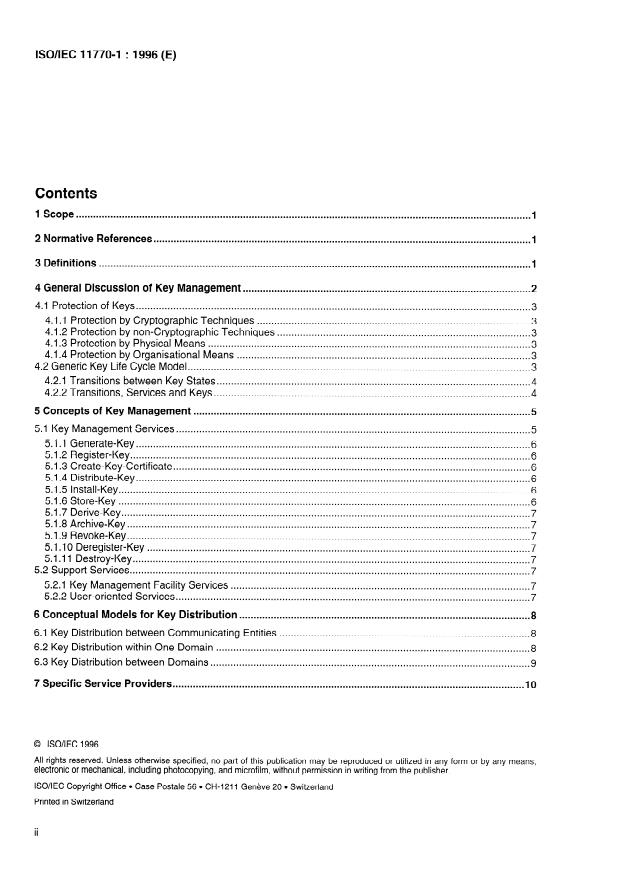
Contents
1 Scope . . . . . . . . . . . . . . . . . . . . . . . . . . . . . . . . . . . . . . . . . . . . . . . . . . . . . . . . .*.*.*.
2 Normative References . . . . . . . . . . . . . . . . . . . . . . . . . . . . . . . . . . . . . . . . . . . . . . . . .~.
. . . . . . . . . . . . . . . . . . . . . . . . . . . . . . . . . . . . . . . . . . . . . . . . . . . . . . . . . .~. “.~
3 Def initions
4 General Discussion of Key Management . . . . . . . . . . . . . . . . . . . . . . . . . . . . . . . . . . . . . . . . . . . . . . . . . . . . . . . . . . . . . . . . .~.
.........................................................................................................................................
4.1 Protection of Keys
...............................................................................................
4.1 .l Protection by Cryptographic Techniques
........................................................................................
4.1.2 Protection by non-Cryptographic Techniques
................................................................................................................
4.1.3 Protection by Physical Means
......................................................................................................
4.1.4 Protection by Organisational Means
.......................................................................................................................
4.2 Generic Key Life Cycle Model
.............................................................................................................
4.2.1 Transitions between Key States
..............................................................................................................
4.2.2 Transitions, Services and Keys
. . . . . . . .~.=.~.~~.~.~.~.~ “~.~.~~.~~.~.~.=.~.~.~.~
5 Concepts of Key Management
...........................................................................................................................
5.1 Key Management Services
.........................................................................................................................................
5.1 .l Generate-Key
...........................................................................................................................................
5.1.2 Register-Key
............................................................................................................................
5.1.3 Create-Key-Certificate
5.1.4 Distribute-Key .
5.1.5 Install-Key .
5.1.6 Store-Key .
5.1.7 Derive-Key .
5.1.8 Archive-Key .
5.1.9 Revoke-Key .
5.1. IO Deregister-Key .
5.1 .ll Destroy-Key .
...........................................................................................................................................
5.2 Support Services
........................................................................................................
5.2.1 Key Management Facility Services
...........................................................................................................................
5.2.2 User-oriented Services
6 Conceptual Models for Key Distribution . . . . . . . . . . . . . . . . . . . . . . . . . . . . . . . . . . . . . . . . . . . . . . . . . . . . . . . . . . . . . . . . . . . . . .~.
.......................................................................................
6.1 Key Distribution between Communicating Entities
.............................................................................................................
6.2 Key Distribution within One Domain
...............................................................................................................
6.3 Key Distribution between Domains
7 Specif ic Service Providers . . . . . . . . . . . . . . . . . . . . . . . . . . . . . . . . . . . . . . . . . . . . . . . . . . . . . . . . . . . . . . . . . . . . . . . . . . . . . . . . . . . . . . . . . . . . . . . . . . . . . . . . . . . . . . . . . . . . . . . . .
0 ISO/IEC 1996
All rights reserved. UnOess otherwise specified, no gart of this publication may be reproduced or utiiized in any form or by any means,
electronie or mechanical, including photocopying, and microfilm, without Permission in writing from the publisher.
ISO/IEC Copyright Office l Case Postale 56 l CH-121 1 Geneve 20 l SwitzerPand
Printed in Switzerland
ii
ISOAEC 11770-1 : 1996 (E ’;
0 ISOAEC
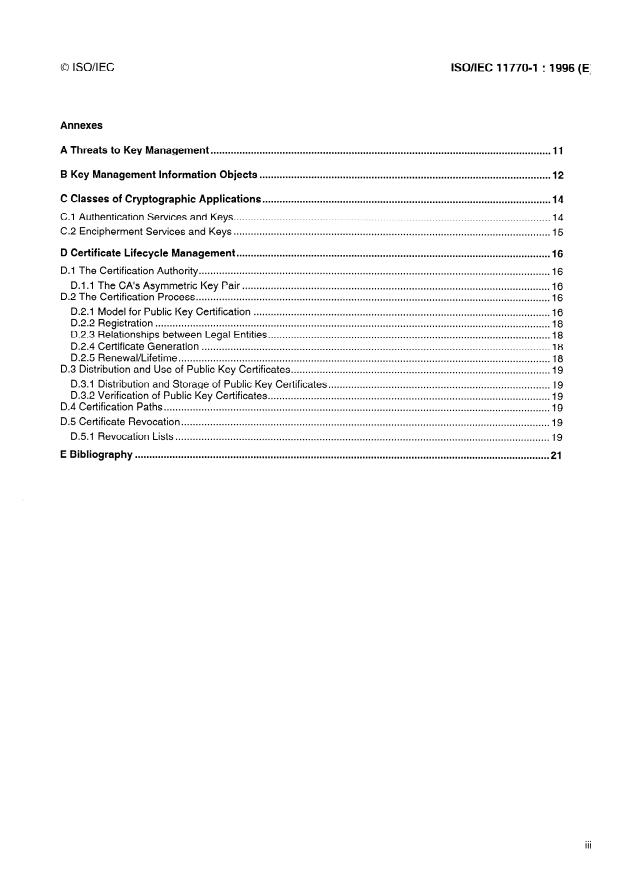
Annexes
. . . . . . . . . . . . . . . . . . . . . . . . . . . . . . . . . . . . . . . .*. 11
A Threats to Key Management
B Key Management Information Objects . . . . . . . . . . . . . . . . . . . . . . . . . . . . . . . . . . . . . . . . . . . . . . . . . . . . . . . . . . . . . . . . . . . . . . . . . . . . . . . . . . . . . . . . . . . . . . . . . . . . .
.,.,. “.~. 14
C Classes of Cryptographic Applications
C.l Authentication Services and Keys .
C.2 Encipherment Services and Keys .
. . . . . . . . . . . . . . . . . . . . . . . . . . . . . . . . . . . . . . . . . . . . . . . . . . . . . . . . . . . . . . . . . . . . . . . . . . . . . . . . . . . .*. 16
D Certif icate Lifecycle Management
D.l The Certification Authority . . . . . . . . . . . . . . . . . . . . . . . . . . . . . . . . . . . . . . . . . . . . . . . . . . . . . . . . . . . . . . . . . . . . . . . . . . . . . . . . . . . . . . . . . . . . . . . . . . . . . . . . . . . . . . . . . . . . . . . . .
D.l .l The CA ’s Asymmetrie Key Pair . . . . . . . . . . . . . . . . . . . . . . . . . . . . . . . . . . . . . . . . . . . . . . . . . . . . . . . . . . . . . . . . . . . . . . . . . . . . . . . . . . . . . . . . . . . . . . . . . . . . . . . . . . .
D.2 The Certification Process . . . . . . . . . . . . . . . . . . . . . . . . . . . . . . . . . . . . . . . . . . . . . . . . . . . . . . . . . . . . . . . . . . . . . . . . . . . . . . . . . . . . . . . . . . . . . . . . . . . . . . . . . . . . . . . . . . . . . . . . .
. . . . . . . . . . . . . . . . . . . . . . . . . . . . . . . . . . . . . . . . . . . . . . . . . . . . . . . . . . . . . . . . . . . . . . . . . . . . . . . . . . . . . . . . . . . . . . . . . . . . . . . 16
D.2.1 Model for Public Key Certification
D.2.2 Registration . . . . . . . . . . . . . . . . . . . . . . . . . . . . . . . . . . . . . . . . . . . . . . . . . . . . . . . . . . . . . . . . . . . . . . . . . . . . . . . . . . . . . . . . . . . . . . . . . . . . . . . . . . . . . . . . . . . . . . . . .
D.2.3 Relationships between Legal Entities . . . . . . . . . . . . . . . . . . . . . . . . . . . . . . . . . . . . . . . . . . . . . . . . . . . . . . . . . . . . . . . . . . . . . . . . . . . . . . . . . . . . . . . . . . . . . . . . . . 18
D.2.4 Certificate Generation . . . . . . . . . . . . . . . . . . . . . . . . . . . . . . . . . . . . . . . . . . . . . . . . . . . . . . . . . . . . . . . . . . . . . . . . . . . . . . . . . . . . . . . . . . . . . . . . . . . . . . . . . . . . . . . . . . . . . . . . .
D.2.5 RenewaYLifetime . . . . . . . . . . . . . . . . . . . . . . . . . . . . . . . . . . . . . . . . . . . . . . . . . . . . . . . . . . . . . . . . . . . . . . . . . . . . . . . . . . . . . . . . . . . . . . . . . . . . . . . . . . . . . . . . . . . . . . . . . 18
D.3 Distribution and Use of Public Key Certificates . . . . . . . . . . . . . . . . . . . . . . . . . . . . . . . . . . . . . . . . . . . . . . . . . . . . . . . . . . . . . . . . . . . . . . . . . . . . . . . . . . . . . . . . . . 19
. . . . . . . . . . . . . . . . . . . . . . . . . . . . . . . . . . . . . . . . . . . . . . . . . . . . . . . . . . . . . . . . . . . . . . . . . . . . . 19
D.3.1 Distribution and Storage of Public Key Certificates
. . . . . . . . . . . . . . . . . . . . . . . . . . .*. 19
D.3.2 Verification of Public Key Certificates
. . . . . . . . . . . . . . . . . . . . . . . . . . . . . . . . . . . . . . . . . . . . . . . . . . . . . . . . . . . . . . . . . . . . . . . . . . . . . . . . . . . . . . . . . . . . . . . . . . . . . . . . . . . . . . . . . . . . . . . . . 19
D.4 Certification Paths
D.5 Cettificate Revocation . . . . . . . . . . . . . . . . . . . . . . . . . . . . . . . . . . . . . . . . . . . . . . . . . . . . . . . . . . . . . . . . . . . . . . . . . . . . . . . . . . . . . . . . . . . . . . . . . . . . . . . . . . . . . . . . . . . . . . . . .
. . . . . . . . . . . . . . . . . . . . . . . . . . . . . . . . . . . . . . . . . . . . . . . . . . . . . . . . . . . . . . . . . . . . . . . . . . . . . . . . . . . . . . . . . . . . . . . . . . . . . . . . . . . . . . . . . . . . . . . . . 19
D.5.1 Revocation Lists
E Bibliography . . . . . . . . . . . . . . . . . . . . . . . . . .*.
. . .
Ill
ISOAEC 11770-1 : 1996 (E) 0 ISOAEC
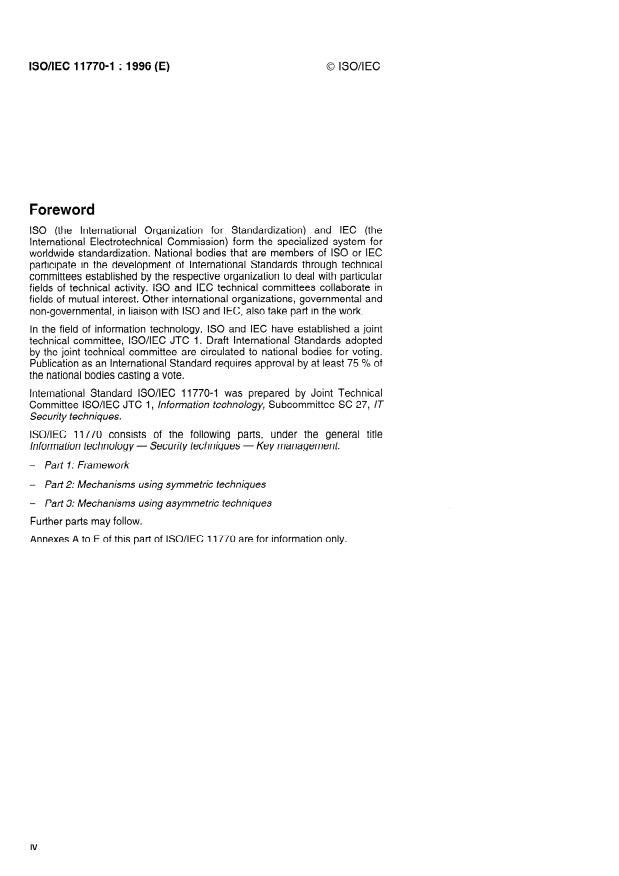
Foreword
ISO (the International Organization for Standardization) and IEC (the
International Electrotechnical Commission) form the specialized System for
worldwide standardization. National bodies that are members of ISO or IEC
participate in the development of International Standards through technical
committees established by the respective organization to deal with particular
fields of technical activity. ISO and IEC technical committees collaborate in
fields of mutual interest. Other international organizations, governmental and
non-governmental, in liaison with ISO and IEC, also take part in the work.
In the field of information technology, ISO and IEC have established a joint
technical committee, ISO/IEC JTC 1. Draft International Standards adopted
by the joint technical committee are circulated to national bodies for voting.
Publication as an International Standard requires approval by at least 75 % of
the national bodies casting a vote.
International Standard ISO/IEC 11770-1 was prepared by Joint Technical
Committee ISO/IEC JTC 1, Informafion technology, Subcommittee SC 27, /T
Security techniques.
ISO/IEC 11770 consists of the following Parts, under the general title
Information technology - Security techniques - Key management:
- Part 1: Framework
- Part 2: Mechanisms using symmetric techniques
- Part 3: Mechanisms using asymmetric techniques
Further Parts may follow.
Annexes A to E of this patt of ISO/IEC 11770 are for information only.
iv
0 ISOAEC ISOAEC 11770-1 : 1996 (E,
Introduction
In Information Technology there is an ever increasing need to use
cryptographic mechanisms for the protection of data against unauthorised
disclosure or manipulation, for entity authentication, and for non-repudiation
functions. The security and reliability of such mechanisms are directly
dependent on the management and protection afforded to a security
Parameter, the key. The secure management of these keys is critical to the
integration of cryptographic functions into a System, since even the most
elaborate security concept will be ineffective if the key management is weak.
The purpose of key management is to provide procedures for handling
cryptographic keying material to be used in symmetric or asymmetric
cryptographic mechanisms.
The fundamental Problem is to establish keying material whose origin,
integrity, timeliness and (in the case of secret keys) confidentiality tan be
guaranteed to both direct and indirect users. Key management includes
functions such as the generation, storage, distribution, deletion and archiving
of keying material in accordance with a security policy (ISO 7498-2).
This patt of 11770 has a special relationship to the frameworks for Open
System Security (ISO/IEC 10181). All the frameworks, including this one,
identify the basic concepts and characteristics of mechanisms covering
different aspects of security. This part of ISO/IEC 11770 introduces general
models for key management that are fundamental for symmetric and
asymmetric cryptographic mechanisms.
V
This page intentionally left blank
INTERNATIQNAL STANDARD 0 ISOAEC
ISO/IEC 11770-1 : 1996 (E
Information technology - Security techniques - Key
management -
Part 1:
Framework
As with other security Services, key management tan
only be provided within the context of a defined
1 Scope
security policy. The definition of security policies is
This patt of ISO/IEC 11770:
outside the scope of this multi-part Standard.
1. identifies the objective of key management;
2. describes a general model on which key
2 Normative References
management mechanisms are based;
The following Standards contain provisions which,
3. defines the basic concepts of key management
through reference in this text, constitute provisions of
common to all the Parts of this multi-part Standard;
this part of ISOAEC 11770. At the time of publication,
4. defines key management Services;
the editions indicated were valid. All Standards are
5. identifies the characteristics of key management
subject to revision, and Parties to agreements based
mechanisms;
on this patt of ISOAEC 11770 are encouraged to
investigate the possibility of applying the most recent
6. specifies requirements for the management of
edition of the Standards indicated below. Members of
keying material during its life cycle; and
IEC and ISO maintain registers of currently valid
7. describes a framework for the management of
International Standards
keying material during its life cycle.
ISO 7498-2: 1989, Information processing Systems -
This framework defines a general model of key
Open Systems Interconnection - Basic Reference
management that is independent of the use of any
- Part 2: Security Architecture.
particular cryptographic algorithm. However, certain Model
key distribution mechanisms may depend on particular
ISO/IEC 9798-1: 1991, Information technology -
algorithm proper-Ges, for example, properties of
Security techniques - En tity authentication
asymmetric algorithms.
mechanisms - Part 1: General model.
Specific key management mechanisms are addressed
ISOAEC 10181-1: 1996, Information technology -
by other Parts of ISO/IEC 11770. Symmetrie
Open Systems Interconnection -
Security
mechanisms are addressed in part 2 (ISO/IEC
frameworks for open Systems: Overview.
11770-2, Information technology -
Security
techniques - Key management - Par? 2:
Mechanisms using symme tric techniques) .
3 Definitions
Asymmetrie mechanisms are addressed in part 3
The following terms are used as defined in ISO 7498-2:
(lSO/lEC 11770-3, Information technology - Security
techniques - Key management - Part 3:
data integrity
Mechanisms using asymme tric techniques) . T h i s pa rt
data origin authentication
of ISOAEC 11770 contains the material required for a
basic understanding of Parts 2 and 3. Examples of the
digital signature
use of key management mechanisms are included in
ISO 8732 and ISO 11166. If non-repudiation is The following term is used as defined in
SO/1 EC
required for key management, ISO/IEC 13888 should 9798-1:
be used.
entity authentication
This patt of ISO/IEC 11770 addresses both the
The following terms are used as defined in SO/1 EC
automated and manual aspects of key management,
10181-1:
including outlines of data elements and sequences of
operations that are used to obtain key management
security authority
Services. However it does not specify details of
security domain
protocol exchanges that may be needed.
trusted third Party (TTP)
ISOAEC 11770-1 : 1996 (E) 0 ISOAEC
For the purposes of ISO/IEC 11770, the following 3.14 public key: That key of an entity ’s asymmetric
definitions apply. key pair which tan be made public.
technique: A
3.1 asymmetric cryptographic 3.15 public key certificate: The public key
cryptographic technique that uses two related information of an entity signed by the certification
transformations, a public transformation (defined by authority and thereby rendered unforgeable.
the public key) and a private transformation (defined
3.16 public key information: information specific to a
by the private key). The two transformations have the
Single entity which contains at least the entity ’s
property that, given the public transformation, it is
distinguishing identifier and at least one public key for
computationally infeasible to derive the private
this entity. There may be other information regarding
transformation.
the certification authority, the entity, and the public key
3.2 certification authority (CA): A centre trusted to included in the public key information, such as the
create and assign public key certificates. Optionally, validity period of the public key, the validity period of
the certification authority may create and assign keys the associated private key, or the identifier of the
to the entities. involved algorithms.
3.3 decipherment: The reversal of a corresponding A time variant
3.17 random number: Parameter
encipherment. whose value is unpredicta ble .
3.4 encipherment: The (reversible) transformation of 3.18 secret key: A key used with symmetric
cryptographic techniques and usable only by a set of
data by a cryptographic algorithm to produce
specified entities.
ciphertext, i.e., to hide the information content of the
data.
3.19 sequence number: A time variant Parameter
whose value is taken from a specified sequence which
3.5 key: A sequence of Symbols that controls the
is non-repeating within a certain time period.
Operation of a cryptographic transformation (e.g.,
encipherment, decipherment, cryptographic check
3.20 symmetric cryptographic technique: A
computation, signature generation, or
function
cryptographic technique that uses the same secret key
signature verification).
for both the originator ’s and the recipient ’s
transformation. Without knowledge of the secret key, it
3.6 key agreement: The process of establishing a
is computationally infeasible to compute either the
shared secret key between entities in such a way that
originator ’s or the recipient ’s transformation.
neither of them tan predetermine the value of that
.
keY
3.21 time stamp: A time variant Parameter which
denotes a Point in time with respect to a common time
3.7 key confirmation: The assurance for one entity
reference.
that another identified entity is in possession of the
correct key.
3.22 time variant Parameter: A data item used by an
3.8 key control: The ability to choose the key, or the
entity to verify that a message is not a replay, such as
Parameters used in the key computation.
a random number, a sequence number, or a time
stamp.
3.9 key distribution centre (KDC): An entity trusted
to generate or acquire, and distribute keys to entities
that each share a key with the KDC.
4 General Discussion of Key Management
3.10 keying material: The data (e.g., keys,
Key management is the administration and use of the
initialisation values) necessary to establish and
Services of generation, registration, certification,
maintain cryptographic keying relationships.
deregistration, distribution, installation, storage,
archiving, revocation, derivation and destruction of
3.11 key management: the administration and use of
keying material.
the generation, registration, certification,
deregistration, distribution, installation, storage, The objective of key management is the secure
archiving, revocation, derivation and destruction of administration and use of these key management
keying material in accordance with a security policy. Services and therefore the protection of keys is
extremely important.
3.12 key translation centre (KTC): An entity trusted
to translate keys between entities that each share a Key management procedures depend on the
key with the KTC. underlying cryptographic mechanisms, the intended
use of the key and the security policy in use. Key
3.13 private key: That key of an entity ’s asymmetric
management also includes those functions that are
key pair which should only be used by that entity.
executed in cryptographic equipment.
NOTE: A private key shall not normally be disclosed.
ISOAEC 117704 :1996(E
0 !lSO/IEC
41 . Protection of Keys with
l to interact cryptographic algorithms
implemented in separate smarf security facilities
Keys are a critical patt of any security System that
(for example, smart cards, memory cards), or
relies on cryptographic techniques. The appropriate
protection of keys depends on a number of factors,
l to store keying material off-line (for example, on
such as the type of application for which the keys are
diskette).
used, the threats they face, the different states the
Secure areas typically are protected by physical
keys may assume, etc. Primarily, depending upon the
security mechanisms.
cryptographic technique, they have to be protected
against disclosure, modification, destruction and
Protection by Organisational Means
4.1.4
replay. Examples of possible threats to keys are given
in Annex A. The validity of a key shall be limited in
One means of protecting keys is to organise them into
time and amount of use. These constraints are
key hierarchies. Except at the lowest level of the
governed by the time and amount of data required to
hierarchy, keys in one level of a hierarchy are used
conduct a key-recovery attack and the strategic value
solely to protect keys in the next level down. Only keys
of the secured information over time. Keys that are
in the lowest level of the hierarchy are used directly to
used to generate keys need more protection than the
provide data security Services. This hierarchical
generated keys. Another important aspect of the
approach allows the use of each key to be limited,
protection of keys is avoidance of their misuse, e.g.,
thus limiting exposure and making attacks difficult. For
use of a key encipherment key to encipher data.
example, the compromise of a Single Session key is
limited to compromising only the information protected
4.1 .l Protection by Cryptographic Techniques
by that key.
Some threats to keying material tan be countered
The use of secure areas addresses the threats of key
using techniques. For example:
cryptographic
disclosure, modification and deletion by unauthorised
encipherment counters disclosure and
keY
entities. However, the threat remains that System
unauthorised use; data integrity mechanisms counter
administrators, authorised to perform certain
modification; data origin authentication mechanisms,
management functions on components of the key
entity authentication
digital signatures, and
management Service, may misuse the special access
mechanisms counter masquerade.
Privileges they possess. In particular, they might try to
obtain a master key (a top level key in a key
Cryptographic Separation mechanisms counter
hierarchy). Disclosure of a master key will potentially
misuse. Such Separation of functional use may be
enable the possessor to discover or manipulate all
accomplished by binding information to the key. For
other keys protected by it (i.e. all other keys in that
example: binding control information to the key
particular key hierarchy). lt is therefore desirable to
assures that specific keys are used for specific tasks
minimise access to this key, perhaps by arranging that
(e.g. key encipherment, data integrity); key control is
no Single user has access to its value. Such a
required for non-repudiation using symmetric
requirement tan be met by dividing the key (dual
techniques.
control or even n-times control) or using dedicated
cryptographic schemes (Secref Sharing Schemes).
Ul.2 Protection by non-Cryptographic
Techniques
4.2 Generic Key Life Cycle Model
Time stamps may be used to restritt the use of keys
A cryptographic key will progress through a series of
to certain valid time periods. Together with sequence
states that define its life cycle. The three principal
numbers, they also protect against the replay of
states are:
recorded key agreement information.
Pending Active: In the Pending Active state, a key
4.1.3 Protection by Physical Means
has been generated, but has not been activated for
use.
Esch cryptographic device within a secure System
usually needs to protect the keying material it uses
Active: In the Active state, the key is used to process
against the threats of modification, deletion and,
information cryptographically.
except for public keys, disclosure. The device typically
Post Active: In this state, the key shall only be used
provides a secure area for key storage, key use and
for decipherment or verification.
algorithm implementation.
cryptographic lt may
provide the means
l to load keying material from a separate secure key
storage device,
0 ISOAEC
ISOAEC 117704 : 1996 (E)
Reactivation allows a Post Active key to be
used again for cryptographic operations.
Destruction ends a key ’s life cycle. lt covers
logical destruction of the key and may also
involve its physical destruction.
Transitions may be triggered by events such as the
need for new keys, the compromise of a key, the
expiration of a key, and the completion of the key life
cycle. All these transitions include a number of
Services for key management. The relationships
between the transitions and the Services are shown in
Table 1. These Services are explained in Clause 5.
: vation
deacti tation
Any particular cryptographic approach will only require
a subset of the Services offered in Table 1.
4.2.2 Transitions, Services and Keys
Keys for particular cryptographic techniques will use
Figure 1 - Key Life Cycle
different combinations of Services during their life
cycles. Two examples are given below.
NOTE: The user of a Post Active key shall be assured that
For symmetric cryptographic techniques, following the
the data had been cryptographically processed before the
key became Post Active. This assurance is commonly generation of a key, the transition from Pending Active
provided by a trusted time variant Parameter.
to Active includes key installation and may also
include key registration and distribution. In some
A key that is known to be compromised shall become
cases, installation may involve the derivation of a
Post Active immediately and may require special
specific key. The Iifetime of a key should be limited to
handling. A key is said to be compromised when its
a fixed period. Deactivation ends the Active state,
unauthorised use is known or suspected.
usually upon expiration. If compromise of a key in the
Figure 1 Shows these states and the corresponding
Active state is suspected or known, revocation also
transitions.
Causes it to enter the Post Active state. A Post Active
key may be archived. If an archived key is needed
Figure 1 represents a generic life cycle model. Other
life cycle models may have additional details that may again, it will be reactivated and may need to be
be substates of the three states presented. The installed or distributed again before it is fully active.
majority of life cycles require an archival activity. This
Otherwise, following deactivation, the key may be
activity may be associated with any of the states,
deregistered and destroyed.
depending on the particular details of the life cycle.
For asymmetric cryptographic techniques, a pair of
keys (public and private) is generated and both keys
4.2.1 Transitions between Key States
enter the Pending Active state. Note that the life cycles
of the two keys are related but not identical. Before it
When a key Progresses from one state to another it
undergoes one of the following transitions as also
enters the Active state, a private key may optionally be
depicted in figure 1:
registered, may optionally be distributed to its user and
is always installed. The transitions between the Active
Generation is the process of generating a
and the Post Active states for a private key, including
key. Key Generation should be performed
deactivation, reactivation, and destruction, are similar
according to prescribed key generation
to those described above for symmetric keys. When a
rules; the process may involve a test
procedure to verify whether these rules public key is certified, commonly a certificate
have been followed.
containing the public key is created by the CA, to
assure the validity and ownership of the public key.
Activation makes a valid for
This public key certificate may be placed in a directory
keY
cryptographic operations.
or other similar Service for distribution, or may be
passed back to the owner for distribution. When the
Deactivation limits a key ’s use. This might
owner sends out information signed with his private
occur because the key has expired or has
been revoked. key he may add his certificate. The key pair becomes
active when the public key is certified. When a key
0 ISOAEC ISOAEC 11770-1 :1996(t
Table 1 - Transitions and Services
Transition Service Notes
Generation generate-key mandatory
register-key optional either here or activation
I l
create-key-certificate optional
distribute-key
optional
store-key optional
Activation create-key-certificate optional
distribute-key optional
derive-key optional
install-key mandatory
store- key optional
register-key optional either here or generation
Deactivation store-key optional
archive-key optional either here or destruction
revoke-key optional
Reactivation create-key-certificate optional
distribute-key optional
1 derive-key optional
I I
install-key mandatory
store-key optional
l I
Destruction
deregister-key mandatory, if registered
I I I
destroy-key mandatory
I I
archive-key optional either here or deactivation
I I I
pair is used for digital signature purposes the public
key may remain in the Active or Post Active state for 5 Concepts of Key Management
an indefinite time after its related private key has been
deactivated or destroyed. Access to the public key 51 . Key Management Services
may be necessary to verify digital signatures made
This Clause describes a general structure for key
before the original expiration date of the associated
management to aid understanding of the key
private key. When asymmetric techniques are used for
management Services, how they fit together and how
encipherment and the key used for encipherment has
they are supported.
been deactivated or destroyed, the corresponding key
Key management relies on the basic Services of
of the pair may remain in the Active or Post Active
generation, registration, certification, distribution,
state for later decipherment.
installation, storage, derivation, archiving, revocation,
deregistration and destruction. These Services may be
The use or application of a key may determine the
patt of a key management System or be provided by
Services for that key. For example, a System may
other Service providers. Depending on the kind of
decide not to register Session keys, since the
Service, the Service provider must fulfil certain
registration process may last longer than their lifetime.
minimum secu rity requirements (e.g., secu re
By contrast, it is necessary to register a secret key
exchange) to be trusted by all entities invofved. For
when symmetric techniques are used for digital
example, the Service provider may be a trusted third
signature.
Party. Figure 2 Shows that the key management
0 ISOAEC
ISO/IEC11770-1 :1996 (E)
. . , A *
. L
create-
-e Reglster- Distribute
D-w
0 0
MP
w w w
w
aertificate
, . . \
Figure 2 - Key Management Services
Services are positioned at the same Ievel and may be
5.1.3 Create-Key-Certificate
used by a variety of different users (persons or
processes). These users may utilise different key The Service Create-Key-Certificate assures the
management facilities within different applications, association of a public key with an entity and is
making use of Services specific to their needs. The provided by a certification authority. When a request
key management Services are listed in Table 1. for key certification is accepted, the certification
authority creates a key certificate. Public key
certificates are discussed in more detail in ISO/IEC
5.1 .l Generate-Key
11770-3.
Generate-Key is a Service that is invoked to generate
keys in a secure way for a particular cryptographic
5.1.4 Distribute-Key
algorithm. This implies that the key generation cannot
be manipulated and, that the keys are generated in an Key distribution is a set of procedures to provide key
unpredictable way and according to a prescribed management information objects (see example in
distribution. This distribution is imposed by the Annex B) securely to authorised entities. A specific
cryptographic algorithm for which it will be used and case of key distribution is key translation where
the required level of cryptographic protection. The keying material is established between entities using a
generation of some keys, e.g., master keys, demands key translation centre (see Subclause 6.2). ISO/IEC
special care because knowledge of these keys offers
11770-2 offers different mechanisms to establish keys
access to all related or derived keys. ISO/IEC 11770-3 includes
between entities.
mechanisms for key agreement of secret keys and
transport mechanisms for secret and public keys.
5.1.2 Register-Key
The Service Register-Key associates a key with an
5.1.5 Install-Key
entity. lt is provided by a registration authority, and is
symmetric cryptographic
usually applied when
The Service Install-Key is always needed before the
techniques are used. When an entity wishes to
use of a key. The installation of the key means the
register a key it has to contact the registration
establishment of the key within a key management
authority. Key registration involves a request for
facility in a manner that protects it from compromise.
registration and a confirmation of that registration.
5.1.6 Store-Key
A registration authority maintains a register of keys
and related information in a suitably secure manner.
The Service Store-Key provides secure storage of
Annex B offers details of key management
keys intended for current or near-term use or for back-
information.
up. It is usually advantageous to provide physically
separate key storage. For example, it ensures
Operations provided by a key registration authority
confidentiality and integrity for keying material or
are registration and deregistration.
integrity for public keys. Storage may occur in all key
states (i.e. Pending Active, Active and Post Active) of
a key ’s life cycle. Depending on the importante of the
I SO/IEC11770-1 :1996(L
0 ISO/IEC
5.1 .ll Destroy-Key
keys, they tan be protected using one of the following
mechanisms:
The Service Destroy-Kc ?y provides a process for the
secure destruction of keys that are no longer needed.
l physical security (e.g., by storing them within a
Destroying a key means eliminating all records of this
tarnper-resistant device or by external means such
key management information Object, such that no
as diskette or memory card),
information remaining after the destruction provides
l encipherment with keys that are themselves
any means of recovering the destroyed key. This is
protected by physical security, or
taken to include the destruction of all archived copies.
l protecting the access to them by password or PIN.
However, before archived keys are destroyed a check
For all keying material, any attempted compromise
must be carried out to ensure that no archived
should be detectable.
material protected by these keys will ever be needed
again.
5.1.7 Derive-Key
NOTE: Some keys may be stored outside an electronie
device or System. Destruction of those keys requires
The Service Derive-Key forms a potentially large
additional administrative measures.
number of keys using a secret original key called the
derivation key, non-secret variable data and a
5.2 Support Services.
transformation process (which also need not be
secret). The result of this process is the derived key.
Other Services may be needed to support key
The derivation key needs special protection. The
management.
derivation process should be non-reversible and non-
predictable to ensure that the compromise of a derived
5.2.1 Key Management Facility Services
key does not disclose the derivation key or any other
Key management Services may make use of other
derived key.
Services that are security related. These Services
include:
5.1.8 Archive-Key
access control This Service may be used to
Key archiving provides a process for the secure, long-
ensure that the resources of
Perm storage of keys after normal use. lt may use the
a key management System
Service of key storage but allows for a different
tan be accessed only by
implementation such as off-line storage. Archived keys
authorised entities in an
may need to be retrieved at a much later date to prove
authorised manner.
or disprove certain Claims after normal use is
discontinued.
audit The tracking of security-
relevant actions that appear
5.1.9 Revoke-Key
in a management
keY
System. Audit trails may help
When the compromise of a key is suspected or known
identify security risks and
the Service Revo ke-Key assu res t he secu re
security leaks.
deactivation of the key. This Service is necessaty for
keys having reached their expiration date. Revocation
authentication This Service should be used
of keys will also take place when a key owner ’s
to establish an entity as an
circumstances Change. After a key is revoked it may
authorised member of a
only be used for decipherment and verification. The
security domain.
Service Revoke-Key is not appropriate to certificate
cryptographic Services These Services should be
based schemes, where key life is controlled by expiry
used by key management
of the certificate.
Services to provide integrity,
NOTE: Some applications use the term delete-key for this
confidentiality, authentication
Service
and non-repudiation.
5.1 .lO Deregister-Key time Service This Service is necessary for
generating time variant
The Service Deregister-Key is a procedure provided by
Parameters such as validity
a key registration authority that removes the
durations.
association of a key with an entity. lt is patt of the
destruction process (see 5.1 .ll Destroy-Key). When
5.2.2 User-oriented Services
an entity wishes Po deregister a key, the registration
authority is contacted.
Cryptographic Systems and devices may require other
Services that are necessary for adequate functionality,
user registration Services. These Services are
e-g.9
ISOAEC 117704 : 1996 (E) 0 ISOAEC
implementation specific and beyond the scope of this
l For data integrity or data origin authentication, the
part of ISOAEC 11770. recipient requires the sender ’s corresponding
public key certificate.
l For confidentiality the sender requires a valid public
6 Conceptual Models for Key Distribution
key certificate of the recipient.
The distribution of keys between entities tan be
l For authentication, confidentiality, and integrity,
complex. lt is influenced by the nature of the
each Partner requires the public key certificate of
communications links, the trust relationships involved
the other. This provides the means for mutual non-
and the cryptographic techniques used. The entities
repudiation.
may either communicate directly or indirectly, may
Esch entity may need to contact its authority to get an
belong to the same or different security domains, and
appropriate public key certificate. If the communicating
may or may not use the Services of a trusted authority.
Partners trust each other and tan mutually
The following conceptual models illustrate how these
authenticate their public key certificates, then no
different cases influence the distribution of keys and
authority is needed.
information.
NOTE: There exist cryptographic applications where no
6.1 Key Distribution between Communicating
authority is involved. In that Situation the communicating
Entities Partners may only securely exchange specific public
information instead of their public key certificates.
Communication between entities is influenced by the
When symmetric cryptography is in use between two
link between these entities, the trust between these
such Partners, key generation is initiated in one of two
entities and the cryptographic techniques used.
ways:
There exists a connection between entities A and B,
1. By one entity generating the key and sending it to a
who wish to exchange information using cryptographic
Key Translation Centre (KTC);
techniques. This communication connection is
2. By one entity asking a Key Distribution Centre to
illustrated in Figure 3. Generally, key distribution must
generate a key for subsequent distribution.
take place over a secure channel that is logically
different from the traffit channel.
If key generation is carried out by one of the entities,
secure distribution of the key tan be handled by a Key
Translation Centre, as illustrated in Figure 4. The
numbers represent the Steps of the exchange. The
Entity B
Entity A
KTC receives the enciphered key from entity A (1 ),
deciphers it and re-enciphers it using the key shared
between itself and entity B. Then it may
l either fotvvard the enciphered key to entity B (2), or
Figure 3 - Communications Link between Two
Entities
l send it back to entity A (3), who forwards it to entity
B (4).
Cases where direct communicating entities are
involved are key agreement, key control and key KeY
Translation
confirmation. Further details of these ca
...
Questions, Comments and Discussion
Ask us and Technical Secretary will try to provide an answer. You can facilitate discussion about the standard in here.
Loading comments...