


ISO 10101-3:2022
(Main)Natural gas - Determination of water by the Karl Fischer method - Part 3: Coulometric procedure
Natural gas - Determination of water by the Karl Fischer method - Part 3: Coulometric procedure
This document specifies a coulometric procedure for the determination of water content by the Karl Fischer method. The method is applicable to natural gas and other gases which do not react with Karl Fischer (KF) reagents. It applies to water concentrations between 5 mg/m3 and 5 000 mg/m3. Volumes are expressed at temperature of 273,15 K (0 °C) and a pressure of 101,325 kPa (1 atm).
Gaz naturel — Dosage de l'eau par la méthode de Karl Fischer — Partie 3: Méthode coulométrique
General Information
Relations
Overview
ISO 10101-3:2022 - Natural gas - Determination of water by the Karl Fischer method - Part 3: Coulometric procedure specifies a coulometric Karl Fischer (KF) titration technique for measuring water content in natural gas and other gases that do not react with KF reagents. The standard covers measurements over the range 5 mg/m3 to 5 000 mg/m3, with volumes expressed at 273.15 K (0 °C) and 101.325 kPa (1 atm). It defines the coulometric principle, apparatus, reagents, sampling, test procedure, blank correction and result expression including measurement uncertainty.
Key topics and technical requirements
- Method principle: Coulometric KF titration - iodine generated electrochemically; charge passed is proportional to water mass via Faraday’s law.
- Applicable range: 5 mg/m3 to 5 000 mg/m3 (water in gas).
- Reagents: Coulometric-specific reagents; for diaphragm cells use separate anolyte and catholyte. Recommended reference solution examples given (e.g., 10 mg/g ±1 % or alternatives 5.0 mg/l ±4 % / 10.0 mg/l ±4 %).
- Cell designs: Cells with diaphragm (anode/cathode compartments) and without diaphragm - advantages and trade-offs are discussed.
- Apparatus: Titration cell, gas inlet with 3‑way valve, drying tube, platinum electrodes, stirrer; wet-test gas meter or equivalent (accuracy ±1 %) to measure volume.
- Operational parameters: Typical gas flowrate guidance 30–40 L/h (optimum depends on equipment geometry). Equilibration and drift checks required before measurement.
- Blank correction: Required for low water concentrations (<100 mg/m3) to correct iodine losses during gas passage.
- Quality controls: Response testing by injecting known reference solution volumes; measurement uncertainty addressed (subclause 9.2).
- Safety note: Account for local safety regulations when equipment is in hazardous areas.
Applications and users
ISO 10101-3:2022 is intended for:
- Gas analysis laboratories performing water-in-gas testing using Karl Fischer coulometry.
- Natural gas producers, pipeline and transmission operators for monitoring moisture content and process control.
- Instrument manufacturers and calibration services developing or validating coulometric KF equipment.
- Use cases include routine moisture analysis, quality control, leak detection support, and laboratory method validation for gases that are inert to KF reagents.
Keywords: ISO 10101-3:2022, Karl Fischer coulometric, natural gas water determination, water content in gas, KF titration, gas analysis, measurement uncertainty.
Related standards
- ISO 10101-1 - Natural gas - Determination of water by the Karl Fischer method - Part 1: Introduction (referenced normative guidance).
- ISO 14532 - Natural gas - Vocabulary (terms and definitions used).
For implementation, follow the standard’s procedures for sampling, reagent handling, blank correction and documentation of test reports.

Standards Content (Sample)
INTERNATIONAL ISO
STANDARD 10101-3
Second edition
2022-08
Natural gas — Determination of water
by the Karl Fischer method —
Part 3:
Coulometric procedure
Gaz naturel — Dosage de l'eau par la méthode de Karl Fischer —
Partie 3: Méthode coulométrique
Reference number
© ISO 2022
All rights reserved. Unless otherwise specified, or required in the context of its implementation, no part of this publication may
be reproduced or utilized otherwise in any form or by any means, electronic or mechanical, including photocopying, or posting on
the internet or an intranet, without prior written permission. Permission can be requested from either ISO at the address below
or ISO’s member body in the country of the requester.
ISO copyright office
CP 401 • Ch. de Blandonnet 8
CH-1214 Vernier, Geneva
Phone: +41 22 749 01 11
Email: copyright@iso.org
Website: www.iso.org
Published in Switzerland
ii
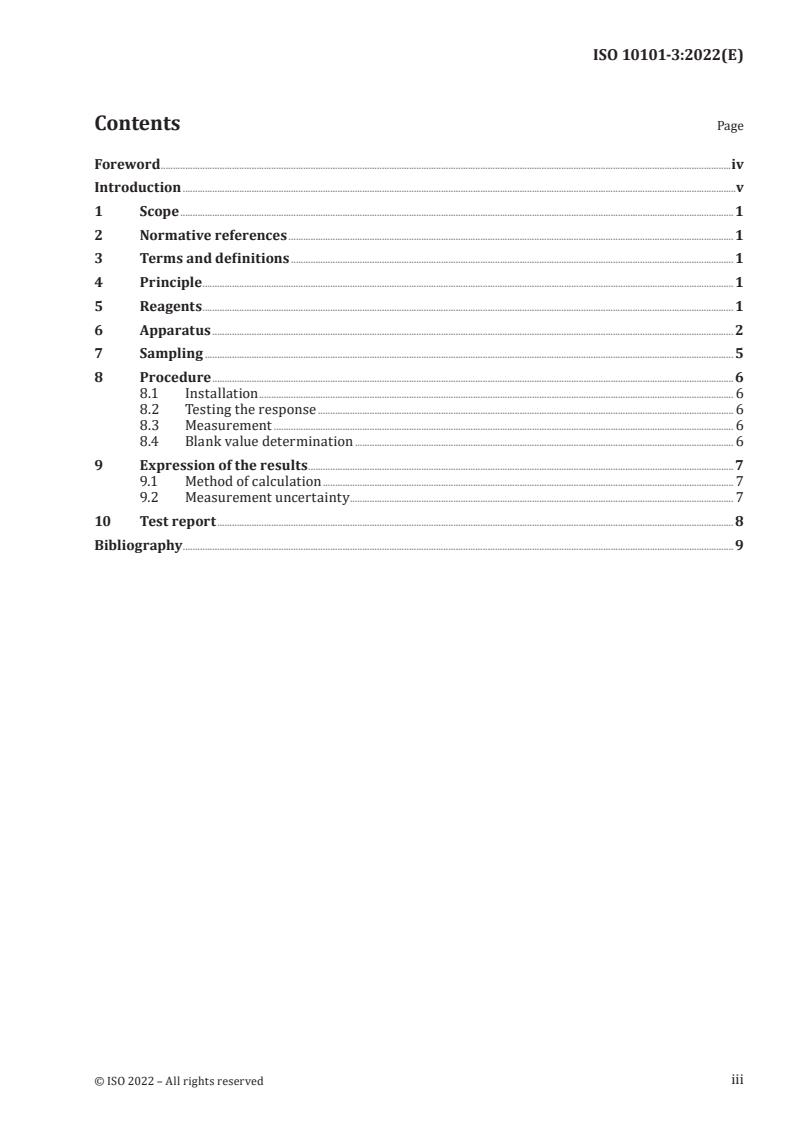
Contents Page
Foreword .iv
Introduction .v
1 Scope . 1
2 Normative references . 1
3 Terms and definitions . 1
4 Principle . 1
5 Reagents . 1
6 Apparatus . 2
7 Sampling . 5
8 Procedure .6
8.1 Installation . 6
8.2 Testing the response . 6
8.3 Measurement . 6
8.4 Blank value determination . 6
9 Expression of the results .7
9.1 Method of calculation . 7
9.2 Measurement uncertainty . 7
10 Test report . 8
Bibliography . 9
iii
Foreword
ISO (the International Organization for Standardization) is a worldwide federation of national standards
bodies (ISO member bodies). The work of preparing International Standards is normally carried out
through ISO technical committees. Each member body interested in a subject for which a technical
committee has been established has the right to be represented on that committee. International
organizations, governmental and non-governmental, in liaison with ISO, also take part in the work.
ISO collaborates closely with the International Electrotechnical Commission (IEC) on all matters of
electrotechnical standardization.
The procedures used to develop this document and those intended for its further maintenance are
described in the ISO/IEC Directives, Part 1. In particular the different approval criteria needed for the
different types of ISO documents should be noted. This document was drafted in accordance with the
editorial rules of the ISO/IEC Directives, Part 2 (see www.iso.org/directives).
Attention is drawn to the possibility that some of the elements of this document may be the subject of
patent rights. ISO shall not be held responsible for identifying any or all such patent rights. Details of
any patent rights identified during the development of the document will be in the Introduction and/or
on the ISO list of patent declarations received (see www.iso.org/patents).
Any trade name used in this document is information given for the convenience of users and does not
constitute an endorsement.
For an explanation on the voluntary nature of standards, the meaning of ISO specific terms and
expressions related to conformity assessment, as well as information about ISO's adherence to the
World Trade Organization (WTO) principles in the Technical Barriers to Trade (TBT) see the following
URL: www.iso.org/iso/foreword.html.
This document was prepared by Technical Committee ISO/TC 193, Natural Gas, Subcommittee SC 1,
Analysis of natural gas, in collaboration with the European Committee for Standardization (CEN)
Technical Committee CEN/TC 238, Test gases, test pressures, appliance categories and gas appliance types,
in accordance with the Agreement on technical cooperation between ISO and CEN (Vienna Agreement).
This second edition cancels and replaces the first edition (ISO 10101-3:1993), which has been technically
revised.
The main changes are as follows:
— Clause 2 and Bibliography were revised;
— new fixed structure numbering inserted;
— Subclause 9.2 Measurement of uncertainty was added.
A list of all parts in the ISO 10101 series can be found on the ISO website.
iv
Introduction
Water vapour may be present in natural gas due to, for example, natural occurrence in the well
production stream, the storage of gas in underground reservoirs, transmission or distribution through
mains containing moisture or other reasons.
The Karl Fischer (KF) titration can be divided into two basic techniques – depending on the application
range – volumetric and coulometric KF titration. The two analysis techniques differ in the mode of
iodine addition or generation. Volumetric KF titration is preferably used for the determination of large
amounts of water in the range of 1 mg to 100 mg. Coulometry, however, is a micro-method which is
particularly well suited for determination of quantities of water from 10 μg to 10 mg.
Modern KF coulometers cover a range from 10 μg to 200 mg of water. Usually a resolution of 0,1 μg of
water is achieved.
In coulometric water determination, iodine is not added in the form of a titrating solution but rather
directly produced from an iodine-containing solution by an anodic oxidation reaction. The high analytic
precision at low absolute water quantities makes coulometric KF titration particularly well suited for
determination of the water content in aqueous gases.
Coulometric KF titration can be subdivided according to two distinct designs of the analysis cell:
Cells with and without diaphragm. In both variants, the measuring cells are made of a titration
vessel tightly sealed to prevent moisture ingress. The sample gas is passed directly through a glass
frit into the KF titration cell. Thus, absorption of moisture from the environment is prevented and the
gas finely dispersed. The fine distribution of the gas in the hygroscopic KF solution provides a large
surface for material exchange, so that the water contained in the gas can be fully absorbed by the
solution and then titrated. In the version with a diaphragm, the cell is divided into a large anode and
a small cathode compartment, each filled with different reagents. Spatial separation is achieved by
means of the diaphragm. In both compartments platinum electrodes are installed, via which a working
current is passed through the titration cell. Due to the applied current, at the anode iodine is formed,
which immediately reacts with the absorbed water from the gas sample. When all the water has been
consumed by the reaction, an excess of iodine is formed that will be detected voltametrically, ending
the titration. The amount of electricity consumed can be used to directly calculate, using Faraday’s law,
the quantity of water.
MQ⋅
HO
m =
HO
zF⋅
where
z
is the number of exchanged electrons;
M the molecular weight of water;
HO
F
the Faraday constant (96 485 C/mol);
Q
the charge which has flowed in C.
In the KF titration cell variant without a diaphragm there is no separation between the anode and
cathode chambers. Thus, for the filling of the cell only one reagent is needed and used. In order to prevent
direct reduction of iodine at the cathode, the cathode and anode are spatially separated from each other
by a large distance. The use of the cell without a diaphragm has the advantage that the titration cell is
easier to clean and only one reagent is consumed, whose replacement can be completely automated. In
addition, unlike in cells with a diaphragm, during longer downtimes no moisture can accumulate in the
diaphragm, making the titration cell faster to become operational. For the measurement of extremely
low water contents (few ppm of water), the leading KF equipment manufacturers recommend, despite
these advantages, use of a KF coulometer with diaphragm. For practical implementation, however, this
adds possible sources of error, complication and prolongation of the measurement times.
v
WARNING — Local safety regulations should be taken into account, when the equipment is located in
hazardous areas.
vi
INTERNATIONAL STANDARD I
...
Frequently Asked Questions
ISO 10101-3:2022 is a standard published by the International Organization for Standardization (ISO). Its full title is "Natural gas - Determination of water by the Karl Fischer method - Part 3: Coulometric procedure". This standard covers: This document specifies a coulometric procedure for the determination of water content by the Karl Fischer method. The method is applicable to natural gas and other gases which do not react with Karl Fischer (KF) reagents. It applies to water concentrations between 5 mg/m3 and 5 000 mg/m3. Volumes are expressed at temperature of 273,15 K (0 °C) and a pressure of 101,325 kPa (1 atm).
This document specifies a coulometric procedure for the determination of water content by the Karl Fischer method. The method is applicable to natural gas and other gases which do not react with Karl Fischer (KF) reagents. It applies to water concentrations between 5 mg/m3 and 5 000 mg/m3. Volumes are expressed at temperature of 273,15 K (0 °C) and a pressure of 101,325 kPa (1 atm).
ISO 10101-3:2022 is classified under the following ICS (International Classification for Standards) categories: 75.060 - Natural gas. The ICS classification helps identify the subject area and facilitates finding related standards.
ISO 10101-3:2022 has the following relationships with other standards: It is inter standard links to ISO 10101-3:1993. Understanding these relationships helps ensure you are using the most current and applicable version of the standard.
You can purchase ISO 10101-3:2022 directly from iTeh Standards. The document is available in PDF format and is delivered instantly after payment. Add the standard to your cart and complete the secure checkout process. iTeh Standards is an authorized distributor of ISO standards.
Questions, Comments and Discussion
Ask us and Technical Secretary will try to provide an answer. You can facilitate discussion about the standard in here.
Loading comments...