


IEC/DTR 61400-4-3
(Main)Wind energy generation systems — Part 4-3: Explanatory notes on IEC 61400-4 - Supportive information for wind turbine gearbox design
Wind energy generation systems — Part 4-3: Explanatory notes on IEC 61400-4 - Supportive information for wind turbine gearbox design
Systèmes de génération d'énergie éolienne — Partie 4-3: Notes explicatives sur l'IEC 61400-4 — Informations complémentaires pour la conception des multiplicateurs d'éoliennes
General Information
- Status
- Not Published
- Technical Committee
- ISO/TC 60 - Gears
- Drafting Committee
- ISO/TC 60 - Gears
- Current Stage
- 5060 - Close of voting Proof returned by Secretariat
- Start Date
- 02-May-2026
- Completion Date
- 01-May-2026
Overview
IEC/DTR 61400-4-3 is a technical report offering detailed explanatory notes and supportive information for wind turbine gearbox design as guided by IEC 61400-4. Developed under ISO/TC 60 and the IEC Technical Committee 88, this document complements the primary standards for wind energy generation systems, focusing specifically on gearboxes, an essential component ensuring the efficient and reliable operation of wind turbines.
These explanatory notes provide users-such as engineers, designers, manufacturers, and certification bodies-with practical background, context, and rationale related to various design requirements in the wind energy gearbox sector. The report is intended to clarify design considerations, historical developments, and recommended practices, supporting robust, safe, and efficient gearbox designs for wind turbines.
Key Topics
The technical report reviews a broad range of gearbox design and verification aspects, including:
- Gear Design Considerations: Covers details on aspect ratios, profile shifts, and pinion mounting practices to enhance load distribution and longevity.
- Safety Factors for Gear Reliability: Provides insights on the evolution of safety factors for gear tooth strength and surface durability, emphasizing the move to ISO 6336 series for harmonized fatigue life analysis.
- Transition to New Calculation Methods: Explains updates linked to ISO 6336-3:2019, highlighting changes in how root fillet shapes and tooth stresses are assessed, with an emphasis on accuracy and best practices in calculation methods.
- Micropitting and Tooth Flank Fracture Analysis: Describes risk evaluation techniques and reference standards for addressing micropitting and tooth flank fractures in gear systems.
- Rolling Bearing Design: Offers recommendations for preliminary bearing selection, discusses the background for rating life calculations, and analyzes bearing arrangement strategies for different gearbox stages.
- Structural Elements and Robustness Testing: Outlines approaches to verifying the robustness of gearbox designs through established testing protocols and references.
Applications
This technical report is highly relevant for stakeholders involved in the design, implementation, and certification of wind turbine gearboxes:
- Component Design Optimization: Gear and bearing manufacturers can use these notes to align their products with the latest industry practices, ensuring compatibility with IEC 61400-4 mandates.
- Risk Assessment and Reliability Engineering: By understanding the rationale behind safety factors and calculation updates, designers can better assess and mitigate the risks of fatigue, micropitting, and fractures.
- Certification and Compliance: Certification bodies and regulatory authorities benefit from the explanations of harmonized methodologies, aiding in uniform evaluations and international acceptance.
- Maintenance and Lifetime Evaluation: Operators and technical managers can leverage the lifecycle and robustness testing guidance to plan maintenance and extend the operational life of wind turbine gearboxes.
Ultimately, using this document as a reference promotes consistency, improves safety margins, and enhances the operational reliability of wind turbines globally.
Related Standards
For comprehensive wind energy system design and compliance, the following standards are closely related to IEC/DTR 61400-4-3:
- IEC 61400-1 – Wind energy generation systems – Design requirements
- IEC 61400-4 – Wind energy generation systems – Design requirements for wind turbine gearboxes
- ISO 6336 series – Calculation of load capacity of spur and helical gears
- ISO/TS 6336-22 – Calculation of micropitting load capacity of cylindrical gears
- ISO/TS 6336-4 – Calculation of tooth flank fracture load capacity
- Additional referenced standards pertaining to bearing life and structural testing
By consulting IEC/DTR 61400-4-3 alongside these key references, wind power organizations can ensure that their gearbox designs are state-of-the-art and internationally recognized for quality and performance.

Get Certified
Connect with accredited certification bodies for this standard

DNV
DNV is an independent assurance and risk management provider.

Lloyd's Register
Lloyd's Register is a global professional services organisation specialising in engineering and technology.
DNV Energy Systems
Energy and renewable energy certification.
Sponsored listings
Frequently Asked Questions
IEC/DTR 61400-4-3 is a draft published by the International Organization for Standardization (ISO). Its full title is "Wind energy generation systems — Part 4-3: Explanatory notes on IEC 61400-4 - Supportive information for wind turbine gearbox design". This standard covers: Wind energy generation systems — Part 4-3: Explanatory notes on IEC 61400-4 - Supportive information for wind turbine gearbox design
Wind energy generation systems — Part 4-3: Explanatory notes on IEC 61400-4 - Supportive information for wind turbine gearbox design
IEC/DTR 61400-4-3 is classified under the following ICS (International Classification for Standards) categories: 21.200 - Gears; 27.180 - Wind turbine energy systems. The ICS classification helps identify the subject area and facilitates finding related standards.
IEC/DTR 61400-4-3 is available in PDF format for immediate download after purchase. The document can be added to your cart and obtained through the secure checkout process. Digital delivery ensures instant access to the complete standard document.
Standards Content (Sample)
FINAL DRAFT
Technical
Report
ISO/TC 60
Wind energy generation systems —
Secretariat: ANSI
Part 4-3:
Voting begins on:
2026-03-06
Explanatory notes on IEC 61400-4
- Supportive information for wind
Voting terminates on:
2026-05-01
turbine gearbox design
Systèmes de génération d'énergie éolienne —
Partie 4-3: Notes explicatives sur l'IEC 61400-4 — Informations
complémentaires pour la conception des multiplicateurs
d'éoliennes
RECIPIENTS OF THIS DRAFT ARE INVITED TO SUBMIT,
WITH THEIR COMMENTS, NOTIFICATION OF ANY
RELEVANT PATENT RIGHTS OF WHICH THEY ARE AWARE
AND TO PROVIDE SUPPOR TING DOCUMENTATION.
IN ADDITION TO THEIR EVALUATION AS
BEING ACCEPTABLE FOR INDUSTRIAL, TECHNO-
LOGICAL, COMMERCIAL AND USER PURPOSES, DRAFT
This draft is submitted to a parallel vote in ISO and in IEC.
INTERNATIONAL STANDARDS MAY ON OCCASION HAVE
TO BE CONSIDERED IN THE LIGHT OF THEIR POTENTIAL
TO BECOME STAN DARDS TO WHICH REFERENCE MAY BE
MADE IN NATIONAL REGULATIONS.
Reference number
FINAL DRAFT
Technical
Report
ISO/TC 60
Wind energy generation systems —
Secretariat: ANSI
Part 4-3:
Voting begins on:
Explanatory notes on IEC 61400-4
2026-03-06
- Supportive information for wind
Voting terminates on:
turbine gearbox design
2026-05-01
Systèmes de génération d'énergie éolienne —
Partie 4-3: Notes explicatives sur l'IEC 61400-4 — Informations
complémentaires pour la conception des multiplicateurs
d'éoliennes
RECIPIENTS OF THIS DRAFT ARE INVITED TO SUBMIT,
WITH THEIR COMMENTS, NOTIFICATION OF ANY
RELEVANT PATENT RIGHTS OF WHICH THEY ARE AWARE
AND TO PROVIDE SUPPORTING D OCUMENTATION.
IN ADDITION TO THEIR EVALUATION AS
BEING ACCEPTABLE FOR INDUSTRIAL, TECHNO-
LOGICAL, COMMERCIAL AND USER PURPOSES, DRAFT
This draft is submitted to a parallel vote in ISO and in IEC.
INTERNATIONAL STANDARDS MAY ON OCCASION HAVE
TO BE CONSIDERED IN THE LIGHT OF THEIR POTENTIAL
TO BECOME STAND ARDS TO WHICH REFERENCE MAY BE
MADE IN NATIONAL REGULATIONS.
Reference number
© IEC 2026 – All rights reserved
ii
IEC DTR 61400-4-3 © IEC 2026
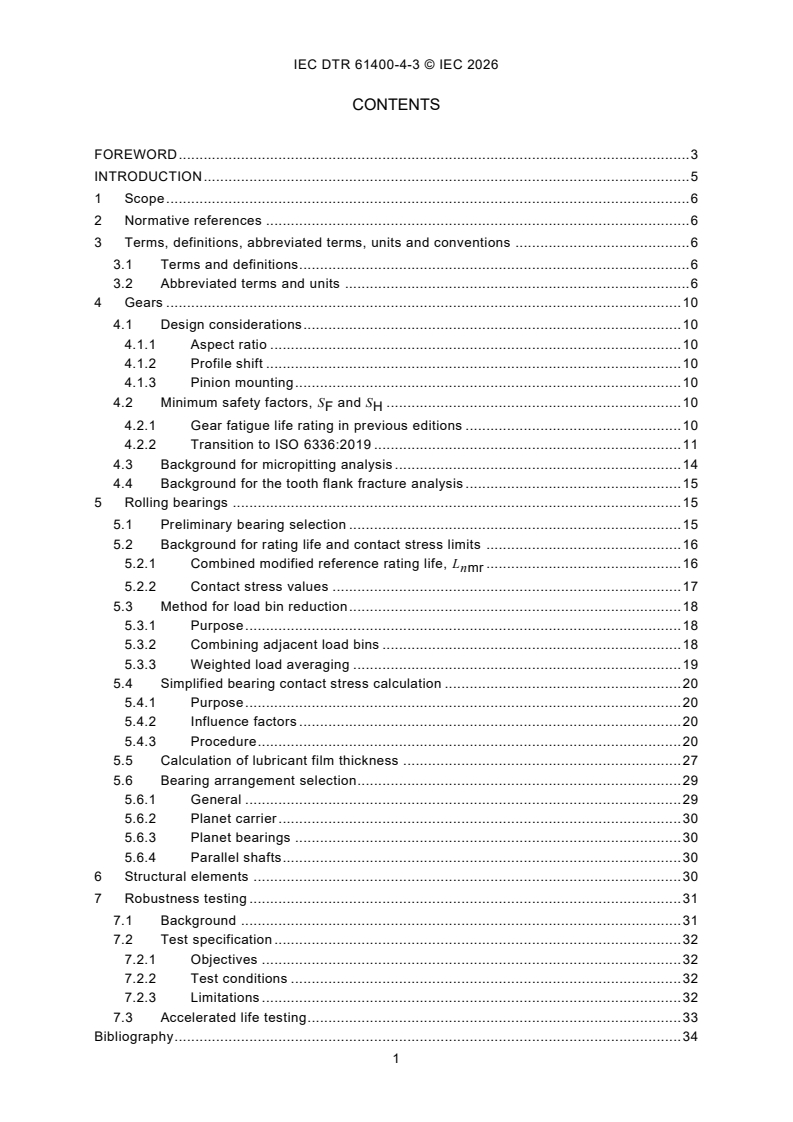
CONTENTS
FOREWORD . 3
INTRODUCTION . 5
1 Scope . 6
2 Normative references . 6
3 Terms, definitions, abbreviated terms, units and conventions . 6
3.1 Terms and definitions. 6
3.2 Abbreviated terms and units . 6
4 Gears . 10
4.1 Design considerations . 10
4.1.1 Aspect ratio . 10
4.1.2 Profile shift . 10
4.1.3 Pinion mounting . 10
4.2 Minimum safety factors, S and S . 10
F H
4.2.1 Gear fatigue life rating in previous editions . 10
4.2.2 Transition to ISO 6336:2019 . 11
4.3 Background for micropitting analysis . 14
4.4 Background for the tooth flank fracture analysis . 15
5 Rolling bearings . 15
5.1 Preliminary bearing selection . 15
5.2 Background for rating life and contact stress limits . 16
5.2.1 Combined modified reference rating life, L . 16
nmr
5.2.2 Contact stress values . 17
5.3 Method for load bin reduction . 18
5.3.1 Purpose . 18
5.3.2 Combining adjacent load bins . 18
5.3.3 Weighted load averaging . 19
5.4 Simplified bearing contact stress calculation . 20
5.4.1 Purpose . 20
5.4.2 Influence factors . 20
5.4.3 Procedure . 20
5.5 Calculation of lubricant film thickness . 27
5.6 Bearing arrangement selection. 29
5.6.1 General . 29
5.6.2 Planet carrier . 30
5.6.3 Planet bearings . 30
5.6.4 Parallel shafts . 30
6 Structural elements . 30
7 Robustness testing . 31
7.1 Background . 31
7.2 Test specification . 32
7.2.1 Objectives . 32
7.2.2 Test conditions . 32
7.2.3 Limitations . 32
7.3 Accelerated life testing . 33
Bibliography . 34
IEC DTR 61400-4-3 © IEC 2026
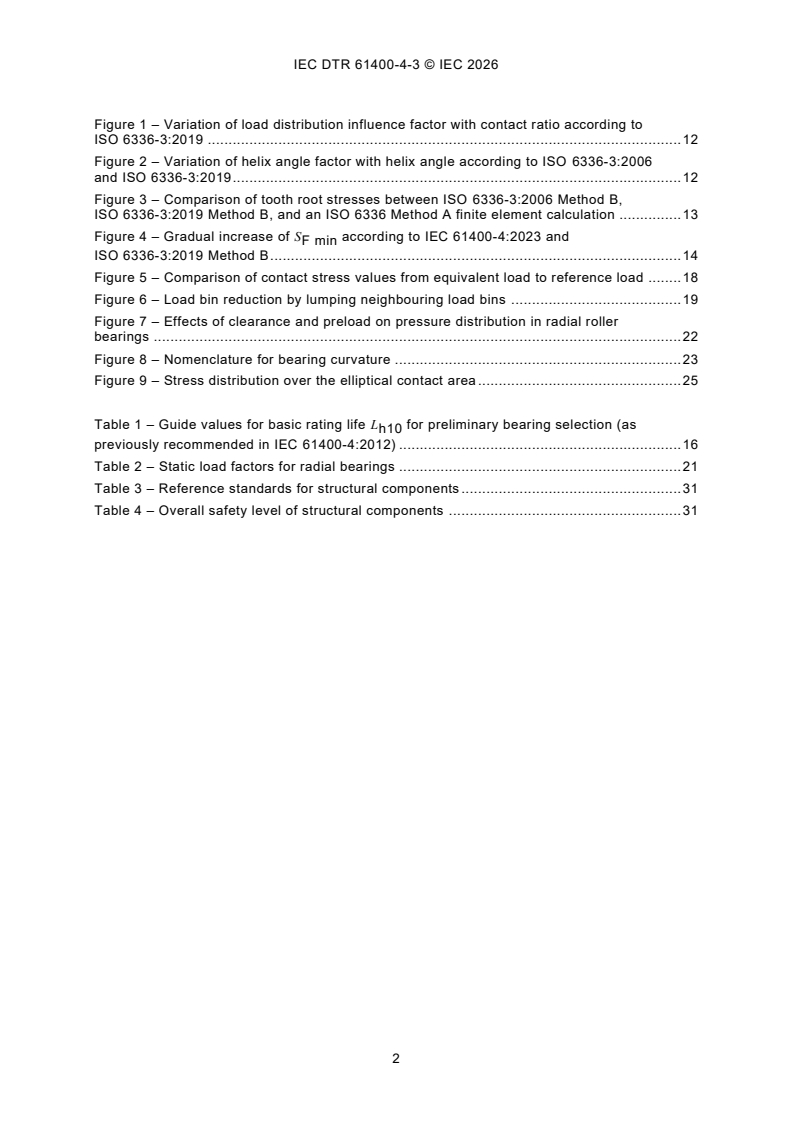
Figure 1 – Variation of load distribution influence factor with contact ratio according to
ISO 6336-3:2019 . 12
Figure 2 – Variation of helix angle factor with helix angle according to ISO 6336-3:2006
and ISO 6336-3:2019 . 12
Figure 3 – Comparison of tooth root stresses between ISO 6336-3:2006 Method B,
ISO 6336-3:2019 Method B, and an ISO 6336 Method A finite element calculation . 13
Figure 4 – Gradual increase of S according to IEC 61400-4:2023 and
F min
ISO 6336-3:2019 Method B . 14
Figure 5 – Comparison of contact stress values from equivalent load to reference load . 18
Figure 6 – Load bin reduction by lumping neighbouring load bins . 19
Figure 7 – Effects of clearance and preload on pressure distribution in radial roller
bearings . 22
Figure 8 – Nomenclature for bearing curvature . 23
Figure 9 – Stress distribution over the elliptical contact area . 25
Table 1 – Guide values for basic rating life L for preliminary bearing selection (as
h10
previously recommended in IEC 61400-4:2012) . 16
Table 2 – Static load factors for radial bearings . 21
Table 3 – Reference standards for structural components . 31
Table 4 – Overall safety level of structural components . 31
IEC DTR 61400-4-3 © IEC 2026
INTERNATIONAL ELECTROTECHNICAL COMMISSION
____________
Wind energy generation systems -
Part 4-3: Explanatory notes on IEC 61400-4 series -
Supportive information for wind turbine gearbox design
FOREWORD
1) The International Electrotechnical Commission (IEC) is a worldwide organization for standardization comprising
all national electrotechnical committees (IEC National Committees). The object of IEC is to promote international
co-operation on all questions concerning standardization in the electrical and electronic fields. To this end and
in addition to other activities, IEC publishes International Standards, Technical Specifications, Technical Reports,
Publicly Available Specifications (PAS) and Guides (hereafter referred to as “IEC Publication(s)”). Their
preparation is entrusted to technical committees; any IEC National Committee interested in the subject dealt with
may participate in this preparatory work. International, governmental and non-governmental organizations liaising
with the IEC also participate in this preparation. IEC collaborates closely with the International Organization for
Standardization (ISO) in accordance with conditions determined by agreement between the two organizations.
2) The formal decisions or agreements of IEC on technical matters express, as nearly as possible, an international
consensus of opinion on the relevant subjects since each technical committee has representation from all
interested IEC National Committees.
3) IEC Publications have the form of recommendations for international use and are accepted by IEC National
Committees in that sense. While all reasonable efforts are made to ensure that the technical content of IEC
Publications is accurate, IEC cannot be held responsible for the way in which they are used or for any
misinterpretation by any end user.
4) In order to promote international uniformity, IEC National Committees undertake to apply IEC Publications
transparently to the maximum extent possible in their national and regional publications. Any divergence between
any IEC Publication and the corresponding national or regional publication shall be clearly indicated in the latter.
5) IEC itself does not provide any attestation of conformity. Independent certification bodies provide conformity
assessment services and, in some areas, access to IEC marks of conformity. IEC is not responsible for any
services carried out by independent certification bodies.
6) All users should ensure that they have the latest edition of this publication.
7) No liability shall attach to IEC or its directors, employees, servants or agents including individual experts and
members of its technical committees and IEC National Committees for any personal injury, property damage or
other damage of any nature whatsoever, whether direct or indirect, or for costs (including legal fees) and
expenses arising out of the publication, use of, or reliance upon, this IEC Publication or any other IEC
Publications.
8) Attention is drawn to the Normative references cited in this publication. Use of the referenced publications is
indispensable for the correct application of this publication.
9) IEC draws attention to the possibility that the implementation of this document may involve the use of (a)
patent(s). IEC takes no position concerning the evidence, validity or applicability of any claimed patent rights in
respect thereof. As of the date of publication of this document, IEC had not received notice of (a) patent(s), which
may be required to implement this document. However, implementers are cautioned that this may not represent
the latest information, which may be obtained from the patent database available at https://patents.iec.ch. IEC
shall not be held responsible for identifying any or all such patent rights.
IEC TR 61400-4-3 has been prepared by IEC technical committee 88: Wind energy generation
systems. It is a Technical Report.
The text of this Technical Report is based on the following documents:
Draft Report on voting
88/XX/DTR 88/XX/RVDTR
Full information on the voting for its approval can be found in the report on voting indicated in
the above table.
The language used for the development of this Technical Report is English.
IEC DTR 61400-4-3 © IEC 2026
This document was drafted in accordance with ISO/IEC Directives, Part 2, and developed in
accordance with ISO/IEC Directives, Part 1 and ISO/IEC Directives, IEC Supplement, available
at www.iec.ch/members_experts/refdocs. The main document types developed by IEC are
described in greater detail at www.iec.ch/publications.
A list of all parts of the IEC 61400 series, published under the general title Wind energy
generation systems, can be found on the IEC website.
The committee has decided that the contents of this document will remain unchanged until the
stability date indicated on the IEC website under webstore.iec.ch in the data related to the
specific document. At this date, the document will be
– reconfirmed,
– withdrawn, or
– revised.
IEC DTR 61400-4-3 © IEC 2026
INTRODUCTION
The purpose of this document is to provide explanations and supportive information to
IEC 61400-4. The contents are non-normative but cover important aspects of gearbox design
and verification.
This document also provides a review of the history, background, and previous requirements,
and how some of the requirements in IEC 61400-4 have developed over time.
IEC DTR 61400-4-3 © IEC 2026
1 Scope
This document, which is a Technical Report, provides non-binding information regarding wind
turbine gearbox design and verification.
The explanatory notes in this document are provided to give context, history, and supportive
information to selected design requirements in IEC 61400-4. This is provided for gear design
considerations in Clause 4 and rolling bearings in Clause 5. History and rationale for design
verification by robustness testing is included in Clause 6.
2 Normative references
The following documents are referred to in the text in such a way that some or all of their content
constitutes requirements of this document. For dated references, only the edition cited applies.
For undated references, the latest edition of the referenced document (including any
amendments) applies.
IEC 61400-1, Wind energy generation systems - Part 1: Design requirements
IEC 61400-4, Wind energy generation systems - Part 4: Design requirements for wind turbine
gearboxes
3 Terms, definitions, abbreviated terms, units and conventions
3.1 Terms and definitions
For the purposes of this document, the terms and definitions given in IEC 61400-1 and
IEC 61400-4 apply.
ISO and IEC maintain terminological databases for use in standardization at the following
addresses:
– IEC Electropedia: available at http://www.electropedia.org/
– ISO Online browsing platform: available at http://www.iso.org/obp
3.2 Abbreviated terms and units
This technical report uses equations and relationships from several engineering specialties. As
a result there are, in some cases, conflicting definitions for the same symbol. All the symbols
used in the document are nevertheless listed, but, if there is ambiguity, the specific definition
is presented in the clause where they are used in equations, graphs, or text.
A
maximum material exposure –
FF,max
a contact ellipse dimension perpendicular to the direction of motion mm
life modification factor, based on a systems approach of life
a
–
ISO
calculation
b contact ellipse dimension parallel to the direction of motion mm
C
basic dynamic radial load rating N
r
C
contact truncation factor –
T
C
elastic constant –
δL
D
ball or roller diameter mm
w
D
working pitch diameter mm
pw
IEC DTR 61400-4-3 © IEC 2026
E modulus of elasticity (Young’s modulus) MPa
E′ reduced modulus of elasticity MPa
F
maximum axial load N
a
F
maximum radial load N
r
f
load distribution influence factor –
ε
material parameter –
G
G
assembled internal radial clearance mm
r
film thickness parameter –
H
h film thickness mm
h
minimum film thickness mm
min
ratio of maximum contact pressure to contact pressure for line
K
–
lc
contact without misalignment
K
misalignment factor –
m
k load sharing factor for the maximum loaded roller –
L
basic rating life at 90 % reliability h
h10
L
combined modified reference rating life at (100 – n) % reliability
10 rev
nmr
L
combined nominal reference rating life
10 rev
nr
L
effective roller length mm
we
l length mm
th
n
–
number of cycles in the i bin of the original load spectrum
i
th
n
–
number of cycles in the j bin of the reduced load spectrum
j
n
shaft rotational speed r/min
R
th
P
N
load level of i bin of the original load spectrum
i
th
P
N
load level of the j bin of the reduced load spectrum
j
P
dynamic equivalent radial load N
r
P
combined external force N
p life exponent –
p
contact pressure for line contact MPa
line
p
maximum contact stress MPa
max
p
maximum contact stress for truncated contacts MPa
T
p
maximum contact pressure MPa
Q single roller maximum load for a clearance-free bearing N
load parameter –
Q
R reduced radius of curvature in the entrainment direction mm
r
rolling element radius mm
r
rolling element radius mm
r
raceway groove radius mm
r
raceway groove radius mm
IEC DTR 61400-4-3 © IEC 2026
S contact osculation –
S
safety factor for tooth breakage –
F
S
minimum required safety factor for tooth root stress –
F min
S
safety factor for pitting –
H
S
minimum required safety factor for pitting –
H min
S
(bearing) static safety factor –
S
safety factor against micropitting –
λ
s
root-mean-square roughness of the raceway mm
R
s
root-mean-square (RMS) roughness of the rolling element mm
RE
speed parameter –
U
U
entrainment velocity mm/s
i
X
static radial load factor –
x exponent of G in the film thickness equation –
tooth form factor, for the influence on nominal tooth root stress
Y
–
F
with load applied at the outer point of single pair tooth contact
Y
static axial load factor –
Y
helix angle factor (tooth root) –
β
y exponent of Λ in the κ – Λ equation –
Z number of rolling elements in a bearing row –
composite pressure-viscosity coefficient value over the contact
α 1/Pa
inlet
α
bearing nominal contact angle °
β helix angle °
γ partial safety factor for consequence of failure
–
m
γ partial safety factor for resistance
–
n
ε
virtual contact ratio of the virtual spur gear –
αn
ε
overlap ratio –
β
γ auxiliary bearing parameter –
η
dynamic viscosity at atmospheric pressure Pa·s
κ viscosity ratio –
κ
viscosity ratio for synthetic oil –
syn
Λ ratio of the film thickness to the composite surface finish –
ratio of the film thickness to the composite surface finish for
Λ
–
mineral
mineral oil
ratio of the film thickness to the composite surface finish for
Λ
–
syn
synthetic oil
µ auxiliary Hertzian parameter –
v auxiliary Hertzian parameter –
actual kinematic viscosity
mm /s
reference kinematic viscosity mm /s
IEC DTR 61400-4-3 © IEC 2026
θ
misalignment slope of the shaft ′
L
Σ
curvature sum for line contact –
ρline
Σ
curvature sum for point contact –
ρpoint
σ
nominal tooth root stress MPa
F0
ρ
curvature factor with respect to body 1 in plane 1 –
ρ
curvature factor with respect to body 1 in plane 2 –
ρ
curvature factor with respect to body 2 in plane 1 –
ρ
curvature factor with respect to body 2 in plane 2 –
auxiliary Hertzian parameter –
ω
inner race rotational speed –/s
i
ω
mean (cage) rotational speed –/s
m
ω
outer race rotational speed –/s
o
ω
roller rotational speed –/s
R
Poisson’s ratio –
AGMA American Gear Manufacturers Association
ANSI American National Standards Institute
AWEA American Wind Energy Association
CRB cylindrical roller bearing
DIN Deutsches Institut für Normung
DNV Det Norske Veritas
FE finite element
FMEA failure mode and effects analysis
HS-IS high-speed intermediate shaft
HSS high-speed shaft
IEC International Electrotechnical Commission
ISO International Organization for Standardization
IS-PS intermediate-speed planet shaft
ISS intermediate-speed shaft
LS-IS low-speed intermediate shaft
LS-PS low-speed planet shaft (or axle)
LSS low-speed shaft
PS planet shaft (or axle)
RMS root-mean-square
SRB spherical roller bearing
TRB tapered roller bearing
IEC DTR 61400-4-3 © IEC 2026
4 Gears
4.1 Design considerations
4.1.1 Aspect ratio
The aspect ratio is the ratio between common face width and the smaller reference diameter of
the gear mesh, and it is an indicator of how sensitive a gear set is to misalignment. To achieve
good load distribution on spur and single helical gears, the aspect ratio is typically less than
1,25. For double helical gears, the aspect ratio is typically less than 2,0.
4.1.2 Profile shift
Profile shift is used to:
– prevent undercut;
– balance specific sliding;
– balance flash temperature;
– balance bending fatigue life;
– avoid narrow top lands;
– adjust backlash and center distance.
The profile shift is typically large enough to avoid undercut and small enough to avoid narrow
top lands. The profile shift is typically designed for balanced specific sliding.
4.1.3 Pinion mounting
Pinions are typically mounted between bearings. The only exception to this is the sun pinion,
where overhung pinions are used. Sun pinions are typically designed without bearings to
achieve load sharing between planet gears.
4.2 Minimum safety factors, S and S
F H
4.2.1 Gear fatigue life rating in previous editions
The minimum safety factors for root bending strength, S , and surface durability, S , have
F H
remained unchanged since ANSI/AGMA/AWEA 6006-A03 was published because general
industry experience suggests that these requirements secure satisfactory reliability in the
application.
In the late 1990s, several standards were in use for rating gear sets in wind turbine gearboxes.
Most European manufacturers applied DIN 3990 series, whereas AGMA 2001 (or its metric
equivalent ANSI/AGMA 2101) was more commonly used by American and Japanese suppliers.
In addition, some certification bodies maintained their own rating standards (e.g. DNV
Classification Note 41.2). ISO 6336 series was not widely deployed across the wind industry.
All these rating standards calculate different safety factors for the same input data; thus, the
results are not comparable.
Lacking a harmonized industry standard for fatigue life analysis of gears in wind turbine
gearboxes, several certification bodies prescribed their own minimum safety factors. Due to the
combination of different rating standards and different minimum safety factors, calculated
transferable torque for the same gear set differed by as much as 30 %.
IEC DTR 61400-4-3 © IEC 2026
ANSI/AGMA/AWEA 6006-A03 allowed for two alternative approaches:
– gear rating in accordance with ANSI/AGMA 2101 using minimum safety factors S ≥ 1,0 and
H
S ≥ 1,0;
F
– or gear rating in accordance with ISO 6336 series using minimum safety factors S ≥ 1,25
H
and S ≥ 1,56.
F
The safety factors defined in IEC 61400-4 based on ISO 6336 series are intended to account
for the differences between the ANSI/AGMA 2101 and ISO 6336 series rating systems, such
that transferable torque would be approximately the same as described by Errichello (2000;
2002).
ISO 81400-4 and ANSI/AGMA/AWEA 6006-A03 allowed both AGMA and ISO rating method.
IEC 61400-4:2012 finally converged to use ISO 6336 series as the only allowable rating
standard because it had become the prevailing method in the industry. Pitting resistance is
described by Hertzian contact stress and is proportional to the square-root of the load. Thus,
S = 1,25 represents the same load reserve as S = 1,56.
H min F
4.2.2 Transition to ISO 6336:2019
4.2.2.1 Retrospective
The minimum safety factors, S and S , were established for the 1996 edition of the ISO 6336
F H
series. The revision of the ISO 6336 series in 2006 did not introduce significant changes to
calculated safety factors, so the minimum safety factors remained unchanged in
IEC 61400-4:2012.
ISO 6336-3:2019 introduced a more accurate calculation of the root fillet shape for Method B,
which is commonly used for wind turbine gearboxes. Systematic comparisons of typical wind
turbine gear geometries indicate that the calculation with ISO 6336-3:2019 Method B results in
up to 20 % higher safety factors, S , than with ISO 6336-3:2006 Method B.
F
4.2.2.2 Analysis
In ISO 6336-3:2019 Method B, the tooth form factor, Y , and the helix angle factor, Y , have
F β
been redefined, such that the product of these factors leads to lower tooth root stresses for
most helical gear designs when compared to an ISO 6336-3:2006 Method B calculation
(Sendlbeck et al., 2021). Figure 1 shows the additional load distribution influence factor, f ,
ε
which is now included in the calculation of the tooth form factor, Y , in ISO 6336-3:2019 as
F
described in Formula (1).
Y = Y f
ε (1)
F,2019 F,2006
Analyses of typical helical gear designs for low-speed, intermediate, and high-speed stages
reveal that the load distribution influence factor, f , varies in the range of approximately 0,77 to
ε
0,9 depending on and . Hence, Y according to ISO 6336-3:2019 is reduced
αn β F
proportionately by this value of f compared to ISO 6336-3:2006.
ε
IEC DTR 61400-4-3 © IEC 2026
Figure 1 – Variation of load distribution influence factor
with contact ratio according to ISO 6336-3:2019
Figure 2 shows the difference in the helix angle factor, Y , between ISO 6336-3:2006, Figure 6
β
and ISO 6336-3:2019, Figure 8, the latter of which includes an additional influence from the
helix angle as described in Formula (2).
YY=
ββ,2019 ,2006 (2)
cos β
The larger the helix angle, β, the larger the difference in Y between the two editions. The
β
difference between the two methods is illustrated for a typical helical, high -speed shaft (HSS)
gear.
Figure 2 – Variation of helix angle factor with helix angle according
to ISO 6336-3:2006 and ISO 6336-3:2019
IEC DTR 61400-4-3 © IEC 2026
The root bending stress calculated with ISO 6336‑3:2019 Method B and ISO 6336‑3 Method A
finite element (FE) calculations correlate well and have been shown to be up to 20 % lower than
the root bending stress calculated with ISO 6336‑3:2006 Method B for typical wind turbine
gearbox designs for the 2 to 4 MW power class. Figure 3 compares the nominal tooth root
stress, σ , for these three methods for an example 4 MW wind turbine gearbox with two
F0
planetary (i.e. low-speed and intermediate-speed) stages and 1 helical, high-speed stage.
Hence the gear load can be increased by the same percentage when rating against the minimum
safety factor of 1,56 and using ISO 6336‑3:2019 Method B.
Figure 3 – Comparison of tooth root stresses between ISO 6336-3:2006 Method B,
ISO 6336-3:2019 Method B, and an ISO 6336 Method A finite element calculation
ISO 6336-3:2019 in general reflects the state of art, but application experience for wind turbine
gearboxes is limited. Therefore, Method A is required by IEC 61400-4:2023 when exceeding
the application experience of IEC 61400-4:2012 and ISO 6336-3:2006 by more than 15 %.
Formulas (3) and (4) describe the link of the helix angle factor, Y , and the load distribution
β
influence factor, f , to the formulas in ISO 6336-3 and the relation between the safety factors
ε
for root bending strength according to ISO 6336-3:2006 and ISO 6336-3:2019.
σ YY
(3)
F0 F β
YY
F,2006 β,2006
SS=
(4)
F,2019 F,2006
Y
β,2019
Therefore, for typical wind turbine gearbox designs, the differences between the nominal tooth
root stress, σ , and the safety factor for tooth breakage, S , are described in Formulas (5) and
F0 F
(6).
σ
F0,2019
0,75 0,85
(5)
σ
F0,2006
IEC DTR 61400-4-3 © IEC 2026
S
F,2019
1,33 1,18
(6)
S 0,75 0,85
F,2006
The rating according to IEC 61400-4:2023 considers the above explained circumstances by
adding a factor which increases the minimum safety factor, S , gradually if Method B is used
F
and the experience range of IEC 61400-4:2012 in combination with ISO 6336-3:2006 is
exceeded by 15 %. Figure 4 illustrates the gradual increase of S .
F min
Figure 4 – Gradual increase of S according to IEC 61400-4:2023
F min
and ISO 6336-3:2019 Method B
The above requirement regarding the application of ISO 6336 3:2019 can be removed in future
editions of IEC 61400-4, if justified by statistically significant field experience.
4.3 Background for micropitting analysis
IEC 61400-4:2012 recommended a review of the parameters influencing micropitting and
referenced ISO/TR 15144-1. ISO/TR 15144-1 has been withdrawn, and its calculation
procedure has been transferred to ISO/TS 6336-22 without significant changes.
Micropitting is influenced by operating conditions such as load, speed, sliding, temperature,
surface topography, specific lubricant film thickness, and chemical composition of the lubricant
as described in ISO/TS 6336-22. Hence, it is important to refer to field experience with similar
designs, stemming from same production processes and operating with similar control
strategies and proven lubricants. It has been shown that low roughness values can reduce
micropitting risk.
Application experience showed that with S < 2 calculated according to ISO/TS 6336-22,
λ
micropitting can occur in some designs, whereas other designs operate without any micropitting
(Pinnekamp and Heider 2015). Pinnekamp and Heider (2015) suggest minimum safety factors
depending on knowledge of loads and input parameters for the calculation. The better the
knowledge and experience with the calculation method, the lower the recommended safety
factors can be. Pinnekamp and Heider (2015) report a moderate micropitting risk in the range
of S = 1,5 to 2,0. Olson et al. (2022) and Errichello (2016) provide comparisons of calculated
λ
micropitting risk with experimental data. Application experience from gearbox manufacturers
shows that low-speed shaft (LSS) planetary gear stages with S > 1,5 are operating without
λ
micropitting.
IEC DTR 61400-4-3 © IEC 2026
NOTE The scope of ISO/TS 6336-22 is limited to a pitch line velocity higher than 2 m/s. At lower pitch line velocities,
wear can become the dominating failure mode and micropitting does not occur even at a very low calculated safety
factor, S . Hence, if low speed wear does not occur, ISO/TS 6336-22 can be applied also for pitch line velocities
λ
below 2 m/s.
4.4 Background for the tooth flank fracture analysis
IEC 61400-4:2012 refers to tooth interior fatigue fracture only; tooth flank fracture is not
addressed. At the time of publication of IEC 61400-4:2012, there was no standardized method
for assessing the risk of tooth flank fracture, so IEC 61400-4:2012 recommended DNV
Classification Note 41.2. ISO 10825-1 describes the different failure characteristics of tooth
interior fatigue fracture and tooth flank fracture.
ISO/TS 6336-4:2019 includes a newly developed method for assessing the risk of tooth flank
fracture, which is still subject to further development. It is published to gain a broader
experience with the obtained results. The knowledge gained will serve for further development
and refinement of ISO/TS 6336-4:2019.
The application of ISO/TS 6336-4 to wind turbine gearbox designs reveals that a minimum
safety factor, respectively a maximum exposure rate A , cannot yet be defined. It has been
FF,max
observed from experimental investigations on case carburized gears in Witzig (2012) that a
maximum material exposure A ≥ 0,8 can lead to tooth flank fractures in the case of
FF,max
constant input torque, but in practice this limit value is not sufficiently validated. Often, but not
always, those failures occur in conjunction with material inhomogeneities or non-metallic
inclusions. Also, material characteristics after heat treatment, such as case hardness depth or
residual stress levels in the case and core area, are subject to further research.
IEC 61400-4:2023 recommends the application of ISO/TS 6336-4 to gain further experience
with this method on wind turbine gearboxes. Furthermore, the Method A calculation requires
precise information on the local stresses. At the same time, research on influence parameters
for tooth flank fracture is ongoing. The target is to combine the application experience on wind
turbine gearboxes and new research results and finally increase the accuracy of
ISO/TS 6336-4.
5 Rolling bearings
5.1 Preliminary bearing selection
IEC 61400-4:2012 described preliminary bearing selection in Clause C.1 including
recommended basic rating life values for different gear stages in Table C.1. These values were
based on Table 2 in ANSI/AGMA/AWEA 6006-A03, where the values had been obtained from
comparison calculations of wind turbine gearboxes of 680 kW to 1,3 MW rated power, designed
in the late 1990s.
There is no reasonable way to transfer these values to modern gearbox designs. Preliminary
bearing selection based on basic rating life only (i.e., disregarding lubrication conditions and
actual bearing internal load distribution) is not state of the art anymore. With contemporary
bearing analysis tools, preliminary bearing selection can be easily based on the rating
calculations prescribed in IEC 61400-4. Most of the previous IEC 61400-4:2012, Annex C has
been moved to this TR for reference.
Basic rating life, L , in accordance with ISO 281 or the bearing manufacturers’ catalogue has
h10
been used for a preliminary selection of bearings in the design process of the gearbox. This
standardized calculation method for dynamically loaded rolling bearings is based on simplified
load distribution assumptions described in Formula (7).
IEC DTR 61400-4-3 © IEC 2026
p
10 C
r
(7)
L =
h10
60nP
Rr
where
C is the basic dynamic radial load rating;
r
n is the speed, expressed in revolutions per minute;
R
P is the dynamic equivalent radial load;
r
p is the life exponent, which is 3,0 for ball bearings and 10/3 for roller bearings.
Miner’s rule is commonly used to combine loads and speeds given in the load spectrum supplied
by the wind turbine manufacturer.
Table 1 lists minimum values for the basic rating life, L , for this preliminary bearing selection
h10
process as previously recommended in IEC 61400-4:2012. The values in this table are valid for
a design life of 20 years and they are typically adjusted for designs with different design lifetime.
Table 1 – Guide values for basic rating life L for preliminary bearing selection
h10
(as previously recommended in IEC 61400-4:2012)
Bearing position Speed range Recommended basic rating life
n D L
R pw h10
mm/min h
High-speed shaft (HSS) 150 000 to 430 000 30 000
High-speed intermediate shaft (HS-IS) 25 000 to 220 000 40 000
Low-speed intermediate shaft (LS-IS) 10 000 to 60 000 80 000
Intermediate-speed shaft (ISS) 10 000 to 60 000 80 000
Intermediate-speed planet shaft (IS-PS) 20 000 to 150 000 80 000
Low-speed planet shaft (LS-PS) 10 000 to 60 000 100 000
Low-speed shaft (LSS) 5 000 to 15 000 100 000
NOTE 1 These guide values have been derived from experience with contemporary gearbox designs in the power
range of 0,68 to 1,3 MW in which the speed index n D falls within the specified ranges.
R pw
NOTE 2 The guide values apply for bearings manufactured from contemporary, commonly used, high quality
hardened bearing steel, in accordance with good manufacturing practice and basically of conventional design as
regards the shape of rolling contact surfaces.
NOTE 3 Usually, there is no equivalent load available for the input shaft.
5.2 Background for rating life and contact stress limits
5.2.1 Combined modified reference rating life, L
nmr
The requirements for rating life calculation in IEC 61400-4 limit the ratio between combined
modified reference rating life, L , and combined nominal reference rating life, L , to a value
nmr nr
of 15 (i.e., the value of the combined modified reference rating life, L , for the complete load
nmr
spectrum is limited to 15 times combined L ). Compared to IEC 61400-4:2012, the limiting
nr
value has been increased from 10 to 15.
ISO 281 defines a value of 50 for the upper limit of the life modification factor, a .
ISO
IEC DTR 61400-4-3 © IEC 2026
The provision for limiting the total life factor between modified and nominal rating life was
originally introduced in ANSI/AGMA/AWEA 6006-A03, because there was little field experience
with the analysis of modified reference rating life at that time. Now, after more than 15 years of
positive field experience), this arbitrary limitation seems to be non-essential. On the other hand,
for contemporary gearbox designs, the limitation of the total life factor to 10 can become a
design driver, i.e., necessitating an increase of bearing size, which can be detrimental to total
bearing performance in application (compare bearing selection guidance in IEC 61400-4).
Therefore, it was decided to increase the limiting value for the total life factor between modified
and nominal rating life slightly from 10 to 15.
5.2.2 Contact stress values
In addition to rating calculations, IEC 61400-4 provides guide values for maximum contact
stress at reference load for different bearing positions Compared to IEC 61400-4:2012, the
table has been simplified, and these values have been slightly increased as shown in Figure 5.
The guide values for maximum contact stress were originally introduced in
ANSI/AGMA/AWEA 6006-A03, as a safeguard against overly optimistic life ratings. The values
were based on comparative calculations for typical bearing positions of wind turbine gearboxes
of 680 kW to 1,3 MW rated power, designed in the late 1990s. These designs can differ
significantly from contemporary designs, and it was deemed impractical to recalculate or
transfer these values to contemporary bearing arrangements. It was decided to simplify the
table and to distinguish only between planet bearings, low-speed positions, and high-speed
positions, where the distinction between low- and high-speed was based on speed multiplied
by pitch diameter values provided in IEC 61400-4:2012, Table 7.
The main reason for the apparently increased values in Table 8 is the changed definition of the
load at which these contact stresses are calculated. IEC 61400-4:2012 defined guide values at
Miner’s sum equivalent load of the bearing. IEC 61400-4:2023, changed this to the guide values
for maximum contact stress at reference load of the gearbox, which is by nature higher tha n
the Miner’s sum equivalent load. This obviously necessitates an increase of the given values,
depending on the ratio of Miner’s sum equivalent load to reference load. The updated values
shown in Figure 5 were recalculated based on typical ratios of Miner’s sum equivalent load to
reference load for recent wind turbine gearbox designs.
IEC DTR 61400-4-3 © IEC 2026
Figure 5 – Comparison of contact stress values from equivalent load to reference load
Recalculated to Miner’s sum equivalent load, the new guide values for all but the high -speed
positions are not significantly changed from the values given in IEC 61400-4:2012.
For high-speed positions, previous values have been proven to be a design driver, leading to
rather oversized bearings on the high-speed shaft. Therefore, the guide values have been
slightly increased to allow for a more robust design against at or below m inimum load.
5.3 Method for load bin reduction
5.3.1 Purpose
This subclause explains different methods for reducing the number of bins in a given load
spectrum. The methods presented here are only applicable for bearings that are predominantly
loaded by forces resulting from rotor torque. This is the case with most gearbox bearings, but
the notable exceptions are wind turbine gearbox designs where the input shaft carries other
moments and forces from the main shaft and rotor or from the weight of the gearbox.
5.3.2 Combining adjacent load bins
The simplest way of reducing the number of bins is to combine a number of adjacent load bins
as illustrated in Figure 6. If this method is applied, the load for the resulting bin is typically the
maximum load of the original bins in the positive torque range and the minimum load of the
original bins in the negative torque range. The size of the load steps which define a bin can be
non-constant. Also, the number of bins that are combined can be non-constant. The final
number of load bins after the reduction is typically 20 or more. This approach will result in a
conservative approximation of the bearing life ratings.
IEC DTR 61400-4-3 © IEC 2026
Figure 6 – Load bin reduction by lumping neighbouring load bins
th
The number of cycles, n , and the load level, P , of the j bin of the reduced load spectrum are
j j
i
nn=
(8)
ji
ii=
i
PP= max
( ) (9)
ji
ii=
where
th
i = i …i are the bins of the original spectrum combined into the j bin of the reduced load
1 2
spectrum;
th
P is the load level of the j bin of the reduced load spectrum;
j
th
P is the load level of i bin of the original load spectrum;
i
th
n is the number of cycles in the j bin of the reduced load spectrum;
j
th
n is the number of cycles in the i bin of the original load spectrum.
i
5.3.3 Weighted load averaging
This method for reducing the number of bins uses Miner’s rule to determine a weighted average
load for each bin of the reduced spectrum. The same life exponent is used as applied in the
calculation of the modif
...
Questions, Comments and Discussion
Ask us and Technical Secretary will try to provide an answer. You can facilitate discussion about the standard in here.
Loading comments...