


ISO 22078:2020
(Main)Intelligent transport systems — Bicyclist detection and collision mitigation systems (BDCMS) — Performance requirements and test procedures
Intelligent transport systems — Bicyclist detection and collision mitigation systems (BDCMS) — Performance requirements and test procedures
This document specifies the concept of operation, minimum functionality, system requirements, system interfaces, and test procedures for bicyclist detection and collision mitigation systems (BDCMS). It also defines the system test criteria necessary to verify that a given implementation meets the requirements of this document. Implementation choices are left to system designers, wherever possible. BDCMS are fundamentally intended to provide emergency braking (EB) of equipped vehicles in order to mitigate collision severity between the subject vehicle (SV) and a bicyclist. BDCMS detect bicyclists forward of the SV, determine if the detected bicyclists are in a hazardous situation with respect to the SV, and initiate EB if a hazardous situation exists and a collision is imminent. Systems that include other countermeasures such as evasive steering are outside the scope of this document. This document defines two types of BDCMS (based on operation in different ambient illuminance) and two classes of BDCMS (based on operation on different vehicle size classes), as depicted in Table 1. This document does not apply to motorcycles. The operational design domain is public roads. BDCMS is not intended for off-road use. Responsibility for the safe operation of the vehicle remains with the driver. Licensable motor vehicles intended for use on public roads (i.e. motorcycles, cars, light trucks, buses, motor coaches), and other heavy vehicles as hazards are outside the scope of this document and are covered under ISO 22839. Pedestrians are outside the scope of this document and are covered under ISO 19237. Annex A contains informative information relative to BDCMS.
Systèmes de transport intelligents — Systèmes de détection des cyclistes et d’atténuation des collisions (BDCMS) — Exigences de performance et procédures d'essai
General Information
Standards Content (Sample)
INTERNATIONAL ISO
STANDARD 22078
First edition
2020-02
Intelligent transport systems —
Bicyclist detection and collision
mitigation systems (BDCMS) —
Performance requirements and test
procedures
Systèmes de transport intelligents — Systèmes de détection des
cyclistes et d’atténuation des collisions (BDCMS) — Exigences de
performance et procédures d'essai
Reference number
©
ISO 2020
© ISO 2020
All rights reserved. Unless otherwise specified, or required in the context of its implementation, no part of this publication may
be reproduced or utilized otherwise in any form or by any means, electronic or mechanical, including photocopying, or posting
on the internet or an intranet, without prior written permission. Permission can be requested from either ISO at the address
below or ISO’s member body in the country of the requester.
ISO copyright office
CP 401 • Ch. de Blandonnet 8
CH-1214 Vernier, Geneva
Phone: +41 22 749 01 11
Fax: +41 22 749 09 47
Email: copyright@iso.org
Website: www.iso.org
Published in Switzerland
ii © ISO 2020 – All rights reserved
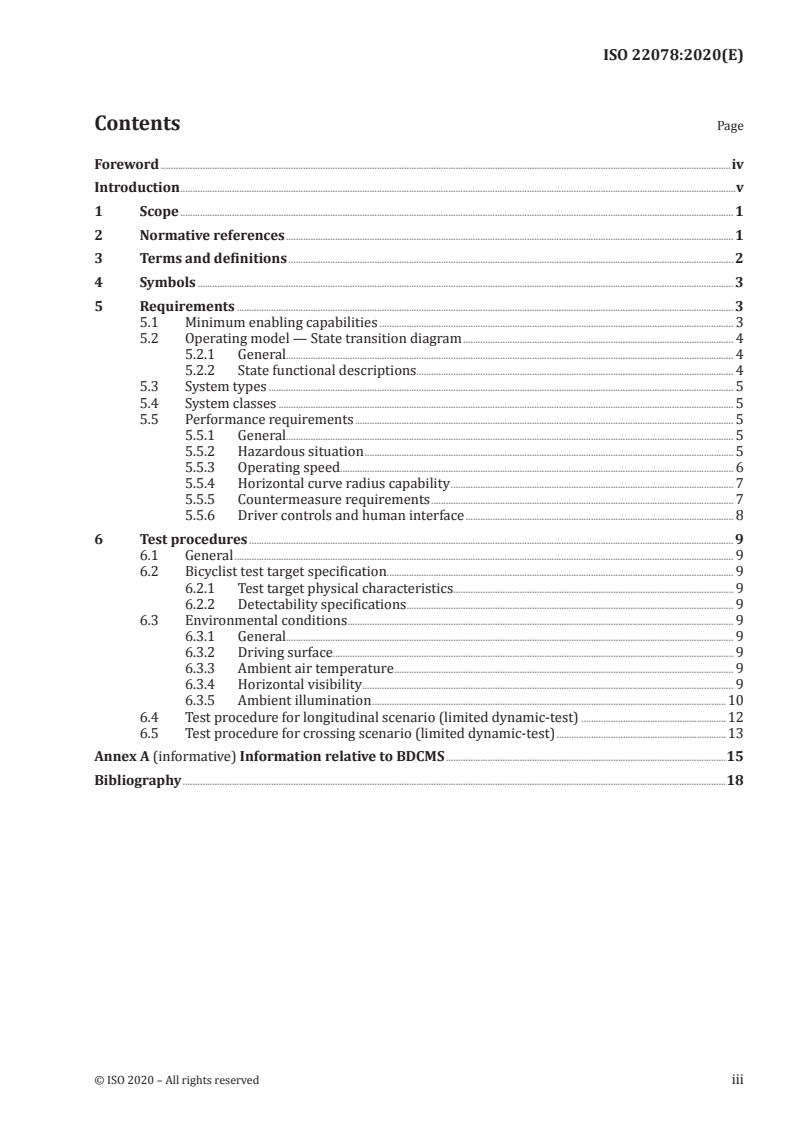
Contents Page
Foreword .iv
Introduction .v
1 Scope . 1
2 Normative references . 1
3 Terms and definitions . 2
4 Symbols . 3
5 Requirements . 3
5.1 Minimum enabling capabilities . 3
5.2 Operating model — State transition diagram . 4
5.2.1 General. 4
5.2.2 State functional descriptions. 4
5.3 System types . 5
5.4 System classes . 5
5.5 Performance requirements . 5
5.5.1 General. 5
5.5.2 Hazardous situation . 5
5.5.3 Operating speed. 6
5.5.4 Horizontal curve radius capability . 7
5.5.5 Countermeasure requirements . 7
5.5.6 Driver controls and human interface . 8
6 Test procedures . 9
6.1 General . 9
6.2 Bicyclist test target specification . 9
6.2.1 Test target physical characteristics . . 9
6.2.2 Detectability specifications . 9
6.3 Environmental conditions . 9
6.3.1 General. 9
6.3.2 Driving surface. 9
6.3.3 Ambient air temperature . 9
6.3.4 Horizontal visibility . 9
6.3.5 Ambient illumination .10
6.4 Test procedure for longitudinal scenario (limited dynamic-test) .12
6.5 Test procedure for crossing scenario (limited dynamic-test) .13
Annex A (informative) Information relative to BDCMS .15
Bibliography .18
Foreword
ISO (the International Organization for Standardization) is a worldwide federation of national standards
bodies (ISO member bodies). The work of preparing International Standards is normally carried out
through ISO technical committees. Each member body interested in a subject for which a technical
committee has been established has the right to be represented on that committee. International
organizations, governmental and non-governmental, in liaison with ISO, also take part in the work.
ISO collaborates closely with the International Electrotechnical Commission (IEC) on all matters of
electrotechnical standardization.
The procedures used to develop this document and those intended for its further maintenance are
described in the ISO/IEC Directives, Part 1. In particular, the different approval criteria needed for the
different types of ISO documents should be noted. This document was drafted in accordance with the
editorial rules of the ISO/IEC Directives, Part 2 (see www .iso .org/ directives).
Attention is drawn to the possibility that some of the elements of this document may be the subject of
patent rights. ISO shall not be held responsible for identifying any or all such patent rights. Details of
any patent rights identified during the development of the document will be in the Introduction and/or
on the ISO list of patent declarations received (see www .iso .org/ patents).
Any trade name used in this document is information given for the convenience of users and does not
constitute an endorsement.
For an explanation of the voluntary nature of standards, the meaning of ISO specific terms and
expressions related to conformity assessment, as well as information about ISO's adherence to the
World Trade Organization (WTO) principles in the Technical Barriers to Trade (TBT) see www .iso .org/
iso/ foreword .html.
This document was prepared by Technical Committee ISO/TC 204, Intelligent transport systems.
Any feedback or questions on this document should be directed to the user’s national standards body. A
complete listing of these bodies can be found at www .iso .org/ members .html.
iv © ISO 2020 – All rights reserved
Introduction
Bicyclist detection and collision mitigation systems (BDCMS) reduce the severity of collisions between
a human-driven vehicle and bicyclists that cannot be avoided and may reduce the likelihood of such
collisions by automatically activating emergency braking (EB). BDCMS assist in slowing the subject
vehicle (SV) when a collision is likely.
BDCMS functions may be used as a stand-alone system or might be part of a driver assistance system.
As depicted in Figure 1, the BDCMS will provide information to the driver and perform SV actuation in
the form of longitudinal control.
Figure 1 — BDCMS functional elements
INTERNATIONAL STANDARD ISO 22078:2020(E)
Intelligent transport systems — Bicyclist detection and
collision mitigation systems (BDCMS) — Performance
requirements and test procedures
1 Scope
This document specifies the concept of operation, minimum functionality, system requirements, system
interfaces, and test procedures for bicyclist detection and collision mitigation systems (BDCMS). It also
defines the system test criteria necessary to verify that a given implementation meets the requirements
of this document. Implementation choices are left to system designers, wherever possible.
BDCMS are fundamentally intended to provide emergency braking (EB) of equipped vehicles in order
to mitigate collision severity between the subject vehicle (SV) and a bicyclist. BDCMS detect bicyclists
forward of the SV, determine if the detected bicyclists are in a hazardous situation with respect to the
SV, and initiate EB if a hazardous situation exists and a collision is imminent. Systems that include other
countermeasures such as evasive steering are outside the scope of this document.
This document defines two types of BDCMS (based on operation in different ambient illuminance) and
two classes of BDCMS (based on operation on different vehicle size classes), as depicted in Table 1. This
document does not apply to motorcycles. The operational design domain is public roads. BDCMS is not
intended for off-road use.
Table 1 — Types and classes of BDCMS
BDCMS class I BDCMS class II
BDCMS type I Daytime only Daytime only
Light vehicles only Heavy vehicles only
BDCMS type II Daytime, twilight, and night-time Daytime, twilight, and night-time
Light vehicles only Heavy vehicles only
Responsibility for the safe operation of the vehicle remains with the driver.
Licensable motor vehicles intended for use on public roads (i.e. motorcycles, cars, light trucks, buses,
motor coaches), and other heavy vehicles as hazards are outside the scope of this document and are
covered under ISO 22839.
Pedestrians are outside the scope of this document and are covered under ISO 19237.
Annex A contains informative information relative to BDCMS.
2 Normative references
The following documents are referred to in the text in such a way that some or all of their content
constitutes requirements of this document. For dated references, only the edition cited applies. For
undated references, the latest edition of the referenced document (including any amendments) applies.
ISO 8608, Mechanical vibration — Road surface profiles — Reporting of measured data
1)
ISO 19206-4:— , Road vehicle — Test devices for target vehicles, vulnerable road users and other objects,
for assessment of active safety functions —Part 4: Requirements for bicyclist targets
ISO/CIE 19476, Characterization of the performance of illuminance meters and luminance meters
1) Under preparation. Stage at the time of publication: ISO/DIS 19206-4:2020.
3 Terms and definitions
For the purposes of this document, the following terms and definitions apply.
ISO and IEC maintain terminological databases for use in standardization at the following addresses:
— ISO Online browsing platform: available at https:// www .iso .org/ obp
— IEC Electropedia: available at http:// www .electropedia .org/
3.1
bicyclist
human-vehicle combination consisting of a human riding on top of a two-wheel frame (bicycle) with a
steering mechanism, brakes, two pedals for propulsion (optionally with motor-assisted pedalling) that
does not require a licence for use on public roads
3.2
bicyclist collision
collision between the subject vehicle (SV) (3.12) and a bicyclist (3.1)
3.3
daytime
condition where the ambient illuminance is greater than 2 000 lx
3.4
driver override
driver-initiated suppression of an emergency braking (EB) (3.5) or collision warning (CW)
countermeasure
3.5
emergency braking
EB
bicyclist detection and collision mitigation systems (BDCMS) countermeasure that responds to the
detection of a hazardous situation by automatically activating braking, and optionally issuing a collision
warning (CW), to quickly reduce the subject vehicle (SV) (3.12) velocity
3.6
hazardous situation
condition whereby the position and orientation of a detected bicyclist (3.1), in relation to the position
and orientation of the subject vehicle (SV) (3.12), will result in an imminent collision
3.7
heavy vehicle
single vehicle or combination of vehicles equipped with a pneumatic braking system, defined as
category 1-2 or category 2 in the United Nations Economic and Social Council World Forum for
Harmonization of Vehicle Regulations ECE/TRANS/WP.29/1045
3.8
impact point
relative position, from the subject vehicle (SV) (3.12) point of view, where a collision with a bicyclist
(3.1) is expected in a hazardous situation, defined as the relative position where the SV will contact the
bicyclist
3.9
light vehicle
vehicle defined as category 1-1 in the United Nations Economic and Social Council World Forum for
Harmonization of Vehicle Regulations ECE/TRANS/WP.29/1045
3.10
night-time
condition where the ambient illuminance is less than 1 lx
2 © ISO 2020 – All rights reserved
3.11
off-road
road surface conditions (i.e. unpaved) not intended for vehicular traffic or governed by normal traffic laws
3.12
subject vehicle
SV
vehicle equipped with bicyclist detection and collision mitigation systems (BDCMS)
3.13
twilight
condition where the ambient illuminance is 3-400 lx
Note 1 to entry: Generally, twilight occurs during civil twilight, from when the geometric centre of the sun’s disk
dips below the horizon until the geometric centre of the sun’s disk is less than 6 ° below the horizon.
4 Symbols
v velocity of the bicyclist
B
v maximum bicyclist speed for the BDCMS operation
B
max
v minimum bicyclist speed for the BDCMS operation
B
min
v velocity of the SV
SV
v maximum SV speed for the BDCMS operation
SV
max
v minimum SV speed for the BDCMS operation
SV
min
W width of the SV
SV
5 Requirements
5.1 Minimum enabling capabilities
Vehicles equipped with BDCMS shall able to:
— detect the hazardous situation;
— determine the SV velocity;
— initiate appropriate BDCMS countermeasures (optionally CW) and generate at least the minimum
required BDCMS speed reduction;
— activation and modulation of the brakes whether or not the driver is already braking.
— enhancement of the driver control based on brakes with a yaw stability capability and a capability
to manage longitudinal wheel slip, by utilizing an electronic stability control (ESC) system;
— management of permission of the driver's ability to increase the deceleration to any higher value up
to the maximum possible vehicle deceleration after EB has been initiated;
— management of permission of the driver's ability to override commands at any time;
— provision of information about system availability to the driver.
5.2 Operating model — State transition diagram
5.2.1 General
The BDCMS shall function according to the state transition diagram in Figure 2. Specific implementation,
beyond what is illustrated in Figure 2, of the state transitions is left to the manufacturer.
Key
1 ignition on or (optional) ignition on and driver turn on
SV speed ≥ v and SV speed ≤ v
SV SV
min max
3 failure detected (automatic deactivation possible)
SV speed < v or SV speed > v , exception: when SV speed falls below v or exceeds v , while EB
SV SV SV SV
min max min max
is active, EB continues to be operational as long as the command is being issued
5 fail self-test, ignition off or (optional) driver turn off
6 fail self-test, ignition off or (optional) driver turn off
Figure 2 — BDCMS state transition diagram including optional features
5.2.2 State functional descriptions
5.2.2.1 General
The BDCMS state descriptions address the functional requirements of BDCMS, identifying which
functions shall be performed in each state.
5.2.2.2 BDCMS off state
No countermeasures are performed in the BDCMS off state. Upon turning the ignition to the off
position, BDCMS shall transition to the BDCMS off state. Whenever the self-test function determines
that BDCMS are not able to deliver adequate performance, or when the driver manually turns off the
BDCMS (optional), it shall transition to the BDCMS off state. BDCMS may be in the BDCMS off state when
the vehicle is on.
5.2.2.3 BDCMS inactive state
In the BDCMS inactive state, BDCMS shall monitor vehicle speed and determine if it is appropriate to
activate the system.
BDCMS shall enter the BDCMS inactive state from the BDCMS off state if the ignition on sequence has
been completed and the engine is running. BDCMS shall enter inactive state from the active state if the
conditions for activating are not met, for example, if the vehicle speed drops below v . If a
SV
min
manufacturer-defined failure mode is encountered for which an automatic recovery (optional) is
possible, the BDCMS shall transition from the BDCMS active state to the BDCMS inactive state. Based on
4 © ISO 2020 – All rights reserved
the results of a diagnostic self-test, functions of all or some of the countermeasures may be restored.
Once the recovery occurs, the system may transition back to the BDCMS active state. Finally, if the
driver manually turns on BDCMS (optional), then it shall transit from the BDCMS off state to the BDCMS
inactive state.
5.2.2.4 BDCMS active state
BDCMS shall enter this state if the vehicle speed is greater than or equal to v and less than v .
SV SV
min max
In the BDCMS active state, it shall monitor for triggering conditions resulting in the selection of EB and
decide to activate countermeasures or optionally override if so instructed by the operator. BDCMS may
optionally provide a CW to the driver.
If a system failure is detected or there is an inability to perform a countermeasure, BDCMS shall transfer
to the BDCMS inactive state if automatic recovery from the failure is possible. If the system fails, and a
self-test results in a case where automatic recovery without driver intervention is not possible, BDCMS
shall transfer to the BDCMS off state. Means of notification of these failures to the driver is left up to the
manufacturer.
5.3 System types
There are two types of BDCMS:
— type 1: BDCMS is capable of daytime activation;
— type 2: BDCMS is capable of daytime, twilight and night-time activations.
5.4 System classes
There are two classes of BDCMS:
— class 1: BDCMS operate on light vehicles only;
— class 2: BDCMS operate on heavy vehicles only.
5.5 Performance requirements
5.5.1 General
BDCMS shall, at a minimum, provide an EB countermeasure based on determination of a hazardous
situation.
5.5.2 Hazardous situation
BDCMS shall monitor the area forward of the SV, whenever it is in the active state, to determine if a
hazardous situation exists.
Typical hazardous situations such as longitudinal and crossing ones are shown in Figure 3. BDCMS shall
determine if a hazardous situation exists for any relative bicyclist approach angle and size of bicyclist.
Figure 3 — Bicyclist longitudinal and crossing hazardous situations
BDCMS may optionally detect bicycles when a pedestrian is present next to the bicycle. Performance
limitations are given by bad weather conditions (e.g. fog, rain, and snow), illumination (e.g. glaring by
backlighting), occlusions and abnormal shapes of bicyclists (e.g. special clothing, large transported items).
BDCMS shall not initiate emergency countermeasures when a bicyclist is detected forward of the SV
when the situation is determined not to be hazardous (i.e. when the bicyclist and SV trajectory are such
that a collision is not imminent).
BDCMS shall determine a hazardous situation on roads with a horizontal curve radius of 500 m or
greater (see 5.5.3 and A.1).
5.5.3 Operating speed
5.5.3.1 General
BDCMS shall operate with an SV speed between 4,2 m/s (15 km/h) and 15,3 m/s (55 km/h) and shall
address bicyclists with a speed between 2,8 m/s (10 km/h) and 5,6 m/s (20 km/h). Beyond these
operating speed ranges, the upper and lower speed limits of BDCMS operation for the SV and the upper
and lower speed limits for bicyclist
...
Questions, Comments and Discussion
Ask us and Technical Secretary will try to provide an answer. You can facilitate discussion about the standard in here.