

ISO 248-2:2019
(Main)Rubber, raw — Determination of volatile-matter content — Part 2: Thermogravimetric methods using an automatic analyser with an infrared drying unit
General Information
- Abstract
1.1 This document specifies two thermogravimetric methods for the determination of moisture and other volatile-matter content in raw rubbers by using an automatic analyser with an infrared drying unit. 1.2 These methods are applicable to the determination of volatile-matter content in synthetic rubbers (SBR, NBR, BR, IR, CR, IIR, halogenated IIR and EPDM) listed in ISO 1629 and to various forms of raw rubber, such as bale, block, chip, pellet, crumb, powder and sheet. These methods might also be applicable to other raw rubbers only when the change in mass is proven to be due solely to loss of original volatile matter and not to rubber degradation. 1.3 The methods are not applicable to raw rubbers which need homogenizing as specified in ISO 1795. 1.4 The hot-mill method and the oven method specified in ISO 248‑1 and the methods specified in this document might not give identical results. In cases of dispute, therefore, the oven method, procedure A, specified in ISO 248‑1:2011, is the referee method. NOTE These methods can be useful for routine determinations, e.g. quality control, when the measurement conditions for the automatic analyser are fixed for a particular raw rubber or grade of raw rubber.
- Status
- Published
- Publication Date
- 25-Mar-2019
- Drafting Committee
- ISO/TC 45/SC 3/WG 5 - Synthetic and reclaimed rubber
- Current Stage
- 9093 - International Standard confirmed
- Start Date
- 14-Jun-2024
- Completion Date
- 29-Aug-2026
Buy Documents


ISO 248-2:2019 - Rubber, raw -- Determination of volatile-matter content
ISO 248-2:2019 - Rubber, raw — Determination of volatile-matter content — Part 2: Thermogravimetric methods using an automatic analyser with an infrared drying unit/26/2019
Overview - ISO 248-2:2019 (Rubber, raw - Thermogravimetric methods)
ISO 248-2:2019 specifies two thermogravimetric procedures using an automatic analyser with an infrared drying unit to determine moisture and other volatile‑matter content in raw rubbers. The standard is intended for routine determinations (e.g., quality control) of synthetic rubbers listed in ISO 1629 and covers multiple sample forms (bale, block, chip, pellet, crumb, powder, sheet). Results depend on fixed analyser conditions for a given rubber type or grade.
Key topics and technical requirements
- Scope and applicability
- Applies to many synthetic rubbers (SBR, NBR, BR, IR, CR, IIR, halogenated IIR, EPDM).
- Not applicable to raw rubbers that require homogenizing as per ISO 1795.
- Applicable only when mass loss is due to original volatile matter, not rubber degradation.
- Two thermogravimetric methods
- Method A - pre-defined drying time: set a drying temperature (preferably 100–120 °C) and a drying time determined for each rubber grade; analyser stops when that time elapses.
- Method B - end point by mass‑loss rate: drying stops when the mass-loss rate falls to a pre-defined value determined for the grade.
- Apparatus and measurement
- Automatic analyser with an infrared (near/far IR acceptable) drying unit, balance accurate to 1 mg, and microprocessor for control and calculation.
- Typical test portion mass: 2 g to 15 g; bale samples should be cut to small pieces quickly to avoid volatile loss.
- Calibration and system accuracy
- Performance check with sodium l‑tartrate dihydrate (reference volatile-matter ~15.66 ± 0.5 %); relative standard deviation must be < 1.0 % over 10 determinations.
- Calculation and reporting
- Volatile-matter content computed as percent mass loss: (mA − mB) / mA × 100.
- Test report must reference ISO 248-2:2019, sample ID, method (A or B), apparatus and conditions, related ISO 248‑1 procedure used to set endpoints, result and date.
Practical applications and users
- Quality control and incoming raw‑material inspection in rubber manufacturing.
- Independent testing laboratories validating moisture/volatile content in synthetic rubbers and different sample forms.
- R&D and process monitoring where fast, repeatable volatile-matter determinations are needed.
- Useful for routine screening when analyser conditions are fixed per rubber grade.
Related standards
- ISO 248-1 (Hot‑mill and oven methods) - note: oven method, procedure A in ISO 248‑1:2011 is the referee method if discrepancies arise.
- ISO 1795 (Sampling and preparative procedures) - for sampling and homogenizing requirements.
Keywords: ISO 248-2:2019, volatile-matter content, raw rubber, thermogravimetric methods, automatic analyser, infrared drying unit, moisture determination, quality control.
Relations
- Effective Date
- 31-Mar-2018
Buy Documents
ISO 248-2:2019 - Rubber, raw -- Determination of volatile-matter content
ISO 248-2:2019 - Rubber, raw — Determination of volatile-matter content — Part 2: Thermogravimetric methods using an automatic analyser with an infrared drying unit/26/2019
Get Certified
Connect with accredited certification bodies for this standard

DIN CERTCO
DIN Group product certification.

Smithers Quality Assessments
US management systems and product certification.
Sponsored listings
Frequently Asked Questions
ISO 248-2:2019 is a standard published by the International Organization for Standardization (ISO). Its full title is "Rubber, raw — Determination of volatile-matter content — Part 2: Thermogravimetric methods using an automatic analyser with an infrared drying unit". This standard covers: 1.1 This document specifies two thermogravimetric methods for the determination of moisture and other volatile-matter content in raw rubbers by using an automatic analyser with an infrared drying unit. 1.2 These methods are applicable to the determination of volatile-matter content in synthetic rubbers (SBR, NBR, BR, IR, CR, IIR, halogenated IIR and EPDM) listed in ISO 1629 and to various forms of raw rubber, such as bale, block, chip, pellet, crumb, powder and sheet. These methods might also be applicable to other raw rubbers only when the change in mass is proven to be due solely to loss of original volatile matter and not to rubber degradation. 1.3 The methods are not applicable to raw rubbers which need homogenizing as specified in ISO 1795. 1.4 The hot-mill method and the oven method specified in ISO 248‑1 and the methods specified in this document might not give identical results. In cases of dispute, therefore, the oven method, procedure A, specified in ISO 248‑1:2011, is the referee method. NOTE These methods can be useful for routine determinations, e.g. quality control, when the measurement conditions for the automatic analyser are fixed for a particular raw rubber or grade of raw rubber.
1.1 This document specifies two thermogravimetric methods for the determination of moisture and other volatile-matter content in raw rubbers by using an automatic analyser with an infrared drying unit. 1.2 These methods are applicable to the determination of volatile-matter content in synthetic rubbers (SBR, NBR, BR, IR, CR, IIR, halogenated IIR and EPDM) listed in ISO 1629 and to various forms of raw rubber, such as bale, block, chip, pellet, crumb, powder and sheet. These methods might also be applicable to other raw rubbers only when the change in mass is proven to be due solely to loss of original volatile matter and not to rubber degradation. 1.3 The methods are not applicable to raw rubbers which need homogenizing as specified in ISO 1795. 1.4 The hot-mill method and the oven method specified in ISO 248‑1 and the methods specified in this document might not give identical results. In cases of dispute, therefore, the oven method, procedure A, specified in ISO 248‑1:2011, is the referee method. NOTE These methods can be useful for routine determinations, e.g. quality control, when the measurement conditions for the automatic analyser are fixed for a particular raw rubber or grade of raw rubber.
ISO 248-2:2019 is classified under the following ICS (International Classification for Standards) categories: 83.040.10 - Latex and raw rubber. The ICS classification helps identify the subject area and facilitates finding related standards.
ISO 248-2:2019 has the following relationships with other standards: It is inter standard links to ISO 248-2:2012. Understanding these relationships helps ensure you are using the most current and applicable version of the standard.
ISO 248-2:2019 is available in PDF format for immediate download after purchase. The document can be added to your cart and obtained through the secure checkout process. Digital delivery ensures instant access to the complete standard document.
Standards Content (Sample)
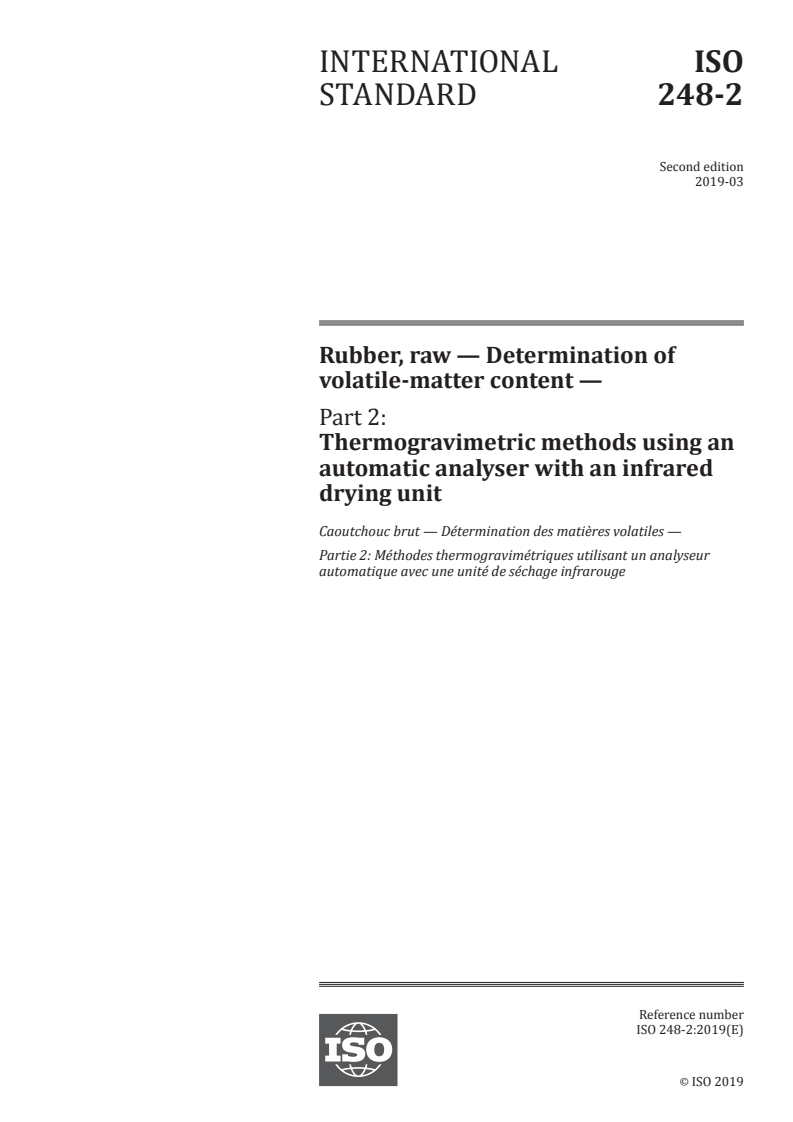
INTERNATIONAL ISO
STANDARD 248-2
Second edition
2019-03
Rubber, raw — Determination of
volatile-matter content —
Part 2:
Thermogravimetric methods using an
automatic analyser with an infrared
drying unit
Caoutchouc brut — Détermination des matières volatiles —
Partie 2: Méthodes thermogravimétriques utilisant un analyseur
automatique avec une unité de séchage infrarouge
Reference number
©
ISO 2019
© ISO 2019
All rights reserved. Unless otherwise specified, or required in the context of its implementation, no part of this publication may
be reproduced or utilized otherwise in any form or by any means, electronic or mechanical, including photocopying, or posting
on the internet or an intranet, without prior written permission. Permission can be requested from either ISO at the address
below or ISO’s member body in the country of the requester.
ISO copyright office
CP 401 • Ch. de Blandonnet 8
CH-1214 Vernier, Geneva
Phone: +41 22 749 01 11
Fax: +41 22 749 09 47
Email: copyright@iso.org
Website: www.iso.org
Published in Switzerland
ii © ISO 2019 – All rights reserved
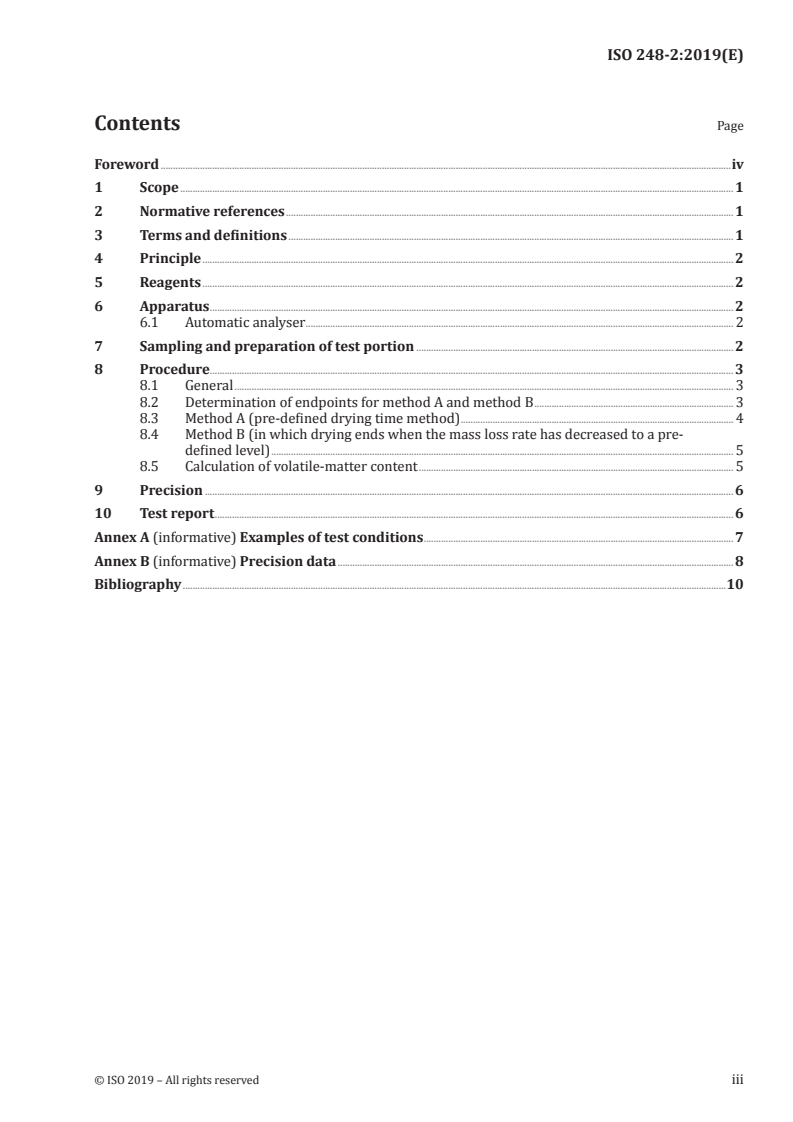
Contents Page
Foreword .iv
1 Scope . 1
2 Normative references . 1
3 Terms and definitions . 1
4 Principle . 2
5 Reagents . 2
6 Apparatus . 2
6.1 Automatic analyser . 2
7 Sampling and preparation of test portion . 2
8 Procedure. 3
8.1 General . 3
8.2 Determination of endpoints for method A and method B . 3
8.3 Method A (pre-defined drying time method) . 4
8.4 Method B (in which drying ends when the mass loss rate has decreased to a pre-
defined level) . 5
8.5 Calculation of volatile-matter content . 5
9 Precision . 6
10 Test report . 6
Annex A (informative) Examples of test conditions . 7
Annex B (informative) Precision data . 8
Bibliography .10
Foreword
ISO (the International Organization for Standardization) is a worldwide federation of national standards
bodies (ISO member bodies). The work of preparing International Standards is normally carried out
through ISO technical committees. Each member body interested in a subject for which a technical
committee has been established has the right to be represented on that committee. International
organizations, governmental and non-governmental, in liaison with ISO, also take part in the work.
ISO collaborates closely with the International Electrotechnical Commission (IEC) on all matters of
electrotechnical standardization.
The procedures used to develop this document and those intended for its further maintenance are
described in the ISO/IEC Directives, Part 1. In particular, the different approval criteria needed for the
different types of ISO documents should be noted. This document was drafted in accordance with the
editorial rules of the ISO/IEC Directives, Part 2 (see www .iso .org/directives).
Attention is drawn to the possibility that some of the elements of this document may be the subject of
patent rights. ISO shall not be held responsible for identifying any or all such patent rights. Details of
any patent rights identified during the development of the document will be in the Introduction and/or
on the ISO list of patent declarations received (see www .iso .org/patents).
Any trade name used in this document is information given for the convenience of users and does not
constitute an endorsement.
For an explanation of the voluntary nature of standards, the meaning of ISO specific terms and
expressions related to conformity assessment, as well as information about ISO's adherence to the
World Trade Organization (WTO) principles in the Technical Barriers to Trade (TBT) see www .iso
.org/iso/foreword .html.
This document was prepared by Technical Committee ISO/TC 45, Rubber and rubber products,
Subcommittee SC 3, Raw materials (including latex) for use in the rubber industry.
This second edition cancels and replaces the first edition (ISO 248-2:2012), which has been technically
revised.
The main change compared to the previous edition is the addition of precision data for isoprene rubber
in Table B.2, following an additional ITP conducted by Japan in 2017.
A list of all parts in the ISO 248 series can be found on the ISO website.
Any feedback or questions on this document should be directed to the user’s national standards body. A
complete listing of these bodies can be found at www .iso .org/members .html.
iv © ISO 2019 – All rights reserved
INTERNATIONAL STANDARD ISO 248-2:2019(E)
Rubber, raw — Determination of volatile-matter content —
Part 2:
Thermogravimetric methods using an automatic analyser
with an infrared drying unit
WARNING — Persons using this document should be familiar with normal laboratory practice.
This document does not purport to address all of the safety problems, if any, associated with its
use. It is the responsibility of the user to establish appropriate safety and health practices.
CAUTION — Some procedures specified in this document could involve the use or generation
of substances, or the generation of waste, that could constitute a local environmental hazard.
Reference should be made to appropriate documentation on safe handling and disposal after use.
1 Scope
1.1 This document specifies two thermogravimetric methods for the determination of moisture and
other volatile-matter content in raw rubbers by using an automatic analyser with an infrared drying unit.
1.2 These methods are applicable to the determination of volatile-matter content in synthetic rubbers
(SBR, NBR, BR, IR, CR, IIR, halogenated IIR and EPDM) listed in ISO 1629 and to various forms of raw
rubber, such as bale, block, chip, pellet, crumb, powder and sheet. These methods might also be applicable
to other raw rubbers only when the change in mass is proven to be due solely to loss of original volatile
matter and not to rubber degradation.
1.3 The methods are not applicable to raw rubbers which need homogenizing as specified in ISO 1795.
1.4 The hot-mill method and the oven method specified in ISO 248-1 and the methods specified in this
document might not give identical results. In cases of dispute, therefore, the oven method, procedure A,
specified in ISO 248-1:2011, is the referee method.
NOTE These methods can be useful for routine determinations, e.g. quality control, when the measurement
conditions for the automatic analyser are fixed for a particular raw rubber or grade of raw rubber.
2 Normative references
The following documents are referred to in the text in such a way that some or all of their content
constitutes requirements of this document. For dated references, only the edition cited applies. For
undated references, the latest edition of the referenced document (including any amendments) applies.
ISO 248-1, Rubber, raw — Determination of volatile-matter content — Part 1: Hot-mill method and
oven method
ISO 1795, Rubber, raw natural and raw synthetic — Sampling and further preparative procedures
3 Terms and definitions
No terms and definitions are listed in this document.
ISO and IEC maintain terminological databases for use in standardization at the following addresses:
— ISO Online browsing platform: available at https: //www .iso .org/obp
— IEC Electropedia: available at http: //www .electropedia .org/
4 Principle
A test portion is continuously weighed to constant mass by a thermogravimetric method using an
automatic analyser with infrared drying. The volatile-matter content is calculated as the mass lost
during this procedure.
5 Reagents
Use only reagents of recognized analytical grade and only distilled water or water of equivalent purity.
5.1 Sodium l-tartrate dihydrate, purity ≥99 %, for use as a standard reference material.
6 Apparatus
Use ordinary laboratory apparatus and the following.
6.1 Automatic analyser
The automatic analyser shall consist of the following components:
a) an infrared drying unit or a far-infrared drying unit or a near-infrared drying unit;
b) a balance, capable of weighing to the nearest 1 mg;
c) a microprocessor, capable of controlling drying conditions such as the temperature and the drying
end point, and of continuously calculating volatile-matter content as the mass lost during drying.
The accuracy of the system shall be demonstrated by performing 10 successive determinations on the
standard reference material sodium l-tartrate dihydrate (5.1). The mean of the 10 determinations shall
be (15,66 ± 0,5) %. The relative standard deviation, obtained by Formula (1), shall be less than 1,0 %.
S
s =×100 (1)
rel
W
where
s is the relative standard deviation, in percentage;
rel
S is the standard deviation;
W is the mean volatile-matter content, in mass %.
7 Sampling and preparation of test portion
Take a laboratory sample in accordance with the method specified in ISO 1795, and then prepare a
test portion of between 2 g and 15 g from the laboratory sample. The actual mass of the test portion
depends on the type of analyser, the expected volatile-matter content, and the form of the sample.
For raw rubbers in bale form, the test portion shall be cut into small pieces of volume less than abo
...
INTERNATIONAL ISO
STANDARD 248-2
Second edition
2019-03
Rubber, raw — Determination of
volatile-matter content —
Part 2:
Thermogravimetric methods using an
automatic analyser with an infrared
drying unit
Caoutchouc brut — Détermination des matières volatiles —
Partie 2: Méthodes thermogravimétriques utilisant un analyseur
automatique avec une unité de séchage infrarouge
Reference number
©
ISO 2019
© ISO 2019
All rights reserved. Unless otherwise specified, or required in the context of its implementation, no part of this publication may
be reproduced or utilized otherwise in any form or by any means, electronic or mechanical, including photocopying, or posting
on the internet or an intranet, without prior written permission. Permission can be requested from either ISO at the address
below or ISO’s member body in the country of the requester.
ISO copyright office
CP 401 • Ch. de Blandonnet 8
CH-1214 Vernier, Geneva
Phone: +41 22 749 01 11
Fax: +41 22 749 09 47
Email: copyright@iso.org
Website: www.iso.org
Published in Switzerland
ii © ISO 2019 – All rights reserved
Contents Page
Foreword .iv
1 Scope . 1
2 Normative references . 1
3 Terms and definitions . 1
4 Principle . 2
5 Reagents . 2
6 Apparatus . 2
6.1 Automatic analyser . 2
7 Sampling and preparation of test portion . 2
8 Procedure. 3
8.1 General . 3
8.2 Determination of endpoints for method A and method B . 3
8.3 Method A (pre-defined drying time method) . 4
8.4 Method B (in which drying ends when the mass loss rate has decreased to a pre-
defined level) . 5
8.5 Calculation of volatile-matter content . 5
9 Precision . 6
10 Test report . 6
Annex A (informative) Examples of test conditions . 7
Annex B (informative) Precision data . 8
Bibliography .10
Foreword
ISO (the International Organization for Standardization) is a worldwide federation of national standards
bodies (ISO member bodies). The work of preparing International Standards is normally carried out
through ISO technical committees. Each member body interested in a subject for which a technical
committee has been established has the right to be represented on that committee. International
organizations, governmental and non-governmental, in liaison with ISO, also take part in the work.
ISO collaborates closely with the International Electrotechnical Commission (IEC) on all matters of
electrotechnical standardization.
The procedures used to develop this document and those intended for its further maintenance are
described in the ISO/IEC Directives, Part 1. In particular, the different approval criteria needed for the
different types of ISO documents should be noted. This document was drafted in accordance with the
editorial rules of the ISO/IEC Directives, Part 2 (see www .iso .org/directives).
Attention is drawn to the possibility that some of the elements of this document may be the subject of
patent rights. ISO shall not be held responsible for identifying any or all such patent rights. Details of
any patent rights identified during the development of the document will be in the Introduction and/or
on the ISO list of patent declarations received (see www .iso .org/patents).
Any trade name used in this document is information given for the convenience of users and does not
constitute an endorsement.
For an explanation of the voluntary nature of standards, the meaning of ISO specific terms and
expressions related to conformity assessment, as well as information about ISO's adherence to the
World Trade Organization (WTO) principles in the Technical Barriers to Trade (TBT) see www .iso
.org/iso/foreword .html.
This document was prepared by Technical Committee ISO/TC 45, Rubber and rubber products,
Subcommittee SC 3, Raw materials (including latex) for use in the rubber industry.
This second edition cancels and replaces the first edition (ISO 248-2:2012), which has been technically
revised.
The main change compared to the previous edition is the addition of precision data for isoprene rubber
in Table B.2, following an additional ITP conducted by Japan in 2017.
A list of all parts in the ISO 248 series can be found on the ISO website.
Any feedback or questions on this document should be directed to the user’s national standards body. A
complete listing of these bodies can be found at www .iso .org/members .html.
iv © ISO 2019 – All rights reserved
INTERNATIONAL STANDARD ISO 248-2:2019(E)
Rubber, raw — Determination of volatile-matter content —
Part 2:
Thermogravimetric methods using an automatic analyser
with an infrared drying unit
WARNING — Persons using this document should be familiar with normal laboratory practice.
This document does not purport to address all of the safety problems, if any, associated with its
use. It is the responsibility of the user to establish appropriate safety and health practices.
CAUTION — Some procedures specified in this document could involve the use or generation
of substances, or the generation of waste, that could constitute a local environmental hazard.
Reference should be made to appropriate documentation on safe handling and disposal after use.
1 Scope
1.1 This document specifies two thermogravimetric methods for the determination of moisture and
other volatile-matter content in raw rubbers by using an automatic analyser with an infrared drying unit.
1.2 These methods are applicable to the determination of volatile-matter content in synthetic rubbers
(SBR, NBR, BR, IR, CR, IIR, halogenated IIR and EPDM) listed in ISO 1629 and to various forms of raw
rubber, such as bale, block, chip, pellet, crumb, powder and sheet. These methods might also be applicable
to other raw rubbers only when the change in mass is proven to be due solely to loss of original volatile
matter and not to rubber degradation.
1.3 The methods are not applicable to raw rubbers which need homogenizing as specified in ISO 1795.
1.4 The hot-mill method and the oven method specified in ISO 248-1 and the methods specified in this
document might not give identical results. In cases of dispute, therefore, the oven method, procedure A,
specified in ISO 248-1:2011, is the referee method.
NOTE These methods can be useful for routine determinations, e.g. quality control, when the measurement
conditions for the automatic analyser are fixed for a particular raw rubber or grade of raw rubber.
2 Normative references
The following documents are referred to in the text in such a way that some or all of their content
constitutes requirements of this document. For dated references, only the edition cited applies. For
undated references, the latest edition of the referenced document (including any amendments) applies.
ISO 248-1, Rubber, raw — Determination of volatile-matter content — Part 1: Hot-mill method and
oven method
ISO 1795, Rubber, raw natural and raw synthetic — Sampling and further preparative procedures
3 Terms and definitions
No terms and definitions are listed in this document.
ISO and IEC maintain terminological databases for use in standardization at the following addresses:
— ISO Online browsing platform: available at https: //www .iso .org/obp
— IEC Electropedia: available at http: //www .electropedia .org/
4 Principle
A test portion is continuously weighed to constant mass by a thermogravimetric method using an
automatic analyser with infrared drying. The volatile-matter content is calculated as the mass lost
during this procedure.
5 Reagents
Use only reagents of recognized analytical grade and only distilled water or water of equivalent purity.
5.1 Sodium l-tartrate dihydrate, purity ≥99 %, for use as a standard reference material.
6 Apparatus
Use ordinary laboratory apparatus and the following.
6.1 Automatic analyser
The automatic analyser shall consist of the following components:
a) an infrared drying unit or a far-infrared drying unit or a near-infrared drying unit;
b) a balance, capable of weighing to the nearest 1 mg;
c) a microprocessor, capable of controlling drying conditions such as the temperature and the drying
end point, and of continuously calculating volatile-matter content as the mass lost during drying.
The accuracy of the system shall be demonstrated by performing 10 successive determinations on the
standard reference material sodium l-tartrate dihydrate (5.1). The mean of the 10 determinations shall
be (15,66 ± 0,5) %. The relative standard deviation, obtained by Formula (1), shall be less than 1,0 %.
S
s =×100 (1)
rel
W
where
s is the relative standard deviation, in percentage;
rel
S is the standard deviation;
W is the mean volatile-matter content, in mass %.
7 Sampling and preparation of test portion
Take a laboratory sample in accordance with the method specified in ISO 1795, and then prepare a
test portion of between 2 g and 15 g from the laboratory sample. The actual mass of the test portion
depends on the type of analyser, the expected volatile-matter content, and the form of the sample.
For raw rubbers in bale form, the test portion shall be cut into small pieces of volume less than abo
...