

ISO/IEC 17360:2023
(Main)Automatic identification and data capture techniques — Supply chain applications of RFID — Product tagging, product packaging, transport units, returnable transport units and returnable packaging items
General Information
- Abstract
This document defines the basic features of RFID for use in the supply chain when applied to product tagging, product packaging, transport units and returnable transport items (RTIs) and returnable packaging items (RPIs). This document: — provides specifications for the identification of the items, — makes recommendations about additional information on the RF tag, — specifies the semantics and data syntax to be used, — specifies the data protocol to be used to interface with business applications and the RFID system, — specifies the minimum performance requirements, — specifies the air interface standards between the RF interrogator and RF tag, and — specifies the reuse and recyclability of the RF tag.
- Status
- Published
- Publication Date
- 24-May-2023
- Technical Committee
- ISO/IEC JTC 1/SC 31 - Automatic identification and data capture techniques
- Current Stage
- 9092 - International Standard to be revised
- Start Date
- 16-Dec-2025
- Completion Date
- 29-Aug-2026
Buy Documents


ISO/IEC 17360:2023 - Automatic identification and data capture techniques — Supply chain applications of RFID — Product tagging, product packaging, transport units, returnable transport units and returnable packaging items Released:25. 05. 2023
Overview
ISO/IEC 17360:2023 - Automatic identification and data capture techniques - Supply chain applications of RFID - defines the baseline requirements and best practices for using RFID across supply chain item levels: product tagging, product packaging, transport units, returnable transport items (RTIs) and returnable packaging items (RPIs). The standard covers identification, data syntax and semantics, data protocols for business-system interfacing, minimum performance and air‑interface requirements, plus guidance on reuse and recyclability of RF tags. Recent updates add 8‑bit (UTF‑8) and binary UII encodings and harmonize prior related ISO 1736x documents into a single specification.
Key topics and technical requirements
- Unique Item Identifier (UII): Defines the minimum UII components - Issuing Agency Code (IAC), Company Identification Number (CIN) and Serial Number (SN) - to ensure item-level serialization and traceability.
- Data syntax & semantics: Specifies how data is structured on tags and how business applications should interpret it (including GS1/ANSI DI conventions and ISO/IEC encodings).
- Encoding options: Supports GS1 EPC bitstream, ISO/IEC 15418 formats, UTF‑8 (8‑bit) and binary UII encodings to maximize interoperability across readers and back-end systems.
- Data protocol: References RFID item-management application interfaces (e.g., ISO/IEC 15961‑1) for interfacing readers and enterprise systems.
- Air interface & performance: Specifies air‑interface parameters (e.g., references to ISO/IEC 18000‑3 and 18000‑63) and minimum tag/reader performance requirements for reliable reads in supply chain environments.
- Tag lifecycle: Requirements and recommendations for tag reuse, recyclability and fallback strategies (e.g., barcode backup in case of tag failure).
- Layering & selection: Guidance on distinguishing tag “layers” (item, packaging, transport unit, RTI) including group-select methods for selective interrogation.
Applications and who uses it
ISO/IEC 17360:2023 is used by:
- RFID system integrators and solution architects implementing end‑to‑end tagging and reader deployments.
- Manufacturers and packaging engineers designing tagged products, packages and reusable transport items.
- Logistics and warehouse managers seeking improved inventory visibility, serialized tracking and RTI management.
- Retailers and OEMs implementing provenance, warranty, maintenance tracking and serialized receipts.
- Tag and reader manufacturers ensuring compliance with air‑interface, encoding and performance requirements. Practical use cases include item-level serialization for traceability, automated receiving/picking, RTI lifecycle management and integrating RFID data into ERP/WMS systems.
Related standards
Normative references and related documents include ISO/IEC 15418, ISO/IEC 15434, ISO/IEC 15459‑2, ISO/IEC 15961‑1, ISO/IEC 18000‑3, ISO/IEC 18000‑63, ISO/IEC 20248, ISO/IEC 29160, GS1 EPC Tag Data Standard and GS1 General Specifications.
Keywords: ISO/IEC 17360:2023, RFID supply chain, product tagging, UII, RTI, RPI, RFID encoding, air interface, GS1, traceability, RFID reuse.
Relations
- Effective Date
- 17-Jun-2026
- Effective Date
- 16-Jul-2022
- Effective Date
- 06-Jun-2022
- Effective Date
- 06-Jun-2022
- Effective Date
- 06-Jun-2022
Buy Documents
ISO/IEC 17360:2023 - Automatic identification and data capture techniques — Supply chain applications of RFID — Product tagging, product packaging, transport units, returnable transport units and returnable packaging items Released:25. 05. 2023
Get Certified
Connect with accredited certification bodies for this standard

BSI Group
BSI (British Standards Institution) is the business standards company that helps organizations make excellence a habit.

NYCE
Mexican standards and certification body.
Sponsored listings
Frequently Asked Questions
ISO/IEC 17360:2023 is a standard published by the International Organization for Standardization (ISO). Its full title is "Automatic identification and data capture techniques — Supply chain applications of RFID — Product tagging, product packaging, transport units, returnable transport units and returnable packaging items". This standard covers: This document defines the basic features of RFID for use in the supply chain when applied to product tagging, product packaging, transport units and returnable transport items (RTIs) and returnable packaging items (RPIs). This document: — provides specifications for the identification of the items, — makes recommendations about additional information on the RF tag, — specifies the semantics and data syntax to be used, — specifies the data protocol to be used to interface with business applications and the RFID system, — specifies the minimum performance requirements, — specifies the air interface standards between the RF interrogator and RF tag, and — specifies the reuse and recyclability of the RF tag.
This document defines the basic features of RFID for use in the supply chain when applied to product tagging, product packaging, transport units and returnable transport items (RTIs) and returnable packaging items (RPIs). This document: — provides specifications for the identification of the items, — makes recommendations about additional information on the RF tag, — specifies the semantics and data syntax to be used, — specifies the data protocol to be used to interface with business applications and the RFID system, — specifies the minimum performance requirements, — specifies the air interface standards between the RF interrogator and RF tag, and — specifies the reuse and recyclability of the RF tag.
ISO/IEC 17360:2023 is classified under the following ICS (International Classification for Standards) categories: 35.040.50 - Automatic identification and data capture techniques. The ICS classification helps identify the subject area and facilitates finding related standards.
ISO/IEC 17360:2023 has the following relationships with other standards: It is inter standard links to EN 18219:2026, ISO 17367:2013, ISO 17364:2013, ISO 17366:2013, ISO 17365:2013. Understanding these relationships helps ensure you are using the most current and applicable version of the standard.
ISO/IEC 17360:2023 is available in PDF format for immediate download after purchase. The document can be added to your cart and obtained through the secure checkout process. Digital delivery ensures instant access to the complete standard document.
Standards Content (Sample)
INTERNATIONAL ISO/IEC
STANDARD 17360
First edition
2023-05
Automatic identification and data
capture techniques — Supply chain
applications of RFID — Product
tagging, product packaging, transport
units, returnable transport units and
returnable packaging items
Techniques automatiques d'identification et de capture des
données — Applications de chaîne d'approvisionnements de RFID —
Étiquetage de produits, empaquetage de produits, unités de transport,
éléments restituables de transport et éléments d'empaquetage
restituables
Reference number
© ISO/IEC 2023
© ISO/IEC 2023
All rights reserved. Unless otherwise specified, or required in the context of its implementation, no part of this publication may
be reproduced or utilized otherwise in any form or by any means, electronic or mechanical, including photocopying, or posting on
the internet or an intranet, without prior written permission. Permission can be requested from either ISO at the address below
or ISO’s member body in the country of the requester.
ISO copyright office
CP 401 • Ch. de Blandonnet 8
CH-1214 Vernier, Geneva
Phone: +41 22 749 01 11
Email: copyright@iso.org
Website: www.iso.org
Published in Switzerland
ii
© ISO/IEC 2023 – All rights reserved
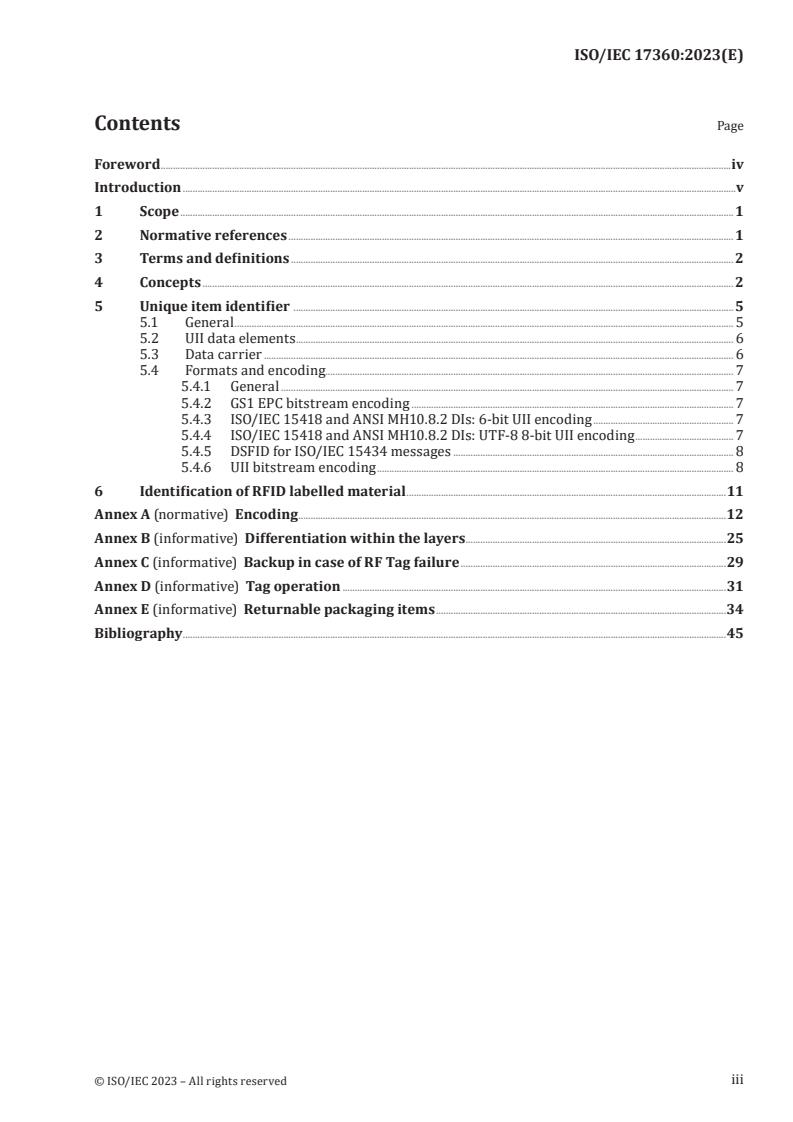
Contents Page
Foreword .iv
Introduction .v
1 Scope . 1
2 Normative references . 1
3 Terms and definitions . 2
4 Concepts . 2
5 Unique item identifier .5
5.1 General . 5
5.2 UII data elements . 6
5.3 Data carrier . 6
5.4 Formats and encoding. 7
5.4.1 General . 7
5.4.2 GS1 EPC bitstream encoding . 7
5.4.3 ISO/IEC 15418 and ANSI MH10.8.2 DIs: 6-bit UII encoding . 7
5.4.4 ISO/IEC 15418 and ANSI MH10.8.2 DIs: UTF-8 8-bit UII encoding . 7
5.4.5 DSFID for ISO/IEC 15434 messages . 8
5.4.6 UII bitstream encoding . 8
6 Identification of RFID labelled material .11
Annex A (normative) Encoding .12
Annex B (informative) Differentiation within the layers .25
Annex C (informative) Backup in case of RF Tag failure .29
Annex D (informative) Tag operation .31
Annex E (informative) Returnable packaging items .34
Bibliography .45
iii
© ISO/IEC 2023 – All rights reserved
Foreword
ISO (the International Organization for Standardization) and IEC (the International Electrotechnical
Commission) form the specialized system for worldwide standardization. National bodies that are
members of ISO or IEC participate in the development of International Standards through technical
committees established by the respective organization to deal with particular fields of technical
activity. ISO and IEC technical committees collaborate in fields of mutual interest. Other international
organizations, governmental and non-governmental, in liaison with ISO and IEC, also take part in the
work.
The procedures used to develop this document and those intended for its further maintenance
are described in the ISO/IEC Directives, Part 1. In particular, the different approval criteria
needed for the different types of document should be noted. This document was drafted in
accordance with the editorial rules of the ISO/IEC Directives, Part 2 (see www.iso.org/directives or
www.iec.ch/members_experts/refdocs).
ISO and IEC draw attention to the possibility that the implementation of this document may involve the
use of (a) patent(s). ISO and IEC take no position concerning the evidence, validity or applicability of
any claimed patent rights in respect thereof. As of the date of publication of this document, ISO and IEC
had not received notice of (a) patent(s) which may be required to implement this document. However,
implementers are cautioned that this may not represent the latest information, which may be obtained
from the patent database available at www.iso.org/patents and https://patents.iec.ch. ISO and IEC shall
not be held responsible for identifying any or all such patent rights.
Any trade name used in this document is information given for the convenience of users and does not
constitute an endorsement.
For an explanation of the voluntary nature of standards, the meaning of ISO specific terms and
expressions related to conformity assessment, as well as information about ISO's adherence to
the World Trade Organization (WTO) principles in the Technical Barriers to Trade (TBT) see
www.iso.org/iso/foreword.html. In the IEC, see www.iec.ch/understanding-standards.
This document was prepared by Joint Technical Committee ISO/IEC JTC 1, Information technology,
Subcommittee SC 31, Automatic identification and data capture techniques.
This first edition of ISO/IEC 17360 cancels and replaces ISO 17367:2013, ISO 17366:2013, ISO 17365:2013
and ISO 17364:2013, which has been technically and editorially revised.
The main changes are as follows:
— ISO 17367:2013, ISO 17366:2013, ISO 17365:2013 and ISO 17364:2013 have been integrated into
this document;
— 8-bit encoding and decoding using the UTF-8 encoding set has been added;
— binary encoding of the UII has been added;
— outdated processes and information have been updated.
Any feedback or questions on this document should be directed to the user’s national standards
body. A complete listing of these bodies can be found at www.iso.org/members.html and
www.iec.ch/national-committees.
iv
© ISO/IEC 2023 – All rights reserved
Introduction
The Supply Chain is a multi-level concept that covers all aspects of taking a product from raw materials
to a final product, including shipping to a final place of sale, use and maintenance and, potentially,
disposal. Each of these levels covers many aspects of dealing with products and the business process
for each level is both unique and overlaps other levels.
For the purposes of this document, “product”, “product packaging”, “transport unit”, and “returnable
transport item (RTI) and returnable packaging item (RPI)” are all called items.
For the purposes of this document, the value of a single byte is represented using hexadecimal
characters written as 0xnn, where “0x” is the hexadecimal indicator and “nn” is the hexadecimal value.
For the purposes of this document, a series of 1’s and/or 0’s followed by a subscript 2 indicates that
these series of digits are to be interpreted as bit values, or as a number expressed in binary form.
For the purposes of this document, the representation of the tags memory banks (MB) 00 , MB01 ,
2 2
MB10 and MB11 are represented as MB00, MB01, MB10 and MB11.
2 2
v
© ISO/IEC 2023 – All rights reserved
INTERNATIONAL STANDARD ISO/IEC 17360:2023(E)
Automatic identification and data capture techniques —
Supply chain applications of RFID — Product tagging,
product packaging, transport units, returnable transport
units and returnable packaging items
1 Scope
This document defines the basic features of RFID for use in the supply chain when applied to product
tagging, product packaging, transport units and returnable transport items (RTIs) and returnable
packaging items (RPIs). This document:
— provides specifications for the identification of the items,
— makes recommendations about additional information on the RF tag,
— specifies the semantics and data syntax to be used,
— specifies the data protocol to be used to interface with business applications and the RFID system,
— specifies the minimum performance requirements,
— specifies the air interface standards between the RF interrogator and RF tag, and
— specifies the reuse and recyclability of the RF tag.
2 Normative references
The following documents are referred to in the text in such a way that some or all of their content
constitutes requirements of this document. For dated references, only the edition cited applies. For
undated references, the latest edition of the referenced document (including any amendments) applies.
ISO 445, Pallets for materials handling — Vocabulary
ISO/IEC 15418, Information technology — Automatic identification and data capture techniques — GS1
Application Identifiers and ASC MH10 Data Identifiers and maintenance
ISO/IEC 15434, Information technology — Automatic identification and data capture techniques — Syntax
for high-capacity ADC media
ISO/IEC 15459-2, Information technology — Automatic identification and data capture techniques —
Unique identification — Part 2: Registration procedures
ISO/IEC 15961-1, Information technology — Data protocol for radio frequency identification (RFID) for
item management — Part 1: Application interface
ISO/IEC 18000-3, Information technology — Radio frequency identification for item management — Part
3: Parameters for air interface communications at 13,56 MHz
ISO/IEC 18000-63, Information technology — Radio frequency identification for item management — Part
63: Parameters for air interface communications at 860 MHz to 960 MHz Type C
ISO/IEC 19762, Information technology — Automatic identification and data capture (AIDC) techniques —
Harmonized vocabulary
© ISO/IEC 2023 – All rights reserved
ISO/IEC 20248, Information technology — Automatic identification and data capture techniques — Digital
signature data structure schema
ISO/IEC 29160, Information technology — Radio frequency identification for item management — RFID
Emblem
ANSI MH10.8.2, Data Identifiers
GS1 EPC Tag Data Standard (TDS)
GS1 General Specifications.
3 Terms and definitions
For the purposes of this document, the terms and definitions given in ISO 445, ISO/IEC 19762 and the
following apply.
ISO and IEC maintain terminology databases for use in standardization at the following addresses:
— ISO Online browsing platform: available at https:// www .iso .org/ obp
— IEC Electropedia: available at https:// www .electropedia .org/
3.1
domain authority identifier
DAID
unique identifier of an entity fulfilling the role of a Domain Authority who is the issuer of the data
contain in the tag
3.2
packaging
material used for the containment, protection, handling, delivery, storage, transport and presentation
of goods
Note 1 to entry: Ownership changes at time of purchase or delivery.
3.3
returnable packaging item
RPI
material used for the “protection” of goods during handling, delivery, storage and transport that are
returned for further usage
Note 1 to entry: See Annex E for details on the use of returnable packaging (3.2) items.
Note 2 to entry: Ownership does not change at time of purchase or delivery.
4 Concepts
Figures 1 and 2 give a graphical representation of supply chain layers. They show a conceptual model
of possible supply chain relationships – not a one-for-one representation of physical things. Although
several layers in Figure 2 have clear physical counterparts, some common supply chain physical items
fit in several layers depending on the use case. For example, as shown in Figure 2, a repetitively used
pallet under constant ownership will be covered as a returnable transport item (RTI), a pallet that is
part of a consolidated unit load will be covered as a transport unit and a pallet that is integral to a
single item will be covered as product packaging. See Annex E for additional details on RTIs.
The term “supply chain layers” or levels, is a multi-level concept that covers all aspects of taking a
product from raw materials to:
— a final product;
© ISO/IEC 2023 – All rights reserved
— shipping;
— a final place of sale, use, maintenance;
— potentially, returned goods and disposal.
Each of these levels covers many aspects of dealing with products and the business process for each
level is both unique and overlaps other levels (see Annex B for additional information).
The item level through freight container level layers are addressed within the suite of standards for
“supply chain applications of RFID” and are intended to enhance supply chain visibility. The movement
vehicle level is not a part of the supply chain applications of RFID family of standards.
Layers 0, 1, 2 and 3 of Figure 2 are the subject of this document. Details of each of these Layers will be
covered in applicable clauses of this document.
Different Layer tags can be distinguished from following, or preceding, Layer tags by the use of a group-
select methodology contained in the RFID interrogator/reader. This group-select function allows the
interrogator, and supporting automated information systems (AIS), to quickly identify different Layer
tags.
© ISO/IEC 2023 – All rights reserved
Key
1 primary packaging (product, e.g. consumer packaging)
2 secondary packaging (outer packaging, e.g. product bulk package)
3 tertiary packaging (transport packaging, e.g. transport unit)
4 tertiary packaging (unitized transport packaging, e.g. transport unit)
5 returnable and non-returnable transport item (e.g. a pallet)
Figure 1 — Packaging
© ISO/IEC 2023 – All rights reserved
Figure 2 — Supply chain layers
5 Unique item identifier
5.1 General
Unique item identification (UII) is a process that assigns a unique data string to an individual item or
in this case, to an RFID tag that is associated to the item. The unique data string is called the unique
item identifier. Unique item identification of items allows data collection and management at a granular
level. The benefits of having granular level data are evident in such areas as provenance, traceability,
maintenance, retail warranties and enabling electronic transactions of record. The benefits are only
possible if each tagged item has a unique identity.
Items that are not uniquely identified will not normally be tagged at the item level. Items to which
unique item identifiers have been assigned are said to be serialized items. Traditionally, low-cost
consumable items will normally be tagged at the package, or higher, level; however, recent studies have
explored the ROI for tagging low-cost items.
The UII provides granular discrimination between like items that are identified with RFID tags or
barcodes. See Annex C for information on using barcode labels as backup in case of RFID Tag failure.
The Unique Tag ID (as defined by ISO/IEC 15963-1) is a mechanism to uniquely identify RFID tags and is
not the unique product identifier defined in this document.
The minimum data elements required for unique identification are an issuing agency code (IAC), a
unique enterprise identifier [Company Identification Number, (CIN)] assigned by the IAC and a serial
number (SN) that is unique within that enterprise identifier.
© ISO/IEC 2023 – All rights reserved
The unique identifier of ISO/IEC 15459-1 provides identification schemes for various layers of the
supply chain, from Layer 0 (products) up to Layer 3 (returnable transport items).
[18]
ISO/IEC 15459-1 and GS1 Serial Shipping Container Code (SSCC) specifies the unique identification
mechanisms for transport unit identification (Layer 2).
See Annex D for information on environmental factors for RFID tag operations.
5.2 UII data elements
Unique identification is provided by the minimum of the following three components:
a) IAC;
b) CIN;
c) SN.
The registration authority, as defined by ISO/IEC 15459-2, assigns the IAC. The IAC assigns the CIN.
The company identified by the CIN assigns the SN. The serial number component can be composed of
multiple parts – but in all cases must be a unique identifier within the CINs domain.
When using ISO/IEC 15418, the unique identity, as defined by IAC CIN SN, is preceded by an applicable
ANSI MH10.8.2 Data Identifier (DI). Any applicable Data Identifier from ISO/IEC 15418 is allowed.
It is strongly recommended that once the UII has been constructed and encoded on an RFID tag that it
be write-protected (locked or permalocked).
5.3 Data carrier
The data carrier/air interface shall be ISO/IEC 18000-63 or ISO/IEC 18000-3, Mode 3.
An ISO/IEC 18000-63 or ISO/IEC 18000-3, Mode 3 tags’ memory is structured in three user-accessible
memory banks:
a) MB01 (UII); for the purpose of this document, contains the ISO/IEC 18000-63-defined constructs of
the Protocol Control bits (PC), optional Extended PC bits (XPC) and the UII.
1) The PC bits contain flags to indicate the numbering system of the tag to be either ISO or GS1,
and the existence of XPC bits and User Memory (MB11).
2) When ISO is indicated, the PC bits contain an Application Family Identifier (AFI) that indicates
the data family of the UII.
3) The AFI is managed as specified by ISO/IEC 15961-3 and listed in the ISO/IEC 15961-2 Data
Constructs Register.
NOTE MB01 can include additional information, like tag and item flags, sensor data and other item
information as indicated by the PC Bits.
b) MB10 (TID); identifies the tag according to ISO/IEC 15963-1.
c) MB11 (USER); contains user information as specified by the AFI and/or the Data Storage Format
Identifier (DSFID). MB11 is optional.
As defined by the AFI, the UII format may be specified by a DSFID. The DSFID is specified and managed
as described in ISO/IEC 15962 and listed in the ISO/IEC 15961-2 Data Constructs Register. The Data
Constructs Register can be found in Reference [7].
© ISO/IEC 2023 – All rights reserved
5.4 Formats and encoding
5.4.1 General
Where there are application requirements to encode both the identity of the asset as well as a shipment
ID or license plate, it is possible to encode these unique identities in either one or two RF tags. In the
case of two tags within the ISO system, each tag will include its own unique AFI, that is, “0xA2” for
license plate (shipment identification) and “0xA3” for the RTI AFI. The AFIs shall be followed by the
respective ANSI MH10.8.2 Data Identifier as specified in ISO/IEC 15418. See Annex E for examples.
NOTE 1 At the time of publication of this document, assigned AFIs are: 0xA1, 0xA2, 0xA3, 0xA5, 0xAC and
0xAD. AFIs 0xA4, 0xA6, 0xA7 and 0xA8 are assigned historically for HAZMAT material and items. These AFIs
are maintained for historical purposes; they are not for use by new applications. The ISO/IEC 18000-63 XPC
HAZMAT flag is used to denote HAZMAT material.
NOTE 2 When using 8-bit encoding, the AFI for 8-bit encoding, 0xAC, will take precedence over and replace
the AFI to denote either license plate or RTI status.
When using RFID tags, the UII for the RTI shall be written to the UII memory bank (MB01, see Figure A.1)
and locked. The UII for the transport unit shall be preceded by the appropriate ANSI MH10.8.2, Category
10 license plate DI. If the license plate is to be stored on the same RFID tag, using the appropriate DI,
it shall be written and locked in user memory (MB11). When combining multiple data structures, the
syntax of the data shall comply with ISO/IEC 15434.
RFID tags shall have the serialized tag ID written to TID (MB10) by the manufacturers in accordance
with ISO/IEC 15963-1 and permalocked.
If read-only or WORM tags are employed in identifying RTIs, two tags shall be used. One tag represents
the unique transport unit identifier and the second represents the unique RTI identifier.
Subclauses 5.4.2 to 5.4.6 specify the unique item identifier methodologies that are allowed.
5.4.2 GS1 EPC bitstream encoding
For GS1 electronic product code (EPC) encoding, the numbering system identifier toggle, shown as
standard toggle (T) in Figure A.2, shall be set to 0 (GS1). The UII shall then be an EPC as specified by
GS1, EPC Tag Data Standard (TDS).
5.4.3 ISO/IEC 15418 and ANSI MH10.8.2 DIs: 6-bit UII encoding
The numbering system identifier toggle, shown as standard T in Figure A.2, shall be set to 1 (ISO).
An ISO/IEC 15418-based UII, consisting of an applicable DI and item information, shall be encoded
according to the AFI selected, as that AFI is defined by the ISO/IEC 15961-2 appointed registration
authority.
When using ISO/IEC 15434-based messages within MB01, the first DI in the message shall identify the
UII, which consists of IAC, CIN, and SN. It is strongly recommended that only one DI, and its data be used
in MB01. In all cases, the UII shall be defined by the first DI in an ISO/IEC 15434-based message placed
in MB01.
G
When used, multiple DIs shall be separated by the control character (011110 ).
S 2
E
The messages should be terminated with the control character O (100001 ).
T 2
Annex A provides additional details on 6-bit encoding and decoding.
5.4.4 ISO/IEC 15418 and ANSI MH10.8.2 DIs: UTF-8 8-bit UII encoding
The numbering system identifier toggle, shown as standard T in Figure A.2, shall be set to 1 (ISO).
© ISO/IEC 2023 – All rights reserved
The UII is encoded using UTF-8 encoding as specified by an appropriate AFI as shown in the
ISO/IEC 15961-2 Data Constructs Register.
When using ISO/IEC 15434-based messages within MB01, the first DI in the message shall identify the
UII, which consists of IAC, CIN, and SN. It is strongly recommended that only one DI, and its data, be
used in MB01. In all cases, the UII shall be defined by the first DI in an ISO/IEC 15434-based message
placed in MB01.
G
When used, multiple DIs shall be separated by the control character (0x1D).
S
E
The messages should be terminated with the control character O (0x04).
T
Annex A provides additional details on 8-bit encoding and decoding.
5.4.5 DSFID for ISO/IEC 15434 messages
See ISO/IEC 15961-2, Data Constructs Register, for Data Format 03 and 13 definitions, and for the
specification for DSFIDs.
5.4.6 UII bitstream encoding
5.4.6.1 Encoding rules
Binary encoding provides superior benefits when encoding data that is equal to or larger than 6
characters.
The numbering system identifier toggle, shown as standard T in Figure A.2, shall be set to 1 (ISO).
The UII is encoded as a bitstream, as shown in Table 1, and as outlined in the steps below Table 3. It is
also identified with the appropriate AFI from the ISO/IEC 15961-2 Data Constructs Register.
Table 1 — Bitstream representation of UII encoding
UII-bitstream data elements
UII-Type SN-Type MB01-DS- MB11-DS- IAC+CIN MB11-Word- UII-SN
UII data element
(see Table 2) (see Table 3) FID-flag FID-flag (DAID encoding) Count (serialization)
n bits
Bit length for the 32, 40 or
4 bits 2 bits 1 bit 1 bit 8 bits According to
data to be encoded 48 bits
the SN-Type
Total bit length of
>48 bits to a 16-bit word boundary
encoded data
Table 2 — UII type identifier
UII-Type UII-Type encoding value Description
binary
0 0000 General item
1 0001 Product
2 0010 Product package
3 0011 Transport unit
4 0100 Transport item
For proprietary use, a UII-Type beyond those listed in Table 2 can be used by an entity identified by an
IAC CIN.
NOTE 1 There is currently no process available to assign additional UII Identifiers.
Table 3 shows the different methods of encoding the serial number element.
© ISO/IEC 2023 – All rights reserved
Table 3 — SN Type description
SN-Type SN-Type Description Encoding rules
encoding value
binary
0 00 Decimal number. The UII-SN shall not be followed with
additional data, i.e. the UII cannot contain
Base-36 (hexatridecimal)
additional data.
number with the digit
1 01
sequence "0" to "9" and then
The UII-SN shall be padded with leading
"A" to "Z".
zeros.
The UII-SN shall be terminated with a
E E
6-bit character set. complete O , incomplete O or by the UII
T T
2 10
G
See Table A.1. length, whichever comes first, or a when
S
followed by additional data.
The SN shall be represented in text as an
uppercase hexadecimal value.
3 11 Use the TID as the SN.
The UII may contain additional data following
the MB11-word-count.
NOTE 2 For SN-Type 0, a UII length of six words (96 bits), and an IAC + CIN encoding length of 40 bits results in
an SN length of 40 bits. For example, SN decimal number 222,722,086 is encoded as 0000 0000 0000 1101 0100
0110 0111 1000 0010 0110 , which is 000D46782616.
NOTE 3 For SN-Type 1, a UII length of six words (96 bits), and an IAC + CIN encoding length of 40 bits results in
an SN length of 40 bits. For example, SN hexatridecimal number "3OLPGM" is encoded as 0000 0000 0000 1101
0100 0110 0111 1000 0010 0110 , which is 000D46782616. Various free web-based convertors are available;
search for "base36 conversion".
NOTE 4 For SN-Type 0 and 1, the UII-SN length is the PC bits UII length in bits minus the length of the preceding
six UII data elements (which is 48 bits, 56 bits or 64 bits).
NOTE 5 The TID is specified to be unique by ISO/IEC 15963-1 and ISO/IEC 18000-63.
The UII-bitstream encoding, as shown in Table 1, consists of the following elements:
a) UII-Type: 4 bits; value selected from Table 2.
b) SN-Type: 2 bits; value selected from Table 3.
c) MB01-DSFID-Flag (UII additional data DSFID): 1 bit.
1) This bit is only valid for SN-Type 2 and 3. It shall be ignored (set to 0 ) for SN-Type 0 and 1.
2) For SN-Type 2:
— When the flag is set to 0 , the UII-SN and the data stored in MB01 following the UII-SN shall
G E E
use as the data element separator, and be terminated with an O , incomplete O , or by
S T T
the UII length, whichever comes first, see 5.4.6.2.
— When the flag is set to 1 , the data stored in MB01 following the UII-SN encoding shall start
with a DSFID and follow the encoding rules of the DSFID. The UII-SN encoding and DSFID
G
shall be separated with a , see 5.4.6.2.
S
3) For SN-Type 3 (the encoded UII does not contain an UII-SN, since the TID is the SN):
— When the flag is set to 0 , the data stored in MB01 following the MB11-Word-Count uses a
proprietary format. The length of the data is the PC bits UII length in bits minus the length
of the preceding six UII data elements (UII-Type, SN-Type, MB01-DSFID-flag, MB11-DSFID-
flag, IAC+CIN and MB11-Word-Count which is 48 bits, 56 bits, or 64 bits).
— When the flag is set to 1 , the data stored in MB01 following the MB11-Word-Count shall
start with a DSFID and follow the encoding rules of the DSFID.
© ISO/IEC 2023 – All rights reserved
d) MB11-DSFID-Flag (UserMem DSFID): 1 bit;
— When the flag is set to 0 , the data stored in MB11 uses a proprietary format.
— When the flag is set to 1 , the data stored in MB11 shall start with an ISO/IEC 15961-1-based
DSFID.
e) IAC+CIN: 32 bits, 40 bits or 48 bits; shall be encoded as specified by ISO/IEC 20248:2022, 7.5.1 DAID
encoding.
NOTE The ISO/IEC 20248 encoding results in encoded data lengths of 32 bits, 40 bits or 48 bits. This is
to provide bit-length efficiency as the IAC and CIN, as specified by ISO/IEC 15459-5, is of variable length.
f) MB11-Word-Count: 8 bits; providing a method to indicate that the first MB11-Word-Count 16-bit
words of MB11 should be read and processed by the application. MB11 may contain more data.
NOTE Accessing MB11 data beyond the first 4080 bits is outside the scope of this document. There are
various standard methods to access these bits, of which the method is typically selected and configured in
the first 4080 bits of MB11.
g) UII-SN (UII encoded serialisation): n bits according to the SN-Type to fit within the ISO/IEC 18000-63
data memory 16-bit word boundary.
5.4.6.2 UII-SN termination examples
The UII-SN may be terminated with:
G
— a when followed by other data, or
S
— be terminated
— by the 16-bit word boundary as specified by the UII Length in the PC bits, see Figure A.2,
E
— by a complete O , or
T
E
— an in complete O .
T
NOTE This termination method is specified in ISO/IEC 15962:2022 T.4.1, step 6.
Table 4 illustrates the UII-SN termination.
E
Table 4 — Valid O termination within a 2-word UII
T
UII-SN Length Encoding UII-SN Termination
32 bits xxxx xxxx xxxx xxxx|xxxx xxxx xxxx xxxx| On the 16-bit word boundary.
E
xxxx xxxx xxxx xxxx|xxxx xxxx xxxx xxeo|
30 bits Incomplete O .
T
E
xxxx xxxx xxxx xxxx|xxxx xxxx xxxx eote|
28 bits Incomplete O .
T
E
xxxx xxxx xxxx xxxx|xxxx xxxx xxeo teot|
26 bits Complete O .
T
E
xxxx xxxx xxxx xxxx|xxxx xxxx eote ot__|
24 bits Complete O .
T
E
22 bits xxxx xxxx xxxx xxxx|xxxx xxeo teot ____| Complete O .
T
Key
x : UII-SN bit
eoteot : 6 EOT encoding bits 100001
_ : bit not part of the encoding
See A.8.4 for binary encoding examples.
© ISO/IEC 2023 – All rights reserved
6 Identification of RFID labelled material
RF tags and RF label inlays compliant with this document shall include one or more of the internationally
accepted RFID emblems as described in ISO/IEC 29160. Figure 3 is an example of an RFID graphical
emblem.
NOTE These emblems can be scaled to the appropriate size and are available in either dark on light or light
on dark.
Figure 3 — RFID tag graphical emblem example
© ISO/IEC 2023 – All rights reserved
Annex A
(normative)
Encoding
A.1 General
This document recommends four possible forms of encoding for ISO/IEC 18000-63 and ISO/IEC 18000-3,
Mode 3 RF tags:
a) a GS1 EPC compliant form for either or both the UII in MB01 and User Memory in MB11:
1) the segmentation of ISO/IEC 18000-63 and ISO/IEC 18000-3, Mode 3 tags is illustrated in
Figure A.1;
2) EPC encoding is detailed in the GS1, EPC Tag Data Standard (TDS);
b) a structure employing ISO/IEC 15962:2022, Format 13 (relative OID);
c) a simplified structure, encoding an entire ISO/IEC 15434 message as a unit, employing a “no
directory”, encoded in either 6-bit or UTF-8, as defined in ISO/IEC 15962 and as described in the
remainder of this annex;
d) bit stream encoding.
A.2 Tag structure
Each of these encoding forms can be unambiguously discerned by the content of bits 0x17 through 0x1F
of MB01, as illustrated in Figures A.1 and A.2 bits 0x00 through 0x1F of MB11.
© ISO/IEC 2023 – All rights reserved
Figure A.1 — ISO/IEC 18000-63 and ISO/IEC 18000-3, Mode 3 Memory Structure
A key concept in this simplified encoding form, in both MB01 and MB11, is the use of 6-bit encoding as
shown in Table A.1. The values shown are in binary.
© ISO/IEC 2023 – All rights reserved
Table A.1 — 6-bit encoding
Information Binary Information Binary Information Binary Information Binary
Space 100000 0 110000 @ 000000 P 010000
E
O 100001 1 110001 A 000001 Q 010001
T
Reserved 100010 2 110010 B 000010 R 010010
F
100011 3 110011 C 000011 S 010011
S
U
100100 4 110100 D 000100 T 010100
S
Reserved 100101 5 110101 E 000101 U 010101
Reserved 100110 6 110110 F 000110 V 010110
Reserved 100111 7 110111 G 000111 W 010111
( 101000 8 111000 H 001000 X 011000
) 101001 9 111001 I 001001 Y 011001
* 101010 : 111010 J 001010 Z 011010
+ 101011 ; 111011 K 001011 [ 011011
, 101100 < 111100 L 001100 \ 011100
- 101101 = 111101 M 001101 ] 011101
G
. 101110 > 111110 N 001110 011110
S
R
/ 101111 ? 111111 O 001111 011111
S
NOTE Table A.1 is 6-bit encoding created through the simple removal of the high-order bit from the
ISO/IEC 646 7-bit ASCII character set, save the shaded values. The shaded values are re-assigned, as provided, to
minimize the bit count when using the ISO/IEC 15434 envelope.
The values in Table A.1 are not to be used without a re-issuance of this document that
reflects the defined values and functionality. An example will be a decision of the GS1 community to
use this encoding and petitioning for the encoding of an ECI. Additionally, the presence of one or more
of these characters can signal a different behaviour on the part of the decoder. While these
values are not used in this iteration of this document, they should not be used for any other purpose
than that defined by this document.
A.3 Tag memory banks
Tag memory shall be logically separated into four distinct banks, each of which may comprise one or
more memory words. A logical memory map is given in Figure A.1. See ISO/IEC 18000-63 for details. A
general definition of the memory banks follows.
a) Reserved memory (MB00) shall contain the kill and access passwords.
b) UII memory (MB01) shall contain a CRC-16, PC bits and a code, i.e. a UII, that identifies the object to
which the tag is or will be attached. See Figure A.2.
c) TID memory (MB10) shall contain an 8-bit ISO/IEC 15963-1 allocation class. TID memory shall
contain sufficient identifying information for an Interrogator to uniquely identify the custom
commands and/or optional features that a tag supports, and to be compliant to this document,
contain a unique serial number.
d) User memory (MB11) allows user-specific data storage. The storage format described in
ISO/IEC 15961-3 and ISO/IEC 15962 defines the memory organization. The presence of data in user
memory in MB11 shall be indicated by the presence of a binary “1” in the 0x15 PC-bit. A binary zero
in the 0x15 PC-bit shall indicate that there is no user memory at MB11 or that there is no data in
MB11. Further information on MB11 can be found in this annex and ISO/IEC 18000-63.
© ISO/IEC 2023 – All rights reserved
A.4 Protocol control bits
The PC bits contain physical-layer information that a tag backscatters with its UII during an “inventory”
operation. There are 16 PC bits, stored in MB01. See Figure A.2.
Figure A.2 — ISO/IEC 18000-63 and ISO/IEC 18000-3, Mode 3 structure of Memory Bank 01
A.5 Encoding of Memory Bank 01 unique item identifier
The standard T, the bit at memory location 0x17, of MB01 is the switch between ISO formats and EPC
formats. When bit 0x17 is set to a “0 ”, the EPC Identifier encoding is as per the GS1, EPC Tag Data
Standard (TDS). When bit 0x17 is set to a “1 ”, the UII encoding is as per ISO/IEC 15459-1 for individual
transport units, ISO/IEC 15459-4 for individual products and product packages, ISO/IEC 15459-5 for
individual RTIs and RPIs and preceded by an appropriate ISO/IEC 15961-2 AFI.
To show an example, encoding of a product is shown. Transport units will be identically encoded
except for the AFI and the DI used. A linear bar code symbol encoding the data providing unique item
identification comprises the DI, IAC, CIN and SN. An example of such a unique item identification
represented in a Code 128 linear bar code is shown in Figure A.3. This barcode can be the backup to an
RFID tag.
Figure A.3 is encoded with the following data.
NOTE The specific DI used in this example does not mean that other DIs cannot be used. Any applicable DI
from ISO/IEC 15418 and ANSI MH10.8.2 can be used.
— DI = 25S
— IAC = UN (DUNS)
— CIN = 043325711
— SN = MH8031200000000001
Figure A.3 — Code 128 encoding of “25SUN043325711MH8031200000000001”
© ISO/IEC 2023 – All rights reserved
When encoded onto an RFID tag, the AFI will be added to the data structure.
— AFI = 0xA1
— DI = 25S
— IAC = UN (DUNS)
— CIN = 043325711
— SN = MH8031200000000001
A complete data structure for an RFID tag, using the information defined above, will be
0xA125SUN043325711MH8031200000000001, and the data is represented in MB01 as shown in
Table A.2.
Table A.2 — MB01 structure of AFI and UII using 6-bit encoding
Information AFI = 0xA1 2 5 S U N 0 4 3 3
1010 0001 110010 110101 010011 010101 001110 110000 110100 110011 110011
Binary
Information 2 5 7 1 1 M H 8 0 3 1 2
110010 110101 110111 110001 110001 001101 001000 111000 110000 110011 110001 110010
Binary
E
Information 0 0 0 0 0 0 0 0 0 0 1 O
T
110000 110000 110000 110000 110000 110000 110000 110000 110000 110000 110001 100001
Binary
When UTF-8 encoding is used, it is represented in MB01 as shown in Table A.3.
Table A.3 — MB01 structure of AFI and UII using ISO/IEC UTF-8 encoding and DIs
Information AFI = 0xAC 2 5 S U N 0 4
1010 1100 00110010 00110101 01010011 01010101 01001110 00110000 00110100
Binary
Information 3 3 2 5 7 1 1 M H 8
00110011 00110011 00110010 00110101 00110111 00110001 00110001 01001101 01001000 00111000
Binary
Information 0 3 1 2 0 0 0 0 0 0
00110000 00110011 00110001 00110010 00110000 00110000 00110000 00110000 00110000 00110000
Binary
E
Information 0 0 0 0 1 O
T
00110000 00110000 00110000 00110000 00110001 00000100
Binary
A.6 General information on encoding data in MB11 - User Memory
To indicate data resides in MB11 (User Memory), the bit at memory location 0x15 of MB01 is set to a
“1 ”. The state of the standard T does not imply format information for MB11 because users may choose
to implement EPC encoding for MB01 and ISO encoding for MB11; for example, in cases where MB01
is read by retailers and MB11 by industrial consumers. The reverse encoding, ISO in MB01 and EPC in
MB11, is also possible.
To avoid confusion between the structures defined herein and those defined in ISO/IEC 15962, MB11
shall declare its access method and format.
© ISO/IEC 2023 – All rights reserved
A.7 Encoding and decoding of data in MB11
A.7.1 Encoding process
A.7.1.1 6-bit encoding
The encoding steps are:
R
a) Starting with a valid ISO/IEC 15434 message using ANSI MH10.8.2 Data Identifiers, strip “[ ) > 06
S
G R E
” from the front and “ O ” from the end.
S S T
NOTE The quotes and spaces that are used to separate the ISO/IEC 15434 data characters, above and
following, are not present in the actual datastream; they are shown for purposes of differentiation and
clarity only.
R G
a) If the resulting data contains the pattern “ 06 ” anywhere, the four-character combination
S S
R
should be replaced with the single character “ ” everywhere it exists. This occurs when multiple
S
“06” record envelopes are used, for example, when describing subassemblies of a complex part.
b) Convert the resulting data characters into their 6-bit code value using Table A.1.
E
c) Add a 6-bit “ O ” pattern from Table A.1 (“100001”) to the end of the bit pattern after the last
T
encoded data character. Add padding bits as needed in the form “100001”.
d) Lay out the 6-bit characters as bits and group them into 8-bit bytes such that any mismatch between
the data and an 8-bit boundary occurs in the last 6-bit padding bits pattern added in e).
e) Delete any bits of the last padding bits pattern that may be in a last, unfilled 8-bit byte.
f) Determine the number of bytes. Convert the count into binary and encode explicitly as the data
byte-count indicator.
E
g) Encode the DSFID, Precursor, data byte-count indicator, data, “ O ” and padding bits (if any) into
T
memory.
A.7.1.2 UTF-8 8-bit encoding
The encoding steps are:
R G R E
a) Starting with a valid ISO/IEC 15434 DI message, strip “[ ) > 06 ” from the front and “ O ”
S S S T
from the end.
b) List every data character into its UTF-8 code value using ISO/IEC 10646.
c) When encoding multiple “06” format envelopes (e.g., to represent a message containing several
"records" from the same data format in order to describe the subassemblies of a complex part),
R G R
reduce each internal ISO/IEC 15434 sequence “ 06 ” indicating a new "record" to a single “ ”
S S S
character.
E
d) Encode an “ O ” pattern after the last encoded data character.
T
E
e) Determine the byte number that contains the last bit of the “ O ” character, convert the decimal
T
count to binary and encode explicitly as the data byte-count indicator.
E
f) Encode the DSFID, Precursor, data byte-count indicator, data, “ O ” and padding bits (if any) into
T
memory.
© ISO/IEC 2023 – All rights reserved
A.7.2 Decode process using 6-bit or UTF-8
A.7.2.1 6-bit decoding
The decoding steps are:
a) Examine the DSFID and Precursor bytes and verify that they are equivalent to “0x03 0x46”.
b) Process the next 8 bits and convert the resulting data-byte-count-indicator to a decimal value to
determine the number of bytes containing data.
c) When using 6-bit encoding; starting with the next bit, group the following bits into character bit-
sets from the 6-bit code table and continue until the number of bytes containing data has be
...