

ISO 7627-1:1983
(Main)Hardmetals — Chemical analysis by flame atomic absorption spectrometry — Part 1: General requirements
General Information
- Abstract
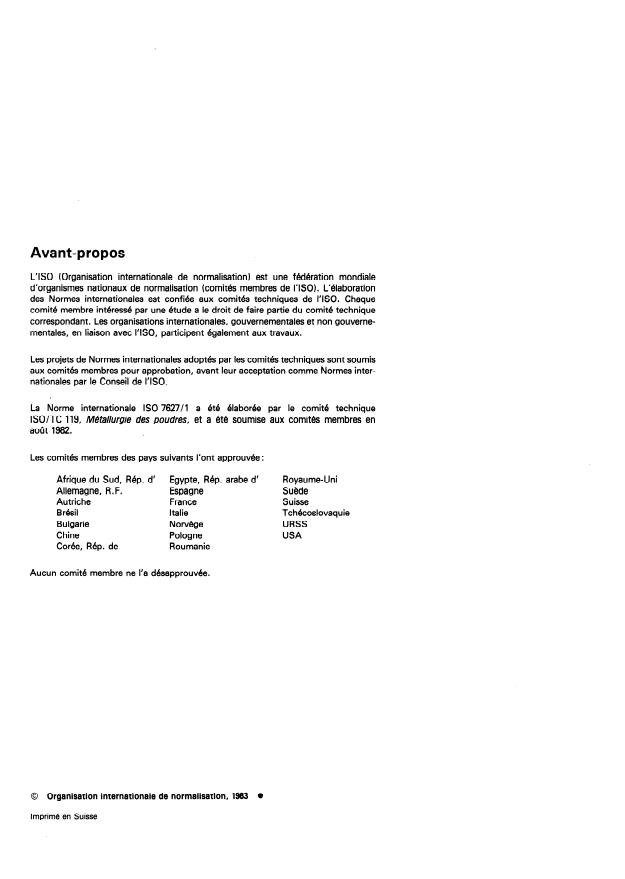
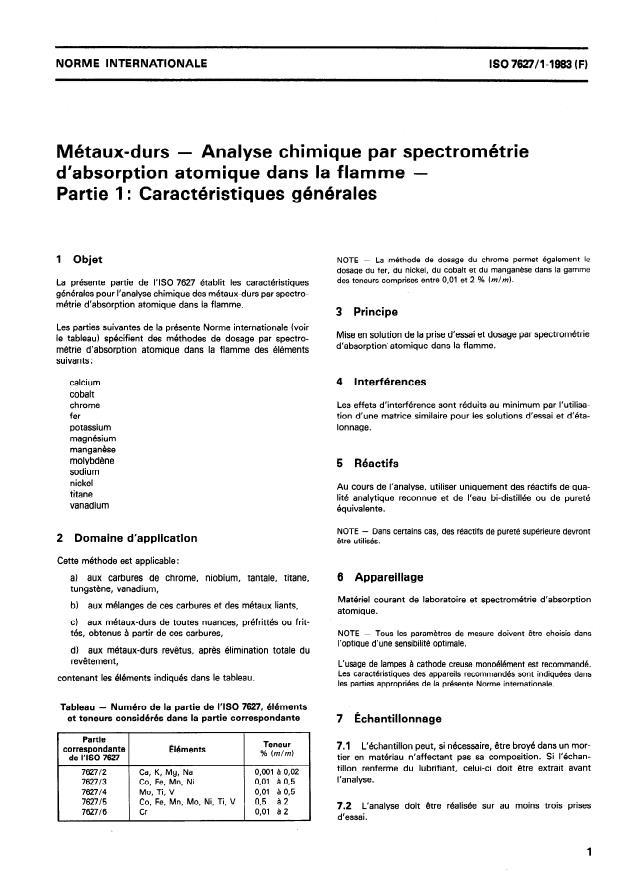
Subsequent parts of ISO 7627 specify methods for determination of the content of a number of elements (see the table). The method is applicable to cabides of chromium, niobium, tantalum, titanium, tungsten, vanadium, mixtures of these carbides and binder metals, all grades of presintered or sintered hardmetals, produced from these cabides, and coated hardmetals, after total removal of coating, with the elements shown in the table.
- Status
- Published
- Publication Date
- 30-Sep-1983
- Technical Committee
- ISO/TC 119/SC 4 - Sampling and testing methods for hardmetals
- Drafting Committee
- ISO/TC 119/SC 4 - Sampling and testing methods for hardmetals
- Current Stage
- 9093 - International Standard confirmed
- Start Date
- 12-Dec-2025
- Completion Date
- 29-Aug-2026
Buy Documents

ISO 7627-1:1983 - Hardmetals — Chemical analysis by flame atomic absorption spectrometry — Part 1: General requirements Released:10/1/1983

ISO 7627-1:1983 - Métaux-durs — Analyse chimique par spectrométrie d'absorption atomique dans la flamme — Partie 1: Caractéristiques générales Released:10/1/1983

ISO 7627-1:1983 - Métaux-durs — Analyse chimique par spectrométrie d'absorption atomique dans la flamme — Partie 1: Caractéristiques générales Released:10/1/1983
Overview
ISO 7627-1:1983 specifies the general requirements for chemical analysis of hardmetals using flame atomic absorption spectrometry (AAS). This Part 1 defines the field of application, fundamental principles, sampling guidance, reagent and apparatus expectations, and reporting conventions that ensure reproducible, accurate elemental analysis for quality assurance and process control.
The method covers total dissolution of a test portion followed by determination by flame AAS. Subsequent parts of ISO 7627 give element-specific methods and concentration ranges.
Key Topics
- Field of application: Applicable to carbides of chromium, niobium, tantalum, titanium, tungsten and vanadium; mixtures of these carbides with binder metals; all grades of presintered or sintered hardmetals; and coated hardmetals after total removal of coating.
- Principle: Dissolution of a test portion and measurement by flame atomic absorption spectrometry.
- Interferences: Minimized by using matrix-matched test and calibration solutions to reduce matrix effects from elements present in the sample.
- Reagents: Use analytical-grade reagents and double-distilled water (or equivalent purity); higher-purity reagents where necessary.
- Apparatus: Ordinary laboratory glassware plus AAS equipment. Single-element hollow-cathode lamps are recommended. Measurement parameters should be selected to optimize sensitivity.
- Sampling & sample prep:
- Crush samples in a mortar made of a material that does not alter composition when necessary.
- Extract any lubricants before analysis.
- Perform the analysis on at least three test portions to obtain representative results.
- Reporting: Test reports shall reference the standard and include sample identification, arithmetic mean of results, any deviations from the standard procedure, and details of occurrences that may have affected results.
Example element ranges (specified in subsequent parts):
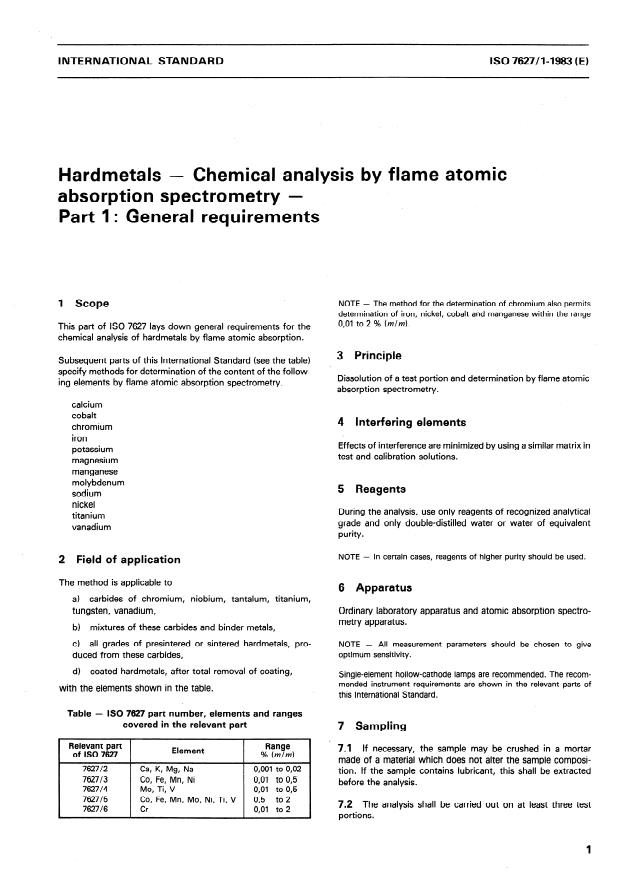
- Ca, K, Mg, Na: 0.001 to 0.02 %
- Co, Fe, Mn, Ni: 0.01 to 0.5 %
- Mo, Ti, V: 0.01 to 0.5 %
- Ni, Ti, V: 0.5 to 2 %
- Cr: 0.01 to 2 %
(Note: element-specific procedures and recommended instrument settings are provided in the relevant Parts of ISO 7627.)
Applications
ISO 7627-1:1983 provides a standardized foundation for laboratories and manufacturers performing chemical analysis of hardmetals. Typical uses include:
- Quality assurance of hardmetal batches and finished parts
- Process control during powder metallurgy and sintering operations
- Incoming material inspection for carbides and binder metals
- Regulatory and conformity testing where reproducible elemental data are required
Adhering to the general requirements reduces inter-lab variability and improves confidence in AAS-based determinations.
Related Standards
- Subsequent Parts of ISO 7627: element-specific methods and instrument settings (see table in ISO 7627 series).
- ISO/TC 119 (Powder metallurgy) publications and related analytical standards for sample dissolution and trace elemental analysis.
For implementation, consult the relevant Parts of ISO 7627 for detailed procedures, calibration ranges and instrument parameters specific to each element.
Buy Documents
ISO 7627-1:1983 - Hardmetals — Chemical analysis by flame atomic absorption spectrometry — Part 1: General requirements Released:10/1/1983
ISO 7627-1:1983 - Métaux-durs — Analyse chimique par spectrométrie d'absorption atomique dans la flamme — Partie 1: Caractéristiques générales Released:10/1/1983
ISO 7627-1:1983 - Métaux-durs — Analyse chimique par spectrométrie d'absorption atomique dans la flamme — Partie 1: Caractéristiques générales Released:10/1/1983
Get Certified
Connect with accredited certification bodies for this standard

Element Materials Technology
Materials testing and product certification.

Inštitut za kovinske materiale in tehnologije
Institute of Metals and Technology. Materials testing, metallurgical analysis, NDT.
Sponsored listings
Frequently Asked Questions
ISO 7627-1:1983 is a standard published by the International Organization for Standardization (ISO). Its full title is "Hardmetals — Chemical analysis by flame atomic absorption spectrometry — Part 1: General requirements". This standard covers: Subsequent parts of ISO 7627 specify methods for determination of the content of a number of elements (see the table). The method is applicable to cabides of chromium, niobium, tantalum, titanium, tungsten, vanadium, mixtures of these carbides and binder metals, all grades of presintered or sintered hardmetals, produced from these cabides, and coated hardmetals, after total removal of coating, with the elements shown in the table.
Subsequent parts of ISO 7627 specify methods for determination of the content of a number of elements (see the table). The method is applicable to cabides of chromium, niobium, tantalum, titanium, tungsten, vanadium, mixtures of these carbides and binder metals, all grades of presintered or sintered hardmetals, produced from these cabides, and coated hardmetals, after total removal of coating, with the elements shown in the table.
ISO 7627-1:1983 is classified under the following ICS (International Classification for Standards) categories: 77.160 - Powder metallurgy. The ICS classification helps identify the subject area and facilitates finding related standards.
ISO 7627-1:1983 is available in PDF format for immediate download after purchase. The document can be added to your cart and obtained through the secure checkout process. Digital delivery ensures instant access to the complete standard document.
Standards Content (Sample)
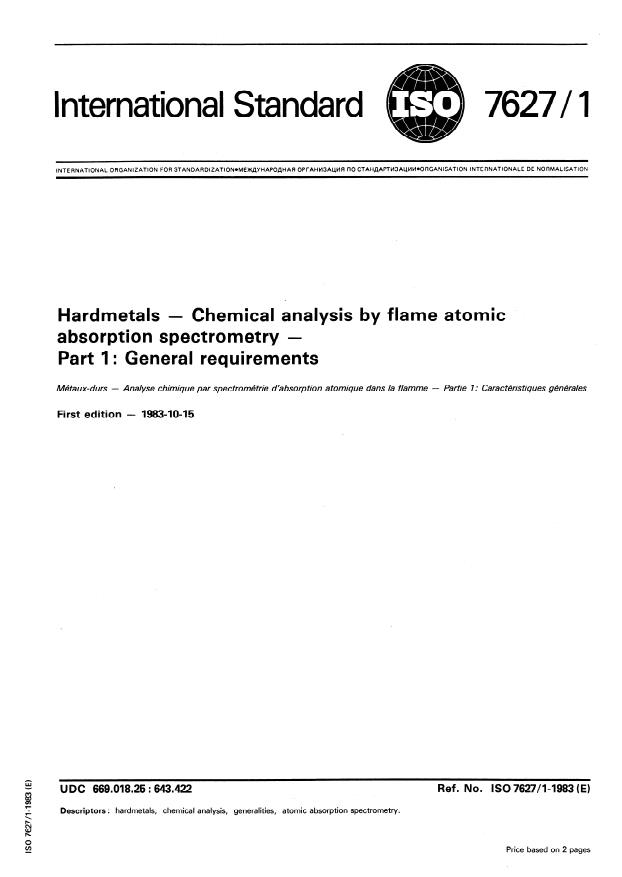
International Standard
INTERNATIONAL ORGANIZATION FOR STANDARDlZATIONWlEX~YHAPOAHAR OPTAHbl3AL&lR fl0 CTAH~APTl43ALWl*ORGANISAilON INTERNATIONALE DE NORMALISATION
Hardmetals - Chemical analysis by flame atomic
absorption spectrometry -
Part 1: General requirements
Mktaux-durs
- Analyse chimique par spectromhrie d ’absorption atomique dans Ia flamme - Partie 1: Caractikistiques g&&ales
First edition - 1983-10-15
UDC 669.018.25 : 643.422 Ref. No. ISO 7627/1-1983 (E)
Descriptors : hardmetals, Chemical analysis, generalities, atomic absorption spectrometry.
Price based on 2 pages
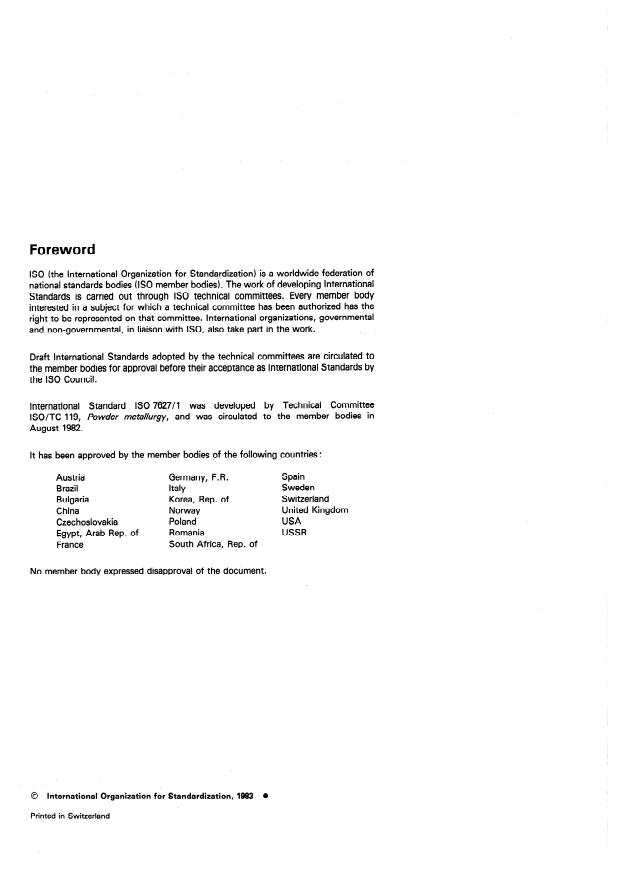
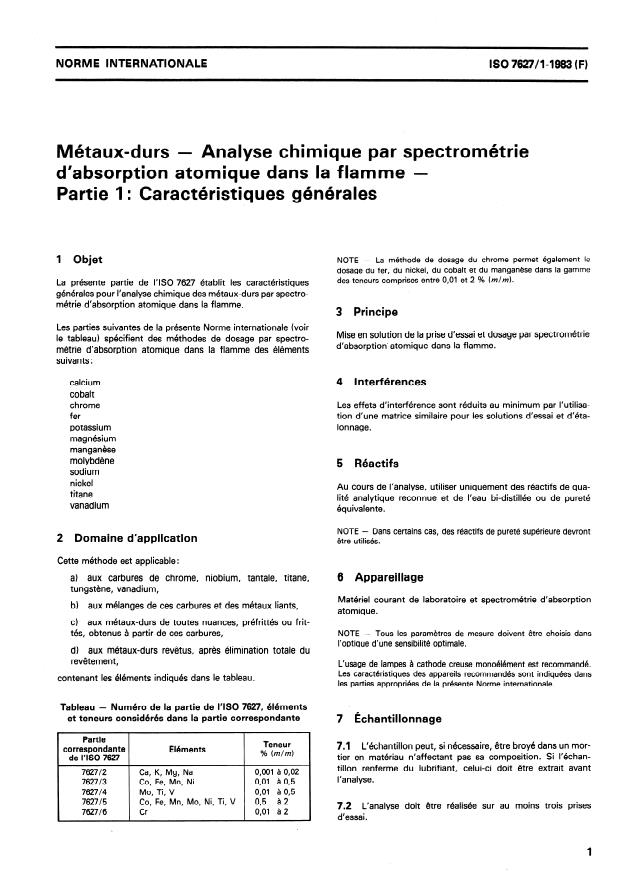
Foreword
ISO (the International Organization for Standardization) is a worldwide federation of
national Standards bodies (ISO member bodies). The work of developing International
Standards is carried out through ISO technical committees. Every member body
interested in a subject for which a technical committee has been authorized has the
right to be represented on that committee. International organizations, governmental
and non-governmental, in liaison with ISO, also take patt in the work.
Draft International Standards adopted by the technical committees are circulated to
the member bodies for approval before their acceptance as International Standards by
the ISO Council.
International Standard ISO 7627/1 was developed by Technical Committee
ISO/TC 119, Powder metahrgy, and was circulated to the member bodies in
August 1982.
lt has been approved by the member bodies of the following countries:
Spain
Austria Germany, F. R.
Brazil Italy Sweden
Bulgaria Korea, Rep. of Switzerland
United Kingdom
China Norway
Czechoslovakia Poland USA
Egypt, Arab Rep. of Romania USSR
South Africa, Rep. of
France
No member body expressed disapproval of the document.
0 International Organkation for Standardkation, 1983
Printed in Switzerland
ISO 7627/1-1983 (E)
INTERNATIONAL STANDARD
’
- Chemical analysis by flame atomic
Hardmetals
absorption spectrometry -
Part 1: General requirements
NOTE - The method for the determination of chromium also permits
1 Scope
determination of iron, nickel, Cobalt and manganese within the range
0,Ol to 2 % hlm).
This part of ISO 7627 lays down general requirements for the
Chemical analysis of hardmetals by flame atomic absorption.
3 Principle
Subsequent Parts of this International Standard (see the table)
specify methods for determi
...
,
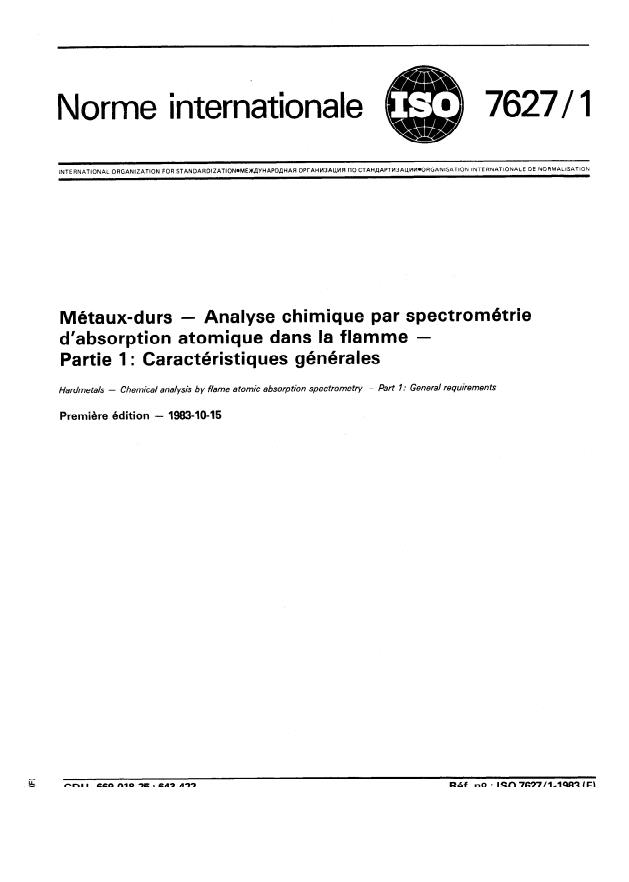
Norme internationale
INTERNATIONAL ORGANIZATION FOR STANDARDIZATION.MEXI(LIYHAPO,QHAfl OPfAHM3ALWlR Il0 CTAH~APTM3Al@llhORGANISATION INTERNATIONALE DE NORMALISATION
Métaux-durs - Analyse chimique par spectrométrie
d’absorption atomique dans la flamme -
Partie 1: Caractéristiques générales
Hardmetals - Chemical analysis b y flame atomic absorption spectrometry - Part I : General requirements
Première édition - 1983-10-15
CDU 669.018.25 : 643.422
Réf. no : ISO 7627/1-1983 (F)
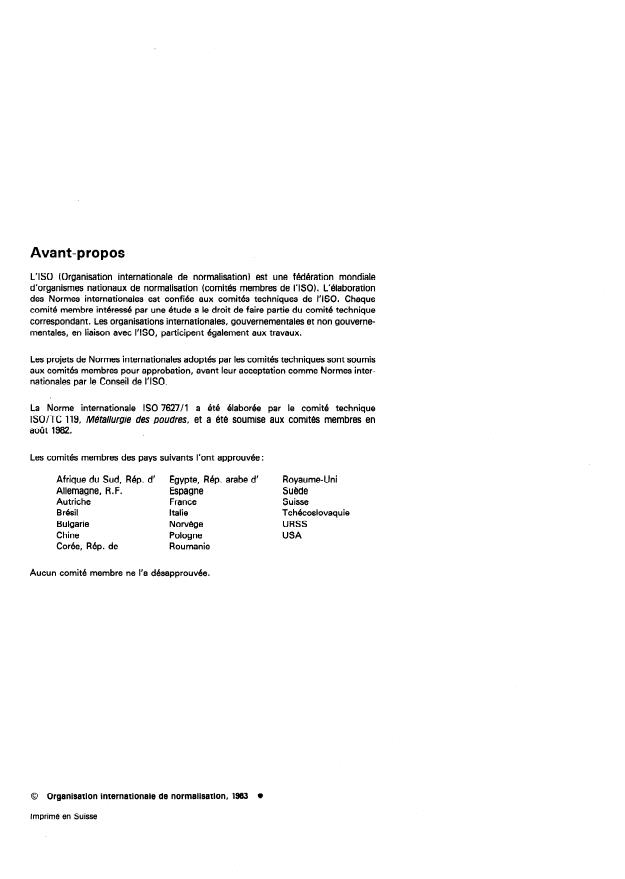
Avant-propos
L’ISO (Organisation internationale de normalisation) est une fédération mondiale
d’organismes nationaux de normalisation (comités membres de I’ISO). L’elaboration
des Normes internationales est conf& aux comites techniques de I’ISO. Chaque
comite membre intéresse par une étude a le droit de faire partie du comité technique
correspondant. Les organisations internationales, gouvernementales et non gouverne-
mentales, en liaison avec I’ISO, participent également aux travaux.
Les projets de Normes internationales adoptés par les comites techniques sont soumis
aux comittss membres pour approbation, avant leur acceptation comme Normes inter-
nationales par le Conseil de I’ISO.
La Norme internationale ISO 7627/1 a et6 élaboree par le comité technique
ISO/TC 119, M&a/lurgie des poudres, et a et6 soumise aux comités membres en
août 1982.
Les comites membres des pays suivants l’ont approuvée:
Afrique du Sud, Rép. d’ Égypte, Rép. arabe d’ Royaume-Uni
Allemagne, R.F. Espagne Suède
Autriche France Suisse
Bresil Italie Tchécoslovaquie
Bulgarie Norvége URSS
Chine
Pologne USA
Corée, Rép. de Roumanie
Aucun comité membre ne l’a désapprouvée.
0 Organisation internationale de normalisation, 1983
Imprimé en Suisse
NORME INTERNATIONALE
ISO 7627/1-1983 (F)
Métaux-durs - Analyse chimique par spectrométrie
d’absorption atomique dans la flamme -
Partie 1: Caractéristiques générales
La méthode de dosage du chrome permet également le
1 Objet NOTE -
dosage du fer, du nickel, du cobalt et du manganèse dans la gamme
des teneurs comprises entre 0,Ol et 2 % (mlm).
La présente partie de I’ISO 7627 établit les caractéristiques
générales pour l’analyse chimique des métaux-durs par spectro-
métrie d’absorption atomique dans la flamme.
3 Principe
Les parties suivantes de la présente Norme internationale (voir
Mise en solution de la prise d’essai et dosage par spectrométrie
le tableau) spécifient des méthodes de dosage par spectro-
d’absorption atomique dans la flamme.
métrie d’absorption atomique dan
...
,
Norme internationale
INTERNATIONAL ORGANIZATION FOR STANDARDIZATION.MEXI(LIYHAPO,QHAfl OPfAHM3ALWlR Il0 CTAH~APTM3Al@llhORGANISATION INTERNATIONALE DE NORMALISATION
Métaux-durs - Analyse chimique par spectrométrie
d’absorption atomique dans la flamme -
Partie 1: Caractéristiques générales
Hardmetals - Chemical analysis b y flame atomic absorption spectrometry - Part I : General requirements
Première édition - 1983-10-15
CDU 669.018.25 : 643.422
Réf. no : ISO 7627/1-1983 (F)
Avant-propos
L’ISO (Organisation internationale de normalisation) est une fédération mondiale
d’organismes nationaux de normalisation (comités membres de I’ISO). L’elaboration
des Normes internationales est conf& aux comites techniques de I’ISO. Chaque
comite membre intéresse par une étude a le droit de faire partie du comité technique
correspondant. Les organisations internationales, gouvernementales et non gouverne-
mentales, en liaison avec I’ISO, participent également aux travaux.
Les projets de Normes internationales adoptés par les comites techniques sont soumis
aux comittss membres pour approbation, avant leur acceptation comme Normes inter-
nationales par le Conseil de I’ISO.
La Norme internationale ISO 7627/1 a et6 élaboree par le comité technique
ISO/TC 119, M&a/lurgie des poudres, et a et6 soumise aux comités membres en
août 1982.
Les comites membres des pays suivants l’ont approuvée:
Afrique du Sud, Rép. d’ Égypte, Rép. arabe d’ Royaume-Uni
Allemagne, R.F. Espagne Suède
Autriche France Suisse
Bresil Italie Tchécoslovaquie
Bulgarie Norvége URSS
Chine
Pologne USA
Corée, Rép. de Roumanie
Aucun comité membre ne l’a désapprouvée.
0 Organisation internationale de normalisation, 1983
Imprimé en Suisse
NORME INTERNATIONALE
ISO 7627/1-1983 (F)
Métaux-durs - Analyse chimique par spectrométrie
d’absorption atomique dans la flamme -
Partie 1: Caractéristiques générales
La méthode de dosage du chrome permet également le
1 Objet NOTE -
dosage du fer, du nickel, du cobalt et du manganèse dans la gamme
des teneurs comprises entre 0,Ol et 2 % (mlm).
La présente partie de I’ISO 7627 établit les caractéristiques
générales pour l’analyse chimique des métaux-durs par spectro-
métrie d’absorption atomique dans la flamme.
3 Principe
Les parties suivantes de la présente Norme internationale (voir
Mise en solution de la prise d’essai et dosage par spectrométrie
le tableau) spécifient des méthodes de dosage par spectro-
d’absorption atomique dans la flamme.
métrie d’absorption atomique dan
...