

ISO/TR 22164:2020
(Main)Hydraulic fluid power — Application notes for the optimization of the energy efficiency of hydraulic systems
General Information
- Abstract
This document gives advice on how to conceive hydraulic systems that can be operated with increased energy efficiency while maintaining the intended functionality of the machine.
- Status
- Published
- Publication Date
- 12-Feb-2020
- Technical Committee
- ISO/TC 131/SC 9 - Installations and systems
- Drafting Committee
- ISO/TC 131/SC 9/WG 1 - Hydraulic systems
- Current Stage
- 6060 - International Standard published
- Start Date
- 13-Feb-2020
- Completion Date
- 13-Feb-2020
Buy Documents
ISO/TR 22164:2020 - Hydraulic fluid power — Application notes for the optimization of the energy efficiency of hydraulic systems Released:2/13/2020
ISO/TR 22164:2020 - Hydraulic fluid power — Application notes for the optimization of the energy efficiency of hydraulic systems/13/2020
Overview
ISO/TR 22164:2020 provides application notes to help designers and engineers conceive hydraulic systems that operate with increased energy efficiency while maintaining the intended functionality of the machine. The technical report emphasizes matching machine requirements, duty cycles and safety constraints to energy-efficiency measures. It targets machine builders, system designers and maintenance teams seeking practical, application-focused guidance for hydraulic fluid power systems.
Key Topics
The document groups measures into general and subsystem-focused recommendations. Key topics include:
- Principal design considerations
- Understand machine specifications, functionality and duty cycle before selecting solutions.
- Use assessment matrices and simulation software to compare architectures and predict energy consumption over load cycles.
- Build awareness and competence among staff on energy-efficiency practices.
- Actuator-related measures
- Match actuator choice and system pressure to application duty cycles.
- Consider pressure-controlled drives or pressure intensifiers where appropriate.
- Apply hydraulic load compensation (counterbalance) where it reduces net power demand.
- Hydraulic power supply
- Select pumps and pump-control arrangements that fit the duty profile (fixed vs variable displacement, pump combinations).
- Choose prime movers and control strategies for on-demand power provision and efficient operating ranges.
- Use accumulators to bridge peak-flow demands and reduce persistent excess flow.
- Optimize cooling and consider on/off implications for drive system cooling energy.
- Distribution and component choices
- Reduce throttling and bypass losses by using displacement controls where applicable.
- Minimize internal leakage through appropriate component selection (e.g., poppet valves, low-leak rotary unions).
- Reduce distribution losses by shortening piping, adapting diameters to flow rates, and minimizing separable connections.
- Improve solenoid valve efficiency, choose appropriate filters and maintain fluid cleanliness.
Applications
This guidance is applicable to a broad range of machines where hydraulics deliver high force, motion of heavy loads, clamping, pressing, weight compensation or hydrostatic transmission. Practical benefits include:
- Lower overall energy consumption across duty cycles
- Reduced cooling and auxiliary power needs
- Extended component life through improved fluid management and filtration
Related Standards
The report references and aligns with relevant safety and design standards. Notable associated documents include:
- ISO 5598 (vocabulary for fluid power)
- ISO 4413 (general rules and safety requirements for hydraulic systems)
- ISO 12100 (safety of machinery - design and risk reduction)
- ISO 14955-1 (energy-efficient design methodology for machine tools)
By following ISO/TR 22164:2020 recommendations, organizations can systematically evaluate and implement energy-efficiency measures without compromising safety or required machine performance.
Relations
- Effective Date
- 06-Jun-2022
Buy Documents
ISO/TR 22164:2020 - Hydraulic fluid power — Application notes for the optimization of the energy efficiency of hydraulic systems Released:2/13/2020
ISO/TR 22164:2020 - Hydraulic fluid power — Application notes for the optimization of the energy efficiency of hydraulic systems/13/2020
Get Certified
Connect with accredited certification bodies for this standard

Institut za varilstvo d.o.o. (Welding Institute)
Slovenia's leading welding institute since 1952. ISO 3834, EN 1090, pressure equipment certification, NDT personnel, welder qualification. Only IIW Au
Sponsored listings
Frequently Asked Questions
ISO/TR 22164:2020 is a technical report published by the International Organization for Standardization (ISO). Its full title is "Hydraulic fluid power — Application notes for the optimization of the energy efficiency of hydraulic systems". This standard covers: This document gives advice on how to conceive hydraulic systems that can be operated with increased energy efficiency while maintaining the intended functionality of the machine.
This document gives advice on how to conceive hydraulic systems that can be operated with increased energy efficiency while maintaining the intended functionality of the machine.
ISO/TR 22164:2020 is classified under the following ICS (International Classification for Standards) categories: 23.100.01 - Fluid power systems in general. The ICS classification helps identify the subject area and facilitates finding related standards.
ISO/TR 22164:2020 has the following relationships with other standards: It is inter standard links to ISO 15614-5:2024. Understanding these relationships helps ensure you are using the most current and applicable version of the standard.
ISO/TR 22164:2020 is available in PDF format for immediate download after purchase. The document can be added to your cart and obtained through the secure checkout process. Digital delivery ensures instant access to the complete standard document.
Standards Content (Sample)
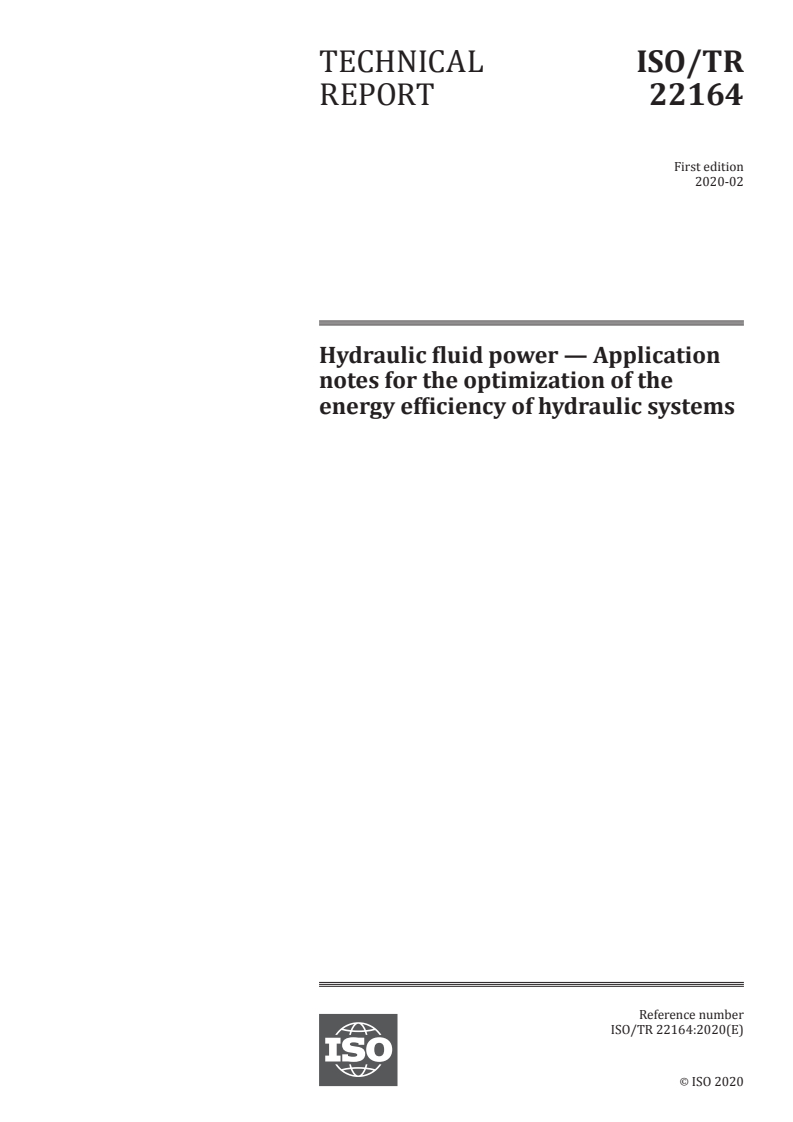
TECHNICAL ISO/TR
REPORT 22164
First edition
2020-02
Hydraulic fluid power — Application
notes for the optimization of the
energy efficiency of hydraulic systems
Reference number
©
ISO 2020
© ISO 2020
All rights reserved. Unless otherwise specified, or required in the context of its implementation, no part of this publication may
be reproduced or utilized otherwise in any form or by any means, electronic or mechanical, including photocopying, or posting
on the internet or an intranet, without prior written permission. Permission can be requested from either ISO at the address
below or ISO’s member body in the country of the requester.
ISO copyright office
CP 401 • Ch. de Blandonnet 8
CH-1214 Vernier, Geneva
Phone: +41 22 749 01 11
Fax: +41 22 749 09 47
Email: copyright@iso.org
Website: www.iso.org
Published in Switzerland
ii © ISO 2020 – All rights reserved
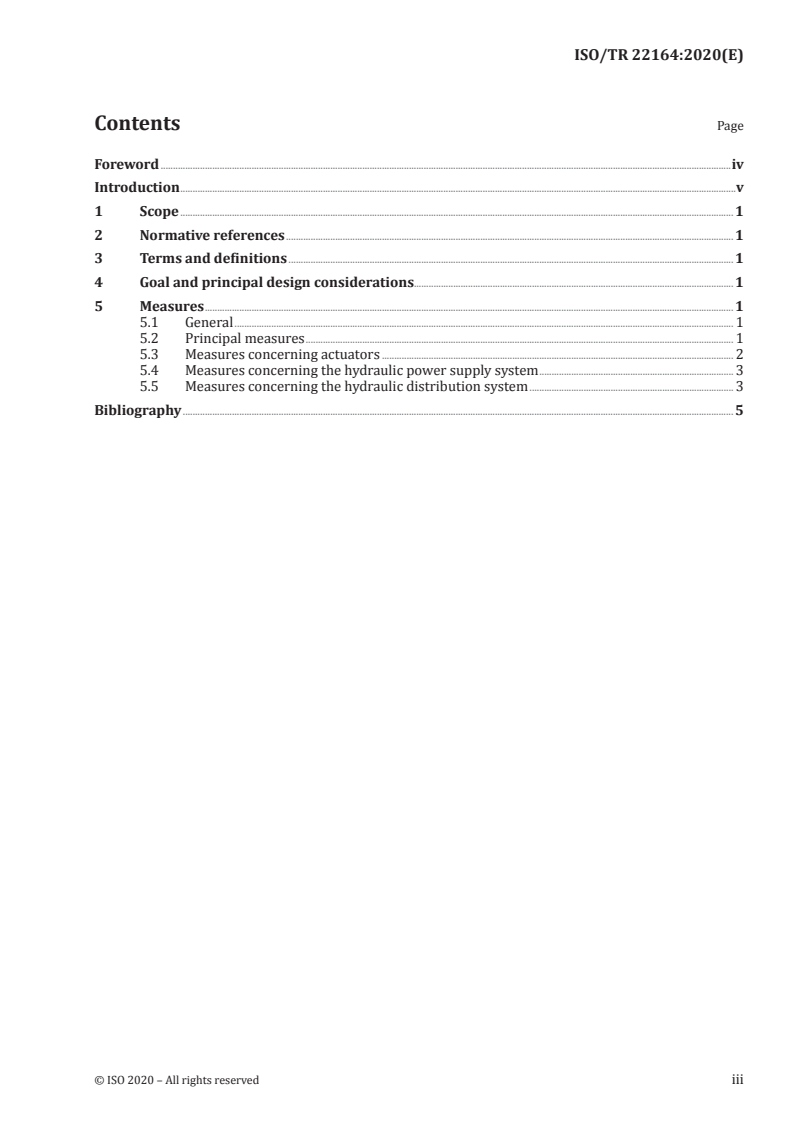
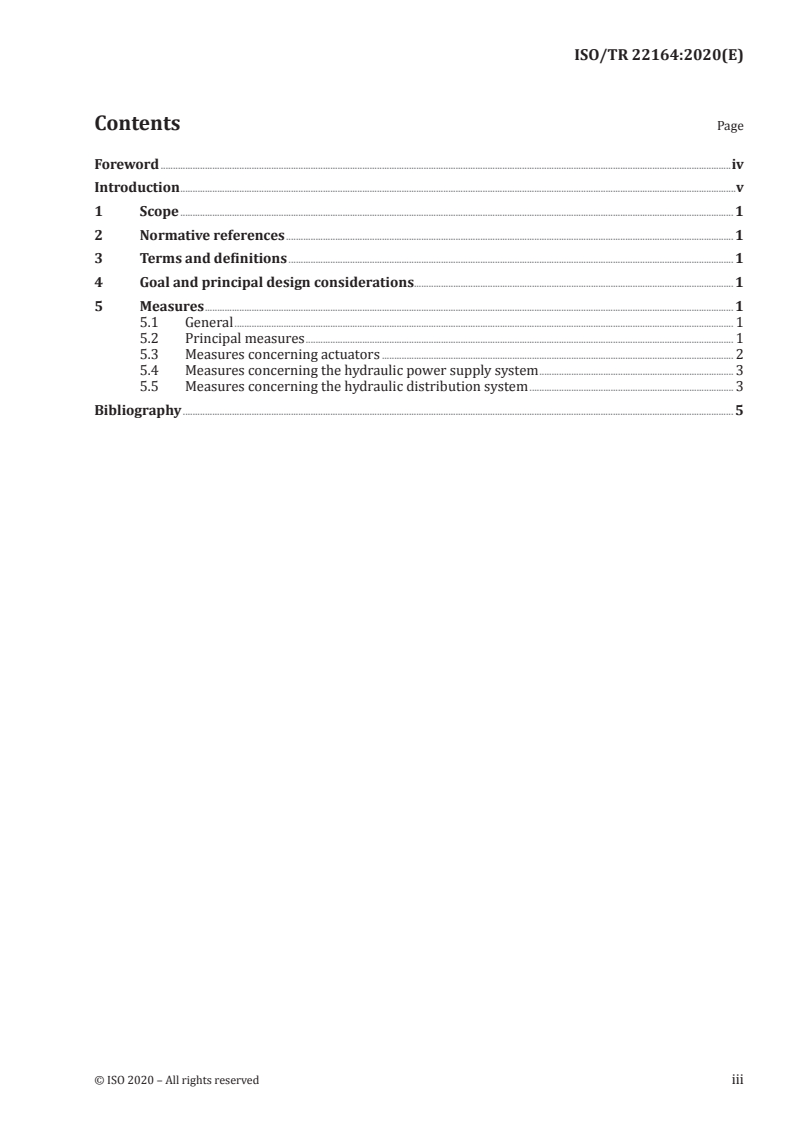
Contents Page
Foreword .iv
Introduction .v
1 Scope . 1
2 Normative references . 1
3 Terms and definitions . 1
4 Goal and principal design considerations. 1
5 Measures . 1
5.1 General . 1
5.2 Principal measures . 1
5.3 Measures concerning actuators . 2
5.4 Measures concerning the hydraulic power supply system . 3
5.5 Measures concerning the hydraulic distribution system . 3
Bibliography . 5
Foreword
ISO (the International Organization for Standardization) is a worldwide federation of national standards
bodies (ISO member bodies). The work of preparing International Standards is normally carried out
through ISO technical committees. Each member body interested in a subject for which a technical
committee has been established has the right to be represented on that committee. International
organizations, governmental and non-governmental, in liaison with ISO, also take part in the work.
ISO collaborates closely with the International Electrotechnical Commission (IEC) on all matters of
electrotechnical standardization.
The procedures used to develop this document and those intended for its further maintenance are
described in the ISO/IEC Directives, Part 1. In particular, the different approval criteria needed for the
different types of ISO documents should be noted. This document was drafted in accordance with the
editorial rules of the ISO/IEC Directives, Part 2 (see www .iso .org/ directives).
Attention is drawn to the possibility that some of the elements of this document may be the subject of
patent rights. ISO shall not be held responsible for identifying any or all such patent rights. Details of
any patent rights identified during the development of the document will be in the Introduction and/or
on the ISO list of patent declarations received (see www .iso .org/ patents).
Any trade name used in this document is information given for the convenience of users and does not
constitute an endorsement.
For an explanation of the voluntary nature of standards, the meaning of ISO specific terms and
expressions related to conformity assessment, as well as information about ISO's adherence to the
World Trade Organization (WTO) principles in the Technical Barriers to Trade (TBT) see www .iso .org/
iso/ foreword .html.
This document was prepared by Technical Committee ISO/TC 131, Fluid power systems, Subcommittee
SC 9, Installations and systems.
Any feedback or questions on this document should be directed to the user’s national standards body. A
complete listing of these bodies can be found at www .iso .org/ members .html.
iv © ISO 2020 – All rights reserved
Introduction
Energy consumption of machines is primarily defined by the type of machine, e.g. lathes, injection
moulding machines and excavators.
Additionally, the level of energy consumption is a function of the requirements of the machine
manufacturer and duty cycle and frequency of use by the operator. It is only when the machines are
adapted for specific applications (e.g. working cycle, control precision, level of automation) in an optimal
manner, that energy efficiency concepts can have a positive impact.
Typical applications for hydraulics in machines are:
— clamping with high force;
— pressing with high force;
— motion, acceleration and braking of heavy loads;
— hydraulic weight compensation;
— hydrostatic transmission.
TECHNICAL REPORT ISO/TR 22164:2020(E)
Hydraulic fluid power — Application notes for the
optimization of the energy efficiency of hydraulic systems
1 Scope
This document gives advice on how to conceive hydraulic systems that can be operated with increased
energy efficiency while maintaining the intended functionality of the machine.
2 Normative references
The following documents are referred to in the text in such a way that some or all of their content
constitutes requirements of this document. For dated references, only the edition cited applies. For
undated references, the latest edition of the referenced document (including any amendments) applies.
ISO 5598, Fluid power systems and components — Vocabulary
3 Terms and definitions
For the purposes of this document, the terms and definitions given in ISO 5598 apply.
ISO and IEC maintain terminological databases for use in standardization at the following addresses:
— IEC Electropedia: available at http:// www .electropedia .org/
— ISO Online browsing platform: available at https:// www .iso .org/ obp
4 Goal and principal design considerations
The goal is to reduce the energy consumption for specific functions considering the demand of power
input (effective, reactive and peak) of a hydraulic system and related auxiliary systems.
The more precisely the requirements and characteristics of the machine operation and duty cycle are
identified, the more energy efficiently
...
TECHNICAL ISO/TR
REPORT 22164
First edition
2020-02
Hydraulic fluid power — Application
notes for the optimization of the
energy efficiency of hydraulic systems
Reference number
©
ISO 2020
© ISO 2020
All rights reserved. Unless otherwise specified, or required in the context of its implementation, no part of this publication may
be reproduced or utilized otherwise in any form or by any means, electronic or mechanical, including photocopying, or posting
on the internet or an intranet, without prior written permission. Permission can be requested from either ISO at the address
below or ISO’s member body in the country of the requester.
ISO copyright office
CP 401 • Ch. de Blandonnet 8
CH-1214 Vernier, Geneva
Phone: +41 22 749 01 11
Fax: +41 22 749 09 47
Email: copyright@iso.org
Website: www.iso.org
Published in Switzerland
ii © ISO 2020 – All rights reserved
Contents Page
Foreword .iv
Introduction .v
1 Scope . 1
2 Normative references . 1
3 Terms and definitions . 1
4 Goal and principal design considerations. 1
5 Measures . 1
5.1 General . 1
5.2 Principal measures . 1
5.3 Measures concerning actuators . 2
5.4 Measures concerning the hydraulic power supply system . 3
5.5 Measures concerning the hydraulic distribution system . 3
Bibliography . 5
Foreword
ISO (the International Organization for Standardization) is a worldwide federation of national standards
bodies (ISO member bodies). The work of preparing International Standards is normally carried out
through ISO technical committees. Each member body interested in a subject for which a technical
committee has been established has the right to be represented on that committee. International
organizations, governmental and non-governmental, in liaison with ISO, also take part in the work.
ISO collaborates closely with the International Electrotechnical Commission (IEC) on all matters of
electrotechnical standardization.
The procedures used to develop this document and those intended for its further maintenance are
described in the ISO/IEC Directives, Part 1. In particular, the different approval criteria needed for the
different types of ISO documents should be noted. This document was drafted in accordance with the
editorial rules of the ISO/IEC Directives, Part 2 (see www .iso .org/ directives).
Attention is drawn to the possibility that some of the elements of this document may be the subject of
patent rights. ISO shall not be held responsible for identifying any or all such patent rights. Details of
any patent rights identified during the development of the document will be in the Introduction and/or
on the ISO list of patent declarations received (see www .iso .org/ patents).
Any trade name used in this document is information given for the convenience of users and does not
constitute an endorsement.
For an explanation of the voluntary nature of standards, the meaning of ISO specific terms and
expressions related to conformity assessment, as well as information about ISO's adherence to the
World Trade Organization (WTO) principles in the Technical Barriers to Trade (TBT) see www .iso .org/
iso/ foreword .html.
This document was prepared by Technical Committee ISO/TC 131, Fluid power systems, Subcommittee
SC 9, Installations and systems.
Any feedback or questions on this document should be directed to the user’s national standards body. A
complete listing of these bodies can be found at www .iso .org/ members .html.
iv © ISO 2020 – All rights reserved
Introduction
Energy consumption of machines is primarily defined by the type of machine, e.g. lathes, injection
moulding machines and excavators.
Additionally, the level of energy consumption is a function of the requirements of the machine
manufacturer and duty cycle and frequency of use by the operator. It is only when the machines are
adapted for specific applications (e.g. working cycle, control precision, level of automation) in an optimal
manner, that energy efficiency concepts can have a positive impact.
Typical applications for hydraulics in machines are:
— clamping with high force;
— pressing with high force;
— motion, acceleration and braking of heavy loads;
— hydraulic weight compensation;
— hydrostatic transmission.
TECHNICAL REPORT ISO/TR 22164:2020(E)
Hydraulic fluid power — Application notes for the
optimization of the energy efficiency of hydraulic systems
1 Scope
This document gives advice on how to conceive hydraulic systems that can be operated with increased
energy efficiency while maintaining the intended functionality of the machine.
2 Normative references
The following documents are referred to in the text in such a way that some or all of their content
constitutes requirements of this document. For dated references, only the edition cited applies. For
undated references, the latest edition of the referenced document (including any amendments) applies.
ISO 5598, Fluid power systems and components — Vocabulary
3 Terms and definitions
For the purposes of this document, the terms and definitions given in ISO 5598 apply.
ISO and IEC maintain terminological databases for use in standardization at the following addresses:
— IEC Electropedia: available at http:// www .electropedia .org/
— ISO Online browsing platform: available at https:// www .iso .org/ obp
4 Goal and principal design considerations
The goal is to reduce the energy consumption for specific functions considering the demand of power
input (effective, reactive and peak) of a hydraulic system and related auxiliary systems.
The more precisely the requirements and characteristics of the machine operation and duty cycle are
identified, the more energy efficiently
...