

ISO/TR 22165:2018
(Main)Pneumatic fluid power — Application notes for the improvement of the energy efficiency of pneumatic systems
General Information
- Abstract
This document gives advice on how to conceive pneumatic systems, which under consideration of functionality and economic efficiency, can be operated with increased energy efficiency. It does not focus on compressed air generation and distribution.
- Status
- Published
- Publication Date
- 07-Nov-2018
- Technical Committee
- ISO/TC 131/SC 9 - Installations and systems
- Drafting Committee
- ISO/TC 131/SC 9/WG 2 - Pneumatic systems
- Current Stage
- 6060 - International Standard published
- Start Date
- 08-Nov-2018
- Completion Date
- 29-Aug-2026
Buy Documents
ISO/TR 22165:2018 - Pneumatic fluid power — Application notes for the improvement of the energy efficiency of pneumatic systems Released:11/8/2018
ISO/TR 22165:2018 - Pneumatic fluid power — Application notes for the improvement of the energy efficiency of pneumatic systems/8/2018
Overview
ISO/TR 22165:2018 - "Pneumatic fluid power - Application notes for the improvement of the energy efficiency of pneumatic systems" is a Technical Report from ISO (first edition 2018). It provides practical advice for conceiving and optimising pneumatic systems so they can be operated with increased energy efficiency, taking into account both functionality and economic efficiency. The document focuses on system- and application-level measures for pneumatics inside machines and installations and explicitly does not concentrate on compressed air generation and distribution.
Key topics
The report highlights practical measures and design considerations to reduce energy consumption in pneumatic systems, including:
- Requirement-driven design: defining precise specifications (forces, cycle times, precision, lifetime) to enable energetically and economically optimal drive concepts.
- Component selection & sizing:
- appropriate selection and dimensioning of compressors and coordinated interaction (including options such as speed control or heat recuperation at the compressor level is mentioned in the context of overall design);
- avoiding oversizing (e.g., too many filters) and minimizing pressure drops through correct valve, hose and connector sizing.
- Network and layout:
- optimal pipe/hose routing and diameters, short runs, few cross-sectional changes, and low-resistance connectors to reduce pressure loss.
- Control and operation:
- enabling shutdown/standby of subsystems where safe, use of energy-saving actuator technologies (bistable valves, reduced holding current valves), and selection of drive types matching the application (e.g., single-acting cylinders).
- Vacuum system efficiency:
- use of compact energy-saving ejectors, air-saving circuits, locating vacuum generation close to the point of use and minimizing hose volumes.
- Maintenance, monitoring and assessment:
- scheduled monitoring of filter pressure differentials and leak detection (including condition monitoring via flow sensors), plus use of simulation and assessment matrices for application-specific optimisation.
- Safety & standards alignment: follow general rules and safety requirements for pneumatic systems (see ISO 4414).
Applications and users
ISO/TR 22165 is aimed at professionals involved in the design, installation, operation and maintenance of pneumatic systems and machines, including:
- machine designers and OEMs,
- system and control engineers,
- maintenance planners and energy managers,
- plant engineers and integrators,
- pneumatic component manufacturers and suppliers.
Typical use cases include stationary machines performing movements, clamping, pressing, packaging, dosing, positioning and related tasks where pneumatic drives are used.
Related standards
- ISO 4414 - Pneumatic fluid power - General rules and safety requirements for systems and their components
- ISO 14955-1 - Machine tools - Environmental evaluation (design methodology for energy-efficient machine tools)
Keywords: ISO/TR 22165:2018, pneumatic systems, energy efficiency, pneumatic fluid power, compressed air systems, pneumatics energy saving, ISO standard.
Buy Documents
ISO/TR 22165:2018 - Pneumatic fluid power — Application notes for the improvement of the energy efficiency of pneumatic systems Released:11/8/2018
ISO/TR 22165:2018 - Pneumatic fluid power — Application notes for the improvement of the energy efficiency of pneumatic systems/8/2018
Get Certified
Connect with accredited certification bodies for this standard

Institut za varilstvo d.o.o. (Welding Institute)
Slovenia's leading welding institute since 1952. ISO 3834, EN 1090, pressure equipment certification, NDT personnel, welder qualification. Only IIW Au
Sponsored listings
Frequently Asked Questions
ISO/TR 22165:2018 is a technical report published by the International Organization for Standardization (ISO). Its full title is "Pneumatic fluid power — Application notes for the improvement of the energy efficiency of pneumatic systems". This standard covers: This document gives advice on how to conceive pneumatic systems, which under consideration of functionality and economic efficiency, can be operated with increased energy efficiency. It does not focus on compressed air generation and distribution.
This document gives advice on how to conceive pneumatic systems, which under consideration of functionality and economic efficiency, can be operated with increased energy efficiency. It does not focus on compressed air generation and distribution.
ISO/TR 22165:2018 is classified under the following ICS (International Classification for Standards) categories: 23.100.01 - Fluid power systems in general. The ICS classification helps identify the subject area and facilitates finding related standards.
ISO/TR 22165:2018 is available in PDF format for immediate download after purchase. The document can be added to your cart and obtained through the secure checkout process. Digital delivery ensures instant access to the complete standard document.
Standards Content (Sample)
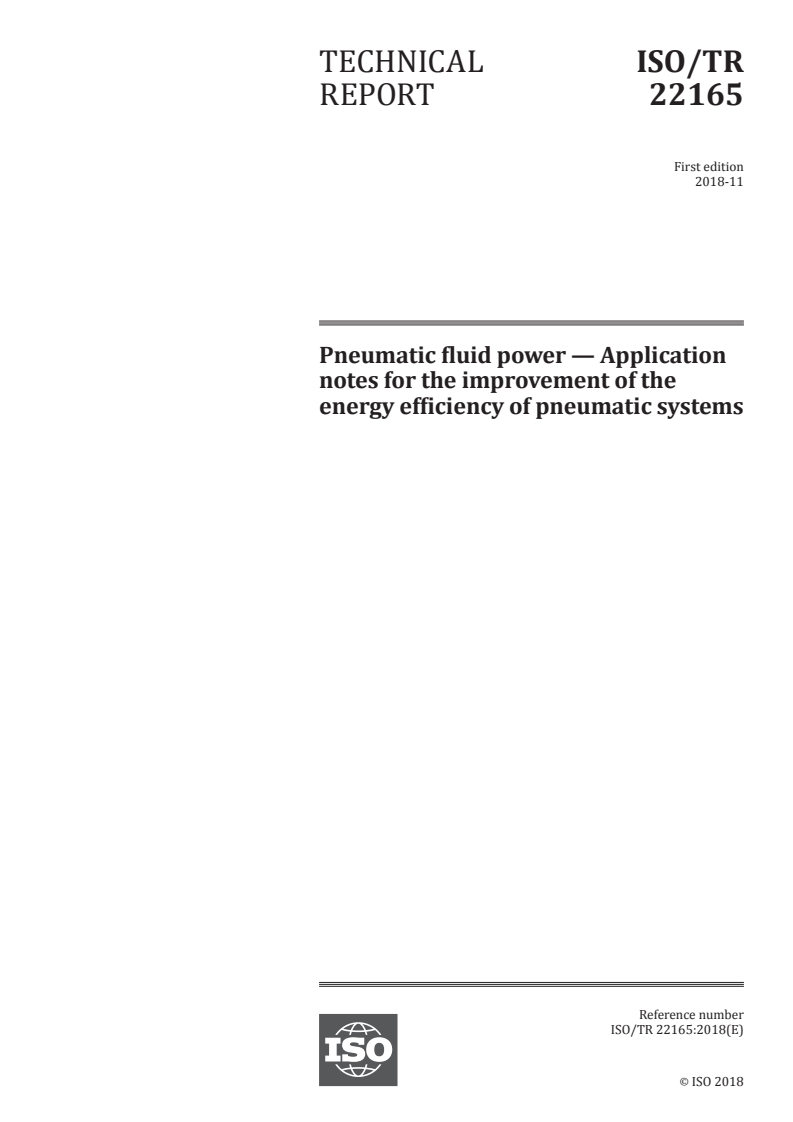
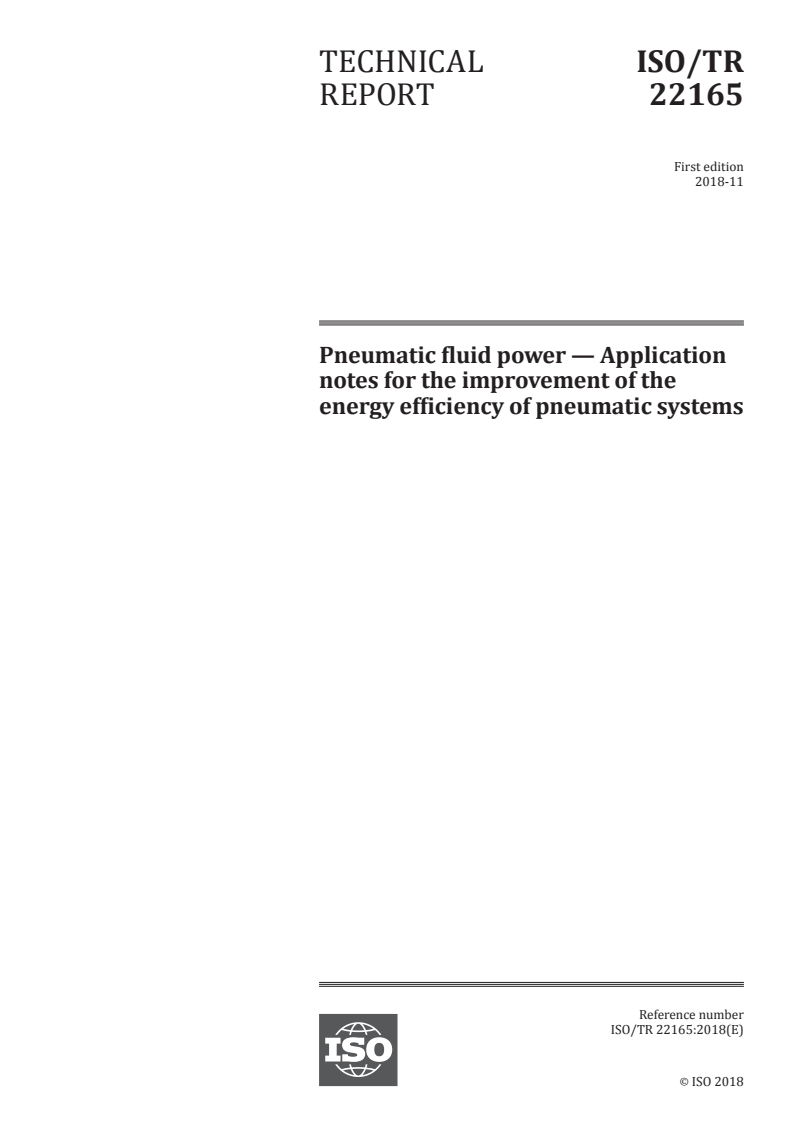
TECHNICAL ISO/TR
REPORT 22165
First edition
2018-11
Pneumatic fluid power — Application
notes for the improvement of the
energy efficiency of pneumatic systems
Reference number
©
ISO 2018
© ISO 2018
All rights reserved. Unless otherwise specified, or required in the context of its implementation, no part of this publication may
be reproduced or utilized otherwise in any form or by any means, electronic or mechanical, including photocopying, or posting
on the internet or an intranet, without prior written permission. Permission can be requested from either ISO at the address
below or ISO’s member body in the country of the requester.
ISO copyright office
CP 401 • Ch. de Blandonnet 8
CH-1214 Vernier, Geneva
Phone: +41 22 749 01 11
Fax: +41 22 749 09 47
Email: copyright@iso.org
Website: www.iso.org
Published in Switzerland
ii © ISO 2018 – All rights reserved
Contents Page
Foreword .iv
Introduction .v
1 Scope . 1
2 Normative references . 1
3 Terms and definitions . 1
4 General . 1
Bibliography . 3
Foreword
ISO (the International Organization for Standardization) is a worldwide federation of national standards
bodies (ISO member bodies). The work of preparing International Standards is normally carried out
through ISO technical committees. Each member body interested in a subject for which a technical
committee has been established has the right to be represented on that committee. International
organizations, governmental and non-governmental, in liaison with ISO, also take part in the work.
ISO collaborates closely with the International Electrotechnical Commission (IEC) on all matters of
electrotechnical standardization.
The procedures used to develop this document and those intended for its further maintenance are
described in the ISO/IEC Directives, Part 1. In particular, the different approval criteria needed for the
different types of ISO documents should be noted. This document was drafted in accordance with the
editorial rules of the ISO/IEC Directives, Part 2 (see www .iso .org/directives).
Attention is drawn to the possibility that some of the elements of this document may be the subject of
patent rights. ISO shall not be held responsible for identifying any or all such patent rights. Details of
any patent rights identified during the development of the document will be in the Introduction and/or
on the ISO list of patent declarations received (see www .iso .org/patents).
Any trade name used in this document is information given for the convenience of users and does not
constitute an endorsement.
For an explanation of the voluntary nature of standards, the meaning of ISO specific terms and
expressions related to conformity assessment, as well as information about ISO's adherence to the
World Trade Organization (WTO) principles in the Technical Barriers to Trade (TBT) see www .iso
.org/iso/foreword .html.
This document was prepared by Technical Committee ISO/TC 131, Fluid power systems, Subcommittee
SC 9, Installations and systems.
Any feedback or questions on this document should be directed to the user’s national standards body. A
complete listing of these bodies can be found at www .iso .org/members .html.
iv © ISO 2018 – All rights reserved
Introduction
The energy consumption of a stationary machine is not only defined by the type of machine (e.g.
turning machine, injection moulding machine) but significantly by the requirements of the machine
manufacturer and the mode of use of the machine. Only if the machine is optimally adapted to need (e.g.
working cycle, precision, grade of automatisation), can the energy concept developed for it work.
It follows that the pneumatic part in a drive system of a machine and the energy portion needed for its
operation depend on the tasks and requirements the pneumatics has to fulfil in the machine.
Typical applications for pneumatics in stationary machines are:
— Movements (linear, rotary);
— Clamping, pressing, moving, separating, positioning and orienting of workpieces;
— Packing, filling, dosing, locking, opening.
TECHNICAL REPORT ISO/TR 2216
...
TECHNICAL ISO/TR
REPORT 22165
First edition
2018-11
Pneumatic fluid power — Application
notes for the improvement of the
energy efficiency of pneumatic systems
Reference number
©
ISO 2018
© ISO 2018
All rights reserved. Unless otherwise specified, or required in the context of its implementation, no part of this publication may
be reproduced or utilized otherwise in any form or by any means, electronic or mechanical, including photocopying, or posting
on the internet or an intranet, without prior written permission. Permission can be requested from either ISO at the address
below or ISO’s member body in the country of the requester.
ISO copyright office
CP 401 • Ch. de Blandonnet 8
CH-1214 Vernier, Geneva
Phone: +41 22 749 01 11
Fax: +41 22 749 09 47
Email: copyright@iso.org
Website: www.iso.org
Published in Switzerland
ii © ISO 2018 – All rights reserved
Contents Page
Foreword .iv
Introduction .v
1 Scope . 1
2 Normative references . 1
3 Terms and definitions . 1
4 General . 1
Bibliography . 3
Foreword
ISO (the International Organization for Standardization) is a worldwide federation of national standards
bodies (ISO member bodies). The work of preparing International Standards is normally carried out
through ISO technical committees. Each member body interested in a subject for which a technical
committee has been established has the right to be represented on that committee. International
organizations, governmental and non-governmental, in liaison with ISO, also take part in the work.
ISO collaborates closely with the International Electrotechnical Commission (IEC) on all matters of
electrotechnical standardization.
The procedures used to develop this document and those intended for its further maintenance are
described in the ISO/IEC Directives, Part 1. In particular, the different approval criteria needed for the
different types of ISO documents should be noted. This document was drafted in accordance with the
editorial rules of the ISO/IEC Directives, Part 2 (see www .iso .org/directives).
Attention is drawn to the possibility that some of the elements of this document may be the subject of
patent rights. ISO shall not be held responsible for identifying any or all such patent rights. Details of
any patent rights identified during the development of the document will be in the Introduction and/or
on the ISO list of patent declarations received (see www .iso .org/patents).
Any trade name used in this document is information given for the convenience of users and does not
constitute an endorsement.
For an explanation of the voluntary nature of standards, the meaning of ISO specific terms and
expressions related to conformity assessment, as well as information about ISO's adherence to the
World Trade Organization (WTO) principles in the Technical Barriers to Trade (TBT) see www .iso
.org/iso/foreword .html.
This document was prepared by Technical Committee ISO/TC 131, Fluid power systems, Subcommittee
SC 9, Installations and systems.
Any feedback or questions on this document should be directed to the user’s national standards body. A
complete listing of these bodies can be found at www .iso .org/members .html.
iv © ISO 2018 – All rights reserved
Introduction
The energy consumption of a stationary machine is not only defined by the type of machine (e.g.
turning machine, injection moulding machine) but significantly by the requirements of the machine
manufacturer and the mode of use of the machine. Only if the machine is optimally adapted to need (e.g.
working cycle, precision, grade of automatisation), can the energy concept developed for it work.
It follows that the pneumatic part in a drive system of a machine and the energy portion needed for its
operation depend on the tasks and requirements the pneumatics has to fulfil in the machine.
Typical applications for pneumatics in stationary machines are:
— Movements (linear, rotary);
— Clamping, pressing, moving, separating, positioning and orienting of workpieces;
— Packing, filling, dosing, locking, opening.
TECHNICAL REPORT ISO/TR 2216
...