


ISO 6416:2004
(Main)Hydrometry — Measurement of discharge by the ultrasonic (acoustic) method
Hydrometry — Measurement of discharge by the ultrasonic (acoustic) method
ISO 6416:2004 describes the establishment and operation of an ultrasonic (transit-time) gauging station for the continuous measurement of discharge in a river, an open channel or a closed conduit. It also describes the basic principles on which the method is based, the operation and performance of associated instrumentation and procedures for commissioning. It is limited to the transit time of ultrasonic pulses technique, and is not applicable to systems that make use of the Doppler shift or correlation orlevel-to-flow techniques. ISO 6416:2004 is not applicable to measurement in rivers with ice.
Hydrométrie — Mesure du débit à l'aide de la méthode ultrasonique (acoustique)
General Information
- Status
- Withdrawn
- Publication Date
- 27-Jun-2004
- Withdrawal Date
- 27-Jun-2004
- Technical Committee
- ISO/TC 113/SC 1 - Velocity area methods
- Drafting Committee
- ISO/TC 113/SC 1 - Velocity area methods
- Current Stage
- 9599 - Withdrawal of International Standard
- Start Date
- 11-Oct-2017
- Completion Date
- 12-Feb-2026
Relations
- Effective Date
- 26-May-2012
- Effective Date
- 15-Apr-2008
Get Certified
Connect with accredited certification bodies for this standard

BSMI (Bureau of Standards, Metrology and Inspection)
Taiwan's standards and inspection authority.
Sponsored listings
Frequently Asked Questions
ISO 6416:2004 is a standard published by the International Organization for Standardization (ISO). Its full title is "Hydrometry — Measurement of discharge by the ultrasonic (acoustic) method". This standard covers: ISO 6416:2004 describes the establishment and operation of an ultrasonic (transit-time) gauging station for the continuous measurement of discharge in a river, an open channel or a closed conduit. It also describes the basic principles on which the method is based, the operation and performance of associated instrumentation and procedures for commissioning. It is limited to the transit time of ultrasonic pulses technique, and is not applicable to systems that make use of the Doppler shift or correlation orlevel-to-flow techniques. ISO 6416:2004 is not applicable to measurement in rivers with ice.
ISO 6416:2004 describes the establishment and operation of an ultrasonic (transit-time) gauging station for the continuous measurement of discharge in a river, an open channel or a closed conduit. It also describes the basic principles on which the method is based, the operation and performance of associated instrumentation and procedures for commissioning. It is limited to the transit time of ultrasonic pulses technique, and is not applicable to systems that make use of the Doppler shift or correlation orlevel-to-flow techniques. ISO 6416:2004 is not applicable to measurement in rivers with ice.
ISO 6416:2004 is classified under the following ICS (International Classification for Standards) categories: 17.120.20 - Flow in open channels. The ICS classification helps identify the subject area and facilitates finding related standards.
ISO 6416:2004 has the following relationships with other standards: It is inter standard links to ISO 6416:2017, ISO 6416:1992. Understanding these relationships helps ensure you are using the most current and applicable version of the standard.
ISO 6416:2004 is available in PDF format for immediate download after purchase. The document can be added to your cart and obtained through the secure checkout process. Digital delivery ensures instant access to the complete standard document.
Standards Content (Sample)
INTERNATIONAL ISO
STANDARD 6416
Third edition
2004-07-01
Hydrometry — Measurement of discharge
by the ultrasonic (acoustic) method
Hydrométrie — Mesure du débit à l'aide de la méthode ultrasonique
(acoustique)
Reference number
©
ISO 2004
PDF disclaimer
This PDF file may contain embedded typefaces. In accordance with Adobe's licensing policy, this file may be printed or viewed but
shall not be edited unless the typefaces which are embedded are licensed to and installed on the computer performing the editing. In
downloading this file, parties accept therein the responsibility of not infringing Adobe's licensing policy. The ISO Central Secretariat
accepts no liability in this area.
Adobe is a trademark of Adobe Systems Incorporated.
Details of the software products used to create this PDF file can be found in the General Info relative to the file; the PDF-creation
parameters were optimized for printing. Every care has been taken to ensure that the file is suitable for use by ISO member bodies. In
the unlikely event that a problem relating to it is found, please inform the Central Secretariat at the address given below.
© ISO 2004
All rights reserved. Unless otherwise specified, no part of this publication may be reproduced or utilized in any form or by any means,
electronic or mechanical, including photocopying and microfilm, without permission in writing from either ISO at the address below or
ISO's member body in the country of the requester.
ISO copyright office
Case postale 56 • CH-1211 Geneva 20
Tel. + 41 22 749 01 11
Fax + 41 22 749 09 47
E-mail copyright@iso.org
Web www.iso.org
Published in Switzerland
ii © ISO 2004 – All rights reserved
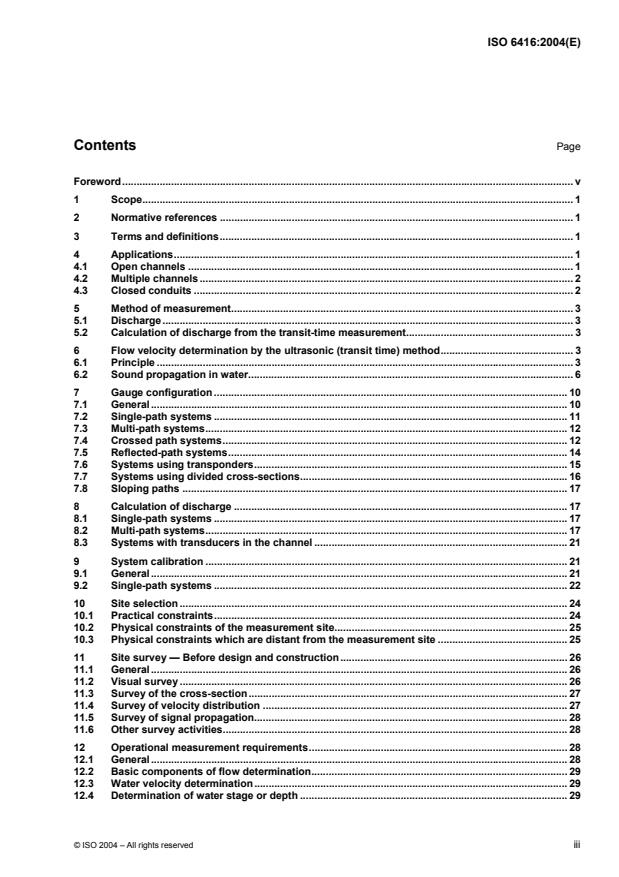
Contents Page
Foreword. v
1 Scope. 1
2 Normative references . 1
3 Terms and definitions. 1
4 Applications. 1
4.1 Open channels . 1
4.2 Multiple channels . 2
4.3 Closed conduits . 2
5 Method of measurement. 3
5.1 Discharge. 3
5.2 Calculation of discharge from the transit-time measurement. 3
6 Flow velocity determination by the ultrasonic (transit time) method. 3
6.1 Principle . 3
6.2 Sound propagation in water. 6
7 Gauge configuration . 10
7.1 General. 10
7.2 Single-path systems . 11
7.3 Multi-path systems. 12
7.4 Crossed path systems. 12
7.5 Reflected-path systems. 14
7.6 Systems using transponders. 15
7.7 Systems using divided cross-sections. 16
7.8 Sloping paths . 17
8 Calculation of discharge . 17
8.1 Single-path systems . 17
8.2 Multi-path systems. 17
8.3 Systems with transducers in the channel . 21
9 System calibration . 21
9.1 General. 21
9.2 Single-path systems . 22
10 Site selection . 24
10.1 Practical constraints. 24
10.2 Physical constraints of the measurement site. 25
10.3 Physical constraints which are distant from the measurement site . 25
11 Site survey — Before design and construction. 26
11.1 General. 26
11.2 Visual survey . 26
11.3 Survey of the cross-section. 27
11.4 Survey of velocity distribution . 27
11.5 Survey of signal propagation. 28
11.6 Other survey activities. 28
12 Operational measurement requirements. 28
12.1 General. 28
12.2 Basic components of flow determination. 29
12.3 Water velocity determination. 29
12.4 Determination of water stage or depth . 29
12.5 Channel width.30
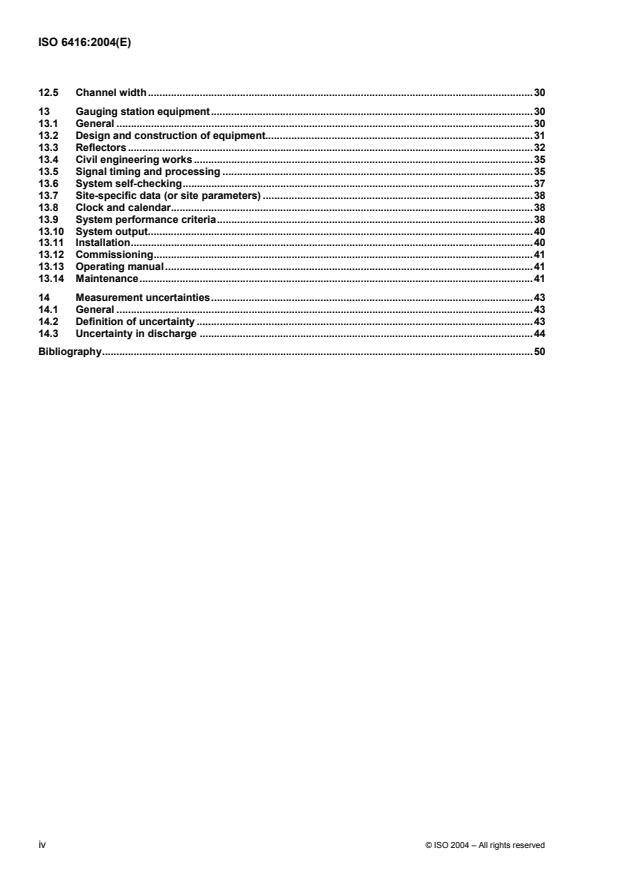
13 Gauging station equipment.30
13.1 General .30
13.2 Design and construction of equipment.31
13.3 Reflectors .32
13.4 Civil engineering works .35
13.5 Signal timing and processing .35
13.6 System self-checking.37
13.7 Site-specific data (or site parameters) .38
13.8 Clock and calendar.38
13.9 System performance criteria.38
13.10 System output.40
13.11 Installation.40
13.12 Commissioning.41
13.13 Operating manual.41
13.14 Maintenance.41
14 Measurement uncertainties.43
14.1 General .43
14.2 Definition of uncertainty .43
14.3 Uncertainty in discharge .44
Bibliography.50
iv © ISO 2004 – All rights reserved
Foreword
ISO (the International Organization for Standardization) is a worldwide federation of national standards bodies
(ISO member bodies). The work of preparing International Standards is normally carried out through ISO
technical committees. Each member body interested in a subject for which a technical committee has been
established has the right to be represented on that committee. International organizations, governmental and
non-governmental, in liaison with ISO, also take part in the work. ISO collaborates closely with the
International Electrotechnical Commission (IEC) on all matters of electrotechnical standardization.
International Standards are drafted in accordance with the rules given in the ISO/IEC Directives, Part 2.
The main task of technical committees is to prepare International Standards. Draft International Standards
adopted by the technical committees are circulated to the member bodies for voting. Publication as an
International Standard requires approval by at least 75 % of the member bodies casting a vote.
Attention is drawn to the possibility that some of the elements of this document may be the subject of patent
rights. ISO shall not be held responsible for identifying any or all such patent rights.
ISO 6416 was prepared by Technical Committee ISO/TC 113, Hydrometry, Subcommittee SC 1, Velocity area
methods.
This third edition cancels and replaces the second edition (ISO 6416:1992), which has been technically
revised.
INTERNATIONAL STANDARD ISO 6416:2004(E)
Hydrometry — Measurement of discharge by the ultrasonic
(acoustic) method
1 Scope
This International Standard describes the establishment and operation of an ultrasonic (transit-time) gauging
station for the continuous measurement of discharge in a river, an open channel or a closed conduit. It also
describes the basic principles on which the method is based, the operation and performance of associated
instrumentation and procedures for commissioning.
It is limited to the “transit time of ultrasonic pulses” technique, and is not applicable to systems that make use
of the “Doppler shift” or “correlation” or “level-to-flow” techniques.
This International Standard is not applicable to measurement in rivers with ice.
2 Normative references
The following referenced documents are indispensable for the application of this document. For dated
references, only the edition cited applies. For undated references, the latest edition of the referenced
document (including any amendments) applies.
ISO 772:1996, Hydrometric determinations — Vocabulary and symbols
ISO 4373:1995, Measurement of liquid flow in open channels — Water-level measuring devices
3 Terms and definitions
For the purposes of this document, the terms and definitions given in ISO 772 apply.
4 Applications
4.1 Open channels
4.1.1 The method is suitable for use in river flow measurement, a significant advantage being additional
freedom from siting constraints in comparison with other available techniques. In particular, the method does
not demand the presence of a natural control or the creation of a man-made control at the proposed gauge
location, as it does not rely upon the establishment of a unique relation between water level and discharge.
4.1.2 Gauges using the method are capable of providing highly accurate flow determinations over a range
of flows contained within a defined gauge cross-section. They are tolerant of the backwater effects created by
tides, downstream tributary discharges, downstream weed growth, reservoir or head-pond water level
manipulation, and periodic channel obstruction.
NOTE For locations subjected to significant bed level or profile instability, it may not be possible to use gauges.
4.1.3 Use of the method usually creates no obstruction to navigation. It creates no significant hazard or loss
of amenity for other channel users or riparian interests. However, some species of fish may be sensitive to
some types of ultrasonic signal. The gauge can be designed to be physically unobtrusive.
4.1.4 For use in remote locations, the electronic equipment can be designed to operate from battery power.
To economise on power consumption, the system is usually set to sample the flow for short periods and to
return to a quiescent condition between samples. (see 10.1.3 and 13.9.5).
4.1.5 The method is not really suitable for use when the channel is covered with ice, because of the
difficulty of determining the cross-sectional area of the water. Although this is a limitation of use, the method
may still have value in determining water velocity under the ice, if transducers can be positioned in unfrozen
water.
4.2 Multiple channels
4.2.1 At locations where the total flow is divided between two or more physically separate channels, such
as under a multiple-arched bridge, the instrumentation can be configured to determine individual channel
flows separately and then to combine these to create a single unified determination of flow.
4.2.2 If flow may not readily be contained within a single well-defined cross-section, and in particular if there
is significant flow that bypasses the main gauge cross-section by way of an extensive flood plain, it may be
possible to subdivide the flood plain into a series of “channels” in which the flow can be measured.
4.2.3 A station designer may decide to provide a comprehensive flood-plain measurement capability by this
means or may, alternatively, simply provide a flow or velocity sampling facility. In the latter situation, gauged
cross-sections may be constructed in the flood plain. These do not normally provide total coverage, but merely
provide locations at which flood-plain flow can be sampled for subsequent examination and analysis.
4.2.4 It should be noted that systems designed to determine flood-plain flow may suffer from the practical
difficulties of
a) inability to commission the system due to there being no water in the measurement section,
b) maintenance of the section, including weed cutting, debris clearance and repair of vandalism.
4.3 Closed conduits
The ultrasonic method can also be applied to the measurement of flow in closed conduits, including both
storm-water and foul sewers, under both free-flowing and surcharged conditions.
For systems used in foul sewers, special attention should be paid to the following:
a) the source of the water, especially whether it is from an aeration tank or from a section of channel
containing aerators or from a hydro-electric plant. The air dissolved in the water from such sources may
cause bubbles to form, and these may inhibit the operation of the flow gauge (see 10.3.1);
b) possible aeration of the water caused by a hydraulic jump or weir upstream of the measurement section,
especially under storm conditions (see 10.3.1);
c) the design of transducer mountings, to eliminate the risk of fouling by grease, rags and paper;
d) the need for the system to meet local codes of practice for electrical equipment installed in potentially
explosive atmospheres. This usually requires a certified intrinsically safe design for both the transducers
(which can be piezo-electric sources of ignition) and for the electronic unit (see for example EN 50014);
e) the change in the flow computation algorithm when the conduit is surcharged.
2 © ISO 2004 – All rights reserved
For foul sewers which are less than about 4 m in width, a high loading of suspended solids is unlikely to
present a serious problem of signal attenuation (see 6.2.3).
5 Method of measurement
5.1 Discharge
5.1.1 Discharge, as defined in ISO 772, is the volume of liquid flowing through a cross-section in a unit time.
It is usually denoted by the symbol q and expressed in cubic metres per second (m /s). The definition of
discharge is the product of the wetted cross-sectional area and the mean velocity vector perpendicular to it.
5.1.2 The measurement methods may either determine the bulk quantity discharge q directly, by measuring
the time taken to fill a tank of known volume, or the methods may be indirect and require calculation of the
discharge from measured flow velocities in all points of the wet cross-section. The latter are generally referred
to as “velocity-area methods”. In practice it is not possible to measure velocities at all points, and so the
velocity-area methods deal with only a limited number of measuring points.
The transit-time method is a velocity-area method using flow velocities which have been determined by the
equipment, and which are averaged along one or more lines which are usually, but not necessarily, horizontal.
5.2 Calculation of discharge from the transit-time measurement
5.2.1 Flow measurement by the ultrasonic transit-time technique is analogous to flow measurement by
current meters. However, while the most commonly used current-metering method is based on the estimation
of mean velocity at a series of verticals dispersed across the gauged cross-section, in the transit-time method
the velocity samples are horizontally orientated (and vertically distributed). In principle, flow can be computed
by exactly the same methods applied to a current meter gauging (see ISO 748). However, in practice, the
different graphical methods available do not lend themselves easily to automatic computation, and only the
arithmetic methods are useable.
5.2.2 Discharge can be computed, provided that a relation can be established between the estimated
(horizontally averaged) flow velocity and the mean cross-sectional velocity. If the measured velocity at a single
elevation is not sufficient to establish this relation, measurements at more elevations can be carried out. The
resulting samples of flow velocity can be vertically integrated to provide an estimate of mean cross-sectional
velocity.
5.2.3 Discharge calculation also requires the cross-sectional area of the water to be known. An ultrasonic
transit-time system will, therefore, normally be capable not only of making sample measurements of velocity,
but also of determining (or accepting a signal from some other device determining) water depth, and of storing
details of the relation between water depth and cross-sectional area. It will also normally be capable of
executing the mathematical functions necessary to compute flow from the relevant stored and directly
determined data.
6 Flow velocity determination by the ultrasonic (transit time) method
6.1 Principle
6.1.1 An ultrasonic pulse travels in a downstream direction faster than a similar pulse travels upstream. The
speed of a pulse of sound travelling diagonally across the flow in a downstream direction will be increased by
the velocity component of the water. Conversely, the speed of a sound pulse moving in the opposite direction
will be decreased. The difference in the transit time in the two directions can be used to resolve both the
velocity of sound in water as well as the component of the velocity along the path taken by the ultrasonic
pulses.
Key
1 v component of water velocity along the path
path
2 v component of water velocity in the direction of the flow
line
3 direction of flow
4 channel width
5 ultrasonic path
A, B transducers
θ angle between the path and the direction of flow
y downstream distance between transducers
Figure 1 — Schematic illustrating the general principle
6.1.2 For the path between transducers A and B in Figure 1, the transit time for the ultrasonic pulses are:
t = L/(c − v cosθ ) and t = L/(c + v cosθ ) (1)
AB BA
where
t is the transit time from transducer A to B, in seconds;
AB
t is the transit time from transducer B to A, in seconds;
BA
L is the path length (distance between transducer A and transducer B), in metres;
c is the speed of sound in water, in metres per second;
v is the line velocity or the average velocity of the water across the channel in the direction of flow, in
line
metres per second;
θ is the angle between the path and direction of flow.
Resolving for line velocity:
v = L × (t − t ) / (t × t × 2 cosθ ) (2)
line AB BA AB BA
4 © ISO 2004 – All rights reserved
6.1.3 The transit times in Equation (2) are for the water path only, and do not include the fixed delays due to
the travel times through the faces of the transducers and cables, delays in the transmitter and receiver circuits,
and delays in signal detection (which may be affected by signal distortion). These fixed delays do not affect
the transit-time difference (t − t ), but will affect the term (t × t ). This factor is of particular importance
AB BA AB BA
for small channels or where long cable runs to the transducers are required.
Typical delay times for the transducers and electronic circuits are between 4 µs and 20 µs.
The delay time for the cables is typically 1 µs per 200 m of cable, i.e. for 100 m each way, transmit and
receive.
Taking the signal delays into account, Equation (2) for the computed water velocity becomes:
v = L × (t − t ) / [(t − δ ) × (t − δ ) × 2 cosθ ] (3)
R F R F
where
t is the transit time from the electronic unit via transducer A to B and back to the unit, in seconds;
R
t is the transit time from the electronic unit via transducer B to A and back to the unit, in seconds;
F
δ is the signal delay.
For a channel of width 1 m, with path angle of 45° and total signal delay of 10 µs, an error of 2 % in the
computed water velocity would be introduced if the delay effect were to be ignored.
For wider channels, the effect of the signal delay is reduced in proportion to the path length, and may be
insignificant.
6.1.4 It should be noted that the calculation of water velocity is
independent of the speed of sound in water,
proportional to the difference in transit times,
inversely proportional to the product of the transit times,
critically dependent on the angle between the path and the direction of flow (see Table 1).
Table 1 — Systematic errors incurred if the assumed direction of flow is not parallel to the channel
axis
Path angle Velocity error for 1° difference between
θ actual and assumed flow direction
%
degrees
30 1,0
45 1,7
60 3,0
6.1.5 In open-channel flow measurement, practical considerations will normally dictate that
a) the transducers at either end of an “ultrasonic path” are located on opposite banks of the watercourse;
b) the line joining them is at an angle to the mean direction of flow, which should be between 30° and 65°.
6.1.6 The following limitations are encountered in open-channel flow measurement.
a) At intersection angles greater than 65°, the time difference between sound pulses in opposite directions
may become small and therefore subject to a relatively large uncertainty, especially at low velocities.
b) At an angle of 90°, there will be no time difference between forward and reverse pulses, and thus velocity
cannot be determined.
c) With large angles, there is also an increase in the error in velocity computation that results from
assumptions made in the assessment of the angle. This is due to the presence of the cosine function in
the equation relating time difference to velocity (see 6.1.3). Table 1 demonstrates this effect.
d) At intersection angles less than 30°, the following problems can arise.
1) The length of the channel occupied by the gauge can become excessive, and cease to be quasi-
uniform.
2) The direction of flow relative to the path may not be constant.
3) There can be practical problems with site selection, due to the length of the channel which is required
to be set aside for the flow gauge, and maintained free of debris and weeds.
4) The excessive length of the paths can cause problems of signal strength and/or signal reflection from
the channel bed or water surface, especially if vertical temperature gradients are present.
6.1.7 To calculate discharge, the flow gauge should contain a means of storing details of the relation
between water depth and cross-sectional area, determine water depth or stage, determine water velocity for
each path, and be capable of executing the mathematical functions necessary to calculate flow from the
relevant stored and directly determined data (see Clause 7).
6.2 Sound propagation in water
6.2.1 General
Sound is a mechanical disturbance of the medium in which it propagates. It encompasses a wide range of
frequencies. The audible range is from approximately 50 Hz to 15 000 Hz, and is generally referred to as
“sonic”. Frequencies less than 50 Hz are usually termed “subsonic”, and those above 15 000 Hz “ultrasonic”.
Transit-time systems operate in the ultrasonic range at frequencies typically between 100 kHz and 1 MHz.
The performance of transit-time systems depends heavily on the characteristics of sound propagation in water.
These characteristics are briefly described here.
6.2.2 Speed of sound in water
The speed of sound in water is independent of frequency, but depends on the temperature, salinity and
pressure of the water. In open channels, the effect of pressure is negligible. Over the normal ambient
temperature range, the speed of sound in fresh water varies from about 1400 m/s to a little over 1 500 m/s
(see Table 2).
6 © ISO 2004 – All rights reserved
Table 2 — Speed of sound in non-saline water at different temperatures
Temperature Speed of sound (approximate)
°C m/s
0 1 402
10 1 447
20 1 482
30 1 509
40 1 529
NOTE 1 The above figures apply to the water in most natural fresh-water rivers and foul
sewers.
NOTE 2 In seawater the corresponding speeds are approximately 50 m/s higher.
[6]
The speed of sound c in water is given by :
2 3 2 2
c = 1 402,4 + 5,01T − 0,055 1 T + 0,000 22 T + 1,33S + 0,000 13S − 0,013 T S + 0,000 1 T S + 0,016d (4)
where
c is the speed of sound in water, in metres per second;
T is the water temperature, in degrees Celsius;
S is the salinity of the water, in grams salt per litre water;
d is the depth of water, in metres.
6.2.3 Propagation losses
Only a portion of the acoustic energy transmitted reaches the target. The loss in signal strength is called
propagation loss, and consists of spreading loss and attenuation loss.
Spreading loss is the reduction in acoustic intensity due to the increase in area over which the given acoustic
energy is distributed. Losses due to this cause depend upon the relation between the path length, the
diameter of the ultrasonic transducer and its characteristic frequency. Spreading occurs in accordance with
the inverse square law, which applies in general to all forms of radiant energy. However, if signals are
measured as voltages, where energy is proportional to the square of the voltage, then the spreading loss
follows an inverse law. This effect can only be observed over short path lengths, up to about 20 m, in clean
water. Above this value, attenuation losses due to absorption and scattering start to take effect.
Absorption is the process by which acoustic energy is converted into heat by friction between the water
molecules, as the sound wave is subjected to repeated compressions and expansions of the medium. In
general, this loss is a function of frequency squared.
Scattering is the modification of the direction in which acoustic energy is propagated, caused by reflections
from the innumerable inhomogeneities in the water, for example microscopic air bubbles and suspended
particulate matter. These inhomogeneities result in changes in specific acoustic impedance, causing the
signal to reflect and scatter. The effect is greater at higher transducer frequencies.
Losses due to absorption and scattering increase exponentially with increasing path length. This means that if
the suspended solids loading in sewer water were such as to cause a loss of half the signal energy when the
signal propagates through a metre of water, then that signal would be halved again after passing through
another metre of water. For a path length of 20 m, the signal would be reduced to one millionth of the value
expected for clean water.
For a 5 m path length in a foul sewer, a signal reduction of a factor of 30 (a factor of about 5,5 in voltage)
would be tolerable, but for a 20 m path length it is unlikely that any signal would be observable.
For these reasons, transducers of lower frequency are used for the longer paths. The range of values of
transducer frequency f for a given path length L is illustrated in Figure 2.
Figure 2 — Commonly used transducer frequencies for various path lengths
6.2.4 Signal path bending
6.2.4.1 The path taken by an acoustic pulse is bent if the water through which it is propagating varies
significantly in either temperature or salinity. In slow-moving rivers, with poor vertical mixing, the effect of the
sun upon the surface produces a vertically distributed temperature gradient. This causes the acoustic path to
bend towards the river bed.
The acoustic wave propagates across the channel as a cone. If a vertical temperature gradient exists, only
that ray which starts in a certain upward direction will arrive at the other end of the path. With a temperature
gradient of 0,5 °C per metre of depth, over a path length of 50 m the vertical deflection D (as defined in
r
Figure 3) will be about 0,5 m. In contrast, the effect of vertical density gradients (such as may be associated
with salt water intrusion into the gauged reach) is to bend the path towards the surface.
Similar effects can be produced by horizontally distributed temperature or density gradients, as is the case
with partial shading of the water surface from insolation such as found at the confluence where a tributary with
waters of contrasting characteristics joins.
6.2.4.2 The approximate degree to which the signal path is bent is given by:
R = c (d − d ) / (c − c ) (5)
1 2 1 1 2
where
R is the radius of curvature of the ultrasonic path, in metres (see Figure 3);
c , c is the speed of sound at depths d and d respectively, in metres per second [which can be
1 2 1 2
calculated using Equation (4)].
8 © ISO 2004 – All rights reserved
Key
1 transducer
2 transducer
D deflection of the ultrasonic path
r
L path length
R radius of curvature of the ultrasonic path
Figure 3 — Signal bending as a result of a vertical temperature gradient
The deflection D of the ultrasonic path from a straight line is given by
r
D =−RR − 0,25L (6)
r ()
where L is the path length, in metres.
6.2.5 Reflection
6.2.5.1 Sound is reflected from the water surface and, to a lesser extent, from the channel bed. The bed
is usually a net absorber of sound. As the acoustic wave propagates across a channel (generally as a cone of
around 5° width), some part of it will intersect with the water surface and be reflected, suffering a 180° phase
change in the process. The secondary wave will proceed across the channel and arrive at the opposite bank.
Its arrival will be sensed by the target transducer later than the direct wave, and the difference in arrival time
will be a function of the difference in the respective lengths of the direct and indirect paths.
Errors in signal timing will occur if the secondary signal interferes with the first cycle of the direct signal. To
avoid this effect, the difference in the two paths should exceed one acoustic wavelength (speed of
sound/frequency). This will be achieved if the depth of water above the acoustic path exceeds that given by
Equation (7):
L
D = 27 (7)
min
f
where
D is the minimum depth of water above the path and also the minimum clearance between the bed
min
and the path, in metres;
L is the path length, in metres;
ƒ is the transducer frequency, in hertz.
6.2.5.2 The minimum depth of water above the path for the various transducer frequencies and path
lengths is given in Table 3.
Table 3 — Examples of minimum clearance for various transducer frequencies and path lengths
Path length Transducer frequency Minimum depth
L f D
min
m kHz m
1 1500 0,02
1 1000 0,03
1 500 0.04
3 1000 0.045
3 500 0.065
10 500 0,12
10 200 0,19
30 500 0,21
30 200 0,33
50 500 0,27
50 200 0,43
100 200 0,60
100 100 0,90
6.2.5.3 A similar restriction may apply to the channel bed, particularly if it is smooth and reflects rather
than absorbing an acoustic signal. Signals reflected from the bed do not suffer a phase change.
7 Gauge configuration
7.1 General
7.1.1 Flow measurement stations using the ultrasonic method may be configured in many ways to take into
account
a) local site circumstances,
b) the measurement uncertainty and operational reliability required,
c) the range of flows for which reliable data are required,
d) the resources available to the user to maintain the gauge in an operational state.
7.1.2 The number of depth sensors, number of paths, vertical spacing, angle to flow, the use of in-line,
crossed or reflected configurations may all be specified.
The water depth shall be measured, using either one or more devices as specified in ISO 4373, or using
upward-looking ultrasonic devices which are incorporated into the flow meter’s electronic system. An error in
the determination of depth by this method will occur if there is a difference between the mean temperature of
the river and that where an ultrasonic depth transducer is positioned. A temperature difference of 5 °C will
produce an error of about 1 %, depending on the offset between the transducer and the bed. The system
designer should be aware of the possibility of such an effect occurring and include it in the estimate of
uncertainty or, in extreme cases, select another method of depth determination. The designer should also be
10 © ISO 2004 – All rights reserved
aware that if there are such temperature differences in the river it is likely that serious beam bending would
occur and the ultrasonic method of flow determination may not be suitable anyway (see 6.2.4).
It should be stressed that a suitable site is of prime importance (see Clause 10). Although the effects of some
undesirable site characteristics can be reduced by the installation of a more sophisticated system, a superior
performance at a lower equipment cost will be achieved on a better site. It is recognized that the system
designer often has to accept the site characteristics which are presented, but these can ultimately limit the
achievable performance, both in terms of measurement uncertainty and reliability under adverse conditions.
7.2 Single-path systems
7.2.1 In its most basic form, the ultrasonic gauge can operate satisfactorily with a single pair of transducers,
giving only a single “line” velocity determination. This single pair of transducers need not necessarily be
mounted horizontally.
Provided that a relation can be established between this sample and the mean velocity in the cross-section,
discharge can be computed. However the uncertainty of the flow determinations will inevitably be greater than
that of the methods used to calibrate the velocity relationship. The cost of calibration, which will involve flow
determinations by an alternative method at various flows and seasons, can be high.
If the relationship is estimated using the mean figures for velocity coefficient C from Table 4 (see 9.2), then
v
an uncertainty of 15 % can usually be expected. Under limited circumstances, a single-path installation is
capable of an uncertainty much better than this. These circumstances are
a) the depth range is limited to d/D between 0,4 and 0,7,
b) the velocity profile can be quantified,
c) the velocity profile does not vary significantly with level or flow variations.
7.2.2 Transducer mountings may be constructed to be movable in the vertical plane. Using this facility, a
vertical velocity profile can be determined employing the gauge instrumentation in a manner analogous to the
use of the rotating-element current meter. The transducers can then be set, for operational purposes, at an
elevation that provides as close an estimate as possible of the mean velocity in the cross-section (see
Figure 10).
7.2.3 In this variant, transducer settings may also be altered seasonally, to take differences in flow regime
into account, but there can be practical limitations to the frequency with which such alterations can reasonably
be made and therefore limitations to the general utility of this configuration.
7.2.4 For the single-path gauge with movable transducers, the range of water levels at the gauge site
should normally be small or, at least, such changes as do occur should be slow. Quite wide variations in water
level can sometimes be accommodated if the phenomenon is seasonal, for example in a groundwater-fed
stream where discharges vary only slowly from day to day but where there may be distinctly different winter
and summer regimes. The slowness of these variations can permit resetting of transducer levels on a
seasonal basis.
7.2.5 The single-path gauge also relies upon there being a relatively stable velocity profile, essentially
unaffected by changes in the relation between water level and flow. It is unsuited to locations that experience
a significant change in velocity profile caused by upstream weed growth or silt deposition, and also to sites
which experience significant backwater effects.
7.2.6 The single-path gauge is inherently vulnerable to transducer damage or malfunction. There is no built-
in component redundancy capability (see 7.3.3). However, the system is simple and of low cost.
7.3 Multi-path systems
7.3.1 It will be necessary to install a multi-path flow meter system at sites where
a) there is wide and frequent variation in water level and/or flow,
b) the velocity distribution in the vertical deviates significantly from the theoretical, and may vary with
seasonal weed growth,
c) there are significant backwater effects affecting the vertical velocity profile.
7.3.2 The number of paths that can be installed is limited by the cost of the installation and by the design of
the gauge instrumentation. The aim is to achieve an acceptable representation of the vertical velocity profile in
the gauge cross-section, at all levels and flows, from the highest to the lowest required to be measured.
The uncertainty in flow determination should be evaluated using the methods given in Clause 14. For a given
configuration, the calculations should be performed for a range of water levels and flows.
7.3.3 If a high level of performance security (i.e. freedom from operational interruption or degradation) is
also a goal in the system, it is desirable to provide additional “redundant” paths as well as water-depth
sensors, such that physical damage, obstruction or malfunction of one or more of them has a minimal effect
upon the overall uncertainty of measurement.
7.3.4 In some channels, especially where surcharge is possible, water-depth sensors using different
technologies and ranges may be required to provide data over the whole range of operation. An automatic
arbitration routine to select the most appropriate sensor will be needed.
7.3.5 Multi-path gauge configurations are also appropriate for sites where the flow is split between multiple
channels, and where the cross-section of the channel varies in a complex way with depth. This is particularly
so for channels which surcharge or where the flow meter section is located under a bridge.
7.4 Crossed-path systems
7.4.1 One of the fundamental requirements of the ultrasonic technique is to know the angle at which each
individual path in a
...
Questions, Comments and Discussion
Ask us and Technical Secretary will try to provide an answer. You can facilitate discussion about the standard in here.
Loading comments...