


ISO/IEC 29500-1:2008
(Main)Information technology — Document description and processing languages — Office Open XML File Formats — Part 1: Fundamentals and Markup Language Reference
Information technology — Document description and processing languages — Office Open XML File Formats — Part 1: Fundamentals and Markup Language Reference
ISO/IEC 29500-1:2008 defines a set of XML vocabularies for representing word-processing documents, spreadsheets and presentations, based on the Microsoft Office 2008 applications. It specifies requirements for Office Open XML consumers and producers that comply to the strict conformance category.
Technologies de l'information — Description des documents et langages de traitement — Formats de fichier "Office Open XML" — Partie 1: Principes essentiels et référence de langage de balisage
General Information
- Status
- Withdrawn
- Publication Date
- 16-Nov-2008
- Withdrawal Date
- 16-Nov-2008
- Technical Committee
- ISO/IEC JTC 1/SC 34 - Document description and processing languages
- Drafting Committee
- ISO/IEC JTC 1/SC 34 - Document description and processing languages
- Current Stage
- 9599 - Withdrawal of International Standard
- Start Date
- 12-Aug-2011
- Completion Date
- 12-Feb-2026
Relations
- Effective Date
- 08-May-2020
- Effective Date
- 02-Apr-2011
ISO/IEC 29500-1:2008 - Information technology -- Document description and processing languages -- Office Open XML File Formats
ISO/IEC 29500-1:2008 - Information technology -- Document description and processing languages -- Office Open XML File Formats
Get Certified
Connect with accredited certification bodies for this standard

BSI Group
BSI (British Standards Institution) is the business standards company that helps organizations make excellence a habit.

NYCE
Mexican standards and certification body.
Sponsored listings
Frequently Asked Questions
ISO/IEC 29500-1:2008 is a standard published by the International Organization for Standardization (ISO). Its full title is "Information technology — Document description and processing languages — Office Open XML File Formats — Part 1: Fundamentals and Markup Language Reference". This standard covers: ISO/IEC 29500-1:2008 defines a set of XML vocabularies for representing word-processing documents, spreadsheets and presentations, based on the Microsoft Office 2008 applications. It specifies requirements for Office Open XML consumers and producers that comply to the strict conformance category.
ISO/IEC 29500-1:2008 defines a set of XML vocabularies for representing word-processing documents, spreadsheets and presentations, based on the Microsoft Office 2008 applications. It specifies requirements for Office Open XML consumers and producers that comply to the strict conformance category.
ISO/IEC 29500-1:2008 is classified under the following ICS (International Classification for Standards) categories: 35.060 - Languages used in information technology; 35.240.30 - IT applications in information, documentation and publishing. The ICS classification helps identify the subject area and facilitates finding related standards.
ISO/IEC 29500-1:2008 has the following relationships with other standards: It is inter standard links to ISO/IEC 29500-1:2008/Amd 1:2010, ISO/IEC 29500-1:2011. Understanding these relationships helps ensure you are using the most current and applicable version of the standard.
ISO/IEC 29500-1:2008 is available in PDF format for immediate download after purchase. The document can be added to your cart and obtained through the secure checkout process. Digital delivery ensures instant access to the complete standard document.
Standards Content (Sample)
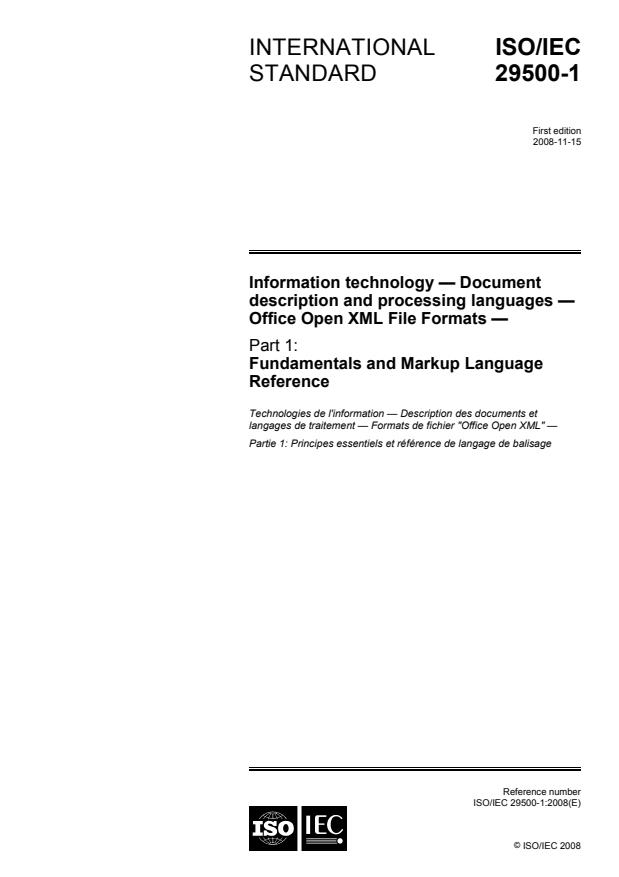
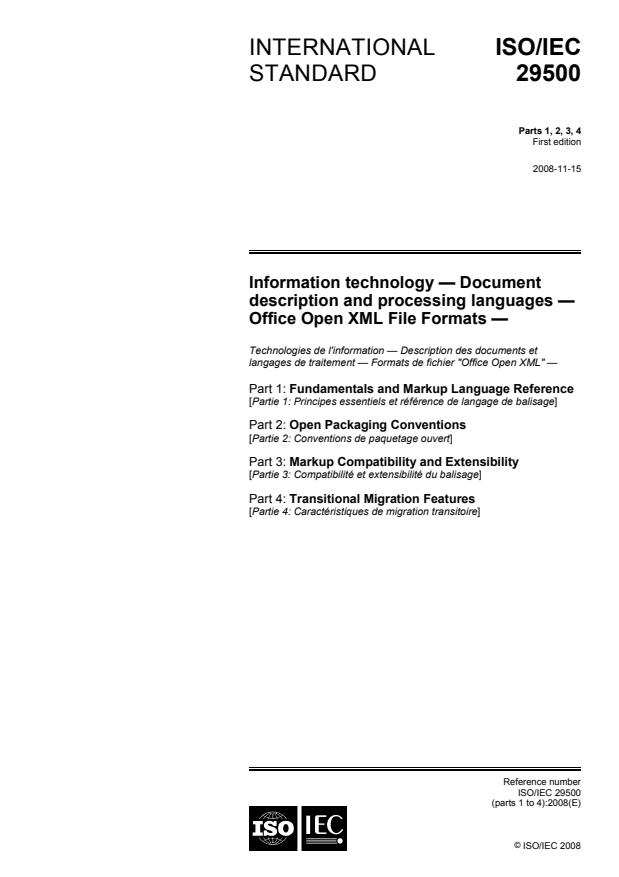
INTERNATIONAL ISO/IEC
STANDARD 29500-1
First edition
2008-11-15
Information technology — Document
description and processing languages —
Office Open XML File Formats —
Part 1:
Fundamentals and Markup Language
Reference
Technologies de l'information — Description des documents et
langages de traitement — Formats de fichier "Office Open XML" —
Partie 1: Principes essentiels et référence de langage de balisage
Reference number
©
ISO/IEC 2008
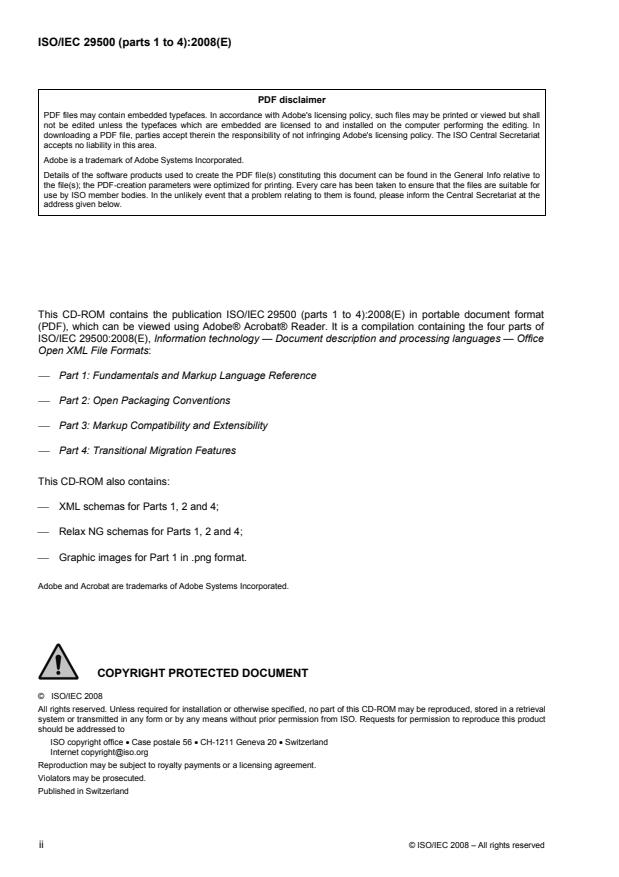
PDF disclaimer
This PDF file may contain embedded typefaces. In accordance with Adobe's licensing policy, this file may be printed or viewed but
shall not be edited unless the typefaces which are embedded are licensed to and installed on the computer performing the editing. In
downloading this file, parties accept therein the responsibility of not infringing Adobe's licensing policy. The ISO Central Secretariat
accepts no liability in this area.
Adobe is a trademark of Adobe Systems Incorporated.
Details of the software products used to create this PDF file can be found in the General Info relative to the file; the PDF-creation
parameters were optimized for printing. Every care has been taken to ensure that the file is suitable for use by ISO member bodies. In
the unlikely event that a problem relating to it is found, please inform the Central Secretariat at the address given below.
© ISO/IEC 2008
All rights reserved. Unless otherwise specified, no part of this publication may be reproduced or utilized in any form or by any means,
electronic or mechanical, including photocopying and microfilm, without permission in writing from either ISO at the address below or
ISO's member body in the country of the requester.
ISO copyright office
Case postale 56 • CH-1211 Geneva 20
Tel. + 41 22 749 01 11
Fax + 41 22 749 09 47
E-mail copyright@iso.org
Web www.iso.org
Published in Switzerland
ii © ISO/IEC 2008 – All rights reserved
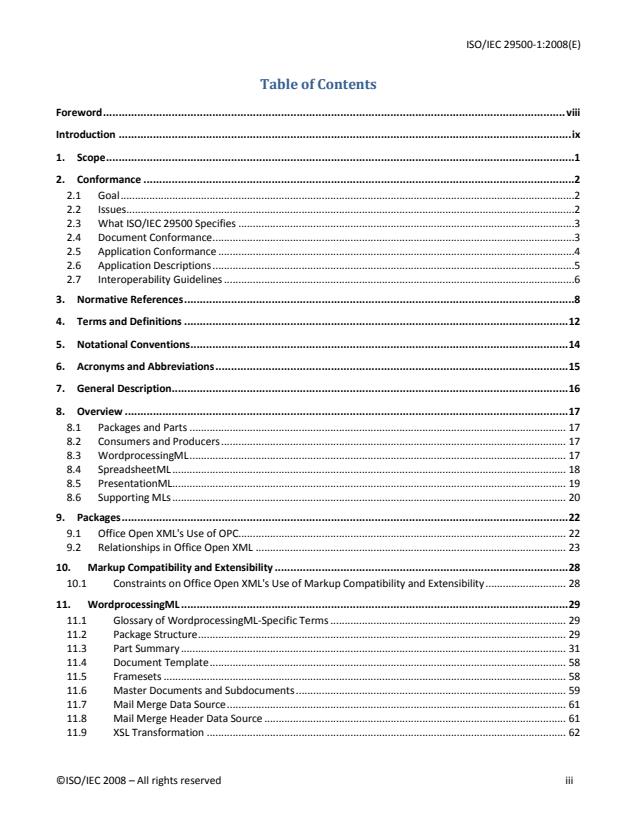
Table of Contents
Foreword . viii
Introduction . ix
1. Scope .1
2. Conformance .2
2.1 Goal .2
2.2 Issues .2
2.3 What ISO/IEC 29500 Specifies .3
2.4 Document Conformance .3
2.5 Application Conformance .4
2.6 Application Descriptions .5
2.7 Interoperability Guidelines .6
3. Normative References .8
4. Terms and Definitions . 12
5. Notational Conventions . 14
6. Acronyms and Abbreviations . 15
7. General Description. 16
8. Overview . 17
8.1 Packages and Parts . 17
8.2 Consumers and Producers . 17
8.3 WordprocessingML . 17
8.4 SpreadsheetML . 18
8.5 PresentationML. 19
8.6 Supporting MLs . 20
9. Packages . 22
9.1 Office Open XML's Use of OPC. 22
9.2 Relationships in Office Open XML . 23
10. Markup Compatibility and Extensibility . 28
10.1 Constraints on Office Open XML's Use of Markup Compatibility and Extensibility . 28
11. WordprocessingML . 29
11.1 Glossary of WordprocessingML-Specific Terms . 29
11.2 Package Structure . 29
11.3 Part Summary . 31
11.4 Document Template . 58
11.5 Framesets . 58
11.6 Master Documents and Subdocuments . 59
11.7 Mail Merge Data Source . 61
11.8 Mail Merge Header Data Source . 61
11.9 XSL Transformation . 62
©ISO/IEC 2008 – All rights reserved iii
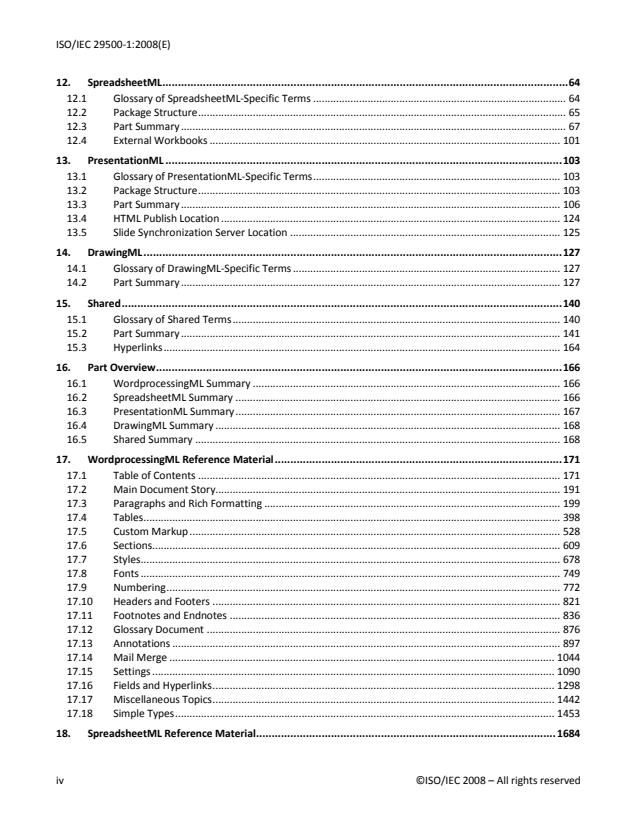
12. SpreadsheetML . 64
12.1 Glossary of SpreadsheetML-Specific Terms . 64
12.2 Package Structure . 65
12.3 Part Summary . 67
12.4 External Workbooks . 101
13. PresentationML . 103
13.1 Glossary of PresentationML-Specific Terms . 103
13.2 Package Structure . 103
13.3 Part Summary . 106
13.4 HTML Publish Location . 124
13.5 Slide Synchronization Server Location . 125
14. DrawingML . 127
14.1 Glossary of DrawingML-Specific Terms . 127
14.2 Part Summary . 127
15. Shared . 140
15.1 Glossary of Shared Terms . 140
15.2 Part Summary . 141
15.3 Hyperlinks . 164
16. Part Overview . 166
16.1 WordprocessingML Summary . 166
16.2 SpreadsheetML Summary . 166
16.3 PresentationML Summary . 167
16.4 DrawingML Summary . 168
16.5 Shared Summary . 168
17. WordprocessingML Reference Material . 171
17.1 Table of Contents . 171
17.2 Main Document Story. 191
17.3 Paragraphs and Rich Formatting . 199
17.4 Tables . 398
17.5 Custom Markup . 528
17.6 Sections. 609
17.7 Styles . 678
17.8 Fonts . 749
17.9 Numbering . 772
17.10 Headers and Footers . 821
17.11 Footnotes and Endnotes . 836
17.12 Glossary Document . 876
17.13 Annotations . 897
17.14 Mail Merge . 1044
17.15 Settings . 1090
17.16 Fields and Hyperlinks . 1298
17.17 Miscellaneous Topics . 1442
17.18 Simple Types . 1453
18. SpreadsheetML Reference Material . 1684
iv ©ISO/IEC 2008 – All rights reserved
18.1 Table of Contents . 1684
18.2 Workbook . 1703
18.3 Worksheets . 1756
18.4 Shared String Table . 1896
18.5 Tables . 1907
18.6 Calculation Chain . 1924
18.7 Comments . 1928
18.8 Styles . 1936
18.9 Metadata . 1993
18.10 Pivot Tables. 2010
18.11 Shared Workbook Data . 2176
18.12 QueryTable Data . 2210
18.13 External Data Connections . 2218
18.14 Supplementary Workbook Data . 2242
18.15 Volatile Dependencies . 2256
18.16 Custom XML Mappings . 2262
18.17 Formulas . 2270
18.18 Simple Types . 2664
19. PresentationML Reference Material . 2753
19.1 Table of Contents . 2753
19.2 Presentation . 2759
19.3 Slides . 2806
19.4 Comments . 2861
19.5 Animation . 2866
19.6 Slide Synchronization Data . 2972
19.7 Simple Types . 2974
20. DrawingML - Framework Reference Material . 3007
20.1 DrawingML - Main . 3007
20.2 DrawingML - Picture . 3447
20.3 DrawingML - Locked Canvas . 3457
20.4 DrawingML - WordprocessingML Drawing . 3458
20.5 DrawingML - SpreadsheetML Drawing . 3507
21. DrawingML - Components Reference Material . 3545
21.1 DrawingML - Main . 3545
21.2 DrawingML - Charts . 3751
21.3 DrawingML - Chart Drawings . 3910
21.4 DrawingML - Diagrams . 3938
22. Shared MLs Reference Material . 4070
22.1 Math . 4070
22.2 Extended Properties . 4230
22.3 Custom Properties . 4240
22.4 Variant Types . 4243
22.5 Custom XML Data Properties . 4260
22.6 Bibliography . 4263
22.7 Additional Characteristics . 4311
©ISO/IEC 2008 – All rights reserved v
22.8 Office Document Relationships . 4315
22.9 Shared Simple Types . 4317
23. Custom XML Schema References . 4340
23.1 Table of Contents . 4340
23.2 Elements . 4340
Annex A. (normative) Schemas – W3C XML Schema . 4345
A.1 WordprocessingML . 4345
A.2 SpreadsheetML . 4410
A.3 PresentationML. 4494
A.4 DrawingML - Framework . 4525
A.5 DrawingML - Components . 4590
A.6 Shared MLs. 4641
A.7 Custom XML Schema References . 4665
Annex B. (informative) Schemas – RELAX NG . 4667
B.1 WordprocessingML . 4667
B.2 SpreadsheetML . 4712
B.3 PresentationML. 4806
B.4 DrawingML - Framework . 4831
B.5 DrawingML - Components . 4880
B.6 Shared MLs. 4916
B.7 Custom XML Schema References . 4932
B.8 Additional Resources . 4932
Annex C. (informative) Additional Syntax Constraints . 4934
Annex D. (informative) Namespace Prefix Mapping in Examples . 4935
Annex E. (informative) Processing Bitfields with XSLT . 4937
E.1 Handling raw bitfields . 4937
E.2 Handling hexadecimal-encoded bitfields . 4938
Annex F. (informative) WordprocessingML Custom XML Data Extraction . 4940
Annex G. (normative) WordprocessingML Page Borders . 4942
Annex H. (normative) Predefined SpreadsheetML Style Definitions . 4943
H.1 Built-in Table Styles . 4943
H.2 Built-in Cell Styles. 4999
H.3 Built-in PivotTable AutoFormats . 5003
Annex I. (informative) Example Predefined DrawingML Shape and Text Geometries. 5019
Annex J. (informative) Bidirectional Support . 5020
J.1 Introduction . 5020
J.2 Shared (WordprocessingML and DrawingML) . 5020
J.3 WordprocessingML . 5022
J.4 SpreadsheetML . 5025
J.5 PresentationML. 5026
J.6 DrawingML . 5026
vi ©ISO/IEC 2008 – All rights reserved
J.7 The Unicode Bidirectional Algorithm and Office Open XML . 5026
Annex K. (informative) Accessibility Best Practices . 5030
K.1 The Value of Creating an Accessible Office Open XML Implementation . 5030
K.2 Needs by Type of Disability . 5031
K.3 Best Practices for Developers . 5034
K.4 Best Practices for Document and Template Authors . 5037
K.5 Best Practices for Customers of Office Open XML Implementations . 5050
Annex L. (informative) Root Element Locations . 5063
L.1 Grouped by Part Name . 5063
L.2 Grouped by Schema Name . 5065
Annex M. (informative) Primer . 5069
M.1 Introduction to WordprocessingML . 5069
M.2 Introduction to SpreadsheetML. 5162
M.3 Introduction to PresentationML . 5301
M.4 Introduction to DrawingML . 5333
M.5 Introduction to VML. 5492
M.6 Introduction to Shared MLs . 5506
M.7 Miscellaneous Topics . 5538
Annex N. (informative) Differences Between ISO/IEC 29500:2008 and ECMA-376:2006. 5553
N.1 WordprocessingML . 5553
N.2 SpreadsheetML . 5556
N.3 PresentationML. 5557
N.4 DrawingML . 5558
N.5 VML . 5559
N.6 Shared . 5559
N.7 Custom XML Schema References . 5560
©ISO/IEC 2008 – All rights reserved vii
Foreword
ISO (the International Organization for Standardization) and IEC (the International Electrotechnical Commission)
form the specialized system for worldwide standardization. National bodies that are members of ISO or IEC
participate in the development of International Standards through technical committees established by the
respective organization to deal with particular fields of technical activity. ISO and IEC technical committees
collaborate in fields of mutual interest. Other international organizations, governmental and non-governmental,
in liaison with ISO and IEC, also take part in the work. In the field of information technology, ISO and IEC have
established a joint technical committee, ISO/IEC JTC 1.
International Standards are drafted in accordance with the rules given in the ISO/IEC Directives, Part 2.
The main task of the joint technical committee is to prepare International Standards. Draft International
Standards adopted by the joint technical committee are circulated to national bodies for voting. Publication as
an International Standard requires approval by at least 75 % of the national bodies casting a vote.
Attention is drawn to the possibility that some of the elements of this document may be the subject of patent
rights. ISO and IEC shall not be held responsible for identifying any or all such patent rights.
ISO/IEC 29500 was prepared by Ecma International (as ECMA-376:2006) and was adopted, under a special “fast-
track procedure”, by Joint Technical Committee ISO/IEC JTC 1, Information technology, in parallel with its
approval by the national bodies of ISO and IEC.
Some important differences between ISO/IEC 29500 and ECMA-376:2006 are given in Annex N.
ISO/IEC 29500 consists of the following parts, under the general title Information technology — Document
description and processing languages — Office Open XML File Formats:
Part 1: Fundamentals and Markup Language Reference
Part 2: Open Packaging Conventions
Part 3: Markup Compatibility and Extensibility
Part 4: Transitional Migration Features
Annexes A, G and H form a normative part of this Part of ISO/IEC 29500. Annexes B–F and I–N are for
information only.
This Part of ISO/IEC 29500 includes five annexes (Annex A, Annex B, Annex G, Annex H, and Annex I) that refer to
data files provided in electronic form.
viii ©ISO/IEC 2008 – All rights reserved
Introduction
ISO/IEC 29500 specifies a family of XML schemas, collectively called Office Open XML, which define the XML
vocabularies for word-processing, spreadsheet, and presentation documents, as well as the packaging of
documents that conform to these schemas.
The goal is to enable the implementation of the Office Open XML formats by the widest set of tools and
platforms, fostering interoperability across office productivity applications and line-of-business systems, as well
as to support and strengthen document archival and preservation, all in a way that is fully compatible with the
existing corpus of Microsoft Office documents.
The following organizations have participated in the creation of ISO/IEC 29500 and their contributions are
gratefully acknowledged:
Apple, Barclays Capital, BP, The British Library, Essilor, Intel, Microsoft, NextPage, Novell, Statoil, Toshiba, and
the United States Library of Congress
©ISO/IEC 2008 – All rights reserved ix
INTERNATIONAL STANDARD ISO/IEC 29500-1:2008(E)
Information technology — Document description and
processing languages — Office Open XML File Formats
Part 1:
Fundamentals and Markup Language Reference
1. Scope
ISO/IEC 29500 defines a set of XML vocabularies for representing word-processing documents, spreadsheets and
presentations. On the one hand, the goal of ISO/IEC 29500 is to be capable of faithfully representing the pre-
existing corpus of word-processing documents, spreadsheets and presentations that had been produced by the
Microsoft Office applications (from Microsoft Office 97 to Microsoft Office 2008, inclusive) at the date of the
creation of ISO/IEC 29500. It also specifies requirements for Office Open XML consumers and producers. On the
other hand, the goal is to facilitate extensibility and interoperability by enabling implementations by multiple
vendors and on multiple platforms.
This Part of ISO/IEC29500 specifies concepts for documents and applications of both strict and transitional
conformance.
©ISO/IEC 2008 – All rights reserved 1
2. Conformance
The text in ISO/IEC 29500 is divided into normative and informative categories. Text marked informative (using
the mechanisms described in §7) is for information purposes only. Unless stated otherwise, all text is normative.
Use of the word “shall” indicates required behavior.
Any behavior that is not explicitly specified by ISO/IEC 29500 is implicitly unspecified (§4).
2.1 Goal
This subclause is informative
The goal of this clause is to define conformance, and to provide interoperability guidelines in a way that fosters
broad and innovative use of the Office Open XML file format, while maximizing interoperability and preserving
investment in existing files and applications (§4). By meeting this goal, ISO/IEC 29500 benefits the following
audiences:
Developers that design, implement, or maintain Office Open XML applications.
Developers that interact programmatically with Office Open XML applications.
Governmental or commercial entities that procure Office Open XML applications.
Testing organizations that verify conformance of specific Office Open XML applications to ISO/IEC 29500.
(Note that ISO/IEC 29500 does not include a test suite.)
Educators and authors who teach about Office Open XML applications.
End informative subclause
2.2 Issues
This subclause is informative
To achieve the above goal, the following issues need to be considered:
1. The application domain encompasses a range of possible consumers (§4) and producers (§4) so broad
that defining specific application behaviors would restrict innovation. For example, stipulating visual
layout would be inappropriate for a consumer that extracts data for machine consumption, or that
renders text in sound. Another example is that restricting capacity or precision runs the risk of diluting
the value of future advances in hardware.
2. Commonsense user expectations regarding the interpretation of an Office Open XML package (§4) play
such an important role in that package's value that a purely syntactic definition of conformance would
fail to effect a useful level of interoperability. For example, such a definition would admit an application
that reads a package, and then writes it in a manner that, though syntactically valid, differs arbitrarily
from the original.
2 ©ISO/IEC 2008 – All rights reserved
3. Legitimate operations on a package include deliberate transformations, making blanket change
prohibitions inappropriate in the conformance definition. For example, collapsing spreadsheet formulas
to their calculated values, or converting complex presentation graphics to static bitmaps, could be
correct for an application whose published purpose is to perform those operations. Again,
commonsense user expectation makes the difference.
4. Existing files and applications exercise a broad range of formats and functionality that, if required by the
conformance definition, would add an impractical amount of bulk to ISO/IEC 29500 and could
inadvertently obligate new applications to implement a prohibitive amount of functionality. This issue is
caused by the breadth of currently available functionality and is compounded by the existence of legacy
formats.
End informative subclause
2.3 What ISO/IEC 29500 Specifies
To address the issues listed above, ISO/IEC 29500 constrains both syntax and semantics, but it is not intended to
predefine application behavior. Therefore, it includes, among others, the following three types of information:
1. W3C XML Schemas and an associated validation procedure for validating document syntax against those
schemas. (The validation procedure includes un-zipping, locating files, processing the extensibility XML
elements and attributes, and W3C XML Schema validation.)
2. Additional syntax constraints in written form. [Note: These constraints are described in written form
because they could not feasibly be expressed in the schema language. end note]
3. Descriptions of XML element semantics. The semantics of an XML element refers to its intended
interpretation by a human being.
2.4 Document Conformance
Document conformance is purely syntactic; it involves only Items 1 and 2 in §2.3 above.
A conforming document shall conform to the transitional W3C XML Schema or the strict W3C XML
Schema (Item 1), and any additional syntax constraints (Item 2).
The document shall be of category Wordprocessing, Spreadsheet, or Presentation.
The document character set shall conform to the Unicode Standard and ISO/IEC 10646:2003, with either
the UTF-8 or UTF-16 encoding form, as required by the XML 1.0 standard.
Any XML element or attribute not explicitly included in ISO/IEC 29500 shall use the extensibility
mechanisms described by ISO/IEC 29500-1 and ISO/IEC 29500-3.
Each Part of this multi-part standard has its own conformance clause. The term conformance class is used to
disambiguate conformance within different Parts of this multi-part standard. This Part of ISO/IEC 29500 defines
the following document conformance classes:
WML Strict, if the document is a conforming document of category Wordprocessing that conforms to
the strict schema and does not include any features from Part 4.
©ISO/IEC 2008 – All rights reserved 3
SML Strict, if the document is a conforming document of category Spreadsheet that conforms to the
strict schema and does not include any features from Part 4.
PML Strict, if the document is a conforming document of category Presentation that conforms to the
strict schema and does not include any features from Part 4.
In addition, documents of conformance class WML Strict, SML Strict, or PML Strict shall not embed documents
of conformance class WML Transitional, SML Transitional, or PML Transitional as defined in Part 4.
Document categories Wordprocessing, Spreadsheet, and Presentation are defined in §4.
[Note: Other document conformance classes could be defined in the future. end note]
[Note: A document cannot be of more than one of the above conformance classes. end note]
2.5 Application Conformance
Application conformance incorporates both syntax and semantics; it involves items 1, 2, and 3 in §2.3 above.
A conforming consumer shall not reject any conforming documents of at least one document
conformance class.
A conforming producer shall be able to produce conforming documents of at least one document
conformance class.
A conforming application shall treat the information in Office Open XML documents in a manner
consistent with the semantic definitions given in ISO/IEC 29500. An application's intended behavior
need not require that application to process all of the information in an Office Open XML document.
However, the information that it does process shall be processed in a manner that is consistent with the
semantic definitions given in ISO/IEC 29500.
[Note: This note illustrates the third bullet above. Conforming applications might serve various functions.
Examples include a viewer, an editor, and a back-end processor. Here is an illustration of how the third bullet
applies to each of those examples:
If a conforming viewer supports a given feature, then when it displays information using that feature, it
respects the semantics of that feature as described in the Standard.
If a conforming editor supports a given feature, then when it provides its user with an interface for
manipulating information using that feature, it respects the semantics of that feature as described in the
Standard.
If a conforming back-end processor supports a given feature, then when that processor transforms or
assembles information involving that feature, that processor respects the semantics of that feature as
described in the Standard.
end note]
This Part of ISO/IEC 29500 defines the following application conformance classes:
4 ©ISO/IEC 2008 – All rights reserved
WML Strict, if
...
INTERNATIONAL ISO/IEC
STANDARD 29500
Parts 1, 2, 3, 4
First edition
2008-11-15
Information technology — Document
description and processing languages —
Office Open XML File Formats —
Technologies de l'information — Description des documents et
langages de traitement — Formats de fichier "Office Open XML" —
Part 1: Fundamentals and Markup Language Reference
[Partie 1: Principes essentiels et référence de langage de balisage]
Part 2: Open Packaging Conventions
[Partie 2: Conventions de paquetage ouvert]
Part 3: Markup Compatibility and Extensibility
[Partie 3: Compatibilité et extensibilité du balisage]
Part 4: Transitional Migration Features
[Partie 4: Caractéristiques de migration transitoire]
Reference number
ISO/IEC 29500
(parts 1 to 4):2008(E)
©
ISO/IEC 2008
ISO/IEC 29500 (parts 1 to 4):2008(E)
PDF disclaimer
PDF files may contain embedded typefaces. In accordance with Adobe's licensing policy, such files may be printed or viewed but shall
not be edited unless the typefaces which are embedded are licensed to and installed on the computer performing the editing. In
downloading a PDF file, parties accept therein the responsibility of not infringing Adobe's licensing policy. The ISO Central Secretariat
accepts no liability in this area.
Adobe is a trademark of Adobe Systems Incorporated.
Details of the software products used to create the PDF file(s) constituting this document can be found in the General Info relative to
the file(s); the PDF-creation parameters were optimized for printing. Every care has been taken to ensure that the files are suitable for
use by ISO member bodies. In the unlikely event that a problem relating to them is found, please inform the Central Secretariat at the
address given below.
This CD-ROM contains the publication ISO/IEC 29500 (parts 1 to 4):2008(E) in portable document format
(PDF), which can be viewed using Adobe® Acrobat® Reader. It is a compilation containing the four parts of
ISO/IEC 29500:2008(E), Information technology — Document description and processing languages — Office
Open XML File Formats:
⎯ Part 1: Fundamentals and Markup Language Reference
⎯ Part 2: Open Packaging Conventions
⎯ Part 3: Markup Compatibility and Extensibility
⎯ Part 4: Transitional Migration Features
This CD-ROM also contains:
⎯ XML schemas for Parts 1, 2 and 4;
⎯ Relax NG schemas for Parts 1, 2 and 4;
⎯ Graphic images for Part 1 in .png format.
Adobe and Acrobat are tradema
...
Questions, Comments and Discussion
Ask us and Technical Secretary will try to provide an answer. You can facilitate discussion about the standard in here.
Loading comments...