

ISO/IEC 30114-2:2018
(Main)Information technology — Extensions of Office Open XML file formats — Part 2: Character repertoire checking
General Information
- Abstract
ISO/IEC 30114-2:2018 provides an extension of OOXML for embedding CREPDL scripts within an OOXML document, and validating character contents in the OOXML document against these CREPDL scripts.
- Status
- Published
- Publication Date
- 04-Apr-2018
- Technical Committee
- ISO/IEC JTC 1/SC 34 - Document description and processing languages
- Drafting Committee
- ISO/IEC JTC 1/SC 34/WG 4 - Office Open XML
- Current Stage
- 9093 - International Standard confirmed
- Start Date
- 08-Sep-2023
- Completion Date
- 29-Aug-2026
Buy Documents
ISO/IEC 30114-2:2018 - Information technology -- Extensions of Office Open XML file formats
ISO/IEC 30114-2:2018 - Information technology — Extensions of Office Open XML file formats — Part 2: Character repertoire checking/5/2018
Overview
ISO/IEC 30114-2:2018 specifies an extension to Office Open XML (OOXML) that enables embedding CREPDL (Character Repertoire Description Language) scripts inside an OOXML package and validating the character repertoire of document parts against those scripts. The standard defines how CREPDL scripts are packaged as OPC (Open Packaging Conventions) parts, how they are referenced, and how character repertoire checking is performed. A typical use is ensuring that spreadsheet cells or other parts contain characters only from a specified repertoire (for example, ISO/IEC 8859-1).
Key topics and technical requirements
- Embedding CREPDL scripts: CREPDL scripts are included as OPC parts (CREPDL parts) and must conform to ISO/IEC 19757-7 after any MCE (Markup Compatibility and Extensibility) processing.
- Character Checking Origin and Condition parts: The standard introduces two new OPC part types:
- Character Checking Origin part - empty stream, single optional instance per package.
- Character Checking Condition part - XML documents that reference a root CREPDL script and one or more target parts/locations whose character contents are validated.
- Processing model: For each Character Checking Condition part:
- Apply MCE processing.
- Retrieve and MCE-process the referenced CREPDL script.
- Validate the character contents of each referenced target part against the CREPDL script.
- Schemas and conformance: Character Checking Condition parts must be valid against the XML Schema / RELAX NG schemas in Annex A after MCE processing. The standard targets OOXML conformance classes Strict and Transitional.
- Media types and relationships (Annex B):
- Media types:
- Character Checking Condition: application/vnd.openxmlformats-extension.character-checking-condition
- Character Checking Origin: application/vnd.openxmlformats-extension.character-checking-origin
- CREPDL part: application/xml
- Relationship types (examples): package→origin, origin→condition, condition→script, condition→target (full URIs are defined in Annex B).
- Media types:
Applications and who uses it
- Software vendors and implementers building OOXML readers/writers or validation tools can incorporate character repertoire checking to enforce allowed character sets.
- Document converters and migration tools that must ensure target systems accept only specific character repertoires.
- Localization and compliance teams that need automated checks (for regulatory, legacy-system compatibility, or data-entry constraints) to enforce character restrictions.
- Quality assurance and document processing pipelines that require embedded validation rules close to document data.
Related standards
- ISO/IEC 19757-7 - Character Repertoire Description Language (CREPDL)
- ISO/IEC 29500-1/2/3/4 - Office Open XML file formats and packaging, Markup Compatibility and Extensibility (MCE)
- W3C XML and XML Schema specifications
ISO/IEC 30114-2:2018 integrates character repertoire validation into the OOXML packaging model, providing a standardized, portable way to embed and apply CREPDL-based character checks within Office Open XML documents.
Buy Documents
ISO/IEC 30114-2:2018 - Information technology -- Extensions of Office Open XML file formats
ISO/IEC 30114-2:2018 - Information technology — Extensions of Office Open XML file formats — Part 2: Character repertoire checking/5/2018
Get Certified
Connect with accredited certification bodies for this standard

BSI Group
BSI (British Standards Institution) is the business standards company that helps organizations make excellence a habit.

NYCE
Mexican standards and certification body.
Sponsored listings
Frequently Asked Questions
ISO/IEC 30114-2:2018 is a standard published by the International Organization for Standardization (ISO). Its full title is "Information technology — Extensions of Office Open XML file formats — Part 2: Character repertoire checking". This standard covers: ISO/IEC 30114-2:2018 provides an extension of OOXML for embedding CREPDL scripts within an OOXML document, and validating character contents in the OOXML document against these CREPDL scripts.
ISO/IEC 30114-2:2018 provides an extension of OOXML for embedding CREPDL scripts within an OOXML document, and validating character contents in the OOXML document against these CREPDL scripts.
ISO/IEC 30114-2:2018 is classified under the following ICS (International Classification for Standards) categories: 35.060 - Languages used in information technology; 35.240.30 - IT applications in information, documentation and publishing. The ICS classification helps identify the subject area and facilitates finding related standards.
ISO/IEC 30114-2:2018 is available in PDF format for immediate download after purchase. The document can be added to your cart and obtained through the secure checkout process. Digital delivery ensures instant access to the complete standard document.
Standards Content (Sample)
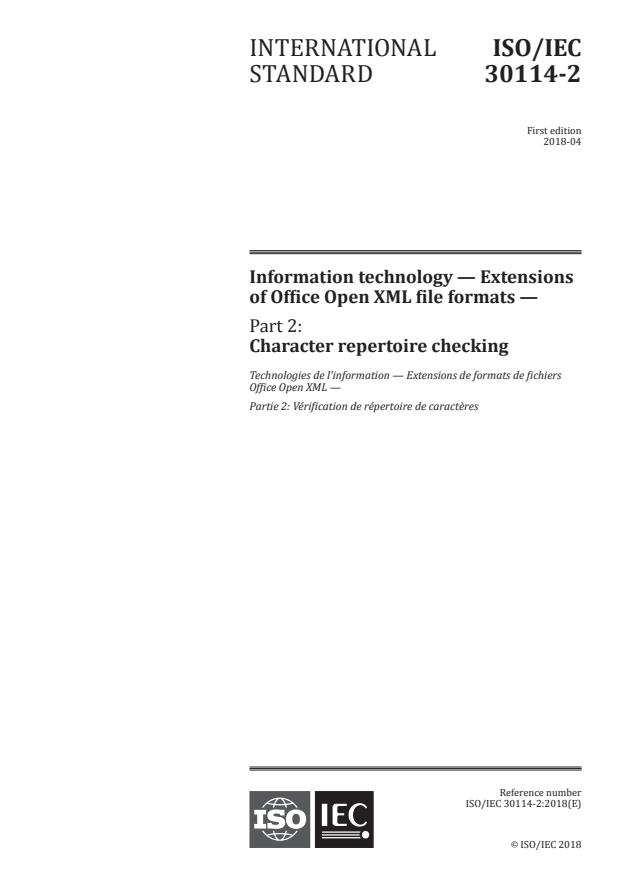
INTERNATIONAL ISO/IEC
STANDARD 30114-2
First edition
2018-04
Information technology — Extensions
of Office Open XML file formats —
Part 2:
Character repertoire checking
Technologies de l'information — Extensions de formats de fichiers
Office Open XML —
Partie 2: Vérification de répertoire de caractères
Reference number
©
ISO/IEC 2018
© ISO/IEC 2018
All rights reserved. Unless otherwise specified, or required in the context of its implementation, no part of this publication may
be reproduced or utilized otherwise in any form or by any means, electronic or mechanical, including photocopying, or posting
on the internet or an intranet, without prior written permission. Permission can be requested from either ISO at the address
below or ISO’s member body in the country of the requester.
ISO copyright office
CP 401 • Ch. de Blandonnet 8
CH-1214 Vernier, Geneva
Phone: +41 22 749 01 11
Fax: +41 22 749 09 47
Email: copyright@iso.org
Website: www.iso.org
Published in Switzerland
ii © ISO/IEC 2018 – All rights reserved
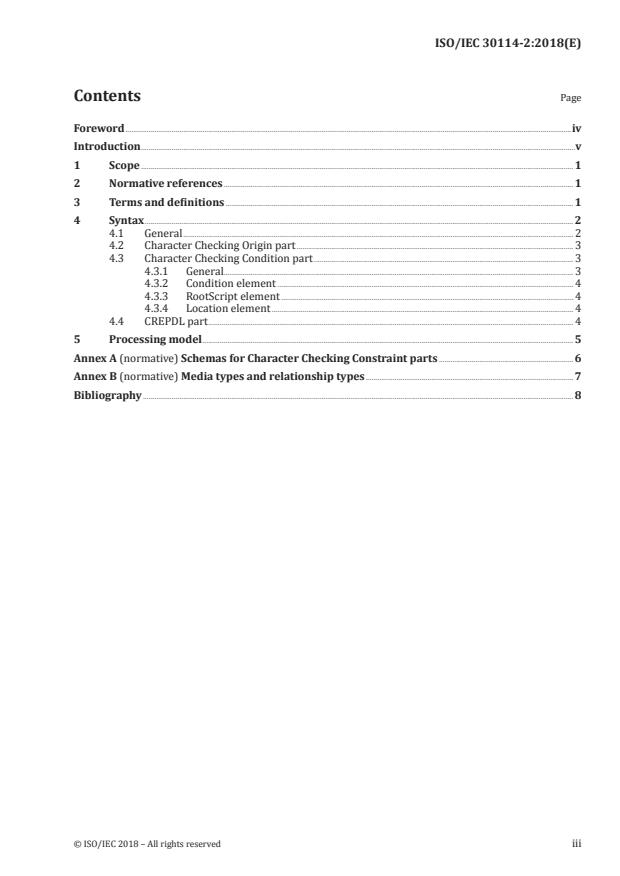
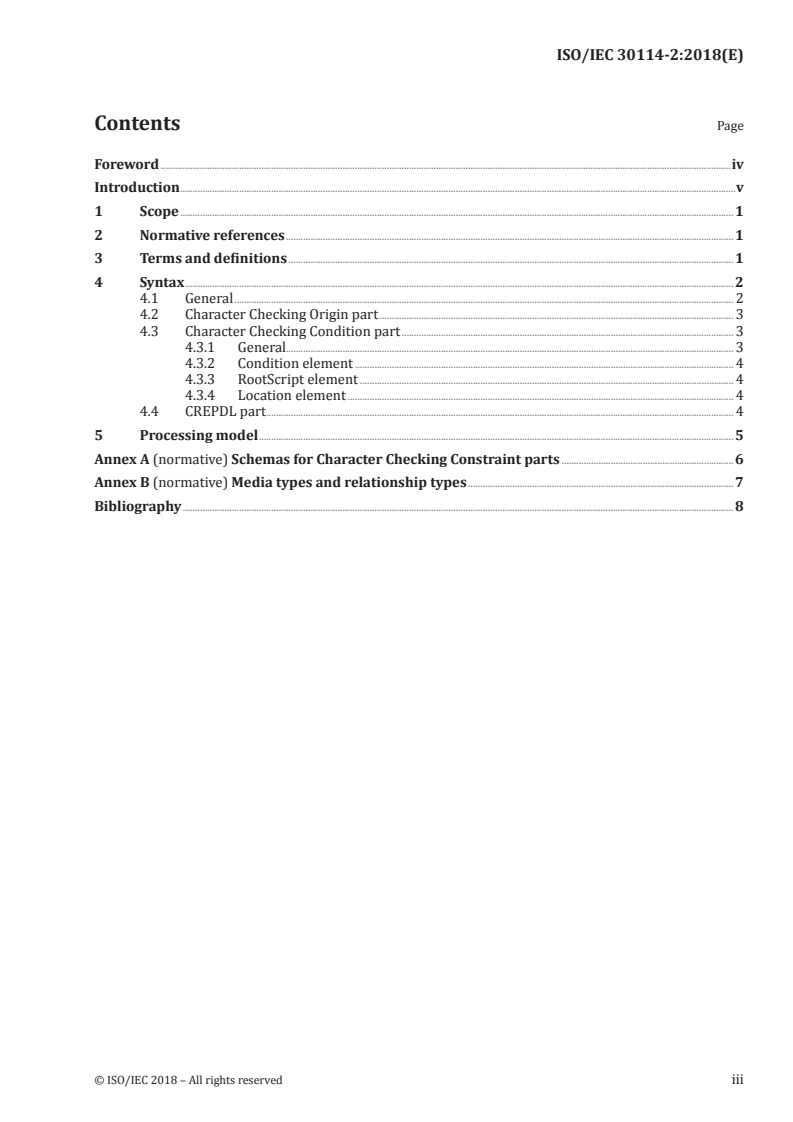
Contents Page
Foreword .iv
Introduction .v
1 Scope . 1
2 Normative references . 1
3 Terms and definitions . 1
4 Syntax . 2
4.1 General . 2
4.2 Character Checking Origin part . 3
4.3 Character Checking Condition part . 3
4.3.1 General. 3
4.3.2 Condition element . 4
4.3.3 RootScript element . 4
4.3.4 Location element . 4
4.4 CREPDL part . 4
5 Processing model . 5
Annex A (normative) Schemas for Character Checking Constraint parts . 6
Annex B (normative) Media types and relationship types . 7
Bibliography . 8
© ISO/IEC 2018 – All rights reserved iii
Foreword
ISO (the International Organization for Standardization) and IEC (the International Electrotechnical
Commission) form the specialized system for worldwide standardization. National bodies that are
members of ISO or IEC participate in the development of International Standards through technical
committees established by the respective organization to deal with particular fields of technical
activity. ISO and IEC technical committees collaborate in fields of mutual interest. Other international
organizations, governmental and non-governmental, in liaison with ISO and IEC, also take part in the
work. In the field of information technology, ISO and IEC have established a joint technical committee,
ISO/IEC JTC 1.
The procedures used to develop this document and those intended for its further maintenance are
described in the ISO/IEC Directives, Part 1. In particular the different approval criteria needed for
the different types of document should be noted. This document was drafted in accordance with the
editorial rules of the ISO/IEC Directives, Part 2 (see www .iso .org/ directives).
Attention is drawn to the possibility that some of the elements of this document may be the subject
of patent rights. ISO and IEC shall not be held responsible for identifying any or all such patent
rights. Details of any patent rights identified during the development of the document will be in the
Introduction and/or on the ISO list of patent declarations received (see www .iso .org/ patents).
Any trade name used in this document is information given for the convenience of users and does not
constitute an endorsement.
For an explanation on the voluntary nature of standards, the meaning of ISO specific terms and
expressions related to conformity assessment, as well as information about ISO's adherence to the
World Trade Organization (WTO) principles in the Technical Barriers to Trade (TBT) see the following
URL: www .iso .org/ iso/ foreword .html.
This document was prepared by Technical Committee ISO/IEC JTC 1, Information technology,
Subcommittee SC 34, Document description and processing languages.
A list of all parts in the ISO/IEC 30114 series can be found on the ISO website.
iv © ISO/IEC 2018 – All rights reserved
Introduction
ISO/IEC 29500 was designed to allow the addition of markup and other data to Open Office XML (OOXML)
documents, and to allow OOXML applications unaware of such markup and date to provide reasonable
results.
This document standardizes a set of extensions for character repertoire checking. For example, it can be
used to ensure that some cells in OOXML Spreadsheet documents contain characters in ISO/IEC 8859-
[1]
1 only.
© ISO/IEC 2018 – All rights reserved v
INTERNATIONAL STANDARD ISO/IEC 30114-2:2018(E)
Information technology — Extensions of Office Open XML
file formats —
Part 2:
Character repertoire checking
1 Scope
This document provides an extension of OOXML for embedding CREPDL scripts within an OOXML
document, and validating character contents in the OOXML document against these CREPDL scripts.
2 Normative references
The following documents are referred to in the text in such a way that some or all of their content
constitutes requirements of this document. For dated references, only the edition cited applies. For
undated references, the latest edition of the referenced document (including any amendments) applies.
ISO/IEC 19757-2, Information technology — Document Schema Definition Language (DSDL) — Part 2:
Regular-grammar-based validation — RELAX NG
ISO/IEC 19757-7, Information technology — Document Schema Definition Languages (DSDL) — Part 7:
Character Repertoire Description Language (CREPDL)
ISO/IEC 29500-1, Information technology — Document description and processing languages — Office
Open XML File Formats — Part 1: Fundamentals and Markup Language Reference
ISO/IEC 29500-2, Information technology — Document description and processing languages — Office
Open XML File Formats — Part 2: Open Packaging Conventions
ISO/IEC 29500-3, Information technology — Document description and processing languages — Office
Open XML File Formats — Part 3: Markup Compatibility and Extensibility
ISO/IEC 29500-4, Information technology — Document description and processing languages — Office
Open XML File Formats — Part 4: Transitional Migration Features
W3C XML, Extensible Markup Language (XML) 1.0, W3C Recommendation, available at http:// www .w3
.org/ TR/ xml
W3C XML Schema Part 1: Structure, W3C Recommendation, available at http:// www .w3 .org/ TR/
xmlschema -1/
3 Terms and definitions
For the purposes of this document, the terms and definitions given in W3C XML, W3C XML Schema
Part 1, ISO/IEC 19757-2, ISO/IEC 19757-7, ISO/IEC 29500-1, ISO/IEC 29500-2, ISO/IEC 29500-3, and
ISO/IEC 29500-4 and the following apply.
ISO and IEC maintain terminological databases for use in
...
INTERNATIONAL ISO/IEC
STANDARD 30114-2
First edition
2018-04
Information technology — Extensions
of Office Open XML file formats —
Part 2:
Character repertoire checking
Technologies de l'information — Extensions de formats de fichiers
Office Open XML —
Partie 2: Vérification de répertoire de caractères
Reference number
©
ISO/IEC 2018
© ISO/IEC 2018
All rights reserved. Unless otherwise specified, or required in the context of its implementation, no part of this publication may
be reproduced or utilized otherwise in any form or by any means, electronic or mechanical, including photocopying, or posting
on the internet or an intranet, without prior written permission. Permission can be requested from either ISO at the address
below or ISO’s member body in the country of the requester.
ISO copyright office
CP 401 • Ch. de Blandonnet 8
CH-1214 Vernier, Geneva
Phone: +41 22 749 01 11
Fax: +41 22 749 09 47
Email: copyright@iso.org
Website: www.iso.org
Published in Switzerland
ii © ISO/IEC 2018 – All rights reserved
Contents Page
Foreword .iv
Introduction .v
1 Scope . 1
2 Normative references . 1
3 Terms and definitions . 1
4 Syntax . 2
4.1 General . 2
4.2 Character Checking Origin part . 3
4.3 Character Checking Condition part . 3
4.3.1 General. 3
4.3.2 Condition element . 4
4.3.3 RootScript element . 4
4.3.4 Location element . 4
4.4 CREPDL part . 4
5 Processing model . 5
Annex A (normative) Schemas for Character Checking Constraint parts . 6
Annex B (normative) Media types and relationship types . 7
Bibliography . 8
© ISO/IEC 2018 – All rights reserved iii
Foreword
ISO (the International Organization for Standardization) and IEC (the International Electrotechnical
Commission) form the specialized system for worldwide standardization. National bodies that are
members of ISO or IEC participate in the development of International Standards through technical
committees established by the respective organization to deal with particular fields of technical
activity. ISO and IEC technical committees collaborate in fields of mutual interest. Other international
organizations, governmental and non-governmental, in liaison with ISO and IEC, also take part in the
work. In the field of information technology, ISO and IEC have established a joint technical committee,
ISO/IEC JTC 1.
The procedures used to develop this document and those intended for its further maintenance are
described in the ISO/IEC Directives, Part 1. In particular the different approval criteria needed for
the different types of document should be noted. This document was drafted in accordance with the
editorial rules of the ISO/IEC Directives, Part 2 (see www .iso .org/ directives).
Attention is drawn to the possibility that some of the elements of this document may be the subject
of patent rights. ISO and IEC shall not be held responsible for identifying any or all such patent
rights. Details of any patent rights identified during the development of the document will be in the
Introduction and/or on the ISO list of patent declarations received (see www .iso .org/ patents).
Any trade name used in this document is information given for the convenience of users and does not
constitute an endorsement.
For an explanation on the voluntary nature of standards, the meaning of ISO specific terms and
expressions related to conformity assessment, as well as information about ISO's adherence to the
World Trade Organization (WTO) principles in the Technical Barriers to Trade (TBT) see the following
URL: www .iso .org/ iso/ foreword .html.
This document was prepared by Technical Committee ISO/IEC JTC 1, Information technology,
Subcommittee SC 34, Document description and processing languages.
A list of all parts in the ISO/IEC 30114 series can be found on the ISO website.
iv © ISO/IEC 2018 – All rights reserved
Introduction
ISO/IEC 29500 was designed to allow the addition of markup and other data to Open Office XML (OOXML)
documents, and to allow OOXML applications unaware of such markup and date to provide reasonable
results.
This document standardizes a set of extensions for character repertoire checking. For example, it can be
used to ensure that some cells in OOXML Spreadsheet documents contain characters in ISO/IEC 8859-
[1]
1 only.
© ISO/IEC 2018 – All rights reserved v
INTERNATIONAL STANDARD ISO/IEC 30114-2:2018(E)
Information technology — Extensions of Office Open XML
file formats —
Part 2:
Character repertoire checking
1 Scope
This document provides an extension of OOXML for embedding CREPDL scripts within an OOXML
document, and validating character contents in the OOXML document against these CREPDL scripts.
2 Normative references
The following documents are referred to in the text in such a way that some or all of their content
constitutes requirements of this document. For dated references, only the edition cited applies. For
undated references, the latest edition of the referenced document (including any amendments) applies.
ISO/IEC 19757-2, Information technology — Document Schema Definition Language (DSDL) — Part 2:
Regular-grammar-based validation — RELAX NG
ISO/IEC 19757-7, Information technology — Document Schema Definition Languages (DSDL) — Part 7:
Character Repertoire Description Language (CREPDL)
ISO/IEC 29500-1, Information technology — Document description and processing languages — Office
Open XML File Formats — Part 1: Fundamentals and Markup Language Reference
ISO/IEC 29500-2, Information technology — Document description and processing languages — Office
Open XML File Formats — Part 2: Open Packaging Conventions
ISO/IEC 29500-3, Information technology — Document description and processing languages — Office
Open XML File Formats — Part 3: Markup Compatibility and Extensibility
ISO/IEC 29500-4, Information technology — Document description and processing languages — Office
Open XML File Formats — Part 4: Transitional Migration Features
W3C XML, Extensible Markup Language (XML) 1.0, W3C Recommendation, available at http:// www .w3
.org/ TR/ xml
W3C XML Schema Part 1: Structure, W3C Recommendation, available at http:// www .w3 .org/ TR/
xmlschema -1/
3 Terms and definitions
For the purposes of this document, the terms and definitions given in W3C XML, W3C XML Schema
Part 1, ISO/IEC 19757-2, ISO/IEC 19757-7, ISO/IEC 29500-1, ISO/IEC 29500-2, ISO/IEC 29500-3, and
ISO/IEC 29500-4 and the following apply.
ISO and IEC maintain terminological databases for use in
...