


ISO 15621
(Main)Absorbent incontinence products for urine, faeces, or both — General guidelines on evaluation
Absorbent incontinence products for urine, faeces, or both — General guidelines on evaluation
ISO 15621:2017 gives guidelines for evaluating absorbent incontinence aids for urine and/or faeces. It provides a context for the procedures described in other International Standards and published testing procedures. General factors relating to incontinence products and their usage are also addressed.
Produits d'incontinence absorbants pour l'urine, les matières fécales ou les deux — Lignes directrices générales pour l'évaluation
L'ISO 15621:2017 fournit des lignes directrices pour évaluer les aides à l'incontinence pour l'absorption d'urine et/ou de matières fécales. Elle fournit un contexte pour les modes opératoires décrits dans d'autres Normes internationales et modes opératoires d'essais publiés. Les facteurs généraux concernant les produits pour incontinence et leur usage sont également examinés.
General Information
- Status
- Not Published
- Technical Committee
- ISO/TC 173/SC 3 - Aids for ostomy and incontinence
- Drafting Committee
- ISO/TC 173/SC 3 - Aids for ostomy and incontinence
- Current Stage
- 6000 - International Standard under publication
- Start Date
- 13-Dec-2025
- Completion Date
- 12-Feb-2026
Relations
- Effective Date
- 12-Feb-2026
- Effective Date
- 12-Aug-2023
- Effective Date
- 18-Feb-2023
Overview
ISO 15621 provides general guidelines for evaluating absorbent incontinence products intended to contain urine, faeces, or both. Applicable to adults and children, the standard offers context for procedures in related international standards and published testing methods. It emphasizes user-centred evaluation to support informed product selection by clinicians, caregivers, purchasers and manufacturers. The standard highlights the global prevalence of incontinence (estimated 4–8% of the population, about 425 million people) and the role of absorbent products in maintaining dignity, comfort and independence.
Why this matters: ISO 15621 helps stakeholders assess performance, suitability and usability so that end users receive products that meet their clinical, lifestyle and care needs.
Key Topics
User-related factors: The standard prioritizes the end user. Key considerations include quality of life, independence vs. need for assistance, nature and frequency of incontinence episodes, anatomy and body shape, mobility, dexterity, cognitive status and daily activities.
Product-related factors: Important product characteristics covered include product type (pads, pull-ons, all-in-ones), absorption capacity, acquisition speed, retention capacity, rewet and the emergence of products with sensors to indicate saturation.
Usage-related factors: Practical aspects such as ease of application and removal, ergonomics for caregivers, discreetness, environmental impact, cost and logistics (carrying, disposal, laundry) affect product choice and acceptability.
Evaluation methods: ISO 15621 describes the context for testing methodologies and interpretation of results rather than prescribing a single test. It encourages combining laboratory data with in-use trials and user feedback to determine practical suitability.
Applications
ISO 15621 supports multiple stakeholders by providing a framework to:
- Evaluate and compare absorbent incontinence products during procurement or product development
- Inform clinical prescribing and individualized product trials for end users
- Guide caregivers and care-home managers in matching products to client needs
- Help manufacturers understand user and testing expectations when designing products
Practical application recommends in-use trials with individual end users, since laboratory measures alone do not fully predict comfort, fit and real-world performance.
Related Standards
ISO 15621 is intended to be used alongside other ISO standards and classification tools, including:
- ISO 22748 - product type names and illustrations
- ISO 9999 - classification of assistive products
- Other referenced documents for testing and terminology
Summary: ISO 15621 is a user-focused evaluation guide that bridges laboratory testing and real-world product selection. It helps ensure absorbent incontinence products are chosen and tested with practical user needs, caregiver workflows and procurement requirements in mind.

ISO/FDIS 15621 - Absorbent incontinence products for urine, faeces, or both — General guidelines on evaluation Released:10/3/2025
REDLINE ISO/FDIS 15621 - Absorbent incontinence products for urine, faeces, or both — General guidelines on evaluation Released:10/3/2025

ISO/FDIS 15621 - Produits d'incontinence absorbants pour l'urine, les matières fécales ou les deux — Lignes directrices générales pour l'évaluation Released:3. 11. 2025
Get Certified
Connect with accredited certification bodies for this standard

BSI Group
BSI (British Standards Institution) is the business standards company that helps organizations make excellence a habit.

TÜV Rheinland
TÜV Rheinland is a leading international provider of technical services.

TÜV SÜD
TÜV SÜD is a trusted partner of choice for safety, security and sustainability solutions.
Sponsored listings
Frequently Asked Questions
ISO 15621 is a draft published by the International Organization for Standardization (ISO). Its full title is "Absorbent incontinence products for urine, faeces, or both — General guidelines on evaluation". This standard covers: ISO 15621:2017 gives guidelines for evaluating absorbent incontinence aids for urine and/or faeces. It provides a context for the procedures described in other International Standards and published testing procedures. General factors relating to incontinence products and their usage are also addressed.
ISO 15621:2017 gives guidelines for evaluating absorbent incontinence aids for urine and/or faeces. It provides a context for the procedures described in other International Standards and published testing procedures. General factors relating to incontinence products and their usage are also addressed.
ISO 15621 is classified under the following ICS (International Classification for Standards) categories: 11.180.20 - Aids for incontinence and ostomy. The ICS classification helps identify the subject area and facilitates finding related standards.
ISO 15621 has the following relationships with other standards: It is inter standard links to FprEN ISO 15621, ISO 24020:2022, ISO 15621:2017. Understanding these relationships helps ensure you are using the most current and applicable version of the standard.
ISO 15621 is available in PDF format for immediate download after purchase. The document can be added to your cart and obtained through the secure checkout process. Digital delivery ensures instant access to the complete standard document.
Standards Content (Sample)
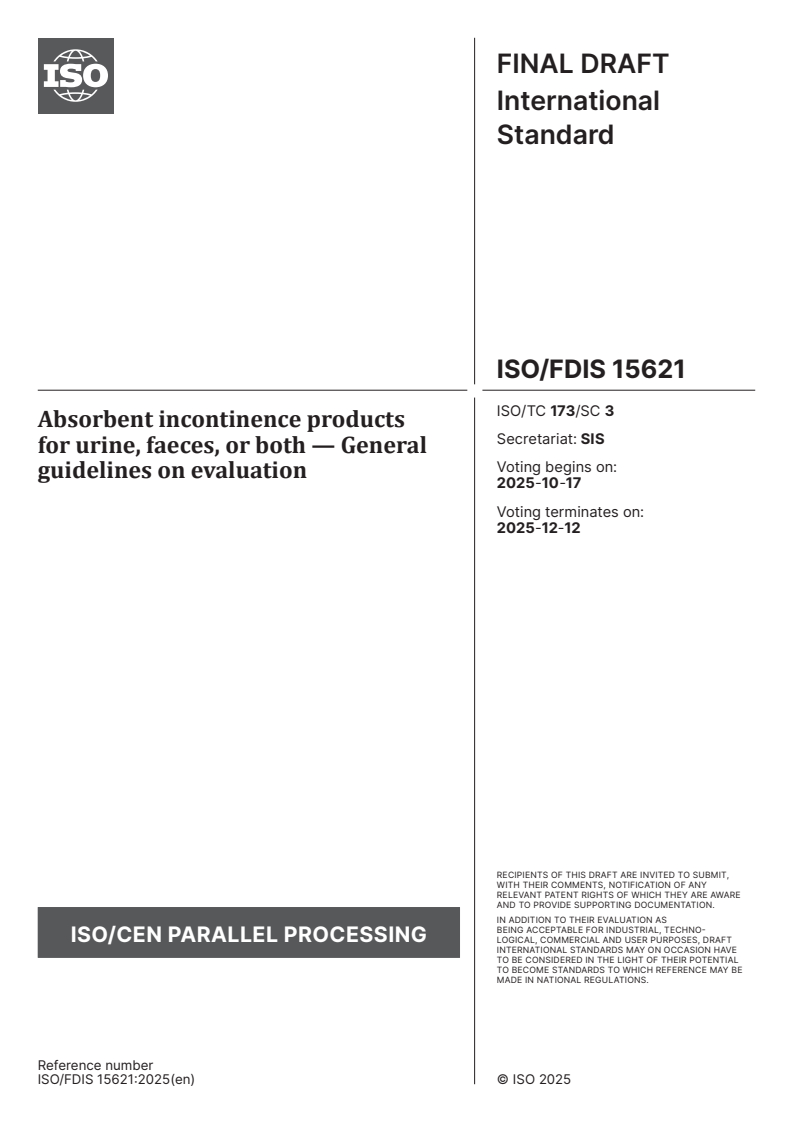
FINAL DRAFT
International
Standard
ISO/FDIS 15621
ISO/TC 173/SC 3
Absorbent incontinence products
Secretariat: SIS
for urine, faeces, or both — General
Voting begins on:
guidelines on evaluation
2025-10-17
Voting terminates on:
2025-12-12
RECIPIENTS OF THIS DRAFT ARE INVITED TO SUBMIT,
WITH THEIR COMMENTS, NOTIFICATION OF ANY
RELEVANT PATENT RIGHTS OF WHICH THEY ARE AWARE
AND TO PROVIDE SUPPOR TING DOCUMENTATION.
IN ADDITION TO THEIR EVALUATION AS
BEING ACCEPTABLE FOR INDUSTRIAL, TECHNO
ISO/CEN PARALLEL PROCESSING LOGICAL, COMMERCIAL AND USER PURPOSES, DRAFT
INTERNATIONAL STANDARDS MAY ON OCCASION HAVE
TO BE CONSIDERED IN THE LIGHT OF THEIR POTENTIAL
TO BECOME STAN DARDS TO WHICH REFERENCE MAY BE
MADE IN NATIONAL REGULATIONS.
Reference number
ISO/FDIS 15621:2025(en) © ISO 2025
FINAL DRAFT
ISO/FDIS 15621:2025(en)
International
Standard
ISO/FDIS 15621
ISO/TC 173/SC 3
Absorbent incontinence products
Secretariat: SIS
for urine, faeces, or both — General
Voting begins on:
guidelines on evaluation
Voting terminates on:
RECIPIENTS OF THIS DRAFT ARE INVITED TO SUBMIT,
WITH THEIR COMMENTS, NOTIFICATION OF ANY
RELEVANT PATENT RIGHTS OF WHICH THEY ARE AWARE
AND TO PROVIDE SUPPOR TING DOCUMENTATION.
© ISO 2025
IN ADDITION TO THEIR EVALUATION AS
All rights reserved. Unless otherwise specified, or required in the context of its implementation, no part of this publication may
BEING ACCEPTABLE FOR INDUSTRIAL, TECHNO
ISO/CEN PARALLEL PROCESSING
LOGICAL, COMMERCIAL AND USER PURPOSES, DRAFT
be reproduced or utilized otherwise in any form or by any means, electronic or mechanical, including photocopying, or posting on
INTERNATIONAL STANDARDS MAY ON OCCASION HAVE
the internet or an intranet, without prior written permission. Permission can be requested from either ISO at the address below
TO BE CONSIDERED IN THE LIGHT OF THEIR POTENTIAL
or ISO’s member body in the country of the requester.
TO BECOME STAN DARDS TO WHICH REFERENCE MAY BE
MADE IN NATIONAL REGULATIONS.
ISO copyright office
CP 401 • Ch. de Blandonnet 8
CH-1214 Vernier, Geneva
Phone: +41 22 749 01 11
Email: copyright@iso.org
Website: www.iso.org
Published in Switzerland Reference number
ISO/FDIS 15621:2025(en) © ISO 2025
ii
ISO/FDIS 15621:2025(en)
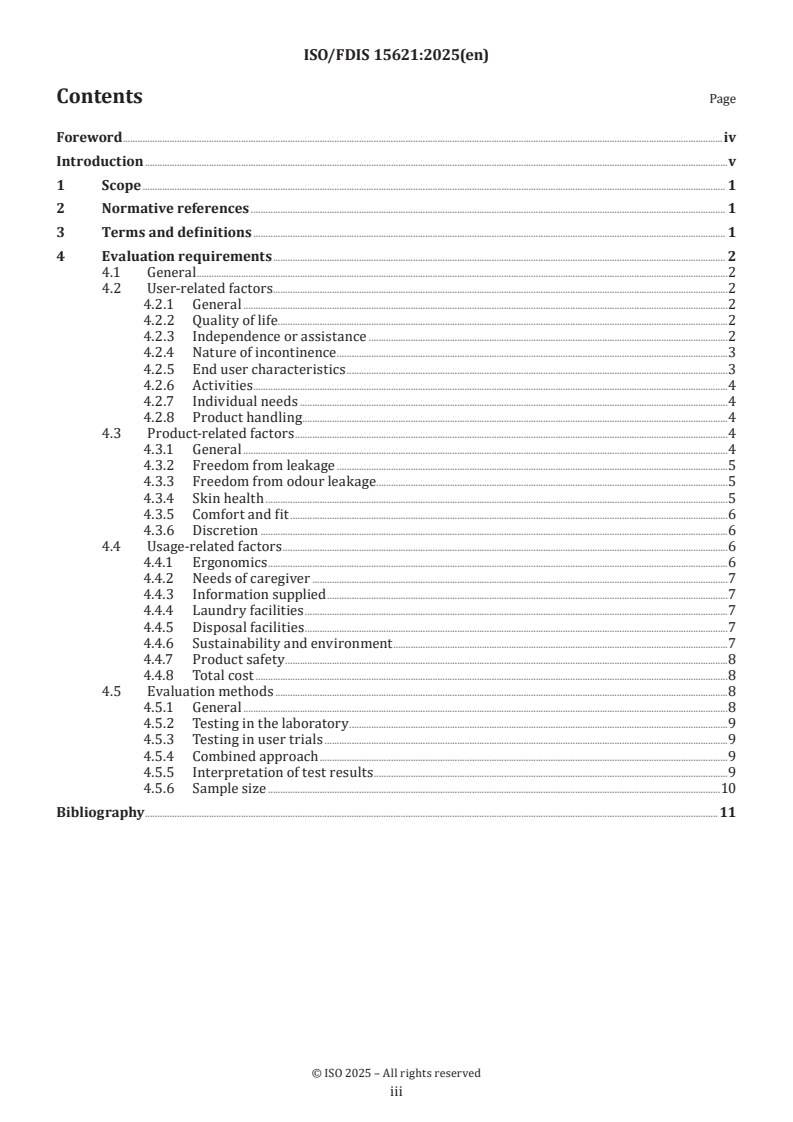
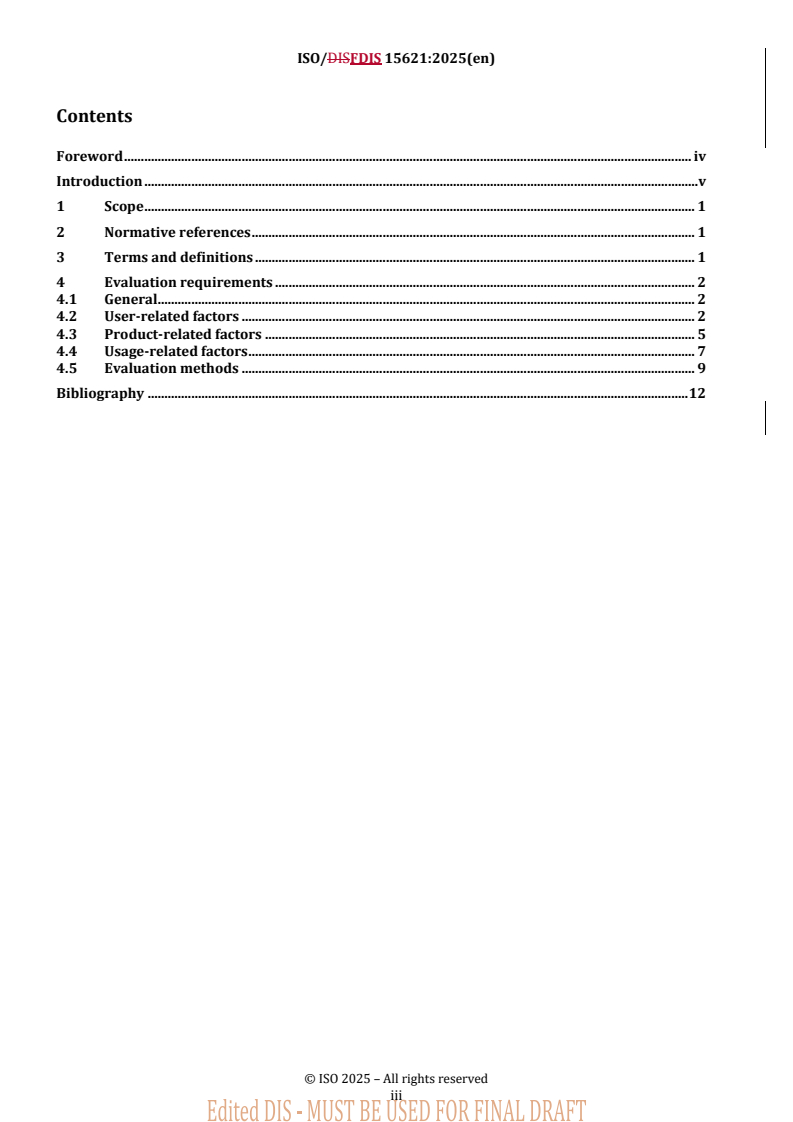
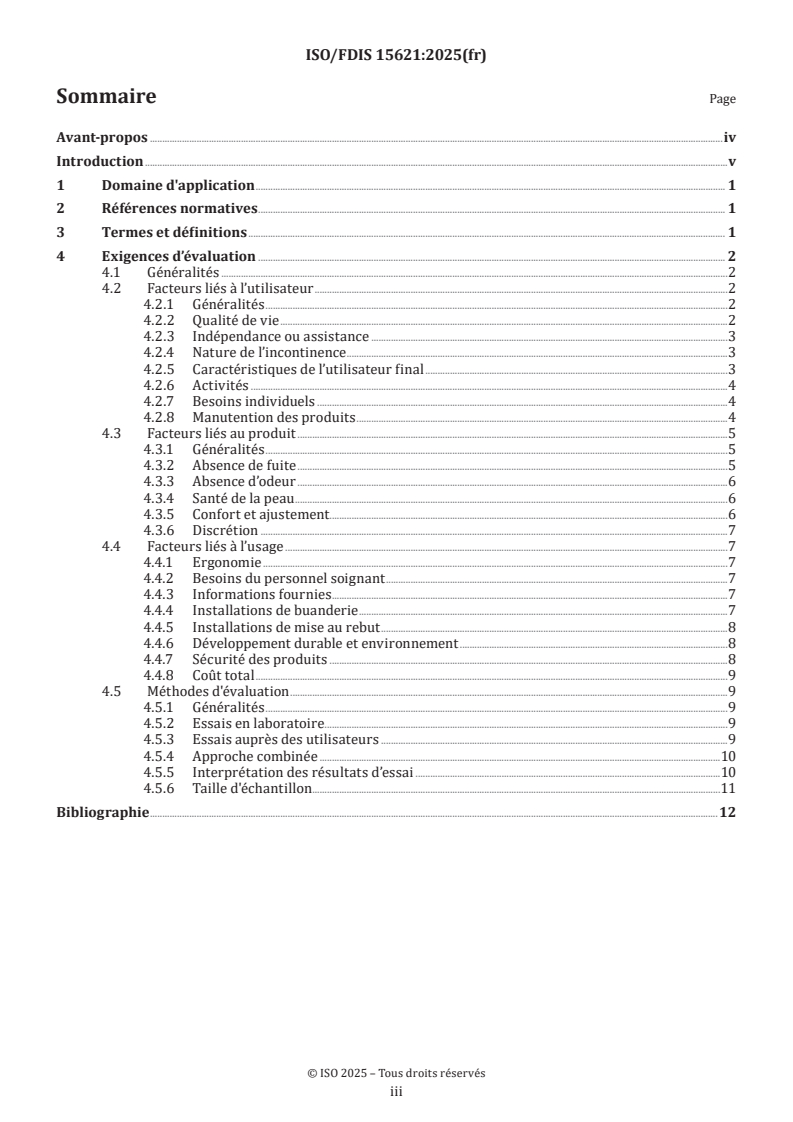
Contents Page
Foreword .iv
Introduction .v
1 Scope . 1
2 Normative references . 1
3 Terms and definitions . 1
4 Evaluation requirements . 2
4.1 General .2
4.2 User-related factors.2
4.2.1 General .2
4.2.2 Quality of life . .2
4.2.3 Independence or assistance .2
4.2.4 Nature of incontinence .3
4.2.5 End user characteristics .3
4.2.6 Activities .4
4.2.7 Individual needs .4
4.2.8 Product handling .4
4.3 Product-related factors .4
4.3.1 General .4
4.3.2 Freedom from leakage .5
4.3.3 Freedom from odour leakage . .5
4.3.4 Skin health .5
4.3.5 Comfort and fit .6
4.3.6 Discretion .6
4.4 Usage-related factors .6
4.4.1 Ergonomics .6
4.4.2 Needs of caregiver .7
4.4.3 Information supplied .7
4.4.4 Laundry facilities .7
4.4.5 Disposal facilities .7
4.4.6 Sustainability and environment .7
4.4.7 Product safety .8
4.4.8 Total cost .8
4.5 Evaluation methods .8
4.5.1 General .8
4.5.2 Testing in the laboratory .9
4.5.3 Testing in user trials .9
4.5.4 Combined approach .9
4.5.5 Interpretation of test results .9
4.5.6 Sample size .10
Bibliography .11
iii
ISO/FDIS 15621:2025(en)
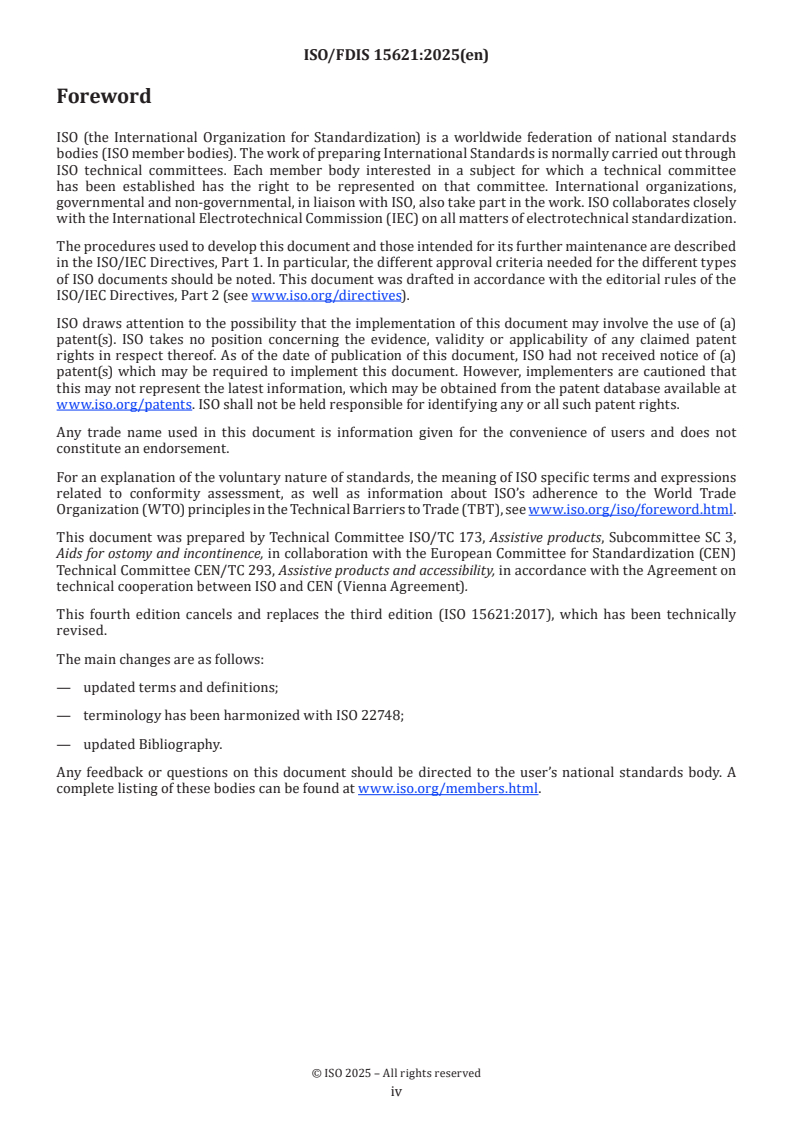
Foreword
ISO (the International Organization for Standardization) is a worldwide federation of national standards
bodies (ISO member bodies). The work of preparing International Standards is normally carried out through
ISO technical committees. Each member body interested in a subject for which a technical committee
has been established has the right to be represented on that committee. International organizations,
governmental and non-governmental, in liaison with ISO, also take part in the work. ISO collaborates closely
with the International Electrotechnical Commission (IEC) on all matters of electrotechnical standardization.
The procedures used to develop this document and those intended for its further maintenance are described
in the ISO/IEC Directives, Part 1. In particular, the different approval criteria needed for the different types
of ISO documents should be noted. This document was drafted in accordance with the editorial rules of the
ISO/IEC Directives, Part 2 (see www.iso.org/directives).
ISO draws attention to the possibility that the implementation of this document may involve the use of (a)
patent(s). ISO takes no position concerning the evidence, validity or applicability of any claimed patent
rights in respect thereof. As of the date of publication of this document, ISO had not received notice of (a)
patent(s) which may be required to implement this document. However, implementers are cautioned that
this may not represent the latest information, which may be obtained from the patent database available at
www.iso.org/patents. ISO shall not be held responsible for identifying any or all such patent rights.
Any trade name used in this document is information given for the convenience of users and does not
constitute an endorsement.
For an explanation of the voluntary nature of standards, the meaning of ISO specific terms and expressions
related to conformity assessment, as well as information about ISO’s adherence to the World Trade
Organization (WTO) principles in the Technical Barriers to Trade (TBT), see www.iso.org/iso/foreword.html.
This document was prepared by Technical Committee ISO/TC 173, Assistive products, Subcommittee SC 3,
Aids for ostomy and incontinence, in collaboration with the European Committee for Standardization (CEN)
Technical Committee CEN/TC 293, Assistive products and accessibility, in accordance with the Agreement on
technical cooperation between ISO and CEN (Vienna Agreement).
This fourth edition cancels and replaces the third edition (ISO 15621:2017), which has been technically
revised.
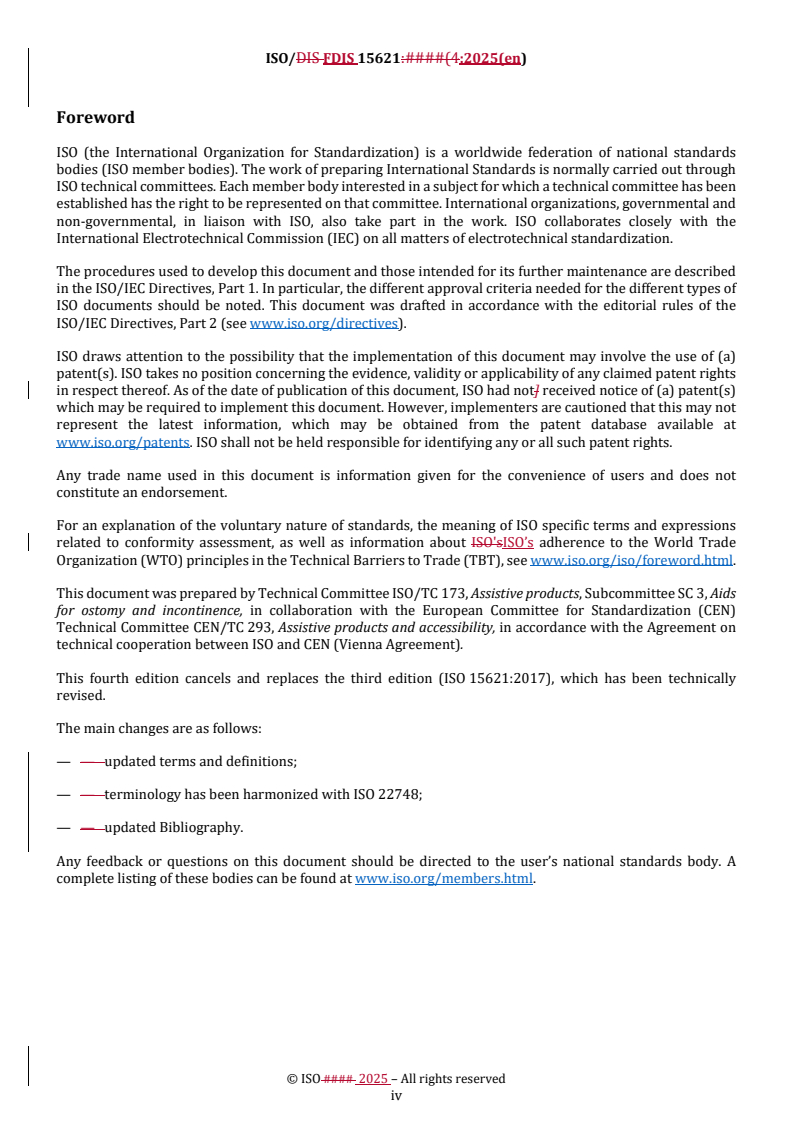
The main changes are as follows:
— updated terms and definitions;
— terminology has been harmonized with ISO 22748;
— updated Bibliography.
Any feedback or questions on this document should be directed to the user’s national standards body. A
complete listing of these bodies can be found at www.iso.org/members.html.
iv
ISO/FDIS 15621:2025(en)
Introduction
Incontinence is a set of diseases that affects between 4 % and 8 % of the population or the lives of
approximately 425 million people worldwide. Absorbent products can help people affected by urinary
incontinence or faecal incontinence, or both, to live an independent and dignified life. There are many
absorbent incontinence products on the market that can help persons to stay dry and comfortable. They can
be purchased at pharmacies or supermarkets by consumers or via public procurement from producers or
wholesalers, but selecting the right product can be difficult.
There are many factors to consider when choosing absorbent incontinence products, for example:
— the particular needs of the end user (e.g. the nature and severity of their incontinence);
— the needs of assisting caregivers (e.g. ergonomics in the design of the product);
— the design of the products (e.g. pads, all-in-ones, pull-ons) and their characteristics (e.g. design to secure
leakage security and maintaining skin health);
— cost;
— environmental impact.
Currently, there is a limited amount of published data on these factors. This document gives guidance for
evaluating absorbent incontinence products so that informed choices can be made. It describes the needs
of people with incontinence, lists the most important factors for end users and caregivers and gives an
overview of testing methodologies and interpretation of test results.
There are a number of stakeholders who can benefit from using this document, e.g. purchasers within
healthcare systems, care providers, nursing home managers, prescribers, caregivers, manufacturers,
suppliers, sick funds, insurance companies and end users themselves. These stakeholders often have
different priorities and different needs. However, it is important to remember that the most important
stakeholder is always the end user. End users have different needs depending on, for example, their anatomy,
age, the nature and severity of incontinence, mobility, dexterity, cognitive status, mental health, lifestyle,
and personal priorities. These factors should be taken into account when the most appropriate products are
being chosen by and for them. Practical, in-use suitability is best determined by testing products with the
individual end user.
Other standards that can be useful for evaluating absorbent incontinence products and performing user
trials include
— ISO 6658,
— ISO 9999,
— ISO 11948-1,
— ISO 16021, and
— ISO 22748.
v
FINAL DRAFT International Standard ISO/FDIS 15621:2025(en)
Absorbent incontinence products for urine, faeces, or both —
General guidelines on evaluation
1 Scope
This document is applicable for evaluating absorbent incontinence products for urine, faeces, or both for
adults and children. It provides a context for the procedures described in other International Standards and
for published testing procedures. General factors relating to incontinence products and their usage are also
addressed.
2 Normative references
The following documents are referred to in the text in such a way that some or all of their content constitutes
requirements of this document. For dated references, only the edition cited applies. For undated references,
the latest edition of the referenced document (including any amendments) applies.
ISO 22748, Absorbent incontinence products for urine and/or faeces — Product type names and illustrations
3 Terms and definitions
For the purposes of this document, the following terms and definitions apply.
ISO and IEC maintain terminology databases for use in standardization at the following addresses:
— ISO Online browsing platform: available at https:// www .iso .org/ obp
— IEC Electropedia: available at https:// www .electropedia .org/
3.1
absorbent incontinence product
product containing absorbent material to contain urine, faeces, or both when the wearer experiences
incontinence
3.2
absorption capacity
amount of liquid that can be absorbed by an absorbent incontinence product (3.1) under specified conditions
3.3
acquisition speed
time taken for a specified amount of liquid to be absorbed into an absorbent incontinence product (3.1) under
specified conditions
3.4
end user
person who wears an absorbent incontinence product (3.1)
3.5
caregiver
person who assists users with applying and changing incontinence products
Note 1 to entry: Caregivers can be paid staff or family/friends.
ISO/FDIS 15621:2025(en)
3.6
absorbent product with sensors
absorbent incontinence product (3.1) including sensors used to monitor the saturation of the product to
indicate when it might need changing, assist with care planning, or both
3.7
retention capacity
amount of liquid that is retained by an absorbent incontinence product (3.1) after all unbound liquid has been
removed under specified conditions
3.8
rewet
amount of liquid that escapes from an absorbent incontinence product (3.1) when it is exposed to external
forces or pressure under specified conditions
4 Evaluation requirements
4.1 General
The details of how an evaluation is conducted and the factors that it needs to focus on will vary depending
on, for example, the needs and priorities of the end users, their caregivers, the organization providing the
products. It will also depend on the purpose of the evaluation: for example, if the priority is to exclude poorly
performing products, or to distinguish between products with broadly similar characteristics, the specific
questions will differ.
But, whatever the nature and purpose of an evaluation, the factors to be considered can be usefully divided
into the three groups: user-related factors (see 4.2), product-related factors (see 4.3), and usage-related
factors (see 4.4).
Users of this document shall refer to ISO 22748 for terms, pictures and examples of the product types
discussed in this document.
NOTE 1 Preferred term can vary in different context and countries.
NOTE 2 It can be helpful to prepare for an evaluation by consulting the international classification ISO 9999:2022,
Code 09 30.
4.2 User-related factors
4.2.1 General
The needs of the individual end user are of utmost importance and, therefore, should always be the primary
focus when evaluating products.
4.2.2 to 4.2.8 list key assessment factors related to the end user as discussed in Reference [9]. These
assessment factors provide perspectives on how absorbent incontinence products can benefit the end user.
4.2.2 Quality of life
All forms of incontinence can cause isolation, depression and physiological problems and can significantly
damage the social and work-related aspects of the sufferer’s life and that of their family. Absorbent
incontinence products, however, can have a positive impact on the quality of life of individuals suffering
from incontinence by helping them to maintain their sense of dignity and enabling them to leave home, to
work, to take part in social activities and to live a full and satisfying life.
4.2.3 Independence or assistance
The most important goal is to give people the ability to live as independent a life as possible. An important
aspect of this is to be able to access toilet facilities and to manage incontinence and toileting. Independence
ISO/FDIS 15621:2025(en)
is made possible when the end user is able to access appropriate facilities and change their absorbent
incontinence products on their own. Many end users are unable to achieve independence in this regard and
need assistance.
The ease of putting absorbent incontinence products on and taking them off should be considered, especially
[8]
for users with one or more of the following: reduced mobility, reduced dexterity, cognitive impairment,
reliance on caregivers.
If end users can change products themselves, they will be more independent, preserving their dignity, as well
as reducing care costs. Product types which end users can apply and remove themselves, should be favoured,
maximising their independence and minimising the burden to caregivers, as well as their associated costs.
4.2.4 Nature of incontinence
Determining the nature of someone’s incontinence and their suitability for different treatment and
management options is a normal part of the assessment process when someone presents with incontinence
problems. If the use of absorbent incontinence products is indicated, the frequency and timing (e.g. day or
night) of incontinence events and the amount of urine, faeces or both leaked will be important factors in
selecting appropriate products. A frequency volume chart (FVC) or a bladder diary covering at least 24 h
[9]
and a “pad test” (leakage test) can be useful tools to obtain valuable information about the incontinence.
In recent years, absorbent products with sensors have been developed with the purpose of monitoring the
saturation of the products to indicate when they might need changing or to assist with care planning, or both.
Some people lose only small quantities of urine on infrequent occasions, in which case an absorbent
incontinence product with more limited absorption capacity can be adequate. Others can lose a substantial
quantity of urine at a high flow rate and need a product which can rapidly absorb and distribute the urine
and retain it, under a variety of circumstances. Similar considerations apply to leakage of faeces, with the
added variable of the consistency of the faeces. The gender of the user can also be an important factor; some
products are designed specifically for men or for women.
The proximity and accessibility of toilet facilities can also influence the need for absorbent incontinence
products. Where only slight, or even no, clinical incontinence exists, products can still be required if toilet
facilities cannot be reached (easily and quickly enough) because of mobility, cognitive status or accessibility
problems.
4.2.5 End user characteristics
The particular characteristics and activities of individual end users should be considered in selecting
products most appropriate to their needs.
Some products work with only male anatomy or only female anatomy, while some are suitable for either.
Body shape or size (e.g. height, body mass index, waist and thigh measurements) can influence the comfort
and effectiveness of a product. As morphology of users can range from very low weight to extremely obese
individuals, Products that match the body size should be chosen. Difficulty in fitting some products can
make them impractical or ineffective.
Although the prevalence of incontinence increases with age, it occurs in people of all ages. Incontinence
can arise in people with no other disability, as well as in those with complex and profound disability. A
wide range of physical and cognitive impairments can restrict a person’s ability to cope independently with
incontinence. Impaired mobility can make some product choices impractical or necessitate toilet or clothing
modification to allow effective use of the product.
Reduced dexterity (restrictions in hand or finger movement) can make it difficult to use some products.
Impaired eyesight can limit effective application and management.
For people with reduced mental acuity, the familiar appearance of absorbent incontinence products that
resemble normal underwear can make it easier for them to manage.
ISO/FDIS 15621:2025(en)
4.2.6 Activities
People with identical bladder problems can find that their needs are best met by using different products,
depending on their different situations, for example, where they spend their time (e.g. home, work, business
trips, social outings) and the nature of their activities (e.g. physical exercise, travelling).
Daily activities can influence the choice of product, and a mix of products can provide optimum management.
Different products can be the most satisfactory for daytime and going out (when, for example, discreetness
can be a priority) and night-time or staying in (when comfort can be a higher priority) or for holidays (when
carrying large quantities of bulky products can be a problem).
In general, those who are able to change their own absorbent incontinence product whenever they choose
can be able to manage with a lower absorption capacity product than those wh
...
ISO/DISFDIS 15621:2025(en)
ISO/TC 173/SC 3
Secretariat: SIS
Date: 2025-08-2010-02
Absorbent incontinence products for urine, faeces, or both — General
guidelines on evaluation
FDIS stage
ISO/DIS FDIS 15621:####(4:2025(en)
All rights reserved. Unless otherwise specified, or required in the context of its implementation, no part of this publication
may be reproduced or utilized otherwise in any form or by any means, electronic or mechanical, including photocopying,
or posting on the internet or an intranet, without prior written permission. Permission can be requested from either ISO
at the address below or ISO’s member body in the country of the requester.
ISO copyright office
CP 401 • Ch. de Blandonnet 8
CH-1214 Vernier, Geneva
Phone: + 41 22 749 01 11
EmailE-mail: copyright@iso.org
Website: www.iso.org
Published in Switzerland
© ISO #### 2025 – All rights reserved
ii
ISO/DISFDIS 15621:2025(en)
Contents
Foreword . iv
Introduction . v
1 Scope . 1
2 Normative references . 1
3 Terms and definitions . 1
4 Evaluation requirements . 2
4.1 General . 2
4.2 User-related factors . 2
4.3 Product-related factors . 5
4.4 Usage-related factors . 7
4.5 Evaluation methods . 9
Bibliography . 12
iii
ISO/DIS FDIS 15621:####(4:2025(en)
Foreword
ISO (the International Organization for Standardization) is a worldwide federation of national standards
bodies (ISO member bodies). The work of preparing International Standards is normally carried out through
ISO technical committees. Each member body interested in a subject for which a technical committee has been
established has the right to be represented on that committee. International organizations, governmental and
non-governmental, in liaison with ISO, also take part in the work. ISO collaborates closely with the
International Electrotechnical Commission (IEC) on all matters of electrotechnical standardization.
The procedures used to develop this document and those intended for its further maintenance are described
in the ISO/IEC Directives, Part 1. In particular, the different approval criteria needed for the different types of
ISO documents should be noted. This document was drafted in accordance with the editorial rules of the
ISO/IEC Directives, Part 2 (see www.iso.org/directives).
ISO draws attention to the possibility that the implementation of this document may involve the use of (a)
patent(s). ISO takes no position concerning the evidence, validity or applicability of any claimed patent rights
in respect thereof. As of the date of publication of this document, ISO had not] received notice of (a) patent(s)
which may be required to implement this document. However, implementers are cautioned that this may not
represent the latest information, which may be obtained from the patent database available at
www.iso.org/patents. ISO shall not be held responsible for identifying any or all such patent rights.
Any trade name used in this document is information given for the convenience of users and does not
constitute an endorsement.
For an explanation of the voluntary nature of standards, the meaning of ISO specific terms and expressions
related to conformity assessment, as well as information about ISO'sISO’s adherence to the World Trade
Organization (WTO) principles in the Technical Barriers to Trade (TBT), see www.iso.org/iso/foreword.html.
This document was prepared by Technical Committee ISO/TC 173, Assistive products, Subcommittee SC 3, Aids
for ostomy and incontinence, in collaboration with the European Committee for Standardization (CEN)
Technical Committee CEN/TC 293, Assistive products and accessibility, in accordance with the Agreement on
technical cooperation between ISO and CEN (Vienna Agreement).
This fourth edition cancels and replaces the third edition (ISO 15621:2017), which has been technically
revised.
The main changes are as follows:
— — updated terms and definitions;
— — terminology has been harmonized with ISO 22748;
— — updated Bibliography.
Any feedback or questions on this document should be directed to the user’s national standards body. A
complete listing of these bodies can be found at www.iso.org/members.html.
© ISO #### 2025 – All rights reserved
iv
ISO/DISFDIS 15621:2025(en)
Introduction
Incontinence is a set of diseases that affects between 4 % and 8 % of the population or the lives of
approximately 425 Mmillion people worldwide. Absorbent products can help people affected by urinary
and/incontinence or faecal incontinence, or both, to live an independent and dignified life. There are many
absorbent incontinence products on the market that can help persons to stay dry and comfortable. They can
be purchased at pharmacies or supermarkets by consumers or via public procurement from producers or
wholesalers, but selecting the right product can be difficult.
There are many factors to consider when choosing absorbent incontinence products, for example:
— — the particular needs of the end user (e.g. the nature and severity of their incontinence);
— — the needs of assisting caregivers (e.g. ergonomics in the design of the product);
— — the design of the products (e.g. pads, all-in-ones, pull-ons),) and their characteristics (e.g. design to
secure leakage security and maintaining skin health));
— — cost;
— — environmental impact.
Currently, there is a limited amount of published data on these factors. This document gives guidance for
evaluating absorbent incontinence products so that informed choices can be made. It describes the needs of
people with incontinence, lists the most important factors for end users and caregivers and gives an overview
of testing methodologies and interpretation of test results.
There are a number of stakeholders who can benefit from using this document, e.g. purchasers within
healthcare systems, care providers, nursing home managers, prescribers, caregivers, manufacturers,
suppliers, sick funds, insurance companies and end users themselves. These stakeholders often have different
priorities and different needs. However, it is important to remember that the most important stakeholder is
always the end user. End users have different needs depending on, for example, their anatomy, age, the nature
and severity of incontinence, mobility, dexterity, cognitive status, mental health, lifestyle, and personal
priorities. These factors should be taken into account when the most appropriate products are being chosen
by and for them. Practical, in-use suitability is best determined by testing products with the individual end
user.
Other standards that can be useful for evaluating absorbent incontinence products and performing user trials
include
— — ISO 6658,
— — ISO 9999,
— — ISO 11948--1, and
— — ISO 16021, and
— — ISO 22748,.
v
DRAFT International Standard ISO/DIS 15621:2025(en)
Absorbent incontinence products for urine, faeces, or both — General
guidelines on evaluation
1 Scope
This document is applicable for evaluating absorbent incontinence products for urine, faeces, or both for
adults and children. It provides a context for the procedures described in other International Standards and
for published testing procedures. General factors relating to incontinence products and their usage are also
addressed.
2 Normative references
The following documents are referred to in the text in such a way that some or all of their content constitutes
requirements of this document. For dated references, only the edition cited applies. For undated references,
the latest edition of the referenced document (including any amendments) applies.
ISO 22748:2021, Absorbent incontinence products for urine and/or faeces — Product type names and
illustrations
3 Terms and definitions
For the purposes of this document, the following terms and definitions apply.
ISO and IEC maintain terminology databases for use in standardization at the following addresses:
— — ISO Online browsing platform: available at https://www.iso.org/obp
— — IEC Electropedia: available at https://www.electropedia.org/
3.1 General terms
3.1 3.1.1
absorbent incontinence product
product containing absorbent material to contain urine, faeces, or both when the wearer experiences
incontinence
3.2 3.1.2
absorption capacity
amount of liquid that can be absorbed by an absorbent incontinence product (3.1(3.1.1)) under specified
conditions
3.3 3.1.3
acquisition speed
time taken for a specified amount of liquid to be absorbed into an absorbent incontinence product (3.1(3.1.1))
under specified conditions
3.4 3.1.4
end user
person who wears an absorbent incontinence product (3.1(3.1.1))
ISO/FDIS 15621:2025(en)
3.5 3.1.5
caregiver
person who assists user(s)users with applying and changing incontinence products
Note 1 to entry: Caregivers can be paid staff or family/friends.
3.6 3.1.6
absorbent product with sensors
absorbent incontinence product (3.1) including sensors used to monitor the saturation of athe product to
indicate when it might need changing ,, assist with care planning, or both.
3.7 3.1.7
retention capacity
amount of liquid that is retained by an absorbent incontinence product (3.1(3.1.1)) after all unbound liquid has
been removed under specified conditions
3.8 3.1.8
rewet
amount of liquid that escapes from an absorbent incontinence product (3.1(3.1.1)) when it is exposed to
external forces or pressure under specified conditions
4 Evaluation requirements
4.1 General
The details of how an evaluation is conducted and the factors that it needs to focus on will vary depending on,
for example, the needs and priorities of the end users, their caregivers, the organization providing the
products, etc. It will also depend on the purpose of the evaluation: for example, if the priority is to exclude
poorly performing products, or to distinguish between products with broadly similar characteristics, the
specific questions will differ.
But, whatever the nature and purpose of an evaluation, the factors to be considered can be usefully divided
into the three groups: user-related factors (see 4.24.2),), product-related factors (see 4.34.3),), and usage-
related factors (see 4.44.4).).
Users of this document shall refer to ISO 2247822748 for terms, pictures and examples of the product types
discussed in this document.
NOTE 1 Preferred term can vary in different context and countries.
NOTE 2 It can be helpful to prepare for an evaluation by consulting the international classification ISO 9999:2022,
[2]
Code 09 30 .
4.2 User-related factors
4.2.1 General
The needs of the individual end user are of utmost importance and, therefore, should always be the primary
focus when evaluating products.
4.2.24.2.2 to 4.2.84.2.8 list key assessment factors related to the end user as discussed in Reference [9[10].].
These assessment factors provide perspectives on how absorbent incontinence products can benefit the end
user.
© ISO #### 2025 – All rights reserved
ISO/DISFDIS 15621:2025(en)
4.2.2 Quality of life
All forms of incontinence can cause isolation, depression and physiological problems and can significantly
damage the social and work-related aspects of the sufferer'ssufferer’s life and that of their family. Absorbent
incontinence products, however, can have a positive impact on the quality of life of individuals suffering from
incontinence by helping them to maintain their sense of dignity and enabling them to leave home, to work, to
take part in social activities and to live a full and satisfying life.
4.2.3 Independence or assistance
The most important goal is to give people the ability to live as independent a life as possible. An important
aspect of this is to be able to access toilet facilities and to manage incontinence and toileting. Independence is
made possible when the end user is able to access appropriate facilities and change their absorbent
incontinence products on their own. Many end users are unable to achieve independence in this regard and
will need assistance.
The ease of putting absorbent incontinence products on and taking them off should be considered, especially
[8]
for users with one or more of the following: reduced mobility, reduced dexterity , cognitive impairment,
reliance on caregivers.
The ease of putting absorbent incontinence products on and taking them off should be considered, especially
[8 [8] ]
for users with one or more of the following: reduced mobility, reduced dexterity, , cognitive impairment,
reliance on caregivers.
If end users can change products themselves, they will be more independent, preserving their dignity, as well
as reducing care costs. Product types which end users can apply and remove themselves, should be favoured,
maximising their independence and minimising the burden to caregivers, as well as their associated costs.
4.2.4 Nature of incontinence
Determining the nature of someone’s incontinence and their suitability for different treatment and
management options is a normal part of the assessment process when someone presents with incontinence
problems. If the use of absorbent incontinence products is indicated, the frequency and timing (e.g. day or
night) of incontinence events and the amount of urine, faeces or both leaked will be important factors in
selecting appropriate products. A frequency volume chart (FVC) or a bladder diary covering at least 24 h and
[9 [10]]
a “pad test” (leakage test) can be useful tools to obtain valuable information about the incontinence. . In
recent years, absorbent products with sensors have been developed with the purpose of monitoring the
saturation of the products to indicate when they might need changing or to assist with care planning, or both.
Some people lose only small quantities of urine on infrequent occasions, in which case an absorbent
incontinence product with more limited absorption capacity can be adequate. Others can lose a substantial
quantity of urine at a high flow rate and need a product which can rapidly absorb and distribute the urine and
retain it, under a variety of circumstances. Similar considerations apply to leakage of faeces, with the added
variable of the consistency of the faeces. The gender of the user can also be an important factor; some products
are designed specifically for men or for women.
The proximity and accessibility of toilet facilities can also influence the need for absorbent incontinence
products. Where only slight, or even no, clinical incontinence exists, products can still be required if toilet
facilities cannot be reached (easily and quickly enough) because of mobility, cognitive status or accessibility
problems.
ISO/FDIS 15621:2025(en)
4.2.5 End user characteristics
The particular characteristics and activities of individual end users should be considered in selecting
product(s)products most appropriate to their needs.
Some products work with only male anatomy or only female anatomy, while some are suitable for either. Body
shape or size (e.g. height, body mass index, waist and thigh measurements) can influence the comfort and
effectiveness of a product. As morphology of users can range from very low weight to extremely obese
individuals, Products that match the body size should be chosen. Difficulty in fitting some products can make
them impractical or ineffective.
Although the prevalence of incontinence increases with age, it occurs in people of all ages. Incontinence can
arise in people with no other disability, as well as in those with complex and profound disability. A wide range
of physical and cognitive impairments can restrict a person’s ability to cope independently with incontinence.
Impaired mobility can make some product choices impractical or necessitate toilet or clothing modification to
allow effective use of the product.
Reduced dexterity (restrictions in hand or finger movement) can make it difficult to use some products.
Impaired eyesight can limit effective application and management.
For people with reduced mental acuity, the familiar appearance of absorbent incontinence products that
resemble normal underwear can make it easier for them to manage.
4.2.6 Activities
People with identical bladder problems can find that their needs are best met by using different products,
depending on their different situations, for example, where they spend their time (e.g. home, work, business
trips, social outings) and the nature of their activities (e.g. physical exercise, travelling).
Daily activities can influence the choice of product, and a mix of products can provide optimum management.
Different products can be the most satisfactory for daytime and going out (when, for example, discreetness
can be a priority) and nighttimenight-time or staying in (when comfort can be a higher priority) or for holidays
(when carrying large quantities of bulky products can be a problem).
In general, those who are able to change their own absorbent incontinence product whenever they choose
mightcan be able to manage with a lower absorption capacity product than those who are reliant on a
caregiver. In addition, those whose lifestyles take them away a lot, e.g. on business or social matters, need to
think carefully about how easy it will be to carry a supply of products, dispose of them and deal with any
laundry. These factors can influence their choice of product.
4.2.7 Individual needs
Different products work best for different people. Therefore, where possible, the end user should be given a
choice of products with which to experiment to determine which is most satisfactory for them.
The products which work best for an individual end user will depend to some extent on their daily living and
other activities. For example, those who can walk (with or without assistance) and stand up can have very
different needs from those who are mostly or fully confined to bed or wheeled mobility devices.
Some can manage urination and defecation independently in the bathroom while others can need assistance
to use a bedpan or commode. Where possible, end users should have access to a range of products that fit their
activities of daily living and should be given choice in selecting which works best for them.
© ISO #### 2025 – All rights reserved
ISO/DISFDIS 15621:2025(en)
4.2.8 Product handling
The ease with which an absorbent incontinence product can be put on or taken off is important for all end
users and any caregivers and especially for those with reduced mobility, cognitive function or manual
dexterity. Some products can be difficult to take off without coming into contact with absorbent material
soaked in urine, faeces or both - ‒ an unpleasant experience, heightened if the product has leaked.
Other important aspects of handling are the end user'suser’s ability to open the package, to dispose of the
product after usage and to cope with any packaging, such as cardboard boxes containing the products.
NOTE User-related factors are further described in Reference [9[10].].
4.3 Product-related factors
4.3.1 General
Absorbent incontinence products are available in a variety of broad designs and often come in different sizes
and absorbency levels (see ISO 22748 for further details). Selecting the best product or set of products for an
individual will depend on the type and severity of their incontinence, but also on wider factors such as their
body size and shape, mobility and dependence on caregivers. Products maycan be intended for men, for
women or for both and the design of many products is based on anatomy. Whether a product is suitable and
effective depends on a person’s anatomy, rather than their gender identity.
Users in clinical studies have been asked which aspects of product performance are most important to them
in managing their urinary incontinence and the factors discussed in 4.3.24.3.2 to 4.3.64.3.6 were most
commonly cited (see Reference [9[10]).]). They are also important for faecal incontinence.
4.3.2 Freedom from leakage
Freedom from product leakage is the most important factor. It is important to note that:
— — incontinence episodes differ between persons in terms of the frequencies, quantities and flow rates
with which urine or faeces, or both, are lost;
— — for the same person, these same parameters can vary over a period of time, with time of day or with
their circumstances.
Properties and features known to have an impact on freedom from product leakage include the correct choice
of product types depending on different user situations, the product size, absorption capacity, acquisition
speed, retention capacity and rewet properties. Product features such as shaping and elastication to achieve a
good fit can also reduce the risk of product leakage, as can barrier technologies such as
...
PROJET FINAL
Norme
internationale
ISO/FDIS 15621
ISO/TC 173/SC 3
Produits d'incontinence absorbants
Secrétariat: SIS
pour l'urine, les matières fécales
Début de vote:
ou les deux — Lignes directrices
2025-10-17
générales pour l'évaluation
Vote clos le:
2025-12-12
Absorbent incontinence products for urine, faeces, or both —
General guidelines on evaluation
LES DESTINATAIRES DU PRÉSENT PROJET SONT
INVITÉS À PRÉSENTER, AVEC LEURS OBSERVATIONS,
NOTIFICATION DES DROITS DE PROPRIÉTÉ DONT ILS
AURAIENT ÉVENTUELLEMENT CONNAISSANCE ET À
FOURNIR UNE DOCUMENTATION EXPLICATIVE.
OUTRE LE FAIT D’ÊTRE EXAMINÉS POUR
ÉTABLIR S’ILS SONT ACCEPTABLES À DES FINS
INDUSTRIELLES, TECHNOLOGIQUES ET COM-MERCIALES,
AINSI QUE DU POINT DE VUE DES UTILISATEURS, LES
PROJETS DE NORMES
TRAITEMENT PARALLÈLE ISO/CEN
INTERNATIONALES DOIVENT PARFOIS ÊTRE CONSIDÉRÉS
DU POINT DE VUE DE LEUR POSSI BILITÉ DE DEVENIR DES
NORMES POUVANT
SERVIR DE RÉFÉRENCE DANS LA RÉGLEMENTATION
NATIONALE.
Numéro de référence
ISO/FDIS 15621:2025(fr) © ISO 2025
PROJET FINAL
ISO/FDIS 15621:2025(fr)
Norme
internationale
ISO/FDIS 15621
ISO/TC 173/SC 3
Produits d'incontinence absorbants
Secrétariat: SIS
pour l'urine, les matières fécales
Début de vote:
ou les deux — Lignes directrices
2025-10-17
générales pour l'évaluation
Vote clos le:
2025-12-12
Absorbent incontinence products for urine, faeces, or both —
General guidelines on evaluation
LES DESTINATAIRES DU PRÉSENT PROJET SONT
INVITÉS À PRÉSENTER, AVEC LEURS OBSERVATIONS,
NOTIFICATION DES DROITS DE PROPRIÉTÉ DONT ILS
AURAIENT ÉVENTUELLEMENT CONNAISSANCE ET À
FOURNIR UNE DOCUMENTATION EXPLICATIVE.
DOCUMENT PROTÉGÉ PAR COPYRIGHT
OUTRE LE FAIT D’ÊTRE EXAMINÉS POUR
ÉTABLIR S’ILS SONT ACCEPTABLES À DES FINS
© ISO 2025 INDUSTRIELLES, TECHNOLOGIQUES ET COM-MERCIALES,
AINSI QUE DU POINT DE VUE DES UTILISATEURS, LES
Tous droits réservés. Sauf prescription différente ou nécessité dans le contexte de sa mise en œuvre, aucune partie de cette
PROJETS DE NORMES
TRAITEMENT PARALLÈLE ISO/CEN
INTERNATIONALES DOIVENT PARFOIS ÊTRE CONSIDÉRÉS
publication ne peut être reproduite ni utilisée sous quelque forme que ce soit et par aucun procédé, électronique ou mécanique,
DU POINT DE VUE DE LEUR POSSI BILITÉ DE DEVENIR DES
y compris la photocopie, ou la diffusion sur l’internet ou sur un intranet, sans autorisation écrite préalable. Une autorisation peut
NORMES POUVANT
être demandée à l’ISO à l’adresse ci-après ou au comité membre de l’ISO dans le pays du demandeur.
SERVIR DE RÉFÉRENCE DANS LA RÉGLEMENTATION
NATIONALE.
ISO copyright office
Case postale 401 • Ch. de Blandonnet 8
CH-1214 Vernier, Genève
Tél.: +41 22 749 01 11
E-mail: copyright@iso.org
Web: www.iso.org
Publié en Suisse Numéro de référence
ISO/FDIS 15621:2025(fr) © ISO 2025
ii
ISO/FDIS 15621:2025(fr)
Sommaire Page
Avant-propos .iv
Introduction .v
1 Domaine d'application . 1
2 Références normatives . 1
3 Termes et définitions . 1
4 Exigences d’évaluation . 2
4.1 Généralités .2
4.2 Facteurs liés à l’utilisateur .2
4.2.1 Généralités .2
4.2.2 Qualité de vie .2
4.2.3 Indépendance ou assistance .3
4.2.4 Nature de l’incontinence .3
4.2.5 Caractéristiques de l’utilisateur final .3
4.2.6 Activités .4
4.2.7 Besoins individuels .4
4.2.8 Manutention des produits .4
4.3 Facteurs liés au produit .5
4.3.1 Généralités .5
4.3.2 Absence de fuite .5
4.3.3 Absence d’odeur .6
4.3.4 Santé de la peau .6
4.3.5 Confort et ajustement.6
4.3.6 Discrétion .7
4.4 Facteurs liés à l’usage .7
4.4.1 Ergonomie .7
4.4.2 Besoins du personnel soignant .7
4.4.3 Informations fournies .7
4.4.4 Installations de buanderie .7
4.4.5 Installations de mise au rebut .8
4.4.6 Développement durable et environnement .8
4.4.7 Sécurité des produits .8
4.4.8 Coût total .9
4.5 Méthodes d'évaluation .9
4.5.1 Généralités .9
4.5.2 Essais en laboratoire . .9
4.5.3 Essais auprès des utilisateurs .9
4.5.4 Approche combinée .10
4.5.5 Interprétation des résultats d’essai .10
4.5.6 Taille d'échantillon . .11
Bibliographie .12
iii
ISO/FDIS 15621:2025(fr)
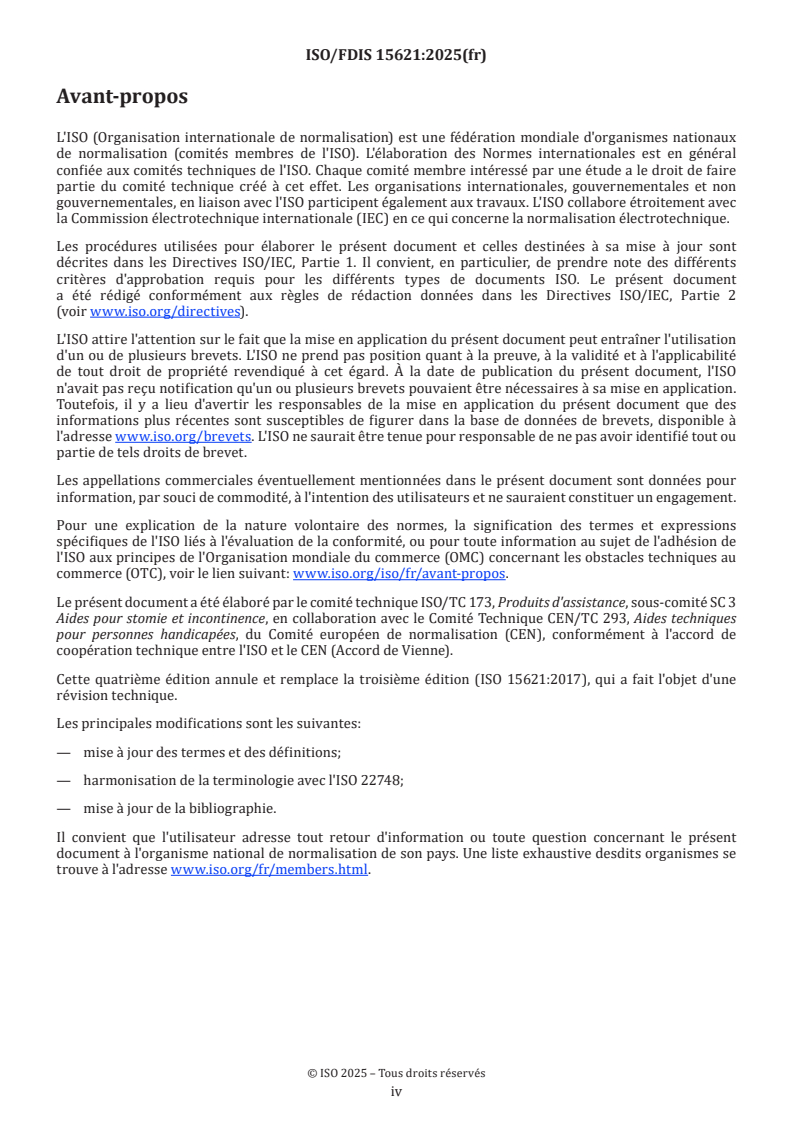
Avant-propos
L'ISO (Organisation internationale de normalisation) est une fédération mondiale d'organismes nationaux
de normalisation (comités membres de l'ISO). L'élaboration des Normes internationales est en général
confiée aux comités techniques de l'ISO. Chaque comité membre intéressé par une étude a le droit de faire
partie du comité technique créé à cet effet. Les organisations internationales, gouvernementales et non
gouvernementales, en liaison avec l'ISO participent également aux travaux. L'ISO collabore étroitement avec
la Commission électrotechnique internationale (IEC) en ce qui concerne la normalisation électrotechnique.
Les procédures utilisées pour élaborer le présent document et celles destinées à sa mise à jour sont
décrites dans les Directives ISO/IEC, Partie 1. Il convient, en particulier, de prendre note des différents
critères d'approbation requis pour les différents types de documents ISO. Le présent document
a été rédigé conformément aux règles de rédaction données dans les Directives ISO/IEC, Partie 2
(voir www.iso.org/directives).
L'ISO attire l'attention sur le fait que la mise en application du présent document peut entraîner l'utilisation
d'un ou de plusieurs brevets. L'ISO ne prend pas position quant à la preuve, à la validité et à l'applicabilité
de tout droit de propriété revendiqué à cet égard. À la date de publication du présent document, l'ISO
n'avait pas reçu notification qu'un ou plusieurs brevets pouvaient être nécessaires à sa mise en application.
Toutefois, il y a lieu d'avertir les responsables de la mise en application du présent document que des
informations plus récentes sont susceptibles de figurer dans la base de données de brevets, disponible à
l'adresse www.iso.org/brevets. L'ISO ne saurait être tenue pour responsable de ne pas avoir identifié tout ou
partie de tels droits de brevet.
Les appellations commerciales éventuellement mentionnées dans le présent document sont données pour
information, par souci de commodité, à l'intention des utilisateurs et ne sauraient constituer un engagement.
Pour une explication de la nature volontaire des normes, la signification des termes et expressions
spécifiques de l'ISO liés à l'évaluation de la conformité, ou pour toute information au sujet de l'adhésion de
l'ISO aux principes de l'Organisation mondiale du commerce (OMC) concernant les obstacles techniques au
commerce (OTC), voir le lien suivant: www.iso.org/iso/fr/avant-propos.
Le présent document a été élaboré par le comité technique ISO/TC 173, Produits d'assistance, sous-comité SC 3
Aides pour stomie et incontinence, en collaboration avec le Comité Technique CEN/TC 293, Aides techniques
pour personnes handicapées, du Comité européen de normalisation (CEN), conformément à l'accord de
coopération technique entre l'ISO et le CEN (Accord de Vienne).
Cette quatrième édition annule et remplace la troisième édition (ISO 15621:2017), qui a fait l'objet d'une
révision technique.
Les principales modifications sont les suivantes:
— mise à jour des termes et des définitions;
— harmonisation de la terminologie avec l'ISO 22748;
— mise à jour de la bibliographie.
Il convient que l'utilisateur adresse tout retour d'information ou toute question concernant le présent
document à l'organisme national de normalisation de son pays. Une liste exhaustive desdits organismes se
trouve à l'adresse www.iso.org/fr/members.html.
iv
ISO/FDIS 15621:2025(fr)
Introduction
L’incontinence est un ensemble de maladies qui touchent entre 4 % et 8 % de la population et affecte
ainsi la vie de près de 425 millions de personnes dans le monde. Les produits absorbants peuvent aider
les personnes affectées par l'incontinence urinaire ou l'incontinence fécale, ou les deux, à mener une vie
indépendante et digne. De nombreux produits de ce type sont actuellement commercialisés et donnent
aux patients la possibilité de rester au sec dans des conditions de confort. Les consommateurs peuvent les
acheter en pharmacie et dans les supermarchés tandis que les acheteurs publics s’approvisionnent auprès de
producteurs ou de grossistes, mais le choix de la solution adaptée peut s’avérer difficile.
Il existe un nombre important de facteurs à prendre en considération pour le choix des produits
d'incontinence ayant un pouvoir absorbant et notamment:
— les besoins particuliers de l'utilisateur final (par exemple, la nature et la gravité de son incontinence);
— les besoins des soignants (par exemple, ergonomie dans la conception du produit);
— la conception des produits (par exemple, serviettes, tout-en-un, culottes) et leurs caractéristiques
(par exemple, conception pour assurer la sécurité des fuites et maintenir la santé de la peau);
— le coût;
— l'impact environnemental.
Les données publiées sur ces facteurs sont actuellement limitées. Le présent document donne des
recommandations pour l'évaluation des produits d'incontinence ayant un pouvoir absorbant de sorte que des
choix éclairés puissent être effectués. Il décrit les besoins des personnes souffrant d'incontinence, énumère
les facteurs les plus importants pour les utilisateurs finaux et les soignants et donne une vue d'ensemble des
méthodologies d'essai et de l'interprétation des résultats d'essai.
Un certain nombre de parties prenantes peuvent tirer profit de l'utilisation du présent document, par
exemple les acheteurs au sein des systèmes de soins de santé, les prestataires de soins, les directeurs de
maison de retraite, les prescripteurs, les soignants, les fabricants, les fournisseurs, les caisses d'assurance
maladie, les compagnies d'assurance et les utilisateurs finaux eux-mêmes. Les priorités et les besoins de ces
parties prenantes sont souvent différents. Néanmoins, il est important de se rappeler que la partie prenante
la plus importante est toujours l'utilisateur final. Les besoins des utilisateurs finaux peuvent varier en
fonction, par exemple, de leur anatomie, de leur âge, de la nature et de la sévérité de leur incontinence, de
leur mobilité, de leur dextérité, de leur état cognitif, de leur santé mentale, de leur mode de vie et de leurs
priorités personnelles. Il convient de prendre ces facteurs en compte lorsque les produits les plus appropriés
sont choisis par et pour eux. La meilleure méthode pour déterminer l’adéquation pratique en usage quotidien
d’un produit consiste à le soumettre à essai sur l’utilisateur final lui-même.
D'autres normes qui peuvent être utiles pour l'évaluation des produits d'incontinence ayant un pouvoir
absorbant et la réalisation d'essais utilisateurs incluent:
— ISO 6658,
— ISO 9999,
— ISO 11948-1,
— ISO 16021, et
— ISO 22748.
v
PROJET FINAL Norme internationale ISO/FDIS 15621:2025(fr)
Produits d'incontinence absorbants pour l'urine, les matières
fécales ou les deux — Lignes directrices générales pour
l'évaluation
1 Domaine d'application
Le présent document s'applique à l'évaluation des produits d'incontinence ayant un pouvoir absorbant
pour l'urine, les matières fécales ou les deux pour les adultes et les enfants. Il fournit un contexte pour
les procédures décrites dans d'autres normes internationales et pour les procédures d'essai publiées. Les
facteurs généraux concernant les produits pour incontinence et leur usage sont également examinés.
2 Références normatives
Les documents suivants sont cités dans le texte de sorte qu’ils constituent, pour tout ou partie de leur
contenu, des exigences du présent document. Pour les références datées, seule l'édition citée s'applique. Pour
les références non datées, la dernière édition du document de référence s'applique (y compris les éventuels
amendements).
ISO 22748, Produits d'incontinence pour l'absorption d'urine et/ou de matières fécales — Noms de types de
produits et illustrations
3 Termes et définitions
Pour les besoins du présent document, les termes et définitions suivants s'appliquent.
L’ISO et l’IEC tiennent à jour des bases de données terminologiques destinées à être utilisées en normalisation,
consultables aux adresses suivantes:
— ISO Online browsing platform: disponible à l'adresse https:// www .iso .org/ obp
— IEC Electropedia: disponible à l'adresse https:// www .electropedia .org/
3.1
produit d'incontinence ayant un pouvoir absorbant
produit contenant un matériau absorbant destiné à retenir l'urine, les matières fécales ou les deux lorsque le
porteur éprouve de l'incontinence
3.2
pouvoir absorbant
quantité de liquide qui peut être absorbée par un produit d'incontinence ayant un pouvoir absorbant (3.1)
dans des conditions spécifiées
3.3
vitesse d’acquisition
temps pris pour une quantité spécifiée de liquide à absorber dans un produit d'incontinence ayant un pouvoir
absorbant (3.1) dans des conditions spécifiées
3.4
utilisateur final
personne qui porte un produit d'incontinence ayant un pouvoir absorbant (3.1)
ISO/FDIS 15621:2025(fr)
3.5
personnel soignant
personne qui aide les utilisateurs à appliquer et à modifier des produits d'incontinence
Note 1 à l'article: Les soignants peuvent être professionnels rémunérés ou être de la famille/des amis.
3.6
produit ayant un pouvoir absorbant avec capteurs
produit d'incontinence ayant un pouvoir absorbant (3.1) comprenant les capteurs utilisés pour surveiller la
saturation du produit afin d'indiquer quand il pourrait être nécessaire de changer, d'aider à la planification
des soins, ou les deux
3.7
capacité de rétention
quantité de liquide qui est retenue par un produit d'incontinence ayant un pouvoir absorbant (3.1) après le
retrait de tout liquide non lié dans des conditions spécifiées
3.8
réhumidification
quantité de liquide qui s'échappe d'un produit d'incontinence ayant un pouvoir absorbant (3.1) lorsqu'il est
exposé à des forces externes ou à une pression dans des conditions spécifiées
4 Exigences d’évaluation
4.1 Généralités
Les détails de la manière dont une évaluation est effectuée et les facteurs sur lesquels elle doit se concentrer
varieront en fonction, par exemple, des besoins et des priorités des utilisateurs finaux, de leurs soignants,
de l'organisme fournissant les produits. Cela dépendra également de l'objectif de l'évaluation: par exemple, si
la priorité est d'exclure des produits peu performants ou de faire la distinction entre des produits ayant des
caractéristiques globalement similaires, les questions spécifiques seront différentes.
Cependant, quels que soient la nature et le but d'une évaluation, les facteurs à prendre en compte peuvent
utilement être divisés en trois groupes: les facteurs liés à l'utilisateur (voir 4.2), les facteurs liés au produit
(voir 4.3) et les facteurs liés à l'usage (voir 4.4).
Les utilisateurs du présent document doivent se référer à l'ISO 22748 pour obtenir des termes, des images et
des exemples des types de produits décrits dans le présent document.
NOTE 1 Le terme privilégié peut varier selon le contexte et les pays.
NOTE 2 Il peut être utile de préparer une évaluation en consultant la classification internationale ISO 9999:2022,
Code 09 30.
4.2 Facteurs liés à l’utilisateur
4.2.1 Généralités
Les besoins propres à l’utilisateur final sont de la plus haute importance et il convient donc qu’ils constituent
toujours le premier objectif d’une évaluation des produits.
4.2.2 à 4.2.8 listent les facteurs d'évaluation clés relatifs à l'utilisateur final, comme indiqué dans la
Référence [9]. Ces facteurs d’évaluation permettent de mieux comprendre de quelle manière les produits
d'incontinence ayant un pouvoir absorbant peuvent soulager l’utilisateur final.
4.2.2 Qualité de vie
Toutes les formes d'incontinence peuvent provoquer l'isolement, la dépression et des problèmes
physiologiques et peuvent endommager de manière significative les aspects sociaux et liés au travail de la vie
ISO/FDIS 15621:2025(fr)
du sujet et celle de sa famille. Les produits d'incontinence ayant un pouvoir absorbant peuvent quant à elles
avoir un impact positif sur la qualité de vie des personnes qui souffrent d’incontinence, en leur permettant
de préserver leur dignité, de sortir, de travailler, de prendre part à des activités sociales et de vivre une vie
pleine et satisfaisante.
4.2.3 Indépendance ou assistance
L’objectif le plus important est de donner aux personnes les moyens de vivre une vie aussi indépendante que
possible. Un aspect essentiel dans ce domaine est la capacité pour une personne d’accéder aux installations
sanitaires et de gérer son incontinence et sa toilette. On considère que l’indépendance est rendue possible
lorsque l’utilisateur final est en mesure de se rendre dans les installations adéquates et de changer, par
ses propres moyens, le produit d'incontinence qu’il porte. De nombreux utilisateurs finaux ne sont pas en
mesure d'obtenir l'indépendance à cet égard et ont besoin d'aide.
Il convient de prendre en compte la facilité de mise en place et de retrait des produits d'incontinence ayant
un pouvoir absorbant, en particulier pour les utilisateurs ayant un ou plusieurs des éléments suivants:
[8]
mobilité réduite, dextérité réduite, déficience cognitive, dépendance vis-à-vis des soignants.
Si les utilisateurs finaux peuvent les changer eux-mêmes, ils seront plus indépendants, ce qui préservera
leur dignité et réduira également le coût des soins. Il convient de privilégier les types de produits que les
utilisateurs finaux peuvent appliquer et retirer eux-mêmes, en maximisant leur autonomie et en minimisant
la charge pour les soignants, ainsi que leurs coûts associés.
4.2.4 Nature de l’incontinence
La détermination de la nature de l'incontinence d'une personne et de son aptitude à bénéficier de différentes
options de traitement et de prise en charge fait partie du processus normal d'évaluation lorsqu'une
personne présente des problèmes d'incontinence. Si l'utilisation de produits d'incontinence ayant un pouvoir
absorbant est indiquée, la fréquence et le moment (jour ou nuit, par exemple) des événements d'incontinence
et la quantité d'urine, de matières fécales ou les deux fuites constitueront des facteurs importants dans le
choix des produits appropriés. Un catalogue mictionnel (CVF) ou un journal de miction couvrant au moins
24 h et un «pad test» (test d'étanchéité) peuvent être des outils utiles pour obtenir des informations utiles
[9]
sur l'incontinence. Ces dernières années, des produits ayant un pouvoir absorbant avec capteurs ont été
mis au point dans le but de surveiller la saturation des produits pour indiquer quand ils pourraient avoir
besoin de changer ou d'aider à la planification des soins, ou les deux.
Certaines personnes ne perdent que de petites quantités d'urine en de rares occasions, auquel cas un
produits d'incontinence ayant un pouvoir absorbant avec une capacité d'absorption plus limitée peut être
adéquat. D'autres peuvent perdre une quantité importante d'urine à un débit élevé et ont besoin d'un
produit qui peut rapidement absorber et distribuer l'urine et la conserver dans diverses circonstances.
Des considérations analogues s’appliquent aux pertes fécales avec une variable supplémentaire, à savoir la
consistance des selles. Le sexe de l'utilisateur peut également être un facteur important; certains produits
sont conçus spécifiquement pour les hommes ou pour les femmes.
La proximité et l’accessibilité des installations sanitaires peuvent également influencer la nécessité
d'un produit d'incontinence ayant un pouvoir absorbant. Lorsqu'il n'existe qu'une légère, voire aucune,
incontinence clinique, des produits peuvent encore être demandés si les toilettes ne peuvent pas être
accessibles (facilement et rapidement) en raison de leur mobilité, de leur état cognitif ou de leurs problèmes
d'accessibilité.
4.2.5 Caractéristiques de l’utilisateur final
Il convient de tenir compte des caractéristiques et activités particulières des utilisateurs finaux individuels
lors de la sélection des produits les plus appropriés à leurs besoins.
Certains produits fonctionnent uniquement avec l'anatomie masculine ou uniquement avec l'anatomie
féminine, tandis que d'autres sont adaptés à l'une ou l'autre. La forme ou la taille du corps (par exemple,
hauteur, indice de masse corporelle, mesurage de la taille et de la cuisse) peut influencer le confort et
l'efficacité d'un produit. Comme la morphologie des utilisateurs peut aller de très faible poids à des individus
ISO/FDIS 15621:2025(fr)
extrêmement obèses, il convient de choisir des produits correspondant à la taille corporelle. La difficulté
d'adaptation de certains produits peut les rendre irréalisables ou inefficaces.
Bien que la fréquence de l’incontinence augmente avec l’âge, toutes les tranches d’âge sont concernées.
L'incontinence peut survenir chez les personnes sans autre handicap, ainsi que chez celles présentant
un handicap complexe et profond. Un large éventail de troubles physiques et cognitifs peuvent limiter la
capacité d’une personne à gérer son incontinence de manière autonome. Une mobilité réduite peut rendre
certains choix de produits peu pratiques ou nécessiter une modification des toilettes ou des vêtements pour
permettre une utilisation efficace du produit.
La réduction de la dextérité, autrement dit les restrictions dans les mouvements de la main ou des doigts,
peut rendre certains produits difficiles à utiliser. L'affaiblissement de la vue peut limiter l'application et la
gestion efficaces.
Pour les personnes ayant une acuité mentale réduite, l'aspect familier des produits d'incontinence ayant un
pouvoir absorbant qui ressemblent à des sous-vêtements normaux peut leur faciliter la gestion.
4.2.6 Activités
Les personnes présentant des problèmes de vessie identiques peuvent trouver que leurs besoins sont mieux
satisfaits en utilisant différents produits, en fonction de leurs différentes situations, par exemple, où elles
passent leur temps (par exemple, domicile, travail, voyages d'affaires, sorties sociales) et la nature de leurs
activités (par exemple, exercice physique, déplacements).
Les activités quotidiennes peuvent influencer le choix du produit, et un mélange de produits peut assurer une
gestion optimale. Différents produits peuvent être plus satisfaisants pour la journée et les sorties (lorsque,
par exemple, la discrétion peut être une priorité) et la nuit ou les moments passés à la maison (lorsque le
confort peut être une priorité plus élevée) ou les vacances (lorsque le transport de grandes quantités de
produits encombrants peut être un problème).
En règle générale, ceux qui sont en mesure de changer leur propre produits d'incontinence ayant un
pouvoir absorbant chaque fois qu'ils le choisissent peuvent être en mesure de gérer avec un produit à
capacité d'absorption inférieure à ceux qui dépendent d'un soignant. De plus, celles dont le mode de vie les
conduit à être souvent en déplacement pour des raisons professionnelles ou sociales, par exemple, doivent
soigneusement réfléchir à la possibilité de transporter une réserve de produits, de les mettre au rebut et de
gérer le problème du linge. Ces facteurs peuvent influencer leur choix de produit.
4.2.7 Besoins individuels
Des personnes différentes ont besoin de produits différents. Ainsi, il convient, dans la mesure du possible,
de remettre à l’utilisateur final un éventail de produits à expérimenter afin de déterminer ceux qui lui
conviennent le mieux.
Les produits qui fonctionnent le mieux pour un utilisateur final individuel dépendent dans une certaine
mesure de leur vie quotidienne et d'autres activités. Par exemple, ceux qui peuvent marcher (avec ou
sans assistance) et se lever peuvent avoir des besoins très différents de ceux qui sont principalement ou
totalement confinés
...
Questions, Comments and Discussion
Ask us and Technical Secretary will try to provide an answer. You can facilitate discussion about the standard in here.
Loading comments...