


ISO 8124-7:2015
(Main)Safety of toys — Part 7: Requirements and test methods for finger paints
Safety of toys — Part 7: Requirements and test methods for finger paints
ISO 8124-7:2015 specifies requirements for the substances and materials used in finger paints. It is applicable to finger paints only. It is not applicable to paints intended to be applied to the face or body e.g. face paints. Additional requirements are specified for markings, labelling and containers.
Sécurité des jouets — Partie 7: Exigences et méthodes d'essai pour les peintures digitales
General Information
- Status
- Published
- Publication Date
- 30-Sep-2015
- Technical Committee
- ISO/TC 181 - Safety of toys
- Drafting Committee
- ISO/TC 181 - Safety of toys
- Current Stage
- 9060 - Close of review
- Completion Date
- 02-Sep-2031


Relations
- Effective Date
- 26-Nov-2021
Overview
ISO 8124-7:2015 - Safety of toys - Part 7: Requirements and test methods for finger paints - sets chemical, formulation and labelling requirements specifically for finger paints intended for children. The standard addresses risks from incidental ingestion, skin contact and eye exposure by specifying permitted substances, impurity limits and required test methods. ISO 8124-7:2015 applies only to finger paints (including powders to be mixed per manufacturer’s instructions) and explicitly excludes face or body paints.
Key topics and technical requirements
- Scope and classification: Finger paints must not be classified under key GHS health hazard classes (acute toxicity, skin/eye irritation, sensitization, mutagenicity, carcinogenicity, reproductive toxicity, specific target organ toxicity, aspiration).
- Colourants: Only colourants that meet the standard’s hazard and purity rules may be used. Azo colourants that can release specified primary aromatic amines on cleavage are prohibited (testing method in Annex C). Annex B lists commonly used compliant colourants.
- Primary aromatic amines: Certain amines (e.g., benzidine, 2‑naphthylamine) must be non-detectable; other carcinogenic amines are limited to a total of 20 mg/kg and 10 mg/kg per individual (see Annex C methods).
- Preservatives: Only preservatives listed in Annex D are allowed, with maximum concentrations specified in Table D.1; methods referenced in EU cosmetics legislation may be used for quantification.
- Impurities and migration: Limits are set for polychlorinated biphenyls (PCBs < 2 mg/kg), hexachlorobenzene (HCB < 5 mg/kg) and benzo[a]pyrene (< 0.05 mg/kg for carbon black paints), and migration limits align with ISO 8124‑3:2010.
- Taste, smell and embittering: Finger paints must not be sweetened or fragranced; an embittering agent (e.g., naringin or denatonium benzoate) is required to discourage ingestion, with suggested dilution detectability and example concentrations provided.
- pH and formulation components: pH must be between 4.0 and 10.0 (ISO 787‑9 test). Binding agents, extenders, humectants and surfactants must not carry the prohibited hazard classifications.
- Specific analyses and annexes: Annex C (azo cleavage / amine detection), Annex E (PCB/HCB/benzo[a]pyrene), Annex F (common ingredients), and Annex G (labelling guidance).
Practical applications - who uses this standard
- Manufacturers and formulators of finger paints: to design compliant, marketable products and select permitted colourants, preservatives and additives.
- Quality control and testing laboratories: to apply the specified test methods (Annexes C, E) and verify impurity and migration limits.
- Regulatory authorities and compliance teams: to assess product safety, labeling and conformity with toy safety rules.
- Importers, retailers and product safety consultants: to validate supplier conformity and manage recalls or documentation.
Related standards
- ISO 8124 series (Parts 1–8) - broader toy safety requirements
- ISO 8124‑3:2010 - migration of certain elements
- ISO 787‑9 - pH determination of pigments and extenders
- EN 71‑12 (referenced) - N‑nitrosamines test methods
ISO 8124-7:2015 is essential for ensuring the chemical safety and market compliance of finger paints, reducing ingestion and contact risks for children while guiding manufacturers and labs on validated test methods and limits.
Frequently Asked Questions
ISO 8124-7:2015 is a standard published by the International Organization for Standardization (ISO). Its full title is "Safety of toys — Part 7: Requirements and test methods for finger paints". This standard covers: ISO 8124-7:2015 specifies requirements for the substances and materials used in finger paints. It is applicable to finger paints only. It is not applicable to paints intended to be applied to the face or body e.g. face paints. Additional requirements are specified for markings, labelling and containers.
ISO 8124-7:2015 specifies requirements for the substances and materials used in finger paints. It is applicable to finger paints only. It is not applicable to paints intended to be applied to the face or body e.g. face paints. Additional requirements are specified for markings, labelling and containers.
ISO 8124-7:2015 is classified under the following ICS (International Classification for Standards) categories: 97.200.50 - Toys. The ICS classification helps identify the subject area and facilitates finding related standards.
ISO 8124-7:2015 has the following relationships with other standards: It is inter standard links to ISO 8124-7:2015/Amd 1:2020. Understanding these relationships helps ensure you are using the most current and applicable version of the standard.
ISO 8124-7:2015 is available in PDF format for immediate download after purchase. The document can be added to your cart and obtained through the secure checkout process. Digital delivery ensures instant access to the complete standard document.
Standards Content (Sample)
INTERNATIONAL ISO
STANDARD 8124-7
First edition
2015-10-01
Safety of toys —
Part 7:
Requirements and test methods for
finger paints
Sécurité des jouets —
Partie 7: Exigences et méthodes d’essai pour les peintures digitales
Reference number
©
ISO 2015
© ISO 2015, Published in Switzerland
All rights reserved. Unless otherwise specified, no part of this publication may be reproduced or utilized otherwise in any form
or by any means, electronic or mechanical, including photocopying, or posting on the internet or an intranet, without prior
written permission. Permission can be requested from either ISO at the address below or ISO’s member body in the country of
the requester.
ISO copyright office
Ch. de Blandonnet 8 • CP 401
CH-1214 Vernier, Geneva, Switzerland
Tel. +41 22 749 01 11
Fax +41 22 749 09 47
copyright@iso.org
www.iso.org
ii © ISO 2015 – All rights reserved
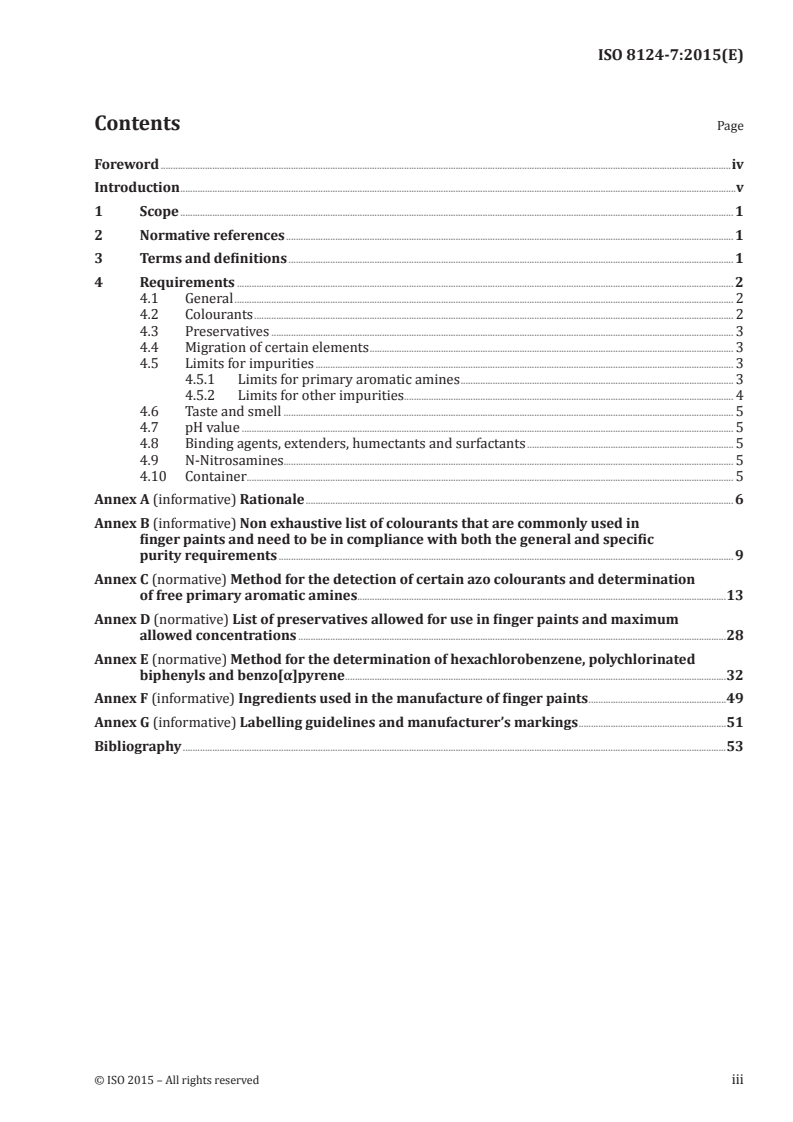
Contents Page
Foreword .iv
Introduction .v
1 Scope . 1
2 Normative references . 1
3 Terms and definitions . 1
4 Requirements . 2
4.1 General . 2
4.2 Colourants . 2
4.3 Preservatives . 3
4.4 Migration of certain elements . 3
4.5 Limits for impurities . 3
4.5.1 Limits for primary aromatic amines . 3
4.5.2 Limits for other impurities. 4
4.6 Taste and smell . 5
4.7 pH value . 5
4.8 Binding agents, extenders, humectants and surfactants . 5
4.9 N-Nitrosamines. 5
4.10 Container . 5
Annex A (informative) Rationale . 6
Annex B (informative) Non exhaustive list of colourants that are commonly used in
finger paints and need to be in compliance with both the general and specific
purity requirements . 9
Annex C (normative) Method for the detection of certain azo colourants and determination
of free primary aromatic amines .13
Annex D (normative) List of preservatives allowed for use in finger paints and maximum
allowed concentrations .28
Annex E (normative) Method for the determination of hexachlorobenzene, polychlorinated
biphenyls and benzo[α]pyrene .32
Annex F (informative) Ingredients used in the manufacture of finger paints .49
Annex G (informative) Labelling guidelines and manufacturer’s markings .51
Bibliography .53
Foreword
ISO (the International Organization for Standardization) is a worldwide federation of national standards
bodies (ISO member bodies). The work of preparing International Standards is normally carried out
through ISO technical committees. Each member body interested in a subject for which a technical
committee has been established has the right to be represented on that committee. International
organizations, governmental and non-governmental, in liaison with ISO, also take part in the work.
ISO collaborates closely with the International Electrotechnical Commission (IEC) on all matters of
electrotechnical standardization.
The procedures used to develop this document and those intended for its further maintenance are
described in the ISO/IEC Directives, Part 1. In particular the different approval criteria needed for the
different types of ISO documents should be noted. This document was drafted in accordance with the
editorial rules of the ISO/IEC Directives, Part 2 (see www.iso.org/directives).
Attention is drawn to the possibility that some of the elements of this document may be the subject of
patent rights. ISO shall not be held responsible for identifying any or all such patent rights. Details of
any patent rights identified during the development of the document will be in the Introduction and/or
on the ISO list of patent declarations received (see www.iso.org/patents).
Any trade name used in this document is information given for the convenience of users and does not
constitute an endorsement.
For an explanation on the meaning of ISO specific terms and expressions related to conformity
assessment, as well as information about ISO’s adherence to the WTO principles in the Technical
Barriers to Trade (TBT) see the following URL: Foreword - Supplementary information
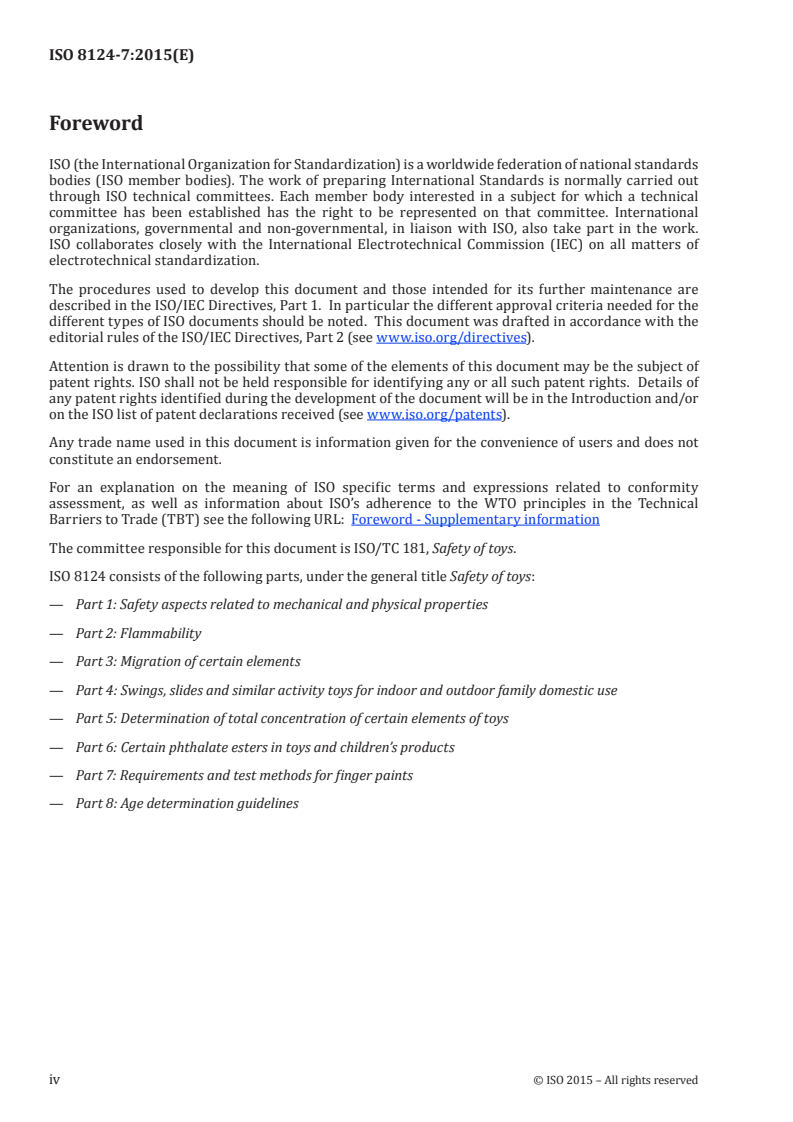
The committee responsible for this document is ISO/TC 181, Safety of toys.
ISO 8124 consists of the following parts, under the general title Safety of toys:
— Part 1: Safety aspects related to mechanical and physical properties
— Part 2: Flammability
— Part 3: Migration of certain elements
— Part 4: Swings, slides and similar activity toys for indoor and outdoor family domestic use
— Part 5: Determination of total concentration of certain elements of toys
— Part 6: Certain phthalate esters in toys and children’s products
— Part 7: Requirements and test methods for finger paints
— Part 8: Age determination guidelines
iv © ISO 2015 – All rights reserved
Introduction
This part of ISO 8124 contains requirements which are intended to reduce the risks to children when
finger paints are used as intended or in a foreseeable way, bearing in mind the behaviour of children.
In particular it is recognized that finger paints present different risks when compared to other toys
because of their intended use which requires application to the hands and fingers of young children.
It cannot be ruled out that some of the paint material will be ingested or flicked into the eye or that
prolonged contact with the skin will occur. Therefore, in order to address the particular risks associated
with finger paints, this part of ISO 8124 contains requirements relating to the ingredients that may be
used in the manufacture of finger paints and limitations on certain impurities that may be found in
these ingredients. It also sets out certain requirements on the packaging and labelling of finger paints.
Chemical Abstract Service Registry Numbers (CAS) or Colour Index Numbers given in the Tables are
provided for information purposes only.
Annex A provides rationale for the requirements.
INTERNATIONAL STANDARD ISO 8124-7:2015(E)
Safety of toys —
Part 7:
Requirements and test methods for finger paints
1 Scope
This part of ISO 8124 specifies requirements for the substances and materials used in finger paints. It is
applicable to finger paints only.
It is not applicable to paints intended to be applied to the face or body e.g. face paints.
Additional requirements are specified for markings, labelling and containers.
2 Normative references
The following referenced documents are indispensable for the application of this document. For dated
references, only the edition cited applies. For undated references, the latest edition of the referenced
document (including any amendments) applies.
ISO 787-9, General methods of test for pigments and extenders — Part 9: Determination of pH value of an
aqueous suspension
ISO 8124-3:2010, Safety of toys — Part 3: Migration of certain elements
3 Terms and definitions
For the purposes of this document the following definitions apply.
3.1
finger paint
aqueous semi-solid or liquid, coloured mixture specially designed for children to apply directly to
suitable surfaces with the fingers and hands
Note 1 to entry: Finger paint supplied in powder form is mixed with water according to the manufacturer’s
instructions before being considered in relation to this part of ISO 8124.
3.2
colourant
pigment or dyestuff
Note 1 to entry: For definitions of pigment and dyestuff see A.2.
3.3
extender
material in granular or powder form, insoluble in the medium and used to modify or influence certain
physical properties
Note 1 to entry: [SOURCE: ISO 4618:2014, definition 2.102, modified — Note 1 to entry deleted]
3.4
humectant
substance that delays the drying process
3.5
binding agent
water-soluble or miscible, non-volatile component that binds the paint to the surface to which it has
been applied
3.6
preservative
substance that prevents the growth of undesirable micro-organisms
3.7
surfactant
surface active substance that reduces the surface tension of the solution
Note 1 to entry: It can be used to make components miscible.
3.8
embittering agent
substance that gives the product a bitter taste
4 Requirements
4.1 General
Finger paints supplied in powder form shall be assessed against this part of ISO 8124 when mixed with
water in accordance with the manufacturer’s instructions.
When assessed according to the rules set out in the United Nations Globally Harmonized System of
Classification and Labelling of Chemicals (GHS), a finger paint shall not be classified with any of the
following health hazards:
— acute toxicity (hazard class 3.1);
— skin corrosion/irritation (hazard class 3.2);
— serious eye damage/eye irritation (hazard class 3.3);
— respiratory or skin sensitization (hazard class 3.4);
— germ cell mutagenicity (hazard class 3.5);
— carcinogenicity (hazard class 3.6);
— reproductive toxicity – adverse effects on sexual function and fertility or on development
(hazard class 3.7);
— specific target organ toxicity — single exposure effects other than narcotic effects (hazard class 3.8);
— specific target organ toxicity — repeated exposure (hazard class 3.9);
— aspiration hazard (hazard class 3.10).
4.2 Colourants
See A.2.
4.2.1 Colourants used in finger paint shall not have any of the health hazard classifications set out in
4.1 (hazard class 3.1 to 3.10).
2 © ISO 2015 – All rights reserved
NOTE Annex B provides a list of commonly used colorants that have been found to meet the requirements
of 4.2, providing they meet the purity requirements specified. These fall into one or more of the following
categories: Colourants permitted for use in food and/or cosmetics and other pigments which meet the general
requirements of 4.1.
4.2.2 Finger paints shall not contain azo colourants that by cleavage of one or more azo groups can
produce the primary aromatic amines listed in Tables 1 and 2 when tested in accordance with the test
method specified in Annex C.
4.3 Preservatives
See A.3.
Finger paints shall be preserved using only the preservatives listed in Annex D. The maximum
concentrations of preservatives shall not exceed the limits in column 4 of Table D.1 in Annex D.
Methods for the determination of certain preservatives are set out in the EU Cosmetics Legislation,
(see Bibliography) and should be used when evaluating the maximum concentrations specified in the
column “maximum allowed concentration” of Table D.1. Alternative methods that provide an equivalent
detection limit may also be used.
4.4 Migration of certain elements
See A.4.
The concentration of elements shall not exceed the maximum limit values for finger paint specified in
ISO 8124-3:2010, Table 1.
4.5 Limits for impurities
See A.5.
4.5.1 Limits for primary aromatic amines
4.5.1.1 The primary aromatic amines listed in Table 1 shall not be detectable when tested in accordance
with the test method in Annex C.
Table 1 — Primary aromatic amines
Primary aromatic amines CAS Number
Benzidine 92–87–5
2-Naphthylamine 91–59–8
4-Chloro-2-methylaniline (4-Chloro-o-toluidine) 95–69–2
4-Aminobiphenyl 92–67–1
4.5.1.2 Finger paint shall not contain carcinogenic primary aromatic amines (see Table 2 for a non-
exhaustive list of relevant substances) in a total amount exceeding 20 mg/kg, with no individual primary
aromatic amine exceeding 10 mg/kg, when tested in accordance with Annex C. The limitation does not
apply to aromatic aminocarboxylic acids or aminosulfonic acids.
Table 2 — Other primary aromatic amines (non-exhaustive list)
Primary aromatic amine CAS Number
o-Aminoazotoluene (4-o-Tolyazo-o-toluidine) 97–56–3
a
For certain pigments limit values for 3,3’-Dichlorobenzidine are given Annex B, Table B.1.
Table 2 (continued)
Primary aromatic amine CAS Number
2-Amino-4-nitrotoluene (5-Nitro-o-toluidine) 99–55–8
4-Chloroaniline 106–47–8
2,4-Diaminoanisole 615–05–4
4,4’-Diaminodiphenylmethane (4,4’-Methylenedianiline) 101–77–9
a
3,3’-Dichlorobenzidine 91–94–1
3,3’-Dimethoxybenzidine 119–90–4
3,3’-Dimethylbenzidine 119–93–7
3,3’-Dimethyl-4,4’-diaminodiphenylmethane (4,4’-Methylenedi-o-toluidine) 838–88–0
p-Cresidine (6-Methoxy-m-toluidine) 120–71–8
2 , 2 ’ - D ic h l o r o - 4 , 4 ’ - me t hy l e ne d i a n i l i ne 101–14–4
(4,4’-Methylene-bis-2-chloroaniline)
4,4’-Oxydianiline 101–80–4
4,4’-Thiodianiline 139–65–1
o-Toluidine 95–53–4
2,4-Xylidine 95–68–1
2,6-Xylidine 87–62–7
4-Amino-3-fluorophenol 399–95–1
6-Amino-2-ethoxynaphthalene not available
2-Methoxyaniline (o-Anisidine) 90–04–0
4-Aminoazobenzene 60–09–3
4-Methyl-m-phenylenediamine (Toluene-2,4-diamine) 95–80–7
2,4,5-Trimethylaniline 137–17–7
Aniline 62–53–3
a
For certain pigments limit values for 3,3’-Dichlorobenzidine are given Annex B, Table B.1.
4.5.2 Limits for other impurities
See A.5.
Finger paints shall not contain the impurities specified in Table 3, column 1 above the limits specified
in column 2 when colourants specified in column 3 are used, when tested in accordance with Annex E.
Table 3 — Impurities in finger paints
Values in milligrams per kilogram of finger paint
Impurity Limit Finger paints of concern
Polychlorinated biphenyls < 2 Finger paints containing chlorinated
colourants or colourants manufac-
tured in chlorinated solvents
Hexachlorobenzene < 5 Finger paints containing chlorinated
colourants or colourants manufac-
(CAS No. 118–74–1)
tured in chlorinated solvents
Benzo (α) pyrene < 0,05 Only for finger paints containing
carbon black
(CAS No. 50–32–8)
4 © ISO 2015 – All rights reserved
4.6 Taste and smell
See A.7.
Finger paints shall not be sweetened, flavoured or fragranced.
An embittering agent in accordance with Table 4 shall be added in order to discourage and minimize
the ingestion of paint.
Table 4 — Embittering agents
Embittering agent CAS Number
Naringin CAS 10236–47–2
Denatonium benzoate CAS 3734–33–6
The bitterness should be detectable by taste when the finger paint is diluted with water in a ratio of 1:100.
The following levels have been found suitable: naringin 1 %; denatonium benzoate 0,0004 % (4 mg/kg).
The relative bitterness of these substances is approximately 1:3 000 (naringin : denatonium benzoate).
The embittering agent and its concentration should be such that it provides a bitter taste during the
expected lifetime of the finger paint.
4.7 pH value
See A.8.
The pH value of the finger paint shall be between 4,0 and 10,0 when tested in accordance with ISO 787-9.
4.8 Binding agents, extenders, humectants and surfactants
Finger paints shall only use binding agents, extenders, humectants and surfactants which are not
classified with any of the health hazards set out in in 4.1 (hazards class 3.1 to 3.10).
NOTE See Annex F for a list of compounds known to be commonly used in finger paints.
4.9 N-Nitrosamines
See A.9.
Finger paints shall not contain more than 0,02 mg/kg of N-nitrosodiethanolamine (NDELA), CAS
No.:1116-54-7.
NOTE One suitable and validated test method is detailed in EN 71–12:2013, 7.2.1 and Clause 8. Other test
methods may be used provided they are validated for finger paints.
4.10 Container
See A.10.
Containers used for finger paints shall not have a design that is likely to be mistaken by children with
containers of foodstuffs or drinks.
Manufacturers should take into consideration the material(s), shape, volume, colours, labelling, other
packaging and the means of access to the contents, when assessing similarity with containers of
foodstuff or drinks.
Annex A
(informative)
Rationale
A.1 Finger paints
In addition to water, finger paints essentially consist of colourants, binders, preservatives and
embittering agents and may additionally contain extenders, humectants and surfactants. Finger paints
may be coloured by using colouring substances or mixtures containing colouring and other ingredients
which are incorporated into a finger paint to impart colour to the finger paint.
A.2 Colourants
See 4.2.
Annex B contains a list of colourants which are suitable for finger paints subject to them meeting
certain purity requirements. It includes colourants specific to finger paints, food colourants and
cosmetic colourants.
More detailed requirements on aromatic amines are included in order to exclude risks which may
derive from impurities in colourants.
Dyes are intensely coloured or fluorescent organic substances only, which impart colour to a substrate
by selective absorption of light. They are soluble and/or go through an application process which, at
least temporarily, destroys any crystal structure by absorption, solution, and mechanical retention, or
by ionic or covalent chemical bonds.
Pigments are coloured, black, white or fluorescent particulate organic or inorganic solids which usually
are insoluble in, and essentially physically and chemically unaffected by, the vehicle or substrate in
which they are incorporated. They alter appearance by selective absorption and/or by scattering of
light. Pigments are usually dispersed in vehicles or substrates for application, as for instance in the
manufacture or inks, paints, plastics or other polymeric materials. Pigments retain a crystal or
particulate structure throughout the coloration process.
A.3 Preservatives
See 4.3.
The use of appropriate preservatives in water-based systems like finger paints is necessary in order to
provide protection against the growth of bacteria, fungi and yeasts and maintain a hygienic compound.
Preservatives allowed for use in finger paints are listed in Annex D. The following properties were taken
into consideration when drafting this list: high efficacy with respect to micro-organisms accompanied
by suitable toxicological performance (e.g. low human toxicity, low volatility, low odour), suitable
technical performance (e.g. solubility in water-based systems, stability against other ingredients,
stability against chemical or physical influences) and suitable environmental performance [e.g. low
adsorbable organic halogens (AOX), low persistence]. The list includes, for example, preservatives that
are allowed for cosmetic use or for food use.
A.4 Elements
See 4.4.
6 © ISO 2015 – All rights reserved
The limit values and test methods for the migration of certain elements in finger paints are specified in
ISO 8124-3, Table 1, row 3.
A.5 Limits for primary aromatic amines
See 4.5.1.1 and 4.5.1.2.
Table 1 lists the four primary aromatic amines which shall not be determinable in finger paints at the
limit of quantification (LOQ) using the method described in Annex C using GC-MS as the detection
technique. Table 2 lists 24 primary aromatic amines which were taken from Table 2 of EN 71-7:2014
entitled “Other carcinogenic primary aromatic amines (non-exhaustive list)”. Therefore, the listing of
primary aromatic amines in Table 2 of this part of ISO 8124 has been described as a non-exhaustive list
and does not preclude other primary aromatic amines from being analysed. The information provided in
Chromatography (C.6.5) and Precision (C.8) includes the four primary aromatic amines listed in Table 1,
and 18 primary aromatic amines from Table 2. The inclusion of 18 rather than all 23 primary aromatic
amines in Table 2 reflects the difficulty in obtaining the suitable commercial standards at the time of
writing this part of ISO 8124. The information in C.5 and C.8 should provide the competent analyst with
indicative information in the determination of other primary aromatic amines where/when calibration
standards are available. The limitation for primary aromatic amines does not apply to aromatic
aminocarboxylic acids or aminosulfonic acids because they are considered to be harmless.
A.6 Limit for benzo(α)pyrene
See 4.5.2.
Benzo(α)pyrene in finger paints is limited to the currently technically achievable analytical limit of
quantitation (LOQ) of 0,02 mg/kg.
A.7 Taste and smell
See 4.6.
The addition of sweeteners, flavourings and fragrances to a finger paint may be determined by an
assessment of the individual ingredients in the formulation of the finger paint.
The requirement to add an embittering agent to finger paints is intended to minimize potential oral
ingestion by young children who may deliberately or accidentally put some of the finger paint in their
mouth.
It should be noted that products with added embittering agents show remarkable bitterness, which
may remain for a while after putting it into the mouth.
Experience has shown that the bitterness in finger paint will last for the product’s lifetime, if one of the
two embittering agents in Table 4 is used in diluted finger paint as given in the Note in 4.6.
A.8 pH value
See 4.7.
The use of calcium carbonate may raise the pH value as a result of more dissociation by dilution with
water in accordance with ISO 787-9 up to pH 10.
Some types of formulations containing calcium carbonate show pH values higher than 10 because the
dilution of the finger paint is made with distilled water. This may also be found for small amounts of
calcium carbonate in finger paint. Such a high increase as an analytical artefact does not happen when
tap water is used to dilute the finger paint.
A.9 N-Nitrosamines
See 4.9.
To avoid the possible formation of N-nitrosamines avoid using formulations that combine
diethanolamine andtriethanolamine (which is known to be often contaminated with diethanolamine
or which can be decomposedto diethanolamine) with possible sources of nitrite that may be present in
certain preservatives (e.g. bronopol) and other raw materials.
Work undertaken during the development of EN 71-12:2013, showed that the only N-nitrosamine of
relevance for finger paints is N-nitrosodiethanolamine (NDELA), CAS No.:1116-54-7. Consequently
this part of ISO 8124 sets a limitation on NDELA only. EN 71-12:2013 mentions other N-nitrosamines
because this aligns with the EU toy safety directive but other N-nitrosamines are not known to occur in
finger paints.
EN 71-12:2013 contains a validated test method for the determinations of NDELA in finger paints but
other test methods may be used provided they are validated for determination of NDELA in a typical
finger paint matrix.
A.10 Containers
See 4.10.
This requirement is intended to minimize the potential for a child to mistake finger paint for a foodstuff
or a drink. The requirement is one of a series of precautionary measures (e.g. embittering agents, no
flavour, no sweetening, no fragrance, warning to parents to supervise) intended to discourage the
ingestion of finger paints by typical users (e.g. two years and above).
A.11 Labelling guidelines
See Annex G.
Young children have a propensity for exploring objects orally. The warning phrase recognizes the
fact that children under three years of age may be tempted to taste or eat the finger paint and this is
something that the supervisor would be expected to discourage or prevent. Even though finger paints
that are in conformity with this part of ISO 8124 may be considered to present a minimal risk, ingestion
of repeated amounts of finger paint is not recommended.
8 © ISO 2015 – All rights reserved
Annex B
(informative)
Non exhaustive list of colourants that are commonly used in finger
paints and need to be in compliance with both the general and
specific purity requirements
Table B.1 lists organic colourants commonly used in finger paints.
Table B.1 — Organic colourants which are commonly used in finger paints
a
No. Colour CI Generic Name CI Constitution CAS Number Limitations, requirements and information
Number
b
1 Yellow Pigment Yellow 1 11680 2512–29–0 See .
Check purity criteria for amine limits and
d
that excess coupling component is less than
1 000 ppm (parts per million).
b
2 Pigment Yellow 3 11710 6486–23–3 See .
Check purity criteria for amine limits and
d
that excess coupling component is less than
1 000 ppm.
3 Pigment Yellow 12 21090 6358–85–6 3,3’-Dichlorobenzidine ≤ 5 mg/kg: see C.1
detection limit of the method.
4 Pigment Yellow 13 21100 5102–83–0 3,3’-Dichlorobenzidine ≤ 5 mg/kg: see C.1
detection limit of the method.
5 Pigment Yellow 14 21095 5468–75–7 3,3’-Dichlorobenzidine ≤ 5 mg/kg: see C.1
detection limit of the method.
6 Pigment Yellow 17 21105 4531–49–1 3,3’-Dichlorobenzidine ≤ 5 mg/kg: see C.1
detection limit of the method.
7 Pigment Yellow 74 11741 6358–31–2 Check purity criteria for amine limits and
d
that excess coupling component is less than
1 000 ppm.
8 Pigment Yellow 138 56300 30125–47–4
9 Pigment Yellow 139 56298 36888–99–0
10 Pigment Yellow 151 13980 31837–42–0
11 Yellow Pigment Yellow 154 11781 68134–22–5 Check purity criteria for amine limits and
d
that excess coupling component is less than
1 000 ppm.
12 Pigment Yellow 155 200310 68516–73–4
13 Pigment Yellow 185 56290 76199–85–4
14 Natural Yellow 3 75300 458–37–7 Food grade, for example see current European
legislation (2008/128/EC), E 100
15 Natural Yellow 6 75100 8 9 3 8 2 – 8 8 – 7
27876–94–4
a
The Colour Index is published by The Society of Dyers and Colourists, PO Box 244, Perkin House 82 Grattan Road,
Bradford, West Yorkshire BD1 2JB, United Kingdom, www.colour-index.org. Colourants are classified using both their CI
generic name and their constitution number. These relate only to the “essential colourant” as defined by the Colour Index.
b [8]
This substance is restricted in Regulation (EC) No 1223/2009 as follows: “Not to be used in eye products” or “Not to
be used in products applied on mucous membranes”, as applicable.
c [8]
This substance is restricted in Regulation (EC) No 1223/2009 as follows: “Rinse-off products”.
d Azo colourants are typically formed by a reaction sequence of diazotization of a primary aromatic amine which is
referred to as the diazo component, followed by reaction (known as “coupling”) with a compound having active methylene
groups referred to as a coupling component.
Table B.1 (continued)
a
No. Colour CI Generic Name CI Constitution CAS Number Limitations, requirements and information
Number
16 Natural Yellow 26 75130 7235–40–8 Food grade, for example see current European
Directive (2008/128/EC), E 160 a
17 Natural Yellow 27 75135 79–75–4 Food grade, for example see current European
Directive (2008/128/EC), E 161 d
3763–55–1
18 Orange Pigment Orange 13 21110 3520–72–7 Check purity criteria for amine limits and
d
coupling component limits
Combinations with Pigment Black
7 shall be checked for release of
3,3’dichlorobenzene
3,3’-dichlorobenzidine ≤ 5 mg/kg: see C.1
Detection limit of the method
19 Orange Pigment Orange 34 21115 15793–73–4 Check purity criteria for amine limits and
d
coupling component limits
Combinations with Pigment Black
7 shall be checked for release of
3,3’ dichlorobenzene
3,3’-dichlorobenzidine ≤ 5 mg/kg: see C.1
Detection limit of the method
b
20 Pigment Orange 43 71105 4424–06–0 See .
21 Pigment Orange 71 561200 86432–50–8
22 Pigment Orange 73 56117 84632–59–7
23 Natural Orange 4 75120 8015–67–6 Food grade, for example see current European
Directive (2008/128/EC), E 160 b
24 Red Pigment Red 48:2 15865:2 7023–61–2
25 Pigment Red 48:3 15865:3 15782–05–5
26 Pigment Red 57:2 15850:2 17852–98–1
27 Pigment Red 57:1 15850:1 5281–04–9
28 Pigment Red 63:1 15880:1 6417–83–0
29 Pigment Red 68 15525 5850–80–6
30 Pigment Red 83 58000:1 104074–25–1
c
31 Pigment Red 122 73915 980–26–7 See .
32 Pigment Red 181 73360 2379–74–0
33 Pigment Red 214 200660 82643–43–4
34 Pigment Red 242 20067 52238–92–3
35 Pigment Red 254 56110 84632–65–5
36 Pigment Red 255 561050 54660–00–3
37 Pigment Red 264 561300 88949–33–1
38 Pigment Red 272 561150 350249–32–0
a
The Colour Index is published by The Society of Dyers and Colourists, PO Box 244, Perkin House 82 Grattan Road,
Bradford, West Yorkshire BD1 2JB, United Kingdom, www.colour-index.org. Colourants are classified using both their CI
generic name and their constitution number. These relate only to the “essential colourant” as defined by the Colour Index.
b [8]
This substance is restricted in Regulation (EC) No 1223/2009 as follows: “Not to be used in eye products” or “Not to
be used in products applied on mucous membranes”, as applicable.
c [8]
This substance is restricted in Regulation (EC) No 1223/2009 as follows: “Rinse-off products”.
d Azo colourants are typically formed by a reaction sequence of diazotization of a primary aromatic amine which is
referred to as the diazo component, followed by reaction (known as “coupling”) with a compound having active methylene
groups referred to as a coupling component.
10 © ISO 2015 – All rights reserved
Table B.1 (continued)
a
No. Colour CI Generic Name CI Constitution CAS Number Limitations, requirements and information
Number
39 Red Natural Red 4 75470 1 3 9 0 –6 5 –4 Food grade, for example see current European
1260–17–9 Directive (2008/128/EC), E 120
c
40 Violet Pigment Violet 19 73900 1047–16–1 See .
c
41 Pigment Violet 23 51319 2 15 2 4 7 – 95 – 3 See .
6358–30–1
42 Blue Pigment Blue 15 74160 14 7 – 14 – 8 , Check purity criteria for PCB, PCDD/DF and
1 2 2 3 9 – 8 7 –1 HCB limits.
2 7 6 1 4 –7 1 –7
For example, limits as specified in existing
6 89 8 7 – 6 3– 3
chemical regulations in EU (see regulation.
16040–69–0
(EC) No. 1907/2006 “REACH”, Annex XVII)
Pigment Blue 15:2 and 15:4 are surface treated.
Before using surface treated substances,
manufacturers should contact their suppliers
regarding composition and hazards.
c
43 Pigment Blue 16 74100 574–93–6 See .
44 Pigment Blue 60 69800 81–77–6
b
45 Green Pigment Green 7 74260 1328–53–6 See .
46 Pigment Green 36 74265 14302–13–7
47 Natural Green 3 75810 8 0 4 9 – 8 4 –1 Food grade, for example see current European
11006–34–1 Directive (2008/128/EC), E 140 and E 141
a
The Colour Index is published by The Society of Dyers and Colourists, PO Box 244, Perkin House 82 Grattan Road,
Bradford, West Yorkshire BD1 2JB, United Kingdom, www.colour-index.org. Colourants are classified using both their CI
generic name and their constitution number. These relate only to the “essential colourant” as defined by the Colour Index.
b [8]
This substance is restricted in Regulation (EC) No 1223/2009 as follows: “Not to be used in eye products” or “Not to
be used in products applied on mucous membranes”, as applicable.
c [8]
This substance is restricted in Regulation (EC) No 1223/2009 as follows: “Rinse-off products”.
d Azo colourants are typically formed by a reaction sequence of diazotization of a primary aromatic amine which is
referred to as the diazo component, followed by reaction (known as “coupling”) with a compound having active methylene
groups referred to as a coupling component.
Table B.2 lists non-organic colourants commonly used in finger paints.
Table B.2 — Non-organic colourants which are commonly used in finger paints
a
No. Colour CI Generic Name CI Constitution CAS Number Limitations, requirements and information
Number
48 Yellow Pigment Yellow 42 77492 51274–00–1 Iron oxide yellow
Food grade, for example see current European
Directive (2008/128/EC), E 172
49 Red Pigment Red 101 77491 1309–37–1 Food grade, for example see current European
Directive (2008/128/EC), E 172
50 Blue Pigment Blue 29 77007 1317–97–1 Ultramarine
57455–37–5
a
The Colour Index is published by The Society of Dyers and Colourists, PO Box 244, Perkin House 82 Grattan Road,
Bradford, West Yorkshire BD1 2JB, United Kingdom, www.colour-index.org. Colourant are classified using both their CI
Generic name and their constitution number. These relate only to the “essential colourant” as defined by the Colour Index.
Table B.2 (continued)
a
No. Colour CI Generic Name CI Constitution CAS Number Limitations, requirements and information
Number
51 White Pigment White 4 77947 1314–13–2 Zinc Oxide
52 Pigment White 6 77891 13463–67–7 Food grade, for example see current European
Directive (2008/128/EC), E 171
53 Pigment White 18 77220 2 0 7– 4 3 9 – 9 Chalk
208–915–9
Food grade, for example see current European
Directive (2008/128/EC), E 170
Mixture Calcium carbonate, Magnesium
carbonate
54 Pigment White 19 77004 8047–76–5 Aluminium silicate, hydrated
55 Silver 77820 7440–22–4 Food grade, for example see current European
Directive (2008/128/EC), E 174
56 Pigment White 21 77120 7727–43–7 Blancfixe
57 Pigment White 25 77231 91315–45–6 Gypsum
58 Aluminium, zinc, magnesium - Various
and calcium stearates
59 Black Pigment Black 6 77266 1333–86–4 Carbon black
food contact quality
60 Pigment Black 7 77266 1333–86–4 Carbon black
food contact quality
61 Pigment Black 11 77499 12227–89–3 Food grade, for example see current European
Directive (2008/128/EC), E 172
62 Brown Pigment Metal 3 77480 7440–57–5 Gold
Food grade, for example see current European
Directive (2008/128/EC), E 175
63 Orange Ferrous oxide 77489 Various Food grade, for example see current European
Directive (2008/128/EC), E 172 (Mix)
a
The Colour Index is published by The Society of Dyers and Colourists, PO Box 244, Perkin House 82 Grattan Road,
Bradford, West Yorkshire BD1 2JB, United Kingdom, www.colour-index.org. Colourant are classified using both their CI
Generic name and their constitution number. These relate only to the “essential colourant” as defined by the Colour Index.
12 © ISO 2015 – All rights reserved
Annex C
(normative)
Method for the detection of certain azo colourants and
determination of free primary aromatic amines
C.1 General
For the detection of certain azo colourants, the sample is treated with sodium dithionite in a citrate
buffer (pH 6) at 70 °C in a sealed vessel. Upon reductive cleavage, the resultant amines are extracted
with tert-Butyl methyl ether (MTBE) by means of a “kieselguhr” type SPE column. The ether extract is
carefully concentrated with a rotary evaporator or an equivalent sample concentrator and the residue
is dissolved in acetonitrile or other suitable solvent, depending upon the detection/determination
procedure to be used.
The detection/determination of amines resulting either from the reductive cleavage method or already
present in the sample as free primary aromatic amines is performed by high performance liquid
chromatography with a diode-array detector (HPLC/DAD) or by capillary gas chromatography with
mass-selective detector (GC-MS).
The amines shall be identified by at least one of the chromatographic separation techniques described
in this annex. Unless an unequivocal identification is achieved (e.g. by using GC-MS and comparing
retention times with known standards), confirmation of positive results shall be achieved by a suitable
alternative separation technique (to avoid possible misinterpretation from, for example, isomers of the
amines to be identified).
NOTE 1 Some amines may be thermally unstable and cannot be determined by gas chromatography.
The quantification of the amines is performed by HPLC/DAD or GC-MS.
NOTE 2 Some of the amines are cleaved under the reductive conditions in C.6.2 according to Table C.1:
Table C.1 — Amine compounds and cleavage products
Amine compound Cleavage products
o-Aminoazotoluene o-Toluidine, 2-Methyl-p-phenylendiamine
2-Amino-4-nitrotoluene 4-Methyl-m-phenylenediamine
4-Aminoazobenzene p-Phenylenediamine, Aniline
4-Aminoazobenzene is reductively cleaved to p-phenylenediamine and aniline; o-aminoazotoluene is
reductively cleaved to 2-methyl-p-phenylenediamine and o-toluidine; and 5-nitro-o-toluidine is reduced
to 4-methyl-m-phenylenediamine.
A prohibited azo colourant is deemed to be present in the finger paint if, on reductive cleavage, one or
more of the amines listed in Tables 1 and 2 is present in a concentration exceeding 30 mg/kg.
Each primary aromatic amines listed in Table 1 is deemed to be determinable at levels exceeding 5 mg/kg.
C.2 Reagents
Reagent-grade chemicals are to be used, if nothing else is specified.
C.2.1 Methanol.
C.2.2 Acetonitrile.
C.2.3 tert-Butyl methyl ether.
C.2.4 Citrate/sodium hydroxide buffer, c(trisodium citrate) = 0,06 mol/l, pH 6, preheated to 70 °C
or 37 °C: Dissolve 12,6 g citric acid monohydrate and 6,4 g sodium hydroxide in 900 ml water. Adjust the
1)
volume to 1 L .
C.2.5 Sodium dithionite solution, freshly dissolved in water, ρ = 200 mg/ml.
2)
C.2.6 Porous, granular “kieselguhr” SPE column .
C.2.7 Anhydrous sodium sulfate.
C.2.8 Certified amine standards, primarily those listed in Tables 1 and 2.
NOTE The amines in Tables 1 and 2 are human carcinogens or cancer suspect agents (Cat. 1A and 1B). The
handling of these chemicals requires the utmost care and commensurate safety measures.
C.2.9 Internal standards for gas chromatography.
C.2.9.1 IS 1: 2,4,5-Trichloroaniline, CAS No. 636-30-6.
C.2.9.2 IS 2: 4-Amino-2-methylquinoline, CAS No. 6628-04-2.
C.2.9.3 IS 3: Tributylphosphate, CAS No. 126-73-8.
C.2.10 Standard solutions.
C.2.10.1 Stock solution of aromatic amines.
Prepare a stock solution containing 100 mg/l of each aromatic amine (C.2.8) in methanol (C.2.1). This
solution shall be stored in the absence of light at (−18 ± 2) °C.
C.2.10.2 Calibration solutions.
Prepare six calibration solutions in the range 0,1 mg/l to 5,0 mg/l by dilution of the aromatic amines
stock solutions (C.2.10.1) into (100 ± 0,1) ml volumetric flasks using MBTE (C.2.3). Before making up to
the final volume, add 0,1 ml of internal standard (C.2.10.3) to each calibration solution in order to obtain
a final internal standard concentration of 1 mg/l. The calibration solutions are ready for GC-MS analysis.
C.2.10.3 Internal standard solution.
Prepare a stock solution of each internal standard (C.2.9.1 – C.2.9.3) at 10,0 mg/l in methanol (C.2.1).
C.2.10.4 Recovery solution of aromatic amines.
Prepare a recovery solution containing 10 mg/l of each aromatic amine (C.2.10.1) in methanol (C.2.1).
This solution shall be stored in the absence of light at (−18 ± 2) °C.
1) “Ready for use” solution, Merck-Nr. 1.09437 is an example of a suitable product available commercially. This
information is given for the convenience of users of this document and does not constitute an endorsement by ISO
of this product.
2) Chromabond® XTR is an example of a suitable product available commercially. This information is given for the
convenience of users of this document and does not constitute an endorsement by ISO of this product.
14 © ISO 2015 – All rights reserved
The stability of all calibration solutions should be checked regularly. These should be stable for up to 6
months when stored in the dark at (−18 ± 2) °C.
NOTE The solvent used will depend on the chromatographic method chosen for analysis.
C.3 Apparatus
Ordinary laboratory equipment, and:
C.3.1 Reaction vessel (50 ml conical flask) of temperature-resistant glass with tight-fitting cap.
C.3.2 Water bath, capable of maintaining a temperature of (37 ± 2) °C and (70 ± 2) °C.
C.3.3 Column made from glass or polypropylene, 25 mm to 30 mm internal diameter, 140 mm to
150 mm length, filled with about 20 g porous, granular “kieselguhr” SPE material, fitted on the out
...
INTERNATIONAL ISO
STANDARD 8124-7
First edition
2015-10-01
Safety of toys —
Part 7:
Requirements and test methods for
finger paints
Sécurité des jouets —
Partie 7: Exigences et méthodes d’essai pour les peintures digitales
Reference number
©
ISO 2015
© ISO 2015, Published in Switzerland
All rights reserved. Unless otherwise specified, no part of this publication may be reproduced or utilized otherwise in any form
or by any means, electronic or mechanical, including photocopying, or posting on the internet or an intranet, without prior
written permission. Permission can be requested from either ISO at the address below or ISO’s member body in the country of
the requester.
ISO copyright office
Ch. de Blandonnet 8 • CP 401
CH-1214 Vernier, Geneva, Switzerland
Tel. +41 22 749 01 11
Fax +41 22 749 09 47
copyright@iso.org
www.iso.org
ii © ISO 2015 – All rights reserved
Contents Page
Foreword .iv
Introduction .v
1 Scope . 1
2 Normative references . 1
3 Terms and definitions . 1
4 Requirements . 2
4.1 General . 2
4.2 Colourants . 2
4.3 Preservatives . 3
4.4 Migration of certain elements . 3
4.5 Limits for impurities . 3
4.5.1 Limits for primary aromatic amines . 3
4.5.2 Limits for other impurities. 4
4.6 Taste and smell . 5
4.7 pH value . 5
4.8 Binding agents, extenders, humectants and surfactants . 5
4.9 N-Nitrosamines. 5
4.10 Container . 5
Annex A (informative) Rationale . 6
Annex B (informative) Non exhaustive list of colourants that are commonly used in
finger paints and need to be in compliance with both the general and specific
purity requirements . 9
Annex C (normative) Method for the detection of certain azo colourants and determination
of free primary aromatic amines .13
Annex D (normative) List of preservatives allowed for use in finger paints and maximum
allowed concentrations .28
Annex E (normative) Method for the determination of hexachlorobenzene, polychlorinated
biphenyls and benzo[α]pyrene .32
Annex F (informative) Ingredients used in the manufacture of finger paints .49
Annex G (informative) Labelling guidelines and manufacturer’s markings .51
Bibliography .53
Foreword
ISO (the International Organization for Standardization) is a worldwide federation of national standards
bodies (ISO member bodies). The work of preparing International Standards is normally carried out
through ISO technical committees. Each member body interested in a subject for which a technical
committee has been established has the right to be represented on that committee. International
organizations, governmental and non-governmental, in liaison with ISO, also take part in the work.
ISO collaborates closely with the International Electrotechnical Commission (IEC) on all matters of
electrotechnical standardization.
The procedures used to develop this document and those intended for its further maintenance are
described in the ISO/IEC Directives, Part 1. In particular the different approval criteria needed for the
different types of ISO documents should be noted. This document was drafted in accordance with the
editorial rules of the ISO/IEC Directives, Part 2 (see www.iso.org/directives).
Attention is drawn to the possibility that some of the elements of this document may be the subject of
patent rights. ISO shall not be held responsible for identifying any or all such patent rights. Details of
any patent rights identified during the development of the document will be in the Introduction and/or
on the ISO list of patent declarations received (see www.iso.org/patents).
Any trade name used in this document is information given for the convenience of users and does not
constitute an endorsement.
For an explanation on the meaning of ISO specific terms and expressions related to conformity
assessment, as well as information about ISO’s adherence to the WTO principles in the Technical
Barriers to Trade (TBT) see the following URL: Foreword - Supplementary information
The committee responsible for this document is ISO/TC 181, Safety of toys.
ISO 8124 consists of the following parts, under the general title Safety of toys:
— Part 1: Safety aspects related to mechanical and physical properties
— Part 2: Flammability
— Part 3: Migration of certain elements
— Part 4: Swings, slides and similar activity toys for indoor and outdoor family domestic use
— Part 5: Determination of total concentration of certain elements of toys
— Part 6: Certain phthalate esters in toys and children’s products
— Part 7: Requirements and test methods for finger paints
— Part 8: Age determination guidelines
iv © ISO 2015 – All rights reserved
Introduction
This part of ISO 8124 contains requirements which are intended to reduce the risks to children when
finger paints are used as intended or in a foreseeable way, bearing in mind the behaviour of children.
In particular it is recognized that finger paints present different risks when compared to other toys
because of their intended use which requires application to the hands and fingers of young children.
It cannot be ruled out that some of the paint material will be ingested or flicked into the eye or that
prolonged contact with the skin will occur. Therefore, in order to address the particular risks associated
with finger paints, this part of ISO 8124 contains requirements relating to the ingredients that may be
used in the manufacture of finger paints and limitations on certain impurities that may be found in
these ingredients. It also sets out certain requirements on the packaging and labelling of finger paints.
Chemical Abstract Service Registry Numbers (CAS) or Colour Index Numbers given in the Tables are
provided for information purposes only.
Annex A provides rationale for the requirements.
INTERNATIONAL STANDARD ISO 8124-7:2015(E)
Safety of toys —
Part 7:
Requirements and test methods for finger paints
1 Scope
This part of ISO 8124 specifies requirements for the substances and materials used in finger paints. It is
applicable to finger paints only.
It is not applicable to paints intended to be applied to the face or body e.g. face paints.
Additional requirements are specified for markings, labelling and containers.
2 Normative references
The following referenced documents are indispensable for the application of this document. For dated
references, only the edition cited applies. For undated references, the latest edition of the referenced
document (including any amendments) applies.
ISO 787-9, General methods of test for pigments and extenders — Part 9: Determination of pH value of an
aqueous suspension
ISO 8124-3:2010, Safety of toys — Part 3: Migration of certain elements
3 Terms and definitions
For the purposes of this document the following definitions apply.
3.1
finger paint
aqueous semi-solid or liquid, coloured mixture specially designed for children to apply directly to
suitable surfaces with the fingers and hands
Note 1 to entry: Finger paint supplied in powder form is mixed with water according to the manufacturer’s
instructions before being considered in relation to this part of ISO 8124.
3.2
colourant
pigment or dyestuff
Note 1 to entry: For definitions of pigment and dyestuff see A.2.
3.3
extender
material in granular or powder form, insoluble in the medium and used to modify or influence certain
physical properties
Note 1 to entry: [SOURCE: ISO 4618:2014, definition 2.102, modified — Note 1 to entry deleted]
3.4
humectant
substance that delays the drying process
3.5
binding agent
water-soluble or miscible, non-volatile component that binds the paint to the surface to which it has
been applied
3.6
preservative
substance that prevents the growth of undesirable micro-organisms
3.7
surfactant
surface active substance that reduces the surface tension of the solution
Note 1 to entry: It can be used to make components miscible.
3.8
embittering agent
substance that gives the product a bitter taste
4 Requirements
4.1 General
Finger paints supplied in powder form shall be assessed against this part of ISO 8124 when mixed with
water in accordance with the manufacturer’s instructions.
When assessed according to the rules set out in the United Nations Globally Harmonized System of
Classification and Labelling of Chemicals (GHS), a finger paint shall not be classified with any of the
following health hazards:
— acute toxicity (hazard class 3.1);
— skin corrosion/irritation (hazard class 3.2);
— serious eye damage/eye irritation (hazard class 3.3);
— respiratory or skin sensitization (hazard class 3.4);
— germ cell mutagenicity (hazard class 3.5);
— carcinogenicity (hazard class 3.6);
— reproductive toxicity – adverse effects on sexual function and fertility or on development
(hazard class 3.7);
— specific target organ toxicity — single exposure effects other than narcotic effects (hazard class 3.8);
— specific target organ toxicity — repeated exposure (hazard class 3.9);
— aspiration hazard (hazard class 3.10).
4.2 Colourants
See A.2.
4.2.1 Colourants used in finger paint shall not have any of the health hazard classifications set out in
4.1 (hazard class 3.1 to 3.10).
2 © ISO 2015 – All rights reserved
NOTE Annex B provides a list of commonly used colorants that have been found to meet the requirements
of 4.2, providing they meet the purity requirements specified. These fall into one or more of the following
categories: Colourants permitted for use in food and/or cosmetics and other pigments which meet the general
requirements of 4.1.
4.2.2 Finger paints shall not contain azo colourants that by cleavage of one or more azo groups can
produce the primary aromatic amines listed in Tables 1 and 2 when tested in accordance with the test
method specified in Annex C.
4.3 Preservatives
See A.3.
Finger paints shall be preserved using only the preservatives listed in Annex D. The maximum
concentrations of preservatives shall not exceed the limits in column 4 of Table D.1 in Annex D.
Methods for the determination of certain preservatives are set out in the EU Cosmetics Legislation,
(see Bibliography) and should be used when evaluating the maximum concentrations specified in the
column “maximum allowed concentration” of Table D.1. Alternative methods that provide an equivalent
detection limit may also be used.
4.4 Migration of certain elements
See A.4.
The concentration of elements shall not exceed the maximum limit values for finger paint specified in
ISO 8124-3:2010, Table 1.
4.5 Limits for impurities
See A.5.
4.5.1 Limits for primary aromatic amines
4.5.1.1 The primary aromatic amines listed in Table 1 shall not be detectable when tested in accordance
with the test method in Annex C.
Table 1 — Primary aromatic amines
Primary aromatic amines CAS Number
Benzidine 92–87–5
2-Naphthylamine 91–59–8
4-Chloro-2-methylaniline (4-Chloro-o-toluidine) 95–69–2
4-Aminobiphenyl 92–67–1
4.5.1.2 Finger paint shall not contain carcinogenic primary aromatic amines (see Table 2 for a non-
exhaustive list of relevant substances) in a total amount exceeding 20 mg/kg, with no individual primary
aromatic amine exceeding 10 mg/kg, when tested in accordance with Annex C. The limitation does not
apply to aromatic aminocarboxylic acids or aminosulfonic acids.
Table 2 — Other primary aromatic amines (non-exhaustive list)
Primary aromatic amine CAS Number
o-Aminoazotoluene (4-o-Tolyazo-o-toluidine) 97–56–3
a
For certain pigments limit values for 3,3’-Dichlorobenzidine are given Annex B, Table B.1.
Table 2 (continued)
Primary aromatic amine CAS Number
2-Amino-4-nitrotoluene (5-Nitro-o-toluidine) 99–55–8
4-Chloroaniline 106–47–8
2,4-Diaminoanisole 615–05–4
4,4’-Diaminodiphenylmethane (4,4’-Methylenedianiline) 101–77–9
a
3,3’-Dichlorobenzidine 91–94–1
3,3’-Dimethoxybenzidine 119–90–4
3,3’-Dimethylbenzidine 119–93–7
3,3’-Dimethyl-4,4’-diaminodiphenylmethane (4,4’-Methylenedi-o-toluidine) 838–88–0
p-Cresidine (6-Methoxy-m-toluidine) 120–71–8
2 , 2 ’ - D ic h l o r o - 4 , 4 ’ - me t hy l e ne d i a n i l i ne 101–14–4
(4,4’-Methylene-bis-2-chloroaniline)
4,4’-Oxydianiline 101–80–4
4,4’-Thiodianiline 139–65–1
o-Toluidine 95–53–4
2,4-Xylidine 95–68–1
2,6-Xylidine 87–62–7
4-Amino-3-fluorophenol 399–95–1
6-Amino-2-ethoxynaphthalene not available
2-Methoxyaniline (o-Anisidine) 90–04–0
4-Aminoazobenzene 60–09–3
4-Methyl-m-phenylenediamine (Toluene-2,4-diamine) 95–80–7
2,4,5-Trimethylaniline 137–17–7
Aniline 62–53–3
a
For certain pigments limit values for 3,3’-Dichlorobenzidine are given Annex B, Table B.1.
4.5.2 Limits for other impurities
See A.5.
Finger paints shall not contain the impurities specified in Table 3, column 1 above the limits specified
in column 2 when colourants specified in column 3 are used, when tested in accordance with Annex E.
Table 3 — Impurities in finger paints
Values in milligrams per kilogram of finger paint
Impurity Limit Finger paints of concern
Polychlorinated biphenyls < 2 Finger paints containing chlorinated
colourants or colourants manufac-
tured in chlorinated solvents
Hexachlorobenzene < 5 Finger paints containing chlorinated
colourants or colourants manufac-
(CAS No. 118–74–1)
tured in chlorinated solvents
Benzo (α) pyrene < 0,05 Only for finger paints containing
carbon black
(CAS No. 50–32–8)
4 © ISO 2015 – All rights reserved
4.6 Taste and smell
See A.7.
Finger paints shall not be sweetened, flavoured or fragranced.
An embittering agent in accordance with Table 4 shall be added in order to discourage and minimize
the ingestion of paint.
Table 4 — Embittering agents
Embittering agent CAS Number
Naringin CAS 10236–47–2
Denatonium benzoate CAS 3734–33–6
The bitterness should be detectable by taste when the finger paint is diluted with water in a ratio of 1:100.
The following levels have been found suitable: naringin 1 %; denatonium benzoate 0,0004 % (4 mg/kg).
The relative bitterness of these substances is approximately 1:3 000 (naringin : denatonium benzoate).
The embittering agent and its concentration should be such that it provides a bitter taste during the
expected lifetime of the finger paint.
4.7 pH value
See A.8.
The pH value of the finger paint shall be between 4,0 and 10,0 when tested in accordance with ISO 787-9.
4.8 Binding agents, extenders, humectants and surfactants
Finger paints shall only use binding agents, extenders, humectants and surfactants which are not
classified with any of the health hazards set out in in 4.1 (hazards class 3.1 to 3.10).
NOTE See Annex F for a list of compounds known to be commonly used in finger paints.
4.9 N-Nitrosamines
See A.9.
Finger paints shall not contain more than 0,02 mg/kg of N-nitrosodiethanolamine (NDELA), CAS
No.:1116-54-7.
NOTE One suitable and validated test method is detailed in EN 71–12:2013, 7.2.1 and Clause 8. Other test
methods may be used provided they are validated for finger paints.
4.10 Container
See A.10.
Containers used for finger paints shall not have a design that is likely to be mistaken by children with
containers of foodstuffs or drinks.
Manufacturers should take into consideration the material(s), shape, volume, colours, labelling, other
packaging and the means of access to the contents, when assessing similarity with containers of
foodstuff or drinks.
Annex A
(informative)
Rationale
A.1 Finger paints
In addition to water, finger paints essentially consist of colourants, binders, preservatives and
embittering agents and may additionally contain extenders, humectants and surfactants. Finger paints
may be coloured by using colouring substances or mixtures containing colouring and other ingredients
which are incorporated into a finger paint to impart colour to the finger paint.
A.2 Colourants
See 4.2.
Annex B contains a list of colourants which are suitable for finger paints subject to them meeting
certain purity requirements. It includes colourants specific to finger paints, food colourants and
cosmetic colourants.
More detailed requirements on aromatic amines are included in order to exclude risks which may
derive from impurities in colourants.
Dyes are intensely coloured or fluorescent organic substances only, which impart colour to a substrate
by selective absorption of light. They are soluble and/or go through an application process which, at
least temporarily, destroys any crystal structure by absorption, solution, and mechanical retention, or
by ionic or covalent chemical bonds.
Pigments are coloured, black, white or fluorescent particulate organic or inorganic solids which usually
are insoluble in, and essentially physically and chemically unaffected by, the vehicle or substrate in
which they are incorporated. They alter appearance by selective absorption and/or by scattering of
light. Pigments are usually dispersed in vehicles or substrates for application, as for instance in the
manufacture or inks, paints, plastics or other polymeric materials. Pigments retain a crystal or
particulate structure throughout the coloration process.
A.3 Preservatives
See 4.3.
The use of appropriate preservatives in water-based systems like finger paints is necessary in order to
provide protection against the growth of bacteria, fungi and yeasts and maintain a hygienic compound.
Preservatives allowed for use in finger paints are listed in Annex D. The following properties were taken
into consideration when drafting this list: high efficacy with respect to micro-organisms accompanied
by suitable toxicological performance (e.g. low human toxicity, low volatility, low odour), suitable
technical performance (e.g. solubility in water-based systems, stability against other ingredients,
stability against chemical or physical influences) and suitable environmental performance [e.g. low
adsorbable organic halogens (AOX), low persistence]. The list includes, for example, preservatives that
are allowed for cosmetic use or for food use.
A.4 Elements
See 4.4.
6 © ISO 2015 – All rights reserved
The limit values and test methods for the migration of certain elements in finger paints are specified in
ISO 8124-3, Table 1, row 3.
A.5 Limits for primary aromatic amines
See 4.5.1.1 and 4.5.1.2.
Table 1 lists the four primary aromatic amines which shall not be determinable in finger paints at the
limit of quantification (LOQ) using the method described in Annex C using GC-MS as the detection
technique. Table 2 lists 24 primary aromatic amines which were taken from Table 2 of EN 71-7:2014
entitled “Other carcinogenic primary aromatic amines (non-exhaustive list)”. Therefore, the listing of
primary aromatic amines in Table 2 of this part of ISO 8124 has been described as a non-exhaustive list
and does not preclude other primary aromatic amines from being analysed. The information provided in
Chromatography (C.6.5) and Precision (C.8) includes the four primary aromatic amines listed in Table 1,
and 18 primary aromatic amines from Table 2. The inclusion of 18 rather than all 23 primary aromatic
amines in Table 2 reflects the difficulty in obtaining the suitable commercial standards at the time of
writing this part of ISO 8124. The information in C.5 and C.8 should provide the competent analyst with
indicative information in the determination of other primary aromatic amines where/when calibration
standards are available. The limitation for primary aromatic amines does not apply to aromatic
aminocarboxylic acids or aminosulfonic acids because they are considered to be harmless.
A.6 Limit for benzo(α)pyrene
See 4.5.2.
Benzo(α)pyrene in finger paints is limited to the currently technically achievable analytical limit of
quantitation (LOQ) of 0,02 mg/kg.
A.7 Taste and smell
See 4.6.
The addition of sweeteners, flavourings and fragrances to a finger paint may be determined by an
assessment of the individual ingredients in the formulation of the finger paint.
The requirement to add an embittering agent to finger paints is intended to minimize potential oral
ingestion by young children who may deliberately or accidentally put some of the finger paint in their
mouth.
It should be noted that products with added embittering agents show remarkable bitterness, which
may remain for a while after putting it into the mouth.
Experience has shown that the bitterness in finger paint will last for the product’s lifetime, if one of the
two embittering agents in Table 4 is used in diluted finger paint as given in the Note in 4.6.
A.8 pH value
See 4.7.
The use of calcium carbonate may raise the pH value as a result of more dissociation by dilution with
water in accordance with ISO 787-9 up to pH 10.
Some types of formulations containing calcium carbonate show pH values higher than 10 because the
dilution of the finger paint is made with distilled water. This may also be found for small amounts of
calcium carbonate in finger paint. Such a high increase as an analytical artefact does not happen when
tap water is used to dilute the finger paint.
A.9 N-Nitrosamines
See 4.9.
To avoid the possible formation of N-nitrosamines avoid using formulations that combine
diethanolamine andtriethanolamine (which is known to be often contaminated with diethanolamine
or which can be decomposedto diethanolamine) with possible sources of nitrite that may be present in
certain preservatives (e.g. bronopol) and other raw materials.
Work undertaken during the development of EN 71-12:2013, showed that the only N-nitrosamine of
relevance for finger paints is N-nitrosodiethanolamine (NDELA), CAS No.:1116-54-7. Consequently
this part of ISO 8124 sets a limitation on NDELA only. EN 71-12:2013 mentions other N-nitrosamines
because this aligns with the EU toy safety directive but other N-nitrosamines are not known to occur in
finger paints.
EN 71-12:2013 contains a validated test method for the determinations of NDELA in finger paints but
other test methods may be used provided they are validated for determination of NDELA in a typical
finger paint matrix.
A.10 Containers
See 4.10.
This requirement is intended to minimize the potential for a child to mistake finger paint for a foodstuff
or a drink. The requirement is one of a series of precautionary measures (e.g. embittering agents, no
flavour, no sweetening, no fragrance, warning to parents to supervise) intended to discourage the
ingestion of finger paints by typical users (e.g. two years and above).
A.11 Labelling guidelines
See Annex G.
Young children have a propensity for exploring objects orally. The warning phrase recognizes the
fact that children under three years of age may be tempted to taste or eat the finger paint and this is
something that the supervisor would be expected to discourage or prevent. Even though finger paints
that are in conformity with this part of ISO 8124 may be considered to present a minimal risk, ingestion
of repeated amounts of finger paint is not recommended.
8 © ISO 2015 – All rights reserved
Annex B
(informative)
Non exhaustive list of colourants that are commonly used in finger
paints and need to be in compliance with both the general and
specific purity requirements
Table B.1 lists organic colourants commonly used in finger paints.
Table B.1 — Organic colourants which are commonly used in finger paints
a
No. Colour CI Generic Name CI Constitution CAS Number Limitations, requirements and information
Number
b
1 Yellow Pigment Yellow 1 11680 2512–29–0 See .
Check purity criteria for amine limits and
d
that excess coupling component is less than
1 000 ppm (parts per million).
b
2 Pigment Yellow 3 11710 6486–23–3 See .
Check purity criteria for amine limits and
d
that excess coupling component is less than
1 000 ppm.
3 Pigment Yellow 12 21090 6358–85–6 3,3’-Dichlorobenzidine ≤ 5 mg/kg: see C.1
detection limit of the method.
4 Pigment Yellow 13 21100 5102–83–0 3,3’-Dichlorobenzidine ≤ 5 mg/kg: see C.1
detection limit of the method.
5 Pigment Yellow 14 21095 5468–75–7 3,3’-Dichlorobenzidine ≤ 5 mg/kg: see C.1
detection limit of the method.
6 Pigment Yellow 17 21105 4531–49–1 3,3’-Dichlorobenzidine ≤ 5 mg/kg: see C.1
detection limit of the method.
7 Pigment Yellow 74 11741 6358–31–2 Check purity criteria for amine limits and
d
that excess coupling component is less than
1 000 ppm.
8 Pigment Yellow 138 56300 30125–47–4
9 Pigment Yellow 139 56298 36888–99–0
10 Pigment Yellow 151 13980 31837–42–0
11 Yellow Pigment Yellow 154 11781 68134–22–5 Check purity criteria for amine limits and
d
that excess coupling component is less than
1 000 ppm.
12 Pigment Yellow 155 200310 68516–73–4
13 Pigment Yellow 185 56290 76199–85–4
14 Natural Yellow 3 75300 458–37–7 Food grade, for example see current European
legislation (2008/128/EC), E 100
15 Natural Yellow 6 75100 8 9 3 8 2 – 8 8 – 7
27876–94–4
a
The Colour Index is published by The Society of Dyers and Colourists, PO Box 244, Perkin House 82 Grattan Road,
Bradford, West Yorkshire BD1 2JB, United Kingdom, www.colour-index.org. Colourants are classified using both their CI
generic name and their constitution number. These relate only to the “essential colourant” as defined by the Colour Index.
b [8]
This substance is restricted in Regulation (EC) No 1223/2009 as follows: “Not to be used in eye products” or “Not to
be used in products applied on mucous membranes”, as applicable.
c [8]
This substance is restricted in Regulation (EC) No 1223/2009 as follows: “Rinse-off products”.
d Azo colourants are typically formed by a reaction sequence of diazotization of a primary aromatic amine which is
referred to as the diazo component, followed by reaction (known as “coupling”) with a compound having active methylene
groups referred to as a coupling component.
Table B.1 (continued)
a
No. Colour CI Generic Name CI Constitution CAS Number Limitations, requirements and information
Number
16 Natural Yellow 26 75130 7235–40–8 Food grade, for example see current European
Directive (2008/128/EC), E 160 a
17 Natural Yellow 27 75135 79–75–4 Food grade, for example see current European
Directive (2008/128/EC), E 161 d
3763–55–1
18 Orange Pigment Orange 13 21110 3520–72–7 Check purity criteria for amine limits and
d
coupling component limits
Combinations with Pigment Black
7 shall be checked for release of
3,3’dichlorobenzene
3,3’-dichlorobenzidine ≤ 5 mg/kg: see C.1
Detection limit of the method
19 Orange Pigment Orange 34 21115 15793–73–4 Check purity criteria for amine limits and
d
coupling component limits
Combinations with Pigment Black
7 shall be checked for release of
3,3’ dichlorobenzene
3,3’-dichlorobenzidine ≤ 5 mg/kg: see C.1
Detection limit of the method
b
20 Pigment Orange 43 71105 4424–06–0 See .
21 Pigment Orange 71 561200 86432–50–8
22 Pigment Orange 73 56117 84632–59–7
23 Natural Orange 4 75120 8015–67–6 Food grade, for example see current European
Directive (2008/128/EC), E 160 b
24 Red Pigment Red 48:2 15865:2 7023–61–2
25 Pigment Red 48:3 15865:3 15782–05–5
26 Pigment Red 57:2 15850:2 17852–98–1
27 Pigment Red 57:1 15850:1 5281–04–9
28 Pigment Red 63:1 15880:1 6417–83–0
29 Pigment Red 68 15525 5850–80–6
30 Pigment Red 83 58000:1 104074–25–1
c
31 Pigment Red 122 73915 980–26–7 See .
32 Pigment Red 181 73360 2379–74–0
33 Pigment Red 214 200660 82643–43–4
34 Pigment Red 242 20067 52238–92–3
35 Pigment Red 254 56110 84632–65–5
36 Pigment Red 255 561050 54660–00–3
37 Pigment Red 264 561300 88949–33–1
38 Pigment Red 272 561150 350249–32–0
a
The Colour Index is published by The Society of Dyers and Colourists, PO Box 244, Perkin House 82 Grattan Road,
Bradford, West Yorkshire BD1 2JB, United Kingdom, www.colour-index.org. Colourants are classified using both their CI
generic name and their constitution number. These relate only to the “essential colourant” as defined by the Colour Index.
b [8]
This substance is restricted in Regulation (EC) No 1223/2009 as follows: “Not to be used in eye products” or “Not to
be used in products applied on mucous membranes”, as applicable.
c [8]
This substance is restricted in Regulation (EC) No 1223/2009 as follows: “Rinse-off products”.
d Azo colourants are typically formed by a reaction sequence of diazotization of a primary aromatic amine which is
referred to as the diazo component, followed by reaction (known as “coupling”) with a compound having active methylene
groups referred to as a coupling component.
10 © ISO 2015 – All rights reserved
Table B.1 (continued)
a
No. Colour CI Generic Name CI Constitution CAS Number Limitations, requirements and information
Number
39 Red Natural Red 4 75470 1 3 9 0 –6 5 –4 Food grade, for example see current European
1260–17–9 Directive (2008/128/EC), E 120
c
40 Violet Pigment Violet 19 73900 1047–16–1 See .
c
41 Pigment Violet 23 51319 2 15 2 4 7 – 95 – 3 See .
6358–30–1
42 Blue Pigment Blue 15 74160 14 7 – 14 – 8 , Check purity criteria for PCB, PCDD/DF and
1 2 2 3 9 – 8 7 –1 HCB limits.
2 7 6 1 4 –7 1 –7
For example, limits as specified in existing
6 89 8 7 – 6 3– 3
chemical regulations in EU (see regulation.
16040–69–0
(EC) No. 1907/2006 “REACH”, Annex XVII)
Pigment Blue 15:2 and 15:4 are surface treated.
Before using surface treated substances,
manufacturers should contact their suppliers
regarding composition and hazards.
c
43 Pigment Blue 16 74100 574–93–6 See .
44 Pigment Blue 60 69800 81–77–6
b
45 Green Pigment Green 7 74260 1328–53–6 See .
46 Pigment Green 36 74265 14302–13–7
47 Natural Green 3 75810 8 0 4 9 – 8 4 –1 Food grade, for example see current European
11006–34–1 Directive (2008/128/EC), E 140 and E 141
a
The Colour Index is published by The Society of Dyers and Colourists, PO Box 244, Perkin House 82 Grattan Road,
Bradford, West Yorkshire BD1 2JB, United Kingdom, www.colour-index.org. Colourants are classified using both their CI
generic name and their constitution number. These relate only to the “essential colourant” as defined by the Colour Index.
b [8]
This substance is restricted in Regulation (EC) No 1223/2009 as follows: “Not to be used in eye products” or “Not to
be used in products applied on mucous membranes”, as applicable.
c [8]
This substance is restricted in Regulation (EC) No 1223/2009 as follows: “Rinse-off products”.
d Azo colourants are typically formed by a reaction sequence of diazotization of a primary aromatic amine which is
referred to as the diazo component, followed by reaction (known as “coupling”) with a compound having active methylene
groups referred to as a coupling component.
Table B.2 lists non-organic colourants commonly used in finger paints.
Table B.2 — Non-organic colourants which are commonly used in finger paints
a
No. Colour CI Generic Name CI Constitution CAS Number Limitations, requirements and information
Number
48 Yellow Pigment Yellow 42 77492 51274–00–1 Iron oxide yellow
Food grade, for example see current European
Directive (2008/128/EC), E 172
49 Red Pigment Red 101 77491 1309–37–1 Food grade, for example see current European
Directive (2008/128/EC), E 172
50 Blue Pigment Blue 29 77007 1317–97–1 Ultramarine
57455–37–5
a
The Colour Index is published by The Society of Dyers and Colourists, PO Box 244, Perkin House 82 Grattan Road,
Bradford, West Yorkshire BD1 2JB, United Kingdom, www.colour-index.org. Colourant are classified using both their CI
Generic name and their constitution number. These relate only to the “essential colourant” as defined by the Colour Index.
Table B.2 (continued)
a
No. Colour CI Generic Name CI Constitution CAS Number Limitations, requirements and information
Number
51 White Pigment White 4 77947 1314–13–2 Zinc Oxide
52 Pigment White 6 77891 13463–67–7 Food grade, for example see current European
Directive (2008/128/EC), E 171
53 Pigment White 18 77220 2 0 7– 4 3 9 – 9 Chalk
208–915–9
Food grade, for example see current European
Directive (2008/128/EC), E 170
Mixture Calcium carbonate, Magnesium
carbonate
54 Pigment White 19 77004 8047–76–5 Aluminium silicate, hydrated
55 Silver 77820 7440–22–4 Food grade, for example see current European
Directive (2008/128/EC), E 174
56 Pigment White 21 77120 7727–43–7 Blancfixe
57 Pigment White 25 77231 91315–45–6 Gypsum
58 Aluminium, zinc, magnesium - Various
and calcium stearates
59 Black Pigment Black 6 77266 1333–86–4 Carbon black
food contact quality
60 Pigment Black 7 77266 1333–86–4 Carbon black
food contact quality
61 Pigment Black 11 77499 12227–89–3 Food grade, for example see current European
Directive (2008/128/EC), E 172
62 Brown Pigment Metal 3 77480 7440–57–5 Gold
Food grade, for example see current European
Directive (2008/128/EC), E 175
63 Orange Ferrous oxide 77489 Various Food grade, for example see current European
Directive (2008/128/EC), E 172 (Mix)
a
The Colour Index is published by The Society of Dyers and Colourists, PO Box 244, Perkin House 82 Grattan Road,
Bradford, West Yorkshire BD1 2JB, United Kingdom, www.colour-index.org. Colourant are classified using both their CI
Generic name and their constitution number. These relate only to the “essential colourant” as defined by the Colour Index.
12 © ISO 2015 – All rights reserved
Annex C
(normative)
Method for the detection of certain azo colourants and
determination of free primary aromatic amines
C.1 General
For the detection of certain azo colourants, the sample is treated with sodium dithionite in a citrate
buffer (pH 6) at 70 °C in a sealed vessel. Upon reductive cleavage, the resultant amines are extracted
with tert-Butyl methyl ether (MTBE) by means of a “kieselguhr” type SPE column. The ether extract is
carefully concentrated with a rotary evaporator or an equivalent sample concentrator and the residue
is dissolved in acetonitrile or other suitable solvent, depending upon the detection/determination
procedure to be used.
The detection/determination of amines resulting either from the reductive cleavage method or already
present in the sample as free primary aromatic amines is performed by high performance liquid
chromatography with a diode-array detector (HPLC/DAD) or by capillary gas chromatography with
mass-selective detector (GC-MS).
The amines shall be identified by at least one of the chromatographic separation techniques described
in this annex. Unless an unequivocal identification is achieved (e.g. by using GC-MS and comparing
retention times with known standards), confirmation of positive results shall be achieved by a suitable
alternative separation technique (to avoid possible misinterpretation from, for example, isomers of the
amines to be identified).
NOTE 1 Some amines may be thermally unstable and cannot be determined by gas chromatography.
The quantification of the amines is performed by HPLC/DAD or GC-MS.
NOTE 2 Some of the amines are cleaved under the reductive conditions in C.6.2 according to Table C.1:
Table C.1 — Amine compounds and cleavage products
Amine compound Cleavage products
o-Aminoazotoluene o-Toluidine, 2-Methyl-p-phenylendiamine
2-Amino-4-nitrotoluene 4-Methyl-m-phenylenediamine
4-Aminoazobenzene p-Phenylenediamine, Aniline
4-Aminoazobenzene is reductively cleaved to p-phenylenediamine and aniline; o-aminoazotoluene is
reductively cleaved to 2-methyl-p-phenylenediamine and o-toluidine; and 5-nitro-o-toluidine is reduced
to 4-methyl-m-phenylenediamine.
A prohibited azo colourant is deemed to be present in the finger paint if, on reductive cleavage, one or
more of the amines listed in Tables 1 and 2 is present in a concentration exceeding 30 mg/kg.
Each primary aromatic amines listed in Table 1 is deemed to be determinable at levels exceeding 5 mg/kg.
C.2 Reagents
Reagent-grade chemicals are to be used, if nothing else is specified.
C.2.1 Methanol.
C.2.2 Acetonitrile.
C.2.3 tert-Butyl methyl ether.
C.2.4 Citrate/sodium hydroxide buffer, c(trisodium citrate) = 0,06 mol/l, pH 6, preheated to 70 °C
or 37 °C: Dissolve 12,6 g citric acid monohydrate and 6,4 g sodium hydroxide in 900 ml water. Adjust the
1)
volume to 1 L .
C.2.5 Sodium dithionite solution, freshly dissolved in water, ρ = 200 mg/ml.
2)
C.2.6 Porous, granular “kieselguhr” SPE column .
C.2.7 Anhydrous sodium sulfate.
C.2.8 Certified amine standards, primarily those listed in Tables 1 and 2.
NOTE The amines in Tables 1 and 2 are human carcinogens or cancer suspect agents (Cat. 1A and 1B). The
handling of these chemicals requires the utmost care and commensurate safety measures.
C.2.9 Internal standards for gas chromatography.
C.2.9.1 IS 1: 2,4,5-Trichloroaniline, CAS No. 636-30-6.
C.2.9.2 IS 2: 4-Amino-2-methylquinoline, CAS No. 6628-04-2.
C.2.9.3 IS 3: Tributylphosphate, CAS No. 126-73-8.
C.2.10 Standard solutions.
C.2.10.1 Stock solution of aromatic amines.
Prepare a stock solution containing 100 mg/l of each aromatic amine (C.2.8) in methanol (C.2.1). This
solution shall be stored in the absence of light at (−18 ± 2) °C.
C.2.10.2 Calibration solutions.
Prepare six calibration solutions in the range 0,1 mg/l to 5,0 mg/l by dilution of the aromatic amines
stock solutions (C.2.10.1) into (100 ± 0,1) ml volumetric flasks using MBTE (C.2.3). Before making up to
the final volume, add 0,1 ml of internal standard (C.2.10.3) to each calibration solution in order to obtain
a final internal standard concentration of 1 mg/l. The calibration solutions are ready for GC-MS analysis.
C.2.10.3 Internal standard solution.
Prepare a stock solution of each internal standard (C.2.9.1 – C.2.9.3) at 10,0 mg/l in methanol (C.2.1).
C.2.10.4 Recovery solution of aromatic amines.
Prepare a recovery solution containing 10 mg/l of each aromatic amine (C.2.10.1) in methanol (C.2.1).
This solution shall be stored in the absence of light at (−18 ± 2) °C.
1) “Ready for use” solution, Merck-Nr. 1.09437 is an example of a suitable product available commercially. This
information is given for the convenience of users of this document and does not constitute an endorsement by ISO
of this product.
2) Chromabond® XTR is an example of a suitable product available commercially. This information is given for the
convenience of users of this document and does not constitute an endorsement by ISO of this product.
14 © ISO 2015 – All rights reserved
The stability of all calibration solutions should be checked regularly. These should be stable for up to 6
months when stored in the dark at (−18 ± 2) °C.
NOTE The solvent used will depend on the chromatographic method chosen for analysis.
C.3 Apparatus
Ordinary laboratory equipment, and:
C.3.1 Reaction vessel (50 ml conical flask) of temperature-resistant glass with tight-fitting cap.
C.3.2 Water bath, capable of maintaining a temperature of (37 ± 2) °C and (70 ± 2) °C.
C.3.3 Column made from glass or polypropylene, 25 mm to 30 mm internal diameter, 140 mm to
150 mm length, filled with about 20 g porous, granular “kieselguhr” SPE material, fitted on the out
...