


ISO 11622:2005
(Main)Gas cylinders — Conditions for filling gas cylinders
Gas cylinders — Conditions for filling gas cylinders
ISO 11622:2005 specifies the general requirements (charging pressure, filling ratio, etc.) for filling single gas cylinders and manifolded gas cylinders (bundles) with single component gases. ISO 11622:2005 excludes the specific requirements for filling cryogenic gas and liquefied petroleum gas (LPG) commercial-grade cylinders.
Bouteilles à gaz — Conditions de remplissage des bouteilles à gaz
General Information
- Status
- Withdrawn
- Publication Date
- 10-Jul-2005
- Withdrawal Date
- 10-Jul-2005
- Technical Committee
- ISO/TC 58/SC 4 - Operational requirements for gas cylinders
- Drafting Committee
- ISO/TC 58/SC 4 - Operational requirements for gas cylinders
- Current Stage
- 9599 - Withdrawal of International Standard
- Start Date
- 24-Sep-2009
- Completion Date
- 12-Feb-2026
Get Certified
Connect with accredited certification bodies for this standard

Institut za varilstvo d.o.o. (Welding Institute)
Slovenia's leading welding institute since 1952. ISO 3834, EN 1090, pressure equipment certification, NDT personnel, welder qualification. Only IIW Au
Sponsored listings
Frequently Asked Questions
ISO 11622:2005 is a standard published by the International Organization for Standardization (ISO). Its full title is "Gas cylinders — Conditions for filling gas cylinders". This standard covers: ISO 11622:2005 specifies the general requirements (charging pressure, filling ratio, etc.) for filling single gas cylinders and manifolded gas cylinders (bundles) with single component gases. ISO 11622:2005 excludes the specific requirements for filling cryogenic gas and liquefied petroleum gas (LPG) commercial-grade cylinders.
ISO 11622:2005 specifies the general requirements (charging pressure, filling ratio, etc.) for filling single gas cylinders and manifolded gas cylinders (bundles) with single component gases. ISO 11622:2005 excludes the specific requirements for filling cryogenic gas and liquefied petroleum gas (LPG) commercial-grade cylinders.
ISO 11622:2005 is classified under the following ICS (International Classification for Standards) categories: 23.020.30 - Pressure vessels, gas cylinders; 23.020.35 - Gas cylinders. The ICS classification helps identify the subject area and facilitates finding related standards.
ISO 11622:2005 is available in PDF format for immediate download after purchase. The document can be added to your cart and obtained through the secure checkout process. Digital delivery ensures instant access to the complete standard document.
Standards Content (Sample)
INTERNATIONAL ISO
STANDARD 11622
First edition
2005-07-15
Gas cylinders — Conditions for filling gas
cylinders
Bouteilles à gaz — Conditions de remplissage des bouteilles à gaz
Reference number
©
ISO 2005
PDF disclaimer
This PDF file may contain embedded typefaces. In accordance with Adobe's licensing policy, this file may be printed or viewed but
shall not be edited unless the typefaces which are embedded are licensed to and installed on the computer performing the editing. In
downloading this file, parties accept therein the responsibility of not infringing Adobe's licensing policy. The ISO Central Secretariat
accepts no liability in this area.
Adobe is a trademark of Adobe Systems Incorporated.
Details of the software products used to create this PDF file can be found in the General Info relative to the file; the PDF-creation
parameters were optimized for printing. Every care has been taken to ensure that the file is suitable for use by ISO member bodies. In
the unlikely event that a problem relating to it is found, please inform the Central Secretariat at the address given below.
© ISO 2005
All rights reserved. Unless otherwise specified, no part of this publication may be reproduced or utilized in any form or by any means,
electronic or mechanical, including photocopying and microfilm, without permission in writing from either ISO at the address below or
ISO's member body in the country of the requester.
ISO copyright office
Case postale 56 • CH-1211 Geneva 20
Tel. + 41 22 749 01 11
Fax + 41 22 749 09 47
E-mail copyright@iso.org
Web www.iso.org
Published in Switzerland
ii © ISO 2005 – All rights reserved
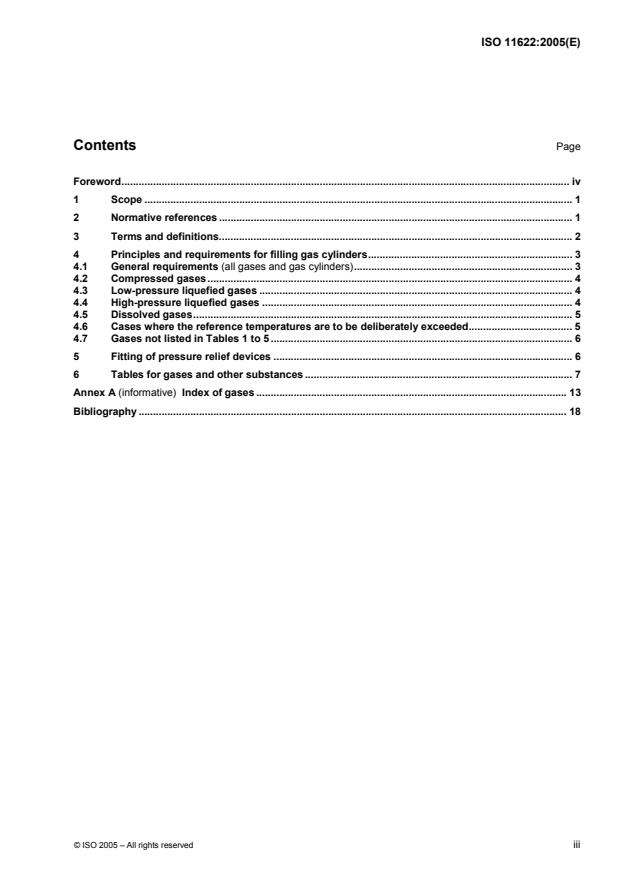
Contents Page
Foreword. iv
1 Scope. 1
2 Normative references. 1
3 Terms and definitions. 2
4 Principles and requirements for filling gas cylinders. 3
4.1 General requirements (all gases and gas cylinders). 3
4.2 Compressed gases. 4
4.3 Low-pressure liquefied gases . 4
4.4 High-pressure liquefied gases . 4
4.5 Dissolved gases. 5
4.6 Cases where the reference temperatures are to be deliberately exceeded. 5
4.7 Gases not listed in Tables 1 to 5 . 6
5 Fitting of pressure relief devices . 6
6 Tables for gases and other substances . 7
Annex A (informative) Index of gases . 13
Bibliography . 18
Foreword
ISO (the International Organization for Standardization) is a worldwide federation of national standards bodies
(ISO member bodies). The work of preparing International Standards is normally carried out through ISO
technical committees. Each member body interested in a subject for which a technical committee has been
established has the right to be represented on that committee. International organizations, governmental and
non-governmental, in liaison with ISO, also take part in the work. ISO collaborates closely with the
International Electrotechnical Commission (IEC) on all matters of electrotechnical standardization.
International Standards are drafted in accordance with the rules given in the ISO/IEC Directives, Part 2.
The main task of technical committees is to prepare International Standards. Draft International Standards
adopted by the technical committees are circulated to the member bodies for voting. Publication as an
International Standard requires approval by at least 75 % of the member bodies casting a vote.
Attention is drawn to the possibility that some of the elements of this document may be the subject of patent
rights. ISO shall not be held responsible for identifying any or all such patent rights.
ISO 11622 was prepared by Technical Committee ISO/TC 58, Gas cylinders, Subcommittee SC 4,
Operational requirements for gas cylinders.
iv © ISO 2005 – All rights reserved
INTERNATIONAL STANDARD ISO 11622:2005(E)
Gas cylinders — Conditions for filling gas cylinders
1 Scope
This International Standard specifies the general requirements (charging pressure, filling ratio, etc.) for filling
single gas cylinders and manifolded gas cylinders (bundles) with single component gases.
This International Standard excludes the specific requirements for filling cryogenic gas and liquefied petroleum
gas (LPG) commercial-grade cylinders.
2 Normative references
The following referenced documents are indispensable for the application of this document. For dated
references, only the edition cited applies. For undated references, the latest edition of the referenced
document (including any amendments) applies.
ISO 6406, Gas cylinders — Seamless steel gas cylinders — Periodic inspection and testing
ISO 10460, Gas cylinders — Welded carbon-steel gas cylinders — Periodic inspection and testing
ISO 10461, Gas cylinders — Seamless aluminium-alloy gas cylinders — Periodic inspection and testing
ISO 10462, Gas cylinders — Transportable cylinders for dissolved acetylene — Periodic inspection and
maintenance
ISO 10691, Gas cylinders — Refillable welded steel cylinders for liquified petroleum gas (LPG) — Procedures
for checking before, during and after filling
ISO 11755, Gas cylinders — Cylinder bundles for compressed and liquefied gases (excluding acetylene) —
Inspection at time of filling
ISO 24431, Gas cylinders — Cylinders for compressed and liquefied gases (excluding acetylene) —
1)
Inspection at time of filling
1) To be published.
3 Terms and definitions
For the purposes of this International Standard, the following terms and definitions apply.
3.1
gas
2)
any substance that is completely gaseous at 1,013 bar and 20 °C or has a vapour pressure exceeding 3 bar
at 50 °C
NOTE 1 Hydrogen fluoride and hydrogen cyanide are handled as low-pressure liquefied gases in this International
Standard and listed in Table 5 together with other liquids that may be used to fill gas cylinders.
NOTE 2 All pressures are given in bar gauge unless otherwise stated (1 bar = 105 N/m = 100 kPa).
3.2
single component gas
gas (3.1) that is technically pure in the gas cylinder
NOTE A single component gas dissolved under pressure falls within this category.
3.3
gas cylinder
transportable pressure receptacle of a water capacity not exceeding 150 l
3.4
bundle
assembly of cylinders that are fastened together and are interconnected by a manifold and transported as a
unit with a total water capacity not exceeding 3 000 l, except for bundles intended for the transport of
Division 2.3 (as defined in the United Nations Recommendations on the Transport of Dangerous Goods —
Model Regulations), which are limited to 1 000 l water capacity
3.5
compressed gas
gas which when packaged under pressure for transport is entirely gaseous at −50 °C
NOTE This category includes all gases with a critical temperature less than or equal to −50 °C.
3.6
high-pressure liquefied gas
gas which when packaged under pressure for transport is partially liquid at temperatures above −50 °C and
has a critical temperature between −50 °C and +65 °C
3.7
low-pressure liquefied gas
gas which when packaged under pressure for transport is partially liquid at temperatures above −50 °C and
has a critical temperature above +65 °C
3.8
dissolved gas
gas which when packaged under pressure for transport is dissolved in a liquid-phase solvent
3.9
critical temperature
temperature above which a substance cannot exist in the liquid state
5 5 2
2) 1 bar = 10 Pa = 100 kPa = 0,1 MPa = 10 N/m .
2 © ISO 2005 – All rights reserved
3.10
filling ratio
ratio of the mass of gas to the mass of water at 15 °C that would fill completely a pressure receptacle fitted
ready for use
NOTE Related terms are filling factor and filling degree, often expressed in kg/l or similar.
3.11
filling-ratio reference temperature
temperature at which the liquid density is to be evaluated for calculating the filling ratio
NOTE See 4.3 and 4.4.
3.12
developed pressure
pressure achieved by the contents of a gas cylinder filled according to this International Standard when raised
to a specified reference temperature
3.13
developed pressure at T
max
pressure developed by the gas contents in a cylinder at a uniform temperature of T
max
NOTE T is the expected maximum uniform temperature in normal service as specified in international or national
max
cylinder filling regulations.
3.14
settled pressure
pressure of the contents of the cylinder at 15 °C (p )
3.15
test pressure
required pressure applied during a pressure test
3.16
pressure relief device
device that is fitted to the cylinder or cylinder valve and designed to relieve gas pressure in the event of
abnormal conditions resulting in the development of excessive pressure inside the cylinder or when the
cylinder is subjected to high temperatures
3.17
compatibility
interaction of gas and cylinder/cylinder equipment that comes in contact with gas under the conditions of use,
implying a satisfactory gas/cylinder/cylinder equipment combination
3.18
tare weight
mass of the cylinder and other fittings not removed during the cylinder filling operation, such as valve, dip tube
and any permanently or semi permanently fixed valve protection device
4 Principles and requirements for filling gas cylinders
4.1 General requirements (all gases and gas cylinders)
4.1.1 The gas to be used for filling shall be compatible with the cylinder, the cylinder valve and any other
fittings that may be in contact with the gas (see ISO 11114-1 and ISO 11114-2).
4.1.2 When presented for filling, the cylinder shall be within the specified period for periodic inspection and
test in accordance with ISO 6406, ISO 10460, ISO 10461 and ISO 10462.
4.1.3 The cylinder and cylinder valve shall be in serviceable condition in accordance with ISO 10691,
ISO 11755 and ISO 24431.
4.1.4 The cylinder shall be equipped with a suitable valve with the appropriate valve outlet.
4.1.5 The cylinder shall be correctly identified for the intended gas.
4.1.6 Filling ratios specified in this International Standard are maximum values. Hence, the filling mass
charged into the cylinder shall take account of the accuracy of the filling procedure and weighing equipment.
4.1.7 The pressure relief device shall be suitably designed to a setting relative to the cylinder’s test
pressure. It shall operate between −10 % and +0 % of the cylinder test pressure.
4.1.8 If required before filling, the identity of the cylinder's owner shall be established, and his authorization
shall be obtained to fill the cylinder.
4.2 Compressed gases
The maximum settled pressure shall be the lower of the following values:
a) two-thirds of the test pressure;
b) a pressure that does not exceed the cylinder test pressure when the cylinder content is raised to the
reference temperature of 65 °C;
c) the pressure given in Table 1.
4.3 Low-pressure liquefied gases
The developed pressure at 65 °C shall not exceed the cylinder test pressure.
At a filling ratio reference temperature of 50 °C, there shall be a vapour space of at least 5 % of the total
cylinder water capacity, and the cylinder shall not be hydraulically full at any temperature up to 60 °C.
Data for low-pressure liquefied gases are given in Table 2. The tare weight of the cylinder shall be identified in
accordance with ISO 13769. For pure gases where the filling data are not provided in Table 2, the following
determination is required:
k = (0,0032 × T − 0,24) × ρ
l
f b
where
k is the maximum filling ratio
f
T is the boiling point (in Kelvin)
b
ρ is the density of liquid at boiling point (in kg/l)
l
4.4 High-pressure liquefied gases
4.4.1 The chosen filling ratio shall be such that the developed pressure at a reference temperature of 65 °C
does not exceed the corresponding cylinder test pressure.
4 © ISO 2005 – All rights reserved
4.4.2 Data for high-pressure liquefied gases are given in Table 3. For high-pressure liquefied gases where
filling data are not provided in Table 3, the maximum filling ratio shall be determined as follows:
−4
k = 8,5 × 10 × ρ × p
f g h
where
k is the maximum filling ratio
f
ρ is the gas density in g/l (at 15 °C and 1 bar)
g
p is the minimum test pressure (in bar)
h
If the density of the gas is unknown, the following formula can be used:
−3
pM×× 10
h
k =
f
R × 338
where
k is the maximum filling ratio
f
p is the minimum test pressure (in bar)
h
M is the molecular mass (in g/mol)
−2
R = 8,31451 × 10 bar · l/mol · K (gas constant)
NOTE For several gases from Table 3 (chlorotrifluoromethane, ethane, ethylene, hydrogen chloride, nitrous oxide,
phosphine, silane, sulfur hexafluoride and trifluoromethane) the minimum test pressure can be below the value shown in
Table 3, according to the filling ratio.
4.5 Dissolved gases
If cylinders are filled with gases dissolved under pressure, the minimum test pressure shall be 60 bar in the
case of acetylene for cylinders without pressure relief devices or 52 bar for cylinders with fusible plugs. In the
case of other dissolved gases, the test pressure shall correspond to that pressure resulting from a reference
temperature of 65 °C and prescribed concentration of the gas in the solvent.
4.6 Cases where the reference temperatures are to be deliberately exceeded
4.6.1 The maximum anticipated temperature shall be established. The choice of pressure relief device, if
used, shall ensure that the pressure of a full cylinder does not exceed the cylinder rated test pressure. The
suitability of the cylinder and valve materials shall be checked for operation at the maximum anticipated
temperature.
4.6.2 The filling ratios for high-pressure and low-pressure liquefied gases given in this International
Standard shall not be exceeded.
4.6.3 For compressed gases, a filling pressure shall be chosen to ensure the developed pressure at the
maximum anticipated temperature does not exceed the cylinder test pressure.
4.6.4 For liquefied gases where the critical temperature is equal to or greater than the maximum anticipated
temperature, the cylinder test pressure shall exceed the vapour pressure of the gas at the maximum
anticipated temperature. A filling ratio shall be chosen to ensure the cylinder is not hydraulically full at the
anticipated maximum temperature.
4.6.5 For liquefied gases where the critical temperature is less than the maximum anticipated temperature,
a filling ratio shall be chosen to ensure the cylinder test pressure is not exceeded at the maximum anticipated
temperature.
4.7 Gases not listed in Tables 1 to 5
4.7.1 The following data shall be sought or determined experimentally:
gas group (i.e. compressed, low-pressure liquefied, high-pressure liquefied or dissolved gas);
for compressed gases, the value of developed pressure at the reference temperature;
for low-pressure liquefied gases, the vapour pressure at 65 °C and liquid density at the filling ratio
reference temperature;
for high-pressure liquefied gases, the developed pressure at the reference temperature for the proposed
filling ratio(s);
flammability, oxipotential, toxicity and corrosivity data for labelling, cylinder colour coding and valve outlet
determination;
material compatibility data for selection of suitable cylinder and cylinder valve materials and determination
of periodic cylinder inspection and test requirements.
4.7.2 Appropriate calculations shall be made to determine safe filling conditions to comply with the
requirements of this International Standard.
4.7.3 A review of the gas service shall be undertaken by competent persons to establish
that the materials of construction of the cylinder and cylinder valve are compatible with the gas contents,
the colour coding and labelling requirements for gas cylinders,
the valve outlet to be used, and
the periodic inspection and test requirements of gas cylinders.
5 Fitting of pressure relief devices
The filling conditions defined in this International Standard are designed to give safe operation in normal use
without a pressure relief device; if fitted, the selection of pressure relief device is at the discretion of the gas
supplier/cylinder owner or in accordance with regulatory requirements.
Pressure relief devices shall not be fitted to cylinders intended for the conveyance of toxic gases (or mixtures)
with an LC < 200 ppm or pyrophoric gases.
Cylinders used for the conveyance of non-toxic or non-pyrophoric gases may be fitted with appropriate
pressure relief devices at the discretion of the gas supplier/cylinder owner or in accordance with regulatory
requirements. The pressure relief device shall be suitably designed to a setting relative to the cylinder’s test
pressure. It shall operate between −10 % and +0 % of the cylinder test pressure.
6 © ISO 2005 – All rights reserved
6 Tables for gases and other substances
Gases are listed in groups by description in Tables 1 to 5 as follows:
Table 1, Compressed gases
Table 2, Low-pressure liquefied gases
Table 3, High-pressure liquefied gases
Table 4, Gases dissolved under pressure
Table 5, Liquids that may be used to fill gas cylinders
NOTE Gases and other substances are in alphabetical order based on the English language.
The minimum test pressure in the tables is a function of the settled pressure p or the filling ratio, except for
fluorine, nitric oxide and oxygen difluoride, but shall be at least 10 bar.
Other filling factors may be used provided that the requirements of Clause 4 are met.
For high-pressure liquefied gases, the use of a test pressure other than those indicated is permitted, provided
that the filling ratio is such that the internal pressure does not exceed the test pressure of the cylinder at 65 °C.
Annex A provides translations for the gases.
Table 1 — Compressed gases
UN number Gas name Chemical Critical Minimum test Settled Pressure relief Remarks
formula temperature pressure pressure device
T p
cr 15
°C bar bar or kg/l
a
52 for cylinders
with porous
with fuse plugs
Acetylene See ISO 3807-1 mass
3374 C H
2 2
(solvent free) and ISO 3807-2 See ISO 3807-1
60 for cylinders
and ISO 3807-2
without fuse plugs
1006 Argon Ar −122,2 1,5 × p 300
Carbon
1016 CO −140,2 1,5 × p 200
monoxide
1957 Deuterium D −234,8 1,5 × p 300
2 15
Max. 5 kg per
1045 Fluorine F −129,0 200 30 forbidden
cylinder
1046 Helium He −267,9 1,5 × p 300
1049 Hydrogen H −239,9 1,5 × p 300
2 15
1056 Krypton Kr −63,8 1,5 × p 200
1971 Methane CH −82,6 1,5 × p 200
4 15
1065 Neon Ne −228,7 1,5 × p 300
1660 Nitric oxide NO −92,9 200 50 forbidden
1066 Nitrogen N −146,9 1,5 × p 300
2 15
1072 Oxygen O −118,3 1,5 × p
2 15
Oxygen
2190 OF −58,0 200 30 forbidden
difluoride
a
According to type approval.
Table 2 — Low pressure liquefied gases
UN Gas name Chemical Critical Minimum Filling ratios Pressure Remarks
number formula temperature test relief device
pressure
T
cr
°C bar
1005 Ammonia NH 132,4 33 0,53
Arsenic pentafluoride AsF
a
2188 Arsine AsH 99,9 42 1,10 forbidden
1741 Boron trichloride BCl 178,8 10 1,19 forbidden
2901 Bromine chloride BrCl 10 1,50
Bromochlorodifluoromethane
1974 CBrClF 153,7 10 1,61
(R 12 B 1)
Bromotrifluorethylene
2419 C BrF 184,8 10 1,19
2 3
(R 1131 B 1)
250 1,60
Bromotrifluoromethane
1009 CBrF 66,8 120 1,44
(R 13 B 1)
42 1,13
1010 Butadiene-1,2 CH :C:CHCH 176,1 10 0,59
2 3
1010 Butadiene-1,3 CH :CHCH:CH 152,0 10 0,55
2 2
1011 n-Butane C H 152,0 10 0,51
4 10
1012 Butylene-1 CH :CHC :H 146,4 10 0,53
2 2 5
1012 cis-Butylene-2 CH CH:CHCH 162,4 10 0,55
3 3
1012 trans-Butylene-2 CH CH:CHCH 155,5 10 0,54
3 3
2204 Carbonyl sulfide COS 102,0 26 0,84 forbidden
1017 Chlorine Cl 144,0 22 1,25
2548 Chlorine pentafluoride ClF 142,6 13 1,49 forbidden
1749 Chlorine trifluoride ClF 153,7 30 1,40 forbidden
1-Chloro-1,2-difluoroethane C H ClF
2 3 2
Chlorodifluoroethane
2517 CClF CH 137,1 10 0,99
2 3
(R 142b)
Chlorodifluoroethylene
C HClF 127,0
3 2
(R 1122)
Chlorodifluoromethane
1018 CHClF 96,2 29 1,03
(R 22)
Chloropentafluoroethane
1020 C ClF 80,0 25 1,08
2 5
(R 115)
Chlorotetrafluoroethane
1021 CHClFCF > 70 12 1,20
(R 124)
Chlorotrifluoroethane
1983 CH ClCF 150,0 10 1,18
2 3
(R 133a)
Chlorotrifluoroethylene
1082 C ClF 105,8 19 1,13
2 3
(R 1113)
1026 Cyanogen C N 126,6 100 0,70 forbidden
2 2
1589 Cyanogen chloride CClN 215,0 20 1,03 forbidden
2601 Cyclobutane C H 186,8 10 0,63
4 8
1027 Cyclopropane C H 125,2 20 0,53
3 6
Decafluorobutane C F 10 1,32
4 10
8 © ISO 2005 – All rights reserved
Table 2 (continued)
UN Gas name Chemical Critical Minimum Filling ratios Pressure Remarks
number formula temperature test relief device
pressure
T
cr
°C bar
Dichlorodifluoromethane
1028 CCl F 112,0 18 1,15
2 2
(R 12)
Dichlorofluoromethane
1029 CHClF 178,5 10 1,23
(R 21)
2189 Dichlorosilane SiH Cl 176,3 10 0,90 forbidden
2 2
Dichlorotetrafluoroethane
1958 C Cl F 145,7 10 1,30
2 2 4
(R 114)
1030 1,1-Difluoroethane (R 152a) CHF CH 113,5 18 0,79 forbidden
2 3
3252 Difluoromethane (R 32) CH F 78 48 0,78
2 2
1032 Dimethylamine C CN 164,6 10 0,59
2 7
Common
1033 Dimethylether C HO 126,9 18 0,58
name
2 6
Neopentene
2044 2,2-Dimethylpropane CH C(C
...
Questions, Comments and Discussion
Ask us and Technical Secretary will try to provide an answer. You can facilitate discussion about the standard in here.
Loading comments...