


ISO 4437-5:2014
(Main)Plastics piping systems for the supply of gaseous fuels - Polyethylene (PE) — Part 5: Fitness for purpose of the system
Plastics piping systems for the supply of gaseous fuels - Polyethylene (PE) — Part 5: Fitness for purpose of the system
ISO 4437-5:2014 specifies the requirements of fitness for purpose of the polyethylene (PE) piping system to be used for the supply of gaseous fuels. It specifies the definitions of electrofusion, socket fusion, butt fusion, and mechanical joints. It specifies the method of preparation of test piece joints and the tests to be carried out on these joints for assessing the fitness for purpose of the system under normal and extreme conditions. It specifies the test parameters for the test methods referred to in this part of ISO 4437. In conjunction with ISO 4437‑1, ISO 4437‑2, ISO 4437‑3, and ISO 4437‑4, it is applicable to PE pipes, fittings, valves, their joints, and joints with components of PE and other materials intended to be used under the following conditions: the maximum operating pressure (MOP) is based on the design stress, determined from the compound minimum required strength (MRS) divided by the C factor, and taking into account rapid crack propagation (RCP) requirements; and a temperature of 20 °C is taken as reference temperature for the design basis.
Systèmes de canalisations en matières plastiques pour la d istribution de combustibles gazeux — Polyéthylène (PE) — Partie 5: Aptitude à l'emploi du système
General Information
- Status
- Withdrawn
- Publication Date
- 12-Jan-2014
- Current Stage
- 9599 - Withdrawal of International Standard
- Start Date
- 14-Feb-2024
- Completion Date
- 12-Feb-2026
Relations
- Effective Date
- 09-Feb-2026
- Effective Date
- 09-Feb-2026
- Effective Date
- 23-Apr-2020
- Effective Date
- 29-Jan-2011
Get Certified
Connect with accredited certification bodies for this standard

ABS Quality Evaluations Inc.
American Bureau of Shipping quality certification.

Element Materials Technology
Materials testing and product certification.

Smithers Quality Assessments
US management systems and product certification.
Sponsored listings
Frequently Asked Questions
ISO 4437-5:2014 is a standard published by the International Organization for Standardization (ISO). Its full title is "Plastics piping systems for the supply of gaseous fuels - Polyethylene (PE) — Part 5: Fitness for purpose of the system". This standard covers: ISO 4437-5:2014 specifies the requirements of fitness for purpose of the polyethylene (PE) piping system to be used for the supply of gaseous fuels. It specifies the definitions of electrofusion, socket fusion, butt fusion, and mechanical joints. It specifies the method of preparation of test piece joints and the tests to be carried out on these joints for assessing the fitness for purpose of the system under normal and extreme conditions. It specifies the test parameters for the test methods referred to in this part of ISO 4437. In conjunction with ISO 4437‑1, ISO 4437‑2, ISO 4437‑3, and ISO 4437‑4, it is applicable to PE pipes, fittings, valves, their joints, and joints with components of PE and other materials intended to be used under the following conditions: the maximum operating pressure (MOP) is based on the design stress, determined from the compound minimum required strength (MRS) divided by the C factor, and taking into account rapid crack propagation (RCP) requirements; and a temperature of 20 °C is taken as reference temperature for the design basis.
ISO 4437-5:2014 specifies the requirements of fitness for purpose of the polyethylene (PE) piping system to be used for the supply of gaseous fuels. It specifies the definitions of electrofusion, socket fusion, butt fusion, and mechanical joints. It specifies the method of preparation of test piece joints and the tests to be carried out on these joints for assessing the fitness for purpose of the system under normal and extreme conditions. It specifies the test parameters for the test methods referred to in this part of ISO 4437. In conjunction with ISO 4437‑1, ISO 4437‑2, ISO 4437‑3, and ISO 4437‑4, it is applicable to PE pipes, fittings, valves, their joints, and joints with components of PE and other materials intended to be used under the following conditions: the maximum operating pressure (MOP) is based on the design stress, determined from the compound minimum required strength (MRS) divided by the C factor, and taking into account rapid crack propagation (RCP) requirements; and a temperature of 20 °C is taken as reference temperature for the design basis.
ISO 4437-5:2014 is classified under the following ICS (International Classification for Standards) categories: 75.200 - Petroleum products and natural gas handling equipment; 83.140.30 - Plastics pipes and fittings for non fluid use. The ICS classification helps identify the subject area and facilitates finding related standards.
ISO 4437-5:2014 has the following relationships with other standards: It is inter standard links to EN ISO 21225-1:2018, EN ISO 21225-2:2018, ISO 4437-5:2024, ISO 4437:2007. Understanding these relationships helps ensure you are using the most current and applicable version of the standard.
ISO 4437-5:2014 is available in PDF format for immediate download after purchase. The document can be added to your cart and obtained through the secure checkout process. Digital delivery ensures instant access to the complete standard document.
Standards Content (Sample)
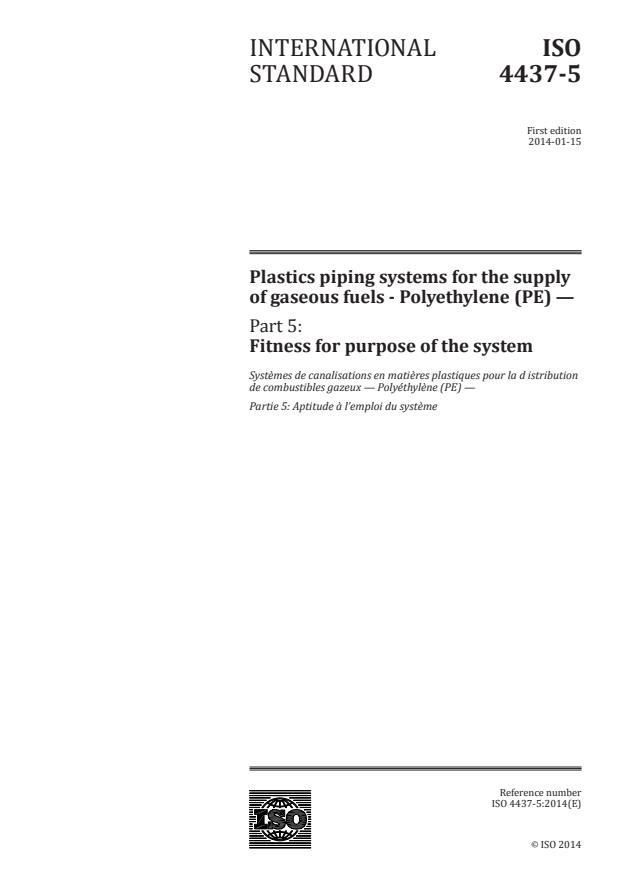
INTERNATIONAL ISO
STANDARD 4437-5
First edition
2014-01-15
Plastics piping systems for the supply
of gaseous fuels - Polyethylene (PE) —
Part 5:
Fitness for purpose of the system
Systèmes de canalisations en matières plastiques pour la d istribution
de combustibles gazeux — Polyéthylène (PE) —
Partie 5: Aptitude à l’emploi du système
Reference number
©
ISO 2014
© ISO 2014
All rights reserved. Unless otherwise specified, no part of this publication may be reproduced or utilized otherwise in any form
or by any means, electronic or mechanical, including photocopying, or posting on the internet or an intranet, without prior
written permission. Permission can be requested from either ISO at the address below or ISO’s member body in the country of
the requester.
ISO copyright office
Case postale 56 • CH-1211 Geneva 20
Tel. + 41 22 749 01 11
Fax + 41 22 749 09 47
E-mail copyright@iso.org
Web www.iso.org
Published in Switzerland
ii © ISO 2014 – All rights reserved
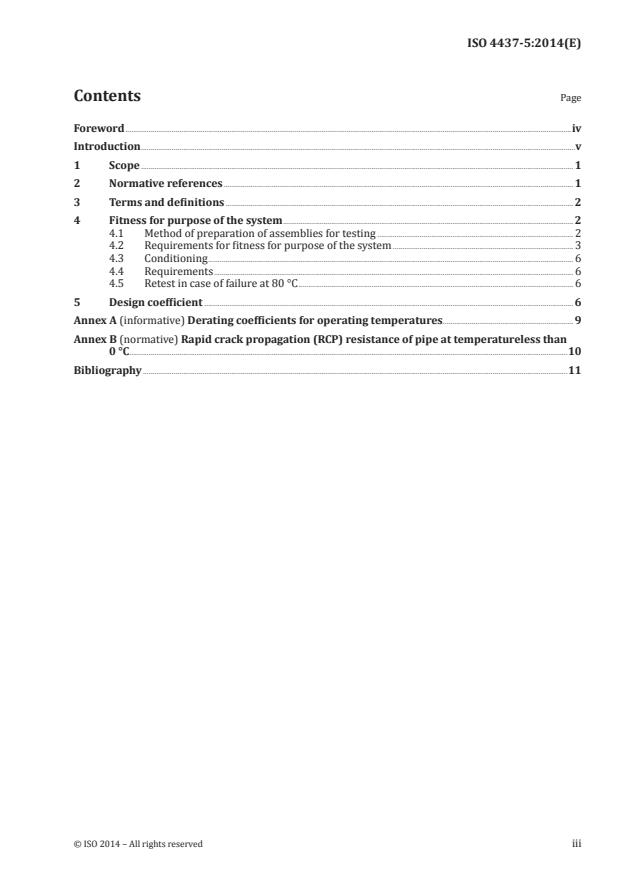
Contents Page
Foreword .iv
Introduction .v
1 Scope . 1
2 Normative references . 1
3 Terms and definitions . 2
4 Fitness for purpose of the system . 2
4.1 Method of preparation of assemblies for testing . 2
4.2 Requirements for fitness for purpose of the system . 3
4.3 Conditioning . 6
4.4 Requirements . 6
4.5 Retest in case of failure at 80 °C . 6
5 Design coefficient . 6
Annex A (informative) Derating coefficients for operating temperatures.9
Annex B (normative) Rapid crack propagation (RCP) resistance of pipe at temperatureless than
0 °C .10
Bibliography .11
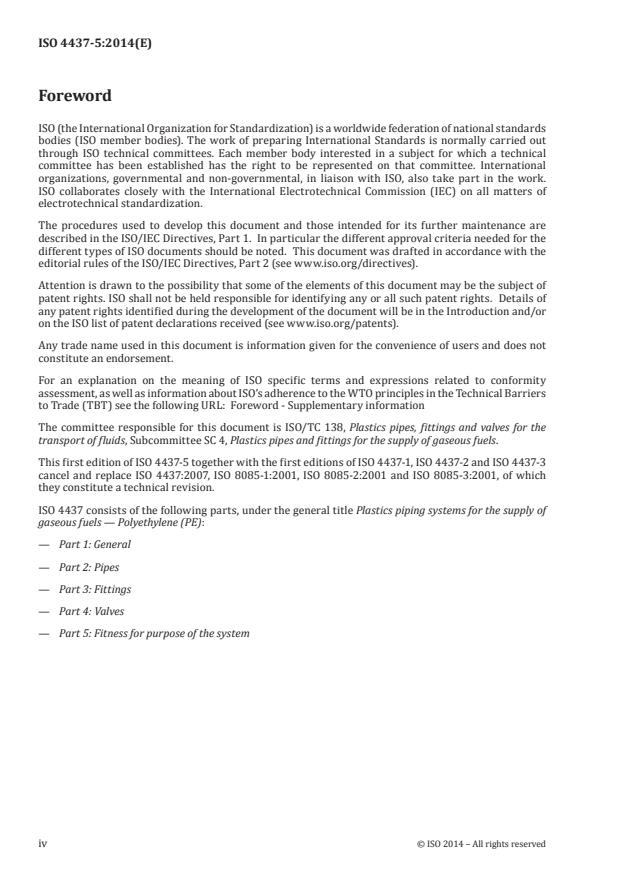
Foreword
ISO (the International Organization for Standardization) is a worldwide federation of national standards
bodies (ISO member bodies). The work of preparing International Standards is normally carried out
through ISO technical committees. Each member body interested in a subject for which a technical
committee has been established has the right to be represented on that committee. International
organizations, governmental and non-governmental, in liaison with ISO, also take part in the work.
ISO collaborates closely with the International Electrotechnical Commission (IEC) on all matters of
electrotechnical standardization.
The procedures used to develop this document and those intended for its further maintenance are
described in the ISO/IEC Directives, Part 1. In particular the different approval criteria needed for the
different types of ISO documents should be noted. This document was drafted in accordance with the
editorial rules of the ISO/IEC Directives, Part 2 (see www.iso.org/directives).
Attention is drawn to the possibility that some of the elements of this document may be the subject of
patent rights. ISO shall not be held responsible for identifying any or all such patent rights. Details of
any patent rights identified during the development of the document will be in the Introduction and/or
on the ISO list of patent declarations received (see www.iso.org/patents).
Any trade name used in this document is information given for the convenience of users and does not
constitute an endorsement.
For an explanation on the meaning of ISO specific terms and expressions related to conformity
assessment, as well as information about ISO’s adherence to the WTO principles in the Technical Barriers
to Trade (TBT) see the following URL: Foreword - Supplementary information
The committee responsible for this document is ISO/TC 138, Plastics pipes, fittings and valves for the
transport of fluids, Subcommittee SC 4, Plastics pipes and fittings for the supply of gaseous fuels.
This first edition of ISO 4437-5 together with the first editions of ISO 4437-1, ISO 4437-2 and ISO 4437-3
cancel and replace ISO 4437:2007, ISO 8085-1:2001, ISO 8085-2:2001 and ISO 8085-3:2001, of which
they constitute a technical revision.
ISO 4437 consists of the following parts, under the general title Plastics piping systems for the supply of
gaseous fuels — Polyethylene (PE):
— Part 1: General
— Part 2: Pipes
— Part 3: Fittings
— Part 4: Valves
— Part 5: Fitness for purpose of the system
iv © ISO 2014 – All rights reserved
Introduction
This part of ISO 4437 specifies the requirements of a piping system and its components made from
polyethylene (PE), and which is intended to be used for the supply of gaseous fuels.
Requirements and test methods for material and components are specified in ISO 4437-1, ISO 4437-2,
ISO 4437-3, and ISO 4437-4.
[2]
Recommended practice for installation is given in ISO/TS 10839.
This part of ISO 4437 covers the characteristics of fitness for purpose of the system.
INTERNATIONAL STANDARD ISO 4437-5:2014(E)
Plastics piping systems for the supply of gaseous fuels -
Polyethylene (PE) —
Part 5:
Fitness for purpose of the system
1 Scope
This part of ISO 4437 specifies the requirements of fitness for purpose of the polyethylene (PE) piping
system to be used for the supply of gaseous fuels.
It specifies the definitions of electrofusion, socket fusion, butt fusion, and mechanical joints.
It specifies the method of preparation of test piece joints and the tests to be carried out on these joints
for assessing the fitness for purpose of the system under normal and extreme conditions.
It specifies the test parameters for the test methods referred to in this part of ISO 4437.
In conjunction with ISO 4437-1, ISO 4437-2, ISO 4437-3, and ISO 4437-4, it is applicable to PE pipes,
fittings, valves, their joints, and joints with components of PE and other materials intended to be used
under the following conditions:
a) the maximum operating pressure (MOP) is based on the design stress, determined from the
compound minimum required strength (MRS) divided by the C factor, and taking into account rapid
crack propagation (RCP) requirements;
b) a temperature of 20 °C as reference temperature for the design basis.
NOTE 1 For other operating temperatures, derating coefficients are given in Annex A.
NOTE 2 It is the responsibility of the purchaser or specifier to make the appropriate selections from these
aspects, taking into account their particular requirements and any relevant national regulations and installation
practices or codes.
2 Normative references
The following documents, in whole or in part, are normatively referenced in this document and are
indispensable for its application. For dated references, only the edition cited applies. For undated
references, the latest edition of the referenced document (including any amendments) applies.
ISO 1167-1:2006, Thermoplastics pipes, fittings and assemblies for the conveyance of fluids — Determination
of the resistance to internal pressure — Part 1: General method
ISO 1167-2, Thermoplastics pipes, fittings and assemblies for the conveyance of fluids — Determination of
the resistance to internal pressure — Part 2: Preparation of pipe test pieces
ISO 1167-4, Thermoplastics pipes, fittings and assemblies for the conveyance of fluids — Determination of
the resistance to internal pressure — Part 4: Preparation of assemblies
ISO 4437-2, Plastics piping systems for the supply of gaseous fuels — Polyethylene (PE) — Part 2: Pipes
ISO 4437-3, Plastics piping systems for the supply of gaseous fuels — Polyethylene (PE) — Part 3: Fittings
1)
ISO 10838-1 , Mechanical fittings for polyethylene piping systems for the supply of gaseous fuels ― Part 1:
Metal fittings for pipes of nominal outside diameter less than or equal to 63 mm
1)
ISO 10838-2 , Mechanical fittings for polyethylene piping systems for the supply of gaseous fuels ― Part 2:
Metal fittings for pipes of nominal outside diameter greater than 63 mm
1)
ISO 10838-3 , Mechanical fittings for polyethylene piping systems for the supply of gaseous fuels ― Part 3:
Thermoplastics fittings for pipes of nominal outside diameter less than or equal to 63 mm
ISO 11413:2008, Plastics pipes and fittings — Preparation of test piece assemblies between a polyethylene
(PE) pipe and an electrofusion fitting
ISO 11414:2009, Plastics pipes and fittings — Preparation of polyethylene (PE) pipe/pipe or pipe/fitting test
piece assemblies by butt fusion
ISO 13477, Thermoplastics pipes for the conveyance of fluids — Determination of resistance to rapid crack
propagation (RCP) — Small-scale steady-state test (S4 test)
ISO 13478, Thermoplastics pipes for the conveyance of fluids — Determination of resistance to rapid crack
propagation (RCP) — Full-scale test (FST)
ISO 13953, Polyethylene (PE) pipes and fittings — Determination of the tensile strength and failure mode of
test pieces from a butt-fused joint
ISO 13954, Plastics pipes and fittings — Peel decohesion test for polyethylene (PE) electrofusion assemblies
of nominal outside diameter greater than or equal to 90 mm
ISO 13955, Plastics pipes and fittings — Crushing decohesion test for polyethylene (PE) electrofusion
assemblies
ISO 13956, Plastics pipes and fittings — Decohesion test of polyethylene (PE) saddle fusion joints —
Evaluation of ductility of fusion joint interface by tear test
ISO 21751, Plastics pipes and fittings — Decohesion test of electrofusion assemblies — Strip-bend test
3 Terms and definitions
For the purposes of this document, the terms and definitions given in ISO 4437-1 and the following apply.
3.1
mechanical joint
joint made by assembling a PE pipe with a fitting that generally includes a compression part to provide
for pressure integrity, leak tightness, and resistance to end loads
4 Fitness for purpose of the system
4.1 Method of preparation of assemblies for testing
4.1.1 General
The joints shall be made by using pipes conforming to ISO 4437-2 and fittings conforming to ISO 4437-3.
Test pieces for pressure testing shall be closed with pressure-tight, end-load-bearing end caps, plugs, or
flanges which shall be provided with connections for the entry of water and release of air.
The peelable layer of peelable-layer pipe shall be removed in the area of the joint prior to jointing.
Test assemblies should be prepared taking into consideration applicable national safety regulations.
1) These International Standards are under revision and will be replaced by ISO 17885.
2 © ISO 2014 – All rights reserved
4.1.2 Butt fusion joints
PE pipes, spigot end fittings, and valves intended to be used for jointing by butt fusion shall be prepared
and assembled in accordance with ISO 11414:2009. The conditions for the preparation of the joints are
given in 4.2.2.1 for the assessment of fitness for purpose of the system under normal conditions and in
4.2.2.2 for the assessment of fitness for purpose of the system under extreme conditions.
4.1.3 Electrofusion joints
PE pipes, fittings and valves intended to be used for jointing by electrofusion shall be prepared and
assembled in accordance with ISO 11413:2008. The conditions for the preparation of the joints are given
in 4.2.3.1 for the assessment of fitness for purpose of the system under normal conditions and in 4.2.3.2
for the assessment of fitness for purpose of the system under extreme conditions.
For joints with electrofusion saddle fittings, the electrofusion saddle fitting shall be fused to the pipe
while it is pneumatically pressurized to the allowable maximum operating pressure. The pipe shall be
cut immediately after the manufacturer prescribed cooling time has elapsed.
For straight equal electrofusion socket fittings (couplers), test joints on selected diameters out of the
product range shall be prepared with a gap of 0,05d between the pipe end and the maximum theoretical
n
depth of penetration of the fitting, where for diameters greater th
...
Questions, Comments and Discussion
Ask us and Technical Secretary will try to provide an answer. You can facilitate discussion about the standard in here.
Loading comments...