

ISO 4437-2:2024
(Main)Plastics piping systems for the supply of gaseous fuels — Polyethylene (PE) — Part 2: Pipes
General Information
- Abstract
This document specifies the characteristics of pipes made from polyethylene (PE) for piping systems in the field of the supply of gaseous fuels. It also specifies the test parameters for the test methods referred to in this document. In conjunction with ISO 4437-1, ISO 4437-3, ISO 4437-4 and ISO 4437-5, this document is applicable to PE pipes, fittings and valves, their joints, and joints with components of PE and other materials intended to be used under the following conditions: a) a maximum operating pressure (MOP), up to and including 10 bar[1], at a reference temperature of 20 °C for design purposes; b) an operating temperature between −20 °C and 40 °C. For operating temperatures between 20 °C and 40 °C, derating coefficients are defined in ISO 4437-5. The ISO 4437 series covers a range of MOPs and gives requirements concerning colours. This document is applicable to three types of pipes: — PE pipes (outside diameter, dn) including any identification stripes; — PE pipes with co-extruded layers on either or both the outside and/or inside of the pipe (total outside diameter, dn) as specified in Annex A, where all PE layers have the same MRS rating; — PE pipes (outside diameter, dn) with a peelable and contiguous thermoplastics additional layer on the outside of the pipe ("coated pipe") as specified in Annex B. It is the responsibility of the purchaser or specifier to make the appropriate selections from these aspects, taking into account their particular requirements and any relevant national regulations and installation practices or codes. [1] 1 bar = 0,1 MPa = 105 Pa; 1 MPa = 1 N/mm2.
- Status
- Published
- Publication Date
- 13-Feb-2024
- Drafting Committee
- ISO/TC 138/SC 4/WG 3 - PE Pipe Systems
- Current Stage
- 9092 - International Standard to be revised
- Start Date
- 19-Sep-2024
- Completion Date
- 29-Aug-2026
Overview
ISO 4437-2:2024 - Plastics piping systems for the supply of gaseous fuels - Polyethylene (PE) - Part 2: Pipes specifies the characteristics and test parameters for polyethylene (PE) pipes used in the distribution of gaseous fuels. The standard applies to PE pipes, including co‑extruded and coated types, intended for systems with a maximum operating pressure (MOP) up to and including 10 bar (reference temperature 20 °C) and operating temperatures between −20 °C and 40 °C. It is part of the ISO 4437 series and must be used together with the companion parts covering materials, fittings, valves and system fitness-for-purpose.
Key technical topics and requirements
- Scope and operating conditions
- MOP up to 10 bar at 20 °C; operating temperature range −20 °C to 40 °C. Derating coefficients for 20–40 °C are referenced in ISO 4437-5.
- Types of PE pipes covered
- Standard PE pipes (with identification stripes)
- Pipes with co‑extruded layers (Annex A) where all PE layers share the same MRS rating
- Coated pipes with a peelable thermoplastic external layer (Annex B)
- Material and performance
- Requirements for PE compounds, identification-stripe compounds and permissible recycled material
- Inclusion of PE 100-RC (resistance to slow crack growth) materials and updated test methods for these materials
- Geometrical and mechanical requirements
- Mean outside diameter, wall thickness minima and tolerances, out‑of‑roundness, ring stiffness, tensile properties
- Conditioning, mechanical and physical test parameters (e.g., long‑term pressure resistance, RCP and slow crack growth tests)
- Additional provisions
- Marking requirements, squeeze‑off technique (Annex C), and maximum nominal outside diameter extended up to 800 mm
- Purchaser/specifier responsibility
- Selection of pipe type, dimensions and material options must consider national regulations, installation practice and system requirements
Practical applications
- Design, manufacture, testing and procurement of PE gas distribution pipelines
- Low- and medium-pressure gas mains and service lines for natural gas, biomethane and other gaseous fuels
- Quality control and compliance verification for pipe suppliers and test laboratories
Who should use this standard
- Gas utility engineers and network designers
- Pipe manufacturers and compound formulators
- Installers, contractors and inspection bodies
- Regulatory authorities and procurement/specification teams
Related standards
- ISO 4437 series: ISO 4437-1, -3, -4, -5 (system materials, fittings, valves, fitness for purpose)
- Test and material standards referenced: ISO 1167, ISO 13477/13478/13479, ISO 11922-1, ISO 6259, ISO 18488/18489
This standard is essential for ensuring safe, durable and compliant PE piping systems for gaseous fuel distribution.
Relations
- Effective Date
- 09-Sep-2026
- Effective Date
- 25-Mar-2026
- Effective Date
- 21-Sep-2024
- Effective Date
- 23-Apr-2020
Get Certified
Connect with accredited certification bodies for this standard

DIN CERTCO
DIN Group product certification.

Element Materials Technology
Materials testing and product certification.
ABS Group Brazil
ABS Group certification services in Brazil.
Sponsored listings
Frequently Asked Questions
ISO 4437-2:2024 is a standard published by the International Organization for Standardization (ISO). Its full title is "Plastics piping systems for the supply of gaseous fuels — Polyethylene (PE) — Part 2: Pipes". This standard covers: This document specifies the characteristics of pipes made from polyethylene (PE) for piping systems in the field of the supply of gaseous fuels. It also specifies the test parameters for the test methods referred to in this document. In conjunction with ISO 4437-1, ISO 4437-3, ISO 4437-4 and ISO 4437-5, this document is applicable to PE pipes, fittings and valves, their joints, and joints with components of PE and other materials intended to be used under the following conditions: a) a maximum operating pressure (MOP), up to and including 10 bar[1], at a reference temperature of 20 °C for design purposes; b) an operating temperature between −20 °C and 40 °C. For operating temperatures between 20 °C and 40 °C, derating coefficients are defined in ISO 4437-5. The ISO 4437 series covers a range of MOPs and gives requirements concerning colours. This document is applicable to three types of pipes: — PE pipes (outside diameter, dn) including any identification stripes; — PE pipes with co-extruded layers on either or both the outside and/or inside of the pipe (total outside diameter, dn) as specified in Annex A, where all PE layers have the same MRS rating; — PE pipes (outside diameter, dn) with a peelable and contiguous thermoplastics additional layer on the outside of the pipe ("coated pipe") as specified in Annex B. It is the responsibility of the purchaser or specifier to make the appropriate selections from these aspects, taking into account their particular requirements and any relevant national regulations and installation practices or codes. [1] 1 bar = 0,1 MPa = 105 Pa; 1 MPa = 1 N/mm2.
This document specifies the characteristics of pipes made from polyethylene (PE) for piping systems in the field of the supply of gaseous fuels. It also specifies the test parameters for the test methods referred to in this document. In conjunction with ISO 4437-1, ISO 4437-3, ISO 4437-4 and ISO 4437-5, this document is applicable to PE pipes, fittings and valves, their joints, and joints with components of PE and other materials intended to be used under the following conditions: a) a maximum operating pressure (MOP), up to and including 10 bar[1], at a reference temperature of 20 °C for design purposes; b) an operating temperature between −20 °C and 40 °C. For operating temperatures between 20 °C and 40 °C, derating coefficients are defined in ISO 4437-5. The ISO 4437 series covers a range of MOPs and gives requirements concerning colours. This document is applicable to three types of pipes: — PE pipes (outside diameter, dn) including any identification stripes; — PE pipes with co-extruded layers on either or both the outside and/or inside of the pipe (total outside diameter, dn) as specified in Annex A, where all PE layers have the same MRS rating; — PE pipes (outside diameter, dn) with a peelable and contiguous thermoplastics additional layer on the outside of the pipe ("coated pipe") as specified in Annex B. It is the responsibility of the purchaser or specifier to make the appropriate selections from these aspects, taking into account their particular requirements and any relevant national regulations and installation practices or codes. [1] 1 bar = 0,1 MPa = 105 Pa; 1 MPa = 1 N/mm2.
ISO 4437-2:2024 is classified under the following ICS (International Classification for Standards) categories: 75.200 - Petroleum products and natural gas handling equipment; 83.140.30 - Plastics pipes and fittings for non fluid use. The ICS classification helps identify the subject area and facilitates finding related standards.
ISO 4437-2:2024 has the following relationships with other standards: It is inter standard links to EN ISO 11301-1:2026, CEN ISO/TS 23818-1:2026, ISO 4437-2, ISO 4437-2:2014. Understanding these relationships helps ensure you are using the most current and applicable version of the standard.
ISO 4437-2:2024 is available in PDF format for immediate download after purchase. The document can be added to your cart and obtained through the secure checkout process. Digital delivery ensures instant access to the complete standard document.
Standards Content (Sample)
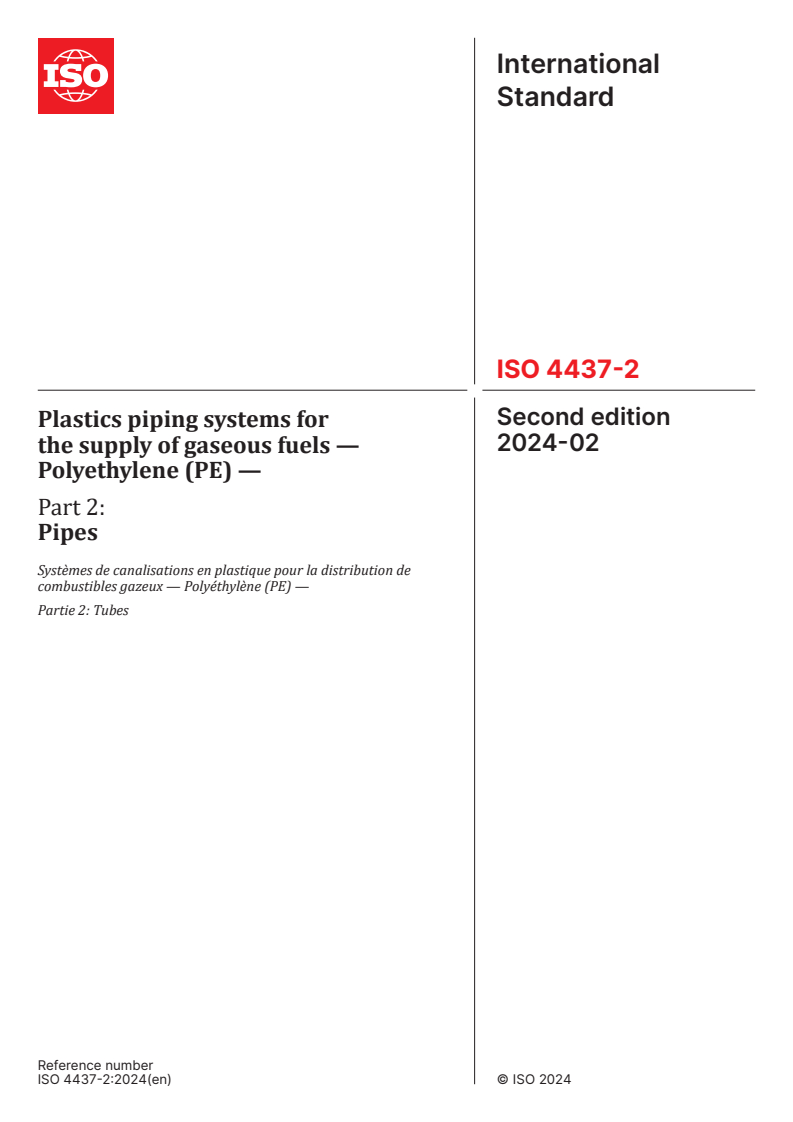
International
Standard
ISO 4437-2
Second edition
Plastics piping systems for
2024-02
the supply of gaseous fuels —
Polyethylene (PE) —
Part 2:
Pipes
Systèmes de canalisations en plastique pour la distribution de
combustibles gazeux — Polyéthylène (PE) —
Partie 2: Tubes
Reference number
© ISO 2024
All rights reserved. Unless otherwise specified, or required in the context of its implementation, no part of this publication may
be reproduced or utilized otherwise in any form or by any means, electronic or mechanical, including photocopying, or posting on
the internet or an intranet, without prior written permission. Permission can be requested from either ISO at the address below
or ISO’s member body in the country of the requester.
ISO copyright office
CP 401 • Ch. de Blandonnet 8
CH-1214 Vernier, Geneva
Phone: +41 22 749 01 11
Email: copyright@iso.org
Website: www.iso.org
Published in Switzerland
ii
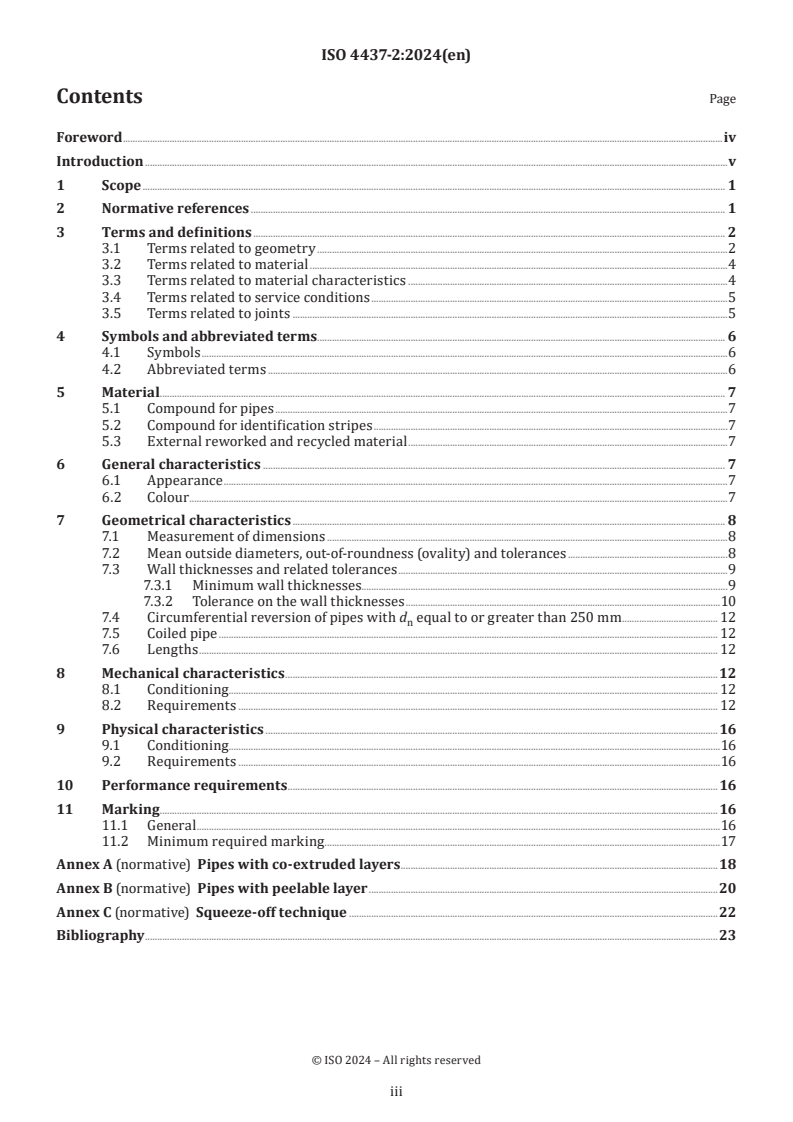
Contents Page
Foreword .iv
Introduction .v
1 Scope . 1
2 Normative references . 1
3 Terms and definitions . 2
3.1 Terms related to geometry .2
3.2 Terms related to material .4
3.3 Terms related to material characteristics .4
3.4 Terms related to service conditions .5
3.5 Terms related to joints .5
4 Symbols and abbreviated terms. 6
4.1 Symbols .6
4.2 Abbreviated terms .6
5 Material. 7
5.1 Compound for pipes .7
5.2 Compound for identification stripes .7
5.3 External reworked and recycled material .7
6 General characteristics . 7
6.1 Appearance .7
6.2 Colour .7
7 Geometrical characteristics . 8
7.1 Measurement of dimensions .8
7.2 Mean outside diameters, out-of-roundness (ovality) and tolerances .8
7.3 Wall thicknesses and related tolerances .9
7.3.1 Minimum wall thicknesses.9
7.3.2 Tolerance on the wall thicknesses .10
7.4 Circumferential reversion of pipes with d equal to or greater than 250 mm . 12
n
7.5 Coiled pipe . 12
7.6 Lengths . 12
8 Mechanical characteristics .12
8.1 Conditioning. 12
8.2 Requirements . 12
9 Physical characteristics .16
9.1 Conditioning.16
9.2 Requirements .16
10 Performance requirements . .16
11 Marking . .16
11.1 General .16
11.2 Minimum required marking .17
Annex A (normative) Pipes with co-extruded layers .18
Annex B (normative) Pipes with peelable layer .20
Annex C (normative) Squeeze-off technique .22
Bibliography .23
iii
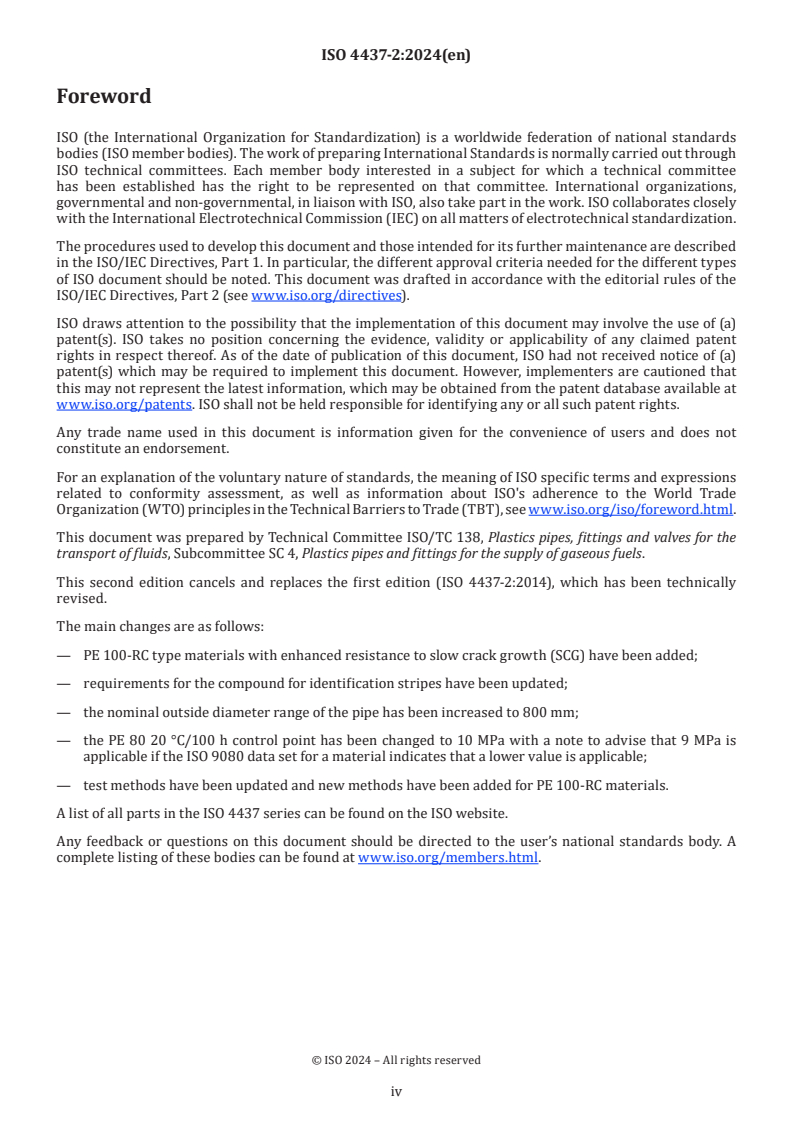
Foreword
ISO (the International Organization for Standardization) is a worldwide federation of national standards
bodies (ISO member bodies). The work of preparing International Standards is normally carried out through
ISO technical committees. Each member body interested in a subject for which a technical committee
has been established has the right to be represented on that committee. International organizations,
governmental and non-governmental, in liaison with ISO, also take part in the work. ISO collaborates closely
with the International Electrotechnical Commission (IEC) on all matters of electrotechnical standardization.
The procedures used to develop this document and those intended for its further maintenance are described
in the ISO/IEC Directives, Part 1. In particular, the different approval criteria needed for the different types
of ISO document should be noted. This document was drafted in accordance with the editorial rules of the
ISO/IEC Directives, Part 2 (see www.iso.org/directives).
ISO draws attention to the possibility that the implementation of this document may involve the use of (a)
patent(s). ISO takes no position concerning the evidence, validity or applicability of any claimed patent
rights in respect thereof. As of the date of publication of this document, ISO had not received notice of (a)
patent(s) which may be required to implement this document. However, implementers are cautioned that
this may not represent the latest information, which may be obtained from the patent database available at
www.iso.org/patents. ISO shall not be held responsible for identifying any or all such patent rights.
Any trade name used in this document is information given for the convenience of users and does not
constitute an endorsement.
For an explanation of the voluntary nature of standards, the meaning of ISO specific terms and expressions
related to conformity assessment, as well as information about ISO's adherence to the World Trade
Organization (WTO) principles in the Technical Barriers to Trade (TBT), see www.iso.org/iso/foreword.html.
This document was prepared by Technical Committee ISO/TC 138, Plastics pipes, fittings and valves for the
transport of fluids, Subcommittee SC 4, Plastics pipes and fittings for the supply of gaseous fuels.
This second edition cancels and replaces the first edition (ISO 4437-2:2014), which has been technically
revised.
The main changes are as follows:
— PE 100-RC type materials with enhanced resistance to slow crack growth (SCG) have been added;
— requirements for the compound for identification stripes have been updated;
— the nominal outside diameter range of the pipe has been increased to 800 mm;
— the PE 80 20 °C/100 h control point has been changed to 10 MPa with a note to advise that 9 MPa is
applicable if the ISO 9080 data set for a material indicates that a lower value is applicable;
— test methods have been updated and new methods have been added for PE 100-RC materials.
A list of all parts in the ISO 4437 series can be found on the ISO website.
Any feedback or questions on this document should be directed to the user’s national standards body. A
complete listing of these bodies can be found at www.iso.org/members.html.
iv
Introduction
The ISO 4437 series specifies the requirements for a piping system and its components made from
polyethylene (PE) compounds, which is intended to be used for the supply of gaseous fuels.
This document covers the characteristics of pipes.
Requirements and test methods for materials and components, other than pipes, are specified in ISO 4437-1,
ISO 4437-3 and ISO 4437-4.
Characteristics for fitness for purpose of the system are covered in ISO 4437-5.
Recommended practice for design, handling and installation is given in ISO/TS 10839.
v
International Standard ISO 4437-2:2024(en)
Plastics piping systems for the supply of gaseous fuels —
Polyethylene (PE) —
Part 2:
Pipes
1 Scope
This document specifies the characteristics of pipes made from polyethylene (PE) for piping systems in the
field of the supply of gaseous fuels.
It also specifies the test parameters for the test methods referred to in this document.
In conjunction with ISO 4437-1, ISO 4437-3, ISO 4437-4 and ISO 4437-5, this document is applicable to PE
pipes, fittings and valves, their joints, and joints with components of PE and other materials intended to be
used under the following conditions:
1)
a) a maximum operating pressure (MOP), up to and including 10 bar , at a reference temperature of 20 °C
for design purposes;
b) an operating temperature between −20 °C and 40 °C.
For operating temperatures between 20 °C and 40 °C, derating coefficients are defined in ISO 4437-5.
The ISO 4437 series covers a range of MOPs and gives requirements concerning colours.
This document is applicable to three types of pipes:
— PE pipes (outside diameter, d ) including any identification stripes;
n
— PE pipes with co-extruded layers on either or both the outside and/or inside of the pipe (total outside
diameter, d ) as specified in Annex A, where all PE layers have the same MRS rating;
n
— PE pipes (outside diameter, d ) with a peelable and contiguous thermoplastics additional layer on the
n
outside of the pipe ("coated pipe") as specified in Annex B.
It is the responsibility of the purchaser or specifier to make the appropriate selections from these aspects,
taking into account their particular requirements and any relevant national regulations and installation
practices or codes.
2 Normative references
The following documents are referred to in the text in such a way that some or all of their content constitutes
requirements of this document. For dated references, only the edition cited applies. For undated references,
the latest edition of the referenced document (including any amendments) applies.
ISO 1133-1, Plastics — Determination of the melt mass-flow rate (MFR) and melt volume-flow rate (MVR) of
thermoplastics — Part 1: Standard method
ISO 1167-1:2006, Thermoplastics pipes, fittings and assemblies for the conveyance of fluids — Determination of
the resistance to internal pressure — Part 1: General method
5 2
1) 1 bar = 0,1 MPa = 10 Pa; 1 MPa = 1 N/mm .
ISO 1167-2, Thermoplastics pipes, fittings and assemblies for the conveyance of fluids — Determination of the
resistance to internal pressure — Part 2: Preparation of pipe test pieces
ISO 2505, Thermoplastics pipes — Longitudinal reversion — Test method and parameters
ISO 3126, Plastics piping systems — Plastics components — Determination of dimensions
ISO 4437-1, Plastics piping systems for the supply of gaseous fuels — Polyethylene (PE) — Part 1: General
ISO 4437-5, Plastics piping systems for the supply of gaseous fuels — Polyethylene (PE) — Part 5: Fitness for
purpose of the system
ISO 6259-1, Thermoplastics pipes — Determination of tensile properties — Part 1: General test method
ISO 6259-3, Thermoplastics pipes — Determination of tensile properties — Part 3: Polyolefin pipes
ISO 9969, Thermoplastics pipes — Determination of ring stiffness
ISO 11922-1:2018, Thermoplastics pipes for the conveyance of fluids — Dimensions and tolerances — Part 1:
Metric series
ISO 11357-6, Plastics — Differential scanning calorimetry (DSC) — Part 6: Determination of oxidation induction
time (isothermal OIT) and oxidation induction temperature (dynamic OIT)
ISO 13477, Thermoplastics pipes for the conveyance of fluids — Determination of resistance to rapid crack
propagation (RCP) — Small-scale steady-state test (S4 test)
ISO 13478, Thermoplastics pipes for the conveyance of fluids — Determination of resistance to rapid crack
propagation (RCP) — Full-scale test (FST)
ISO 13479, Polyolefin pipes for the conveyance of fluids — Determination of resistance to crack propagation —
Test method for slow crack growth on notched pipes
ISO 13968, Plastics piping and ducting systems — Thermoplastics pipes — Determination of ring flexibility
ISO 18488, Polyethylene (PE) materials for piping systems — Determination of Strain Hardening Modulus in
relation to slow crack growth — Test method
ISO 18489, Polyethylene (PE) materials for piping systems — Determination of resistance to slow crack growth
under cyclic loading — Cracked Round Bar test method
3 Terms and definitions
For the purposes of this document, the following terms and definitions apply.
ISO and IEC maintain terminology databases for use in standardization at the following addresses:
— ISO Online browsing platform: available at https:// www .iso .org/ obp
— IEC Electropedia: available at https:// www .electropedia .org/
3.1 Terms related to geometry
3.1.1
nominal size
DN/OD
numerical designation of the size of a component related to the outside diameter
Note 1 to entry: It is a convenient round number approximately equal to the manufacturing dimension in millimetres
(mm). It is not applicable to components designated by thread size.
3.1.2
nominal outside diameter
d
n
specified outside diameter assigned to a nominal size (3.1.1)
Note 1 to entry: Nominal outside diameter is expressed in millimetres (mm).
3.1.3
mean outside diameter
d
em
value of the measurement of the outer circumference of the pipe or spigot end of a fitting in any cross-section
divided by π (= 3,142), rounded to the next greater 0,1 mm
3.1.4
minimum mean outside diameter
d
em,min
minimum value for the mean outside diameter (3.1.3) as specified for a given nominal size (3.1.1)
3.1.5
maximum mean outside diameter
d
em,max
maximum value for the mean outside diameter (3.1.3) as specified for a given nominal size (3.1.1)
3.1.6
out-of-roundness
ovality
difference between the maximum and the minimum outside diameters in the same cross-section of a pipe or
spigot
3.1.7
nominal wall thickness
e
n
numerical designation of the wall thickness of a component, which is a convenient round number,
approximately equal to the manufacturing dimension in millimetres (mm)
Note 1 to entry: For thermoplastics components conforming to the ISO 4437 series, the value of the nominal wall
thickness, e , is identical to the specified minimum wall thickness at any point (3.1.9).
n
3.1.8
wall thickness at any point
e
wall thickness at any point around the circumference of a component rounded to the next greater 0,1 mm
Note 1 to entry: The symbol for the wall thickness of a fitting and valve body at any point is E.
3.1.9
minimum wall thickness at any point
e
min
minimum value for the wall thickness at any point (3.1.8) around the circumference of a component
3.1.10
tolerance
permitted variation of the specified value of a quantity, expressed as the difference between the permitted
maximum and the permitted minimum value
3.1.11
wall thickness tolerance
T
y
permitted difference between the wall thickness at any point (3.1.8) and the nominal wall thickness (3.1.7)
Note 1 to entry: e ≤ e ≤ e + T .
n n y
3.1.12
standard dimension ratio
SDR
numerical designation of a pipe series (3.1.13), which is a convenient round number, approximately equal to
the dimension ratio of the nominal outside diameter (3.1.2) and the nominal wall thickness (3.1.7)
3.1.13
pipe series
S
number for pipe designation
Note 1 to entry: The relationship between the pipe series, S, and the standard dimension ratio (SDR) (3.1.12) is given by
the following formula, as specified in ISO 4065.
SDR−1
S =
3.2 Terms related to material
3.2.1
compound
homogenous extruded mixture of base polymer (3.2.4) (polyethylene) and additives (i.e. anti-oxidants,
pigments, carbon black, UV-stabilizers and others) at a dosage level necessary for the processing and use of
components
3.2.2
virgin material
compound (3.2.1) in a form such as granules that has not been subjected to use or processing other than that
required for its manufacture and to which no reworked or recyclable materials have been added
3.2.3
reworked material
plastics material from rejected unused products or trimmings capable of being reclaimed that have been
manufactured and retained within plants owned and operated by the same legal entity
3.2.4
base polymer
polymer produced by the material supplier for the manufacture of the compound (3.2.1)
3.3 Terms related to material characteristics
3.3.1
lower confidence limit of the predicted hydrostatic strength
σ
LPL
quantity, with the dimensions of stress, which represents the 97,5 % lower confidence limit of the predicted
hydrostatic strength at temperature θ and time t
Note 1 to entry: It is expressed in megapascals (MPa).
3.3.2
minimum required strength
MRS
value of the lower confidence limit of the predicted hydrostatic strength (3.3.1) at 20 °C and 50 years, rounded
down to the next smaller value of the R10 series or R20 series
Note 1 to entry: Only compounds (3.2.1) with an MRS of 8 MPa or 10 MPa are specified in this document.
Note 2 to entry: The R10 series and the R20 series conform to ISO 3.
Note 3 to entry: It is expressed in megapascals (MPa).
[SOURCE: ISO 12162:2009, 3.3, modified — Note 1 to entry has been removed and replaced with new Notes
1 to 3 to entry.]
3.3.3
design coefficient
C
coefficient with a value greater than 1 which takes into consideration service conditions as well as properties
of the components of a piping system other than those represented in the lower confidence limit
3.3.4
melt mass-flow rate
MFR
value relating to the viscosity of the molten material at a specified temperature and load
Note 1 to entry: It is expressed in grams per 10 minutes (g/10 min).
3.4 Terms related to service conditions
3.4.1
gaseous fuel
fuel which is in gaseous state at a temperature of 15 °C at atmospheric pressure
Note 1 to entry: There are proposals to inject gases from renewable sources in natural gas networks, e.g. hydrogen
(H ). This is the subject of ongoing research.
3.4.2
maximum operating pressure
MOP
maximum effective pressure of the fluid in the piping system which is allowed in continuous use
Note 1 to entry: It is expressed in bar. It takes into account the physical and the mechanical characteristics of the
components of a piping system. It is calculated using the following formula:
20×MRS
MOP =
C ×()SDR − 1
Note 2 to entry: Research on long-term performance prediction of polyethylene gas distribution systems shows a
possible service life of at least 100 years; see References [14], [15] and [16].
3.4.3
reference temperature
temperature for which the piping system is designed
Note 1 to entry: It is used as the base for further calculation when designing a piping system or parts of a piping
system for operating temperatures different from the reference temperature (see ISO 4437-5).
3.5 Terms related to joints
3.5.1
fusion compatibility
ability of two similar or dissimilar polyethylene compounds (3.2.1) to be fused together to form a joint
3.5.2
squeeze-off
restriction of the gas flow to an acceptable rate through mechanical compression of the pipe
Note 1 to entry: See Annex C.
4 Symbols and abbreviated terms
4.1 Symbols
For the purposes of this document, the following symbols apply.
C design coefficient
d mean outside diameter
em
d maximum mean outside diameter
em,max
d minimum mean outside diameter
em,min
d nominal outside diameter
n
e wall thickness (at any point) around the circumference of a component
e minimum wall thickness (at any point)
min
e nominal wall thickness
n
strain hardening modulus
p
p critical pressure
c
p critical pressure obtained in full-scale test
c,full-scale
p critical pressure obtained in S4-test
c,s4
S pipe series
T wall thickness tolerance
y
t time
θ temperature
σ lower confidence limit of the predicted hydrostatic strength
LPL
4.2 Abbreviated terms
For the purposes of this document, the following abbreviated terms apply.
ANPT accelerated notched pipe test
CRB cracked round bar (test)
DN/OD nominal size, outside diameter-related
LPL lower predicted limit
MFR melt mass-flow rate
MOP maximum operating pressure
MRS minimum required strength
NPT notched pipe test
PE polyethylene
RC raised crack resistance
RCP rapid crack propagation
SCG slow crack growth
SDR standard dimension ratio
SHT strain hardening test
5 Material
5.1 Compound for pipes
The PE compound from which the pipes are made shall conform to ISO 4437-1.
The pipes shall be made from virgin material or reworked material from the same PE compound from the
manufacturer’s own plant, or a mixture of both. Reworked material from the base pipe of peelable layer pipe
(coated pipe) and reworked material from pipes with identification stripes may be used.
For co-extruded layers, see Annex A. A coextruded pipe made of a combination of PE 100 and PE 100-RC
layers shall be regarded as PE 100 and marked accordingly.
Reworked material from co-extruded pipes or from pipes reworked with the peelable layer attached shall
not be used.
5.2 Compound for identification stripes
The stripe compound (see 6.2) shall be manufactured from a PE base polymer in accordance with ISO 4437-1,
which is used for a pipe compound for which fusion compatibility has been proven.
The compound used for identification stripes in the form of a pipe shall conform to the decohesion test
requirement of resistance to weathering as described in ISO 4437-1:2024, Table 2.
The OIT of the stripe compound shall be ≥ 10 min at 210 °C, measured by the compound supplier in
b
accordance with ISO 11357-6 (table footnote of Table 6 applies).
5.3 External reworked and recycled material
Reworked material obtained from external sources and recycled material shall not be used.
6 General characteristics
6.1 Appearance
When viewed without magnification, the internal and external surfaces of pipes shall be smooth and clean
and shall have no scoring, cavities and other surface defects to an extent that would prevent conformity to
this document.
The ends of the pipe shall be cut cleanly and square to the axis of the pipe.
6.2 Colour
Pipes shall be black (PE 80, PE 100 and PE 100-RC), yellow (PE 80) or orange (PE 100 and PE 100-RC). In
addition, black PE 80 pipes may be identified by yellow stripes and black PE 100 and PE 100-RC pipes may be
identified by yellow or orange stripes, according to national preference.
The outer co-extruded layer of co-extruded pipes (see Annex A) or the outer peelable layer of peelable-layer
pipes (see Annex B) shall be either black, yellow or orange. In addition, identification stripes may be used
according to national preference.
7 Geometrical characteristics
7.1 Measurement of dimensions
The dimensions of the pipe shall be measured in accordance with ISO 3126 and rounded to the next 0,1 mm.
In case of dispute, the measurement shall be made at least 24 h after manufacture and after being conditioned
for at least 4 h at (23 ± 2) °C.
Indirect measurement at the stage of production is allowed at shorter time periods, provided that evidence
is shown of correlation.
7.2 Mean outside diameters, out-of-roundness (ovality) and tolerances
The mean outside diameters of the pipe, d , shall conform to Table 1.
em
For straight pipes, the maximum out-of-roundness shall conform to Table 1. For coiled pipes, the maximum
out-of-roundness shall be specified by agreement between the manufacturer and the end user.
Care should be taken that packaging and storage does not lead to an increased out-of-roundness and
flattening of the pipe. Additional information is given in ISO/TS 10839.
Table 1 — Mean outside diameters and out-of-roundness
Dimensions in millimetres
Nominal outside Mean outside diameter Maximum out-
Nominal size
diameter of-roundness for
a
d d
DN/OD
em,min em,max
b
d straight pipes
n
16 16 16,0 16,3 1,2
20 20 20,0 20,3 1,2
25 25 25,0 25,3 1,2
32 32 32,0 32,3 1,3
40 40 40,0 40,4 1,4
50 50 50,0 50,4 1,4
63 63 63,0 63,4 1,5
75 75 75,0 75,5 1,6
90 90 90,0 90,6 1,8
110 110 110,0 110,7 2,2
125 125 125,0 125,8 2,5
140 140 140,0 140,9 2,8
160 160 160,0 161,0 3,2
180 180 180,0 181,1 3,6
200 200 200,0 201,2 4,0
225 225 225,0 226,4 4,5
250 250 250,0 251,5 5,0
280 280 280,0 281,7 9,8
315 315 315,0 316,9 11,1
a
In accordance with ISO 11922-1:2018, except for d 50. Grade B for sizes ≤ 630, except for d 40 and grade A for sizes ≥ 710
n n
and fo
...