

ISO 5840-2:2021
(Main)Cardiovascular implants — Cardiac valve prostheses — Part 2: Surgically implanted heart valve substitutes
General Information
- Abstract
This document is applicable to heart valve substitutes intended for implantation in human hearts, generally requiring cardiopulmonary bypass and generally with direct visualization. See Annex E for examples of surgical heart valve substitutes and their components. This document is applicable to both newly developed and modified surgical heart valve substitutes and to the accessory devices, packaging, and labelling required for their implantation and for determining the appropriate size of the surgical heart valve substitute to be implanted. This document establishes an approach for verifying/validating the design and manufacture of a surgical heart valve substitute through risk management. The selection of appropriate qualification tests and methods are derived from the risk assessment. The tests can include those to assess the physical, chemical, biological, and mechanical properties of surgical heart valve substitutes and of their materials and components. The tests can also include those for pre-clinical in vivo evaluation and clinical evaluation of the finished surgical heart valve substitute. This document defines operational conditions and performance requirements for surgical heart valve substitutes where adequate scientific and/or clinical evidence exists for their justification. For some heart valve substitutes (e.g. sutureless), the requirements of both this document and ISO 5840-3:2021 can be relevant and are considered as applicable to the specific device design and are based on the results of the risk analysis.
- Status
- Published
- Publication Date
- 20-Jan-2021
- Technical Committee
- ISO/TC 150/SC 2 - Cardiovascular implants and extracorporeal systems
- Drafting Committee
- ISO/TC 150/SC 2/WG 1 - Cardiac valves
- Current Stage
- 9060 - Close of review
- Completion Date
- 02-Sep-2031
Buy Documents



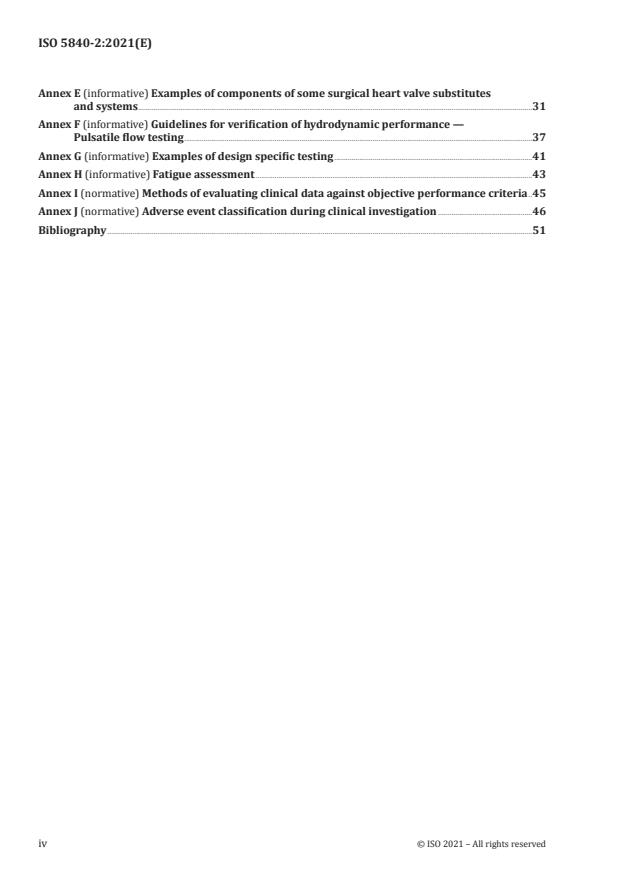
ISO 5840-2:2021 - Cardiovascular implants -- Cardiac valve prostheses

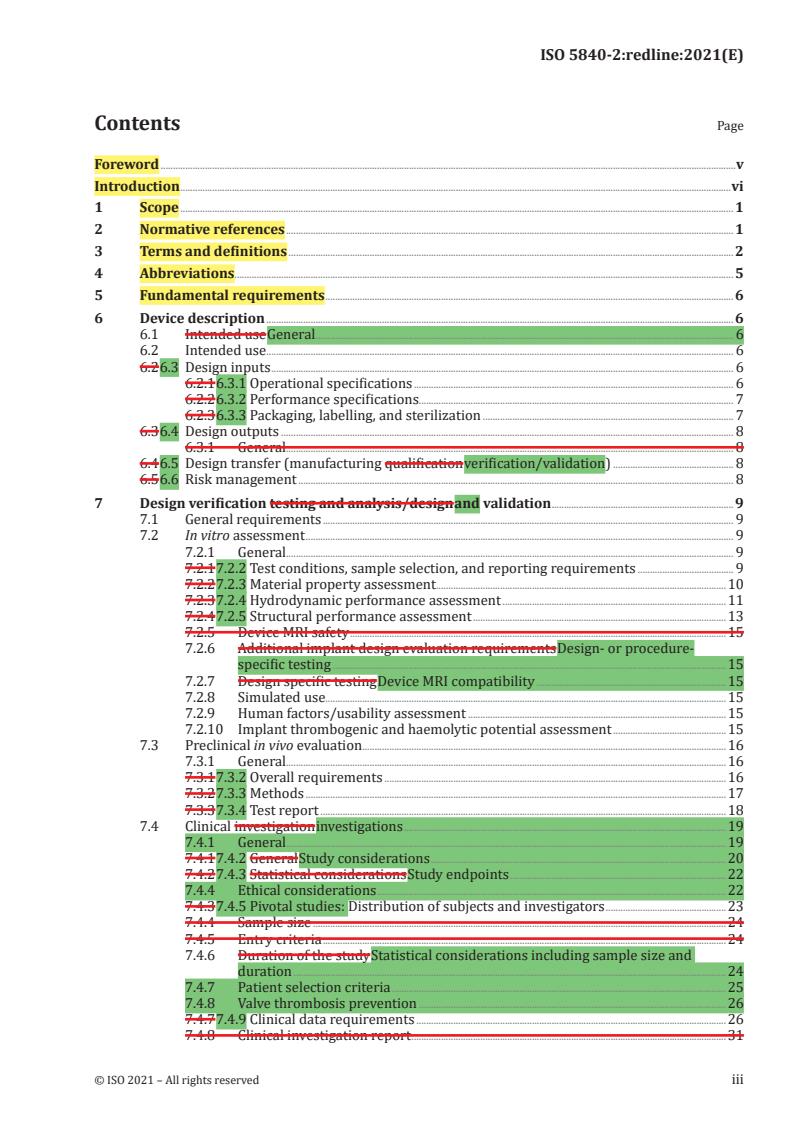
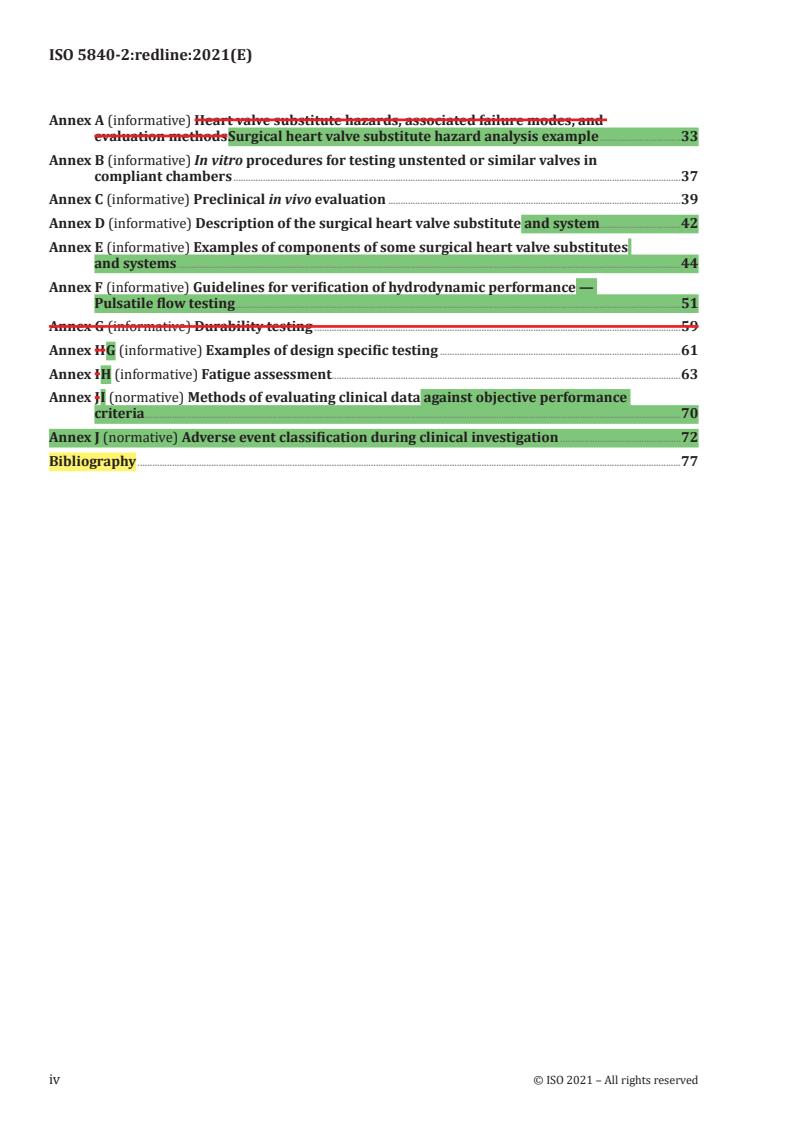
ISO 5840-2:2021REDLINE - Cardiovascular implants -- Cardiac valve prostheses

ISO 5840-2:2021 - Cardiovascular implants — Cardiac valve prostheses — Part 2: Surgically implanted heart valve substitutes/21/2021
REDLINE ISO 5840-2:2021 - Cardiovascular implants — Cardiac valve prostheses — Part 2: Surgically implanted heart valve substitutes/21/2021



ISO 5840-2:2021 - Implants cardiovasculaires -- Prothèses valvulaires


ISO 5840-2:2021REDLINE - Implants cardiovasculaires -- Protheses valvulaires

ISO 5840-2:2021 - Implants cardiovasculaires — Prothèses valvulaires — Partie 2: Prothèses valvulaires implantées chirurgicalement/21/2021
REDLINE ISO 5840-2:2021 - Implants cardiovasculaires — Prothèses valvulaires — Partie 2: Prothèses valvulaires implantées chirurgicalement/21/2021
Overview
ISO 5840-2:2021 - "Cardiovascular implants - Cardiac valve prostheses - Part 2: Surgically implanted heart valve substitutes" is an international standard that sets requirements and guidance for the design verification, testing, preclinical and clinical evaluation, packaging, and labelling of surgically implanted heart valve substitutes. It applies to devices implanted during open surgery (generally requiring cardiopulmonary bypass and direct visualization), including newly developed and modified surgical valve substitutes and their accessory devices.
This part of the ISO 5840 series establishes a risk‑based approach to verify and validate device design and manufacture, and defines operational conditions and performance requirements where scientific or clinical evidence exists.
Key topics and requirements
- Scope and intended use: Applicability to surgical heart valve substitutes, associated accessories, packaging and sizing methods.
- Risk management: Device qualification and selection of appropriate tests based on risk assessment.
- Design inputs/outputs and transfer: Requirements for specifying operational and performance specifications and for manufacturing qualification.
- Design verification and validation: Emphasis on in vitro testing, preclinical in vivo evaluation, and clinical investigations tied to the risk profile.
- In vitro assessments (examples described):
- Material property assessment
- Hydrodynamic performance (pulsatile flow testing guidance in Annex F)
- Structural performance and fatigue/durability testing (Annex G and I)
- MRI safety and device compatibility
- Thrombogenic and haemolytic potential, simulated use, and human factors/usability
- Preclinical and clinical evaluation: Guidance on study design, statistical considerations, endpoints, reporting, and adverse event classification (Annexes C and J).
- Documentation and labelling: Requirements for packaging, sterilization, labelling and clinical reporting.
Applications and who uses this standard
ISO 5840-2:2021 is used by:
- Medical device manufacturers designing and modifying surgically implanted heart valves and delivery/accessory systems.
- Regulatory and quality affairs teams preparing technical files, regulatory submissions, and conformity assessments.
- Test laboratories and contract research organizations (CROs) conducting in vitro, durability, and preclinical testing.
- Clinical investigators and cardiac device clinicians planning clinical investigations and interpreting device performance criteria.
- Design engineers and risk managers applying risk-based test selection and design verification.
Related standards
- ISO 5840-1 - General requirements for cardiac valve prostheses.
- ISO 5840-3:2021 - Requirements for transcatheter heart valve substitutes (may be relevant for some designs, e.g., sutureless valves).
Keywords: ISO 5840-2:2021, surgically implanted heart valve substitutes, cardiac valve prostheses, cardiovascular implants, hydrodynamic performance, durability testing, preclinical evaluation, clinical investigation, risk management.
Relations
- Effective Date
- 09-Feb-2026
- Effective Date
- 12-Feb-2026
- Effective Date
- 06-Jun-2022
- Effective Date
- 25-Nov-2023
- Effective Date
- 23-Apr-2020
Buy Documents
ISO 5840-2:2021 - Cardiovascular implants -- Cardiac valve prostheses
ISO 5840-2:2021REDLINE - Cardiovascular implants -- Cardiac valve prostheses
ISO 5840-2:2021 - Cardiovascular implants — Cardiac valve prostheses — Part 2: Surgically implanted heart valve substitutes/21/2021
REDLINE ISO 5840-2:2021 - Cardiovascular implants — Cardiac valve prostheses — Part 2: Surgically implanted heart valve substitutes/21/2021
ISO 5840-2:2021 - Implants cardiovasculaires -- Prothèses valvulaires
ISO 5840-2:2021REDLINE - Implants cardiovasculaires -- Protheses valvulaires
ISO 5840-2:2021 - Implants cardiovasculaires — Prothèses valvulaires — Partie 2: Prothèses valvulaires implantées chirurgicalement/21/2021
REDLINE ISO 5840-2:2021 - Implants cardiovasculaires — Prothèses valvulaires — Partie 2: Prothèses valvulaires implantées chirurgicalement/21/2021
Get Certified
Connect with accredited certification bodies for this standard

BSI Group
BSI (British Standards Institution) is the business standards company that helps organizations make excellence a habit.

TÜV Rheinland
TÜV Rheinland is a leading international provider of technical services.

TÜV SÜD
TÜV SÜD is a trusted partner of choice for safety, security and sustainability solutions.
Sponsored listings
Frequently Asked Questions
ISO 5840-2:2021 is a standard published by the International Organization for Standardization (ISO). Its full title is "Cardiovascular implants — Cardiac valve prostheses — Part 2: Surgically implanted heart valve substitutes". This standard covers: This document is applicable to heart valve substitutes intended for implantation in human hearts, generally requiring cardiopulmonary bypass and generally with direct visualization. See Annex E for examples of surgical heart valve substitutes and their components. This document is applicable to both newly developed and modified surgical heart valve substitutes and to the accessory devices, packaging, and labelling required for their implantation and for determining the appropriate size of the surgical heart valve substitute to be implanted. This document establishes an approach for verifying/validating the design and manufacture of a surgical heart valve substitute through risk management. The selection of appropriate qualification tests and methods are derived from the risk assessment. The tests can include those to assess the physical, chemical, biological, and mechanical properties of surgical heart valve substitutes and of their materials and components. The tests can also include those for pre-clinical in vivo evaluation and clinical evaluation of the finished surgical heart valve substitute. This document defines operational conditions and performance requirements for surgical heart valve substitutes where adequate scientific and/or clinical evidence exists for their justification. For some heart valve substitutes (e.g. sutureless), the requirements of both this document and ISO 5840-3:2021 can be relevant and are considered as applicable to the specific device design and are based on the results of the risk analysis.
This document is applicable to heart valve substitutes intended for implantation in human hearts, generally requiring cardiopulmonary bypass and generally with direct visualization. See Annex E for examples of surgical heart valve substitutes and their components. This document is applicable to both newly developed and modified surgical heart valve substitutes and to the accessory devices, packaging, and labelling required for their implantation and for determining the appropriate size of the surgical heart valve substitute to be implanted. This document establishes an approach for verifying/validating the design and manufacture of a surgical heart valve substitute through risk management. The selection of appropriate qualification tests and methods are derived from the risk assessment. The tests can include those to assess the physical, chemical, biological, and mechanical properties of surgical heart valve substitutes and of their materials and components. The tests can also include those for pre-clinical in vivo evaluation and clinical evaluation of the finished surgical heart valve substitute. This document defines operational conditions and performance requirements for surgical heart valve substitutes where adequate scientific and/or clinical evidence exists for their justification. For some heart valve substitutes (e.g. sutureless), the requirements of both this document and ISO 5840-3:2021 can be relevant and are considered as applicable to the specific device design and are based on the results of the risk analysis.
ISO 5840-2:2021 is classified under the following ICS (International Classification for Standards) categories: 11.040.40 - Implants for surgery, prosthetics and orthotics. The ICS classification helps identify the subject area and facilitates finding related standards.
ISO 5840-2:2021 has the following relationships with other standards: It is inter standard links to EN ISO 5840-1:2021, EN ISO 5840-2:2021, ISO 5360:2016, ISO 5840-2:2021/Amd 1:2025, ISO 5840-2:2015. Understanding these relationships helps ensure you are using the most current and applicable version of the standard.
ISO 5840-2:2021 is available in PDF format for immediate download after purchase. The document can be added to your cart and obtained through the secure checkout process. Digital delivery ensures instant access to the complete standard document.
Standards Content (Sample)
INTERNATIONAL ISO
STANDARD 5840-2
Second edition
2021-01
Cardiovascular implants — Cardiac
valve prostheses —
Part 2:
Surgically implanted heart valve
substitutes
Implants cardiovasculaires — Prothèses valvulaires —
Partie 2: Prothèse valvulaires implantées chirurgicalement
Reference number
©
ISO 2021
© ISO 2021
All rights reserved. Unless otherwise specified, or required in the context of its implementation, no part of this publication may
be reproduced or utilized otherwise in any form or by any means, electronic or mechanical, including photocopying, or posting
on the internet or an intranet, without prior written permission. Permission can be requested from either ISO at the address
below or ISO’s member body in the country of the requester.
ISO copyright office
CP 401 • Ch. de Blandonnet 8
CH-1214 Vernier, Geneva
Phone: +41 22 749 01 11
Email: copyright@iso.org
Website: www.iso.org
Published in Switzerland
ii © ISO 2021 – All rights reserved
Contents Page
Foreword .v
Introduction .vi
1 Scope . 1
2 Normative references . 1
3 Terms and definitions . 1
4 Abbreviations. 3
5 Fundamental requirements . 4
6 Device description . 4
6.1 General . 4
6.2 Intended use . 4
6.3 Design inputs . 4
6.3.1 Operational specifications . 4
6.3.2 Performance specifications . 4
6.3.3 Packaging, labelling, and sterilization . 5
6.4 Design outputs . 5
6.5 Design transfer (manufacturing verification/validation) . 5
6.6 Risk management . 6
7 Design verification and validation . 6
7.1 General requirements . 6
7.2 In vitro assessment . 6
7.2.1 General. 6
7.2.2 Test conditions, sample selection, and reporting requirements . 6
7.2.3 Material property assessment . 6
7.2.4 Hydrodynamic performance assessment . 6
7.2.5 Structural performance assessment . 7
7.2.6 Design- or procedure-specific testing. 8
7.2.7 Device MRI compatibility . 8
7.2.8 Simulated use. 8
7.2.9 Human factors/usability assessment . 8
7.2.10 Implant thrombogenic and haemolytic potential assessment . 8
7.3 Preclinical in vivo evaluation . 8
7.3.1 General. 8
7.3.2 Overall requirements . 8
7.3.3 Methods . 9
7.3.4 Test report .10
7.4 Clinical investigations .11
7.4.1 General.11
7.4.2 Study considerations .12
7.4.3 Study endpoints .13
7.4.4 Ethical considerations .14
7.4.5 Pivotal studies: Distribution of subjects and investigators .14
7.4.6 Statistical considerations including sample size and duration .15
7.4.7 Patient selection criteria .16
7.4.8 Valve thrombosis prevention .17
7.4.9 Clinical data requirements .17
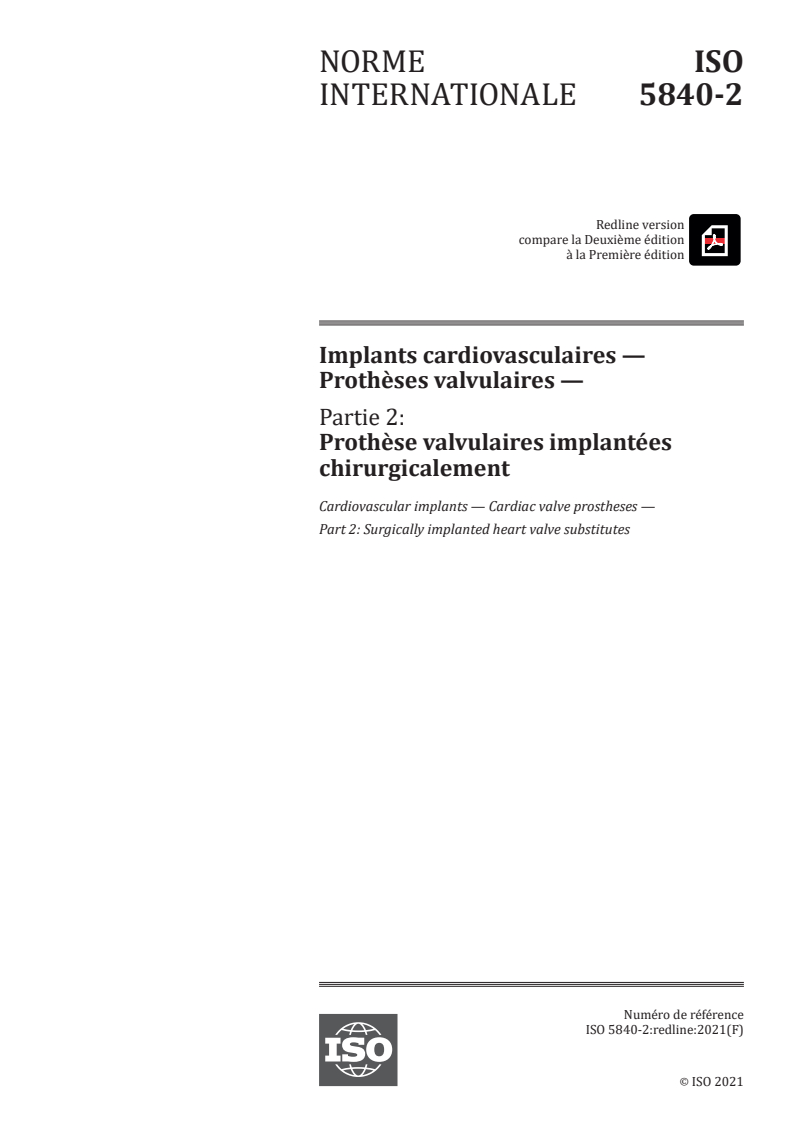
Annex A (informative) Surgical heart valve substitute hazard analysis example .22
Annex B (informative) In vitro procedures for testing unstented or similar valves in
compliant chambers .24
Annex C (informative) Preclinical in vivo evaluation .26
Annex D (informative) Description of the surgical heart valve substitute and system.29
Annex E (informative) Examples of components of some surgical heart valve substitutes
and systems .31
Annex F (informative) Guidelines for verification of hydrodynamic performance —
Pulsatile flow testing .37
Annex G (informative) Examples of design specific testing .41
Annex H (informative) Fatigue assessment .43
Annex I (normative) Methods of evaluating clinical data against objective performance criteria .45
Annex J (normative) Adverse event classification during clinical investigation .46
Bibliography .51
iv © ISO 2021 – All rights reserved
Foreword
ISO (the International Organization for Standardization) is a worldwide federation of national standards
bodies (ISO member bodies). The work of preparing International Standards is normally carried out
through ISO technical committees. Each member body interested in a subject for which a technical
committee has been established has the right to be represented on that committee. International
organizations, governmental and non-governmental, in liaison with ISO, also take part in the work.
ISO collaborates closely with the International Electrotechnical Commission (IEC) on all matters of
electrotechnical standardization.
The procedures used to develop this document and those intended for its further maintenance are
described in the ISO/IEC Directives, Part 1. In particular, the different approval criteria needed for the
different types of ISO documents should be noted. This document was drafted in accordance with the
editorial rules of the ISO/IEC Directives, Part 2 (see www .iso .org/ directives).
Attention is drawn to the possibility that some of the elements of this document may be the subject of
patent rights. ISO shall not be held responsible for identifying any or all such patent rights. Details of
any patent rights identified during the development of the document will be in the Introduction and/or
on the ISO list of patent declarations received (see www .iso .org/ patents).
Any trade name used in this document is information given for the convenience of users and does not
constitute an endorsement.
For an explanation of the voluntary nature of standards, the meaning of ISO specific terms and
expressions related to conformity assessment, as well as information about ISO's adherence to the
World Trade Organization (WTO) principles in the Technical Barriers to Trade (TBT), see www .iso .org/
iso/ foreword .html.
This document was prepared by Technical Committee ISO/TC 150, Implants for surgery, Subcommittee
SC 2, Cardiovascular implants and extracorporeal systems, in collaboration with the European Committee
for Standardization (CEN) Technical Committee CEN/TC 285, Non-active surgical implants, in accordance
with the Agreement on technical cooperation between ISO and CEN (Vienna Agreement).
This second edition cancels and replaces the first edition (ISO 5840-2:2015), which has been technically
revised.
The main changes compared to the previous edition are as follows: the engineering and clinical
requirements in the ISO 5840 series have been updated to current specifications and integrated and
harmonized across all of its parts.
A list of all parts in the ISO 5840 series can be found on the ISO website.
Any feedback or questions on this document should be directed to the user’s national standards body. A
complete listing of these bodies can be found at www .iso .org/ members .html.
Introduction
This document has been prepared for surgical heart valve substitutes with emphasis on providing
guidance for in vitro testing, preclinical in vivo and clinical evaluations, reporting of all in vitro,
preclinical in vivo, and clinical evaluations and labelling and packaging of the device. This process is
intended to clarify the required procedures prior to market release and to enable prompt identification
and management of any subsequent issues.
This document is used in conjunction with ISO 5840-1 and ISO 5840-3.
vi © ISO 2021 – All rights reserved
INTERNATIONAL STANDARD ISO 5840-2:2021(E)
Cardiovascular implants — Cardiac valve prostheses —
Part 2:
Surgically implanted heart valve substitutes
1 Scope
This document is applicable to heart valve substitutes intended for implantation in human hearts,
generally requiring cardiopulmonary bypass and generally with direct visualization. See Annex E for
examples of surgical heart valve substitutes and their components.
This document is applicable to both newly developed and modified surgical heart valve substitutes and
to the accessory devices, packaging, and labelling required for their implantation and for determining
the appropriate size of the surgical heart valve substitute to be implanted.
This document establishes an approach for verifying/validating the design and manufacture of a
surgical heart valve substitute through risk management. The selection of appropriate qualification
tests and methods are derived from the risk assessment. The tests can include those to assess the
physical, chemical, biological, and mechanical properties of surgical heart valve substitutes and of
their materials and components. The tests can also include those for pre-clinical in vivo evaluation and
clinical evaluation of the finished surgical heart valve substitute.
This document defines operational conditions and performance requirements for surgical heart valve
substitutes where adequate scientific and/or clinical evidence exists for their justification.
For some heart valve substitutes (e.g. sutureless), the requirements of both this document and
ISO 5840-3:2021 can be relevant and are considered as applicable to the specific device design and are
based on the results of the risk analysis.
2 Normative references
The following documents are referred to in the text in such a way that some or all of their content
constitutes requirements of this document. For dated references, only the edition cited applies. For
undated references, the latest edition of the referenced document (including any amendments) applies.
ISO 5840-1:2021, Cardiovascular implants — Cardiac valve prostheses — Part 1: General requirements
ISO 5840-3, Cardiovascular implants — Cardiac valve prostheses — Part 3: Heart valve substitutes
implanted by transcatheter techniques
ISO 10993-2, Biological evaluation of medical devices — Part 2: Animal welfare requirements
ISO 14155, Clinical investigation of medical devices for human subjects — Good clinical practice
ISO 14630, Non-active surgical implants — General requirements
ISO 16061, Instrumentation for use in association with non-active surgical implants — General requirements
3 Terms and definitions
For the purposes of this document, the terms and definitions given in ISO 5840-1:2021 and the
following apply.
ISO and IEC maintain terminological databases for use in standardization at the following addresses:
— ISO Online browsing platform: available at https:// www .iso .org/ obp
— IEC Electropedia: available at http:// www .electropedia .org/
3.1
acute assessment
intra-procedural and immediate post-procedural results used to assess in vivo safety and performance
Note 1 to entry: All animals entered into acute short-term assessment shall remain under general anaesthesia for
the duration of the study.
3.2
chronic assessment
long-term results following the procedure used to assess chronic in vivo safety and performance after
the animal has recovered from anaesthesia
Note 1 to entry: The endpoints and durations of these studies should be determined by risk analysis.
3.3
component-joining material
material such as a suture, adhesive, or welding compound used to assemble the components of a heart
valve system
[SOURCE: ISO 5840-1:2021, 3.31]
3.4
external sewing ring diameter
ESRD
outside diameter in millimetres of the sewing ring at the largest point
Note 1 to entry: See Figure 1.
Note 2 to entry: See also 3.5, 3.7 and 3.8.
3.5
prosthesis minimum internal diameter
numerical indication of the minimum diameter within a fully assembled
flexible surgical heart valve substitute and which is measured with a standard validated procedure,
taking the entire flow channel into consideration
Note 1 to entry: See Figure 1.
Note 2 to entry: See also 3.2 and 3.4.
3.6
prosthesis minimum internal diameter
measurement of the prosthesis minimum internal housing diameter
Note 1 to entry: See Figure 1.
Note 2 to entry: See also 3.2 and 3.4.
3.7
intra-annular
wholly or partially within the patient’s annulus
Note 1 to entry: See Figure 1.
Note 2 to entry: See also 3.4, 3.5 and 3.8.
2 © ISO 2021 – All rights reserved
a) Aortic/pulmonic b) Aortic/pulmonic c) Mitral/tricuspid
intra-annular supra-annular intra-annular
Key
1 prosthesis minimum internal diameter
2 patient annulus diameter
3 external sewing ring diameter
Figure 1 — Designation of dimensions of surgical heart valve substitute sewing ring
configurations
3.8
supra-annulus
region wholly above the patient’s annulus
Note 1 to entry: See Figure 1.
Note 2 to entry: See also 3.4, 3.5, and 3.7.
3.9
patient annulus diameter
PAD
diameter in millimetres of the smallest flow area within the patient’s valve annulus
Note 1 to entry: See Figure 1.
3.10
valve size
designated valve size
manufacturer's designation of a surgical heart valve substitute which indicates the intended patient
annulus diameter
Note 1 to entry: The valve size is equivalent to the PAD (3.9).
Note 2 to entry: This takes into consideration the manufacturer's recommended implant position relative to the
annulus and the suture technique.
4 Abbreviations
For the purposes of this document, the following abbreviations apply.
AE adverse event
CIP clinical investigation plan
CRF case report form
CT computed tomography
EOA effective orifice area
FEA finite element analysis
IFU instructions for use
LVOT left ventricular outflow tract
MRI magnetic resonance imaging
OPC objective performance criteria
PMCF post-market clinical follow-up
PVL paravalvular leak
RMS root mean square
SAE serious adverse event
TEE transoesophageal echo
TTE transthoracic echo
5 Fundamental requirements
Refer to ISO 5840-1:2021, Clause 5.
6 Device description
6.1 General
Refer to ISO 5840-1:2021, 6.1.
6.2 Intended use
Refer to ISO 5840-1:2021, 6.2.
6.3 Design inputs
6.3.1 Operational specifications
Refer to ISO 5840-1:2021, 6.3.1.
6.3.2 Performance specifications
6.3.2.1 General
Refer to ISO 5840-1:2021, 6.1 for general requirements.
6.3.2.2 Surgical heart valve substitute minimum performance requirements
Surgical heart valves shall meet the following minimum performance specifications:
— allow forward flow with acceptably small mean pressure difference;
4 © ISO 2021 – All rights reserved
— prevent retrograde flow with acceptably small regurgitation;
— resist embolization;
— avoid haemolysis;
— resist thrombus formation;
— be biocompatible;
— be compatible with in vivo diagnostic techniques;
— be deliverable and implantable in the target population;
— be able to ensure effective fixation within the target implant site;
— have an acceptable noise level;
— have reproducible function;
— maintain structural and functional integrity during the expected lifetime of the device;
— maintain its functionality and sterility for a reasonable shelf life prior to implantation.
6.3.2.3 Accessories
The requirements of ISO 16061 for instruments used with surgical implants shall apply. Surgical heart
valve accessories shall mitigate the risk of the valve being inadvertently implanted upside down.
Examples of surgical valve accessories, including sizing tools and valve handles, are shown in Annex E.
6.3.2.4 Implant procedure
Refer to ISO 5840-1:2021, 6.3.3.
6.3.3 Packaging, labelling, and sterilization
Refer to ISO 5840-1:2021, 6.3.4.
In addition to the items specified in ISO 5840-1:2021, C.1.3, outer container labelling for the valve
implant shall include in diagrammatic and/or tabular form the following items:
— intended valve to be replaced;
— intended position in relation to the annulus;
— inflow internal orifice diameter;
— prosthesis minimum internal diameter;
— external sewing ring diameter (ESRD).
Annex D contains a list of terms that may be used in describing various valve models.
6.4 Design outputs
Refer to ISO 5840-1:2021, 6.4.
6.5 Design transfer (manufacturing verification/validation)
Refer to ISO 5840-1:2021, 6.5.
6.6 Risk management
Refer to ISO 5840-1:2021, 6.6.
Annex A contains a list of potential hazards specific to surgical heart valve substitutes that can serve as
the basis for a risk analysis.
7 Design verification and validation
7.1 General requirements
In vitro assessment shall be used to mitigate the risks identified in the risk analysis. General
requirements that are applicable to all heart valve systems are provided in ISO 5840-1:2021, 7.1.
Specific considerations for surgical heart valve substitutes are provided in this document.
7.2 In vitro assessment
7.2.1 General
Refer to ISO 5840-1:2021, 7.2.1.
7.2.2 Test conditions, sample selection, and reporting requirements
Refer to ISO 5840-1:2021, 7.2.2.
7.2.3 Material property assessment
Refer to ISO 5840-1:2021, 7.2.3.
7.2.4 Hydrodynamic performance assessment
Hydrodynamic testing shall be performed to provide information on the fluid dynamic performance
of the surgical heart valve substitute. ISO 5840-1:2021, Annex I provides guidelines for conducting
and reporting steady hydrodynamic tests. Guidelines for conducting and reporting of pulsatile
hydrodynamic tests are provided in Annex F. For pulsatile flow testing, the performance of the
pulse duplicator shall be characterized. Refer to F.2.2.2 for guidelines related to pulse duplicator
characterization. The measurement accuracy and repeatability of the test system(s) shall be evaluated
and documented. The hydrodynamic waveforms produced by the pulse duplicator shall reasonably
simulate physiological conditions. Representative waveforms used to generate hydrodynamic test
results shall be documented in the test report. Reference [11] provides characteristics of reasonable
aortic and mitral waveforms.
Tests shall be carried out on at least three surgical heart valve substitutes of each size and on at least
one reference valve of each of the smallest, largest, and an intermediate size. A larger sample size
may be required to ensure adequate representation of the expected variability in the manufacture of
devices.
The in vitro test results shall meet or exceed the minimum performance requirements provided in
Table 1 and Table 2, which are given as a function of valve size. The minimum performance requirements
correspond to the following nominal pulsatile-flow conditions: beat rate = 70 cycles/min, simulated
cardiac output = 5,0 l/min, and systolic duration = 35 %, at normotensive pressure conditions, as
specified in ISO 5840-1:2021, Table 3 or Table 4. These pulsatile flow conditions are based on a healthy
normal adult and might not be applicable for paediatric device evaluation (see ISO 5840-1:2021,
Annex E for paediatric parameters). The minimum performance requirements are based on values in
the published scientific literature. The values in Table 1 and Table 2 are applicable to new or modified
heart valve substitutes which have not been clinically proven or evaluated under previous versions of
the ISO 5840 series.
6 © ISO 2021 – All rights reserved
For pulmonary and tricuspid heart valve substitutes and paediatric devices, minimum performance
requirements are not provided; however, the manufacturer shall justify the acceptability of
hydrodynamic performance of the devices.
Additional hydrodynamic characterization testing shall be conducted over a range of test conditions
as described in Annex F, F.2.3.2 and F.2.3.3. This testing is for characterization purposes only without
corresponding minimum performance requirements.
Table 1 — Minimum device performance requirements, aortic
Valve size
mm
Parameter
17 19 21 23 25 27 29 31
EOA (cm ) greater than or equal to 0,70 0,85 1,05 1,25 1,45 1,70 1,95 2,25
Total regurgitant fraction (% of forward
10 10 10 10 15 15 20 20
flow volume) less than or equal to
Table 2 — Minimum device performance requirements, mitral
Valve size
mm
Parameter
23 25 27 29 31 33
EOA (cm ) greater than or equal to 1,05 1,25 1,45 1,65 1,90 2,15
Total regurgitant fraction (% of forward
15 15 15 20 20 20
flow volume) less than or equal to
The total regurgitant fraction shall include closing volume and leakage volume (see ISO 5840-1:2021,
Figure 2). For traditional surgical valve designs with a sewing ring, the ring fabric may be sealed to
prevent paravalvular leakage during testing. For novel surgical valve designs without a sewing ring
(e.g. sutureless), sealing shall be justified and paravalvular leakage volume shall be included in the
leakage volume.
7.2.5 Structural performance assessment
7.2.5.1 General
An assessment of the ability of the surgical heart valve substitute to withstand the loads and/or
deformations to which it will be subjected shall be performed in order to evaluate the risks associated
with potential structural failure modes.
7.2.5.2 Implant durability assessment
The requirements of ISO 5840-1 shall apply.
7.2.5.3 Device structural component fatigue assessment
The requirements of Annex H and of ISO 5840-1 shall apply.
7.2.5.4 Component corrosion assessment
The requirements of ISO 5840-1 shall apply.
7.2.5.5 Cavitation (rigid valves)
An assessment of the potential for cavitation as indicated by the formation of vapor bubbles during
valve closure shall be considered for rigid valves. Assessment of cavitation damage shall be performed
by a detailed examination of study valves used in the preclinical in vivo study and in the simulated long-
term in vitro study (i.e. durability assessment). The in vitro cavitation assessment shall be performed by
characterization of the smallest and largest valve sizes in terms of any observed damage and the extent
of damage compared to the appropriate reference valves.
7.2.6 Design- or procedure-specific testing
7.2.6.1 General
See Annex G for examples of design specific or procedure specific testing to be considered. The
manufacturer shall define all applicable requirements based on the results of the risk assessment for
the specific device design.
7.2.6.2 Visibility
The ability to visualize the implanted device using the manufacturer’s recommended imaging
modalities (e.g. fluoroscopy, MRI, CT, echocardiography) shall be evaluated.
7.2.7 Device MRI compatibility
Refer to ISO 5840-1:2021, 7.2.7.
7.2.8 Simulated use
The requirements of ISO 5840-1:2021, 7.2.8 shall apply.
The model shall consider anatomical variation in intended patient population with respect to intended
implant site as well as physiological factors (e.g. temperature effects, pulsatile flow). In the case where
device anchoring relies on specific interactions with the native anatomy (e.g. annulus, aortic root),
testing of the interactions shall be included in the simulated use evaluation. Justification for critical
parameters of the simulated use model shall be provided.
7.2.9 Human factors/usability assessment
The requirements of ISO 5840-1:2021, 7.2.9 shall apply.
7.2.10 Implant thrombogenic and haemolytic potential assessment
The requirements of ISO 5840-1:2021, 7.2.10 shall apply.
7.3 Preclinical in vivo evaluation
7.3.1 General
The general requirements of ISO 14630 shall be considered.
7.3.2 Overall requirements
A preclinical in vivo test programme shall be conducted for new or modified devices in order to address
the safety and performance of the surgical heart valve substitute. For design modifications to surgical
heart valve substitutes with established clinical history, omission or abbreviation of preclinical in vivo
evaluation shall be appropriately justified.
The preclinical programme design shall be based on risk assessment and appropriate ISO documents.
This programme may involve the use of different species and implant durations to address the key
issues identified in the risk assessment.
8 © ISO 2021 – All rights reserved
The preclinical in vivo evaluation shall:
a) evaluate the haemodynamic performance of the surgical heart valve substitute;
b) assess the surgical handling characteristics of the test surgical heart valve substitute and its
accessories (if any);
c) assess the biological reaction to the surgical heart valve substitute; consideration shall be given
but not limited to the following items:
1) healing characteristics (pannus formation, tissue overgrowth);
2) haemolysis;
3) thrombus formation;
4) embolization of material from the heart valve substitute;
5) biological response (e.g. inflammation, rejection);
6) calcification (flexible valves);
7) acoustic characteristics (rigid valves), if the manufacturer is making specific acoustic claims;
8) structural valve deterioration and/or non-structural valve dysfunction;
9) cavitation (rigid valves);
d) mimic, as closely as possible, the condition of the finished product as intended for clinical use,
including exposure to process chemicals and the maximum number of allowed sterilization cycles;
e) evaluate the test surgical heart valve substitute in all positions for which it is intended (e.g. aortic,
mitral);
f) subject comparably sized control surgical heart valve substitutes to identical test conditions as the
test surgical heart valve substitute;
g) mimic, as closely as possible, the implantation technique for the placement of both the test and the
control surgical heart valve substitutes (e.g. suture technique and orientation);
h) be performed by appropriately experienced and knowledgeable test laboratories;
i) address animal welfare in accordance with the principles given in ISO 10993-2.
7.3.3 Methods
Guidance on the conduct of in vivo preclinical evaluation and a series of tests which can be used to
address the relevant issues are given in Annex C. The intent of these studies is to mimic as closely as
possible the clinical use and haemodynamic performance of the surgical heart valve substitute. It is
recognized that adverse events arising after valve implantation can be attributed to the implanted
valve, the procedure, and/or the environment into which it is implanted, including interactions among
these. Therefore, adverse clinical events arising during or after valve implantation shall be carefully
analysed and interpreted in order to identify the cause of the adverse event to the extent possible.
The investigator should seek to control as many variables as possible within each study arm (e.g. species,
gender, and age). The test surgical heart valve substitute shall be assessed in anatomical positions
for which it is intended to be used clinically. Animals suffering from perioperative complications not
related to the heart valve substitute may be excluded from the group of study animals with appropriate
justification, but information about them shall be reported.
The number of animals used for implantation of test and control surgical heart valve substitutes and
study endpoints shall be justified for each test based on the risk analysis.
For all studies, the specified duration of the observation period of the animals shall be justified
according to the parameter(s) under investigation. New devices (e.g. new design or novel blood-
contacting materials) require an extended duration of the observation period (not less than 140 days).
A minimum duration less than 140 d may be suitable for evaluating minor modifications of an existing
surgical heart valve system, such as investigations of healing. Any pre-clinical investigation with a
designated endpoint of less than 140 d requires a justification with rationale as to why a longer survival
period was not attempted.
For survival studies, a post-mortem examination shall be performed (e.g. macroscopic, radiographic,
histological) focusing on device integrity and device related pathology. The report shall include this
information from all animals that have been entered into the study.
The study shall provide at least the following:
a) in vivo evaluation of the final device and system design;
b) any detectable pathological consequences involving the surgical heart valve substitute and/or
the major organs, including but not limited to: post-implantation changes in shape or structural
components, thrombo-embolic phenomena, pannus formation, and inflammatory responses;
c) any detectable structural alterations (macro- or microscopic or radiographic) in the surgical heart
valve substitute (e.g. damage, support structure fracture, material degeneration, changes in shape
or dimensions);
d) serial blood analyses performed pre-operatively, at appropriately justified intervals during the
observation period, and at termination to assess haemolysis, abnormalities in haematology and
clinical chemistry parameters;
e) implantation characteristics, including but not limited to usability, handling characteristics, and
sizing technique;
f) haemodynamic performance over a range of cardiac indices (e.g. 2,5 l/min to 6,0 l/min);
g) any paravalvular leakage (PVL);
h) adverse clinical events, (e.g. myocardial infarction, significant cardiac arrhythmias, infection);
i) any other system or procedure related complication or events.
7.3.4 Test report
The test laboratory shall produce the test report, which shall include a summary assessment of the
data generated during the course of the investigation. The test report shall include the complete
study protocol. All data generated from the preclinical in vivo evaluation shall be incorporated into
a comprehensive test report. The report should include the results generated by tests described in
Annex C.
The test report shall include the following:
a) identification of each valve used (product description, serial number, and other appropriate valve
identification);
b) detailed description of the animal model used and the rationale and justification for its use; the
pre-procedural assessment of each animal shall include documentation of health status as well as
gender, weight, and age of the animal;
c) description of the operative procedure, including implant technique, test surgical heart valve
substitute orientation, valve position, and operative complications;
d) description of the pre-procedural and post-procedural clinical course of each animal including,
clinical observations, medication(s), and interventions used to treat adverse events; a description of,
10 © ISO 2021 – All rights reserved
and a justification for, any anticoagulation or antiplatelet drug regimen used as well as therapeutic
level monitoring methods;
e) any deviations from the protocol or amendments to the protocol and their significance;
f) names of the investigators and their institutions along with information about the implanting
personnel and the laboratory’s experience with surgical heart valve substitute implantation and
animal care;
g) interpretation of data, including a comparison of the results between test and control animals, and
a recommendation relative to the expected clinical safety and performance of the surgical heart
valve substitute under investigation;
h) for survival studies, the study pathologist’s report that includes gross and radiographic examination
and histopathology findings for each explanted surgical heart valve substitute, including gross
photographs of the device and surrounding tissue, for each explanted heart valve substitute;
i) for survival studies, detailed full necropsy reports for each animal in the study that includes an
assessment of the entire body (e.g. thromboembolism or any other adverse effects assumed to be
caused by the heart valve substitute);
j) summary of all data generated from all animals during the course of the investigation, in particular,
serious adverse events generated by evaluations described in Annex C, as well as deviations from
the protocol and their significance, shall be addressed.
7.4 Clinical investigations
7.4.1 General
The requirements of ISO 14630 and ISO 14155 shall apply. Clinical investigations shall be performed
for new surgical heart valve systems and expanded indications for use. For modifications of an existing
heart valve system, if a determination is made based on the risk analysis that clinical investigations are
not required, scientific justification addressing safety and effectiveness shall be provided.
Clinical studies are recommended for design changes of a marketed device that may affect the safety
and effectiveness (e.g. novel blood-contacting materials, changes that alter the flow characteristics or
haemodynamics, changes that affect the mechanical loading on the valve).
Clinical investigations shall be designed to evaluate the surgical heart valve system for its intended
use. The studies shall include an assessment of adverse events related to risks arising from the use
of the surgical heart valve system and from the procedure. The clinical investigation shall include
pre-procedure, peri-procedure, and follow-up data from a specified number of subjects, each with a
follow-up appropriate for the device and its intended use. The clinical investigation programme shall be
designed to provide substantial evidence of acceptable safety and effectiveness to support the intended
labelling for the device.
The phases of a clinical programme typically include a pilot phase (e.g. first-in-human or feasibility
studies), a pivotal phase (studies to support market approval), and a post-market phase. Humanitarian
use (e.g. compassionate use, emergency use, special access) is a separate process and is not considered
part of the clinical programme. A series of patients receiving a novel device under humanitarian use
shall not be used as a substitute for any clinical investigational study. Prior to embarking on a pivotal
clinical investigation, pilot phase studies shall be considered to provide initial information regarding
clinical safety and device performance. The information derived from the pilot phase may also be used
to optimize the surgical heart valve system and patient selection prior to initiation of a larger clinical
investigation following further pre-clinical testing. A scientific justification shall be provided if pilot
phase studies are not to be undertaken.
A pivotal clinical investigation shall be designed to ensure:
a) the presence of a well-defined, clinically relevant question;
b) an acceptable level of risk-benefit for the patient considering the available alternatives and standard
of care;
c) an appropriate study design to answer the clinical question, including a well-defined patient
population, study endpoints and duration.
A randomised study design for a pivotal trial should be considered for the following reasons:
a) ethical considerations can require a head-to-head comparison with alternative treatments or
standard of care;
b) randomised trials provide the highest quality scientific evidence and minimize bias;
c) randomised trial results can promote adoption of effective therapies.
For clinical investigations to serve as a basis for market approval, there should be sufficient data to
support safety and effectiveness. These studies should include a statistical methodology, specific
inclusion/exclusion criteria, use of accepted endpoint definitions, a rigorous method of collecting
information on defined case report forms, a rigorous system to monitor the data collection, defined
follow-up intervals, and complete follow-up of the study populations.
7.4.2 Study considerations
The decision to use a medical device in the context of a particular clinical procedure requires the
residual risk to be balanced against the anticipated benefits of the procedure or the risk and anticipated
benefits of alternative procedures. The requirements of ISO 14971 shall apply.
With surgical heart valve systems, haemodynamic performance and those adverse events which are
directly related to the device or procedure should be measured to assess risk (e.g. coronary obstruction,
LVOT obstruction). Haemodynamic and clinical performance including adverse events may also depend
on factors other than the device itself, including:
a) patient comorbidities;
b) the underlying pathological process and whether it continues to progress;
c) whether the degree of functional improvement achieved is suf
...
INTERNATIONAL ISO
STANDARD 5840-2
Redline version
compares Second edition to
First edition
Cardiovascular implants — Cardiac
valve prostheses —
Part 2:
Surgically implanted heart valve
substitutes
Implants cardiovasculaires — Prothèses valvulaires —
Partie 2: Prothèse valvulaires implantées chirurgicalement
Reference number
ISO 5840-2:redline:2021(E)
©
ISO 2021
ISO 5840-2:redline:2021(E)
IMPORTANT
This marked-up version uses the following colour-coding:
Text example 1 — Text has been added (in green)
— Text has been deleted (in red)
Text example 2
— Graphic figure has been added
— Graphic figure has been deleted
1.x . — If there are changes in a clause/subclause, the corresponding clause/
subclause number is highlighted in yellow in the Table of contents
DISCLAIMER
This marked-up version highlights the main changes in this edition of the document
compared with the previous edition. It does not focus on details (e.g. changes in
punctuation).
This marked-up version does not constitute the official ISO document and is not intended to
be used for implementation purposes.
© ISO 2021
All rights reserved. Unless otherwise specified, or required in the context of its implementation, no part of this publication may
be reproduced or utilized otherwise in any form or by any means, electronic or mechanical, including photocopying, or posting
on the internet or an intranet, without prior written permission. Permission can be requested from either ISO at the address
below or ISO’s member body in the country of the requester.
ISO copyright office
CP 401 • Ch. de Blandonnet 8
CH-1214 Vernier, Geneva
Phone: +41 22 749 01 11
Fax: +41 22 749 09 47
Email: copyright@iso.org
Website: www.iso.org
Published in Switzerland
ii © ISO 2021 – All rights reserved
ISO 5840-2:redline:2021(E)
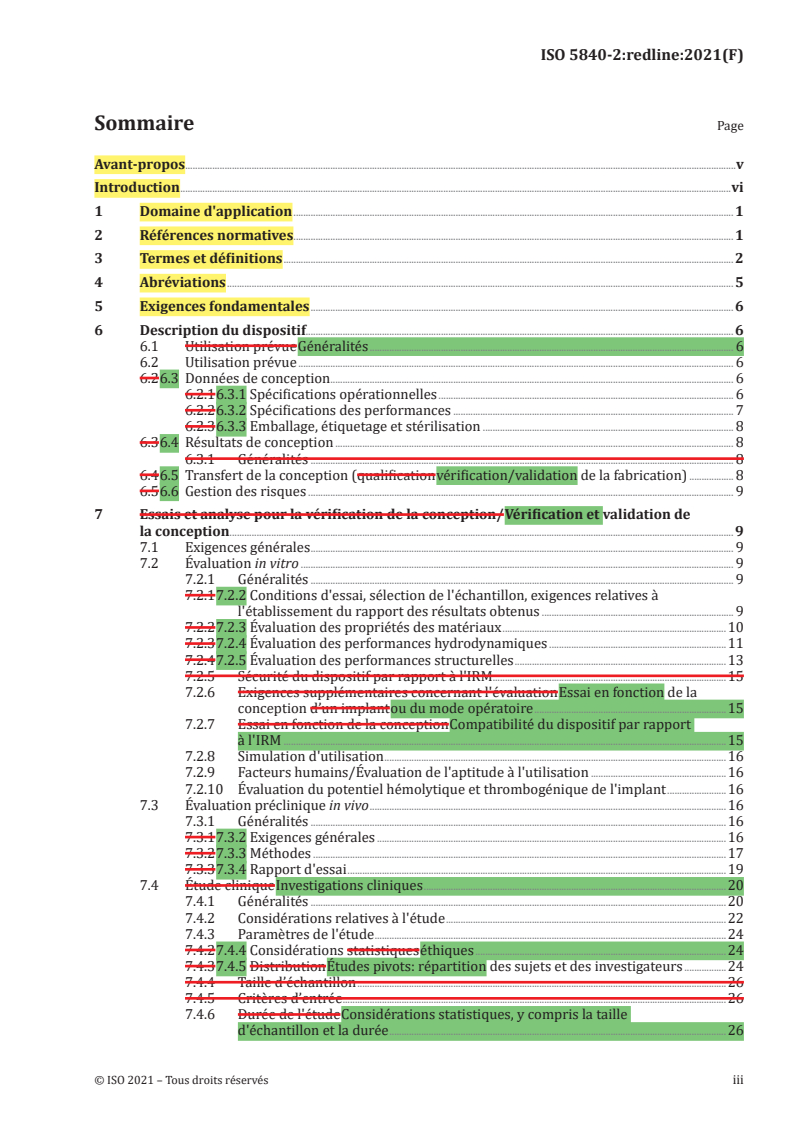
Contents Page
Foreword .v
Introduction .vi
1 Scope . 1
2 Normative references . 1
3 Terms and definitions . 2
4 Abbreviations. 5
5 Fundamental requirements . 6
6 Device description . 6
6.1 Intended use General . 6
6.2 Intended use . 6
6.2 6.3 Design inputs . 6
6.2.1 6.3.1 Operational specifications . 6
6.2.2 6.3.2 Performance specifications. 7
6.2.3 6.3.3 Packaging, labelling, and sterilization . 7
6.3 6.4 Design outputs . 8
6.3.1 General. 8
6.4 6.5 Design transfer (manufacturing qualification verification/validation) . 8
6.5 6.6 Risk management . 8
7 Design verification testing and analysis/design and validation .9
7.1 General requirements . 9
7.2 In vitro assessment . 9
7.2.1 General. 9
7.2.1 7.2.2 Test conditions, sample selection, and reporting requirements . 9
7.2.2 7.2.3 Material property assessment .10
7.2.3 7.2.4 Hydrodynamic performance assessment .11
7.2.4 7.2.5 Structural performance assessment .13
7.2.5 Device MRI safety .15
7.2.6 Additional implant design evaluation requirements Design- or procedure-
specific testing .15
7.2.7 Design specific testing Device MRI compatibility .15
7.2.8 Simulated use.15
7.2.9 Human factors/usability assessment .15
7.2.10 Implant thrombogenic and haemolytic potential assessment .15
7.3 Preclinical in vivo evaluation .16
7.3.1 General.16
7.3.1 7.3.2 Overall requirements .16
7.3.2 7.3.3 Methods .17
7.3.3 7.3.4 Test report .18
7.4 Clinical investigation investigations .19
7.4.1 General.19
7.4.1 7.4.2 General Study considerations .20
7.4.2 7.4.3 Statistical considerations Study endpoints .22
7.4.4 Ethical considerations .22
7.4.3 7.4.5 Pivotal studies: Distribution of subjects and investigators .23
7.4.4 Sample size .24
7.4.5 Entry criteria .24
7.4.6 Duration of the study Statistical considerations including sample size and
duration .24
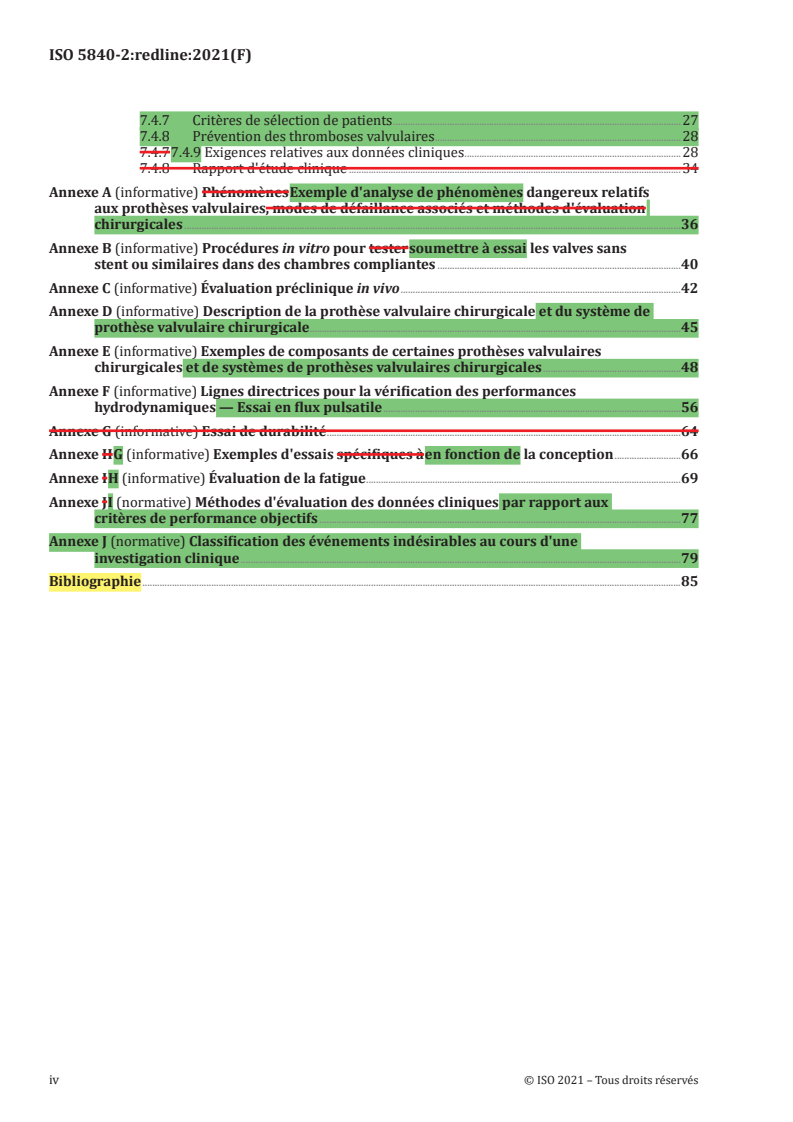
7.4.7 Patient selection criteria .25
7.4.8 Valve thrombosis prevention .26
7.4.7 7.4.9 Clinical data requirements .26
7.4.8 Clinical investigation report .31
ISO 5840-2:redline:2021(E)
Annex A (informative) Heart valve substitute hazards, associated failure modes, and
evaluation methods Surgical heart valve substitute hazard analysis example .33
Annex B (informative) In vitro procedures for testing unstented or similar valves in
compliant chambers .37
Annex C (informative) Preclinical in vivo evaluation .39
Annex D (informative) Description of the surgical heart valve substitute and system.42
Annex E (informative) Examples of components of some surgical heart valve substitutes
and systems .44
Annex F (informative) Guidelines for verification of hydrodynamic performance —
Pulsatile flow testing .51
Annex G (informative) Durability testing .59
Annex H G (informative) Examples of design specific testing .61
Annex I H (informative) Fatigue assessment .63
Annex J I (normative) Methods of evaluating clinical data against objective performance
criteria .70
Annex J (normative) Adverse event classification during clinical investigation .72
Bibliography .77
iv © ISO 2021 – All rights reserved
ISO 5840-2:redline:2021(E)
Foreword
ISO (the International Organization for Standardization) is a worldwide federation of national standards
bodies (ISO member bodies). The work of preparing International Standards is normally carried out
through ISO technical committees. Each member body interested in a subject for which a technical
committee has been established has the right to be represented on that committee. International
organizations, governmental and non-governmental, in liaison with ISO, also take part in the work.
ISO collaborates closely with the International Electrotechnical Commission (IEC) on all matters of
electrotechnical standardization.
The procedures used to develop this document and those intended for its further maintenance are
described in the ISO/IEC Directives, Part 1. In particular, the different approval criteria needed for the
different types of ISO documents should be noted. This document was drafted in accordance with the
editorial rules of the ISO/IEC Directives, Part 2 (see www .iso .org/ directiveswww .iso .org/ directives).
Attention is drawn to the possibility that some of the elements of this document may be the subject of
patent rights. ISO shall not be held responsible for identifying any or all such patent rights. Details of
any patent rights identified during the development of the document will be in the Introduction and/or
on the ISO list of patent declarations received (see www .iso .org/ patentswww .iso .org/ patents).
Any trade name used in this document is information given for the convenience of users and does not
constitute an endorsement.
For an explanation on theof the voluntary nature of standards, the meaning of ISO specific terms and
expressions related to conformity assessment, as well as information about ISO's adherence to the
WTOWorld Trade Organization (WTO) principles in the Technical Barriers to Trade (TBT) see the
following URL: , see Foreword - Supplementary informationwww .iso .org/ iso/ foreword .html.
The committee responsible for this document isThis document was prepared by Technical Committee
ISO/TC 150, Implants for surgery, Subcommittee SC 2, Cardiovascular implants and extracorporeal
systems., in collaboration with the European Committee for Standardization (CEN) Technical Committee
CEN/TC 285, Non-active surgical implants, in accordance with the Agreement on technical cooperation
between ISO and CEN (Vienna Agreement).
This firstsecond edition of ISO 5840-2, together with ISO 5840-1 and cancels and replaces the first
edition (ISO 5840-32:2015, cancels and replaces ISO 5840:2005), which has been technically revised.
The main changes compared to the previous edition are as follows: the engineering and clinical
requirements in the ISO 5840 series consists of the following parts, under the general title Cardiovascular
implants — Cardiac valve prostheses:h ave been updated to current specifications and integrated and
harmonized across all of its parts.
— Part 1: General requirements
— Part 2: Surgically implanted heart valve substitutes
— Part 3: Heart valve substitutes implanted by transcatheter techniques
A list of all parts in the ISO 5840 series can be found on the ISO website.
Any feedback or questions on this document should be directed to the user’s national standards body. A
complete listing of these bodies can be found at www .iso .org/ members .html.
ISO 5840-2:redline:2021(E)
Introduction
This part of ISO 5840document has been prepared for surgical heart valve substitutes with emphasis
on specifying types ofproviding guidance for in vitro testing, preclinical in vivo and clinical evaluations,
reporting of all in vitro, preclinical in vivo, and clinical evaluations and labelling and packaging of the
device. This process is intended to clarify the required procedures prior to market release and to enable
prompt identification and management of any subsequent issues.
This part of ISO 5840document is to be used in conjunction with ISO 5840-1 and ISO 5840-3.
vi © ISO 2021 – All rights reserved
INTERNATIONAL STANDARD ISO 5840-2:redline:2021(E)
Cardiovascular implants — Cardiac valve prostheses —
Part 2:
Surgically implanted heart valve substitutes
1 Scope
This part of ISO 5840document is applicable to heart valve substitutes intended for implantation in
human hearts, generally requiring cardiopulmonary bypass and generally with direct visualization.
See Annex E for examples of surgical heart valve substitutes and their components.
This part of ISO 5840document is applicable to both newly developed and modified surgical heart
valve substitutes and to the accessoriesaccessory devices, packaging, and labelling required for their
implantation and for determining the appropriate size of the surgical heart valve substitute to be
implanted.
This part of ISO 5840 outlinesdocument establishes an approach for qualifyingverifying/validating the
design and manufacture of a surgical heart valve substitute through risk management. The selection of
appropriate qualification tests and methods are derived from the risk assessment. The tests can include
those to assess the physical, chemical, biological, and mechanical properties of surgical heart valve
substitutes and of their materials and components. The tests can also include those for pre-clinical in
vivo evaluation and clinical evaluation of the finished surgical heart valve substitute.
This part of ISO 5840 definesdocument defines operational conditions and performance requirements
for surgical heart valve substitutes where adequate scientific and/or clinical evidence exists for their
justification.
For novel surgicalsome heart valve substitutes (e.g. sutureless), the requirements of both this
International Standarddocument and ISO 5840-3:2021 mightcan be relevant and shall beare considered
as applicable to the specific device design and shall beare based on the results of the risk analysis.
This part of ISO 5840 excludes heart valve substitutes designed for implantation in artificial hearts or
heart assist devices.
This part of ISO 5840 excludes homografts.
2 Normative references
The following documents, in whole or in part, are normatively referenced in this document and are
indispensable for its application are referred to in the text in such a way that some or all of their content
constitutes requirements of this document. For dated references, only the edition cited applies. For
undated references, the latest edition of the referenced document (including any amendments) applies.
ISO 5840-1:2015 2021, Cardiovascular implants and extracorporeal systems — Cardiac valve prostheses —
Part 1: General requirements
ISO 10993-1 5840-3, Biological evaluation of medical devices Cardiovascular implants — Cardiac valve
prostheses — Part 1: Evaluation and testing within a risk management process 3: Heart valve substitutes
implanted by transcatheter techniques
ISO 10993-2, Biological evaluation of medical devices — Part 2: Animal welfare requirements
ISO 14155, Clinical investigation of medical devices for human subjects — Good clinical practice
ISO 14630, Non-active surgical implants — General requirements
ISO 5840-2:redline:2021(E)
ISO 14971, Medical devices — Application of risk management to medical devices
ISO 16061, Instrumentation for use in association with non-active surgical implants – — General
requirements
ISO/IEC 17025:2005, General requirements for the competence of testing and calibration laboratories
ISO 22442 (all parts), Medical devices utilizing animal tissues and their derivatives
ASTM F2052, Standard Test Method for Measurement of Magnetically Induced Displacement Force on
Medical Devices in the Magnetic Resonance Environment
ASTM F2119, Standard Test Method for Evaluation of MR Image Artifacts from Passive Implants
ASTM F2182, Standard Test Method for Measurement of Radio Frequency Induced Heating On or Near
Passive Implants During Magnetic Resonance Imaging
ASTM F2213, Standard Test Method for Measurement of Magnetically Induced Torque on Medical Devices
in the Magnetic Resonance Environment
ASTM F2503, Standard Practice for Marking Medical Devices and Other Items for Safety in the Magnetic
Resonance Environment
3 Terms and definitions
For the purposes of this document, the following terms and definitions given in ISO 5840-1:2021 and
the following apply.
ISO and IEC maintain terminological databases for use in standardization at the following addresses:
— ISO Online browsing platform: available at https:// www .iso .org/ obp
— IEC Electropedia: available at http:// www .electropedia .org/
3.1
cycle rate acute assessment
number of complete cycles per unit of time, usually expressed as cycles per minute (cycles/min) intra-
procedural and immediate post-procedural results used to assess in vivo safety and performance
Note 1 to entry: All animals entered into acute short-term assessment shall remain under general anaesthesia for
the duration of the study.
3.2
chronic assessment
long-term results following the procedure used to assess chronic in vivo safety and performance after
the animal has recovered from anaesthesia
Note 1 to entry: The endpoints and durations of these studies should be determined by risk analysis.
3.3
component-joining material
material such as a suture, adhesive, or welding compound used to assemble the components of a heart
valve system
[SOURCE: ISO 5840-1:2021, 3.31]
3.4
external sewing ring diameter
ESRD
outside diameter in millimetres of the sewing ring at the largest point
2 © ISO 2021 – All rights reserved
ISO 5840-2:redline:2021(E)
Note 1 to entry: See Figure 1.
Note 2 to entry: See also 3.5, 3.7 and 3.8.
3.2 3.5
prosthesis minimum internal orifice diameter
numerical indication of the minimum diameter within a fully assembled
flexible surgical heart valve substitute through which blood flows and which is measured with a
standard validated procedure, taking the entire flow channel into consideration
Note 1 to entry: See Figure 1.
Note 2 to entry: See also 3.2 and 3.4.
3.6
prosthesis minimum internal diameter
measurement of the prosthesis minimum internal housing diameter
Note 1 to entry: See Figure 1.
Note 2 to entry: See also 3.2 and 3.4.
3.3 3.7
intra-annular sewing ring
sewing ring designed to secure the surgical heart valve wholly or mostly wholly or partially within the
patient’s tissue annulus
Note 1 to entry: See Figure 1.
Note 2 to entry: See also 3.2 3.4, 3.10 3.5 and 3.12 3.8.
ISO 5840-2:redline:2021(E)
a) Aortic/pulmonic b) Aortic/pulmonic c) Mitral/tricuspid
intra-annular supra-annular intra-annular
Key
1 prosthesis minimum internal orifice diameter
2 tissue patient annulus diameter
3 external sewing ring diameter
Figure 1 — Designation of dimensions of surgical heart valve substitute sewing ring
configurations
3.4
major bleeding
any episode of major internal or external bleeding that causes death, hospitalization, or permanent
injury (e.g. vision loss) or necessitates transfusion
3.5
major paravalvular leak
paravalvular leakage leading to death or re-intervention, or causing heart failure requiring additional
medication, or causing moderate or severe regurgitation or prosthesis 'rocking' on investigation even
in the apparent absence of symptoms, or causing hemolytic anemia
3.6
nonstructural valve dysfunction
abnormality extrinsic to the heart valve substitute that results in stenosis, regurgitation, and/or
haemolytic anemia
3.7
prosthetic valve endocarditis
any infection involving a valve in which an operation has been performed, based on reoperation,
autopsy or the Duke Criteria for Endocarditis
Note 1 to entry: See Reference [16].
3.8
structural valve deterioration
change in the function of a heart valve substitute resulting from an intrinsic abnormality that causes
stenosis or regurgitation
Note 1 to entry: This definition excludes infection or thrombosis of the heart valve substitute. It includes intrinsic
changes such as wear, fatigue failure, stress fracture, occluder escape, suture line disruption of components of
the prosthesis, calcification, cavitation erosion, leaflet tear, and stent creep.
3.9
support structure
component of a heart valve substitute that houses the occluder(s)
EXAMPLE Stent, frame, housing.
4 © ISO 2021 – All rights reserved
ISO 5840-2:redline:2021(E)
3.10 3.8
supra-annular sewing ring annulus
sewing ring designed to secure the valve region wholly above the patient’s tissue annulus
Note 1 to entry: See Figure 1.
Note 2 to entry: See also 3.4, 3.5, and 3.7.
3.11
thromboembolism
any embolic event that occurs in the absence of infection after the immediate perioperative period and
may be manifested by a neurological event or a noncerebral embolic event
3.12 3.9
tissue patient annulus diameter
TAD PAD
diameter in millimetres of the smallest flow area within the patient’s valve annulus
Note 1 to entry: See Figure 1.
3.13 3.10
valve size
designated valve size
manufacturer's designation of a surgical heart valve substitute which indicates the tissue annulus
diameter (TAD in millimetres) of the patient into whom the surgical heart valve substitute is intended
to be implanted (i.e. TAD = designated valve size) intended patient annulus diameter
Note 1 to entry: The valve size is equivalent to the PAD (3.9).
Note 12 to entry: This takes into consideration the manufacturer's recommended implant position relative to the
annulus and the suture technique.
3.14
valve thrombosis
any thrombus not caused by infection attached to or near an operated valve that occluded part of the
blood flow path, interferes with valve function, or is sufficiently large to warrant treatment
Note 1 to entry: See Reference [14].
4 Abbreviations
For the purposes of this document, the following abbreviations apply.
EOA Effective Orifice Area
CFD Computational Fluid Dynamics
FEA Finite Element Analysis
IFU Instructions For Use
OPC Objective Performance Criteria
AE adverse event
CIP clinical investigation plan
CRF case report form
CT computed tomography
ISO 5840-2:redline:2021(E)
EOA effective orifice area
FEA finite element analysis
IFU instructions for use
LVOT left ventricular outflow tract
MRI magnetic resonance imaging
OPC objective performance criteria
PMCF post-market clinical follow-up
PVL paravalvular leak
RMS root mean square
SAE serious adverse event
TEE transoesophageal echo
TTE transthoracic echo
5 Fundamental requirements
The manufacturer shall determine, at all stages of the product life cycle, the acceptability of the product
for clinical useRefer to ISO 5840-1:2021, Clause 5.
6 Device description
6.1 Intended use General
The manufacturer shall identify the physiological condition(s) to be treated, the intended patient
population, potential adverse events, and intended claimsRefer to ISO 5840-1:2021, 6.1.
6.2 Intended use
Refer to ISO 5840-1:2021, 6.2.
6.2 6.3 Design inputs
6.2.1 6.3.1 Operational specifications
The manufacturer shall define the operational specifications for the device, including the principles
of operation, expected device lifetime, shelf life, shipping/storage limits, and the physiological
environment in which it is intended to function. The manufacturer shall carefully define all relevant
dimensional parameters that will be required to accurately select the size of device to be implanted.
Refer to ISO 5840-1:20152021, Table 1 and Table 2 6.3.1define the expected physiological parameters
of the intended adult patient population for surgical heart valve substitutes for both normal and
pathological patient conditions.
NOTE See the paediatric annex of ISO 5840-1:2015, Annex E.
6 © ISO 2021 – All rights reserved
ISO 5840-2:redline:2021(E)
6.2.2 6.3.2 Performance specifications
6.2.2.1 6.3.2.1 General
The manufacturer shall establish (i.e. define, document, and implement) the clinical performance
requirements of the device and the corresponding device performance specificationsRefer to
ISO 5840-1:2021, 6.1 for the intended use and device claims. The following list of desired clinical and
device-based performance characteristics describes a safe and effective surgical heart valve substitute.
general requirements.
NOTE For novel devices, portions of ISO 5840-3 can be applicable
6.2.2.2 6.3.2.2 Surgical heart valve substitute minimum performance requirements
Specifications shall be defined with respect to at least the following performance characteristicsSurgical
heart valves shall meet the following minimum performance specifications:
— ability to allow forward flow with acceptably small mean pressure difference;
— ability to prevent retrograde flow with acceptably small regurgitation;
— ability to resist embolization;
— ability to resistavoid haemolysis;
— ability to resist thrombus formation;
— be biocompatible;
— be compatible with in vivo diagnostic techniques;
— be deliverable and implantable in the target population;
— abilitybe able to ensure effective fixation within the target implant site;
— hashave an acceptable noise level;
— hashave reproducible function;
— maintainsmaintain structural and functional integrity during the expected lifetime of the device;
— maintainsmaintain its functionality and sterility for a reasonable shelf life prior to implantation.
6.3.2.3 Accessories
The requirements of ISO 16061 for instruments used with surgical implants shall apply. Surgical heart
valve accessories shall mitigate the risk of the valve being inadvertently implanted upside down.
Examples of surgical valve accessories, including sizing tools and valve handles, are shown in Annex E.
6.3.2.4 Implant procedure
Refer to ISO 5840-1:2021, 6.3.3.
6.2.3 6.3.3 Packaging, labelling, and sterilization
Refer to ISO 5840-1:2021, 6.3.4.
The surgical heart valve substitute and accessories shall meet the requirements for packaging,
labelling, and sterilization contained withinIn addition to the items specified in ISO 5840-1:20152021,
ISO 5840-2:redline:2021(E)
C.1.3, Annexes B, C, and D, respectively.outer container labelling for the valve implant shall include in
diagrammatic and/or tabular form the following items:
— intended valve to be replaced;
— intended position in relation to the annulus;
— inflow internal orifice diameter;
— prosthesis minimum internal diameter;
— external sewing ring diameter (ESRD).
Annex D contains a list of terms that may be used in describing various valve models.
6.3 6.4 Design outputs
6.3.1 General
The manufacturer shall establish (i.e. define, document, and implement) a complete specification of the
surgical heart valve substitute system, which includes component and assembly-level specifications,
accessories, packaging, and labelling.
Annex E contains a listing of components and terms that may be used in describing various valve types.
Refer to ISO 5840-1:2021, 6.4.
6.4 6.5 Design transfer (manufacturing qualification verification/validation)
6.4.1 The manufacturer shall generate a manufacturing flowchart identifying the manufacturing
process operations and inspection steps. The input of all components and important manufacturing
materials shall be indicated on the flowchart.
6.4.2 As part of the risk management process, the manufacturer shall establish the control measures
and process conditions necessary to ensure that the device is safe and suitable for its intended use. The
risk management file shall identify and justify the verification activities necessary to demonstrate the
acceptability of the process ranges chosen.
6.4.3 The manufacturer shall establish the adequacy of full-scale manufacturing by validation of the
manufacturing process. The manufacturer shall document the results of the validation of all special
processes and the validation of all process software.
NOTE See ISO 13485.
Refer to ISO 5840-1:2021, 6.5.
6.5 6.6 Risk management
The manufacturer shall define and implement a risk management program in accordance withRefer to
ISO 14971 5840-1:2021, 6.6.
Annex A contains a list of potential hazards specific to surgical heart valve substitutes that can serve as
the basis for a risk analysis.
8 © ISO 2021 – All rights reserved
ISO 5840-2:redline:2021(E)
7 Design verification testing and analysis/design and validation
7.1 General requirements
In vitroThe manufacturer shall perform verification testing in order to demonstrate that the device
specifications result in a surgical heart valve substitute system that meets the design specifications
(design output meets design input). The manufacturer shall establish those tests relating to hazards
identified from assessment shall be used to mitigate the risks identified in the risk analysis. The
protocols shall identify the test purpose, set-up, equipment (specifications, calibration, etc.), test
conditions (with a justification of appropriateness to anticipated in vivoGeneral requirements that are
applicable to all heart valve systems are provided in operating conditionsISO 5840-1:2021, 7.1 for the
device), acceptance criteria, and sample quantities tested. Specific considerations for surgical heart
valve substitutes are provided in this document.
NOTE See ISO 16061.
For novel surgical heart valve substitutes (e.g. sutureless), the requirements of both this part of
ISO 5840 and ISO 5840-3 might be relevant and shall be considered, if applicable to the specific device
design and based on the results of the risk analysis.
The manufacturer shall validate the design of the surgical heart valve substitute, its packaging/
labelling, and accessories.
7.2 In vitro assessment
7.2.1 General
Refer to ISO 5840-1:2021, 7.2.1.
7.2.1 7.2.2 Test conditions, sample selection, and reporting requirements
7.2.1.1 Test conditions and sample selection
Test specimens shall represent, as closely as possible, the finished product to be supplied for clinical use,
including exposure to the maximum number of recommended sterilization cycles, process chemicals,
and aging effects in accordance with all manufacturing procedures and Instructions for Use, where
appropriate. Any deviations of the test specimens from the finished product shall be justified.
The specimens selected for testing shall fully represent the total implant size range. Depending on the
particular test, testing might not necessarily have to be completed for each discrete valve size, but
shall at least be completed for the smallest, intermediate, and largest sizes. A rationale for device size
selection shall be provided.
For all tests, the number of samples shall be justified based on the specific intent of the test (see
ISO 5840-1:2015, Annex F). Sampling shall ensure adequate representation of the expected variability in
the manufacture of devices. Additional recommendations regarding sampling and sample conditioning
are included within each test method defined herein, as appropriate.
Where simulation of in vivo conditions is applicable to the test method, consideration shall be given to
those operational environments given in ISO 5840-1:2015, Table 1 and Table 2 for the adult population.
See ISO 5840-1:2015, Annex E for guidelines regarding suggested test conditions for the paediatric
population. Where applicable, testing shall be performed using a test fluid of isotonic saline, blood,
or a blood-equivalent fluid whose physical properties (e.g. specific gravity, viscosity at operating
temperatures) are appropriate to the test being performed. The test fluid used shall be justified. Testing
shall be performed at the intended operating temperature as appropriate,
Test methods for design verification testing shall be appropriately validated. Refer to applicable
sections of ISO/IEC 17025:2005.
ISO 5840-2:redline:2021(E)
7.2.1.2 Reporting requirements
Each test report shall include the following, at a minimum:
a) rationale for the test;
b) identification and description of the sample(s) tested (e.g. batch number);
c) identification and description of the reference valve(s);
d) number of specimens tested, and sample size rationale;
e) detailed description of the test method including measurement accuracy and repeatability of the
test system;
f) verification that appropriate quality assurance standards have been met (e.g. good laboratory
practices);
g) test results and conclusions.
Statistical procedures such as described in ISO 5840-1:2015, Annex F may be used to assist data
analysis.
Refer to ISO 5840-1:2021, 7.2.2.
7.2.2 7.2.3 Material property assessment
7.2.2.1 General
Properties of surgical heart valve substitute system shall be evaluated as applicable to the specific
design as determined by the risk assessment. The material requirements of ISO 14630 and ISO 16061
shall apply. Additional testing specific to certain materials shall be performed to determine the
appropriateness of the material for use in the design.
7.2.2.2 Biological safety
The biocompatibility of the materials and components used in surgical heart valve substitutes shall
be determined in accordance with ISO 10993-1. The test plan recorded in the risk management file
shall comprise a biological safety evaluation program with a justification for the appropriateness and
adequacy of the information obtained. The documentation shall include a rationale for the commission
of any biological safety tests carried out to supplement information obtained from other sources, and for
the omission of any tests identified by ISO 10993-1 but not performed. During the hazard identification
stage of a biological safety evaluation, sufficient information shall be obtained to allow the identification
of toxicological hazards and the potential for effects on relevant hematological characteristics. Where
an identified hazard has the potential for significant clinical effects, the toxicological risk shall be
characterized through evaluation of data on, for example, mode of action, dose-response, exposure
level, biochemical interactions, and toxicokinetics.
For surgical heart valve substitutes using animal tissue or their derivatives, the risk associated with
the use of these materials shall be evaluated in accordance with the ISO 22442- series.
7.2.2.3 Material and mechanical property testing
Material properties of all constituent materials comprising the surgical heart valve substitute shall be
evaluated as applicable to the specific design. Scientific literature citations or previous characterization
data from similar devices can be referenced; however, the applicability of the literature data to the
surgical heart valve substitute shall be justified.
10 © ISO 2021 – All rights reserved
ISO 5840-2:redline:2021(E)
Mechanical properties shall be characterized at various stages of manufacture, as applicable.
Environmental conditions that might affect device or component performance or durability shall be
evaluated and included in testing protocols (e.g. shelf life testing). ISO 5840-1:2015, Annex G provides
potentially relevant physical, mechanical, and chemical properties by material class and components.
ISO 5840-1:2015, Annex H provides a list of standards that might be applicable to the testing of materials
and components. ISO 5840-1:2015, Annex I provides guidance on mechanical property characterization
of raw and conditioned materials. ISO 5840-1:2015, Annex J provides guidance on corrosion assessment.
Refer to ISO 5840-1:2021, 7.2.3.
7.2.3 7.2.4 Hydrodynamic performance assessment
Hydrodynamic testing shall be performed to provide information on the fluid mechanicaldynamic
performance of the surgical heart valve substitute. ISO 5840-1:2021, Annex I and provide indicators
of valveprovides guidelines for conducting and reporting steady hydrodynamic tests. Guidelines for
conducting and reporting of pulsatile hydrodynamic tests are provided in Annex Fperformance. For
pulsatile flow testing, the performance of the pulse duplicator shall be characterized. Refer to F.2.2.2in
terms of load to the heart and potential for blood stasis for guidelines related to pulse duplicator
characterization. The measurement accuracy and repeatability of the test system(s) shall be evaluated
and documented. The hydrodynamic waveforms produced by the pulse duplicator shall reasonably
simulate physiological conditions. Representative waveforms used to generate hydrodynamic test
results shall be documented in the test report. Reference [11and damage] provides characteristics of
reasonable aortic and mitral waveforms.
A guideline for the performing and reporting of hydrodynamic tests is given in Annex F.
Tests shall be carried out on at least three surgical heart valve substitutes of each size and on at least
one reference valve of each of the smallest, mediumlargest, and largest sizesan intermediate size. A
larger sample size may be required to ensure adequate representation of the expected variability in the
manufacture of devices.
The in vitro test results shall meet or exceed the minimum performance requirements provided
in Table 21 and Table 2, which are given as a function of valve size. The minimum performance
requirements correspond to the following nominal pulsatile-flow conditions: beat rate = 70 cycles/min,
simulated cardiac output = 5,0 l/min, and systolic duration = 35 %, at normotensive conditionspressure
conditions, as specified in ISO 5840-1:2021, Table 3 or Table 4. These pulsatile flow conditions are
based on a healthy normal adult and might not be applicable for paediatric device evaluation (see
ISO 5840-1:2021, Annex E for paediatric parameters). The minimum performance requirements are
based on values in the published scientific literature. The values in Table 1 and Table 2 of this part of
ISO 5840are applicable to new or modified heart valve substitutes which have not been clinically proven
or evaluated under the previous versionversions of ISO 5840:2005. The haemodynamic waveforms
produced by the pulse duplicator shall reasonably simulate physiological conditions as shown inthe
...
INTERNATIONAL ISO
STANDARD 5840-2
Second edition
2021-01
Cardiovascular implants — Cardiac
valve prostheses —
Part 2:
Surgically implanted heart valve
substitutes
Implants cardiovasculaires — Prothèses valvulaires —
Partie 2: Prothèse valvulaires implantées chirurgicalement
Reference number
©
ISO 2021
© ISO 2021
All rights reserved. Unless otherwise specified, or required in the context of its implementation, no part of this publication may
be reproduced or utilized otherwise in any form or by any means, electronic or mechanical, including photocopying, or posting
on the internet or an intranet, without prior written permission. Permission can be requested from either ISO at the address
below or ISO’s member body in the country of the requester.
ISO copyright office
CP 401 • Ch. de Blandonnet 8
CH-1214 Vernier, Geneva
Phone: +41 22 749 01 11
Email: copyright@iso.org
Website: www.iso.org
Published in Switzerland
ii © ISO 2021 – All rights reserved
Contents Page
Foreword .v
Introduction .vi
1 Scope . 1
2 Normative references . 1
3 Terms and definitions . 1
4 Abbreviations. 3
5 Fundamental requirements . 4
6 Device description . 4
6.1 General . 4
6.2 Intended use . 4
6.3 Design inputs . 4
6.3.1 Operational specifications . 4
6.3.2 Performance specifications . 4
6.3.3 Packaging, labelling, and sterilization . 5
6.4 Design outputs . 5
6.5 Design transfer (manufacturing verification/validation) . 5
6.6 Risk management . 6
7 Design verification and validation . 6
7.1 General requirements . 6
7.2 In vitro assessment . 6
7.2.1 General. 6
7.2.2 Test conditions, sample selection, and reporting requirements . 6
7.2.3 Material property assessment . 6
7.2.4 Hydrodynamic performance assessment . 6
7.2.5 Structural performance assessment . 7
7.2.6 Design- or procedure-specific testing. 8
7.2.7 Device MRI compatibility . 8
7.2.8 Simulated use. 8
7.2.9 Human factors/usability assessment . 8
7.2.10 Implant thrombogenic and haemolytic potential assessment . 8
7.3 Preclinical in vivo evaluation . 8
7.3.1 General. 8
7.3.2 Overall requirements . 8
7.3.3 Methods . 9
7.3.4 Test report .10
7.4 Clinical investigations .11
7.4.1 General.11
7.4.2 Study considerations .12
7.4.3 Study endpoints .13
7.4.4 Ethical considerations .14
7.4.5 Pivotal studies: Distribution of subjects and investigators .14
7.4.6 Statistical considerations including sample size and duration .15
7.4.7 Patient selection criteria .16
7.4.8 Valve thrombosis prevention .17
7.4.9 Clinical data requirements .17
Annex A (informative) Surgical heart valve substitute hazard analysis example .22
Annex B (informative) In vitro procedures for testing unstented or similar valves in
compliant chambers .24
Annex C (informative) Preclinical in vivo evaluation .26
Annex D (informative) Description of the surgical heart valve substitute and system.29
Annex E (informative) Examples of components of some surgical heart valve substitutes
and systems .31
Annex F (informative) Guidelines for verification of hydrodynamic performance —
Pulsatile flow testing .37
Annex G (informative) Examples of design specific testing .41
Annex H (informative) Fatigue assessment .43
Annex I (normative) Methods of evaluating clinical data against objective performance criteria .45
Annex J (normative) Adverse event classification during clinical investigation .46
Bibliography .51
iv © ISO 2021 – All rights reserved
Foreword
ISO (the International Organization for Standardization) is a worldwide federation of national standards
bodies (ISO member bodies). The work of preparing International Standards is normally carried out
through ISO technical committees. Each member body interested in a subject for which a technical
committee has been established has the right to be represented on that committee. International
organizations, governmental and non-governmental, in liaison with ISO, also take part in the work.
ISO collaborates closely with the International Electrotechnical Commission (IEC) on all matters of
electrotechnical standardization.
The procedures used to develop this document and those intended for its further maintenance are
described in the ISO/IEC Directives, Part 1. In particular, the different approval criteria needed for the
different types of ISO documents should be noted. This document was drafted in accordance with the
editorial rules of the ISO/IEC Directives, Part 2 (see www .iso .org/ directives).
Attention is drawn to the possibility that some of the elements of this document may be the subject of
patent rights. ISO shall not be held responsible for identifying any or all such patent rights. Details of
any patent rights identified during the development of the document will be in the Introduction and/or
on the ISO list of patent declarations received (see www .iso .org/ patents).
Any trade name used in this document is information given for the convenience of users and does not
constitute an endorsement.
For an explanation of the voluntary nature of standards, the meaning of ISO specific terms and
expressions related to conformity assessment, as well as information about ISO's adherence to the
World Trade Organization (WTO) principles in the Technical Barriers to Trade (TBT), see www .iso .org/
iso/ foreword .html.
This document was prepared by Technical Committee ISO/TC 150, Implants for surgery, Subcommittee
SC 2, Cardiovascular implants and extracorporeal systems, in collaboration with the European Committee
for Standardization (CEN) Technical Committee CEN/TC 285, Non-active surgical implants, in accordance
with the Agreement on technical cooperation between ISO and CEN (Vienna Agreement).
This second edition cancels and replaces the first edition (ISO 5840-2:2015), which has been technically
revised.
The main changes compared to the previous edition are as follows: the engineering and clinical
requirements in the ISO 5840 series have been updated to current specifications and integrated and
harmonized across all of its parts.
A list of all parts in the ISO 5840 series can be found on the ISO website.
Any feedback or questions on this document should be directed to the user’s national standards body. A
complete listing of these bodies can be found at www .iso .org/ members .html.
Introduction
This document has been prepared for surgical heart valve substitutes with emphasis on providing
guidance for in vitro testing, preclinical in vivo and clinical evaluations, reporting of all in vitro,
preclinical in vivo, and clinical evaluations and labelling and packaging of the device. This process is
intended to clarify the required procedures prior to market release and to enable prompt identification
and management of any subsequent issues.
This document is used in conjunction with ISO 5840-1 and ISO 5840-3.
vi © ISO 2021 – All rights reserved
INTERNATIONAL STANDARD ISO 5840-2:2021(E)
Cardiovascular implants — Cardiac valve prostheses —
Part 2:
Surgically implanted heart valve substitutes
1 Scope
This document is applicable to heart valve substitutes intended for implantation in human hearts,
generally requiring cardiopulmonary bypass and generally with direct visualization. See Annex E for
examples of surgical heart valve substitutes and their components.
This document is applicable to both newly developed and modified surgical heart valve substitutes and
to the accessory devices, packaging, and labelling required for their implantation and for determining
the appropriate size of the surgical heart valve substitute to be implanted.
This document establishes an approach for verifying/validating the design and manufacture of a
surgical heart valve substitute through risk management. The selection of appropriate qualification
tests and methods are derived from the risk assessment. The tests can include those to assess the
physical, chemical, biological, and mechanical properties of surgical heart valve substitutes and of
their materials and components. The tests can also include those for pre-clinical in vivo evaluation and
clinical evaluation of the finished surgical heart valve substitute.
This document defines operational conditions and performance requirements for surgical heart valve
substitutes where adequate scientific and/or clinical evidence exists for their justification.
For some heart valve substitutes (e.g. sutureless), the requirements of both this document and
ISO 5840-3:2021 can be relevant and are considered as applicable to the specific device design and are
based on the results of the risk analysis.
2 Normative references
The following documents are referred to in the text in such a way that some or all of their content
constitutes requirements of this document. For dated references, only the edition cited applies. For
undated references, the latest edition of the referenced document (including any amendments) applies.
ISO 5840-1:2021, Cardiovascular implants — Cardiac valve prostheses — Part 1: General requirements
ISO 5840-3, Cardiovascular implants — Cardiac valve prostheses — Part 3: Heart valve substitutes
implanted by transcatheter techniques
ISO 10993-2, Biological evaluation of medical devices — Part 2: Animal welfare requirements
ISO 14155, Clinical investigation of medical devices for human subjects — Good clinical practice
ISO 14630, Non-active surgical implants — General requirements
ISO 16061, Instrumentation for use in association with non-active surgical implants — General requirements
3 Terms and definitions
For the purposes of this document, the terms and definitions given in ISO 5840-1:2021 and the
following apply.
ISO and IEC maintain terminological databases for use in standardization at the following addresses:
— ISO Online browsing platform: available at https:// www .iso .org/ obp
— IEC Electropedia: available at http:// www .electropedia .org/
3.1
acute assessment
intra-procedural and immediate post-procedural results used to assess in vivo safety and performance
Note 1 to entry: All animals entered into acute short-term assessment shall remain under general anaesthesia for
the duration of the study.
3.2
chronic assessment
long-term results following the procedure used to assess chronic in vivo safety and performance after
the animal has recovered from anaesthesia
Note 1 to entry: The endpoints and durations of these studies should be determined by risk analysis.
3.3
component-joining material
material such as a suture, adhesive, or welding compound used to assemble the components of a heart
valve system
[SOURCE: ISO 5840-1:2021, 3.31]
3.4
external sewing ring diameter
ESRD
outside diameter in millimetres of the sewing ring at the largest point
Note 1 to entry: See Figure 1.
Note 2 to entry: See also 3.5, 3.7 and 3.8.
3.5
prosthesis minimum internal diameter
numerical indication of the minimum diameter within a fully assembled
flexible surgical heart valve substitute and which is measured with a standard validated procedure,
taking the entire flow channel into consideration
Note 1 to entry: See Figure 1.
Note 2 to entry: See also 3.2 and 3.4.
3.6
prosthesis minimum internal diameter
measurement of the prosthesis minimum internal housing diameter
Note 1 to entry: See Figure 1.
Note 2 to entry: See also 3.2 and 3.4.
3.7
intra-annular
wholly or partially within the patient’s annulus
Note 1 to entry: See Figure 1.
Note 2 to entry: See also 3.4, 3.5 and 3.8.
2 © ISO 2021 – All rights reserved
a) Aortic/pulmonic b) Aortic/pulmonic c) Mitral/tricuspid
intra-annular supra-annular intra-annular
Key
1 prosthesis minimum internal diameter
2 patient annulus diameter
3 external sewing ring diameter
Figure 1 — Designation of dimensions of surgical heart valve substitute sewing ring
configurations
3.8
supra-annulus
region wholly above the patient’s annulus
Note 1 to entry: See Figure 1.
Note 2 to entry: See also 3.4, 3.5, and 3.7.
3.9
patient annulus diameter
PAD
diameter in millimetres of the smallest flow area within the patient’s valve annulus
Note 1 to entry: See Figure 1.
3.10
valve size
designated valve size
manufacturer's designation of a surgical heart valve substitute which indicates the intended patient
annulus diameter
Note 1 to entry: The valve size is equivalent to the PAD (3.9).
Note 2 to entry: This takes into consideration the manufacturer's recommended implant position relative to the
annulus and the suture technique.
4 Abbreviations
For the purposes of this document, the following abbreviations apply.
AE adverse event
CIP clinical investigation plan
CRF case report form
CT computed tomography
EOA effective orifice area
FEA finite element analysis
IFU instructions for use
LVOT left ventricular outflow tract
MRI magnetic resonance imaging
OPC objective performance criteria
PMCF post-market clinical follow-up
PVL paravalvular leak
RMS root mean square
SAE serious adverse event
TEE transoesophageal echo
TTE transthoracic echo
5 Fundamental requirements
Refer to ISO 5840-1:2021, Clause 5.
6 Device description
6.1 General
Refer to ISO 5840-1:2021, 6.1.
6.2 Intended use
Refer to ISO 5840-1:2021, 6.2.
6.3 Design inputs
6.3.1 Operational specifications
Refer to ISO 5840-1:2021, 6.3.1.
6.3.2 Performance specifications
6.3.2.1 General
Refer to ISO 5840-1:2021, 6.1 for general requirements.
6.3.2.2 Surgical heart valve substitute minimum performance requirements
Surgical heart valves shall meet the following minimum performance specifications:
— allow forward flow with acceptably small mean pressure difference;
4 © ISO 2021 – All rights reserved
— prevent retrograde flow with acceptably small regurgitation;
— resist embolization;
— avoid haemolysis;
— resist thrombus formation;
— be biocompatible;
— be compatible with in vivo diagnostic techniques;
— be deliverable and implantable in the target population;
— be able to ensure effective fixation within the target implant site;
— have an acceptable noise level;
— have reproducible function;
— maintain structural and functional integrity during the expected lifetime of the device;
— maintain its functionality and sterility for a reasonable shelf life prior to implantation.
6.3.2.3 Accessories
The requirements of ISO 16061 for instruments used with surgical implants shall apply. Surgical heart
valve accessories shall mitigate the risk of the valve being inadvertently implanted upside down.
Examples of surgical valve accessories, including sizing tools and valve handles, are shown in Annex E.
6.3.2.4 Implant procedure
Refer to ISO 5840-1:2021, 6.3.3.
6.3.3 Packaging, labelling, and sterilization
Refer to ISO 5840-1:2021, 6.3.4.
In addition to the items specified in ISO 5840-1:2021, C.1.3, outer container labelling for the valve
implant shall include in diagrammatic and/or tabular form the following items:
— intended valve to be replaced;
— intended position in relation to the annulus;
— inflow internal orifice diameter;
— prosthesis minimum internal diameter;
— external sewing ring diameter (ESRD).
Annex D contains a list of terms that may be used in describing various valve models.
6.4 Design outputs
Refer to ISO 5840-1:2021, 6.4.
6.5 Design transfer (manufacturing verification/validation)
Refer to ISO 5840-1:2021, 6.5.
6.6 Risk management
Refer to ISO 5840-1:2021, 6.6.
Annex A contains a list of potential hazards specific to surgical heart valve substitutes that can serve as
the basis for a risk analysis.
7 Design verification and validation
7.1 General requirements
In vitro assessment shall be used to mitigate the risks identified in the risk analysis. General
requirements that are applicable to all heart valve systems are provided in ISO 5840-1:2021, 7.1.
Specific considerations for surgical heart valve substitutes are provided in this document.
7.2 In vitro assessment
7.2.1 General
Refer to ISO 5840-1:2021, 7.2.1.
7.2.2 Test conditions, sample selection, and reporting requirements
Refer to ISO 5840-1:2021, 7.2.2.
7.2.3 Material property assessment
Refer to ISO 5840-1:2021, 7.2.3.
7.2.4 Hydrodynamic performance assessment
Hydrodynamic testing shall be performed to provide information on the fluid dynamic performance
of the surgical heart valve substitute. ISO 5840-1:2021, Annex I provides guidelines for conducting
and reporting steady hydrodynamic tests. Guidelines for conducting and reporting of pulsatile
hydrodynamic tests are provided in Annex F. For pulsatile flow testing, the performance of the
pulse duplicator shall be characterized. Refer to F.2.2.2 for guidelines related to pulse duplicator
characterization. The measurement accuracy and repeatability of the test system(s) shall be evaluated
and documented. The hydrodynamic waveforms produced by the pulse duplicator shall reasonably
simulate physiological conditions. Representative waveforms used to generate hydrodynamic test
results shall be documented in the test report. Reference [11] provides characteristics of reasonable
aortic and mitral waveforms.
Tests shall be carried out on at least three surgical heart valve substitutes of each size and on at least
one reference valve of each of the smallest, largest, and an intermediate size. A larger sample size
may be required to ensure adequate representation of the expected variability in the manufacture of
devices.
The in vitro test results shall meet or exceed the minimum performance requirements provided in
Table 1 and Table 2, which are given as a function of valve size. The minimum performance requirements
correspond to the following nominal pulsatile-flow conditions: beat rate = 70 cycles/min, simulated
cardiac output = 5,0 l/min, and systolic duration = 35 %, at normotensive pressure conditions, as
specified in ISO 5840-1:2021, Table 3 or Table 4. These pulsatile flow conditions are based on a healthy
normal adult and might not be applicable for paediatric device evaluation (see ISO 5840-1:2021,
Annex E for paediatric parameters). The minimum performance requirements are based on values in
the published scientific literature. The values in Table 1 and Table 2 are applicable to new or modified
heart valve substitutes which have not been clinically proven or evaluated under previous versions of
the ISO 5840 series.
6 © ISO 2021 – All rights reserved
For pulmonary and tricuspid heart valve substitutes and paediatric devices, minimum performance
requirements are not provided; however, the manufacturer shall justify the acceptability of
hydrodynamic performance of the devices.
Additional hydrodynamic characterization testing shall be conducted over a range of test conditions
as described in Annex F, F.2.3.2 and F.2.3.3. This testing is for characterization purposes only without
corresponding minimum performance requirements.
Table 1 — Minimum device performance requirements, aortic
Valve size
mm
Parameter
17 19 21 23 25 27 29 31
EOA (cm ) greater than or equal to 0,70 0,85 1,05 1,25 1,45 1,70 1,95 2,25
Total regurgitant fraction (% of forward
10 10 10 10 15 15 20 20
flow volume) less than or equal to
Table 2 — Minimum device performance requirements, mitral
Valve size
mm
Parameter
23 25 27 29 31 33
EOA (cm ) greater than or equal to 1,05 1,25 1,45 1,65 1,90 2,15
Total regurgitant fraction (% of forward
15 15 15 20 20 20
flow volume) less than or equal to
The total regurgitant fraction shall include closing volume and leakage volume (see ISO 5840-1:2021,
Figure 2). For traditional surgical valve designs with a sewing ring, the ring fabric may be sealed to
prevent paravalvular leakage during testing. For novel surgical valve designs without a sewing ring
(e.g. sutureless), sealing shall be justified and paravalvular leakage volume shall be included in the
leakage volume.
7.2.5 Structural performance assessment
7.2.5.1 General
An assessment of the ability of the surgical heart valve substitute to withstand the loads and/or
deformations to which it will be subjected shall be performed in order to evaluate the risks associated
with potential structural failure modes.
7.2.5.2 Implant durability assessment
The requirements of ISO 5840-1 shall apply.
7.2.5.3 Device structural component fatigue assessment
The requirements of Annex H and of ISO 5840-1 shall apply.
7.2.5.4 Component corrosion assessment
The requirements of ISO 5840-1 shall apply.
7.2.5.5 Cavitation (rigid valves)
An assessment of the potential for cavitation as indicated by the formation of vapor bubbles during
valve closure shall be considered for rigid valves. Assessment of cavitation damage shall be performed
by a detailed examination of study valves used in the preclinical in vivo study and in the simulated long-
term in vitro study (i.e. durability assessment). The in vitro cavitation assessment shall be performed by
characterization of the smallest and largest valve sizes in terms of any observed damage and the extent
of damage compared to the appropriate reference valves.
7.2.6 Design- or procedure-specific testing
7.2.6.1 General
See Annex G for examples of design specific or procedure specific testing to be considered. The
manufacturer shall define all applicable requirements based on the results of the risk assessment for
the specific device design.
7.2.6.2 Visibility
The ability to visualize the implanted device using the manufacturer’s recommended imaging
modalities (e.g. fluoroscopy, MRI, CT, echocardiography) shall be evaluated.
7.2.7 Device MRI compatibility
Refer to ISO 5840-1:2021, 7.2.7.
7.2.8 Simulated use
The requirements of ISO 5840-1:2021, 7.2.8 shall apply.
The model shall consider anatomical variation in intended patient population with respect to intended
implant site as well as physiological factors (e.g. temperature effects, pulsatile flow). In the case where
device anchoring relies on specific interactions with the native anatomy (e.g. annulus, aortic root),
testing of the interactions shall be included in the simulated use evaluation. Justification for critical
parameters of the simulated use model shall be provided.
7.2.9 Human factors/usability assessment
The requirements of ISO 5840-1:2021, 7.2.9 shall apply.
7.2.10 Implant thrombogenic and haemolytic potential assessment
The requirements of ISO 5840-1:2021, 7.2.10 shall apply.
7.3 Preclinical in vivo evaluation
7.3.1 General
The general requirements of ISO 14630 shall be considered.
7.3.2 Overall requirements
A preclinical in vivo test programme shall be conducted for new or modified devices in order to address
the safety and performance of the surgical heart valve substitute. For design modifications to surgical
heart valve substitutes with established clinical history, omission or abbreviation of preclinical in vivo
evaluation shall be appropriately justified.
The preclinical programme design shall be based on risk assessment and appropriate ISO documents.
This programme may involve the use of different species and implant durations to address the key
issues identified in the risk assessment.
8 © ISO 2021 – All rights reserved
The preclinical in vivo evaluation shall:
a) evaluate the haemodynamic performance of the surgical heart valve substitute;
b) assess the surgical handling characteristics of the test surgical heart valve substitute and its
accessories (if any);
c) assess the biological reaction to the surgical heart valve substitute; consideration shall be given
but not limited to the following items:
1) healing characteristics (pannus formation, tissue overgrowth);
2) haemolysis;
3) thrombus formation;
4) embolization of material from the heart valve substitute;
5) biological response (e.g. inflammation, rejection);
6) calcification (flexible valves);
7) acoustic characteristics (rigid valves), if the manufacturer is making specific acoustic claims;
8) structural valve deterioration and/or non-structural valve dysfunction;
9) cavitation (rigid valves);
d) mimic, as closely as possible, the condition of the finished product as intended for clinical use,
including exposure to process chemicals and the maximum number of allowed sterilization cycles;
e) evaluate the test surgical heart valve substitute in all positions for which it is intended (e.g. aortic,
mitral);
f) subject comparably sized control surgical heart valve substitutes to identical test conditions as the
test surgical heart valve substitute;
g) mimic, as closely as possible, the implantation technique for the placement of both the test and the
control surgical heart valve substitutes (e.g. suture technique and orientation);
h) be performed by appropriately experienced and knowledgeable test laboratories;
i) address animal welfare in accordance with the principles given in ISO 10993-2.
7.3.3 Methods
Guidance on the conduct of in vivo preclinical evaluation and a series of tests which can be used to
address the relevant issues are given in Annex C. The intent of these studies is to mimic as closely as
possible the clinical use and haemodynamic performance of the surgical heart valve substitute. It is
recognized that adverse events arising after valve implantation can be attributed to the implanted
valve, the procedure, and/or the environment into which it is implanted, including interactions among
these. Therefore, adverse clinical events arising during or after valve implantation shall be carefully
analysed and interpreted in order to identify the cause of the adverse event to the extent possible.
The investigator should seek to control as many variables as possible within each study arm (e.g. species,
gender, and age). The test surgical heart valve substitute shall be assessed in anatomical positions
for which it is intended to be used clinically. Animals suffering from perioperative complications not
related to the heart valve substitute may be excluded from the group of study animals with appropriate
justification, but information about them shall be reported.
The number of animals used for implantation of test and control surgical heart valve substitutes and
study endpoints shall be justified for each test based on the risk analysis.
For all studies, the specified duration of the observation period of the animals shall be justified
according to the parameter(s) under investigation. New devices (e.g. new design or novel blood-
contacting materials) require an extended duration of the observation period (not less than 140 days).
A minimum duration less than 140 d may be suitable for evaluating minor modifications of an existing
surgical heart valve system, such as investigations of healing. Any pre-clinical investigation with a
designated endpoint of less than 140 d requires a justification with rationale as to why a longer survival
period was not attempted.
For survival studies, a post-mortem examination shall be performed (e.g. macroscopic, radiographic,
histological) focusing on device integrity and device related pathology. The report shall include this
information from all animals that have been entered into the study.
The study shall provide at least the following:
a) in vivo evaluation of the final device and system design;
b) any detectable pathological consequences involving the surgical heart valve substitute and/or
the major organs, including but not limited to: post-implantation changes in shape or structural
components, thrombo-embolic phenomena, pannus formation, and inflammatory responses;
c) any detectable structural alterations (macro- or microscopic or radiographic) in the surgical heart
valve substitute (e.g. damage, support structure fracture, material degeneration, changes in shape
or dimensions);
d) serial blood analyses performed pre-operatively, at appropriately justified intervals during the
observation period, and at termination to assess haemolysis, abnormalities in haematology and
clinical chemistry parameters;
e) implantation characteristics, including but not limited to usability, handling characteristics, and
sizing technique;
f) haemodynamic performance over a range of cardiac indices (e.g. 2,5 l/min to 6,0 l/min);
g) any paravalvular leakage (PVL);
h) adverse clinical events, (e.g. myocardial infarction, significant cardiac arrhythmias, infection);
i) any other system or procedure related complication or events.
7.3.4 Test report
The test laboratory shall produce the test report, which shall include a summary assessment of the
data generated during the course of the investigation. The test report shall include the complete
study protocol. All data generated from the preclinical in vivo evaluation shall be incorporated into
a comprehensive test report. The report should include the results generated by tests described in
Annex C.
The test report shall include the following:
a) identification of each valve used (product description, serial number, and other appropriate valve
identification);
b) detailed description of the animal model used and the rationale and justification for its use; the
pre-procedural assessment of each animal shall include documentation of health status as well as
gender, weight, and age of the animal;
c) description of the operative procedure, including implant technique, test surgical heart valve
substitute orientation, valve position, and operative complications;
d) description of the pre-procedural and post-procedural clinical course of each animal including,
clinical observations, medication(s), and interventions used to treat adverse events; a description of,
10 © ISO 2021 – All rights reserved
and a justification for, any anticoagulation or antiplatelet drug regimen used as well as therapeutic
level monitoring methods;
e) any deviations from the protocol or amendments to the protocol and their significance;
f) names of the investigators and their institutions along with information about the implanting
personnel and the laboratory’s experience with surgical heart valve substitute implantation and
animal care;
g) interpretation of data, including a comparison of the results between test and control animals, and
a recommendation relative to the expected clinical safety and performance of the surgical heart
valve substitute under investigation;
h) for survival studies, the study pathologist’s report that includes gross and radiographic examination
and histopathology findings for each explanted surgical heart valve substitute, including gross
photographs of the device and surrounding tissue, for each explanted heart valve substitute;
i) for survival studies, detailed full necropsy reports for each animal in the study that includes an
assessment of the entire body (e.g. thromboembolism or any other adverse effects assumed to be
caused by the heart valve substitute);
j) summary of all data generated from all animals during the course of the investigation, in particular,
serious adverse events generated by evaluations described in Annex C, as well as deviations from
the protocol and their significance, shall be addressed.
7.4 Clinical investigations
7.4.1 General
The requirements of ISO 14630 and ISO 14155 shall apply. Clinical investigations shall be performed
for new surgical heart valve systems and expanded indications for use. For modifications of an existing
heart valve system, if a determination is made based on the risk analysis that clinical investigations are
not required, scientific justification addressing safety and effectiveness shall be provided.
Clinical studies are recommended for design changes of a marketed device that may affect the safety
and effectiveness (e.g. novel blood-contacting materials, changes that alter the flow characteristics or
haemodynamics, changes that affect the mechanical loading on the valve).
Clinical investigations shall be designed to evaluate the surgical heart valve system for its intended
use. The studies shall include an assessment of adverse events related to risks arising from the use
of the surgical heart valve system and from the procedure. The clinical investigation shall include
pre-procedure, peri-procedure, and follow-up data from a specified number of subjects, each with a
follow-up appropriate for the device and its intended use. The clinical investigation programme shall be
designed to provide substantial evidence of acceptable safety and effectiveness to support the intended
labelling for the device.
The phases of a clinical programme typically include a pilot phase (e.g. first-in-human or feasibility
studies), a pivotal phase (studies to support market approval), and a post-market phase. Humanitarian
use (e.g. compassionate use, emergency use, special access) is a separate process and is not considered
part of the clinical programme. A series of patients receiving a novel device under humanitarian use
shall not be used as a substitute for any clinical investigational study. Prior to embarking on a pivotal
clinical investigation, pilot phase studies shall be considered to provide initial information regarding
clinical safety and device performance. The information derived from the pilot phase may also be used
to optimize the surgical heart valve system and patient selection prior to initiation of a larger clinical
investigation following further pre-clinical testing. A scientific justification shall be provided if pilot
phase studies are not to be undertaken.
A pivotal clinical investigation shall be designed to ensure:
a) the presence of a well-defined, clinically relevant question;
b) an acceptable level of risk-benefit for the patient considering the available alternatives and standard
of care;
c) an appropriate study design to answer the clinical question, including a well-defined patient
population, study endpoints and duration.
A randomised study design for a pivotal trial should be considered for the following reasons:
a) ethical considerations can require a head-to-head comparison with alternative treatments or
standard of care;
b) randomised trials provide the highest quality scientific evidence and minimize bias;
c) randomised trial results can promote adoption of effective therapies.
For clinical investigations to serve as a basis for market approval, there should be sufficient data to
support safety and effectiveness. These studies should include a statistical methodology, specific
inclusion/exclusion criteria, use of accepted endpoint definitions, a rigorous method of collecting
information on defined case report forms, a rigorous system to monitor the data collection, defined
follow-up intervals, and complete follow-up of the study populations.
7.4.2 Study considerations
The decision to use a medical device in the context of a particular clinical procedure requires the
residual risk to be balanced against the anticipated benefits of the procedure or the risk and anticipated
benefits of alternative procedures. The requirements of ISO 14971 shall apply.
With surgical heart valve systems, haemodynamic performance and those adverse events which are
directly related to the device or procedure should be measured to assess risk (e.g. coronary obstruction,
LVOT obstruction). Haemodynamic and clinical performance including adverse events may also depend
on factors other than the device itself, including:
a) patient comorbidities;
b) the underlying pathological process and whether it continues to progress;
c) whether the degree of functional improvement achieved is suf
...
INTERNATIONAL ISO
STANDARD 5840-2
Redline version
compares Second edition to
First edition
Cardiovascular implants — Cardiac
valve prostheses —
Part 2:
Surgically implanted heart valve
substitutes
Implants cardiovasculaires — Prothèses valvulaires —
Partie 2: Prothèse valvulaires implantées chirurgicalement
Reference number
ISO 5840-2:redline:2021(E)
©
ISO 2021
ISO 5840-2:redline:2021(E)
IMPORTANT
This marked-up version uses the following colour-coding:
Text example 1 — Text has been added (in green)
— Text has been deleted (in red)
Text example 2
— Graphic figure has been added
— Graphic figure has been deleted
1.x . — If there are changes in a clause/subclause, the corresponding clause/
subclause number is highlighted in yellow in the Table of contents
DISCLAIMER
This marked-up version highlights the main changes in this edition of the document
compared with the previous edition. It does not focus on details (e.g. changes in
punctuation).
This marked-up version does not constitute the official ISO document and is not intended to
be used for implementation purposes.
© ISO 2021
All rights reserved. Unless otherwise specified, or required in the context of its implementation, no part of this publication may
be reproduced or utilized otherwise in any form or by any means, electronic or mechanical, including photocopying, or posting
on the internet or an intranet, without prior written permission. Permission can be requested from either ISO at the address
below or ISO’s member body in the country of the requester.
ISO copyright office
CP 401 • Ch. de Blandonnet 8
CH-1214 Vernier, Geneva
Phone: +41 22 749 01 11
Fax: +41 22 749 09 47
Email: copyright@iso.org
Website: www.iso.org
Published in Switzerland
ii © ISO 2021 – All rights reserved
ISO 5840-2:redline:2021(E)
Contents Page
Foreword .v
Introduction .vi
1 Scope . 1
2 Normative references . 1
3 Terms and definitions . 2
4 Abbreviations. 5
5 Fundamental requirements . 6
6 Device description . 6
6.1 Intended use General . 6
6.2 Intended use . 6
6.2 6.3 Design inputs . 6
6.2.1 6.3.1 Operational specifications . 6
6.2.2 6.3.2 Performance specifications. 7
6.2.3 6.3.3 Packaging, labelling, and sterilization . 7
6.3 6.4 Design outputs . 8
6.3.1 General. 8
6.4 6.5 Design transfer (manufacturing qualification verification/validation) . 8
6.5 6.6 Risk management . 8
7 Design verification testing and analysis/design and validation .9
7.1 General requirements . 9
7.2 In vitro assessment . 9
7.2.1 General. 9
7.2.1 7.2.2 Test conditions, sample selection, and reporting requirements . 9
7.2.2 7.2.3 Material property assessment .10
7.2.3 7.2.4 Hydrodynamic performance assessment .11
7.2.4 7.2.5 Structural performance assessment .13
7.2.5 Device MRI safety .15
7.2.6 Additional implant design evaluation requirements Design- or procedure-
specific testing .15
7.2.7 Design specific testing Device MRI compatibility .15
7.2.8 Simulated use.15
7.2.9 Human factors/usability assessment .15
7.2.10 Implant thrombogenic and haemolytic potential assessment .15
7.3 Preclinical in vivo evaluation .16
7.3.1 General.16
7.3.1 7.3.2 Overall requirements .16
7.3.2 7.3.3 Methods .17
7.3.3 7.3.4 Test report .18
7.4 Clinical investigation investigations .19
7.4.1 General.19
7.4.1 7.4.2 General Study considerations .20
7.4.2 7.4.3 Statistical considerations Study endpoints .22
7.4.4 Ethical considerations .22
7.4.3 7.4.5 Pivotal studies: Distribution of subjects and investigators .23
7.4.4 Sample size .24
7.4.5 Entry criteria .24
7.4.6 Duration of the study Statistical considerations including sample size and
duration .24
7.4.7 Patient selection criteria .25
7.4.8 Valve thrombosis prevention .26
7.4.7 7.4.9 Clinical data requirements .26
7.4.8 Clinical investigation report .31
ISO 5840-2:redline:2021(E)
Annex A (informative) Heart valve substitute hazards, associated failure modes, and
evaluation methods Surgical heart valve substitute hazard analysis example .33
Annex B (informative) In vitro procedures for testing unstented or similar valves in
compliant chambers .37
Annex C (informative) Preclinical in vivo evaluation .39
Annex D (informative) Description of the surgical heart valve substitute and system.42
Annex E (informative) Examples of components of some surgical heart valve substitutes
and systems .44
Annex F (informative) Guidelines for verification of hydrodynamic performance —
Pulsatile flow testing .51
Annex G (informative) Durability testing .59
Annex H G (informative) Examples of design specific testing .61
Annex I H (informative) Fatigue assessment .63
Annex J I (normative) Methods of evaluating clinical data against objective performance
criteria .70
Annex J (normative) Adverse event classification during clinical investigation .72
Bibliography .77
iv © ISO 2021 – All rights reserved
ISO 5840-2:redline:2021(E)
Foreword
ISO (the International Organization for Standardization) is a worldwide federation of national standards
bodies (ISO member bodies). The work of preparing International Standards is normally carried out
through ISO technical committees. Each member body interested in a subject for which a technical
committee has been established has the right to be represented on that committee. International
organizations, governmental and non-governmental, in liaison with ISO, also take part in the work.
ISO collaborates closely with the International Electrotechnical Commission (IEC) on all matters of
electrotechnical standardization.
The procedures used to develop this document and those intended for its further maintenance are
described in the ISO/IEC Directives, Part 1. In particular, the different approval criteria needed for the
different types of ISO documents should be noted. This document was drafted in accordance with the
editorial rules of the ISO/IEC Directives, Part 2 (see www .iso .org/ directiveswww .iso .org/ directives).
Attention is drawn to the possibility that some of the elements of this document may be the subject of
patent rights. ISO shall not be held responsible for identifying any or all such patent rights. Details of
any patent rights identified during the development of the document will be in the Introduction and/or
on the ISO list of patent declarations received (see www .iso .org/ patentswww .iso .org/ patents).
Any trade name used in this document is information given for the convenience of users and does not
constitute an endorsement.
For an explanation on theof the voluntary nature of standards, the meaning of ISO specific terms and
expressions related to conformity assessment, as well as information about ISO's adherence to the
WTOWorld Trade Organization (WTO) principles in the Technical Barriers to Trade (TBT) see the
following URL: , see Foreword - Supplementary informationwww .iso .org/ iso/ foreword .html.
The committee responsible for this document isThis document was prepared by Technical Committee
ISO/TC 150, Implants for surgery, Subcommittee SC 2, Cardiovascular implants and extracorporeal
systems., in collaboration with the European Committee for Standardization (CEN) Technical Committee
CEN/TC 285, Non-active surgical implants, in accordance with the Agreement on technical cooperation
between ISO and CEN (Vienna Agreement).
This firstsecond edition of ISO 5840-2, together with ISO 5840-1 and cancels and replaces the first
edition (ISO 5840-32:2015, cancels and replaces ISO 5840:2005), which has been technically revised.
The main changes compared to the previous edition are as follows: the engineering and clinical
requirements in the ISO 5840 series consists of the following parts, under the general title Cardiovascular
implants — Cardiac valve prostheses:h ave been updated to current specifications and integrated and
harmonized across all of its parts.
— Part 1: General requirements
— Part 2: Surgically implanted heart valve substitutes
— Part 3: Heart valve substitutes implanted by transcatheter techniques
A list of all parts in the ISO 5840 series can be found on the ISO website.
Any feedback or questions on this document should be directed to the user’s national standards body. A
complete listing of these bodies can be found at www .iso .org/ members .html.
ISO 5840-2:redline:2021(E)
Introduction
This part of ISO 5840document has been prepared for surgical heart valve substitutes with emphasis
on specifying types ofproviding guidance for in vitro testing, preclinical in vivo and clinical evaluations,
reporting of all in vitro, preclinical in vivo, and clinical evaluations and labelling and packaging of the
device. This process is intended to clarify the required procedures prior to market release and to enable
prompt identification and management of any subsequent issues.
This part of ISO 5840document is to be used in conjunction with ISO 5840-1 and ISO 5840-3.
vi © ISO 2021 – All rights reserved
INTERNATIONAL STANDARD ISO 5840-2:redline:2021(E)
Cardiovascular implants — Cardiac valve prostheses —
Part 2:
Surgically implanted heart valve substitutes
1 Scope
This part of ISO 5840document is applicable to heart valve substitutes intended for implantation in
human hearts, generally requiring cardiopulmonary bypass and generally with direct visualization.
See Annex E for examples of surgical heart valve substitutes and their components.
This part of ISO 5840document is applicable to both newly developed and modified surgical heart
valve substitutes and to the accessoriesaccessory devices, packaging, and labelling required for their
implantation and for determining the appropriate size of the surgical heart valve substitute to be
implanted.
This part of ISO 5840 outlinesdocument establishes an approach for qualifyingverifying/validating the
design and manufacture of a surgical heart valve substitute through risk management. The selection of
appropriate qualification tests and methods are derived from the risk assessment. The tests can include
those to assess the physical, chemical, biological, and mechanical properties of surgical heart valve
substitutes and of their materials and components. The tests can also include those for pre-clinical in
vivo evaluation and clinical evaluation of the finished surgical heart valve substitute.
This part of ISO 5840 definesdocument defines operational conditions and performance requirements
for surgical heart valve substitutes where adequate scientific and/or clinical evidence exists for their
justification.
For novel surgicalsome heart valve substitutes (e.g. sutureless), the requirements of both this
International Standarddocument and ISO 5840-3:2021 mightcan be relevant and shall beare considered
as applicable to the specific device design and shall beare based on the results of the risk analysis.
This part of ISO 5840 excludes heart valve substitutes designed for implantation in artificial hearts or
heart assist devices.
This part of ISO 5840 excludes homografts.
2 Normative references
The following documents, in whole or in part, are normatively referenced in this document and are
indispensable for its application are referred to in the text in such a way that some or all of their content
constitutes requirements of this document. For dated references, only the edition cited applies. For
undated references, the latest edition of the referenced document (including any amendments) applies.
ISO 5840-1:2015 2021, Cardiovascular implants and extracorporeal systems — Cardiac valve prostheses —
Part 1: General requirements
ISO 10993-1 5840-3, Biological evaluation of medical devices Cardiovascular implants — Cardiac valve
prostheses — Part 1: Evaluation and testing within a risk management process 3: Heart valve substitutes
implanted by transcatheter techniques
ISO 10993-2, Biological evaluation of medical devices — Part 2: Animal welfare requirements
ISO 14155, Clinical investigation of medical devices for human subjects — Good clinical practice
ISO 14630, Non-active surgical implants — General requirements
ISO 5840-2:redline:2021(E)
ISO 14971, Medical devices — Application of risk management to medical devices
ISO 16061, Instrumentation for use in association with non-active surgical implants – — General
requirements
ISO/IEC 17025:2005, General requirements for the competence of testing and calibration laboratories
ISO 22442 (all parts), Medical devices utilizing animal tissues and their derivatives
ASTM F2052, Standard Test Method for Measurement of Magnetically Induced Displacement Force on
Medical Devices in the Magnetic Resonance Environment
ASTM F2119, Standard Test Method for Evaluation of MR Image Artifacts from Passive Implants
ASTM F2182, Standard Test Method for Measurement of Radio Frequency Induced Heating On or Near
Passive Implants During Magnetic Resonance Imaging
ASTM F2213, Standard Test Method for Measurement of Magnetically Induced Torque on Medical Devices
in the Magnetic Resonance Environment
ASTM F2503, Standard Practice for Marking Medical Devices and Other Items for Safety in the Magnetic
Resonance Environment
3 Terms and definitions
For the purposes of this document, the following terms and definitions given in ISO 5840-1:2021 and
the following apply.
ISO and IEC maintain terminological databases for use in standardization at the following addresses:
— ISO Online browsing platform: available at https:// www .iso .org/ obp
— IEC Electropedia: available at http:// www .electropedia .org/
3.1
cycle rate acute assessment
number of complete cycles per unit of time, usually expressed as cycles per minute (cycles/min) intra-
procedural and immediate post-procedural results used to assess in vivo safety and performance
Note 1 to entry: All animals entered into acute short-term assessment shall remain under general anaesthesia for
the duration of the study.
3.2
chronic assessment
long-term results following the procedure used to assess chronic in vivo safety and performance after
the animal has recovered from anaesthesia
Note 1 to entry: The endpoints and durations of these studies should be determined by risk analysis.
3.3
component-joining material
material such as a suture, adhesive, or welding compound used to assemble the components of a heart
valve system
[SOURCE: ISO 5840-1:2021, 3.31]
3.4
external sewing ring diameter
ESRD
outside diameter in millimetres of the sewing ring at the largest point
2 © ISO 2021 – All rights reserved
ISO 5840-2:redline:2021(E)
Note 1 to entry: See Figure 1.
Note 2 to entry: See also 3.5, 3.7 and 3.8.
3.2 3.5
prosthesis minimum internal orifice diameter
numerical indication of the minimum diameter within a fully assembled
flexible surgical heart valve substitute through which blood flows and which is measured with a
standard validated procedure, taking the entire flow channel into consideration
Note 1 to entry: See Figure 1.
Note 2 to entry: See also 3.2 and 3.4.
3.6
prosthesis minimum internal diameter
measurement of the prosthesis minimum internal housing diameter
Note 1 to entry: See Figure 1.
Note 2 to entry: See also 3.2 and 3.4.
3.3 3.7
intra-annular sewing ring
sewing ring designed to secure the surgical heart valve wholly or mostly wholly or partially within the
patient’s tissue annulus
Note 1 to entry: See Figure 1.
Note 2 to entry: See also 3.2 3.4, 3.10 3.5 and 3.12 3.8.
ISO 5840-2:redline:2021(E)
a) Aortic/pulmonic b) Aortic/pulmonic c) Mitral/tricuspid
intra-annular supra-annular intra-annular
Key
1 prosthesis minimum internal orifice diameter
2 tissue patient annulus diameter
3 external sewing ring diameter
Figure 1 — Designation of dimensions of surgical heart valve substitute sewing ring
configurations
3.4
major bleeding
any episode of major internal or external bleeding that causes death, hospitalization, or permanent
injury (e.g. vision loss) or necessitates transfusion
3.5
major paravalvular leak
paravalvular leakage leading to death or re-intervention, or causing heart failure requiring additional
medication, or causing moderate or severe regurgitation or prosthesis 'rocking' on investigation even
in the apparent absence of symptoms, or causing hemolytic anemia
3.6
nonstructural valve dysfunction
abnormality extrinsic to the heart valve substitute that results in stenosis, regurgitation, and/or
haemolytic anemia
3.7
prosthetic valve endocarditis
any infection involving a valve in which an operation has been performed, based on reoperation,
autopsy or the Duke Criteria for Endocarditis
Note 1 to entry: See Reference [16].
3.8
structural valve deterioration
change in the function of a heart valve substitute resulting from an intrinsic abnormality that causes
stenosis or regurgitation
Note 1 to entry: This definition excludes infection or thrombosis of the heart valve substitute. It includes intrinsic
changes such as wear, fatigue failure, stress fracture, occluder escape, suture line disruption of components of
the prosthesis, calcification, cavitation erosion, leaflet tear, and stent creep.
3.9
support structure
component of a heart valve substitute that houses the occluder(s)
EXAMPLE Stent, frame, housing.
4 © ISO 2021 – All rights reserved
ISO 5840-2:redline:2021(E)
3.10 3.8
supra-annular sewing ring annulus
sewing ring designed to secure the valve region wholly above the patient’s tissue annulus
Note 1 to entry: See Figure 1.
Note 2 to entry: See also 3.4, 3.5, and 3.7.
3.11
thromboembolism
any embolic event that occurs in the absence of infection after the immediate perioperative period and
may be manifested by a neurological event or a noncerebral embolic event
3.12 3.9
tissue patient annulus diameter
TAD PAD
diameter in millimetres of the smallest flow area within the patient’s valve annulus
Note 1 to entry: See Figure 1.
3.13 3.10
valve size
designated valve size
manufacturer's designation of a surgical heart valve substitute which indicates the tissue annulus
diameter (TAD in millimetres) of the patient into whom the surgical heart valve substitute is intended
to be implanted (i.e. TAD = designated valve size) intended patient annulus diameter
Note 1 to entry: The valve size is equivalent to the PAD (3.9).
Note 12 to entry: This takes into consideration the manufacturer's recommended implant position relative to the
annulus and the suture technique.
3.14
valve thrombosis
any thrombus not caused by infection attached to or near an operated valve that occluded part of the
blood flow path, interferes with valve function, or is sufficiently large to warrant treatment
Note 1 to entry: See Reference [14].
4 Abbreviations
For the purposes of this document, the following abbreviations apply.
EOA Effective Orifice Area
CFD Computational Fluid Dynamics
FEA Finite Element Analysis
IFU Instructions For Use
OPC Objective Performance Criteria
AE adverse event
CIP clinical investigation plan
CRF case report form
CT computed tomography
ISO 5840-2:redline:2021(E)
EOA effective orifice area
FEA finite element analysis
IFU instructions for use
LVOT left ventricular outflow tract
MRI magnetic resonance imaging
OPC objective performance criteria
PMCF post-market clinical follow-up
PVL paravalvular leak
RMS root mean square
SAE serious adverse event
TEE transoesophageal echo
TTE transthoracic echo
5 Fundamental requirements
The manufacturer shall determine, at all stages of the product life cycle, the acceptability of the product
for clinical useRefer to ISO 5840-1:2021, Clause 5.
6 Device description
6.1 Intended use General
The manufacturer shall identify the physiological condition(s) to be treated, the intended patient
population, potential adverse events, and intended claimsRefer to ISO 5840-1:2021, 6.1.
6.2 Intended use
Refer to ISO 5840-1:2021, 6.2.
6.2 6.3 Design inputs
6.2.1 6.3.1 Operational specifications
The manufacturer shall define the operational specifications for the device, including the principles
of operation, expected device lifetime, shelf life, shipping/storage limits, and the physiological
environment in which it is intended to function. The manufacturer shall carefully define all relevant
dimensional parameters that will be required to accurately select the size of device to be implanted.
Refer to ISO 5840-1:20152021, Table 1 and Table 2 6.3.1define the expected physiological parameters
of the intended adult patient population for surgical heart valve substitutes for both normal and
pathological patient conditions.
NOTE See the paediatric annex of ISO 5840-1:2015, Annex E.
6 © ISO 2021 – All rights reserved
ISO 5840-2:redline:2021(E)
6.2.2 6.3.2 Performance specifications
6.2.2.1 6.3.2.1 General
The manufacturer shall establish (i.e. define, document, and implement) the clinical performance
requirements of the device and the corresponding device performance specificationsRefer to
ISO 5840-1:2021, 6.1 for the intended use and device claims. The following list of desired clinical and
device-based performance characteristics describes a safe and effective surgical heart valve substitute.
general requirements.
NOTE For novel devices, portions of ISO 5840-3 can be applicable
6.2.2.2 6.3.2.2 Surgical heart valve substitute minimum performance requirements
Specifications shall be defined with respect to at least the following performance characteristicsSurgical
heart valves shall meet the following minimum performance specifications:
— ability to allow forward flow with acceptably small mean pressure difference;
— ability to prevent retrograde flow with acceptably small regurgitation;
— ability to resist embolization;
— ability to resistavoid haemolysis;
— ability to resist thrombus formation;
— be biocompatible;
— be compatible with in vivo diagnostic techniques;
— be deliverable and implantable in the target population;
— abilitybe able to ensure effective fixation within the target implant site;
— hashave an acceptable noise level;
— hashave reproducible function;
— maintainsmaintain structural and functional integrity during the expected lifetime of the device;
— maintainsmaintain its functionality and sterility for a reasonable shelf life prior to implantation.
6.3.2.3 Accessories
The requirements of ISO 16061 for instruments used with surgical implants shall apply. Surgical heart
valve accessories shall mitigate the risk of the valve being inadvertently implanted upside down.
Examples of surgical valve accessories, including sizing tools and valve handles, are shown in Annex E.
6.3.2.4 Implant procedure
Refer to ISO 5840-1:2021, 6.3.3.
6.2.3 6.3.3 Packaging, labelling, and sterilization
Refer to ISO 5840-1:2021, 6.3.4.
The surgical heart valve substitute and accessories shall meet the requirements for packaging,
labelling, and sterilization contained withinIn addition to the items specified in ISO 5840-1:20152021,
ISO 5840-2:redline:2021(E)
C.1.3, Annexes B, C, and D, respectively.outer container labelling for the valve implant shall include in
diagrammatic and/or tabular form the following items:
— intended valve to be replaced;
— intended position in relation to the annulus;
— inflow internal orifice diameter;
— prosthesis minimum internal diameter;
— external sewing ring diameter (ESRD).
Annex D contains a list of terms that may be used in describing various valve models.
6.3 6.4 Design outputs
6.3.1 General
The manufacturer shall establish (i.e. define, document, and implement) a complete specification of the
surgical heart valve substitute system, which includes component and assembly-level specifications,
accessories, packaging, and labelling.
Annex E contains a listing of components and terms that may be used in describing various valve types.
Refer to ISO 5840-1:2021, 6.4.
6.4 6.5 Design transfer (manufacturing qualification verification/validation)
6.4.1 The manufacturer shall generate a manufacturing flowchart identifying the manufacturing
process operations and inspection steps. The input of all components and important manufacturing
materials shall be indicated on the flowchart.
6.4.2 As part of the risk management process, the manufacturer shall establish the control measures
and process conditions necessary to ensure that the device is safe and suitable for its intended use. The
risk management file shall identify and justify the verification activities necessary to demonstrate the
acceptability of the process ranges chosen.
6.4.3 The manufacturer shall establish the adequacy of full-scale manufacturing by validation of the
manufacturing process. The manufacturer shall document the results of the validation of all special
processes and the validation of all process software.
NOTE See ISO 13485.
Refer to ISO 5840-1:2021, 6.5.
6.5 6.6 Risk management
The manufacturer shall define and implement a risk management program in accordance withRefer to
ISO 14971 5840-1:2021, 6.6.
Annex A contains a list of potential hazards specific to surgical heart valve substitutes that can serve as
the basis for a risk analysis.
8 © ISO 2021 – All rights reserved
ISO 5840-2:redline:2021(E)
7 Design verification testing and analysis/design and validation
7.1 General requirements
In vitroThe manufacturer shall perform verification testing in order to demonstrate that the device
specifications result in a surgical heart valve substitute system that meets the design specifications
(design output meets design input). The manufacturer shall establish those tests relating to hazards
identified from assessment shall be used to mitigate the risks identified in the risk analysis. The
protocols shall identify the test purpose, set-up, equipment (specifications, calibration, etc.), test
conditions (with a justification of appropriateness to anticipated in vivoGeneral requirements that are
applicable to all heart valve systems are provided in operating conditionsISO 5840-1:2021, 7.1 for the
device), acceptance criteria, and sample quantities tested. Specific considerations for surgical heart
valve substitutes are provided in this document.
NOTE See ISO 16061.
For novel surgical heart valve substitutes (e.g. sutureless), the requirements of both this part of
ISO 5840 and ISO 5840-3 might be relevant and shall be considered, if applicable to the specific device
design and based on the results of the risk analysis.
The manufacturer shall validate the design of the surgical heart valve substitute, its packaging/
labelling, and accessories.
7.2 In vitro assessment
7.2.1 General
Refer to ISO 5840-1:2021, 7.2.1.
7.2.1 7.2.2 Test conditions, sample selection, and reporting requirements
7.2.1.1 Test conditions and sample selection
Test specimens shall represent, as closely as possible, the finished product to be supplied for clinical use,
including exposure to the maximum number of recommended sterilization cycles, process chemicals,
and aging effects in accordance with all manufacturing procedures and Instructions for Use, where
appropriate. Any deviations of the test specimens from the finished product shall be justified.
The specimens selected for testing shall fully represent the total implant size range. Depending on the
particular test, testing might not necessarily have to be completed for each discrete valve size, but
shall at least be completed for the smallest, intermediate, and largest sizes. A rationale for device size
selection shall be provided.
For all tests, the number of samples shall be justified based on the specific intent of the test (see
ISO 5840-1:2015, Annex F). Sampling shall ensure adequate representation of the expected variability in
the manufacture of devices. Additional recommendations regarding sampling and sample conditioning
are included within each test method defined herein, as appropriate.
Where simulation of in vivo conditions is applicable to the test method, consideration shall be given to
those operational environments given in ISO 5840-1:2015, Table 1 and Table 2 for the adult population.
See ISO 5840-1:2015, Annex E for guidelines regarding suggested test conditions for the paediatric
population. Where applicable, testing shall be performed using a test fluid of isotonic saline, blood,
or a blood-equivalent fluid whose physical properties (e.g. specific gravity, viscosity at operating
temperatures) are appropriate to the test being performed. The test fluid used shall be justified. Testing
shall be performed at the intended operating temperature as appropriate,
Test methods for design verification testing shall be appropriately validated. Refer to applicable
sections of ISO/IEC 17025:2005.
ISO 5840-2:redline:2021(E)
7.2.1.2 Reporting requirements
Each test report shall include the following, at a minimum:
a) rationale for the test;
b) identification and description of the sample(s) tested (e.g. batch number);
c) identification and description of the reference valve(s);
d) number of specimens tested, and sample size rationale;
e) detailed description of the test method including measurement accuracy and repeatability of the
test system;
f) verification that appropriate quality assurance standards have been met (e.g. good laboratory
practices);
g) test results and conclusions.
Statistical procedures such as described in ISO 5840-1:2015, Annex F may be used to assist data
analysis.
Refer to ISO 5840-1:2021, 7.2.2.
7.2.2 7.2.3 Material property assessment
7.2.2.1 General
Properties of surgical heart valve substitute system shall be evaluated as applicable to the specific
design as determined by the risk assessment. The material requirements of ISO 14630 and ISO 16061
shall apply. Additional testing specific to certain materials shall be performed to determine the
appropriateness of the material for use in the design.
7.2.2.2 Biological safety
The biocompatibility of the materials and components used in surgical heart valve substitutes shall
be determined in accordance with ISO 10993-1. The test plan recorded in the risk management file
shall comprise a biological safety evaluation program with a justification for the appropriateness and
adequacy of the information obtained. The documentation shall include a rationale for the commission
of any biological safety tests carried out to supplement information obtained from other sources, and for
the omission of any tests identified by ISO 10993-1 but not performed. During the hazard identification
stage of a biological safety evaluation, sufficient information shall be obtained to allow the identification
of toxicological hazards and the potential for effects on relevant hematological characteristics. Where
an identified hazard has the potential for significant clinical effects, the toxicological risk shall be
characterized through evaluation of data on, for example, mode of action, dose-response, exposure
level, biochemical interactions, and toxicokinetics.
For surgical heart valve substitutes using animal tissue or their derivatives, the risk associated with
the use of these materials shall be evaluated in accordance with the ISO 22442- series.
7.2.2.3 Material and mechanical property testing
Material properties of all constituent materials comprising the surgical heart valve substitute shall be
evaluated as applicable to the specific design. Scientific literature citations or previous characterization
data from similar devices can be referenced; however, the applicability of the literature data to the
surgical heart valve substitute shall be justified.
10 © ISO 2021 – All rights reserved
ISO 5840-2:redline:2021(E)
Mechanical properties shall be characterized at various stages of manufacture, as applicable.
Environmental conditions that might affect device or component performance or durability shall be
evaluated and included in testing protocols (e.g. shelf life testing). ISO 5840-1:2015, Annex G provides
potentially relevant physical, mechanical, and chemical properties by material class and components.
ISO 5840-1:2015, Annex H provides a list of standards that might be applicable to the testing of materials
and components. ISO 5840-1:2015, Annex I provides guidance on mechanical property characterization
of raw and conditioned materials. ISO 5840-1:2015, Annex J provides guidance on corrosion assessment.
Refer to ISO 5840-1:2021, 7.2.3.
7.2.3 7.2.4 Hydrodynamic performance assessment
Hydrodynamic testing shall be performed to provide information on the fluid mechanicaldynamic
performance of the surgical heart valve substitute. ISO 5840-1:2021, Annex I and provide indicators
of valveprovides guidelines for conducting and reporting steady hydrodynamic tests. Guidelines for
conducting and reporting of pulsatile hydrodynamic tests are provided in Annex Fperformance. For
pulsatile flow testing, the performance of the pulse duplicator shall be characterized. Refer to F.2.2.2in
terms of load to the heart and potential for blood stasis for guidelines related to pulse duplicator
characterization. The measurement accuracy and repeatability of the test system(s) shall be evaluated
and documented. The hydrodynamic waveforms produced by the pulse duplicator shall reasonably
simulate physiological conditions. Representative waveforms used to generate hydrodynamic test
results shall be documented in the test report. Reference [11and damage] provides characteristics of
reasonable aortic and mitral waveforms.
A guideline for the performing and reporting of hydrodynamic tests is given in Annex F.
Tests shall be carried out on at least three surgical heart valve substitutes of each size and on at least
one reference valve of each of the smallest, mediumlargest, and largest sizesan intermediate size. A
larger sample size may be required to ensure adequate representation of the expected variability in the
manufacture of devices.
The in vitro test results shall meet or exceed the minimum performance requirements provided
in Table 21 and Table 2, which are given as a function of valve size. The minimum performance
requirements correspond to the following nominal pulsatile-flow conditions: beat rate = 70 cycles/min,
simulated cardiac output = 5,0 l/min, and systolic duration = 35 %, at normotensive conditionspressure
conditions, as specified in ISO 5840-1:2021, Table 3 or Table 4. These pulsatile flow conditions are
based on a healthy normal adult and might not be applicable for paediatric device evaluation (see
ISO 5840-1:2021, Annex E for paediatric parameters). The minimum performance requirements are
based on values in the published scientific literature. The values in Table 1 and Table 2 of this part of
ISO 5840are applicable to new or modified heart valve substitutes which have not been clinically proven
or evaluated under the previous versionversions of ISO 5840:2005. The haemodynamic waveforms
produced by the pulse duplicator shall reasonably simulate physiological conditions as shown inthe
...
NORME ISO
INTERNATIONALE 5840-2
Deuxième édition
2021-01
Implants cardiovasculaires —
Prothèses valvulaires —
Partie 2:
Prothèse valvulaires implantées
chirurgicalement
Cardiovascular implants — Cardiac valve prostheses —
Part 2: Surgically implanted heart valve substitutes
Numéro de référence
©
ISO 2021
DOCUMENT PROTÉGÉ PAR COPYRIGHT
© ISO 2021
Tous droits réservés. Sauf prescription différente ou nécessité dans le contexte de sa mise en œuvre, aucune partie de cette
publication ne peut être reproduite ni utilisée sous quelque forme que ce soit et par aucun procédé, électronique ou mécanique,
y compris la photocopie, ou la diffusion sur l’internet ou sur un intranet, sans autorisation écrite préalable. Une autorisation peut
être demandée à l’ISO à l’adresse ci-après ou au comité membre de l’ISO dans le pays du demandeur.
ISO copyright office
Case postale 401 • Ch. de Blandonnet 8
CH-1214 Vernier, Genève
Tél.: +41 22 749 01 11
E-mail: copyright@iso.org
Web: www.iso.org
Publié en Suisse
ii © ISO 2021 – Tous droits réservés
Sommaire Page
Avant-propos .v
Introduction .vi
1 Domaine d'application . 1
2 Références normatives . 1
3 Termes et définitions . 2
4 Abréviations . 3
5 Exigences fondamentales . 4
6 Description du dispositif. 4
6.1 Généralités . 4
6.2 Utilisation prévue . 4
6.3 Données de conception . 4
6.3.1 Spécifications opérationnelles . 4
6.3.2 Spécifications des performances . 4
6.3.3 Emballage, étiquetage et stérilisation . 5
6.4 Résultats de conception . 6
6.5 Transfert de la conception (vérification/validation de la fabrication) . 6
6.6 Gestion des risques . 6
7 Vérification et validation de la conception. 6
7.1 Exigences générales . 6
7.2 Évaluation in vitro . 6
7.2.1 Généralités . 6
7.2.2 Conditions d'essai, sélection de l'échantillon, exigences relatives à
l'établissement du rapport des résultats obtenus . 6
7.2.3 Évaluation des propriétés des matériaux . 6
7.2.4 Évaluation des performances hydrodynamiques . 6
7.2.5 Évaluation des performances structurelles . 8
7.2.6 Essai en fonction de la conception ou du mode opératoire . 8
7.2.7 Compatibilité du dispositif par rapport à l'IRM . 8
7.2.8 Simulation d'utilisation . 8
7.2.9 Facteurs humains/Évaluation de l'aptitude à l'utilisation . 9
7.2.10 Évaluation du potentiel hémolytique et thrombogénique de l'implant . 9
7.3 Évaluation préclinique in vivo. 9
7.3.1 Généralités . 9
7.3.2 Exigences générales . 9
7.3.3 Méthodes .10
7.3.4 Rapport d'essai .11
7.4 Investigations cliniques .12
7.4.1 Généralités .12
7.4.2 Considérations relatives à l'étude .13
7.4.3 Paramètres de l'étude .14
7.4.4 Considérations éthiques .15
7.4.5 Études pivots: répartition des sujets et des investigateurs .15
7.4.6 Considérations statistiques, y compris la taille d'échantillon et la durée .16
7.4.7 Critères de sélection de patients .18
7.4.8 Prévention des thromboses valvulaires .18
7.4.9 Exigences relatives aux données cliniques.19
Annexe A (informative) Exemple d'analyse de phénomènes dangereux relatifs aux
prothèses valvulaires chirurgicales .24
Annexe B (informative) Procédures in vitro pour soumettre à essai les valves sans stent ou
similaires dans des chambres compliantes .26
Annexe C (informative) Évaluation préclinique in vivo .28
Annexe D (informative) Description de la prothèse valvulaire chirurgicale et du système de
prothèse valvulaire chirurgicale.31
Annexe E (informative) Exemples de composants de certaines prothèses valvulaires
chirurgicales et de systèmes de prothèses valvulaires chirurgicales .33
Annexe F (informative) Lignes directrices pour la vérification des performances
hydrodynamiques — Essai en flux pulsatile .39
Annexe G (informative) Exemples d'essais en fonction de la conception .43
Annexe H (informative) Évaluation de la fatigue .45
Annexe I (normative) Méthodes d'évaluation des données cliniques par rapport aux
critères de performance objectifs .48
Annexe J (normative) Classification des événements indésirables au cours d'une
investigation clinique .50
Bibliographie .56
iv © ISO 2021 – Tous droits réservés
Avant-propos
L'ISO (Organisation internationale de normalisation) est une fédération mondiale d'organismes
nationaux de normalisation (comités membres de l'ISO). L'élaboration des Normes internationales est
en général confiée aux comités techniques de l'ISO. Chaque comité membre intéressé par une étude
a le droit de faire partie du comité technique créé à cet effet. Les organisations internationales,
gouvernementales et non gouvernementales, en liaison avec l'ISO participent également aux travaux.
L'ISO collabore étroitement avec la Commission électrotechnique internationale (IEC) en ce qui
concerne la normalisation électrotechnique.
Les procédures utilisées pour élaborer le présent document et celles destinées à sa mise à jour sont
décrites dans les Directives ISO/IEC, Partie 1. Il convient, en particulier de prendre note des différents
critères d'approbation requis pour les différents types de documents ISO. Le présent document a été
rédigé conformément aux règles de rédaction données dans les Directives ISO/IEC, Partie 2 (voir www
.iso .org/ directives).
L'attention est attirée sur le fait que certains des éléments du présent document peuvent faire l'objet de
droits de propriété intellectuelle ou de droits analogues. L'ISO ne saurait être tenue pour responsable
de ne pas avoir identifié de tels droits de propriété et averti de leur existence. Les détails concernant
les références aux droits de propriété intellectuelle ou autres droits analogues identifiés lors de
l'élaboration du document sont indiqués dans l'Introduction et/ou dans la liste des déclarations de
brevets reçues par l'ISO (voir www .iso .org/ brevets).
Les appellations commerciales éventuellement mentionnées dans le présent document sont données
pour information, par souci de commodité, à l'intention des utilisateurs et ne sauraient constituer un
engagement.
Pour une explication de la nature volontaire des normes, la signification des termes et expressions
spécifiques de l'ISO liés à l'évaluation de la conformité, ou pour toute information au sujet de l'adhésion
de l'ISO aux principes de l'Organisation mondiale du commerce (OMC) concernant les obstacles
techniques au commerce (OTC), voir le lien suivant: www .iso .org/ iso/ foreword .html.
Le présent document a été élaboré par le comité technique ISO/TC 150, Implants chirurgicaux, et le
sous-comité SC 2, Implants cardiovasculaires et circuits extra-corporels, en collaboration avec le Comité
européen de normalisation (CEN), le comité technique CEN/TC 285, Implants chirurgicaux non actifs,
conformément à l'Accord de coopération technique entre l'ISO et le CEN (Accord de Vienne).
Cette deuxième édition annule et remplace la première édition (ISO 5840-2:2015), qui a fait l'objet d'une
révision technique.
Les principales modifications par rapport à l'édition précédente sont les suivantes: les exigences
techniques et cliniques de la série ISO 5840 ont été mises à jour en fonction des spécifications actuelles,
puis intégrées et harmonisées au niveau de toutes les parties.
Une liste de toutes les parties de la série ISO 5840 est disponible sur le site Web de l'ISO.
Il convient que l'utilisateur adresse tout retour d'information ou toute question concernant le présent
document à l'organisme national de normalisation de son pays. Une liste exhaustive desdits organismes
se trouve à l'adresse www .iso .org/ fr/ members .html.
Introduction
Le présent document concernant les prothèses valvulaires chirurgicales met l'accent sur les
recommandations pour les essais in vitro, les évaluations précliniques in vivo et les évaluations cliniques,
sur la consignation dans un rapport de toutes les évaluations in vitro, précliniques in vivo et cliniques,
et sur l'étiquetage et l'emballage du dispositif. Ce processus est destiné à clarifier les modes opératoires
requis avant la mise sur le marché, et à permettre l'identification et la gestion rapides des problèmes
susceptibles d'être rencontrés ultérieurement.
Le présent document est utilisé conjointement avec l'ISO 5840-1 et l'ISO 5840-3.
vi © ISO 2021 – Tous droits réservés
NORME INTERNATIONALE ISO 5840-2:2021(F)
Implants cardiovasculaires — Prothèses valvulaires —
Partie 2:
Prothèse valvulaires implantées chirurgicalement
1 Domaine d'application
Le présent document s'applique aux prothèses valvulaires destinées à être implantées dans un cœur
humain et nécessitant en général une circulation extra-corporelle et une visualisation directe. Voir des
exemples de prothèses valvulaires implantées chirurgicalement et de leurs composants à l'Annexe E.
Le présent document s'applique à la fois aux prothèses valvulaires chirurgicales récemment mises
au point et aux prothèses valvulaires chirurgicales modifiées, ainsi qu'aux dispositifs auxiliaires, à
l'emballage et à l'étiquetage exigés pour leur implantation. Il s'applique également à la détermination de
la taille appropriée de la prothèse valvulaire chirurgicale à implanter.
Le présent document établit une approche permettant de vérifier/valider la conception et la fabrication
d'une prothèse valvulaire chirurgicale dans une optique de gestion du risque. La sélection des méthodes
et des essais de qualification appropriés se fait à partir de l'appréciation du risque. Les essais peuvent
être destinés à évaluer les propriétés physiques, chimiques, biologiques et mécaniques de prothèses
valvulaires chirurgicales ainsi que celles de leurs matériaux et composants. Ces essais peuvent
également englober les essais destinés à l'évaluation préclinique in vivo et à l'évaluation clinique des
prothèses valvulaires chirurgicales à l'état fini.
Le présent document définit les conditions de fonctionnement et les exigences de performance relatives
aux prothèses valvulaires chirurgicales lorsqu'il existe une preuve scientifique et/ou clinique adéquate
pour les justifier.
Pour certaines prothèses valvulaires chirurgicales (par exemple, les prothèses sans suture), les
exigences du présent document et de l'ISO 5840-3:2021 peuvent être pertinentes. Elles sont considérées
comme applicables à la conception spécifique du dispositif, dans la mesure où elles s'appuient sur les
résultats de l'analyse du risque.
2 Références normatives
Les documents suivants cités dans le texte constituent, pour tout ou partie de leur contenu, des
exigences du présent document. Pour les références datées, seule l'édition citée s'applique. Pour les
références non datées, la dernière édition du document de référence s'applique (y compris les éventuels
amendements).
ISO 5840-1:2021, Implants cardiovasculaires — Prothèses valvulaires — Partie 1: Exigences générales
ISO 5840-3, Implants cardiovasculaires — Prothèses valvulaires — Partie 3: Valves cardiaques de
substitution implantées par des techniques transcathéter
ISO 10993-2, Évaluation biologique des dispositifs médicaux — Partie 2: Exigences relatives à la protection
des animaux
ISO 14155, Investigation clinique des dispositifs médicaux pour sujets humains — Bonnes pratiques cliniques
ISO 14630, Implants chirurgicaux non actifs — Exigences générales
ISO 16061, Instrumentation à utiliser en association avec les implants chirurgicaux non actifs — Exigences
générales
3 Termes et définitions
Pour les besoins du présent document, les termes et les définitions de ISO 5840-1:2021 ainsi que les
suivants s’appliquent.
L’ISO et l’IEC tiennent à jour des bases de données terminologiques destinées à être utilisées en
normalisation, consultables aux adresses suivantes:
— ISO Online browsing platform: disponible à l’adresse https:// www .iso .org/ obp
— IEC Electropedia: disponible à l’adresse http:// www .electropedia .org/
3.1
évaluation aiguë
résultats peropératoires et postopératoires immédiats utilisés pour évaluer la sécurité et les
performances in vivo
Note 1 à l'article: Tous les animaux soumis à une évaluation à court terme aiguë doivent rester sous anesthésie
générale pendant toute la durée de l'étude.
3.2
évaluation chronique
résultats à long terme suivant la procédure permettant d'évaluer la sécurité et la performance in vivo
chroniques une fois l'animal remis de l'anesthésie
Note 1 à l'article: Il convient que les critères et les durées de ces études soient déterminés par une analyse du risque.
3.3
matériau d'assemblage
matériau, par exemple suture, adhésif ou soudure, utilisé pour assembler les composants d'un système
de prothèse valvulaire
[SOURCE: ISO 5840-1:2021, 3.31]
3.4
diamètre extérieur de l'anneau de suture
ESRD (external sewing ring diameter)
diamètre extérieur en millimètres de l'anneau de suture au point le plus grand
Note 1 à l'article: Voir Figure 1.
Note 2 à l'article: Voir également 3.5, 3.7 et 3.8.
3.5
diamètre intérieur minimal de la prothèse
valeur numérique du diamètre minimal de cette prothèse
entièrement assemblée qui est mesuré selon une procédure standard validée, en tenant compte de la
totalité du canal d'écoulement
Note 1 à l'article: Voir Figure 1.
Note 2 à l'article: Voir également 3.2 et 3.4.
3.6
diamètre intérieur minimal de la prothèse
mesure du diamètre intérieur minimal du logement de la
prothèse
Note 1 à l'article: Voir Figure 1.
Note 2 à l'article: Voir également 3.2 et 3.4.
Note 3 à l'article:
2 © ISO 2021 – Tous droits réservés
3.7
intra-annulaire
qui se trouve entièrement ou partiellement dans l'anneau du patient
Note 1 à l'article: Voir Figure 1.
Note 2 à l'article: Voir également 3.4, 3.5 et 3.8.
a) Aortique/pulmonaire en b) Aortique/pulmonaire en c) Mitrale/tricuspide en intra-
intra-annulaire supra-annulaire annulaire
Légende
1 diamètre intérieur minimal de la prothèse
2 diamètre de l'anneau du patient
3 diamètre extérieur de l'anneau de suture
Figure 1 — Désignation des dimensions des configurations de l'anneau de suture des prothèses
valvulaires chirurgicales
3.8
supra-annulaire
qui se trouve entièrement au-dessus de l'anneau du patient
Note 1 à l'article: Voir Figure 1.
Note 2 à l'article: Voir également 3.4, 3.5 et 3.7.
3.9
diamètre de l'anneau du patient
PAD (patient annulus diameter)
diamètre, en millimètres, de la plus petite aire d'écoulement à l'intérieur de l'anneau valvulaire du patient
Note 1 à l'article: Voir Figure 1.
3.10
taille de valve
désignation de la taille de valve
désignation donnée par le fabricant d'une prothèse valvulaire chirurgicale, qui indique le diamètre
prévu de l'anneau du patient
Note 1 à l'article: La taille de valve correspond au PAD (3.9).
Note 2 à l'article: Cela prend en compte la position de l'implant, recommandée par le fabricant, par rapport à
l'anneau et la technique de suture.
4 Abréviations
Pour les besoins du présent document, les abréviations suivantes s'appliquent.
AE Événement indésirable (adverse event)
PIC Plan d'investigation clinique
CRF Cahier d'observations (case report form)
CT Tomodensitométrie (computed tomography)
AEO Aire efficace de l'orifice
FEA Analyse par éléments finis (finite element analysis)
LVOT Voie de sortie ventriculaire gauche (left ventricular outflow tract)
IRM Imagerie par résonance magnétique
IFU instructions d'utilisation (instructions for use)
OPC Critères de performance objectifs (objective performance criteria)
PVL Fuite paravalvulaire (paravalvular leak)
SAE Événement indésirable grave
SCAC Suivi clinique après commercialisation
RMS Moyenne quadratique (root mean square)
ETO Écho transœsophagien
ETT Écho transthoracique
5 Exigences fondamentales
Se reporter à l'ISO 5840-1:2021, Article 5.
6 Description du dispositif
6.1 Généralités
Se reporter à l'ISO 5840-1:2021, 6.1.
6.2 Utilisation prévue
Se reporter à l'ISO 5840-1:2021, 6.2.
6.3 Données de conception
6.3.1 Spécifications opérationnelles
Se reporter à l'ISO 5840-1:2021, 6.3.1.
6.3.2 Spécifications des performances
6.3.2.1 Généralités
Voir les exigences générales dans l'ISO 5840-1:2021, 6.1.
4 © ISO 2021 – Tous droits réservés
6.3.2.2 Exigences de performance minimale des prothèses valvulaires chirurgicales
Les prothèses valvulaires chirurgicales doivent répondre aux spécifications de performance minimale
suivantes:
— permettre l'écoulement vers l'aval avec une différence de pression moyenne suffisamment faible
pour être acceptable;
— éviter l'écoulement rétrograde avec une régurgitation suffisamment faible pour être acceptable;
— résister à l'embolisation;
— éviter l'hémolyse;
— résister à la formation de thrombus;
— biocompatibilité;
— compatibilité avec les techniques de diagnostic in vivo;
— capacité à être posées et implantées dans la population cible;
— aptitude à assurer une fixation efficace dans le site d'implantation cible;
— niveau sonore acceptable;
— fonction reproductible;
— maintien de l'intégrité structurelle et fonctionnelle du dispositif au cours de sa durée de vie attendue;
— maintien de la fonctionnalité et de la stérilité pendant une durée de stockage raisonnable avant
implantation.
6.3.2.3 Accessoires
Les exigences de l'ISO 16061 relatives aux instruments utilisés avec des implants chirurgicaux doivent
s'appliquer. Les accessoires pour prothèses valvulaires chirurgicales doivent réduire le risque que la
prothèse soit implantée à l'envers par inadvertance.
Des exemples d'accessoires pour prothèses valvulaires chirurgicales, notamment des outils de mesure
du diamètre et des poignées de valve, sont présentés à l'Annexe E.
6.3.2.4 Mode opératoire d'implantation
Se reporter à l'ISO 5840-1:2021, 6.3.3.
6.3.3 Emballage, étiquetage et stérilisation
Se reporter à l'ISO 5840-1:2021, 6.3.4.
Outre les éléments spécifiés dans l'ISO 5840-1:2021, paragraphe C.1.2, l'étiquetage du conteneur externe
de l'implant valvulaire doit inclure les éléments suivants sous forme de schéma et/ou de tableau:
— valve prévue pour être remplacée;
— position prévue par rapport à l'anneau;
— diamètre d'entrée de l'orifice interne;
— diamètre intérieur minimal de la prothèse;
— diamètre extérieur de l'anneau de suture (ESRD).
L'Annexe D contient une liste de termes qui peuvent être utilisés lors de la description des différents
modèles de valves.
6.4 Résultats de conception
Se reporter à l'ISO 5840-1:2021, 6.4.
6.5 Transfert de la conception (vérification/validation de la fabrication)
Se reporter à l'ISO 5840-1:2021, 6.5.
6.6 Gestion des risques
Se reporter à l'ISO 5840-1:2021, 6.6.
L'Annexe A comporte une liste des phénomènes dangereux potentiels spécifiques des prothèses
valvulaires chirurgicales qui peut servir de base à une analyse du risque.
7 Vérification et validation de la conception
7.1 Exigences générales
L'évaluation in vitro doit être utilisée pour réduire les risques identifiés lors de l'analyse du risque.
Les exigences générales applicables à tous les systèmes de prothèse valvulaire sont fournies dans
l'ISO 5840-1:2021, 7.1. Des considérations particulières aux prothèses valvulaires chirurgicales sont
fournies dans le présent document.
7.2 Évaluation in vitro
7.2.1 Généralités
Se reporter à l'ISO 5840-1:2021, 7.2.1.
7.2.2 Conditions d'essai, sélection de l'échantillon, exigences relatives à l'établissement du
rapport des résultats obtenus
Se reporter à l'ISO 5840-1:2021, 7.2.2.
7.2.3 Évaluation des propriétés des matériaux
Se reporter à l'ISO 5840-1:2021, 7.2.3.
7.2.4 Évaluation des performances hydrodynamiques
Des essais hydrodynamiques doivent être réalisés pour fournir des informations sur les performances
fluidodynamiques de la prothèse valvulaire chirurgicale. L'Annexe I de l'ISO 5840-1:2021 donne des
lignes directrices sur la conduite et l'établissement de rapports d'essais hydrodynamiques stables.
Des lignes directrices sur la conduite et l'établissement de rapports d'essais hydrodynamiques en
mode pulsatile sont données à l'Annexe F. Pour les essais en flux pulsatile, les performances du
simulateur de pulsations doivent être caractérisées. Se reporter au paragraphe F.2.2.2 pour consulter
les lignes directrices relatives à la caractérisation du simulateur de pulsations. L'exactitude et la
répétabilité des mesures du ou des systèmes d'essai doivent être évaluées et documentées. Les formes
d'onde hydrodynamiques produites par le simulateur de pulsations doivent simuler les conditions
physiologiques de façon acceptable. Les formes d'onde représentatives utilisées pour générer les
résultats d'essais hydrodynamiques doivent être documentées dans le rapport d'essai. La Référence
[11] donne des caractéristiques de formes d'onde aortiques et mitrales réalistes.
6 © ISO 2021 – Tous droits réservés
Les essais doivent être menés sur au moins trois prothèses valvulaires chirurgicales de chaque taille
et sur au moins une valve de référence de chacune des tailles suivantes: la plus petite, la plus grande
et une taille intermédiaire. Une taille d'échantillon plus grande peut être requise pour garantir une
représentation adéquate de la variabilité prévue lors de la fabrication des dispositifs.
Les résultats d'essais in vitro doivent au moins satisfaire aux exigences de performance minimale
fournies dans le Tableau 1 et le Tableau 2, qui sont données en fonction de la taille de la valve. Les
exigences de performance minimale correspondent aux conditions nominales de flux pulsatile suivantes:
fréquence cardiaque = 70 cycles/min, débit cardiaque simulé = 5,0 l/min et durée systolique = 35 %
dans des conditions de pression normotensives, telles que spécifiées dans l'ISO 5840-1:2021, Tableau 3
ou Tableau 4. Ces conditions de flux pulsatile sont fondées sur celles d'un adulte normal en bonne santé
et peuvent ne pas être applicables pour une évaluation de dispositif pédiatrique (voir l'Annexe E de
l'ISO 5840-1:2021 pour les paramètres pédiatriques). Les exigences de performance minimale sont
fondées sur les valeurs de la littérature scientifique publiée. Les valeurs du Tableau 1 et du Tableau 2
s'appliquent aux nouvelles prothèses valvulaires ou aux prothèses valvulaires modifiées qui n'ont pas
été cliniquement approuvées ou évaluées en vertu des versions précédentes de la série ISO 5840.
Pour les prothèses valvulaires pulmonaires et tricuspides ainsi que pour les dispositifs pédiatriques,
les exigences de performance minimale ne sont pas fournies; le fabricant doit toutefois faire la preuve
de l'acceptabilité des performances hydrodynamiques des dispositifs.
Les essais de caractérisation hydrodynamique supplémentaires doivent être réalisés sur une plage
de conditions d'essai, telle que décrite dans l'Annexe F, paragraphes F.2.3.2 et F.2.3.3. Ces essais n'ont
d'autre but que la caractérisation, sans exigences de performance minimale correspondantes.
Tableau 1 — Exigences de performance minimale du dispositif, aortique
Taille de valve
en mm
Paramètre
17 19 21 23 25 27 29 31
AEO (cm ) supérieure ou égale à 0,70 0,85 1,05 1,25 1,45 1,70 1,95 2,25
Fraction de régurgitation totale (% du
volume d'écoulement vers l'aval) infé- 10 10 10 10 15 15 20 20
rieure ou égale à
Tableau 2 — Exigences de performance minimale du dispositif, mitrale
Taille de valve
en mm
Paramètre
23 25 27 29 31 33
AEO (cm ) supérieure ou égale à 1,05 1,25 1,45 1,65 1,90 2,15
Fraction de régurgitation totale (% du
volume d'écoulement vers l'aval) inférieure 15 15 15 20 20 20
ou égale à
La fraction de régurgitation totale doit comprendre le volume de fermeture et le volume de fuite (voir
l'ISO 5840-1:2021, Figure 2). Pour les conceptions de prothèses valvulaires chirurgicales traditionnelles
avec anneau de suture, le tissu de l'anneau peut être scellé pour éviter les fuites paravalvulaires au cours
des essais. Pour les nouvelles conceptions de prothèses valvulaires chirurgicales sans anneau de suture
(par exemple, sans suture), l'étanchéification doit être justifiée et le volume de la fuite paravalvulaire
doit être incluse dans le volume de fuite.
7.2.5 Évaluation des performances structurelles
7.2.5.1 Généralités
Une évaluation de la capacité de la prothèse valvulaire chirurgicale à résister aux charges et/ou aux
déformations auxquelles elle sera soumise doit être réalisée afin d'évaluer les risques associés aux
modes de défaillance structurels potentiels.
7.2.5.2 Évaluation de la durabilité de l'implant
Les exigences de l'ISO 5840-1 doivent s'appliquer.
7.2.5.3 Évaluation de la fatigue des composants structurels du dispositif
Les exigences de l'Annexe H et de l'ISO 5840-1 doivent s'appliquer.
7.2.5.4 Évaluation de la corrosion des composants
Les exigences de l'ISO 5840-1 doivent s'appliquer.
7.2.5.5 Cavitation (valves rigides)
Une évaluation du potentiel de cavitation, signalé par la formation de bulles de vapeur pendant la
fermeture de la valve, doit être envisagée pour les valves rigides. Une évaluation des dommages dus
à la cavitation doit être réalisée sous la forme d'un examen détaillé des valves d'étude utilisées dans
l'étude préclinique in vivo et l'étude in vitro à long terme simulée (autrement dit, l'évaluation de la
durabilité). L'évaluation in vitro de la cavitation doit être réalisée sous la forme d'une caractérisation
de la plus petite et de la plus grande tailles de valves en termes de dommages observés et d'étendue des
dommages par rapport aux valves de référence idoines.
7.2.6 Essai en fonction de la conception ou du mode opératoire
7.2.6.1 Généralités
Voir des exemples d'essais en fonction de la conception ou du mode opératoire à l'Annexe G. Le fabricant
doit définir toutes les exigences applicables sur la base des résultats de l'appréciation du risque pour la
conception de dispositif spécifique.
7.2.6.2 Visibilité
La capacité de visualiser le dispositif implanté sur la base des modalités d'imagerie recommandées par
le fabricant (par exemple, fluoroscopie, IRM, TDM, échocardiographie) doit être évaluée.
7.2.7 Compatibilité du dispositif par rapport à l'IRM
Se reporter à l'ISO 5840-1:2021, 7.2.7.
7.2.8 Simulation d'utilisation
Les exigences de l'ISO 5840-1:2021, 7.2.8, doivent s'appliquer.
Le modèle doit prendre en compte la variation anatomique chez la population de patients cible par
rapport au site d'implantation prévu, ainsi que les facteurs physiologiques (par exemple les effets
de température, le flux pulsatile). Si l'ancrage du dispositif dépend d'interactions spécifiques avec
l'anatomie d'origine (par exemple anneau, racine aortique), les essais sur les interactions doivent être
inclus dans l'évaluation de la simulation d'utilisation. Une justification des paramètres critiques du
modèle de simulation d'utilisation doit être fournie.
8 © ISO 2021 – Tous droits réservés
7.2.9 Facteurs humains/Évaluation de l'aptitude à l'utilisation
Les exigences de l'ISO 5840-1:2021, 7.2.9, doivent s'appliquer.
7.2.10 Évaluation du potentiel hémolytique et thrombogénique de l'implant
Les exigences de l'ISO 5840-1:2021, 7.2.10, doivent s'appliquer.
7.3 Évaluation préclinique in vivo
7.3.1 Généralités
Les exigences générales de l'ISO 14630 doivent être prises en compte.
7.3.2 Exigences générales
Un programme d'essai préclinique in vivo doit être réalisé pour les dispositifs nouveaux ou modifiés afin
de traiter les questions de sécurité et de performance de la prothèse valvulaire chirurgicale. En ce qui
concerne les modifications de la conception de prothèses valvulaires chirurgicales avec un historique
clinique établi, l'omission ou l'abrègement de l'évaluation préclinique in vivo doit être dûment justifié.
La conception du programme préclinique doit s'appuyer sur l'appréciation du risque et sur des
documents d'orientation appropriés de l'ISO. Ce programme peut impliquer le recours à différentes
espèces animales et à différentes durées d'implantation afin de traiter les problèmes clés identifiés
dans l'appréciation du risque.
L'évaluation préclinique in vivo doit:
a) évaluer les performances hémodynamiques de la prothèse valvulaire chirurgicale;
b) évaluer les caractéristiques de manipulation chirurgicale de la prothèse valvulaire chirurgicale
d'essai et de ses accessoires éventuels;
c) évaluer la réaction biologique à la prothèse valvulaire chirurgicale, sachant que les éléments
suivants, entre autres, doivent être pris en compte:
1) caractéristiques de cicatrisation (formation de pannus, prolifération tissulaire);
2) hémolyse;
3) formation de thrombus;
4) embolisation du matériau de la prothèse valvulaire;
5) réaction biologique (par exemple inflammation, rejet);
6) calcification (valves flexibles);
7) caractéristiques acoustiques (valves rigides), si le fabricant fait des déclarations spécifiques à
cet égard;
8) détérioration structurelle de la valve et/ou dysfonctionnement non structurel;
9) cavitation (valves rigides);
d) reproduire, aussi fidèlement que possible, l'état du produit fini tel qu'il est prévu pour une
utilisation clinique, et l'exposer notamment aux produits chimiques utilisés dans le procédé et au
nombre maximal de cycles de stérilisation autorisés;
e) évaluer la prothèse valvulaire chirurgicale d'essai dans toutes les positions pour lesquelles elle est
prévue (par exemple, aortique, mitrale);
f) soumettre des prothèses valvulaires chirurgicales témoins, de taille comparable, à des conditions
d'essai identiques à celles de la prothèse valvulaire chirurgicale d'essai;
g) reproduire, aussi fidèlement que possible, la technique d'implantation pour la mise en place des
prothèses valvulaires chirurgicales témoins et d'essai (par exemple, technique de suture et
orientation);
h) être réalisée par des laboratoires d'essai expérimentés et ayant des connaissances dans le domaine;
i) considérer le bien-être des animaux conformément aux principes donnés dans l'ISO 10993-2.
7.3.3 Méthodes
Des recommandations relatives à la réalisation d'une évaluation préclinique in vivo et une série
d'essais, qui peuvent être utilisés pour aborder des questions pertinentes, sont données à l'Annexe C.
Ces études visent à reproduire aussi fidèlement que possible l'utilisation clinique et les performances
hémodynamiques de la prothèse valvulaire chirurgicale. Il est reconnu que des événements
indésirables survenant après l'implantation de la valve peuvent être attribués à la valve implantée, au
mode opératoire d'implantation et/ou à l'environnement dans lequel elle est implantée, y compris aux
interactions entre les deux. Par conséquent, les événements cliniques indésirables survenant pendant
ou après l'implantation de la valve doivent être attentivement analysés et interprétés afin d'en identifier
la cause, dans la mesure du possible.
Il convient que l'investigateur cherche à contrôler le plus grand nombre de variables possible dans
chaque axe d'étude (par exemple, l'espèce, le genre et l'âge). La prothèse valvulaire chirurgicale d'essai
doit être évaluée dans toutes les positions anatomiques pour lesquelles elle a été conçue en vue d'une
utilisation clinique. Les animaux souffrant de complications péri-opératoires non liées à la prothèse
valvulaire peuvent être exclus du groupe des animaux d'étude avec une justification appropriée, mais
les informations les concernant doivent être consignées dans un rapport.
Le nombre d'animaux utilisés pour l'implantation de prothèses valvulaires chirurgicales témoins et
d'essai, et les paramètres d'étude doivent être justifiés pour chaque essai, sur la base de l'analyse du risque.
Pour toutes les études, la durée spécifiée de la période d'observation des animaux doit être justifiée
conformément à un ou plusieurs paramètres étudiés. Les nouveaux dispositifs (par exemple, nouvelle
conception ou nouveaux matériaux en contact avec le sang) nécessitent une durée prolongée de la
période d'observation (pas moins de 140 jours). Une durée minimale inférieure à 140 jours peut convenir
pour évaluer des modifications mineures apportées à un système de prothèse valvulaire chirurgicale
existant, telles que des études sur la cicatrisation. Toute étude pré-clinique dont un paramètre désigné
est inférieur à 140 jours doit être justifiée en indiquant les raisons pour lesquelles une période de survie
plus longue n'a pas été tentée.
Pour les études de survie, un examen post-mortem (par exemple macroscopique, radiographique et
histologique) doit être effectué, en se concentrant sur l'intégrité du dispositif et la pathologie liée au
dispositif. Le rapport doit comprendre les informations provenant de tous les animaux inclus dans
l'étude.
Cette étude doit au moins comporter:
a) une évaluation in vivo de la conception finale du dispositif et du système;
b) toute conséquence pathologique détectable au niveau de la prothèse valvulaire chirurgicale et/ou
des principaux organes, comprenant, sans s'y limiter, des variations après implantation de la forme
ou des composants structurels, des phénomènes thrombo-emboliques, la formation d'un pannus et
des réactions inflammatoires;
c) toute altération structurelle détectable (macroscopique, microscopique ou radiographique) de la
prothèse valvulaire chirurgicale (par exemple, détérioration, fracture de la structure de support,
dégénérescence des matériaux, variations de forme ou de dimensions);
10 © ISO 2021 – Tous droits réservés
d) plusieurs analyses de sang effectuées avant l'opération, puis à des intervalles justifiés de façon
appropriée au cours de la période d'observation et à la fin de la période d'observation afin d'évaluer
l'hémolyse, de détecter les anomalies hématologiques et de vérifier les paramètres chimiques et
cliniques;
e) les caractéristiques d'implantation, notamment, sans s'y limiter, l'aptitude à l'utilisation, les
caractéristiques de manipulation et la technique de dimensionnement;
f) les performances hémodynamiques sur une plage d'index cardiaques (par exemple, entre 2,5 l/min
et 6,0 l/min);
g) toute fuite paravalvulaire (PVL);
h) les événements cliniques indésirables (par exemple, infarctus du myocarde, arythmies cardiaques
importantes, infection);
i) toute autre complication ou tout autre événement lié au système ou au mode opératoire.
7.3.4 Rapport d'essai
Le laboratoire d'essai doit rédiger le rapport d'essai, qui doit comporter une évaluation résumée des
données générées au cours de l'étude. Ce rapport d'essai doit inclure le protocole d'essai complet. Toutes
les données générées à partir de l'évaluation préclinique in vivo doivent être incluses dans un rapport
d'essai exhaustif. Il convient que ce rapport comprenne les résultats issus des essais décrits dans
l'Annexe C.
Le rapport d'essai doit comporter les données suivantes:
a) l'identification de chacune des valves utilisées (description du produit, numéro de série et autre
identification appropriée de la valve);
b) la description détaillée du modèle animal utilisé et la justification de son utilisation. L'évaluation
préopératoire de chaque animal doit comprendre la documentation concernant l'état de santé de
même que le genre, le poids et l'âge de l'animal;
c) la description du mode opératoire, y compris la technique d'implantation, l'orientation de la
prothèse valvulaire chirurgicale, la position de la valve et les complications opératoires;
d) la description du parcours clinique préopératoire et postopératoire de chaque animal, incluant les
observations cliniques, le ou les médicaments administrés et les interventions réalisées pour traiter
les événements cliniques indésirables; une description de, et une justification pour, l'anticoagulant
ou l'antiagrégant plaquettaire, ainsi que la posologie utilisée, de même que les méthodes de
surveillance de niveau thérapeutique;
e) tout écart par rapport au protocole ou aux amendements apportés au protocole et leur signification;
f) le nom des investigateurs et de leurs institutions, de même que les informations concernant
l'expérience du personnel chargé de l'implantation et du laboratoire, en matière d'implantation de
prothèses valvulaires chirurgicales et de soins aux animaux;
g) l'interprétation des données, notamment une comparaison des
...
NORME ISO
INTERNATIONALE 5840-2
Redline version
compare la Deuxième édition
à la Première édition
Implants cardiovasculaires —
Prothèses valvulaires —
Partie 2:
Prothèse valvulaires implantées
chirurgicalement
Cardiovascular implants — Cardiac valve prostheses —
Part 2: Surgically implanted heart valve substitutes
Numéro de référence
ISO 5840-2:redline:2021(F)
©
ISO 2021
ISO 5840-2:redline:2021(F)
IMPORTANT
Cette version avec marques de révision utilise les codes couleur suivants:
Exemple de texte 1 — Texte ayant été ajouté (en vert)
— Texte ayant été supprimé (en rouge)
Exemple de texte 2
— Figure graphique ayant été ajoutée
— Figure graphique ayant été supprimée
1.x . — Si des modifications ont été apportées à un article/paragraphe, l’arti-
cle/le paragraphe est mis en évidence en jaune dans le Sommaire
AVERTISSEMENT
Cette version marquée met en évidence les principales modifications dans la présente
édition du document comparée à l’édition précédente. Elle ne reflète pas les détails (par
exemple les changements de ponctuation).
Cette version marquée ne constitue pas le document ISO officiel et n’est pas destinée à être
utilisée à des fins de mise en œuvre.
DOCUMENT PROTÉGÉ PAR COPYRIGHT
© ISO 2021
Tous droits réservés. Sauf prescription différente ou nécessité dans le contexte de sa mise en oeuvre, aucune partie de cette
publication ne peut être reproduite ni utilisée sous quelque forme que ce soit et par aucun procédé, électronique ou mécanique,
y compris la photocopie, ou la diffusion sur l’internet ou sur un intranet, sans autorisation écrite préalable. Une autorisation peut
être demandée à l’ISO à l’adresse ci-après ou au comité membre de l’ISO dans le pays du demandeur.
ISO copyright office
Case postale 401 • Ch. de Blandonnet 8
CH-1214 Vernier, Geneva
Tél.: +41 22 749 01 11
Fax: +41 22 749 09 47
E-mail: copyright@iso.org
Web: www.iso.org
Publié en Suisse
ii © ISO 2021 – Tous droits réservés
ISO 5840-2:redline:2021(F)
Sommaire Page
Avant-propos .v
Introduction .vi
1 Domaine d'application . 1
2 Références normatives . 1
3 Termes et définitions . 2
4 Abréviations . 5
5 Exigences fondamentales . 6
6 Description du dispositif. 6
6.1 Utilisation prévue Généralités . 6
6.2 Utilisation prévue . 6
6.2 6.3 Données de conception . 6
6.2.1 6.3.1 Spécifications opérationnelles . 6
6.2.2 6.3.2 Spécifications des performances . 7
6.2.3 6.3.3 Emballage, étiquetage et stérilisation . 8
6.3 6.4 Résultats de conception . 8
6.3.1 Généralités . 8
6.4 6.5 Transfert de la conception (qualification vérification/validation de la fabrication) . 8
6.5 6.6 Gestion des risques . 9
7 Essais et analyse pour la vérification de la conception/ Vérification et validation de
la conception. 9
7.1 Exigences générales . 9
7.2 Évaluation in vitro . 9
7.2.1 Généralités . 9
7.2.1 7.2.2 Conditions d'essai, sélection de l'échantillon, exigences relatives à
l'établissement du rapport des résultats obtenus . 9
7.2.2 7.2.3 Évaluation des propriétés des matériaux .10
7.2.3 7.2.4 Évaluation des performances hydrodynamiques .11
7.2.4 7.2.5 Évaluation des performances structurelles .13
7.2.5 Sécurité du dispositif par rapport à l'IRM .15
7.2.6 Exigences supplémentaires concernant l'évaluation Essai en fonction de la
conception d’un implant ou du mode opératoire .15
7.2.7 Essai en fonction de la conception Compatibilité du dispositif par rapport
à l'IRM .15
7.2.8 Simulation d'utilisation .16
7.2.9 Facteurs humains/Évaluation de l'aptitude à l'utilisation .16
7.2.10 Évaluation du potentiel hémolytique et thrombogénique de l'implant .16
7.3 Évaluation préclinique in vivo .16
7.3.1 Généralités .16
7.3.1 7.3.2 Exigences générales .16
7.3.2 7.3.3 Méthodes .17
7.3.3 7.3.4 Rapport d'essai .19
7.4 Étude clinique Investigations cliniques .20
7.4.1 Généralités .20
7.4.2 Considérations relatives à l'étude .22
7.4.3 Paramètres de l'étude .24
7.4.2 7.4.4 Considérations statistiques éthiques .24
7.4.3 7.4.5 Distribution Études pivots: répartition des sujets et des investigateurs .24
7.4.4 Taille d’échantillon .26
7.4.5 Critères d’entrée .26
7.4.6 Durée de l'étude Considérations statistiques, y compris la taille
d'échantillon et la durée .26
ISO 5840-2:redline:2021(F)
7.4.7 Critères de sélection de patients .27
7.4.8 Prévention des thromboses valvulaires .28
7.4.7 7.4.9 Exigences relatives aux données cliniques .28
7.4.8 Rapport d'étude clinique .34
Annexe A (informative) Phénomènes Exemple d'analyse de phénomènes dangereux relatifs
aux prothèses valvulaires, modes de défaillance associés et méthodes d'évaluation
chirurgicales .36
Annexe B (informative) Procédures in vitro pour tester soumettre à essai les valves sans
stent ou similaires dans des chambres compliantes .40
Annexe C (informative) Évaluation préclinique in vivo .42
Annexe D (informative) Description de la prothèse valvulaire chirurgicale et du système de
prothèse valvulaire chirurgicale.45
Annexe E (informative) Exemples de composants de certaines prothèses valvulaires
chirurgicales et de systèmes de prothèses valvulaires chirurgicales .48
Annexe F (informative) Lignes directrices pour la vérification des performances
hydrodynamiques — Essai en flux pulsatile .56
Annexe G (informative) Essai de durabilité .64
Annexe H G (informative) Exemples d'essais spécifiques à en fonction de la conception .66
Annexe I H (informative) Évaluation de la fatigue .69
Annexe J I (normative) Méthodes d'évaluation des données cliniques par rapport aux
critères de performance objectifs .77
Annexe J (normative) Classification des événements indésirables au cours d'une
investigation clinique .79
Bibliographie .85
iv © ISO 2021 – Tous droits réservés
ISO 5840-2:redline:2021(F)
Avant-propos
L'ISO (Organisation internationale de normalisation) est une fédération mondiale d'organismes
nationaux de normalisation (comités membres de l'ISO). L'élaboration des Normes internationales est
en général confiée aux comités techniques de l'ISO. Chaque comité membre intéressé par une étude
a le droit de faire partie du comité technique créé à cet effet. Les organisations internationales,
gouvernementales et non gouvernementales, en liaison avec l'ISO participent également aux travaux.
L'ISO collabore étroitement avec la Commission électrotechnique internationale (IEC) en ce qui
concerne la normalisation électrotechnique.
Les procédures utilisées pour élaborer le présent document et celles destinées à sa mise à jour sont
décrites dans les Directives ISO/IEC, Partie 1. Il convient, en particulier de prendre note des différents
critères d'approbation requis pour les différents types de documents ISO. Le présent document a été
rédigé conformément aux règles de rédaction données dans les Directives ISO/IEC, Partie 2 (voir www
.iso .org/ directiveswww .iso .org/ directives).
L'attention est appeléeattirée sur le fait que certains des éléments du présent document peuvent faire
l'objet de droits de propriété intellectuelle ou de droits analogues. L'ISO ne saurait être tenue pour
responsable de ne pas avoir identifié de tels droits de propriété et averti de leur existence. Les détails
concernant les références aux droits de propriété intellectuelle ou autres droits analogues identifiés
lors de l'élaboration du document sont indiqués dans l'Introduction et/ou dans la liste des déclarations
de brevets reçues par l'ISO (voir www .iso .org/ brevetswww .iso .org/ brevets).
Les appellations commerciales éventuellement mentionnées dans le présent document sont données
pour information, par souci de commodité, à l’intentionl'intention des utilisateurs et ne sauraient
constituer un engagement.
Pour une explication de la nature volontaire des normes, la signification des termes et expressions
spécifiques de l'ISO liés à l'évaluation de la conformité, ou pour toute information au sujet de l'adhésion
de l'ISO aux principes de l'OMCl'Organisation mondiale du commerce (OMC) concernant les obstacles
techniques au commerce (OTC), voir le lien suivant: Avant-propos — Informations supplémentaireswww
.iso .org/ iso/ foreword .html.
Le comité chargé de l'élaboration du présent document est l'ISOprésent document a été élaboré par le
comité technique ISO/TC 150, Implants chirurgicaux, et le sous-comité SC 2, Implants cardiovasculaires
et circuits extra-corporels, en collaboration avec le Comité européen de normalisation (CEN), le comité
technique CEN/TC 285, Implants chirurgicaux non actifs, conformément à l'Accord de coopération
technique entre l'ISO et le CEN (Accord de Vienne).
Cette première édition de l'deuxième édition annule et remplace la première édition (ISO 5840-2:2015,
conjointement avec l'ISO 5840-1 et l'ISO 5840-3, annule et remplace l'ISO 5840:2005), laquellequi a fait
l'objet d'une révision technique.
L'Les principales modifications par rapport à l'édition précédente sont les suivantes: les exigences
techniques et cliniques de la série ISO 5840 comprend les parties suivantes, présentées sous le
titre général Implants cardiovasculaires — Prothèses valvulaires:o nt été mises à jour en fonction des
spécifications actuelles, puis intégrées et harmonisées au niveau de toutes les parties.
— Partie 1: Exigences générales
— Partie 2: Prothèses valvulaires implantées chirurgicalement
— Partie 3: Prothèses valvulaires implantées par des techniques transcathéters
Une liste de toutes les parties de la série ISO 5840 est disponible sur le site Web de l'ISO.
Il convient que l'utilisateur adresse tout retour d'information ou toute question concernant le présent
document à l'organisme national de normalisation de son pays. Une liste exhaustive desdits organismes
se trouve à l'adresse www .iso .org/ fr/ members .html.
ISO 5840-2:redline:2021(F)
Introduction
La présente partie de l'ISO 5840Le présent document concernant les prothèses valvulaires chirurgicales
met l'accent sur la spécification des types d'essailes recommandations pour les essais in vitro, sur
les évaluations précliniques in vivo et les évaluations cliniques, sur la consignation dans un rapport
de toutes les évaluations in vitro, précliniques in vivo et cliniques, et sur l'étiquetage et l'emballage du
dispositif. Ce processus est destiné à clarifier les modes opératoires requis avant la mise sur le marché,
et à permettre l'identification et la gestion rapides des problèmes susceptibles d'être rencontrés
ultérieurement.
La présente partie deLe présent document est utilisé conjointement avec l'ISO 5840-1 doit être utilisée
conjointement avecet l'ISO 5840-13.
vi © ISO 2021 – Tous droits réservés
NORME INTERNATIONALE ISO 5840-2:redline:2021(F)
Implants cardiovasculaires — Prothèses valvulaires —
Partie 2:
Prothèse valvulaires implantées chirurgicalement
1 Domaine d'application
La présente partie de l'ISO 5840Le présent document s'applique aux prothèses valvulaires destinées à
être implantées dans leun cœur humain et nécessitant en général une circulation extra-corporelle et
une visualisation directe. Voir des exemples de prothèses valvulaires implantées chirurgicalement et
de leurs composants à l'Annexe E.
La présente partie de l'ISO 5840Le présent document s'applique à la fois aux prothèses valvulaires
chirurgicales récemment mises au point et aux prothèses valvulaires chirurgicales modifiées, ainsi
qu'aux accessoiresdispositifs auxiliaires, à l'emballage et à l'étiquetage exigés pour leur implantation
et pour. Il s'applique également à la détermination de la taille appropriée de la prothèse valvulaire
chirurgicale à implanter.
La présente partie de l'ISO 5840 présente une approche pour la qualification deLe présent document
établit une approche permettant de vérifier/valider la conception et de la fabrication d'une prothèse
valvulaire chirurgicale à travers la gestion des risquesdans une optique de gestion du risque. La
sélection des méthodes et des essais de qualification appropriés se fait à partir de l'appréciation du
risque. Les essais peuvent inclure les essaisêtre destinés à évaluer les propriétés physiques, chimiques,
biologiques et mécaniques desde prothèses valvulaires chirurgicales ainsi que celles de leurs matériaux
et composants. Ces essais peuvent également englober les essais destinés à l'évaluation préclinique in
vivo et à l'évaluation clinique des prothèses valvulaires chirurgicales à l'état fini.
La présente partie de l'Le présent document définit les conditions de ISO 5840 définitfonctionnement
et les exigences de performancesperformance relatives aux prothèses valvulaires chirurgicales
lorsqu’unelorsqu'il existe une preuve scientifique et/ou clinique adéquate existe pour les justifier.
Pour les nouvellescertaines prothèses valvulaires chirurgicales (par exemple, les prothèses sans
suture), les exigences de la présente Norme internationaledu présent document et de l'ISO 5840-3:2021
peuvent être pertinentes. Elles doivent êtresont considérées comme applicables à la conception
spécifique du dispositif et s'appuyer, dans la mesure où elles s'appuient sur les résultats de l'analyse des
risquesdu risque.
La présente partie de l'ISO 5840 exclut les prothèses valvulaires destinées à être implantées dans les
cœurs artificiels ou dans des dispositifs d'assistance cardiaque.
La présente partie de l'ISO 5840 ne couvre pas les allogreffes.
2 Références normatives
Les documents ci-après, dans leur intégralité ou non, sont des références normatives indispensables à
l’applicationsuivants cités dans le texte constituent, pour tout ou partie de leur contenu, des exigences
du présent document. Pour les références datées, seule l'édition citée s'applique. Pour les références non
datées, la dernière édition du document de référence s'applique (y compris les éventuels amendements).
ISO 5840-1:2015 2021, Implants cardiovasculaires et circuits extra-corporels — Prothèses valvulaires —
Partie 1: Exigences générales
ISO 5840-2:redline:2021(F)
ISO 10993-1 5840-3, Évaluation biologique des dispositifs médicaux Implants cardiovasculaires —
Prothèses valvulaires — Partie 1: Évaluation et essais au sein d'un processus de gestion du risque 3: Valves
cardiaques de substitution implantées par des techniques transcathéter
ISO 10993-2, Évaluation biologique des dispositifs médicaux — Partie 2: Exigences relatives à la protection
des animaux
ISO 14155, Investigation clinique des dispositifs médicaux pour sujets humains — Bonnes pratiques cliniques
ISO 14630, Implants chirurgicaux non actifs — Exigences générales
ISO 14971, Dispositifs médicaux — Application de la gestion des risques aux dispositifs médicaux
ISO 16061, Instrumentation à utiliser en association avec les implants chirurgicaux non actifs — Exigences
générales
ISO/IEC 17025:2005, Exigences générales concernant la compétence des laboratoires d'étalonnages et
d'essais
ISO 22442 (toutes les parties), Tissus animaux et leurs dérivés utilisés dans la fabrication des dispositifs
médicaux
ASTM F2052, Standard Test Method for Measurement of Magnetically Induced Displacement Force on
Medical Devices in the Magnetic Resonance Environment
ASTM F2119, Standard Test Method for Evaluation of MR Image Artifacts from Passive Implants
ASTM F2182, Standard Test Method for Measurement of Radio Frequency Induced Heating On or Near
Passive Implants During Magnetic Resonance Imaging
ASTM F2213, Standard Test Method for Measurement of Magnetically Induced Torque on Medical Devices
in the Magnetic Resonance Environment
ASTM F2503, Standard Practice for Marking Medical Devices and Other Items for Safety in the Magnetic
Resonance Environment
3 Termes et définitions
Pour les besoins du présent document, les termes et définitions donnés dans l’les définitions de
ISO 5840-1:2021 ainsi que les suivants s’appliquent.
L’ISO et l’IEC tiennent à jour des bases de données terminologiques destinées à être utilisées en
normalisation, consultables aux adresses suivantes:
— ISO Online browsing platform: disponible à l’adresse https:// www .iso .org/ obp
— IEC Electropedia: disponible à l’adresse http:// www .electropedia .org/
3.1
évaluation aiguë
résultats peropératoires et postopératoires immédiats utilisés pour évaluer la sécurité et les
performances in vivo
Note 1 à l'article: Tous les animaux soumis à une évaluation à court terme aiguë doivent rester sous anesthésie
générale pendant toute la durée de l'étude.
3.2
évaluation chronique
résultats à long terme suivant la procédure permettant d'évaluer la sécurité et la performance in vivo
chroniques une fois l'animal remis de l'anesthésie
Note 1 à l'article: Il convient que les critères et les durées de ces études soient déterminés par une analyse du risque.
2 © ISO 2021 – Tous droits réservés
ISO 5840-2:redline:2021(F)
3.3
matériau d'assemblage
matériau, par exemple suture, adhésif ou soudure, utilisé pour assembler les composants d'un système
de prothèse valvulaire
[SOURCE: ISO 5840-1:2021, 3.31]
3.1 3.4
fréquence de cycle diamètre extérieur de l'anneau de suture
ESRD (external sewing ring diameter)
nombre de cycles complets par unité de temps, généralement exprimé en cycles par minute (cycles/
min) diamètre extérieur en millimètres de l'anneau de suture au point le plus grand
Note 1 à l'article: Voir Figure 1.
Note 2 à l'article: Voir également 3.5, 3.7 et 3.8.
3.2 3.5
diamètre de l'orifice interne intérieur minimal de la prothèse
indication valeur numérique du diamètre minimal à
l'intérieur d'une prothèse valvulaire chirurgicale à travers laquelle le sang circule de cette prothèse
entièrement assemblée qui est mesuré selon une procédure standard validée, en tenant compte de la
totalité du canal d'écoulement
Note 1 à l'article: Voir Figure 1.
Note 2 à l'article: Voir également 3.2 et 3.4.
3.6
diamètre intérieur minimal de la prothèse
mesure du diamètre intérieur minimal du logement de la
prothèse
Note 1 à l'article: Voir Figure 1.
Note 2 à l'article: Voir également 3.2 et 3.4.
3.3 3.7
anneau de suture intra-annulaire
anneau de suture conçu pour fixer une grande partie ou l'ensemble de la valve cardiaque chirurgicale
dans l'anneau fibreux qui se trouve entièrement ou partiellement dans l'anneau du patient
Note 1 à l'article: Voir Figure 1.
Note 2 à l'article: Voir également 3.2 3.4, 3.10 3.5 et 3.12 3.8.
ISO 5840-2:redline:2021(F)
Intra a) Aortique/pulmonaire Supra b) Aortique/pulmonaire c) Mitrale/tricuspide en
en intra-annulaire en supra-annulaire intra-annulaire
Légende
1 diamètre de l'orifice interne intérieur minimal de la prothèse
2 diamètre de l'anneau fibreux du patient
3 diamètre externe extérieur de l'anneau de suture
Figure 1 — Désignation des dimensions des configurations de l'anneau de suture des prothèses
valvulaires chirurgicales
3.4
hémorragie majeure
tout épisode d'hémorragie majeure interne ou externe entraînant la mort, une hospitalisation ou une
lésion permanente (par exemple, perte de vision) ou nécessitant une transfusion
3.5
fuite paravalvulaire majeure
fuite paravalvulaire entraînant la mort ou une nouvelle intervention, ou provoquant une insuffisance
cardiaque nécessitant un traitement médicamenteux supplémentaire, ou entraînant une régurgitation
modérée ou intense ou un «balancement» de la prothèse détecté par un examen même en l'absence de
symptômes visibles, ou provoquant une anémie hémolytique
3.6
dysfonctionnement non structurel de valve
anomalie extrinsèque à la prothèse valvulaire engendrant une sténose, une régurgitation et/ou une
anémie hémolytique
3.7
endocardite de prothèse valvulaire
toute infection au niveau d'une valve ayant subi une opération, déterminée lors d'une réintervention,
d'une autopsie ou d'après les critères d'endocardite de Duke
Note 1 à l'article: Voir Référence [16].
3.8
détérioration structurelle de la valve
modification du fonctionnement d'une prothèse valvulaire résultant d'une anomalie intrinsèque
entraînant une sténose ou une régurgitation
Note 1 à l'article: Cette définition exclut toute infection ou thrombose de la prothèse valvulaire. Elle englobe les
modifications intrinsèques comme l'usure, la défaillance par fatigue, la fracture par fatigue, le détachement de
l'obturateur, la rupture de la suture des composants de la prothèse, la calcification, l'érosion par cavitation, la
déchirure d'ailette et le fluage du stent.
4 © ISO 2021 – Tous droits réservés
ISO 5840-2:redline:2021(F)
3.9
structure de support
composant d'une prothèse valvulaire dans lequel le ou les obturateurs sont logés
EXEMPLE Stent, armature, logement.
3.10 3.8
anneau de suture supra-annulaire
anneau de suture conçu pour fixer la valve complètement qui se trouve entièrement au-dessus de
l'anneau fibreux du patient
Note 1 à l'article: Voir Figure 1.
Note 2 à l'article: Voir également 3.4, 3.5 et 3.7.
3.11
thrombo-embolie
toute embolie non accompagnée d'une infection survenant immédiatement après la période
périopératoire et pouvant se manifester par un événement neurologique ou un événement embolique
non cérébral
3.12 3.9
diamètre de l'anneau fibreux du patient
TAD PAD (patient annulus diameter)
diamètre, en millimètres, de la plus petite aire d'écoulement à l'intérieur de l'anneau valvulaire du patient
Note 1 à l'article: Voir Figure 1.
3.13 3.10
taille de la valve
désignation de la taille de valve
désignation donnée par le fabricant d'une prothèse valvulaire chirurgicale, qui indique le diamètre de
l'anneau fibreux (TAD en millimètres) du patient dans lequel la prothèse valvulaire chirurgicale est
destinée à être implantée (c’est-à-dire TAD = taille de la valve désignée) prévu de l'anneau du patient
Note 1 à l'article: La taille de valve correspond au PAD (3.9).
Note 2 à l'article: Ceci Cela prend en compte la position de l'implant, recommandée par le fabricant, par rapport à
l'anneau fibreux et la technique de suture.
3.14
thrombose valvulaire
tout thrombus non dû à une infection au niveau ou à proximité d'une valve ayant subi une opération,
et qui arrête une partie de la circulation sanguine, qui gêne le fonctionnement de la valve ou qui est
suffisamment important pour justifier un traitement
Note 1 à l'article: Voir Référence [14].
4 Abréviations
Pour les besoins du présent document, les abréviations suivantes s'appliquent.
AEO Aire efficace de l'orifice
CFD Dynamique des fluides computationnelle
FEA Analyse par éléments finis
IFU Notice d'utilisation
OPC Critères de performance objectifs
ISO 5840-2:redline:2021(F)
AE Événement indésirable (adverse event)
PIC Plan d'investigation clinique
CRF Cahier d'observations (case report form)
CT Tomodensitométrie (computed tomography)
AEO Aire efficace de l'orifice
FEA Analyse par éléments finis (finite element analysis)
LVOT Voie de sortie ventriculaire gauche (left ventricular outflow tract)
IRM Imagerie par résonance magnétique
IFU instructions d'utilisation (instructions for use)
OPC Critères de performance objectifs (objective performance criteria)
PVL Fuite paravalvulaire (paravalvular leak)
SAE Événement indésirable grave
SCAC Suivi clinique après commercialisation
RMS Moyenne quadratique (root mean square)
ETO Écho transœsophagien
ETT Écho transthoracique
5 Exigences fondamentales
Le fabricant doit déterminer, à chaque étape du cycle de vie du produit, l'acceptabilité du produit pour
une utilisation cliniqueSe reporter à l'ISO 5840-1:2021, Article 5.
6 Description du dispositif
6.1 Utilisation prévue Généralités
Le fabricant doit identifier la ou les conditions physiologiques à traiter, la population de patients cible,
les événements indésirables possibles et les déclarations prévuesSe reporter à l'ISO 5840-1:2021, 6.1.
6.2 Utilisation prévue
Se reporter à l'ISO 5840-1:2021, 6.2.
6.2 6.3 Données de conception
6.2.1 6.3.1 Spécifications opérationnelles
Le fabricant doit définir les spécifications opérationnelles du dispositif, notamment les principes de
fonctionnement, la durée de vie attendue, la durée de stockage, les spécifications pour le transport/
stockage et l'environnement physiologique pour le fonctionnement prévu. Le fabricant doit définir
avec soin tous les paramètres dimensionnels pertinents qui seront nécessaires pour sélectionner
correctement la taille du dispositif à implanter. Les Tableaux 1 et 2 deSe reporter à l'ISO 5840-1:20152021,
6 © ISO 2021 – Tous droits réservés
ISO 5840-2:redline:2021(F)
6.3.1 définissent les paramètres physiologiques attendus de la population de patients adultes prévue
pour les prothèses valvulaires implantées dans des conditions normales et pathologiques.
NOTE Voir les dispositifs pédiatriques de l’ISO 5840-1:2015, Annexe E.
6.2.2 6.3.2 Spécifications des performances
6.2.2.1 6.3.2.1 Généralités
Le fabricant doit établir (c’est-à-dire définir, documenter et mettre en œuvre) les exigences de
performances cliniques du dispositif et les spécifications de performances correspondantes du
dispositif pour l’utilisation prévue et les revendications du dispositifVoir les exigences générales dans
l'ISO 5840-1:2021, 6.1. La liste suivante des caractéristiques de performance clinique souhaitées et des
caractéristiques de performance du dispositif correspond à une prothèse valvulaire chirurgicale sûre
et efficace.
NOTE Pour les nouveaux dispositifs, certaines sections de l'ISO 5840-3 peuvent s'appliquer.
6.2.2.2 6.3.2.2 Exigences de performance minimale des prothèses valvulaires chirurgicales
Les spécifications doivent être définies au moins pour les caractéristiques de performancesprothèses
valvulaires chirurgicales doivent répondre aux spécifications de performance minimale suivantes:
— aptitude à permettre un écoulement vers l’aval présentantpermettre l'écoulement vers l'aval avec
une différence de pression moyenne suffisamment faible pour être acceptable;
— aptitude à éviter l'écoulement rétrograde avec une régurgitation suffisamment faible pour être
acceptable;
— aptitude à résister à l'embolisation;
— aptitude à résister àéviter l'hémolyse;
— aptitude à résister à la formation de thrombus;
— biocompatibilité;
— compatibilité avec les techniques de diagnostic in vivo;
— capacité à être posé et implantéposées et implantées dans la population cible;
— aptitude à assurer une fixation efficace dans le site d’implantationd'implantation cible;
— niveau sonore acceptable;
— fonction reproductible;
— maintien de l'intégrité structurelle et fonctionnelle du dispositif au cours de sa durée de vie attendue;
— maintien de la fonctionnalité et de la stérilité pendant une durée de stockage raisonnable avant
implantation.
6.3.2.3 Accessoires
Les exigences de l'ISO 16061 relatives aux instruments utilisés avec des implants chirurgicaux doivent
s'appliquer. Les accessoires pour prothèses valvulaires chirurgicales doivent réduire le risque que la
prothèse soit implantée à l'envers par inadvertance.
Des exemples d'accessoires pour prothèses valvulaires chirurgicales, notamment des outils de mesure
du diamètre et des poignées de valve, sont présentés à l'Annexe E.
ISO 5840-2:redline:2021(F)
6.3.2.4 Mode opératoire d'implantation
Se reporter à l'ISO 5840-1:2021, 6.3.3.
6.2.3 6.3.3 Emballage, étiquetage et stérilisation
Se reporter à l'ISO 5840-1:2021, 6.3.4.
La prothèse valvulaire chirurgicale et ses accessoires doivent satisfaire aux exigences d'emballage,
d'étiquetage et de stérilisation présentées respectivement dans les Annexes B, COutre les éléments
spécifiés dans l'ISO 5840-1:2021, paragraphe C.1.2 et D de l', l'étiquetage du conteneur externe
de l'implant valvulaire doit inclure les éléments suivants sous forme de schéma et/ou de tableau:
ISO 5840-1:2015.
— valve prévue pour être remplacée;
— position prévue par rapport à l'anneau;
— diamètre d'entrée de l'orifice interne;
— diamètre intérieur minimal de la prothèse;
— diamètre extérieur de l'anneau de suture (ESRD).
L'Annexe D contient une liste de termes qui peuvent être utilisés lors de la description des différents
modèles de valves.
6.3 6.4 Résultats de conception
6.3.1 Généralités
Le fabricant doit établir (c’est-à-dire définir, documenter et réaliser) une spécification complète
du système de prothèse valvulaire chirurgicale, notamment les spécifications des composants, de
l'assemblage, les accessoires, l'emballage et l'étiquetage.
L'Annexe E présente une liste des composants et des termes qui peuvent être utilisés pour décrire les
différents types de valves.
Se reporter à l'ISO 5840-1:2021, 6.4.
6.4 6.5 Transfert de la conception (qualification vérification/validation de la fabrication)
6.4.1 Le fabricant doit générer un organigramme de fabrication identifiant les opérations du procédé
de fabrication et les étapes d'inspection. L'intégration de tous les composants et matériaux de fabrication
importants doit être indiquée dans l'organigramme.
6.4.3 Dans le cadre du processus de gestion des risques, le fabricant doit établir les mesures de contrôle
et les conditions de procédé nécessaires pour garantir que le dispositif est sûr et adapté à l'utilisation
prévue. Le dossier de gestion des risques doit identifier et justifier les activités de vérification nécessaires
pour démontrer l'acceptabilité des plages de procédé choisies.
6.4.4 Le fabricant doit établir la pertinence de la fabrication à grande échelle en validant le procédé de
fabrication. Le fabricant doit documenter les résultats de la validation de tous les procédés spéciaux et la
validation de tous les logiciels de procédé.
NOTE Voir l’ISO 13485.
Se reporter à l'ISO 5840-1:2021, 6.5.
8 © ISO 2021 – Tous droits réservés
ISO 5840-2:redline:2021(F)
6.5 6.6 Gestion des risques
Le fabricant doit définir et mettre en œuvre un programme de gestion des risques conformémentSe
reporter à l'ISO 149715840-1:2021, 6.6.
L'Annexe A comporte une liste des phénomènes dangereux potentiels spécifiques des prothèses
valvulaires chirurgicales qui peut servir de base à une analyse du risque.
7 Essais et analyse pour la vérification de la conception/ Vérification et
validation de la conception
7.1 Exigences générales
Le fabricant doit effectuer des essais pour démontrer que les spécifications du dispositif résultent en
un système de prothèse valvulaire chirurgicale conforme aux spécifications de conception (résultats
de conception conformes aux données de conception). Le fabricantL'évaluation in vitro doit établir les
essais relatifs aux risques identifiés parêtre utilisée pour réduire les risques identifiés lors de l'analyse
du risque. Les protocoles doivent identifier l’objectif, la préparation, l'équipement d’essai (spécifications,
étalonnage, etc.), les conditions d'essai (avec une justification de l'adéquation exigences générales
applicables à tous les systèmes de prothèse valvulaire sont fournies dans l'ISO 5840-1:2021, 7.1aux
conditions de fonctionnement. Des considérations particulières aux in vivo attendues du dispositif),
les critères d'acceptation et les quantités d'échantillons soumises à essaiprothèses valvulaires
chirurgicales sont fournies dans le présent document.
NOTE Voir l’ISO 16061.
Pour les nouvelles prothèses valvulaires chirurgicales (par exemple, les prothèses sans suture), les
exigences de la présente partie de l'ISO 5840 et de l'ISO 5840-3 peuvent être pertinentes. Elles doivent
être considérées comme applicables à la conception spécifique du dispositif et fondées sur les résultats
de l'analyse du risque.
Le fabricant doit valider la conception de la prothèse valvulaire chirurgicale, son emballage/étiquetage
et ses accessoires.
7.2 Évaluation in vitro
7.2.1 Généralités
Se reporter à l'ISO 5840-1:2021, 7.2.1.
7.2.1 7.2.2 Conditions d'essai, sélection de l'échantillon, exigences relatives à l'établissement
du rapport des résultats obtenus
7.2.1.1 Conditions d'essai et sélection de l'échantillon
Les éprouvettes d’essai doivent représenter, aussi étroitement que possible, le produit fini fourni
pour l'utilisation clinique, et elles doivent être exposées au nombre maximal de cycles de stérilisation
recommandés, aux procédés chimiques et aux effets du vieillissement conformément à tous les modes
opératoires de fabrication et à la notice d'utilisation, le cas échéant. Tout écart entre les éprouvettes
d’essai et le produit fini doit être justifié.
Les éprouvettes sélectionnées pour les essais doivent représenter l’ensemble de la gamme des tailles
des implants. Il n’est pas nécessaire d’effectuer tous les essais sur chaque taille de valve donnée,
mais chaque essai doit toutefois être effectué au minimum pour la plus petite et la plus grande tailles
d’implant et sur une taille d'implant intermédiaire. Le choix de la taille du dispositif doit être justifié.
Pour tous les essais, le nombre d'échantillons doit être justifié sur la base de l’objet spécifique de l'essai
(voir Annexe F de l'ISO 5840-1:2015). L’échantillonnage doit garantir une représentation adéquate
ISO 5840-2:redline:2021(F)
de la variabilité prévue lors de la fabrication des dispositifs. Des recommandations supplémentaires
concernant l'échantillonnage et le conditionnement des échantillons sont comprises dans chaque
méthode d'essai définie ici, le cas échéant.
Lorsque la simulation des conditions in vivo est applicable à la méthode d'essai, les environnements de
fonctionnement donnés dans les Tableaux 1 et 2 de l'ISO 5840-1:2015 pour la population adulte doivent
être pris en compte. Voir Annexe E de l'ISO 5840-1:2015 pour connaître les lignes directrices concernant
les conditions d'essai suggérées pour la population pédiatrique. Selon le cas, les essais doivent être
réalisés en utilisant un fluide d'essai de solution saline isotonique, de sang ou d'un fluide analogue
au sang dont les propriétés physiques (comme la masse volumique, la viscosité à la température de
fonctionnement) sont appropriées pour l'essai réalisé. Le choix du fluide d'essai utilisé doit être justifié.
Les essais doivent être effectués à la température de fonctionnement prévue.
Les méthodes d'essai employées pour une vérification de la conception doivent être validées de façon
appropriée. Voir les articles applicables de l'ISO/IEC 17025:2005.
7.2.1.2 Exigences relatives à l'établissement du rapport des résultats obtenus
Chaque rapport d'essai doit contenir au moins les informations suivantes:
a) la justification de l'essai,
b) l'identification et la description du ou des échantillons d'essai (par exemple, le numéro de lot);
c) l'identification et la description de la ou des valves de référence;
d) le nombre d'échantillons soumis à essai et la justification de la taille de l'échantillon;
e) la description détaillée de la méthode d'essai, notamment l'exactitude et la répétabilité des mesures
du système d'essai;
f) la vérification de la conformité aux normes d'assurance qualité appropriées (par exemple, les
bonnes pratiques de laboratoire);
g) les résultats et conclusions de l'essai.
Des procédures statistiques, comme celles décrites dans l'Annexe F de l'ISO 5840-1:2015, peuvent être
utilisées pour faciliter l'analyse des données.
Se reporter à l'ISO 5840-1:2021, 7.2.2.
7.2.2 7.2.3 Évaluation des propriétés des matériaux
7.2.2.1 Généralités
Les propriétés du système de prothèse valvulaire chirurgicale doivent être évaluées en fonction de
la conception spécifique, telle qu'elle est déterminée par l'appréciation du risque. Les exigences de
l'ISO 14630 et de l'ISO 16061 relatives aux matériaux doivent s'appliquer. Des essais supplémentaires
...
NORME ISO
INTERNATIONALE 5840-2
Deuxième édition
2021-01
Implants cardiovasculaires —
Prothèses valvulaires —
Partie 2:
Prothèse valvulaires implantées
chirurgicalement
Cardiovascular implants — Cardiac valve prostheses —
Part 2: Surgically implanted heart valve substitutes
Numéro de référence
©
ISO 2021
DOCUMENT PROTÉGÉ PAR COPYRIGHT
© ISO 2021
Tous droits réservés. Sauf prescription différente ou nécessité dans le contexte de sa mise en œuvre, aucune partie de cette
publication ne peut être reproduite ni utilisée sous quelque forme que ce soit et par aucun procédé, électronique ou mécanique,
y compris la photocopie, ou la diffusion sur l’internet ou sur un intranet, sans autorisation écrite préalable. Une autorisation peut
être demandée à l’ISO à l’adresse ci-après ou au comité membre de l’ISO dans le pays du demandeur.
ISO copyright office
Case postale 401 • Ch. de Blandonnet 8
CH-1214 Vernier, Genève
Tél.: +41 22 749 01 11
E-mail: copyright@iso.org
Web: www.iso.org
Publié en Suisse
ii © ISO 2021 – Tous droits réservés
Sommaire Page
Avant-propos .v
Introduction .vi
1 Domaine d'application . 1
2 Références normatives . 1
3 Termes et définitions . 2
4 Abréviations . 3
5 Exigences fondamentales . 4
6 Description du dispositif. 4
6.1 Généralités . 4
6.2 Utilisation prévue . 4
6.3 Données de conception . 4
6.3.1 Spécifications opérationnelles . 4
6.3.2 Spécifications des performances . 4
6.3.3 Emballage, étiquetage et stérilisation . 5
6.4 Résultats de conception . 6
6.5 Transfert de la conception (vérification/validation de la fabrication) . 6
6.6 Gestion des risques . 6
7 Vérification et validation de la conception. 6
7.1 Exigences générales . 6
7.2 Évaluation in vitro . 6
7.2.1 Généralités . 6
7.2.2 Conditions d'essai, sélection de l'échantillon, exigences relatives à
l'établissement du rapport des résultats obtenus . 6
7.2.3 Évaluation des propriétés des matériaux . 6
7.2.4 Évaluation des performances hydrodynamiques . 6
7.2.5 Évaluation des performances structurelles . 8
7.2.6 Essai en fonction de la conception ou du mode opératoire . 8
7.2.7 Compatibilité du dispositif par rapport à l'IRM . 8
7.2.8 Simulation d'utilisation . 8
7.2.9 Facteurs humains/Évaluation de l'aptitude à l'utilisation . 9
7.2.10 Évaluation du potentiel hémolytique et thrombogénique de l'implant . 9
7.3 Évaluation préclinique in vivo. 9
7.3.1 Généralités . 9
7.3.2 Exigences générales . 9
7.3.3 Méthodes .10
7.3.4 Rapport d'essai .11
7.4 Investigations cliniques .12
7.4.1 Généralités .12
7.4.2 Considérations relatives à l'étude .13
7.4.3 Paramètres de l'étude .14
7.4.4 Considérations éthiques .15
7.4.5 Études pivots: répartition des sujets et des investigateurs .15
7.4.6 Considérations statistiques, y compris la taille d'échantillon et la durée .16
7.4.7 Critères de sélection de patients .18
7.4.8 Prévention des thromboses valvulaires .18
7.4.9 Exigences relatives aux données cliniques.19
Annexe A (informative) Exemple d'analyse de phénomènes dangereux relatifs aux
prothèses valvulaires chirurgicales .24
Annexe B (informative) Procédures in vitro pour soumettre à essai les valves sans stent ou
similaires dans des chambres compliantes .26
Annexe C (informative) Évaluation préclinique in vivo .28
Annexe D (informative) Description de la prothèse valvulaire chirurgicale et du système de
prothèse valvulaire chirurgicale.31
Annexe E (informative) Exemples de composants de certaines prothèses valvulaires
chirurgicales et de systèmes de prothèses valvulaires chirurgicales .33
Annexe F (informative) Lignes directrices pour la vérification des performances
hydrodynamiques — Essai en flux pulsatile .39
Annexe G (informative) Exemples d'essais en fonction de la conception .43
Annexe H (informative) Évaluation de la fatigue .45
Annexe I (normative) Méthodes d'évaluation des données cliniques par rapport aux
critères de performance objectifs .48
Annexe J (normative) Classification des événements indésirables au cours d'une
investigation clinique .50
Bibliographie .56
iv © ISO 2021 – Tous droits réservés
Avant-propos
L'ISO (Organisation internationale de normalisation) est une fédération mondiale d'organismes
nationaux de normalisation (comités membres de l'ISO). L'élaboration des Normes internationales est
en général confiée aux comités techniques de l'ISO. Chaque comité membre intéressé par une étude
a le droit de faire partie du comité technique créé à cet effet. Les organisations internationales,
gouvernementales et non gouvernementales, en liaison avec l'ISO participent également aux travaux.
L'ISO collabore étroitement avec la Commission électrotechnique internationale (IEC) en ce qui
concerne la normalisation électrotechnique.
Les procédures utilisées pour élaborer le présent document et celles destinées à sa mise à jour sont
décrites dans les Directives ISO/IEC, Partie 1. Il convient, en particulier de prendre note des différents
critères d'approbation requis pour les différents types de documents ISO. Le présent document a été
rédigé conformément aux règles de rédaction données dans les Directives ISO/IEC, Partie 2 (voir www
.iso .org/ directives).
L'attention est attirée sur le fait que certains des éléments du présent document peuvent faire l'objet de
droits de propriété intellectuelle ou de droits analogues. L'ISO ne saurait être tenue pour responsable
de ne pas avoir identifié de tels droits de propriété et averti de leur existence. Les détails concernant
les références aux droits de propriété intellectuelle ou autres droits analogues identifiés lors de
l'élaboration du document sont indiqués dans l'Introduction et/ou dans la liste des déclarations de
brevets reçues par l'ISO (voir www .iso .org/ brevets).
Les appellations commerciales éventuellement mentionnées dans le présent document sont données
pour information, par souci de commodité, à l'intention des utilisateurs et ne sauraient constituer un
engagement.
Pour une explication de la nature volontaire des normes, la signification des termes et expressions
spécifiques de l'ISO liés à l'évaluation de la conformité, ou pour toute information au sujet de l'adhésion
de l'ISO aux principes de l'Organisation mondiale du commerce (OMC) concernant les obstacles
techniques au commerce (OTC), voir le lien suivant: www .iso .org/ iso/ foreword .html.
Le présent document a été élaboré par le comité technique ISO/TC 150, Implants chirurgicaux, et le
sous-comité SC 2, Implants cardiovasculaires et circuits extra-corporels, en collaboration avec le Comité
européen de normalisation (CEN), le comité technique CEN/TC 285, Implants chirurgicaux non actifs,
conformément à l'Accord de coopération technique entre l'ISO et le CEN (Accord de Vienne).
Cette deuxième édition annule et remplace la première édition (ISO 5840-2:2015), qui a fait l'objet d'une
révision technique.
Les principales modifications par rapport à l'édition précédente sont les suivantes: les exigences
techniques et cliniques de la série ISO 5840 ont été mises à jour en fonction des spécifications actuelles,
puis intégrées et harmonisées au niveau de toutes les parties.
Une liste de toutes les parties de la série ISO 5840 est disponible sur le site Web de l'ISO.
Il convient que l'utilisateur adresse tout retour d'information ou toute question concernant le présent
document à l'organisme national de normalisation de son pays. Une liste exhaustive desdits organismes
se trouve à l'adresse www .iso .org/ fr/ members .html.
Introduction
Le présent document concernant les prothèses valvulaires chirurgicales met l'accent sur les
recommandations pour les essais in vitro, les évaluations précliniques in vivo et les évaluations cliniques,
sur la consignation dans un rapport de toutes les évaluations in vitro, précliniques in vivo et cliniques,
et sur l'étiquetage et l'emballage du dispositif. Ce processus est destiné à clarifier les modes opératoires
requis avant la mise sur le marché, et à permettre l'identification et la gestion rapides des problèmes
susceptibles d'être rencontrés ultérieurement.
Le présent document est utilisé conjointement avec l'ISO 5840-1 et l'ISO 5840-3.
vi © ISO 2021 – Tous droits réservés
NORME INTERNATIONALE ISO 5840-2:2021(F)
Implants cardiovasculaires — Prothèses valvulaires —
Partie 2:
Prothèse valvulaires implantées chirurgicalement
1 Domaine d'application
Le présent document s'applique aux prothèses valvulaires destinées à être implantées dans un cœur
humain et nécessitant en général une circulation extra-corporelle et une visualisation directe. Voir des
exemples de prothèses valvulaires implantées chirurgicalement et de leurs composants à l'Annexe E.
Le présent document s'applique à la fois aux prothèses valvulaires chirurgicales récemment mises
au point et aux prothèses valvulaires chirurgicales modifiées, ainsi qu'aux dispositifs auxiliaires, à
l'emballage et à l'étiquetage exigés pour leur implantation. Il s'applique également à la détermination de
la taille appropriée de la prothèse valvulaire chirurgicale à implanter.
Le présent document établit une approche permettant de vérifier/valider la conception et la fabrication
d'une prothèse valvulaire chirurgicale dans une optique de gestion du risque. La sélection des méthodes
et des essais de qualification appropriés se fait à partir de l'appréciation du risque. Les essais peuvent
être destinés à évaluer les propriétés physiques, chimiques, biologiques et mécaniques de prothèses
valvulaires chirurgicales ainsi que celles de leurs matériaux et composants. Ces essais peuvent
également englober les essais destinés à l'évaluation préclinique in vivo et à l'évaluation clinique des
prothèses valvulaires chirurgicales à l'état fini.
Le présent document définit les conditions de fonctionnement et les exigences de performance relatives
aux prothèses valvulaires chirurgicales lorsqu'il existe une preuve scientifique et/ou clinique adéquate
pour les justifier.
Pour certaines prothèses valvulaires chirurgicales (par exemple, les prothèses sans suture), les
exigences du présent document et de l'ISO 5840-3:2021 peuvent être pertinentes. Elles sont considérées
comme applicables à la conception spécifique du dispositif, dans la mesure où elles s'appuient sur les
résultats de l'analyse du risque.
2 Références normatives
Les documents suivants cités dans le texte constituent, pour tout ou partie de leur contenu, des
exigences du présent document. Pour les références datées, seule l'édition citée s'applique. Pour les
références non datées, la dernière édition du document de référence s'applique (y compris les éventuels
amendements).
ISO 5840-1:2021, Implants cardiovasculaires — Prothèses valvulaires — Partie 1: Exigences générales
ISO 5840-3, Implants cardiovasculaires — Prothèses valvulaires — Partie 3: Valves cardiaques de
substitution implantées par des techniques transcathéter
ISO 10993-2, Évaluation biologique des dispositifs médicaux — Partie 2: Exigences relatives à la protection
des animaux
ISO 14155, Investigation clinique des dispositifs médicaux pour sujets humains — Bonnes pratiques cliniques
ISO 14630, Implants chirurgicaux non actifs — Exigences générales
ISO 16061, Instrumentation à utiliser en association avec les implants chirurgicaux non actifs — Exigences
générales
3 Termes et définitions
Pour les besoins du présent document, les termes et les définitions de ISO 5840-1:2021 ainsi que les
suivants s’appliquent.
L’ISO et l’IEC tiennent à jour des bases de données terminologiques destinées à être utilisées en
normalisation, consultables aux adresses suivantes:
— ISO Online browsing platform: disponible à l’adresse https:// www .iso .org/ obp
— IEC Electropedia: disponible à l’adresse http:// www .electropedia .org/
3.1
évaluation aiguë
résultats peropératoires et postopératoires immédiats utilisés pour évaluer la sécurité et les
performances in vivo
Note 1 à l'article: Tous les animaux soumis à une évaluation à court terme aiguë doivent rester sous anesthésie
générale pendant toute la durée de l'étude.
3.2
évaluation chronique
résultats à long terme suivant la procédure permettant d'évaluer la sécurité et la performance in vivo
chroniques une fois l'animal remis de l'anesthésie
Note 1 à l'article: Il convient que les critères et les durées de ces études soient déterminés par une analyse du risque.
3.3
matériau d'assemblage
matériau, par exemple suture, adhésif ou soudure, utilisé pour assembler les composants d'un système
de prothèse valvulaire
[SOURCE: ISO 5840-1:2021, 3.31]
3.4
diamètre extérieur de l'anneau de suture
ESRD (external sewing ring diameter)
diamètre extérieur en millimètres de l'anneau de suture au point le plus grand
Note 1 à l'article: Voir Figure 1.
Note 2 à l'article: Voir également 3.5, 3.7 et 3.8.
3.5
diamètre intérieur minimal de la prothèse
valeur numérique du diamètre minimal de cette prothèse
entièrement assemblée qui est mesuré selon une procédure standard validée, en tenant compte de la
totalité du canal d'écoulement
Note 1 à l'article: Voir Figure 1.
Note 2 à l'article: Voir également 3.2 et 3.4.
3.6
diamètre intérieur minimal de la prothèse
mesure du diamètre intérieur minimal du logement de la
prothèse
Note 1 à l'article: Voir Figure 1.
Note 2 à l'article: Voir également 3.2 et 3.4.
Note 3 à l'article:
2 © ISO 2021 – Tous droits réservés
3.7
intra-annulaire
qui se trouve entièrement ou partiellement dans l'anneau du patient
Note 1 à l'article: Voir Figure 1.
Note 2 à l'article: Voir également 3.4, 3.5 et 3.8.
a) Aortique/pulmonaire en b) Aortique/pulmonaire en c) Mitrale/tricuspide en intra-
intra-annulaire supra-annulaire annulaire
Légende
1 diamètre intérieur minimal de la prothèse
2 diamètre de l'anneau du patient
3 diamètre extérieur de l'anneau de suture
Figure 1 — Désignation des dimensions des configurations de l'anneau de suture des prothèses
valvulaires chirurgicales
3.8
supra-annulaire
qui se trouve entièrement au-dessus de l'anneau du patient
Note 1 à l'article: Voir Figure 1.
Note 2 à l'article: Voir également 3.4, 3.5 et 3.7.
3.9
diamètre de l'anneau du patient
PAD (patient annulus diameter)
diamètre, en millimètres, de la plus petite aire d'écoulement à l'intérieur de l'anneau valvulaire du patient
Note 1 à l'article: Voir Figure 1.
3.10
taille de valve
désignation de la taille de valve
désignation donnée par le fabricant d'une prothèse valvulaire chirurgicale, qui indique le diamètre
prévu de l'anneau du patient
Note 1 à l'article: La taille de valve correspond au PAD (3.9).
Note 2 à l'article: Cela prend en compte la position de l'implant, recommandée par le fabricant, par rapport à
l'anneau et la technique de suture.
4 Abréviations
Pour les besoins du présent document, les abréviations suivantes s'appliquent.
AE Événement indésirable (adverse event)
PIC Plan d'investigation clinique
CRF Cahier d'observations (case report form)
CT Tomodensitométrie (computed tomography)
AEO Aire efficace de l'orifice
FEA Analyse par éléments finis (finite element analysis)
LVOT Voie de sortie ventriculaire gauche (left ventricular outflow tract)
IRM Imagerie par résonance magnétique
IFU instructions d'utilisation (instructions for use)
OPC Critères de performance objectifs (objective performance criteria)
PVL Fuite paravalvulaire (paravalvular leak)
SAE Événement indésirable grave
SCAC Suivi clinique après commercialisation
RMS Moyenne quadratique (root mean square)
ETO Écho transœsophagien
ETT Écho transthoracique
5 Exigences fondamentales
Se reporter à l'ISO 5840-1:2021, Article 5.
6 Description du dispositif
6.1 Généralités
Se reporter à l'ISO 5840-1:2021, 6.1.
6.2 Utilisation prévue
Se reporter à l'ISO 5840-1:2021, 6.2.
6.3 Données de conception
6.3.1 Spécifications opérationnelles
Se reporter à l'ISO 5840-1:2021, 6.3.1.
6.3.2 Spécifications des performances
6.3.2.1 Généralités
Voir les exigences générales dans l'ISO 5840-1:2021, 6.1.
4 © ISO 2021 – Tous droits réservés
6.3.2.2 Exigences de performance minimale des prothèses valvulaires chirurgicales
Les prothèses valvulaires chirurgicales doivent répondre aux spécifications de performance minimale
suivantes:
— permettre l'écoulement vers l'aval avec une différence de pression moyenne suffisamment faible
pour être acceptable;
— éviter l'écoulement rétrograde avec une régurgitation suffisamment faible pour être acceptable;
— résister à l'embolisation;
— éviter l'hémolyse;
— résister à la formation de thrombus;
— biocompatibilité;
— compatibilité avec les techniques de diagnostic in vivo;
— capacité à être posées et implantées dans la population cible;
— aptitude à assurer une fixation efficace dans le site d'implantation cible;
— niveau sonore acceptable;
— fonction reproductible;
— maintien de l'intégrité structurelle et fonctionnelle du dispositif au cours de sa durée de vie attendue;
— maintien de la fonctionnalité et de la stérilité pendant une durée de stockage raisonnable avant
implantation.
6.3.2.3 Accessoires
Les exigences de l'ISO 16061 relatives aux instruments utilisés avec des implants chirurgicaux doivent
s'appliquer. Les accessoires pour prothèses valvulaires chirurgicales doivent réduire le risque que la
prothèse soit implantée à l'envers par inadvertance.
Des exemples d'accessoires pour prothèses valvulaires chirurgicales, notamment des outils de mesure
du diamètre et des poignées de valve, sont présentés à l'Annexe E.
6.3.2.4 Mode opératoire d'implantation
Se reporter à l'ISO 5840-1:2021, 6.3.3.
6.3.3 Emballage, étiquetage et stérilisation
Se reporter à l'ISO 5840-1:2021, 6.3.4.
Outre les éléments spécifiés dans l'ISO 5840-1:2021, paragraphe C.1.2, l'étiquetage du conteneur externe
de l'implant valvulaire doit inclure les éléments suivants sous forme de schéma et/ou de tableau:
— valve prévue pour être remplacée;
— position prévue par rapport à l'anneau;
— diamètre d'entrée de l'orifice interne;
— diamètre intérieur minimal de la prothèse;
— diamètre extérieur de l'anneau de suture (ESRD).
L'Annexe D contient une liste de termes qui peuvent être utilisés lors de la description des différents
modèles de valves.
6.4 Résultats de conception
Se reporter à l'ISO 5840-1:2021, 6.4.
6.5 Transfert de la conception (vérification/validation de la fabrication)
Se reporter à l'ISO 5840-1:2021, 6.5.
6.6 Gestion des risques
Se reporter à l'ISO 5840-1:2021, 6.6.
L'Annexe A comporte une liste des phénomènes dangereux potentiels spécifiques des prothèses
valvulaires chirurgicales qui peut servir de base à une analyse du risque.
7 Vérification et validation de la conception
7.1 Exigences générales
L'évaluation in vitro doit être utilisée pour réduire les risques identifiés lors de l'analyse du risque.
Les exigences générales applicables à tous les systèmes de prothèse valvulaire sont fournies dans
l'ISO 5840-1:2021, 7.1. Des considérations particulières aux prothèses valvulaires chirurgicales sont
fournies dans le présent document.
7.2 Évaluation in vitro
7.2.1 Généralités
Se reporter à l'ISO 5840-1:2021, 7.2.1.
7.2.2 Conditions d'essai, sélection de l'échantillon, exigences relatives à l'établissement du
rapport des résultats obtenus
Se reporter à l'ISO 5840-1:2021, 7.2.2.
7.2.3 Évaluation des propriétés des matériaux
Se reporter à l'ISO 5840-1:2021, 7.2.3.
7.2.4 Évaluation des performances hydrodynamiques
Des essais hydrodynamiques doivent être réalisés pour fournir des informations sur les performances
fluidodynamiques de la prothèse valvulaire chirurgicale. L'Annexe I de l'ISO 5840-1:2021 donne des
lignes directrices sur la conduite et l'établissement de rapports d'essais hydrodynamiques stables.
Des lignes directrices sur la conduite et l'établissement de rapports d'essais hydrodynamiques en
mode pulsatile sont données à l'Annexe F. Pour les essais en flux pulsatile, les performances du
simulateur de pulsations doivent être caractérisées. Se reporter au paragraphe F.2.2.2 pour consulter
les lignes directrices relatives à la caractérisation du simulateur de pulsations. L'exactitude et la
répétabilité des mesures du ou des systèmes d'essai doivent être évaluées et documentées. Les formes
d'onde hydrodynamiques produites par le simulateur de pulsations doivent simuler les conditions
physiologiques de façon acceptable. Les formes d'onde représentatives utilisées pour générer les
résultats d'essais hydrodynamiques doivent être documentées dans le rapport d'essai. La Référence
[11] donne des caractéristiques de formes d'onde aortiques et mitrales réalistes.
6 © ISO 2021 – Tous droits réservés
Les essais doivent être menés sur au moins trois prothèses valvulaires chirurgicales de chaque taille
et sur au moins une valve de référence de chacune des tailles suivantes: la plus petite, la plus grande
et une taille intermédiaire. Une taille d'échantillon plus grande peut être requise pour garantir une
représentation adéquate de la variabilité prévue lors de la fabrication des dispositifs.
Les résultats d'essais in vitro doivent au moins satisfaire aux exigences de performance minimale
fournies dans le Tableau 1 et le Tableau 2, qui sont données en fonction de la taille de la valve. Les
exigences de performance minimale correspondent aux conditions nominales de flux pulsatile suivantes:
fréquence cardiaque = 70 cycles/min, débit cardiaque simulé = 5,0 l/min et durée systolique = 35 %
dans des conditions de pression normotensives, telles que spécifiées dans l'ISO 5840-1:2021, Tableau 3
ou Tableau 4. Ces conditions de flux pulsatile sont fondées sur celles d'un adulte normal en bonne santé
et peuvent ne pas être applicables pour une évaluation de dispositif pédiatrique (voir l'Annexe E de
l'ISO 5840-1:2021 pour les paramètres pédiatriques). Les exigences de performance minimale sont
fondées sur les valeurs de la littérature scientifique publiée. Les valeurs du Tableau 1 et du Tableau 2
s'appliquent aux nouvelles prothèses valvulaires ou aux prothèses valvulaires modifiées qui n'ont pas
été cliniquement approuvées ou évaluées en vertu des versions précédentes de la série ISO 5840.
Pour les prothèses valvulaires pulmonaires et tricuspides ainsi que pour les dispositifs pédiatriques,
les exigences de performance minimale ne sont pas fournies; le fabricant doit toutefois faire la preuve
de l'acceptabilité des performances hydrodynamiques des dispositifs.
Les essais de caractérisation hydrodynamique supplémentaires doivent être réalisés sur une plage
de conditions d'essai, telle que décrite dans l'Annexe F, paragraphes F.2.3.2 et F.2.3.3. Ces essais n'ont
d'autre but que la caractérisation, sans exigences de performance minimale correspondantes.
Tableau 1 — Exigences de performance minimale du dispositif, aortique
Taille de valve
en mm
Paramètre
17 19 21 23 25 27 29 31
AEO (cm ) supérieure ou égale à 0,70 0,85 1,05 1,25 1,45 1,70 1,95 2,25
Fraction de régurgitation totale (% du
volume d'écoulement vers l'aval) infé- 10 10 10 10 15 15 20 20
rieure ou égale à
Tableau 2 — Exigences de performance minimale du dispositif, mitrale
Taille de valve
en mm
Paramètre
23 25 27 29 31 33
AEO (cm ) supérieure ou égale à 1,05 1,25 1,45 1,65 1,90 2,15
Fraction de régurgitation totale (% du
volume d'écoulement vers l'aval) inférieure 15 15 15 20 20 20
ou égale à
La fraction de régurgitation totale doit comprendre le volume de fermeture et le volume de fuite (voir
l'ISO 5840-1:2021, Figure 2). Pour les conceptions de prothèses valvulaires chirurgicales traditionnelles
avec anneau de suture, le tissu de l'anneau peut être scellé pour éviter les fuites paravalvulaires au cours
des essais. Pour les nouvelles conceptions de prothèses valvulaires chirurgicales sans anneau de suture
(par exemple, sans suture), l'étanchéification doit être justifiée et le volume de la fuite paravalvulaire
doit être incluse dans le volume de fuite.
7.2.5 Évaluation des performances structurelles
7.2.5.1 Généralités
Une évaluation de la capacité de la prothèse valvulaire chirurgicale à résister aux charges et/ou aux
déformations auxquelles elle sera soumise doit être réalisée afin d'évaluer les risques associés aux
modes de défaillance structurels potentiels.
7.2.5.2 Évaluation de la durabilité de l'implant
Les exigences de l'ISO 5840-1 doivent s'appliquer.
7.2.5.3 Évaluation de la fatigue des composants structurels du dispositif
Les exigences de l'Annexe H et de l'ISO 5840-1 doivent s'appliquer.
7.2.5.4 Évaluation de la corrosion des composants
Les exigences de l'ISO 5840-1 doivent s'appliquer.
7.2.5.5 Cavitation (valves rigides)
Une évaluation du potentiel de cavitation, signalé par la formation de bulles de vapeur pendant la
fermeture de la valve, doit être envisagée pour les valves rigides. Une évaluation des dommages dus
à la cavitation doit être réalisée sous la forme d'un examen détaillé des valves d'étude utilisées dans
l'étude préclinique in vivo et l'étude in vitro à long terme simulée (autrement dit, l'évaluation de la
durabilité). L'évaluation in vitro de la cavitation doit être réalisée sous la forme d'une caractérisation
de la plus petite et de la plus grande tailles de valves en termes de dommages observés et d'étendue des
dommages par rapport aux valves de référence idoines.
7.2.6 Essai en fonction de la conception ou du mode opératoire
7.2.6.1 Généralités
Voir des exemples d'essais en fonction de la conception ou du mode opératoire à l'Annexe G. Le fabricant
doit définir toutes les exigences applicables sur la base des résultats de l'appréciation du risque pour la
conception de dispositif spécifique.
7.2.6.2 Visibilité
La capacité de visualiser le dispositif implanté sur la base des modalités d'imagerie recommandées par
le fabricant (par exemple, fluoroscopie, IRM, TDM, échocardiographie) doit être évaluée.
7.2.7 Compatibilité du dispositif par rapport à l'IRM
Se reporter à l'ISO 5840-1:2021, 7.2.7.
7.2.8 Simulation d'utilisation
Les exigences de l'ISO 5840-1:2021, 7.2.8, doivent s'appliquer.
Le modèle doit prendre en compte la variation anatomique chez la population de patients cible par
rapport au site d'implantation prévu, ainsi que les facteurs physiologiques (par exemple les effets
de température, le flux pulsatile). Si l'ancrage du dispositif dépend d'interactions spécifiques avec
l'anatomie d'origine (par exemple anneau, racine aortique), les essais sur les interactions doivent être
inclus dans l'évaluation de la simulation d'utilisation. Une justification des paramètres critiques du
modèle de simulation d'utilisation doit être fournie.
8 © ISO 2021 – Tous droits réservés
7.2.9 Facteurs humains/Évaluation de l'aptitude à l'utilisation
Les exigences de l'ISO 5840-1:2021, 7.2.9, doivent s'appliquer.
7.2.10 Évaluation du potentiel hémolytique et thrombogénique de l'implant
Les exigences de l'ISO 5840-1:2021, 7.2.10, doivent s'appliquer.
7.3 Évaluation préclinique in vivo
7.3.1 Généralités
Les exigences générales de l'ISO 14630 doivent être prises en compte.
7.3.2 Exigences générales
Un programme d'essai préclinique in vivo doit être réalisé pour les dispositifs nouveaux ou modifiés afin
de traiter les questions de sécurité et de performance de la prothèse valvulaire chirurgicale. En ce qui
concerne les modifications de la conception de prothèses valvulaires chirurgicales avec un historique
clinique établi, l'omission ou l'abrègement de l'évaluation préclinique in vivo doit être dûment justifié.
La conception du programme préclinique doit s'appuyer sur l'appréciation du risque et sur des
documents d'orientation appropriés de l'ISO. Ce programme peut impliquer le recours à différentes
espèces animales et à différentes durées d'implantation afin de traiter les problèmes clés identifiés
dans l'appréciation du risque.
L'évaluation préclinique in vivo doit:
a) évaluer les performances hémodynamiques de la prothèse valvulaire chirurgicale;
b) évaluer les caractéristiques de manipulation chirurgicale de la prothèse valvulaire chirurgicale
d'essai et de ses accessoires éventuels;
c) évaluer la réaction biologique à la prothèse valvulaire chirurgicale, sachant que les éléments
suivants, entre autres, doivent être pris en compte:
1) caractéristiques de cicatrisation (formation de pannus, prolifération tissulaire);
2) hémolyse;
3) formation de thrombus;
4) embolisation du matériau de la prothèse valvulaire;
5) réaction biologique (par exemple inflammation, rejet);
6) calcification (valves flexibles);
7) caractéristiques acoustiques (valves rigides), si le fabricant fait des déclarations spécifiques à
cet égard;
8) détérioration structurelle de la valve et/ou dysfonctionnement non structurel;
9) cavitation (valves rigides);
d) reproduire, aussi fidèlement que possible, l'état du produit fini tel qu'il est prévu pour une
utilisation clinique, et l'exposer notamment aux produits chimiques utilisés dans le procédé et au
nombre maximal de cycles de stérilisation autorisés;
e) évaluer la prothèse valvulaire chirurgicale d'essai dans toutes les positions pour lesquelles elle est
prévue (par exemple, aortique, mitrale);
f) soumettre des prothèses valvulaires chirurgicales témoins, de taille comparable, à des conditions
d'essai identiques à celles de la prothèse valvulaire chirurgicale d'essai;
g) reproduire, aussi fidèlement que possible, la technique d'implantation pour la mise en place des
prothèses valvulaires chirurgicales témoins et d'essai (par exemple, technique de suture et
orientation);
h) être réalisée par des laboratoires d'essai expérimentés et ayant des connaissances dans le domaine;
i) considérer le bien-être des animaux conformément aux principes donnés dans l'ISO 10993-2.
7.3.3 Méthodes
Des recommandations relatives à la réalisation d'une évaluation préclinique in vivo et une série
d'essais, qui peuvent être utilisés pour aborder des questions pertinentes, sont données à l'Annexe C.
Ces études visent à reproduire aussi fidèlement que possible l'utilisation clinique et les performances
hémodynamiques de la prothèse valvulaire chirurgicale. Il est reconnu que des événements
indésirables survenant après l'implantation de la valve peuvent être attribués à la valve implantée, au
mode opératoire d'implantation et/ou à l'environnement dans lequel elle est implantée, y compris aux
interactions entre les deux. Par conséquent, les événements cliniques indésirables survenant pendant
ou après l'implantation de la valve doivent être attentivement analysés et interprétés afin d'en identifier
la cause, dans la mesure du possible.
Il convient que l'investigateur cherche à contrôler le plus grand nombre de variables possible dans
chaque axe d'étude (par exemple, l'espèce, le genre et l'âge). La prothèse valvulaire chirurgicale d'essai
doit être évaluée dans toutes les positions anatomiques pour lesquelles elle a été conçue en vue d'une
utilisation clinique. Les animaux souffrant de complications péri-opératoires non liées à la prothèse
valvulaire peuvent être exclus du groupe des animaux d'étude avec une justification appropriée, mais
les informations les concernant doivent être consignées dans un rapport.
Le nombre d'animaux utilisés pour l'implantation de prothèses valvulaires chirurgicales témoins et
d'essai, et les paramètres d'étude doivent être justifiés pour chaque essai, sur la base de l'analyse du risque.
Pour toutes les études, la durée spécifiée de la période d'observation des animaux doit être justifiée
conformément à un ou plusieurs paramètres étudiés. Les nouveaux dispositifs (par exemple, nouvelle
conception ou nouveaux matériaux en contact avec le sang) nécessitent une durée prolongée de la
période d'observation (pas moins de 140 jours). Une durée minimale inférieure à 140 jours peut convenir
pour évaluer des modifications mineures apportées à un système de prothèse valvulaire chirurgicale
existant, telles que des études sur la cicatrisation. Toute étude pré-clinique dont un paramètre désigné
est inférieur à 140 jours doit être justifiée en indiquant les raisons pour lesquelles une période de survie
plus longue n'a pas été tentée.
Pour les études de survie, un examen post-mortem (par exemple macroscopique, radiographique et
histologique) doit être effectué, en se concentrant sur l'intégrité du dispositif et la pathologie liée au
dispositif. Le rapport doit comprendre les informations provenant de tous les animaux inclus dans
l'étude.
Cette étude doit au moins comporter:
a) une évaluation in vivo de la conception finale du dispositif et du système;
b) toute conséquence pathologique détectable au niveau de la prothèse valvulaire chirurgicale et/ou
des principaux organes, comprenant, sans s'y limiter, des variations après implantation de la forme
ou des composants structurels, des phénomènes thrombo-emboliques, la formation d'un pannus et
des réactions inflammatoires;
c) toute altération structurelle détectable (macroscopique, microscopique ou radiographique) de la
prothèse valvulaire chirurgicale (par exemple, détérioration, fracture de la structure de support,
dégénérescence des matériaux, variations de forme ou de dimensions);
10 © ISO 2021 – Tous droits réservés
d) plusieurs analyses de sang effectuées avant l'opération, puis à des intervalles justifiés de façon
appropriée au cours de la période d'observation et à la fin de la période d'observation afin d'évaluer
l'hémolyse, de détecter les anomalies hématologiques et de vérifier les paramètres chimiques et
cliniques;
e) les caractéristiques d'implantation, notamment, sans s'y limiter, l'aptitude à l'utilisation, les
caractéristiques de manipulation et la technique de dimensionnement;
f) les performances hémodynamiques sur une plage d'index cardiaques (par exemple, entre 2,5 l/min
et 6,0 l/min);
g) toute fuite paravalvulaire (PVL);
h) les événements cliniques indésirables (par exemple, infarctus du myocarde, arythmies cardiaques
importantes, infection);
i) toute autre complication ou tout autre événement lié au système ou au mode opératoire.
7.3.4 Rapport d'essai
Le laboratoire d'essai doit rédiger le rapport d'essai, qui doit comporter une évaluation résumée des
données générées au cours de l'étude. Ce rapport d'essai doit inclure le protocole d'essai complet. Toutes
les données générées à partir de l'évaluation préclinique in vivo doivent être incluses dans un rapport
d'essai exhaustif. Il convient que ce rapport comprenne les résultats issus des essais décrits dans
l'Annexe C.
Le rapport d'essai doit comporter les données suivantes:
a) l'identification de chacune des valves utilisées (description du produit, numéro de série et autre
identification appropriée de la valve);
b) la description détaillée du modèle animal utilisé et la justification de son utilisation. L'évaluation
préopératoire de chaque animal doit comprendre la documentation concernant l'état de santé de
même que le genre, le poids et l'âge de l'animal;
c) la description du mode opératoire, y compris la technique d'implantation, l'orientation de la
prothèse valvulaire chirurgicale, la position de la valve et les complications opératoires;
d) la description du parcours clinique préopératoire et postopératoire de chaque animal, incluant les
observations cliniques, le ou les médicaments administrés et les interventions réalisées pour traiter
les événements cliniques indésirables; une description de, et une justification pour, l'anticoagulant
ou l'antiagrégant plaquettaire, ainsi que la posologie utilisée, de même que les méthodes de
surveillance de niveau thérapeutique;
e) tout écart par rapport au protocole ou aux amendements apportés au protocole et leur signification;
f) le nom des investigateurs et de leurs institutions, de même que les informations concernant
l'expérience du personnel chargé de l'implantation et du laboratoire, en matière d'implantation de
prothèses valvulaires chirurgicales et de soins aux animaux;
g) l'interprétation des données, notamment une comparaison des
...
NORME ISO
INTERNATIONALE 5840-2
Redline version
compare la Deuxième édition
à la Première édition
Implants cardiovasculaires —
Prothèses valvulaires —
Partie 2:
Prothèse valvulaires implantées
chirurgicalement
Cardiovascular implants — Cardiac valve prostheses —
Part 2: Surgically implanted heart valve substitutes
Numéro de référence
ISO 5840-2:redline:2021(F)
©
ISO 2021
ISO 5840-2:redline:2021(F)
IMPORTANT
Cette version avec marques de révision utilise les codes couleur suivants:
Exemple de texte 1 — Texte ayant été ajouté (en vert)
— Texte ayant été supprimé (en rouge)
Exemple de texte 2
— Figure graphique ayant été ajoutée
— Figure graphique ayant été supprimée
1.x . — Si des modifications ont été apportées à un article/paragraphe, l’arti-
cle/le paragraphe est mis en évidence en jaune dans le Sommaire
AVERTISSEMENT
Cette version marquée met en évidence les principales modifications dans la présente
édition du document comparée à l’édition précédente. Elle ne reflète pas les détails (par
exemple les changements de ponctuation).
Cette version marquée ne constitue pas le document ISO officiel et n’est pas destinée à être
utilisée à des fins de mise en œuvre.
DOCUMENT PROTÉGÉ PAR COPYRIGHT
© ISO 2021
Tous droits réservés. Sauf prescription différente ou nécessité dans le contexte de sa mise en oeuvre, aucune partie de cette
publication ne peut être reproduite ni utilisée sous quelque forme que ce soit et par aucun procédé, électronique ou mécanique,
y compris la photocopie, ou la diffusion sur l’internet ou sur un intranet, sans autorisation écrite préalable. Une autorisation peut
être demandée à l’ISO à l’adresse ci-après ou au comité membre de l’ISO dans le pays du demandeur.
ISO copyright office
Case postale 401 • Ch. de Blandonnet 8
CH-1214 Vernier, Geneva
Tél.: +41 22 749 01 11
Fax: +41 22 749 09 47
E-mail: copyright@iso.org
Web: www.iso.org
Publié en Suisse
ii © ISO 2021 – Tous droits réservés
ISO 5840-2:redline:2021(F)
Sommaire Page
Avant-propos .v
Introduction .vi
1 Domaine d'application . 1
2 Références normatives . 1
3 Termes et définitions . 2
4 Abréviations . 5
5 Exigences fondamentales . 6
6 Description du dispositif. 6
6.1 Utilisation prévue Généralités . 6
6.2 Utilisation prévue . 6
6.2 6.3 Données de conception . 6
6.2.1 6.3.1 Spécifications opérationnelles . 6
6.2.2 6.3.2 Spécifications des performances . 7
6.2.3 6.3.3 Emballage, étiquetage et stérilisation . 8
6.3 6.4 Résultats de conception . 8
6.3.1 Généralités . 8
6.4 6.5 Transfert de la conception (qualification vérification/validation de la fabrication) . 8
6.5 6.6 Gestion des risques . 9
7 Essais et analyse pour la vérification de la conception/ Vérification et validation de
la conception. 9
7.1 Exigences générales . 9
7.2 Évaluation in vitro . 9
7.2.1 Généralités . 9
7.2.1 7.2.2 Conditions d'essai, sélection de l'échantillon, exigences relatives à
l'établissement du rapport des résultats obtenus . 9
7.2.2 7.2.3 Évaluation des propriétés des matériaux .10
7.2.3 7.2.4 Évaluation des performances hydrodynamiques .11
7.2.4 7.2.5 Évaluation des performances structurelles .13
7.2.5 Sécurité du dispositif par rapport à l'IRM .15
7.2.6 Exigences supplémentaires concernant l'évaluation Essai en fonction de la
conception d’un implant ou du mode opératoire .15
7.2.7 Essai en fonction de la conception Compatibilité du dispositif par rapport
à l'IRM .15
7.2.8 Simulation d'utilisation .16
7.2.9 Facteurs humains/Évaluation de l'aptitude à l'utilisation .16
7.2.10 Évaluation du potentiel hémolytique et thrombogénique de l'implant .16
7.3 Évaluation préclinique in vivo .16
7.3.1 Généralités .16
7.3.1 7.3.2 Exigences générales .16
7.3.2 7.3.3 Méthodes .17
7.3.3 7.3.4 Rapport d'essai .19
7.4 Étude clinique Investigations cliniques .20
7.4.1 Généralités .20
7.4.2 Considérations relatives à l'étude .22
7.4.3 Paramètres de l'étude .24
7.4.2 7.4.4 Considérations statistiques éthiques .24
7.4.3 7.4.5 Distribution Études pivots: répartition des sujets et des investigateurs .24
7.4.4 Taille d’échantillon .26
7.4.5 Critères d’entrée .26
7.4.6 Durée de l'étude Considérations statistiques, y compris la taille
d'échantillon et la durée .26
ISO 5840-2:redline:2021(F)
7.4.7 Critères de sélection de patients .27
7.4.8 Prévention des thromboses valvulaires .28
7.4.7 7.4.9 Exigences relatives aux données cliniques .28
7.4.8 Rapport d'étude clinique .34
Annexe A (informative) Phénomènes Exemple d'analyse de phénomènes dangereux relatifs
aux prothèses valvulaires, modes de défaillance associés et méthodes d'évaluation
chirurgicales .36
Annexe B (informative) Procédures in vitro pour tester soumettre à essai les valves sans
stent ou similaires dans des chambres compliantes .40
Annexe C (informative) Évaluation préclinique in vivo .42
Annexe D (informative) Description de la prothèse valvulaire chirurgicale et du système de
prothèse valvulaire chirurgicale.45
Annexe E (informative) Exemples de composants de certaines prothèses valvulaires
chirurgicales et de systèmes de prothèses valvulaires chirurgicales .48
Annexe F (informative) Lignes directrices pour la vérification des performances
hydrodynamiques — Essai en flux pulsatile .56
Annexe G (informative) Essai de durabilité .64
Annexe H G (informative) Exemples d'essais spécifiques à en fonction de la conception .66
Annexe I H (informative) Évaluation de la fatigue .69
Annexe J I (normative) Méthodes d'évaluation des données cliniques par rapport aux
critères de performance objectifs .77
Annexe J (normative) Classification des événements indésirables au cours d'une
investigation clinique .79
Bibliographie .85
iv © ISO 2021 – Tous droits réservés
ISO 5840-2:redline:2021(F)
Avant-propos
L'ISO (Organisation internationale de normalisation) est une fédération mondiale d'organismes
nationaux de normalisation (comités membres de l'ISO). L'élaboration des Normes internationales est
en général confiée aux comités techniques de l'ISO. Chaque comité membre intéressé par une étude
a le droit de faire partie du comité technique créé à cet effet. Les organisations internationales,
gouvernementales et non gouvernementales, en liaison avec l'ISO participent également aux travaux.
L'ISO collabore étroitement avec la Commission électrotechnique internationale (IEC) en ce qui
concerne la normalisation électrotechnique.
Les procédures utilisées pour élaborer le présent document et celles destinées à sa mise à jour sont
décrites dans les Directives ISO/IEC, Partie 1. Il convient, en particulier de prendre note des différents
critères d'approbation requis pour les différents types de documents ISO. Le présent document a été
rédigé conformément aux règles de rédaction données dans les Directives ISO/IEC, Partie 2 (voir www
.iso .org/ directiveswww .iso .org/ directives).
L'attention est appeléeattirée sur le fait que certains des éléments du présent document peuvent faire
l'objet de droits de propriété intellectuelle ou de droits analogues. L'ISO ne saurait être tenue pour
responsable de ne pas avoir identifié de tels droits de propriété et averti de leur existence. Les détails
concernant les références aux droits de propriété intellectuelle ou autres droits analogues identifiés
lors de l'élaboration du document sont indiqués dans l'Introduction et/ou dans la liste des déclarations
de brevets reçues par l'ISO (voir www .iso .org/ brevetswww .iso .org/ brevets).
Les appellations commerciales éventuellement mentionnées dans le présent document sont données
pour information, par souci de commodité, à l’intentionl'intention des utilisateurs et ne sauraient
constituer un engagement.
Pour une explication de la nature volontaire des normes, la signification des termes et expressions
spécifiques de l'ISO liés à l'évaluation de la conformité, ou pour toute information au sujet de l'adhésion
de l'ISO aux principes de l'OMCl'Organisation mondiale du commerce (OMC) concernant les obstacles
techniques au commerce (OTC), voir le lien suivant: Avant-propos — Informations supplémentaireswww
.iso .org/ iso/ foreword .html.
Le comité chargé de l'élaboration du présent document est l'ISOprésent document a été élaboré par le
comité technique ISO/TC 150, Implants chirurgicaux, et le sous-comité SC 2, Implants cardiovasculaires
et circuits extra-corporels, en collaboration avec le Comité européen de normalisation (CEN), le comité
technique CEN/TC 285, Implants chirurgicaux non actifs, conformément à l'Accord de coopération
technique entre l'ISO et le CEN (Accord de Vienne).
Cette première édition de l'deuxième édition annule et remplace la première édition (ISO 5840-2:2015,
conjointement avec l'ISO 5840-1 et l'ISO 5840-3, annule et remplace l'ISO 5840:2005), laquellequi a fait
l'objet d'une révision technique.
L'Les principales modifications par rapport à l'édition précédente sont les suivantes: les exigences
techniques et cliniques de la série ISO 5840 comprend les parties suivantes, présentées sous le
titre général Implants cardiovasculaires — Prothèses valvulaires:o nt été mises à jour en fonction des
spécifications actuelles, puis intégrées et harmonisées au niveau de toutes les parties.
— Partie 1: Exigences générales
— Partie 2: Prothèses valvulaires implantées chirurgicalement
— Partie 3: Prothèses valvulaires implantées par des techniques transcathéters
Une liste de toutes les parties de la série ISO 5840 est disponible sur le site Web de l'ISO.
Il convient que l'utilisateur adresse tout retour d'information ou toute question concernant le présent
document à l'organisme national de normalisation de son pays. Une liste exhaustive desdits organismes
se trouve à l'adresse www .iso .org/ fr/ members .html.
ISO 5840-2:redline:2021(F)
Introduction
La présente partie de l'ISO 5840Le présent document concernant les prothèses valvulaires chirurgicales
met l'accent sur la spécification des types d'essailes recommandations pour les essais in vitro, sur
les évaluations précliniques in vivo et les évaluations cliniques, sur la consignation dans un rapport
de toutes les évaluations in vitro, précliniques in vivo et cliniques, et sur l'étiquetage et l'emballage du
dispositif. Ce processus est destiné à clarifier les modes opératoires requis avant la mise sur le marché,
et à permettre l'identification et la gestion rapides des problèmes susceptibles d'être rencontrés
ultérieurement.
La présente partie deLe présent document est utilisé conjointement avec l'ISO 5840-1 doit être utilisée
conjointement avecet l'ISO 5840-13.
vi © ISO 2021 – Tous droits réservés
NORME INTERNATIONALE ISO 5840-2:redline:2021(F)
Implants cardiovasculaires — Prothèses valvulaires —
Partie 2:
Prothèse valvulaires implantées chirurgicalement
1 Domaine d'application
La présente partie de l'ISO 5840Le présent document s'applique aux prothèses valvulaires destinées à
être implantées dans leun cœur humain et nécessitant en général une circulation extra-corporelle et
une visualisation directe. Voir des exemples de prothèses valvulaires implantées chirurgicalement et
de leurs composants à l'Annexe E.
La présente partie de l'ISO 5840Le présent document s'applique à la fois aux prothèses valvulaires
chirurgicales récemment mises au point et aux prothèses valvulaires chirurgicales modifiées, ainsi
qu'aux accessoiresdispositifs auxiliaires, à l'emballage et à l'étiquetage exigés pour leur implantation
et pour. Il s'applique également à la détermination de la taille appropriée de la prothèse valvulaire
chirurgicale à implanter.
La présente partie de l'ISO 5840 présente une approche pour la qualification deLe présent document
établit une approche permettant de vérifier/valider la conception et de la fabrication d'une prothèse
valvulaire chirurgicale à travers la gestion des risquesdans une optique de gestion du risque. La
sélection des méthodes et des essais de qualification appropriés se fait à partir de l'appréciation du
risque. Les essais peuvent inclure les essaisêtre destinés à évaluer les propriétés physiques, chimiques,
biologiques et mécaniques desde prothèses valvulaires chirurgicales ainsi que celles de leurs matériaux
et composants. Ces essais peuvent également englober les essais destinés à l'évaluation préclinique in
vivo et à l'évaluation clinique des prothèses valvulaires chirurgicales à l'état fini.
La présente partie de l'Le présent document définit les conditions de ISO 5840 définitfonctionnement
et les exigences de performancesperformance relatives aux prothèses valvulaires chirurgicales
lorsqu’unelorsqu'il existe une preuve scientifique et/ou clinique adéquate existe pour les justifier.
Pour les nouvellescertaines prothèses valvulaires chirurgicales (par exemple, les prothèses sans
suture), les exigences de la présente Norme internationaledu présent document et de l'ISO 5840-3:2021
peuvent être pertinentes. Elles doivent êtresont considérées comme applicables à la conception
spécifique du dispositif et s'appuyer, dans la mesure où elles s'appuient sur les résultats de l'analyse des
risquesdu risque.
La présente partie de l'ISO 5840 exclut les prothèses valvulaires destinées à être implantées dans les
cœurs artificiels ou dans des dispositifs d'assistance cardiaque.
La présente partie de l'ISO 5840 ne couvre pas les allogreffes.
2 Références normatives
Les documents ci-après, dans leur intégralité ou non, sont des références normatives indispensables à
l’applicationsuivants cités dans le texte constituent, pour tout ou partie de leur contenu, des exigences
du présent document. Pour les références datées, seule l'édition citée s'applique. Pour les références non
datées, la dernière édition du document de référence s'applique (y compris les éventuels amendements).
ISO 5840-1:2015 2021, Implants cardiovasculaires et circuits extra-corporels — Prothèses valvulaires —
Partie 1: Exigences générales
ISO 5840-2:redline:2021(F)
ISO 10993-1 5840-3, Évaluation biologique des dispositifs médicaux Implants cardiovasculaires —
Prothèses valvulaires — Partie 1: Évaluation et essais au sein d'un processus de gestion du risque 3: Valves
cardiaques de substitution implantées par des techniques transcathéter
ISO 10993-2, Évaluation biologique des dispositifs médicaux — Partie 2: Exigences relatives à la protection
des animaux
ISO 14155, Investigation clinique des dispositifs médicaux pour sujets humains — Bonnes pratiques cliniques
ISO 14630, Implants chirurgicaux non actifs — Exigences générales
ISO 14971, Dispositifs médicaux — Application de la gestion des risques aux dispositifs médicaux
ISO 16061, Instrumentation à utiliser en association avec les implants chirurgicaux non actifs — Exigences
générales
ISO/IEC 17025:2005, Exigences générales concernant la compétence des laboratoires d'étalonnages et
d'essais
ISO 22442 (toutes les parties), Tissus animaux et leurs dérivés utilisés dans la fabrication des dispositifs
médicaux
ASTM F2052, Standard Test Method for Measurement of Magnetically Induced Displacement Force on
Medical Devices in the Magnetic Resonance Environment
ASTM F2119, Standard Test Method for Evaluation of MR Image Artifacts from Passive Implants
ASTM F2182, Standard Test Method for Measurement of Radio Frequency Induced Heating On or Near
Passive Implants During Magnetic Resonance Imaging
ASTM F2213, Standard Test Method for Measurement of Magnetically Induced Torque on Medical Devices
in the Magnetic Resonance Environment
ASTM F2503, Standard Practice for Marking Medical Devices and Other Items for Safety in the Magnetic
Resonance Environment
3 Termes et définitions
Pour les besoins du présent document, les termes et définitions donnés dans l’les définitions de
ISO 5840-1:2021 ainsi que les suivants s’appliquent.
L’ISO et l’IEC tiennent à jour des bases de données terminologiques destinées à être utilisées en
normalisation, consultables aux adresses suivantes:
— ISO Online browsing platform: disponible à l’adresse https:// www .iso .org/ obp
— IEC Electropedia: disponible à l’adresse http:// www .electropedia .org/
3.1
évaluation aiguë
résultats peropératoires et postopératoires immédiats utilisés pour évaluer la sécurité et les
performances in vivo
Note 1 à l'article: Tous les animaux soumis à une évaluation à court terme aiguë doivent rester sous anesthésie
générale pendant toute la durée de l'étude.
3.2
évaluation chronique
résultats à long terme suivant la procédure permettant d'évaluer la sécurité et la performance in vivo
chroniques une fois l'animal remis de l'anesthésie
Note 1 à l'article: Il convient que les critères et les durées de ces études soient déterminés par une analyse du risque.
2 © ISO 2021 – Tous droits réservés
ISO 5840-2:redline:2021(F)
3.3
matériau d'assemblage
matériau, par exemple suture, adhésif ou soudure, utilisé pour assembler les composants d'un système
de prothèse valvulaire
[SOURCE: ISO 5840-1:2021, 3.31]
3.1 3.4
fréquence de cycle diamètre extérieur de l'anneau de suture
ESRD (external sewing ring diameter)
nombre de cycles complets par unité de temps, généralement exprimé en cycles par minute (cycles/
min) diamètre extérieur en millimètres de l'anneau de suture au point le plus grand
Note 1 à l'article: Voir Figure 1.
Note 2 à l'article: Voir également 3.5, 3.7 et 3.8.
3.2 3.5
diamètre de l'orifice interne intérieur minimal de la prothèse
indication valeur numérique du diamètre minimal à
l'intérieur d'une prothèse valvulaire chirurgicale à travers laquelle le sang circule de cette prothèse
entièrement assemblée qui est mesuré selon une procédure standard validée, en tenant compte de la
totalité du canal d'écoulement
Note 1 à l'article: Voir Figure 1.
Note 2 à l'article: Voir également 3.2 et 3.4.
3.6
diamètre intérieur minimal de la prothèse
mesure du diamètre intérieur minimal du logement de la
prothèse
Note 1 à l'article: Voir Figure 1.
Note 2 à l'article: Voir également 3.2 et 3.4.
3.3 3.7
anneau de suture intra-annulaire
anneau de suture conçu pour fixer une grande partie ou l'ensemble de la valve cardiaque chirurgicale
dans l'anneau fibreux qui se trouve entièrement ou partiellement dans l'anneau du patient
Note 1 à l'article: Voir Figure 1.
Note 2 à l'article: Voir également 3.2 3.4, 3.10 3.5 et 3.12 3.8.
ISO 5840-2:redline:2021(F)
Intra a) Aortique/pulmonaire Supra b) Aortique/pulmonaire c) Mitrale/tricuspide en
en intra-annulaire en supra-annulaire intra-annulaire
Légende
1 diamètre de l'orifice interne intérieur minimal de la prothèse
2 diamètre de l'anneau fibreux du patient
3 diamètre externe extérieur de l'anneau de suture
Figure 1 — Désignation des dimensions des configurations de l'anneau de suture des prothèses
valvulaires chirurgicales
3.4
hémorragie majeure
tout épisode d'hémorragie majeure interne ou externe entraînant la mort, une hospitalisation ou une
lésion permanente (par exemple, perte de vision) ou nécessitant une transfusion
3.5
fuite paravalvulaire majeure
fuite paravalvulaire entraînant la mort ou une nouvelle intervention, ou provoquant une insuffisance
cardiaque nécessitant un traitement médicamenteux supplémentaire, ou entraînant une régurgitation
modérée ou intense ou un «balancement» de la prothèse détecté par un examen même en l'absence de
symptômes visibles, ou provoquant une anémie hémolytique
3.6
dysfonctionnement non structurel de valve
anomalie extrinsèque à la prothèse valvulaire engendrant une sténose, une régurgitation et/ou une
anémie hémolytique
3.7
endocardite de prothèse valvulaire
toute infection au niveau d'une valve ayant subi une opération, déterminée lors d'une réintervention,
d'une autopsie ou d'après les critères d'endocardite de Duke
Note 1 à l'article: Voir Référence [16].
3.8
détérioration structurelle de la valve
modification du fonctionnement d'une prothèse valvulaire résultant d'une anomalie intrinsèque
entraînant une sténose ou une régurgitation
Note 1 à l'article: Cette définition exclut toute infection ou thrombose de la prothèse valvulaire. Elle englobe les
modifications intrinsèques comme l'usure, la défaillance par fatigue, la fracture par fatigue, le détachement de
l'obturateur, la rupture de la suture des composants de la prothèse, la calcification, l'érosion par cavitation, la
déchirure d'ailette et le fluage du stent.
4 © ISO 2021 – Tous droits réservés
ISO 5840-2:redline:2021(F)
3.9
structure de support
composant d'une prothèse valvulaire dans lequel le ou les obturateurs sont logés
EXEMPLE Stent, armature, logement.
3.10 3.8
anneau de suture supra-annulaire
anneau de suture conçu pour fixer la valve complètement qui se trouve entièrement au-dessus de
l'anneau fibreux du patient
Note 1 à l'article: Voir Figure 1.
Note 2 à l'article: Voir également 3.4, 3.5 et 3.7.
3.11
thrombo-embolie
toute embolie non accompagnée d'une infection survenant immédiatement après la période
périopératoire et pouvant se manifester par un événement neurologique ou un événement embolique
non cérébral
3.12 3.9
diamètre de l'anneau fibreux du patient
TAD PAD (patient annulus diameter)
diamètre, en millimètres, de la plus petite aire d'écoulement à l'intérieur de l'anneau valvulaire du patient
Note 1 à l'article: Voir Figure 1.
3.13 3.10
taille de la valve
désignation de la taille de valve
désignation donnée par le fabricant d'une prothèse valvulaire chirurgicale, qui indique le diamètre de
l'anneau fibreux (TAD en millimètres) du patient dans lequel la prothèse valvulaire chirurgicale est
destinée à être implantée (c’est-à-dire TAD = taille de la valve désignée) prévu de l'anneau du patient
Note 1 à l'article: La taille de valve correspond au PAD (3.9).
Note 2 à l'article: Ceci Cela prend en compte la position de l'implant, recommandée par le fabricant, par rapport à
l'anneau fibreux et la technique de suture.
3.14
thrombose valvulaire
tout thrombus non dû à une infection au niveau ou à proximité d'une valve ayant subi une opération,
et qui arrête une partie de la circulation sanguine, qui gêne le fonctionnement de la valve ou qui est
suffisamment important pour justifier un traitement
Note 1 à l'article: Voir Référence [14].
4 Abréviations
Pour les besoins du présent document, les abréviations suivantes s'appliquent.
AEO Aire efficace de l'orifice
CFD Dynamique des fluides computationnelle
FEA Analyse par éléments finis
IFU Notice d'utilisation
OPC Critères de performance objectifs
ISO 5840-2:redline:2021(F)
AE Événement indésirable (adverse event)
PIC Plan d'investigation clinique
CRF Cahier d'observations (case report form)
CT Tomodensitométrie (computed tomography)
AEO Aire efficace de l'orifice
FEA Analyse par éléments finis (finite element analysis)
LVOT Voie de sortie ventriculaire gauche (left ventricular outflow tract)
IRM Imagerie par résonance magnétique
IFU instructions d'utilisation (instructions for use)
OPC Critères de performance objectifs (objective performance criteria)
PVL Fuite paravalvulaire (paravalvular leak)
SAE Événement indésirable grave
SCAC Suivi clinique après commercialisation
RMS Moyenne quadratique (root mean square)
ETO Écho transœsophagien
ETT Écho transthoracique
5 Exigences fondamentales
Le fabricant doit déterminer, à chaque étape du cycle de vie du produit, l'acceptabilité du produit pour
une utilisation cliniqueSe reporter à l'ISO 5840-1:2021, Article 5.
6 Description du dispositif
6.1 Utilisation prévue Généralités
Le fabricant doit identifier la ou les conditions physiologiques à traiter, la population de patients cible,
les événements indésirables possibles et les déclarations prévuesSe reporter à l'ISO 5840-1:2021, 6.1.
6.2 Utilisation prévue
Se reporter à l'ISO 5840-1:2021, 6.2.
6.2 6.3 Données de conception
6.2.1 6.3.1 Spécifications opérationnelles
Le fabricant doit définir les spécifications opérationnelles du dispositif, notamment les principes de
fonctionnement, la durée de vie attendue, la durée de stockage, les spécifications pour le transport/
stockage et l'environnement physiologique pour le fonctionnement prévu. Le fabricant doit définir
avec soin tous les paramètres dimensionnels pertinents qui seront nécessaires pour sélectionner
correctement la taille du dispositif à implanter. Les Tableaux 1 et 2 deSe reporter à l'ISO 5840-1:20152021,
6 © ISO 2021 – Tous droits réservés
ISO 5840-2:redline:2021(F)
6.3.1 définissent les paramètres physiologiques attendus de la population de patients adultes prévue
pour les prothèses valvulaires implantées dans des conditions normales et pathologiques.
NOTE Voir les dispositifs pédiatriques de l’ISO 5840-1:2015, Annexe E.
6.2.2 6.3.2 Spécifications des performances
6.2.2.1 6.3.2.1 Généralités
Le fabricant doit établir (c’est-à-dire définir, documenter et mettre en œuvre) les exigences de
performances cliniques du dispositif et les spécifications de performances correspondantes du
dispositif pour l’utilisation prévue et les revendications du dispositifVoir les exigences générales dans
l'ISO 5840-1:2021, 6.1. La liste suivante des caractéristiques de performance clinique souhaitées et des
caractéristiques de performance du dispositif correspond à une prothèse valvulaire chirurgicale sûre
et efficace.
NOTE Pour les nouveaux dispositifs, certaines sections de l'ISO 5840-3 peuvent s'appliquer.
6.2.2.2 6.3.2.2 Exigences de performance minimale des prothèses valvulaires chirurgicales
Les spécifications doivent être définies au moins pour les caractéristiques de performancesprothèses
valvulaires chirurgicales doivent répondre aux spécifications de performance minimale suivantes:
— aptitude à permettre un écoulement vers l’aval présentantpermettre l'écoulement vers l'aval avec
une différence de pression moyenne suffisamment faible pour être acceptable;
— aptitude à éviter l'écoulement rétrograde avec une régurgitation suffisamment faible pour être
acceptable;
— aptitude à résister à l'embolisation;
— aptitude à résister àéviter l'hémolyse;
— aptitude à résister à la formation de thrombus;
— biocompatibilité;
— compatibilité avec les techniques de diagnostic in vivo;
— capacité à être posé et implantéposées et implantées dans la population cible;
— aptitude à assurer une fixation efficace dans le site d’implantationd'implantation cible;
— niveau sonore acceptable;
— fonction reproductible;
— maintien de l'intégrité structurelle et fonctionnelle du dispositif au cours de sa durée de vie attendue;
— maintien de la fonctionnalité et de la stérilité pendant une durée de stockage raisonnable avant
implantation.
6.3.2.3 Accessoires
Les exigences de l'ISO 16061 relatives aux instruments utilisés avec des implants chirurgicaux doivent
s'appliquer. Les accessoires pour prothèses valvulaires chirurgicales doivent réduire le risque que la
prothèse soit implantée à l'envers par inadvertance.
Des exemples d'accessoires pour prothèses valvulaires chirurgicales, notamment des outils de mesure
du diamètre et des poignées de valve, sont présentés à l'Annexe E.
ISO 5840-2:redline:2021(F)
6.3.2.4 Mode opératoire d'implantation
Se reporter à l'ISO 5840-1:2021, 6.3.3.
6.2.3 6.3.3 Emballage, étiquetage et stérilisation
Se reporter à l'ISO 5840-1:2021, 6.3.4.
La prothèse valvulaire chirurgicale et ses accessoires doivent satisfaire aux exigences d'emballage,
d'étiquetage et de stérilisation présentées respectivement dans les Annexes B, COutre les éléments
spécifiés dans l'ISO 5840-1:2021, paragraphe C.1.2 et D de l', l'étiquetage du conteneur externe
de l'implant valvulaire doit inclure les éléments suivants sous forme de schéma et/ou de tableau:
ISO 5840-1:2015.
— valve prévue pour être remplacée;
— position prévue par rapport à l'anneau;
— diamètre d'entrée de l'orifice interne;
— diamètre intérieur minimal de la prothèse;
— diamètre extérieur de l'anneau de suture (ESRD).
L'Annexe D contient une liste de termes qui peuvent être utilisés lors de la description des différents
modèles de valves.
6.3 6.4 Résultats de conception
6.3.1 Généralités
Le fabricant doit établir (c’est-à-dire définir, documenter et réaliser) une spécification complète
du système de prothèse valvulaire chirurgicale, notamment les spécifications des composants, de
l'assemblage, les accessoires, l'emballage et l'étiquetage.
L'Annexe E présente une liste des composants et des termes qui peuvent être utilisés pour décrire les
différents types de valves.
Se reporter à l'ISO 5840-1:2021, 6.4.
6.4 6.5 Transfert de la conception (qualification vérification/validation de la fabrication)
6.4.1 Le fabricant doit générer un organigramme de fabrication identifiant les opérations du procédé
de fabrication et les étapes d'inspection. L'intégration de tous les composants et matériaux de fabrication
importants doit être indiquée dans l'organigramme.
6.4.3 Dans le cadre du processus de gestion des risques, le fabricant doit établir les mesures de contrôle
et les conditions de procédé nécessaires pour garantir que le dispositif est sûr et adapté à l'utilisation
prévue. Le dossier de gestion des risques doit identifier et justifier les activités de vérification nécessaires
pour démontrer l'acceptabilité des plages de procédé choisies.
6.4.4 Le fabricant doit établir la pertinence de la fabrication à grande échelle en validant le procédé de
fabrication. Le fabricant doit documenter les résultats de la validation de tous les procédés spéciaux et la
validation de tous les logiciels de procédé.
NOTE Voir l’ISO 13485.
Se reporter à l'ISO 5840-1:2021, 6.5.
8 © ISO 2021 – Tous droits réservés
ISO 5840-2:redline:2021(F)
6.5 6.6 Gestion des risques
Le fabricant doit définir et mettre en œuvre un programme de gestion des risques conformémentSe
reporter à l'ISO 149715840-1:2021, 6.6.
L'Annexe A comporte une liste des phénomènes dangereux potentiels spécifiques des prothèses
valvulaires chirurgicales qui peut servir de base à une analyse du risque.
7 Essais et analyse pour la vérification de la conception/ Vérification et
validation de la conception
7.1 Exigences générales
Le fabricant doit effectuer des essais pour démontrer que les spécifications du dispositif résultent en
un système de prothèse valvulaire chirurgicale conforme aux spécifications de conception (résultats
de conception conformes aux données de conception). Le fabricantL'évaluation in vitro doit établir les
essais relatifs aux risques identifiés parêtre utilisée pour réduire les risques identifiés lors de l'analyse
du risque. Les protocoles doivent identifier l’objectif, la préparation, l'équipement d’essai (spécifications,
étalonnage, etc.), les conditions d'essai (avec une justification de l'adéquation exigences générales
applicables à tous les systèmes de prothèse valvulaire sont fournies dans l'ISO 5840-1:2021, 7.1aux
conditions de fonctionnement. Des considérations particulières aux in vivo attendues du dispositif),
les critères d'acceptation et les quantités d'échantillons soumises à essaiprothèses valvulaires
chirurgicales sont fournies dans le présent document.
NOTE Voir l’ISO 16061.
Pour les nouvelles prothèses valvulaires chirurgicales (par exemple, les prothèses sans suture), les
exigences de la présente partie de l'ISO 5840 et de l'ISO 5840-3 peuvent être pertinentes. Elles doivent
être considérées comme applicables à la conception spécifique du dispositif et fondées sur les résultats
de l'analyse du risque.
Le fabricant doit valider la conception de la prothèse valvulaire chirurgicale, son emballage/étiquetage
et ses accessoires.
7.2 Évaluation in vitro
7.2.1 Généralités
Se reporter à l'ISO 5840-1:2021, 7.2.1.
7.2.1 7.2.2 Conditions d'essai, sélection de l'échantillon, exigences relatives à l'établissement
du rapport des résultats obtenus
7.2.1.1 Conditions d'essai et sélection de l'échantillon
Les éprouvettes d’essai doivent représenter, aussi étroitement que possible, le produit fini fourni
pour l'utilisation clinique, et elles doivent être exposées au nombre maximal de cycles de stérilisation
recommandés, aux procédés chimiques et aux effets du vieillissement conformément à tous les modes
opératoires de fabrication et à la notice d'utilisation, le cas échéant. Tout écart entre les éprouvettes
d’essai et le produit fini doit être justifié.
Les éprouvettes sélectionnées pour les essais doivent représenter l’ensemble de la gamme des tailles
des implants. Il n’est pas nécessaire d’effectuer tous les essais sur chaque taille de valve donnée,
mais chaque essai doit toutefois être effectué au minimum pour la plus petite et la plus grande tailles
d’implant et sur une taille d'implant intermédiaire. Le choix de la taille du dispositif doit être justifié.
Pour tous les essais, le nombre d'échantillons doit être justifié sur la base de l’objet spécifique de l'essai
(voir Annexe F de l'ISO 5840-1:2015). L’échantillonnage doit garantir une représentation adéquate
ISO 5840-2:redline:2021(F)
de la variabilité prévue lors de la fabrication des dispositifs. Des recommandations supplémentaires
concernant l'échantillonnage et le conditionnement des échantillons sont comprises dans chaque
méthode d'essai définie ici, le cas échéant.
Lorsque la simulation des conditions in vivo est applicable à la méthode d'essai, les environnements de
fonctionnement donnés dans les Tableaux 1 et 2 de l'ISO 5840-1:2015 pour la population adulte doivent
être pris en compte. Voir Annexe E de l'ISO 5840-1:2015 pour connaître les lignes directrices concernant
les conditions d'essai suggérées pour la population pédiatrique. Selon le cas, les essais doivent être
réalisés en utilisant un fluide d'essai de solution saline isotonique, de sang ou d'un fluide analogue
au sang dont les propriétés physiques (comme la masse volumique, la viscosité à la température de
fonctionnement) sont appropriées pour l'essai réalisé. Le choix du fluide d'essai utilisé doit être justifié.
Les essais doivent être effectués à la température de fonctionnement prévue.
Les méthodes d'essai employées pour une vérification de la conception doivent être validées de façon
appropriée. Voir les articles applicables de l'ISO/IEC 17025:2005.
7.2.1.2 Exigences relatives à l'établissement du rapport des résultats obtenus
Chaque rapport d'essai doit contenir au moins les informations suivantes:
a) la justification de l'essai,
b) l'identification et la description du ou des échantillons d'essai (par exemple, le numéro de lot);
c) l'identification et la description de la ou des valves de référence;
d) le nombre d'échantillons soumis à essai et la justification de la taille de l'échantillon;
e) la description détaillée de la méthode d'essai, notamment l'exactitude et la répétabilité des mesures
du système d'essai;
f) la vérification de la conformité aux normes d'assurance qualité appropriées (par exemple, les
bonnes pratiques de laboratoire);
g) les résultats et conclusions de l'essai.
Des procédures statistiques, comme celles décrites dans l'Annexe F de l'ISO 5840-1:2015, peuvent être
utilisées pour faciliter l'analyse des données.
Se reporter à l'ISO 5840-1:2021, 7.2.2.
7.2.2 7.2.3 Évaluation des propriétés des matériaux
7.2.2.1 Généralités
Les propriétés du système de prothèse valvulaire chirurgicale doivent être évaluées en fonction de
la conception spécifique, telle qu'elle est déterminée par l'appréciation du risque. Les exigences de
l'ISO 14630 et de l'ISO 16061 relatives aux matériaux doivent s'appliquer. Des essais supplémentaires
...