

ISO 6426-2:2002/Amd 1:2012
(Amendment)Horological vocabulary — Part 2: Technical and commercial definitions — Amendment 1
General Information
- Abstract
- Status
- Withdrawn
- Publication Date
- 07-Aug-2012
- Technical Committee
- ISO/TC 114/SC 9 - Technical definitions
- Drafting Committee
- ISO/TC 114/SC 9 - Technical definitions
- Current Stage
- 9599 - Withdrawal of International Standard
- Start Date
- 20-Feb-2026
- Completion Date
- 29-Aug-2026
Overview
ISO 6426-2:2002/Amd 1:2012 is an amendment to the international standard ISO 6426-2, which focuses on horological vocabulary. Specifically, Part 2 of this standard covers technical and commercial definitions relevant to the horology industry-the scientific study and measurement of time and the art of making timepieces. This amendment updates key terminology and ensures consistency in language used across technical documents and commercial communications in horology.
Prepared by ISO Technical Committee 114 on Horology, Subcommittee SC 9 on Technical definitions, this document supports global standardization by refining the meanings of terms critical to watchmakers, component manufacturers, and retailers.
Key Topics
Technical and Commercial Definitions: The amendment refines definitions related to horological components and terminology used within the watchmaking sector. Emphasis is placed on clarity for terms involving materials and parts used in mechanical timepieces.
Horological Jewels: An important update involves the term "horological jewel," now clearly defined as a non-metallic movement component with a hardness exceeding HV 1200, which is critical for durability and technical performance.
Functional Jewel: This term is specifically reserved to describe natural or synthetic jewels that improve frictional stability and reduce wear on contact surfaces within timepieces, referencing ISO 1112 for further specification.
Technical Consistency: The amendment revises references and bibliographies, such as updating the cited version of ISO 1112 from 1999 to 2009, helping ensure alignment with the latest standards related to horological jewels.
Vocabulary Precision: Adjustments in the alphabetical index, like replacing "jewel" with "horological jewel," ensure a more exact use of terminology that reflects current industry usage and enhances comprehension in both technical and commercial contexts.
Applications
Watchmaking: Manufacturers and designers utilize these standardized terms to ensure consistent communication and quality assurance in the production of watches, clocks, and timing instruments.
Component Specification: Suppliers of watch parts apply these definitions when describing the hardness and function of materials like synthetic rubies used in movements, aiding in procurement and quality control.
Technical Documentation: The amendment aids technical writers and standardization bodies in creating clear, accurate manuals, catalogs, and datasheets that comply with international horological standards.
Commercial Transactions: Buyers and sellers in the horology market rely on precise vocabulary to avoid misunderstandings and to maintain transparency about product specifications.
Education and Research: Educators and researchers benefit from a harmonized vocabulary to teach horology and support innovations that build on recognized standard terms.
Related Standards
ISO 1112:2009 – Horology - Functional and non-functional jewels: This standard specifies the specifications and classifications for synthetic and natural jewels used in horological applications, directly linked to definitions refined in ISO 6426-2:2002/Amd 1:2012.
ISO/IEC Directives, Part 2 – Procedures for drafting International Standards: Provides the framework followed by ISO in preparing standards like ISO 6426-2 and its amendments.
ISO 6426-1 – Horological vocabulary - Part 1: Basic terms: Complements Part 2 by covering foundational terminology for horology.
Technical Committee ISO/TC 114 – Focuses on horological standards, offering various protocols and definitions critical to harmonizing the technical language across the watchmaking industry.
This amendment to ISO 6426-2 advances precision and usability of horological terminology, facilitating global communication and commercial exchange within the watchmaking sector, and supporting technical innovation and quality assurance in horology manufacturing and design.
Relations
- Effective Date
- 11-Dec-2021
- Effective Date
- 25-Nov-2023
Frequently Asked Questions
ISO 6426-2:2002/Amd 1:2012 is a standard published by the International Organization for Standardization (ISO). Its full title is "Horological vocabulary — Part 2: Technical and commercial definitions — Amendment 1". This standard covers: Horological vocabulary — Part 2: Technical and commercial definitions — Amendment 1
Horological vocabulary — Part 2: Technical and commercial definitions — Amendment 1
ISO 6426-2:2002/Amd 1:2012 is classified under the following ICS (International Classification for Standards) categories: 01.040.39 - Precision mechanics. Jewellery (Vocabularies); 39.040.01 - Horology in general. The ICS classification helps identify the subject area and facilitates finding related standards.
ISO 6426-2:2002/Amd 1:2012 has the following relationships with other standards: It is inter standard links to ISO 6426-2:2002, ISO 6426-2:2026. Understanding these relationships helps ensure you are using the most current and applicable version of the standard.
ISO 6426-2:2002/Amd 1:2012 is available in PDF format for immediate download after purchase. The document can be added to your cart and obtained through the secure checkout process. Digital delivery ensures instant access to the complete standard document.
Standards Content (Sample)
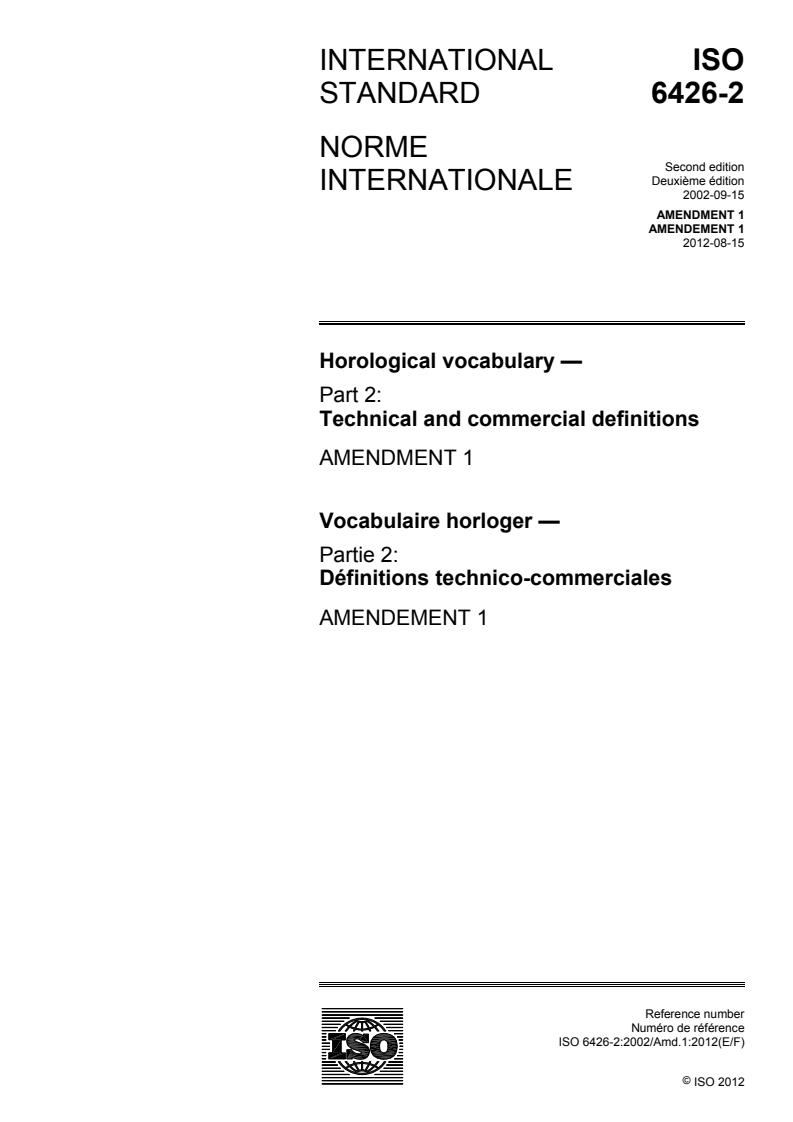
INTERNATIONAL ISO
STANDARD 6426-2
NORME
Second edition
Deuxième édition
INTERNATIONALE
2002-09-15
AMENDMENT 1
AMENDEMENT 1
2012-08-15
Horological vocabulary —
Part 2:
Technical and commercial definitions
AMENDMENT 1
Vocabulaire horloger —
Partie 2:
Définitions technico-commerciales
AMENDEMENT 1
Reference number
Numéro de référence
ISO 6426-2:2002/Amd.1:2012(E/F)
©
ISO 2012
ISO 6426-2:2002/Amd.1:2012(E/F)
DOCUMENT PROTÉGÉ PAR COPYRIGHT
© ISO 2012
All rights reserved. Unless otherwise specified, no part of this publication may be reproduced or utilized in any form or by any means,
electronic or mechanical, including photocopying and microfilm, without permission in writing from either ISO at the address below or
ISO's member body in the country of the requester. / Droits de reproduction réservés. Sauf prescription différente, aucune partie de cette
publication ne peut être reproduite ni utilisée sous quelque forme que ce soit et par aucun procédé, électronique ou mécanique, y compris
la photocopie et les microfilms, sans l'accord écrit de l'ISO à l'adresse ci-après ou du comité membre de l'ISO dans le pays du
demandeur.
ISO copyright office
Case postale 56 CH-1211 Geneva 20
Tel. + 41 22 749 01 11
Fax + 41 22 749 09 47
E-mail copyright@iso.org
Web www.iso.org
Published in Switzerland/Publié en Suisse
ii © ISO 2012 – All rights reserved/Tous droits réservés
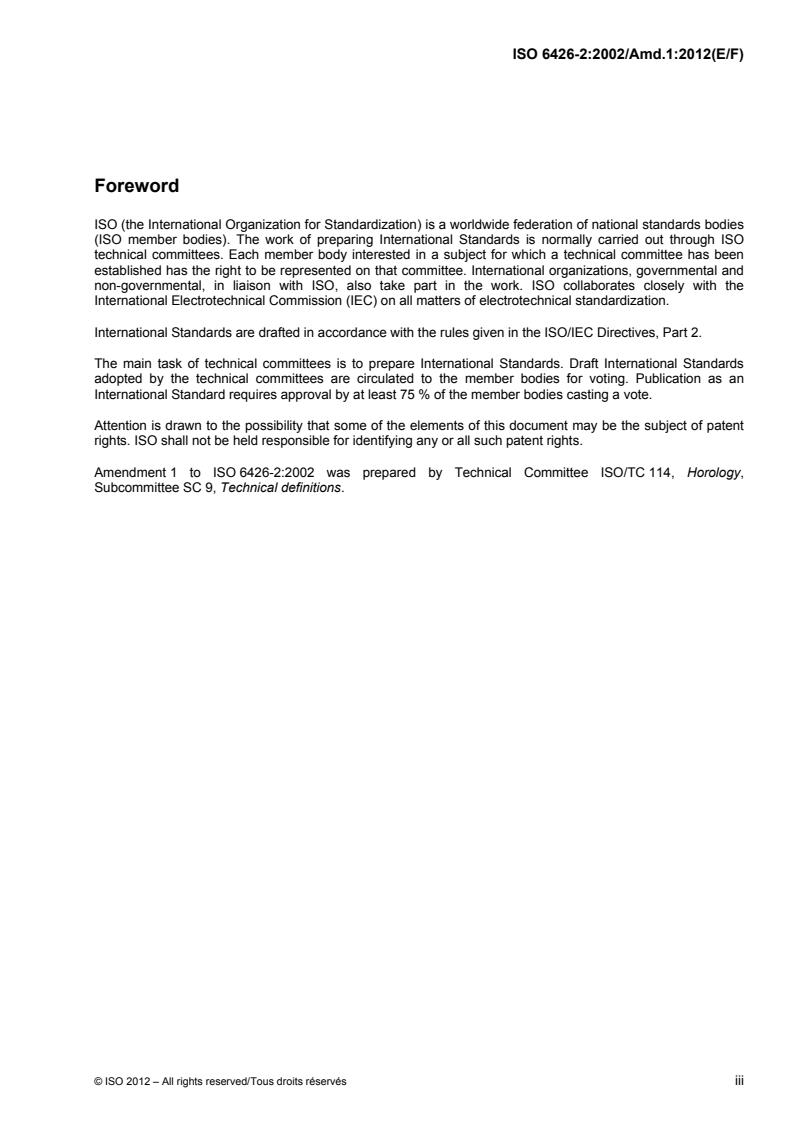
ISO 6426-2:2002/Amd.1:2012(E/F)
Foreword
ISO (the International Organization for Standardization) is a worldwide federation of national standards bodies
(ISO member bodies). The work of preparing International Standards is normally carried out through ISO
technical committees. Each member body interested in a subject for which a technical committee has been
established has the right to be represented on that committee. International organizations, governmental and
non-governmental, in liaison with ISO, also take part in the work. ISO collaborates closely with the
International Electrotechnical Commission (IEC) on all matters of electrotechnical standardization.
International Standards are drafted in accordance with the rules given in the ISO/IEC Directives, Part 2.
The main task of technical committees is to prepare International Standards. Draft International Standards
adopted by the technical committees are circulated to the member bodies for voting. Publication as an
International Standard requires approval by at least 75 % of the member bodies casting a vote.
Attention is drawn to the possibility that some of the elements of this document may be the subject of patent
rights. ISO shall not be held responsible for identifying any or all such patent rights.
Amendment 1 to ISO 6426-2:2002 was prepared by Technical Committee ISO/TC 114, Horology,
Subcommittee SC 9, Technical definitions.
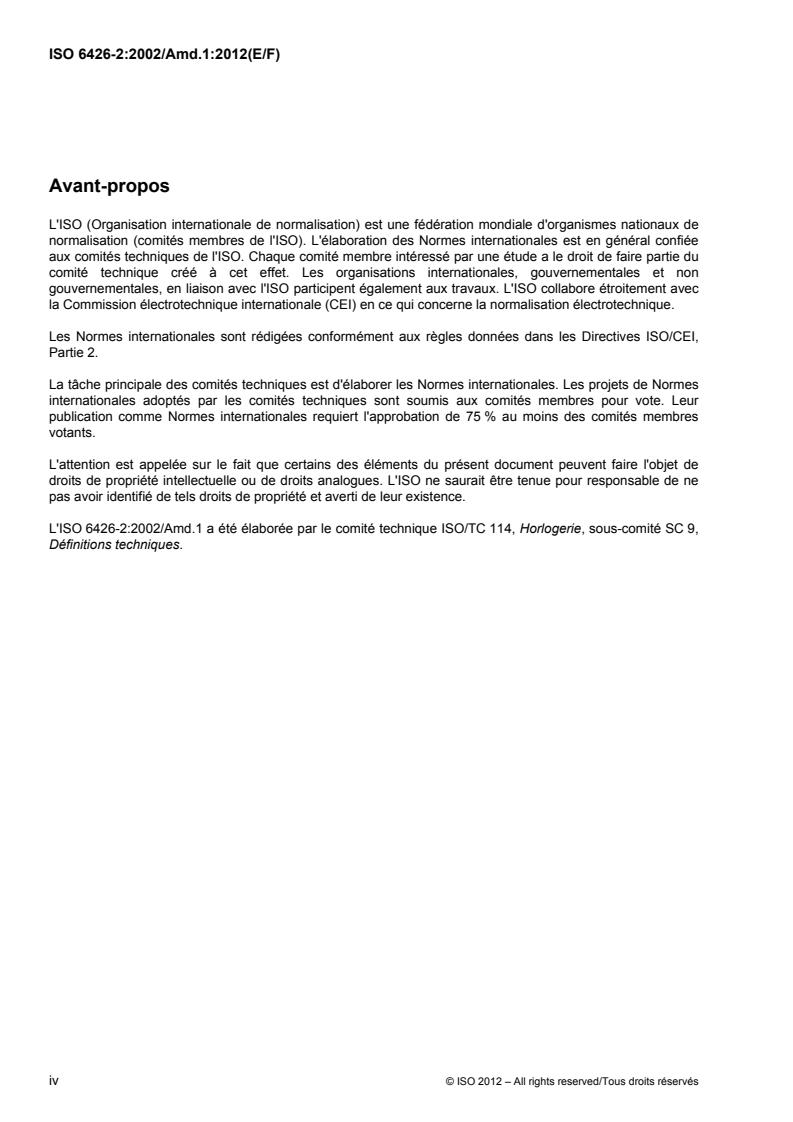
ISO 6426-2:2002/Amd.1:2012(E/F)
Avant-propos
L'ISO (Organisation internationale de normalisation) est une fédération mondiale d'organismes nationaux de
normalisation (comités membres de l'ISO). L'élaboration des Normes internationales est en général confiée
aux comités techniques de l'ISO. Chaque comité membre i
...