

ISO 19338:2025
(Main)Performance requirements for standards on concrete structures
General Information
- Abstract
This document provides performance requirements for standards on concrete structures. It can be used for international alignment of design, assessment and construction requirements. This document includes: a) principles, which guide the selection of requirements that translate societal and owner’s expectations for the performance of the concrete structure; b) requirements, which define the required performance of the concrete structure; c) criteria, which give means for expressing the requirements; d) evaluation clauses, which give acceptable methods of verifying the specific criteria.
- Status
- Published
- Publication Date
- 02-Mar-2025
- Technical Committee
- ISO/TC 71/SC 4 - Performance requirements for structural concrete
- Current Stage
- 9092 - International Standard to be revised
- Start Date
- 18-May-2026
- Completion Date
- 29-Aug-2026
Overview
ISO 19338:2025 - Performance requirements for standards on concrete structures - defines high‑level performance principles and verification methods intended to align international design, assessment and construction requirements for concrete structures. The fourth edition expands scope to include performance requirements for assessment of existing concrete structures and adds new guidance on life‑cycle management, sustainability and durability. ISO 19338:2025 is a reference framework for developing or harmonizing standards that specify how concrete structures should perform over their service life.
Key Topics and Requirements
ISO 19338:2025 sets out structured performance requirements rather than prescriptive solutions. Major technical topics include:
- Principles and general requirements - guidance on translating societal and owner expectations into measurable performance objectives (structural concept, integrity, workmanship, quality assurance).
- Performance requirements and criteria - required performance for structural safety, serviceability, restorability, durability, fire resistance and fatigue, with criteria for expressing those requirements.
- Loadings and actions - treatment of permanent, variable, accidental, seismic, wind and construction loads, including action combinations and load factors.
- Resistance and materials - resistance calculation approaches for flexure, shear, bond/anchorage, bearing, and partial safety factors for materials.
- Performance evaluation methods - acceptable verification routes including theoretical, numerical and experimental analysis for ultimate and serviceability limit states.
- Special systems and detailing - requirements for precast and prestressed concrete, detailing rules, prestress losses and grouting, and earthquake‑resistant design and assessment.
- Durability, fire and sustainability - service life concepts, environmental actions and sustainability evaluation (with an informative Annex on sustainability).
- Construction and quality control - construction requirements and quality assurance provisions for ensuring intended performance in practice.
Practical Applications and Who Uses It
ISO 19338:2025 is used to develop or revise national and international design and assessment standards and to harmonize technical requirements across jurisdictions. Typical users:
- Standards organizations and technical committees (for drafting or aligning design and assessment standards)
- Structural engineers and designers (to interpret performance objectives and verification methods)
- Bridge and building assessors (evaluating existing concrete structures against performance criteria)
- Contractors, precast and prestressing specialists (quality control, workmanship and detailing)
- Owners, asset managers and regulators (defining service life and sustainability targets)
- Test laboratories and research bodies (applying experimental and numerical evaluation methods)
Related Standards (applicable)
ISO 19338:2025 is intended to be used alongside other national and international concrete design and assessment codes and the body of ISO/TC 71 work on concrete, reinforced and prestressed concrete. It provides a performance‑based framework to support harmonization of those prescriptive codes and standards.
Keywords: ISO 19338:2025, concrete structures, performance requirements, design, assessment, durability, service life, fire resistance, seismic design, quality control, sustainability.
Relations
- Revises
ISO 19338:2014 - Performance and assessment requirements for design standards on structural concrete - Effective Date
- 23-Apr-2020
Get Certified
Connect with accredited certification bodies for this standard

DIBt (Deutsches Institut für Bautechnik)
German Institute for Building Technology.
DIN CERTCO
DIN Group product certification.

Aboma Certification B.V.
Specialized in construction, metal, and transport sectors.
Sponsored listings
Frequently Asked Questions
ISO 19338:2025 is a standard published by the International Organization for Standardization (ISO). Its full title is "Performance requirements for standards on concrete structures". This standard covers: This document provides performance requirements for standards on concrete structures. It can be used for international alignment of design, assessment and construction requirements. This document includes: a) principles, which guide the selection of requirements that translate societal and owner’s expectations for the performance of the concrete structure; b) requirements, which define the required performance of the concrete structure; c) criteria, which give means for expressing the requirements; d) evaluation clauses, which give acceptable methods of verifying the specific criteria.
This document provides performance requirements for standards on concrete structures. It can be used for international alignment of design, assessment and construction requirements. This document includes: a) principles, which guide the selection of requirements that translate societal and owner’s expectations for the performance of the concrete structure; b) requirements, which define the required performance of the concrete structure; c) criteria, which give means for expressing the requirements; d) evaluation clauses, which give acceptable methods of verifying the specific criteria.
ISO 19338:2025 is classified under the following ICS (International Classification for Standards) categories: 91.080.40 - Concrete structures. The ICS classification helps identify the subject area and facilitates finding related standards.
ISO 19338:2025 has the following relationships with other standards: It is inter standard links to ISO 19338:2014. Understanding these relationships helps ensure you are using the most current and applicable version of the standard.
ISO 19338:2025 is available in PDF format for immediate download after purchase. The document can be added to your cart and obtained through the secure checkout process. Digital delivery ensures instant access to the complete standard document.
Standards Content (Sample)
International
Standard
ISO 19338
Fourth edition
Performance requirements for
2025-03
standards on concrete structures
Exigences de performance pour les normes relatives aux
structures en béton
Reference number
© ISO 2025
All rights reserved. Unless otherwise specified, or required in the context of its implementation, no part of this publication may
be reproduced or utilized otherwise in any form or by any means, electronic or mechanical, including photocopying, or posting on
the internet or an intranet, without prior written permission. Permission can be requested from either ISO at the address below
or ISO’s member body in the country of the requester.
ISO copyright office
CP 401 • Ch. de Blandonnet 8
CH-1214 Vernier, Geneva
Phone: +41 22 749 01 11
Email: copyright@iso.org
Website: www.iso.org
Published in Switzerland
ii
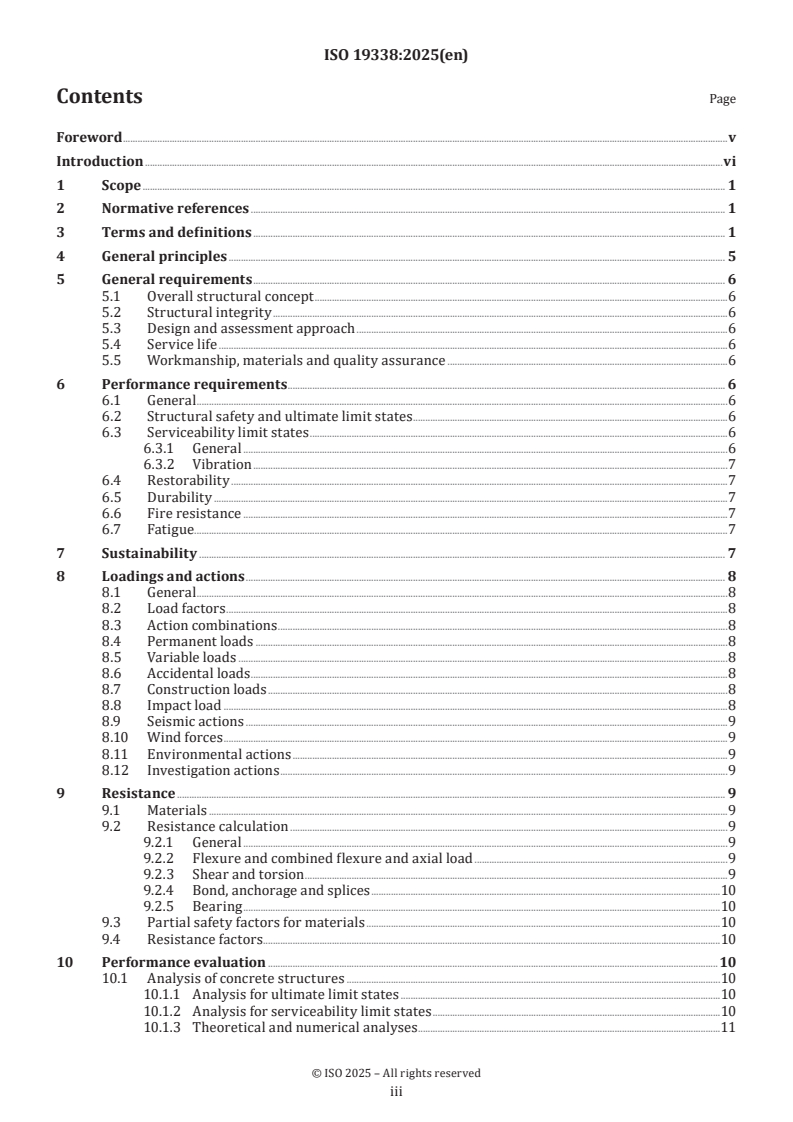
Contents Page
Foreword .v
Introduction .vi
1 Scope . 1
2 Normative references . 1
3 Terms and definitions . 1
4 General principles . 5
5 General requirements . 6
5.1 Overall structural concept .6
5.2 Structural integrity .6
5.3 Design and assessment approach .6
5.4 Service life .6
5.5 Workmanship, materials and quality assurance .6
6 Performance requirements . . 6
6.1 General .6
6.2 Structural safety and ultimate limit states .6
6.3 Serviceability limit states .6
6.3.1 General .6
6.3.2 Vibration .7
6.4 Restorability .7
6.5 Durability .7
6.6 Fire resistance .7
6.7 Fatigue .7
7 Sustainability . 7
8 Loadings and actions . 8
8.1 General .8
8.2 Load factors .8
8.3 Action combinations .8
8.4 Permanent loads .8
8.5 Variable loads .8
8.6 Accidental loads .8
8.7 Construction loads .8
8.8 Impact load .8
8.9 Seismic actions .9
8.10 Wind forces .9
8.11 Environmental actions .9
8.12 Investigation actions .9
9 Resistance . 9
9.1 Materials .9
9.2 Resistance calculation .9
9.2.1 General .9
9.2.2 Flexure and combined flexure and axial load .9
9.2.3 Shear and torsion .9
9.2.4 Bond, anchorage and splices .10
9.2.5 Bearing .10
9.3 Partial safety factors for materials .10
9.4 Resistance factors .10
10 Per f or m a nc e ev a lu at ion .10
10.1 Analysis of concrete structures .10
10.1.1 Analysis for ultimate limit states .10
10.1.2 Analysis for serviceability limit states .10
10.1.3 Theoretical and numerical analyses .11
iii
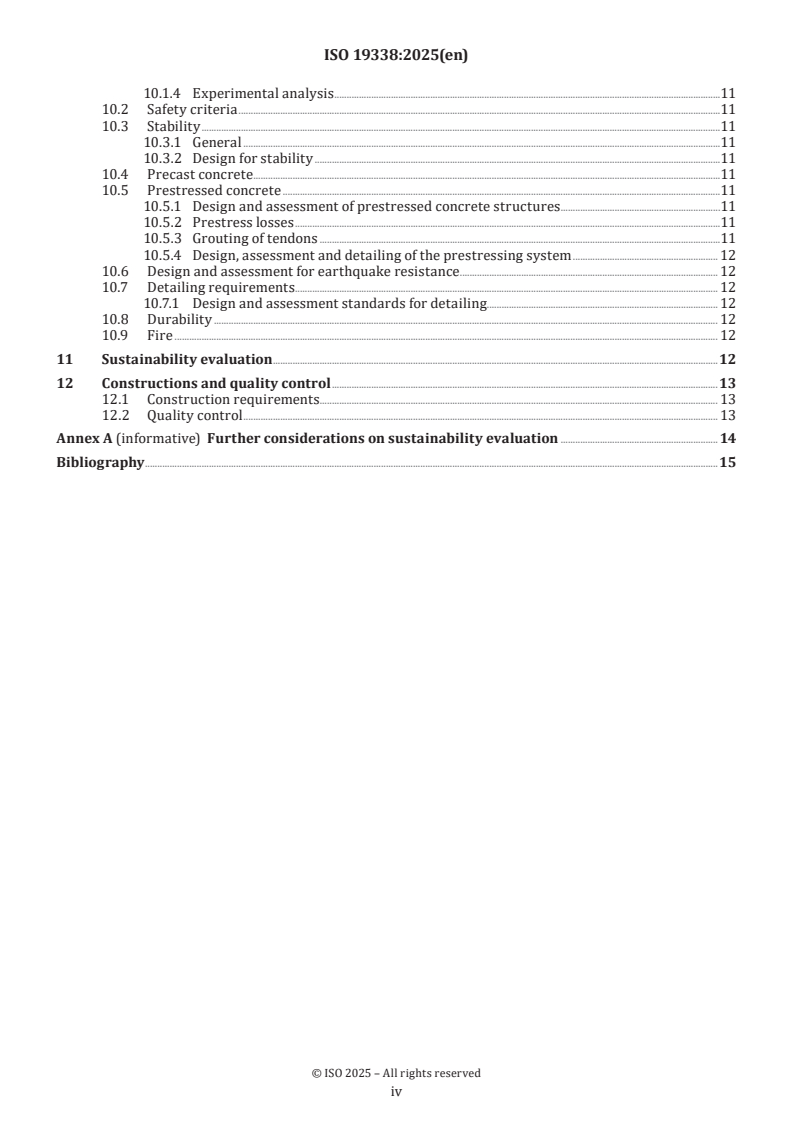
10.1.4 Experimental analysis .11
10.2 Safety criteria .11
10.3 Stability .11
10.3.1 General .11
10.3.2 Design for stability .11
10.4 Precast concrete . .11
10.5 Prestressed concrete .11
10.5.1 Design and assessment of prestressed concrete structures .11
10.5.2 Prestress losses .11
10.5.3 Grouting of tendons .11
10.5.4 Design, assessment and detailing of the prestressing system . 12
10.6 Design and assessment for earthquake resistance . 12
10.7 Detailing requirements . . 12
10.7.1 Design and assessment standards for detailing. 12
10.8 Durability . 12
10.9 Fire . 12
11 Sustainability evaluation . .12
12 Constructions and quality control .13
12.1 Construction requirements. 13
12.2 Quality control . 13
Annex A (informative) Further considerations on sustainability evaluation . 14
Bibliography .15
iv
Foreword
ISO (the International Organization for Standardization) is a worldwide federation of national standards
bodies (ISO member bodies). The work of preparing International Standards is normally carried out through
ISO technical committees. Each member body interested in a subject for which a technical committee
has been established has the right to be represented on that committee. International organizations,
governmental and non-governmental, in liaison with ISO, also take part in the work. ISO collaborates closely
with the International Electrotechnical Commission (IEC) on all matters of electrotechnical standardization.
The procedures used to develop this document and those intended for its further maintenance are described
in the ISO/IEC Directives, Part 1. In particular, the different approval criteria needed for the different types
of ISO document should be noted. This document was drafted in accordance with the editorial rules of the
ISO/IEC Directives, Part 2 (see www.iso.org/directives).
ISO draws attention to the possibility that the implementation of this document may involve the use of (a)
patent(s). ISO takes no position concerning the evidence, validity or applicability of any claimed patent
rights in respect thereof. As of the date of publication of this document, ISO had not received notice of (a)
patent(s) which may be required to implement this document. However, implementers are cautioned that
this may not represent the latest information, which may be obtained from the patent database available at
www.iso.org/patents. ISO shall not be held responsible for identifying any or all such patent rights.
Any trade name used in this document is information given for the convenience of users and does not
constitute an endorsement.
For an explanation of the voluntary nature of standards, the meaning of ISO specific terms and expressions
related to conformity assessment, as well as information about ISO's adherence to the World Trade
Organization (WTO) principles in the Technical Barriers to Trade (TBT), see www.iso.org/iso/foreword.html.
This document was prepared by Technical Committee ISO/TC 71, Concrete, reinforced concrete and pre-
stressed concrete, Subcommittee SC 4, Performance requirements for structural concrete.
This fourth edition cancels and replaces the third edition (ISO 19338:2014), which has been technically
revised.
The main changes are as follows:
— title has been revised in order to best reflect the new Scope;
— Scope has been expanded, now including performance requirements for standards on assessment of
existing concrete structures;
— Normative references has been revised;
— Terms and definitions has been expanded;
— new Clause 4 on general principles guiding the design of new concrete structures and the assessment of
existing ones has been included, with an emphasis on life cycle management;
— new Clauses 7 and 11, and Annex A have been added;
— former Clause 7, Assessment, has been reorganized into two new Clauses 9 and 10.
Any feedback or questions on this document should be directed to the user’s national standards body. A
complete listing of these bodies can be found at www.iso.org/members.html.
v
Introduction
Concrete is the most popular material used in the construction market. Presently, about four tonnes of
concrete are produced each year for every human being in the world (some 32 billion tonnes per year). This
also translates into an omnipresence of concrete structures in the built environment, which, in turn, are
managed during their life cycle under the constraints of sustainability.
International Standards on concrete technology and concrete structures can play a significant role in
improving the global trade climate. International Standards in the field of concrete and its use in civil
infrastructure are increasingly needed as the economic development of the world continues and new
problems are identified.
Both developed and developing countries currently face the challenge of designing and building new
structures while managing an aging built environment under economic and sustainability constraints.
Consequently, standardization should be pursued not only of the design of new concrete structures, but also
of the assessment of existing concrete structures.
It is important for uncertainties to be dealt with in the design and assessment of concrete structures. These
can be related to inherent variability such as material properties, dimensions, and loads, or epistemic
uncertainties, i.e. those related to the lack of (or limited) knowledge. In this latter category, there are errors
associated with predictive models, sampling errors and measurement errors.
Design standards for new concrete structures allow for uncertainties in the design and construction
[8]
processes; on the other hand, much of what was initially uncertain is no longer in the finished structure .
However, the determination of the actual values of various parameters (e.g. in situ concrete compressive
strengths and area of longitudinal reinforcement) in the existing concrete structure introduces uncertainty
of its own. The structure can have undergone a deterioration process, such as corrosion of the reinforcement
or been damaged by accidental actions. Additionally, economic, social and environmental considerations can
result in a greater differentiation in structural reliability for the assessment of existing structures than for
the design of new structures (ISO 13822). As a result, standards for the assessment of existing concrete
structures should recognize the differences between the assessment of existing concrete structures and the
design of new ones.
This document gives the performance requirements for design, assessment or design and assessment
standards on concrete structures. This document provides general provisions and guidelines, and is
intended to provide wide latitude of choice in terms of general requirements for the performance evaluation
of concrete structures. It should be used, therefore, in conjunction with sound engineering judgment.
1)
ISO/TC 71/SC 4 has defined a procedure to review codes and standards for general alignment with
ISO 19338. Summaries of these reviews are shared with the Code or standard authors, and potential
beneficial changes to ISO 19338 are shared with SC 4 for review and implementation. These comparable
national and regional standards are generally more prescriptive in nature than International Standards and
vary somewhat from region to region.
1) Document publicly accessible at: https://www.iso.org/committee/49920.html?view=documents
vi
International Standard ISO 19338:2025(en)
Performance requirements for standards on concrete
structures
1 Scope
This document provides performance requirements for standards on concrete structures. It can be used for
international alignment of design, assessment and construction requirements.
This document includes:
a) principles, which guide the selection of requirements that translate societal and owner’s expectations
for the performance of the concrete structure;
b) requirements, which define the required performance of the concrete structure;
c) criteria, which give means for expressing the requirements;
d) evaluation clauses, which give acceptable methods of verifying the specific criteria.
2 Normative references
The following documents are referred to in the text in such a way that some or all of their content constitutes
requirements of this document. For dated references, only the edition cited applies. For undated references,
the latest edition of the referenced document (including any amendments) applies.
ISO 2394, General principles on reliability for structures
3 Terms and definitions
For the purposes of this document, the following terms and definitions apply.
ISO and IEC maintain terminology databases for use in standardization at the following addresses:
— ISO Online browsing platform: available at https:// www .iso .org/ obp
— IEC Electropedia: available at https:// www .electropedia .org/
3.1
accidental action
action (3.2) whose chance of occurrence is very small, but the intensity is very large compared with variable
actions (3.37)
3.2
action
assembly of concentrated or distributed mechanical forces acting on/in a structure (direct actions),
deformations imposed on the structure or contained within it (indirect actions), or environmental actions (3.9)
3.3
analysis
procedure or algorithm for determination of action effects
Note 1 to entry: It is an acceptable method of evaluating the performance index or verifying compliance with specific
criteria (3.5) of a structure.
3.4
assessment
set of activities carried out in order to verify the performance of an existing structure for future use
3.5
criteria
means of expressing the performance requirement (3.20) for concrete structures by specific technical values
and appropriate limits
3.6
design service life
period of time specified in the design of a structure for which a structure or its members is to be used for its
intended purpose without major repair (3.23) being necessary
[SOURCE: ISO 16311-1:2024, 3.3, modified — Note 1 to entry and Figure 2 were removed.]
3.7
deterioration
process that adversely affects the structural performance (3.33) including reliability (3.22) over time
Note 1 to entry: Deterioration may be caused by naturally occurring chemical, physical, or biological action (3.2),
normal or severe environmental actions (3.9), repeated actions such as those causing fatigue, wear due to use, and
improper operation and maintenance (3.15) of the structure.
[SOURCE: ISO 2394:2015, 2.1.31]
3.8
durability
ability of a structure or any of its components to perform its required functions in its service environment
over a period of time without unforeseen cost for maintenance (3.15) or repair (3.23)
[SOURCE: ISO 17738-1:2021,3.1.7, modified — “building” has been replaced by “structure”.]
3.9
environmental actions
assembly of physical, chemical or biological influences which may cause restraint effects or deterioration
(3.7) to the materials making up the structure, which in turn may adversely affect its serviceability (3.30),
durability (3.8), safety (3.29) and restorability (3.27)
3.10
experimental analysis
analysis (3.3) using physical models (3.17) to determine load-carrying capacity and serviceability (3.30) of
prototype design
3.11
investigation
collection of information through inspection, document search, load testing or other methods
[SOURCE: ISO 16311-1:2024, 3.7, modified — “and other testing” has been replaced by “or other methods”.]
3.12
life cycle management
set of systematic and coordinated activities and practices through which a structure is appropriately
managed over its life cycle
[SOURCE: ISO 22040:2021, 3.2, modified — The acronym "LCM" was removed.]
3.13
limit state
state beyond which a structure no longer satisfies the design requirements
[SOURCE: ISO 2394:2015, 2.2.7, modified — “criteria” has been replaced by “requirements”.]
3.14
load factor
multiplier applied to the representative value of a load (3.24), defined according to a reliability-based design
procedure that takes into account the uncertainty and variability of the corresponding action (3.2)
3.15
maintenance
set of activities taken to check, evaluate, and preserve or restore the performance of a structure, so as to
satisfy a performance requirement (3.20) in service
3.16
maintenance plan
plan realizing maintenance (3.15) strategy in order to ensure that the structure retains the performance
within the specified tolerances throughout its service life
[SOURCE: ISO 16311-1:2024, 3.10, modified — Note 1 to entry was removed.]
3.17
model
physical, mathematical or numerical idealization of actions (3.2) and structural behaviour used for the
purposes of analysis (3.3), design and verification
3.18
partial safety factors for materials
divisors applied to the material characteristic strength in general conformance with reliability-based design
requirements
Note 1 to entry: See also resistance factor (3.26).
3.19
perf
...