

ISO 9704:1990
(Main)Passenger cars — Wiper systems — Shaft ends and arm-holes
General Information
- Abstract
Specifies the main dimensions and general requirements for wiper arm to shaft end connections of wiper systems. Gives the preferred type 1; the normative annex A includes the non-preferred type 2.
- Status
- Published
- Publication Date
- 12-Dec-1990
- Technical Committee
- ISO/TC 22/SC 35 - Lighting and visibility
- Drafting Committee
- ISO/TC 22/SC 35/WG 3 - Visibility
- Current Stage
- 9093 - International Standard confirmed
- Start Date
- 23-Oct-2023
- Completion Date
- 29-Aug-2026
Buy Documents

ISO 9704:1990 - Passenger cars — Wiper systems — Shaft ends and arm-holes Released:12/13/1990
ISO 9704:1990 - Voitures particulieres — Dispositifs d'essuie-glace — Bouts d'axes de fixation et trou de fixation sur le porte-balai Released:12/13/1990


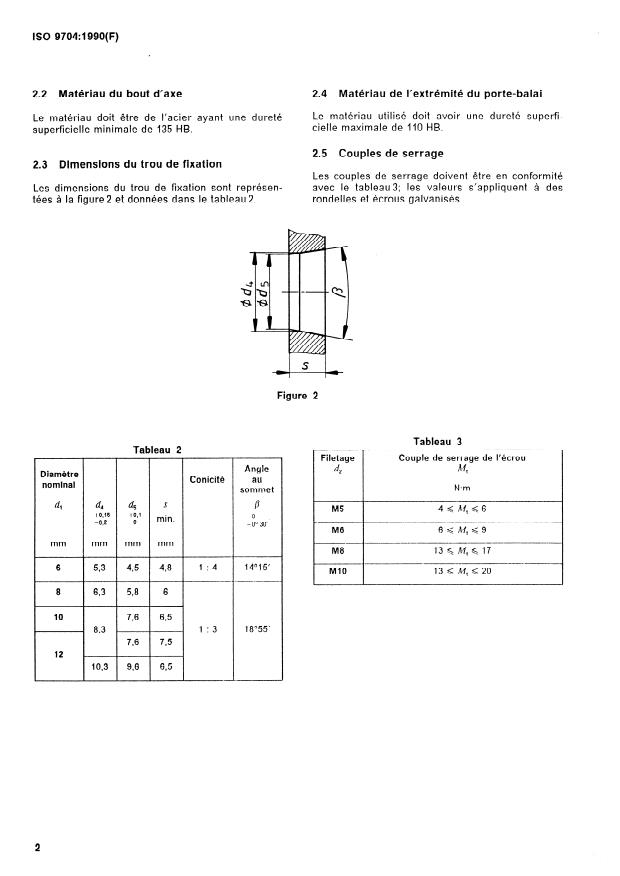
ISO 9704:1990 - Voitures particulieres — Dispositifs d'essuie-glace — Bouts d'axes de fixation et trou de fixation sur le porte-balai Released:12/13/1990
Overview
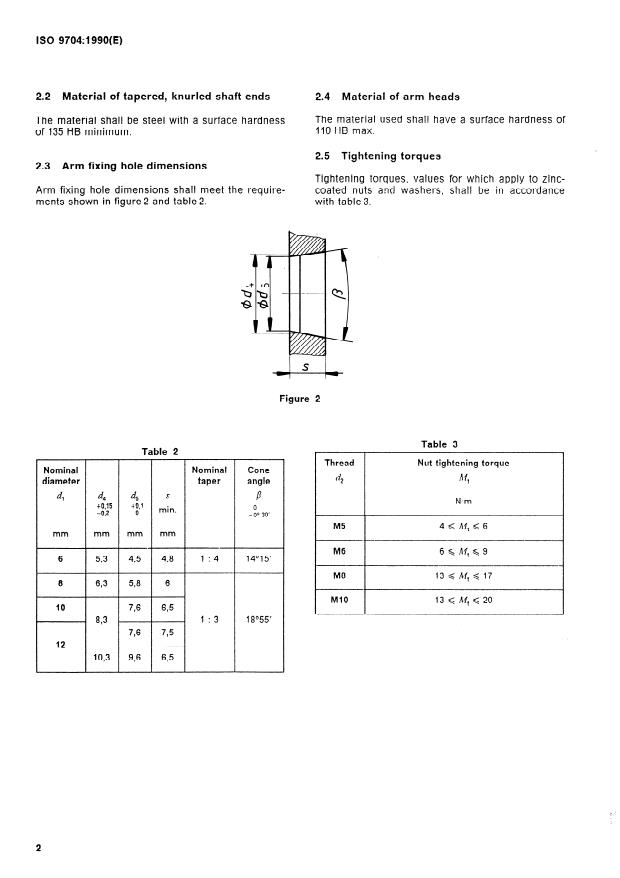
ISO 9704:1990 specifies the main dimensions and general requirements for wiper arm to shaft end connections used on passenger cars. The standard defines preferred and non-preferred connector types, dimensional drawings and tables, material and hardness limits, and fastening requirements to ensure reliable mechanical engagement between wiper arms and shaft ends. Although written for passenger cars, ISO 9704 can be applied to other vehicle classes where no specific international standard exists.
Key topics and technical requirements
- Connector types
- Type 1 (preferred): Conical, knurled shaft ends (normative in the main text).
- Type 2 (non-preferred, Annex A): Knurled-drive (entraîneur) shaft ends with a locking system - provided as a normative annex for markets where this form remains common.
- Dimensions and profiles
- Principal dimensions for shaft ends and arm-holes are given in figures and tables in the standard; tooth/profile geometry requirements (e.g., tooling tooth apex angle) are specified for repeatable manufacturing.
- Materials and hardness
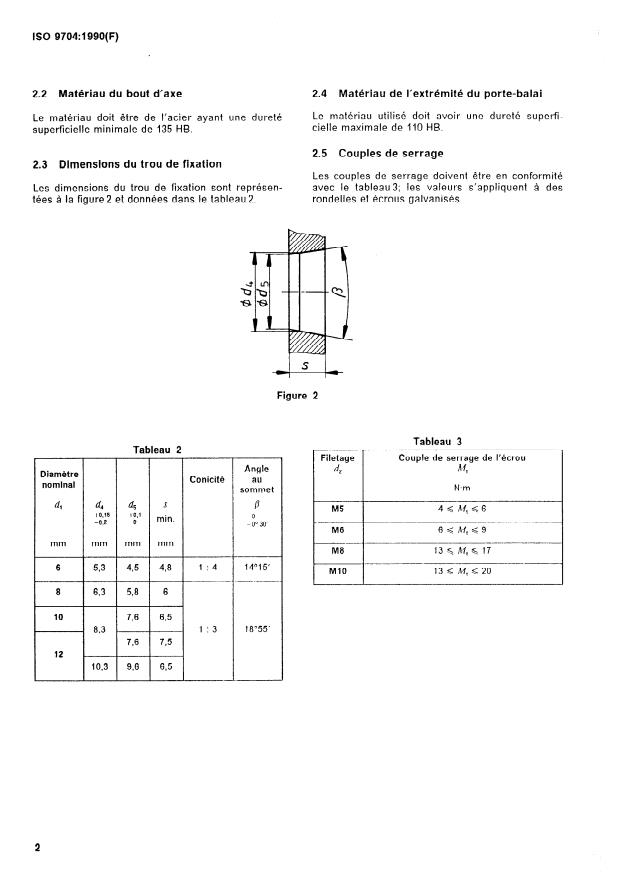
- Shaft-end material: Steel with a specified minimum superficial hardness (document gives minimum 135 HB).
- Wiper arm/arm-hole material: Maximum superficial hardness specified (document gives maximum 110 HB).
- Type 2 materials: Knurled driver made from zinc alloy or sintered iron; arm end may be zinc or aluminium alloy (Annex A).
- Fastening and torque
- Recommended tightening torques are specified by nominal thread size and apply to assemblies with washers and galvanized nuts (torque values are provided in the standard tables).
- Coatings and tolerances
- Dimensional allowances for painted or coated fittings are addressed (Annex A guidance on increasing hole dimensions when coatings are applied).
Applications and who uses this standard
- Automotive OEM design and engineering teams specifying wiper system interfaces
- Component suppliers (wiper arms, motor shafts, repair parts) ensuring interchangeability
- Aftermarket manufacturers and fitment engineers matching replacement parts
- Quality, test and regulatory laboratories validating mechanical fit, hardness, and torque
- Vehicle homologation and procurement teams seeking standardized wiper interface specifications
Related standards
- ISO 9704 was developed by ISO/TC 22 (Road vehicles). It complements other vehicle component and safety standards covering wipers and windshield systems; users should consult relevant ISO/TC 22 standards for broader wiper-system requirements.
Keywords: ISO 9704, wiper systems, shaft ends, arm-holes, passenger cars, wiper arm connection, knurled shaft, conical shaft, material hardness, tightening torque.
Buy Documents
ISO 9704:1990 - Passenger cars — Wiper systems — Shaft ends and arm-holes Released:12/13/1990
ISO 9704:1990 - Voitures particulieres — Dispositifs d'essuie-glace — Bouts d'axes de fixation et trou de fixation sur le porte-balai Released:12/13/1990
ISO 9704:1990 - Voitures particulieres — Dispositifs d'essuie-glace — Bouts d'axes de fixation et trou de fixation sur le porte-balai Released:12/13/1990
Get Certified
Connect with accredited certification bodies for this standard

TÜV Rheinland
TÜV Rheinland is a leading international provider of technical services.

TÜV SÜD
TÜV SÜD is a trusted partner of choice for safety, security and sustainability solutions.

DEKRA Certification Inc.
DEKRA US certification services.
Sponsored listings
Frequently Asked Questions
ISO 9704:1990 is a standard published by the International Organization for Standardization (ISO). Its full title is "Passenger cars — Wiper systems — Shaft ends and arm-holes". This standard covers: Specifies the main dimensions and general requirements for wiper arm to shaft end connections of wiper systems. Gives the preferred type 1; the normative annex A includes the non-preferred type 2.
Specifies the main dimensions and general requirements for wiper arm to shaft end connections of wiper systems. Gives the preferred type 1; the normative annex A includes the non-preferred type 2.
ISO 9704:1990 is classified under the following ICS (International Classification for Standards) categories: 43.040.65 - Glazing and wiper systems. The ICS classification helps identify the subject area and facilitates finding related standards.
ISO 9704:1990 is available in PDF format for immediate download after purchase. The document can be added to your cart and obtained through the secure checkout process. Digital delivery ensures instant access to the complete standard document.
Standards Content (Sample)
INTERNATIONAL
STANDARD
First edition
1990-l 2-15
Passenger cars - Wiper systems - Shaft ends
and arm-holes
-
Voitures particulifkes Dispositifs d’essuie-g/ace - Bouts d’axes de
fixation et trou de fixa tio n SW- le Porte-baiai
Reference number
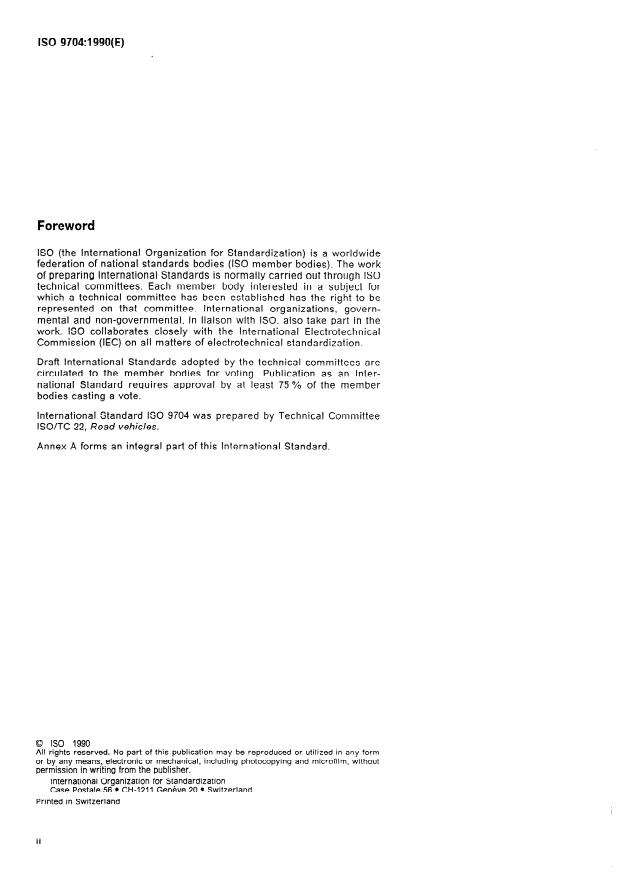
IS0 9704: 1990(E)
IS0 9704:1990(E)
Foreword
IS0 (the International Organization for Standardization) is a worldwide
federation of national standards bodies (IS0 member bodies). The work
of preparing International Standards is normally carried out through IS0
technical committees. Each member body interested in a subject for
which a technical committee has been established has the right to be
represented on that committee. International organizations, govern-
mental and non-governmental, in liaison with ISO, also take part in the
work. IS0 collaborates closely with the International Electrotechnical
Commission (IEC) on all matters of electrotechnical standardization.
Draft International Standards adopted by the technical committees are
circulated to the member bodies for voting. Publication as an lnter-
national Standard requires approval by at least 75 % of the member
bodies casting a vote.
International Standard IS0 9704 was prepared by Technical Committee
ISO/TC 22, Road vehicles.
Annex A forms an integral part of this International Standard.
0 IS0 1990
All rights reserved. No part of this publication may be reproduced or utilized in any form
or by any means, electronic or mechanical, including photocopying and microfilm, without
permission in writing from the publisher.
International Organizati on for Standardization
Case Postale 56 l CH-1 211 Gen6ve 20 l Switzerl and
Printed in Switzerland
ii
IS0 9704:1990(E)
INTERNATIONAL STANDARD
- Wiper systems - Shaft ends and arm-holes
Passenger cars
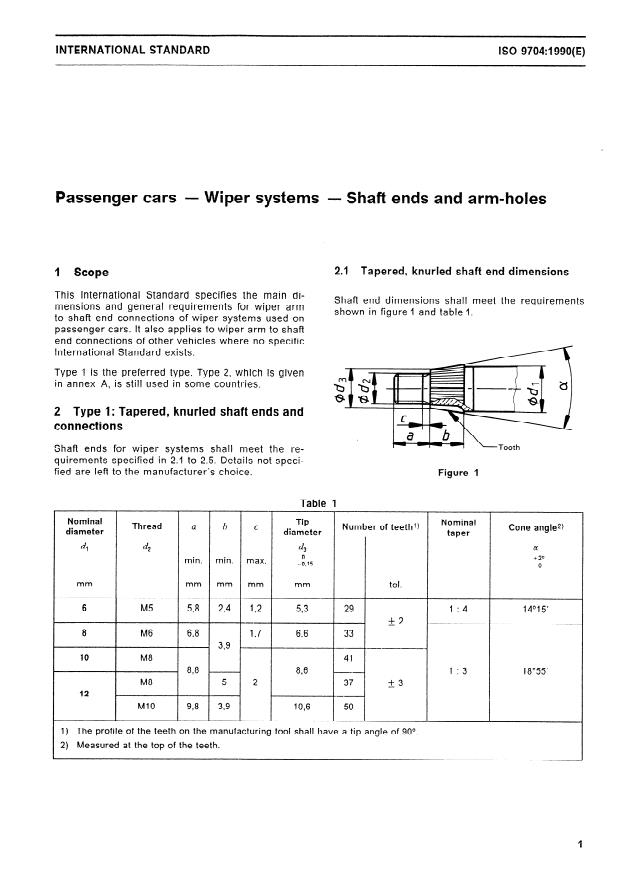
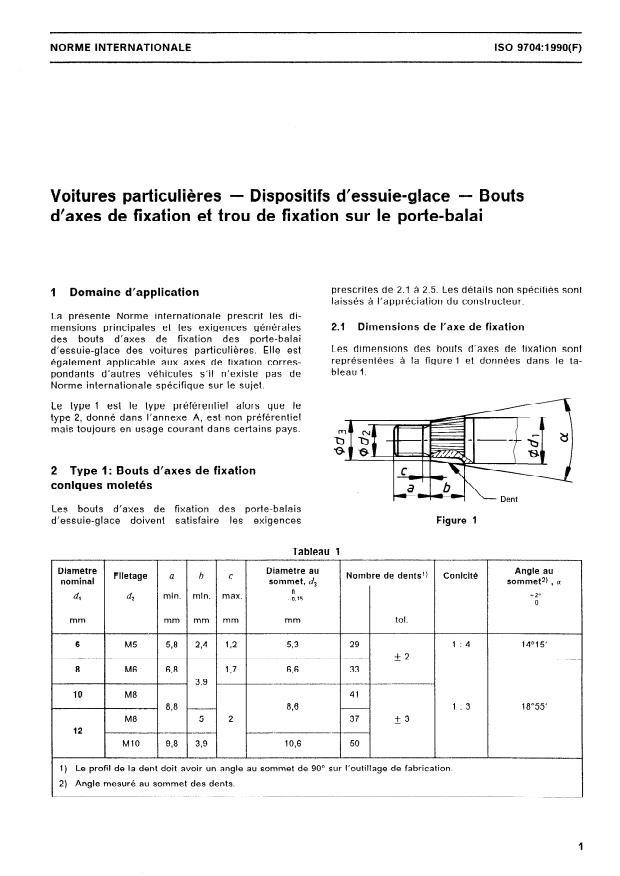
Tapered, knurled shaft end dimensions
2.1
1 Scope
This International Standard specifies the main di-
Shaft end dimensions shall meet the requirements
mensions and general requirements for wiper arm
shown in figure 1 and table I.
to shaft end connections of wiper systems used on
passenger cars. It also applies to wiper arm to shaft
end connections of other vehicles where no specific
International Standard exists.
Type 1 is the preferred type. Type 2, which is given
in annex A, is still used in some countries.
2 Type 1: Tapered, knurled shaft ends and
connections
Shaft ends for wiper systems shall meet the re-
quirements specified in 2.1 to 2.5. Details not speci-
Figure 1
fied are left to the manufacturer’s choice.
Table 1
Nominal Tip Nominal
Number of teeth’) Cone angle2)
Thread a h c
taper
diameter diameter
oc
4 n'2 d3
0 +2O
min. min. max.
--0,15
mm mm mm mm mm tol.
114 14O15’
5,8 2,4 1,2 593 29
6 M5
.- ----
- rf:2
197 676 33
8 M6 68
’ 33 -
10 M8
113 18O55’
1 83
37 t3
M8 5 2
-
Ml0 9,8 3,9 10,6
1) The profile of the teeth on the manufacturing tool shall have a tip angle of 90°.
Measured at the top
...
NORME
INTERNATIONALE
Première édition
1990-12-15
Voitures particulières - Dispositifs
Bouts d’axes de fixation et
d’essuie-glace -
trou de fixation sur le porte-balai
Passenger cars - Wiper systems - Shaft ends and arm-holes
--_--I_.------ ---- --
-- PP
Numbro de référence
ISO 9704: 1990(F)
Avant-propos
L’ISO (Organisation internationale de normalisation) est une fédération
mondiale d’organismes nationaux de normalisation (comités membres
de I’ISO). L’élaboration des Normes internationales est en général
confiée aux comités techniques de I’ISO. Chaque comité membre inté-
ressé par une étude a le droit de faire partie du comité technique créé
à cet effet. Les organisations internationales, gouvernementales et non
gouvernementales, en liaison avec I’ISO participent également aux tra-
vaux. L’ISO collabore étroitement avec la Commission électrotechnique
internationale (CEI) en ce qui concerne la normalisation éiectrotech-
nique.
Les projets de Normes internationales adoptés par les comités techni-
ques sont soumis aux comités membres pour vote. Leur publication
comme Normes internationales requiert l’approbation de 75 % au moins
des comités membres votants.
La Norme internationale ISO 9704 a été élaborée par le comité techni-
que ISO/TC 22, Véhicules routiers.
L’annexe A fait partie intégrante de la présente Norme internationale.
0 ISO 1990
Droits de reproduction réservés. Aucune partie de cette publication ne peut être repro-
duite ni utilisée sous quelque forme que ce soit et par aucun procédé, électronique ou
mécanique, y compris la photocopie et les microfilms, sans l’accord écrit de l’éditeur.
Organisation internationale de normalisation
56 l CH-1211
Case Postale Genève 20 l Suisse
Imprimé en Suisse
ii
NORIUIE INTERNATIONALE
Voitures particulières - Dispositifs d’essuie-glace - Bouts
d’axes de fixation et trou de fixation sur le porte-balai
prescrites de 2.1 à 2.5. Les détails non spécifiés sont
1 Domaine d’application
laissés à l’appréciation du constructeur.
La présente Norme internationale prescrit les di-
2.1 Dimensions de l’axe de fixation
mensions principales et les exigences générales
des bouts d’axes de fixation des porte-balai
Les dimensions des bouts d’axes de fixation sont
d’essuie-glace des voitures particulières. Elle est
représentées à la figure 1 et données dans le ta-
également applicable aux axes de fixation corres-
bleau 1.
pondants d’autres véhicules s’il n’existe pas de
Norme internationale spécifique sur le sujet.
Le type 1 est le type préférentiel alors que le
type 2, donné dans l’annexe A, est non préférentiel
mais toujours en usage courant dans cet-tains pays.
2 Type 1: Bouts d’axes de fixation
coniques moletés
Les bouts d’axes de fixation des porte-balais
d’essuie-glace doivent satisfaire les exigences Figure 1
Tableau 1
--
1 1 1 1 1
Diamètre au Angle au
Diamètre
Filetage Q h (3 Nombre de dents’) Conicité
sommet*) , OC
nominal sommet, dg
+2O
min. min. max.
4 d2 --0,15
mm mm bl.
mm mm mm mm mm mm mm mm
6 M5 5,8 2,4 1,2 29 1:4 14Ol5’
6 M5 5,8 2,4 1,2 5,3 5,3
- --------
+2
--
8 8 M6 M6 68 68 197 197 696 696
._----
4 4 399 399
10 10 M8 M8
1:3 18’55’
1 1 898 898 876 876
M8 M8 5 5 2 2
m-.- m-.- W^- W^-
...
NORME
INTERNATIONALE
Première édition
1990-12-15
Voitures particulières - Dispositifs
Bouts d’axes de fixation et
d’essuie-glace -
trou de fixation sur le porte-balai
Passenger cars - Wiper systems - Shaft ends and arm-holes
--_--I_.------ ---- --
-- PP
Numbro de référence
ISO 9704: 1990(F)
Avant-propos
L’ISO (Organisation internationale de normalisation) est une fédération
mondiale d’organismes nationaux de normalisation (comités membres
de I’ISO). L’élaboration des Normes internationales est en général
confiée aux comités techniques de I’ISO. Chaque comité membre inté-
ressé par une étude a le droit de faire partie du comité technique créé
à cet effet. Les organisations internationales, gouvernementales et non
gouvernementales, en liaison avec I’ISO participent également aux tra-
vaux. L’ISO collabore étroitement avec la Commission électrotechnique
internationale (CEI) en ce qui concerne la normalisation éiectrotech-
nique.
Les projets de Normes internationales adoptés par les comités techni-
ques sont soumis aux comités membres pour vote. Leur publication
comme Normes internationales requiert l’approbation de 75 % au moins
des comités membres votants.
La Norme internationale ISO 9704 a été élaborée par le comité techni-
que ISO/TC 22, Véhicules routiers.
L’annexe A fait partie intégrante de la présente Norme internationale.
0 ISO 1990
Droits de reproduction réservés. Aucune partie de cette publication ne peut être repro-
duite ni utilisée sous quelque forme que ce soit et par aucun procédé, électronique ou
mécanique, y compris la photocopie et les microfilms, sans l’accord écrit de l’éditeur.
Organisation internationale de normalisation
56 l CH-1211
Case Postale Genève 20 l Suisse
Imprimé en Suisse
ii
NORIUIE INTERNATIONALE
Voitures particulières - Dispositifs d’essuie-glace - Bouts
d’axes de fixation et trou de fixation sur le porte-balai
prescrites de 2.1 à 2.5. Les détails non spécifiés sont
1 Domaine d’application
laissés à l’appréciation du constructeur.
La présente Norme internationale prescrit les di-
2.1 Dimensions de l’axe de fixation
mensions principales et les exigences générales
des bouts d’axes de fixation des porte-balai
Les dimensions des bouts d’axes de fixation sont
d’essuie-glace des voitures particulières. Elle est
représentées à la figure 1 et données dans le ta-
également applicable aux axes de fixation corres-
bleau 1.
pondants d’autres véhicules s’il n’existe pas de
Norme internationale spécifique sur le sujet.
Le type 1 est le type préférentiel alors que le
type 2, donné dans l’annexe A, est non préférentiel
mais toujours en usage courant dans cet-tains pays.
2 Type 1: Bouts d’axes de fixation
coniques moletés
Les bouts d’axes de fixation des porte-balais
d’essuie-glace doivent satisfaire les exigences Figure 1
Tableau 1
--
1 1 1 1 1
Diamètre au Angle au
Diamètre
Filetage Q h (3 Nombre de dents’) Conicité
sommet*) , OC
nominal sommet, dg
+2O
min. min. max.
4 d2 --0,15
mm mm bl.
mm mm mm mm mm mm mm mm
6 M5 5,8 2,4 1,2 29 1:4 14Ol5’
6 M5 5,8 2,4 1,2 5,3 5,3
- --------
+2
--
8 8 M6 M6 68 68 197 197 696 696
._----
4 4 399 399
10 10 M8 M8
1:3 18’55’
1 1 898 898 876 876
M8 M8 5 5 2 2
m-.- m-.- W^- W^-
...