


ISO 11983:2025
(Main)Road vehicles — Safety glazing materials — Test methods for electro-switchable glazing
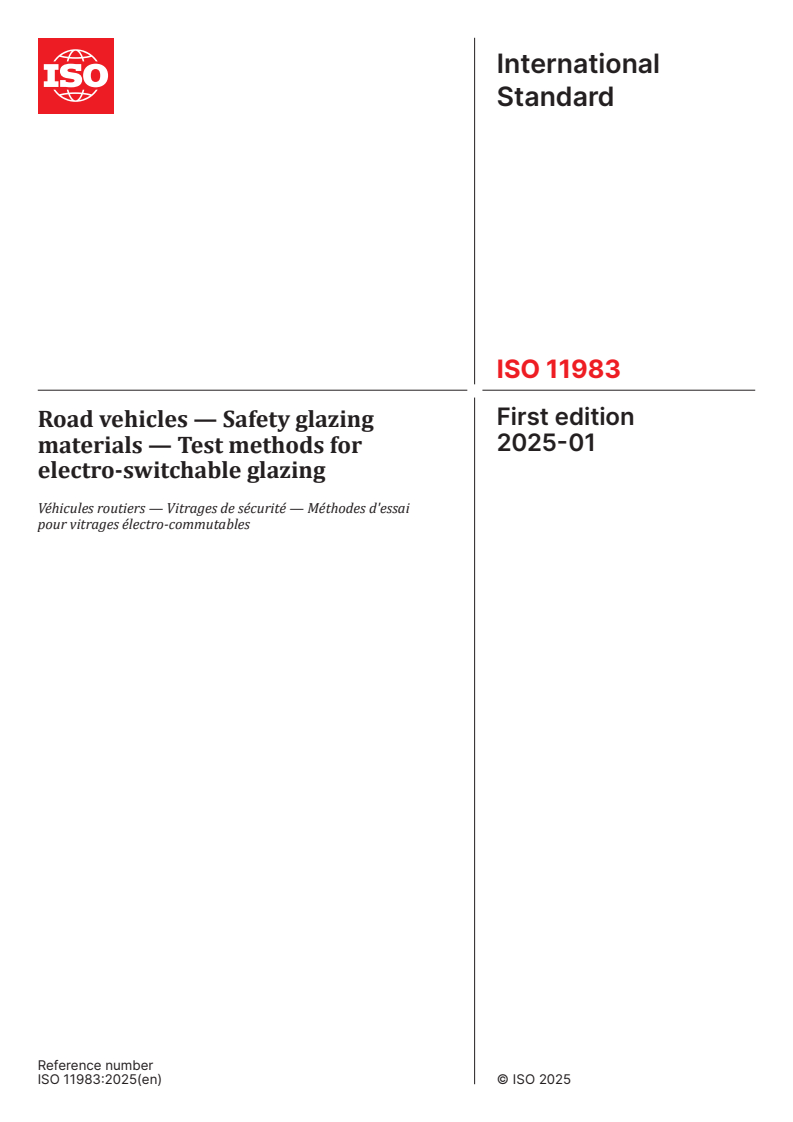
Road vehicles — Safety glazing materials — Test methods for electro-switchable glazing
This document provides the test methods for regular luminous transmittance, switching time, haze, insulation resistance, humidity resistance, low temperature resistance, colour uniformity, switching cycles and radiation durability for electro-switchable glazing used on road vehicles. This document applies to switchable glazing in response to applied voltage or current.
Véhicules routiers — Vitrages de sécurité — Méthodes d'essai pour vitrages électro-commutables
General Information
- Status
- Published
- Publication Date
- 27-Jan-2025
- Technical Committee
- ISO/TC 22/SC 35 - Lighting and visibility
- Drafting Committee
- ISO/TC 22/SC 35 - Lighting and visibility
- Current Stage
- 6060 - International Standard published
- Start Date
- 28-Jan-2025
- Due Date
- 11-Jan-2025
- Completion Date
- 28-Jan-2025
Overview
ISO 11983:2025 - Road vehicles - Safety glazing materials - Test methods for electro-switchable glazing defines standardized test methods for electro-switchable (switchable) glazing used on road vehicles. The standard covers laboratory procedures to evaluate optical and durability performance of glazing that changes luminous transmittance in response to applied voltage or current. Key outcomes include repeatable measurements of transmittance, switching performance and environmental resistance to support safety, quality control and product development.
Key topics and technical requirements
ISO 11983:2025 addresses a comprehensive set of test methods and associated test conditions, including:
- Regular luminous transmittance - measurement of steady-state light transmission in each switch state (measuring state, apparatus and result expression).
- Switching time - methods to quantify transition time between transmittance states.
- Haze - evaluation of scattering that affects visibility and optical clarity.
- Insulation resistance - electrical insulation assessment relevant to glazing driven by voltage or current.
- Humidity resistance and low temperature resistance - environmental conditioning and post-condition performance checks.
- Colour uniformity - optical uniformity assessment across the glazing surface using colour-difference methods.
- Switching cycles - endurance testing to determine operational life under repeated switching.
- Radiation durability - exposure tests to assess UV/solar radiation effects on performance and appearance. The document also specifies ambient test conditions, apparatus descriptions, device-under-test requirements, procedures and how to express results. Normative references include related ISO standards for optical properties, xenon-arc weathering, colourimetry and haze measurement.
Applications and who uses it
ISO 11983:2025 is intended for:
- Automotive OEMs and systems integrators specifying electro-switchable glazing for windshields, side windows, sunroofs, rear windows and interior partitions.
- Glazing manufacturers and suppliers developing electrochromic, suspended-particle or other switchable technologies to demonstrate compliance and performance.
- Independent test laboratories performing type approval, certification, QA and R&D testing.
- Regulatory bodies and standardization committees that reference harmonized test methods for safety glazing. Practical uses include qualifying products for vehicle integration, benchmarking switching speed and optical clarity, validating environmental durability (humidity, temperature, radiation) and supporting reliability claims for switching cycles.
Related standards
Relevant referenced documents (useful for cross-reference and extended methods):
- ISO 3538 (optical properties)
- ISO 4892-2 (xenon-arc exposure)
- ISO/CIE 11664-6 (CIEDE2000 colour-difference)
- ISO 13837 (solar transmittance)
- ISO 14782 (haze for transparent materials)
ISO 11983:2025 provides a harmonized, repeatable framework for evaluating the optical, electrical and environmental performance of electro-switchable glazing in road-vehicle applications.

Get Certified
Connect with accredited certification bodies for this standard

TÜV Rheinland
TÜV Rheinland is a leading international provider of technical services.

TÜV SÜD
TÜV SÜD is a trusted partner of choice for safety, security and sustainability solutions.

AIAG (Automotive Industry Action Group)
American automotive industry standards and training.
Sponsored listings
Frequently Asked Questions
ISO 11983:2025 is a standard published by the International Organization for Standardization (ISO). Its full title is "Road vehicles — Safety glazing materials — Test methods for electro-switchable glazing". This standard covers: This document provides the test methods for regular luminous transmittance, switching time, haze, insulation resistance, humidity resistance, low temperature resistance, colour uniformity, switching cycles and radiation durability for electro-switchable glazing used on road vehicles. This document applies to switchable glazing in response to applied voltage or current.
This document provides the test methods for regular luminous transmittance, switching time, haze, insulation resistance, humidity resistance, low temperature resistance, colour uniformity, switching cycles and radiation durability for electro-switchable glazing used on road vehicles. This document applies to switchable glazing in response to applied voltage or current.
ISO 11983:2025 is classified under the following ICS (International Classification for Standards) categories: 43.040.65 - Glazing and wiper systems. The ICS classification helps identify the subject area and facilitates finding related standards.
ISO 11983:2025 is available in PDF format for immediate download after purchase. The document can be added to your cart and obtained through the secure checkout process. Digital delivery ensures instant access to the complete standard document.
Standards Content (Sample)
International
Standard
ISO 11983
First edition
Road vehicles — Safety glazing
2025-01
materials — Test methods for
electro-switchable glazing
Véhicules routiers — Vitrages de sécurité — Méthodes d'essai
pour vitrages électro-commutables
Reference number
© ISO 2025
All rights reserved. Unless otherwise specified, or required in the context of its implementation, no part of this publication may
be reproduced or utilized otherwise in any form or by any means, electronic or mechanical, including photocopying, or posting on
the internet or an intranet, without prior written permission. Permission can be requested from either ISO at the address below
or ISO’s member body in the country of the requester.
ISO copyright office
CP 401 • Ch. de Blandonnet 8
CH-1214 Vernier, Geneva
Phone: +41 22 749 01 11
Email: copyright@iso.org
Website: www.iso.org
Published in Switzerland
ii
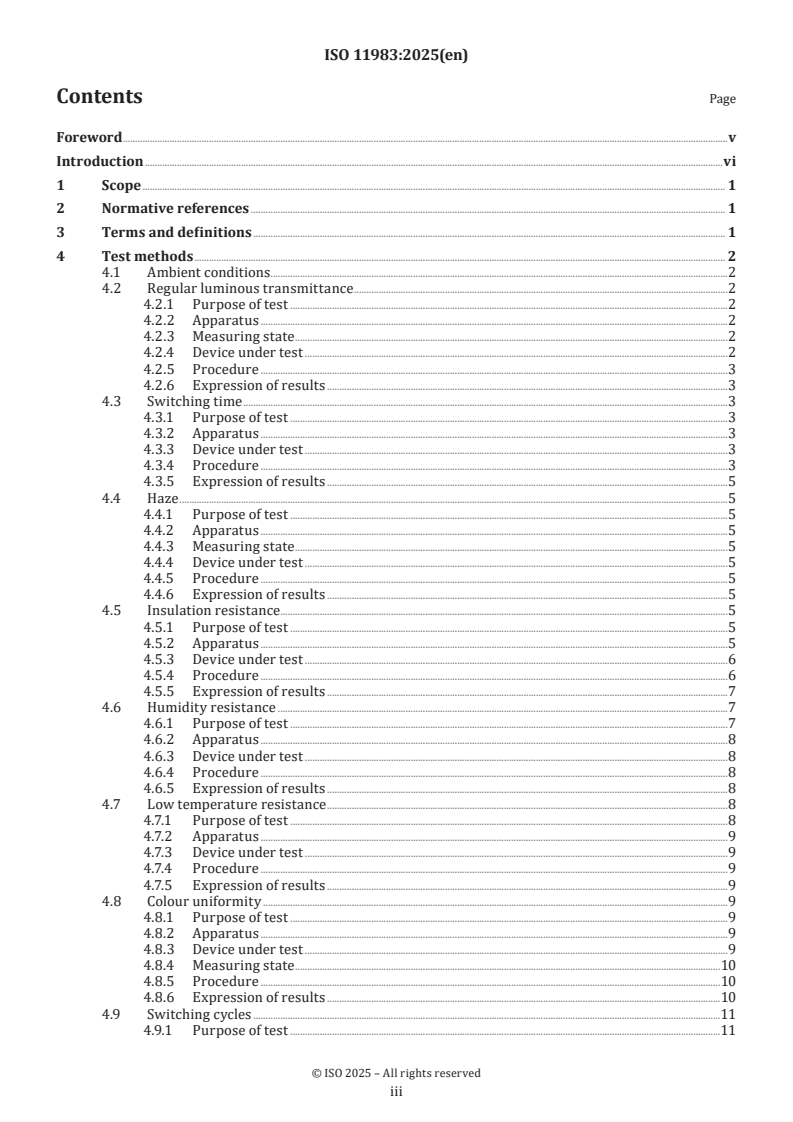
Contents Page
Foreword .v
Introduction .vi
1 Scope . 1
2 Normative references . 1
3 Terms and definitions . 1
4 Test methods . 2
4.1 Ambient conditions.2
4.2 Regular luminous transmittance .2
4.2.1 Purpose of test .2
4.2.2 Apparatus .2
4.2.3 Measuring state .2
4.2.4 Device under test .2
4.2.5 Procedure .3
4.2.6 Expression of results .3
4.3 Switching time .3
4.3.1 Purpose of test .3
4.3.2 Apparatus .3
4.3.3 Device under test .3
4.3.4 Procedure .3
4.3.5 Expression of results .5
4.4 Haze .5
4.4.1 Purpose of test .5
4.4.2 Apparatus .5
4.4.3 Measuring state .5
4.4.4 Device under test .5
4.4.5 Procedure .5
4.4.6 Expression of results .5
4.5 Insulation resistance.5
4.5.1 Purpose of test .5
4.5.2 Apparatus .5
4.5.3 Device under test .6
4.5.4 Procedure .6
4.5.5 Expression of results .7
4.6 Humidity resistance .7
4.6.1 Purpose of test .7
4.6.2 Apparatus .8
4.6.3 Device under test .8
4.6.4 Procedure .8
4.6.5 Expression of results .8
4.7 Low temperature resistance .8
4.7.1 Purpose of test .8
4.7.2 Apparatus .9
4.7.3 Device under test .9
4.7.4 Procedure .9
4.7.5 Expression of results .9
4.8 Colour uniformity .9
4.8.1 Purpose of test .9
4.8.2 Apparatus .9
4.8.3 Device under test .9
4.8.4 Measuring state .10
4.8.5 Procedure .10
4.8.6 Expression of results .10
4.9 Switching cycles .11
4.9.1 Purpose of test .11
iii
4.9.2 Apparatus .11
4.9.3 Device under test .11
4.9.4 Procedure . 12
4.9.5 Expression of results . 12
4.10 Radiation durability . . 12
4.10.1 Purpose of test . 12
4.10.2 Apparatus . 12
4.10.3 Device under test . 13
4.10.4 Procedure . 13
4.10.5 Expression of results . 13
Annex A (informative) Introduction to different principles of electro-switchable glazing . 14
iv
Foreword
ISO (the International Organization for Standardization) is a worldwide federation of national standards
bodies (ISO member bodies). The work of preparing International Standards is normally carried out through
ISO technical committees. Each member body interested in a subject for which a technical committee
has been established has the right to be represented on that committee. International organizations,
governmental and non-governmental, in liaison with ISO, also take part in the work. ISO collaborates closely
with the International Electrotechnical Commission (IEC) on all matters of electrotechnical standardization.
The procedures used to develop this document and those intended for its further maintenance are described
in the ISO/IEC Directives, Part 1. In particular, the different approval criteria needed for the different types
of ISO document should be noted. This document was drafted in accordance with the editorial rules of the
ISO/IEC Directives, Part 2 (see www.iso.org/directives).
ISO draws attention to the possibility that the implementation of this document may involve the use of (a)
patent(s). ISO takes no position concerning the evidence, validity or applicability of any claimed patent
rights in respect thereof. As of the date of publication of this document, ISO had not received notice of (a)
patent(s) which may be required to implement this document. However, implementers are cautioned that
this may not represent the latest information, which may be obtained from the patent database available at
www.iso.org/patents. ISO shall not be held responsible for identifying any or all such patent rights.
Any trade name used in this document is information given for the convenience of users and does not
constitute an endorsement.
For an explanation of the voluntary nature of standards, the meaning of ISO specific terms and expressions
related to conformity assessment, as well as information about ISO's adherence to the World Trade
Organization (WTO) principles in the Technical Barriers to Trade (TBT), see www.iso.org/iso/foreword.html.
This document was prepared by Technical Committee ISO/TC 22, Road vehicles, Subcommittee SC 35,
Lighting and visibility.
Any feedback or questions on this document should be directed to the user’s national standards body. A
complete listing of these bodies can be found at www.iso.org/members.html.
v
Introduction
This document outlines the test method to evaluate properties of electro-switchable glazing during the
switching period and under stable states of luminous transmittance.
There are various principles of electro-switchable glazing that can be used to produce safety glazing for
road vehicles. See Annex A for a description of these principles. The luminous transmittance states that
the electro-switchable glazing can be switched to and the time it takes to switch between these states are
major concerns for consumers and the market. The lifetime of these different electro-switchable glazing is
influenced by humidity, temperature and radiation. The various principles differ in terms of performance,
but they can be improved applying appropriate voltage or current or applying more complex circuits.
vi
International Standard ISO 11983:2025(en)
Road vehicles — Safety glazing materials — Test methods for
electro-switchable glazing
1 Scope
This document provides the test methods for regular luminous transmittance, switching time, haze,
insulation resistance, humidity resistance, low temperature resistance, colour uniformity, switching cycles
and radiation durability for electro-switchable glazing used on road vehicles.
This document applies to switchable glazing in response to applied voltage or current.
2 Normative references
The following documents are referred to in the text in such a way that some or all of their content constitutes
requirements of this document. For dated references, only the edition cited applies. For undated references,
the latest edition of the referenced document (including any amendments) applies.
ISO 3538:1997, Road vehicles — Safety glazing materials — Test methods for optical properties
ISO 4892-2:2013, Plastics — Methods of exposure to laboratory light sources — Part 2: Xenon-arc lamps
ISO 6469-3:2021, Electrically propelled road vehicles — Safety specifications — Part 3: Electrical safety
ISO/CIE 11664-6, Colorimetry — Part 6: CIEDE2000 colour-difference formula
ISO 13837:2021, Road vehicles — Safety glazing materials — Method for the determination of solar
transmittance
ISO 14782:2021, Plastics — Determination of haze for transparent materials
3 Terms and definitions
For the purposes of this document, the following terms and definitions apply.
ISO and IEC maintain terminology databases for use in standardization at the following addresses:
— ISO Online browsing platform: available at https:// www .iso .org/ obp
— IEC Electropedia: available at https:// www .electropedia .org/
3.1
electro-switchable glazing
glazing comprised of one or more panes of material whose transmittance properties can be altered in
response to an applied voltage or current
3.2
highest transmittance state
stable state as glazing switched to highest regular luminous transmittance (3.4) under specific conditions
Note 1 to entry: This is also referred to as the clear state or bleached state.
3.3
lowest transmittance state
stable state as glazing switched to lowest regular luminous transmittance (3.4) under specific conditions
Note 1 to entry: This is also referred to as the tinted state, dark state, or coloured state.
3.4
regular luminous transmittance
light transmittance from 380 nm to 780 nm measured perpendicularly to the glazing without considering
diffused light
3.5
tinting time
period of electro-switchable glazing (3.1) switching from highest transmittance state (3.2) to lowest
transmittance state (3.3)
3.6
switching cycle
electro-switchable glazing (3.1) switched from lowest/highest transmittance state (3.2) to highest/lowest
transmittance state (3.3) and back to lowest/highest transmittance state with each process finished once
4 Test methods
4.1 Ambient conditions
Unless otherwise specified, the tests shall be conducted under the following conditions:
a) ambient temperature: (23 ± 5) °C;
4 5
b) atmospheric pressure: 8,06 × 10 Pa to 1,06 × 10 Pa (860 mbar to 1 060 mbar);
c) relative humidity:(60 ± 20) %.
4.2 Regular luminous transmittance
4.2.1 Purpose of test
The purpose of this test is to determine regular luminous transmittance of electro-switchable glazing in
different transmittance states.
4.2.2 Apparatus
4.2.2.1 Control system, which shall be provided by the manufacturers for switching the device under test
(DUT) to a different state. The control system and parameters shall be pre-set to make the specimen switch
same as finished product.
4.2.2.2 Regular luminous transmittance measuring system, which is described in ISO 3538:1997, 5.1.2.
4.2.3 Measuring state
The regular luminous transmittance of any state that the glazing can be switched to, may be measured.
4.2.4 Device under test
One specimen or finished product may be used as the DUT.
4.2.5 Procedure
Before measuring regular luminous transmittance, switch the DUT for at least five cycles.
Then, switch the whole DUT to required state and keep it in that state for about 5 min. Measure regular
luminous transmittance of the DUT according to ISO 3538:1997, 5.1.3.
4.2.6 Expression of results
Record the regular luminous transmittance and the corresponding state of DUT. The value shall be rounded
to 0,1 %.
4.3 Switching time
4.3.1 Purpose of test
The purpose of this test is to determine the switching time between different states of electro-switchable
glazing.
4.3.2 Apparatus
4.3.2.1 Spectrophotometer, which has the time drive function and whose time interval can be switched to
1 s or shorter. An equivalent photometer can be used, but the light output shall be filtered to 550 nm ± 5 nm
or other required wavelengths, and the measurements shall be recorded per sec
...
Questions, Comments and Discussion
Ask us and Technical Secretary will try to provide an answer. You can facilitate discussion about the standard in here.
Loading comments...