


ISO/IEC 14496-22:2015
(Main)Information technology — Coding of audio-visual objects — Part 22: Open Font Format
Information technology — Coding of audio-visual objects — Part 22: Open Font Format
ISO/IEC 14496-22:2015 specifies the Open Font Format (OFF) specification, the TrueType? and Compact Font Format (CFF) outline formats, and the TrueType hinting language. Many references to both TrueType and PostScript exist throughout this document, as Open Font Format fonts combine the two technologies.
Technologies de l'information — Codage des objets audiovisuels — Partie 22: Format de police de caractères ouvert
General Information
- Status
- Withdrawn
- Publication Date
- 08-Oct-2015
- Withdrawal Date
- 08-Oct-2015
- Current Stage
- 9599 - Withdrawal of International Standard
- Start Date
- 24-Jan-2019
- Completion Date
- 14-Feb-2026
Relations
- Effective Date
- 18-Dec-2021
- Effective Date
- 27-Nov-2021
- Effective Date
- 09-Sep-2017
- Effective Date
- 19-Apr-2014
- Effective Date
- 19-Apr-2014
- Effective Date
- 19-Apr-2014

Get Certified
Connect with accredited certification bodies for this standard

BSI Group
BSI (British Standards Institution) is the business standards company that helps organizations make excellence a habit.

NYCE
Mexican standards and certification body.
Sponsored listings
Frequently Asked Questions
ISO/IEC 14496-22:2015 is a standard published by the International Organization for Standardization (ISO). Its full title is "Information technology — Coding of audio-visual objects — Part 22: Open Font Format". This standard covers: ISO/IEC 14496-22:2015 specifies the Open Font Format (OFF) specification, the TrueType? and Compact Font Format (CFF) outline formats, and the TrueType hinting language. Many references to both TrueType and PostScript exist throughout this document, as Open Font Format fonts combine the two technologies.
ISO/IEC 14496-22:2015 specifies the Open Font Format (OFF) specification, the TrueType? and Compact Font Format (CFF) outline formats, and the TrueType hinting language. Many references to both TrueType and PostScript exist throughout this document, as Open Font Format fonts combine the two technologies.
ISO/IEC 14496-22:2015 is classified under the following ICS (International Classification for Standards) categories: 35.040 - Information coding; 35.040.40 - Coding of audio, video, multimedia and hypermedia information. The ICS classification helps identify the subject area and facilitates finding related standards.
ISO/IEC 14496-22:2015 has the following relationships with other standards: It is inter standard links to ISO/IEC 14496-22:2015/Amd 2:2017, ISO/IEC 14496-22:2015/Amd 1:2017, ISO/IEC 14496-22:2019, ISO/IEC 14496-22:2009, ISO/IEC 14496-22:2009/Amd 2:2012, ISO/IEC 14496-22:2009/Amd 1:2010. Understanding these relationships helps ensure you are using the most current and applicable version of the standard.
ISO/IEC 14496-22:2015 is available in PDF format for immediate download after purchase. The document can be added to your cart and obtained through the secure checkout process. Digital delivery ensures instant access to the complete standard document.
Standards Content (Sample)
INTERNATIONAL ISO/IEC
STANDARD 14496-22
Third edition
2015-10-01
Information technology — Coding of
audio-visual objects —
Part 22:
Open Font Format
Technologies de l’information — Codage des objets audiovisuels —
Partie 22: Format de police de caractères ouvert
Reference number
©
ISO/IEC 2015
© ISO/IEC 2015, Published in Switzerland
All rights reserved. Unless otherwise specified, no part of this publication may be reproduced or utilized otherwise in any form
or by any means, electronic or mechanical, including photocopying, or posting on the internet or an intranet, without prior
written permission. Permission can be requested from either ISO at the address below or ISO’s member body in the country of
the requester.
ISO copyright office
Ch. de Blandonnet 8 • CP 401
CH-1214 Vernier, Geneva, Switzerland
Tel. +41 22 749 01 11
Fax +41 22 749 09 47
copyright@iso.org
www.iso.org
ii © ISO/IEC 2015 – All rights reserved
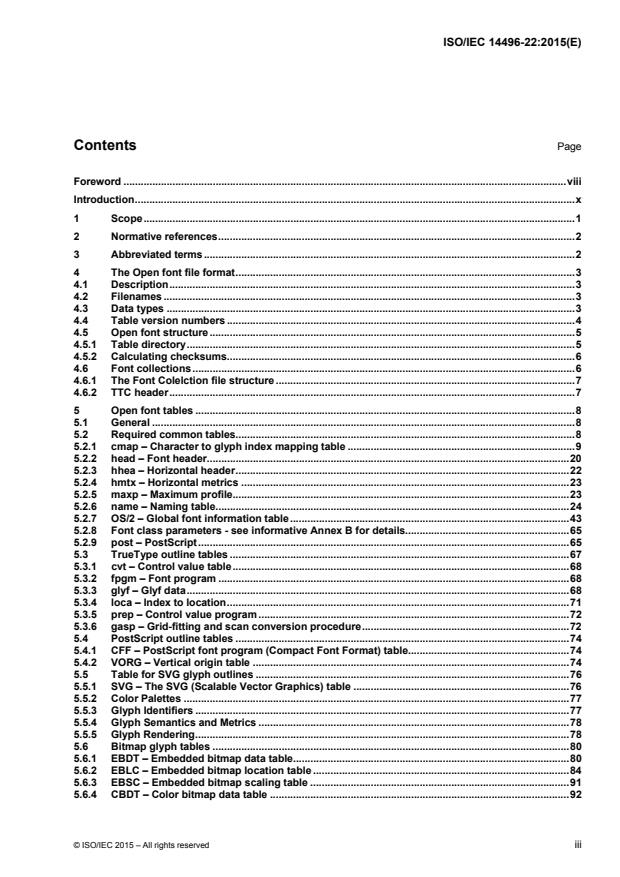
Contents Page
Foreword . viii
Introduction . x
1 Scope . 1
2 Normative references . 2
3 Abbreviated terms . 2
4 The Open font file format . 3
4.1 Description . 3
4.2 Filenames . 3
4.3 Data types . 3
4.4 Table version numbers . 4
4.5 Open font structure . 5
4.5.1 Table directory . 5
4.5.2 Calculating checksums. 6
4.6 Font collections . 6
4.6.1 The Font Colelction file structure . 7
4.6.2 TTC header . 7
5 Open font tables . 8
5.1 General . 8
5.2 Required common tables. 8
5.2.1 cmap – Character to glyph index mapping table . 9
5.2.2 head – Font header . 20
5.2.3 hhea – Horizontal header . 22
5.2.4 hmtx – Horizontal metrics . 23
5.2.5 maxp – Maximum profile. 23
5.2.6 name – Naming table . 24
5.2.7 OS/2 – Global font information table . 43
5.2.8 Font class parameters - see informative Annex B for details. 65
5.2.9 post – PostScript . 65
5.3 TrueType outline tables . 67
5.3.1 cvt – Control value table . 68
5.3.2 fpgm – Font program . 68
5.3.3 glyf – Glyf data . 68
5.3.4 loca – Index to location . 71
5.3.5 prep – Control value program . 72
5.3.6 gasp – Grid-fitting and scan conversion procedure . 72
5.4 PostScript outline tables . 74
5.4.1 CFF – PostScript font program (Compact Font Format) table . 74
5.4.2 VORG – Vertical origin table . 74
5.5 Table for SVG glyph outlines . 76
5.5.1 SVG – The SVG (Scalable Vector Graphics) table . 76
5.5.2 Color Palettes . 77
5.5.3 Glyph Identifiers . 77
5.5.4 Glyph Semantics and Metrics . 78
5.5.5 Glyph Rendering . 78
5.6 Bitmap glyph tables . 80
5.6.1 EBDT – Embedded bitmap data table . 80
5.6.2 EBLC – Embedded bitmap location table . 84
5.6.3 EBSC – Embedded bitmap scaling table . 91
5.6.4 CBDT – Color bitmap data table . 92
© ISO/IEC 2015 – All rights reserved iii
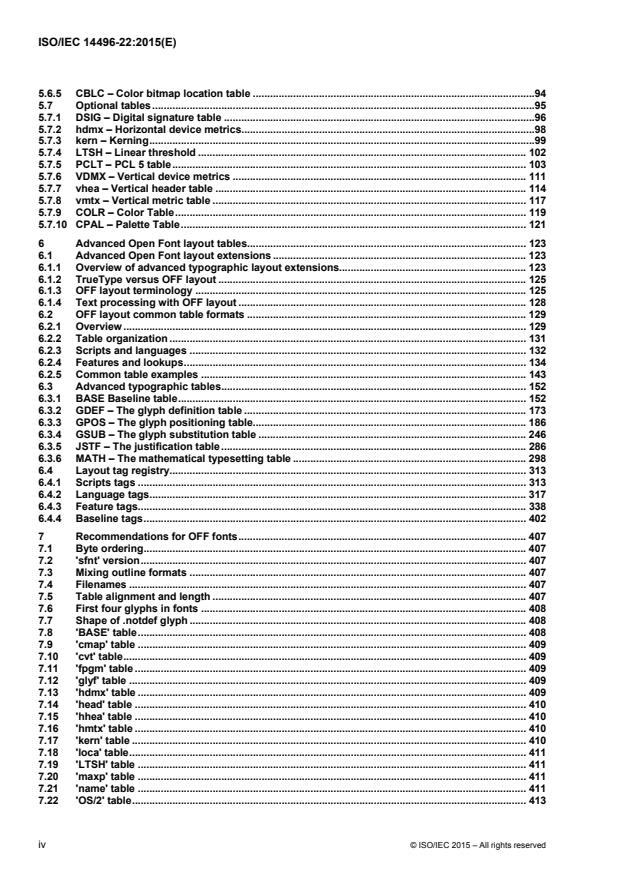
5.6.5 CBLC – Color bitmap location table .94
5.7 Optional tables .95
5.7.1 DSIG – Digital signature table .96
5.7.2 hdmx – Horizontal device metrics .98
5.7.3 kern – Kerning .99
5.7.4 LTSH – Linear threshold . 102
5.7.5 PCLT – PCL 5 table . 103
5.7.6 VDMX – Vertical device metrics . 111
5.7.7 vhea – Vertical header table . 114
5.7.8 vmtx – Vertical metric table . 117
5.7.9 COLR – Color Table . 119
5.7.10 CPAL – Palette Table . 121
6 Advanced Open Font layout tables . 123
6.1 Advanced Open Font layout extensions . 123
6.1.1 Overview of advanced typographic layout extensions . 123
6.1.2 TrueType versus OFF layout . 125
6.1.3 OFF layout terminology . 125
6.1.4 Text processing with OFF layout . 128
6.2 OFF layout common table formats . 129
6.2.1 Overview . 129
6.2.2 Table organization . 131
6.2.3 Scripts and languages . 132
6.2.4 Features and lookups . 134
6.2.5 Common table examples . 143
6.3 Advanced typographic tables . 152
6.3.1 BASE Baseline table . 152
6.3.2 GDEF – The glyph definition table . 173
6.3.3 GPOS – The glyph positioning table. 186
6.3.4 GSUB – The glyph substitution table . 246
6.3.5 JSTF – The justification table . 286
6.3.6 MATH – The mathematical typesetting table . 298
6.4 Layout tag registry. 313
6.4.1 Scripts tags . 313
6.4.2 Language tags . 317
6.4.3 Feature tags . 338
6.4.4 Baseline tags . 402
7 Recommendations for OFF fonts . 407
7.1 Byte ordering . 407
7.2 'sfnt' version . 407
7.3 Mixing outline formats . 407
7.4 Filenames . 407
7.5 Table alignment and length . 407
7.6 First four glyphs in fonts . 408
7.7 Shape of .notdef glyph . 408
7.8 'BASE' table . 408
7.9 'cmap' table . 409
7.10 'cvt' table . 409
7.11 'fpgm' table . 409
7.12 'glyf' table . 409
7.13 'hdmx' table . 409
7.14 'head' table . 410
7.15 'hhea' table . 410
7.16 'hmtx' table . 410
7.17 'kern' table . 410
7.18 'loca' table . 411
7.19 'LTSH' table . 411
7.20 'maxp' table . 411
7.21 'name' table . 411
7.22 'OS/2' table . 413
iv © ISO/IEC 2015 – All rights reserved
7.23 sTypoAscender, sTypoDescender and sTypoLineGap . 413
7.24 'post' table . 413
7.25 'prep' table . 414
7.26 'VDMX' table . 414
7.27 TrueType Collections . 414
8 General recommendations . 414
8.1 Optimized table ordering . 414
8.2 Non-standard (Symbol) fonts . 414
8.3 Device resolutions . 415
8.4 Baseline to baseline distances . 415
8.5 Style bits . 416
8.6 Drop-out control . 416
8.7 Embedded bitmaps . 416
8.8 OFF CJK font guidelines . 417
Annex A (informative) Patent Statements . 418
Annex B (informative) Font Class and Font Subclass parameters . 419
B.1 Introduction . 419
B.2 sFamilyClass . 419
B.3 Class ID=0 No Classification . 419
B.4 Class ID=1 Oldstyle Serifs . 419
B.4.1 Subclass ID = 0 : No Classification . 419
B.4.2 Subclass ID = 1 : IBM Rounded Legibility . 420
B.4.3 Subclass ID = 2 : Garalde . 420
B.4.4 Subclass ID = 3 : Venetian . 420
B.4.5 Subclass ID = 4 : Modified Venetian . 420
B.4.6 Subclass ID = 5 : Dutch Modern . 420
B.4.7 Subclass ID = 6 : Dutch Traditional . 420
B.4.8 Subclass ID = 7 : Contemporary . 420
B.4.9 Subclass ID = 8 : Calligraphic . 420
B.4.10 Subclass ID = 9-14 : (reserved for future use) . 420
B.4.11 Subclass ID = 15 : Miscellaneous . 421
B.5 Class ID=2 Transitional Serifs . 421
B.5.1 Subclass ID = 0 : No Classification . 421
B.5.2 Subclass ID = 1 : Direct Line . 421
B.5.3 Subclass ID = 2 : Script . 421
B.5.4 Subclass ID = 3-14 : (reserved for future use) . 421
B.5.5 Subclass ID = 15 : Miscellaneous . 421
B.6 Class ID=3 Modern Serifs . 421
B.6.1 Subclass ID = 0 : No Classification . 421
B.6.2 Subclass ID = 1 : Italian . 422
B.6.3 Subclass ID = 2 : Script . 422
B.6.4 Subclass ID = 3-14 : (reserved for future use) . 422
B.6.5 Subclass ID = 15 : Miscellaneous . 422
B.7 Class ID=4 Clarendon Serifs . 422
B.7.1 Subclass ID = 0 : No Classification . 422
B.7.2 Subclass ID = 1 : Clarendon . 422
B.7.3 Subclass ID = 2 : Modern . 422
B.7.4 Subclass ID = 3 : Traditional . 422
B.7.5 Subclass ID = 4 : Newspaper . 423
B.7.6 Subclass ID = 5 : Stub Serif . 423
B.7.7 Subclass ID = 6 : Monotone . 423
B.7.8 Subclass ID = 7 : Typewriter . 423
B.7.9 Subclass ID = 8-14: (reserved for future use) . 423
B.7.10 Subclass ID = 15 : Miscellaneous . 423
B.8 Class ID=5 Slab Serifs . 423
B.8.1 Subclass ID = 0 : No Classification . 423
B.8.2 Subclass ID = 1 : Monotone . 423
B.8.3 Subclass ID = 2 : Humanist . 424
© ISO/IEC 2015 – All rights reserved v
B.8.4 Subclass ID = 3 : Geometric . 424
B.8.5 Subclass ID = 4 : Swiss . 424
B.8.6 Subclass ID = 5 : Typewriter . 424
B.8.7 Subclass ID = 6-14 : (reserved for future use) . 424
B.8.8 Subclass ID = 15 : Miscellaneous . 424
B.9 Class ID=6 (reserved for future use) . 424
B.10 Class ID=7 Freeform Serifs . 424
B.10.1 Subclass ID = 0 : No Classification . 424
B.10.2 Subclass ID = 1 : Modern . 425
B.10.3 Subclass ID = 2-14 : (reserved for future use) . 425
B.10.4 Subclass ID = 15 : Miscellaneous . 425
B.11 Class ID=8 Sans Serifs . 425
B.11.1 Subclass ID = 0 : No Classification . 425
B.11.2 Subclass ID = 1 : IBM Neo-grotesque Gothic . 425
B.11.3 Subclass ID = 2 : Humanist . 425
B.11.4 Subclass ID = 3 : Low-x Round Geometric . 425
B.11.5 Subclass ID = 4 : High-x Round Geometric . 425
B.11.6 Subclass ID = 5 : Neo-grotesque Gothic . 426
B.11.7 Subclass ID = 6 : Modified Neo-grotesque Gothic . 426
B.11.8 Subclass ID = 7-8 : (reserved for future use) . 426
B.11.9 Subclass ID = 9 : Typewriter Gothic . 426
B.11.10 Subclass ID = 10 : Matrix . 426
B.11.11 Subclass ID = 11-14 : (reserved for future use) . 426
B.11.12 Subclass ID = 15 : Miscellaneous . 426
B.12 Class ID=9 Ornamentals . 426
B.12.1 Subclass ID = 0 : No Classification . 426
B.12.2 Subclass ID = 1 : Engraver . 426
B.12.3 Subclass ID = 2 : Black Letter . 427
B.12.4 Subclass ID = 3 : Decorative . 427
B.12.5 Subclass ID = 4 : Three Dimensional . 427
B.12.6 Subclass ID = 5-14 : (reserved for future use) . 427
B.12.7 Subclass ID = 15 : Miscellaneous . 427
B.13 Class ID=10 Scripts . 427
B.13.1 Subclass ID = 0 : No Classification . 427
B.13.2 Subclass ID = 1 : Uncial . 427
B.13.3 Subclass ID = 2 : Brush Joined . 427
B.13.4 Subclass ID = 3 : Formal Joined . 428
B.13.5 Subclass ID = 4 : Monotone Joined . 428
B.13.6 Subclass ID = 5 : Calligraphic . 428
B.13.7 Subclass ID = 6 : Brush Unjoined . 428
B.13.8 Subclass ID = 7 : Formal Unjoined . 428
B.13.9 Subclass ID = 8 : Monotone Unjoined . 428
B.13.10 Subclass ID = 9-14 : (reserved for future use) . 428
B.13.11 Subclass ID = 15 : Miscellaneous . 428
B.14 Class ID=11 (reserved for future use) . 429
B.15 Class ID=12 Symbolic . 429
B.15.1 Subclass ID = 0 : No Classification . 429
B.15.2 Subclass ID = 1-2 : (reserved for future use) . 429
B.15.3 Subclass ID = 3 : Mixed Serif . 429
B.15.4 Subclass ID = 4-5 : (reserved for future use) . 429
B.15.5 Subclass ID = 6 : Oldstyle Serif . 429
B.15.6 Subclass ID = 7 : Neo-grotesque Sans Serif . 429
B.15.7 Subclass ID = 8-14 : (reserved for future use) . 429
B.15.8 Subclass ID = 15 : Miscellaneous . 430
B.16 Class ID=13 Reserved . 430
B.17 Class ID=14 Reserved . 430
Annex C (informative) Earlier versions of OS/2 – OS/2 and Windows metrics . 431
C.1 OS/2 - OS/2 and Windows metrics (version 0) . 431
C.2 OS/2 - OS/2 and Windows metrics (version 1) . 450
vi © ISO/IEC 2015 – All rights reserved
C.3 OS/2 - OS/2 and Windows metrics (version 2) . 471
C.4 OS/2 - OS/2 and Windows metrics (version 3) . 490
C.5 OS/2 - OS/2 and Windows metrics (version 4) . 509
Annex D (informative) OFF Mirroring Pairs List. 531
Annex E (normative) Registration of Media Type: application/font-sfnt . 538
Bibliography . 541
© ISO/IEC 2015 – All rights reserved vii
Foreword
ISO (the International Organization for Standardization) and IEC (the International Electrotechnical
Commission) form the specialized system for worldwide standardization. National bodies that are members of
ISO or IEC participate in the development of International Standards through technical committees
established by the respective organization to deal with particular fields of technical activity. ISO and IEC
technical committees collaborate in fields of mutual interest. Other international organizations, governmental
and non-governmental, in liaison with ISO and IEC, also take part in the work. In the field of information
technology, ISO and IEC have established a joint technical committee, ISO/IEC JTC 1.
The procedures used to develop this document and those intended for its further maintenance are described
in the ISO/IEC Directives, Part 1. In particular the different approval criteria needed for the different types of
document should be noted. This document was drafted in accordance with the editorial rules of the
ISO/IEC Directives, Part 2 (see www.iso.org/directives).
Attention is drawn to the possibility that some of the elements of this document may be the subject of patent
rights. ISO and IEC shall not be held responsible for identifying any or all such patent rights. Details of any
patent rights identified during the development of the document will be in the Introduction and/or on the ISO
list of patent declarations received (see www.iso.org/patents).
Any trade name used in this document is information given for the convenience of users and does not
constitute an endorsement.
For an explanation on the meaning of ISO specific terms and expressions related to conformity assessment,
as well as information about ISO's adherence to the WTO principles in the Technical Barriers to Trade (TBT),
see the following URL: Foreword — Supplementary information.
The committee responsible for this document is ISO/IEC JTC 1, Information technology, Subcommittee SC 29,
Coding of audio, picture, multimedia and hypermedia information.
This third edition cancels and replaces the second edition (ISO/IEC 14496-22:2009), which has been
technically revised. It also incorporates ISO/IEC 14496-22:2009/Cor 1:2010, ISO/IEC 14496-
22:2009/Amd 1:2010 and ISO/IEC 14496-22:2009/Amd 2:2010.
ISO/IEC 14496 consists of the following parts, under the general title Information technology — Coding of
audio-visual objects:
Part 1: Systems
Part 2: Visual
Part 3: Audio
Part 4: Conformance testing
Part 5: Reference software
Part 6: Delivery Multimedia Integration Framework (DMIF)
Part 7: Optimized reference software for coding of audio-visual objects
Part 8: Carriage of ISO/IEC 14496 contents over IP networks
viii © ISO/IEC 2015 – All rights reserved
Part 9: Reference hardware description
Part 10: Advanced Video Coding
Part 11: Scene description and application engine
Part 12: ISO base media file format
Part 13: Intellectual Property Management and Protection (IPMP) extensions
Part 14: MP4 file format
Part 15: Carriage of network abstraction layer (NAL) unit structured video in ISO base media file format
Part 16: Animation Framework eXtension (AFX)
Part 17: Streaming text format
Part 18: Font compression and streaming
Part 19: Synthesized texture stream
Part 20: Lightweight Application Scene Representation (LASeR) and Simple Aggregation Format (SAF)
Part 21: MPEG-J Graphics Framework eXtensions (GFX)
Part 22: Open Font Format
Part 23: Symbolic Music Representation
Part 24: Audio and systems interaction
Part 25: 3D Graphics Compression Model
Part 26: Audio conformance
Part 27: 3D Graphics conformance
Part 28: Composite Font Representation
Part 29: Web video coding
Part 30: Timed text and other visual overlays in ISO base media file format
The following part is in preparation:
Part 30: Video coding for browsers
A future part dealing with Internet video coding is planned.
© ISO/IEC 2015 – All rights reserved ix
Introduction
The International Organization for Standardization (ISO) and International Electrotechnical Commission (IEC)
draw attention to the fact that it is claimed that compliance with this document may involve the use of a patent.
The ISO and IEC take no position concerning the evidence, validity and scope of this patent right.
The holder of this patent right has assured ISO and IEC that he is willing to negotiate licences under
reasonable and non-discriminatory terms and conditions with applicants throughout the world. In this respect,
the statement of the holder of this patent right is registered with ISO and IEC. Information may be obtained
from the companies listed in Annex A.
Attention is drawn to the possibility that some of the elements of this document may be the subject of patent
rights other than those identified in Annex A. ISO and IEC shall not be held responsible for identifying any or
all such patent rights.
x © ISO/IEC 2015 – All rights reserved
INTERNATIONAL STANDARD ISO/IEC 14496-22:2015(E)
Information technology — Coding of audio-visual
objects — Part 22: Open Font Format
1 Scope
i
This part of ISO/IEC 14496 specifies the Open Font Format (OFF) specification, the TrueType™
and Compact Font Format (CFF) outline formats, and the TrueType hinting language. Many
references to both TrueType and PostScript exist throughout this document, as Open Font Format
fonts combine the two technologies.
ii
NOTE This specification is based on the OpenType® font format specification, and is technically
equivalent to that specification.
Multimedia applications require a broad range of media-related standards. In addition to the typical
audio and video applications, multimedia presentations include scalable 2D graphics and text
supporting all languages of the world. Faithful reproduction of scalable multimedia content requires
additional components including scalable font technology. The Open Font Format is an extension
of the TrueType font format, adding support for PostScript font data. OFF fonts and the operating
system services which support OFF fonts provide users with a simple way to install and use fonts,
whether the fonts contain TrueType outlines or CFF (PostScript) outlines.
The Open Font Format addresses the following goals:
broader multi-platform support
excellent support for international character sets
excellent protection for font data
smaller file sizes to make font distribution more efficient
excellent support for advanced typographic control
iii
PostScript® data included in OFF fonts may be directly rasterized or converted to the TrueType
outline format for rendering, depending on which rasterizers have been installed in the host
operating system. But the user model is the same: OFF fonts just work. Users will not need to be
aware of the type of outline data in OFF fonts. And font creators can use whichever outline format
they feel provides the best set of features for their work, without worrying about limiting a font's
usability.
OFF fonts can include the OFF Layout tables, which allow font creators to design broader
international and high-end typographic fonts. The OFF Layout tables contain information on glyph
substitution, glyph positioning, justification, and baseline positioning, enabling text-processing
applications to improve text layout.
As with TrueType fonts, OFF fonts allow the handling of large glyph sets using Unicode encoding.
Such encoding allows broad international support, as well as support for typographic glyph variants.
Additionally, OFF fonts may contain digital signatures, which allows operating systems and
browsing applications to identify the source and integrity of font files, including embedded font files
obtained in web documents, before using them. Also, font developers can encode embedding
restrictions in OFF fonts which cannot be altered in a font signed by the developer.
© ISO/IEC 2015 – All rights reserved 1
2 Normative references
The following referenced documents are indispensable for the application of this document. For
dated references, only the edition cited applies. For undated references, the latest edition of the
referenced document (including any amendments) applies.
ISO/IEC 10646, Information technology — Universal Coded Character Set (UCS)
ISO/IEC 14496-18, Information technology — Coding of audio-visual objects — Part 18: Font
compression and streaming
ISO/IEC 15948:2004
...
Questions, Comments and Discussion
Ask us and Technical Secretary will try to provide an answer. You can facilitate discussion about the standard in here.
Loading comments...