


ISO/IEC 14496-22:2009
(Main)Information technology — Coding of audio-visual objects — Part 22: Open Font Format
Information technology — Coding of audio-visual objects — Part 22: Open Font Format
ISO/IEC 14496-22:2009 specifies the Open Font Format (OFF) specification, the TrueType™ and Compact Font Format (CFF) outline formats, and the TrueType hinting language. It makes references to both TrueType and PostScript, as Open Font Format fonts combine the two technologies. Multimedia applications require a broad range of media-related standards. In addition to the typical audio and video applications, multimedia presentations include scalable 2D graphics and text supporting all languages of the world. Faithful reproduction of scalable multimedia content requires additional components including scalable font technology. The Open Font Format is an extension of the TrueType font format, adding support for PostScript font data. OFF fonts and the operating system services which support OFF fonts provide users with a simple way to install and use fonts, whether the fonts contain TrueType outlines or CFF (PostScript) outlines. The Open Font Format addresses the following goals: broader multi-platform support; excellent support for international character sets; excellent protection for font data; smaller file sizes to make font distribution more efficient; excellent support for advanced typographic control. PostScript® data included in OFF fonts may be directly rasterized or converted to the TrueType outline format for rendering, depending on which rasterizers have been installed in the host operating system. But the user model is the same: OFF fonts just work. Users will not need to be aware of the type of outline data in OFF fonts. And font creators can use whichever outline format they feel provides the best set of features for their work, without worrying about limiting a font's usability. OFF fonts can include the OFF Layout tables, which allow font creators to design broader international and high-end typographic fonts. The OFF Layout tables contain information on glyph substitution, glyph positioning, justification, and baseline positioning, enabling text-processing applications to improve text layout. As with TrueType fonts, OFF fonts allow the handling of large glyph sets using Unicode encoding. Such encoding allows broad international support, as well as support for typographic glyph variants. Additionally, OFF fonts may contain digital signatures, which enable operating systems and browsing applications to identify the source and integrity of font files, including embedded font files obtained in web documents, before using them. Also, font developers can encode embedding restrictions in OFF fonts which cannot be altered in a font signed by the developer.
Technologies de l'information — Codage des objets audiovisuels — Partie 22: Format de police de caractères ouvert
General Information
- Status
- Withdrawn
- Publication Date
- 30-Jul-2009
- Withdrawal Date
- 30-Jul-2009
- Current Stage
- 9599 - Withdrawal of International Standard
- Start Date
- 09-Oct-2015
- Completion Date
- 12-Feb-2026
Relations
- Effective Date
- 09-May-2020
- Effective Date
- 23-Apr-2020
- Effective Date
- 19-Apr-2014
- Effective Date
- 10-Jul-2008
ISO/IEC 14496-22:2009 - Information technology -- Coding of audio-visual objects
ISO/IEC 14496-22:2009 - Information technology -- Coding of audio-visual objects
Get Certified
Connect with accredited certification bodies for this standard

BSI Group
BSI (British Standards Institution) is the business standards company that helps organizations make excellence a habit.

NYCE
Mexican standards and certification body.
Sponsored listings
Frequently Asked Questions
ISO/IEC 14496-22:2009 is a standard published by the International Organization for Standardization (ISO). Its full title is "Information technology — Coding of audio-visual objects — Part 22: Open Font Format". This standard covers: ISO/IEC 14496-22:2009 specifies the Open Font Format (OFF) specification, the TrueType™ and Compact Font Format (CFF) outline formats, and the TrueType hinting language. It makes references to both TrueType and PostScript, as Open Font Format fonts combine the two technologies. Multimedia applications require a broad range of media-related standards. In addition to the typical audio and video applications, multimedia presentations include scalable 2D graphics and text supporting all languages of the world. Faithful reproduction of scalable multimedia content requires additional components including scalable font technology. The Open Font Format is an extension of the TrueType font format, adding support for PostScript font data. OFF fonts and the operating system services which support OFF fonts provide users with a simple way to install and use fonts, whether the fonts contain TrueType outlines or CFF (PostScript) outlines. The Open Font Format addresses the following goals: broader multi-platform support; excellent support for international character sets; excellent protection for font data; smaller file sizes to make font distribution more efficient; excellent support for advanced typographic control. PostScript® data included in OFF fonts may be directly rasterized or converted to the TrueType outline format for rendering, depending on which rasterizers have been installed in the host operating system. But the user model is the same: OFF fonts just work. Users will not need to be aware of the type of outline data in OFF fonts. And font creators can use whichever outline format they feel provides the best set of features for their work, without worrying about limiting a font's usability. OFF fonts can include the OFF Layout tables, which allow font creators to design broader international and high-end typographic fonts. The OFF Layout tables contain information on glyph substitution, glyph positioning, justification, and baseline positioning, enabling text-processing applications to improve text layout. As with TrueType fonts, OFF fonts allow the handling of large glyph sets using Unicode encoding. Such encoding allows broad international support, as well as support for typographic glyph variants. Additionally, OFF fonts may contain digital signatures, which enable operating systems and browsing applications to identify the source and integrity of font files, including embedded font files obtained in web documents, before using them. Also, font developers can encode embedding restrictions in OFF fonts which cannot be altered in a font signed by the developer.
ISO/IEC 14496-22:2009 specifies the Open Font Format (OFF) specification, the TrueType™ and Compact Font Format (CFF) outline formats, and the TrueType hinting language. It makes references to both TrueType and PostScript, as Open Font Format fonts combine the two technologies. Multimedia applications require a broad range of media-related standards. In addition to the typical audio and video applications, multimedia presentations include scalable 2D graphics and text supporting all languages of the world. Faithful reproduction of scalable multimedia content requires additional components including scalable font technology. The Open Font Format is an extension of the TrueType font format, adding support for PostScript font data. OFF fonts and the operating system services which support OFF fonts provide users with a simple way to install and use fonts, whether the fonts contain TrueType outlines or CFF (PostScript) outlines. The Open Font Format addresses the following goals: broader multi-platform support; excellent support for international character sets; excellent protection for font data; smaller file sizes to make font distribution more efficient; excellent support for advanced typographic control. PostScript® data included in OFF fonts may be directly rasterized or converted to the TrueType outline format for rendering, depending on which rasterizers have been installed in the host operating system. But the user model is the same: OFF fonts just work. Users will not need to be aware of the type of outline data in OFF fonts. And font creators can use whichever outline format they feel provides the best set of features for their work, without worrying about limiting a font's usability. OFF fonts can include the OFF Layout tables, which allow font creators to design broader international and high-end typographic fonts. The OFF Layout tables contain information on glyph substitution, glyph positioning, justification, and baseline positioning, enabling text-processing applications to improve text layout. As with TrueType fonts, OFF fonts allow the handling of large glyph sets using Unicode encoding. Such encoding allows broad international support, as well as support for typographic glyph variants. Additionally, OFF fonts may contain digital signatures, which enable operating systems and browsing applications to identify the source and integrity of font files, including embedded font files obtained in web documents, before using them. Also, font developers can encode embedding restrictions in OFF fonts which cannot be altered in a font signed by the developer.
ISO/IEC 14496-22:2009 is classified under the following ICS (International Classification for Standards) categories: 35.040 - Information coding; 35.040.40 - Coding of audio, video, multimedia and hypermedia information. The ICS classification helps identify the subject area and facilitates finding related standards.
ISO/IEC 14496-22:2009 has the following relationships with other standards: It is inter standard links to ISO/IEC 14496-22:2009/Amd 2:2012, ISO/IEC 14496-22:2009/Amd 1:2010, ISO/IEC 14496-22:2015, ISO/IEC 14496-22:2007. Understanding these relationships helps ensure you are using the most current and applicable version of the standard.
ISO/IEC 14496-22:2009 is available in PDF format for immediate download after purchase. The document can be added to your cart and obtained through the secure checkout process. Digital delivery ensures instant access to the complete standard document.
Standards Content (Sample)
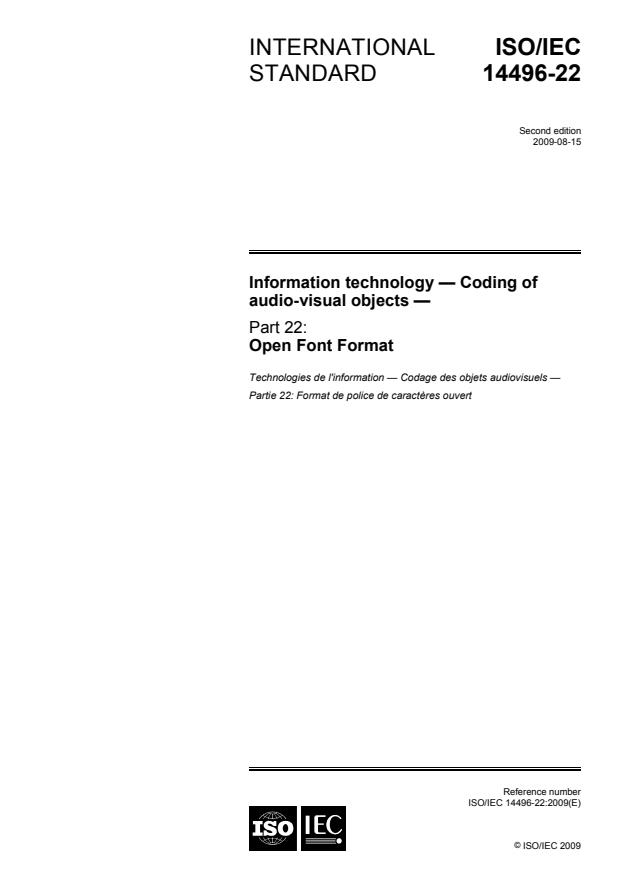
INTERNATIONAL ISO/IEC
STANDARD 14496-22
Second edition
2009-08-15
Information technology — Coding of
audio-visual objects —
Part 22:
Open Font Format
Technologies de l'information — Codage des objets audiovisuels —
Partie 22: Format de police de caractères ouvert
Reference number
©
ISO/IEC 2009
PDF disclaimer
This PDF file may contain embedded typefaces. In accordance with Adobe's licensing policy, this file may be printed or viewed but
shall not be edited unless the typefaces which are embedded are licensed to and installed on the computer performing the editing. In
downloading this file, parties accept therein the responsibility of not infringing Adobe's licensing policy. The ISO Central Secretariat
accepts no liability in this area.
Adobe is a trademark of Adobe Systems Incorporated.
Details of the software products used to create this PDF file can be found in the General Info relative to the file; the PDF-creation
parameters were optimized for printing. Every care has been taken to ensure that the file is suitable for use by ISO member bodies. In
the unlikely event that a problem relating to it is found, please inform the Central Secretariat at the address given below.
© ISO/IEC 2009
All rights reserved. Unless otherwise specified, no part of this publication may be reproduced or utilized in any form or by any means,
electronic or mechanical, including photocopying and microfilm, without permission in writing from either ISO at the address below or
ISO's member body in the country of the requester.
ISO copyright office
Case postale 56 • CH-1211 Geneva 20
Tel. + 41 22 749 01 11
Fax + 41 22 749 09 47
E-mail copyright@iso.org
Web www.iso.org
Published in Switzerland
ii © ISO/IEC 2009 – All rights reserved
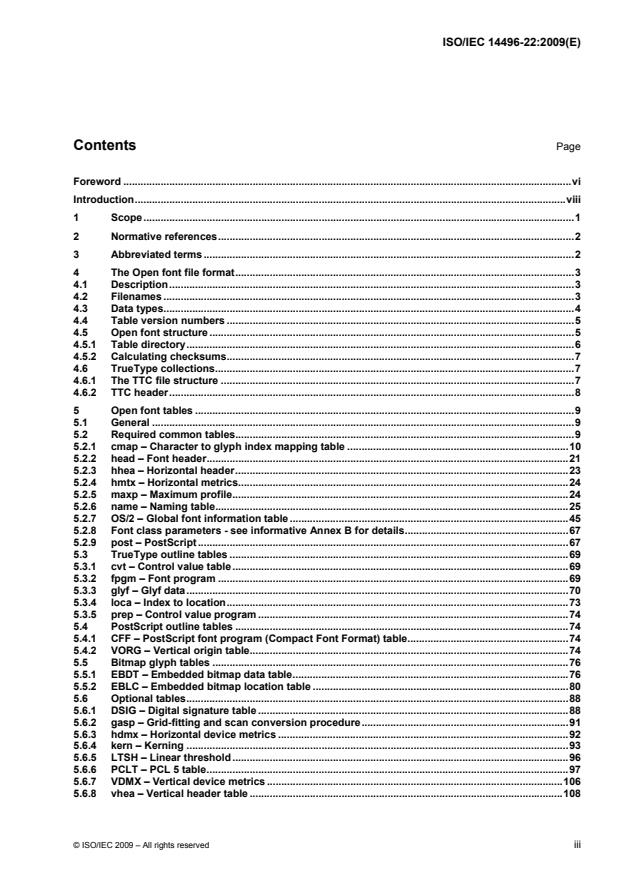
Contents Page
Foreword .vi
Introduction.viii
1 Scope.1
2 Normative references.2
3 Abbreviated terms .2
4 The Open font file format.3
4.1 Description.3
4.2 Filenames .3
4.3 Data types.4
4.4 Table version numbers .5
4.5 Open font structure .5
4.5.1 Table directory.6
4.5.2 Calculating checksums.7
4.6 TrueType collections.7
4.6.1 The TTC file structure .7
4.6.2 TTC header.8
5 Open font tables .9
5.1 General .9
5.2 Required common tables.9
5.2.1 cmap – Character to glyph index mapping table .10
5.2.2 head – Font header.21
5.2.3 hhea – Horizontal header.23
5.2.4 hmtx – Horizontal metrics.24
5.2.5 maxp – Maximum profile.24
5.2.6 name – Naming table.25
5.2.7 OS/2 – Global font information table .45
5.2.8 Font class parameters - see informative Annex B for details.67
5.2.9 post – PostScript .67
5.3 TrueType outline tables .69
5.3.1 cvt – Control value table.69
5.3.2 fpgm – Font program .69
5.3.3 glyf – Glyf data.70
5.3.4 loca – Index to location.73
5.3.5 prep – Control value program .74
5.4 PostScript outline tables .74
5.4.1 CFF – PostScript font program (Compact Font Format) table.74
5.4.2 VORG – Vertical origin table.74
5.5 Bitmap glyph tables .76
5.5.1 EBDT – Embedded bitmap data table.76
5.5.2 EBLC – Embedded bitmap location table .80
5.6 Optional tables.88
5.6.1 DSIG – Digital signature table .88
5.6.2 gasp – Grid-fitting and scan conversion procedure.91
5.6.3 hdmx – Horizontal device metrics .92
5.6.4 kern – Kerning .93
5.6.5 LTSH – Linear threshold.96
5.6.6 PCLT – PCL 5 table.97
5.6.7 VDMX – Vertical device metrics .106
5.6.8 vhea – Vertical header table .108
© ISO/IEC 2009 – All rights reserved iii
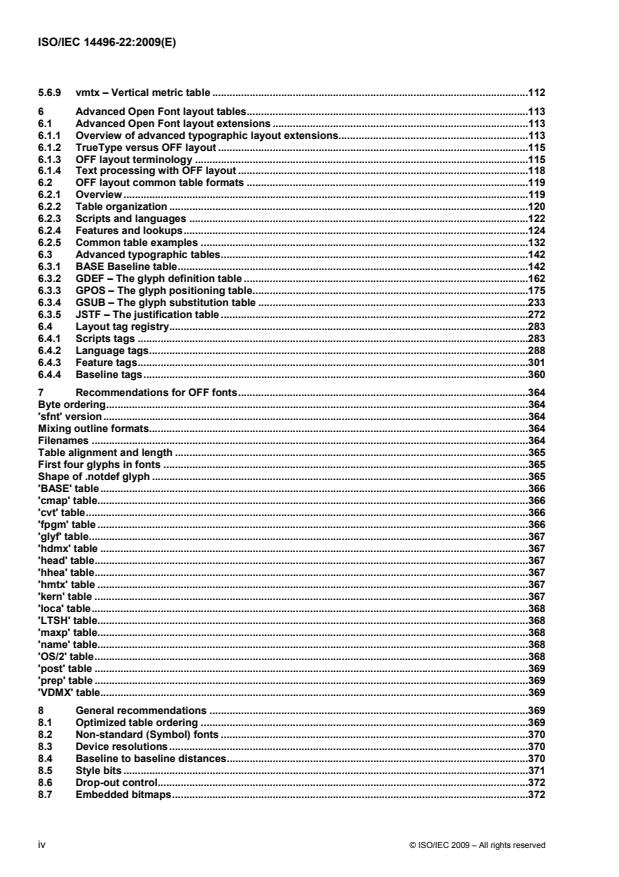
5.6.9 vmtx – Vertical metric table .112
6 Advanced Open Font layout tables.113
6.1 Advanced Open Font layout extensions .113
6.1.1 Overview of advanced typographic layout extensions.113
6.1.2 TrueType versus OFF layout .115
6.1.3 OFF layout terminology .115
6.1.4 Text processing with OFF layout .118
6.2 OFF layout common table formats .119
6.2.1 Overview.119
6.2.2 Table organization .120
6.2.3 Scripts and languages .122
6.2.4 Features and lookups.124
6.2.5 Common table examples .132
6.3 Advanced typographic tables.142
6.3.1 BASE Baseline table.142
6.3.2 GDEF – The glyph definition table .162
6.3.3 GPOS – The glyph positioning table.175
6.3.4 GSUB – The glyph substitution table .233
6.3.5 JSTF – The justification table .272
6.4 Layout tag registry.283
6.4.1 Scripts tags .283
6.4.2 Language tags.288
6.4.3 Feature tags.301
6.4.4 Baseline tags.360
7 Recommendations for OFF fonts.364
Byte ordering.364
'sfnt' version.364
Mixing outline formats.364
Filenames .364
Table alignment and length .365
First four glyphs in fonts .365
Shape of .notdef glyph .365
'BASE' table.366
'cmap' table.366
'cvt' table.366
'fpgm' table .366
'glyf' table.367
'hdmx' table .367
'head' table.367
'hhea' table.367
'hmtx' table .367
'kern' table .367
'loca' table.368
'LTSH' table.368
'maxp' table.368
'name' table.368
'OS/2' table.368
'post' table .369
'prep' table .369
'VDMX' table.369
8 General recommendations .369
8.1 Optimized table ordering .369
8.2 Non-standard (Symbol) fonts .370
8.3 Device resolutions.370
8.4 Baseline to baseline distances.370
8.5 Style bits .371
8.6 Drop-out control.372
8.7 Embedded bitmaps.372
iv © ISO/IEC 2009 – All rights reserved
8.8 OFF CJK font guidelines.372
Annex A (informative) Patent Statements .373
Annex B (informative) Font Class and Font Subclass parameters.374
Annex C (informative) Earlier versions of OS/2 – OS/2 and Windows metrics.385
Annex D (informative) OFF Mirroring Pairs List.460
Bibliography.467
© ISO/IEC 2009 – All rights reserved v
Foreword
ISO (the International Organization for Standardization) and IEC (the International Electrotechnical
Commission) form the specialized system for worldwide standardization. National bodies that are members of
ISO or IEC participate in the development of International Standards through technical committees
established by the respective organization to deal with particular fields of technical activity. ISO and IEC
technical committees collaborate in fields of mutual interest. Other international organizations, governmental
and non-governmental, in liaison with ISO and IEC, also take part in the work. In the field of information
technology, ISO and IEC have established a joint technical committee, ISO/IEC JTC 1.
International Standards are drafted in accordance with the rules given in the ISO/IEC Directives, Part 2.
The main task of the joint technical committee is to prepare International Standards. Draft International
Standards adopted by the joint technical committee are circulated to national bodies for voting. Publication as
an International Standard requires approval by at least 75 % of the national bodies casting a vote.
ISO/IEC 14496-22 was prepared by Joint Technical Committee ISO/IEC JTC 1, Information technology,
Subcommittee SC 29, Coding of audio, picture, multimedia and hypermedia Information.
This second edition cancels and replaces the first edition (ISO/IEC 14496-22:2007) which has been
technically revised.
ISO/IEC 14496 consists of the following parts, under the general title Information technology — Coding of
audio-visual objects:
⎯ Part 1: Systems
⎯ Part 2: Visual
⎯ Part 3: Audio
⎯ Part 4: Conformance testing
⎯ Part 5: Reference software
⎯ Part 6: Delivery Multimedia Integration Framework (DMIF)
⎯ Part 7: Optimized reference software for coding of audio-visual objects
⎯ Part 8: Carriage of ISO/IEC 14496 contents over IP networks
⎯ Part 9: Reference hardware description
⎯ Part 10: Advanced Video Coding
⎯ Part 11: Scene description and application engine
⎯ Part 12: ISO base media file format
⎯ Part 13: Intellectual Property Management and Protection (IPMP) extensions
⎯ Part 14: MP4 file format
vi © ISO/IEC 2009 – All rights reserved
⎯ Part 15: Advanced Video Coding (AVC) file format
⎯ Part 16: Animation Framework eXtension (AFX)
⎯ Part 17: Streaming text format
⎯ Part 18: Font compression and streaming
⎯ Part 19: Synthesized texture stream
⎯ Part 20: Lightweight Application Scene Representation (LASeR) and Simple Aggregation Format (SAF)
⎯ Part 21: MPEG-J Graphics Framework eXtensions (GFX)
⎯ Part 22: Open Font Format
⎯ Part 23: Symbolic Music Representation
⎯ Part 24: Audio and systems interaction
⎯ Part 25: 3D Graphics Compression Model
© ISO/IEC 2009 – All rights reserved vii
Introduction
The International Organization for Standardization (ISO) and International Electrotechnical Commission (IEC)
draw attention to the fact that it is claimed that compliance with this document may involve the use of a patent.
The ISO and IEC take no position concerning the evidence, validity and scope of this patent right.
The holder of this patent right has assured ISO and IEC that he is willing to negotiate licences under
reasonable and non-discriminatory terms and conditions with applicants throughout the world. In this respect,
the statement of the holder of this patent right is registered with ISO and IEC. Information may be obtained
from the companies listed in Annex A.
Attention is drawn to the possibility that some of the elements of this document may be the subject of patent
rights other than those identified in Annex A. ISO and IEC shall not be held responsible for identifying any or
all such patent rights.
viii © ISO/IEC 2009 – All rights reserved
INTERNATIONAL STANDARD ISO/IEC 14496-22:2009(E)
Information technology — Coding of audio-visual objects —
Part 22:
Open Font Format
1 Scope
i
This part of ISO/IEC 14496 specifies the Open Font Format (OFF) specification, the TrueType™ and
Compact Font Format (CFF) outline formats, and the TrueType hinting language. Many references to both
TrueType and PostScript exist throughout this document, as Open Font Format fonts combine the two
technologies.
ii
NOTE This specification is based on the OpenType® font format specification, and is technically equivalent to that
specification.
Multimedia applications require a broad range of media-related standards. In addition to the typical audio and
video applications, multimedia presentations include scalable 2D graphics and text supporting all languages of
the world. Faithful reproduction of scalable multimedia content requires additional components including
scalable font technology. The Open Font Format is an extension of the TrueType font format, adding support
for PostScript font data. OFF fonts and the operating system services which support OFF fonts provide users
with a simple way to install and use fonts, whether the fonts contain TrueType outlines or CFF (PostScript)
outlines.
The Open Font Format addresses the following goals:
• broader multi-platform support;
• excellent support for international character sets;
• excellent protection for font data;
• smaller file sizes to make font distribution more efficient;
• excellent support for advanced typographic control.
iii
PostScript® data included in OFF fonts may be directly rasterized or converted to the TrueType outline
format for rendering, depending on which rasterizers have been installed in the host operating system. But the
user model is the same: OFF fonts just work. Users will not need to be aware of the type of outline data in
OFF fonts. And font creators can use whichever outline format they feel provides the best set of features for
their work, without worrying about limiting a font's usability.
OFF fonts can include the OFF Layout tables, which allow font creators to design broader international and
high-end typographic fonts. The OFF Layout tables contain information on glyph substitution, glyph positioning,
justification, and baseline positioning, enabling text-processing applications to improve text layout.
i
TrueType is a trademark of Apple Computer Incorporated.
ii
OPENTYPE is either a registered trademark or trademark of Microsoft Corporation in the United States and/or other
countries.
iii
PostScript is a registered trademark of Adobe Systems Incorporated.
© ISO/IEC 2009 – All rights reserved 1
As with TrueType fonts, OFF fonts allow the handling of large glyph sets using Unicode encoding. Such
encoding allows broad international support, as well as support for typographic glyph variants.
Additionally, OFF fonts may contain digital signatures, which enable operating systems and browsing
applications to identify the source and integrity of font files, including embedded font files obtained in web
documents, before using them. Also, font developers can encode embedding restrictions in OFF fonts which
cannot be altered in a font signed by the developer.
2 Normative references
The following referenced documents are indispensable for the application of this document. For dated
references, only the edition cited applies. For undated references, the latest edition of the referenced
document (including any amendments) applies.
ISO/IEC 10646, Information technology — Universal Multiple-Octet Coded Character Set (UCS)
ISO/IEC 14496-18, Information technology — Coding of audio-visual objects — Part 18: Font compression
and streaming
TrueType Instruction Set,
Unicode 5.1,
3 Abbreviated terms
List of abbreviated terms.
ACF Average Character Face
ANSI American National Standards Institute
ASCII American Standard Code for Information Interchange
ATM Adobe Type Manager
BMP [Unicode] Basic Multilingual Plane (also known as UCS-2)
BTBD Baseline To Baseline Distance
CFF Compact Font Format
CID Character Identifier
CJK Chinese Japanese Korean [characters, ideographs, fonts, etc.]
CJKV Chinese Japanese Korean and Vietnamese
CV Control Value
CVT Control Value Table
DLL Dynamically Linked Library
FDEF Function Definition
GID Glyph ID
ICF Ideographic Character Face
IDEF Instruction Definition
IETF Internet Engineering Task Force
JIS Japanese Industrial Standard
LTR Left To Right
2 © ISO/IEC 2009 – All rights reserved
NLC National Language Council of Japan
OFF Open Font Format
OMPL OFF Mirroring Pairs List
OTF OpenType Font
PCL Printer Control Language
PPM, PPEM Pixels Per EM
PRC People's Republic of China
RTL Right To Left
TTC TrueType Collection
TTF TrueType Font
UCS Universal Character Set
UTF Unicode Transformation Format
UVS Unicode Variation Sequence
VM Virtual Memory
W3C World Wide Web Consortium
4 The Open font file format
4.1 Description
An Open font file contains data, in table format, that comprises either a TrueType or a PostScript outline font.
Rasterizers use combinations of data from the tables contained in the font to render the TrueType or
PostScript glyph outlines. Some of this supporting data is used no matter which outline format is used; some
of the supporting data is specific to either TrueType or PostScript.
4.2 Filenames
OFF fonts may have the extension .OTF or .TTF, depending on the kind of outlines in the font and the
creator's desire for compatibility on systems without native OFF support.
• In all cases, fonts with only CFF data (no TrueType outlines) always have an .OTF extension.
• Fonts containing TrueType outlines may have either .OTF or .TTF, depending on the desire for
backward compatibility on older systems or with previous versions of the font. TrueType Collection
fonts should have a .TTC extension whether or not the fonts have OFF layout tables present.
© ISO/IEC 2009 – All rights reserved 3
4.3 Data types
The following data types are used in the OFF font file. All OFF fonts use big-endian (network byte order):
Data Type Description
BYTE 8-bit unsigned integer.
CHAR 8-bit signed integer.
USHORT 16-bit unsigned integer.
SHORT 16-bit signed integer.
UINT24 24-bit unsigned integer.
ULONG 32-bit unsigned integer.
LONG 32-bit signed integer.
Fixed 32-bit signed fixed-point number (16.16)
FUNIT Smallest measurable distance in the em space.
FWORD 16-bit signed integer (SHORT) that describes a quantity in
FUnits.
UFWORD 16-bit unsigned integer (USHORT) that describes a
quantity in FUnits.
F2DOT14 16-bit signed fixed number with the low 14 bits of fraction
(2.14).
LONGDATETIME Date represented in number of seconds since 12:00
midnight, January 1, 1904. The value is represented as a
signed 64-bit integer.
Tag Array of four uint8s (length = 32 bits) used to identify a
script, language system, feature, or baseline
GlyphID Glyph index number, same as uint16(length = 16 bits)
Offset Offset to a table, same as uint16 (length = 16 bits), NULL
Offset = 0x0000
4 © ISO/IEC 2009 – All rights reserved
The F2DOT14 format consists of a signed, 2's complement mantissa and an unsigned fraction. To compute
the actual value, take the mantissa and add the fraction. Examples of 2.14 values are:
Decimal
Hex Value Mantissa Fraction
Value
1.999939 0x7fff 1 16383/16384
1.75 0x7000 1 12288/16384
0.000061 0x0001 0 1/16384
0.0 0x0000 0 0/16384
-0.000061 0xffff -1 16383/16384
-2.0 0x8000 -2 0/16384
4.4 Table version numbers
Most tables have version numbers, and the version number for the entire font is contained in the Table
Directory. It should be noted that there are two different table version number types, each with its own
numbering scheme. USHORT version numbers always start at zero (0). Fixed version numbers start at one
(1.0 or 0x00010000), except where noted (EBDT, EBLC and EBSC tables).
Implementations reading tables must include code to check version numbers so that if and when the format
and therefore the version number changes, older implementations will reject newer versions gracefully, if the
changes are incompatible.
When a Fixed number is used as a version, the upper 16 bits comprise a major version number and the lower
16 bits a minor. Tables with non-zero minor version numbers always specify the literal value of the version
number since the normal representation of Fixed numbers is not necessarily followed. For example, the
version number of 'maxp' table version 0.5 is 0x00005000, and that of 'vhea' table version 1.1 is 0x00011000.
If an implementation understands a major version number, then it can safely proceed reading the table. The
minor version number indicates extensions to the format that are undetectable by implementations that do not
support them.
The only exception to this is the Offset Table's sfnt version. This serves solely to identify whether the OFF font
contains TrueType outlines (a value of 1.0) or CFF data (the tag 'OTTO'), as described in subclause 3.5,
'Open Font Structure.'
When a USHORT number is used to indicate version, it should be treated as though it were a minor version
number; i.e., all format changes are compatible extensions.
4.5 Open font structure
A key characteristic of the OFF format is the TrueType sfnt "wrapper", which provides organization for a
collection of tables in a general and extensible manner.
The OFF font with the Offset Table. If the font file contains only one font, the Offset Table will begin at byte 0
of the file. If the font file is a TrueType collection, the beginning point of the Offset Table for each font is
indicated in the TTCHeader.
© ISO/IEC 2009 – All rights reserved 5
Offset Table
Type Name Description
Fixed sfnt version 0x00010000 for version 1.0 or 'OTTO'.
USHORT numTables Number of tables.
USHORT searchRange (Maximum power of 2 <= numTables) x 16.
USHORT entrySelector Log2(maximum power of 2 <= numTables).
USHORT rangeShift NumTables x 16-searchRange.
OFF fonts that contain TrueType outlines should use the value of 1.0 for the sfnt version. OFF fonts containing
CFF data should use the tag 'OTTO' as the sfnt version number.
4.5.1 Table directory
The Offset Table is followed immediately by the Table Record entries. Entries in the Table Record must be
sorted in ascending order by tag. Offset values in the Table Record are measured from the start of the font file.
Table Record
Type Name Description
ULONG tag 4 -byte identifier.
ULONG checkSum CheckSum for this table.
ULONG Offset Offset from beginning of TrueType font
file.
ULONG length Length of this table.
The Table Record makes it possible for a given font to contain only those tables it actually needs. As a result
there is no standard value for numTables.
Tags are the names given to tables in the OFF font file. All tag names consist of four characters. Names with
less than four letters are allowed if followed by the necessary trailing spaces. All tag names defined within a
font (e.g., table names, feature tags, language tags) must be built from printing characters represented by
ASCII values 32-126.
NOTE Tag names are case sensitive.
6 © ISO/IEC 2009 – All rights reserved
4.5.2 Calculating checksums
Table checksums are the unsigned sum of the longs of a given table. In C, the following function can be used
to determine a checksum:
ULONG
CalcTableChecksum(ULONG *Table, ULONG Length)
{
ULONG Sum = 0L;
ULONG *Endptr = Table+((Length+3) & ~3) / sizeof(ULONG);
while (Table < EndPtr)
Sum += *Table++;
return Sum;
}
NOTE This function implies that the length of a table must be a multiple of four bytes. In fact, a font is not considered
structurally proper without the correct padding. All tables must begin on four byte boundries, and any remaining space
between tables is padded with zeros. The length of all tables should be recorded in the table record with their actual length
(not their padded length).
To calculate the checkSum for the 'head' table which itself includes the checkSumAdjustment entry for the
entire font, do the following:
1. Set the checkSumAdjustment to 0.
2. Calculate the checksum for all the tables including the 'head' table and enter that value into the table
directory.
3. Calculate the checksum for the entire font.
4. Subtract that value from the hex value B1B0AFBA.
5. Store the result in checkSumAdjustment.
The checkSum for the head table which includes the checkSumAdjustment entry for the entire font is now
incorrect. That is not a problem. Do not change it. An application attempting to verify that the 'head' table has
not changed should calculate the checkSum for that table by not including the checkSumAdjustment value,
and compare the result with the entry in the table directory.
4.6 TrueType collections
A TrueType Collection (TTC) is a means of delivering multiple OFF fonts in a single file structure. TrueType
Collections are most useful when the fonts to be delivered together share many glyphs in common. By
allowing multiple fonts to share glyph sets, TTCs can result in a significant saving of file space.
For example, a group of Japanese fonts may each have their own designs for the kana glyphs, but share
identical designs for the kanji. With ordinary OFF font files, the only way to include the common kanji glyphs is
to copy their glyph data into each font. Since the kanji represent much more data than the kana, this results in
a great deal of wasteful duplication of glyph data. TTCs were defined to solve this problem.
The CFF rasterizer does not currently support TTC files.
4.6.1 The TTC file structure
The TTC File Structure
A TrueType Collection file consists of a single TTC Header table, one or more Offset Tables with Table
Directories, and a number of OFF tables. The TTC Header must be located at the beginning of the TTC file.
© ISO/IEC 2009 – All rights reserved 7
The TTC file must contain a complete Offset Table and Table Directory for each font. A TTC file Table
Directory has exactly the same format as a TTF file Table Directory. The table Offsets in all Table Directories
within a TTC file are measured from the beginning of the TTC file.
Each OFF table in a TTC file is referenced through the Offset Table and Table Directory of each font which
uses that table. Some of the OFF tables must appear multiple times, once for each font included in the TTC;
while other tables may be shared by multiple fonts in the TTC.
As an example, consider a TTC file which combines two Japanese fonts (Font1 and Font2). The fonts have
different kana designs (Kana1 and Kana2) but use the same design for kanji. The TTC file contains a single
'glyf' table which includes both designs of kana together with the kanji; both fonts' Table Directories point to
this 'glyf' table. But each font's Table Directory points to a different 'cmap' table, which identifies the glyph set
to use. Font1's 'cmap' table points to the Kana1 region of the 'loca' and 'glyf' tables for kana glyphs, and to the
kanji region for the kanji. Font2's 'cmap' table points to the Kana2 region of the 'loca' and 'glyf' tables for kana
glyphs, and to the same kanji region for the kanji.
The tables that should have a unique copy per font are those that are used by the system in identifying the
font and its character mapping, including 'cmap', 'name', and 'OS/2'. The tables that should be shared by fonts
in the TTC are those that define glyph and instruction data or use glyph indices to access data: 'glyf', 'loca',
'hmtx', 'hdmx', 'LTSH', 'cvt ', 'fpgm', 'prep', 'EBLC', 'EBDT', 'EBSC', 'maxp', and so on. In practice, any tables
which have identical data for two or more fonts may be shared.
NOTE Tools are available to help build .TTC files. The process involves paying close attention the issue of glyph
renumbering in a font and the side effects that can result, in the 'cmap' table and elsewhere. The fonts to be merged must
also have compatible TrueType instructions-that is, their pre-programs, function definitions, and control values must not
conflict.
TrueType Collection files use the filename suffix .TTC.
4.6.2 TTC header
There are two versions of the TTC Header: Version 1.0 has been used for TTC files without digital signatures.
Version 2.0 can be used for TTC files with or without digital signatures -- if there's no signature, then the last
three fields of the version 2.0 header are left null.
If a digital signature is used, the DSIG table for the file must be the last table in the TTC file. Signatures in a
TTC file are expected to be Format 1 signatures.
The purpose of the TTC Header table is to locate the different Offset Tables within a TTC file. The TTC
Header is located at the beginning of the TTC file (Offset = 0). It consists of an identification tag, a version
number, a count of the number of OFF fonts in the file, and an array of Offsets to each Offset Table.
TTC Header Version 1.0
Type Name Description
TAG TTCTag TrueType Collection ID string: 'ttcf'
FIXED Version Version of the TTC Header (1.0), 0x00010000
ULONG numFonts Number of fonts in TTC
ULONG OffsetTable[numFonts] Array of Offsets to the OffsetTable for each font from the beginning
of the file
8 © ISO/IEC 2009 – All rights reserved
TTC Header Version 2.0
Type Name Description
TAG TTCTag TrueType Collection ID string: 'ttcf'
FIXED Version Version of the TTC Header (2.0), 0x00020000
ULONG numFonts Number of fonts in TTC
ULONG OffsetTable[numFonts] Array of Offsets to the OffsetTable for each font from the beginning of
the file
ULONG ulDsigTag Tag indicating that a DSIG table exists, 0x44534947 ('DSIG') (null if
no signature)
ULONG ulDsigLength The length (in bytes) of the DSIG table (null if no signature)
ULONG ulDsigOffset The Offset (in bytes) of the DSIG table from the beginning of the TTC
file (null if no signature)
5 Open font tables
5.1 General
The rasterizer has a much easier time traversing tables if they are padded so that each table begins on a 4-
byte boundary. All tables shall be long-aligned and padded with zeroes.
5.2 Required common tables
Whether TrueType or PostScript outlines are used in an OFF font, the following tables are required for the font
to function correctly:
Tag Name
cmap Character to glyph mapping
head Font header
hhea Horizontal header
hmtx Horizontal metrics
maxp Maximum profile
name Naming table
OS/2 OS/2 and Windows specific metrics
post PostScript information
© ISO/IEC 2009 – All rights reserved 9
5.2.1 cmap – Character to glyph index mapping table
5.2.1.1 Table structure
This table defines the mapping of character codes to the glyph index values used in the font. It may contain
more than one subtable, in order to support more than one character encoding scheme. Character codes that
do not correspond to any glyph in the font should be mapped to glyph index 0. The glyph at this location must
be a special glyph representing a missing character, commonly known as .notdef.
The table header indicates the character encodings for which subtables are present. Each subtable is in one
of seven possible formats and begins with a format code indicating the format used.
The Character to Glyph Index Mapping Table is organized as follows:
cmap Header
Type Name Description
USHORT Version Table version number (0)
USHORT numTables Number of encoding tables that follow
The cmap table header is followed by an array of encoding records that specify the particular encoding and
the Offset to the subtable for that encoding. The number of encoding records is numTables. An encoding
record entry looks like:
Encoding Record
Type Name Description
USHORT platformID Platform ID.
USHORT encodingID Platform-specific encoding ID.
ULONG Offset Byte Offset frombeginning of table to the subtable for this
encoding
NOTE The values of platformID, encodingID and languageID are defined in the 'name' table description in subclause
4.2.6.
The platform ID and platform-specific encoding ID in the header entry (and, in the case of the Macintosh
platform, the language field in the subtable itself) are used to specify a particular 'cmap
...
INTERNATIONAL ISO/IEC
STANDARD 14496-22
Second edition
2009-08-15
Information technology — Coding of
audio-visual objects —
Part 22:
Open Font Format
Technologies de l'information — Codage des objets audiovisuels —
Partie 22: Format de police de caractères ouvert
Reference number
©
ISO/IEC 2009
PDF disclaimer
PDF files may contain embedded typefaces. In accordance with Adobe's licensing policy, such files may be printed or viewed but shall
not be edited unless the typefaces which are embedded are licensed to and installed on the computer performing the editing. In
downloading a PDF file, parties accept therein the responsibility of not infringing Adobe's licensing policy. The ISO Central Secretariat
accepts no liability in this area.
Adobe is a trademark of Adobe Systems Incorporated.
Details of the software products used to create the PDF file(s) constituting this document can be found in the General Info relative to
the file(s); the PDF-creation parameters were optimized for printing. Every care has been taken to ensure that the files are suitable for
use by ISO member bodies. In the unlikely event that a problem relating to them is found, please inform the Central Secretariat at the
address given below.
This CD-ROM contains the publication ISO/IEC 14496-22:2009 in portable document format (PDF), which
can be viewed using Adobe® Acrobat® Reader.
Adobe and Acrobat are trademarks of Adobe Systems Incorporated.
This second edition cancels and replaces the first edition (ISO/IEC 14496-22:2007), which has been
technically revised.
© ISO/IEC 2009
All rights reserved. Unless required for installation or otherwise specified, no part of this CD-ROM may be reproduced, stored in a retrieval
system or transmitted in any form or by any means without prior permission from ISO. Requests for permission to reproduce this product
should be addressed to
ISO copyright office • C
...
Questions, Comments and Discussion
Ask us and Technical Secretary will try to provide an answer. You can facilitate discussion about the standard in here.
Loading comments...