


ISO/IEC TR 16501:1999
(Main)Information technology — Generic digital audio-visual systems — Technical Report on ISO/IEC 16500 — Description of digital audio-visual functionalities
Information technology — Generic digital audio-visual systems — Technical Report on ISO/IEC 16500 — Description of digital audio-visual functionalities
This Technical Report describes the functions that may be supported by systems using ISO/IEC 16500. These functions have been derived by analyzing the requirements of a number of example applications from the viewpoints of a range of participants, including: _ content providers _ IPR holders _ service providers _ rights collection agencies _ delivery system providers _ regulatory authorities _ end-users _ business support services _ equipment manufacturers _ financial services Applications, tools and functions are described from a behavioral viewpoint. The report does not assume any technical implementation for a particular service. The Technical Report consists of a main body, and a series of Annexes. The main body introduces the concept of a contour in the context of ISO/IEC 16500 and outlines its use in compliance and conformance definitions. The behaviour and parameters of sets of core functions and generic tools that can be derived from the functions are then presented. Nineteeen example applications are analysed and described in terms of generic and application specific functionalities. The main body concludes with an integrated summary listing of the functionalities required by users and providers of digital audio-visual applications and systems organised under a set of functional groupings . The User and Market Requirements and the corresponding Functional Requirements required for the IDB (Interactive Digital Broadcast) contour are defined in Annex A. Similar information is provided in Annex B for the EDB (Enhanced Digital Broadcast) contour. This overall structure is designed to readily incorporate future descriptions of new core functions, generic tools, sample applications and additional contours.
Technologies de l'information — Systèmes audiovisuels numériques génériques — Rapport technique sur l'ISO/CEI 16500 — Description des fonctionnalités audiovisuelles numériques
General Information
- Status
- Published
- Publication Date
- 15-Dec-1999
- Current Stage
- 9060 - Close of review
- Start Date
- 19-Dec-2012
- Completion Date
- 18-Dec-2012
Relations
- Effective Date
- 06-Jun-2022
Overview
ISO/IEC TR 16501:1999 is an informative Technical Report from ISO/IEC that describes the digital audio‑visual functionalities relevant to systems using ISO/IEC 16500. Rather than mandating implementations, it catalogs the behavioral functions, generic tools and example applications that stakeholders need when designing, evaluating or integrating digital audio‑visual (AV) services. The report introduces the concept of a contour (service/environment profile) and includes Annex A (IDB - Interactive Digital Broadcast) and Annex B (EDB - Enhanced Digital Broadcast) as concrete contour definitions.
Key topics and technical requirements
- Core functions - Behavioral descriptions for essential services such as:
- Bit transport, Session and Access control
- Navigation, Program selection & Choice
- Application launch, Application control, Presentation control
- Media synchronization links, Usage data, User profile
- Generic tools and function decomposition - Reusable capabilities derived from core functions to support multiple applications.
- Service management - Billing/charging/trading, content loading, commercial insertion, session and exception handling.
- Security & IPR - Viewpoints and categories for protection, rights management and secure content distribution.
- System environment - Interoperability, platform independence and latency considerations.
- Example applications - Nineteen scenarios (e.g., Movies on Demand, Teleshopping, Broadcast, Games, Telemedicine, Videoconferencing) mapped to required functional sets.
- Contours and conformance - Use of contours to define compliance and conformance for IDB and EDB service profiles.
Practical applications
- Use as a functional requirements checklist when designing digital AV platforms, middleware, set‑top boxes or streaming services.
- Guide for system architects and product teams to ensure service interoperability and to define service‑level contours (IDB/EDB).
- Reference for service providers and content owners to specify access control, billing and rights workflows.
- Aid for test labs and integrators to plan conformance testing against behavioral functionality rather than specific implementations.
- Useful for regulators and rights agencies to understand functional impacts on content protection and distribution.
Who should use this standard
- Content providers, IPR holders, service providers, rights collection agencies
- Delivery system and equipment manufacturers, platform developers
- Business support services, financial services and regulatory authorities
- System integrators, QA/test labs and standards architects
Related standards
- ISO/IEC 16500 - Primary specification that TR 16501 describes functionally.
- DAVIC outputs and ISO/IEC JTC 1 publications for wider multimedia interoperability guidance.
Keywords: ISO/IEC TR 16501:1999, digital audio‑visual systems, digital AV functionalities, IDB contour, EDB contour, core functions, interoperability, access control, media synchronization.

Get Certified
Connect with accredited certification bodies for this standard

BSI Group
BSI (British Standards Institution) is the business standards company that helps organizations make excellence a habit.

NYCE
Mexican standards and certification body.
Sponsored listings
Frequently Asked Questions
ISO/IEC TR 16501:1999 is a technical report published by the International Organization for Standardization (ISO). Its full title is "Information technology — Generic digital audio-visual systems — Technical Report on ISO/IEC 16500 — Description of digital audio-visual functionalities". This standard covers: This Technical Report describes the functions that may be supported by systems using ISO/IEC 16500. These functions have been derived by analyzing the requirements of a number of example applications from the viewpoints of a range of participants, including: _ content providers _ IPR holders _ service providers _ rights collection agencies _ delivery system providers _ regulatory authorities _ end-users _ business support services _ equipment manufacturers _ financial services Applications, tools and functions are described from a behavioral viewpoint. The report does not assume any technical implementation for a particular service. The Technical Report consists of a main body, and a series of Annexes. The main body introduces the concept of a contour in the context of ISO/IEC 16500 and outlines its use in compliance and conformance definitions. The behaviour and parameters of sets of core functions and generic tools that can be derived from the functions are then presented. Nineteeen example applications are analysed and described in terms of generic and application specific functionalities. The main body concludes with an integrated summary listing of the functionalities required by users and providers of digital audio-visual applications and systems organised under a set of functional groupings . The User and Market Requirements and the corresponding Functional Requirements required for the IDB (Interactive Digital Broadcast) contour are defined in Annex A. Similar information is provided in Annex B for the EDB (Enhanced Digital Broadcast) contour. This overall structure is designed to readily incorporate future descriptions of new core functions, generic tools, sample applications and additional contours.
This Technical Report describes the functions that may be supported by systems using ISO/IEC 16500. These functions have been derived by analyzing the requirements of a number of example applications from the viewpoints of a range of participants, including: _ content providers _ IPR holders _ service providers _ rights collection agencies _ delivery system providers _ regulatory authorities _ end-users _ business support services _ equipment manufacturers _ financial services Applications, tools and functions are described from a behavioral viewpoint. The report does not assume any technical implementation for a particular service. The Technical Report consists of a main body, and a series of Annexes. The main body introduces the concept of a contour in the context of ISO/IEC 16500 and outlines its use in compliance and conformance definitions. The behaviour and parameters of sets of core functions and generic tools that can be derived from the functions are then presented. Nineteeen example applications are analysed and described in terms of generic and application specific functionalities. The main body concludes with an integrated summary listing of the functionalities required by users and providers of digital audio-visual applications and systems organised under a set of functional groupings . The User and Market Requirements and the corresponding Functional Requirements required for the IDB (Interactive Digital Broadcast) contour are defined in Annex A. Similar information is provided in Annex B for the EDB (Enhanced Digital Broadcast) contour. This overall structure is designed to readily incorporate future descriptions of new core functions, generic tools, sample applications and additional contours.
ISO/IEC TR 16501:1999 is classified under the following ICS (International Classification for Standards) categories: 35.040 - Information coding; 35.040.40 - Coding of audio, video, multimedia and hypermedia information. The ICS classification helps identify the subject area and facilitates finding related standards.
ISO/IEC TR 16501:1999 has the following relationships with other standards: It is inter standard links to ISO 4049:2009. Understanding these relationships helps ensure you are using the most current and applicable version of the standard.
ISO/IEC TR 16501:1999 is available in PDF format for immediate download after purchase. The document can be added to your cart and obtained through the secure checkout process. Digital delivery ensures instant access to the complete standard document.
Standards Content (Sample)
TECHNICAL ISO/IEC
REPORT TR
First edition
1999-12-15
Information technology — Generic digital
audio-visual systems — Technical Report
on ISO/IEC 16500 — Description of digital
audio-visual functionalities
Technologies de l'information — Systèmes audiovisuels numériques
génériques — Rapport technique sur l'ISO/CEI 16500 — Description des
fonctionnalités audiovisuelles numériques
Reference number
©
ISO/IEC 1999
PDF disclaimer
This PDF file may contain embedded typefaces. In accordance with Adobe's licensing policy, this file may be printed or viewed but shall not
be edited unless the typefaces which are embedded are licensed to and installed on the computer performing the editing. In downloading this
file, parties accept therein the responsibility of not infringing Adobe's licensing policy. The ISO Central Secretariat accepts no liability in this
area.
Adobe is a trademark of Adobe Systems Incorporated.
Details of the software products used to create this PDF file can be found in the General Info relative to the file; the PDF-creation parameters
were optimized for printing. Every care has been taken to ensure that the file is suitable for use by ISO member bodies. In the unlikely event
that a problem relating to it is found, please inform the Central Secretariat at the address given below.
© ISO/IEC 1999
All rights reserved. Unless otherwise specified, no part of this publication may be reproduced or utilized in any form or by any means, electronic
or mechanical, including photocopying and microfilm, without permission in writing from either ISO at the address below or ISO's member body
in the country of the requester.
ISO copyright office
Case postale 56 � CH-1211 Geneva 20
Tel. + 41 22 749 01 11
Fax + 41 22 734 10 79
E-mail copyright@iso.ch
Web www.iso.ch
Printed in Switzerland
ii © ISO/IEC 1999 – All rights reserved
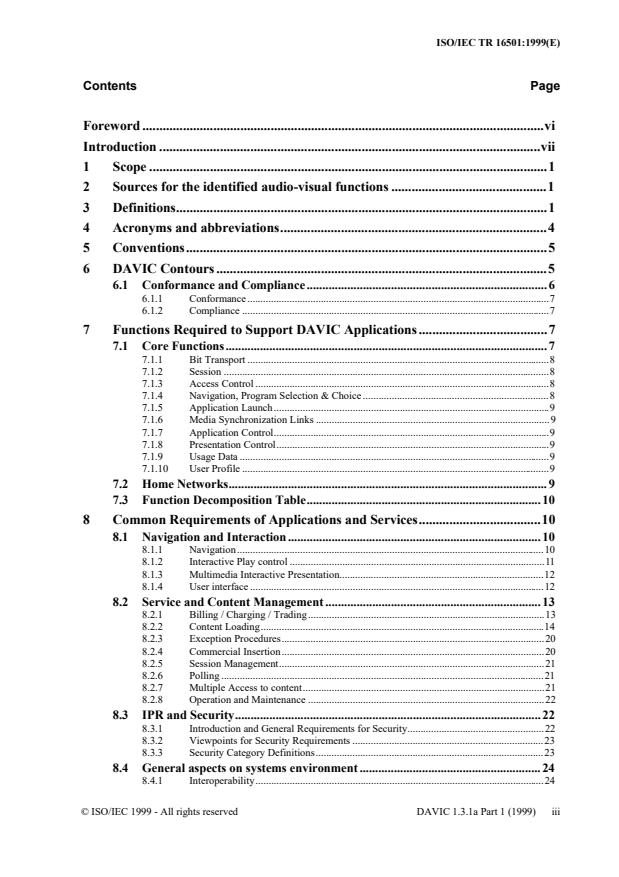
Contents Page
Foreword .vi
Introduction .vii
1 Scope .1
2 Sources for the identified audio-visual functions .1
3 Definitions.1
4 Acronyms and abbreviations.4
5 Conventions.5
6 DAVIC Contours .5
6.1 Conformance and Compliance . 6
6.1.1 Conformance.7
6.1.2 Compliance .7
7 Functions Required to Support DAVIC Applications.7
7.1 Core Functions. 7
7.1.1 Bit Transport .8
7.1.2 Session .8
7.1.3 Access Control .8
7.1.4 Navigation, Program Selection & Choice .8
7.1.5 Application Launch.9
7.1.6 Media Synchronization Links .9
7.1.7 Application Control.9
7.1.8 Presentation Control.9
7.1.9 Usage Data .9
7.1.10 User Profile .9
7.2 Home Networks. 9
7.3 Function Decomposition Table. 10
8 Common Requirements of Applications and Services.10
8.1 Navigation and Interaction. 10
8.1.1 Navigation.10
8.1.2 Interactive Play control .11
8.1.3 Multimedia Interactive Presentation.12
8.1.4 User interface .12
8.2 Service and Content Management . 13
8.2.1 Billing / Charging / Trading.13
8.2.2 Content Loading.14
8.2.3 Exception Procedures.20
8.2.4 Commercial Insertion.20
8.2.5 Session Management.21
8.2.6 Polling .21
8.2.7 Multiple Access to content.21
8.2.8 Operation and Maintenance .22
8.3 IPR and Security. 22
8.3.1 Introduction and General Requirements for Security.22
8.3.2 Viewpoints for Security Requirements .23
8.3.3 Security Category Definitions.23
8.4 General aspects on systems environment . 24
8.4.1 Interoperability.24
© ISO/IEC 1999 - All rights reserved DAVIC 1.3.1a Part 1 (1999) iii
8.4.2 Platform Independence.25
8.4.3 Latency .25
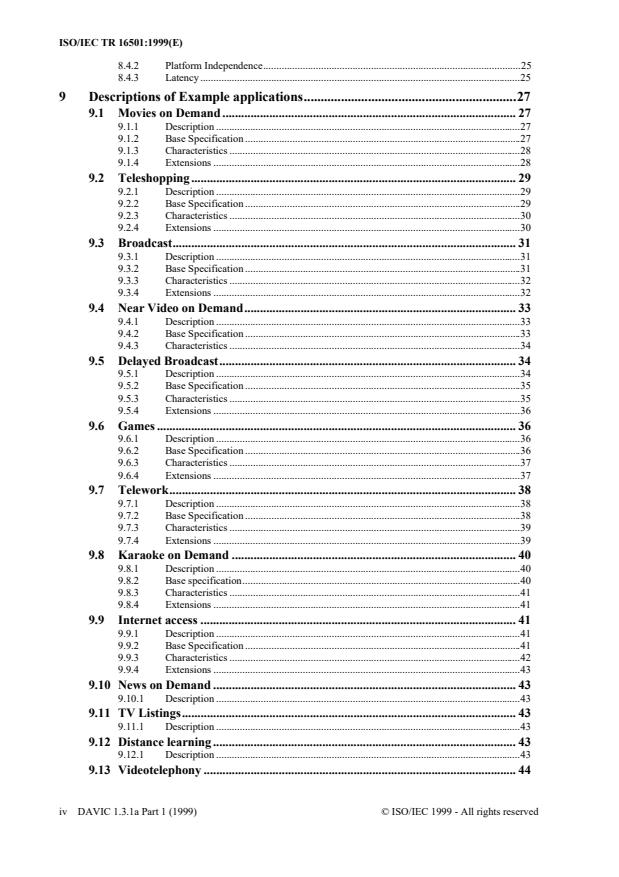
9 Descriptions of Example applications.27
9.1 Movies on Demand . 27
9.1.1 Description .27
9.1.2 Base Specification .27
9.1.3 Characteristics .28
9.1.4 Extensions .28
9.2 Teleshopping . 29
9.2.1 Description .29
9.2.2 Base Specification .29
9.2.3 Characteristics .30
9.2.4 Extensions .30
9.3 Broadcast. 31
9.3.1 Description .31
9.3.2 Base Specification .31
9.3.3 Characteristics .32
9.3.4 Extensions .32
9.4 Near Video on Demand. 33
9.4.1 Description .33
9.4.2 Base Specification .33
9.4.3 Characteristics .34
9.5 Delayed Broadcast. 34
9.5.1 Description .34
9.5.2 Base Specification .35
9.5.3 Characteristics .35
9.5.4 Extensions .36
9.6 Games . 36
9.6.1 Description .36
9.6.2 Base Specification .36
9.6.3 Characteristics .37
9.6.4 Extensions .37
9.7 Telework. 38
9.7.1 Description .38
9.7.2 Base Specification .38
9.7.3 Characteristics .39
9.7.4 Extensions .39
9.8 Karaoke on Demand . 40
9.8.1 Description .40
9.8.2 Base specification.40
9.8.3 Characteristics .41
9.8.4 Extensions .41
9.9 Internet access . 41
9.9.1 Description .41
9.9.2 Base Specification .41
9.9.3 Characteristics .42
9.9.4 Extensions .43
9.10 News on Demand . 43
9.10.1 Description .43
9.11 TV Listings. 43
9.11.1 Description .43
9.12 Distance learning . 43
9.12.1 Description .43
9.13 Videotelephony . 44
iv DAVIC 1.3.1a Part 1 (1999) © ISO/IEC 1999 - All rights reserved
9.13.1 Description .44
9.14 Home Banking. 44
9.14.1 Description .44
9.15 Telemedicine. 44
9.15.1 Description .44
9.16 Content production. 44
9.16.1 Description .44
9.17 Transaction Services. 44
9.17.1 Description .44
9.18 Videoconferencing . 45
9.18.1 Description .45
9.19 Virtual CD-ROM. 45
9.19.1 Description .45
10 Digital audio-visual functional groups and function descriptions.45
Annex A: Enhanced Digital Broadcast Contour.63
Annex B: Interactive Digital Broadcast Contour.79
Bibliography.95
© ISO/IEC 1999 - All rights reserved DAVIC 1.3.1a Part 1 (1999) v
Foreword
ISO (the International Organization for Standardization) and IEC (the International Electrotechnical Commission)
form the specialized system for worldwide standardization. National bodies that are members of ISO or IEC
participate in the development of International Standards through technical committees established by the
respective organization to deal with particular fields of technical activity. ISO and IEC technical committees
collaborate in fields of mutual interest. Other international organizations, governmental and non-governmental, in
liaison with ISO and IEC, also take part in the work.
International Standards are drafted in accordance with the rules given in the ISO/IEC Directives, Part 3.
In the field of information technology, ISO and IEC have established a joint technical committee, ISO/IEC JTC 1.
Draft International Standards adopted by the joint technical committee are circulated to national bodies for voting.
Publication as an International Standard requires approval by at least 75 % of the national bodies casting a vote.
In exceptional circumstances, when a technical committee has collected data of a different kind from that which is
normally published as an International Standard ("state of the art", for example), it may decide by a simple majority
vote of its participating members to publish a Technical Report. A Technical Report is entirely informative in nature
and does not have to be reviewed until the data it provides are considered to be no longer valid or useful.
Attention is drawn to the possibility that some of the elements of this Technical Report may be the subject of patent
rights. ISO and IEC shall not be held responsible for identifying any or all such patent rights.
ISO/IEC TR 16501 was prepared by DAVIC (Digital Audio-Visual Council) and was adopted, under the PAS
procedure, by Joint Technical Committee ISO/IEC JTC 1, Information technology, in parallel with its approval by
national bodies of ISO and IEC.
vi DAVIC 1.3.1a Part 1 (1999) © ISO/IEC 1999 - All rights reserved
Introduction
ISO/IEC TR 16501 provides a detailed listing of the core functions, generic tool capabilities and sample
applications required by users and providers of digital audio-visual applications and systems. It introduces the
concept of a contour and defines the functions required for IDB (Interactive Digital Broadcast) and EDB
(Enhanced Digital Broadcast) contours. The Technical Report complements ISO/IEC 16500. It is the source of
the requirements used to identify the generic tool technologies defined in ISO/IEC 16500 and, in particular, it
identifies the user needs and market requirements which are addressed by the contour technology toolsets defined
in ISO/IEC 16500-3.
© ISO/IEC 1999 - All rights reserved DAVIC 1.3.1a Part 1 (1999) vii
TECHNICAL REPORT ©ISO/IEC ISO/IEC TR 16501:1999(E)
Information technology — Generic digital audio-visual systems
— Technical Report on ISO/IEC 16500 — Description of digital
audio-visual functionalities
1 Scope
This Technical Report describes the functions that may be supported by systems using ISO/IEC 16500. These
functions have been derived by analyzing the requirements of a number of example applications from the
viewpoints of a range of participants, including:
� content providers � IPR holders
� service providers � rights collection agencies
� delivery system providers � regulatory authorities
� end-users � business support services
� equipment manufacturers � financial services
Applications, tools and functions are described from a behavioral viewpoint. The report does not assume any
technical implementation for a particular service.
The Technical Report consists of a main body, and a series of Annexes. The main body introduces the concept of
a contour in the context of ISO/IEC 16500 and outlines its use in compliance and conformance definitions. The
behaviour and parameters of sets of core functions and generic tools that can be derived from the functions are
then presented. Nineteeen example applications are analysed and described in terms of generic and application
specific functionalities. The main body concludes with an integrated summary listing of the functionalities
required by users and providers of digital audio-visual applications and systems organised under a set of
functional groupings . The User and Market Requirements and the corresponding Functional Requirements
required for the IDB (Interactive Digital Broadcast) contour are defined in Annex A. Similar information is
provided in Annex B for the EDB (Enhanced Digital Broadcast) contour. This overall structure is designed to
readily incorporate future descriptions of new core functions, generic tools, sample applications and additional
contours.
2 Sources for the identified audio-visual functions
The functions specified in this Technical Report were derived by analyzing the requirements of a number of
example applications, and the generic requirements common to a range of applications. The applications
considered were all taken from the responses to the calls for proposals issued by DAVIC, and prioritized during
discussions within the DAVIC Applications Technical Committee. The example applications were used as the
focus for requirements analysis, and it is expected that a wide range of applications can be implemented using this
Technical Report and ISO/IEC 16500.
3 Definitions
This clause defines new terms, and the intended meaning of certain common terms used in this Report. ISO/IEC
16500-1 Annex A defines additional terms and, in some cases, alternative interpretations that are appropriate in
other contexts.
3.1. Access Control: Provides means to access services and protection against the unauthorized interception
of the services.
© ISO/IEC 1999 - All rights reserved DAVIC 1.3.1a Part 1 (1999) 1
3.2. Access Network: a part of the Delivery system consisting of a collection of equipment and
infrastructures, that link a number of Service Consumer Systems to the rest of the Delivery system through a
single (or a limited number of) common port(s).
3.3. Application: a set of objects that provides an environment for processing Application Service Layer
information flows.
3.4. Application Programming Interface (API): set of inter-layer service request and service response
messages, message formats, and the rules for message exchange between hierarchical clients and servers. API
messages may be executed locally by the server, or the server may rely on remote resources to provide a response
to the client.
3.5. Assets: Things that a user sees or hears, e.g., bitmap, audio, and text.
3.6. Channel surfing: Viewing of many broadcast channels in a short time period by the End user.
3.7. Client: a service consuming object or system (block); (a synonym for user)
3.8. Compliance to a contour: providing all of the system functions specified in a contour according to the
mapping to ISO/IEC 16500 technologies specified in the corresponding annex of ISO/IEC 16500-3. See
subclause 6.1.2
3.9. Conditional Access: A means of allowing system users to access only those services that are
authorized to them.
3.10. Confidentiality: the protection of information from unauthorized disclosure
3.11. Conformance to a contour: providing system functions, as defined in a particular contour, used by the
services in a system for which conformance is declared. See subclause 6.1.1
3.12. Content Provider: one who owns or is licensed to sell content.
3.13. Control Word: the secret key used for a scrambling algorithm.
3.14. Control-information: information that may change the state of the object intercepting the information
flow, e.g., a remote control channel up command input. (In some cases an object may interpret a message but
reject a request and remain in its current state.)
3.15. Distribution Network: a collection of equipment and infrastructures that delivers information flows
from the Access Node to the Network Termination elements of the Access Network.
3.16. Email: Electronic mail. Email allows the sending of information in an electronic format from one
Internet user to another. Users are identified on the Internet by a unique email address.
3.17. Entitlement Control Message (ECM): Conditional Access messages carrying an encrypted form of
the control words or a means to recover the control words, together with access parameters, i.e., an identification
of the service and of the conditions required for accessing this service.
3.18. Entitlement Management Message (EMM): Conditional Access messages used to convey
entitlements or keys to users, or to invalidate or delete entitlements or keys.
3.19. FTP: File Transfer Protocol. FTP allows a connection to be made between two Internet computers in
order to transfer files between them.
3.20. Function: Features of a Digital AudioVisual System that are realized through Services. For example,
interactive play control (VCR-type controls) is a function. (See also Service)
3.21. Hierarchy: an arrangement of objects in order of rank; some objects in the arrangement are subordinate
to others; objects of the same hierarchical rank are peer objects
3.22. HTML: Hypertext Mark-up Language. HTML is a document formatting language used to specify the
format of Hypertext documents on the World Wide Web. HTML consists of ASCII text files with special tags to
specify formatting information. This includes the specification of Hypertext links, graphics information and plain
text.
2 DAVIC 1.3.1a Part 1 (1999) © ISO/IEC 1999 - All rights reserved
3.23. HTTP: Hypertext Transfer Protocol. HTTP is the protocol Web servers and browsers use to send
request, accept request, send responses and receive response of documents on the World Wide Web. It also
specifies how to initiate transfers of data using other protocols such as FTP and SMTP.
3.24. Hypertext: Hypertext is text that a user may select in some manner to cause some different set of
information to be retrieved and displayed. A common example is a link on a Web page, which may be selected
causing a new Web page to be retrieved.
3.25. Interface: a point of demarcation between two blocks through which information flows from one block
to the other. A DAVIC interface may be a physical-interface or a logical-interface.
3.26. Internet: The term Internet is used in many ways in this document. It is widely understood to mean the
global network of computers tied together via different types of networks. These computers use a standard set of
protocols to communicate, mainly TCP/IP and UDP/IP.
3.27. Key management: The generation, storage, distribution archiving, deletion, revocation, registration,
and deregistration of cryptographic keys.
3.28. Navigation: the process of reaching a service objective by means of making successive choices; the
term may be applied to the selection of a service category, a service provider or an offer within a particular
service.
3.29. Network: a collection of interconnected elements that provides connection services to users
3.30. Network control function: The Network Control Function is responsible for the error-free receipt and
transmission of content flow information to and from the Server.
3.31. Non-repudiation: the proof of the origin and reception of a message. This means that the sender cannot
deny the sending of the message and the receiver cannot deny the reception of the message.
3.32. Partition: a decomposition or subdivision of an object into smaller objects; the created objects are
peers with respect to each other, but are hierarchically subordinate to the original partitioned object
3.33. Peer: of the same rank or order: peer objects belong to the same layer (category or classification).
3.34. Physical interface: An interface where the physical characteristics of signals used to represent
information and the physical characteristics of channels used to carry the signals are defined. A physical interface
is an external interface. It is fully defined by its physical and electrical characteristics. Logical information flows
map to signal flows that pass through physical interfaces.
3.35. Plane: a category that identifies a collection of related objects, e.g., objects that execute similar or
complementary functions; or peer objects that interact to use or to provide services in a class that reflects
authority, capability, or time period. Management-plane service objects, for example, may authorize ISP-clients'
access to certain control-plane service objects that in turn may allow the clients to use services provided by
certain user-plane objects.
3.36. Privacy: privacy protects authorized participants from illegal utilization or knowledge of information
related to their components in the DAVIC System
3.37. Protocol: set of message formats (semantic, syntactic, and symbolic rules) and the rules for message
exchange between peer layer entities (which messages are valid when)
3.38. Real-time: Quality of a process, the execution of which is determined or controlled in time. The term is
sometimes extended to refer to a delivery process which is perceived fast enough to be considered as almost
instantaneous.
3.39. Reference point: a set of interfaces between any two related blocks through which information flows
from one block to the other. A reference point comprises one or more logical (non-physical) information-transfer
interfaces, and one or more physical signal-transfer interfaces.
3.40. Server: any service providing system.
3.41. Service provider: an entity that provides a service to a client.
3.42. Session: an interval during which a logical, mutually agreed correspondence between two objects exists
for the transfer of related information. A session defines a relationship between the participating users in a service
instance.
© ISO/IEC 1999 - All rights reserved DAVIC 1.3.1a Part 1 (1999) 3
3.43. Specification: a definition of the requirements of a system. A specification consists of general
parameters required of the system and the functional specification of its required behavior. Specification may also
be used as shorthand for specification and/or description, e.g., in SDL specification or system specification.
3.44. Symbol: a bit or a defined sequence of bits.
3.45. System: a collection of interacting objects that serves a useful purpose; typically, a primary subdivision
of an object of any size or composition (including domains)
3.46. User: a service consuming object or system
3.47. Virtual channel: communication channel that provides for the sequential unidirectional transport of
ATM cells
4 Acronyms and abbreviations
This clause defines the acronyms and abbreviations used in this Technical Report. Additional acronyms and
abbreviations relevant to digital audio-visual applications is available in Annex B of ISO/IEC 16500-1.
CA Conditional Access
DVB Digital Video Broadcasting
DVB-SI DVB - Service Information
ECM Entitlement Control Message
EMM Entitlement Management
EPG Electronic Program Guide
HDTV High Definition Television
HTML HyperText Markup Language
IP Internet Protocol
IPR Intellectual Property Rights
ISDN Integrated Services Digital Network
ISO International Organization for Standardization
ITU International Telecommunications Union
JPEG Joint Photographic Experts Group
KOD Karaoke-On-Demand
Mbps Megabits per second
MOD Movies-On-Demand
MPEG Moving Picture Experts Group
MPEG-TS MPEG Transport Stream
NVOD Near Video-On-Demand (Also N-VOD)
PG Parental Guidance
PIN Personal Identification Number
PPV Pay-Per-View
QoS Quality of Service
STB Set-Top Box
STU Set-Top Unit
4 DAVIC 1.3.1a Part 1 (1999) © ISO/IEC 1999 - All rights reserved
UPI User Premises Interface
VASP Value Added Service provider
VOD Video-On-Demand
5 Conventions
The style of this Report follows the general guidelines of the Guide for ITU-T and ISO/IEC JTC 1 cooperation.
Appendix II: Rules for presentation of ITU-T | ISO/IEC common text (March 1993)
6 DAVIC Contours
The purpose of contours is to enable the building of marketable products by translating market requirements into
functional specifications and then to technological solutions. The whole process is shown in Figure 6.1.
Market Domain
Requirements
Function Domain
Capabilities
Technology Domain
Capabilities
Requirements
Figure 6.1 — Contour Domains
A contour is expressed in three domains:
� in the Market domain, as a set of market and user requirements;
� in the Function domain, as a set of functional requirements; and
� in the Technology domain, as a set of system functions and selected tools.
© ISO/IEC 1999 - All rights reserved DAVIC 1.3.1a Part 1 (1999) 5
All DAVIC Requirements
Market Domain
Functions
A Contour
includes
Technologies
all three
Function Domain
Technology Domain
Figure 6.2 — Contour Definition
A contour consists of three separate essential items of information which describe:
� a set of user and market requirements with a focus on a market segment;
� a set of functional specifications for interoperable DAVIC system components derived from the user
and market requirements; and
� a set of technologies supporting the functional requirements.
Each contour is developed in a two step approach and is best understood using the following two documents:
� This Technical Report which describes the User & Market Requirements and provides a list of
Functional Requirements. These are system-level requirements, not sub-system level and they do
not define physically where in the system a particular function has to be executed;
and
� ISO/IEC 16500-3 which contains a corresponding Annex which lists the technologies required to
fulfil the functionality identified for each contour and, where appropriate, assigns specific DAVIC
components from ISO/IEC 16500 to achieve the required technologies.
DAVIC contours are used to define systems, derived from User & Market requirements. They describe fully the
functions and their mapping to the DAVIC technologies required to implement marketable solutions. There is no
implied relationship between one contour and another. A contour may be a superset, a subset or be completely
independent of another.
Systems, which are implemented according to the contour, may also implement functions and technologies
outside the contour (including those outside DAVIC).
6.1 Conformance and Compliance
The following definitions apply.
6 DAVIC 1.3.1a Part 1 (1999) © ISO/IEC 1999 - All rights reserved
6.1.1 Conformance
DAVIC defines a system to be conformant to a contour when it uses the contour as a guide but may omit
functions where appropriate (for example in the case of regional solutions to optimize cost-effectiveness). All
functions that are selected from the contour must be executed according to the mapping to DAVIC technologies
specified in the appropriate annex to ISO/IEC 16500-3.
6.1.2 Compliance
DAVIC defines a system to be compliant with a contour when it is capable of executing all functions that are
specified in the appropriate annex to ISO/IEC TR 16501, according to the mapping to DAVIC technologies
specified in the corresponding annex to ISO/IEC 16500-3, and meets all of the requirements of the contour.
7 Functions Required to Support DAVIC Applications
7.1 Core Functions
DAVIC compliant systems are intended to facilitate the introduction of a wide variety of applications. These
applications will consume system resources and have functionality that is spread across a number of DAVIC
subsystems. Examples of applications are given in clause 9. These applications have both common and specific
functionality. Future applications which require the definition of additional and new functions can easily be
accommodated by adding them to the current list of core functions below.
However, it is possible to identify core DAVIC functions that are basic to the system’s operation, integrity and
development. These functions provide core functionality to the system and all its running applications. They may
be subdivided into the following groups: -
� Bit Transport
� Session
� Access Control
� Navigation, Program Selection & Choice
� Application Launch
� Media Synchronization Links
� Application Control
� Presentation Control
� Usage Data
� User Profile
Figure 7.1 depicts the interrelationship of these core functional groups and running applications.
© ISO/IEC 1999 - All rights reserved DAVIC 1.3.1a Part 1 (1999) 7
Presentation control
Access control
User profile Usage data Navigation & Selection Application control
Application launch Applications
Media Synchronisation links
Session
Bit Transport
Figure 7.1 — Core Functional groups
Applications will invoke the core functions as required, or replace or extend them with more specific functions
(which may in turn invoke core functions). An application will comprise specific code with many calls to the core
functions.
A function element used by more than one application is almost certainly “core”. However, a function element
used by only one application is still considered "core” if it cannot be synthesized from other “core” functions. If
the function can be synthesized then it is an application-specific function.
7.1.1 Bit Transport
This group of functions provides physical and logical links of a given bandwidth, facilities to combine such links,
and switching information to achieve logical connections between points. Signal splitting and combination
functions and facilities will enable point to point, point to multipoint, multipoint to point and multipoint to
multipoint connections to be established.
The physical data stream provided by the bit-transport functions may be multiplexed between several services
and/or applications so that each is given the logical connections it requires. Each application session must be able
to negotiate the data rate of each logical connection established depending on requirements and current
transmission resource occupancy.
7.1.2 Session
This group of functions controls the Bit Transport functions, calling upon them to establish or change a logical
connection. Such a connection may be point to point, point to multipoint, multipoint to point or multipoint to
multipoint, and it may be at a predetermined or a variable data rate. The establishment of connection criteria such
as data rate will be by the use of protocols mutually agreed between Session and Bit Transport.
The Session functions provide common facilities such as data encryption, file transfer and verification to all
applications.
7.1.3 Access Control
This group of functions provides facilities to authenticate a user, and to determine and verify access rights to the
network. They also control a user’s access to specific applications and related content, goods and services, and
provide verification of credit and payment.
7.1.4 Navigation, Program Selection & Choice
This group of functions provides the user with menu selection facilities, enabling the choice of application or
content. Selection will be aided by appropriate user specific criteria (including access-control rights, preferences,
interests etc.) and knowledge of prior behavior, and will almost certainly be hierarchical, involving several levels
of menu. At the lowest level, the user’s response will result in the launch of a resident or downloaded application.
8 DAVIC 1.3.1a Part 1 (1999) © ISO/IEC 1999 - All rights reserved
7.1.5 Application Launch
This group of functions provides the facilities to run an application. The application code may be already resident
in the STU or may be obtained via a session to a remote server. Having been loaded, the application is then
launched, execution transferring to the new code. It is the launched application’s responsibility to obtain and
dispose of system resources, to initiate and terminate any new sessions and to conclude in an orderly and clean
fashion.
7.1.6 Media Synchronization Links
This group of functions provides links between objects, such as sound segments, subtitles, still images, moving
images and applications to achieve a multimedia presentation. Examples of usage would be: to allow the viewer
to select and subsequently order products seen on-screen during a TV broadcast; to display subtitles or to listen to
audio description for hearing or sight-impaired viewers; to provide text translation to another language, or to
synchronize language dubbed audio.
7.1.7 Application Control
This group of functions provides control of the applications, and should be distinguished from Presentation
Control. Communication between the user and an application will result in modifications to the application’s
behavior or content options selected according to the user’s commands and preferences. Examples would be
pausing, rewind, forward wind, audio pitch & tempo control, bookmarking and content interaction such as the
choice of a sad or happy ending to a play.
7.1.8 Presentation Control
This group of functions provides the provision to users of control for the delivery and display of multimedia
information, such as subtitle activation and positioning, choice of language etc. Such control does not involve any
control of the server or the information flowing therefrom.
7.1.9 Usage Data
This is a group of functions that collect, store and supply data concerning users’ consumption of material,
resources and applications. The data supports payment, and gives feedback to content providers for market
research and planning purposes. It also enables system management to monitor resource utilization.
The underlying data collected by these functions is likely to be covered by data protection regulations, and needs
to have controlled dissemination. Individuals will need to receive bills for applications used and content supplied,
and content providers will need to have demographic and socioeconomic information about audiences.
Payment for services may be from a variety of sources, from the user, from the service provider or from the
Content Provider, in a similar way to telephone services today. Costs are likely to involve a number of elements,
including the royalty costs of copyrighted material, the cost of storage and the cost of supply. Some cost elements
may well be fixed; others may vary from time to time during the day. So for example, an old film viewed at peak
time could have a low royalty cost but a high access cost, a new film viewed late at night could have a high
royalty cost but a low access charge.
7.1.10 User Profile
This group of functions stores and utilizes information about the individual user and their prior behavior in order
to control access (e.g. Identification and Password), to assist navigation, and to correctly bill for services
receive
...
Questions, Comments and Discussion
Ask us and Technical Secretary will try to provide an answer. You can facilitate discussion about the standard in here.
Loading comments...