


ISO 5630-7:2014
(Main)Paper and board — Accelerated ageing — Part 7: Exposure to light
Paper and board — Accelerated ageing — Part 7: Exposure to light
ISO 5630-7:2014 specifies a method for accelerating the ageing of paper and board through exposure to an elevated light irradiance and for assessing the effect of ageing on optical properties for the purpose of predicting stability to long-term natural ageing that occurs due to exposure to light. It is applicable to all types of paper and board whose surface is white or near white.
Papier et carton — Vieillissement accéléré — Partie 7: Exposition à la lumière
General Information
- Status
- Withdrawn
- Publication Date
- 11-Aug-2014
- Technical Committee
- ISO/TC 6/SC 2 - Test methods and quality specifications for paper and board
- Current Stage
- 9599 - Withdrawal of International Standard
- Start Date
- 02-Aug-2022
- Completion Date
- 14-Feb-2026
Relations
- Effective Date
- 06-Jun-2022
Get Certified
Connect with accredited certification bodies for this standard

Control Union Certifications
Global certification for agriculture and sustainability.

Gozdarski inštitut Slovenije
Slovenian Forestry Institute. Forest management certification support, timber testing.
Sponsored listings
Frequently Asked Questions
ISO 5630-7:2014 is a standard published by the International Organization for Standardization (ISO). Its full title is "Paper and board — Accelerated ageing — Part 7: Exposure to light". This standard covers: ISO 5630-7:2014 specifies a method for accelerating the ageing of paper and board through exposure to an elevated light irradiance and for assessing the effect of ageing on optical properties for the purpose of predicting stability to long-term natural ageing that occurs due to exposure to light. It is applicable to all types of paper and board whose surface is white or near white.
ISO 5630-7:2014 specifies a method for accelerating the ageing of paper and board through exposure to an elevated light irradiance and for assessing the effect of ageing on optical properties for the purpose of predicting stability to long-term natural ageing that occurs due to exposure to light. It is applicable to all types of paper and board whose surface is white or near white.
ISO 5630-7:2014 is classified under the following ICS (International Classification for Standards) categories: 85.060 - Paper and board. The ICS classification helps identify the subject area and facilitates finding related standards.
ISO 5630-7:2014 has the following relationships with other standards: It is inter standard links to ISO/TR 14253-6:2012. Understanding these relationships helps ensure you are using the most current and applicable version of the standard.
ISO 5630-7:2014 is available in PDF format for immediate download after purchase. The document can be added to your cart and obtained through the secure checkout process. Digital delivery ensures instant access to the complete standard document.
Standards Content (Sample)
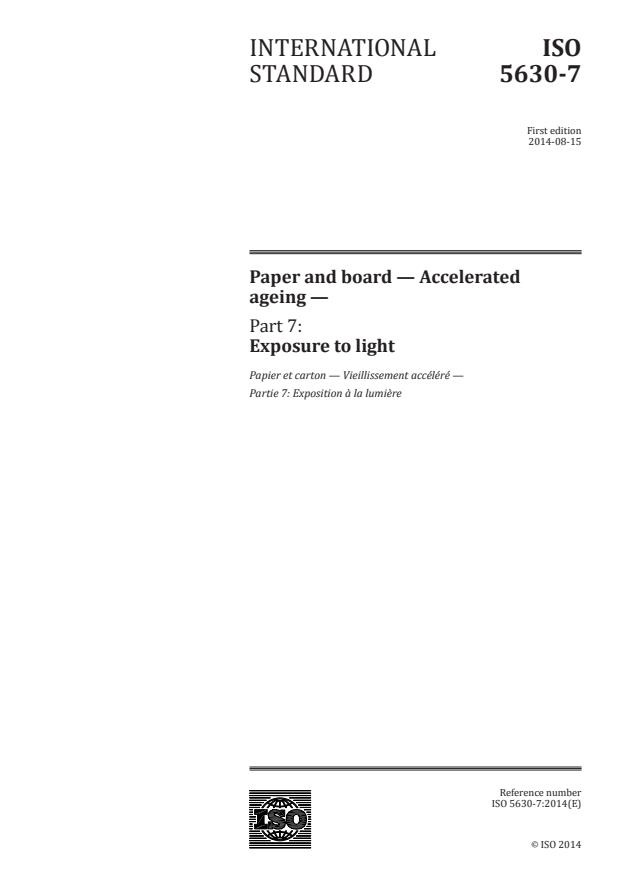
INTERNATIONAL ISO
STANDARD 5630-7
First edition
2014-08-15
Paper and board — Accelerated
ageing —
Part 7:
Exposure to light
Papier et carton — Vieillissement accéléré —
Partie 7: Exposition à la lumière
Reference number
©
ISO 2014
© ISO 2014
All rights reserved. Unless otherwise specified, no part of this publication may be reproduced or utilized otherwise in any form
or by any means, electronic or mechanical, including photocopying, or posting on the internet or an intranet, without prior
written permission. Permission can be requested from either ISO at the address below or ISO’s member body in the country of
the requester.
ISO copyright office
Case postale 56 • CH-1211 Geneva 20
Tel. + 41 22 749 01 11
Fax + 41 22 749 09 47
E-mail copyright@iso.org
Web www.iso.org
Published in Switzerland
ii © ISO 2014 – All rights reserved
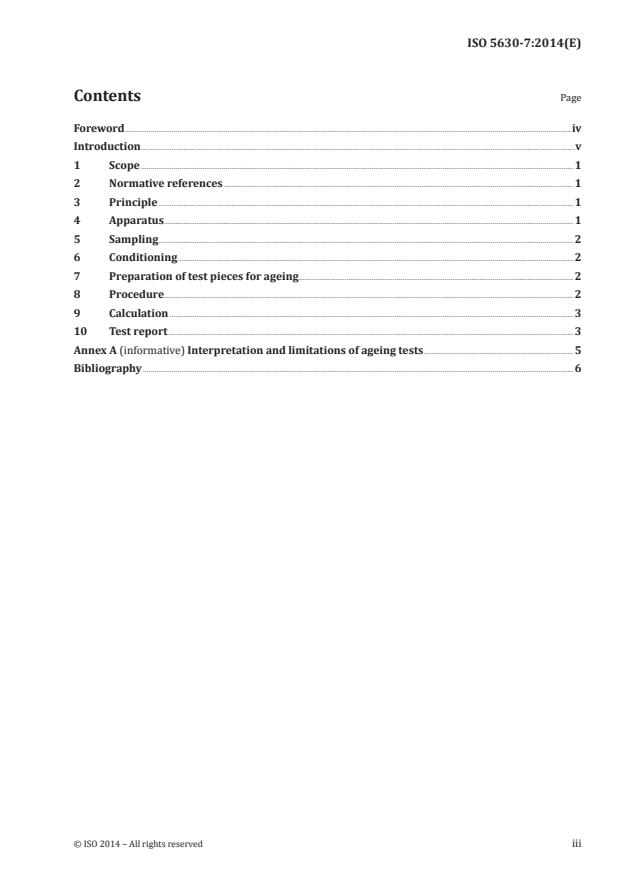
Contents Page
Foreword .iv
Introduction .v
1 Scope . 1
2 Normative references . 1
3 Principle . 1
4 Apparatus . 1
5 Sampling . 2
6 Conditioning . 2
7 Preparation of test pieces for ageing . 2
8 Procedure. 2
9 Calculation . 3
10 Test report . 3
Annex A (informative) Interpretation and limitations of ageing tests . 5
Bibliography . 6
Foreword
ISO (the International Organization for Standardization) is a worldwide federation of national standards
bodies (ISO member bodies). The work of preparing International Standards is normally carried out
through ISO technical committees. Each member body interested in a subject for which a technical
committee has been established has the right to be represented on that committee. International
organizations, governmental and non-governmental, in liaison with ISO, also take part in the work.
ISO collaborates closely with the International Electrotechnical Commission (IEC) on all matters of
electrotechnical standardization.
The procedures used to develop this document and those intended for its further maintenance are
described in the ISO/IEC Directives, Part 1. In particular the different approval criteria needed for the
different types of ISO documents should be noted. This document was drafted in accordance with the
editorial rules of the ISO/IEC Directives, Part 2 (see www.iso.org/directives).
Attention is drawn to the possibility that some of the elements of this document may be the subject of
patent rights. ISO shall not be held responsible for identifying any or all such patent rights. Details of any
patent rights identified during the development of the document will be in the Introduction and/or on
the ISO list of patent declarations received (see www.iso.org/patents).
Any trade name used in this document is information given for the convenience of users and does not
constitute an endorsement.
For an explanation on the meaning of ISO specific terms and expressions related to conformity
assessment, as well as information about ISO’s adherence to the WTO principles in the Technical Barriers
to Trade (TBT) see the following URL: Foreword - Supplementary information
The committee responsible for this document is ISO/TC 6, Paper, board and pulps, Subcommittee SC 2,
Test methods and quality specifications for paper and board.
ISO 5630 consists of the following parts, under the general title Paper and board — Accelerated ageing:
— Part 1: Dry heat treatment at 105 °C
— Part 3: Moist heat treatment at 80 °C and 65 % relative humidity
— Part 4: Dry heat treatment at 120 or 150 °C
— Part 5: Exposure to elevated temperature at 100 °C
— Part 6: Exposure to atmospheric pollution (nitrogen dioxide)
— Part 7: Exposure to light
Part 2: Moist heat treatment at 90 °C and 25 % relative humidity was withdrawn in 1992.
iv © ISO 2014 – All rights reserved
Introduction
Exposure of paper or board to a hostile environment, such as some type of radiation, elevated
temperature, or chemical pollutant over a period of hours or days can provide information concerning
the natural changes that can occur in the material over a period of years.
This test method for accelerated ageing by exposure of paper to an elevated light flux has its origins
[2]
in the extensive ASTM research program which developed experimental procedures and studied a
range of printing and writing papers. The light irradiance specified in this part of ISO 5630 is much
lower than that recommended by the ASTM study which is considered too high and requires expensive
and hazardous equipment.
To get a full understanding of the stability of paper to long-term natural ageing effects, a combination
of test methods for accelerated ageing can be used. Application of accelerated ageing tests assumes that
the changes that occur under harsher than normal conditions have a strong positive correlation with
those occurring under “normal” conditions.
INTERNATIONAL STANDARD ISO 5630-7:2014(E)
Paper and board — Accelerated ageing —
Part 7:
Exposure to light
1 Scope
This part of ISO 5630 specifies a method for accelerating the ageing of paper and board through exposure
to an elevated light irradiance and for assessing the effect of ageing on optical properties for the purpose
of predicting stability to long-term natural ageing that occurs due to exposure to light. It is applicable to
all types of paper and board whose surface is white or near white.
2 Normative references
The following documents, in whole or in part, are normatively referenced in this document and are
indispensable for its application. For dated references, only the edition cited applies. For undated
references, the latest edition of the referenced document (including any amendments) applies.
ISO 186, Paper and board — Sampling to determine average quality
ISO 187, Paper, board and pulps — Standard atmosphere for conditioning and testing and procedure for
monitoring the atmosphere and conditioning of samples
ISO 2470-1, Paper, board and pulps — Measurement of diffuse blue reflectance factor — Part 1: Indoor
daylight conditions (ISO brightness)
ISO 5631-1, Paper and board — Determination of colour by diffuse reflectance — Part 1: Indoor daylight
conditions (C/2°)
3 Principle
Sheets of paper are aged at an accelerated rate by exposing them to an elevated light irradiance. The
elevated irradiance accelerates changes in the optical properties which occur when paper is exposed
to “normal” light levels over an extended period. By comparing diffuse blue reflectance factor (ISO
brightness) and the b* CIELab colour coordinate before and after ageing, a measure of the stability of
the optical properties of the paper when exposed to light is obtained.
4 Apparatus
2 2
4.1 Light source, producing an even irradiance (total irradiance) to all test surfaces of 20 W/m ± 1 W/m
2 2
in the wavelength range 290 nm to 800 nm with a UV component of 1,0 W/m ± 0,1 W/m . The ratio of
the irradiance in the wavelength range 400 nm to 600 nm to that in the range 600 nm to 800 nm shall be
1,0 to 1,5 with all wavelengths over the range 400 nm to 700 nm present in the radiation.
The uniformity of the total irradiance shall be such that it does not vary by more than ±1 W/m on any
portion of the test surface of the specimen. If the light delivered by the source includes wavelengths
below 300 nm, these shall be removed by the use of a suitable glass filter.
The total irradiance of the light source at the specimen surface shall be checked at regular intervals to
maintain it within a range of ±1 W/m of its nominal value (value when first tested or first used) with
a UV component maintained within ±0,1 W/m . If the irradiance is outside either of these ranges, the
lamp(s) shall be replaced.
...
Questions, Comments and Discussion
Ask us and Technical Secretary will try to provide an answer. You can facilitate discussion about the standard in here.
Loading comments...