

ISO 16260:2025
(Main)Paper and board — Determination of internal bond strength
General Information
- Abstract
This document specifies a method to measure the energy required to rapidly delaminate a test piece of paper or board. Rupture of the test piece in the “Z” or thickness direction is initiated by a pendulum having a defined mass, moving at a defined velocity. The procedure is suitable for both single- and multi-ply papers and boards, including coated sheets and those that are laminated with synthetic polymer films. It is particularly suitable for papers and boards that can be subjected to z-direction rapid impacts, impulses or shock loads during printing or conversion. The test procedure entails the adherence of double-sided adhesive tape to both sides of the test piece under pressure. For this reason, the method is unsuitable for materials that can be structurally damaged by compression or are porous enough to permit migration of the tape adhesive into or through the test piece.
- Status
- Published
- Publication Date
- 30-Nov-2025
- Technical Committee
- ISO/TC 6/SC 2 - Test methods and quality specifications for paper and board
- Current Stage
- 6060 - International Standard published
- Start Date
- 01-Dec-2025
- Due Date
- 14-Jul-2026
- Completion Date
- 01-Dec-2025
Buy Documents

ISO 16260:2025 - Paper and board — Determination of internal bond strength Released:12/1/2025

ISO 16260:2025 - Papier et carton — Détermination de la force de cohésion interne Released:16. 01. 2026
REDLINE ISO 16260:2025 - Papier et carton — Détermination de la force de cohésion interne Released:16. 01. 2026
Overview
ISO 16260:2025 - Paper and board - Determination of internal bond strength - specifies a standardized pendulum impact method to measure the energy required to rapidly delaminate a paper or board test piece in the Z (thickness) direction. The test quantifies internal bond strength as the average potential energy (J/m) absorbed during rapid splitting initiated by a defined pendulum mass and velocity. The method is suitable for single- and multi-ply papers and boards, including coated sheets and materials laminated with synthetic films, but is not suitable for samples that are structurally damaged by compression or porous enough to allow migration of adhesive.
Key topics and technical requirements
- Test principle: A square test piece is sandwiched between double-sided adhesive tape, fixed to a rigid metal anvil and an L‑shaped aluminium platen; a pendulum strikes the platen to initiate Z‑direction rupture. Energy absorbed is calculated from pendulum overswing and known instrument parameters.
- Apparatus: Pendulum with low‑friction spindle and defined striker, L‑shaped aluminium platen, metal anvil, test assembly preparation device (25.4 mm ±0.2 mm test area), and reliable latching/release mechanism.
- Specimen preparation: Use controlled pressure and time to adhere tape to both faces; ensure platen clamping to avoid flexing. Most preparation stations prepare multiple assemblies simultaneously.
- Conditioning and sampling: Follow standard atmosphere and sampling procedures (see ISO 187 and ISO 186 references) before testing.
- Calibration and verification: Mandatory instrument calibration and periodic verification (Annex A and new Annex B) to maintain measurement traceability; precision data and repeatability information provided (Annex C).
- Scope limitations: Not suitable for compressible or porous substrates where adhesive migrates; results from mechanical and electronic testers may differ (see Clause 12).
- Test reporting: Document instrument type, tester range, environmental conditions, mean value and standard deviation, and any deviations per Clause 13.
Practical applications and users
- Quality control and acceptance testing for paper and board manufacturers.
- Performance screening for converters and printers to predict susceptibility to Z‑direction impacts (picking, blistering, delamination) during printing and converting.
- R&D labs developing coatings, laminates, or multi‑ply products where interply adhesion is critical.
- Third‑party testing laboratories providing compliance and comparison data for suppliers and customers.
- Useful keyword contexts: ISO 16260, internal bond strength test, Z‑direction delamination, pendulum impact tester, paper testing standards.
Related standards
- ISO 186 - Paper and board: Sampling to determine average quality
- ISO 187 - Standard atmosphere for conditioning and testing
- EN 755‑2 - Aluminium and aluminium alloys - Mechanical properties (referenced for platen material)
ISO 16260:2025 provides a repeatable, impact‑rate sensitive method for assessing internal bond performance where rapid Z‑direction loads are relevant to end‑use quality and process robustness.
Relations
- Effective Date
- 15-Jul-2023
Buy Documents
ISO 16260:2025 - Paper and board — Determination of internal bond strength Released:12/1/2025
ISO 16260:2025 - Papier et carton — Détermination de la force de cohésion interne Released:16. 01. 2026
REDLINE ISO 16260:2025 - Papier et carton — Détermination de la force de cohésion interne Released:16. 01. 2026
Get Certified
Connect with accredited certification bodies for this standard

Control Union Certifications
Global certification for agriculture and sustainability.

Gozdarski inštitut Slovenije
Slovenian Forestry Institute. Forest management certification support, timber testing.
Sponsored listings
Frequently Asked Questions
ISO 16260:2025 is a standard published by the International Organization for Standardization (ISO). Its full title is "Paper and board — Determination of internal bond strength". This standard covers: This document specifies a method to measure the energy required to rapidly delaminate a test piece of paper or board. Rupture of the test piece in the “Z” or thickness direction is initiated by a pendulum having a defined mass, moving at a defined velocity. The procedure is suitable for both single- and multi-ply papers and boards, including coated sheets and those that are laminated with synthetic polymer films. It is particularly suitable for papers and boards that can be subjected to z-direction rapid impacts, impulses or shock loads during printing or conversion. The test procedure entails the adherence of double-sided adhesive tape to both sides of the test piece under pressure. For this reason, the method is unsuitable for materials that can be structurally damaged by compression or are porous enough to permit migration of the tape adhesive into or through the test piece.
This document specifies a method to measure the energy required to rapidly delaminate a test piece of paper or board. Rupture of the test piece in the “Z” or thickness direction is initiated by a pendulum having a defined mass, moving at a defined velocity. The procedure is suitable for both single- and multi-ply papers and boards, including coated sheets and those that are laminated with synthetic polymer films. It is particularly suitable for papers and boards that can be subjected to z-direction rapid impacts, impulses or shock loads during printing or conversion. The test procedure entails the adherence of double-sided adhesive tape to both sides of the test piece under pressure. For this reason, the method is unsuitable for materials that can be structurally damaged by compression or are porous enough to permit migration of the tape adhesive into or through the test piece.
ISO 16260:2025 is classified under the following ICS (International Classification for Standards) categories: 85.060 - Paper and board. The ICS classification helps identify the subject area and facilitates finding related standards.
ISO 16260:2025 has the following relationships with other standards: It is inter standard links to ISO 16260:2016. Understanding these relationships helps ensure you are using the most current and applicable version of the standard.
ISO 16260:2025 is available in PDF format for immediate download after purchase. The document can be added to your cart and obtained through the secure checkout process. Digital delivery ensures instant access to the complete standard document.
Standards Content (Sample)
International
Standard
ISO 16260
Second edition
Paper and board — Determination
2025-12
of internal bond strength
Papier et carton — Détermination de la force de cohésion interne
Reference number
© ISO 2025
All rights reserved. Unless otherwise specified, or required in the context of its implementation, no part of this publication may
be reproduced or utilized otherwise in any form or by any means, electronic or mechanical, including photocopying, or posting on
the internet or an intranet, without prior written permission. Permission can be requested from either ISO at the address below
or ISO’s member body in the country of the requester.
ISO copyright office
CP 401 • Ch. de Blandonnet 8
CH-1214 Vernier, Geneva
Phone: +41 22 749 01 11
Email: copyright@iso.org
Website: www.iso.org
Published in Switzerland
ii
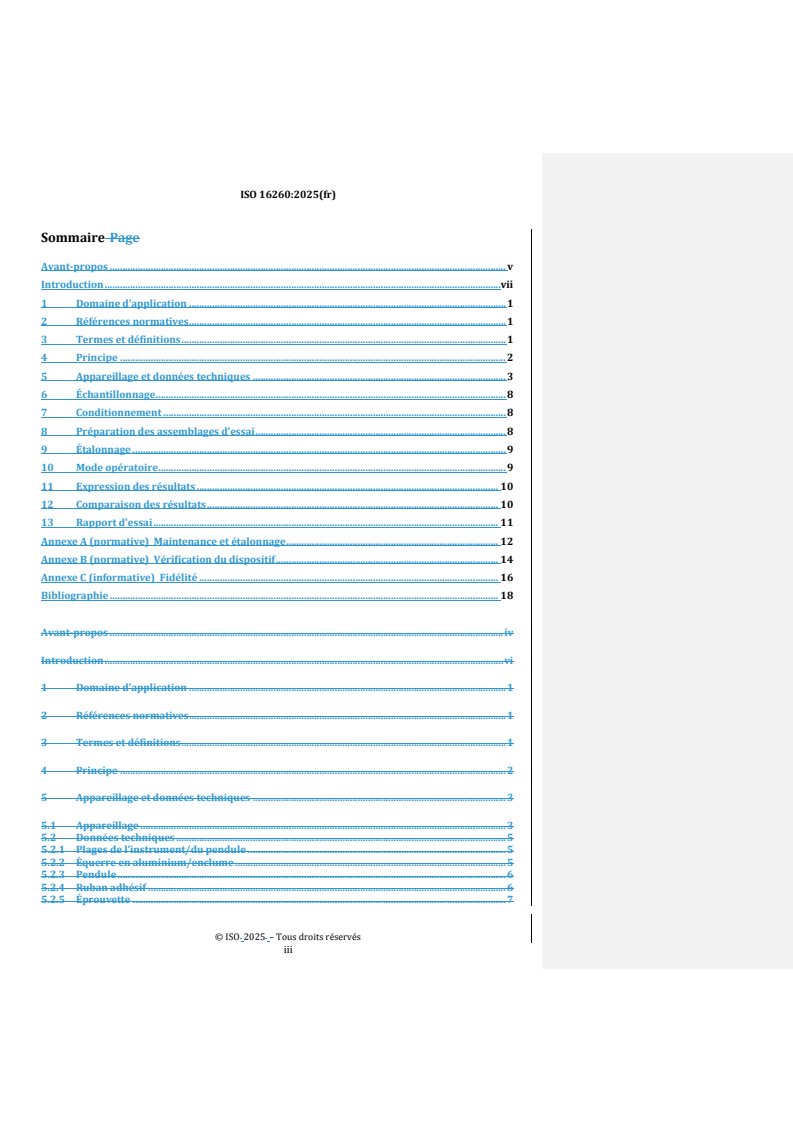
Contents Page
Foreword .iv
Introduction .v
1 Scope . 1
2 Normative references . 1
3 Terms and definitions . 1
4 Principle . 2
5 Apparatus and technical data . 2
5.1 Apparatus .2
5.2 Technical data .5
5.2.1 Instrument/pendulum ranges .5
5.2.2 Aluminium platen/anvil .5
5.2.3 Pendulum .5
5.2.4 Adhesive tape .6
5.2.5 Test piece .7
6 Sampling . 7
7 Conditioning . 7
8 Preparation of test assemblies . 7
8.1 Preparation of strips .7
8.2 Load of preparation station .7
8.3 Operation of preparation station .7
8.4 Separation of the test pieces .8
9 Calibration . 8
10 Procedure . 8
10.1 Atmospheric conditions.8
10.2 Selection of instrument range .8
10.3 Horizontal position of the pendulum.8
10.4 First test assembly .8
10.5 Release of the pendulum .8
10.6 Examination of the test piece .8
10.7 Notation of the test value .8
10.8 Repetition .9
10.9 Use of test pieces of high internal bond strength .9
11 Expression of results . 9
11.1 Mean value .9
11.2 Standard deviation .9
12 Comparison of results . 9
13 Test report . 9
Annex A (normative) Maintenance and calibration .11
Annex B (normative) Verification of device .13
Annex C (informative) Precision .15
Bibliography . 17
iii
Foreword
ISO (the International Organization for Standardization) is a worldwide federation of national standards
bodies (ISO member bodies). The work of preparing International Standards is normally carried out through
ISO technical committees. Each member body interested in a subject for which a technical committee
has been established has the right to be represented on that committee. International organizations,
governmental and non-governmental, in liaison with ISO, also take part in the work. ISO collaborates closely
with the International Electrotechnical Commission (IEC) on all matters of electrotechnical standardization.
The procedures used to develop this document and those intended for its further maintenance are described
in the ISO/IEC Directives, Part 1. In particular, the different approval criteria needed for the different types
of ISO documents should be noted. This document was drafted in accordance with the editorial rules of the
ISO/IEC Directives, Part 2 (see www.iso.org/directives).
ISO draws attention to the possibility that the implementation of this document may involve the use of (a)
patent(s). ISO takes no position concerning the evidence, validity or applicability of any claimed patent
rights in respect thereof. As of the date of publication of this document, ISO had not received notice of (a)
patent(s) which may be required to implement this document. However, implementers are cautioned that
this may not represent the latest information, which may be obtained from the patent database available at
www.iso.org/patents. ISO shall not be held responsible for identifying any or all such patent rights.
Any trade name used in this document is information given for the convenience of users and does not
constitute an endorsement.
For an explanation of the voluntary nature of standards, the meaning of ISO specific terms and expressions
related to conformity assessment, as well as information about ISO's adherence to the World Trade
Organization (WTO) principles in the Technical Barriers to Trade (TBT), see www.iso.org/iso/foreword.html.
This document was prepared by Technical Committee ISO/TC 6, Paper, board and pulps, Subcommittee SC 2,
Test methods and quality specifications for paper and board.
This second edition cancels and replaces the first edition (ISO 16260:2016), which has been technically
revised.
The main changes are as follows:
— addition of a reference to possible different results, depending on the type of tester in the introduction;
— update of 5.1.6 regarding “Analog ply bond devices” and “Digital ply bond devices” and addition of
Figure 3;
— update of Table 1, regarding the contact force (former mass);
— update of 5.2.2 “Aluminium platen/anvil”;
— addition of 5.2.3.1 “Reduced pendulum length";
— revision of Clause 8 “Preparation of test assemblies” and Clause 9 “Calibration”;
— update of 10.2 “Selection of instrument range”;
— addition of new Clause 12 “Comparison of results”;
— revision of Clause 13 “test report”;
— renumbered former Annex B to Annex C, with addition of the used tester type;
— addition of “Verification of device” as new Annex B;
— editorial changes.
Any feedback or questions on this document should be directed to the user’s national standards body. A
complete listing of these bodies can be found at www.iso.org/members.html.
iv
Introduction
Paper and board sheets can, during printing, conversion or specific product applications, be subjected to
impulses, impacts or shock loads of sufficient magnitude to cause structural failure. Commonly observed in-
plane structural failures include surface picking, blistering and interior delimitation.
This document describes one method for determining the internal bond strength of a product of pulp, paper
or board by measuring the energy needed to delaminate a paper or board sample in the "Z" (thickness)
[4][8]
direction. There are other published methods for determining “Z” or thickness direction tensile
strength, but in this method, the delaminating force is applied at a rate significantly higher than in other
methods. This method can, therefore, be preferred for predicting sheet performance under printing or
converting conditions.
Different types of testers (mechanical and electronic) are in use for this method. The results obtained with
the two types of testers may not be not comparable (see Clause 12).
v
International Standard ISO 16260:2025(en)
Paper and board — Determination of internal bond strength
1 Scope
This document specifies a method to measure the energy required to rapidly delaminate a test piece of
paper or board. Rupture of the test piece in the “Z” or thickness direction is initiated by a pendulum having a
defined mass, moving at a defined velocity.
The procedure is suitable for both single- and multi-ply papers and boards, including coated sheets and
those that are laminated with synthetic polymer films. It is particularly suitable for papers and boards that
[4][8]
can be subjected to z-direction rapid impacts, impulses or shock loads during printing or conversion.
The test procedure entails the adherence of double-sided adhesive tape to both sides of the test piece under
pressure. For this reason, the method is unsuitable for materials that can be structurally damaged by
compression or are porous enough to permit migration of the tape adhesive into or through the test piece.
2 Normative references
The following documents are referred to in the text in such a way that some or all of their content constitutes
requirements of this document. For dated references, only the edition cited applies. For undated references,
the latest edition of the referenced document (including any amendments) applies.
EN 755-2:2013, Aluminium and aluminium alloys — Extruded rod/bar, tube and profiles — Part 2: Mechanical
properties
ISO 186, Paper and board — Sampling to determine average quality
ISO 187, Paper, board and pulps — Standard atmosphere for conditioning and testing and procedure for
monitoring the atmosphere and conditioning of samples
3 Terms and definitions
For the purposes of this document, the following terms and definitions apply.
ISO and IEC maintain terminology databases for use in standardization at the following addresses:
— ISO Online browsing platform: available at https:// www .iso .org/ obp
— IEC Electropedia: available at https:// www .electropedia .org/
3.1
internal bond strength
average potential energy, expressed as J/m of surface, required to delaminate a test piece under the
conditions of the test
Note 1 to entry: The result is the difference of the potential energy before and the remaining energy after delaminating
the test piece.
3.2
test assembly
test piece, laminated between two pieces of double-sided adhesive tape, with the bottom side of the lower tape
adhered to a rigid metal anvil and the upper side of the upper tape adhered to an “L”-shaped aluminium platen
4 Principle
A square test piece is adhered to a flat metal anvil by means of double-sided adhesive tape. An “L”-shaped
aluminium platen with the same surface area as the test piece is then adhered to the upper surface of the
test piece, again, using double-sided adhesive tape. The test assembly is shown in Figure 1. The test assembly
is secured in position and a pendulum allowed to impact the upper inside surface of the platen, causing it to
rotate about its outside corner, splitting the test piece in the “Z” or thickness direction (see Figure 2). The
energy absorbed in rupturing the test piece is calculated from the measurement of the subsequent over-
swing of the pendulum and the known masses and dimensions of the system components.
Key
1 test piece
2 double-sided adhesive tape
3 aluminium platen
4 metal anvil
Figure 1 — Components of a test assembly
Key
1 pendulum strike point and direction
Figure 2 — Pendulum to aluminium platen strike point
Precision data are provided in Annex C.
Verification of the measuring instrument compliance using an impact device is described in Annex B.
5 Apparatus and technical data
5.1 Apparatus
5.1.1 Test assembly preparation device, with the dimensions 25,4 mm ± 0,2 mm × 25,4 mm ± 0,2 mm for
testing by pressing the components of the test assembly (see 5.1.4) together at a controlled pressure for a
controlled time. During the pressure cycle, the aluminium platen (see 5.2.2) should be securely clamped in
position to prevent flexing.
NOTE Most commercially available preparation stations are capable of simultaneously preparing five test
assemblies.
Ensure that the test instrument is levelled in the front–back and left–right directions and the pendulum is
horizontal when in the latched position.
5.1.2 Pendulum, mounted on a pedestal by means of a horizontal spindle supported on low-friction
bearings. The pendulum shall be free to rotate from a horizontal position through at least 180°. At its
free end, the pendulum carries a metal striker ball which contacts the inside face of the aluminium platen
on the test assembly when the pendulum reaches the vertical position. To minimize energy losses due to
vibration, the centre of percussion of the pendulum should be at the point of impact of the striker ball with
the aluminium platen. There should be no looseness in the construction of pendulums that have augmented
weight assemblies.
5.1.3 Apparatus for securing the pendulum in a horizontal position, with provision for a rapid,
vibration-free release.
5.1.4 Test assembly, is formed from a stationary anvil (base) and a separable aluminium platen (5.2.2)
that is a right angle in cross section together with the test piece (5.2.5) and adhesive tape (5.2.4) (see
Figure 1).
Anvils intended for use in multiple test piece preparation stations should be indelibly marked to ensure that
they are always placed in the same position in the preparation station. The test assembly is securely held
in position so that the pendulum strikes the centre of percussion of the aluminium platen when the axis of
rotation is at the outside corner of the right angle of the platen (see Figure 2).
5.1.5 Apparatus for registering the peak angular swing of the pendulum after impact with the test
assembly.
5.1.6 Apparatus to convert the peak angular swing of the pendulum to an internal bond strength
value. Commonly employed methods include optical encoder computer and mechanical scale/friction
pointer. Examples are given in the list below:
a) Analog ply bond devices: For analogue ply bond devices, it is necessary to compensate the angle used
(see Figure 3). The scales of the analogue devices contain a compensation that takes account of the
original alloy of the platen. If the alloy is changed, the compensation used may not be appropriate and
this would lead to erroneous values being obtained. This correction factor is not applicable for digital
devices.
b) Digital ply bond devices: To improve comparability of the values, both the compensated and the
uncompensated ones shall be shown on the display. This shall be documented in the test report
(Clause 13).
a) Angular resistance not included in result
b) Angular resistance included in result
Key
1 pendulum
2 pendulum movement
3 pendulum swing with aluminium platen
4 pendulum swing without aluminium platen
5 difference is the resistance of aluminium platen
6 aluminium plate
Figure 3 — Different scales of analogue ply bond devices
5.1.7 Optional means to extend the range of the ply bond device. This can be achieved by fitting
pendulums of different masses, or by adding augmenting weights to the pendulum, or reducing the surface
area of the test piece by an amount not exceeding 50 %. The user of this document should consult the
manufacturer of the test instrument regarding the installation and verification of such options. Any such
modifications to the instrument shall be included in the test report.
5.1.8 Device suitable for cutting strips of the test material 25,4 mm ± 0,2 mm wide (see 5.2.5) and of
sufficient length to mount in the test assembly preparation device.
5.1.9 Knife or multi-blade cutting device, for separating test assemblies prepared in a multi-station test
assembly preparation device or station.
5.1.10 Double-sided adhesive paper tape, with a creped release liner (see 5.1.4 and 5.2.4).
5.1.11 Solvent, suitable for removing adhesive residue from the anvils and aluminium platens.
5.2 Technical data
5.2.1 Instrument/pendulum ranges
Table 1 — Instrument and pendu
...
Norme
internationale
ISO 16260
Deuxième édition
Papier et carton — Détermination
2025-12
de la force de cohésion interne
Paper and board — Determination of internal bond strength
Numéro de référence
DOCUMENT PROTÉGÉ PAR COPYRIGHT
© ISO 2025
Tous droits réservés. Sauf prescription différente ou nécessité dans le contexte de sa mise en œuvre, aucune partie de cette
publication ne peut être reproduite ni utilisée sous quelque forme que ce soit et par aucun procédé, électronique ou mécanique,
y compris la photocopie, ou la diffusion sur l’internet ou sur un intranet, sans autorisation écrite préalable. Une autorisation peut
être demandée à l’ISO à l’adresse ci-après ou au comité membre de l’ISO dans le pays du demandeur.
ISO copyright office
Case postale 401 • Ch. de Blandonnet 8
CH-1214 Vernier, Genève
Tél.: +41 22 749 01 11
E-mail: copyright@iso.org
Web: www.iso.org
Publié en Suisse
ii
Sommaire Page
Avant-propos .iv
Introduction .vi
1 Domaine d’application . 1
2 Références normatives . 1
3 Termes et définitions . 1
4 Principe. 2
5 Appareillage et données techniques . . 3
5.1 Appareillage .3
5.2 Données techniques .5
5.2.1 Plages de l’instrument/du pendule .5
5.2.2 Équerre en aluminium/enclume .5
5.2.3 Pendule .5
5.2.4 Ruban adhésif .6
5.2.5 Éprouvette .7
6 Échantillonnage . 7
7 Conditionnement . 7
8 Préparation des assemblages d’essai . . 7
8.1 Préparation des bandes .7
8.2 Chargement du poste de préparation .7
8.3 Fonctionnement du poste de préparation .7
8.4 Séparation des éprouvettes .8
9 Étalonnage . 8
10 Mode opératoire . 8
10.1 Conditions atmosphériques .8
10.2 Sélection d’une plage d’instrument .8
10.3 Position horizontale du pendule .8
10.4 Premier assemblage d’essai .8
10.5 Libération du pendule .9
10.6 Examen de l’éprouvette .9
10.7 Notation de la valeur d’essai . .9
10.8 Répétition .9
10.9 Utilisation d’éprouvettes à force de cohésion interne élevée .9
11 Expression des résultats . 9
11.1 Valeur moyenne .9
11.2 Écart-type .9
12 Comparaison des résultats . 9
13 Rapport d'essai . 9
Annexe A (normative) Maintenance et étalonnage .11
Annexe B (normative) Vérification du dispositif .13
Annexe C (informative) Fidélité . .15
Bibliographie . 17
iii
Avant-propos
L’ISO (Organisation internationale de normalisation) est une fédération mondiale d’organismes nationaux
de normalisation (comités membres de l’ISO). L’élaboration des Normes internationales est en général
confiée aux comités techniques de l’ISO. Chaque comité membre intéressé par une étude a le droit de faire
partie du comité technique créé à cet effet. Les organisations internationales, gouvernementales et non
gouvernementales, en liaison avec l’ISO participent également aux travaux. L’ISO collabore étroitement avec
la Commission électrotechnique internationale (IEC) en ce qui concerne la normalisation électrotechnique.
Les procédures utilisées pour élaborer le présent document et celles destinées à sa mise à jour sont
décrites dans les Directives ISO/IEC, Partie 1. Il convient, en particulier, de prendre note des différents
critères d’approbation requis pour les différents types de documents ISO. Le présent document
a été rédigé conformément aux règles de rédaction données dans les Directives ISO/IEC, Partie 2
(voir https://www.iso.org/directives).
L’ISO attire l’attention sur le fait que la mise en application du présent document peut entraîner l’utilisation
d’un ou de plusieurs brevets. L’ISO ne prend pas position quant à la preuve, à la validité et à l’applicabilité de
tout droit de propriété revendiqué à cet égard. À la date de publication du présent document, l’ISO n’avait pas
reçu notification qu’un ou plusieurs brevets pouvaient être nécessaires à sa mise en application. Toutefois,
il y a lieu d’avertir les responsables de la mise en application du présent document que des informations
plus récentes sont susceptibles de figurer dans la base de données de brevets, disponible à l’adresse
www.iso.org/brevets. L’ISO ne saurait être tenue pour responsable de ne pas avoir identifié tout ou partie de
tels droits de brevet.
Les appellations commerciales éventuellement mentionnées dans le présent document sont données pour
information, par souci de commodité, à l’intention des utilisateurs et ne sauraient constituer un engagement.
Pour une explication de la nature volontaire des normes, la signification des termes et expressions
spécifiques de l’ISO liés à l’évaluation de la conformité, ou pour toute information au sujet de l’adhésion de
l’ISO aux principes de l’Organisation mondiale du commerce (OMC) concernant les obstacles techniques au
commerce (OTC), voir le lien suivant: www.iso.org/avant-propos.
Le présent document a été élaboré par le comité technique ISO/TC 6, Papiers, cartons et pâtes, sous-comité
SC 2, Méthodes d'essais et spécifications de qualité des papiers et cartons.
Cette seconde édition annule et remplace la première édition (ISO 16260:2016), qui a fait l’objet d’une
révision technique.
Les principales modifications sont les suivantes:
— ajout d'une référence aux différents résultats possibles en fonction du type d'appareil d'essai dans
l'introduction;
— mise à jour du 5.1.6 concernant les «dispositifs analogiques d’essai de résistance de la liaison des plis» et
les «dispositifs numériques d’essai de résistance de la liaison des plis» et ajout de la Figure 3;
— mise à jour du Tableau 1 concernant la force de contact (à la place de la masse);
— mise à jour du 5.2.2 «Équerre en aluminium/enclume»;
— ajout du 5.2.3.1 «Longueur réduite du pendule»;
— révision de l'Article 8 «Préparation des assemblages d’essai» et de l'Article 9 «Étalonnage»;
— mise à jour du 10.2 «Sélection d'un plage d'instrument»;
— ajout du nouvel Article 12 «Comparaison des résultats»;
— révision de l'Article 13 «Rapport d’essai»;
— renumérotation de l'ancienne Annexe B en Annexe C, avec l'ajout du type d'appareil d'essai utilisé;
iv
— ajout de «Vérification du dispositif» en tant que nouvelle Annexe B;
— modifications rédactionnelles.
Il convient que l’utilisateur adresse tout retour d’information ou toute question concernant le présent
document à l’organisme national de normalisation de son pays. Une liste exhaustive desdits organismes se
trouve à l’adresse www.iso.org/members.html.
v
Introduction
Les feuilles de papier et de carton peuvent, au cours de l’impression, de la transformation ou d’applications
spécifiques du produit, être soumises à des impulsions, des chocs ou des charges par à-coups d’une ampleur
suffisante pour causer une rupture structurelle. Les ruptures structurelles couramment observées dans le
plan sont l’arrachage de surface, le cloquage et la délamination interne.
Le présent document décrit une méthode permettant de déterminer la force de cohésion interne d’un produit
de pâte, papier ou carton en mesurant l'énergie nécessaire pour délaminer un échantillon de papier ou de
[4][8]
carton dans le sens «Z» (épaisseur). Il existe d'autres méthodes publiées qui permettent de déterminer
la résistance à la traction dans le sens «Z» ou sens de l’épaisseur mais, dans la présente méthode, la force
de délamination est appliquée à une vitesse significativement plus élevée que dans les autres méthodes.
Cette méthode peut donc être privilégiée pour prédire la performance de la feuille dans des conditions
d’impression ou de transformation.
Différents types d'appareils d'essai (mécaniques et électroniques) sont utilisés pour cette méthode. Les
résultats obtenus avec les deux types d'appareils d'essai peuvent ne pas être comparables (voir Article 12).
vi
Norme internationale ISO 16260:2025(fr)
Papier et carton — Détermination de la force de cohésion
interne
1 Domaine d’application
Le présent document spécifie une méthode pour mesurer l'énergie requise pour délaminer rapidement une
éprouvette de papier ou de carton. La rupture de l’éprouvette dans le sens Z ou sens de l’épaisseur est initiée
par un pendule de masse définie, qui se déplace à une vitesse donnée.
Le mode opératoire convient à la fois pour les papiers et cartons monocouche et multicouches, y compris pour
les feuilles couchées et celles qui sont laminées avec des films polymères synthétiques. Il est particulièrement
adapté dans le cas de papiers et cartons qui peuvent être soumis à des chocs rapides, des impulsions ou des
[4][8]
charges par à-coups dans le sens «Z» au cours de l'impression ou de la transformation.
Le mode opératoire d’essai implique de faire adhérer un ruban adhésif double face sur les deux faces de
l’éprouvette en appliquant une pression. C’est pourquoi la méthode ne convient pas pour des matériaux dont
la structure pourrait être endommagée par compression ou qui sont suffisamment poreux pour permettre
la migration de l’adhésif du ruban à l’intérieur de l’éprouvette ou à travers cette dernière.
2 Références normatives
Les documents suivants sont cités dans le texte de sorte qu’ils constituent, pour tout ou partie de leur
contenu, des exigences du présent document. Pour les références datées, seule l'édition citée s'applique. Pour
les références non datées, la dernière édition du document de référence s'applique (y compris les éventuels
amendements).
EN 755-2:2013, Aluminium et alliages d’aluminium — Barres, tubes et profilés filés — Partie 2: Caractéristiques
mécaniques
ISO 186, Papier et carton — Échantillonnage pour déterminer la qualité moyenne
ISO 187, Papier, carton et pâtes — Atmosphère normale de conditionnement et d'essai et méthode de surveillance
de l'atmosphère et de conditionnement des échantillons
3 Termes et définitions
Pour les besoins du présent document, les termes et définitions suivants s'appliquent.
L’ISO et l’IEC tiennent à jour des bases de données terminologiques destinées à être utilisées en normalisation,
consultables aux adresses suivantes:
— ISO Online browsing platform: disponible à l’adresse https://www.iso.org/obp
— IEC Electropedia: disponible à l'adresse https://www.electropedia.org/
3.1
force de cohésion interne
énergie potentielle moyenne, exprimée en J/m de surface, nécessaire pour délaminer une éprouvette dans
les conditions de l’essai
Note 1 à l'article: Le résultat est la différence entre l’énergie potentielle avant et l’énergie résiduelle après la
délamination de l’éprouvette.
3.2
assemblage d’essai
éprouvette collée entre deux morceaux de ruban adhésif double face, la face inférieure de la couche de ruban
inférieure étant collée à une enclume métallique rigide et la face supérieure de la couche de ruban supérieure
étant collée à une équerre en aluminium
4 Principe
Une éprouvette carrée est collée sur une enclume métallique plane avec du ruban adhésif double face. Une
équerre en aluminium ayant la même superficie que l’éprouvette est ensuite collée à la surface supérieure de
l’éprouvette, de nouveau avec du ruban adhésif double face. L'assemblage d'essai est représenté à la Figure 1.
L’assemblage d'essai est fixé en position et un pendule est lancé contre la surface interne supérieure de
l’équerre, entraînant sa rotation autour de son coin extérieur et séparant l’éprouvette dans le sens «Z» ou
sens de l’épaisseur (voir Figure 2). L’énergie absorbée lors de la rupture de l’éprouvette est calculée à partir
du mesurage de la hauteur de remontée du pendule après le choc ainsi que des masses et dimensions connues
des composants du système.
Légende
1 éprouvette
2 ruban adhésif double face
3 équerre en aluminium
4 enclume métallique
Figure 1 — Composants de l’assemblage d’essai
Légende
1 point de frappe et direction de frappe du pendule
Figure 2 — Position du point de frappe du pendule par rapport à l’équerre en aluminium
Les données de fidélité sont fournies à l’Annexe C.
La vérification de la conformité de l’instrument de mesure à l’aide d’un dispositif d’essai au choc est décrite
à l'Annexe B.
5 Appareillage et données techniques
5.1 Appareillage
5.1.1 Appareil pour la préparation d’assemblages d’essai, de dimensions égales à
25,4 mm ± 0,2 mm × 25,4 mm ± 0,2 mm, obtenus en pressant ensemble tous les composants de l’assemblage
d'essai (voir 5.1.4) à une pression contrôlée pendant une durée contrôlée. Au cours du cycle de pression,
il convient que l’équerre en aluminium (voir 5.2.2) soit fermement maintenue en position pour éviter sa
flexion.
NOTE La plupart des postes de préparation disponibles dans le commerce permettent de préparer simultanément
cinq assemblages d’essai.
S’assurer que l’instrument d’essai est de niveau dans les sens avant/arrière et gauche/droite et que le
pendule est horizontal lorsqu’il est en position bloquée.
5.1.2 Pendule, monté sur un bâti au moyen d’une tige horizontale supportée par des paliers à faible
frottement. Le pendule doit pouvoir pivoter librement d’au moins 180° par rapport à la position horizontale.
À son extrémité libre, le pendule porte une bille percutrice métallique qui entre en contact avec la face
interne de l’équerre en aluminium sur l’assemblage d’essai lorsque le pendule atteint la position verticale.
Pour réduire au minimum les pertes d’énergie dues aux vibrations, il convient que le centre de percussion du
pendule soit situé au point d’impact de la bille percutrice avec l’équerre en aluminium. Il convient qu’il n’y ait
aucun jeu dans la construction des pendules auxquels des poids sont ajoutés.
5.1.3 Appareil de fixation du pendule en position horizontale, permettant de libérer celui-ci
rapidement, sans vibrations.
5.1.4 Assemblage d'essai constitué d’une enclume fixe (socle) et d’une équerre en aluminium (5.2.2)
amovible placée à angle droit dans le sens transversal, ainsi que de l’éprouvette (5.2.5) et du ruban adhésif
(5.2.4) (voir Figure 1).
Il convient que les enclumes prévues pour être utilisées dans des postes de préparation d’éprouvettes
multiples comportent un marquage indélébile afin de s’assurer qu’elles sont toujours placées dans la même
position dans le poste de préparation. L’assemblage d’essai est fermement maintenu en position de sorte que
le pendule percute le centre de percussion de l’équerre en aluminium lorsque l’axe de rotation se trouve sur
le coin extérieur de l’angle droit de l’équerre (voir Figure 2).
5.1.5 Appareil d’enregistrement de l’oscillation angulaire maximale du pendule après le choc avec
l’assemblage d’essai.
5.1.6 Appareil de conversion de l’oscillation angulaire maximale du pendule en une valeur de force
de cohésion interne. Les méthodes couramment employées utilisent des codeurs optiques numériques ou
des dispositifs mécaniques à échelle et aiguille indicatrice de frottement. Des exemples sont donnés dans la
liste ci-dessous:
a) Dispositifs analogiques d’essai de résistance de la liaison des plis: Pour les dispositifs analogiques
d’essai de résistance de la liaison des plis, une compensation de l’angle utilisé est nécessaire
(voir Figure 3). Les échelles des dispositifs analogiques intègrent une compensation qui permet de tenir
compte de l’alliage d’origine de l’équerre. En cas de changement d’alliage, la compensation utilisée peut
ne pas convenir, ce qui pourrait conduire à l’obtention de valeurs erronées. Ce facteur de correction n’est
pas applicable pour les dispositifs numériques.
b) Dispositifs numériques d’essai de résistance de la liaison des plis: Pour améliorer la comparabilité
des valeurs, l’écran doit afficher les valeurs compensées comme les valeurs non compensées. Ces valeurs
doivent figurer dans le rapport d’essai (Article 13).
a) Résistance angulaire non incluse dans le résultat
b) Résistance angulaire incluse dans le résultat
Légende
1 pendule
2 mouvement du pendule
3 oscillation du pendule avec équerre en aluminium
4 oscillation du pendule sans équerre en aluminium
5 différence = résistance de l'équerre en aluminium
6 équerre en aluminium
Figure 3 — Différentes échelles des dispositifs analogiques d’essai de résistance de la liaison des
plis
5.1.7 Moyen, facultatif, permettant d’étendre la plage du dispositif d'essai de résistance de la
liaison des plis. Pour cela, il est admis d’utiliser des pendules de masses différentes, ou d’ajouter des poids
au pendule ou de réduire la superficie de l’éprouvette jusqu’à 50 % au maximum. Il convient que l’utilisateur
du présent document consulte le fabricant de l’instrument d’essai en ce qui concerne la mise en place et la
vérification de ces options. Toute modification de ce type apportée à l’instrument doit être indiquée dans le
rapport d’essai.
5.1.8 Dispositif adapté permettant de découper des bandes de matériau d’essai de 25,4 mm ± 0,2 mm
de largeur (voir 5.2.5) et d’une longueur suffisante pour permettre leur montage dans le dispositif de
préparation de l’assemblage d’essai.
5.1.9 Couteau ou dispositif de coupe à plusieurs lames pour séparer les assemblages d’essai préparés
dans un poste ou un dispositif de préparation d’assemblages d’essai multiples.
5.1.10 Ruban adhésif double face, doté d’un dorsal crêpé (voir 5.1.4 et 5.2.4).
5.1.11 Solvant, adapté pour éliminer les résidus d’adhésif des enclumes et des équerres en aluminium.
5.2 Données techniques
5.2.1 Plages de l’instrument/du pendule
Tableau 1 — Plages de l’instrument/du pendule
Plage 0 Plage 1 Plage 2 Plage 3
Échelle basse Échelle haute
de Scott Bond de Scott Bond
Plage de mesure (J/m ) (recommandation, 50 à 400 100 à 600 200 à 1 200 300 à 2 400
sinon instructions du fabricant)
Correspondance avec l’échelle
...
ISO/TC 6/SC 2
Secrétariat: SIS
Date: Deuxième édition
2025-12-03
Papier et carton — Détermination de la force de cohésion interne
Paper and board — Determination of internal bond strength
ISO/FDIS 16260:2025(fr)
© ISO 2025
Tous droits réservés. Sauf prescription différente ou nécessité dans le contexte de sa mise en œuvreoeuvre, aucune partie
de cette publication ne peut être reproduite ni utilisée sous quelque forme que ce soit et par aucun procédé, électronique
ou mécanique, y compris la photocopie, ou la diffusion sur l’internet ou sur un intranet, sans autorisation écrite préalable.
Une autorisation peut être demandée à l’ISO à l’adresse ci-après ou au comité membre de l’ISO dans le pays du
demandeur.
ISO copyright office
Case postaleCP 401 • Ch. de Blandonnet 8
CH-1214 Vernier, GenèveGeneva
Tél.:Phone: + 41 22 749 01 11
E-mail: copyright@iso.org
Web: www.iso.org
Website: www.iso.org
Publié en Suisse
© ISO 2025 – Tous droits réservés
ii
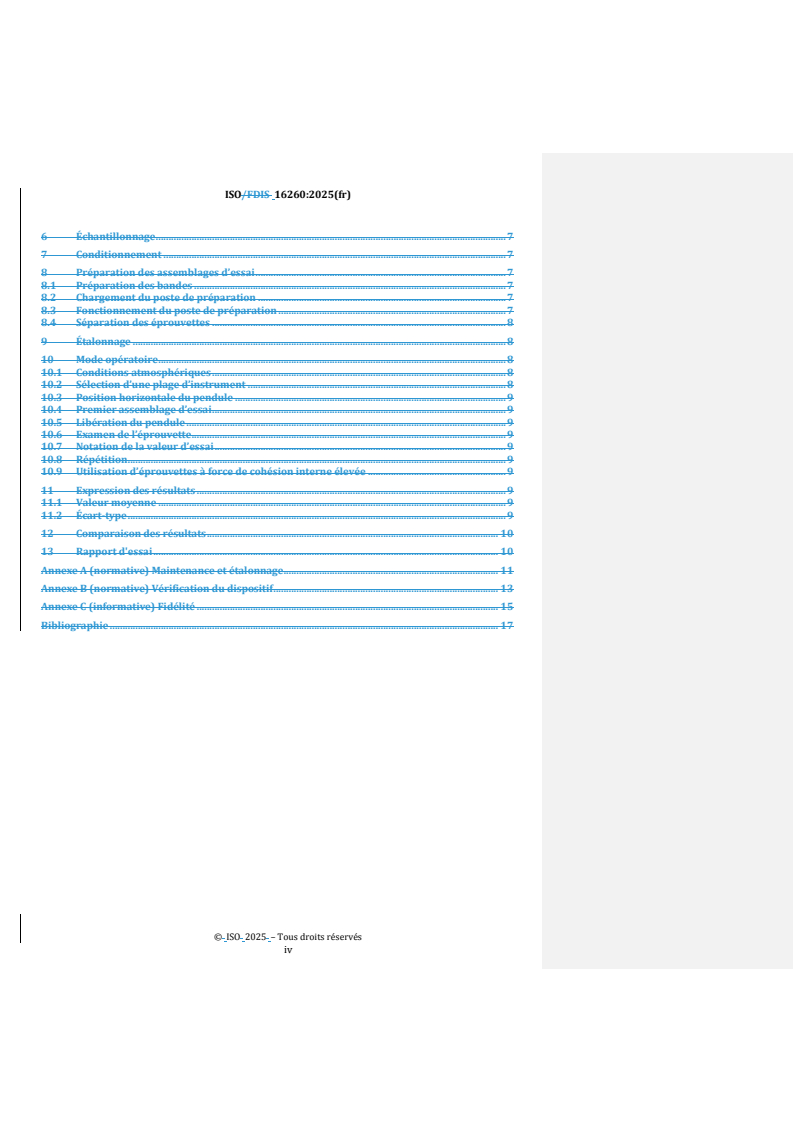
Sommaire Page
Avant-propos . v
Introduction .vii
1 Domaine d’application . 1
2 Références normatives . 1
3 Termes et définitions . 1
4 Principe . 2
5 Appareillage et données techniques . 3
6 Échantillonnage . 8
7 Conditionnement . 8
8 Préparation des assemblages d’essai . 8
9 Étalonnage . 9
10 Mode opératoire . 9
11 Expression des résultats . 10
12 Comparaison des résultats . 10
13 Rapport d'essai . 11
Annexe A (normative) Maintenance et étalonnage . 12
Annexe B (normative) Vérification du dispositif . 14
Annexe C (informative) Fidélité . 16
Bibliographie . 18
Avant-propos . iv
Introduction . vi
1 Domaine d’application . 1
2 Références normatives . 1
3 Termes et définitions . 1
4 Principe . 2
5 Appareillage et données techniques . 3
5.1 Appareillage . 3
5.2 Données techniques . 5
5.2.1 Plages de l’instrument/du pendule . 5
5.2.2 Équerre en aluminium/enclume . 5
5.2.3 Pendule . 6
5.2.4 Ruban adhésif . 6
5.2.5 Éprouvette . 7
© ISO 2025 – Tous droits réservés
iii
ISO/FDIS 16260:2025(fr)
6 Échantillonnage . 7
7 Conditionnement . 7
8 Préparation des assemblages d’essai . 7
8.1 Préparation des bandes . 7
8.2 Chargement du poste de préparation . 7
8.3 Fonctionnement du poste de préparation . 7
8.4 Séparation des éprouvettes . 8
9 Étalonnage . 8
10 Mode opératoire . 8
10.1 Conditions atmosphériques . 8
10.2 Sélection d’une plage d’instrument . 8
10.3 Position horizontale du pendule . 9
10.4 Premier assemblage d’essai . 9
10.5 Libération du pendule . 9
10.6 Examen de l’éprouvette. 9
10.7 Notation de la valeur d’essai . 9
10.8 Répétition. 9
10.9 Utilisation d’éprouvettes à force de cohésion interne élevée . 9
11 Expression des résultats . 9
11.1 Valeur moyenne . 9
11.2 Écart-type . 9
12 Comparaison des résultats . 10
13 Rapport d'essai . 10
Annexe A (normative) Maintenance et étalonnage . 11
Annexe B (normative) Vérification du dispositif . 13
Annexe C (informative) Fidélité . 15
Bibliographie . 17
© ISO 2025 – Tous droits réservés
iv
Avant-propos
L’ISO (Organisation internationale de normalisation) est une fédération mondiale d’organismes nationaux de
normalisation (comités membres de l’ISO). L’élaboration des Normes internationales est en général confiée
aux comités techniques de l’ISO. Chaque comité membre intéressé par une étude a le droit de faire partie du
comité technique créé à cet effet. Les organisations internationales, gouvernementales et non
gouvernementales, en liaison avec l’ISO participent également aux travaux. L’ISO collabore étroitement avec
la Commission électrotechnique internationale (IEC) en ce qui concerne la normalisation électrotechnique.
Les procédures utilisées pour élaborer le présent document et celles destinées à sa mise à jour sont décrites
dans les Directives ISO/IEC, Partie 1. Il convient, en particulier, de prendre note des différents critères
d’approbation requis pour les différents types de documents ISO. Le présent document a été rédigé
conformément aux règles de rédaction données dans les Directives ISO/IEC, Partie 2
(voir https://www.iso.org/directives).
Field Code Changed
L’ISO attire l’attention sur le fait que la mise en application du présent document peut entraîner l’utilisation
d’un ou de plusieurs brevets. L’ISO ne prend pas position quant à la preuve, à la validité et à l’applicabilité de
tout droit de propriété revendiqué à cet égard. À la date de publication du présent document, l’ISO n’avait pas
reçu notification qu’un ou plusieurs brevets pouvaient être nécessaires à sa mise en application. Toutefois, il
y a lieu d’avertir les responsables de la mise en application du présent document que des informations plus
récentes sont susceptibles de figurer dans la base de données de brevets, disponible à l’adresse
www.iso.org/brevets. L’ISO ne saurait être tenue pour responsable de ne pas avoir identifié tout ou partie de
tels droits de brevet.
Les appellations commerciales éventuellement mentionnées dans le présent document sont données pour
information, par souci de commodité, à l’intention des utilisateurs et ne sauraient constituer un engagement.
Pour une explication de la nature volontaire des normes, la signification des termes et expressions spécifiques
de l’ISO liés à l’évaluation de la conformité, ou pour toute information au sujet de l’adhésion de l’ISO aux
principes de l’Organisation mondiale du commerce (OMC) concernant les obstacles techniques au commerce
(OTC), voir le lien suivant: www.iso.org/avant-propos.
Le présent document a été élaboré par le comité technique ISO/TC 6, Papiers, cartons et pâtes, sous-comité
SC 2, Méthodes d'essais et spécifications de qualité des papiers et cartons.
Cette seconde édition annule et remplace la première édition (ISO 16260:2016), qui a fait l’objet d’une révision
technique.
Les principales modifications sont les suivantes:
— — ajout d'une référence aux différents résultats possibles en fonction du type d'appareil d'essai dans
l'introduction;
— — mise à jour du 5.1.65.1.6 concernant les «dispositifs analogiques d’essai de résistance de la liaison des
plis» et les «dispositifs numériques d’essai de résistance de la liaison des plis» et ajout de la Figure 3;0;
— — mise à jour du Tableau 10 concernant la force de contact (à la place de la masse);
— — mise à jour du 5.2.25.2.2 «Équerre en aluminium/enclume»;
— — ajout du 5.2.3.15.2.3.1 «Longueur réduite du pendule»;
— — révision de l'Article 88 «Préparation des assemblages d’essai» et de l'Article 99 «Étalonnage»;
— — mise à jour du 10.210.2 «Sélection d'un plage d'instrument»;
© ISO 2025 – Tous droits réservés
v
ISO/FDIS 16260:2025(fr)
— — ajout du nouvel Article 1212 «Comparaison des résultats»;
— — révision de l'Article 1313 «Rapport d’essai»;
— — renumérotation de l'ancienne Annexe BAnnexe B en Annexe C,Annexe C, avec l'ajout du type
d'appareil d'essai utilisé;
— — ajout de «Vérification du dispositif» en tant que nouvelle Annexe B;Annexe B;
— — modifications rédactionnelles.
Il convient que l’utilisateur adresse tout retour d’information ou toute question concernant le présent
document à l’organisme national de normalisation de son pays. Une liste exhaustive desdits organismes se
trouve à l’adresse www.iso.org/members.html.
© ISO 2025 – Tous droits réservés
vi
Introduction
Les feuilles de papier et de carton peuvent, au cours de l’impression, de la transformation ou d’applications
spécifiques du produit, être soumises à des impulsions, des chocs ou des charges par à-coups d’une ampleur
suffisante pour causer une rupture structurelle. Les ruptures structurelles couramment observées dans le plan
sont l’arrachage de surface, le cloquage et la délamination interne.
Le présent document décrit une méthode permettant de déterminer la force de cohésion interne d’un produit
de pâte, papier ou carton en mesurant l'énergie nécessaire pour délaminer un échantillon de papier ou de
[4][8][ ][ ]
carton dans le sens «Z» (épaisseur). Il existe d'autres méthodes publiées 0 0 qui permettent de
déterminer la résistance à la traction dans le sens «Z» ou sens de l’épaisseur mais, dans la présente méthode,
la force de délamination est appliquée à une vitesse significativement plus élevée que dans les autres
méthodes. Cette méthode peut donc être privilégiée pour prédire la performance de la feuille dans des
conditions d’impression ou de transformation.
Différents types d'appareils d'essai (mécaniques et électroniques) sont utilisés pour cette méthode. Les
résultats obtenus avec les deux types d'appareils d'essai peuvent ne pas être comparables (voir
Article 12).12).
© ISO 2025 – Tous droits réservés
vii
Norme internationale ISO 16260:2025(fr)
Papier et carton — Détermination de la force de cohésion interne
1 Domaine d’application
Le présent document spécifie une méthode pour mesurer l'énergie requise pour délaminer rapidement une
éprouvette de papier ou de carton. La rupture de l’éprouvette dans le sens Z ou sens de l’épaisseur est initiée
par un pendule de masse définie, qui se déplace à une vitesse donnée.
Le mode opératoire convient à la fois pour les papiers et cartons monocouche et multicouches, y compris pour
les feuilles couchées et celles qui sont laminées avec des films polymères synthétiques. Il est particulièrement
adapté dans le cas de papiers et cartons qui peuvent être soumis à des chocs rapides, des impulsions ou des
[4][8][ ][ ]
charges par à-coups dans le sens «Z» 0 0 au cours de l'impression ou de la transformation.
Le mode opératoire d’essai implique de faire adhérer un ruban adhésif double face sur les deux faces de
l’éprouvette en appliquant une pression. C’est pourquoi la méthode ne convient pas pour des matériaux dont
la structure pourrait être endommagée par compression ou qui sont suffisamment poreux pour permettre la
migration de l’adhésif du ruban à l’intérieur de l’éprouvette ou à travers cette dernière.
2 Références normatives
Les documents suivants sont cités dans le texte de sorte qu’ils constituent, pour tout ou partie de leur contenu,
des exigences du présent document. Pour les références datées, seule l'édition citée s'applique. Pour les
références non datées, la dernière édition du document de référence s'applique (y compris les éventuels
amendements).
EN 755-2:2013, Aluminium et alliages d’aluminium — Barres, tubes et profilés filés —
Partie 2: Caractéristiques mécaniques
ISO 186, Papier et carton — Échantillonnage pour déterminer la qualité moyenne
EN 755-2:2013, Aluminium et alliages d’aluminium — Barres, tubes et profilés filés —
Partie 2: Caractéristiques mécaniques
ISO 186, Papier et carton — Échantillonnage pour déterminer la qualité moyenne
ISO 187, Papier, carton et pâtes — Atmosphère normale de conditionnement et d'essai et méthode de surveillance
de l'atmosphère et de conditionnement des échantillons
3 Termes et définitions
Pour les besoins du présent document, les termes et définitions suivants s'appliquent.
L’ISO et l’IEC tiennent à jour des bases de données terminologiques destinées à être utilisées en normalisation,
consultables aux adresses suivantes:
— — ISO Online browsing platform: disponible à l’adresse https://www.iso.org/obp
— — IEC Electropedia: disponible à l'adresse https://www.electropedia.org/
ISO/FDIS 16260:2025(fr)
3.1 3.1
force de cohésion interne
énergie potentielle moyenne, exprimée en J/m de surface, nécessaire pour délaminer une éprouvette dans
les conditions de l’essai
Note 1 à l’article l'article: Le résultat est la différence entre l’énergie potentielle avant et l’énergie résiduelle après la
délamination de l’éprouvette.
3.2 3.2
assemblage d’essai
éprouvette collée entre deux morceaux de ruban adhésif double face, la face inférieure de la couche de ruban
inférieure étant collée à une enclume métallique rigide et la face supérieure de la couche de ruban supérieure
étant collée à une équerre en aluminium
4 Principe
Une éprouvette carrée est collée sur une enclume métallique plane avec du ruban adhésif double face. Une
équerre en aluminium ayant la même superficie que l’éprouvette est ensuite collée à la surface supérieure de
l’éprouvette, de nouveau avec du ruban adhésif double face. L'assemblage d'essai est représenté à la
Figure 1.0. L’assemblage d'essai est fixé en position et un pendule est lancé contre la surface interne
supérieure de l’équerre, entraînant sa rotation autour de son coin extérieur et séparant l’éprouvette dans le
sens «Z» ou sens de l’épaisseur (voir Figure 2).0). L’énergie absorbée lors de la rupture de l’éprouvette est
calculée à partir du mesurage de la hauteur de remontée du pendule après le choc ainsi que des masses et
dimensions connues des composants du système.
16260_ed2fig1.EPS
Légende
1 éprouvette
2 ruban adhésif double face
3 équerre en aluminium
4 enclume métallique
Figure 1 — Composants de l’assemblage d’essai
© ISO 2025 – Tous droits réservés
16260_ed2fig2.EPS
Légende
1 point de frappe et direction de frappe du pendule
Figure 2 — Position du point de frappe du pendule par rapport à l’équerre en aluminium
Les données de fidélité sont fournies à l’Annexe C.l’Annexe C.
La vérification de la conformité de l’instrument de mesure à l’aide d’un dispositif d’essai au choc est décrite à
l'Annexe B.l'Annexe B.
5 Appareillage et données techniques
5.1 Appareillage
5.1.1 5.1.1 Appareil pour la préparation d’assemblages d’essai, de dimensions égales à
25,4 mm ± 0,2 mm × 25,4 mm ± 0,2 mm, obtenus en pressant ensemble tous les composants de l’assemblage
d'essai (voir 5.1.4)5.1.4) à une pression contrôlée pendant une durée contrôlée. Au cours du cycle de pression,
il convient que l’équerre en aluminium (voir 5.2.2)5.2.2) soit fermement maintenue en position pour éviter
sa flexion.
NOTE La plupart des postes de préparation disponibles dans le commerce permettent de préparer simultanément
cinq assemblages d’essai.
S’assurer que l’instrument d’essai est de niveau dans les sens avant/arrière et gauche/droite et que le pendule
est horizontal lorsqu’il est en position bloquée.
5.1.2 5.1.2 Pendule, monté sur un bâti au moyen d’une tige horizontale supportée par des paliers à faible
frottement. Le pendule doit pouvoir pivoter librement d’au moins 180° par rapport à la position horizontale.
À son extrémité libre, le pendule porte une bille percutrice métallique qui entre en contact avec la face interne
de l’équerre en aluminium sur l’assemblage d’essai lorsque le pendule atteint la position verticale. Pour
réduire au minimum les pertes d’énergie dues aux vibrations, il convient que le centre de percussion du
pendule soit situé au point d’impact de la bille percutrice avec l’équerre en aluminium. Il convient qu’il n’y ait
aucun jeu dans la construction des pendules auxquels des poids sont ajoutés.
5.1.3 5.1.3 Appareil de fixation du pendule en position horizontale, permettant de libérer celui-ci
rapidement, sans vibrations.
5.1.4 5.1.4 Assemblage d'essai constitué d’une enclume fixe (socle) et d’une équerre en aluminium
(5.2.2)(5.2.2) amovible placée à angle droit dans le sens transversal, ainsi que de l’éprouvette (5.2.5)(5.2.5)
et du ruban adhésif (5.2.4)(5.2.4) (voir Figure 1).0).
Il convient que les enclumes prévues pour être utilisées dans des postes de préparation d’éprouvettes
multiples comportent un marquage indélébile afin de s’assurer qu’elles sont toujours placées dans la même
© ISO 2025 – Tous droits réservés
ISO/FDIS 16260:2025(fr)
position dans le poste de préparation. L’assemblage d’essai est fermement maintenu en position de sorte que
le pendule percute le centre de percussion de l’équerre en aluminium lorsque l’axe de rotation se trouve sur
le coin extérieur de l’angle droit de l’équerre (voir Figure 2).0).
5.1.5 5.1.5 Appareil d’enregistrement de l’oscillation angulaire maximale du pendule après le choc
avec l’assemblage d’essai.
5.1.6 5.1.6 Appareil de conversion de l’oscillation angulaire maximale du pendule en une valeur de
force de cohésion interne. Les méthodes couramment employées utilisent des codeurs optiques numériques
ou des dispositifs mécaniques à échelle et aiguille indicatrice de frottement. Des exemples sont donnés dans
la liste ci-dessous:
a) a) Dispositifs analogiques d’essai de résistance de la liaison des plis: Pour les dispositifs
analogiques d’essai de résistance de la liaison des plis, une compensation de l’angle utilisé est nécessaire
(voir Figure 3).0). Les échelles des dispositifs analogiques intègrent une compensation qui permet de
tenir compte de l’alliage d’origine de l’équerre. En cas de changement d’alliage, la compensation utilisée
peut ne pas convenir, ce qui pourrait conduire à l’obtention de valeurs erronées. Ce facteur de correction
n’est pas applicable pour les dispositifs numériques.
b) b) Dispositifs numériques d’essai de résistance de la liaison des plis: Pour améliorer la
comparabilité des valeurs, l’écran doit afficher les valeurs compensées comme les valeurs non
compensées. Ces valeurs doivent figurer dans le rapport d’essai (Article 12).(13).
16260_ed2fig3.EPS
a) Résistance angulaire non incluse dans le résultat
© ISO 2025 – Tous droits réservés
16260_ed2fig3b.EPS
b) Résistance angulaire incluse dans le résultat
Légende
1 pendule
2 mouvement du pendule
3 oscillation du pendule avec équerre en aluminium
4 oscillation du pendule sans équerre en aluminium
5 différence = résistance de l'équerre en aluminium
6 équerre en aluminium
Figure 3 — Différentes échelles des dispositifs analogiques d’essai de résistance de la liaison des plis
5.1.7 5.1.7 Moyen, facultatif, permettant d’étendre la plage du dispositif d'essai de résistance de la
liaison des plis. Pour cela, il est admis d’utiliser des pendules de masses différentes, ou d’ajouter des poids
au pendule ou de réduire la superficie de l’éprouvette jusqu’à 50 % au maximum. Il convient que l’utilisateur
du présent document consulte le fabricant de l’instrument d’essai en ce qui concerne la mise en place et la
vérification de ces options. Toute modification de ce type apportée à l’instrument doit être indiquée dans le
rapport d’essai.
5.1.8 5.1.8 Dispositif adapté permettant de découper des bandes de matériau d’essai de
25,4 mm ± 0,2 mm de largeur (voir 5.2.5)5.2.5) et d’une longueur suffisante pour permettre leur montage
dans le dispositif de préparation de l’assemblage d’essai.
5.1.9 5.1.9 Couteau ou dispositif de coupe à plusieurs lames pour séparer les assemblages d’essai
préparés dans un poste ou un dispositif de préparation d’assemblages d’essai multiples.
5.1.10 5.1.10 Ruban adhésif double face, doté d’un dorsal crêpé (voir 5.1.45.1.4 et 5.2.4).5.2.4).
5.1.11 5.1.11 Solvant, adapté pour éliminer les résidus d’adhésif des enclumes et des équerres en
aluminium.
© ISO 2025 – Tous droits réservés
ISO/FDIS 16260:2025(fr)
5.2 Données techniques
5.2.1 Plages de l’instrument/du pendule
Tableau 1 — Plages de l’instrument/du pendule
Plage 0 Plage 1 Plage 2 Plage 3
Échelle basse Échelle haute
de Scott Bond de Scott Bond
Plage de mesure (J/m ) (recommandation, 50 à 400 100 à 600 200 à 1 20
...