

ISO 8269:1985
(Main)Doorsets — Static loading test
General Information
- Abstract
- Status
- Published
- Publication Date
- 26-Jun-1985
- Technical Committee
- ISO/TC 162 - Doors, windows and curtain walling
- Drafting Committee
- ISO/TC 162 - Doors, windows and curtain walling
- Current Stage
- 9093 - International Standard confirmed
- Start Date
- 17-Nov-2022
- Completion Date
- 29-Aug-2026
Buy Documents

ISO 8269:1985 - Doorsets — Static loading test Released:6/27/1985
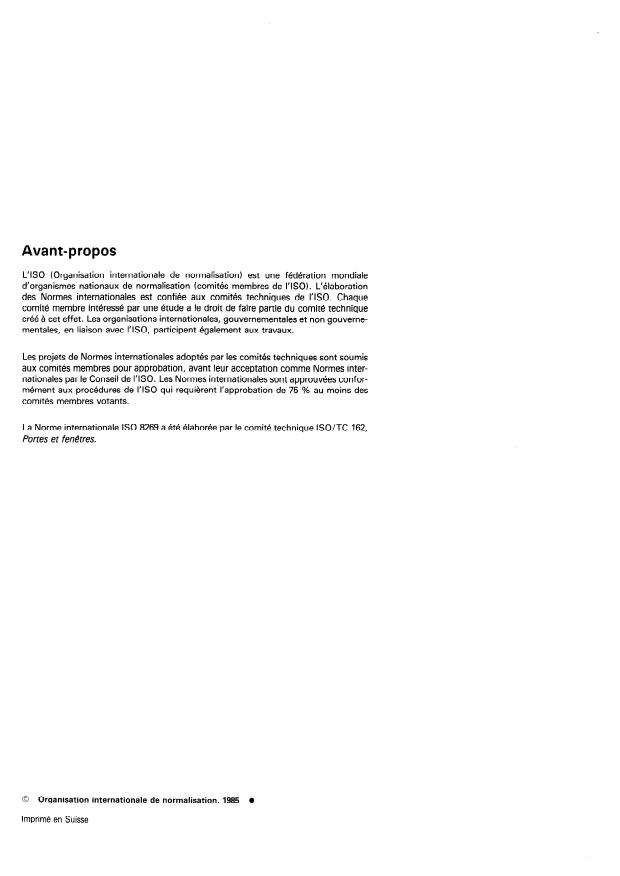
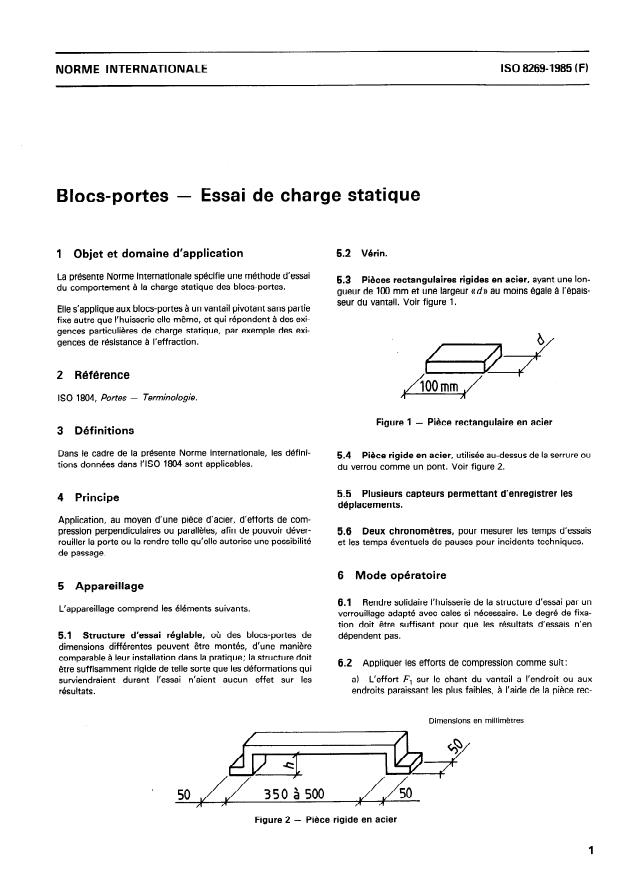
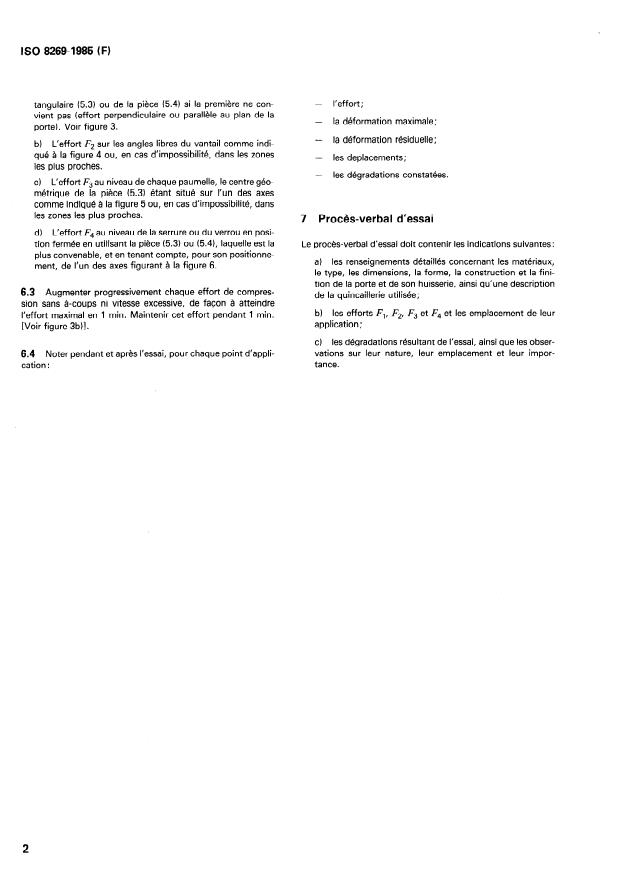
ISO 8269:1985 - Blocs-portes — Essai de charge statique Released:6/27/1985

ISO 8269:1985 - Blocs-portes — Essai de charge statique Released:6/27/1985
Overview - ISO 8269:1985 (Doorsets - Static loading test)
ISO 8269:1985 defines a laboratory method to assess the static load behaviour of doorsets (single-leaf pivoting doorsets with no fixed part other than the frame). Prepared by ISO/TC 162 (Doors and windows), the standard describes test apparatus, loading locations and procedures, measurements to be taken, and the required test report content. It is primarily intended to determine how a doorset reacts to sustained compressive or shear loads applied at critical points (edge, free corners, hinge area and lock area).
Key topics and technical requirements
- Test scope: Static loading of single-leaf pivoting doorsets to evaluate deformation and damage under sustained loads (e.g., for security or resistance assessments).
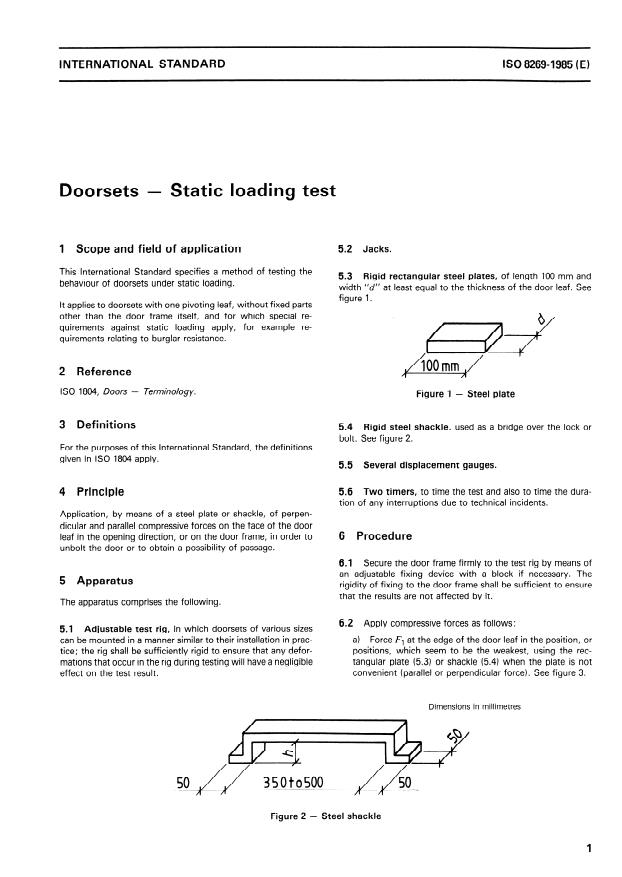
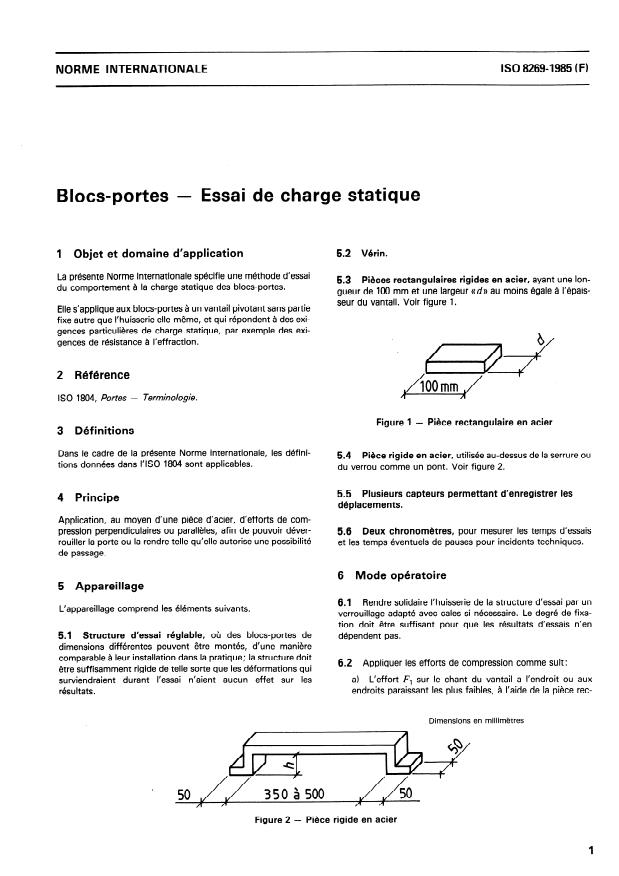
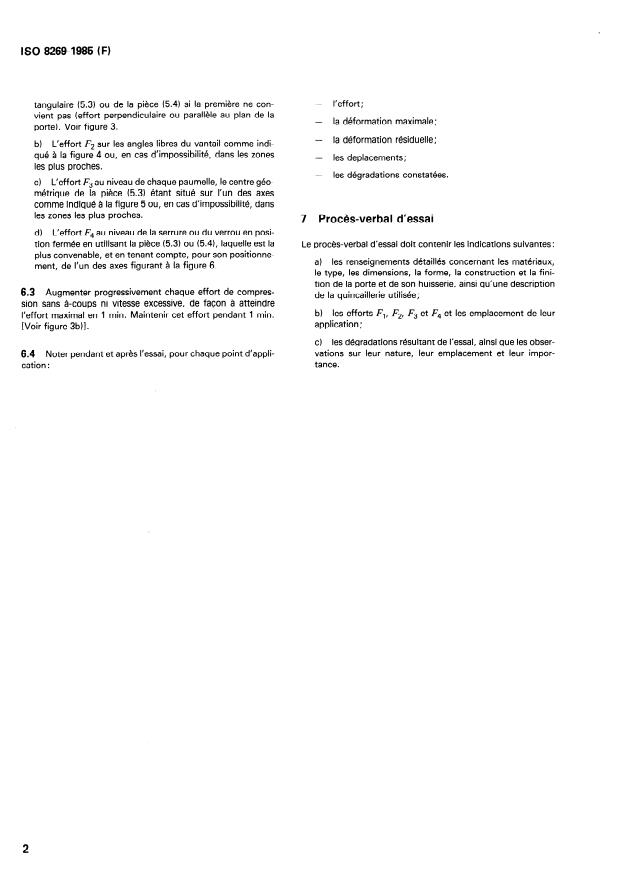
- Apparatus: Adjustable rigid test structure; hydraulic jack(s)/vérin; rigid rectangular steel pieces used to apply loads; displacement sensors; chronometers. The standard references a rectangular steel piece of 100 mm length (with width at least equal to the door leaf thickness) and shows typical block sizes such as 50 × 100 × 20 mm in the figures.
- Load application points:
- Edge of the door leaf (chant du vantail)
- Free corners of the leaf (angles libres)
- At each hinge (paumelle)
- At the lock or latch position (serrure/verrou) using a bridging steel piece
- Procedure: Each compressive load is increased progressively (no shocks) to reach the maximum in about 1 minute and then held for 1 minute. Measurements are taken before loading, during the 1-minute hold, and after release.
- Measurements and outcomes: Maximum deformation, residual deformation, displacements (via sensors), and recorded physical damage. Test report must list materials, dimensions, hardware, forces (F1–F4) with application locations, and detailed observations of damage.
Applications - who uses ISO 8269
- Doorset and door hardware manufacturers validating design strength and performance.
- Test laboratories conducting compliance and performance testing for product certification.
- Specifiers, architects and consultants assessing suitability of doorsets for security, institutional, or high-use installations.
- Regulatory bodies and procurement teams requiring documented static load performance for safety or anti-intrusion requirements.
Related standards and terms
- ISO 1804 (Doors - Terminology) is referenced for definitions used in ISO 8269.
- ISO/TC 162 is the technical committee responsible for doors and windows standards.
Keywords: ISO 8269, doorsets, static loading test, doorset static load testing, door testing, door assemblies, door hardware, doorset performance, static load.
Buy Documents
ISO 8269:1985 - Doorsets — Static loading test Released:6/27/1985
ISO 8269:1985 - Blocs-portes — Essai de charge statique Released:6/27/1985
ISO 8269:1985 - Blocs-portes — Essai de charge statique Released:6/27/1985
Get Certified
Connect with accredited certification bodies for this standard

DIBt (Deutsches Institut für Bautechnik)
German Institute for Building Technology.
DIN CERTCO
DIN Group product certification.

Aboma Certification B.V.
Specialized in construction, metal, and transport sectors.
Sponsored listings
Frequently Asked Questions
ISO 8269:1985 is a standard published by the International Organization for Standardization (ISO). Its full title is "Doorsets — Static loading test". This standard covers: Doorsets — Static loading test
Doorsets — Static loading test
ISO 8269:1985 is classified under the following ICS (International Classification for Standards) categories: 91.060.50 - Doors and windows. The ICS classification helps identify the subject area and facilitates finding related standards.
ISO 8269:1985 is available in PDF format for immediate download after purchase. The document can be added to your cart and obtained through the secure checkout process. Digital delivery ensures instant access to the complete standard document.
Standards Content (Sample)
International Standard
INTERNATIONAL ORGANIZATION FOR STANDARDIZATION@MEX,QYHAPOI1HAR OPI-AHM3AUMfl I-IO CTAH,QAPTM3A~Mkl*ORGANISATlON INTERNATIONALE DE NORMALISATION
Doorsets - Static loading test
Blocs-portes - Essai de Charge statique
First edition - 1985-07-01
UDC 69.028.1 : 620.173 Ref. No. ISO 8269-1985 (E)
Descriptors : doors, door frames, tests, static tests, static loads.
Ul Price based on 6 pages
-
Foreword
ISO (the International Organization for Standardization) is a worldwide federation of
national Standards bodies (ISO member bodies). The work of preparing International
Standards is normally carried out through ISO technical committees. Esch member
body interested in a subject for which a technical committee has been established has
the right to be represented on that committee. International organizations, govern-
mental and non-governmental, in liaison with ISO, also take part in the work.
Draft International Standards adopted by the technical committees are circulated to
the member bodies for approval before their acceptance as International Standards by
the ISO Council. They are approved in accordance with ISO procedures requiring at
least 75 % approval by the member bodies voting.
International Standard ISO 8269 was prepared by Technical Committee ISO/TC 162,
Doors and windows.
0 International Organkation for Standardkation, 1985
Printed in Switzerland
ISO 8269-1985 (EI
INTERNATIONAL STANDARD
- Static loading test
Doorsets
5.2 Jacks.
1 Scope and field of application
This International Standard specifies a method of testing the
5.3 Rigid rectangular steel plates, of length 100 mm and
behaviour of doorsets under static loading.
width “d” at least equal to the thickness of the door leaf. See
figure 1.
It applies to doorsets with one pivoting leaf, without fixed Parts
other than the door frame itself, and for which special re-
quirements against static loading apply, for example re-
quirements relating to burglar resistance.
//9
IOOmm
2 Reference
ISO 1804, Doors - Terminology.
Figure 1 - Steel plate
3 Definitions
5.4 Rigid steel shackle, used as a bridge over the leck or
bolt See figure 2.
For the purposes of this International Standard, the definitions
given in ISO 1804 apply.
5.5 Several displacement gauges.
Two timers, to time the test and also to time the dura-
5.6
4 Principle
tion of any interruptions due to technical incidents.
Application, by means of a steel plate or shackle, of perpen-
dicular and parallel compressive forces on the face of the door
6 Procedure
leaf in the opening direction, or on the door frame, in Order to
unbolt the door or to obtain a possibility of passage.
6.1 Secure the door frame firmly to the test rig by means of
an adjustable fixing device with a block if necessary. The
5 Apparatus
rigidity of fixing to the door frame shall be sufficient to ensure
that the results are not affected by it.
The apparatus comprises the following.
6.2 Apply compressive forces as follows:
5.1 Adjustable test rig, in which doorsets of various sizes
Forte F, at the edge of the door leaf in the Position, or
a)
tan be mounted in a manner similar to their installation in prac-
positions, whi
...
Norme internationale
INTERNATIONAL ORGANIZATION FOR STANDARDIZATION.MEX&YHAPO,QHAR OPTAHM3AuMR l-l0 CTAHAAPTM3A~MVl.ORGANlSATlON INTERNATIONALE DE NORMALISATION
Blocs-portes - Essai de charge statique
Doorsets - Static loading test
Première édition - 1985-07-01
CDU 69.028.1 : 620.173 Réf. no : ISO 82694985 (F)
Descripteurs : porte, huisserie, essai, essai statique, charge statique.
Prix basé sur 6 pages
Avant-propos
L’ISO (Organisation internationale de normalisation) est une fédération mondiale
d’organismes nationaux de normalisation (comités membres de I’ISO). L’élaboration
des Normes internationales est confiée aux comités techniques de I’ISO. Chaque
comité membre intéressé par une étude a le droit de faire partie du comité technique
créé à cet effet. Les organisations internationales, gouvernementales et non gouverne-
mentales, en liaison avec I’ISO, participent également aux travaux.
Les projets de Normes internationales adoptés par les comités techniques sont soumis
aux comités membres pour approbation, avant leur acceptation comme Normes inter-
nationales par le Conseil de I’ISO. Les Normes internationales sont approuvées confor-
mément aux procédures de I’ISO qui requièrent l’approbation de 75 % au moins des
comités membres votants.
La Norme internationale ISO 8269 a été élaborée par le comité technique ISO/TC 162,
Portes et fenêtres.
Organisation internationale de normalisation, 1985 l
Imprimé en Suisse
ISO 82694985 (FI
NORME INTERNATIONALE
Essai de charge statique
Blocs-portes -
5.2 Vérin.
1 Objet et domaine d’application
La présente Norme internationale spécifie une méthode d’essai
5.3 Pièces rectangulaires rigides en acier, ayant une lon-
du comportement à la charge statique des blocs-portes.
gueur de 100 mm et une largeur t(d)) au moins égale à I’épais-
seur du vantail. Voir figure 1.
Elle s’applique aux blocs-portes à un vantail pivotant sans partie
fixe autre que l’huisserie elle-même, et qui répondent à des exi-
gences particulières de charge statique, par exemple des exi-
gences de résistance à l’effraction.
.-//Y
2 Référence
IOOmm
ISO 1804, Portes - Terminologie.
Figure 1 - Pièce rectangulaire en acier
3 Définitions
Dans le cadre de la présente Norme internationale, les défini-
5.4 Pièce rigide en acier, utilisée au-dessus de la serrure ou
tions données dans I’ISO 1804 sont applicables.
du verrou comme un pont. Voir figure 2.
5.5 Plusieurs capteurs permettant d’enregistrer les
4 Principe
déplacements.
Application, au moyen d’une pièce d’acier, d’efforts de com-
pression perpendiculaires ou parallèles, afin de pouvoir déver-
5.6 Deux chronomètres, pour mesurer les temps d’essais
rouiller la porte ou la rendre telle qu’elle autorise une possibilité et les temps éventuels de pauses pour incidents techniques.
de passage.
6 Mode opératoire
5 Appareillage
6.1 Rendre solidaire l’huisserie de la structure d’essai par un
L’appareillage comprend les éléments suivants.
verrouillage adapté avec cales si nécessaire. Le degré de fixa-
tion doit être suffisant pour que les résultats d’essais n’en
5.1 Structure d’essai réglable, où des blocs-portes de
dépendent pas.
dimensions différentes peuvent être montés, d’une manière
comparable à leur installation dans la pratique; la structure doit
6.2 Appliquer les efforts de compres
...
Norme internationale
INTERNATIONAL ORGANIZATION FOR STANDARDIZATION.MEX&YHAPO,QHAR OPTAHM3AuMR l-l0 CTAHAAPTM3A~MVl.ORGANlSATlON INTERNATIONALE DE NORMALISATION
Blocs-portes - Essai de charge statique
Doorsets - Static loading test
Première édition - 1985-07-01
CDU 69.028.1 : 620.173 Réf. no : ISO 82694985 (F)
Descripteurs : porte, huisserie, essai, essai statique, charge statique.
Prix basé sur 6 pages
Avant-propos
L’ISO (Organisation internationale de normalisation) est une fédération mondiale
d’organismes nationaux de normalisation (comités membres de I’ISO). L’élaboration
des Normes internationales est confiée aux comités techniques de I’ISO. Chaque
comité membre intéressé par une étude a le droit de faire partie du comité technique
créé à cet effet. Les organisations internationales, gouvernementales et non gouverne-
mentales, en liaison avec I’ISO, participent également aux travaux.
Les projets de Normes internationales adoptés par les comités techniques sont soumis
aux comités membres pour approbation, avant leur acceptation comme Normes inter-
nationales par le Conseil de I’ISO. Les Normes internationales sont approuvées confor-
mément aux procédures de I’ISO qui requièrent l’approbation de 75 % au moins des
comités membres votants.
La Norme internationale ISO 8269 a été élaborée par le comité technique ISO/TC 162,
Portes et fenêtres.
Organisation internationale de normalisation, 1985 l
Imprimé en Suisse
ISO 82694985 (FI
NORME INTERNATIONALE
Essai de charge statique
Blocs-portes -
5.2 Vérin.
1 Objet et domaine d’application
La présente Norme internationale spécifie une méthode d’essai
5.3 Pièces rectangulaires rigides en acier, ayant une lon-
du comportement à la charge statique des blocs-portes.
gueur de 100 mm et une largeur t(d)) au moins égale à I’épais-
seur du vantail. Voir figure 1.
Elle s’applique aux blocs-portes à un vantail pivotant sans partie
fixe autre que l’huisserie elle-même, et qui répondent à des exi-
gences particulières de charge statique, par exemple des exi-
gences de résistance à l’effraction.
.-//Y
2 Référence
IOOmm
ISO 1804, Portes - Terminologie.
Figure 1 - Pièce rectangulaire en acier
3 Définitions
Dans le cadre de la présente Norme internationale, les défini-
5.4 Pièce rigide en acier, utilisée au-dessus de la serrure ou
tions données dans I’ISO 1804 sont applicables.
du verrou comme un pont. Voir figure 2.
5.5 Plusieurs capteurs permettant d’enregistrer les
4 Principe
déplacements.
Application, au moyen d’une pièce d’acier, d’efforts de com-
pression perpendiculaires ou parallèles, afin de pouvoir déver-
5.6 Deux chronomètres, pour mesurer les temps d’essais
rouiller la porte ou la rendre telle qu’elle autorise une possibilité et les temps éventuels de pauses pour incidents techniques.
de passage.
6 Mode opératoire
5 Appareillage
6.1 Rendre solidaire l’huisserie de la structure d’essai par un
L’appareillage comprend les éléments suivants.
verrouillage adapté avec cales si nécessaire. Le degré de fixa-
tion doit être suffisant pour que les résultats d’essais n’en
5.1 Structure d’essai réglable, où des blocs-portes de
dépendent pas.
dimensions différentes peuvent être montés, d’une manière
comparable à leur installation dans la pratique; la structure doit
6.2 Appliquer les efforts de compres
...