

IWA 43:2023
(Main)Glass types — Crystal glass, crystal and lead crystal — Specifications and test methods
General Information
- Abstract
This document provides the specifications and specifies the requirements for the designation of three types of glass namely crystal glass, crystal, and lead crystal, according to their chemical composition, density and refractive index. This document also describes the test methods to measure the respective characteristics of these crystal glass types. Given the potential lead contamination concerns in crystal glass and crystal, this document additionally stipulates a maximum permissible limit for lead content. This document is applicable to the designated crystal glass types used as tableware, containers (e.g. bottles, decanters, perfume jars), giftware, home decor and any decorative components in consumer goods (e.g. glass components and/or parts used in jewellery, textile applications, and electrical and electronic equipment), furniture and luminaries. This document does not apply to crystal glass types used within the areas of construction, healthcare and laboratories, and other technical uses of glass.
- Status
- Published
- Publication Date
- 08-Oct-2023
- Technical Committee
- ISO/TMBG - Technical Management Board - groups
- Drafting Committee
- ISO/TMBG - Technical Management Board - groups
- Current Stage
- 6060 - International Standard published
- Start Date
- 09-Oct-2023
- Completion Date
- 09-Oct-2023
Buy Documents
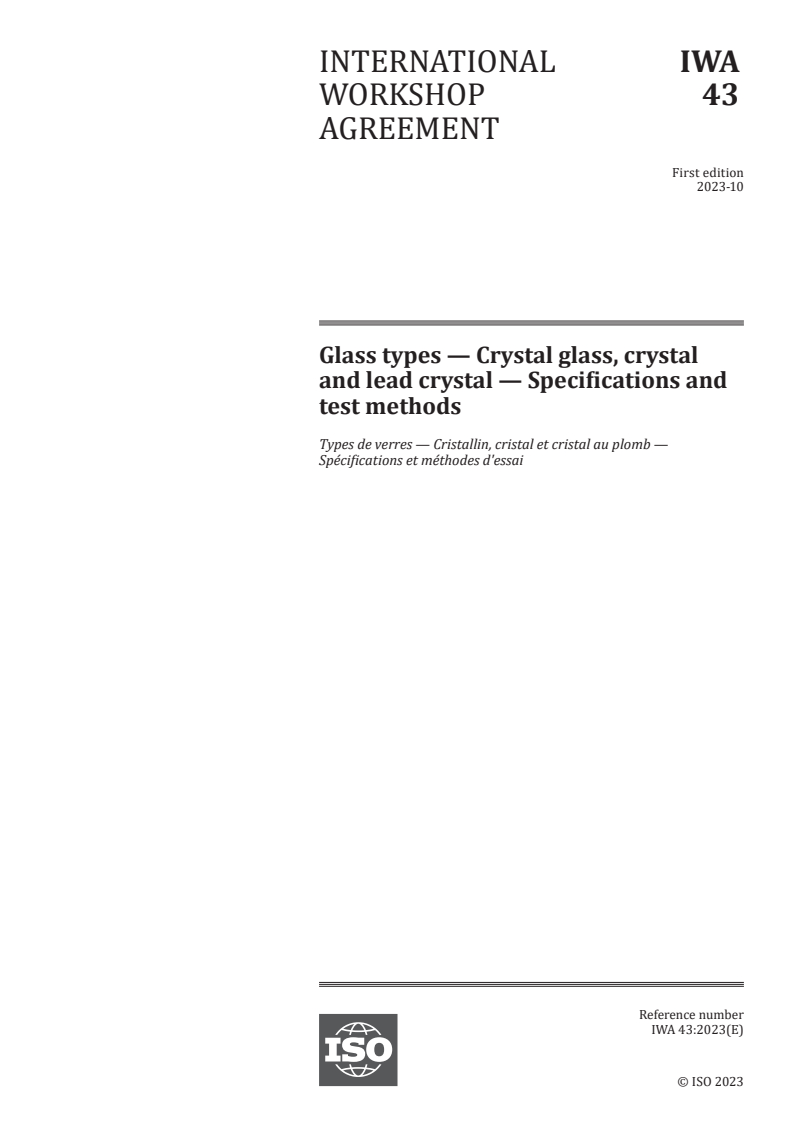
IWA 43:2023 - Glass types — Crystal glass, crystal and lead crystal — Specifications and test methods Released:9. 10. 2023
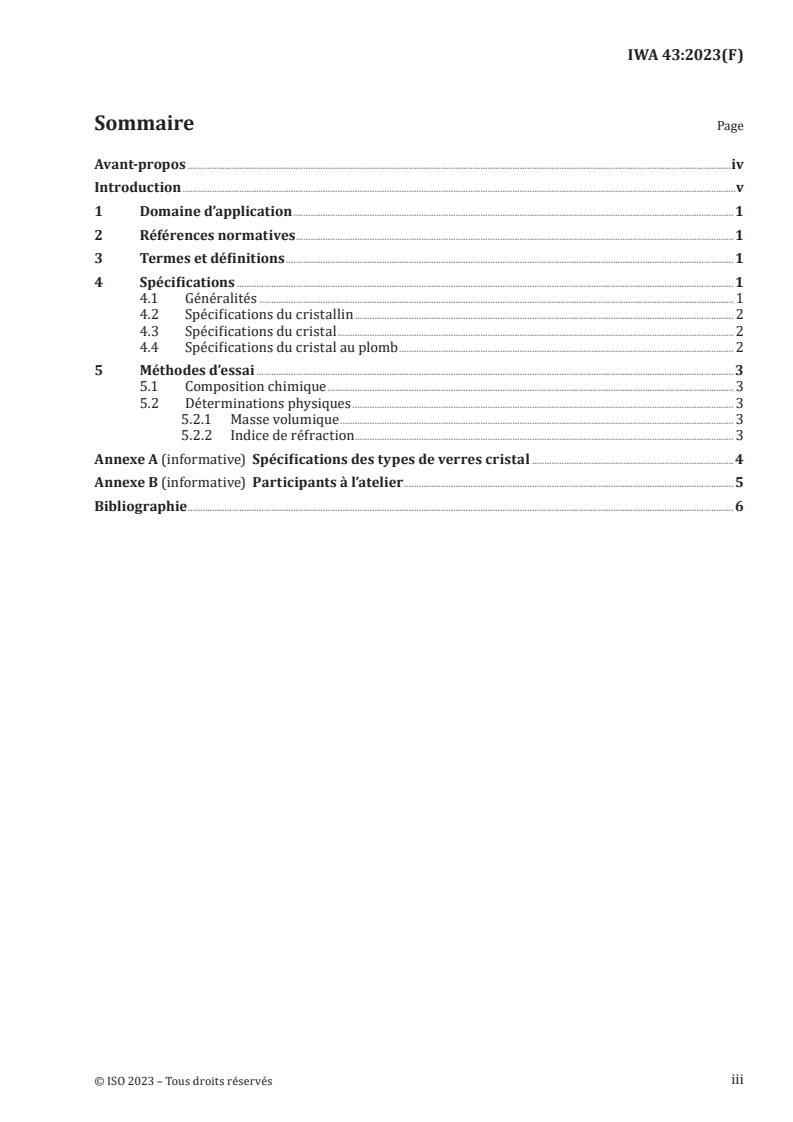
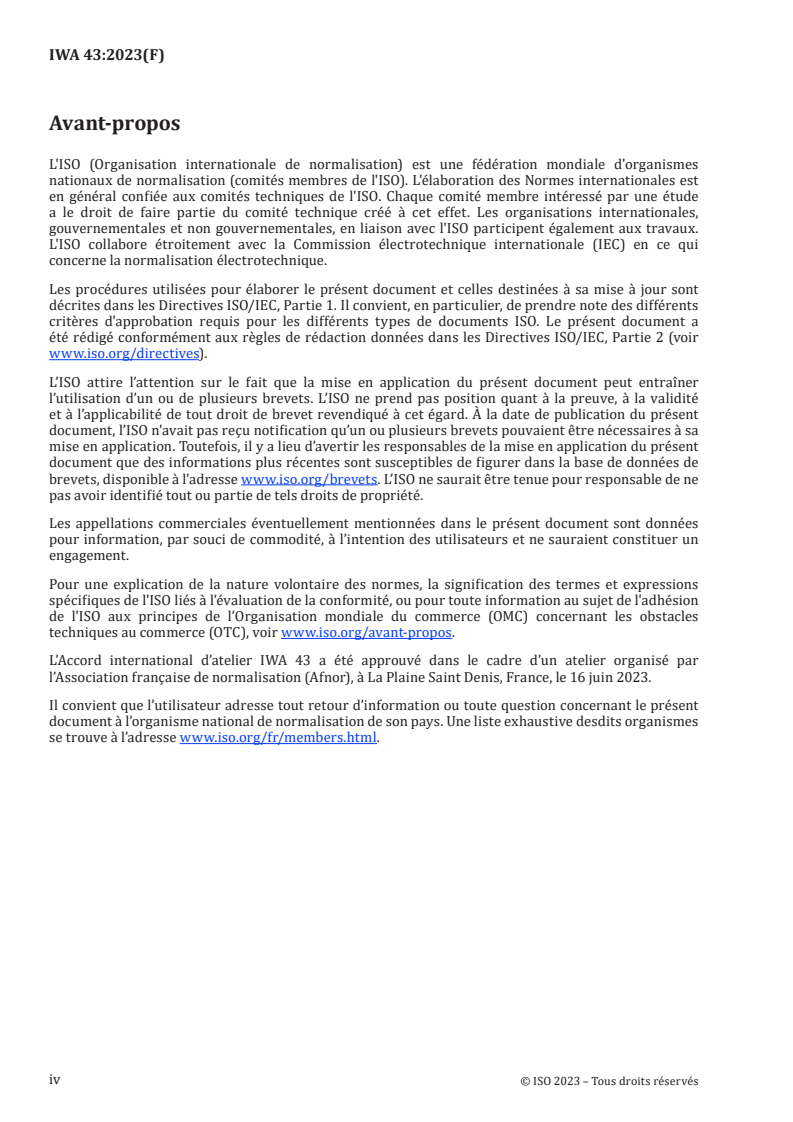
IWA 43:2023 - Types de verres — Cristallin, cristal et cristal au plomb — Spécifications et méthodes d'essai/6/2023
Overview
IWA 43:2023 - "Glass types - Crystal glass, crystal and lead crystal - Specifications and test methods" (ISO) defines clear, measurable criteria for classifying three decorative glass types: crystal glass, crystal, and lead crystal. The document specifies composition, density, refractive index, and maximum lead (Pb) limits where relevant, and describes accepted test methods to verify these characteristics. It applies to consumer products such as tableware, containers, giftware, home décor, jewellery components, furniture fittings and luminaires, but excludes construction, healthcare, laboratory and other technical uses.
Key topics and technical requirements
- Classification is based on three main criteria: metal oxide composition, density, and refractive index, plus a maximum lead content for crystal glass and crystal.
- Specifications (summary from Annex A):
- Crystal glass
- Metal oxides (ZnO, BaO, K2O, SrO, Al2O3, TiO2, ZrO2, Sb2O3) singly or together ≥ 10% (mass fraction)
- Density ≥ 2.45 g/cm3
- Refractive index nD ≥ 1.520
- Maximum Pb: 100 ppm
- Crystal
- Same oxides including CaO, singly or together ≥ 24% (mass fraction)
- Density ≥ 2.67 g/cm3
- Refractive index nD ≥ 1.535
- Maximum Pb: 500 ppm
- Lead crystal
- Lead oxide (PbO) ≥ 24% (mass fraction)
- Density ≥ 2.90 g/cm3
- Refractive index nD ≥ 1.545
- Crystal glass
- Test method highlights:
- Chemical composition: ICP‑OES (preferred in disputes; DIN 51086‑2) or XRF (DIN 51001 / ASTM E1621)
- Density: hydrostatic (buoyancy) with ±0.01 g/cm3 accuracy - ASTM C693, ASTM C729 or pycnometer
- Refractive index: measured at 589.3 nm with ±0.001 accuracy - ASTM C1648 (Abbe refractometer or prism coupler)
Applications and who uses it
- Product manufacturers and glassware designers use IWA 43:2023 to ensure correct material designation (marketing, quality control).
- Testing laboratories and quality assurance teams apply the specified methods (ICP‑OES, XRF, hydrostatic density, refractometry) to verify compliance.
- Importers, retailers and regulators rely on the standard for product classification, labelling and safety checks - especially where lead content and consumer safety are concerned.
- Useful for supply chain compliance, procurement specifications, and consumer safety documentation for tableware, bottles, decorative items and electronic/electrical components with decorative glass.
Related standards
- ASTM C693, ASTM C729 (density)
- ASTM C1648 (refractive index guidance)
- ASTM E1621 (XRF elemental analysis)
- DIN 51001, DIN 51086‑2 (XRF and ICP‑OES methods) These referenced test methods support implementation of IWA 43:2023 for reliable, comparable results.
Buy Documents
IWA 43:2023 - Glass types — Crystal glass, crystal and lead crystal — Specifications and test methods Released:9. 10. 2023
IWA 43:2023 - Types de verres — Cristallin, cristal et cristal au plomb — Spécifications et méthodes d'essai/6/2023
Frequently Asked Questions
IWA 43:2023 is a standardization document published by the International Organization for Standardization (ISO). Its full title is "Glass types — Crystal glass, crystal and lead crystal — Specifications and test methods". This standard covers: This document provides the specifications and specifies the requirements for the designation of three types of glass namely crystal glass, crystal, and lead crystal, according to their chemical composition, density and refractive index. This document also describes the test methods to measure the respective characteristics of these crystal glass types. Given the potential lead contamination concerns in crystal glass and crystal, this document additionally stipulates a maximum permissible limit for lead content. This document is applicable to the designated crystal glass types used as tableware, containers (e.g. bottles, decanters, perfume jars), giftware, home decor and any decorative components in consumer goods (e.g. glass components and/or parts used in jewellery, textile applications, and electrical and electronic equipment), furniture and luminaries. This document does not apply to crystal glass types used within the areas of construction, healthcare and laboratories, and other technical uses of glass.
This document provides the specifications and specifies the requirements for the designation of three types of glass namely crystal glass, crystal, and lead crystal, according to their chemical composition, density and refractive index. This document also describes the test methods to measure the respective characteristics of these crystal glass types. Given the potential lead contamination concerns in crystal glass and crystal, this document additionally stipulates a maximum permissible limit for lead content. This document is applicable to the designated crystal glass types used as tableware, containers (e.g. bottles, decanters, perfume jars), giftware, home decor and any decorative components in consumer goods (e.g. glass components and/or parts used in jewellery, textile applications, and electrical and electronic equipment), furniture and luminaries. This document does not apply to crystal glass types used within the areas of construction, healthcare and laboratories, and other technical uses of glass.
IWA 43:2023 is classified under the following ICS (International Classification for Standards) categories: 81.040.01 - Glass in general. The ICS classification helps identify the subject area and facilitates finding related standards.
IWA 43:2023 is available in PDF format for immediate download after purchase. The document can be added to your cart and obtained through the secure checkout process. Digital delivery ensures instant access to the complete standard document.
Standards Content (Sample)
INTERNATIONAL IWA
WORKSHOP 43
AGREEMENT
First edition
2023-10
Glass types — Crystal glass, crystal
and lead crystal — Specifications and
test methods
Types de verres — Cristallin, cristal et cristal au plomb —
Spécifications et méthodes d'essai
Reference number
© ISO 2023
All rights reserved. Unless otherwise specified, or required in the context of its implementation, no part of this publication may
be reproduced or utilized otherwise in any form or by any means, electronic or mechanical, including photocopying, or posting on
the internet or an intranet, without prior written permission. Permission can be requested from either ISO at the address below
or ISO’s member body in the country of the requester.
ISO copyright office
CP 401 • Ch. de Blandonnet 8
CH-1214 Vernier, Geneva
Phone: +41 22 749 01 11
Email: copyright@iso.org
Website: www.iso.org
Published in Switzerland
ii
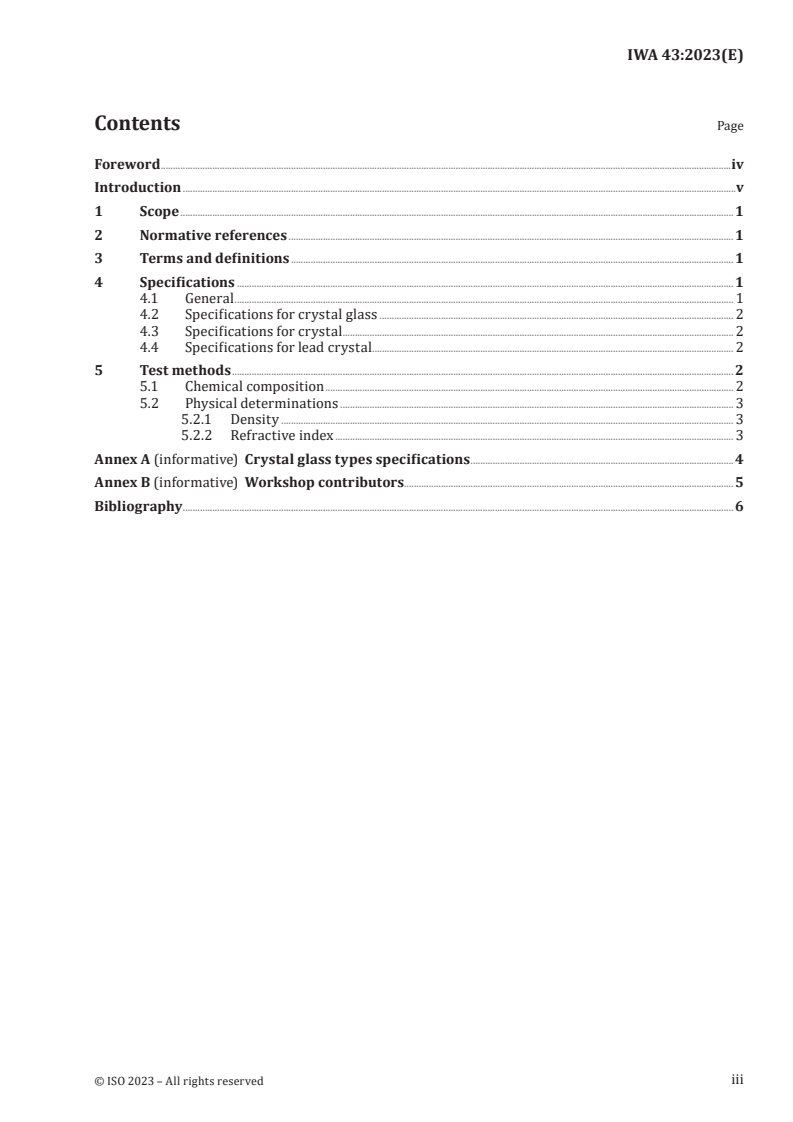
Contents Page
Foreword .iv
Introduction .v
1 Scope . 1
2 Normative references . 1
3 Terms and definitions . 1
4 Specifications . 1
4.1 General . 1
4.2 Specifications for crystal glass . 2
4.3 Specifications for crystal . . 2
4.4 Specifications for lead crystal . 2
5 Test methods . 2
5.1 Chemical composition . 2
5.2 Physical determinations . 3
5.2.1 Density . 3
5.2.2 Refractive index . 3
Annex A (informative) Crystal glass types specifications . 4
Annex B (informative) Workshop contributors. 5
Bibliography . 6
iii
Foreword
ISO (the International Organization for Standardization) is a worldwide federation of national standards
bodies (ISO member bodies). The work of preparing International Standards is normally carried out
through ISO technical committees. Each member body interested in a subject for which a technical
committee has been established has the right to be represented on that committee. International
organizations, governmental and non-governmental, in liaison with ISO, also take part in the work.
ISO collaborates closely with the International Electrotechnical Commission (IEC) on all matters of
electrotechnical standardization.
The procedures used to develop this document and those intended for its further maintenance are
described in the ISO/IEC Directives, Part 1. In particular, the different approval criteria needed for the
different types of ISO document should be noted. This document was drafted in accordance with the
editorial rules of the ISO/IEC Directives, Part 2 (see www.iso.org/directives).
ISO draws attention to the possibility that the implementation of this document may involve the use
of (a) patent(s). ISO takes no position concerning the evidence, validity or applicability of any claimed
patent rights in respect thereof. As of the date of publication of this document, ISO had not received
notice of (a) patent(s) which may be required to implement this document. However, implementers are
cautioned that this may not represent the latest information, which may be obtained from the patent
database available at www.iso.org/patents. ISO shall not be held responsible for identifying any or all
such patent rights.
Any trade name used in this document is information given for the convenience of users and does not
constitute an endorsement.
For an explanation of the voluntary nature of standards, the meaning of ISO specific terms and
expressions related to conformity assessment, as well as information about ISO's adherence to
the World Trade Organization (WTO) principles in the Technical Barriers to Trade (TBT), see
www.iso.org/iso/foreword.html.
International Workshop Agreement IWA 43 was approved at a workshop hosted by the Association
française de normalisation (Afnor), held in La Plaine Saint Denis, France, on 16 June 2023.
Any feedback or questions on this document should be directed to the user’s national standards body. A
complete listing of these bodies can be found at www.iso.org/members.html.
iv
Introduction
This document is intended to provide specifications and test methods for three crystal glass types
(crystal glass, crystal, lead crystal) used in consumer goods in relation to tableware, containers,
furniture, home decor, jewellery and any other decorative components in consumer goods. The purpose
is to promote a global understanding of consumer quality requirements, together with corresponding
methods to measure the specifications.
The three crystal glass types are determined based on three criteria: chemical composition, refractive
index and density. A maximum lead content criterion is added for crystal and crystal glass.
The refractive index depends on the chemical composition of glass. While lead oxide remains the most
efficient constituent to obtain a high refractive index because it favours general qualities (mass purity,
high transparency for non-coloured glass), other components such as calcium oxide, barium oxide, zinc
oxide may also contribute to a high refractive index.
v
© ISO
...
ACCORD IWA
INTERNATIONAL 43
D’ATELIER
Première édition
2023-10
Types de verres — Cristallin, cristal et
cristal au plomb — Spécifications et
méthodes d'essai
Glass types — Crystal glass, crystal and lead crystal — Specifications
and test methods
Numéro de référence
DOCUMENT PROTÉGÉ PAR COPYRIGHT
© ISO 2023
Tous droits réservés. Sauf prescription différente ou nécessité dans le contexte de sa mise en œuvre, aucune partie de cette
publication ne peut être reproduite ni utilisée sous quelque forme que ce soit et par aucun procédé, électronique ou mécanique,
y compris la photocopie, ou la diffusion sur l’internet ou sur un intranet, sans autorisation écrite préalable. Une autorisation peut
être demandée à l’ISO à l’adresse ci-après ou au comité membre de l’ISO dans le pays du demandeur.
ISO copyright office
Case postale 401 • Ch. de Blandonnet 8
CH-1214 Vernier, Genève
Tél.: +41 22 749 01 11
E-mail: copyright@iso.org
Web: www.iso.org
Publié en Suisse
ii
Sommaire Page
Avant-propos .iv
Introduction .v
1 Domaine d’application . 1
2 Références normatives .1
3 Termes et définitions . 1
4 Spécifications . 1
4.1 Généralités . 1
4.2 Spécifications du cristallin . 2
4.3 Spécifications du cristal . 2
4.4 Spécifications du cristal au plomb . 2
5 Méthodes d’essai . 3
5.1 Composition chimique . 3
5.2 Déterminations physiques . 3
5.2.1 Masse volumique . 3
5.2.2 Indice de réfraction . 3
Annexe A (informative) Spécifications des types de verres cristal . 4
Annexe B (informative) Participants à l’atelier . 5
Bibliographie . 6
iii
Avant-propos
L'ISO (Organisation internationale de normalisation) est une fédération mondiale d'organismes
nationaux de normalisation (comités membres de l'ISO). L'élaboration des Normes internationales est
en général confiée aux comités techniques de l'ISO. Chaque comité membre intéressé par une étude
a le droit de faire partie du comité technique créé à cet effet. Les organisations internationales,
gouvernementales et non gouvernementales, en liaison avec l'ISO participent également aux travaux.
L'ISO collabore étroitement avec la Commission électrotechnique internationale (IEC) en ce qui
concerne la normalisation électrotechnique.
Les procédures utilisées pour élaborer le présent document et celles destinées à sa mise à jour sont
décrites dans les Directives ISO/IEC, Partie 1. Il convient, en particulier, de prendre note des différents
critères d'approbation requis pour les différents types de documents ISO. Le présent document a
été rédigé conformément aux règles de rédaction données dans les Directives ISO/IEC, Partie 2 (voir
www.iso.org/directives).
L’ISO attire l’attention sur le fait que la mise en application du présent document peut entraîner
l’utilisation d’un ou de plusieurs brevets. L’ISO ne prend pas position quant à la preuve, à la validité
et à l’applicabilité de tout droit de brevet revendiqué à cet égard. À la date de publication du présent
document, l’ISO n'avait pas reçu notification qu’un ou plusieurs brevets pouvaient être nécessaires à sa
mise en application. Toutefois, il y a lieu d’avertir les responsables de la mise en application du présent
document que des informations plus récentes sont susceptibles de figurer dans la base de données de
brevets, disponible à l'adresse www.iso.org/brevets. L’ISO ne saurait être tenue pour responsable de ne
pas avoir identifié tout ou partie de tels droits de propriété.
Les appellations commerciales éventuellement mentionnées dans le présent document sont données
pour information, par souci de commodité, à l’intention des utilisateurs et ne sauraient constituer un
engagement.
Pour une explication de la nature volontaire des normes, la signification des termes et expressions
spécifiques de l'ISO liés à l'évaluation de la conformité, ou pour toute information au sujet de l'adhésion
de l'ISO aux principes de l’Organisation mondiale du commerce (OMC) concernant les obstacles
techniques au commerce (OTC), voir www.iso.org/avant-propos.
L’Accord international d’atelier IWA 43 a été approuvé dans le cadre d’un atelier organisé par
l’Association française de normalisation (Afnor), à La Plaine Saint Denis, France, le 16 juin 2023.
Il convient que l’utilisateur adresse tout retour d’information ou toute question concernant le présent
document à l’organisme national de normalisation de son pays. Une liste exhaustive desdits organismes
se trouve à l’adresse www.iso.org/fr/members.html.
iv
Introduction
Le présent document est destiné à fournir des spécifications et des méthodes d’essai pour trois types de
verres en cristal (le cristallin, le cristal et le cristal au plomb) utilisés dans les produits de consommation
en rapport avec la vaisselle, les récipients, le mobilier, la décoration intérieure, la joaillerie et autres
éléments décoratifs des produits de consommation. L’objectif est de promouvoir une compréhension
globale des exigences de qualité des consommateurs, avec les méthodes correspondantes pour mesurer
les spécifications.
Les trois types de verres cristal sont déterminés à partir de trois critères: la composition chimique,
l’indice de réfraction et la masse volumique. S’y ajoute un critère de teneur maximale en plomb pour le
cristal et le cristallin.
L’indice de réfraction dépend de la composition chimique du verre. L’oxyde de plomb demeure le
constituant le plus efficace pour obtenir un indice de réfraction élevé car il favorise les qualités générales
(pureté massique, haute transparence du verre non coloré). Toutefois d’autres composés comme l’oxyde
de calcium, l’oxyde de baryum, l’oxyde de zinc peuvent également contribuer à l’obtention d’un indice de
réfraction élevé.
v
ACCORD INTERNATIONAL D’ATELIER IWA 43:2023(F)
Types de verres — Cristallin, cristal et cristal au plomb —
Spécifications et méthodes d'essai
1 Domaine d’application
Le présent document fournit les spécifications et fix
...