

ISO/IEC 15816:2002
(Main)Information technology — Security techniques — Security information objects for access control
General Information
- Abstract
The scope of this Recommendation | International Standard is: a) the definition of guidelines for specifying the abstract syntax of generic and specific Security Information Objects (SIOs) for Access Control; b) the specification of generic SIOs for Access Control; c) the specification of specific SIOs for Access Control. The scope of this Recommendation | International Standard covers only the "statics" of SIOs through syntactic definitions in terms of ASN.1 descriptions and additional semantic explanations. It does not cover the "dynamics" of SIOs, for example rules relating to their creation and deletion. The dynamics of SIOs are a local implementation issue.
- Status
- Published
- Publication Date
- 30-Jan-2002
- Drafting Committee
- ISO/IEC JTC 1/SC 27/WG 4 - Security controls and services
- Current Stage
- 9060 - Close of review
- Completion Date
- 04-Jun-2029
Buy Documents
ISO/IEC 15816:2002 - Information technology — Security techniques — Security information objects for access control Released:1/31/2002
ISO/IEC 15816:2002 - Technologies de l'information — Techniques de sécurité — Objets d'information de sécurité pour le contrôle d'acces Released:6/20/2002
Overview - ISO/IEC 15816:2002 (Security information objects for access control)
ISO/IEC 15816:2002 specifies Security Information Objects (SIOs) used to support access control in IT systems. The standard provides guidelines for defining the abstract syntax of generic and specific SIOs and supplies a set of SIO definitions expressed with ASN.1 (Abstract Syntax Notation One). It covers the statics of SIOs (structure, syntax and semantic explanations) - not lifecycle or operational rules (creation, deletion, etc.), which are left to local implementation.
Keywords: ISO/IEC 15816, security information objects, access control, ASN.1, security labels, confidentiality label, security policy information file (SPIF).
Key topics and technical requirements
- Abstract syntax guidance: Rules and guidelines for specifying the abstract syntax of generic and specific SIO classes so implementations can interoperate.
- ASN.1 module: Complete ASN.1 definitions for SIOs are provided (see Annex A, id-SIOsAccessControl-MODULE), enabling consistent encoding and exchange.
- Defined SIOs: Includes definitions and semantics for key SIOs such as:
- Confidentiality label - expresses compartments, handling requirements and protection levels for data objects (routing, encryption, markings, audit needs).
- Security Policy Information File (SPIF) - conveys domain-specific security policy information.
- Clearance attribute - representing authorization/clearance data associated with principals.
- Static focus: Emphasis on syntactic and semantic definitions; dynamics (policy administration, creation/deletion rules) are explicitly out of scope.
- Interoperability objective: Standardizes common structures to reduce duplicate or conflicting definitions across security frameworks.
Applications - who uses ISO/IEC 15816
- Security architects and system designers implementing access control and labeling schemes.
- Software developers and integrators for directory services, messaging systems, databases, and middleware that require consistent security metadata.
- Implementers of PKI, RBAC and attribute-based access control systems who need standard label and attribute representations.
- Standards bodies and vendors seeking interoperability among security management tools and cross-domain information sharing.
- Organizations adopting formal security labeling for confidentiality, routing, auditing and handling rules.
Practical benefits include more consistent security labels, easier integration between products, and reduced ambiguity in exchanging access-control metadata.
Related standards
- ASN.1 family: ITU‑T X.680 / X.681 (ISO/IEC 8824‑1/2) for notation and information object specifications.
- Encoding rules: ITU‑T X.690 (BER/CER/DER).
- Directory and certificate frameworks: ITU‑T X.500 (ISO/IEC 9594), X.509 (PKI/attribute certificates).
- Access-control and security architecture references: ITU‑T X.803, X.810 and ISO/IEC 7498‑2.
Using ISO/IEC 15816 helps ensure consistent, ASN.1-based representations of security metadata needed for robust, interoperable access control.
Buy Documents
ISO/IEC 15816:2002 - Information technology — Security techniques — Security information objects for access control Released:1/31/2002
ISO/IEC 15816:2002 - Technologies de l'information — Techniques de sécurité — Objets d'information de sécurité pour le contrôle d'acces Released:6/20/2002
Get Certified
Connect with accredited certification bodies for this standard

BSI Group
BSI (British Standards Institution) is the business standards company that helps organizations make excellence a habit.

Bureau Veritas
Bureau Veritas is a world leader in laboratory testing, inspection and certification services.

DNV
DNV is an independent assurance and risk management provider.
Sponsored listings
Frequently Asked Questions
ISO/IEC 15816:2002 is a standard published by the International Organization for Standardization (ISO). Its full title is "Information technology — Security techniques — Security information objects for access control". This standard covers: The scope of this Recommendation | International Standard is: a) the definition of guidelines for specifying the abstract syntax of generic and specific Security Information Objects (SIOs) for Access Control; b) the specification of generic SIOs for Access Control; c) the specification of specific SIOs for Access Control. The scope of this Recommendation | International Standard covers only the "statics" of SIOs through syntactic definitions in terms of ASN.1 descriptions and additional semantic explanations. It does not cover the "dynamics" of SIOs, for example rules relating to their creation and deletion. The dynamics of SIOs are a local implementation issue.
The scope of this Recommendation | International Standard is: a) the definition of guidelines for specifying the abstract syntax of generic and specific Security Information Objects (SIOs) for Access Control; b) the specification of generic SIOs for Access Control; c) the specification of specific SIOs for Access Control. The scope of this Recommendation | International Standard covers only the "statics" of SIOs through syntactic definitions in terms of ASN.1 descriptions and additional semantic explanations. It does not cover the "dynamics" of SIOs, for example rules relating to their creation and deletion. The dynamics of SIOs are a local implementation issue.
ISO/IEC 15816:2002 is classified under the following ICS (International Classification for Standards) categories: 35.030 - IT Security; 35.040 - Information coding. The ICS classification helps identify the subject area and facilitates finding related standards.
ISO/IEC 15816:2002 is available in PDF format for immediate download after purchase. The document can be added to your cart and obtained through the secure checkout process. Digital delivery ensures instant access to the complete standard document.
Standards Content (Sample)
INTERNATIONAL ISO/IEC
STANDARD 15816
First edition
2002-02-01
Information technology — Security
techniques — Security information
objects for access control
Technologies de l'information — Techniques de sécurité — Objets
d'informations de sécurité pour le contrôle d'accès
Reference number
©
ISO/IEC 2002
PDF disclaimer
This PDF file may contain embedded typefaces. In accordance with Adobe's licensing policy, this file may be printed or viewed but shall not
be edited unless the typefaces which are embedded are licensed to and installed on the computer performing the editing. In downloading this
file, parties accept therein the responsibility of not infringing Adobe's licensing policy. The ISO Central Secretariat accepts no liability in this
area.
Adobe is a trademark of Adobe Systems Incorporated.
Details of the software products used to create this PDF file can be found in the General Info relative to the file; the PDF-creation parameters
were optimized for printing. Every care has been taken to ensure that the file is suitable for use by ISO member bodies. In the unlikely event
that a problem relating to it is found, please inform the Central Secretariat at the address given below.
© ISO/IEC 2002
All rights reserved. Unless otherwise specified, no part of this publication may be reproduced or utilized in any form or by any means, electronic
or mechanical, including photocopying and microfilm, without permission in writing from either ISO at the address below or ISO's member body
in the country of the requester.
ISO copyright office
Case postale 56 • CH-1211 Geneva 20
Tel. + 41 22 749 01 11
Fax + 41 22 749 09 47
E-mail copyright@iso.ch
Web www.iso.ch
Printed in Switzerland
ii © ISO/IEC 2002 – All rights reserved
CONTENTS
Page
1 Scope . 1
2 Normative references. 1
2.1 Identical Recommendations | International Standards. 1
2.2 Paired Recommendations | International Standards equivalent in technical content. 2
3 Definitions . 2
4 Abbreviations. 2
5 Conventions . 3
5.1 Security Information Object Class Description. 3
5.2 Generic Security Information Object Class Correspondence . 3
5.3 Security Information Object Composition. 3
6 Specification of Security Information Objects. 3
6.1 Confidentiality Label. 3
6.1.1 Introduction . 3
6.1.2 ASN.1 Specification of the Label. 4
6.1.3 Binding Methods for Confidentiality Labels. 5
6.2 Security Policy Information File . 5
6.2.1 Introduction . 5
6.2.2 ASN.1 Specification of the Security Policy Information File . 6
6.3 Clearance Attribute. 9
6.3.1 Introduction . 9
6.3.2 Definition of clearance attribute. 10
7 Security Information Object Interaction . 10
7.1 SIO Class Structure Comparison. 10
7.2 Security Information Object Interaction for Access Control. 10
Annex A – Security Information Objects for Access Control in ASN.1. 13
Annex B – Expansion of the SECURITY-CATEGORY Syntax. 19
© ISO/IEC 2002 – All rights reserved iii
Foreword
ISO (the International Organization for Standardization) and IEC (the International Electrotechnical Commission) form the
specialized system for worldwide standardization. National bodies that are members of ISO or IEC participate in the
development of International Standards through technical committees established by the respective organization to deal with
particular fields of technical activity. ISO and IEC technical committees collaborate in fields of mutual interest. Other
international organizations, governmental and non-governmental, in liaison with ISO and IEC, also take part in the work. In
the field of information technology, ISO and IEC have established a joint technical committee, ISO/IEC JTC 1.
International Standards are drafted in accordance with the rules given in the ISO/IEC Directives, Part 3.
The main task of the joint technical committee is to prepare International Standards. Draft International Standards adopted by
the joint technical committee are circulated to national bodies for voting. Publication as an International Standard requires
approval by at least 75 % of the national bodies casting a vote.
Attention is drawn to the possibility that some of the elements of this International Standard may be the subject of patent
rights. ISO and IEC shall not be held responsible for identifying any or all such patent rights.
ISO/IEC 15816 was prepared by Joint Technical Committee ISO/IEC JTC 1, Information technology, Subcommittee SC 27, IT
Security techniques, in collaboration with ITU-T. The identical text is published as ITU-T Rec. X.841.
Annex A forms a normative part of of this International Standard. Annex B is for information only.
iv © ISO/IEC 2002 – All rights reserved
Introduction
This Recommendation | International Standard on Security Information Objects (SIOs) for Access Control provides
object definitions that are commonly needed in more than one security standard such that multiple and different
definitions of the same functionality may be avoided. Precision in these definitions is achieved by use of the Abstract
Syntax Notation One (ASN.1) defined in ITU-T Rec. X.680 (1997) | ISO/IEC 8824-1:1998, and ITU-T Rec. X.681
(1997) | ISO/IEC 8824-2:1998.
The aim of security management is to ensure that assets, including information, are protected appropriately and cost
effectively. In order to protect proprietary interests and Intellectual Property Rights, organizations need to control the
handling of their information. Severe damage or embarrassment can be caused to either the originator or holder of
sensitive information, for example, if it is released to those not authorized to receive it (a breach of confidentiality), or if
it is modified in any way (a breach of integrity). Each organization needs to ensure that it protects its own information
and assets adequately in all forms during its storage, processing and transmission between and within organizations over
both private and public networks. Organizations must be satisfied that their assets will be protected properly when they
are held or processed by others if business is to be conducted more widely.
The motivation for development of SIOs for Access Control is the achievement of the flexibility and interoperability in
security management that accrues from the use of common structures for similar functions. Standardization of security
labels and alternative methods for access control have been pursued in this Recommendation | International Standard.
© ISO/IEC 2002 – All rights reserved v
ISO/IEC 15816 : 2002 (E)
INTERNATIONAL STANDARD
ISO/IEC 15816 : 2001 (E)
ITU-T RECOMMENDATION
INFORMATION TECHNOLOGY – SECURITY TECHNIQUES – SECURITY
INFORMATION OBJECTS FOR ACCESS CONTROL
1 Scope
The scope of this Recommendation | International Standard is:
a) the definition of guidelines for specifying the abstract syntax of generic and specific Security Information
Objects (SIOs) for Access Control;
b) the specification of generic SIOs for Access Control;
c) the specification of specific SIOs for Access Control.
The scope of this Recommendation | International Standard covers only the "statics" of SIOs through syntactic
definitions in terms of ASN.1 descriptions and additional semantic explanations. It does not cover the "dynamics" of
SIOs, for example rules relating to their creation and deletion. The dynamics of SIOs are a local implementation issue.
2 Normative references
The following Recommendations and International Standards contain provisions which, through reference in this text,
constitute provisions of this Recommendation | International Standard. At the time of publication, the editions indicated
were valid. All Recommendations and Standards are subject to revision, and parties to agreements based on this
Recommendation | International Standard are encouraged to investigate the possibility of applying the most recent
edition of the Recommendations and Standards listed below. Members of IEC and ISO maintain registers of currently
valid International Standards. The Telecommunication Standardization Bureau of ITU maintains a list of currently valid
ITU-T Recommendations.
2.1 Identical Recommendations | International Standards
– ITU-T Recommendation X.411 (1999) | ISO/IEC 10021-4, Information technology – Message Handling
Systems (MHS): Message transfer system: Abstract service definition and procedures.
– ITU-T Recommendation X.500 (2001) | ISO/IEC 9594-1:2001, Information technology – Open Systems
Interconnection – The Directory: Overview of concepts, models and services.
– ITU-T Recommendation X.501 (2001) | ISO/IEC 9594-2:2001, Information technology – Open Systems
Interconnection – The Directory: Models.
– ITU-T Recommendation X.509 (2000) | ISO/IEC 9594-8:2001, Information technology – Open Systems
Interconnection – The Directory: Public-key and attribute certificate frameworks.
– ITU-T Recommendation X.680 (1997) | ISO/IEC 8824-1:1998, Information technology – Abstract syntax
notation one (ASN.1): Specification of basic notation.
– ITU-T Recommendation X.681 (1997) | ISO/IEC 8824-2:1998, Information technology – Abstract syntax
notation one (ASN.1): Information object specification.
– ITU-T Recommendation X.682 (1997) | ISO/IEC 8824-3:1998, Information technology – Abstract syntax
notation one (ASN.1): Constraint specification.
– ITU-T Recommendation X.683 (1997) | ISO/IEC 8824-4:1998, Information technology – Abstract syntax
notation one (ASN.1): Parameterization of ASN.1 specifications.
– ITU-T Recommendation X.690 (1997) | ISO/IEC 8825-1:1998, Information technology – ASN.1 encoding
rules: Specification of Basic Encoding Rules (BER), Canonical Encoding Rules (CER) and Distinguished
Encoding Rules (DER).
ITU-T X.841 (10/2000 E) 1
ISO/IEC 15816 : 2002 (E)
– CCITT Recommendation X.722 (1992) | ISO/IEC 10165-4:1992, Information technology – Open Systems
Interconnection – Structure of management information: Guidelines for the definition of managed objects.
– ITU-T Recommendation X.741 (1995) | ISO/IEC 10164-9:1995, Information technology – Open Systems
Interconnection – Systems Management: Objects and attributes for access control.
– ITU-T Recommendation X.803 (1994) | ISO/IEC 10745:1995, Information technology – Open Systems
Interconnection – Upper layers security model.
– ITU-T Recommendation X.810 (1995) | ISO/IEC 10181-1:1996, Information technology – Open Systems
Interconnection – Security frameworks for open systems: Overview.
– ITU-T Recommendation X.830 (1995) | ISO/IEC 11586-1:1996, Information technology – Open Systems
Interconnection – Generic upper layers security: Overview, models and notation.
2.2 Paired Recommendations | International Standards equivalent in technical content
– CCITT Recommendation X.800 (1991), Security architecture for Open Systems Interconnection for
CCITT applications.
ISO 7498-2:1989, Information processing systems – Open Systems Interconnection – Basic Reference
Model – Part 2: Security Architecture.
3 Definitions
For the purposes of this Recommendation | International Standard, the following definitions apply.
3.1 Compartmentalization: As defined in ISO/IEC 2382-8.
3.2 Generic SIO Class: An SIO Class in which the data types for one or more of the components are not fully
specified.
3.3 Information Object: As defined in ITU-T Rec. X.681 | ISO/IEC 8824-2.
3.4 Information Object Class: As defined in ITU-T Rec. X.681 | ISO/IEC 8824-2.
3.5 Object Identifier (OID): As defined in ITU-T Rec. X.680 | ISO/IEC 8824-1.
3.6 Seal: As defined in ITU-T Rec. X.810 | ISO/IEC 10181-1.
3.7 Security Authority: The entity accountable for the administration of a security policy within a security
domain.
3.8 Security Domain: A collection of users and systems subject to a common security policy.
3.9 Security Information Object: An instance of an SIO Class.
3.10 Security Information Object Class: An Information Object Class that has been tailored for security use.
3.11 Security Label: As defined in CCITT Rec. X.800 and ISO/IEC 7498-2.
3.12 Security Policy: As defined in ISO/IEC 2382-8.
3.13 Security Policy Information File: A construct that conveys domain-specific security policy information.
3.14 Specific SIO Class: An SIO Class in which the data types for all components are fully specified.
4 Abbreviations
For the purposes of this Recommendation | International Standard, the following abbreviations apply:
ASN.1 Abstract Syntax Notation One
EE End Entity
IT Information Technology
2 ITU-T X.841 (10/2000 E)
ISO/IEC 15816 : 2002 (E)
OID Object Identifier
RBAC Rule Based Access Control
SIO Security Information Object
SPIF Security Policy Information File
5 Conventions
5.1 Security Information Object Class Description
An SIO Class comprises:
– a value for a SIO Class identifier;
– a set of one or more data type specifications, one for each component the SIO Class contains; and
– a statement of the semantics associated with use of the SIO Class.
5.2 Generic Security Information Object Class Correspondence
A Generic SIO Class is an SIO Class in which the data types for one or more of the components are not fully specified. A
Specific SIO Class is an SIO Class in which the data types for all components are fully specified. A generic SIO Class
corresponds to a family of specific SIO Classes.
5.3 Security Information Object Composition
The specification of each SIO in this Recommendation | International Standard contains the following parts:
– a description of the SIO;
– an explanation of the usage of the SIO;
– a description of the components of the SIO.
The description of the components of the SIO includes the ASN.1 specification and the object identifier of the object
class being defined.
6 Specification of Security Information Objects
When a new requirement is identified for an SIO, the following steps shall be followed to encourage reuse of existing
specifications and to reduce the proliferation of different specifications meeting the same requirements:
– If this Recommendation | International Standard defines an SIO that meets the new requirement, the
definition in this Recommendation | International Standard shall be used.
– Components of SIOs defined in this Recommendation | International Standard should be used in the
definition of the new SIO if they satisfy part of the new requirement.
Specifications of the SIOs that have been developed to support access control are included in the following subclauses. A
complete ASN.1 definition for the Security Information Objects discussed in these subclauses is included as a module in
Annex A. This module is identified as follows:
id-SIOsAccessControl-MODULE OBJECT IDENTIFIER ::= {
joint-iso-itu-t sios(24) specification(0) modules(0) accessControl(0)}
6.1 Confidentiality Label
6.1.1 Introduction
Organizations typically have one or more security policies that provide for the compartmentalization of data into
groupings that are to be protected and handled in the same way. The security policy defines the protection to be applied
to each compartment.
ITU-T X.841 (10/2000 E) 3
ISO/IEC 15816 : 2002 (E)
The aspects of security expressed by a security policy, indicated in a security label, include the following:
– the level of protection to be given to data stored on a system;
– who is authorized to access data, processes or resources;
– security markings required to be shown on any display or print of the material;
– routing and enciphering requirements for data transmitted between systems;
– requirements for protection against unauthorized copying;
– methods for storage of data;
– enciphering algorithms to be used;
– methods of authenticating entities;
– whether operations on the object are to be audited;
– whether preventing repudiation of receipt of an object by recipients is required;
– whether, and whose, digital signatures are required to authenticate the data.
When data is held on an Information Technology (IT) system, or when it is transmitted electronically between systems,
the data are labelled to indicate the security compartment to which the data belongs and thus how the data is to be
handled for security. The label may be separately identifiable from the protected information but is logically bound to it.
The integrity of the labels, and the integrity of their binding to the information, must be assured. This allows IT systems
and networks to make security-relevant decisions, such as access control and routing, without the need to access the
information that is being protected. The security label may be associated with each data object in an IT system, such as
documents, electronic mail messages, display windows, database entries, directory entries and electronic forms. The
labels are intended for use when objects are stored, moved around (particularly between systems), and when they are
being handled by applications that act on labels, including applications that create new objects from existing ones.
When labelled data is to be passed between different security domains, the domains should agree on a security policy to
be applied to that data. If the labels specified by the policy applied within a domain differ from the labels specified by the
policy for shared data, then the policy for the shared data shall specify how to translate between the two sets of labels.
Labels alone are not sufficient to ensure the security of information. The security policy that applies to the information
needs to be enforced by each organization while the labelled information is within the scope of their control. All the
organizations, individuals and IT systems that process an item of information are presumed to know the security policy
for that information. Organizations that exchange information need to establish trust in one another to be satisfied that
information will be handled according to agreed security policies. This trust is usually established through a formal
agreement.
6.1.2 ASN.1 Specification of the Label
The confidentiality label is identified as follows:
id-ConfidentialityLabel OBJECT IDENTIFIER ::= {
joint-iso-itu-t sios(24) specification(0) securityLabels(1) confidentiality(0)}
ConfidentialityLabel ::= SET {
security-policy-identifier SecurityPolicyIdentifier OPTIONAL,
security-classification INTEGER(0.MAX) OPTIONAL,
privacy-mark PrivacyMark OPTIONAL,
security-categories SecurityCategories OPTIONAL }
(ALL EXCEPT({-- none; at least one component shall be present --}))
SecurityPolicyIdentifier ::= OBJECT IDENTIFIER
PrivacyMark ::= CHOICE {
pString PrintableString (SIZE(1.ub-privacy-mark-length)),
utf8String UTF8String (SIZE(1.ub-privacy-mark-length))
}
ub-privacy-mark-length INTEGER ::= 128 -- as defined in ITU-T Rec. X.411 | ISO/IEC 10021-4
SecurityCategories ::= SET SIZE (1.MAX) OF SecurityCategory
SecurityCategory ::= SEQUENCE {
type [0] SECURITY-CATEGORY.&id ({SecurityCategoriesTable}),
value [1] SECURITY-CATEGORY.&Type ({SecurityCategoriesTable} {@type})
}
4 ITU-T X.841 (10/2000 E)
ISO/IEC 15816 : 2002 (E)
SECURITY-CATEGORY ::= TYPE-IDENTIFIER
SecurityCategoriesTable SECURITY-CATEGORY ::= {…}
An example of the expansion of the TYPE-IDENTIFIER information object class is provided in Annex B.
6.1.3 Binding Methods for Confidentiality Labels
6.1.3.1 Binding Method 1
A copy of the data (D) and a copy of the security label (L) are stored together, as a data record, inside the secure
boundary of the system. It is assumed that the system is capable of protecting the integrity of the security label and the
integrity, as well as possibly the secrecy, of the data. The protection provided by the system must be such that an
unauthorized user or application is not capable of altering the data or its associated security label. With this binding
method, no cryptographic function is needed to bind the data and the security label.
6.1.3.2 Binding Method 2
A non-secret digital signature (S) is calculated on D and L using a digital signature algorithm (SigAlg) and the private
key (X) of a public key algorithm. That is,
S = SigAlg(X,f(D),L)
The digital signature is stored together with D and L in a data record. The generated digital signature binds L to D. In this
definition, f is a public function such that f(D) does not reveal information about D.
With this binding method, L and S need not be stored inside the secure boundary of the system. If a cryptographic
service is invoked with an incorrect value of L, D or S, the inconsistency is detected. This is accomplished using the
public key of the public key algorithm as a verification key to verify the signature.
6.1.3.3 Binding Method 3
A non-secret message authentication code (MAC) is calculated on D and L using a MAC-generation mode of an
encipherment algorithm (MacAlg) and a secret MAC algorithm key (K-MAC). That is,
MAC = MacAlg(K-MAC,f(D),L)
The MAC is stored together with D and L in a data record. The generated MAC binds L to D. In this definition, f is a
public function such that f(D) does not reveal information about D.
With this binding method, L and MAC need not be stored inside the secure boundary of the system. If a cryptographic
service is invoked with an incorrect value of L, D or MAC, the inconsistency is detected. This is accomplished by
calculating a MAC-of-reference using the provided values of L and D and a copy of K-MAC, and comparing the result
against the provided MAC.
6.2 Security Policy Information File
6.2.1 Introduction
A security policy in its simplest form is a set of criteria for the provision of security services. With regard to access
control, security policy is a subset of a higher system-level security policy that defines the means for enforcing access
control policies between initiators and targets. The access control mechanisms must:
– allow communication where a specific policy permits; and
– deny communication where a specific policy does not explicitly permit.
A security policy is the basis for the decisions made by the access control mechanisms. Domain-specific security policy
information is conveyed via the Security Policy Information File.
The Security Policy Information File contains a sequence of the following:
– versionInformation – indicates the version of the ASN.1 syntax and associated semantics of the Security
Policy Information File specification.
– updateInformation – indicates the currency of the security policy information file data.
– securityPolicyIdData – identifies the security policy to which the Security Policy Information File
applies.
– privilegeId – indicates the OID that identifies the syntax included in the clearance attribute security
category of relying certificates used in conjunction with the Security Policy Information File. The syntax
indicated by privilegeId must be consistent with that indicated by rbacId.
ITU-T X.841 (10/2000 E) 5
ISO/IEC 15816 : 2002 (E)
– securityClassifications – maps the classification of the security label to a classification in the clearance
attribute, and also provides equivalency mappings.
– rbacId – rule based access control object identifier which identifies the syntax included in the
securityLabel security category that is used in conjunction with the Security Policy Information File. The
syntax indicated by rbacId must be consistent with that indicated by privilegeId.
– securityCategories – maps the security categories of the security label to the security categories in the
clearance attribute, and also provides equivalency mappings.
– equivalentPolicies – consolidates all equivalent policies in the SPIF.
– defaultSecurityPolicyIdData – identifies the security policy which will apply if data is received without a
security label.
– extensions – provides a mechanism to include additional capabilities as future requirements are
identified.
The Security Policy Information File is a signed object to protect it from unauthorized changes.
6.2.2 ASN.1 Specification of the Security Policy Information File
The Security Policy Information File is defined by the following syntax:
SecurityPolicyInformationFile ::= SIGNED {EncodedSPIF}
EncodedSPIF ::= TYPE-IDENTIFIER.&Type( SPIF )
SPIF ::= SEQUENCE {
versionInformation VersionInformationData DEFAULT v1,
updateInformation UpdateInformationData,
securityPolicyIdData ObjectIdData,
privilegeId OBJECT IDENTIFIER,
rbacId OBJECT IDENTIFIER,
securityClassifications [0] SEQUENCE OF SecurityClassification OPTIONAL,
securityCategories [1] SEQUENCE OF SecurityCategory OPTIONAL,
equivalentPolicies [2] SEQUENCE OF EquivalentPolicy OPTIONAL,
defaultSecurityPolicyIdData [3] ObjectIdData OPTIONAL,
extensions [4] Extensions OPTIONAL }
6.2.2.1 Version Information
The versionInformation field indicates the ASN.1 syntax version as well as the associated semantics.
VersionInformationData ::= INTEGER { v1(0) } (0.MAX)
6.2.2.2 Upd
...
NORME ISO/CEI
INTERNATIONALE 15816
Première édition
2002-02-01
Technologies de l'information —
Techniques de sécurité — Objets
d'information de sécurité pour le contrôle
d'accès
Information technology — Security techniques — Security information
objects for access control
Numéro de référence
ISO/CEI 15816:2002(F)
©
ISO/CEI 2002
ISO/CEI 15816:2002(F)
PDF – Exonération de responsabilité
Le présent fichier PDF peut contenir des polices de caractères intégrées. Conformément aux conditions de licence d'Adobe, ce fichier peut
être imprimé ou visualisé, mais ne doit pas être modifié à moins que l'ordinateur employé à cet effet ne bénéficie d'une licence autorisant
l'utilisation de ces polices et que celles-ci y soient installées. Lors du téléchargement de ce fichier, les parties concernées acceptent de fait la
responsabilité de ne pas enfreindre les conditions de licence d'Adobe. Le Secrétariat central de l'ISO décline toute responsabilité en la
matière.
Adobe est une marque déposée d'Adobe Systems Incorporated.
Les détails relatifs aux produits logiciels utilisés pour la création du présent fichier PDF sont disponibles dans la rubrique General Info du
fichier; les paramètres de création PDF ont été optimisés pour l'impression. Toutes les mesures ont été prises pour garantir l'exploitation de
ce fichier par les comités membres de l'ISO. Dans le cas peu probable où surviendrait un problème d'utilisation, veuillez en informer le
Secrétariat central à l'adresse donnée ci-dessous.
© ISO/CEI 2002
Droits de reproduction réservés. Sauf prescription différente, aucune partie de cette publication ne peut être reproduite ni utilisée sous quelque
forme que ce soit et par aucun procédé, électronique ou mécanique, y compris la photocopie et les microfilms, sans l'accord écrit de l’ISO à
l’adresse ci-après ou du comité membre de l’ISO dans le pays du demandeur.
ISO copyright office
Case postale 56 • CH-1211 Geneva 20
Tel. + 41 22 749 01 11
Fax. + 41 22 749 09 47
E-mail copyright@iso.ch
Web www.iso.ch
Imprimé en Suisse
ii © ISO/CEI 2002 – Tous droits réservés
ISO/CEI 15816:2002(F)
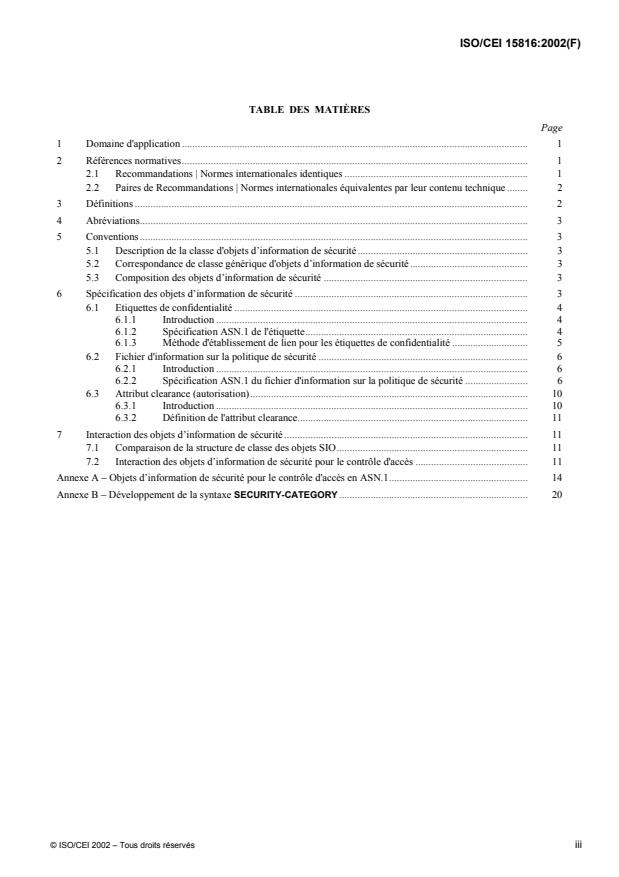
TABLE DES MATIÈRES
Page
1 Domaine d'application . 1
2 Références normatives. 1
2.1 Recommandations | Normes internationales identiques . 1
2.2 Paires de Recommandations | Normes internationales équivalentes par leur contenu technique . 2
3 Définitions . 2
4 Abréviations. 3
5 Conventions . 3
5.1 Description de la classe d'objets d’information de sécurité. 3
5.2 Correspondance de classe générique d'objets d’information de sécurité. 3
5.3 Composition des objets d’information de sécurité . 3
6 Spécification des objets d’information de sécurité . 3
6.1 Etiquettes de confidentialité . 4
6.1.1 Introduction . 4
6.1.2 Spécification ASN.1 de l'étiquette. 4
6.1.3 Méthode d'établissement de lien pour les étiquettes de confidentialité . 5
6.2 Fichier d'information sur la politique de sécurité . 6
6.2.1 Introduction . 6
6.2.2 Spécification ASN.1 du fichier d'information sur la politique de sécurité . 6
6.3 Attribut clearance (autorisation). 10
6.3.1 Introduction . 10
6.3.2 Définition de l'attribut clearance. 11
7 Interaction des objets d’information de sécurité . 11
7.1 Comparaison de la structure de classe des objets SIO. 11
7.2 Interaction des objets d’information de sécurité pour le contrôle d'accès . 11
Annexe A – Objets d’information de sécurité pour le contrôle d'accès en ASN.1. 14
Annexe B – Développement de la syntaxe SECURITY-CATEGORY. 20
© ISO/CEI 2002 – Tous droits réservés iii
ISO/CEI 15816:2002(F)
Avant-propos
L'ISO (Organisation internationale de normalisation) et la CEI (Commission électrotechnique internationale)
forment le système spécialisé de la normalisation mondiale. Les organismes nationaux membres de l'ISO ou de la
CEI participent au développement de Normes internationales par l'intermédiaire des comités techniques créés par
l'organisation concernée afin de s'occuper des domaines particuliers de l'activité technique. Les comités
techniques de l'ISO et de la CEI collaborent dans des domaines d'intérêt commun. D'autres organisations
internationales, gouvernementales et non gouvernementales, en liaison avec l'ISO et la CEI participent également
aux travaux. Dans le domaine des technologies de l'information, l'ISO et la CEI ont créé un comité technique mixte,
l'ISO/CEI JTC 1.
Les Normes internationales sont rédigées conformément aux règles données dans les Directives ISO/CEI, Partie 3.
La tâche principale du comité technique mixte est d'élaborer les Normes internationales. Les projets de Normes
internationales adoptés par le comité technique mixte sont soumis aux organismes nationaux pour vote. Leur
publication comme Normes internationales requiert l'approbation de 75 % au moins des organismes nationaux
votants.
L'attention est appelée sur le fait que certains des éléments de la présente Norme internationale peuvent faire
l'objet de droits de propriété intellectuelle ou de droits analogues. L'ISO et la CEI ne sauraient être tenues pour
responsables de ne pas avoir identifié de tels droits de propriété et averti de leur existence.
L'ISO/CEI 15816 a été élaborée par le comité technique mixte ISO/CEI JTC 1, Technologies de l'nformation,
sous-comité SC 27, Techniques de sécurité des technologies de l'information, en collaboration avec l'UIT-T. Le
texte identique est publié en tant que Rec. UIT-T X.841.
L'annexe A constitue un élément normatif de la présente Norme internationale. L'annexe B est donnée uniquement
à titre d’information.
iv © ISO/CEI 2002 – Tous droits réservés
ISO/CEI 15816:2002(F)
Introduction
La présente Recommandation | Norme internationale sur les objets d’information de sécurité pour le contrôle d'accès
rassemble les définitions d'objets courantes utiles pour les normes de sécurité afin d'éviter la multiplicité de définitions
différentes de la même fonctionnalité. Il a été possible d'obtenir des définitions précises grâce à l'utilisation de la notation
de syntaxe abstraite numéro un (ASN.1) définie dans la Rec. UIT-T X.680 (1997) | ISO/CEI 8824-1:1998, et la
Rec. UIT-T X.681 (1997) | ISO/CEI 8824-2:1998.
L'objet de la gestion de sécurité est de protéger de manière appropriée et économique le capital, y compris l'information.
Afin de protéger leurs intérêts et leurs droits de propriété intellectuelle, les organisations doivent pouvoir contrôler la
façon dont leur information est traitée. Le détenteur ou le créateur d'informations sensibles peut subir un préjudice
considérable ou être dans une situation fort embarrassante si, par exemple, cette information est communiquée à des
personnes non autorisées (rupture de confidentialité) ou si cette information est modifiée de manière quelconque (rupture
d'intégrité). Chaque organisation doit s'efforcer de protéger son capital et notamment son information de manière
adéquate et sous toutes ses formes pendant son stockage, son traitement et sa circulation interne et externe sur les réseaux
privés ou publics. Les organisations doivent avoir l'assurance que leur capital sera bien protégé lorsque celui-ci sera
détenu ou traité par des tiers si elles envisagent d'élargir leur activité.
L'élaboration des objets SIO pour le contrôle d'accès a été motivée par la recherche d'une souplesse et d'une
interopérabilité dans la gestion de la sécurité découlant de l'utilisation de structures communes pour des fonctions
similaires. Dans la présente Recommandation | Norme internationale, on s'est efforcé de normaliser des étiquettes de
sécurité et diverses méthodes de contrôle d'accès.
© ISO/CEI 2002 – Tous droits réservés v
ISO/CEI 15816:2002 (F)
NORME INTERNATIONALE
ISO/CEI 15816:2001 (F)
RECOMMANDATION UIT-T
TECHNOLOGIES DE L'INFORMATION – TECHNIQUES DE SÉCURITÉ –
OBJETS D'INFORMATION DE SÉCURITÉ POUR LE CONTRÔLE D'ACCÈS
1 Domaine d'application
La présente Recommandation | Norme internationale s'applique à:
a) la définition de directives pour la spécification de la syntaxe abstraite des objets d’information de sécurité
(SIO) génériques ou particuliers pour le contrôle d'accès;
b) la spécification des objets SIO génériques pour le contrôle d'accès;
c) la spécification d'objets SIO spécifiques pour le contrôle d'accès.
La présente Recommandation | Norme internationale ne couvre que les aspects "statiques" des objets SIO et utilise pour
cela des définitions syntaxiques sous forme de descriptions ASN.1 et d'explications sémantiques additionnelles. Elle ne
couvre pas les aspects "dynamiques" des objets SIO comme, par exemple, les règles relatives à leur création et à leur
suppression. Les aspects "dynamiques" des objets SIO relèvent de la mise en œuvre locale.
2 Références normatives
Les Recommandations et Normes internationales suivantes contiennent des dispositions qui, par suite de la référence qui
y est faite, constituent des dispositions valables pour la présente Recommandation | Norme internationale. Au moment de
la publication, les éditions indiquées étaient en vigueur. Toutes Recommandations et Normes sont sujettes à révision et
les parties prenantes aux accords fondés sur la présente Recommandation | Norme internationale sont invitées à
rechercher la possibilité d'appliquer les éditions les plus récentes des Recommandations et Normes indiquées ci-après.
Les membres de la CEI et de l'ISO possèdent le registre des Normes internationales en vigueur. Le Bureau de la
normalisation des télécommunications de l'UIT tient à jour une liste des Recommandations de l'UIT-T en vigueur.
2.1 Recommandations | Normes internationales identiques
– Recommandation UIT-T X.411 (1999) | ISO/CEI 10021-4:2001, Technologies de l'information –
Systèmes de messagerie: système de transfert de messages: définition et procédures du service abstrait.
– Recommandation UIT-T X.500 (2001) | ISO/CEI 9594-1:2001, Technologies de l'information –
Interconnexion des systèmes ouverts – L'annuaire: aperçu général des concepts, modèles et services.
– Recommandation UIT-T X.501 (2001) | ISO/CEI 9594-2:2001, Technologies de l'information –
Interconnexion des systèmes ouverts – L'Annuaire: les modèles.
– Recommandation UIT-T X.509 (2000) | ISO/CEI 9594-8:2001, Technologies de l'information –
Interconnexion des systèmes ouverts – L'annuaire: cadre général des certificats de clé publique et
d'attribut.
– Recommandation UIT-T X.680 (1997) | ISO/CEI 8824-1:1998, Technologies de l'information – Notation
de syntaxe abstraite numéro un: spécification de la notation de base.
– Recommandation UIT-T X.681 (1997) | ISO/CEI 8824-2:1998, Technologies de l'information – Notation
de syntaxe abstraite numéro un: spécification des objets informationnels.
– Recommandation UIT-T X.682 (1997) | ISO/CEI 8824-3:1998, Technologies de l'information – Notation
de syntaxe abstraite numéro un: spécification des contraintes.
UIT-T X.841 (10/2000 F) 1
ISO/CEI 15816:2002 (F)
– Recommandation UIT-T X.683 (1997) | ISO/CEI 8824-4:1998, Technologies de l'information – Notation
de syntaxe abstraite numéro un: paramétrage des spécifications de la notation de syntaxe abstraite
numéro un.
– Recommandation UIT-T X.690 (1997) | ISO/CEI 8825-1:1998, Technologies de l'information – Règles de
codage ASN.1: spécification des règles de codage de base, des règles de codage canoniques et des règles
de codage distinctives.
– Recommandation CCITT X.722 (1992) | ISO/CEI 10165-4:1992, Technologies de l'information –
Interconnexion des systèmes ouverts – Structure de l'information de gestion: directives pour la définition
des objets gérés.
– Recommandation UIT-T X.741 (1995) | ISO/CEI 10164-9:1995, Technologies de l'information –
Interconnexion des systèmes ouverts – Gestion-Systèmes: objets et attributs pour le contrôle d'accès.
– Recommandation UIT-T X.803 (1994) | ISO/CEI 10745:1995, Technologies de l'information –
Interconnexion des systèmes ouverts – Modèle de sécurité pour les couches supérieures.
– Recommandation UIT-T X.810 (1995) | ISO/CEI 10181-1:1996, Technologies de l'information –
Interconnexion des systèmes ouverts – Cadres de sécurité pour les systèmes ouverts: aperçu général.
– Recommandation UIT-T X.830 (1995) | ISO/CEI 11586-1:1996, Technologies de l'information –
Interconnexion des systèmes ouverts – Sécurité générique des couches supérieures: aperçu général,
modèles et notation.
2.2 Paires de Recommandations | Normes internationales équivalentes par leur contenu technique
– Recommandation CCITT X.800 (1991), Architecture de sécurité pour l'interconnexion en systèmes
ouverts d'applications du CCITT.
ISO 7498-2:1989, Systèmes de traitement de l'information – Interconnexion de systèmes ouverts – Modèle
de référence de base – Partie 2: architecture de sécurité.
3 Définitions
Pour les besoins de la présente Recommandation | Norme internationale, les définitions suivantes s'appliquent:
3.1 compartimentage: définie dans l'ISO/CEI DIS 2382-8.
3.2 classe générique de SIO: classe de SIO dans laquelle les types de données pour l'une ou plusieurs des
composantes ne sont pas totalement spécifiés.
3.3 objet d’information: défini dans la Rec. UIT-T X.681 | ISO/CEI 8824-2.
3.4 classe d'objets d’information: définie dans la Rec. UIT-T X.681 | ISO/CEI 8824-2.
3.5 identificateur d'objet (OID): défini dans la Rec. UIT-T X.680 | ISO/CEI 8824-1.
3.6 sceau: défini dans la Rec. UIT-T X.810 | ISO/CEI 10181-1.
3.7 autorité chargée de la sécurité: entité responsable auprès de l'administration de la politique de sécurité dans
un domaine de sécurité.
3.8 domaine de sécurité: ensemble d'utilisateurs et de systèmes faisant l'objet de l'application d'une politique de
sécurité commune.
3.9 objet d’information de sécurité: instance d'une classe d'objets SIO.
3.10 classe d'objets d’information de sécurité: classe d'objets d’information qui a été adaptée pour une utilisation
de sécurité.
3.11 étiquette de sécurité: défini dans la Recommandation CCITT X.800 et dans l'ISO 7498-2.
3.12 politique de sécurité: défini dans l'ISO/CEI DIS 2382-8.
3.13 fichier d'informations sur la politique de sécurité: structure qui achemine l'information sur la politique de
sécurité propre au domaine.
3.14 classe d'objets SIO spécifiques: classe d'objets SIO dans laquelle les types de données pour toutes les
composantes sont entièrement spécifiés.
2 UIT-T X.841 (10/2000 F)
ISO/CEI 15816:2002 (F)
4 Abréviations
Pour les besoins de la présente Recommandation | Norme internationale, les abréviations suivantes sont utilisées:
ASN.1 Notation de syntaxe abstraite numéro un (abstract syntax notation one)
EE Entité d'extrémité
IT Technologies de l'information (information technology)
OID Identificateur d'objet (object identifier)
RBAC Contrôle d'accès réglementé (rule based access control)
SIO Objet d’information de sécurité (security information object)
SPIF Fichier d'informations sur la politique de sécurité (security policy information file)
5 Conventions
5.1 Description de la classe d'objets d’information de sécurité
Une classe d'objets SIO comprend:
– une valeur d'identificateur de classe SIO;
– un ensemble de spécifications de type de données, une par composante contenue dans la classe de SIO;
– une déclaration de la sémantique associée à l'utilisation de la classe de SIO.
5.2 Correspondance de classe générique d'objets d’information de sécurité
Une classe générique de SIO est une classe de SIO dans laquelle les types de données pour une ou plusieurs composantes
ne sont pas totalement spécifiés. Une classe de SIO spécifique est une classe de SIO dans laquelle les types de données
pour toutes les composantes sont intégralement spécifiés. Une classe générique de SIO correspond à une famille de
classe de SIO spécifique.
5.3 Composition des objets d’information de sécurité
La spécification de chaque objet SIO dans la présente Recommandation | Norme internationale se compose des éléments
suivants:
– une description du SIO;
– une explication de l'utilisation du SIO;
– une description des composantes du SIO.
La description des composantes du SIO inclut la spécification ASN.1 et l'identificateur d'objet de la classe d'objets en
cours de définition.
6 Spécification des objets d’information de sécurité
Lorsque le besoin d'un nouvel objet SIO se fait sentir, il faut suivre les étapes suivantes si l'on veut faciliter la
réutilisation des spécifications existantes et réduire la multiplication de différentes spécifications correspondant au même
besoin:
– la définition contenue dans cette Recommandation | Norme internationale doit être utilisée lorsque la
présente Recommandation | Norme internationale définit un objet SIO qui répond à un nouveau besoin;
– les composantes des objets SIO définis dans la présente Recommandation | Norme internationale doivent
être utilisées pour la définition du nouvel objet SIO lorsqu'elles correspondent en partie au nouveau
besoin.
Les spécifications des objets SIO qui ont été définis dans le but de prendre en charge le contrôle d'accès sont données
dans les paragraphes qui suivent. Une définition complète en notation ASN.1 des objets d’information de sécurité qui
sont traités dans ces paragraphes est donnée sous la forme d'un module à l'Annexe A. Ce module est identifié comme
suit:
id-SIOsAccessControl-MODULE OBJECT IDENTIFIER ::= {
joint-iso-itu-t sios(24) specification(0) modules(0) accessControl(0)}
UIT-T X.841 (10/2000 F) 3
ISO/CEI 15816:2002 (F)
6.1 Etiquettes de confidentialité
6.1.1 Introduction
Les organisations ont en général une ou plusieurs politiques de sécurité qui prévoient le compartimentage en groupe des
données, données qui sont protégées et manipulées de la même façon. La politique de sécurité définit la protection à
appliquer à chaque compartiment.
Les aspects sécurité exprimés par une politique de sécurité, indiqués dans une étiquette de sécurité se composent des
éléments suivants:
– le niveau de protection à accorder aux données stockées dans un système;
– le nom des personnes qui sont autorisées à accéder aux données, processus ou ressources;
– les marquages de sécurité à afficher sur l'écran ou à imprimer sur la version papier avec les informations;
– les exigences en matière d'acheminement et de cryptage pour les données transmises entre systèmes;
– les exigences de protection contre les copies non autorisées;
– les méthodes de stockage des données;
– les algorithmes de cryptage à utiliser;
– les méthodes d'authentification des entités;
– une indication précisant si les opérations sur l'objet doivent être soumises à une vérification;
– une indication précisant si le destinataire d'un objet n'a pas la possibilité de le refuser;
– une indication précisant si des signatures numériques sont requises pour authentifier les données et quelles
sont ces signatures.
Lorsque les données sont stockées sur un système utilisant les technologies de l'information (système IT), ou lorsqu'elles
sont transmises électroniquement entre systèmes, les données sont étiquetées afin d'indiquer le compartiment de sécurité
auquel elles appartiennent et aussi comment elles doivent être traitées en ce qui concerne la sécurité. L'étiquette peut être
séparément identifiable de l'information protégée mais elle est logiquement liée à cette information. L'intégrité des
étiquettes, et l'intégrité de leur lien avec l'information, doivent être garanties. Le système IT et le réseau peuvent ainsi
prendre des décisions relatives à la sécurité, telles le contrôle d'accès et l'acheminement, sans qu'il soit nécessaire
d'accéder à l'information protégée. L'étiquette de sécurité peut être associée à chaque objet données dans un système IT
(documents, courrier électronique, fenêtres d'affichage, entrées aux bases de données, entrées aux annuaires et
formulaires électroniques, etc.). Les étiquettes sont destinées à être utilisées lorsque les objets sont stockés, déplacés
(particulièrement entre systèmes), et lorsqu'ils doivent être manipulés par des applications qui agissent sur des étiquettes,
y compris les applications qui créent de nouveaux objets à partir des objets existants.
Lorsque les données étiquetées doivent être transmises entre différents domaines de sécurité, les domaines doivent
décider de la politique de sécurité à appliquer à ces données. Si les étiquettes spécifiées par la politique appliquée à
l'intérieur d'un domaine diffèrent des étiquettes spécifiées par la politique pour les données utilisées en commun, la
politique applicable aux données utilisées en commun doit spécifier comment effectuer la conversion entre les deux
ensembles d'étiquettes.
Les étiquettes elles-mêmes ne suffisent pas à assurer la sécurité de l'information. La politique de sécurité en matière
d'information doit être mise en vigueur par chaque organisation lorsque l'information étiquetée relève de leur
compétence. Toutes les organisations, personnes et systèmes IT qui manipulent un élément d'information sont supposés
connaître la politique de sécurité applicable à cette information. Des organisations qui échangent de l'information doivent
avoir une confiance mutuelle, garantissant que cette information sera manipulée conformément aux politiques de sécurité
convenues. Cette confiance fait en général l'objet d'un accord formel.
6.1.2 Spécification ASN.1 de l'étiquette
L'étiquette de confidentialité est identifiée comme suit:
id-ConfidentialityLabel OBJECT IDENTIFIER ::= {
joint-iso-itu-t sios(24) specification(0) securityLabels(1) confidentiality(0)}
ConfidentialityLabel ::= SET {
security-policy-identifier SecurityPolicyIdentifier OPTIONAL,
security-classification INTEGER(0.MAX) OPTIONAL,
privacy-mark PrivacyMark OPTIONAL,
security-categories SecurityCategories OPTIONAL }
(ALL EXCEPT({-- néant; une composante au moins doit être présente --}))
4 UIT-T X.841 (10/2000 F)
ISO/CEI 15816:2002 (F)
SecurityPolicyIdentifier ::= OBJECT IDENTIFIER
PrivacyMark ::= CHOICE {
pString PrintableString (SIZE(1.ub-privacy-mark-length)),
utf8String UTF8String (SIZE(1.ub-privacy-mark-length))
}
ub-privacy-mark-length INTEGER ::= 128 -- comme défini dans la Rec. UIT-T X.411 | ISO/CEI 10021-4
SecurityCategories ::= SET SIZE (1.MAX) OF SecurityCategory
SecurityCategory ::= SEQUENCE {
type [0] SECURITY-CATEGORY.&id ({SecurityCategoriesTable}),
value [1] SECURITY-CATEGORY.&Type ({SecurityCategoriesTable} {@type})
}
SECURITY-CATEGORY ::= TYPE-IDENTIFIER
SecurityCategoriesTable SECURITY-CATEGORY ::= {…}
Un exemple de développement de la classe d'objets d’information TYPE-IDENTIFIER est donné dans l'Annexe B.
6.1.3 Méthode d'établissement de lien pour les étiquettes de confidentialité
6.1.3.1 Méthode 1
Une copie des données (D) et une copie de l'étiquette de sécurité (L) sont stockées ensemble, dans un enregistrement de
données, dans des limites sécurisées du système. On suppose que le système assure la protection de l'intégrité de
l'étiquette de sécurité, l'intégrité des données, ainsi qu'éventuellement leur secret. La protection offerte par le système
doit être telle qu'un utilisateur non autorisé ou une application non autorisée ne puisse pas modifier les données ou leur
étiquette de sécurité. Avec cette méthode d'établissement d'un lien, il n'est pas nécessaire d'avoir une fonction
cryptographique pour lier les données et l'étiquette de sécurité.
6.1.3.2 Méthode 2
Une signature numérique non secrète (S) est calculée sur D (données) et L (étiquette) au moyen d'un algorithme de
signature numérique (SigAlg) et la clé privée (X) d'un algorithme à clé publique, à savoir:
S = SigAlg(X,f(D),L)
La signature numérique est stockée avec D et L dans un même enregistrement de données. La signature numérique ainsi
générée lie L à D. Dans cette définition, f est une fonction publique telle que f(D) ne révèle pas l'information
concernant D.
Dans cette méthode d'établissement d'un lien, L et S ne doivent pas être nécessairement stockés dans les limites
sécurisées du système. Lorsqu'un service cryptographique est sollicité avec une valeur incorrecte de L, D ou S,
l'incohérence est détectée. Cette détection est effectuée au moyen d'une clé publique de l'algorithme de clé publique
servant de clé de vérification de la signature.
6.1.3.3 Méthode 3
Un code d'authentification de message (MAC) non secret est calculé sur D et L au moyen d'un mode de génération de
code MAC d'un algorithme de cryptage (MacAlg) et une clé d'algorithme MAC secrète (K-MAC), à savoir:
MAC = MacAlg(K-MAC,f(D),L)
Le code MAC est stocké avec D et L dans un enregistrement de données. Le code MAC ainsi généré lie L à D. Dans
cette définition, f est une fonction publique de sorte que f(D) ne révèle pas l'information concernant D.
Dans cette méthode d'établissement de lien, L et MAC ne doivent pas nécessairement être stockés dans la limite
sécurisée d'un système. Lorsqu'un service cryptographique est sollicité avec une valeur non correcte de L, D ou MAC,
l'incohérence est détectée. Cette détection est faite en calculant un code MAC de référence utilisant les valeurs fournies
de L et de D et une copie de K-MAC, puis en comparant les résultats avec le code MAC fourni.
UIT-T X.841 (10/2000 F) 5
ISO/CEI 15816:2002 (F)
6.2 Fichier d'information sur la politique de sécurité
6.2.1 Introduction
Une politique de sécurité est la forme la plus simple d'un ensemble de critères de fourniture de services de sécurité. En ce
qui concerne le contrôle d'accès, une politique de sécurité est un sous-ensemble d'une politique de sécurité à un niveau
plus élevé du système qui définit le moyen d'appliquer les politiques de contrôle d'accès entre des initiateurs et des cibles.
Le mécanisme de contrôle d'accès doit:
– permettre la communication lorsqu'une politique spécifique le permet;
– empêcher toute communication lorsqu'une politique spécifique ne le permet pas explicitement.
Une politique de sécurité forme la base des décisions prises par des mécanismes de contrôle d'accès. Une information de
politique de sécurité propre au domaine considéré est acheminée via le fichier d'informations sur la politique de sécurité
(SPIF, security policy information file).
Le fichier SPIF contient une séquence des éléments suivants:
– versionInformation: indique la version de la syntaxe ASN.1 et la sémantique associée de spécification du
fichier SPIF.
– updateInformation: précise la validité des données du fichier SPIF.
– securityPolicyIdData: identifie la politique de sécurité à laquelle le fichier SPIF s'applique.
– privilegeId: indique l'identificateur d'objet OID qui identifie la syntaxe incluse dans la catégorie de
sécurité de l'attribut d'autorisation des certificats sur lequel reposent les certificats utilisés en association
avec le fichier SPIF. La syntaxe indiquée par privilegeId doit être homogène avec celle de rbacId.
– securityClassifications: mappe la classification de l'étiquette de sécurité avec la classification dans
l'attribut d'autorisation, et indique les équivalences.
– rbacId: identificateur de contrôle d'accès basé sur des règles qui identifient la syntaxe incluse dans la
catégorie de sécurité securityLabel qui est utilisée en association avec le fichier SPIF. La syntaxe indiquée
par rbacId doit être homogène avec celle indiquée par privilegeId.
– securityCategories: mappe les catégories de sécurité d'une étiquette de sécurité sur des catégories de
sécurité dans l'attribut d'autorisation et indique les équivalences.
– equivalentPolicies: regroupe toutes les politiques équivalentes dans le SPIF.
– defaultSecurityPolicyIdData: identifie la politique de sécurité lorsque les données sont reçues sans une
étiquette de sécurité.
– extensions: définit un mécanisme permettant d'inclure les capacités additionnelles au fur et à mesure que
de nouveaux besoins seront identifiés.
Le fichier SPIF est un objet signé protégé contre des modifications non autorisées.
6.2.2 Spécification ASN.1 du fichier d'information sur la politique de sécurité
Le fichier d'informations sur la politique de sécurité est défini par la syntaxe suivante:
SecurityPolicyInformationFile ::= SIGNED {EncodedSPIF}
EncodedSPIF ::= TYPE-IDENTIFIER.&Type( SPIF )
SPIF ::= SEQUENCE {
versionInformation VersionInformationData DEFAULT v1,
updateInformation UpdateInformationData,
securityPolicyIdData ObjectIdData,
privilegeId OBJECT IDENTIFIER,
rbacId OBJECT IDENTIFIER,
securityClassifications [0] SEQUENCE OF SecurityClassification OPTIONAL,
securityCategories [1] SEQUENCE OF SecurityCategory OPTIONAL,
6 UIT-T X.841 (10/2000 F)
--------
...