

IEC 81355-1:2024
(Main)Industrial systems, installations and equipment and industrial products — Classification and designation of information — Part 1: Basic rules and classification of information
General Information
- Abstract
This document provides rules and guidelines for the classification and designation of information containers based on their inherent content. This document is applicable for information used in the life cycle of a system, e.g., industrial plants, construction entities and equipment. This document defines classes of information and their information kind classification code (ICC). The defined classes and codes provided are used as values associated with metadata, e.g., in information management systems (see IEC 82045-1 and IEC 82045-2). The rules, guidelines and classes are general and are applicable to all technical areas, for example, mechanical engineering, electrical engineering, construction engineering and process engineering. They can be used for systems based on different technologies or for systems combining several technologies. This document also has the status of a horizontal publication in accordance with IEC Guide 108. It is intended for use by technical committees in preparation of publications related to classification and designation of information. IEC 81355-1:2024 cancels and replaces the second edition of IEC 61355-1 published in 2008. This edition constitutes a technical revision. This edition includes the following significant technical changes with respect to IEC 61355-1:2008: a) focusing on classification of information rather that classification of document kinds; b) introduced a classification scheme based on inherent content of information; c) introduced a distinction between an information container and a document, the latter being for human perception; d) introduction of information kind classification code (ICC), replacing document kind classification code (DCC); e) introduced structuring of information containers; f) introduced an information model of the concepts dealt with; g) introduced a conversion table for merging from the use of DCC to the use of ICC.
- Status
- Published
- Publication Date
- 10-Dec-2024
- Technical Committee
- ISO/TC 10 - Technical product documentation
- Drafting Committee
- ISO/TC 10 - Technical product documentation
- Current Stage
- 6060 - International Standard published
- Start Date
- 11-Dec-2024
- Due Date
- 21-Dec-2023
- Completion Date
- 11-Dec-2024

Overview
IEC 81355-1:2024 (published jointly by IEC and ISO) establishes basic rules and a classification scheme for information used across the life cycle of industrial systems, installations, equipment and products. The standard shifts focus from paper-based “document kinds” to the classification of information containers by their inherent content, introducing the new Information Kind Classification Code (ICC) to replace the older Document Kind Classification Code (DCC). It defines concepts, an information model, naming and structuring rules for information containers, and a conversion table to migrate from DCC to ICC.
Key topics and requirements
- Classification by inherent content: Information is classified according to what it contains, independent of its presentation or intended use.
- Information container concept: Distinguishes an information container (persistent, named set of information) from a document (for human perception). Containers can be structured (models, databases) or unstructured (text, video).
- Information Kind Classification Code (ICC): A coded taxonomy for tagging information containers as metadata values to enable consistent categorization and retrieval.
- Designation and relation rules: Rules for designating information containers and linking them to one or more objects (systems, components) to support traceability across the lifecycle.
- Structuring and sub-containers: Guidance for subdividing and organizing information containers (e.g., chapters, layers, sub-models).
- Information model and migration support: Includes a conceptual model of terms and a conversion table for transitioning from DCC to ICC.
- Metadata usage: ICC codes are intended for use in information management systems and metadata schemes (compatible with IEC 82045 series).
Practical applications
IEC 81355-1:2024 supports consistent information exchange, storage and retrieval in digital ecosystems:
- Use cases: PLM, CMMS, BIM, digital twin development, engineering document management, asset lifecycle management, records management and regulatory compliance.
- Benefits: Improved metadata consistency, unambiguous information exchange between stakeholders, streamlined search and automated processing, and better integration across mechanical, electrical, process and construction engineering domains.
- Typical users: technical committees, standards authors, information managers, systems engineers, PLM/BIM administrators, software developers, system integrators and records officers.
Related standards
- IEC 82045-1 and IEC 82045-2 (information management metadata and document exchange)
- IEC 81346-1 (object and system terminology)
- ISO 19650-1 (BIM - information management concepts)
- IEC Guide 108 (horizontal publication status)
Keywords: IEC 81355-1:2024, classification of information, information container, ICC, metadata, information management, lifecycle, industrial systems, document classification.
Frequently Asked Questions
IEC 81355-1:2024 is a draft published by the International Organization for Standardization (ISO). Its full title is "Industrial systems, installations and equipment and industrial products — Classification and designation of information — Part 1: Basic rules and classification of information". This standard covers: This document provides rules and guidelines for the classification and designation of information containers based on their inherent content. This document is applicable for information used in the life cycle of a system, e.g., industrial plants, construction entities and equipment. This document defines classes of information and their information kind classification code (ICC). The defined classes and codes provided are used as values associated with metadata, e.g., in information management systems (see IEC 82045-1 and IEC 82045-2). The rules, guidelines and classes are general and are applicable to all technical areas, for example, mechanical engineering, electrical engineering, construction engineering and process engineering. They can be used for systems based on different technologies or for systems combining several technologies. This document also has the status of a horizontal publication in accordance with IEC Guide 108. It is intended for use by technical committees in preparation of publications related to classification and designation of information. IEC 81355-1:2024 cancels and replaces the second edition of IEC 61355-1 published in 2008. This edition constitutes a technical revision. This edition includes the following significant technical changes with respect to IEC 61355-1:2008: a) focusing on classification of information rather that classification of document kinds; b) introduced a classification scheme based on inherent content of information; c) introduced a distinction between an information container and a document, the latter being for human perception; d) introduction of information kind classification code (ICC), replacing document kind classification code (DCC); e) introduced structuring of information containers; f) introduced an information model of the concepts dealt with; g) introduced a conversion table for merging from the use of DCC to the use of ICC.
This document provides rules and guidelines for the classification and designation of information containers based on their inherent content. This document is applicable for information used in the life cycle of a system, e.g., industrial plants, construction entities and equipment. This document defines classes of information and their information kind classification code (ICC). The defined classes and codes provided are used as values associated with metadata, e.g., in information management systems (see IEC 82045-1 and IEC 82045-2). The rules, guidelines and classes are general and are applicable to all technical areas, for example, mechanical engineering, electrical engineering, construction engineering and process engineering. They can be used for systems based on different technologies or for systems combining several technologies. This document also has the status of a horizontal publication in accordance with IEC Guide 108. It is intended for use by technical committees in preparation of publications related to classification and designation of information. IEC 81355-1:2024 cancels and replaces the second edition of IEC 61355-1 published in 2008. This edition constitutes a technical revision. This edition includes the following significant technical changes with respect to IEC 61355-1:2008: a) focusing on classification of information rather that classification of document kinds; b) introduced a classification scheme based on inherent content of information; c) introduced a distinction between an information container and a document, the latter being for human perception; d) introduction of information kind classification code (ICC), replacing document kind classification code (DCC); e) introduced structuring of information containers; f) introduced an information model of the concepts dealt with; g) introduced a conversion table for merging from the use of DCC to the use of ICC.
IEC 81355-1:2024 is classified under the following ICS (International Classification for Standards) categories: 01.110 - Technical product documentation. The ICS classification helps identify the subject area and facilitates finding related standards.
IEC 81355-1:2024 is available in PDF format for immediate download after purchase. The document can be added to your cart and obtained through the secure checkout process. Digital delivery ensures instant access to the complete standard document.
Standards Content (Sample)
FINAL DRAFT
International
Standard
IEC/FDIS 81355-1
ISO/TC 10
Industrial systems, installations
Secretariat: SIS
and equipment and industrial
Voting begins on:
products — Classification and
2024-02-02
designation of information —
Voting terminates on:
2024-03-29
Part 1:
Basic rules and classification of
information
RECIPIENTS OF THIS DRAFT ARE INVITED TO SUBMIT,
WITH THEIR COMMENTS, NOTIFICATION OF ANY
RELEVANT PATENT RIGHTS OF WHICH THEY ARE AWARE
AND TO PROVIDE SUPPOR TING DOCUMENTATION.
IN ADDITION TO THEIR EVALUATION AS
BEING ACCEPTABLE FOR INDUSTRIAL, TECHNO-
LOGICAL, COMMERCIAL AND USER PURPOSES, DRAFT
This draft is submitted to a parallel vote in ISO and in IEC.
INTERNATIONAL STANDARDS MAY ON OCCASION HAVE
TO BE CONSIDERED IN THE LIGHT OF THEIR POTENTIAL
TO BECOME STAN DARDS TO WHICH REFERENCE MAY BE
MADE IN NATIONAL REGULATIONS.
Reference number
IEC/FDIS 81355-1:2024(en) © IEC 2024
FINAL DRAFT
IEC/FDIS 81355-1:2024(en)
International
Standard
IEC/FDIS 81355-1
ISO/TC 10
Industrial systems, installations
Secretariat: SIS
and equipment and industrial
Voting begins on:
products — Classification and
2024-02-02
designation of information —
Voting terminates on:
2024-03-29
Part 1:
Basic rules and classification of
information
RECIPIENTS OF THIS DRAFT ARE INVITED TO SUBMIT,
WITH THEIR COMMENTS, NOTIFICATION OF ANY
RELEVANT PATENT RIGHTS OF WHICH THEY ARE AWARE
AND TO PROVIDE SUPPOR TING DOCUMENTATION.
© ISO 2024
IN ADDITION TO THEIR EVALUATION AS
All rights reserved. Unless otherwise specified, or required in the context of its implementation, no part of this publication may
BEING ACCEPTABLE FOR INDUSTRIAL, TECHNO-
LOGICAL, COMMERCIAL AND USER PURPOSES, DRAFT
be reproduced or utilized otherwise in any form or by any means, electronic or mechanical, including photocopying, or posting on
This draft is submitted to a parallel vote in ISO and in IEC.
INTERNATIONAL STANDARDS MAY ON OCCASION HAVE
the internet or an intranet, without prior written permission. Permission can be requested from either ISO at the address below
TO BE CONSIDERED IN THE LIGHT OF THEIR POTENTIAL
or ISO’s member body in the country of the requester.
TO BECOME STAN DARDS TO WHICH REFERENCE MAY BE
MADE IN NATIONAL REGULATIONS.
ISO copyright office
CP 401 • Ch. de Blandonnet 8
CH-1214 Vernier, Geneva
Phone: +41 22 749 01 11
Email: copyright@iso.org
Website: www.iso.org
Published in Switzerland Reference number
IEC/FDIS 81355-1:2024(en) © IEC 2024
© IEC 2024 – All rights reserved
ii
IEC FDIS 81355-1 © IEC 2024 – 3 –
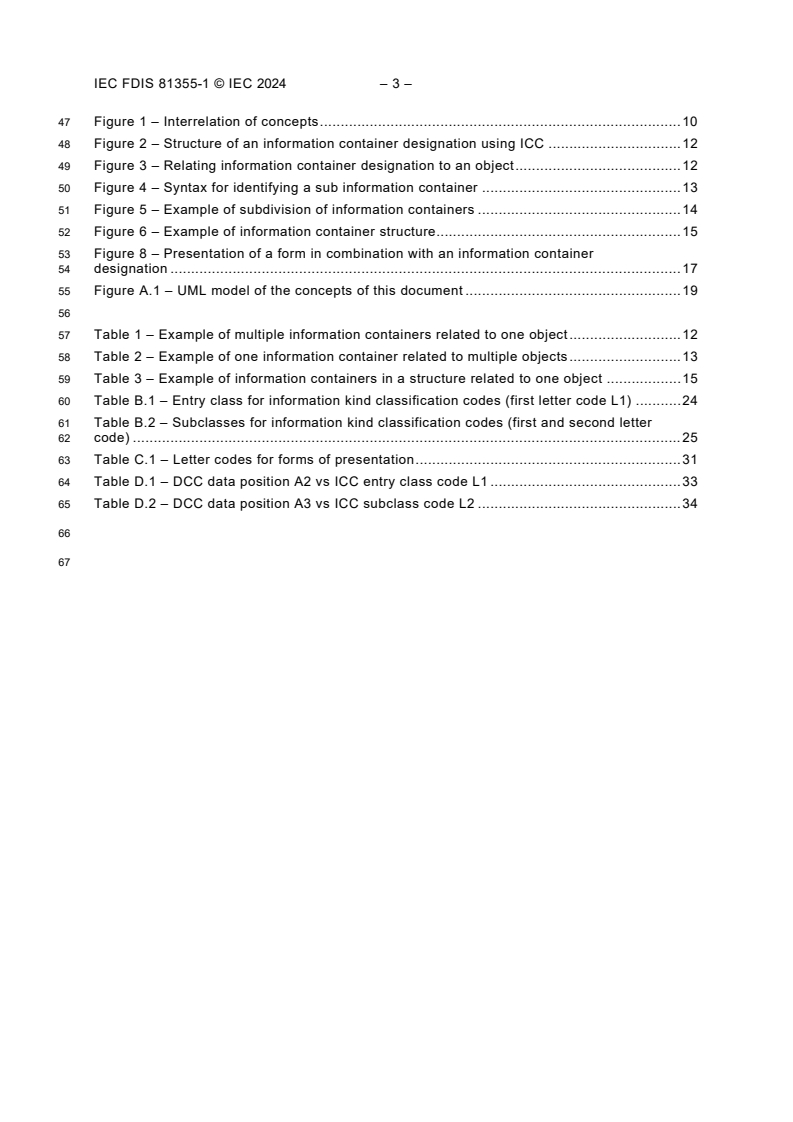
47 Figure 1 – Interrelation of concepts . 10
48 Figure 2 – Structure of an information container designation using ICC . 12
49 Figure 3 – Relating information container designation to an object . 12
50 Figure 4 – Syntax for identifying a sub information container . 13
51 Figure 5 – Example of subdivision of information containers . 14
52 Figure 6 – Example of information container structure. 15
53 Figure 8 – Presentation of a form in combination with an information container
54 designation . 17
55 Figure A.1 – UML model of the concepts of this document . 19
57 Table 1 – Example of multiple information containers related to one object . 12
58 Table 2 – Example of one information container related to multiple objects . 13
59 Table 3 – Example of information containers in a structure related to one object . 15
60 Table B.1 – Entry class for information kind classification codes (first letter code L1) . 24
61 Table B.2 – Subclasses for information kind classification codes (first and second letter
62 code) . 25
63 Table C.1 – Letter codes for forms of presentation . 31
64 Table D.1 – DCC data position A2 vs ICC entry class code L1 . 33
65 Table D.2 – DCC data position A3 vs ICC subclass code L2 . 34
IEC FDIS 81355-1 © IEC 2024
– 4 –
COMMISSION
68 INTERNATIONAL ELECTROTECHNICAL
69 ____________
71 INDUSTRIAL SYSTEMS,
72 INSTALLATIONS AND EQUIPMENT AND INDUSTRIAL PRODUCTS –
73 CLASSIFICATION AND DESIGNATION OF INFORMATION –
75 Part 1: Basic rules and classification of information
77 FOREWORD
78 1) The International Electrotechnical Commission (IEC) is a worldwide organization for standardization comprising
79 all national electrotechnical committees (IEC National Committees). The object of IEC is to promote international
80 co-operation on all questions concerning standardization in the electrical and electronic fields. To this end and
81 in addition to other activities, IEC publishes International Standards, Technical Specifications, Technical Reports,
82 Publicly Available Specifications (PAS) and Guides (hereafter referred to as "IEC Publication(s)"). Their
83 preparation is entrusted to technical committees; any IEC National Committee interested in the subject dealt with
84 may participate in this preparatory work. International, governmental and non-governmental organizations liaising
85 with the IEC also participate in this preparation. IEC collaborates closely with the International Organization for
86 Standardization (ISO) in accordance with conditions determined by agreement between the two organizations.
87 2) The formal decisions or agreements of IEC on technical matters express, as nearly as possible, an international
88 consensus of opinion on the relevant subjects since each technical committee has representation from all
89 interested IEC National Committees.
90 3) IEC Publications have the form of recommendations for international use and are accepted by IEC National
91 Committees in that sense. While all reasonable efforts are made to ensure that the technical content of IEC
92 Publications is accurate, IEC cannot be held responsible for the way in which they are used or for any
93 misinterpretation by any end user.
94 4) In order to promote international uniformity, IEC National Committees undertake to apply IEC Publications
95 transparently to the maximum extent possible in their national and regional publications. Any divergence between
96 any IEC Publication and the corresponding national or regional publication shall be clearly indicated in the latter.
97 5) IEC itself does not provide any attestation of conformity. Independent certification bodies provide conformity
98 assessment services and, in some areas, access to IEC marks of conformity. IEC is not responsible for any
99 services carried out by independent certification bodies.
100 6) All users should ensure that they have the latest edition of this publication.
101 7) No liability shall attach to IEC or its directors, employees, servants or agents including individual experts and
102 members of its technical committees and IEC National Committees for any personal injury, property damage or
103 other damage of any nature whatsoever, whether direct or indirect, or for costs (including legal fees) and
104 expenses arising out of the publication, use of, or reliance upon, this IEC Publication or any other IEC
105 Publications.
106 8) Attention is drawn to the Normative references cited in this publication. Use of the referenced publications is
107 indispensable for the correct application of this publication.
108 9) Attention is drawn to the possibility that some of the elements of this IEC Publication may be the subject of patent
109 rights. IEC shall not be held responsible for identifying any or all such patent rights.
110 IEC 81355-1 has been prepared by IEC/TC 3: Documentation, graphical symbols and
111 representations of technical information, in close cooperation with ISO/TC 10: Technical
112 product documentation. It is an international standard.
113 It is published as a double logo standard and has the status of a horizontal publication in
114 accordance with IEC Guide 108.
115 This edition cancels and replaces the second edition of IEC 61355-1 published in 2008. This
116 edition constitutes a technical revision.
117 This edition includes the following significant technical changes with respect to IEC 61355-
118 1:2008:
119 a) Focusing on classification of information rather that classification of document kinds;
120 b) Introduced a classification scheme based on inherent content of information;
IEC FDIS 81355-1 © IEC 2024 – 5 –
121 c) Introduced a distinction between an informatio1n container and a document, the latter being
122 for human perception;
123 d) Introduction of information kind classification code (ICC), replacing document kind
124 classification code (DCC);
125 e) Introduced structuring of information containers;
126 f) Introduced an information model of the concepts dealt with;
127 g) Introduced a conversion table for merging from the use of DCC to the use of ICC.
128 The text of this International Standard is based on the following documents:
Draft Report on voting
3/XX/FDIS 3/XX/RVD
130 Full information on the voting for its approval can be found in the report on voting indicated in
131 the above table. In ISO, the standard has been approved by xx members out of xx having cast
132 a vote.
133 The language used for the development of this International Standard is English.
134 This document was drafted in accordance with IEC/ISO Directives, Part 2, and developed in
135 accordance with IEC/ISO Directives, Part 1 and IEC/ISO Directives, IEC Supplement, available
136 at www.iec.ch/members_experts/refdocs. The main document types developed by IEC are
137 described in greater detail at www.iec.ch/publications.
138 In this document, italic type is used as follows:
139 • terms defined in Clause 3 (applies to the text in Clause 3 only);
140 • in the description of the EXPRESS model, entity names and attribute identifiers.
141 The committee has decided that the contents of this document will remain unchanged until the
142 stability date indicated on the IEC website under webstore.iec.ch in the data related to the
143 specific document. At this date, the document will be
144 • reconfirmed,
145 • withdrawn,
146 • replaced by a revised edition, or
147 • amended.
IMPORTANT – The "colour inside" logo on the cover page of this document indicates
that it contains colours which are considered to be useful for the correct understanding
of its contents. Users should therefore print this document using a colour printer.
– 6 – IEC FDIS 81355-1 © IEC 2024
151 INTRODUCTION
152 Information is necessary for all activities during the life cycle of industrial systems, installations,
153 equipment and industrial products. It may be produced in any phase or activity. Information may
154 be received from and delivered to other parties, and different parties may need different
155 information for the same object, depending on what is most suitable for their need.
156 This document is based on the former IEC 61355-1:2008 and IEC 61355 DB standards but is
157 now a new joint ISO & IEC document. As a new joint document, this document clarifies key
158 concepts related to information and the designation of sets of information exchanged between
159 parties, as represented by the focus on classification of information and the shift in focus from
160 “documents” to “information containers”.
161 Notably the paper-based presentation of information that was used as a basis for classification
162 in IEC 61355-1:2008 is no longer present in this document. Instead, this document provides
163 “information kind classification codes (ICC)” to be used in the designation of information
164 containers, thereby replacing the previous “document kind class codes (DCC)” of IEC 61355-
165 1:2008.
166 One aim of this document is to support the unambiguous exchange of information for the
167 purpose of communication and understanding between parties. For this purpose, it is necessary
168 to disregard what the set of information is called in daily life. Instead, the basis of understanding
169 is based on a classification of the kind of information managed and exchanged between parties.
170 Another aim of this document is to set up rules for a specific method of correlating information
171 and objects, i.e., to indicate to which object a specific set of information relates. For this
172 purpose, a concept for designation of information containers is provided. Also, a concept for
173 relating information containers to one or more objects is provided. By this, support is also
174 provided for the structuring, storage and retrieval of information based on the information
175 content of an information container and the object to which the information relates.
IEC FDIS 81355-1 © IEC 2024 – 7 –
177 INDUSTRIAL SYSTEMS,
178 INSTALLATIONS AND EQUIPMENT AND INDUSTRIAL PRODUCTS –
179 CLASSIFICATION AND DESIGNATION OF INFORMATION –
181 Part 1: Basic rules and classification of information
185 1 Scope
186 This part of the 81355 International Standard, published jointly by IEC and ISO, provides rules
187 and guidelines for the classification and designation of information containers based on their
188 inherent content. This document is applicable for information used in the life cycle of a system,
189 e.g., industrial plants, construction entities and equipment.
190 This document defines classes of information and their information kind classification code
191 (ICC). The defined classes and codes provided are used as values associated with metadata,
192 e.g., in information management systems (see IEC 82045-1 and IEC 82045-2).
193 The rules, guidelines and classes are general and are applicable to all technical areas, for
194 example mechanical engineering, electrical engineering, construction engineering and process
195 engineering. They can be used for systems based on different technologies or for systems
196 combining several technologies.
197 This document also has the status of a horizontal publication in accordance with IEC Guide 108.
198 It is intended for use by technical committees in preparation of publications related to
199 classification and designation of information.
200 2 Normative references
201 There are no normative references in this document.
202 3 Terms and definitions
203 For the purposes of this document, the following terms and definitions apply.
204 ISO and IEC maintain terminology databases for use in standardization at the following
205 addresses:
206 • IEC Electropedia: available at https://www.electropedia.org/
207 • ISO Online browsing platform: available at https://www.iso.org/obp
208 3.1
209 information
210 intelligence or knowledge capable of being represented in forms suitable for communication,
211 storage or processing
212 Note 1 to entry: Information may be represented for example by signs, symbols, pictures or sounds.
213 [SOURCE: IEC 60050-701:1988, 701-01-01]
214 3.2
215 object
216 entity involved in a process of development, implementation, usage, and disposal
– 8 – IEC FDIS 81355-1 © IEC 2024
217 Note 1 to entry: An object is something abstract or physical toward which thought, feeling, or action is directed.
218 Note 2 to entry: The object has information (3.1) associated to it.
219 [SOURCE: IEC 81346-1:2022, 3.1]
220 3.3
221 system
222 set of interrelated objects (3.2) considered in a defined context as a whole and separated from
223 their environment
224 Note 1 to entry: A system is generally defined with the view of achieving a given objective, e.g. by performing a
225 definite function.
226 Note 2 to entry: Elements of a system can be natural or man-made material objects, as well as modes of thinking
227 and the results thereof (e.g., forms of organisation, mathematical methods, programming languages).
228 Note 3 to entry: The system is considered to be separated from the environment and from the other external
229 systems by an imaginary boundary, through which the system is related to the external systems.
230 Note 4 to entry: The term "system" should be qualified when it is not clear from the context to what it refers, e.g.
231 control system, colorimetric system, system of units, transmission system.
232 Note 5 to entry: When a system is part of another system, it may be considered as an object as defined in this
233 document.
234 [SOURCE: IEC 81346-1:2022, 3.2]
235 3.4
236 data
237 representation of information (3.1) in a formalized manner suitable for human or automatic
238 processing
239 Note 1 to entry: Processing includes communication and interpretation.
240 Note 2 to entry: In English, the word "data" is generally used in plural form. For use in singular form, it can be called
241 "data item".
242 [SOURCE: IEC 60050-171:2019, 171-01-02]
243 3.5
244 data element
245 data item (3.4) that is considered to be indivisible in a certain context
246 [SOURCE: IEC 60050-171:2019, 171-02-01, modified – The example and note have been
247 deleted.]
248 3.6
249 record
250 set of data elements (3.5), treated as a whole
251 [SOURCE: IEC 60050-171:2019, 171-02-28, modified – The domain and note have been
252 deleted, and "context" deleted from the definition.]
253 3.7
254 file
255 set of related records (3.6) treated as a whole
256 [SOURCE: IEC 60050-171:2019, 171-02-30]
IEC FDIS 81355-1 © IEC 2024 – 9 –
257 3.8
258 inherent content
259 subject of information (3.1), independent of any use of the information (3.1)
260 Note 1 to entry: The word "inherent" is regarded as existing in something as a permanent, essential, or
261 characteristic attribute.
262 3.9
263 information class
264 kind of information (3.1) characterized by its inherent content (3.8)
265 3.10
266 information container
267 named persistent set of information (3.1) retrievable from within a file (3.7), system (3.3) or
268 application storage hierarchy
269 EXAMPLE: Including sub-directory, information file (including model, document, table, schedule), or distinct sub-set
270 of an information file such as a chapter or section, layer, or symbol.
271 Note 1 to entry: Structured information containers include geometrical models, schedules and databases.
272 Unstructured information containers include documentation, video clips and sound recordings.
273 Note 2 to entry: Persistent information exists over a timescale long enough for it to have to be managed, i.e. this
274 excludes transient information such as internet search results.
275 Note 3 to entry: Naming of an information container should be according to an agreed naming convention.
276 Note 4 to entry: An information container can include other information containers (sub-containers).
277 [SOURCE: ISO 19650-1:2018, 3.3.12, modified - Note 4 to entry added.]
278 3.11
279 object designation
280 unambiguous identifier of an object (3.2) in a given context
281 Note 1 to entry: Examples of such designations are: reference designation, type number, serial number, name.
282 3.12
283 document
284 information container (3.10) presented in a format suitable for human perception
285 3.13
286 documentation
287 collection of documents (3.12) related to a given object
288 4 General concepts
289 4.1 General
290 Information is necessary for different activities and purposes during the life cycle of a system.
291 Information is often transmitted and stored using specific terms, serving different purposes.
292 These terms are often defined and understood only in a certain context, which can lead to
293 misunderstandings for the recipient of the information.
294 This document provides a classification scheme to structure and sort large amounts of
295 information in groups, based on the type of information. Each of these groups is characterised
296 by an unambiguous definition in a clear hierarchy. The user of this document can link additional
297 information terms by relating any new term to the class defining the kind of information and
298 thereby expand the use and application of this document.
299 Annex A shows the information model of the concept of this document.
– 10 – IEC FDIS 81355-1 © IEC 2024
300 In the context of this document, it is necessary to distinguish between the following concepts
301 and their interrelationship:
302 • object;
303 • information;
304 • information class;
305 • information container;
306 • information container designation;
307 • information storage;
308 • document.
309 Figure 1 shows the relationship among the concepts, where information related to an object is
310 stored as an information container in a data storage and presented as a document.
File / system /
storage hierarchy
Information
container
Object Information
Described by Contained in
===> ===>
Document
Class
Information
container
designation
Revi sion number Date
Interpretable
by humans
312 Figure 1 – Interrelation of concepts
313 4.2 Classification principles
314 This document defines hierarchical classes of information based on its inherent content - "what
315 the information is about in itself” - as distinct from what it is intended or used for.
316 Each class within the hierarchy has a letter code which designates an entry class and its
317 subclass. This letter code is called an information kind classification code, which in this
318 document is abbreviated "ICC". As the ICC is recognized by non-verbatim letter codes (A, B,
319 C, etc.), the ICC itself becomes a natural designation for recognition of information across
320 national borders, languages, and technical disciplines, thus creating a common language for
321 exchange of information.
322 NOTE The former document kind classification code (DCC) provided in IEC 61355-1 is in this document replaced
323 by "ICC", as the aim of this document is to classify information in a broad sense, as distinct from documentation
324 presenting the information in a certain form only. However, the meaning behind former DCC codes is to the extent
325 possible transferred to ICC codes in this document. See also Annex D.
326 The classification scheme defined in Annex B has a hierarchical structure that constitutes two
327 levels L1 and L2, where:
328 • entry classes (L1) are purely defined based on the inherent content of information;
329 • subclasses (L2) of the entry classes are based on different facets, depending on the entry
330 class.
IEC FDIS 81355-1 © IEC 2024 – 11 –
331 Annex B specifies ICC entry classes (Table B.1) and subclasses (Table B.2).
332 Classes of information presented in this document are considered to be complete and fully
333 representative of information related to technical systems. Therefore, no "miscellaneous" or
334 "other" open classes, "free for the user" etc., are provided. See also Clause D.2.
335 Information shall be associated with an entry class and a related subclass when its inherent
336 content matches the definitions of an entry class and a subclass. See Annex B, Table B.1 for
337 entry class and Table B.2 for subclass definitions.
338 5 Designation of information containers
339 5.1 General
340 An information container shall be associated with an information kind classification code (ICC)
341 to which it belongs, as defined in Table B.1 and Table B.2 (see Annex B). To classify
342 information correctly, the information to be classified shall comply with the definition of the ICC
343 selected.
344 The information container designation shall:
345 • designate the information container unambiguously within a defined context;
346 • provide the possibility to specify sorting criteria for object related information;
347 • provide the possibility to identify different kinds of information related to an object;
348 • provide a method to refer to an information container from other information containers.
349 The ICC forms part of an information container designation.
350 If the context is changed, the information container designations shall be verified in the new
351 context.
352 If there is a need for designating multiple kinds of information in one information container, the
353 information container shall be designated as defined in 5.4.
354 5.2 Designation of an information container
355 An information container designation shall consist of (see Figure 2):
356 • the prefix sign "&" (ampersand), followed by;
357 • the letter code for the entry class of information (position L1), followed by;
358 • the letter code for the subclass of information (position L2), followed by;
359 • a number to distinguish among information containers of the same class within the same
360 context.
361 The number, including any leading zero (if any), shall have no specific meaning.
362 NOTE 1 Only characters A through Z, except I and O, are used
– 12 – IEC FDIS 81355-1 © IEC 2024
364 Figure 2 – Structure of an information container designation using ICC
365 5.3 Relating information containers to objects
366 Information is related to one or more objects. Objects can be administrative or technical. If
367 information shall be related to a specific object, the relation between the object and the related
368 information container is defined by (see Figure 3):
369 1) the designation of the object to which the container is related, followed by;
370 2) the designation of the information container related to the object.
372 Figure 3 – Relating information container designation to an object
373 Several information containers can be related to the same object, each unambiguously
374 identified in relation to a certain context, see Table 1.
375 Table 1 – Example of multiple information containers related to one object
Object designation: Information container Information
Wind turbine generator designations
=A1 &DA1 Data sheet (wind turbine generator)
=A1 &FS1 Single-line circuit diagram
=A1 &FS2 Multi-line circuit diagram
=A1 &LH1 Mechanical layout
378 One information container can be related to multiple objects, each unambiguously identified in
379 relation to the same context, see Table 2.
IEC FDIS 81355-1 © IEC 2024 – 13 –
381 Table 2 – Example of one information container related to multiple objects
Object designation: Information container Information
Wind turbine generators designation
=A1 &DA1 Data sheet (wind turbine generator)
=A2 &DA1 Data sheet (wind turbine generator)
=A3 &DA1 Data sheet (wind turbine generator)
383 5.4 Structuring and designation of multiple information containers
384 An information container may be structured by including other information containers, thus
385 establishing part-of relations between the information containers. This will for example be the
386 case where an information container from a sub-supplier shall be incorporated into the
387 supplier's information container.
388 Each sub-information container shall be provided with its own information container
389 designation. In order to reference to the sub information container within the overall information
390 container, the sub information container is identified by concatenating the information container
391 designation for each container from the overall down to the sub information container, see
392 Figure 4.
393 The prefix “&” between the information container designations may be replaced by the character
394 "." (period/full stop), see Figure 4.
396 Figure 4 – Syntax for identifying a sub information container
397 Where an information container contains multiple kinds of information, each which may be
398 assigned an ICC, separate information containers related to each ICC shall be defined. An
399 information container structure as described above shall then be applied.
400 NOTE In the context of IEC 61355, multiple kinds of information presented in the same document is called a
401 "composite document".
402 Figure 5 shows an example of subdivision of information containers.
– 14 – IEC FDIS 81355-1 © IEC 2024
information container
containing one kind of information
kind of information
&AA1
&AA1
… …
… …
…
…
information container information container
containing multiple information containers containing multiple kinds of information
&AA1 &FS1
… … … …
… …
&DA 1 &QA 1
… … … …
… …
404 Figure 5 – Example of subdivision of information containers
405 Figure 6 shows an example of an information container which is divided into sub-containers for
406 a wind turbine generator (WTG), with inclusion of information containers from two sub-suppliers:
407 a lubrication system and a warning system.
408 NOTE For the structure of documentation, see IEC 62023.
IEC FDIS 81355-1 © IEC 2024 – 15 –
410 *Example: The designation for the "Data sheet – Warning system" information container is &AB1&AB2&DA1 or
411 alternatively &AB1.AB2.DA1
412 Figure 6 – Example of information container structure
413 Any information container in an information container structure can be related to one or more
414 objects by using the rules in 5.3.
415 Table 3 shows examples of different information containers from Figure 6 related to one object:
416 Table 3 – Example of information containers in a structure related to one object
Object designation: Information container Information
Wind turbine generator designations
=A1 &AB1 Main information list
=A1 &AB1&AB1&DA1 Data sheet – Lubrication system
=A1 &AB1&AB2&FS1 Circuit diagram – Warning system
418 5.5 Reference to a specific part of an information container
419 To refer to a specific part of an information container, the information container designation can
420 be combined with a reference to the part of interest. This reference is defined by (see Figure
421 7):
– 16 – IEC FDIS 81355-1 © IEC 2024
422 1) the designation of the object to which the container is related, followed by;
423 2) the designation of the information container related to the object, followed by;
424 3) the reference to the specific part of the information container.
425 If used, the reference to a specific part of an information container shall apply alphabetical
426 characters (letters A–Z, except I and O) or numerical characters (numbers 0, 1, 3…), or a
427 combination of letters and numbers. The method used for part designation shall be explained
428 in a document or in supporting documentation.
429 The reference shall be separated from the information container designation part by the
430 character “/” (solidus), (see Figure 7). The presentation of the separator sign may be omitted if
431 no confusion is likely, for example when the part reference is shown in a separate column of a
432 table.
Object designation & L1 L2 N… / A… / N…
Designation of the object to
which the information
container is related
Information container designation
Reference to specific part of the information container
434 Figure 7 information container designation combined with part reference
435 Examples of information container designation with part references are shown in Table 4.
436 Table 4 examples for information container designation with part reference
Information container designation Description
with part reference
&DA1/C3 Data sheet, column 3
&FS1/5 Single-line circuit diagram, page 5
&FS2/H3 Multi-line circuit diagram, column H line 3
&LH1/LL23 Mechanical layout 23 mm from the lower left
438 5.6 Form of presentation
439 In order for a human to see the content of an information container, it has to be presented in a
440 certain format. For the exchange of information containers between parties, it may for some
441 presentation formats be important to indicate the kind of presentation used.
442 A list of forms of presentations is given an Annex C.
443 In the context of this document, the form of presentation related to an information container, is
444 considered as additional information related to the information container designation.
445 Where the form of presentation is presented together with an information container designation,
446 the form of presentation shall be presented within parentheses preceded by the information
447 container designation, see Figure 8.
IEC FDIS 81355-1 © IEC 2024 – 17 –
449 Figure 8 – Presentation of a form in combination with an information container
450 designation
451 EXAMPLE: An information container for layout information, presented in the form of a drawing, is designated &LH1(L).
452 5.7 Identification of documents
453 For identification of documents, a document numbering system or other numbering systems are
454 normally used. In most cases, they fulfil identification purposes inside the borderlines of an
455 organization, together with organization-specific requirements. An information container
456 designation according to this document is not intended to replace any of these numbering
457 systems but serves as an additional means for the purposes described.
458 The object designation shall unambiguously specify the object to which an information container
459 is related. This implies that an object designation shall be (or be made) unambiguous in a
460 specified context.
461 A reference designation in accordance with the IEC/ISO 81346 standard series fulfils the
462 requirement of being unambiguous by itself and is recommended for designation of objects. For
463 objects without a reference designation, any other designation can be used, for example a
464 product-ID, a type-ID, a project number, or even a plain text term, provided the string of
465 characters is unambiguous.
466 5.8 Information for identification purposes
467 The information container designation cannot provide all information needed concerning the
468 content in each step of the life cycle. Supplementary information is required for that purpose,
469 see IEC 82045-1 and IEC 82045-2.
470 In IEC 82045-2:2004, document kind classification code (DCC) is used as a defined metadata,
471 with the identifier "DocumentClassIdIEC61355". Pending a defined metadata for the ICC
472 according to this document, it is recommended to use this metadata.
473 6 Documentation
474 6.1 General
475 This document classifies information about one or more objects. Information is always stored
476 and conveyed in an information container. The information container can include information of
477 one or more information classes related to the object. The practical purpose of the information
478 container is to convey the information among stakeholders of the systems, i.e., exchange of
479 information among parties.
480 Examples of information containers are shown in Table B.2.
– 18 – IEC FDIS 81355-1 © IEC 2024
481 Documentation in its legal sense, either in the form of paper-based documents or in digital
482 formats, is created for the purpose of reference and traceability.
483 A document is an information container in a format suitable for human perception, which
484 contains a momentary state of information at a defined time.
485 If a document contains multiple kinds of information and thus multiple ICCs, then it can be
486 designated with ICCs in ‘part of’ relations as described in 5.4.
487 6.2 Moving from DCC to ICC
488 IEC 61355-1 introduced the document kind classification code (DCC) based on the thesis that
489 documents should be classified according to their content. However, the criterion of the DCC
490 classification of documents was the information which the document contained. Therefore, the
491 DCC has, to the extent possible, been converted to information kind classification code (ICC)
492 in this document.
493 For the general change and update of former document kind classification code (DCC) in
494 IEC 61355-1 to information kind classification code (ICC) in this document, see Annex D.
IEC FDIS 81355-1 © IEC 2024 – 19 –
495 Annex A
496 (informative)
498 Information model
499 A.1 General
500 This annex contains a formal reference information model of the concepts and methods of the
501 information classification system as described in this document.
502 The purpose of this annex is to illustrate the concepts of this document independent from any
503 implementation method.
504 For the preparation of the information model, UML has been used.
505 A.2 UML model
506 Figure A.1 shows the UML model of the concept of this document.
507 NOTE In the description of the model, entity names and attribute identifiers are written in italics to increase the
508 readability.
IncludedIn 0.* Includes
0.*
InformationContainer
0.* 0.* 1.* +RepresentedIn
+MetaInformationOn +IncludedIn 0.* +DesignationOfInformationContainer
NoHumanPerceptionContainer
HumanPerceptionContainerAsDocument
1 +RelatedTo 0.1 PresentationForm
ObjectOfInterest <>
81355PresentationForms
1.* +Contains
C
D
0.* +InformationOn
+IncludedInDocumentation
0.*
G
Documentation L
M
T
X
1.*
+HasMetadata 1.* +Contains 1.* +HasInformation
Information
0.* +ClassForInformation +Represents +ContextForInformations
1 0.*
+HaveMeaningIn
Context
+Description : string
+ValidIn
0.* +InformationContainerInContext
InformationContainerDesignation
+IdentifiedBy
-DesignationNumber : int
0.* +RepresentedBy
Data
+DesignationOfInformationContainer
0.*
1 +InformationClass
ClassOfInformation
+ClassCode : string
+ClassName : string
+InformationClass
+ClassDefinition : string
+Examples : string
1.* +Classes
1 +BelongsTo
<>
ClassificationScheme
+DomainId IEC81355ClassificationDomain
+Description : string
1 81355_1_202X_TabelB2
510 Figure A.1 – UML model of the concepts of this document
– 20 – IEC FDIS 81355-1 © IEC 2024
511 A.3 Entity descriptions
512 A.3.1 ObjectOfInterest
513 This entity represents the "OBJECT" that is in the design and that has information associated
514 with it and that will be presented in information containers. The entity has the following relation
515 attributes:
516 HasInformation 1.*
517 At least one relation to instances of the entity Information, indicating which Information
518 instances that, in a given context, provides meaningful data of the ObjectOfInterest
519 instance.
520 RepresentedIn 1.*
521 At least one relation to instances of the entity InformationContainer, indicating which
522 InformationContainer instances are of relevance for the ObjectOfInterest instance.
524 A.3.2 Information
525 This entity represents the data which is related to an object and that has a particular meaning
526 within a given context. The information is classified and identifiable. The entity has the following
527 relation attributes:
528 IncludedIn 0.*
529 A set of relations to instances of the entity InformationContainer indicating in which
530 information container the data represented by the actual Information is visualized. The
531 set may be empty, thus indicating that the data represented by the Information instance
532 is not visualized in any information container.
533 InformationClass
534 A relation to an instance of the entity ClassOfInformation indicating the class for the data
535 being instantiated by the Information instance.
536 HavingMeaningIn
537 A relation to an instance of the entity Context indicating in which context the Information
538 instance has a valuable meaning.
539 RepresentedBy 0.*
540 A set of relations to instances of the entity Data indicating which Data instances, if any,
541 is representing the Information instance.
542 InformationOn 0.*
543 A set of relations to instances of the entity ObjectOfInterest, indicating which
544 ObjectOfInterest instances, if any, the Information instance is providing information on.
545 MetaInformationOn 0.*
546 A set of relations to instances of the entity InformationContainer, indicating which
547 InformationContainer instances, if any, the Information instance is providing information
548 on.
549 A.3.3 Context
550 This entity represents the different contexts in which information and data will have a meaning.
551 The entity has the following attributes:
552 Description
553 A textual description of the context. The attribute is a string.
554 The entity has the following relation attributes:
555 ContextForInformation 0.*
556 A set of relations to instances of the entity Information indicating which Information
557 instances, if any, having a meaning in the Context instance.
IEC FDIS 81355-1 © IEC 2024 – 21 –
558 InformationContainerInContext 0.*
559 A set of relations to instances of the entity InformationContainerDesignation indicating
560 which InformationContainerDesignation instances, if any, and thereby also which
561 InformationContainer instances are valid in the Context instance.
562 A.3.4 Data
563 This entity represents all recorded data that is of relevance for the instances of the entity
564 ObjectOfInterest and for the metadata of documents. The entity has the following relation
565 attribute:
566 Represents
567 A relation to an instance of the entity Information indicating which Information the data
568 instance represents.
569 Detailed models for this entity are outside the scope of this document.
570 A.3.5 InformationContainer
571 This entity represents instances of the information containers in which information is visualized
572 and is a supertype of the entities HumanPerceptionContainerAsDocument and
573 NoHumanPerceptionContainer. The entity has the following attribute:
574 PresentationForm 0.1
575 An enumerative value of the enumeration IEC81355PresentationForms indicating the
576 presentation form of the instance of InformationContainer associated with the
577 InformationContainerDesignation instance.
578 The entity has the following relation attributes:
579 Contains 1.*
580 A set of at least one relation to instances of the entity Information indicating which
581 Information instances are contained in the InformationContainer instance.
582 IncludedIn 0.*
583 A set of relations to instances of the entity InformationContainer indicating which other
584 InformationContainer instances the InformationContainer instance is included in, if any.
585 Includes 0.*
586 A set of relations to instances of the entity InformationContainer indicating which other
587 InformationContainer instances are included in the InformationContainer instance, if
588 any.
589 RelatedTo 0.*
590 A set of relations to instances of the entity ObjectOfInterest, indicating to which
591 ObjectOfInterest instances, if any, the InformationContainer instance is related.
592 IdentifiedBy 1.*
593 A set of relation to an instance of the entity InformationContainerDesignation indicating
594 which InformationContainerDesignation instances are providing an identifier for the
595 InformationContainer instance.
596 HasMetadata 0.*
597 A set of relations to instances of the entity information indicating the metadata
598 associated with the InformationContainer instance, if any.
599 A.3.6 HumanPerceptionContainerAsDocument
600 This entity, being a subtype of the en
...