


IEC/FDIS 81346-14
(Main)Industrial systems, installations and equipment and industrial products — Structuring principles and reference designations — Part 14: Manufacturing and processing systems
Industrial systems, installations and equipment and industrial products — Structuring principles and reference designations — Part 14: Manufacturing and processing systems
This part of 81346 International Standard, published jointly by IEC and ISO, provides, in combination with IEC 81346-1 and IEC 81346-2, rules and recommendations on the structuring of systems and the information on systems in area of technical products and equipment of manufacturing systems. It also provides classification scheme of infrastructure objects in such system for use in function - product- location- and type-specific reference designations of technical products and their documentation for manufacturing systems. The structuring principles and the classes of infrastructure objects are intended to provide a clear identification and localization of the technical products, and for use in their labelling in the manufacturing plant, for their designation in technical documents and for the designation of the technical documents as well. This document encompasses the process of transforming, processing and maintaining material. The specifications in this document apply for processing, transportation and storage of final products, as well as for auxiliary systems to support the manufacturing process such as electrical systems, management systems and waste disposal systems.This document is not applicable for designations related to product individuals (e.g. inventory number, serial number) or the designation of object types and classes of products (e.g. article number or parts number).
Systèmes, installations et équipements industriels, et produits industriels — Principes de structuration et désignations de référence — Partie 14: Systèmes de fabrication et de traitement
General Information
- Status
- Not Published
- Technical Committee
- ISO/TC 10 - Technical product documentation
- Drafting Committee
- ISO/TC 10 - Technical product documentation
- Current Stage
- 5060 - Close of voting Proof returned by Secretariat
- Start Date
- 21-Mar-2026
- Completion Date
- 20-Mar-2026
Overview
IEC/FDIS 81346-14 – “Industrial systems, installations and equipment and industrial products - Structuring principles and reference designations - Part 14: Manufacturing and processing systems” – is a joint international standard developed by ISO and IEC. This document extends the foundational structuring and reference designation principles of the IEC 81346 series, specifically for manufacturing and processing systems. With the need for consistent identification and documentation in complex industrial environments, this standard supports clear classification and designation of infrastructure, technical products, and supporting systems throughout manufacturing plants.
IEC/FDIS 81346-14 defines how to structure and label objects, systems, and documentation in manufacturing, ensuring traceable and unambiguous identification across technical, functional, location, and type-based aspects. It aims to optimize technical product management, efficient plant design, and effective maintenance by enabling a harmonized framework to classify and name components, assemblies, and their respective documentation.
Key Topics
Structuring Principles
Provides guidelines for organizing manufacturing and processing systems using established methods (function-oriented, product-oriented, location-oriented, type-oriented).Reference Designations
Defines clear rules for generating standardized reference designations that ensure consistency in system labeling and documentation.Classification of Infrastructure Objects
Offers a scheme to classify major system elements-such as prime, technical, and component systems-to support process clarity and system transparency.System Aspects and Identification
Supports multiple perspectives for object identification, including function, product, location, and type, facilitating comprehensive asset management.Labelling & Documentation
Recommends best practices for labelling equipment and systems within manufacturing facilities, and the consistent application of reference codes in technical documents.Coverage of Technical and Auxiliary Systems
Includes supporting systems necessary for the manufacturing process, such as electrical installations, waste management, and material transportation and storage.
Applications
IEC/FDIS 81346-14 is essential for organizations involved in the design, construction, operation, and maintenance of industrial manufacturing plants, processing systems, and their supporting infrastructure. Key applications include:
Standardized Documentation
Enables consistent and understandable technical documentation for complex manufacturing and process plants, crucial for multi-vendor projects and global operations.Efficient Asset Management
Supports asset tracking, lifecycle management, maintenance scheduling, and modernization efforts by providing systematic identification of plant components.Plant Design and Engineering
Promotes interoperability and integration among engineering disciplines, contractors, and suppliers by using unified structuring and naming conventions.Regulatory Compliance
Facilitates adherence to international and national standards for system identification, contributing to regulatory audits and safety assessments.Enhanced Communication
Improves clarity and efficiency in communication between stakeholders-from engineering and production to maintenance-by employing a common reference structure.
Related Standards
The IEC/FDIS 81346-14 standard is part of the broader IEC 81346 series, designed to create an integrated framework for technical systems. Key related standards include:
- IEC 81346-1: General rules for structuring principles and reference designations.
- IEC 81346-2: Classification of objects and code letter assignment.
- Other Parts of IEC 81346: Cover additional sector-specific or system-specific structuring needs.
- ISO 7200: Product documentation structure and identification.
- ISO 10303 (STEP): Product data representation and exchange.
By aligning with these standards, organizations can achieve greater synergies in product documentation, engineering workflows, and plant operations.
Keywords: IEC 81346-14, manufacturing systems, structuring principles, reference designations, technical product documentation, industrial plant identification, classification scheme, asset management, engineering standards, ISO, IEC.
Buy Documents

IEC/FDIS 81346-14 - Industrial systems, installations and equipment and industrial products — Structuring principles and reference designations — Part 14: Manufacturing and processing systems Released:21. 01. 2026

IEC/FDIS 81346-14 - Systèmes, installations et équipements industriels, et produits industriels — Principes de structuration et désignations de référence — Partie 14: Systèmes de fabrication et de traitement
Get Certified
Connect with accredited certification bodies for this standard

Intertek Testing Services NA Inc.
Intertek certification services in North America.

UL Solutions
Global safety science company with testing, inspection and certification.

ANCE
Mexican certification and testing association.
Sponsored listings
Frequently Asked Questions
IEC/FDIS 81346-14 is a draft published by the International Organization for Standardization (ISO). Its full title is "Industrial systems, installations and equipment and industrial products — Structuring principles and reference designations — Part 14: Manufacturing and processing systems". This standard covers: This part of 81346 International Standard, published jointly by IEC and ISO, provides, in combination with IEC 81346-1 and IEC 81346-2, rules and recommendations on the structuring of systems and the information on systems in area of technical products and equipment of manufacturing systems. It also provides classification scheme of infrastructure objects in such system for use in function - product- location- and type-specific reference designations of technical products and their documentation for manufacturing systems. The structuring principles and the classes of infrastructure objects are intended to provide a clear identification and localization of the technical products, and for use in their labelling in the manufacturing plant, for their designation in technical documents and for the designation of the technical documents as well. This document encompasses the process of transforming, processing and maintaining material. The specifications in this document apply for processing, transportation and storage of final products, as well as for auxiliary systems to support the manufacturing process such as electrical systems, management systems and waste disposal systems.This document is not applicable for designations related to product individuals (e.g. inventory number, serial number) or the designation of object types and classes of products (e.g. article number or parts number).
This part of 81346 International Standard, published jointly by IEC and ISO, provides, in combination with IEC 81346-1 and IEC 81346-2, rules and recommendations on the structuring of systems and the information on systems in area of technical products and equipment of manufacturing systems. It also provides classification scheme of infrastructure objects in such system for use in function - product- location- and type-specific reference designations of technical products and their documentation for manufacturing systems. The structuring principles and the classes of infrastructure objects are intended to provide a clear identification and localization of the technical products, and for use in their labelling in the manufacturing plant, for their designation in technical documents and for the designation of the technical documents as well. This document encompasses the process of transforming, processing and maintaining material. The specifications in this document apply for processing, transportation and storage of final products, as well as for auxiliary systems to support the manufacturing process such as electrical systems, management systems and waste disposal systems.This document is not applicable for designations related to product individuals (e.g. inventory number, serial number) or the designation of object types and classes of products (e.g. article number or parts number).
IEC/FDIS 81346-14 is classified under the following ICS (International Classification for Standards) categories: 01.110 - Technical product documentation; 29.020 - Electrical engineering in general. The ICS classification helps identify the subject area and facilitates finding related standards.
IEC/FDIS 81346-14 is available in PDF format for immediate download after purchase. The document can be added to your cart and obtained through the secure checkout process. Digital delivery ensures instant access to the complete standard document.
Standards Content (Sample)
FINAL DRAFT
International
Standard
ISO/TC 10
Industrial systems, installations
Secretariat: SIS
and equipment and industrial
Voting begins on:
products — Structuring principles
2026-01-23
and reference designations —
Voting terminates on:
2026-03-20
Part 14:
Manufacturing and processing
systems
Systèmes industriels, installations et appareils, et produits
industriels — Principes de structuration et désignations de
référence —
Partie 14: Systèmes de fabrication et de traitement
RECIPIENTS OF THIS DRAFT ARE INVITED TO SUBMIT,
WITH THEIR COMMENTS, NOTIFICATION OF ANY
RELEVANT PATENT RIGHTS OF WHICH THEY ARE AWARE
AND TO PROVIDE SUPPOR TING DOCUMENTATION.
IN ADDITION TO THEIR EVALUATION AS
BEING ACCEPTABLE FOR INDUSTRIAL, TECHNO-
LOGICAL, COMMERCIAL AND USER PURPOSES, DRAFT
This draft is submitted to a parallel vote in ISO and in IEC.
INTERNATIONAL STANDARDS MAY ON OCCASION HAVE
TO BE CONSIDERED IN THE LIGHT OF THEIR POTENTIAL
TO BECOME STAN DARDS TO WHICH REFERENCE MAY BE
MADE IN NATIONAL REGULATIONS.
Reference number
FINAL DRAFT
International
Standard
ISO/TC 10
Industrial systems, installations
Secretariat: SIS
and equipment and industrial
Voting begins on:
products — Structuring principles
2026-01-23
and reference designations —
Voting terminates on:
2026-03-20
Part 14:
Manufacturing and processing
systems
Systèmes industriels, installations et appareils, et produits
industriels — Principes de structuration et désignations de
référence —
Partie 14: Systèmes de fabrication et de traitement
RECIPIENTS OF THIS DRAFT ARE INVITED TO SUBMIT,
WITH THEIR COMMENTS, NOTIFICATION OF ANY
RELEVANT PATENT RIGHTS OF WHICH THEY ARE AWARE
AND TO PROVIDE SUPPOR TING DOCUMENTATION.
© ISO 2026
IN ADDITION TO THEIR EVALUATION AS
All rights reserved. Unless otherwise specified, or required in the context of its implementation, no part of this publication may
BEING ACCEPTABLE FOR INDUSTRIAL, TECHNO-
LOGICAL, COMMERCIAL AND USER PURPOSES, DRAFT
be reproduced or utilized otherwise in any form or by any means, electronic or mechanical, including photocopying, or posting on
This draft is submitted to a parallel vote in ISO and in IEC.
INTERNATIONAL STANDARDS MAY ON OCCASION HAVE
the internet or an intranet, without prior written permission. Permission can be requested from either ISO at the address below
TO BE CONSIDERED IN THE LIGHT OF THEIR POTENTIAL
or ISO’s member body in the country of the requester.
TO BECOME STAN DARDS TO WHICH REFERENCE MAY BE
MADE IN NATIONAL REGULATIONS.
ISO copyright office
CP 401 • Ch. de Blandonnet 8
CH-1214 Vernier, Geneva
Phone: +41 22 749 01 11
Email: copyright@iso.org
Website: www.iso.org
Published in Switzerland Reference number
© IEC 2026 – All rights reserved
ii
IEC FDIS 81346-14 © IEC 2026
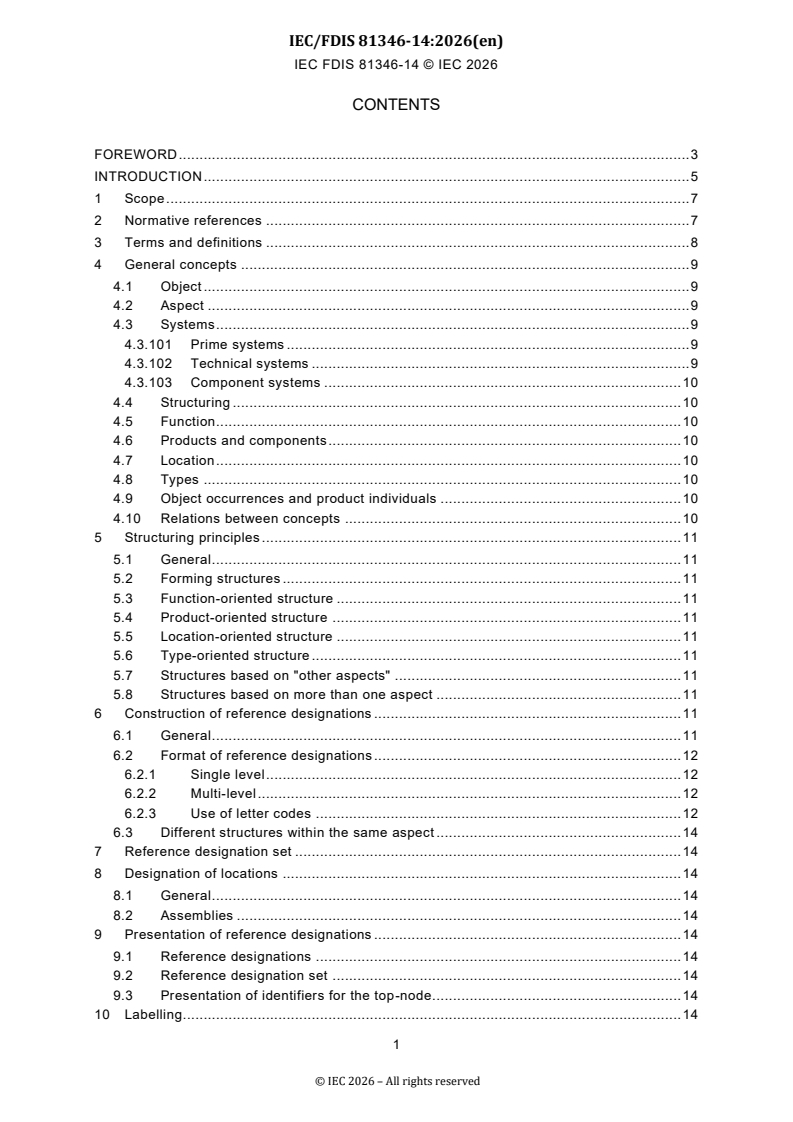
CONTENTS
FOREWORD . 3
INTRODUCTION . 5
1 Scope . 7
2 Normative references . 7
3 Terms and definitions . 8
4 General concepts . 9
4.1 Object . 9
4.2 Aspect . 9
4.3 Systems . 9
4.3.101 Prime systems . 9
4.3.102 Technical systems . 9
4.3.103 Component systems . 10
4.4 Structuring . 10
4.5 Function . 10
4.6 Products and components . 10
4.7 Location . 10
4.8 Types . 10
4.9 Object occurrences and product individuals . 10
4.10 Relations between concepts . 10
5 Structuring principles . 11
5.1 General . 11
5.2 Forming structures . 11
5.3 Function-oriented structure . 11
5.4 Product-oriented structure . 11
5.5 Location-oriented structure . 11
5.6 Type-oriented structure . 11
5.7 Structures based on "other aspects" . 11
5.8 Structures based on more than one aspect . 11
6 Construction of reference designations . 11
6.1 General . 11
6.2 Format of reference designations . 12
6.2.1 Single level . 12
6.2.2 Multi-level . 12
6.2.3 Use of letter codes . 12
6.3 Different structures within the same aspect . 14
7 Reference designation set . 14
8 Designation of locations . 14
8.1 General . 14
8.2 Assemblies . 14
9 Presentation of reference designations . 14
9.1 Reference designations . 14
9.2 Reference designation set . 14
9.3 Presentation of identifiers for the top-node . 14
10 Labelling. 14
© IEC 2026 – All rights reserved
IEC FDIS 81346-14 © IEC 2026
11 Presentation of properties for an object . 14
12 Application of the reference designation system . 14
Annex A (informative) Information model on the reference designation system . 15
Annex B (informative) Establishment and life cycle of objects . 15
Annex C (informative) Manipulation of objects . 15
Annex D (informative) Interpretation of reference designations using different aspects . 15
Annex E (normative) Object represented with several top nodes in an aspect . 15
Annex F (informative) Examples of multiple structures based on the same aspect . 15
Annex G (normative) Incorporating sub-objects in object structures . 15
Annex H (informative) Example of reference designations within a system . 15
Annex I (normative) Designation of relations between objects . 15
Annex J (normative) Requirements for developing sector-specific parts of the
International Standard 81346 series. 15
Annex K (informative) Metadata resource for structure management . 15
Annex L (informative) Recommendations for documentation of the application of the
reference designation system . 15
Annex M (informative) Fundamental ideas for this document . 15
Annex N (informative) Relationship to other standards . 16
Annex AA (normative) Classification letter codes for systems . 17
AA.1 General . 17
AA.2 Classes of prime systems for manufacturing . 17
AA.3 Classes of technical systems . 18
Annex BB (informative) Example of reference designations within a system. 24
Bibliography . 28
Figure 101 – Relation between prime systems, technical systems and component
systems . 12
Figure 102 – Relation between construction complexes, construction entities and
construction spaces . 13
Figure BB.1 – Process flow diagram for a material handling plant . 24
Figure BB.2 – Overview diagram of part of the material process system (=M1) and part
of the power supply system (=B1) supporting the material processing system . 25
Figure BB.3 – Function-oriented structure tree for parts of the material handling plant . 26
Figure BB.4 – Example of designation of technical systems of a prime system (=M1) in
a block diagram for a chemical plant . 27
Table 101 – Examples of using "?" in a class code . 13
Table 102 – Examples of reference designations . 13
Table AA.1 – Classes of prime systems for manufacturing . 17
Table AA.2 – Classes of technical systems . 18
© IEC 2026 – All rights reserved
IEC FDIS 81346-14 © IEC 2026
INTERNATIONAL ELECTROTECHNICAL COMMISSION
____________
Industrial systems, installations and equipment and industrial products -
Structuring principles and reference designations -
Part 14: Manufacturing and processing systems
FOREWORD
1) The International Electrotechnical Commission (IEC) is a worldwide organization for standardization comprising
all national electrotechnical committees (IEC National Committees). The object of IEC is to promote international
co-operation on all questions concerning standardization in the electrical and electronic fields. To this end and
in addition to other activities, IEC publishes International Standards, Technical Specifications, Technical Reports,
Publicly Available Specifications (PAS) and Guides (hereafter referred to as "IEC Publication(s)"). Their
preparation is entrusted to technical committees; any IEC National Committee interested in the subject dealt with
may participate in this preparatory work. International, governmental and non-governmental organizations liaising
with the IEC also participate in this preparation. IEC collaborates closely with the International Organization for
Standardization (ISO) in accordance with conditions determined by agreement between the two organizations.
2) The formal decisions or agreements of IEC on technical matters express, as nearly as possible, an international
consensus of opinion on the relevant subjects since each technical committee has representation from all
interested IEC National Committees.
3) IEC Publications have the form of recommendations for international use and are accepted by IEC National
Committees in that sense. While all reasonable efforts are made to ensure that the technical content of IEC
Publications is accurate, IEC cannot be held responsible for the way in which they are used or for any
misinterpretation by any end user.
4) In order to promote international uniformity, IEC National Committees undertake to apply IEC Publications
transparently to the maximum extent possible in their national and regional publications. Any divergence between
any IEC Publication and the corresponding national or regional publication shall be clearly indicated in the latter.
5) IEC itself does not provide any attestation of conformity. Independent certification bodies provide conformity
assessment services and, in some areas, access to IEC marks of conformity. IEC is not responsible for any
services carried out by independent certification bodies.
6) All users should ensure that they have the latest edition of this publication.
7) No liability shall attach to IEC or its directors, employees, servants or agents including individual experts and
members of its technical committees and IEC National Committees for any personal injury, property damage or
other damage of any nature whatsoever, whether direct or indirect, or for costs (including legal fees) and
expenses arising out of the publication, use of, or reliance upon, this IEC Publication or any other IEC
Publications.
8) Attention is drawn to the Normative references cited in this publication. Use of the referenced publications is
indispensable for the correct application of this publication.
9) IEC draws attention to the possibility that the implementation of this document may involve the use of (a)
patent(s). IEC takes no position concerning the evidence, validity or applicability of any claimed patent rights in
respect thereof. As of the date of publication of this document, IEC had not received notice of (a) patent(s), which
may be required to implement this document. However, implementers are cautioned that this may not represent
the latest information, which may be obtained from the patent database available at https://patents.iec.ch. IEC
shall not be held responsible for identifying any or all such patent rights.
IEC 81346-14 has been prepared by IEC technical committee 3: Documentation, graphical
symbols and representations of technical information, in close cooperation with ISO technical
committee 10: Technical product documentation. It is an International Standard.
It is published as a double logo standard and has been given the status of a horizontal document
in accordance with the ISO/IEC Directives, Part 1.
© IEC 2026 – All rights reserved
IEC FDIS 81346-14 © IEC 2026
The text of this International Standard is based on the following documents:
Draft Report on voting
3/XX/FDIS 3/XX/RVD
Full information on the voting for its approval can be found in the report on voting indicated in
the above table. In ISO, the standard has been approved by xx members out of xx having cast
a vote.
The language used for the development of this International Standard is English.
This document is to be read in conjunction with IEC 81346-1:2022. The provisions of the general
rules dealt with in IEC 81346-1:2022 are only applicable to this document insofar as they are
specifically cited. When this document states "addition", "modification" or "replacement", the
relevant text in IEC 81346-1:2022 is to be adapted accordingly.
Subclauses that are numbered with a 101 (102, 103, etc.) suffix are additional to the same
subclause in IEC 81346-1:2022.
Tables, figures, notes and examples in this document that are new are numbered starting
with 101.
New annexes in this document are lettered AA, BB, etc.
A list of parts of the 81346 International Standard, published under the general title Industrial
systems, installations and equipment and industrial products - Structuring principles and
reference designations, can be found on the IEC website.
This document was drafted in accordance with ISO/IEC Directives, Part 2, and developed in
accordance with ISO/IEC Directives, Part 1 and ISO/IEC Directives, IEC Supplement, available
at www.iec.ch/members_experts/refdocs. The main document types developed by IEC are
described in greater detail at www.iec.ch/publications.
NOTE In this document, the following print types are used:
• introductory statement in the clauses describing the applicability of the corresponding clause of
IEC 81346-1:2022, in italic type;
• entry system, i.e. manufacturing system and technical system, in the definition of the entry classe s, in italic
type;
• name of the parent class in the definition of sub-classes, in italic type;
• in the classification scheme, class codes in bold type.
The committee has decided that the contents of this document will remain unchanged until the
stability date indicated on the IEC website under webstore.iec.ch in the data related to the
specific document. At this date, the document will be
– reconfirmed,
– withdrawn, or
– revised.
© IEC 2026 – All rights reserved
IEC FDIS 81346-14 © IEC 2026
INTRODUCTION
This document considers and supports planning, design, utilization and maintenance of
manufacturing systems. The application of a reference designation system for manufacturing
systems (RDS-MS) can lead to new views and structuring of these activities and thereby offers
opportunities and potential for increasing efficiency and economization.
This document is aligned with the structuring rules provided in IEC 81346-1, and the
classification principles of IEC 81346-2. It also follows the principles for the classification of
prime systems and technical systems provided in ISO 81346-10 and ISO 81346-12.
The focus of this document is to define classes of systems which are used in manufacturing,
and to provide general guidelines for structuring of these systems.
The following advantages of designation systems in accordance with this document and the
81346 International Standard series are:
– the reference designation system can be applied to several technical fields. Mechanical,
electrical and process equipment can be treated the same way – a basis for companywide
synergy effects;
– the reference designation system allows for the integration of any kind of systems and
components without changing the once defined designations;
– the application of different aspects allows, for instance, for the designation of functions
independently from realizing products and their location. The different representation of
systems through multiple aspects and the relations between these allows for a more
inclusive and complete reference model of systems.
The users of this document will be able to manage objects, relations among these and related
properties in a more efficient and consistent way. When implemented, information across
various data processing systems can be handled in an unambiguous way.
Manufacturing is considered as a major part in the five-sector model of the economic sector.
The influence and importance of manufacturing ripples throughout the entire model as
described in the following:
– primary sector (natural sector):
This sector involves the extraction and production of raw materials, for example, farming,
mining, fishing, forestry. The secondary sector relies heavily on this sector for the raw
materials needed to produce products.
EXAMPLE 1 A steel manufacturer needs iron from the mining industry. A tyre manufacturer needs rubber from
the agricultural industry. A car manufacturer needs steel and tyres, thus, implicitly needing iron from the mining
industry and rubber from the agricultural industry.
– secondary sector (industrial sector):
This sector takes the raw materials from the primary sector and transforms them into
finished products. This includes factories producing for example, cars, clothing, electronics,
steel, dairies, breweries. Building and construction is also part of this sector.
– tertiary sector (service sector):
This sector provides services to both individuals and businesses. While manufacturing is
not directly part of this sector, it relies heavily on it.
EXAMPLE 2 Transportation services to move products. Financial services to handle transactions. Marketing
services to sell products.
– quaternary sector (information sector):
This sector deals with information processing and knowledge sharing. It includes IT,
research and development, and consulting. Manufacturing increasingly relies on this sector
for technological advancements, process optimization, and data analysis.
© IEC 2026 – All rights reserved
IEC FDIS 81346-14 © IEC 2026
– quinary sector (human services sector):
This sector involves services that focus on human development and well-being, such as
education, healthcare, and social work. While not directly involved in production, this sector
contributes to a skilled and healthy workforce, which is essential for a thriving manufacturing
industry.
The different sectors of the five-sector model of the economic sector can be subdivided into
subsectors or industries.
For the primary sector (natural sector), the following subsectors are common :
– biotic sector;
– geological sector.
For the secondary sector (industrial sector), the following subsectors are common:
– construction, partly covered by ISO 81346-12.
– manufacturing sector;
• chemicals;
• electrical and optical;
• heavy industry;
• light industry;
• materials.
– utilities, partly covered by ISO 81346-10;
This document is intended to cover manufacturing systems from the geological aspect of the
primary sector, such as minerals, fossil fuels, and land. It is also intended to cover
manufacturing and construction subsectors from the secondary sector .
The specifications in this document apply for processing, transportation and storage of final
products, as well as for auxiliary systems to support the manufacturing process such as
electrical systems, management systems and waste disposal systems.
© IEC 2026 – All rights reserved
IEC FDIS 81346-14 © IEC 2026
1 Scope
This part of 81346 International Standard, published jointly by IEC and ISO, provides, in
combination with IEC 81346-1 and IEC 81346-2, rules and recommendations on the structuring
of systems and the information on systems of manufacturing systems. It also provides additional
classification schemes to those of IEC 81346-2 for use in reference designations within
manufacturing systems.
The structuring principles and the classes of objects are intended to provide a clear
identification and localization of the objects, and for use in their labelling in the manufacturing
plant, for their designation in technical documents and for the designation of the technical
documents as well.
The requirements in this document apply for processing, transportation and storage of products,
as well as for systems to support the manufacturing process such as electrical systems,
management systems and waste disposal systems.
This document applies to different areas within the manufacturing industry such as light
industry, electrical and optical industry, chemical industry, material industry and heavy industry .
This document is not applicable for designations related to product individuals (e.g. inventory
number, serial number) nor to the products manufactured.
This document is also a horizontal publication intended for use by technical committees in
preparation of publications related to reference designations in accordance with the principles
laid down in IEC Guide 108.
2 Normative references
The following documents are referred to in the text in such a way that some or all of their content
constitutes requirements of this document. For dated references, only the edition cited applies.
For undated references, the latest edition of the referenced document (including any
amendments) applies.
IEC 81346-1:2022, Industrial systems, installations and equipment and industrial products -
Structuring principles and reference designations - Part 1: Basic rules
IEC 81346-2:—, Industrial systems, installations and equipment and industrial products -
Structuring principles and reference designations - Part 2: Classification of object and codes
for classes
___________
Third edition under preparation. Stage at time of publication IEC CDV 81346-2:2025.
© IEC 2026 – All rights reserved
IEC FDIS 81346-14 © IEC 2026
3 Terms and definitions
For the purposes of this document, the terms and definitions given in IEC 81346-1:2022,
IEC 81346-2:— and the following apply.
ISO and IEC maintain terminology databases for use in standardization at the following
addresses:
– IEC Electropedia: available at https://www.electropedia.org/
– ISO Online browsing platform: available at https://www.iso.org/obp
3.1
information
intelligence or knowledge capable of being represented in forms suitable for communication,
storage or processing
Note 1 to entry: Information may be represented for example by signs, symbols, pictures or sounds.
[SOURCE: IEC 60050-701:1988, 701-01-01]
3.2
data
representation of information (3.1) in a formalized manner suitable for human or automatic
processing
Note 1 to entry: Processing includes communication and interpretation.
Note 2 to entry: In English, the word "data" is generally used in plural form. For use in singular form, it can be called
"data item".
[SOURCE: IEC 60050-171:2019, 171-01-02]
3.3
plant
assembly of different systems on a specific site
[SOURCE: ISO 81346-10:2022, 3.10]
3.4
manufacturing
production or processing in defined
quantities
3.5
production
making a single product by a particular
series of actions
3.6
processing
treating matter or information by a
particular series of actions
___________
Third edition under preparation. Stage at time of publication IEC CDV 81346-2:2025.
© IEC 2026 – All rights reserved
IEC FDIS 81346-14 © IEC 2026
3.7
equipment
single apparatus or set of devices or apparatuses, or the set of main devices of an installation,
or all devices necessary to perform a specific task
Note 1 to entry: Examples of equipment are a power transformer, the equipment of a substation, measuring
equipment.
[SOURCE: IEC 60050-151:2001, 151-11-25]
3.8
gaseous matter
compressible medium which takes shape of its surrounding container
3.9
liquid matter
incompressible medium which takes shape of its surrounding container
3.10
solid matter
incompressible medium which does not take shape of its surrounding container
4 General concepts
4.1 Object
IEC 81346-1:2022, 4.1 applies.
4.2 Aspect
IEC 81346-1:2022, 4.2 applies.
4.3 Systems
IEC 81346-1:2022, 4.3 applies.
Add the following subclauses:
4.3.101 Prime systems
A prime system provides an overall manufacturing step in the manufacturing process or
provides a support for such steps.
A prime system shall be classified in accordance with to the classification scheme in Annex AA,
Table AA.1.
A prime system may incorporate another prime system as one of its constituent system
elements.
4.3.102 Technical systems
A technical system provides a technical solution for a specific step in the manufacturing process
or provides the necessary support for such a technical solution.
A technical system shall be classified in accordance with the scheme defined in Annex AA,
Table AA.2
© IEC 2026 – All rights reserved
IEC FDIS 81346-14 © IEC 2026
A technical system may incorporate another technical system recursively as one of its elements.
A technical system shall not incorporate a prime system.
4.3.103 Component systems
Component systems are systems that are well defined with respect to both their inherent
function and implementation.
A component system shall be classified in accordance with IEC 81346-2:—, Table 2.
A component system may incorporate another component system recursively as one of its
elements. A component system shall not incorporate a prime system or a technical system.
NOTE A component system is usually considered as an off-the-shelf product.
4.4 Structuring
IEC 81346-1:2022, 4.4 applies.
4.5 Function
IEC 81346-1:2022, 4.5 applies.
4.6 Products and components
IEC 81346-1:2022, 4.6 applies with the following additional note:
NOTE 101 In the context of this document, it is important to note the difference between a product and the product
aspect. A product is the result of the process (work) and is the "thing" that is delivered. The product aspect is a way
to view a system in order to "see" the objects in that system.
4.7 Location
IEC 81346-1:2022, 4.7 applies with the following addition:
Two different aspects shall be applied:
– Host installation aspect: this location aspect shall be applied to relate the location of an
object to locations inside or on a product or product assembly.
EXAMPLE 101 Objects viewed in host of installation are for example locations within or on a cubicle, a c
...
PROJET FINAL
Norme
internationale
ISO/TC 10
Systèmes, installations et
Secrétariat: SIS
équipements industriels, et
Début de vote:
produits industriels — Principes
2026-01-23
de structuration et désignations de
Vote clos le:
référence —
2026-03-20
Partie 14:
Systèmes de fabrication et de
traitement
Industrial systems, installations and equipment and industrial
products — Structuring principles and reference designations —
Part 14: Manufacturing and processing systems
LES DESTINATAIRES DU PRÉSENT PROJET SONT
INVITÉS À PRÉSENTER, AVEC LEURS OBSERVATIONS,
NOTIFICATION DES DROITS DE PROPRIÉTÉ DONT ILS
AURAIENT ÉVENTUELLEMENT CONNAISSANCE ET À
FOURNIR UNE DOCUMENTATION EXPLICATIVE.
OUTRE LE FAIT D’ÊTRE EXAMINÉS POUR
ÉTABLIR S’ILS SONT ACCEPTABLES À DES FINS
INDUSTRIELLES, TECHNOLOGIQUES ET COM-MERCIALES,
AINSI QUE DU POINT DE VUE DES UTILISATEURS, LES
PROJETS DE NORMES
INTERNATIONALES DOIVENT PARFOIS ÊTRE CONSIDÉRÉS
Ce projet est soumis à un vote parallèle à ISO et à IEC.
DU POINT DE VUE DE LEUR POSSI BILITÉ DE DEVENIR DES
NORMES POUVANT
SERVIR DE RÉFÉRENCE DANS LA RÉGLEMENTATION
NATIONALE.
Numéro de référence
PROJET FINAL
Norme
internationale
ISO/TC 10
Systèmes, installations et
Secrétariat: SIS
équipements industriels, et
Début de vote:
produits industriels — Principes
2026-01-23
de structuration et désignations de
Vote clos le:
référence —
2026-03-20
Partie 14:
Systèmes de fabrication et de
traitement
Industrial systems, installations and equipment and industrial
products — Structuring principles and reference designations —
Part 14: Manufacturing and processing systems
LES DESTINATAIRES DU PRÉSENT PROJET SONT
INVITÉS À PRÉSENTER, AVEC LEURS OBSERVATIONS,
NOTIFICATION DES DROITS DE PROPRIÉTÉ DONT ILS
AURAIENT ÉVENTUELLEMENT CONNAISSANCE ET À
FOURNIR UNE DOCUMENTATION EXPLICATIVE.
DOCUMENT PROTÉGÉ PAR COPYRIGHT
OUTRE LE FAIT D’ÊTRE EXAMINÉS POUR
ÉTABLIR S’ILS SONT ACCEPTABLES À DES FINS
© ISO 2026 INDUSTRIELLES, TECHNOLOGIQUES ET COM-MERCIALES,
AINSI QUE DU POINT DE VUE DES UTILISATEURS, LES
Tous droits réservés. Sauf prescription différente ou nécessité dans le contexte de sa mise en œuvre, aucune partie de cette
PROJETS DE NORMES
INTERNATIONALES DOIVENT PARFOIS ÊTRE CONSIDÉRÉS
publication ne peut être reproduite ni utilisée sous quelque forme que ce soit et par aucun procédé, électronique ou mécanique,
Ce projet est soumis à un vote parallèle à ISO et à IEC.
DU POINT DE VUE DE LEUR POSSI BILITÉ DE DEVENIR DES
y compris la photocopie, ou la diffusion sur l’internet ou sur un intranet, sans autorisation écrite préalable. Une autorisation peut
NORMES POUVANT
être demandée à l’ISO à l’adresse ci-après ou au comité membre de l’ISO dans le pays du demandeur.
SERVIR DE RÉFÉRENCE DANS LA RÉGLEMENTATION
NATIONALE.
ISO copyright office
Case postale 401 • Ch. de Blandonnet 8
CH-1214 Vernier, Genève
Tél.: +41 22 749 01 11
E-mail: copyright@iso.org
Web: www.iso.org
Publié en Suisse Numéro de référence
© IEC 2026 – Tous droits réservés
ii
IEC FDIS 81346-14 © IEC 2026
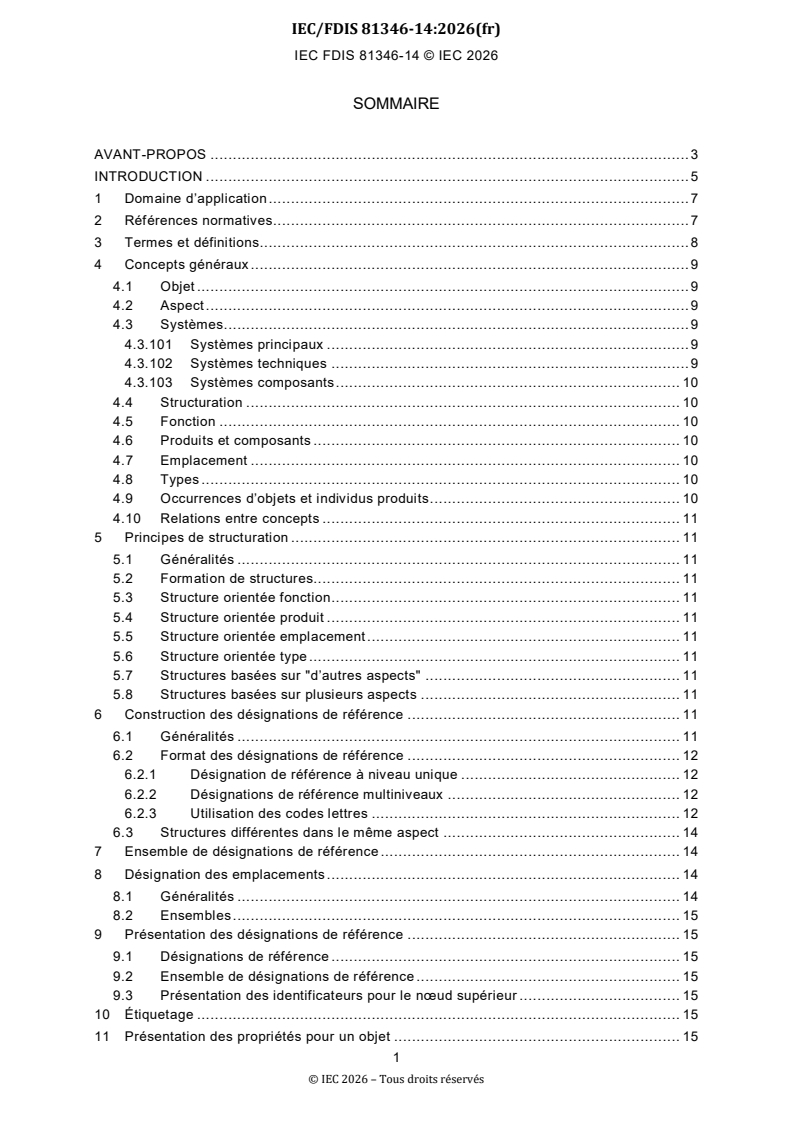
SOMMAIRE
AVANT-PROPOS . 3
INTRODUCTION . 5
1 Domaine d’application . 7
2 Références normatives . 7
3 Termes et définitions. 8
4 Concepts généraux . 9
4.1 Objet . 9
4.2 Aspect . 9
4.3 Systèmes . 9
4.3.101 Systèmes principaux . 9
4.3.102 Systèmes techniques . 9
4.3.103 Systèmes composants . 10
4.4 Structuration . 10
4.5 Fonction . 10
4.6 Produits et composants . 10
4.7 Emplacement . 10
4.8 Types . 10
4.9 Occurrences d’objets et individus produits . 10
4.10 Relations entre concepts . 11
5 Principes de structuration . 11
5.1 Généralités . 11
5.2 Formation de structures. 11
5.3 Structure orientée fonction. 11
5.4 Structure orientée produit . 11
5.5 Structure orientée emplacement . 11
5.6 Structure orientée type . 11
5.7 Structures basées sur "d’autres aspects" . 11
5.8 Structures basées sur plusieurs aspects . 11
6 Construction des désignations de référence . 11
6.1 Généralités . 11
6.2 Format des désignations de référence . 12
6.2.1 Désignation de référence à niveau unique . 12
6.2.2 Désignations de référence multiniveaux . 12
6.2.3 Utilisation des codes lettres . 12
6.3 Structures différentes dans le même aspect . 14
7 Ensemble de désignations de référence . 14
8 Désignation des emplacements . 14
8.1 Généralités . 14
8.2 Ensembles . 15
9 Présentation des désignations de référence . 15
9.1 Désignations de référence . 15
9.2 Ensemble de désignations de référence . 15
9.3 Présentation des identificateurs pour le nœud supérieur . 15
10 Étiquetage . 15
11 Présentation des propriétés pour un objet . 15
© IEC 2026 – Tous droits réservés
IEC FDIS 81346-14 © IEC 2026
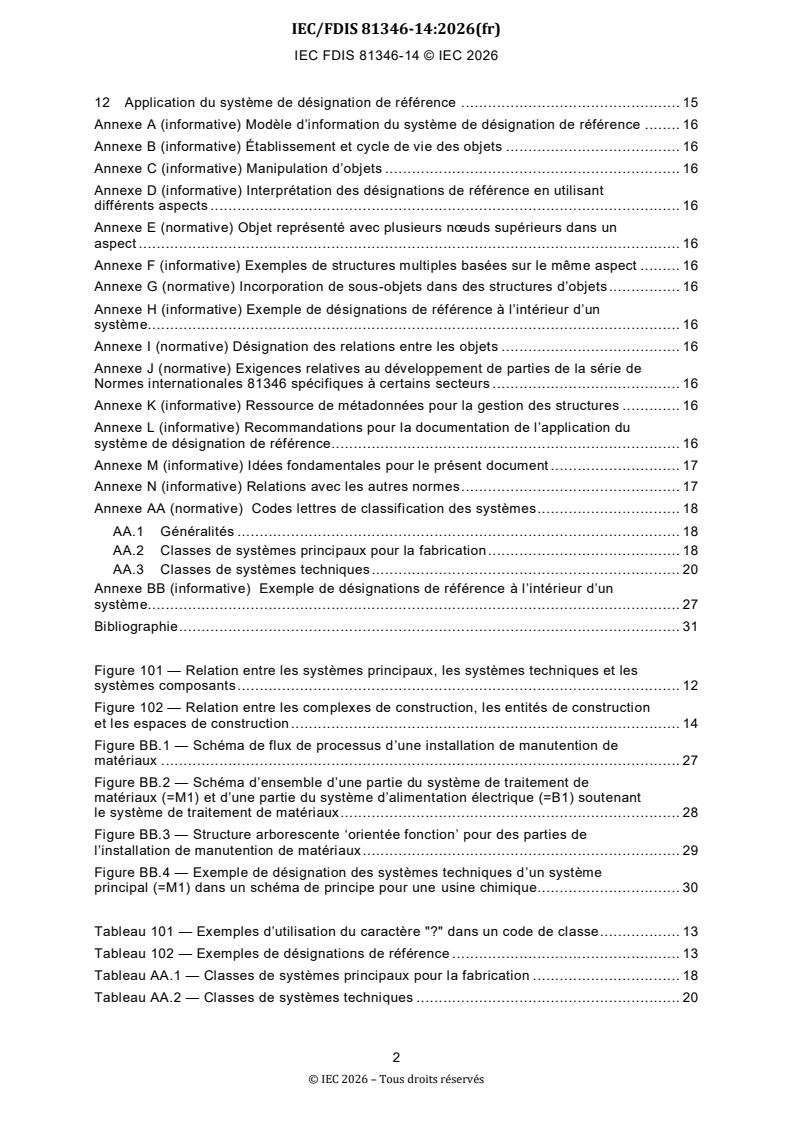
12 Application du système de désignation de référence . 15
Annexe A (informative) Modèle d’information du système de désignation de référence . 16
Annexe B (informative) Établissement et cycle de vie des objets . 16
Annexe C (informative) Manipulation d’objets . 16
Annexe D (informative) Interprétation des désignations de référence en utilisant
différents aspects . 16
Annexe E (normative) Objet représenté avec plusieurs nœuds supérieurs dans un
aspect . 16
Annexe F (informative) Exemples de structures multiples basées sur le même aspect . 16
Annexe G (normative) Incorporation de sous-objets dans des structures d’objets . 16
Annexe H (informative) Exemple de désignations de référence à l’intérieur d’un
système. 16
Annexe I (normative) Désignation des relations entre les objets . 16
Annexe J (normative) Exigences relatives au développement de parties de la série de
Normes internationales 81346 spécifiques à certains secteurs . 16
Annexe K (informative) Ressource de métadonnées pour la gestion des structures . 16
Annexe L (informative) Recommandations pour la documentation de l’application du
système de désignation de référence. 16
Annexe M (informative) Idées fondamentales pour le présent document . 17
Annexe N (informative) Relations avec les autres normes . 17
Annexe AA (normative) Codes lettres de classification des systèmes . 18
AA.1 Généralités . 18
AA.2 Classes de systèmes principaux pour la fabrication . 18
AA.3 Classes de systèmes techniques . 20
Annexe BB (informative) Exemple de désignations de référence à l’intérieur d’un
système. 27
Bibliographie . 31
Figure 101 — Relation entre les systèmes principaux, les systèmes techniques et les
systèmes composants . 12
Figure 102 — Relation entre les complexes de construction, les entités de construction
et les espaces de construction . 14
Figure BB.1 — Schéma de flux de processus d’une installation de manutention de
matériaux . 27
Figure BB.2 — Schéma d’ensemble d’une partie du système de traitement de
matériaux (=M1) et d’une partie du système d’alimentation électrique (=B1) soutenant
le système de traitement de matériaux . 28
Figure BB.3 — Structure arborescente ‘orientée fonction’ pour des parties de
l’installation de manutention de matériaux . 29
Figure BB.4 — Exemple de désignation des systèmes techniques d’un système
principal (=M1) dans un schéma de principe pour une usine chimique. 30
Tableau 101 — Exemples d’utilisation du caractère "?" dans un code de classe. 13
Tableau 102 — Exemples de désignations de référence . 13
Tableau AA.1 — Classes de systèmes principaux pour la fabrication . 18
Tableau AA.2 — Classes de systèmes techniques . 20
© IEC 2026 – Tous droits réservés
IEC FDIS 81346-14 © IEC 2026
COMMISSION ÉLECTROTECHNIQUE INTERNATIONALE
____________
Systèmes, installations et équipements industriels, et produits industriels
— Principes de structuration et désignations de référence —
Partie 14: Systèmes de fabrication et de traitement
AVANT-PROPOS
1) La Commission Électrotechnique Internationale (IEC) est une organisation mondiale de normalisation composée
de l’ensemble des comités électrotechniques nationaux (Comités nationau x de l’IEC). L’IEC a pour objet de
favoriser la coopération internationale pour toutes les questions de normalisation dans les domaines de
l’électricité et de l’électronique. À cet effet, l’IEC – entre autres activités – publie des Normes internationales,
des Spécifications techniques, des Rapports techniques, des Spécifications accessibles au public (PAS) et des
Guides (ci-après dénommés "Publication(s) de l’IEC"). Leur élaboration est confiée à des comités d’études,
aux travaux desquels tout Comité national intéressé par le sujet traité peut participer. Les organisations
internationales, gouvernementales et non gouvernementales, en liaison avec l’IEC, participent également aux
travaux. L’IEC collabore étroitement avec l’Organisation Internationale de Normalisation (ISO), selon des
conditions fixées par accord entre les deux organisations.
2) Les décisions ou accords officiels de l’IEC concernant les questions techniques représentent, dans la mesure du
possible, un accord international sur les sujets étudiés, étant donné que les Comités nationaux de l’IEC intéressés
sont représentés dans chaque comité d’études.
3) Les Publications de l’IEC se présentent sous la forme de recommandations internationales et sont agréées
comme telles par les Comités nationaux de l’IEC. Tous les efforts raisonnables sont entrepris afin que l’IEC
s’assure de l’exactitude du contenu technique de ses publications; l’IEC ne peut pas être tenue responsable de
l’éventuelle mauvaise utilisation ou interprétation qui en est faite par un quelconque utilisateur final.
4) Dans le but d’encourager l’uniformité internationale, les Comités nationaux de l’IEC s’engagent, dans toute la
mesure possible, à appliquer de façon transparente les Publications de l’IEC dans leurs publications nationales
et régionales. Toutes divergences entre toutes Publications de l’IEC et toutes publications nationales ou
régionales correspondantes doivent être indiquées en termes clairs dans ces dernières.
5) L’IEC elle-même ne fournit aucune attestation de conformité. Des organismes de certification indépendants
fournissent des services d’évaluation de conformité et, dans certains secteurs, accèdent aux marques de
conformité de l’IEC. L’IEC n’est responsable d’aucun des services effectués par les organismes de cert ification
indépendants.
6) Tous les utilisateurs doivent s’assurer qu’ils sont en possession de la dernière édition de cette publication.
7) Aucune responsabilité ne doit être imputée à l’IEC, à ses administrateurs, employés, auxiliaires ou mandataires,
y compris ses experts particuliers et les membres de ses comités d’études et des Comités nationaux de l’IEC,
pour tout préjudice causé en cas de dommages corporels et matériels, ou de tout autre dommage de quelque
nature que ce soit, directe ou indirecte, ou pour supporter les coûts (y compris les frais de justice) et les dépenses
découlant de la publication ou de l’utilisation de cette Publication de l’IEC ou de toute autre Publication de l’IEC,
ou au crédit qui lui est accordé.
8) L’attention est attirée sur les références normatives citées dans cette publication. L’utilisation de publications
référencées est obligatoire pour une application correcte de la présente publication.
9) L’IEC attire l’attention sur le fait que la mise en application du présent document peut entraîner l’utilisation d’un
ou de plusieurs brevets. L’IEC ne prend pas position quant à la preuve, à la validité et à l’applicabilité de tout
droit de brevet revendiqué à cet égard. À la date de publication du présent document, l’IEC n’avait pas reçu
notification qu’un ou plusieurs brevets pouvaient être nécessaires à sa mise en application. Toutefois, il y a lieu
d’avertir les responsables de la mise en application du présent document que des informations plus récentes
sont susceptibles de figurer dans la base de données de brevets, disponible à l’adresse https://patents.iec.ch.
L’IEC ne saurait être tenue pour responsable de ne pas avoir identifié de tels droits de brevet.
L’IEC 81346-14 a été établie par le comité d’études 3 de l’IEC: Structures d’informations,
documentation et symboles graphiques, en coopération étroite avec le comité technique 10 de
l’ISO: Documentation technique de produits. Il s’agit d’une Norme internationale.
Elle est publiée en tant que norme double logo et a reçu le statut d’un document horizontal
conformément aux Directives ISO/IEC, Partie 1.
© IEC 2026 – Tous droits réservés
IEC FDIS 81346-14 © IEC 2026
Le texte de cette Norme internationale est issu des documents suivants:
Projet Rapport de vote
3/XX/FDIS 3/XX/RVD
Le rapport de vote indiqué dans le tableau ci-dessus donne toute information sur le vote ayant
abouti à son approbation. À l’ISO, la norme a été approuvée par xx membres sur un total de
xx votes exprimés.
La langue employée pour l’élaboration de cette Norme internationale est l’anglais.
Le présent document est destiné à être utilisé conjointement avec l’IEC 81346-1:2022.
Les dispositions fixées par les exigences générales contenues dans l’IEC 81346-1:2022
s’appliquent uniquement au présent document à chaque fois que cela est expressément
indiqué. Lorsque le présent document spécifie "ajout", "modification" ou "remplacement",
le texte correspondant de l’IEC 81346-1:2022 doit être adapté en conséquence.
Les paragraphes qui sont numérotés avec un suffixe 101 (102, 103, etc.) sont ajoutés au même
paragraphe de l’IEC 81346-1:2022.
Les tableaux, figures, notes et exemples du présent document qui sont nouveaux sont
numérotés à partir de 101.
Les nouvelles annexes du présent document sont appelées AA, BB, etc.
Une liste de toutes les parties de la Norme internationale 81346, publiées sous le titre général
Systèmes, installations et équipements industriels, et produits industriels — Principes de
structuration et désignations de référence, peut être consultée sur le site web de l’IEC.
Ce document a été rédigé selon les Directives ISO/IEC, Partie 2, il a été développé selon les
Directives ISO/IEC, Partie 1 et les Directives ISO/IEC, Supplément IEC, disponibles sous
www.iec.ch/members_experts/refdocs. Les principaux types de documents développés par
l’IEC sont décrits plus en détail sous www.iec.ch/publications.
NOTE Dans le présent document, les caractères d’imprimerie suivants sont utilisés:
• déclaration introductive dans les articles et paragraphes décrivant l’applicabilité de l’article ou du
paragraphe correspondant de l’IEC 81346-1:2022: caractères italiques;
• système d’entrée, c’est-à-dire système de fabrication et système technique, dans la définition des classes
d’entrée: caractères italiques;
• nom de la classe parente dans la définition des sous-classes: caractères italiques;
• dans la hiérarchie de classification, codes de classe: caractères gras.
Le comité a décidé que le contenu de ce document ne sera pas modifié avant la date de stabilité
indiquée sur le site web de l’IEC sous webstore.iec.ch dans les données relatives au document
recherché. À cette date, le document sera
– reconduit,
– supprimé, ou
– révisé.
© IEC 2026 – Tous droits réservés
IEC FDIS 81346-14 © IEC 2026
INTRODUCTION
Le présent document prend en compte et soutient l’organisation, la conception, l’utilisation et
la maintenance des systèmes de fabrication. L’application d’un système de désignation de
référence pour les systèmes de fabrication (RDS-MS) peut conduire à de nouvelles vues et à
une nouvelle structuration de ces activités et offre ainsi des possibilités et le potentiel de gagner
en efficacité et d’accroître les économies.
Le présent document est aligné sur les règles de structuration prévues dans l’IEC 81346-1 et
les principes de classification de l’IEC 81346-2. Il suit également les principes de classification
des systèmes principaux et des systèmes techniques énoncés dans l’ISO 81346-10 et
l’ISO 81346-12.
L’objet spécifique du présent document est de définir des classes de systèmes utilisés dans
l’industrie manufacturière et de fournir des lignes directrices générales pour la structuration de
ces systèmes.
Les systèmes de désignation conformes au présent document et à la série IEC 81346 de
Normes internationales présentent les avantages suivants:
– le système de désignation de référence peut être appliqué à plusieurs domaines techniques.
Les équipements mécaniques, électriques et de traitement peuvent être traités de la même
manière, comme base pour créer des effets de synergie à l’échelle de l’entreprise;
– le système de désignation de référence permet l’intégration de tout type de systèmes et de
composants sans modifier les désignations déjà définies;
– l’application de différents aspects permet par exemple de désigner des fonctions
indépendamment de la réalisation des produits et de leur emplacement. La représentation
différente des systèmes à travers de multiples aspects, et de leurs relations entre eux,
permet d’obtenir un modèle de référence de systèmes plus inclusif et plus complet.
Les utilisateurs du présent document sont en mesure de gérer les objets, les relations entre
eux et les propriétés correspondantes d’une manière plus efficace et plus cohérente. Lorsque la
présente norme est mise en œuvre, les informations contenues dans les différents systèmes
de traitement des données peuvent être traitées sans ambiguïté.
L’industrie manufacturière est considérée comme un élément majeur de notre modèle
d’économie à cinq secteurs. L’influence et l’importance de l’industrie manufacturière
se répercutent sur l’ensemble du modèle, comme décrit ci-dessous:
– secteur primaire (secteur naturel):
Ce secteur implique l’extraction et la production de matières premières, par exemple
l’agriculture, l’exploitation minière, la pêche et la sylviculture. Le secteur secondaire dépend
fortement de ce secteur pour les matières premières nécessaires pour fabriquer ses
produits.
EXEMPLE 1 Une aciérie a besoin de fer provenant de l’industrie minière. Un fabricant de pneus a besoin de
caoutchouc provenant de l’industrie agricole. Un constructeur automobile a besoin d’acier et de pneus, et donc
implicitement de fer provenant de l’industrie minière et de caoutchouc provenant de l’industrie agricole.
– secteur secondaire (secteur industriel):
Ce secteur prend les matières premières du secteur primaire et les transforme en produits
finis. Il comprend les usines produisant par exemple des v oitures, des vêtements,
des appareils électroniques, de l’acier, des produits laitiers, des produits de l’industrie des
brasseries. Le bâtiment et la construction font également partie de ce secteur.
– secteur tertiaire (secteur des services):
Ce secteur fournit des services aux particuliers et aux entreprises. Bien que l’industrie
manufacturière ne fasse pas directement partie de ce secteur, elle en dépend fortement.
EXEMPLE 2 Services de transport pour acheminer les produits. Services financiers pour traiter les
transactions. Services de marketing pour vendre les produits.
© IEC 2026 – Tous droits réservés
IEC FDIS 81346-14 © IEC 2026
– secteur quaternaire (secteur de l’information):
Ce secteur s’occupe du traitement de l’information et du partage des connaissances.
Il comprend l’informatique, la recherche et le développement, ainsi que le conseil.
L’industrie manufacturière s’appuie de plus en plus sur ce secteur pour les avancées
technologiques, l’optimisation des processus et l’analyse des données.
– secteur quinaire (secteur des services à la personne):
Ce secteur comprend les services axés sur le développement humain et le bien-être, tels que
l’éducation, la santé et le travail social. Bien qu’il ne soit pas directement impliqué dans la
production, ce secteur contribue à une main-d’œuvre qualifiée et en bonne santé, ce qui est
essentiel pour une industrie manufacturière prospère.
Les différents secteurs du modèle d’économie à cinq secteurs peuvent être subdivisés en
sous-secteurs ou en industries.
Pour le secteur primaire (secteur naturel), les sous-secteurs suivants sont courants:
– secteur biotique,
– secteur géologique.
Pour le secteur secondaire (secteur industriel), les sous-secteurs suivants sont courants:
– construction, partiellement couverte par l’ISO 81346-12;
– secteur manufacturier:
• produits chimiques,
• électricité et optique,
• industrie lourde,
• industrie légère,
• matériaux;
– entreprises du secteur public, partiellement couvertes par l’ISO 81346-10.
Le présent document est destiné à couvrir les systèmes de fabrication du point de vue
géologique du secteur primaire, tels que les minéraux, les combustibles fossiles et le sol. Il est
également destiné à couvrir les sous-secteurs manufacturier et de la construction du secteur
secondaire.
Les spécifications du présent document s’appliquent au traitement, au transport et au stockage
des produits finis, ainsi qu’aux systèmes auxiliaires pour soutenir le processus de fabrication,
tels que les systèmes électriques, les systèmes de gestion et les systèmes d’élimination des
déchets.
© IEC 2026 – Tous droits réservés
IEC FDIS 81346-14 © IEC 2026
1 Domaine d’application
La présente partie de la Norme internationale IEC 81346, publiée conjointement par l’IEC et
l’ISO, fournit, en combinaison avec l’IEC 81346-1 et l’IEC 81346-2, des règles et
recommandations sur la structuration des systèmes, ainsi que des informations sur les
systèmes de fabrication. Elle fournit également des hiérarchies de classification
supplémentaires qui viennent compléter celles de l’IEC 81346-2 pour une utilisation dans les
désignations de référence au sein des systèmes de fabrication.
Les principes de structuration et les classes d’objets sont destinés à permettre une identification
et une localisation claires des objets. Ils sont conçus pour être utilisés sur l’étiquetage des
objets au sein de l’installation de fabrication, pour désigner ces objets dans les documents
techniques et pour désigner les documents techniques également.
Les exigences du présent document s’appliquent au traitement, au transport et au stockage
des produits, ainsi qu’aux systèmes destinés à soutenir le processus de fabrication, tels que
les systèmes électriques, les systèmes de gestion et les systèmes d’élimination des déchets.
Le présent document s’applique à différents domaines de l’industrie manufacturière, tels que
l’industrie légère, l’industrie électrique et optique, l’industrie chimique, l’industrie des matériaux
et l’industrie lourde.
Le présent document ne s’applique pas aux désignations liées aux produits individuels
(par exemple numéro d’inventaire, numéro de série) ni aux produits fabriqués.
Le présent document est également une publication horizontale destinée à être utilisée par les
comités techniques pour l’établissement de publications liées aux désignations de référence
conformément aux principes exposés dans le Guide 108 de l’IEC.
2 Références normatives
Les documents suivants sont cités dans le texte de sorte qu’ils constituent, pour tout ou partie
de leur contenu, des exigences du présent document. Pour les références datées,
seule l’édition citée s’applique. Pour les références non datées, la dernière édition du document
de référence s’applique (y compris les éventuels amendements).
IEC 81346-1:2022, Systèmes industriels, installations et appareils, et produits industriels —
Principes de structuration et désignations de référence — Partie 1: Règles de base
IEC 81346-2:—, Systèmes industriels, installations et appareils, et produits industriels —
Principes de structuration et désignations de référence — Partie 2: Classification des objets et
codes pour les classes
___________
Troisième édition en cours d’établissement. Stade au moment de la publication: IEC CDV 81346-2:2025.
© IEC 2026 – Tous droits réservés
IEC FDIS 81346-14 © IEC 2026
3 Termes et définitions
Pour les besoins du présent document, les termes et les définitions de l’IEC 81346-1:2022,
l’IEC 81346-2:— , ainsi que les suivants, s’appliquent.
L’ISO et l’IEC tiennent à jour des bases de données terminologiques destinées à être utilisées
en normalisation, consultables aux adresses suivantes:
– IEC Electropedia: disponible à l’adresse https://www.electropedia.org/
– ISO Online browsing platform: disponible à l’adresse https://www.iso.org/obp
3.1
information
renseignement ou élément de connaissance susceptible d’être représenté sous une forme
adaptée à une communication, un enregistrement ou un traitement
Note 1 à l’article: Les informations peuvent se présenter par exemple sous la forme de signes, symboles, images ou
sons.
[SOURCE: IEC 60050-701:1988, 701-01-01]
3.2
donnée
représentation d’une information (3.1) sous une forme conventionnelle convenant au traitement
par des moyens humains ou automatiques
Note 1 à l’article: Le traitement inclut la communication et l’interprétation.
Note 2 à l’article: En anglais, le mot "data" est généralement utilisé au pluriel. Pour un usage au singulier, on peut
utiliser "data item".
[SOURCE: IEC 60050-171:2019, 171-01-02]
3.3
installation (industrielle)
assemblage de différents systèmes sur un site spécifique
[SOURCE: ISO 81346-10:2022, 3.10]
3.4
fabrication
production ou traitement en quantités
définies
3.5
production
fabrication d’un produit unique par
une série particulière d’actions
3.6
traitement
traitement de matière ou d’information
par une série particulière d’actions
___________
Troisième édition en cours d’établissement. Stade au moment de la publication: IEC CDV 81346-2:2025.
© IEC 2026 – Tous droits réservés
IEC FDIS 81346-14 © IEC 2026
3.7
équipement
matériel
appareil unique ou ensemble de dispositifs ou appareils, ou ensemble des dispositifs principaux
d’une installation, ou ensemble des dispositifs nécessaires à l’accomplissement d’une tâche
particulière
Note 1 à l’article: Des exemples d’équipement ou de matériel sont un transformateur de puissance,
l’équipement d’une sous-station, un équipement de mesure.
[SOURCE: IEC 60050-151:2001, 151-11-25]
3.8
matière gazeuse
milieu compressible qui prend la forme du contenant qui l’entoure
3.9
matière liquide
milieu incompressible qui prend la forme du contenant qui l’entoure
3.10
matière solide
milieu incompressible qui ne prend pas la forme du contenant qui l’entoure
4 Concepts généraux
4.1 Objet
L’IEC 81346-1:2022, 4.1, s’applique.
4.2 Aspect
L’IEC 81346-1:2022, 4.2, s’applique.
4.3 Systèmes
L’IEC 81346-1:2022, 4.3, s’applique.
Ajouter les paragraphes suivants:
4.3.101 Systèmes principaux
Un système principal fournit une étape de fabrication globale dans le processus de fabrication
ou fournit un soutien pour de telles étapes.
Un système principal doit être classé conformément à la hiérarchie de classification fournie à
l’Annexe AA, Tableau AA.1.
Un système principal peut comprendre, parmi ses éléments constituants, un autre systèm e
principal.
4.3.102 Systèmes techniques
Un système technique fournit une solution technique pour une étape spécifique du processus
de fabrication ou fournit le soutien nécessaire pour une telle solution technique.
Un système technique doit être classifié conformément à la hiérarchie de classification définie
à l’Annexe AA, Tableau AA.2.
© IEC 2026 – Tous droits réservés
IEC FDIS 81346-14 © IEC 2026
Un système technique peut comprendre de manière récursive, parmi ses éléments constituants,
un autre système technique. Un système technique ne doit pas comporter de système principal.
4.3.103 Systèmes composants
Les systèmes composants sont des systèmes bien définis en ce qui concerne à la fois leur
fonction inhérente et leur mise en œuvre.
Un système composants doivent être classifié conformément à l’IEC 81346-2:—, Tableau 2.
Un système composants peut comprendre de manière récursive, parmi ses éléments
constituants, un autre système composants. Un système composants ne doit pas comporter de
système principal ni de système technique.
NOTE Un système composants est généralement considéré comme un produit grand public.
4.4 Structuration
L’IEC 81346-1:2022, 4.4, s’applique.
4.5 Fonction
L’IEC 81346-1:2022, 4.5, s’applique.
4.6 Produits et composants
L’IEC 81346-1:2022, 4.6, s’applique en tenant compte de la note supplémentaire suivante:
NOTE 101 Dans le contexte du présent document, il est important de noter la différence entre un produit et l’aspect
produit. Un produit est le résultat du processus (travail) et la "chose" qui est livrée. L’aspect produit est un moyen
de visualiser un système afin de "voir" les objets de ce système.
4.7 Emplacement
L’IEC 81346-1:2022, 4.7, s’applique avec l’ajout suivant:
Deux aspects différents doivent être appliqués:
– aspect "hôte d’installation": cet aspect emplacement doit être appliqué pour relier
l’emplacement d’un objet aux emplacements situés à l’intérieur ou sur un produit ou un
ensemble de produits;
EXEMPLE 101 Les objets vus dans l’hôte d’installation sont par exempl e des emplacements à l’intérieur ou sur
une armoire, une console ou un panneau.
– aspect "site d’installation": cet aspect emplacement doit être appliqué pour relier
l’emplacement d’un objet à un emplacement défini à l’intérieur d’un emplacement plus
grand, indépendamment de l’existence d’objets physiques composant cet emplacement plus
grand.
EXEMPLE 102 Les objets vus dans l’aspect "site d’installation" sont un site, une entité de construction
(un bâtiment), une partie d’un bâtiment, un étage.
4.8 Types
L’IEC 81346-1:2022, 4.8, s’applique.
4.9 Occurrences d’objets et individus produits
L’IEC 81346-1:2022, 4.9, s’applique.
© IEC 2026 – Tous droits réservés
IEC FDIS 81346-14 © IEC 2026
4.10 Relations entre concepts
L’IEC 81346-1:2022, 4.10, s’applique.
5 Principes de structuration
5.1 Généralités
L’IEC 81346-1:2022, 5.1, s’applique.
5.2 Formation de structures
L’IEC 81346-1:2022, 5.2, s’applique.
5.3 Structure orientée fonction
L’IEC 81346-1:2022, 5.3, s’applique.
5.4 Structure orientée produit
L’IEC 81346-1:2022, 5.4, s’applique.
5.5 Structure orientée emplacement
L’IEC 81346-1:2022, 5.5, s’applique.
5.6 Structure orientée type
L’IEC 81346-1:2022, 5.6, s’applique.
5.7 Structures basées sur "d’autres aspects"
L’IEC 81346-1:2022, 5.7, s’applique.
5.8 Structures basées sur plusieurs aspects
Il convient qu’un identificateur d’objet soit basé sur un seul aspect. Lorsque plusieurs aspects
sont exigés, l’IEC 81346-1:2022, 5.8, s’applique.
6 Construction des désignations de référence
6.1 Généralités
L’IEC 81346-1:2022, 6.1, s’applique.
© IEC 2026 – Tous droits réservés
IEC FDIS 81346-14 © IEC 2026
6.2 Format des désignations de référence
6.2.1 Désignation de référence à niveau unique
L’IEC 81346-1:2022, 6.2.1, s’applique avec les modifications suivantes:
Remplacer la Règle 7 par ce qui suit:
Règle 7 Les signes utilisés comme préfixe pour indiquer le type d’aspect dans une désignation
de référence doivent être:
a) "=" (SIGNE ÉGAL) lorsqu’il est fait référence à l’aspect fonction de l’objet;
b) "–" (SIGNE MOINS) lorsqu’il est fait référence à l’aspect produit de l’objet;
c) "+" (SIGNE PLUS) lorsqu’il est fait référence à l’aspect hôte d’installation de l’objet;
d) "++" (SIGNE PLUS, SIGNE PLUS) lorsqu’il est fait référence à l’aspect site d’installation de
l’objet;
e) "%" (SIGNE POUR CENT) lorsqu’il est fait référence à l’aspect type de l’objet;
f) "#" (CROISILLON) lorsqu’il est fait référence à d’autres aspects de l’objet.
6.2.2 Désignations de référence multiniveaux
L’IEC 81346-1:2022, 6.2.2, s’applique.
6.2.3 Utilisation des codes lettres
L’IEC 81346-1:2022, 6.2.3, s’applique avec l’ajout des paragraphes suivants:
6.2.3.101 Codes lettres pour l’aspect fonctionnel et l’aspect produit
La Figure 101 représente l’application des codes à UNE, DEUX et TROIS lettres relatifs aux
systèmes principaux (UNE lettre), aux systèmes techniques (DEUX lettres) et aux systèmes
composants (TROIS lettres).
Figure 101 — Relation entre les systèmes principaux, les systèmes techniques et les
systèmes composants
Pour la désignation des systèmes principaux et des systèmes techniques en fonction de leur
aspect fonctionnel, de leur aspect produit ou de leur aspect type, les hiérarchies de
classification de l’Annexe AA doivent s’appliquer.
Pour la désignation des systèmes composants en fonction de leur aspect fonctionnel, de leur
aspect produit ou de leur aspect type, la hiérarchie de classification de l’IEC 81346-2:—,
Tableau 2, doit s’appliquer.
© IEC 2026 – Tous droits réservés
IEC FDIS 81346-14 © IEC 2026
Le Tableau 101 représente des exemples d’utilisation du caractère "?" dans un code lettre et
le Tableau 102 indique des exemples de désignation de référence conformément au présent
document.
Tableau 101 — Exemples d’utilisation du caractère "?" dans un code de classe
Code de Objet Exemples
classe
CM? objet de stockage de matières se trouvant dans une enceinte système de conteneur de
fixe fermée poudre
P? système technique conçu pour assurer la prévention ou la système de sécurité des
protection contre des conditions indésirables équipements et des
personnes
K? systèmes techniques conçus pour ajuster le débit ou une système de régulation de
grandeur appliquée vitesse et de pression
S?? objet servant à détecter une action humaine et à fournir une unité d’interaction humaine
réponse appropriée
Tableau 102 — Exemples de désignations de référence
Objet ou système Désignation de référence
Unité de prélèvement et de placement 1 d’un système d’assemblage 2 =J2=KD1
Transformateur principal 5 d’un système de soudage 1 d’un système de =J3=BB1=TAA5
sous-assemblage 3
Armoire électrique 3 +UCA3
Capteur de champ 4 de l’armoire de commande 2 du système -F1-LC2-BE?4
d’automatisation 1
L’Annexe BB montre un exemple de désignation de référence, au sein d’un système reposant
sur la structure ‘orientée fonction’ d’une installation de fabrication, à l’aide des codes de classes
du présent document.
© IEC 2026 – Tous droits réservés
IEC FDIS 81346-14 © IEC 2026
6.2.3.102 Codes lettres pour l’aspect emplacement
La Figure 102 représente l’application des codes à UNE, DEUX et TROIS lettres relatifs aux
complexes de construction (UNE lettre), aux entités de construction (DEUX lettres) et aux
espaces de construction (TROIS lettres).
Figure 102 — Relation entre les complexes de construction, les entités de construction
et les espaces de construction
Pour la désignation des complexes de construction en fonction de leur aspect emplacement,
il convient d’appliquer les hiérarchies de classification de l’IEC 81346-2:―, Tableau 3.
Pour la désignation des entités de construction en fonction de leur aspect emplacement,
il convient d’appliquer les hiérarchies de classification de l’IEC 81346-2:―, Tableau 4.
Pour la désignation des espaces de construction en fonction de leur aspect emplacement,
il convient d’appliquer les hiérarchies de classification de l’IEC 81346-2:―, Tableau 5.
6.2.3.103 Codes lettres à utiliser dans l’aspect type
Pour les désignations basées sur l’aspect type, les hiérarchies de classification de
l’IEC 81346-2, les hiérarchies de classification de l’Annexe AA ou toute hiérarchie de
classification définie par l’utilisateur peuvent s’appliquer.
La hiérarchie de classification utilisée doit être identifiée dans le document où figure la
désignation de référence ou dans la documentation connexe. La hiérarchie de cl assification
définie par l’utilisateur doit être documentée dans la documentation connexe.
6.3 Structures différentes dans le même aspect
L’IEC 81346-1:2022, 6.3, s’applique.
7 Ensemble de désignations de référence
L’IEC 81346-1:2022, Article 7, s’applique.
8 Désignation des emplacements
8.1 Généralités
L’IEC 81346-1:2022, 8.1, s’applique.
© IEC 2026 – Tous droits réservés
IEC FDIS 81346-14 © IEC 2026
8.2 Ensembles
L’IEC 81346-1:2022, 8.2, s’applique.
9 Présentation des désignations de référence
9.1 Désignations de référence
L’IEC 81346-1:2022, 9.1, s’applique.
9.2 Ensemble de désignations de référence
L’IEC 81346-1:2022, 9.2, s’applique.
9.3 Présentation des identificateurs pour le nœud supérieur
L’IEC 81346-1:2022, 9.3, s’applique.
10 Étiquetage
L’IEC 81346-1:2022, Article 10, s’applique.
11 Présentation des propriétés pour un objet
L’IEC 81346-1:2022, Article 11, s’applique.
12 Application du système de désignation de référence
L’IEC 81346-1:2022, Article 12, s’applique.
© IEC 2026 – Tous droits réservés
IEC FDIS 81346-14 © IEC 2026
Annexe A (informative) Modèle d’information du système de désignation
de référence
L’IEC 81346-1:2022, Annexe A, s’applique.
Annexe B (informative) Établissement et cycle de vie des objets
L’IEC 81346-1:2022, Annexe B, s’applique.
Annexe C (informative) Manipulation d’objets
L’IEC 81346-1:2022, Annexe C, s’applique.
Annexe D (informative) Interprétation des désignations de référence en
utilisant différents aspects
L’IEC 81346-1:2022, Annexe D, s’applique.
Annexe E (normative) Objet représenté avec plusieurs nœuds supérieurs
dans un aspect
L’IEC 81346-1:2022, Annexe E, s’applique.
Annexe F (informative) Exemples de structures multiples basées sur le
même aspect
L’IEC 81346-1:2022, Annexe F, s’applique.
Annexe G (normative) Incorporation de sous-objets dans des structures
d’objets
L’IEC 81346-1:2022, Annexe G, s’applique.
Annexe H (informative) Exemple de désignations de référence à l’intérieur
d’un système
L’IEC 81346-1:2022, Annexe H, ne s’applique pas.
Annexe I (normative) Désignation des relations entre les objets
L’IEC 81346-1:2022, Annexe I, s’applique.
Annexe J (normative) Exigences relatives au développ
...
Questions, Comments and Discussion
Ask us and Technical Secretary will try to provide an answer. You can facilitate discussion about the standard in here.
Loading comments...