


ISO 22927:2021
(Main)Rare earth — Packaging and labelling
Rare earth — Packaging and labelling
This document specifies requirements and recommendations for the packaging and labelling of rare earth ores, concentrates, compounds, metals and alloys that are intended for sale or free distribution. It defines the performance and structure of packaging, and specifies the information to include on the labelling. These requirements and recommendations are designed to ensure quality assurance, enhance safety and prevent environmental pollution during the transportation and storage of rare earth products. This document is applicable to packaging and labelling during transactions between companies. It does not include packaging by companies during storage in their own plant. The method of labelling defined in this document enhances safety by indicating properties of rare earth products and ensures appropriate management of the product by indicating the identity of suppliers.
Terres rares — Emballage et étiquetage
General Information
- Status
- Published
- Publication Date
- 15-Jun-2021
- Technical Committee
- ISO/TC 298 - Rare earth
- Drafting Committee
- ISO/TC 298/WG 3 - Traceability, Packaging and Labelling
- Current Stage
- 9020 - International Standard under periodical review
- Start Date
- 15-Apr-2026
- Completion Date
- 15-Apr-2026
Overview
ISO 22927:2021 - Rare earth - Packaging and labelling specifies requirements and recommendations for the packaging and labelling of rare earth ores, concentrates, compounds, metals and alloys intended for sale or free distribution. The standard defines packaging performance and structure and prescribes the information to appear on labels to ensure quality assurance, enhance safety and prevent environmental pollution during transportation and storage. ISO 22927:2021 applies to commercial transactions between companies (not to on‑plant storage).
Key Topics
- Scope & terms: definitions for supplier, inner/intermediate/outer packaging, protecting gas/liquid, vacuum and minimum packaging unit.
- Packaging principles: sealed, durable packaging to prevent dispersion, moisture/gas ingress, chemical reaction, quality degradation, fire or pollution.
- Inner and intermediate packaging types:
- Polymer bottles and film bags
- Glass bottles (borosilicate)
- Aluminized polymer bags (for sensitive metals/alloys such as cerium)
- Outer packaging options:
- Metal drums (note: steel drums >200 L should meet ISO 15750‑1/2/3)
- Polymer drums and bulk containers
- Flexible intermediate bulk containers (see ISO 21898)
- Corrugated fibreboard boxes, kraft bags, wooden/plywood containers
- Protective measures: use of protecting gases (argon, nitrogen), protecting liquids (oils), or vacuum to maintain product stability.
- Labelling requirements:
- Clear product identity, supplier traceability and handling information
- Specific labelling recommendations for hazardous materials (e.g., cerium/cerium‑containing flammable alloys, metal powders, products containing radioactive elements)
- Label format guidance: language, quality and information layout
- Batch and traceability rules: minimum packaging unit should contain product from the same batch/grade/specification.
Applications
ISO 22927:2021 is practical for organizations involved in the global trade of rare earths:
- Suppliers and producers (mines, beneficiation, hydrometallurgy)
- Traders, brokers and blenders
- Packaging engineers and logistics providers handling shipment and storage
- Quality, HSE and regulatory teams ensuring compliance with labelling and transport safety
- Buyers and distributors verifying supplier traceability and safe handling instructions
Adopting ISO 22927 helps reduce incidents (fires, contamination, radiation exposure), preserves product quality during transit, and supports regulatory compliance alongside local transport and SDS requirements.
Related Standards (if applicable)
- ISO 21067‑1 - Packaging vocabulary
- ISO 22444‑1 / ISO 22444‑2 - Rare earth vocabulary (minerals, oxides, metals/alloys)
- ISO 15750‑1/2/3 - Steel drums (applicable for drums >200 L)
- ISO 21898 - Flexible intermediate bulk containers
Keywords: ISO 22927:2021, rare earth packaging, rare earth labelling, packaging requirements, labelling requirements, rare earth ores, concentrates, compounds, metals, alloys, transport safety, product traceability.
Get Certified
Connect with accredited certification bodies for this standard

NSF International
Global independent organization facilitating standards development and certification.

CIS Institut d.o.o.
Personal Protective Equipment (PPE) certification body. Notified Body NB-2890 for EU Regulation 2016/425 PPE.

Kiwa BDA Testing
Building and construction product certification.
Sponsored listings
Frequently Asked Questions
ISO 22927:2021 is a standard published by the International Organization for Standardization (ISO). Its full title is "Rare earth — Packaging and labelling". This standard covers: This document specifies requirements and recommendations for the packaging and labelling of rare earth ores, concentrates, compounds, metals and alloys that are intended for sale or free distribution. It defines the performance and structure of packaging, and specifies the information to include on the labelling. These requirements and recommendations are designed to ensure quality assurance, enhance safety and prevent environmental pollution during the transportation and storage of rare earth products. This document is applicable to packaging and labelling during transactions between companies. It does not include packaging by companies during storage in their own plant. The method of labelling defined in this document enhances safety by indicating properties of rare earth products and ensures appropriate management of the product by indicating the identity of suppliers.
This document specifies requirements and recommendations for the packaging and labelling of rare earth ores, concentrates, compounds, metals and alloys that are intended for sale or free distribution. It defines the performance and structure of packaging, and specifies the information to include on the labelling. These requirements and recommendations are designed to ensure quality assurance, enhance safety and prevent environmental pollution during the transportation and storage of rare earth products. This document is applicable to packaging and labelling during transactions between companies. It does not include packaging by companies during storage in their own plant. The method of labelling defined in this document enhances safety by indicating properties of rare earth products and ensures appropriate management of the product by indicating the identity of suppliers.
ISO 22927:2021 is classified under the following ICS (International Classification for Standards) categories: 13.030.30 - Special wastes. The ICS classification helps identify the subject area and facilitates finding related standards.
ISO 22927:2021 is available in PDF format for immediate download after purchase. The document can be added to your cart and obtained through the secure checkout process. Digital delivery ensures instant access to the complete standard document.
Standards Content (Sample)
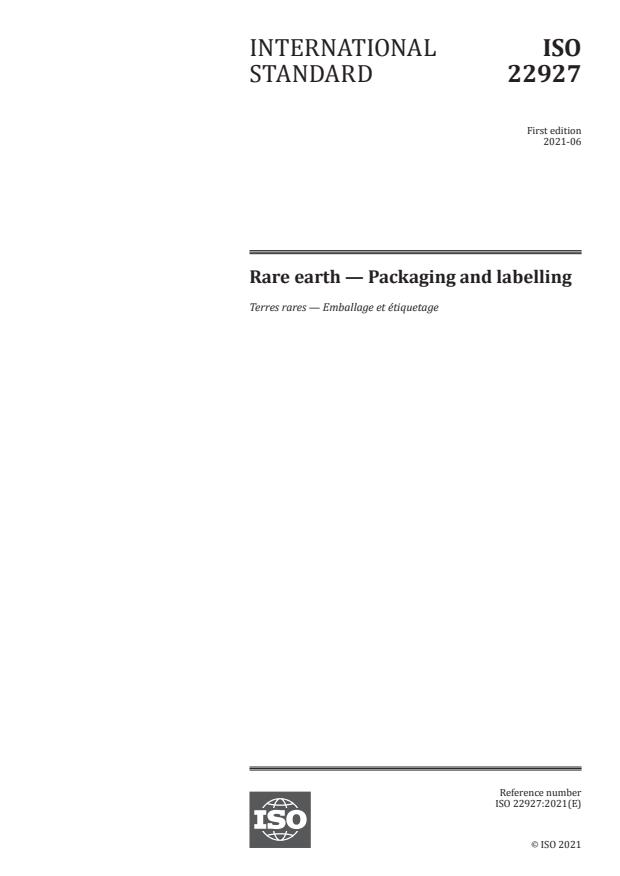
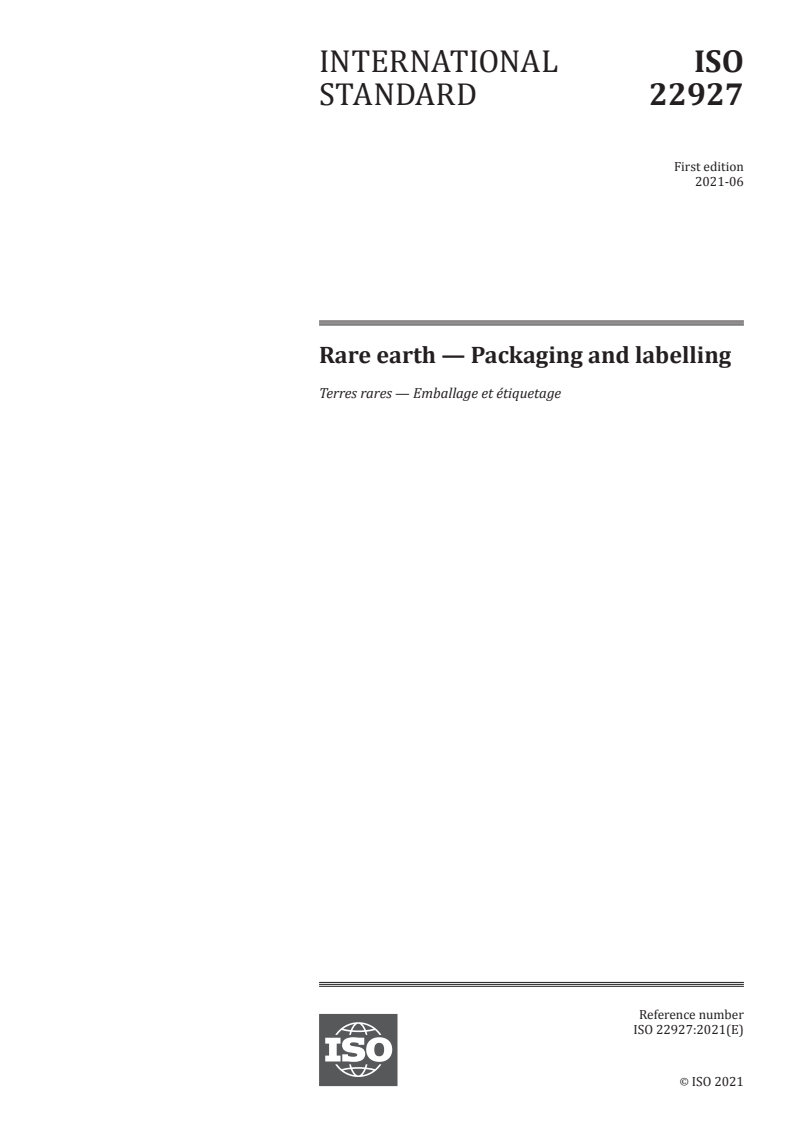
INTERNATIONAL ISO
STANDARD 22927
First edition
2021-06
Rare earth — Packaging and labelling
Terres rares — Emballage et étiquetage
Reference number
©
ISO 2021
© ISO 2021
All rights reserved. Unless otherwise specified, or required in the context of its implementation, no part of this publication may
be reproduced or utilized otherwise in any form or by any means, electronic or mechanical, including photocopying, or posting
on the internet or an intranet, without prior written permission. Permission can be requested from either ISO at the address
below or ISO’s member body in the country of the requester.
ISO copyright office
CP 401 • Ch. de Blandonnet 8
CH-1214 Vernier, Geneva
Phone: +41 22 749 01 11
Email: copyright@iso.org
Website: www.iso.org
Published in Switzerland
ii © ISO 2021 – All rights reserved
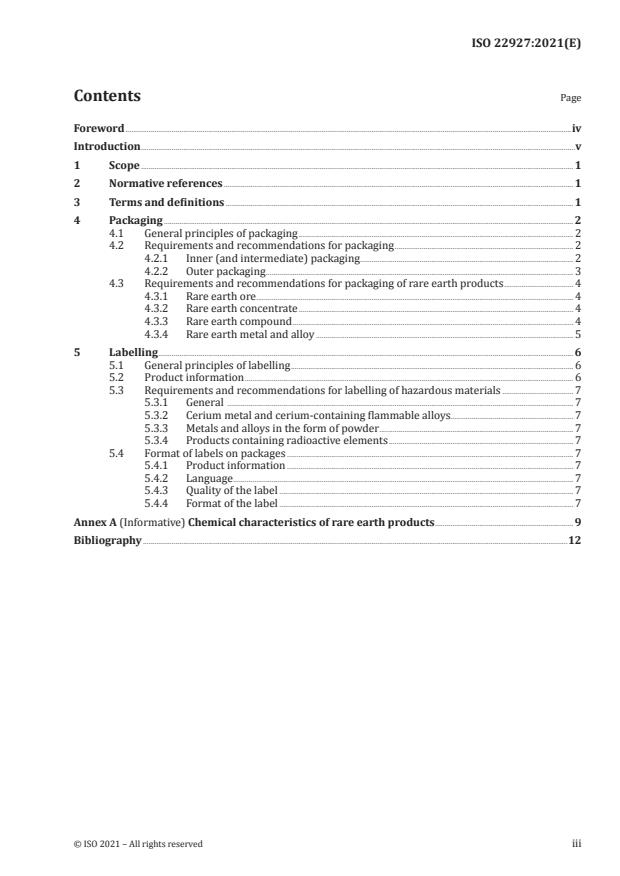
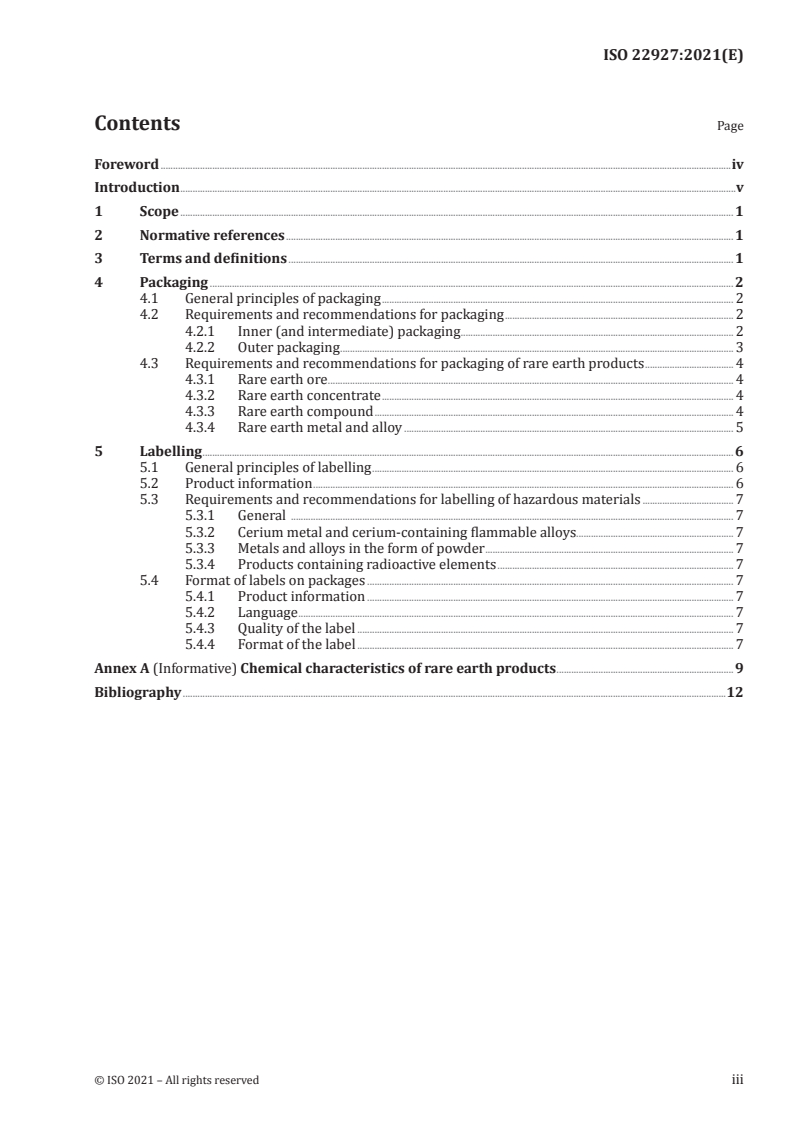
Contents Page
Foreword .iv
Introduction .v
1 Scope . 1
2 Normative references . 1
3 Terms and definitions . 1
4 Packaging . 2
4.1 General principles of packaging . 2
4.2 Requirements and recommendations for packaging . 2
4.2.1 Inner (and intermediate) packaging . . 2
4.2.2 Outer packaging . 3
4.3 Requirements and recommendations for packaging of rare earth products . 4
4.3.1 Rare earth ore . 4
4.3.2 Rare earth concentrate . 4
4.3.3 Rare earth compound . 4
4.3.4 Rare earth metal and alloy . 5
5 Labelling . 6
5.1 General principles of labelling . 6
5.2 Product information . 6
5.3 Requirements and recommendations for labelling of hazardous materials . 7
5.3.1 General . 7
5.3.2 Cerium metal and cerium-containing flammable alloys. 7
5.3.3 Metals and alloys in the form of powder . 7
5.3.4 Products containing radioactive elements . 7
5.4 Format of labels on packages . 7
5.4.1 Product information . 7
5.4.2 Language . 7
5.4.3 Quality of the label . 7
5.4.4 Format of the label . 7
Annex A (Informative) Chemical characteristics of rare earth products . 9
Bibliography .12
Foreword
ISO (the International Organization for Standardization) is a worldwide federation of national standards
bodies (ISO member bodies). The work of preparing International Standards is normally carried out
through ISO technical committees. Each member body interested in a subject for which a technical
committee has been established has the right to be represented on that committee. International
organizations, governmental and non-governmental, in liaison with ISO, also take part in the work.
ISO collaborates closely with the International Electrotechnical Commission (IEC) on all matters of
electrotechnical standardization.
The procedures used to develop this document and those intended for its further maintenance are
described in the ISO/IEC Directives, Part 1. In particular, the different approval criteria needed for the
different types of ISO documents should be noted. This document was drafted in accordance with the
editorial rules of the ISO/IEC Directives, Part 2 (see www .iso .org/ directives).
Attention is drawn to the possibility that some of the elements of this document may be the subject of
patent rights. ISO shall not be held responsible for identifying any or all such patent rights. Details of
any patent rights identified during the development of the document will be in the Introduction and/or
on the ISO list of patent declarations received (see www .iso .org/ patents).
Any trade name used in this document is information given for the convenience of users and does not
constitute an endorsement.
For an explanation of the voluntary nature of standards, the meaning of ISO specific terms and
expressions related to conformity assessment, as well as information about ISO's adherence to the
World Trade Organization (WTO) principles in the Technical Barriers to Trade (TBT), see www .iso .org/
iso/ foreword .html.
This document was prepared by Technical Committee ISO/TC 298, Rare earth.
Any feedback or questions on this document should be directed to the user’s national standards body. A
complete listing of these bodies can be found at www .iso .org/ members .html.
iv © ISO 2021 – All rights reserved
Introduction
The purpose of this document is to ensure quality assurance, enhanced safety and pollution prevention
during the global trade of rare earth products.
Rare earth products (ores, concentrates, compounds, metals and alloys) have some unique chemical
and physical properties. For example, some rare earth products can readily react with O , CO and
2 2
moisture. In addition, some rare earth products, such as monazite, can emit radiation because they
contain thorium and uranium. Under certain circumstances, these features can result in accidents or
create hazards (explosion, fire, downgrading the quality of products, radiation exposure, etc.) during
transportation and storage. Indeed, several such incidents have been reported and these emphasize the
possibility of harm to human health, pollution to the environment and a reduction in product quality.
Such problems are likely to have global effects because rare earth products are transported across
borders.
It is necessary to package rare earth products properly. It is also essential to share clearly defined
information, in a readily accessible format, concerning their physical properties and traceability during
global trade. This document provides requirements that will ensure proper packaging and appropriate
labelling of rare earth products. Proper packaging can prevent rare earth products from losing their
quality and causing accidents resulting from unwanted chemical reactions. Appropriate labelling
with precise information on the properties, traceability and the ways of handling the product can also
reduce the risk of quality degradation and accidents. Conforming to this document will contribute to
ensuring quality, guaranteeing safety and preventing environmental pollution during the global trade
of rare earths.
NOTE There are numerous existing regulations concerning the packaging, labelling and shipment of
materials. Depending on circumstances, such regulations can include References [6] to [23]. In addition, local
regulations concerning shipments, transport and packaging can also apply. Many jurisdictions require that a
safety data sheet (SDS) accompany any shipment.
INTERNATIONAL STANDARD ISO 22927:2021(E)
Rare earth — Packaging and labelling
1 Scope
This document specifies requirements and recommendations for the packaging and labelling of rare
earth ores, concentrates, compounds, metals and alloys that are intended for sale or free distribution.
It defines the performance and structure of packaging, and specifies the information to include on
the labelling. These requirements and recommendations are designed to ensure quality assurance,
enhance safety and prevent environmental pollution during the transportation and storage of rare
earth products.
This document is applicable to packaging and labelling during transactions between companies. It does
not include packaging by companies during storage in their own plant.
The method of labelling defined in this document enhances safety by indicating properties of rare earth
products and ensures appropriate management of the product by indicating the identity of suppliers.
2 Normative references
The following documents are referred to in the text in such a way that some or all of their content
constitutes requirements of this document. For dated references, only the edition cited applies. For
undated references, the latest edition of the referenced document (including any amendments) applies.
ISO 21067-1, Packaging — Vocabulary — Part 1: General terms
ISO 22444-1, Rare earth — Vocabulary — Part 1: Minerals, oxides and other compounds
ISO 22444-2, Rare earth — Vocabulary — Part 2: Metals and their alloys
3 Terms and definitions
For the purposes of this document, the terms and definitions given in ISO 21067-1, ISO 22444-1,
ISO 22444-2 and the following apply.
ISO and IEC maintain terminological databases for use in standardization at the following addresses:
— ISO Online browsing platform: available at https:// www .iso .org/ obp
— IEC Electropedia: available at http:// www .electropedia .org/
3.1
supplier
company that produces and provides rare earth ores, concentrates, compounds, metals, alloys or
solutions for its customer
Note 1 to entry: It includes the mines, beneficiation plants, hydrometallurgical plants, traders/brokers/blenders
of rare earth products.
3.2
inner packaging
container designed to come into direct contact with the product
3.3
intermediate packaging
packaging placed between the inner packaging (3.2) and outer packaging (3.4) if deemed necessary
3.4
outer packaging
container designed to contain inner or intermediate packaging (3.3) including any protective materials
where required
3.5
protecting gas
shielding gas
gas used in packaging that will displace oxygen and water vapour and will not react with the package
contents, and will therefore prevent product degradation and chemical reaction
EXAMPLE Argon, nitrogen.
3.6
protecting liquid
oil or other liquid used as coating on, or to totally submerge, a product to isolate it from air and ensure
quality stability
Note 1 to entry: It is usually used in the packaging of rare earth target products.
3.7
vacuum
space where the air has been removed from the package before sealing
3.8
minimum packaging unit
smallest independent unit for sales and delivery, where items/products cannot be broken up
4 Packaging
4.1 General principles of packaging
Packaging for rare earth products should prevent the products from being accidentally dispersed or
otherwise discharged into the environment and from absorbing moisture or gases. Solid rare earth
metals and compounds can react with water, water vapour and other gases, causing damage to the
quality of products, exothermic reaction and ignition. For these reasons, a sealed package should be
used to contain solid rare earth products, including powders. Rare earth liquid products can flow out
of the packaging if a package loses its integrity, causing potential damage to products, workers and
surroundings. For these reasons, durable packaging should be used. This clause specifies requirements
and recommendations for packaging appropriate to the properties of the rare earth product, including
ores, concentrates, compounds, metals, alloys and solutions (see Annex A for additional information
on the chemical characteristics of rare earth products and key information related to packaging and
labelling).
Within each minimum packaging unit, products should be of the same batch, grade, specification and
form. In the case of different batches of products put in the same minimum packaging unit, they should
be separately packaged with clear identification to avoid mixing of products.
4.2 Requirements and recommendations for packaging
4.2.1 Inner (and intermediate) packaging
4.2.1.1 Polymer bottles
Polymer bottles are vessels made from polymer, having a comparatively narrow neck or mouth, with
closure and usually no handle. They should have a load-bearing capacity depending on the content and
the polymer should be chemically compatible.
2 © ISO 2021 – All rights reserved
4.2.1.2 Glass bottles
Glass bottles are rigid vessels made from borosilicate glass, having a comparatively narrow neck or
mouth, with a closure and usually no handle. They should have load-bearing capacity depending on the
content.
4.2.1.3 Polymer film bags
Polymer film bags are flexible containers made of polymer layers, generally enclosed on all sides except
one, forming an opening that is sealed after filling. They should have load-bearing capacity depending
on the content and should be chemically compatible.
4.2.1.4 Aluminized polymer bags
Aluminized polymer bags are flexible containers made from polymer film metallized with aluminium,
which reduces the permeability of the polymer film to the external atmosphere. They may be used as
inner or intermediate packaging for some rare earth metals and their alloys (such as cerium and cerium
alloy). They should have a load-bearing capacity depending on the content and should be chemically
compatible.
4.2.2 Outer packaging
4.2.2.1 Metal drums
Metal drums are cylindrical vessels made from iron, steel or alloys whose bottom end is permanently
fixed to the body. The top-end (head) is either removable or non-removable. Steel drums with a
capacity of over 200 l used for rare earth product packaging should meet the requirements specified in
ISO 15750-1, ISO 15750-2 and ISO 15750-3. Steel drums with a capacity of less than 200 l used for rare
earth product packaging should have load-bearing capacity depending on the content and should be
chemically compatible or else an appropriate inner package should be used.
4.2.2.2 Polymer drums
Polymer drums are cylindrical vessels made from polymer whose bottom end is permanently fixed
to the body. The top-end (head) is either removable or non-removable. They should have load-bearing
capacity depending on the content and should be chemically compatible or else an appropriate inner
package should be used.
4.2.2.3 Flexible containers
Flexible containers are containers made from a flexible material that are collapsible when empty.
Flexible intermediate bulk containers used for rare earth products packaging should meet the
requirements given in ISO 21898.
4.2.2.4 Polymer bulk containers
Polymer bulk containers are vessels made from polymer, designed to contain liquids, pastes or powders.
They should have load-bearing capacity depending on the content and should be chemically compatible
or an appropriate inner package used.
4.2.2.5 Corrugated fibreboard boxes
Corrugated fibreboard boxes consist of one or more fluted paper sheets glued to a flat sheet of board or
between several sheets. They should have load-bearing capacity depending on the content and should
be chemically compatible or else an appropriate inner package should be used.
4.2.2.6 Kraft bags
Kraft bags are flexible containers made from paper made using the kraft process and are generally
enclosed on all sides except one, forming an opening that may or may not be sealed after filling. They
should have load-bearing capacity depending on the content and should be chemically compatible or
else an appropriate inner package should be used.
4.2.2.7 Wooden/plywood drums or containers
Drums or containers made of wood/plywood and with a top-end (head) that can be removed. They can
be used as outer packaging for rare earth products. They should have load-bearing capacity depending
on the content and should be chemically compatible or else an appropriate inner package should be
used.
4.3 Requirements and recommendations for packaging of rare earth products
4.3.1 Rare earth ore
In most cases, there are no special requirements for packaging ore. Consideration should be given to
the use of flexible containers under special circumstances. Regarding those ores with a certain level of
radioactivity, dust-tight flexible containers or polymer film bags should be used and the radioactivity
on the outside surface of the packaging should take into account the requirements of the International
Commission on Radiological Protection (ICRP) and the International Atomic Energy Agency (IAEA) (see
References [6], [8], [12], [13], [14], [16] and [17]).
4.3.2 Rare earth concentrate
Flexible containers with a dust-tight integral liner should be used for the outer packaging.
4.3.3 Rare earth compound
4.3.3.1 Oxide
Some rare earth oxide (REO) powders can react with moisture or carbon dioxide in the air and form
hydroxides or carbonates or become deliquescent. REOs shall be sealed in an airtight and waterproof
package. Polymer bottles or polymer film bags should be used for the inner package. Steel drums,
polymer drums, flexible containers, polymer bulk containers, corrugated fibreboard boxes, kraft bags
or wooden/fibreboard drums should be used for the outer package.
4.3.3.2 Salts and other compounds
4.3.3.2.1 In solid-state
Most rare earth salts and compounds are in the form of dry powder, granules or solid blocks. They are
usually chemically stable, but most can absorb moisture and become deliquescent. Suitable packaging
should be used depending on their chemical characteristics. Instructions for packaging of typical rare
earth compounds are provided in Table 1.
4 © ISO 2021 – All rights reserved
Table 1 — Instructions for packaging of typical solid rare earth salts and compounds
Instructions for
Type Remarks
inner packaging intermediate packaging outer packaging
Carbonate waterproof and polymer bottles, polymer corrugated fibreboard
airtight package film bags or glass bottles boxes, steel drums,
a
Chloride
flexible containers,
Hydroxide
kraft bags or wooden/
plywood drums
Fluoride
a
Nitrate
a
Sulfate
Oxalate
a
A
...
INTERNATIONAL ISO
STANDARD 22927
First edition
2021-06
Rare earth — Packaging and labelling
Terres rares — Emballage et étiquetage
Reference number
©
ISO 2021
© ISO 2021
All rights reserved. Unless otherwise specified, or required in the context of its implementation, no part of this publication may
be reproduced or utilized otherwise in any form or by any means, electronic or mechanical, including photocopying, or posting
on the internet or an intranet, without prior written permission. Permission can be requested from either ISO at the address
below or ISO’s member body in the country of the requester.
ISO copyright office
CP 401 • Ch. de Blandonnet 8
CH-1214 Vernier, Geneva
Phone: +41 22 749 01 11
Email: copyright@iso.org
Website: www.iso.org
Published in Switzerland
ii © ISO 2021 – All rights reserved
Contents Page
Foreword .iv
Introduction .v
1 Scope . 1
2 Normative references . 1
3 Terms and definitions . 1
4 Packaging . 2
4.1 General principles of packaging . 2
4.2 Requirements and recommendations for packaging . 2
4.2.1 Inner (and intermediate) packaging . . 2
4.2.2 Outer packaging . 3
4.3 Requirements and recommendations for packaging of rare earth products . 4
4.3.1 Rare earth ore . 4
4.3.2 Rare earth concentrate . 4
4.3.3 Rare earth compound . 4
4.3.4 Rare earth metal and alloy . 5
5 Labelling . 6
5.1 General principles of labelling . 6
5.2 Product information . 6
5.3 Requirements and recommendations for labelling of hazardous materials . 7
5.3.1 General . 7
5.3.2 Cerium metal and cerium-containing flammable alloys. 7
5.3.3 Metals and alloys in the form of powder . 7
5.3.4 Products containing radioactive elements . 7
5.4 Format of labels on packages . 7
5.4.1 Product information . 7
5.4.2 Language . 7
5.4.3 Quality of the label . 7
5.4.4 Format of the label . 7
Annex A (Informative) Chemical characteristics of rare earth products . 9
Bibliography .12
Foreword
ISO (the International Organization for Standardization) is a worldwide federation of national standards
bodies (ISO member bodies). The work of preparing International Standards is normally carried out
through ISO technical committees. Each member body interested in a subject for which a technical
committee has been established has the right to be represented on that committee. International
organizations, governmental and non-governmental, in liaison with ISO, also take part in the work.
ISO collaborates closely with the International Electrotechnical Commission (IEC) on all matters of
electrotechnical standardization.
The procedures used to develop this document and those intended for its further maintenance are
described in the ISO/IEC Directives, Part 1. In particular, the different approval criteria needed for the
different types of ISO documents should be noted. This document was drafted in accordance with the
editorial rules of the ISO/IEC Directives, Part 2 (see www .iso .org/ directives).
Attention is drawn to the possibility that some of the elements of this document may be the subject of
patent rights. ISO shall not be held responsible for identifying any or all such patent rights. Details of
any patent rights identified during the development of the document will be in the Introduction and/or
on the ISO list of patent declarations received (see www .iso .org/ patents).
Any trade name used in this document is information given for the convenience of users and does not
constitute an endorsement.
For an explanation of the voluntary nature of standards, the meaning of ISO specific terms and
expressions related to conformity assessment, as well as information about ISO's adherence to the
World Trade Organization (WTO) principles in the Technical Barriers to Trade (TBT), see www .iso .org/
iso/ foreword .html.
This document was prepared by Technical Committee ISO/TC 298, Rare earth.
Any feedback or questions on this document should be directed to the user’s national standards body. A
complete listing of these bodies can be found at www .iso .org/ members .html.
iv © ISO 2021 – All rights reserved
Introduction
The purpose of this document is to ensure quality assurance, enhanced safety and pollution prevention
during the global trade of rare earth products.
Rare earth products (ores, concentrates, compounds, metals and alloys) have some unique chemical
and physical properties. For example, some rare earth products can readily react with O , CO and
2 2
moisture. In addition, some rare earth products, such as monazite, can emit radiation because they
contain thorium and uranium. Under certain circumstances, these features can result in accidents or
create hazards (explosion, fire, downgrading the quality of products, radiation exposure, etc.) during
transportation and storage. Indeed, several such incidents have been reported and these emphasize the
possibility of harm to human health, pollution to the environment and a reduction in product quality.
Such problems are likely to have global effects because rare earth products are transported across
borders.
It is necessary to package rare earth products properly. It is also essential to share clearly defined
information, in a readily accessible format, concerning their physical properties and traceability during
global trade. This document provides requirements that will ensure proper packaging and appropriate
labelling of rare earth products. Proper packaging can prevent rare earth products from losing their
quality and causing accidents resulting from unwanted chemical reactions. Appropriate labelling
with precise information on the properties, traceability and the ways of handling the product can also
reduce the risk of quality degradation and accidents. Conforming to this document will contribute to
ensuring quality, guaranteeing safety and preventing environmental pollution during the global trade
of rare earths.
NOTE There are numerous existing regulations concerning the packaging, labelling and shipment of
materials. Depending on circumstances, such regulations can include References [6] to [23]. In addition, local
regulations concerning shipments, transport and packaging can also apply. Many jurisdictions require that a
safety data sheet (SDS) accompany any shipment.
INTERNATIONAL STANDARD ISO 22927:2021(E)
Rare earth — Packaging and labelling
1 Scope
This document specifies requirements and recommendations for the packaging and labelling of rare
earth ores, concentrates, compounds, metals and alloys that are intended for sale or free distribution.
It defines the performance and structure of packaging, and specifies the information to include on
the labelling. These requirements and recommendations are designed to ensure quality assurance,
enhance safety and prevent environmental pollution during the transportation and storage of rare
earth products.
This document is applicable to packaging and labelling during transactions between companies. It does
not include packaging by companies during storage in their own plant.
The method of labelling defined in this document enhances safety by indicating properties of rare earth
products and ensures appropriate management of the product by indicating the identity of suppliers.
2 Normative references
The following documents are referred to in the text in such a way that some or all of their content
constitutes requirements of this document. For dated references, only the edition cited applies. For
undated references, the latest edition of the referenced document (including any amendments) applies.
ISO 21067-1, Packaging — Vocabulary — Part 1: General terms
ISO 22444-1, Rare earth — Vocabulary — Part 1: Minerals, oxides and other compounds
ISO 22444-2, Rare earth — Vocabulary — Part 2: Metals and their alloys
3 Terms and definitions
For the purposes of this document, the terms and definitions given in ISO 21067-1, ISO 22444-1,
ISO 22444-2 and the following apply.
ISO and IEC maintain terminological databases for use in standardization at the following addresses:
— ISO Online browsing platform: available at https:// www .iso .org/ obp
— IEC Electropedia: available at http:// www .electropedia .org/
3.1
supplier
company that produces and provides rare earth ores, concentrates, compounds, metals, alloys or
solutions for its customer
Note 1 to entry: It includes the mines, beneficiation plants, hydrometallurgical plants, traders/brokers/blenders
of rare earth products.
3.2
inner packaging
container designed to come into direct contact with the product
3.3
intermediate packaging
packaging placed between the inner packaging (3.2) and outer packaging (3.4) if deemed necessary
3.4
outer packaging
container designed to contain inner or intermediate packaging (3.3) including any protective materials
where required
3.5
protecting gas
shielding gas
gas used in packaging that will displace oxygen and water vapour and will not react with the package
contents, and will therefore prevent product degradation and chemical reaction
EXAMPLE Argon, nitrogen.
3.6
protecting liquid
oil or other liquid used as coating on, or to totally submerge, a product to isolate it from air and ensure
quality stability
Note 1 to entry: It is usually used in the packaging of rare earth target products.
3.7
vacuum
space where the air has been removed from the package before sealing
3.8
minimum packaging unit
smallest independent unit for sales and delivery, where items/products cannot be broken up
4 Packaging
4.1 General principles of packaging
Packaging for rare earth products should prevent the products from being accidentally dispersed or
otherwise discharged into the environment and from absorbing moisture or gases. Solid rare earth
metals and compounds can react with water, water vapour and other gases, causing damage to the
quality of products, exothermic reaction and ignition. For these reasons, a sealed package should be
used to contain solid rare earth products, including powders. Rare earth liquid products can flow out
of the packaging if a package loses its integrity, causing potential damage to products, workers and
surroundings. For these reasons, durable packaging should be used. This clause specifies requirements
and recommendations for packaging appropriate to the properties of the rare earth product, including
ores, concentrates, compounds, metals, alloys and solutions (see Annex A for additional information
on the chemical characteristics of rare earth products and key information related to packaging and
labelling).
Within each minimum packaging unit, products should be of the same batch, grade, specification and
form. In the case of different batches of products put in the same minimum packaging unit, they should
be separately packaged with clear identification to avoid mixing of products.
4.2 Requirements and recommendations for packaging
4.2.1 Inner (and intermediate) packaging
4.2.1.1 Polymer bottles
Polymer bottles are vessels made from polymer, having a comparatively narrow neck or mouth, with
closure and usually no handle. They should have a load-bearing capacity depending on the content and
the polymer should be chemically compatible.
2 © ISO 2021 – All rights reserved
4.2.1.2 Glass bottles
Glass bottles are rigid vessels made from borosilicate glass, having a comparatively narrow neck or
mouth, with a closure and usually no handle. They should have load-bearing capacity depending on the
content.
4.2.1.3 Polymer film bags
Polymer film bags are flexible containers made of polymer layers, generally enclosed on all sides except
one, forming an opening that is sealed after filling. They should have load-bearing capacity depending
on the content and should be chemically compatible.
4.2.1.4 Aluminized polymer bags
Aluminized polymer bags are flexible containers made from polymer film metallized with aluminium,
which reduces the permeability of the polymer film to the external atmosphere. They may be used as
inner or intermediate packaging for some rare earth metals and their alloys (such as cerium and cerium
alloy). They should have a load-bearing capacity depending on the content and should be chemically
compatible.
4.2.2 Outer packaging
4.2.2.1 Metal drums
Metal drums are cylindrical vessels made from iron, steel or alloys whose bottom end is permanently
fixed to the body. The top-end (head) is either removable or non-removable. Steel drums with a
capacity of over 200 l used for rare earth product packaging should meet the requirements specified in
ISO 15750-1, ISO 15750-2 and ISO 15750-3. Steel drums with a capacity of less than 200 l used for rare
earth product packaging should have load-bearing capacity depending on the content and should be
chemically compatible or else an appropriate inner package should be used.
4.2.2.2 Polymer drums
Polymer drums are cylindrical vessels made from polymer whose bottom end is permanently fixed
to the body. The top-end (head) is either removable or non-removable. They should have load-bearing
capacity depending on the content and should be chemically compatible or else an appropriate inner
package should be used.
4.2.2.3 Flexible containers
Flexible containers are containers made from a flexible material that are collapsible when empty.
Flexible intermediate bulk containers used for rare earth products packaging should meet the
requirements given in ISO 21898.
4.2.2.4 Polymer bulk containers
Polymer bulk containers are vessels made from polymer, designed to contain liquids, pastes or powders.
They should have load-bearing capacity depending on the content and should be chemically compatible
or an appropriate inner package used.
4.2.2.5 Corrugated fibreboard boxes
Corrugated fibreboard boxes consist of one or more fluted paper sheets glued to a flat sheet of board or
between several sheets. They should have load-bearing capacity depending on the content and should
be chemically compatible or else an appropriate inner package should be used.
4.2.2.6 Kraft bags
Kraft bags are flexible containers made from paper made using the kraft process and are generally
enclosed on all sides except one, forming an opening that may or may not be sealed after filling. They
should have load-bearing capacity depending on the content and should be chemically compatible or
else an appropriate inner package should be used.
4.2.2.7 Wooden/plywood drums or containers
Drums or containers made of wood/plywood and with a top-end (head) that can be removed. They can
be used as outer packaging for rare earth products. They should have load-bearing capacity depending
on the content and should be chemically compatible or else an appropriate inner package should be
used.
4.3 Requirements and recommendations for packaging of rare earth products
4.3.1 Rare earth ore
In most cases, there are no special requirements for packaging ore. Consideration should be given to
the use of flexible containers under special circumstances. Regarding those ores with a certain level of
radioactivity, dust-tight flexible containers or polymer film bags should be used and the radioactivity
on the outside surface of the packaging should take into account the requirements of the International
Commission on Radiological Protection (ICRP) and the International Atomic Energy Agency (IAEA) (see
References [6], [8], [12], [13], [14], [16] and [17]).
4.3.2 Rare earth concentrate
Flexible containers with a dust-tight integral liner should be used for the outer packaging.
4.3.3 Rare earth compound
4.3.3.1 Oxide
Some rare earth oxide (REO) powders can react with moisture or carbon dioxide in the air and form
hydroxides or carbonates or become deliquescent. REOs shall be sealed in an airtight and waterproof
package. Polymer bottles or polymer film bags should be used for the inner package. Steel drums,
polymer drums, flexible containers, polymer bulk containers, corrugated fibreboard boxes, kraft bags
or wooden/fibreboard drums should be used for the outer package.
4.3.3.2 Salts and other compounds
4.3.3.2.1 In solid-state
Most rare earth salts and compounds are in the form of dry powder, granules or solid blocks. They are
usually chemically stable, but most can absorb moisture and become deliquescent. Suitable packaging
should be used depending on their chemical characteristics. Instructions for packaging of typical rare
earth compounds are provided in Table 1.
4 © ISO 2021 – All rights reserved
Table 1 — Instructions for packaging of typical solid rare earth salts and compounds
Instructions for
Type Remarks
inner packaging intermediate packaging outer packaging
Carbonate waterproof and polymer bottles, polymer corrugated fibreboard
airtight package film bags or glass bottles boxes, steel drums,
a
Chloride
flexible containers,
Hydroxide
kraft bags or wooden/
plywood drums
Fluoride
a
Nitrate
a
Sulfate
Oxalate
a
A
...
Questions, Comments and Discussion
Ask us and Technical Secretary will try to provide an answer. You can facilitate discussion about the standard in here.
Loading comments...