

ISO/TR 12037:1998
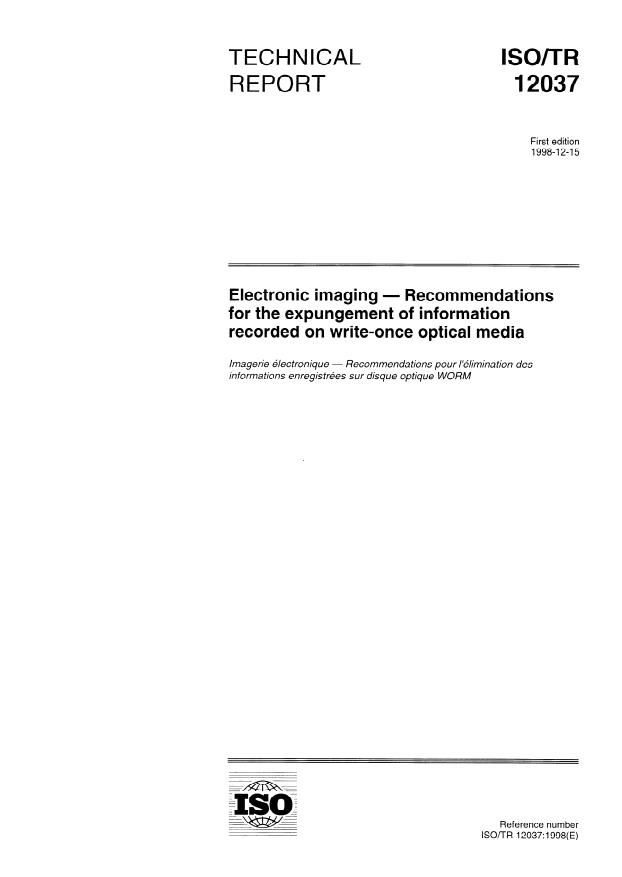
(Main)Electronic imaging — Recommendations for the expungement of information recorded on write-once optical media
General Information
- Abstract
This Technical Report applies to the removal of information recorded on write-once optical media systems when expungement is ordered by the court or administrative authority. Expungement requires specific removal actions to occur. This report establishes procedures for both information removal and documentation of the actions taken during removal. Following the recommendations contained in this Technical Report will ensure that the expungements are performed consistently.
- Status
- Published
- Publication Date
- 16-Dec-1998
- Technical Committee
- ISO/TC 171/SC 1 - Quality, preservation and integrity of information
- Drafting Committee
- ISO/TC 171/SC 1 - Quality, preservation and integrity of information
- Current Stage
- 9093 - International Standard confirmed
- Start Date
- 02-Apr-2013
- Completion Date
- 29-Aug-2026
Buy Documents
ISO/TR 12037:1998 - Electronic imaging — Recommendations for the expungement of information recorded on write-once optical media Released:12/17/1998
ISO/TR 12037:1998 - Electronic imaging — Recommendations for the expungement of information recorded on write-once optical media Released:12/17/1998
Overview
ISO/TR 12037:1998 - Electronic imaging: Recommendations for the expungement of information recorded on write‑once optical media - provides guidance for legally ordered expungement on write‑once optical media. The Technical Report covers technologies such as WORM, magneto‑optical (MO), CD-ROM, CD-R, and optical tape, and establishes consistent procedures for removing recorded information and documenting the actions so that expungements are legally defensible.
Key topics and technical requirements
- Scope and media covered: Applies specifically to expungement on write‑once optical media (WORM, CD‑R, CD‑WORM, MO, optical tape).
- File integrity and audit trail: Emphasizes maintaining accuracy, completeness and legal admissibility by documenting expungement procedures and creating an audit trail (see ISO/TR 12654 referenced).
- Capture of court orders and change notices: If a court order could reveal protected content, the order itself should not be stored on the write‑once media; instead record a Change Notice that references the order without revealing sensitive data.
- Physical elimination / obliteration: Recommends rendering original images uninterpretable, typically by overwriting with revised images or controlled software modules that perform overwrite steps (double overwrite recommended where applicable).
- Rewriting / consolidation: Where necessary, consolidate acceptable records onto new write‑once media and physically destroy the original media that contains expunged records.
- Index management: Remove all index references to expunged pages/records; recopy or update indexes and ensure no side effects remain that could reveal the expungement.
- Documentation: Maintain the court order and the completed Change Notice; record who performed the expungement, dates, and methods used.
- Destruction of copies: All copies - paper, magnetic, film or optical - containing the original unexpunged information must be destroyed or rendered uninterpretable.
Applications and who should use it
ISO/TR 12037 is intended for organizations that must comply with court‑ordered expungements, including:
- Courts, clerks of court and court administrators
- Law enforcement and probation/parole agencies
- Social services, juvenile services, schools and archives
- Vital records centers and any organization using write‑once optical media for records
Practical uses include policy development, procurement requirements (vendors should demonstrate and certify expungement methods), system design reviews, and operational procedures for evidence preservation and lawful data removal.
Related standards
- ISO/TR 12654:1997 - Recommendations for the management of electronic recording systems for recording documents that may be required as evidence on WORM optical disk (referenced for audit trail and capture guidance).
Takeaway: ISO/TR 12037 provides practical, legally focused guidance to ensure court‑ordered expungement on write‑once optical media is performed consistently, documented thoroughly, and defensible in litigation.
Buy Documents
ISO/TR 12037:1998 - Electronic imaging — Recommendations for the expungement of information recorded on write-once optical media Released:12/17/1998
ISO/TR 12037:1998 - Electronic imaging — Recommendations for the expungement of information recorded on write-once optical media Released:12/17/1998
Frequently Asked Questions
ISO/TR 12037:1998 is a technical report published by the International Organization for Standardization (ISO). Its full title is "Electronic imaging — Recommendations for the expungement of information recorded on write-once optical media". This standard covers: This Technical Report applies to the removal of information recorded on write-once optical media systems when expungement is ordered by the court or administrative authority. Expungement requires specific removal actions to occur. This report establishes procedures for both information removal and documentation of the actions taken during removal. Following the recommendations contained in this Technical Report will ensure that the expungements are performed consistently.
This Technical Report applies to the removal of information recorded on write-once optical media systems when expungement is ordered by the court or administrative authority. Expungement requires specific removal actions to occur. This report establishes procedures for both information removal and documentation of the actions taken during removal. Following the recommendations contained in this Technical Report will ensure that the expungements are performed consistently.
ISO/TR 12037:1998 is classified under the following ICS (International Classification for Standards) categories: 37.080 - Document imaging applications. The ICS classification helps identify the subject area and facilitates finding related standards.
ISO/TR 12037:1998 is available in PDF format for immediate download after purchase. The document can be added to your cart and obtained through the secure checkout process. Digital delivery ensures instant access to the complete standard document.
Standards Content (Sample)
TECHNICAL ISOTTR
REPORT 12037
First edition
1998-l 2-l 5
Electronic imaging - Recommendations
for the expungement of information
recorded on write-once optical media
lmagerie klectronique - Recommendations pour I’klimina tion des
informations enregistrkes sur disque optique WORM
Reference number
ISOmR 12037: 1998(E)
ISO/TR 12037: 1998(E)
Contents
........................................................................................................................................................................
1 Scope 1
..................................................................................................................................................................
2 Reference 1
.............................................................................................................................................
3 Terms and definitions 1
.............................................................................................................................
4 File integrity recommendations 3
..........................................................................................................................................................................
5 Index 4
6 Copies . 4
Annex A (informative) Change notice . 5
Annex B (informative) Comments to the court administrator . 6
0 IS0 1998
All rights reserved. Unless otherwise specified, no part of this publication may be reproduced
or utilized in any form or by any means, electronic or mechanical, including photocopying and
microfilm, without permission in writing from the publisher.
International Organization for Standardization
Case postale 56 l CH-1211 Geneve 20 l Switzerland
Internet iso @ iso.ch
Printed in Switzerland
ii
0 IS0 ISO/TR 12037:1998(E)
Foreword
IS0 (the International Organization for Standardization) is a worldwide federation of national standards bodies (IS0
member bodies). The work of preparing International Standards is normally carried out through IS0 technical
committees. Each member body interested in a subject for which a technical committee has been established has
the right to be represented on that committee. International organizations, governmental and non-governmental, in
liaison with ISO, also take part in the work. IS0 collaborates closely with the International Electrotechnical
Commission (IEC) on all matters of electrotechnical standardization.
The main task of Technical Committees is to prepare International Standards, but in exceptional circumstances a
technical committee may propose the publication of a Technical Report of one of the following types:
hen the required support cannot be obtained for the publication of an international s despite
- type 1, w rd,
repeated efforts;
- type 2, when the subject is still under technical development or where for any other reason there is the future
but not immediate possibility of an agreement on an international standard;
- type 3, when a technical committee has co llected data of a different kind from that which is normally published
as an internatio nal stand ard (“state of the a r-t”, for example).
Technical Reports of types 1 and 2 are subject to review within three years of publication, to decide whether they
can be transformed into International Standards. Technical Reports of type 3 do not necessarily have to be
reviewed until the data they provide are considered to be no longer valid or useful.
ISO/TR 12037, which is a Technical Report of type 3, was prepared by Technical Committee ISOTTC 171,
Document imaging applications, Subcommittee SC 3, General issues.
Annexes A and B are for information only.
0 IS0
ISO/rR 12037: 1998(E)
Introduction
This Technical Report describes procedures for court ordered expungement of information recorded on write-once
media including the following technologies: Write-Once Read Many (WORM), Magneto-Optical Recording (MO),
Compact Disk-Read Only Memory (CD-ROM), CD-ROM Recordable (CD-R) and optical tape. This report has been
prepared for public offices such as courts, clerks of the court, law enforcement, social services, probation and parole,
juvenile services, schools, archives, and vital records centres.
It is recognized that, unlike magnetic or magneto-optical storage media, write-once media is inherently difficult to alter.
This Technical Report has been prepared to provide guidelines to ensure that uniform procedures are being followed,
in order to minimize the possibility of having information recorded on write-once media rejected in a court of law. For
example, a legally-ordered expungement, or expungement during file maintenance, may jeopardize the admissibility of
the entire set of records as evidence in a court of law if the expungement is not documented and performed according
to proper procedures.
Organizations that are subjected to expungement rulings should work with the manufacturer and manufacturer’s
engineering staff or supplier to obtain a satisfactory method to eliminate expunged data. Write-once media system
users should address expungement prior to system implementation, in fact, as early as possible in the system design
phase. Write-once optical media system users should further require vendors to demonstrate their expungement
procedures and prepare a certification assuring that index data recovery and image recovery can not be performed
following expungement. In addition, certification and demonstration should also be required when implementing write-
once optical media system hardware or software upgrades.
Some write-once optical media systems have been implemented in such a way that makes expunging difficult or
impossible. Unless the information to be expunged can be rendered uninterpretible through hardware and/or software
processes, expungement can only take place by copying acceptable records (i.e., records that are not expunged) from
one disk to another, destroying the first disk that contains negated record(s), and ensuring that all appropriate index
entries have been updated to reflect the expungement. Update of Index entries must ensure that no side effects related
to unexpunged records occur. The issue of index update is critical because, according to the rules of an expungement,
once an expungement has occurred, then it must be impossible to discern that the expungement has occurred.
One method of expungement that can be used includes arranging a controlled software module that would permit
wiping out a record and any computer-based indices identifying the record. It is recommended that such a software
module provide a double overwrite of the selected records to lessen the possibility of the destroyed information being
reconstructed. Double overwrite procedures may vary between write-once media system manufacturers and suppliers
due to different implementation methods.
iv
TECHNICAL REPORT o Is0
Electronic imaging - Recommendations for the expungement of
information recorded on write-once optical media
1 Scope
This Technical Report applies to the removal of information recorded on write-once optical media systems when
expungement is ordered by the court or administrative authority. Expungement requires specific removal actions to
occur.
This report establishes procedures for both information removal and documentation of the actions taken during
removal. Following the recommendations contained in this Technical Report will ensure that the expungements are
performed consistently.
2 Reference
Recommendations for the management of electronic recording systems
ISOfTR 12654:1997, Electronic imaging -
for the recording of documents that may be required as evidence, on WORM optical disk.
3 Terms and definitions
For the purpose of this Technical Report the following definitions apply.
3.1
amendment
correction or revision
3.2
bit-map
method of representing images by assigning an i
...
TECHNICAL ISO/TR
REPORT 12037
First edition
1998-12-15
Electronic imaging — Recommendations
for the expungement of information
recorded on write-once optical media
Imagerie électronique — Recommendations pour l'élimination des
informations enregistrées sur disque optique WORM
A
Reference number
Contents
1 Scope .1
2 Reference.1
3 Terms and definitions .1
4 File integrity recommendations .3
5 Index.4
6 Copies.4
Annex A (informative) Change notice .5
Annex B (informative) Comments to the court administrator.6
© ISO 1998
All rights reserved. Unless otherwise specified, no part of this publication may be reproduced
or utilized in any form or by any means, electronic or mechanical, including photocopying and
microfilm, without permission in writing from the publisher.
International Organization for Standardization
Case postale 56 • CH-1211 Genève 20 • Switzerland
Internet iso@iso.ch
Printed in Switzerland
ii
© ISO ISO/TR 12037:1998(E)
Foreword
ISO (the International Organization for Standardization) is a worldwide federation of national standards bodies (ISO
member bodies). The work of preparing International Standards is normally carried out through ISO technical
committees. Each member body interested in a subject for which a technical committee has been established has
the right to be represented on that committee. International organizations, governmental and non-governmental, in
liaison with ISO, also take part in the work. ISO collaborates closely with the International Electrotechnical
Commission (IEC) on all matters of electrotechnical standardization.
The main task of Technical Committees is to prepare International Standards, but in exceptional circumstances a
technical committee may propose the publication of a Technical Report of one of the following types:
type 1, when the required support cannot be obtained for the publication of an international standard, despite
repeated efforts;
type 2, when the subject is still under technical development or where for any other reason there is the future
but not immediate possibility of an agreement on an international standard;
type 3, when a technical committee has collected data of a different kind from that which is normally published
as an international standard (“state of the art”, for example).
Technical Reports of types 1 and 2 are subject to review within three years of publication, to decide whether they
can be transformed into International Standards. Technical Reports of type 3 do not necessarily have to be
reviewed until the data they provide are considered to be no longer valid or useful.
ISO/TR 12037, which is a Technical Report of type 3, was prepared by Technical Committee ISO/TC 171,
Document imaging applications, Subcommittee SC 3, General issues.
Annexes A and B are for information only.
iii
Introduction
This Technical Report describes procedures for court ordered expungement of information recorded on write-once
media including the following technologies: Write-Once Read Many (WORM), Magneto-Optical Recording (MO),
Compact Disk-Read Only Memory (CD-ROM), CD-ROM Recordable (CD-R) and optical tape. This report has been
prepared for public offices such as courts, clerks of the court, law enforcement, social services, probation and parole,
juvenile services, schools, archives, and vital records centres.
It is recognized that, unlike magnetic or magneto-optical storage media, write-once media is inherently difficult to alter.
This Technical Report has been prepared to provide guidelines to ensure that uniform procedures are being followed,
in order to minimize the possibility of having information recorded on write-once media rejected in a court of law. For
example, a legally-ordered expungement, or expungement during file maintenance, may jeopardize the admissibility of
the entire set of records as evidence in a court of law if the expungement is not documented and performed according
to proper procedures.
Organizations that are subjected to expungement rulings should work with the manufacturer and manufacturer's
engineering staff or supplier to obtain a satisfactory method to eliminate expunged data. Write-once media system
users should address expungement prior to system implementation, in fact, as early as possible in the system design
phase. Write-once optical media system users should further require vendors to demonstrate their expungement
procedures and prepare a certification assuring that index data recovery and image recovery can not be performed
following expungement. In addition, certification and demonstration should also be required when implementing write-
once optical media system hardware or software upgrades.
Some write-once optical media systems have been implemented in such a way that makes expunging difficult or
impossible. Unless the information to be expunged can be rendered uninterpretible through hardware and/or software
processes, expungement can only take place by copying acceptable records (i.e., records that are not expunged) from
one disk to another, destroying the first disk that contains negated record(s), and ensuring that all appropriate index
entries have been updated to reflect the expungement. Update of Index entries must ensure that no side effects related
to unexpunged records occur. The issue of index update is critical because, according to the rules of an expungement,
once an expungement has occurred, then it must be impossible to discern that the expungement has occurred.
One method of expungement that can be used includes arranging a controlled software module that would permit
wiping out a record and any computer-based indices identifying the record. It is recommended that such a software
module provide a double overwrite of the selected records to lessen the possibility of the destroyed information being
reconstructed. Double overwrite procedures may vary between write-once media system manufacturers and suppliers
due to different implementation methods.
iv
TECHNICAL REPORT © ISO ISO/TR 12037:1998(E)
Electronic imaging — Recommendations for the expungement of
information recorded on write-once optical media
1 Scope
This Technical Report applies to the removal of information recorded on write-once optical media systems when
expungement is ordered by the court or administrative authority. Expungement requires specific removal actions to
occur.
This report establishes procedures for both information removal and documentation of the actions taken during
removal. Following the recommendations contained in this Technical Report will ensure that the expungements are
performed consistently.
2 Reference
ISO/TR 12654:1997, Electronic imaging — Recommendations for the management of electronic recording systems
for the recording of documents that may be required as evidence, on WORM optical disk.
3 Terms and definitions
For the purpose of this Technical Report the following definitions apply.
3.1
amendment
correction or r
...