


ISO 12855:2015
(Main)Electronic fee collection — Information exchange between service provision and toll charging
Electronic fee collection — Information exchange between service provision and toll charging
ISO 12855:2015 specifies - the interfaces between electronic fee collection (EFC) systems for vehicle related transport services, e.g. road user charging, parking and access control; it does not cover interfaces for EFC systems for public transport; an EFC system can include any EFC system, e.g. including systems that automatically read licence plate numbers of vehicles passing a toll point, - an exchange of information between the central equipment of the two roles of service provision and toll charging, e.g. - charging related data (toll declarations, billing details), - administrative data, and - confirmation data, - transfer mechanisms and supporting functions, - information objects, data syntax and semantics, - examples of data interchanges (see Annex C and Annex D), and - an example on how to use this International Standard for the European Electronic Tolling Service (EETS) (see Annex F). ISO 12855:2015 is applicable for any toll service and any technology used for charging. It is defined as a toolbox standard of transactions and Application Protocol Data Units (APDUs), which can be used for the assigned purpose. The detailed definitions of mandatory and optional elements in a real implementation are defined elsewhere. It does not define all communication sequences, communication stacks and timings. The scope of ISO 12855:2015 is illustrated in Figure 2. The data types and associated coding related to the data elements described in Clause 6 are defined in Annex A, using the abstract syntax notation one (ASN.1) according to ISO/IEC 8824‑1.
Perception du télépéage — Échange d'informations entre la prestation de service et la perception du péage
L'ISO 12855:2015 spécifie: - les interfaces entre les installations EFC (Electronic Fee Collection) pour les services de transport associés aux véhicules, tels que la tarification routière, le stationnement et le contrôle d'accès. Elle ne couvre pas les interfaces pour les systèmes électroniques de perception de redevances pour les transports publics; une installation EFC peut comporter un système de perception de télépéage, tel que les systèmes permettant de lire automatiquement les numéros de plaques d'immatriculation des véhicules qui franchissent un point de péage; - l'échange d'informations entre les équipements centraux des deux rôles Prestation de service et Perception de péage, par exemple les données liées à la perception (déclarations de péage, détails de facturation), les données administratives, et les données de confirmation; - les mécanismes de transfert et les fonctions de support; - les objets d'information, la syntaxe et la sémantique des données; - les exemples d'échanges de données (voir les Annexes C et D) et - un exemple illustrant l'utilisation de cette norme Internationale pour le service de télépéage européen (voir Annexe F) L'ISO 12855:2015 supporte tout service de péage et toute technologie utilisée dans le cadre de la perception. Elle est définie comme une norme «boîte à outils» pour les transactions et les messages pouvant être utilisée pour l'objectif prévu. La définition détaillée des éléments obligatoires et facultatifs dans une implémentation réelle doit être définie par ailleurs. Elle ne définit pas toutes les séquences de communication, ni les couches de communication et les paramètres temporels. Le domaine d'application de l'ISO 12855:2015 est illustré à la Figure 2. Les types de données et le codage associé aux éléments de données associés décrits dans l'Article 6 sont définis dans l'Annexe A, à l'aide de la technique de la notation de syntaxe abstraite numéro un (ASN.1) conformément à l'ISO/CEI 8824‑1.
General Information
- Status
- Withdrawn
- Publication Date
- 13-Dec-2015
- Technical Committee
- ISO/TC 204 - Intelligent transport systems
- Drafting Committee
- ISO/TC 204/WG 5 - Fee and toll collection
- Current Stage
- 9599 - Withdrawal of International Standard
- Start Date
- 08-Apr-2022
- Completion Date
- 14-Feb-2026
Relations
- Effective Date
- 09-Feb-2026
- Referred By
CEN ISO/TS 19299:2015 - Electronic fee collection - Security framework (ISO/TS 19299:2015) - Effective Date
- 09-Feb-2026
- Effective Date
- 09-Feb-2026
- Effective Date
- 12-Feb-2026
- Effective Date
- 06-Jun-2022
- Effective Date
- 23-Apr-2020
- Effective Date
- 22-Jun-2013
Buy Documents

ISO 12855:2015 - Electronic fee collection -- Information exchange between service provision and toll charging

ISO 12855:2015 - Perception du télépéage -- Échange d'informations entre la prestation de service et la perception du péage
Get Certified
Connect with accredited certification bodies for this standard

BSI Group
BSI (British Standards Institution) is the business standards company that helps organizations make excellence a habit.

Great Wall Tianjin Quality Assurance Center
Established 1993, first batch to receive national accreditation with IAF recognition.
Hong Kong Quality Assurance Agency (HKQAA)
Hong Kong's leading certification body.
Sponsored listings
Frequently Asked Questions
ISO 12855:2015 is a standard published by the International Organization for Standardization (ISO). Its full title is "Electronic fee collection — Information exchange between service provision and toll charging". This standard covers: ISO 12855:2015 specifies - the interfaces between electronic fee collection (EFC) systems for vehicle related transport services, e.g. road user charging, parking and access control; it does not cover interfaces for EFC systems for public transport; an EFC system can include any EFC system, e.g. including systems that automatically read licence plate numbers of vehicles passing a toll point, - an exchange of information between the central equipment of the two roles of service provision and toll charging, e.g. - charging related data (toll declarations, billing details), - administrative data, and - confirmation data, - transfer mechanisms and supporting functions, - information objects, data syntax and semantics, - examples of data interchanges (see Annex C and Annex D), and - an example on how to use this International Standard for the European Electronic Tolling Service (EETS) (see Annex F). ISO 12855:2015 is applicable for any toll service and any technology used for charging. It is defined as a toolbox standard of transactions and Application Protocol Data Units (APDUs), which can be used for the assigned purpose. The detailed definitions of mandatory and optional elements in a real implementation are defined elsewhere. It does not define all communication sequences, communication stacks and timings. The scope of ISO 12855:2015 is illustrated in Figure 2. The data types and associated coding related to the data elements described in Clause 6 are defined in Annex A, using the abstract syntax notation one (ASN.1) according to ISO/IEC 8824‑1.
ISO 12855:2015 specifies - the interfaces between electronic fee collection (EFC) systems for vehicle related transport services, e.g. road user charging, parking and access control; it does not cover interfaces for EFC systems for public transport; an EFC system can include any EFC system, e.g. including systems that automatically read licence plate numbers of vehicles passing a toll point, - an exchange of information between the central equipment of the two roles of service provision and toll charging, e.g. - charging related data (toll declarations, billing details), - administrative data, and - confirmation data, - transfer mechanisms and supporting functions, - information objects, data syntax and semantics, - examples of data interchanges (see Annex C and Annex D), and - an example on how to use this International Standard for the European Electronic Tolling Service (EETS) (see Annex F). ISO 12855:2015 is applicable for any toll service and any technology used for charging. It is defined as a toolbox standard of transactions and Application Protocol Data Units (APDUs), which can be used for the assigned purpose. The detailed definitions of mandatory and optional elements in a real implementation are defined elsewhere. It does not define all communication sequences, communication stacks and timings. The scope of ISO 12855:2015 is illustrated in Figure 2. The data types and associated coding related to the data elements described in Clause 6 are defined in Annex A, using the abstract syntax notation one (ASN.1) according to ISO/IEC 8824‑1.
ISO 12855:2015 is classified under the following ICS (International Classification for Standards) categories: 03.220.20 - Road transport; 35.240.60 - IT applications in transport. The ICS classification helps identify the subject area and facilitates finding related standards.
ISO 12855:2015 has the following relationships with other standards: It is inter standard links to CEN ISO/TS 17444-1:2017, CEN ISO/TS 19299:2015, EN ISO 19299:2020, EN ISO 12855:2015, ISO/IEC 15938-5:2003/Amd 2:2005, ISO 12855:2022, ISO 12855:2012. Understanding these relationships helps ensure you are using the most current and applicable version of the standard.
ISO 12855:2015 is available in PDF format for immediate download after purchase. The document can be added to your cart and obtained through the secure checkout process. Digital delivery ensures instant access to the complete standard document.
Standards Content (Sample)
INTERNATIONAL ISO
STANDARD 12855
Second edition
2015-12-15
Electronic fee collection —
Information exchange between service
provision and toll charging
Perception du télépéage — Échange d’informations entre la
prestation de service et la perception du péage
Reference number
©
ISO 2015
© ISO 2015, Published in Switzerland
All rights reserved. Unless otherwise specified, no part of this publication may be reproduced or utilized otherwise in any form
or by any means, electronic or mechanical, including photocopying, or posting on the internet or an intranet, without prior
written permission. Permission can be requested from either ISO at the address below or ISO’s member body in the country of
the requester.
ISO copyright office
Ch. de Blandonnet 8 • CP 401
CH-1214 Vernier, Geneva, Switzerland
Tel. +41 22 749 01 11
Fax +41 22 749 09 47
copyright@iso.org
www.iso.org
ii © ISO 2015 – All rights reserved
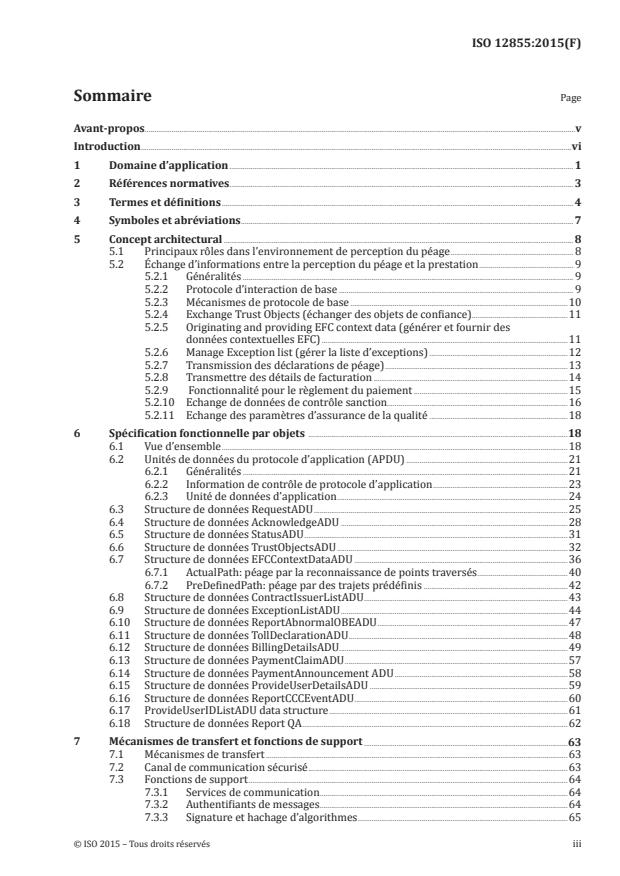
Contents Page
Foreword .v
Introduction .vi
1 Scope . 1
2 Normative references . 2
3 Terms and definitions . 3
4 Symbols and abbreviated terms . 6
5 Architectural concepts and information exchanges . 7
5.1 Main roles in the toll charging environment . 7
5.2 Information exchange between toll charging and provision. 8
5.2.1 General. 8
5.2.2 Basic interaction protocol . 9
5.2.3 Basic protocol mechanisms . 9
5.2.4 Exchange trust objects functionality .10
5.2.5 Exchange of EFC context data and contractual information functionality .11
5.2.6 Manage exception list functionality.11
5.2.7 Report toll declarations functionality .12
5.2.8 Report billing details functionality .13
5.2.9 Payment settlement functionality .14
5.2.10 Exchange enforcement data functionality .15
5.2.11 Exchange quality assurance parameters functionality .16
6 Computational specification .17
6.1 Overview .17
6.2 Application Protocol Data Units .19
6.2.1 General.19
6.2.2 Application Protocol Control Information .21
6.2.3 Application Data Units .21
6.3 RequestADU data structure .22
6.4 AckADU data structure .24
6.5 StatusADU data structure .28
6.6 TrustObjectsADU data structure .29
6.7 EfcContextDataADU data structure .33
6.7.1 ActualPath: tolling by recognition of traversed points .37
6.7.2 PreDefinedPath: Tolling by predefined paths .39
6.8 ContractIssuerListADU data structure .40
6.9 ExceptionListADU data structure .41
6.10 ReportAbnormalOBEADU data structure .43
6.11 Toll DeclarationADU data structure .44
6.12 BillingDetailsADU data structure .45
6.13 PaymentClaimADU data structure .52
6.14 PaymentAnnouncement ADU data structure .54
6.15 ProvideUserDetailsADU data structure .55
6.16 ReportCCCEventADU data structure .56
6.17 ProvideUserIDListADU data structure .57
6.18 Report QA data structure .57
7 Transfer mechanisms and supporting functions .58
7.1 Transfer mechanisms .58
7.2 Secure communication channel .58
7.3 Supporting functions .59
7.3.1 Communication services .59
7.3.2 Authenticators .59
7.3.3 Signature and hash algorithms .60
7.3.4 Keys encryption .61
Annex A (normative) Data type specifications .62
Annex B (normative) Implementation Conformance Statement (ICS) .63
Annex C (informative) Example enforcement process applying standardized APDU exchanges .86
Annex D (informative) Example of data flows in a toll domain .91
Annex E (informative) Example of rounding differences .94
Annex F (informative) Use of this International Standard for the EETS .98
Bibliography .100
iv © ISO 2015 – All rights reserved
Foreword
ISO (the International Organization for Standardization) is a worldwide federation of national standards
bodies (ISO member bodies). The work of preparing International Standards is normally carried out
through ISO technical committees. Each member body interested in a subject for which a technical
committee has been established has the right to be represented on that committee. International
organizations, governmental and non-governmental, in liaison with ISO, also take part in the work.
ISO collaborates closely with the International Electrotechnical Commission (IEC) on all matters of
electrotechnical standardization.
The procedures used to develop this document and those intended for its further maintenance are
described in the ISO/IEC Directives, Part 1. In particular the different approval criteria needed for the
different types of ISO documents should be noted. This document was drafted in accordance with the
editorial rules of the ISO/IEC Directives, Part 2 (see www.iso.org/directives).
Attention is drawn to the possibility that some of the elements of this document may be the subject of
patent rights. ISO shall not be held responsible for identifying any or all such patent rights. Details of
any patent rights identified during the development of the document will be in the Introduction and/or
on the ISO list of patent declarations received (see www.iso.org/patents).
Any trade name used in this document is information given for the convenience of users and does not
constitute an endorsement.
For an explanation on the meaning of ISO specific terms and expressions related to conformity
assessment, as well as information about ISO’s adherence to the WTO principles in the Technical
Barriers to Trade (TBT) see the following URL: Foreword - Supplementary information
The committee responsible for this document is ISO/TC 204, Intelligent transport systems.
This second edition cancels and replaces the first edition (ISO 12855:2012), which has been technically
revised. The following changes have been made:
— adding new Application Data Units (ADUs) due to comments received from National Bodies;
— aligning the ASN.1 data definitions with the current versions of EN 14906, and ISO 17575 (all parts);
— moving the ASN.1 module from Annex A to an external text file, in a format that can be processed by
ASN.1 compilers;
— clarifying the semantics of parameters in ADUs;
— aligning the structure of all major clauses in a consistent manner to improve readability.
Introduction
The widespread use of tolling requires provisions for users of vehicles that circulate through many
different toll domains. Users should be offered a single contract for driving a vehicle through various
toll domains. Where those vehicles require a form of on-board equipment (OBE) this should be
interoperable with the toll systems in the various toll domains. In Europe, for example, this need has
been officially recognized and legislation on interoperability has already been adopted (see Directive
2004/52/EC and Decision 2009/750/EC). There is both a commercial and economic justification in
respect to the OBE and the toll systems for standards enabling interoperability.
The system architecture defined in ISO 17573 is the basis for all standards that relate to tolling systems
in the toll domain. With respect to ISO 17573, this International Standard
— adopts its definitions of terms and concepts and basic system functionalities and structure,
— uses its terminology, and
— specifies the interfaces therein identified.
ISO 17573 uses ISO/IEC 10746-3 for the description of the architecture.
Figure 1 shows the scope of the group of electronic fee collection (EFC) related standards based upon
the architecture standard.
Figure 1 — Scope of EFC related standards
A given transport service for a given vehicle is fully identified by one or several toll declarations made
available to the Toll Charger (TC). Toll declarations have to be made available according to the rules of
the toll regime of the toll domain.
The amount due for a given transport service used by a vehicle liable to toll is finalized by the TC with
the use of toll declarations (as described above) and calculation is made according to the rules of the
toll regime (formula, tariff tables, specific situations rules, traffic conditions, etc.). That means that the
vi © ISO 2015 – All rights reserved
TC has the authority to decide on the amount due, even if it decides to assign the Toll Service Provider
(TSP) the task to calculate the amount due.
The information above, associated with a given transport service, is named billing details; for a given
transport service, the billing details are referring to one or several toll declarations.
Depending on the toll regime, billing details are elaborated with information collected by the TC and/or
the relevant TSP; they are finalized by the TC.
The TC elaborates and makes the payment claims (or toll payment claims) available to each TSP,
according to the bilateral agreements it has with each TSP, referring to billing details. These payment
claims include an amount due taking into account any specific commercial conditions applicable to a
vehicle, a fleet of vehicles or a given TSP.
This International Standard defines a set of interactions in support of technical interoperability
between back-office systems of TCs and TSPs. The EFC-service and the EFC System model on which this
International Standard is based is defined in ISO 17573.
This International Standard does not provide a full solution for interoperability, and it does not define
other parts of the EFC system, other services, other technologies and non-technical elements of
interoperability.
The development of a common European Electronic Toll Service (EETS) as a part of the European EFC
Directive (2004/52/EC) also calls for the definition of an interoperable EFC service. This International
Standard provides for effective support for the work on the definition of EETS. Details on the usage of
this International Standard for the EETS are provided in Annex F.
This International Standard identifies and specifies the set of Application Protocol Data Units exchanged
between two actors in the roles of Toll Service Provider and Toll Charger as defined in ISO 17573.
To specify these interfaces, this International Standard uses the enterprise description of the toll
environment, and the interactions defined between the named classes of roles, as defined in ISO 17573.
This allows for a complete specification of the data that is transferred between those identified entities.
In addition, a number of computational interfaces are identified and interactions in terms of sequences
of Application Protocol Data Units are defined.
INTERNATIONAL STANDARD ISO 12855:2015(E)
Electronic fee collection — Information exchange between
service provision and toll charging
1 Scope
This International Standard specifies
— the interfaces between electronic fee collection (EFC) systems for vehicle related transport
services, e.g. road user charging, parking and access control; it does not cover interfaces for EFC
systems for public transport; an EFC system can include any EFC system, e.g. including systems that
automatically read licence plate numbers of vehicles passing a toll point,
— an exchange of information between the central equipment of the two roles of service provision and
toll charging, e.g.
— charging related data (toll declarations, billing details),
— administrative data, and
— confirmation data,
— transfer mechanisms and supporting functions,
— information objects, data syntax and semantics,
— examples of data interchanges (see Annex C and Annex D), and
— an example on how to use this International Standard for the European Electronic Tolling Service
(EETS) (see Annex F).
This International Standard is applicable for any toll service and any technology used for charging.
It is defined as a toolbox standard of transactions and Application Protocol Data Units (APDUs), which
can be used for the assigned purpose. The detailed definitions of mandatory and optional elements
in a real implementation are defined elsewhere. It does not define all communication sequences,
communication stacks and timings.
The scope of this International Standard is illustrated in Figure 2. The data types and associated coding
related to the data elements described in Clause 6 are defined in Annex A, using the abstract syntax
notation one (ASN.1) according to ISO/IEC 8824-1.
Figure 2 — Scope of this International Standard
This International Standard is not applicable to
— any communication between Toll Charger (TC) or Toll Service Provider (TSP) with any other
involved party,
— any communication between elements of the TC and the TSP that is not part of the back office
communication,
— processes regarding payments and exchanges of fiscal, commercial or legal accounting
documents, and
— definitions of service communication channels, protocols and service primitives to transfer the APDUs.
2 Normative references
The following documents, in whole or in part, are normatively referenced in this document and are
indispensable for its application. For dated references, only the edition cited applies. For undated
references, the latest edition of the referenced document (including any amendments) applies.
ISO 639-1, Codes for the representation of names of languages — Part 1: Alpha-2 code
ISO 3166-1, Codes for the representation of names of countries and their subdivisions — Part 1: Country codes
ISO/IEC 8824-1, Information technology — Abstract Syntax Notation One (ASN.1): Specification of
basic notation
ISO/IEC 8825-4, Information technology — ASN.1 encoding rules: XML Encoding Rules (XER)
ISO/IEC 9594-8:2014, Information technology — Open Systems Interconnection — The Directory —
Part 8: Public-key and attribute certificate frameworks
2 © ISO 2015 – All rights reserved
ISO/IEC 9646-7, Information technology — Open Systems Interconnection — Conformance testing
methodology and framework — Part 7: Implementation Conformance Statements
ISO/IEC 9797-2:2011, Information technology — Security techniques — Message Authentication Codes
(MACs) — Part 2: Mechanisms using a dedicated hash-function
ISO/IEC 10118-3, Information technology — Security techniques — Hash-functions — Part 3: Dedicated
hash-functions
ISO/IEC 11770-3, Information technology — Security techniques — Key management —Part 3: Mechanisms
using asymmetric techniques
ISO/IEC 14888-2:2008, Information technology — Security techniques — Digital signatures with
appendix — Part 2: Integer factorization based mechanisms
ISO 14906:2011/Amd1:2015, Electronic fee collection — Application interface definition for dedicated
short-range communication
ISO 17573, Electronic fee collection — Systems architecture for vehicle-related tolling
1)
ISO 17575-1:— , Electronic fee collection — Application interface definition for autonomous systems —
Part 1: Charging
1)
ISO 17575-3:— , Electronic fee collection — Application interface definition for autonomous systems —
Part 3: Context data
ISO/IEC 18033-2:2006, Information technology — Security techniques — Encryption algorithms — Part 2:
Asymmetric ciphers
ISO/TS 19299:2015, Electronic fee collection — Security framework
IETF RFC 2634, Enhanced Security Services for S/MIME, June 1999
IETF RFC 4347, Datagram Transport Layer Security, April 2006
IETF RFC 5035, Enhanced Security Services (ESS) Update: Adding CertID Algorithm Agility, August 2007
IETF RFC 5246, The Transport Layer Security (TLS) Protocol, August 2008
IETF RFC 5746, Transport Layer Security (TLS) Renegotiation Indication Extension, February 2010
IETF RFC 6040, Tunnelling of Explicit Congestion Notification, February 2013
3 Terms and definitions
For the purposes of this document, the following terms and definitions apply.
3.1
billing detail
information needed to determine or verify the amount due for the usage of a given service
Note 1 to entry: If the data are accepted by both the Toll Charger and the Toll Service Provider then the term used
is “concluded billing detail”, which can be used to issue a payment claim.
Note 2 to entry: For a given transport service, the billing detail refers to one or several valid toll declaration(s).
A valid billing detail has to fulfil formal requirements, including security requirements, agreed between the Toll
Service Provider and the Toll Charger.
1) To be published.
3.2
black list
list of users for which the service provider denies contractual responsibility
Note 1 to entry: The service provider in the context of this International Standard is the Toll Service Provider (TSP).
3.3
charge report
information containing road usage and related information originated at the Front End
Note 1 to entry: In European Decision 2009/750/EC, a charge report is referred to as a “toll declaration”.
[SOURCE: ISO 17575-1:—, 3.6]
3.4
charging data
relevant data on the usage of a certain service
3.5
computational specification
decomposition of a system into objects performing individual functions and interacting at well-
defined interfaces
3.6
electronic fee collection
EFC
fee collection by electronic means
3.7
enforcement
measures or actions performed to achieve compliance with laws, regulations or rules
Note 1 to entry: In this context: the process of compelling observance of a toll regime.
3.8
interoperability
ability of systems to exchange information and to make mutual use of the information that has
been exchanged
Note 1 to entry: For tolling, interoperability aims at enabling a vehicle to drive through various toll domains
while having only one on-board equipment operating under one contract with a Toll Service Provider.
[SOURCE: ISO/IEC TR 10000-1:1998, 3.2.1, modified.]
3.9
on-board equipment
OBE
all required equipment on-board a vehicle for performing required EFC (3.6) functions and
communication services
3.10
payment claim
recurring statement referring to concluded billing details (3.1) made available to the payer by the payee
indicating and justifying the amount due
Note 1 to entry: The payment claim is used by the Toll Service Provider to issue financial objects to its customers
(e.g. invoices on behalf of the Toll Charger). A given toll payment claim refers to billing details (3.1) and takes into
account any specific commercial conditions applicable to a vehicle, a fleet of vehicles, a customer of a Toll Service
Provider and/or a Toll Service Provider. A valid “payment claim” has to fulfil formal requirements, including
security requirements, agreed between the Toll Service Provider and the Toll Charger.
4 © ISO 2015 – All rights reserved
3.11
roadside equipment
RSE
equipment located along the road, ether fixed or mobile
3.12
tariff scheme
set of rules to determine the fee due for a vehicle within a toll domain (3.17)
EXAMPLE A table that shows the fee for various classes of vehicles.
3.13
toll
charge, tax or duty levied in relation with using a vehicle in a toll domain (3.17)
Note 1 to entry: The definition is a generalization of the classic definition of a toll as “a charge, a tax, or a duty for
permission to pass a barrier or to proceed along a road, over a bridge, etc.”. The definition above also includes
fees regarded as an (administrative) obligation, e.g. a tax or a duty.
3.14
toll charger
TC
entity which levies toll (3.13) for the use of vehicles in a toll domain (3.17)
Note 1 to entry: In other documents the terms “operator” or “toll operator” can be used.
[SOURCE: ISO 17573:2010, 3.16, modified — “legal” has been deleted from before “entity” and “the use
of” has been added.]
3.15
toll context data
information defined by the responsible Toll Charger (3.14) necessary to establish the toll (3.13) due for
using a vehicle on a particular toll context and to conclude the toll transaction
[SOURCE: ISO 12855:2015, 3.15]
3.16
toll declaration
statement to declare the usage of a given toll (3.13) service to a Toll Charger (3.14)
Note 1 to entry: A valid toll declaration has to fulfil formal requirements, including security requirements, agreed
between the Toll Service Provider (3.19) and the Toll Charger (3.14).
[SOURCE: ISO/TS 19299:2015, 3.44]
3.17
toll domain
area or a part of a road network where a certain toll regime (3.18) is applied
[SOURCE: ISO 17573:2010, 3.18, modified — “certain” has been added.]
3.18
toll regime
set of rules, including enforcement (3.7) rules, governing the collection of toll (3.13) in a toll domain (3.17)
[SOURCE: ISO 17573:2010, 3.20]
3.19
toll service provider
TSP
entity providing toll (3.13) services in one or more toll domains (3.17)
Note 1 to entry: In other documents the terms “issuer” or “contract issuer” can be used.
Note 2 to entry: The Toll Service Provider (3.19) can provide the on-board equipment (3.9) or can provide only a
magnetic card or a smart card to be used with on-board equipment (3.9) provided by a third party.
Note 3 to entry: The Toll Service Provider (3.19) is responsible for the operation (functioning) of the on-board
equipment (3.9).
[SOURCE: ISO 17573:2010, 3.23, modified — the definition has been condensed.]
3.20
trust object
information object that is exchanged between entities to ensure mutual trust
EXAMPLE An electronic signature or an electronic certificate.
[SOURCE: ISO 17573:2010, 3.28]
3.21
white list
list of users for which the service provider accepts contractual responsibility
Note 1 to entry: The service provider in the context of this International Standard is the Toll Service Provider (3.19).
Note 2 to entry: An entry on a white list is independent of entries on a black list (3.2).
4 Symbols and abbreviated terms
ADU Application data unit (ISO 14906)
ANPR Automatic Number Plate Reading
APCI Application Protocol Control Information
APDU Application Protocol Data Unit (ISO 14906)
CCC Compliance Check Communication (ISO 12813)
CRL Certificate revocation list
DSRC Dedicated short-range communication (ISO 14906)
DTLS Datagram Transport Layer Security
EFC Electronic Fee Collection (ISO 17573)
GNSS Global Navigation Satellite System
HTTPS Hyper-Text Transfer Protocol Secure
ICS Implementation Conformance Statement
IEC International Electrotechnical Commission
IUT Implementation Under Test
ITU International Telecommunication Union
LPN Licence Plate Number
OBE On-Board Equipment (ISO 14906)
OBU On-Board Unit
OCSP Online Certificate Status Protocol
6 © ISO 2015 – All rights reserved
OSI Open Systems Interconnection
PAN Personal Account Number (ISO 14906)
QA Quality Assurance
RSA Rivest, Shamir and Adleman (ISO/TS 19299)
RSE Roadside Equipment (ISO 14906)
SLA Service Level Agreement
SU Service User
SUT System Under Test (ISO/TS 14907-1)
TC Toll Charger
TLS Transport Layer Security
TSP Toll Service Provider
VRM Vehicle Registration Mark
NOTE RSA is an algorithm for public-key cryptography, also referred to as asymmetrical cryptographic
technique.
5 Architectural concepts and information exchanges
5.1 Main roles in the toll charging environment
This International Standard is built upon ISO 17573.
ISO 17573 defines the four main roles shown in Figure 3.
Figure 3 — Roles in the toll charging environment
Information exchanges are agreed upon between Toll Charger and Service Provider, taking into account
privacy regulations. The information exchanges needed by the Toll Charger and the Toll Service
Provider to perform their roles are described in this Clause 5.
5.2 Information exchange between toll charging and provision
5.2.1 General
The information exchange between the service provision and the toll charging roles supports the
provision of functionalities that are based on the EFC system behaviour definitions in ISO 17573.
These functionalities are listed below, in the order they are given in Clauses 5 and 6:
— basic protocol mechanisms;
— exchange trust objects;
— exchange of EFC context data and contractual information;
— manage exception list;
— report toll declarations;
— report billing details;
— payment settlement:
— claim payment for service usage;
— announce payments;
— exchange enforcement data (includes user details);
8 © ISO 2015 – All rights reserved
— exchange quality assurance parameters.
This International Standard leaves implementers the freedom of defining suitable protocol procedures,
i.e. for complex transactions. Therefore, it only defines
— a basic interaction protocol (request – response) for information exchange,
— basic protocol mechanisms, to be used to build more complex protocol procedures, and
— the semantics and the format of the APDUs that are exchanged.
These functionalities are described in 5.2.2 to 5.2.11.
5.2.2 Basic interaction protocol
Information exchanges are performed by means of APDU transfers.
Some APDU transfers need to be acknowledged. When this happens, related protocol procedures are
specified. This International Standard defines no provisions for complex transfers (transactions), i.e.
APDU transfers that cover several APDUs. Instead, this International Standard defines basic protocol
mechanisms to be used by implementations that need to define and perform transactions.
5.2.3 Basic protocol mechanisms
5.2.3.1 General approach
This International Standard provides the following basic protocol mechanisms, which shall be
implemented to exchange information between the Toll Service Provider’s and the Toll Charger’s central
equipment. These basic protocol mechanisms consist of
— an identification schema for the APDUs that are exchanged,
— a generic interaction (i.e. not related to any specific functionality) that allows requesting a specific
information exchange from the counterpart. This interaction is provided by the “request” ADU,
— a generic acknowledge mechanism (i.e. not related to any specific functionality) that allows
acknowledging a specific interaction. The “ack” ADU provides this mechanism, and
— an optional generic status mechanism (i.e. not related to any specific functionality) that allows
providing status information for a specific interchange. This mechanism is provided by the
“status” ADU.
By means of the above mechanisms, an implementation can build more complex protocol procedures,
including rollback, recovery, checkpointing or restart.
This International Standard does not specify timings and retry procedures for acknowledgements.
Timeouts can be defined as agreements between Toll Charger and Toll Service Provider to cover the
case of missing acknowledgements. To handle any lost APDUs a timeout system can be implemented.
5.2.3.2 Identification schema
Each interaction is performed by means of one or more APDU exchanges. Each APDU shall contain
a unique identifier in the namespace of the originator of the APDU. The combination of originator
identifier and APDU identifier ensures that all APDUs are uniquely identified.
5.2.3.3 Request functionality
The “request” functionality shall be used to
— alert the counterpart that one is ready to accept any kind of information exchange,
— inform the counterpart that one is ready to accept a specific type of ADU, by indicating the type of
ADU one is ready to accept,
— request the counterpart re-issue a specific APDU, by indicating the type and the identifier of the
APDU, and
— request information identified by type and ADU content.
5.2.3.4 Acknowledgement functionality
The “acknowledgement” functionality shall be used to inform the counterpart that a specific ADU has
been received correctly, or errors have been detected, or it is not supported.
5.2.3.5 Status functionality
The “status” functionality can be used to provide the counterpart with general status information on
the interface or inform it about a status on previously transferred information. It may be used to
— provide general information on the status of the interface,
— alert the counterpart that some previously provided information becomes invalid without any new
information being currently available, and
— alert the counterpart that the previous information contained an error and has to be recalled.
5.2.4 Exchange trust objects functionality
The “exchange trust objects” functionality is derived from the EFC system behaviours “adding (or
excluding) a new Toll Charger” and “adding (or excluding) a new Service Provider”. Actions performed
when executing the above behaviours shall exchange trust objects to be used in order to secure their
bilateral communication. The functionality may also be used whenever an entity sees the need to
update its own trust objects or another entity may ask for the update of an already existing trust object.
NOTE Examples of trust objects are: asymmetric public keys, certificates, symmetric keys and certificate
revocation lists.
Either the Toll Service Provider or Toll Charger can use the exchange trust objects functionality.
The initiator of the exchange can request the receiver to send trust objects by means of a “request”
ADU. The “request” ADU may contain an optional indicator that specifies already issued trust objects to
be resent. When no indicator is specified, the trust objects to be transferred shall be the current ones.
After receiving a “request” ADU that asks for trust objects, the requested trust objects are newly
generated (or retrieved) by the recipient of the request and sent to the requesting party who shall
acknowledge the reception by issuing an “ack” ADU.
If either party decides at any time to update any own trust objects, it can deliver them to any counterpart
without waiting for a “request” ADU.
The receiver of trust objects shall acknowledge the reception by issuing an “ack” ADU.
After acknowledgement, the exchanged trust objects shall be considered immediately valid unless
they contained a validity starting date. The validity period in this last case shall start from the time
indicated in the trust objects.
10 © ISO 2015 – All rights reserved
5.2.5 Exchange of EFC context data and contractual information functionality
5.2.5.1 Originating and providing EFC context data functionality
The “originating and providing EFC context data” functionality is derived from ISO 17573 as defined in
the EFC system behaviour “adding, modifying or closing a toll regime”.
The “originating and providing EFC context data” functionality may be used by a Toll Charger when
any change of a toll domain or toll regime occurs, including the start of a new toll domain, by issuing an
“EFC context data” ADU.
Any Toll Service Provider may request from any Toll Charger at any time and for any reason to send the
current or any previous version of the toll context data for a toll domain under its responsibility. This
operation is performed by means of a “request” ADU.
Reception of an “EFC context data” ADU shall be acknowledged by means of an “acknowledge” ADU.
The information describing a toll regime uses one or more sets of EFC Context Data. It is defined through
its tolled objects and the rules associated with them. EFC Context Data elements are defined in detail in
ISO 17575-3, and are extended in this International Standard for DSRC-based and other tolling systems.
Other toll regime properties to be configured by the Toll Charger are the interrelations a toll regime
may have in relation to others. These rules and configuration parameters are defined in ISO 17575-3
and are addressed within this International Standard as Toll Context interrelations.
5.2.5.2 Contractual information functionality
The contractual information functionality allows a Toll Service Provider to deliver to the Toll Charger
any type of user contract related information that is stored in the OBEs, among which the personal
account number (PAN), the supported security level and the key set to be used in the calculation of
DSRC authenticators. This functionality allows the Toll Charger to compare data that is stored in the
OBEs with information received by the Toll Service Provider.
5.2.6 Manage exception list functionality
5.2.6.1 General
The “manage exception list” functionality originates from ISO 17573 and is defined in the EFC
system behaviours “collecting toll information – user billing” and “collecting charging information
(autonomous systems)”.
NOTE 1 This International Standard uses the term “exception list” to summarize all possibilities of limiting
the usability of an OBE or giving information on the special handling of an OBE in a toll regime. Other standards
can use different terms, but they are all included in the term “exception list”.
NOTE 2 The conditions and the periods of time that an OBE can be accepted within a toll regime are limited
by putting it on the exception list or removing it. This is solely the responsibility of the Toll Service Provider that
issued the OBE. Any information sufficient for the identification of a specific vehicle or OBE by the Toll Charger
(e.g. OBE ID, PAN, licence plate) can be included in the exception list as agreed between TC and TSP.
5.2.6.2 Exception list entry requested by a Toll Charger
A Toll Charger may use the “manage exception list” functionality when it registers violations by a
specific Service User or wrong technical behaviour by a specific OBE.
NOTE 1 In this case the Toll Charger can issue a “report abnormal OBE” ADU to request the inclusion of this
OBE in the exception list.
The Toll Service Provider shall acknowledge the inclusion of the OBE on the exception list by means
of an ack ADU.
NOTE 2 This can be due to non-conforming behaviour of the Service User or of a malfunctioning OBE or others.
5.2.6.3 Exception list entry decided by the Toll Service Provider
A Toll Service Provider can unilaterally add, modify or delete items in its exception list.
The functionality is performed by issuing the “exception list” ADU. This offers the Toll Service Provider
the opportunity to provide any information about an OBE of a Service User to the Toll Charger.
NOTE 1 The ADU can include, among others, one of the following reasons:
− the Toll Service Provider has terminated its support/responsibility for a vehicle/OBE;
− an OBE was lost or stolen;
− the Toll Service Provider has started/accepted its support/responsibility for a vehicle/OBE;
− the Toll Charger is informed about the commercial conditions to apply to an OBE (e.g. discount for a
group of vehicles).
NOTE 2 The exception list can be used to provide additional information on a vehicle/OBE for a toll regime (e.g.
specific commercial conditions) and/or limit or restrict the acceptance of an OBE within a toll regime operated
via the road infrastructure of a Toll Charger, where an exchange of data between Toll Service Provider and Toll
Charger is needed.
NOTE 3 The exception list can be used to provide information on the country of registration of a vehicle and a
VAT ID number to allow a Toll Charger the correct application of VAT for ferry operations, where this information
is needed for handling of reverse charge VAT in the EU.
Upon reception the Toll Charger may semantically check the received exception list. If an error is
detected in the exception list, the whole exception list shall be disputed by sending an ack ADU
indicating the detected error.
The Toll Service Provider may then rectify the problem and transmit a new exception list. Until a valid
exception list is transmitted, the last correct list remains active in the systems of the Toll Charger.
If a new valid exception list is received by the Toll Charger it shall be acknowledged by sending an ack ADU.
5.2.7 Report toll declarations functionality
The “report toll declarations” functionality originates from ISO 17573 and is defined in the EFC system
behaviour “collecting charging information (autonomous systems)”.
NOTE 1 The charging data generated by an OBE is used to report a Service User entering, moving around in or
leaving a toll domain. A service usage statement with an amount due can be made either by a single tolled object
or by a combination of several tolled objects. Any service us
...
NORME ISO
INTERNATIONALE 12855
Deuxième édition
2015-12-15
Perception du télépéage — Échange
d’informations entre la prestation de
service et la perception du péage
Electronic fee collection — Information exchange between service
provision and toll charging
Numéro de référence
©
ISO 2015
DOCUMENT PROTÉGÉ PAR COPYRIGHT
© ISO 2015, Publié en Suisse
Droits de reproduction réservés. Sauf indication contraire, aucune partie de cette publication ne peut être reproduite ni utilisée
sous quelque forme que ce soit et par aucun procédé, électronique ou mécanique, y compris la photocopie, l’affichage sur
l’internet ou sur un Intranet, sans autorisation écrite préalable. Les demandes d’autorisation peuvent être adressées à l’ISO à
l’adresse ci-après ou au comité membre de l’ISO dans le pays du demandeur.
ISO copyright office
Ch. de Blandonnet 8 • CP 401
CH-1214 Vernier, Geneva, Switzerland
Tel. +41 22 749 01 11
Fax +41 22 749 09 47
copyright@iso.org
www.iso.org
ii © ISO 2015 – Tous droits réservés
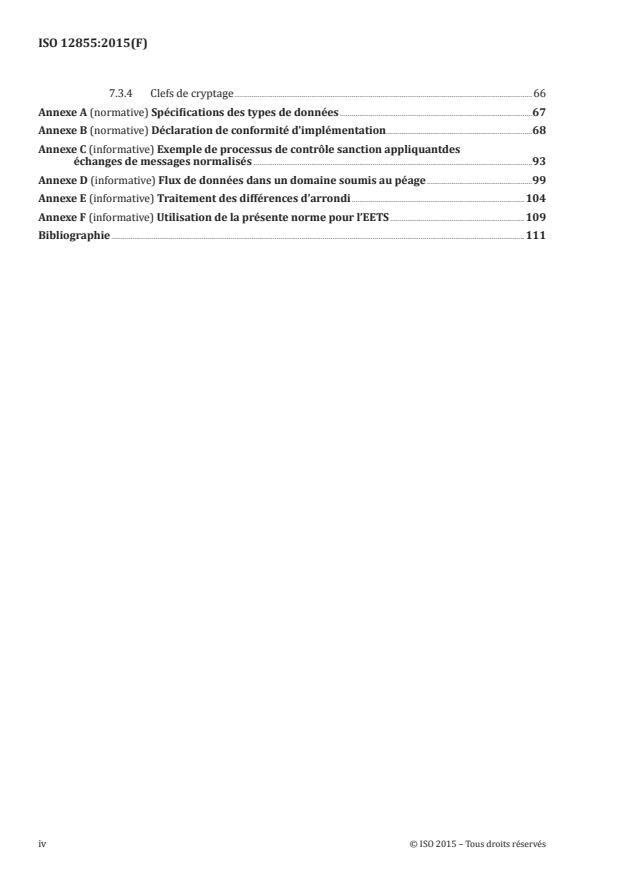
Sommaire Page
Avant-propos .v
Introduction .vi
1 Domaine d’application . 1
2 Références normatives . 3
3 Termes et définitions . 4
4 Symboles et abréviations . 7
5 Concept architectural . 8
5.1 Principaux rôles dans l’environnement de perception du péage . 8
5.2 Échange d’informations entre la perception du péage et la prestation . 9
5.2.1 Généralités . 9
5.2.2 Protocole d’interaction de base . 9
5.2.3 Mécanismes de protocole de base .10
5.2.4 Exchange Trust Objects (échanger des objets de confiance).11
5.2.5 Originating and providing EFC context data (générer et fournir des
données contextuelles EFC) .11
5.2.6 Manage Exception list (gérer la liste d’exceptions) .12
5.2.7 Transmission des déclarations de péage) .13
5.2.8 Transmettre des détails de facturation .14
5.2.9 Fonctionnalité pour le règlement du paiement .15
5.2.10 Echange de données de contrôle sanction.16
5.2.11 Echange des paramètres d’assurance de la qualité .18
6 Spécification fonctionnelle par objets .18
6.1 Vue d’ensemble .18
6.2 Unités de données du protocole d’application (APDU) .21
6.2.1 Généralités .21
6.2.2 Information de contrôle de protocole d’application .23
6.2.3 Unité de données d’application .24
6.3 Structure de données RequestADU .25
6.4 Structure de données AcknowledgeADU .28
6.5 Structure de données StatusADU .31
6.6 Structure de données TrustObjectsADU .32
6.7 Structure de données EFCContextDataADU .36
6.7.1 ActualPath: péage par la reconnaissance de points traversés .40
6.7.2 PreDefinedPath: péage par des trajets prédéfinis .42
6.8 Structure de données ContractIssuerListADU .43
6.9 Structure de données ExceptionListADU .44
6.10 Structure de données ReportAbnormalOBEADU .47
6.11 Structure de données TollDeclarationADU .48
6.12 Structure de données BillingDetailsADU.49
6.13 Structure de données PaymentClaimADU .57
6.14 Structure de données PaymentAnnouncement ADU .58
6.15 Structure de données ProvideUserDetailsADU .59
6.16 Structure de données ReportCCCEventADU .60
6.17 ProvideUserIDListADU data structure .61
6.18 Structure de données Report QA .62
7 Mécanismes de transfert et fonctions de support .63
7.1 Mécanismes de transfert .63
7.2 Canal de communication sécurisé .63
7.3 Fonctions de support .64
7.3.1 Services de communication .64
7.3.2 Authentifiants de messages .64
7.3.3 Signature et hachage d’algorithmes .65
7.3.4 Clefs de cryptage .66
Annexe A (normative) Spécifications des types de données .67
Annexe B (normative) Déclaration de conformité d’implémentation .68
Annexe C (informative) Exemple de processus de contrôle sanction appliquantdes
échanges de messages normalisés .93
Annexe D (informative) Flux de données dans un domaine soumis au péage .99
Annexe E (informative) Traitement des différences d’arrondi .104
Annexe F (informative) Utilisation de la présente norme pour l’EETS .109
Bibliographie .111
iv © ISO 2015 – Tous droits réservés
Avant-propos
L’ISO (Organisation internationale de normalisation) est une fédération mondiale d’organismes
nationaux de normalisation (comités membres de l’ISO). L’élaboration des Normes internationales est
en général confiée aux comités techniques de l’ISO. Chaque comité membre intéressé par une étude
a le droit de faire partie du comité technique créé à cet effet. Les organisations internationales,
gouvernementales et non gouvernementales, en liaison avec l’ISO participent également aux travaux.
L’ISO collabore étroitement avec la Commission électrotechnique internationale (IEC) en ce qui
concerne la normalisation électrotechnique.
Les procédures utilisées pour élaborer le présent document et celles destinées à sa mise à jour sont
décrites dans les Directives ISO/IEC, Partie 1. Il convient, en particulier de prendre note des différents
critères d’approbation requis pour les différents types de documents ISO. Le présent document a été
rédigé conformément aux règles de rédaction données dans les Directives ISO/IEC, Partie 2 (voir www.
iso.org/directives).
L’attention est appelée sur le fait que certains des éléments du présent document peuvent faire l’objet de
droits de propriété intellectuelle ou de droits analogues. L’ISO ne saurait être tenue pour responsable
de ne pas avoir identifié de tels droits de propriété et averti de leur existence. Les détails concernant
les références aux droits de propriété intellectuelle ou autres droits analogues identifiés lors de
l’élaboration du document sont indiqués dans l’Introduction et/ou dans la liste des déclarations de
brevets reçues par l’ISO (voir www.iso.org/brevets).
Les appellations commerciales éventuellement mentionnées dans le présent document sont données
pour information, par souci de commodité, à l’intention des utilisateurs et ne sauraient constituer
un engagement.
Pour une explication de la signification des termes et expressions spécifiques de l’ISO liés à
l’évaluation de la conformité, ou pour toute information au sujet de l’adhésion de l’ISO aux principes
de l’OMC concernant les obstacles techniques au commerce (OTC), voir le lien suivant: Avant-propos —
Informations supplémentaires.
L’ISO 12855 a été élaborée par le comité technique ISO/TC 204, Systèmes intelligents de transport.
Cette deuxième édition annule et remplace la première édition (ISO 12855:2012), qui a fait l’objet d’une
révision technique. Les modifications suivantes ont été apportées:
— L’ajout de nouvelles Unité de Données d’Application (ADU) en raison des commentaires reçus des
organismes nationaux;
— Aligner les définitions de données ASN.1 avec les versions actuelles de la norme EN 14906 et
ISO 17575 (toutes les parties);
— Déplacer le module ASN.1 de l’Annexe A à un fichier de texte externe, dans un format qui peut être
traité par les compilateurs ASN.1;
— Clarifier la sémantique des paramètres des ADUs;
— Aligner la structure de toutes les clauses principales de manière cohérente afin d’améliorer la lisibilité.
Introduction
L’utilisation répandue des péages nécessite des dispositions pour les utilisateurs de véhicules qui
circulent dans différents domaines de péage. Il convient d’offrir aux utilisateurs un contrat unique leur
permettant de conduire un véhicule dans différentes domaines de péage. Lorsque les véhicules ont
besoin d’un équipement embarqué (OBE) ou équivalent, il convient que ce dernier soit interopérable
avec les systèmes de péage des différents domaines de péage. En Europe, par exemple, ce besoin a
été officiellement reconnu et une législation de l’interopérabilité a déjà été adoptée (voir la Directive
2004/52/CE et la Décision 2009/750/CE). Les normes facilitant l’interopérabilité des OBE et des
systèmes de péage sont justifiées tant du point de vue commercial que du point de vue économique.
L’architecture des systèmes définie dans l’ISO 17573:2010 forme la base de toutes les normes relatives
aux systèmes de péage dans le domaine du péage. À partir de cette norme d’architecture de systèmes,
d’autres normes ont constamment réutilisé:
— des définitions communes des termes et concepts ainsi que des fonctionnalités et de la structure des
systèmes de base,
— une terminologie commune, et
— les interfaces identifiées qui sont définies ou qui ont besoin de l’être.
L’ISO 17573:2010 utilise l’ISO/CEI 10746-3 pour la description de l’architecture.
La Figure 1 suivante présente le domaine d’application du groupe de normes relatives aux installations
de perception du télépéage (EFC) reposant sur la norme d’architecture.
Figure 1 — Domaine d’application des normes relatives aux installations EFC
vi © ISO 2015 – Tous droits réservés
Un service de transport donné pour un véhicule donné est entièrement identifié par une ou plusieurs
déclarations de péage, mises à disposition de l’exploitant de péage. Les déclarations de péage doivent
être mises à disposition conformément aux règles du régime de péage du domaine soumis au péage.
Le montant dû pour un service de transport donné utilisé par un véhicule soumis au paiement du péage
est finalisé par l’exploitant de péage (TC) à l’aide d’une ou plusieurs déclarations de péage (tel que cela
est décrit ci-dessus) et le calcul est effectué conformément aux règles du régime de péage (formule,
tableaux tarifaires, règles pour les situations spécifiques, conditions routières, etc.). Cela signifie que
l’exploitant de péage a l’autorité de décider du montant dû, même s’il décide d’attribuer au fournisseur
de services de péage la tâche de calculer le montant dû.
Ces informations, associées à un service de transport donné, sont appelées « détails de facturation »;
pour un service de transport donné, les détails de facturation font référence à une ou plusieurs
déclarations de péage.
En fonction du régime de péage, les détails de facturation sont élaborés avec les informations collectées
par l’exploitant de péage et/ou le fournisseur de services de péage (TSP) concerné; ils sont finalisés par
l’exploitant de péage.
L’exploitant de péage élabore et effectue les demandes de paiement (ou demandes de paiement de péage)
à la disposition de chaque fournisseur de services de péage, conformément aux accords bilatéraux
passés avec le fournisseur de services de péage, en se référant aux détails de facturation. Ces demandes
de paiement comprennent un montant dû qui tient compte de toutes les conditions commerciales
spécifiques éventuellement applicables à un véhicule, à un parc de véhicules ou à un fournisseur de
services de péage donné.
La présente Norme internationale identifie et spécifie l’ensemble des messages échangés entre deux
acteurs dans les rôles de fournisseur de services de péage et de l’exploitant de péage tels que définis
dans l’ISO 17573.
La présente Norme internationale ne fournit pas une solution complète pour l’interopérabilité, et elle
ne définit pas non plus d’autres parties du système EFC, d’autres services, d’autres technologies ou des
éléments non-techniques d’interopérabilité.
Le développement d’un service européen de télépéage commun (EETS) dans le cadre de la directive
européenne EFC (2004/52/CE) appelle également à la définition d’un service interopérable EFC. Cette
Norme internationale fournit un soutien efficace pour les travaux sur la définition de l’EETS. Des détails
sur l’utilisation de la présente Norme internationale pour les EETS sont fournis à l’Annexe F.
La présente Norme internationale identifie et spécifie l’ensemble des Application Protocol Data Units
échangé entre deux acteurs dans les rôles de TSP et de TC tel que défini dans la norme ISO 17573.
Pour spécifier ces interfaces, la présente Norme internationale utilise la description Entreprise de
l’environnement de péage, ainsi que les interactions définies entre les catégories de rôles, telles que
définies dans l’ISO 17573. Cela permet une spécification complète des données transférées entre ces
entités identifiées. De plus, certaines interfaces fonctionnelles sont identifiées lorsque des interactions
en termes de séquences de messages sont définies.
NORME INTERNATIONALE ISO 12855:2015(F)
Perception du télépéage — Échange d’informations entre
la prestation de service et la perception du péage
1 Domaine d’application
La présente Norme internationale spécifie:
— les interfaces entre les installations EFC (Electronic Fee Collection) pour les services de transport
associés aux véhicules, tels que la tarification routière, le stationnement et le contrôle d’accès. Elle
ne couvre pas les interfaces pour les systèmes électroniques de perception de redevances pour les
transports publics; une installation EFC peut comporter un système de perception de télépéage, tel
que les systèmes permettant de lire automatiquement les numéros de plaques d’immatriculation
des véhicules qui franchissent un point de péage;
— l’échange d’informations entre les équipements centraux des deux rôles Prestation de service et
Perception de péage, par exemple
— les données liées à la perception (déclarations de péage, détails de facturation),
— les données administratives, et
— les données de confirmation;
— les mécanismes de transfert et les fonctions de support;
— les objets d’information, la syntaxe et la sémantique des données;
— les exemples d’échanges de données (voir les Annexes C et D) et
— un exemple illustrant l’utilisation de cette norme Internationale pour le service de télépéage
européen (voir Annexe F)
La présente Norme internationale supporte tout service de péage et toute technologie utilisée dans le
cadre de la perception.
Elle est définie comme une norme «boîte à outils» pour les transactions et les messages pouvant
être utilisée pour l’objectif prévu. La définition détaillée des éléments obligatoires et facultatifs dans
une implémentation réelle doit être définie par ailleurs. Elle ne définit pas toutes les séquences de
communication, ni les couches de communication et les paramètres temporels.
Le domaine d’application de la présente Norme internationale est illustré à la Figure 2. Les types de
données et le codage associé aux éléments de données associés décrits dans l’Article 6 sont définis dans
l’Annexe A, à l’aide de la technique de la notation de syntaxe abstraite numéro un (ASN.1) conformément
à l’ISO/CEI 8824-1.
Anglais Français
Central equipment Équipement central
Toll service provider Fournisseur de services de péage
Scope of this International Standard Domaine d’application de la présente Norme inter-
nationale
Trust objects Objets de confiance
Context data Données contextuelles
Exception list Liste d’exceptions
Toll declarations (GNSS) Déclarations de péage (GNSS)
Billing details Détails de facturation
Payment claims Demandes de paiement
QA parameter Paramètre d’AQ (Assurance Qualité)
Enforcement support data Données pour le contrôle-sanction
Toll charger Exploitant de péage
Figure 2 — Domaine d’application de l’ISO 12855
La présente Norme internationale n’est pas applicable à:
— toute communications entre l’exploitant de péages (TC) ou le fournisseur de services de péage (TSP)
avec toute autre partie prenante,
2 © ISO 2015 – Tous droits réservés
— toute communications entre les éléments du TC et le TSP qui ne fait pas partie de la communication
de back-office,
— les processus concernant les paiements et des échanges de documents comptables fiscaux,
commerciaux ou juridiques, et
— la définition des protocoles, des canaux de communication de services, permettant de transférer
réellement les messages.
2 Références normatives
Les documents de référence suivants sont indispensables pour l’application du présent document. Pour
les références datées, seule l’édition citée s’applique. Pour les références non datées, la dernière édition
du document de référence s’applique (y compris les éventuels amendements).
ISO 639-1, Codes pour la représentation des noms de langue -- Partie 1: Code alpha-2
ISO 3166-1, Codes pour la représentation des noms de pays et de leurs subdivisions — Partie 1: Codes de pays
ISO/CEI 8824-1, Technologies de l’information — Notation de syntaxe abstraite numéro un (ASN.1) —
Spécification de la notation de base
ISO/CEI 8825-4, Technologies de l’information — Règles de codage ASN.1: Règles de codage XML (XER)
ISO/IEC 9594-8:2014, Technologies de l’information — Interconnexion de systèmes ouverts (OSI) —
L’annuaire — Partie 8: Cadre général des certificats de clé publique et d’attribut
ISO/IEC 9646-7, Technologies de l’information — Interconnexion de systèmes ouverts (OSI) — Essais
de conformité — Méthodologie générale et procédures — Partie 7: Déclarations de conformité des
mises en oeuvre
ISO/IEC 9797-2:2011, Technologies de l’information — Techniques de sécurité — Codes d’authentification
de message (MAC) — Partie 2: Mécanismes utilisant une fonction de hachage dédiée
ISO/IEC 10118-3, Technologies de l’information — Techniques de sécurité — Fonctions de brouillage —
Partie 3: Fonctions de brouillage dédiées
ISO/IEC 11770-3, Technologies de l’information — Techniques de sécurité — Gestion de clés — Partie 3:
Mécanismes utilisant des techniques asymétriques
ISO/IEC 14888-2:2008, Technologies de l’information — Techniques de sécurité — Signatures numériques
avec appendice — Partie 2: Mécanismes basés sur une factorisation entière
ISO 14906:2011/Amd1:2015, Perception du télépéage — Définition de l’interface d’application relative aux
communications dédiées à courte portée
ISO 17573, Perception du télépéage — Architecture de systèmes pour le péage lié aux véhicules
1)
ISO/TS 17575-1:— Perception du télépéage — Définition de l’interface d’application pour les systèmes
autonomes — Partie 1: Imputation
1)
ISO/TS 17575-3:— Perception du télépéage — Définition de l’interface d’application pour les systèmes
autonomes — Partie 3: Données du contexte
ISO/IEC 18033-2:2006, Technologies de l’information — Techniques de sécurité — Algorithmes de
chiffrement — Partie 2: Chiffres asymétriques
ISO/TS 19299:2015, Electronic fee collection — Security framework
IETF RFC 2634, Enhanced Security Services for S/MIME, June 1999
1) À publier.
IETF RFC 4347, Datagram Transport Layer Security, April 2006
IETF RFC 5035, Enhanced Security Services (ESS) Update: Adding CertID Algorithm Agility, August 2007
IETF RFC 5246, The Transport Layer Security (TLS) Protocol, August 2008
IETF RFC 5746, Transport Layer Security (TLS) Renegotiation Indication Extension, February 2010
IETF RFC 6040, Tunnelling of Explicit Congestion Notification, February 2013
3 Termes et définitions
Pour les besoins du présent document, les termes et définitions suivants s’appliquent.
3.1
détail de facturation
pour un service de transport donné, toutes les données nécessaires pour déterminer et/ou vérifier le
montant dû par l’utilisateur du service
Note 1 à l’article: Si les données sont acceptées par le TC et par le TSP, on l’appelle alors «détail de facturation
final», et il peut être utilisé pour effectuer une demande de paiement.
Note 2 à l’article: Pour un service de transport donné, «détail de facturation» fait référence à une ou plusieurs
déclarations de péage valides. Un «détail de facturation» valide doit respecter les exigences formelles, dont les
exigences de sécurité, convenues entre le fournisseur de services de péage et l’exploitant de péage.
3.2
liste noire
liste d’utilisateurs pour lesquels le fournisseur de service nie toute responsabilité contractuelle
Note 1 à l’article: Dans le contexte de la présente Norme internationale, le fournisseur de service est le fournisseur
de services de péage (TSP).
3.3
rapport de perception
structure de données transmises du site (système, équipements, .) au central (système) pour détailler
l’utilisation des routes et les informations complémentaires associées
Note 1 à l’article: Dans la décision 2009/750/CE, un rapport de perception est désigné «déclaration de péage».
[SOURCE: ISO 17575-1:—, 3.6]
3.4
données de perception
données relatives au péage produites par l’équipement embarqué et envoyées aux systèmes back-office
des fournisseurs de services de péage
3.5
spécification fonctionnelle par objets
décomposition d’un système en objets exécutant des fonctions individuelles et interagissant via des
interfaces bien définis
3.6
perception électronique du télépéage
EFC
perception d’un péage par des moyens électroniques via une interface sans fil
4 © ISO 2015 – Tous droits réservés
3.7
contrôle sanction
processus consistant à imposer le respect d’une loi, d’une réglementation, etc.
Note 1 à l’article: Dans ce contexte, le «contrôle sanction» est le processus consistant à imposer le respect d’un
régime de péage.
3.8
interopérabilité
capacité que possèdent des systèmes à fournir des services et à recevoir des services d’autres systèmes,
et à utiliser les services ainsi échangés afin de fonctionner ensemble de manière efficace
Note 1 à l’article: L’interopérabilité des systèmes de péage vise à permettre à un véhicule de circuler dans
différents domaines de péage en disposant d’un seul équipement embarqué fonctionnant dans le cadre d’un
contrat unique avec un fournisseur de services de péage.
[SOURCE: ISO/IEC/TR 10000-1:1998,3.2.1, modifiée]
3.9
équipement embarqué
OBE
tout l’équipement embarqué dans un véhicule requis pour effectuer les fonctions EFC (3.6) et les
services de commucation requis
3.10
demande de paiement
déclaration périodique faisant référence à des détails de facturation (3.1) finale et mis à la disposition
du fournisseur de services de péage par l’exploitant de péage qui indique et justifie le montant dû
Note 1 à l’article: La demande de paiement est utilisée par le fournisseur de service de péage pour envoyer des
objets financiers à ces clients (par exemple factures pour le compte de l’exploitant de péage). Une demande de
paiement de péage donnée fait référence à des détails de facturation (3.1) et tient compte de toute condition
commerciale spécifique applicable à un véhicule, à un parc de véhicules, à un client d’un fournisseur de services
de péage et/ou à un fournisseur de services de péage. Une «demande de paiement» valide doit respecter les
exigences formelles, dont les exigences de sécurité, convenues entre le fournisseur de services de péage et
l’exploitant de péage.
3.11
équipement au sol
RSE
équipement situé le long du réseau de transport routier à des fins de communication et d’échanges de
données avec les équipements embarqués
3.12
règles de tarification
ensemble de règles visant à déterminer la redevance due pour un véhicule dans un domaine soumis au
péage (3.17) pour un objet soumis à péage, un certain jour et à une certaine heure
EXEMPLE Par exemple un tableau affichant les redevances dues pour différentes classes de véhicules.
3.13
péage
prix demandé, taxe, redevance ou droit en rapport avec l’utilisation d’un véhicule dans un domaine
soumis au péage (3.17)
[SOURCE: ISO 17575-1:—, 3.16]
Note 1 à l’article: Il s’agit d’une généralisation de la définition classique d’un péage s’énonçant comme suit:
«prix demandé, taxe ou droit permettant de franchir une barrière ou d’emprunter une route ou un pont, etc.».
La définition ci-dessus inclut également les redevances considérées comme une obligation (administrative), par
exemple une taxe ou un droit.
3.14
exploitant de péage
TC
entité qui perçoit le péage (3.13) pour l’utilisation de véhicules dans un domaine soumis au péage (3.17)
Note 1 à l’article: Dans d’autres documents, les termes d’«opérateur» ou d’«opérateur de péage» peuvent être utilisés.
[SOURCE: ISO 17573:2010, 3.16, modifiée — «Juridique» a été supprimé avant «entité» et «l’utilisation
de» a été ajouté.]
3.15
données contextuelles de péage
informations définies par le responsable exploitant le péage (3.14) nécessaires pour établir le péage
(3.13) dû pour l’utilisation d’un véhicule sur un contexte de péage particulier et de permettre de
conclure la transaction de péage
[SOURCE: ISO 12855:2015, 3,15]
3.16
déclaration de péage
déclaration auprès d’un exploitant le péage (3.14), destinée à déclarer l’utilisation d’un service de péage
(3.13)
Note 1 à l’article: Une déclaration de péage valide doit respecter les exigences formelles, dont les exigences de
sécurité, convenues entre le fournisseur de services de péage (3.19) et l’exploitant de péage (3.14).
[SOURCE: ISO/TS 19299:2015, 3.44]
3.17
domaine soumis au péage
zone ou tronçon routier où est appliqué un régime de péage (3.18)
[SOURCE: ISO 17573:2010, 3.18, modifié, «certain» a été ajouté sur la version anglaise]
3.18
régime de péage
ensemble de règles, y compris les règlements de contrôle sanction (3.7), régissant la perception d’un
péage (3.13) dans un domaine soumis au péage (3.17)
[SOURCE: ISO 17573:2010, 3.20]
3.19
fournisseur de services de péage
TSP
entité assurant des services de péage (3.13) dans un ou plusieurs domaines de péage (3.17)
Note 1 à l’article: Dans d’autres documents, les termes d’«émetteur» ou d’«émetteur de contrat» peuvent être utilisés.
Note 2 à l’article: Le fournisseur de services de péage (3.19) peut fournir l’équipement embarqué (3.9) ou
uniquement fournir une carte magnétique ou carte à puce à utiliser avec l’équipement embarqué (3.9) fourni par
une tierce partie.
Note 3 à l’article: Le fournisseur de services de péage est responsable du fonctionnement de l’équipement
embarqué (3.9).
[SOURCE: ISO 17573:2010, 3.23, modifié — la définition a été condensée]
3.20
objet de confiance
objet d’information échangé entre des entités pour assurer une confiance mutuelle
EXEMPLE Un objet de confiance peut être une signature électronique ou un certificat électronique.
6 © ISO 2015 – Tous droits réservés
[SOURCE: ISO 17573:2010, 3.28]
3.21
Liste blanche
Liste des usagers pour lesquels le fournisseur de services de péage accepte la responsabilité
contractuelle.
Note 1 à l’article: L’exploitant du péage dans le contexte de cette norme est le fournisseur de service de péage (3.19).
Note 2 à l’article: Une entrée sur une liste blanche doit être indépendante de celle de la liste noire (3.2).
4 Symboles et abréviations
ADU Application Data Unit (ISO 14906)
ANPR Automatic Number Plate Reading (lecture automatique de plaques d’immatriculation)
APCI Application Protocol Control Information (informations de contrôle du protocole d’application)
APDU Application Protocol Data Unit (unité de données de protocole d’application) (ISO 14906)
CCC Compliance Check Communication (communication pour contrôle de conformité) (ISO 12813)
CRL Certificate revocation list (liste de révocation de certificats)
DSRC Dedicated Short-Range Communication (communications dédiées à courte portée) (ISO 14906)
DTLS Datagram Transport Layer Security (sécurité de couche de transport de datagramme)
EFC Electronic Fee Collection (perception du télépéage) (ISO 17573)
GNSS Global Navigation Satellite System (système mondial de navigation par satellite)
HTTPS Hyper-Text Transfer Protocol Secure (protocole de transfert hypertexte sécurisé)
ICS Implementation Conformance Statement (déclaration de conformité d’implémentation)
CEI Commission électrotechnique internationale
IUT Implementation Under Test (implémentation en essai)
ITU International Telecommunication Union (UIT, Union internationale des télécommunications)
LPN Licence Plate Number (numéro de plaque d’immatriculation)
OBE On-Board Equipment (équipement embarqué) (ISO 14906)
OBU On-Board Unit (unité d’identification embarquée)
OCSP Online Certificate Status Protocol (protocole de vérification en ligne de certificat)
OSI Open systems interconnection (interconnexion de systèmes ouverts)
PAN Personal Account Number (numéro de compte personnel) (ISO 14906)
QA Quality Assurance (assurance qualité)
RSA Rivest, Shamir and Adleman (ISO/TS 19299)
RSE Roadside Equipment (équipement au sol) (ISO 14906)
SLA Service Level Agreement (accord sur le niveau de service)
SU Service User (utilisateur de service)
SUT System Under Test (système en essai) (ISO/TS 14907-1)
TC Toll Charger (exploitant de péage)
TLS Transport Layer Security (couche sécurité transport)
TSP Toll Service Provider (fournisseur de services de péage)
VRM Vehicle Registration Mark (marque d’enregistrement du véhicule)
NOTE RSA est un algorithme pour cryptographie à clé publique, également connue sous le nom de
cryptographie asymétrique.
5 Concept architectural
5.1 Principaux rôles dans l’environnement de perception du péage
La construction de la présente Norme internationale est basée sur l’ISO 17573. L’ISO 17573 définit les
quatre rôles principaux présentés à la Figure 3.
Figure 3 — Rôles dans l’environnement de perception du péage
Les échanges d’information sont convenus entre l’exploitant de péage et le fournisseur de services
en tenant également compte des réglementations relatives au respect de la vie privée. Les échanges
d’informations dont l’exploitant de péage et le fournisseur de services de péage ont besoin pour exécuter
leurs rôles sont décrits à l’Article 5.
8 © ISO 2015 – Tous droits réservés
5.2 Échange d’informations entre la perception du péage et la prestation
5.2.1 Généralités
L’échange d’informations entre les rôles de prestation de service et de perception du péage supporte la
fourniture des fonctionnalités suivantes, qui sont toutes basées sur les définitions des comportements
des systèmes EFC dans l’ISO 17573, Article 5 et 6:
— mécanismes basiques de protocole;
— échanger des objets de confiance;
— générer et fournir des données contextuelles EFC;
— gérer la liste d’exceptions;
— transmettre des déclarations de péage;
— transmettre des détails de facturation;
— règlement des paiements:
— réclamation du paiement d’utilisation du service;
— annonce des paiements;
— échanger des données de contrôle sanction (comprend la liste des utilisateurs);
— échanger des paramètres d’assurance de la qualité.
La présente Norme internationale laisse aux personnes chargées de l’implémentation la liberté de
définir des procédures de protocoles appropriées, c’est-à-dire pour des transactions complexes; c’est
pourquoi elle définit exclusivement:
— un protocole d’interaction de base (requête – réponse) pour l’échange d’informations;
— des mécanismes de protocole de base, à utiliser pour créer des procédures de protocoles plus
complexes;
— la sémantique et le format des messages échangés.
Les paragraphes suivants décrivent les fonctionnalités susmentionnées.
5.2.2 Protocole d’interaction de base
Les échanges d’informations ont lieu par l’intermédiaire de transferts d’unités de données de protocole
d’application (APDU – Application Protocol Data Unit).
Certains transferts APDU nécessitent un accusé de réception. Le cas échéant, des procédures de
protocoles connexes sont spécifiées. La présente Norme internationale ne définit pas de dispositions
pour les transferts complexes (transactions), c’est-à-dire pour les transferts APDU couvrant plusieurs
APDU. Elle définit en revanche des mécanismes de protocole de base à utiliser dans le cadre des
implémentations nécessitant l’identification des transactions.
5.2.3 Mécanismes de protocole de base
5.2.3.1 Approche générale
La présente Norme internationale fournit les mécanismes de protocole de base suivants, qui doivent
être mis en œuvre pour échanger des informations entre les équipements centraux du fournisseur de
services de péage et de l’exploitant de péage. Ces mécanismes de protocole de base sont composés de:
— un schéma d’identification pour les messages échangés;
— une interaction générique (c’est-à-dire non liée à une fonctionnalité spécifique quelconque)
permettant de demander à l’autre partie d’effectuer un échange d’informations spécifique. Cette
interaction est fournie par le message «Request»;
— un mécanisme d’accusé de réception générique (c’est-à-dire non lié à une fonctionnalité spécifique
quelconque) permettant d’accuser réception d’un échange spécifique. Ce mécanisme est fourni par
le message «Acknowledge» (accusé de réception), et
— un mécanisme de statut générique (c’est-à-dire non lié à une fonctionnalité spécifique quelconque)
permettant de fournir des informations de statut pour un échange spécifique. Ce mécanisme est
fourni par le message «Status».
À l’aide des mécanismes ci-dessus, une implémentation peut construire des procédures de
protocoles plus complexes, incluant les fonctionnalités rollback (annulation de transaction), recovery
(récupération), checkpointing (réalisation d’un point de contrôle) ou restart (redémarrage).
La présente Norme internationale ne spécifie pas les paramètres temporels ni les procédures de relance
pour les accusés de réception. Des temporisations peuvent être définies sous forme d’accords entre
l’exploitant de péage et le fournisseur de services de péage pour couvrir les cas d’accusés de réception
manquants. Un système de temporisation peut être mis en place pour gérer les messages perdus.
5.2.3.2 Schéma d’identification
Chaque interaction est effectuée au moyen d’un ou plusieurs échanges de messages. Chaque message
doit contenir un identifiant unique dans le champ du Nom du créateur du message. La combinaison de
l’identifiant du créateur et de l’identifiant du message garantit que tous les messages sont identifiés de
façon unique.
5.2.3.3 Message «Request» (Requête)
Le message «Request» peut être utilisé pour:
— avertir l’autre partie que l’on est prêt à accepter n’importe quel type d’échange d’informations;
— informer l’autre partie que l’on est prêt à accepter un type spécifique de message, en indiquant le
type de message que l’on est prêt à accepter;
— demander à l’autre partie de renvoyer un message spécifique, en indiquant le type et l’identifiant du
message;
— demander des informations identifiées par le type et le contenu du message.
5.2.3.4 Message «Acknowledgement» (Acquittement)
La fonctionnalité «Acknowledgement» doit être utilisée pour informer la contrepartie qu’un ADU
spécifique a été reçu correctement, ou que des erreurs ont été détectées, ou qu’il n’est pas supporté.
10 © ISO 2015 – Tous droits réservés
5.2.3.5 Message «Status» (statut)
Le message «Status» est utilisé pour fournir des informations générales sur le statut de l’interface à
l’autre partie ou l’informer du statut d’informations précédemment transférées. Il peut être utilisé pour:
— fournir des informations générales sur le statut de l’interface;
— avertir l’autre partie du fait que certaines informations précédemment fournies deviennent invalides
sans nouvelles informations actuellement disponibles;
— avertir l’autre partie du fait que les informations précédentes contenaient une erreur et doivent
être rappelées.
5.2.4 Exchange Trust Objects (échanger des objets de confiance)
La fonctionnalité «Exchange Trust Objects» est issue des comportements des installations EFC «Adding
(or excluding) a new Toll Charger» [ajouter (ou exclure) un nouveau l’exploitant de péage] et «Adding (or
excluding) a new Service Provider» [ajouter (ou exclure) un nouveau fournisseur de services de péage].
Les actions effectuées lors de l’exécution des comportements ci-dessus doivent échanger des objets
de confiance servant à sécuriser leur communication bilatérale. La fonctionnalité peut également être
utilisée lorsqu’une entité juge nécessaire de mettre à jour ses propres objets de confiance ou lorsqu’une
autre entité peut demander la mise à jour d’un objet de confiance déjà existant.
NOTE Exemples d’objets de confiance: clés publiques asymétriques; certificats; clés symétriques; listes de
révocation de certificats.
La fonctionnalité «Exchange Trust Objects» peut être utilisée par le fournisseur de services de péage ou
par l’exploitant de péage.
L’initiateur de l’échange peut demander au destinataire d’envoyer des objets de confiance en envoyant
un message «Request». Le message «Request» peut contenir un indicateur facultatif qui spécifie les
objets de confiance déjà émis. Lorsqu’aucun indicateur n’est spécifié, les objets de confiance à transférer
doivent être les objets actuels.
Après réception d’un message «Request» demandant des objets de confiance, les objets de confiance
demandés sont générés (ou récupérés) par le destinataire de la requête et envoyés à la partie requérante
qui doit en accuser réception en envoyant un message «Acknowledge».
Une fois l’accusé de réception reçu, les objets de confiance échangés doivent être considé
...
Questions, Comments and Discussion
Ask us and Technical Secretary will try to provide an answer. You can facilitate discussion about the standard in here.
Loading comments...