

ISO 16525-1:2014
(Main)Adhesives — Test methods for isotropic electrically conductive adhesives — Part 1: General test methods
General Information
- Abstract
ISO 16525-1:2014 specifies general test methods for isotropic electrically conductive adhesives used in wiring, die attach of semiconductors, and surface assembly of printed circuit boards.
- Status
- Published
- Publication Date
- 08-May-2014
- Technical Committee
- ISO/TC 61/SC 11 - Products
- Drafting Committee
- ISO/TC 61/SC 11/WG 5 - Polymeric adhesives
- Current Stage
- 9093 - International Standard confirmed
- Start Date
- 03-Feb-2025
- Completion Date
- 29-Aug-2026
Buy Documents
ISO 16525-1:2014 - Adhesives — Test methods for isotropic electrically conductive adhesives — Part 1: General test methods Released:5/9/2014
ISO 16525-1:2014 - Adhésifs — Méthodes d'essai pour adhésifs a conductivité électrique isotrope — Partie 1: Méthodes d'essai générales Released:5/9/2014
Overview
ISO 16525-1:2014 specifies general test methods for isotropic electrically conductive adhesives used in wiring, die attach of semiconductors, and surface assembly of printed circuit boards. It defines sampling, atmospheric conditioning and a core set of tests to characterize adhesive properties both before and after curing. This part does not set performance limits or specify bonded assembly performance - it standardizes how to measure key material attributes for quality control, R&D and supplier verification.
Key topics and requirements
Scope and sampling
- Applies to isotropic electrically conductive adhesives (conductive fillers + resin).
- Sampling requirements follow ISO 15605; a “lot” is defined as one production batch.
- Standard atmospheric test conditions: 23 ± 2 °C and 50 ± 10 % RH (ISO 291).
- Specimens manufactured ≥12 h before testing and conditioned ≥1 h at test atmosphere.
Tests before curing
- Appearance (visual inspection; record colour and viscosity level).
- Density (ISO 1183-1 immersion/pyknometer methods).
- Viscosity (ISO 2555 and ISO 3219 rotational/Brookfield methods).
Tests for conditions of use
- Pot life / working life (ISO 10364).
- Cure schedule (time/temperature to achieve cure).
Tests after curing
- Glass transition temperature, Tg (ISO 11357-2 or ISO 11359-2).
- Moisture absorption ratio (detailed gravimetric procedure with oven at 50 ± 2 °C and humidity chamber at 85 ± 2 °C/85 ± 5 % for typical conditioning).
- Modulus of elasticity (static or dynamic per ISO 4664-1).
- Surface hardness (pencil hardness or penetrometer per ISO 15184).
- Coefficient of linear thermal expansion (TMA per ISO 11359-2).
- Moisture permeability (ISO 2528 gravimetric dish method).
Test reporting
- Reports should reference ISO 16525-1 and include adhesive ID (resin/filler, lot), specimen type and number, test conditions, dates, institution and methods used.
Applications
ISO 16525-1 is essential for:
- Adhesive manufacturers performing product characterization and QC.
- Electronics OEMs and contract manufacturers validating adhesives for wiring, die attach and PCB surface assembly.
- Independent test laboratories and materials engineers assessing thermal, mechanical and moisture-related behavior.
- R&D teams comparing formulations (viscosity, Tg, moisture uptake, thermal expansion).
Related standards
- Other parts of the ISO 16525 series (electric characteristics, heat transfer, shear strength, fatigue, environmental tests, electrochemical migration, high-speed signals).
- Normative references used in ISO 16525-1: ISO 62, ISO 291, ISO 1183‑1, ISO 2555, ISO 3219, ISO 11357‑2, ISO 11359‑2, ISO 15184, ISO 2528, ISO 4664‑1, ISO 10364.
Keywords: ISO 16525-1, isotropic electrically conductive adhesives, adhesives test methods, pot life, glass transition temperature, moisture absorption, viscosity, thermal expansion, PCB assembly.
Buy Documents
ISO 16525-1:2014 - Adhesives — Test methods for isotropic electrically conductive adhesives — Part 1: General test methods Released:5/9/2014
ISO 16525-1:2014 - Adhésifs — Méthodes d'essai pour adhésifs a conductivité électrique isotrope — Partie 1: Méthodes d'essai générales Released:5/9/2014
Get Certified
Connect with accredited certification bodies for this standard

DIN CERTCO
DIN Group product certification.

Smithers Quality Assessments
US management systems and product certification.
Sponsored listings
Frequently Asked Questions
ISO 16525-1:2014 is a standard published by the International Organization for Standardization (ISO). Its full title is "Adhesives — Test methods for isotropic electrically conductive adhesives — Part 1: General test methods". This standard covers: ISO 16525-1:2014 specifies general test methods for isotropic electrically conductive adhesives used in wiring, die attach of semiconductors, and surface assembly of printed circuit boards.
ISO 16525-1:2014 specifies general test methods for isotropic electrically conductive adhesives used in wiring, die attach of semiconductors, and surface assembly of printed circuit boards.
ISO 16525-1:2014 is classified under the following ICS (International Classification for Standards) categories: 83.180 - Adhesives. The ICS classification helps identify the subject area and facilitates finding related standards.
ISO 16525-1:2014 is available in PDF format for immediate download after purchase. The document can be added to your cart and obtained through the secure checkout process. Digital delivery ensures instant access to the complete standard document.
Standards Content (Sample)
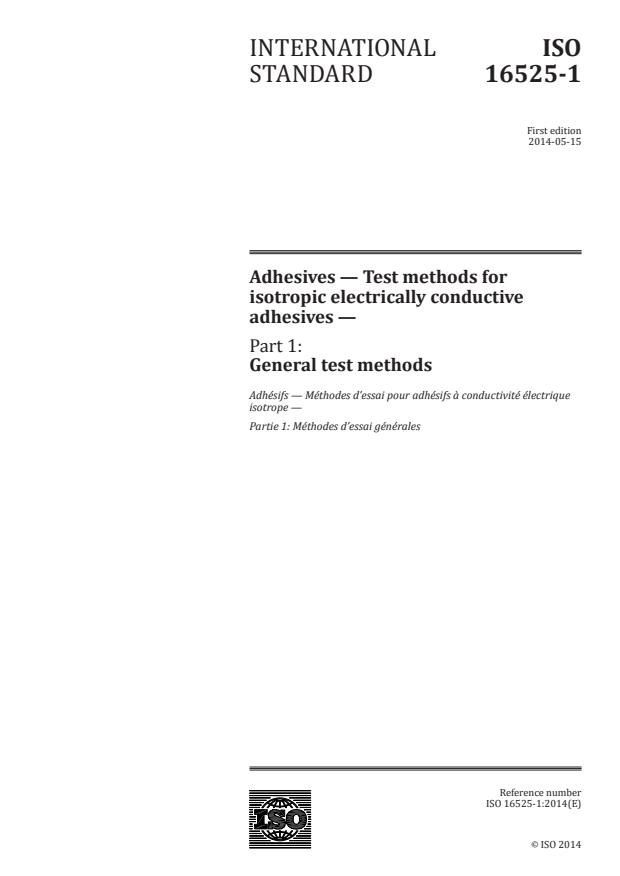
INTERNATIONAL ISO
STANDARD 16525-1
First edition
2014-05-15
Adhesives — Test methods for
isotropic electrically conductive
adhesives —
Part 1:
General test methods
Adhésifs — Méthodes d’essai pour adhésifs à conductivité électrique
isotrope —
Partie 1: Méthodes d’essai générales
Reference number
©
ISO 2014
© ISO 2014
All rights reserved. Unless otherwise specified, no part of this publication may be reproduced or utilized otherwise in any form
or by any means, electronic or mechanical, including photocopying, or posting on the internet or an intranet, without prior
written permission. Permission can be requested from either ISO at the address below or ISO’s member body in the country of
the requester.
ISO copyright office
Case postale 56 • CH-1211 Geneva 20
Tel. + 41 22 749 01 11
Fax + 41 22 749 09 47
E-mail copyright@iso.org
Web www.iso.org
Published in Switzerland
ii © ISO 2014 – All rights reserved
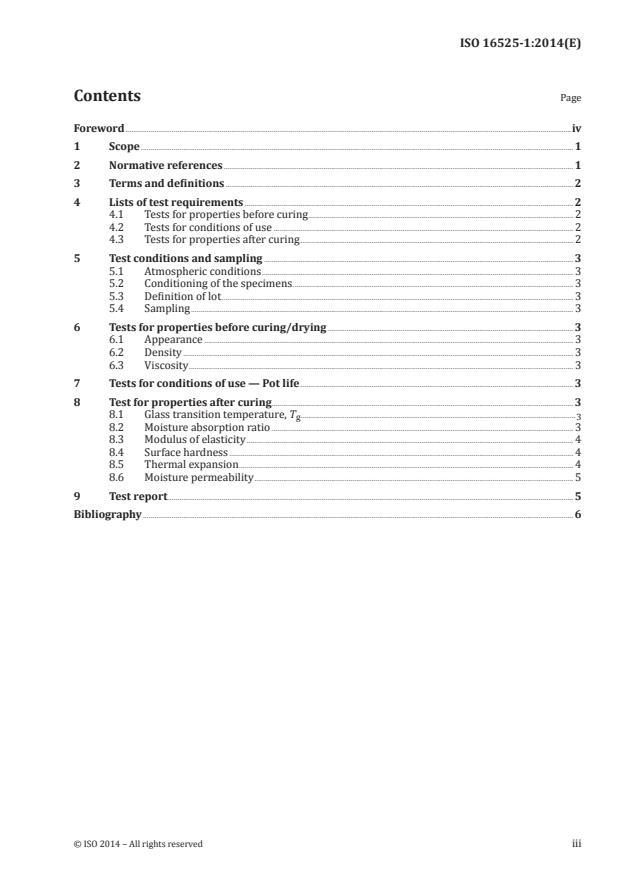
Contents Page
Foreword .iv
1 Scope . 1
2 Normative references . 1
3 Terms and definitions . 2
4 Lists of test requirements . 2
4.1 Tests for properties before curing . 2
4.2 Tests for conditions of use . 2
4.3 Tests for properties after curing . 2
5 Test conditions and sampling . 3
5.1 Atmospheric conditions . 3
5.2 Conditioning of the specimens . 3
5.3 Definition of lot . 3
5.4 Sampling . 3
6 Tests for properties before curing/drying . 3
6.1 Appearance . 3
6.2 Density . 3
6.3 Viscosity . 3
7 Tests for conditions of use — Pot life . 3
8 Test for properties after curing . 3
8.1 Glass transition temperature, T . . .
g 3
8.2 Moisture absorption ratio . 3
8.3 Modulus of elasticity . 4
8.4 Surface hardness . 4
8.5 Thermal expansion . 4
8.6 Moisture permeability . 5
9 Test report . 5
Bibliography . 6
Foreword
ISO (the International Organization for Standardization) is a worldwide federation of national standards
bodies (ISO member bodies). The work of preparing International Standards is normally carried out
through ISO technical committees. Each member body interested in a subject for which a technical
committee has been established has the right to be represented on that committee. International
organizations, governmental and non-governmental, in liaison with ISO, also take part in the work.
ISO collaborates closely with the International Electrotechnical Commission (IEC) on all matters of
electrotechnical standardization.
The procedures used to develop this document and those intended for its further maintenance are
described in the ISO/IEC Directives, Part 1. In particular the different approval criteria needed for the
different types of ISO documents should be noted. This document was drafted in accordance with the
editorial rules of the ISO/IEC Directives, Part 2. www.iso.org/directives.
Attention is drawn to the possibility that some of the elements of this document may be the subject of
patent rights. ISO shall not be held responsible for identifying any or all such patent rights. Details of any
patent rights identified during the development of the document will be in the Introduction and/or on
the ISO list of patent declarations received. www.iso.org/patents.
Any trade name used in this document is information given for the convenience of users and does not
constitute an endorsement.
The committee responsible for this document is ISO/TC 61, Plastics, Subcommittee SC 11, Products.
ISO 16525 consists of the following parts, under the general title Adhesives — Test methods for isotropic
electrically conductive adhesives:
— Part 1: General test methods
— Part 2: Determination of electric characteristics for use in electronic assemblies
— Part 3: Determination of heat-transfer properties
— Part 4: Determination of shear strength and electrical resistance using rigid-to-rigid bonded assemblies
— Part 5: Determination of shear fatigue
— Part 6: Determination of pendulum-type shear impact
— Part 7: Environmental test methods
— Part 8: Electrochemical migration test methods
— Part 9: Determination of high-speed signal-transmission characteristics
iv © ISO 2014 – All rights reserved
INTERNATIONAL STANDARD ISO 16525-1:2014(E)
Adhesives — Test methods for isotropic electrically
conductive adhesives —
Part 1:
General test methods
SAFETY STATEMENT — Persons using this part of ISO 16525 should be familiar with normal
laboratory practice. This part of ISO 16525 does not purport to address all of the safet
...
NORME ISO
INTERNATIONALE 16525-1
Première édition
2014-05-15
Adhésifs — Méthodes d’essai pour
adhésifs à conductivité électrique
isotrope —
Partie 1:
Méthodes d’essai générales
Adhesives — Test methods for isotropic electrically conductive
adhesives —
Part 1: General test methods
Numéro de référence
©
ISO 2014
DOCUMENT PROTÉGÉ PAR COPYRIGHT
© ISO 2014
Droits de reproduction réservés. Sauf indication contraire, aucune partie de cette publication ne peut être reproduite ni utilisée
sous quelque forme que ce soit et par aucun procédé, électronique ou mécanique, y compris la photocopie, l’affichage sur
l’internet ou sur un Intranet, sans autorisation écrite préalable. Les demandes d’autorisation peuvent être adressées à l’ISO à
l’adresse ci-après ou au comité membre de l’ISO dans le pays du demandeur.
ISO copyright office
Case postale 56 • CH-1211 Geneva 20
Tel. + 41 22 749 01 11
Fax + 41 22 749 09 47
E-mail copyright@iso.org
Web www.iso.org
Publié en Suisse
ii © ISO 2014 – Tous droits réservés
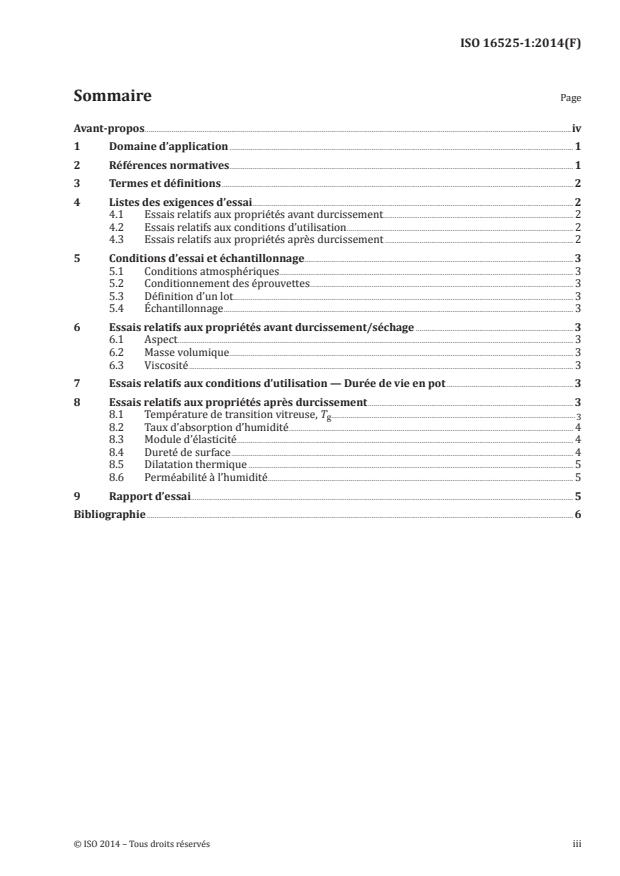
Sommaire Page
Avant-propos .iv
1 Domaine d’application . 1
2 Références normatives . 1
3 Termes et définitions . 2
4 Listes des exigences d’essai . 2
4.1 Essais relatifs aux propriétés avant durcissement. 2
4.2 Essais relatifs aux conditions d’utilisation . 2
4.3 Essais relatifs aux propriétés après durcissement . 2
5 Conditions d’essai et échantillonnage . 3
5.1 Conditions atmosphériques . 3
5.2 Conditionnement des éprouvettes . 3
5.3 Définition d’un lot . 3
5.4 Échantillonnage . 3
6 Essais relatifs aux propriétés avant durcissement/séchage . 3
6.1 Aspect . . 3
6.2 Masse volumique. 3
6.3 Viscosité . 3
7 Essais relatifs aux conditions d’utilisation — Durée de vie en pot .3
8 Essais relatifs aux propriétés après durcissement . 3
8.1 Température de transition vitreuse, T .
g 3
8.2 Taux d’absorption d’humidité . 4
8.3 Module d’élasticité . 4
8.4 Dureté de surface . 4
8.5 Dilatation thermique . 5
8.6 Perméabilité à l’humidité . 5
9 Rapport d’essai . 5
Bibliographie . 6
Avant-propos
L’ISO (Organisation internationale de normalisation) est une fédération mondiale d’organismes
nationaux de normalisation (comités membres de l’ISO). L’élaboration des Normes internationales est
en général confiée aux comités techniques de l’ISO. Chaque comité membre intéressé par une étude
a le droit de faire partie du comité technique créé à cet effet. Les organisations internationales,
gouvernementales et non gouvernementales, en liaison avec l’ISO participent également aux travaux.
L’ISO collabore étroitement avec la Commission électrotechnique internationale (IEC) en ce qui concerne
la normalisation électrotechnique.
Les procédures utilisées pour élaborer le présent document et celles destinées à sa mise à jour sont
décrites dans les Directives ISO/IEC, Partie 1. Il convient, en particulier de prendre note des différents
critères d’approbation requis pour les différents types de documents ISO. Le présent document a été
rédigé conformément aux règles de rédaction données dans les Directives ISO/IEC, Partie 2 (voir www.
iso.org/directives).
L’attention est appelée sur le fait que certains des éléments du présent document peuvent faire l’objet de
droits de propriété intellectuelle ou de droits analogues. L’ISO ne saurait être tenue pour responsable
de ne pas avoir identifié de tels droits de propriété et averti de leur existence. Les détails concernant les
références aux droits de propriété intellectuelle ou autres droits analogues identifiés lors de l’élaboration
du document sont indiqués dans l’Introduction et/ou dans la liste des déclarations de brevets reçues par
l’ISO (voir www.iso.org/brevets).
Les appellations commerciales éventuellement mentionnées dans le présent document sont données
pour information, par souci de commodité, à l’intention des utilisateurs et ne sauraient constituer un
engagement.
Pour une explication de la signification des termes et expressions spécifiques de l’ISO liés à l’évaluation de
la conformité, ou pour toute information au sujet de l’adhésion de l’ISO aux principes de l’OMC concernant
les obstacles techniques au commerce (OTC), voir le lien suivant: Avant-propos — Informations
supplémentaires.
Le comité chargé de l’élaboration du présent document est l’ISO/TC 61, Plastiques, sous-comité SC 11,
Produits.
L’ISO 16525 comprend les parties suivantes, présentées sous le titre général Adhésifs — Méthodes d’essai
pour adhésifs à conductivité électrique isotrope:
— Partie 1: Méthodes d’essai générales
— Partie 2: Détermination des propriétés électriques pour utilisation dans des assemblages électroniques
— Partie 3: Détermination des propriétés de transfert de chaleur
— Partie 4: Détermination de la résistance au cisaillement et de la résistance électrique des assemblages
collés rigide sur rigide
— Partie 5: Détermination de la fatigue par cisaillement
— Partie 6: Détermination de la résistance au choc du type pendule
— Partie 7: Méthodes d’essai environnemental
— Partie 8: Méthodes d’essai de migration électrochimique
— Partie 9: Détermination des propriétés de transmission de signal à haute vitesse
iv © ISO 2014 – Tous droits réservés
NORME INTERNATIONALE ISO 16525-1:2014(F)
Adhésifs — Méthodes d’essai pour adhésifs à conductivité
électrique isotrope —
Partie 1:
Méthodes d’essai générales
AVERTISSEMENT — Il convient que l’utilisateur de la présente partie de l’ISO 16525 connaisse
bien les pratiques courantes de laboratoire. La présente partie de l’ISO 16525 n’a pas pour but de
traiter tous les problèmes de sécurité qui sont, le cas échéant, liés à son utilisation. Il incombe
à l’utilisateur d’établir des pratiques appropriées en matière d’hygiène et de sécurité, et de
s’assurer de la conformité à la réglementation nationale en vigueur.
IMPORTANT — Certains modes opératoires spécifiés dans la présente partie de l’ISO 16525
peuvent impliquer l’utilisation ou la génération de substances o
...