

ISO 13926-1:2018
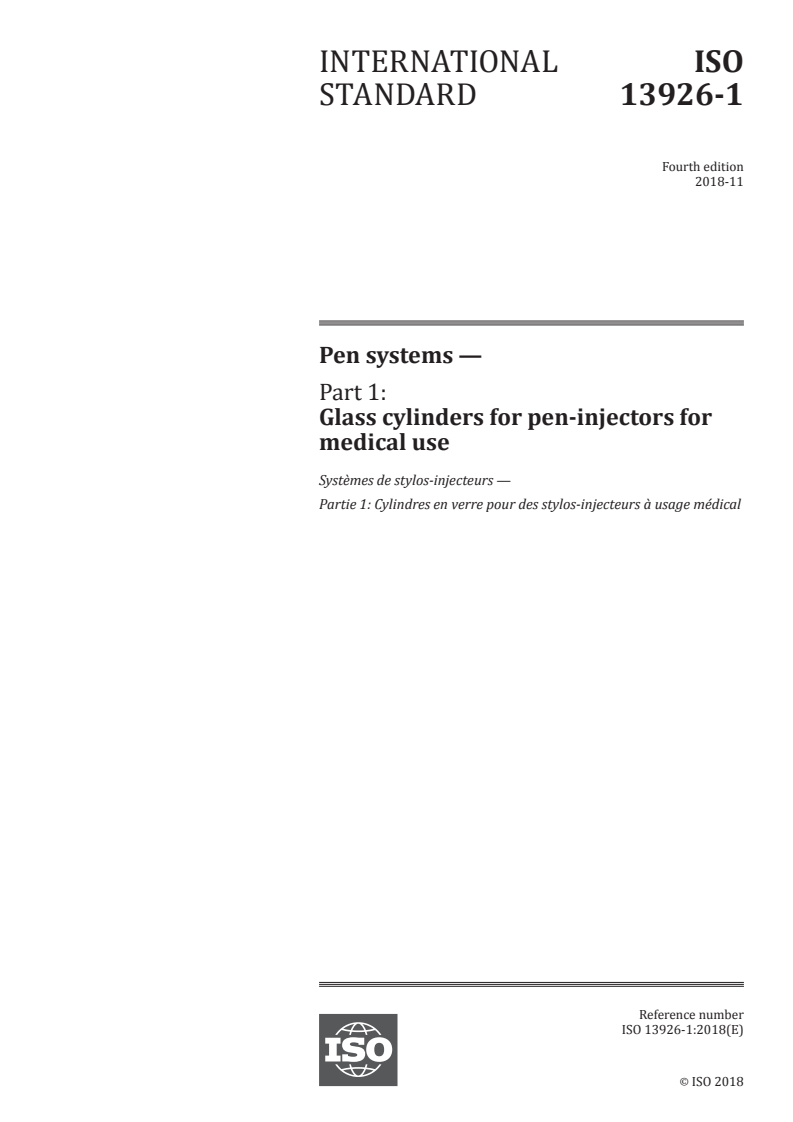
(Main)Pen systems — Part 1: Glass cylinders for pen-injectors for medical use
General Information
- Abstract
This document specifies the design, materials, performance and test methods, and gives recommendations for dimensions for glass cylinders used with pen-injectors for medical use. It applies to the primary containers used in direct contact with the drug.
- Status
- Withdrawn
- Publication Date
- 14-Oct-2018
- Current Stage
- 9599 - Withdrawal of International Standard
- Start Date
- 26-Aug-2026
- Completion Date
- 29-Aug-2026
Overview - ISO 13926-1:2018 (Pen systems: Glass cylinders for pen-injectors)
ISO 13926-1:2018 specifies design, materials, performance and test methods, and gives recommended dimensions for glass cylinders used in pen‑injectors for medical use. It applies to primary containers in direct contact with drug products and is the Part 1 standard in the ISO 13926 pen systems series. The document ensures glass barrels meet packaging, compatibility and quality requirements needed for safe, stable drug delivery in pen-based injection systems.
Key topics and technical requirements
- Materials: Colourless (cl) or amber (br) glass of hydrolytic resistance grain glass in accordance with ISO 720 - corresponding to pharmacopoeial glass type 1. Glass must be free of seeds/bubbles that interfere with visual inspection.
- Dimensions and geometry: Nominal dimensions and tolerances for bore, outer diameter and flange are specified (see Table 1 and Figure 1). The cylinder opening should be cylindrical for the specified depth; a slightly conical (truncated cone) opening is allowed only if the larger diameter does not exceed the smaller by more than 0.3 mm.
- Sealing surface: Sealing surface must be flat, free from ripples or undulations to ensure closure integrity with plunger stoppers and seals.
- Hydrolytic resistance: Internal surface must meet HC 1 container class when tested per ISO 4802‑1 or ISO 4802‑2 (and linked to ISO 720 for classification). Bottom end is sealed prior to testing.
- Annealing quality: Residual stress limits are expressed as optical retardation not exceeding 40 nm per mm of glass thickness when viewed in a strain viewer; test method to be agreed between manufacturer and customer.
- Change control: Chemical composition changes to glass require at least nine months’ notice to users.
- Designation & marking: Product designation format (e.g., Cylinder ISO 13926-1-cl-11,6) and package marking requirements (designation, lot, quantity, manufacturer) are specified.
- Compatibility and validation: Dimensional selection and system validation (glass cylinder + plunger stopper + seal) must follow ISO 11608‑3. Related parts: ISO 13926‑2 (plunger stoppers) and ISO 13926‑3 (seals).
Applications and users
This standard is used by:
- Medical device and pen‑injector manufacturers designing or qualifying cartridge/barrel components.
- Glass tubing and primary packaging suppliers producing pharmaceutical glass cylinders.
- Pharmaceutical formulation and packaging engineers validating container–closure systems for drug products.
- Quality assurance, regulatory affairs, and testing laboratories performing hydrolytic resistance, dimensional, and stress tests. Practical applications include selection and procurement of pen‑injector barrels, design verification, incoming inspection criteria, and validation of container–closure compatibility for injectable drugs.
Related standards
- ISO 720 - Hydrolytic resistance of glass grains
- ISO 4802‑1 / ISO 4802‑2 - Hydrolytic resistance of interior surfaces of glass containers
- ISO 11608‑3 - Needle-based injection systems: finished containers (validation)
- ISO 13926‑2 - Plunger stoppers for pen‑injectors
- ISO 13926‑3 - Seals for pen‑injectors
Keywords: ISO 13926-1:2018, pen systems, glass cylinders, pen‑injectors, hydrolytic resistance, HC1, sealing surface, annealing quality, primary container, ISO 11608-3.
Relations
- Effective Date
- 09-Feb-2026
- Effective Date
- 08-Jul-2024
- Effective Date
- 18-Mar-2017
Get Certified
Connect with accredited certification bodies for this standard

BSI Group
BSI (British Standards Institution) is the business standards company that helps organizations make excellence a habit.

TÜV Rheinland
TÜV Rheinland is a leading international provider of technical services.

TÜV SÜD
TÜV SÜD is a trusted partner of choice for safety, security and sustainability solutions.
Sponsored listings
Frequently Asked Questions
ISO 13926-1:2018 is a standard published by the International Organization for Standardization (ISO). Its full title is "Pen systems — Part 1: Glass cylinders for pen-injectors for medical use". This standard covers: This document specifies the design, materials, performance and test methods, and gives recommendations for dimensions for glass cylinders used with pen-injectors for medical use. It applies to the primary containers used in direct contact with the drug.
This document specifies the design, materials, performance and test methods, and gives recommendations for dimensions for glass cylinders used with pen-injectors for medical use. It applies to the primary containers used in direct contact with the drug.
ISO 13926-1:2018 is classified under the following ICS (International Classification for Standards) categories: 11.040.25 - Syringes, needles an catheters. The ICS classification helps identify the subject area and facilitates finding related standards.
ISO 13926-1:2018 has the following relationships with other standards: It is inter standard links to EN ISO 11608-3:2022, ISO 13926-1:2026, ISO 13926-1:2004. Understanding these relationships helps ensure you are using the most current and applicable version of the standard.
ISO 13926-1:2018 is available in PDF format for immediate download after purchase. The document can be added to your cart and obtained through the secure checkout process. Digital delivery ensures instant access to the complete standard document.
Standards Content (Sample)
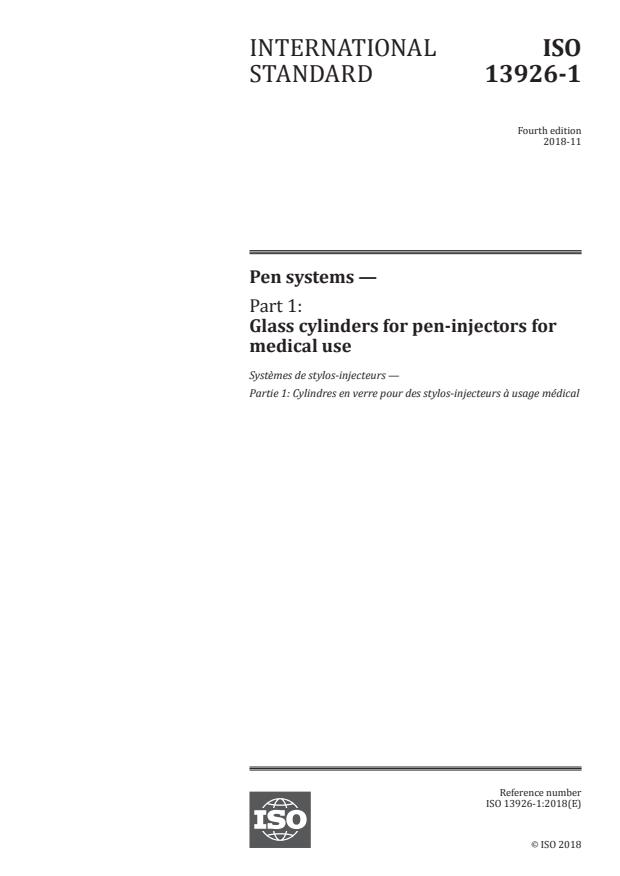
INTERNATIONAL ISO
STANDARD 13926-1
Fourth edition
2018-11
Pen systems —
Part 1:
Glass cylinders for pen-injectors for
medical use
Systèmes de stylos-injecteurs —
Partie 1: Cylindres en verre pour des stylos-injecteurs à usage médical
Reference number
©
ISO 2018
© ISO 2018
All rights reserved. Unless otherwise specified, or required in the context of its implementation, no part of this publication may
be reproduced or utilized otherwise in any form or by any means, electronic or mechanical, including photocopying, or posting
on the internet or an intranet, without prior written permission. Permission can be requested from either ISO at the address
below or ISO’s member body in the country of the requester.
ISO copyright office
CP 401 • Ch. de Blandonnet 8
CH-1214 Vernier, Geneva
Phone: +41 22 749 01 11
Fax: +41 22 749 09 47
Email: copyright@iso.org
Website: www.iso.org
Published in Switzerland
ii © ISO 2018 – All rights reserved
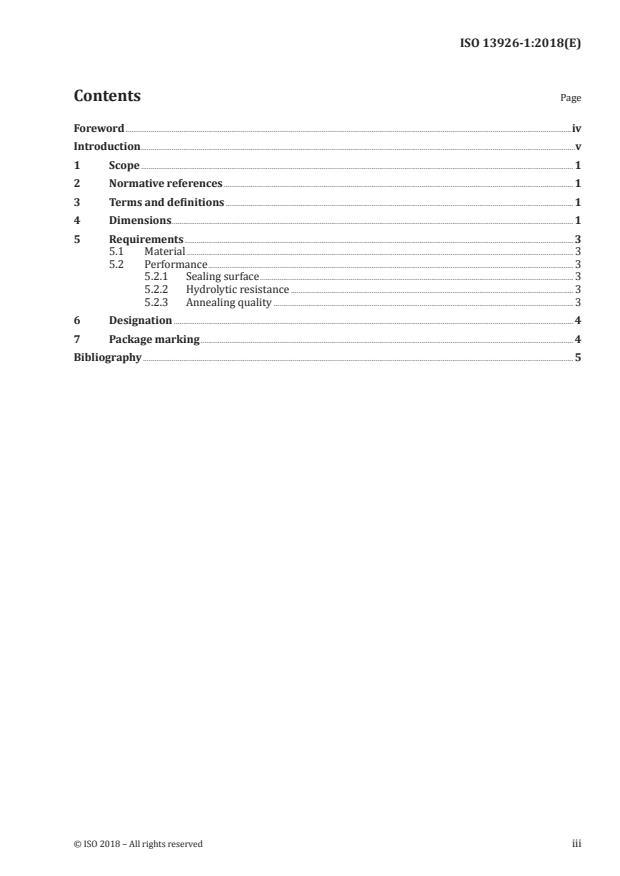
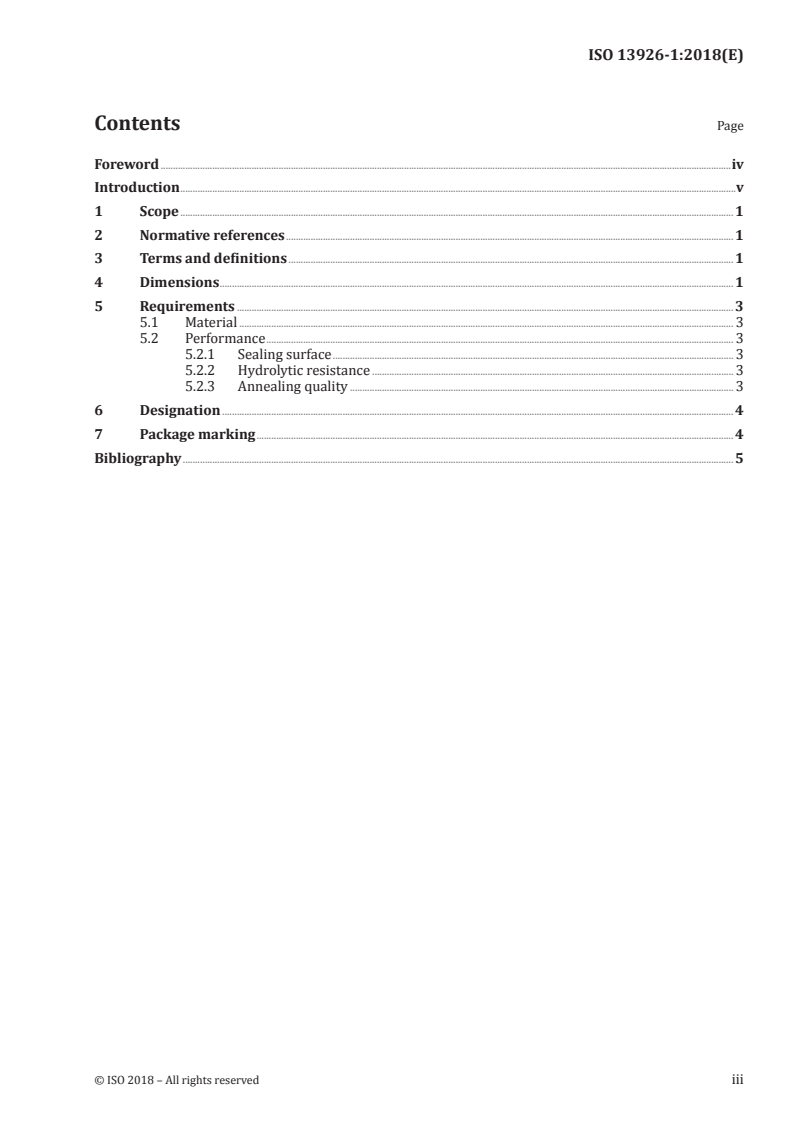
Contents Page
Foreword .iv
Introduction .v
1 Scope . 1
2 Normative references . 1
3 Terms and definitions . 1
4 Dimensions . 1
5 Requirements . 3
5.1 Material . 3
5.2 Performance . 3
5.2.1 Sealing surface . 3
5.2.2 Hydrolytic resistance . 3
5.2.3 Annealing quality . 3
6 Designation . 4
7 Package marking . 4
Bibliography . 5
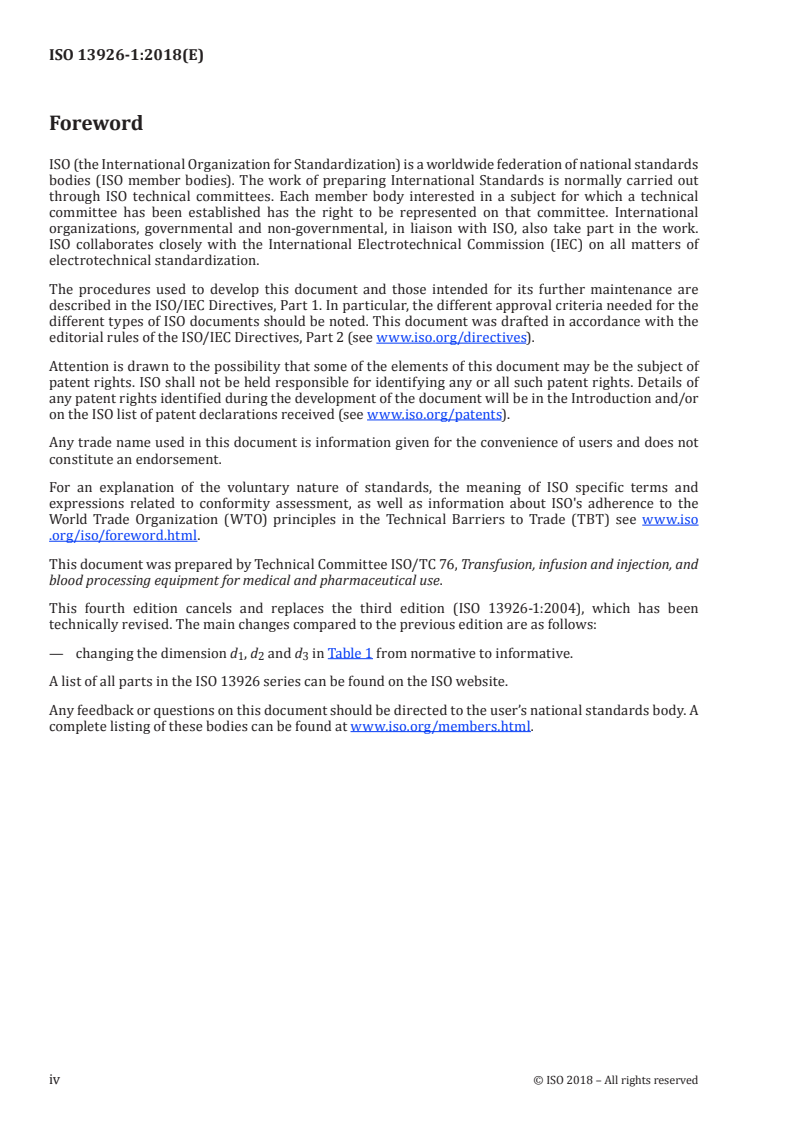
Foreword
ISO (the International Organization for Standardization) is a worldwide federation of national standards
bodies (ISO member bodies). The work of preparing International Standards is normally carried out
through ISO technical committees. Each member body interested in a subject for which a technical
committee has been established has the right to be represented on that committee. International
organizations, governmental and non-governmental, in liaison with ISO, also take part in the work.
ISO collaborates closely with the International Electrotechnical Commission (IEC) on all matters of
electrotechnical standardization.
The procedures used to develop this document and those intended for its further maintenance are
described in the ISO/IEC Directives, Part 1. In particular, the different approval criteria needed for the
different types of ISO documents should be noted. This document was drafted in accordance with the
editorial rules of the ISO/IEC Directives, Part 2 (see www .iso .org/directives).
Attention is drawn to the possibility that some of the elements of this document may be the subject of
patent rights. ISO shall not be held responsible for identifying any or all such patent rights. Details of
any patent rights identified during the development of the document will be in the Introduction and/or
on the ISO list of patent declarations received (see www .iso .org/patents).
Any trade name used in this document is information given for the convenience of users and does not
constitute an endorsement.
For an explanation of the voluntary nature of standards, the meaning of ISO specific terms and
expressions related to conformity assessment, as well as information about ISO's adherence to the
World Trade Organization (WTO) principles in the Technical Barriers to Trade (TBT) see www .iso
.org/iso/foreword .html.
This document was prepared by Technical Committee ISO/TC 76, Transfusion, infusion and injection, and
blood processing equipment for medical and pharmaceutical use.
This fourth edition cancels and replaces the third edition (ISO 13926-1:2004), which has been
technically revised. The main changes compared to the previous edition are as follows:
— changing the dimension d , d and d in Table 1 from normative to informative.
1 2 3
A list of all parts in the ISO 13926 series can be found on the ISO website.
Any feedback or questions on this document should be directed to the user’s national standards body. A
complete listing of these bodies can be found at www .iso .org/members .html.
iv © ISO 2018 – All rights reserved
------------------
...
INTERNATIONAL ISO
STANDARD 13926-1
Fourth edition
2018-11
Pen systems —
Part 1:
Glass cylinders for pen-injectors for
medical use
Systèmes de stylos-injecteurs —
Partie 1: Cylindres en verre pour des stylos-injecteurs à usage médical
Reference number
©
ISO 2018
© ISO 2018
All rights reserved. Unless otherwise specified, or required in the context of its implementation, no part of this publication may
be reproduced or utilized otherwise in any form or by any means, electronic or mechanical, including photocopying, or posting
on the internet or an intranet, without prior written permission. Permission can be requested from either ISO at the address
below or ISO’s member body in the country of the requester.
ISO copyright office
CP 401 • Ch. de Blandonnet 8
CH-1214 Vernier, Geneva
Phone: +41 22 749 01 11
Fax: +41 22 749 09 47
Email: copyright@iso.org
Website: www.iso.org
Published in Switzerland
ii © ISO 2018 – All rights reserved
Contents Page
Foreword .iv
Introduction .v
1 Scope . 1
2 Normative references . 1
3 Terms and definitions . 1
4 Dimensions . 1
5 Requirements . 3
5.1 Material . 3
5.2 Performance . 3
5.2.1 Sealing surface . 3
5.2.2 Hydrolytic resistance . 3
5.2.3 Annealing quality . 3
6 Designation . 4
7 Package marking . 4
Bibliography . 5
Foreword
ISO (the International Organization for Standardization) is a worldwide federation of national standards
bodies (ISO member bodies). The work of preparing International Standards is normally carried out
through ISO technical committees. Each member body interested in a subject for which a technical
committee has been established has the right to be represented on that committee. International
organizations, governmental and non-governmental, in liaison with ISO, also take part in the work.
ISO collaborates closely with the International Electrotechnical Commission (IEC) on all matters of
electrotechnical standardization.
The procedures used to develop this document and those intended for its further maintenance are
described in the ISO/IEC Directives, Part 1. In particular, the different approval criteria needed for the
different types of ISO documents should be noted. This document was drafted in accordance with the
editorial rules of the ISO/IEC Directives, Part 2 (see www .iso .org/directives).
Attention is drawn to the possibility that some of the elements of this document may be the subject of
patent rights. ISO shall not be held responsible for identifying any or all such patent rights. Details of
any patent rights identified during the development of the document will be in the Introduction and/or
on the ISO list of patent declarations received (see www .iso .org/patents).
Any trade name used in this document is information given for the convenience of users and does not
constitute an endorsement.
For an explanation of the voluntary nature of standards, the meaning of ISO specific terms and
expressions related to conformity assessment, as well as information about ISO's adherence to the
World Trade Organization (WTO) principles in the Technical Barriers to Trade (TBT) see www .iso
.org/iso/foreword .html.
This document was prepared by Technical Committee ISO/TC 76, Transfusion, infusion and injection, and
blood processing equipment for medical and pharmaceutical use.
This fourth edition cancels and replaces the third edition (ISO 13926-1:2004), which has been
technically revised. The main changes compared to the previous edition are as follows:
— changing the dimension d , d and d in Table 1 from normative to informative.
1 2 3
A list of all parts in the ISO 13926 series can be found on the ISO website.
Any feedback or questions on this document should be directed to the user’s national standards body. A
complete listing of these bodies can be found at www .iso .org/members .html.
iv © ISO 2018 – All rights reserved
------------------
...