


ISO 14972:1998
(Main)Sterile obturators for single use with over-needle peripheral intravascular catheters
Sterile obturators for single use with over-needle peripheral intravascular catheters
This International Standard specifies requirements for obturators, supplied in the sterile condition and intended for single use for plugging over-needle peripheral catheters. NOTE Attention is drawn to ISO 10555-5, which specifies requirements for over-needle peripheral catheters.
Obturateurs stériles non réutilisables pour cathéters intravasculaires périphériques à aiguille interne
La présente Norme internationale spécifie les exigences relatives aux obturateurs stériles non réutilisables destinés aux cathéters périphériques à aiguille interne. NOTE L'attention du lecteur est attirée sur l'ISO 10555-5, qui spécifie les exigences relatives aux cathéters périphériques à aiguille interne.
General Information
- Status
- Published
- Publication Date
- 19-Dec-1998
- Technical Committee
- ISO/TC 84 - Devices for administration of medicinal products and catheters
- Current Stage
- 9060 - Close of review
- Completion Date
- 02-Sep-2031
Buy Documents

ISO 14972:1998 - Sterile obturators for single use with over-needle peripheral intravascular catheters
ISO 14972:1998 - Sterile obturators for single use with over-needle peripheral intravascular catheters/20/1998


ISO 14972:1998 - Obturateurs stériles non réutilisables pour cathéters intravasculaires périphériques a aiguille interne
ISO 14972:1998 - Obturateurs stériles non réutilisables pour cathéters intravasculaires périphériques à aiguille interne/20/1998
Overview
ISO 14972:1998 defines requirements for sterile obturators for single use intended to plug the lumen of over-needle peripheral intravascular catheters. The standard covers design, sterilization, dimensional compatibility, labeling and essential manufacturer information to ensure safe, single-use obturators supplied in the sterile condition. It cross-references catheter requirements in ISO 10555-5.
Key topics and technical requirements
- Scope and definition: Specifies obturators designed to be inserted into over-needle peripheral catheters to plug the lumen.
- Sterility and sterilization: Obturators must be supplied sterile by a validated method (see ISO 11134, ISO 11135, ISO 11137 for sterilization methods).
- Biocompatibility: Devices shall be free from biological hazard; see ISO 10993-1 for appropriate test methods.
- Surface quality: External surface of the effective shaft length shall appear clean at 2.5× magnification and be free from defects to minimize vessel trauma.
- Mechanical strength (force at break): Minimum tensile force at break is specified by obturator shaft outside diameter:
- 0.35–<0.75 mm → ≥ 3 N
- 0.75–<1.15 mm → ≥ 5 N
- 1.15–<1.85 mm → ≥ 8 N
- ≥1.85 mm → ≥ 12 N
- Luer fitting: Must comply with ISO 594-1 or ISO 594-2 (Luer/conical or lock fittings).
- Dimensional compatibility: Outside diameter must match catheter inner diameter; when fully inserted, the tip must coincide with or protrude no more than 3.0 mm beyond the catheter tip.
- Color coding and radio-detectability: Obturators must use the catheter’s color code and the unit package should show the color. Radio-opacity is recommended; manufacturers may label “radio-opaque” if supported by an appropriate method.
- Manufacturer information: Required information includes product description, compatibility, manufacturer name/address, lot, expiry, sterilization method, single-use indication, storage/handling, instructions and warnings.
Applications and users
ISO 14972 is used by:
- Manufacturers of obturators and over-needle peripheral catheters for product design, testing and labeling.
- Quality assurance and regulatory teams to demonstrate compliance with medical device standards.
- Test laboratories performing tensile (force-at-break) and biocompatibility testing (Annex A provides the tensile test method).
- Procurement and clinical engineering for selecting compatible, single-use sterile obturators for vascular access kits.
Related standards
- ISO 10555-5 (over-needle peripheral catheters)
- ISO 594-1 / ISO 594-2 (Luer fittings)
- ISO 10993-1 (biological evaluation)
- ISO 11134, ISO 11135, ISO 11137 (sterilization validation)
Keywords: ISO 14972, sterile obturators, over-needle peripheral catheters, single-use obturators, Luer fitting, biocompatibility, sterilization, force at break, medical device standards.
Buy Documents
ISO 14972:1998 - Sterile obturators for single use with over-needle peripheral intravascular catheters
ISO 14972:1998 - Sterile obturators for single use with over-needle peripheral intravascular catheters/20/1998
ISO 14972:1998 - Obturateurs stériles non réutilisables pour cathéters intravasculaires périphériques a aiguille interne
ISO 14972:1998 - Obturateurs stériles non réutilisables pour cathéters intravasculaires périphériques à aiguille interne/20/1998
Get Certified
Connect with accredited certification bodies for this standard

BSI Group
BSI (British Standards Institution) is the business standards company that helps organizations make excellence a habit.

TÜV Rheinland
TÜV Rheinland is a leading international provider of technical services.

TÜV SÜD
TÜV SÜD is a trusted partner of choice for safety, security and sustainability solutions.
Sponsored listings
Frequently Asked Questions
ISO 14972:1998 is a standard published by the International Organization for Standardization (ISO). Its full title is "Sterile obturators for single use with over-needle peripheral intravascular catheters". This standard covers: This International Standard specifies requirements for obturators, supplied in the sterile condition and intended for single use for plugging over-needle peripheral catheters. NOTE Attention is drawn to ISO 10555-5, which specifies requirements for over-needle peripheral catheters.
This International Standard specifies requirements for obturators, supplied in the sterile condition and intended for single use for plugging over-needle peripheral catheters. NOTE Attention is drawn to ISO 10555-5, which specifies requirements for over-needle peripheral catheters.
ISO 14972:1998 is classified under the following ICS (International Classification for Standards) categories: 11.040.25 - Syringes, needles an catheters. The ICS classification helps identify the subject area and facilitates finding related standards.
ISO 14972:1998 is available in PDF format for immediate download after purchase. The document can be added to your cart and obtained through the secure checkout process. Digital delivery ensures instant access to the complete standard document.
Standards Content (Sample)
INTERNATIONAL ISO
STANDARD 14972
First edition
1998-12-15
Sterile obturators for single use with over-
needle peripheral intravascular catheters
Obturateurs stériles non réutilisables pour cathéters intravasculaires
périphériques à aiguille interne
A
Reference number
Foreword
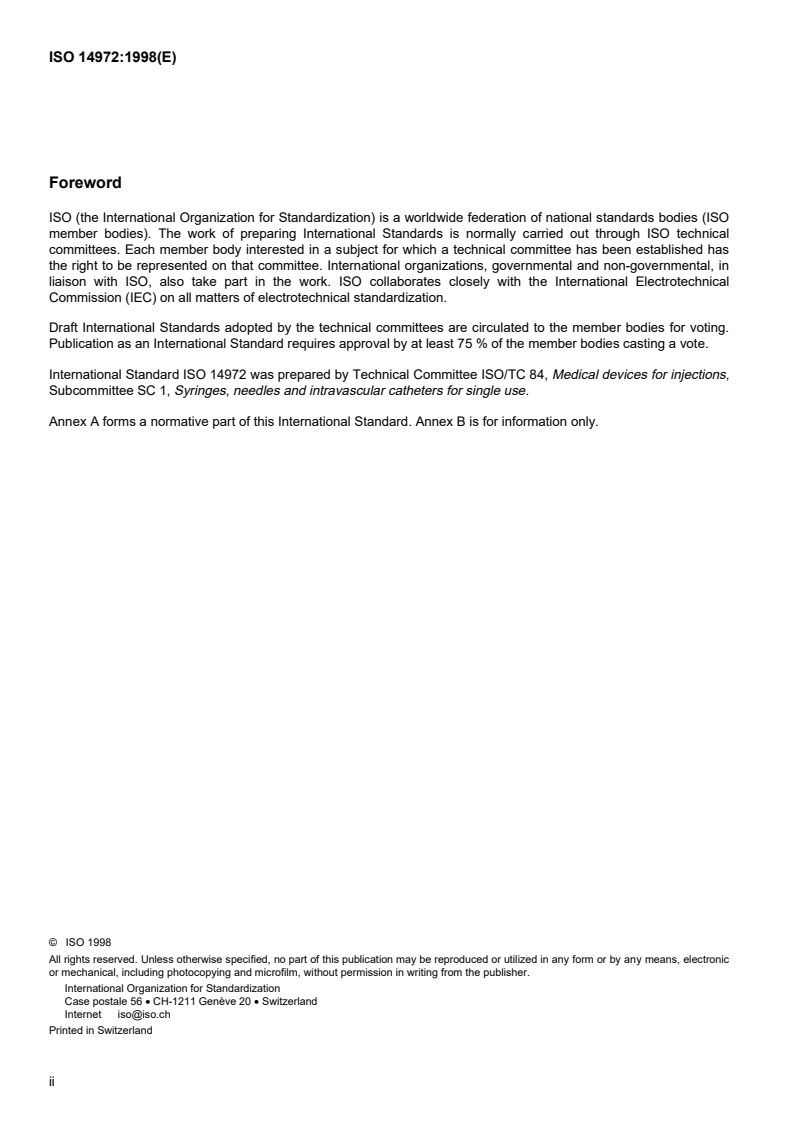
ISO (the International Organization for Standardization) is a worldwide federation of national standards bodies (ISO
member bodies). The work of preparing International Standards is normally carried out through ISO technical
committees. Each member body interested in a subject for which a technical committee has been established has
the right to be represented on that committee. International organizations, governmental and non-governmental, in
liaison with ISO, also take part in the work. ISO collaborates closely with the International Electrotechnical
Commission (IEC) on all matters of electrotechnical standardization.
Draft International Standards adopted by the technical committees are circulated to the member bodies for voting.
Publication as an International Standard requires approval by at least 75 % of the member bodies casting a vote.
International Standard ISO 14972 was prepared by Technical Committee ISO/TC 84, Medical devices for injections,
Subcommittee SC 1, Syringes, needles and intravascular catheters for single use.
Annex A forms a normative part of this International Standard. Annex B is for information only.
© ISO 1998
All rights reserved. Unless otherwise specified, no part of this publication may be reproduced or utilized in any form or by any means, electronic
or mechanical, including photocopying and microfilm, without permission in writing from the publisher.
International Organization for Standardization
Case postale 56 • CH-1211 Genève 20 • Switzerland
Internet iso@iso.ch
Printed in Switzerland
ii
INTERNATIONAL STANDARD © ISO ISO 14972:1998(E)
Sterile obturators for single use with over-needle peripheral
intravascular catheters
1 Scope
This International Standard specifies requirements for obturators, supplied in the sterile condition and intended for
single use for plugging over-needle peripheral catheters.
NOTE Attention is drawn to ISO 10555-5, which specifies requirements for over-needle peripheral catheters.
2 Normative references
The following standards contain provisions which, through reference in this text, constitute provisions of this
International Standard. At the time of publication, the editions indicated were valid. All standards are subject to
revision, and parties to agreements based on this International Standard are encouraged to investigate the
possibility of applying the most recent editions of the standards indicated below. Members of IEC and ISO maintain
registers of currently valid International Standards.
ISO 594-1:1986, Conical fittings with a 6 % (Luer) taper for syringes, needles and certain other medical
equipment — Part 1: General requirements.
ISO 594-2:1998, Conical fittings with a 6 % (Luer) taper for syringes, needles and certain other medical equipment
— Part 2: Lock fittings.
3 Definition
For the purposes of this International Standard, the following definition applies.
3.1
obturator
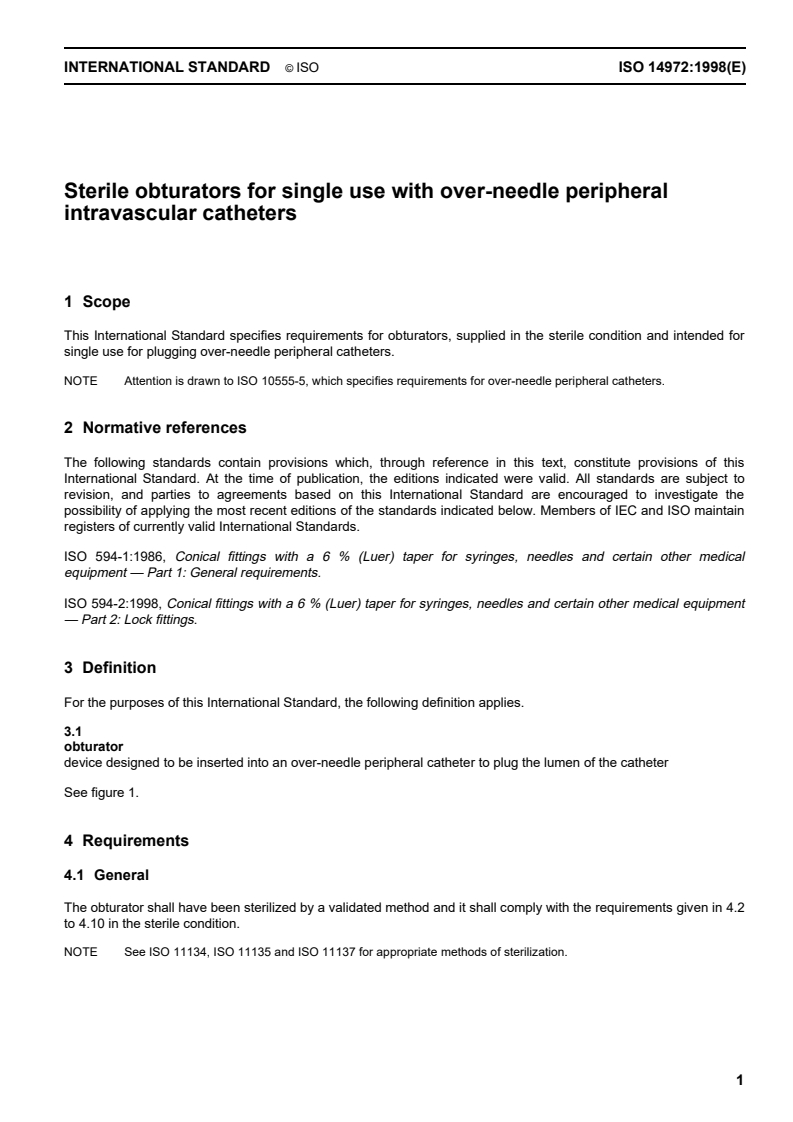
device designed to be inserted into an over-needle peripheral catheter to plug the lumen of the catheter
See figure 1.
4 Requirements
4.1 General
The obturator shall have been sterilized by a validated method and it shall comply with the requirements given in 4.2
to 4.10 in the sterile condition.
NOTE See ISO 11134, ISO 11135 and ISO 11137 for appropriate methods of sterilization.
© ISO
Key
1 Outside diameter 4 Luer fitting (lock fitting shown)
2 Tip 5 Obturator shaft
3 Effective length
Figure 1 — Example of obturator
4.2 Biocompatibility
The obturator shall be free from biological hazard.
NOTE See ISO 10993-1 for the selection of appropriate test methods.
4.3 Surface
When examined by normal or corrected-to-normal vision with 2,5 × magnification, the external surface of the
effective length of the obturator shaft shall appear free from extraneous matter.
The external surface and the tip of the obturator shaft should be free from surface defects in order to minimize
trauma to vessels during use.
4.4 Force at break
When tested in accordance with the method given in annex A, the force at break of the obturator shall be as given in
table 1.
Table 1 — Force at break
Smallest outside diameter of obturator shaft Minimum force at break
mm N
≥ 0,35 < 0,75 3
≥ 0,75 < 1,15 5
≥ 1,15 < 1,85 8
≥ 1,85
© ISO
...
INTERNATIONAL ISO
STANDARD 14972
First edition
1998-12-15
Sterile obturators for single use with over-
needle peripheral intravascular catheters
Obturateurs stériles non réutilisables pour cathéters intravasculaires
périphériques à aiguille interne
A
Reference number
Foreword
ISO (the International Organization for Standardization) is a worldwide federation of national standards bodies (ISO
member bodies). The work of preparing International Standards is normally carried out through ISO technical
committees. Each member body interested in a subject for which a technical committee has been established has
the right to be represented on that committee. International organizations, governmental and non-governmental, in
liaison with ISO, also take part in the work. ISO collaborates closely with the International Electrotechnical
Commission (IEC) on all matters of electrotechnical standardization.
Draft International Standards adopted by the technical committees are circulated to the member bodies for voting.
Publication as an International Standard requires approval by at least 75 % of the member bodies casting a vote.
International Standard ISO 14972 was prepared by Technical Committee ISO/TC 84, Medical devices for injections,
Subcommittee SC 1, Syringes, needles and intravascular catheters for single use.
Annex A forms a normative part of this International Standard. Annex B is for information only.
© ISO 1998
All rights reserved. Unless otherwise specified, no part of this publication may be reproduced or utilized in any form or by any means, electronic
or mechanical, including photocopying and microfilm, without permission in writing from the publisher.
International Organization for Standardization
Case postale 56 • CH-1211 Genève 20 • Switzerland
Internet iso@iso.ch
Printed in Switzerland
ii
INTERNATIONAL STANDARD © ISO ISO 14972:1998(E)
Sterile obturators for single use with over-needle peripheral
intravascular catheters
1 Scope
This International Standard specifies requirements for obturators, supplied in the sterile condition and intended for
single use for plugging over-needle peripheral catheters.
NOTE Attention is drawn to ISO 10555-5, which specifies requirements for over-needle peripheral catheters.
2 Normative references
The following standards contain provisions which, through reference in this text, constitute provisions of this
International Standard. At the time of publication, the editions indicated were valid. All standards are subject to
revision, and parties to agreements based on this International Standard are encouraged to investigate the
possibility of applying the most recent editions of the standards indicated below. Members of IEC and ISO maintain
registers of currently valid International Standards.
ISO 594-1:1986, Conical fittings with a 6 % (Luer) taper for syringes, needles and certain other medical
equipment — Part 1: General requirements.
ISO 594-2:1998, Conical fittings with a 6 % (Luer) taper for syringes, needles and certain other medical equipment
— Part 2: Lock fittings.
3 Definition
For the purposes of this International Standard, the following definition applies.
3.1
obturator
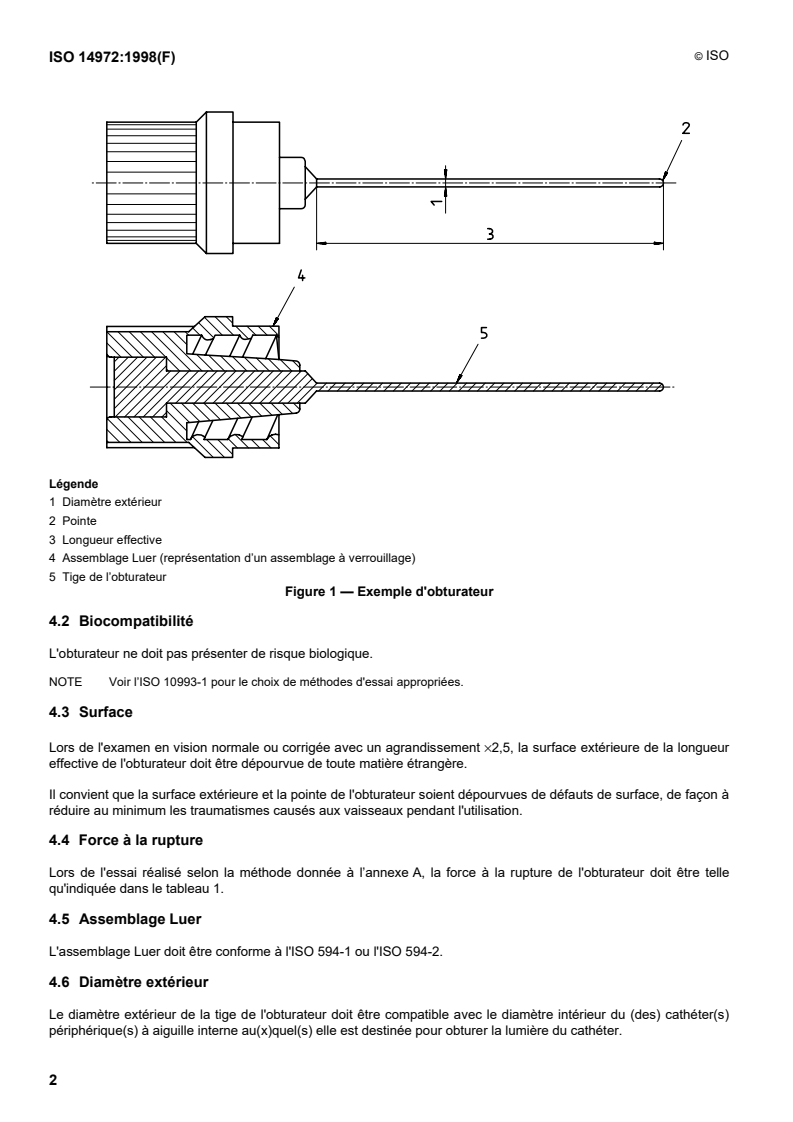
device designed to be inserted into an over-needle peripheral catheter to plug the lumen of the catheter
See figure 1.
4 Requirements
4.1 General
The obturator shall have been sterilized by a validated method and it shall comply with the requirements given in 4.2
to 4.10 in the sterile condition.
NOTE See ISO 11134, ISO 11135 and ISO 11137 for appropriate methods of sterilization.
© ISO
Key
1 Outside diameter 4 Luer fitting (lock fitting shown)
2 Tip 5 Obturator shaft
3 Effective length
Figure 1 — Example of obturator
4.2 Biocompatibility
The obturator shall be free from biological hazard.
NOTE See ISO 10993-1 for the selection of appropriate test methods.
4.3 Surface
When examined by normal or corrected-to-normal vision with 2,5 × magnification, the external surface of the
effective length of the obturator shaft shall appear free from extraneous matter.
The external surface and the tip of the obturator shaft should be free from surface defects in order to minimize
trauma to vessels during use.
4.4 Force at break
When tested in accordance with the method given in annex A, the force at break of the obturator shall be as given in
table 1.
Table 1 — Force at break
Smallest outside diameter of obturator shaft Minimum force at break
mm N
≥ 0,35 < 0,75 3
≥ 0,75 < 1,15 5
≥ 1,15 < 1,85 8
≥ 1,85
© ISO
...
NORME ISO
INTERNATIONALE 14972
Première édition
1998-12-15
Obturateurs stériles non réutilisables pour
cathéters intravasculaires périphériques à
aiguille interne
Sterile obturators for single use with over-needle peripheral intravascular
catheters
A
Numéro de référence
Avant-propos
L'ISO (Organisation internationale de normalisation) est une fédération mondiale d'organismes nationaux de
normalisation (comités membres de l'ISO). L'élaboration des Normes internationales est en général confiée aux
comités techniques de l'ISO. Chaque comité membre intéressé par une étude a le droit de faire partie du comité
technique créé à cet effet. Les organisations internationales, gouvernementales et non gouvernementales, en
liaison avec l'ISO participent également aux travaux. L'ISO collabore étroitement avec la Commission
électrotechnique internationale (CEI) en ce qui concerne la normalisation électrotechnique.
Les projets de Normes internationales adoptés par les comités techniques sont soumis aux comités membres pour
vote. Leur publication comme Normes internationales requiert l'approbation de 75 % au moins des comités
membres votants.
La Norme internationale ISO 14972 a été élaborée par le comité technique ISO/TC 84, Dispositifs médicaux pour
injections, sous-comité SC 1, Seringues, aiguilles et cathéters intravasculaires non réutilisables.
L'annexe A fait partie intégrante de la présente Norme internationale. L'annexe B n’est donnée qu’à titre
d’information.
© ISO 1998
Droits de reproduction réservés. Sauf prescription différente, aucune partie de cette publication ne peut être reproduite ni utilisée sous quelque
forme que ce soit et par aucun procédé, électronique ou mécanique, y compris la photocopie et les microfilms, sans l'accord écrit de l'éditeur.
Organisation internationale de normalisation
Case postale 56 • CH-1211 Genève 20 • Suisse
Internet iso@iso.ch
Imprimé en Suisse
ii
NORME INTERNATIONALE © ISO ISO 14972:1998(F)
Obturateurs stériles non réutilisables pour cathéters
intravasculaires périphériques à aiguille interne
1 Domaine d’application
La présente Norme internationale spécifie les exigences relatives aux obturateurs stériles non réutilisables destinés
aux cathéters périphériques à aiguille interne.
NOTE L'attention du lecteur est attirée sur l'ISO 10555-5, qui spécifie les exigences relatives aux cathéters périphériques à
aiguille interne.
2 Références normatives
Les normes suivantes contiennent des dispositions qui, par suite de la référence qui en est faite, constituent des
dispositions valables pour la présente Norme internationale. Au moment de la publication, les éditions indiquées
étaient en vigueur. Toute norme est sujette à révision et les parties prenantes des accords fondés sur la présente
Norme internationale sont invitées à rechercher la possibilité d'appliquer les éditions les plus récentes des normes
indiquées ci-après. Les membres de la CEI et de l'ISO possèdent le registre des Normes internationales en vigueur
à un moment donné.
ISO 594-1:1986, Assemblages coniques à 6 % (Luer) des seringues et aiguilles et de certains autres appareils à
usage médical — Partie 1: Spécifications générales.
ISO 594-2:1998, Assemblages coniques à 6 % (Luer) des seringues et aiguilles et de certains autres appareils à
usage médical — Partie 2: Assemblages à verrouillage.
3 Définition
Pour les besoins de la présente Norme internationale, la définition suivante s'applique.
3.1
obturateur
dispositif destiné à être introduit dans un cathéter périphérique à aiguille interne afin d'obturer la lumière du cathéter
Voir figure 1.
4 Exigences
4.1 Généralités
L'obturateur doit avoir été stérilisé selon une méthode validée et être conforme aux exigences énoncées en 4.2 à
4.10 à l'état stérile.
NOTE Voir l’ISO 11134, l’SO 11135 et l’ISO 11137 pour les méthodes de stérilisation appropriées.
© ISO
Légende
1 Diamètre extérieur
2 Pointe
3 Longueur effective
4 Assemblage Luer (représentation d’un assemblage à verrouillage)
5 Tige de l’obturateur
Figure 1 — Exemple d'obturateur
4.2 Biocompatibilité
L'obturateur ne doit pas présenter de risque biologique.
NOTE Voir l’ISO 10993-1 pour le choix de méthodes d'essai appropriées.
4.3 Surface
Lors de l'examen en vision normale ou corrigée avec un agrandissement ·2,5, la surface extérieure de la longueur
effective de l'obturateur doit être dépourvue de toute matière étrangère.
Il convient que la surface extérieure et la pointe de l'obturateur soient dépourvues de défauts de surface, de façon à
réduire au minimum les traumatismes causés aux vaisseaux pendant l'utilisation.
4.4 Force à la rupture
Lors de l'essai réalisé selon la méthode donnée à l’annexe A, la force à la rupture de l'obturateur doit être telle
qu'indiquée dans le tableau 1.
4.5 Assemblage Luer
L'assemblage Luer doit être conforme à l'ISO 594-1 ou l'ISO 594-2.
4.6 Diamètre extérieur
Le diamètre extérieur de la tige de l'obturateur doit être compatible avec le diamètre intérieur du (des) cathéter(s)
périphérique(s) à aiguille interne au(x)quel(s) elle est destinée pour
...
NORME ISO
INTERNATIONALE 14972
Première édition
1998-12-15
Obturateurs stériles non réutilisables pour
cathéters intravasculaires périphériques à
aiguille interne
Sterile obturators for single use with over-needle peripheral intravascular
catheters
A
Numéro de référence
Avant-propos
L'ISO (Organisation internationale de normalisation) est une fédération mondiale d'organismes nationaux de
normalisation (comités membres de l'ISO). L'élaboration des Normes internationales est en général confiée aux
comités techniques de l'ISO. Chaque comité membre intéressé par une étude a le droit de faire partie du comité
technique créé à cet effet. Les organisations internationales, gouvernementales et non gouvernementales, en
liaison avec l'ISO participent également aux travaux. L'ISO collabore étroitement avec la Commission
électrotechnique internationale (CEI) en ce qui concerne la normalisation électrotechnique.
Les projets de Normes internationales adoptés par les comités techniques sont soumis aux comités membres pour
vote. Leur publication comme Normes internationales requiert l'approbation de 75 % au moins des comités
membres votants.
La Norme internationale ISO 14972 a été élaborée par le comité technique ISO/TC 84, Dispositifs médicaux pour
injections, sous-comité SC 1, Seringues, aiguilles et cathéters intravasculaires non réutilisables.
L'annexe A fait partie intégrante de la présente Norme internationale. L'annexe B n’est donnée qu’à titre
d’information.
© ISO 1998
Droits de reproduction réservés. Sauf prescription différente, aucune partie de cette publication ne peut être reproduite ni utilisée sous quelque
forme que ce soit et par aucun procédé, électronique ou mécanique, y compris la photocopie et les microfilms, sans l'accord écrit de l'éditeur.
Organisation internationale de normalisation
Case postale 56 • CH-1211 Genève 20 • Suisse
Internet iso@iso.ch
Imprimé en Suisse
ii
NORME INTERNATIONALE © ISO ISO 14972:1998(F)
Obturateurs stériles non réutilisables pour cathéters
intravasculaires périphériques à aiguille interne
1 Domaine d’application
La présente Norme internationale spécifie les exigences relatives aux obturateurs stériles non réutilisables destinés
aux cathéters périphériques à aiguille interne.
NOTE L'attention du lecteur est attirée sur l'ISO 10555-5, qui spécifie les exigences relatives aux cathéters périphériques à
aiguille interne.
2 Références normatives
Les normes suivantes contiennent des dispositions qui, par suite de la référence qui en est faite, constituent des
dispositions valables pour la présente Norme internationale. Au moment de la publication, les éditions indiquées
étaient en vigueur. Toute norme est sujette à révision et les parties prenantes des accords fondés sur la présente
Norme internationale sont invitées à rechercher la possibilité d'appliquer les éditions les plus récentes des normes
indiquées ci-après. Les membres de la CEI et de l'ISO possèdent le registre des Normes internationales en vigueur
à un moment donné.
ISO 594-1:1986, Assemblages coniques à 6 % (Luer) des seringues et aiguilles et de certains autres appareils à
usage médical — Partie 1: Spécifications générales.
ISO 594-2:1998, Assemblages coniques à 6 % (Luer) des seringues et aiguilles et de certains autres appareils à
usage médical — Partie 2: Assemblages à verrouillage.
3 Définition
Pour les besoins de la présente Norme internationale, la définition suivante s'applique.
3.1
obturateur
dispositif destiné à être introduit dans un cathéter périphérique à aiguille interne afin d'obturer la lumière du cathéter
Voir figure 1.
4 Exigences
4.1 Généralités
L'obturateur doit avoir été stérilisé selon une méthode validée et être conforme aux exigences énoncées en 4.2 à
4.10 à l'état stérile.
NOTE Voir l’ISO 11134, l’SO 11135 et l’ISO 11137 pour les méthodes de stérilisation appropriées.
© ISO
Légende
1 Diamètre extérieur
2 Pointe
3 Longueur effective
4 Assemblage Luer (représentation d’un assemblage à verrouillage)
5 Tige de l’obturateur
Figure 1 — Exemple d'obturateur
4.2 Biocompatibilité
L'obturateur ne doit pas présenter de risque biologique.
NOTE Voir l’ISO 10993-1 pour le choix de méthodes d'essai appropriées.
4.3 Surface
Lors de l'examen en vision normale ou corrigée avec un agrandissement ·2,5, la surface extérieure de la longueur
effective de l'obturateur doit être dépourvue de toute matière étrangère.
Il convient que la surface extérieure et la pointe de l'obturateur soient dépourvues de défauts de surface, de façon à
réduire au minimum les traumatismes causés aux vaisseaux pendant l'utilisation.
4.4 Force à la rupture
Lors de l'essai réalisé selon la méthode donnée à l’annexe A, la force à la rupture de l'obturateur doit être telle
qu'indiquée dans le tableau 1.
4.5 Assemblage Luer
L'assemblage Luer doit être conforme à l'ISO 594-1 ou l'ISO 594-2.
4.6 Diamètre extérieur
Le diamètre extérieur de la tige de l'obturateur doit être compatible avec le diamètre intérieur du (des) cathéter(s)
périphérique(s) à aiguille interne au(x)quel(s) elle est destinée pour
...