


ISO/TS 12417:2011
(Main)Cardiovascular implants and extracorporeal systems — Vascular device-drug combination products
Cardiovascular implants and extracorporeal systems — Vascular device-drug combination products
ISO/TS 12417:2011 specifies requirements for vascular device-drug combination products (VDDCPs) based upon current technical and medical knowledge. VDDCPs are medical devices with various clinical indications for use in the human vascular blood system. A VDDCP incorporates, as an integral part, substance(s) which, if used separately, can be considered to be a medicinal product (drug product) but the action of the medicinal substance is ancillary to that of the device and supports the primary mode of action of the device. With regard to safety, ISO/TS 12417 outlines requirements for intended performance, design attributes, materials, design evaluation, manufacturing, sterilization packaging, and information supplied by the manufacturer. For implanted products, ISO/TS 12417 should be considered as a supplement to ISO 14630, which specifies general requirements for the performance of non-active surgical implants. ISO/TS 12417 should also be considered as a supplement to relevant device-specific standards, such as the ISO 25539 series specifying requirements for endovascular devices. Requirements listed in ISO/TS 12417 also address VDDCPs that are not necessarily permanent implants. Delivery systems or parts of the delivery system are included in the scope of ISO/TS 12417 if they comprise an integral component of the vascular device and if they are drug-covered (e.g. drug-covered balloon catheters and drug-covered guidewires). Pumps and infusion catheters which do not contain drug coverings, and whose primary mode of action is to deliver a drug, are not addressed in ISO/TS 12417. Procedures and devices used prior to and following the introduction of the VDDCP (e.g. balloon angioplasty devices) are excluded from the scope of ISO/TS 12417 if they do not affect the drug-related aspects of the device. ISO/TS 12417 is not comprehensive with respect to the pharmacological evaluation of VDDCPs. Some information on the requirements of different related national and regional authorities is given in an annex. Bioabsorbable components of VDDCPs (e.g. coatings) are addressed by ISO/TS 12417 in their connection with drug-related aspects of the device. ISO/TS 12417 does not address issues associated with viable tissues and non-viable biological materials.
Implants cardiovasculaires et systèmes extracorporels — Produits de combinaison médicament-dispositif vasculaire
L'ISO/TS 12417:2011 spécifie les exigences relatives aux produits de combinaison médicament-dispositif vasculaire (VDDCP) sur la base des connaissances techniques et médicales actuelles. Les VDDCP sont des dispositifs médicaux ayant diverses indications cliniques, conçus pour être utilisés dans le système vasculaire sanguin chez l'homme. Un VDDCP comprend une ou plusieurs substances comme partie intégrante qui, si elles sont utilisées séparément, peuvent être considérées comme un produit médicamenteux (médicament), mais l'action de la substance médicamenteuse est auxiliaire à celle du dispositif afin d'appuyer le mode d'action principal du dispositif. En matière de sécurité, l'ISO/TS 12417:2011 définit les exigences relatives aux performances prévues, aux caractéristiques de conception, aux matériaux, à l'évaluation de la conception, à la fabrication, à la stérilisation, à l'emballage et aux informations fournies par le fabricant. Pour les produits implantés, l'ISO/TS 12417:2011 est considérée comme un complément à l'ISO 14630, qui spécifie les exigences générales relatives aux performances des implants chirurgicaux non actifs. L'ISO/TS 12417:2011 est également considérée comme un complément aux normes spécifiques aux dispositifs connexes, notamment la série de l'ISO 25539 qui spécifie les exigences relatives aux dispositifs endovasculaires. Les exigences énumérées dans l'ISO/TS 12417:2011 concernent également les VDDCP qui ne sont pas nécessairement des implants permanents. Les dispositifs d'administration ou parties du dispositif d'administration relèvent du domaine d'application de l'ISO/TS 12417:2011 s'ils font partie intégrante du dispositif vasculaire et s'ils sont revêtus de médicament (par exemple cathéters à ballonnet revêtus de médicament ou fils guides revêtus de médicament). Les pompes et les cathéters de perfusion qui ne contiennent pas de revêtements médicamenteux, et dans lesquels le mode d'action principal est l'administration d'un médicament, ne sont pas abordés dans l'ISO/TS 12417:2011. Les modes opératoires et les dispositifs utilisés avant et après l'introduction du VDDCP (par exemple les dispositifs d'angioplastie transluminale percutanée) sont exclus du domaine d'application de l'ISO/TS 12417:2011 s'ils n'affectent pas les aspects médicamenteux du dispositif. L'ISO/TS 12417:2011 ne détaille pas l'évaluation pharmacologique des VDDCP. Certaines informations relatives aux exigences des différents organismes nationaux et régionaux compétents sont données dans une annexe. Les composants bioabsorbables des VDDCP (par exemple les revêtements) sont abordés dans l'ISO/TS 12417:2011 en ce qui concerne leur rapport avec les aspects médicamenteux du dispositif. L'ISO/TS 12417:2011 n'aborde pas les questions liées aux tissus viables et aux matériaux biologiques non viables.
General Information
- Status
- Withdrawn
- Publication Date
- 22-May-2011
- Withdrawal Date
- 22-May-2011
- Technical Committee
- ISO/TC 150/SC 2 - Cardiovascular implants and extracorporeal systems
- Drafting Committee
- ISO/TC 150/SC 2 - Cardiovascular implants and extracorporeal systems
- Current Stage
- 9599 - Withdrawal of International Standard
- Start Date
- 27-Sep-2015
- Completion Date
- 14-Feb-2026
Relations
- Effective Date
- 20-Apr-2013
Buy Documents

ISO/TS 12417:2011 - Cardiovascular implants and extracorporeal systems -- Vascular device-drug combination products

ISO/TS 12417:2011 - Implants cardiovasculaires et systemes extracorporels -- Produits de combinaison médicament-dispositif vasculaire
Get Certified
Connect with accredited certification bodies for this standard

BSI Group
BSI (British Standards Institution) is the business standards company that helps organizations make excellence a habit.

TÜV Rheinland
TÜV Rheinland is a leading international provider of technical services.

TÜV SÜD
TÜV SÜD is a trusted partner of choice for safety, security and sustainability solutions.
Sponsored listings
Frequently Asked Questions
ISO/TS 12417:2011 is a technical specification published by the International Organization for Standardization (ISO). Its full title is "Cardiovascular implants and extracorporeal systems — Vascular device-drug combination products". This standard covers: ISO/TS 12417:2011 specifies requirements for vascular device-drug combination products (VDDCPs) based upon current technical and medical knowledge. VDDCPs are medical devices with various clinical indications for use in the human vascular blood system. A VDDCP incorporates, as an integral part, substance(s) which, if used separately, can be considered to be a medicinal product (drug product) but the action of the medicinal substance is ancillary to that of the device and supports the primary mode of action of the device. With regard to safety, ISO/TS 12417 outlines requirements for intended performance, design attributes, materials, design evaluation, manufacturing, sterilization packaging, and information supplied by the manufacturer. For implanted products, ISO/TS 12417 should be considered as a supplement to ISO 14630, which specifies general requirements for the performance of non-active surgical implants. ISO/TS 12417 should also be considered as a supplement to relevant device-specific standards, such as the ISO 25539 series specifying requirements for endovascular devices. Requirements listed in ISO/TS 12417 also address VDDCPs that are not necessarily permanent implants. Delivery systems or parts of the delivery system are included in the scope of ISO/TS 12417 if they comprise an integral component of the vascular device and if they are drug-covered (e.g. drug-covered balloon catheters and drug-covered guidewires). Pumps and infusion catheters which do not contain drug coverings, and whose primary mode of action is to deliver a drug, are not addressed in ISO/TS 12417. Procedures and devices used prior to and following the introduction of the VDDCP (e.g. balloon angioplasty devices) are excluded from the scope of ISO/TS 12417 if they do not affect the drug-related aspects of the device. ISO/TS 12417 is not comprehensive with respect to the pharmacological evaluation of VDDCPs. Some information on the requirements of different related national and regional authorities is given in an annex. Bioabsorbable components of VDDCPs (e.g. coatings) are addressed by ISO/TS 12417 in their connection with drug-related aspects of the device. ISO/TS 12417 does not address issues associated with viable tissues and non-viable biological materials.
ISO/TS 12417:2011 specifies requirements for vascular device-drug combination products (VDDCPs) based upon current technical and medical knowledge. VDDCPs are medical devices with various clinical indications for use in the human vascular blood system. A VDDCP incorporates, as an integral part, substance(s) which, if used separately, can be considered to be a medicinal product (drug product) but the action of the medicinal substance is ancillary to that of the device and supports the primary mode of action of the device. With regard to safety, ISO/TS 12417 outlines requirements for intended performance, design attributes, materials, design evaluation, manufacturing, sterilization packaging, and information supplied by the manufacturer. For implanted products, ISO/TS 12417 should be considered as a supplement to ISO 14630, which specifies general requirements for the performance of non-active surgical implants. ISO/TS 12417 should also be considered as a supplement to relevant device-specific standards, such as the ISO 25539 series specifying requirements for endovascular devices. Requirements listed in ISO/TS 12417 also address VDDCPs that are not necessarily permanent implants. Delivery systems or parts of the delivery system are included in the scope of ISO/TS 12417 if they comprise an integral component of the vascular device and if they are drug-covered (e.g. drug-covered balloon catheters and drug-covered guidewires). Pumps and infusion catheters which do not contain drug coverings, and whose primary mode of action is to deliver a drug, are not addressed in ISO/TS 12417. Procedures and devices used prior to and following the introduction of the VDDCP (e.g. balloon angioplasty devices) are excluded from the scope of ISO/TS 12417 if they do not affect the drug-related aspects of the device. ISO/TS 12417 is not comprehensive with respect to the pharmacological evaluation of VDDCPs. Some information on the requirements of different related national and regional authorities is given in an annex. Bioabsorbable components of VDDCPs (e.g. coatings) are addressed by ISO/TS 12417 in their connection with drug-related aspects of the device. ISO/TS 12417 does not address issues associated with viable tissues and non-viable biological materials.
ISO/TS 12417:2011 is classified under the following ICS (International Classification for Standards) categories: 11.040.40 - Implants for surgery, prosthetics and orthotics. The ICS classification helps identify the subject area and facilitates finding related standards.
ISO/TS 12417:2011 has the following relationships with other standards: It is inter standard links to ISO 12417-1:2015. Understanding these relationships helps ensure you are using the most current and applicable version of the standard.
ISO/TS 12417:2011 is available in PDF format for immediate download after purchase. The document can be added to your cart and obtained through the secure checkout process. Digital delivery ensures instant access to the complete standard document.
Standards Content (Sample)
TECHNICAL ISO/TS
SPECIFICATION 12417
First edition
2011-06-01
Cardiovascular implants and
extracorporeal systems — Vascular
device-drug combination products
Implants cardiovasculaires et systèmes extracorporels — Produits de
combinaison médicament-dispositif vasculaire
Reference number
©
ISO 2011
© ISO 2011
All rights reserved. Unless otherwise specified, no part of this publication may be reproduced or utilized in any form or by any means,
electronic or mechanical, including photocopying and microfilm, without permission in writing from either ISO at the address below or
ISO's member body in the country of the requester.
ISO copyright office
Case postale 56 • CH-1211 Geneva 20
Tel. + 41 22 749 01 11
Fax + 41 22 749 09 47
E-mail copyright@iso.org
Web www.iso.org
Published in Switzerland
ii © ISO 2011 – All rights reserved
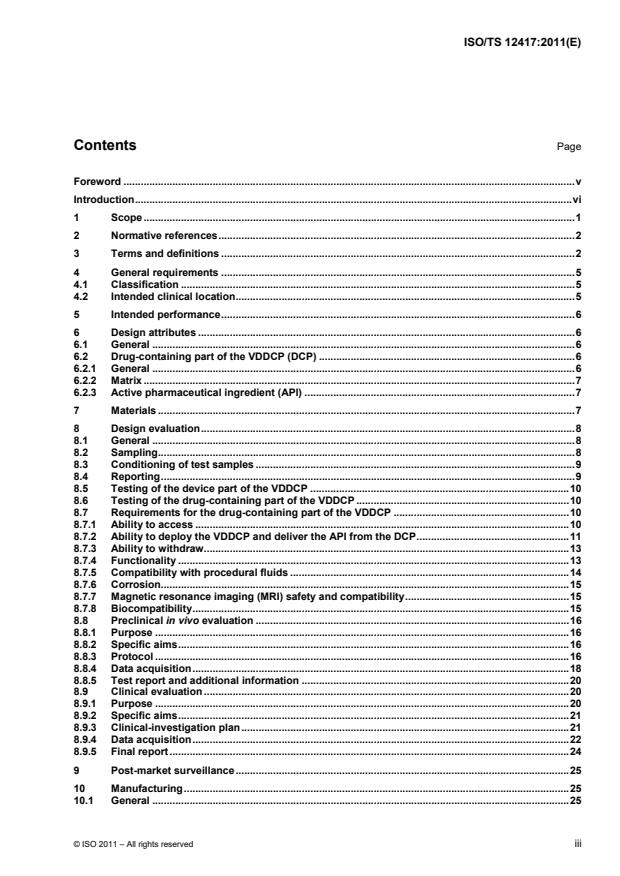
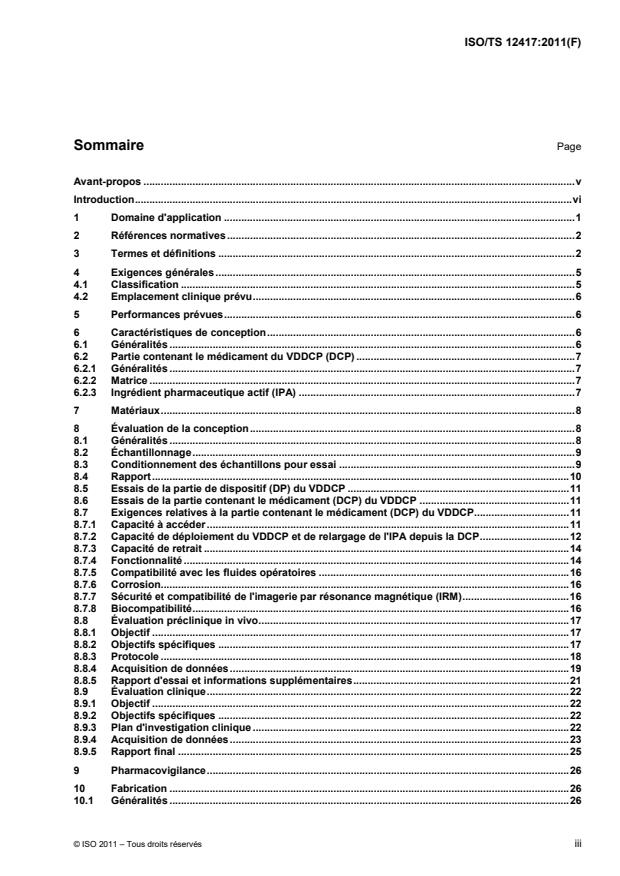
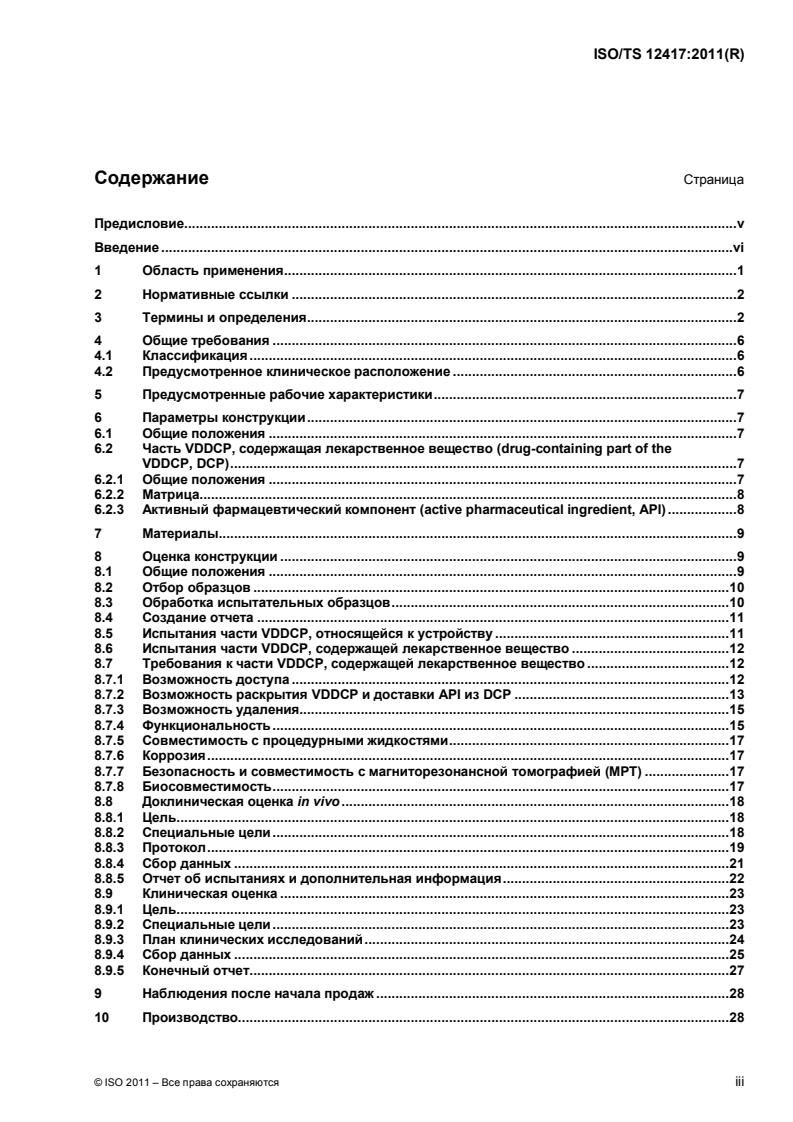
Contents Page
Foreword .v
Introduction.vi
1 Scope.1
2 Normative references.2
3 Terms and definitions .2
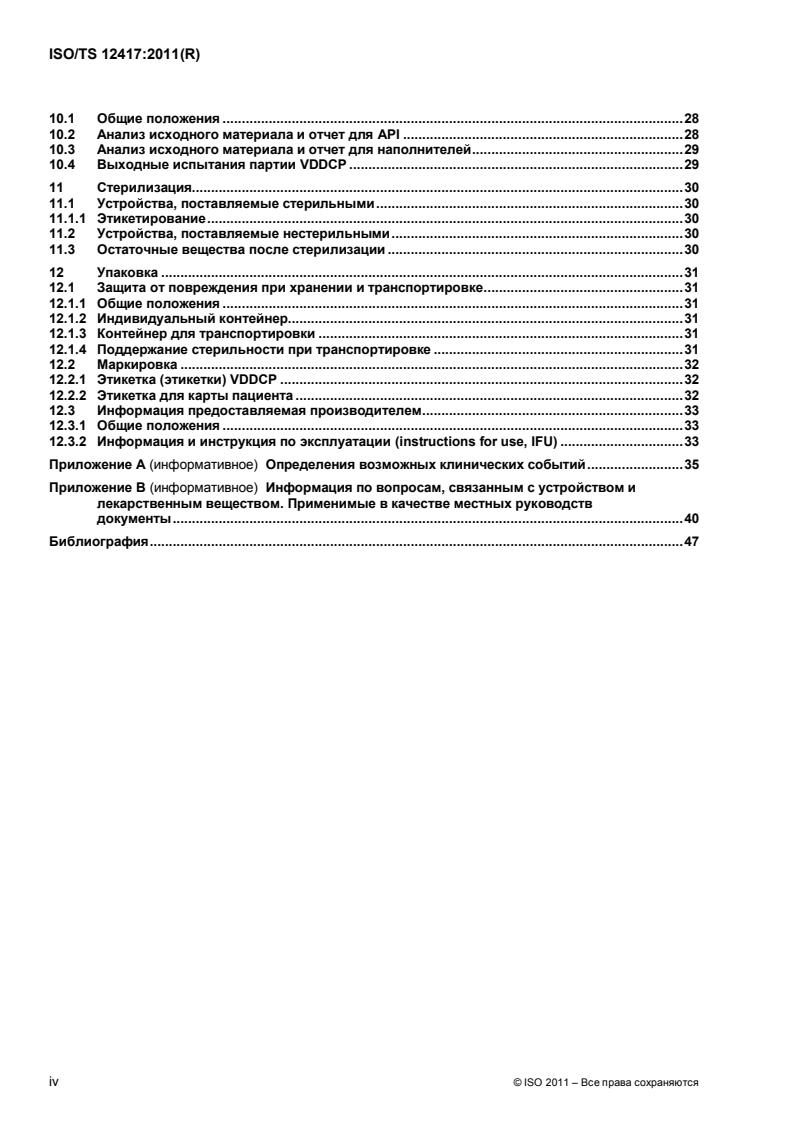
4 General requirements .5
4.1 Classification .5
4.2 Intended clinical location.5
5 Intended performance.6
6 Design attributes .6
6.1 General .6
6.2 Drug-containing part of the VDDCP (DCP) .6
6.2.1 General .6
6.2.2 Matrix .7
6.2.3 Active pharmaceutical ingredient (API) .7
7 Materials .7
8 Design evaluation.8
8.1 General .8
8.2 Sampling.8
8.3 Conditioning of test samples .9
8.4 Reporting.9
8.5 Testing of the device part of the VDDCP .10
8.6 Testing of the drug-containing part of the VDDCP .10
8.7 Requirements for the drug-containing part of the VDDCP .10
8.7.1 Ability to access .10
8.7.2 Ability to deploy the VDDCP and deliver the API from the DCP.11
8.7.3 Ability to withdraw.13
8.7.4 Functionality .13
8.7.5 Compatibility with procedural fluids .14
8.7.6 Corrosion.15
8.7.7 Magnetic resonance imaging (MRI) safety and compatibility.15
8.7.8 Biocompatibility.15
8.8 Preclinical in vivo evaluation .16
8.8.1 Purpose .16
8.8.2 Specific aims.16
8.8.3 Protocol .16
8.8.4 Data acquisition.18
8.8.5 Test report and additional information .20
8.9 Clinical evaluation .20
8.9.1 Purpose .20
8.9.2 Specific aims.21
8.9.3 Clinical-investigation plan.21
8.9.4 Data acquisition.22
8.9.5 Final report.24
9 Post-market surveillance.25
10 Manufacturing.25
10.1 General .25
10.2 Raw-material analysis and reporting for the API.25
10.3 Raw-material analysis and reporting for excipients .26
10.4 VDDCP batch release testing .26
11 Sterilization.27
11.1 Products supplied sterile.27
11.1.1 Labelling .27
11.2 Products supplied non-sterile .27
11.3 Sterilization residuals.27
12 Packaging .27
12.1 Protection from damage during storage and transport.27
12.1.1 General.27
12.1.2 Unit container.27
12.1.3 Shipping container .27
12.1.4 Maintenance of sterility in transit.28
12.2 Marking .28
12.2.1 VDDCP label(s).28
12.2.2 Record label .29
12.3 Information supplied by the manufacturer .29
12.3.1 General.29
12.3.2 Information and instructions for use (IFU).29
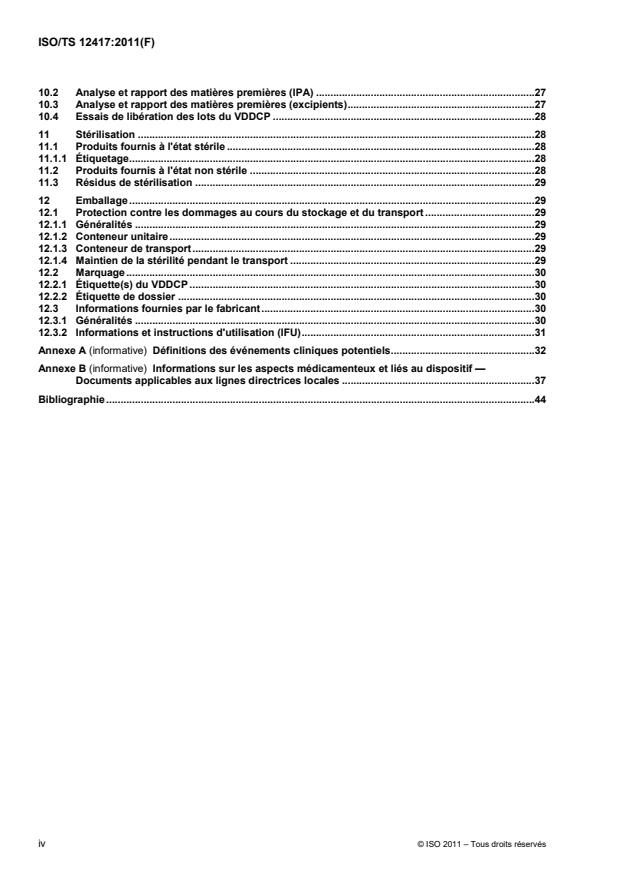
Annex A (informative) Definitions of potential clinical events .31
Annex B (informative) Information on device- and drug-related aspects — Applicable documents
for local guidance .36
Bibliography .43
iv © ISO 2011 – All rights reserved
Foreword
ISO (the International Organization for Standardization) is a worldwide federation of national standards bodies
(ISO member bodies). The work of preparing International Standards is normally carried out through ISO
technical committees. Each member body interested in a subject for which a technical committee has been
established has the right to be represented on that committee. International organizations, governmental and
non-governmental, in liaison with ISO, also take part in the work. ISO collaborates closely with the
International Electrotechnical Commission (IEC) on all matters of electrotechnical standardization.
International Standards are drafted in accordance with the rules given in the ISO/IEC Directives, Part 2.
The main task of technical committees is to prepare International Standards. Draft International Standards
adopted by the technical committees are circulated to the member bodies for voting. Publication as an
International Standard requires approval by at least 75 % of the member bodies casting a vote.
In other circumstances, particularly when there is an urgent market requirement for such documents, a
technical committee may decide to publish other types of normative document:
— an ISO Publicly Available Specification (ISO/PAS) represents an agreement between technical experts in
an ISO working group and is accepted for publication if it is approved by more than 50 % of the members
of the parent committee casting a vote;
— an ISO Technical Specification (ISO/TS) represents an agreement between the members of a technical
committee and is accepted for publication if it is approved by 2/3 of the members of the committee casting
a vote.
An ISO/PAS or ISO/TS is reviewed after three years in order to decide whether it will be confirmed for a
further three years, revised to become an International Standard, or withdrawn. If the ISO/PAS or ISO/TS is
confirmed, it is reviewed again after a further three years, at which time it must either be transformed into an
International Standard or be withdrawn.
Attention is drawn to the possibility that some of the elements of this document may be the subject of patent
rights. ISO shall not be held responsible for identifying any or all such patent rights.
ISO/TS 12417 was prepared by Technical Committee ISO/TC 150, Implants for surgery, Subcommittee SC 2,
Cardiovascular implants and extracorporeal systems.
Introduction
This Technical Specification was prepared in order to provide minimum requirements for vascular device-drug
combination products (VDDCPs).
Only issues related to drug(s) combined with the vascular device based on the ancillary function of the
VDDCP are covered by this Technical Specification.
NOTE For issues related to the primary mode of action of the vascular device, the reader might find it useful to
consider a number of other International Standards (see Bibliography).
vi © ISO 2011 – All rights reserved
TECHNICAL SPECIFICATION ISO/TS 12417:2011(E)
Cardiovascular implants and extracorporeal systems —
Vascular device-drug combination products
1 Scope
1.1 This Technical Specification specifies requirements for vascular device-drug combination products
(VDDCPs) based upon current technical and medical knowledge. VDDCPs are medical devices with various
clinical indications for use in the human vascular blood system. A VDDCP incorporates, as an integral part,
substance(s) which, if used separately, can be considered to be a medicinal product (drug product) but the
action of the medicinal substance is ancillary to that of the device and supports the primary mode of action of
the device. With regard to safety, this Technical Specification outlines requirements for intended performance,
design attributes, materials, design evaluation, manufacturing, sterilization packaging, and information
supplied by the manufacturer. For implanted products, this Technical Specification should be considered as a
supplement to ISO 14630, which specifies general requirements for the performance of non-active surgical
implants. This Technical Specification should also be considered as a supplement to relevant device-specific
standards, such as the ISO 25539 series specifying requirements for endovascular devices. Requirements
listed in this Technical Specification also address VDDCPs that are not necessarily permanent implants.
NOTE Due to variations in the design of products covered by this Technical Specification and due to the relatively
recent development of some of these products, acceptable standardized in vitro tests and clinical results are not always
available. As further scientific and clinical data become available, appropriate revision of this Technical Specification will
be necessary.
1.2 Delivery systems or parts of the delivery system are included in the scope of this Technical
Specification if they comprise an integral component of the vascular device and if they are drug-covered (e.g.
drug-covered balloon catheters and drug-covered guidewires).
1.3 Pumps and infusion catheters which do not contain drug coverings, and whose primary mode of action
is to deliver a drug, are not addressed in this Technical Specification.
1.4 Procedures and devices used prior to and following the introduction of the VDDCP (e.g. balloon
angioplasty devices) are excluded from the scope of this Technical Specification if they do not affect the drug-
related aspects of the device.
1.5 This Technical Specification is not comprehensive with respect to the pharmacological evaluation of
VDDCPs. Some information on the requirements of different related national and regional authorities is given
in Annex B of this Technical Specification.
1.6 Bioabsorbable components of VDDCPs (e.g. coatings) are addressed by this Technical Specification in
their connection with drug-related aspects of the device.
1.7 This Technical Specification does not address issues associated with viable tissues and non-viable
biological materials.
2 Normative references
The following referenced documents are indispensable for the application of this document. For dated
references, only the edition cited applies. For undated references, the latest edition of the referenced
document (including any amendments) applies.
ISO 10993-7, Biological evaluation of medical devices — Part 7: Ethylene oxide sterilization residuals
ISO 11135-1, Sterilization of health care products — Ethylene oxide — Part 1: Requirements for development,
validation and routine control of a sterilization process for medical devices
ISO 11137-1, Sterilization of health care products — Radiation — Part 1: Requirements for development,
validation and routine control of a sterilization process for medical devices
ISO 11607-1, Packaging for terminally sterilized medical devices — Part 1: Requirements for materials, sterile
barrier systems and packaging systems
ISO 14155, Clinical investigation of medical devices for human subjects — Good clinical practice
ISO 14160, Sterilization of health care products — Liquid chemical sterilizing agents for single-use medical
devices utilizing animal tissues and their derivatives — Requirements for characterization, development,
validation and routine control of a sterilization process for medical devices
ISO 14630, Non-active surgical implants — General requirements
ISO 14937, Sterilization of health care products — General requirements for characterization of a sterilizing
agent and the development, validation and routine control of a sterilization process for medical devices
ISO 14971, Medical devices — Application of risk management to medical devices
ISO 17665-1, Sterilization of health care products — Moist heat — Part 1: Requirements for the development,
validation and routine control of a sterilization process for medical devices
NOTE See the Bibliography for additional device-specific and regional information about standards and guidance
documents.
3 Terms and definitions
For the purposes of this document, the terms and definitions given in ISO 14630 and the following apply.
NOTE Potential clinical events are defined in Annex A.
3.1
active pharmaceutical ingredient
API
drug
pharmacologically active (drug or medicinal) substance used as a raw material, which is coated on, bound to
or incorporated into the device to achieve an ancillary device function, such as minimizing vascular restenosis
3.2
batch
quantity of VDDCP at the final stage or pre-final stage of manufacture which has undergone the same
manufacturing cycle, using the same components (e.g. same coating solution, same device size), and meets
the same specifications
NOTE Validation testing can be conducted to demonstrate that manufacturing variables do not impact specifications
such as drug content or drug release, and thereby permit such manufacturing variables within a batch.
2 © ISO 2011 – All rights reserved
3.3
clinical event
complication, failure or device-related observation that might be observed with clinical use of a VDDCP
NOTE Such events might not have clinical significance and might not be attributable to the VDDCP.
3.4
device part of the VDDCP
DP
that part of the VDDCP intended to treat vascular disease by temporary or long-term intervention or
implantation that does not achieve its principal intended action in or on the human body by pharmacological,
immunological or metabolic means, but might be assisted in its function by such means
3.5
drug product
medicinal product
active pharmaceutical ingredient, in its final formulation for administration to the patient, that is primarily
intended to treat, prevent or diagnose disease and that achieves its principal intended action in or on the
human body by pharmacological means
3.6
drug-containing part of the VDDCP
DCP
that part of the VDDCP that consists of the active pharmaceutical ingredient or matrix and associated device
interfaces intended to assist in the primary mode of action of the device and/or diminish or ameliorate an
unintended effect that placement of the device part might stimulate
3.7
DCP interface
common boundary or interconnection between the various components of the device part(s) and the drug-
containing part(s) of a VDDCP
EXAMPLES
a) the interface between the matrix containing the active pharmaceutical ingredient and packaging materials with direct
DCP contact;
b) the device surface(s);
c) the interface between the matrix and the active pharmaceutical ingredient.
3.8
drug content
total labelled amount of active pharmaceutical ingredient in a VDDCP
NOTE Drug content could be expressed as µg/DCP of a certain size.
3.9
drug delivery
local interaction between the VDDCP drug and the in vivo environment, whether the drug is released from,
eluted from or remains bound to the VDDCP
3.10
drug-related impurity
any substance in the drug-containing part of a VDDCP that is not the active pharmaceutical ingredient or an
excipient, such as unintended drug degradation products, drug-synthesis-related impurities, isomers of the
drug, or residual drug solvents
NOTE There might be other impurities, evaluated separately from the drug-related impurities, that are related to
manufacture of the matrix or other components of the VDDCP or come from processing aids, such as monomers,
catalysts, residual matrix-related solvents or residual processing solvents.
3.11
drug release profile
in vitro characterization of the active pharmaceutical ingredient released from the drug-containing part of a
VDDCP over time
NOTE For example, the release can be determined by a drug elution test.
3.12
durability
ability of a VDDCP to maintain adequate product robustness during procedural (i.e. access, deployment,
withdrawal), post-procedural and long-term use (i.e. over time) in accordance with the design specifications
3.13
evaluate
appraise or analyse qualitatively
3.14
excipient
additional material(s) used for manufacturing the drug-containing part of a VDDCP
EXAMPLES Polymers, adhesives.
3.15
matrix
any organic or inorganic material, other than living cells, intentionally applied by a manufacturer to a vascular
device and designed for the purpose of drug storage, local drug activity at the surface and/or enabling,
retarding, delaying or modifying drug release
NOTE The matrix can be permanent or temporary (dissolvable or degradable), can include surface treatments such
as primers, and can be a coating with or without an active pharmaceutical ingredient. The matrix can consist of multiple
excipients and/or multiple active pharmaceutical ingredients.
3.16
pharmacokinetics
absorption, distribution, metabolism and elimination of a drug in vivo
3.17
procedural fluids
blood and serum, saline, contrast media, anticoagulants and antiplatelet medications that come into contact
with a VDDCP
3.18
reference standard
general term covering reference substances, reference preparations and reference spectra
NOTE Reference standards are employed in the identification, purity testing and assay of substances.
3.19
stability studies
studies undertaken according to a prescribed stability protocol to establish, support or confirm the shelf life of
a VDDCP
NOTE Additional guidance on the drug-related aspects of the drug-containing part of the VDDCP can be found in
International Conference on Harmonisation Guideline ICH Q1A.
3.20
uniformity of drug content
comparison of the uniformity of the drug content between individual VDDCPs within each batch as compared
to the labelled claim
4 © ISO 2011 – All rights reserved
3.21
vascular device-drug combination product
VDDCP
medical device (primary mode of action) that incorporates one or more active pharmaceutical ingredients as
an integral part (ancillary mode of action)
3.22
VDDCP delivery
physical or mechanical positioning of a VDDCP at the intended anatomic location by a transport device such
as a catheter
3.23
VDDCP deployment
physical or mechanical release of the drug-containing part of a VDDCP from a transport device such as a
catheter
NOTE The VDDCP can be permanently deployed (i.e. it can be an implant like a drug-eluting stent) or temporarily
deployed (i.e. it can be a drug-eluting balloon, for instance).
3.24
VDDCP specification
list of procedures and appropriate acceptance criteria which are numerical limits, ranges or other criteria for
the tests described
NOTE 1 A specification is a critical quality standard. It establishes the set of criteria to which a VDDCP has to conform.
NOTE 2 Additional guidance on the drug-related aspects of the drug-containing part of the VDDCP can be found in
International Conference on Harmonisation Guideline ICH Q6A.
4 General requirements
4.1 Classification
A VDDCP is a product that is considered to be a medical device but which incorporates, as an integral part,
substances which, if used separately, can be considered to be a medicinal product. It is classified as a
medical device, provided that the action of the medicinal substance is ancillary to that of the device, as
reflected in the product claim and as supported by the scientific data provided by the manufacturer of the
device.
4.2 Intended clinical location
The intended clinical location shall be identified as one or more of the following:
a) abdominal aorta;
b) arterio-venous shunt for vascular access;
c) carotid;
d) coronary;
e) femoral;
f) iliac;
g) popliteal;
h) intracerebral;
i) renal;
j) thoracic aorta;
k) thoraco-abdominal aorta;
l) tibial;
m) other arterial or venous vessels to be specified.
5 Intended performance
The requirements of ISO 14630 shall apply.
6 Design attributes
6.1 General
The requirements of ISO 14630 shall apply.
The design attributes to meet the intended performance of the VDDCP shall additionally take into account at
least the following:
a) the ability of the device part of the VDDCP (i.e. the device without the active pharmaceutical ingredient
and matrix) to fulfil all product-specific requirements for the primary mode of action (e.g. the mechanical
function) which are defined in the device-related standards;
b) the ability of the drug-containing part of the VDDCP to fulfil the drug-specific function and requirements of
the VDDCP as defined in 6.2.
6.2 Drug-containing part of the VDDCP (DCP)
6.2.1 General
The design attributes to meet the intended performance of the DCP shall additionally take into account at least
the following:
a) the ability of the DCP to be consistently, accurately and safely deployed;
b) the appropriate physical and chemical compatibility of the DCP interfaces, i.e. the device, the drug, the
matrix and any packaging with direct DCP contact;
c) the compliance of the DCP with the requirements of ISO 10993-1 and other relevant parts of ISO 10993
(biocompatibility);
d) the conformance of the DCP to VDDCP specifications at the time of manufacture and after storage;
e) the ability to deliver the intended amount of drug safely to the target site in accordance with the
specification of the VDDCP at product release and for the duration of the labelled shelf life;
NOTE The fulfilment of the requirements of this specification (see 6.2.3) is a function of the interaction of all
interfaces.
f) the appropriate interaction between the VDDCP and procedural fluids.
6 © ISO 2011 – All rights reserved
6.2.2 Matrix
The design attributes to meet the intended performance of the matrix used to store and/or release the drug
shall additionally take into account at least the following:
a) the ability of matrix to maintain adequate integrity during procedural use and over time in accordance with
the design specifications (e.g. freedom from significant delaminations, flaps and bare spots);
b) the ability of the matrix to maintain adequate resistance to unintended generation of particles;
c) the conformance of the matrix to VDDCP specifications at the time of manufacture and after storage;
d) the conformance of the matrix dimensions, physical and chemical properties and other matrix parameters
(e.g. porosity, mass, density, distribution, glass transition temperature, melting temperature,
fragmentation point) to the design requirements;
e) if soluble or degradable, the ability to control the solubility or degradation behaviour and the interaction of
the solubilized or degradation products with the body (mechanism of solubility or degradation,
biocompatibility of the matrix as well as the degradation products);
f) the effect of imaging [e.g. magnetic resonance imaging (e.g. the heating caused by MRI)] on the matrix.
6.2.3 Active pharmaceutical ingredient (API)
The design attributes to meet the intended performance of the API shall additionally take into account at least
the following:
a) the conformance of drug content, impurities and degradants to the API specification on receipt and after
storage and handling of the API during the VDDCP manufacturing process;
b) the ability to reproducibly incorporate, as demonstrated by content uniformity, the desired drug and
amount within the VDDCP;
c) the ability to apply the drug to the target site in accordance with the VDDCP specification;
d) the conformance of drug content, impurities and degradants to VDDCP specifications at the time of
manufacture and after storage;
e) the appropriate interaction between the drug(s) and the matrix and/or the device to which the drug(s)
is/are applied;
f) the appropriate interaction between the drug(s) and the tissue to which the drug(s) is/are applied;
g) the effect of imaging (e.g. MRI) on the drug of a VDDCP (e.g. heating).
NOTE Additional guidance on the drug-related specifications can be found in ICH Q6A as well as in general and
individual monographs of pharmacopoeias of the different regions [e.g. the United States Pharmacopeia (USP), Japanese
Pharmacopoeia (JP) and European Pharmacopoeia (EP)].
7 Materials
The requirements of ISO 14630 shall apply. Additional testing specific to certain materials (e.g. metals,
polymers, drugs) shall be performed to determine the appropriateness of the material for use in the design.
8 Design evaluation
8.1 General
The requirements of ISO 14630 shall apply. A risk analysis shall be carried out and the requirements of
ISO 14971 shall apply.
For the properties outlined in the design evaluation clause of this Technical Specification, a justification shall
be provided for the properties that are not assessed.
It was impossible, when writing this Technical Specification, to take into consideration all future and emerging
technologies. VDDCPs using such technologies will need to be evaluated following the basic requirements of
this Technical Specification. Testing beyond the scope of this Technical Specification might also be necessary
to characterize these device systems. Consideration shall be given to the failure modes of the device and their
effects on the performance of the implant in deciding what testing will be appropriate.
Whenever changes are made in materials, construction, configuration, application or processing methods, an
appropriate analysis of the potential impact of the change on the failure modes and performance of the
VDDCP shall be performed. Appropriate testing shall be conducted as deemed necessary.
The use of a control device for comparison should be considered in the evaluation of the design attributes
relevant to the performance of the VDDCP.
Testing to establish the labelled shelf life shall be conducted by repeating appropriate device and drug tests
on the final aged VDDCP. Justification for the selection of tests shall be provided.
If different finished-product manufacturing sites will be used, the generation of appropriate batch
release/stability data to ensure the consistency and equivalency of the finished product across manufacturing
sites should be considered. Some regulatory authorities will require this (e.g. in the US — see also Annex B).
For VDDCPs, long-term stability testing augmented by accelerated stability testing, such as defined by ICH
guidelines, shall be used to define drug attributes for product shelf life. Additional guidance on stability testing
of VDDCPs can be found in ICH Q1A(R2), ICH Q1B(R2), ICH Q1D and ICH Q1E. In addition, ICH Q3B(R2)
and ISO 10993 provide guidance on how to test for identification of impurities and/or degradation products.
ICH guidelines include specific testing time frames and environmental conditions that might not be appropriate
for all product designs, storage conditions and climate zones. Testing intervals for identification of degradation
products will depend on the potential degradation characteristics of the API and/or matrix, as well as the shelf
life of the medical device.
Testing appropriate to climatic zones should also be considered with respect to where the product will be
marketed. World Health Organization (WHO) Technical Report 953, Annex 2, includes climate zones which
might be appropriate to use for stability-testing conditions. Climate zone definitions in local standards and
guidelines (e.g. ASEAN, USP) should also be considered.
8.2 Sampling
A sampling plan should be utilized which will ensure that adequate representation of the data has been
obtained for each parameter measured. The drug- and/or matrix-related design characteristics of the VDDCP
shall be verified to be representative of the products to be released for distribution, including all sizes,
configurations and components. The sampling should fully represent the range of device designs and might
not necessarily require the stability testing of each size (e.g. by bracketing or matrixing to incorporate the
worst-case design). The VDDCP sizes selected for testing shall represent the worst-case combination(s) of
relevant VDDCP dimensions for each test. A rationale should be provided for sample selection. It might be
necessary to conduct an analysis to identify the size(s) of the VDDCP with the greatest potential for failure.
Additional guidance on a mixed bracketing/matrix design [e.g. minimum, intermediate (e.g. worst-case design),
and maximum sizes of the VDDCP] can be found in ICH Q1D. Samples of the extremes of certain design
factors (e.g. strength) should be tested at all time points.
8 © ISO 2011 – All rights reserved
Sampling should ensure adequate representation of the expected variability in the manufacture of devices.
For drug-related aspects of the VDDCP, at least three batches of each of the representative samples of the
drug-containing part of the VDDCP should be tested over the shelf life.
NOTE 1 The sampling plan might differ for characterization, release and stability testing.
NOTE 2 It might be appropriate to assess some properties only at manufacture, if changes are not expected over the
shelf life.
For those tests with specified confidence and reliability parameters, the sample size shall have a statistical
basis. For all tests, the number of samples should be justified.
8.3 Conditioning of test samples
All samples should be subjected to sterilization, including multiple sterilizations, if appropriate, unless
justification is provided for the use of non-sterilized products.
Maximum and minimum tolerances for the conditioning-process parameters within a cycle could result in
different properties for the VDDCP. Additionally, changes in sterilization cycles or process parameters within a
cycle could impact the properties of the VDDCP and this should be borne in mind.
Samples should be subjected to conditions that are normally encountered that could affect the test results.
Conditioning might include preconditioning of the VDDCP as recommended in the instructions for use. If the
product is a single-use product, it might be necessary to consider whether multiple attempts with the same
product should be included in a simulated-use test. If the product is a multiple-use product, the simulated-use
test should incorporate this concept into the test protocol.
For in vitro simulated-use testing, issues associated with clinical access, deployment and withdrawal (if
applicable) of the VDDCP and/or the delivery system should be considered.
A simulated physiological environment (e.g. a temperature-controlled water bath) should be used when
appropriate.
8.4 Reporting
For the purposes of this Technical Specification, reporting relates to requests from a national regulatory
authority.
The test report for the preclinical in vitro testing should include an executive summary of all testing. This
summary should include an identification of all the tests, with the rationale for the omission of any tests. The
information provided in each test report should be based upon a prospectively defined test protocol.
A summary of results, with the acceptance criteria and any potential clinical significance of the results, should
be included and may be in tabular form. Consideration should be given to the anatomical, physiological and
morphological conditions of the intended use in establishing the acceptance criteria. The justification and
clinical applicability of the acceptance criteria for each test should be provided. A table of contents should be
provided and pages should be numbered sequentially.
Individual test reports should include the following information:
a) purpose: state the purpose of the test as it corresponds to this Technical Specification;
b) materials: list all materials (e.g. test articles with lot/serial numbers or other appropriate means of
traceability, equipment) used in performing the test, using figures and diagrams as appropriate;
c) sampling: state the sampling plan, including the basis for sampling and the number of samples tested,
and justifying the selection of the test articles (e.g. choice of sizes, use of conditioning);
d) acceptance criteria: state the criteria for acceptance of the test results;
e) test method: describe in detail the method used to perform the test, including any prospectively defined
inspection procedures, and provide a justification for critical test parameters;
f) protocol deviations: describe any deviations and their potential significance for the interpretation of the
results;
g) expression of results: state the test results, expressed in the units indicated in the test method;
h) conclusions: state the conclusions, based on comparing the results with the acceptance criteria and
including any potential clinical significance of the results.
NOTE Some tests might also require submission of raw data and a detailed data analysis.
8.5 Testing of the device part of the VDDCP
Testing of the device part of the VDDCP (the DP) shall be conducted to evaluate the design attributes
described in Clause 6, as applicable. The appropriate tests of each design attribute should evaluate potential
failure modes and whether the intended product performance is attained.
If the DP is a temporarily placed product, such as a balloon, then testing should also address issues in
relevant guidance documents and standards for non-drug-eluting balloons.
If the DP is an implant, such as a stent, coil, valve or graft, then testing should also address issues in relevant
guidance documents and standards for these specific vascular implants.
NOTE An example of a recommended format for presentation of a summary of the test information for local
regulatory authorities is provided in Annex B.
8.6 Testing of the drug-containing part of the VDDCP
Testing of the drug-containing part of the VDDCP (the DCP) shall be conducted to evaluate the design
attributes described in Clause 6, as applicable. The appropriate tests for each design attribute should evaluate
potential failure modes, VDDCP or clinical effects associated with the potential failure modes, and whether the
intended product performance is attained.
NOTE General documentation for the DCP aspects in the Common Technical Document (CTD) format might be
helpful for the evaluation of the drug-related aspects by a national regulatory authority due to its internationally accepted
format for medicinal products. See Clause B.9 for more information on CTDs.
8.7 Requirements for the drug-containing part of the VDDCP
8.7.1 Ability to access
8.7.1.1 General
This covers the ability of the DCP to permit the safe transport of a sufficient amount of API [i.e. drug(s)] to the
target site during VDDCP delivery.
Hazards to be evaluated include, but are not limited to, the following:
a) introducer and DCP not matching the access site (i.e. size mismatch);
b) unintended lack of mechanical (structural) integrity before advancing to target site/tissue (i.e. particle
generation by API/matrix);
c) unintended lack of chemical integrity (i.e. lack of stability or purity of API and release of matrix
degradation products);
d) unintended effects of API outside target site/tissue due to loss of material before API reaches target
site/tissue;
10 © ISO 2011 – All rights reserved
e) procedural bleeding due to unintended anti-coagulation effects caused by API;
f) chemical incompatibility with procedural fluids.
These hazards might result in clinical events.
NOTE Potential clinical events that could be evaluated are given in Annex A.
Testing shall include the dimensional-compatibility evaluation given in 8.7.1.2.
8.7.1.2 Dimensional compatibility of components
Evaluate the dimensions of the DCP for compatibility with the dimensions of recommended accessories. All
components shall be dimensionally compatible.
8.7.2 Ability to deploy the VDDCP and de
...
SPÉCIFICATION ISO/TS
TECHNIQUE 12417
Première édition
2011-06-01
Implants cardiovasculaires et systèmes
extracorporels — Produits de
combinaison médicament-dispositif
vasculaire
Cardiovascular implants and extracorporeal systems — Vascular
device-drug combination products
Numéro de référence
©
ISO 2011
DOCUMENT PROTÉGÉ PAR COPYRIGHT
© ISO 2011
Droits de reproduction réservés. Sauf prescription différente, aucune partie de cette publication ne peut être reproduite ni utilisée sous
quelque forme que ce soit et par aucun procédé, électronique ou mécanique, y compris la photocopie et les microfilms, sans l'accord écrit
de l'ISO à l'adresse ci-après ou du comité membre de l'ISO dans le pays du demandeur.
ISO copyright office
Case postale 56 • CH-1211 Geneva 20
Tel. + 41 22 749 01 11
Fax + 41 22 749 09 47
E-mail copyright@iso.org
Web www.iso.org
Publié en Suisse
ii © ISO 2011 – Tous droits réservés
Sommaire Page
Avant-propos .v
Introduction.vi
1 Domaine d'application .1
2 Références normatives.2
3 Termes et définitions .2
4 Exigences générales.5
4.1 Classification .5
4.2 Emplacement clinique prévu.6
5 Performances prévues.6
6 Caractéristiques de conception.6
6.1 Généralités .6
6.2 Partie contenant le médicament du VDDCP (DCP) .7
6.2.1 Généralités .7
6.2.2 Matrice .7
6.2.3 Ingrédient pharmaceutique actif (IPA) .7
7 Matériaux.8
8 Évaluation de la conception.8
8.1 Généralités .8
8.2 Échantillonnage.9
8.3 Conditionnement des échantillons pour essai .9
8.4 Rapport.10
8.5 Essais de la partie de dispositif (DP) du VDDCP .11
8.6 Essais de la partie contenant le médicament (DCP) du VDDCP .11
8.7 Exigences relatives à la partie contenant le médicament (DCP) du VDDCP.11
8.7.1 Capacité à accéder .11
8.7.2 Capacité de déploiement du VDDCP et de relargage de l'IPA depuis la DCP.12
8.7.3 Capacité de retrait .14
8.7.4 Fonctionnalité .14
8.7.5 Compatibilité avec les fluides opératoires .16
8.7.6 Corrosion.16
8.7.7 Sécurité et compatibilité de l'imagerie par résonance magnétique (IRM).16
8.7.8 Biocompatibilité.16
8.8 Évaluation préclinique in vivo.17
8.8.1 Objectif .17
8.8.2 Objectifs spécifiques .17
8.8.3 Protocole .18
8.8.4 Acquisition de données.19
8.8.5 Rapport d'essai et informations supplémentaires.21
8.9 Évaluation clinique.22
8.9.1 Objectif .22
8.9.2 Objectifs spécifiques .22
8.9.3 Plan d'investigation clinique .22
8.9.4 Acquisition de données.23
8.9.5 Rapport final .25
9 Pharmacovigilance.26
10 Fabrication .26
10.1 Généralités .26
10.2 Analyse et rapport des matières premières (IPA) .27
10.3 Analyse et rapport des matières premières (excipients).27
10.4 Essais de libération des lots du VDDCP .28
11 Stérilisation .28
11.1 Produits fournis à l'état stérile .28
11.1.1 Étiquetage.28
11.2 Produits fournis à l'état non stérile .28
11.3 Résidus de stérilisation .29
12 Emballage .29
12.1 Protection contre les dommages au cours du stockage et du transport .29
12.1.1 Généralités .29
12.1.2 Conteneur unitaire.29
12.1.3 Conteneur de transport.29
12.1.4 Maintien de la stérilité pendant le transport .29
12.2 Marquage.30
12.2.1 Étiquette(s) du VDDCP .30
12.2.2 Étiquette de dossier .30
12.3 Informations fournies par le fabricant.30
12.3.1 Généralités .30
12.3.2 Informations et instructions d'utilisation (IFU).31
Annexe A (informative) Définitions des événements cliniques potentiels.32
Annexe B (informative) Informations sur les aspects médicamenteux et liés au dispositif —
Documents applicables aux lignes directrices locales .37
Bibliographie .44
iv © ISO 2011 – Tous droits réservés
Avant-propos
L'ISO (Organisation internationale de normalisation) est une fédération mondiale d'organismes nationaux de
normalisation (comités membres de l'ISO). L'élaboration des Normes internationales est en général confiée
aux comités techniques de l'ISO. Chaque comité membre intéressé par une étude a le droit de faire partie du
comité technique créé à cet effet. Les organisations internationales, gouvernementales et non
gouvernementales, en liaison avec l'ISO participent également aux travaux. L'ISO collabore étroitement avec
la Commission électrotechnique internationale (CEI) en ce qui concerne la normalisation électrotechnique.
Les Normes internationales sont rédigées conformément aux règles données dans les Directives ISO/CEI,
Partie 2.
La tâche principale des comités techniques est d'élaborer les Normes internationales. Les projets de Normes
internationales adoptés par les comités techniques sont soumis aux comités membres pour vote. Leur
publication comme Normes internationales requiert l'approbation de 75 % au moins des comités membres
votants.
Dans d'autres circonstances, en particulier lorsqu'il existe une demande urgente du marché, un comité
technique peut décider de publier d'autres types de documents normatifs:
— une Spécification publiquement disponible ISO (ISO/PAS) représente un accord entre les experts dans
un groupe de travail ISO et est acceptée pour publication si elle est approuvée par plus de 50 % des
membres votants du comité dont relève le groupe de travail;
— une Spécification technique ISO (ISO/TS) représente un accord entre les membres d'un comité technique
et est acceptée pour publication si elle est approuvée par 2/3 des membres votants du comité.
Une ISO/PAS ou ISO/TS fait l'objet d'un examen après trois ans afin de décider si elle est confirmée pour trois
nouvelles années, révisée pour devenir une Norme internationale, ou annulée. Lorsqu'une ISO/PAS ou
ISO/TS a été confirmée, elle fait l'objet d'un nouvel examen après trois ans qui décidera soit de sa
transformation en Norme internationale soit de son annulation.
L'attention est appelée sur le fait que certains des éléments du présent document peuvent faire l'objet de
droits de propriété intellectuelle ou de droits analogues. L'ISO ne saurait être tenue pour responsable de ne
pas avoir identifié de tels droits de propriété et averti de leur existence.
L'ISO/TS 12417 a été élaborée par le comité technique ISO/TC 150, Implants chirurgicaux, sous-comité SC 2,
Implants cardiovasculaires et circuits extra-corporels.
Introduction
La présente Spécification technique a été élaborée afin de définir des exigences minimales relatives aux
produits de combinaison médicament-dispositif vasculaire (VDDCP).
Seules les questions liées au(x) médicament(s) combiné(s) au dispositif vasculaire utilisant la fonction
auxiliaire du VDDCP sont abordées par la présente Spécification technique.
NOTE Pour les questions liées au mode d'action principal du dispositif vasculaire, le lecteur pourra trouver utile de
consulter d'autres Normes internationales (voir Bibliographie).
vi © ISO 2011 – Tous droits réservés
SPÉCIFICATION TECHNIQUE ISO/TS 12417:2011(F)
Implants cardiovasculaires et systèmes extracorporels —
Produits de combinaison médicament-dispositif vasculaire
1 Domaine d'application
1.1 La présente Spécification technique spécifie les exigences relatives aux produits de combinaison
médicament-dispositif vasculaire (VDDCP) sur la base des connaissances techniques et médicales actuelles.
Les VDDCP sont des dispositifs médicaux ayant diverses indications cliniques, conçus pour être utilisés dans
le système vasculaire sanguin chez l'homme. Un VDDCP comprend une ou plusieurs substances comme
partie intégrante qui, si elles sont utilisées séparément, peuvent être considérées comme un produit
médicamenteux (médicament), mais l'action de la substance médicamenteuse est auxiliaire à celle du
dispositif afin d'appuyer le mode d'action principal du dispositif. En matière de sécurité, la présente
Spécification technique définit les exigences relatives aux performances prévues, aux caractéristiques de
conception, aux matériaux, à l'évaluation de la conception, à la fabrication, à la stérilisation, à l'emballage et
aux informations fournies par le fabricant. Pour les produits implantés, la présente Spécification technique est
considérée comme un complément à l'ISO 14630, qui spécifie les exigences générales relatives aux
performances des implants chirurgicaux non actifs. Elle est également considérée comme un complément aux
normes spécifiques aux dispositifs connexes, notamment la série de l'ISO 25539 qui spécifie les exigences
relatives aux dispositifs endovasculaires. Les exigences énumérées dans la présente Spécification technique
concernent également les VDDCP qui ne sont pas nécessairement des implants permanents.
NOTE En raison des variantes de conception parmi les produits traités par la présente Spécification technique, et en
raison, dans certains cas, du caractère relativement récent de la mise au point de certains de ces produits, des essais in
vitro normalisés acceptables et des résultats cliniques ne sont pas toujours disponibles. Lorsque de nouvelles données
scientifiques et cliniques seront disponibles, il sera nécessaire de procéder à une révision appropriée de la présente
Spécification technique.
1.2 Les dispositifs d'administration ou parties du dispositif d'administration relèvent du domaine
d'application de la présente Spécification technique s'ils font partie intégrante du dispositif vasculaire et s'ils
sont revêtus de médicament (par exemple cathéters à ballonnet revêtus de médicament ou fils guides revêtus
de médicament).
1.3 Les pompes et les cathéters de perfusion qui ne contiennent pas de revêtements médicamenteux, et
dans lesquels le mode d'action principal est l'administration d'un médicament, ne sont pas abordés dans la
présente Spécification technique.
1.4 Les modes opératoires et les dispositifs utilisés avant et après l'introduction du VDDCP (par exemple
les dispositifs d'angioplastie transluminale percutanée) sont exclus du domaine d'application de la présente
Spécification technique s'ils n'affectent pas les aspects médicamenteux du dispositif.
1.5 La présente Spécification technique ne détaille pas l'évaluation pharmacologique des VDDCP.
Certaines informations relatives aux exigences des différents organismes nationaux et régionaux compétents
sont données dans l'Annexe B.
1.6 Les composants bioabsorbables des VDDCP (par exemple les revêtements) sont abordés dans la
présente Spécification technique en ce qui concerne leur rapport avec les aspects médicamenteux du
dispositif.
1.7 La présente Spécification technique n'aborde pas les questions liées aux tissus viables et aux
matériaux biologiques non viables.
2 Références normatives
Les documents de référence suivants sont indispensables pour l'application du présent document. Pour les
références datées, seule l'édition citée s'applique. Pour les références non datées, la dernière édition du
document de référence s'applique (y compris les éventuels amendements).
ISO 10993-7, Évaluation biologique des dispositifs médicaux — Partie 7: Résidus de stérilisation à l'oxyde
d'éthylène
ISO 11135-1, Stérilisation des produits de santé — Oxyde d'éthylène — Partie 1: Exigences de
développement, de validation et de contrôle de routine d'un processus de stérilisation pour des dispositifs
médicaux
ISO 11137-1, Stérilisation des produits de santé — Irradiation — Partie 1: Exigences relatives à la mise au
point, à la validation et au contrôle de routine d'un procédé de stérilisation pour les dispositifs médicaux
ISO 11607-1, Emballages des dispositifs médicaux stérilisés au stade terminal — Partie 1: Exigences
relatives aux matériaux, aux systèmes de barrière stérile et aux systèmes d'emballage
ISO 14155, Investigation clinique des dispositifs médicaux pour sujets humains — Bonnes pratiques cliniques
ISO 14160, Stérilisation des produits de santé — Agents stérilisants chimiques liquides pour dispositifs
médicaux non réutilisables utilisant des tissus animaux et leurs dérivés — Exigences pour la caractérisation,
le développement, la validation et le contrôle de routine d'un procédé de stérilisation de dispositifs médicaux
ISO 14630, Implants chirurgicaux non actifs — Exigences générales
ISO 14937, Stérilisation des produits de santé — Exigences générales pour la caractérisation d'un agent
stérilisant et pour la mise au point, la validation et la vérification de routine d'un processus de stérilisation pour
dispositifs médicaux
ISO 14971, Dispositifs médicaux — Application de la gestion des risques aux dispositifs médicaux
ISO 17665-1, Stérilisation des produits de santé — Chaleur humide — Partie 1: Exigences pour le
développement, la validation et le contrôle de routine d'un procédé de stérilisation des dispositifs médicaux
NOTE Voir la Bibliographie pour plus d'informations régionales et spécifiques aux dispositifs concernant les normes
et les documents d'orientation.
3 Termes et définitions
Pour les besoins du présent document, les termes et définitions donnés dans l'ISO 14630 ainsi que les
suivants s'appliquent.
NOTE Les événements cliniques potentiels sont définis dans l'Annexe A.
3.1
ingrédient pharmaceutique actif
IPA
médicament
substance pharmacologiquement active (médicament ou produit médicamenteux) utilisée comme matière
première, qui est enduite sur, fixée à ou incorporée dans le dispositif pour atteindre une fonction auxiliaire,
notamment une réduction maximale de la resténose vasculaire
2 © ISO 2011 – Tous droits réservés
3.2
lot
nombre de VDDCP, lors de l'étape de fabrication finale ou de l'étape pré-finale, qui ont subi les mêmes cycles
de fabrication, utilisent les mêmes composants (par exemple même solution de revêtement, taille du
dispositif) et sont conformes aux mêmes spécifications
NOTE Des essais de validation peuvent être réalisés pour démontrer que les variables de fabrication n'ont pas
d'impact sur des spécifications telles que la teneur en médicament ou la libération du médicament et que ces variables de
fabrication peuvent ainsi être utilisées dans un lot.
3.3
événements cliniques
complications, défaillances ou observations relatives au dispositif lors de l'utilisation clinique du VDDCP
NOTE Ces événements peuvent ne pas avoir de signification clinique et peuvent ne pas être attribuables au VDDCP.
3.4
partie de dispositif du VDDCP
DP
partie du VDDCP, conçue pour traiter une maladie vasculaire par le biais d'une intervention ou d'une
implantation temporaire ou à long terme, qui n'exécute pas sa principale action prévue sur le corps humain
par des moyens pharmacologiques, immunologiques ou métaboliques, mais qui peut être assistée dans sa
fonction par de tels moyens
3.5
médicament
produit médicamenteux
IPA dans sa formulation finale, destiné à être administré au patient, qui est principalement conçu pour traiter,
prévenir ou diagnostiquer une maladie et qui exécute sa principale action prévue dans ou sur le corps humain
par des moyens pharmacologiques
3.6
partie contenant le médicament du VDDCP
DCP
partie du VDDCP qui comprend la matrice ou l'ingrédient pharmaceutique actif, et interfaces du dispositif
associé destinées à assister le mode d'action principal du dispositif et/ou diminuer ou améliorer un effet
involontaire que le placement de la partie de dispositif peut stimuler
3.7
interface DCP
limite ou interconnexion commune entre les différents constituants de la(des) partie(s) de dispositif et de
la(des) partie(s) contenant le médicament d'un VDDCP
EXEMPLES
a) interface entre la matrice avec IPA et les matériaux d'emballage en contact direct avec la DCP;
b) surface(s) du dispositif;
c) interface entre la matrice et l'IPA.
3.8
teneur en médicament
quantité totale marquée d'IPA dans le VDDCP
NOTE La teneur en médicament peut être exprimée en µg/DCP d'une certaine taille.
3.9
relargage du médicament
interaction locale entre le médicament du VDDCP et l'environnement in vivo, que le médicament soit libéré du
VDDCP, élué à partir du VDDCP ou qu'il reste fixé au VDDCP
3.10
impureté liée au médicament
toute substance dans la partie contenant le médicament qui n'est pas l'IPA ou un excipient, notamment les
produits de dégradation involontaire du médicament, les impuretés liées à la synthèse du médicament, les
isomères du médicament ou les solvants résiduels du médicament
NOTE Il peut exister d'autres impuretés évaluées séparément des impuretés liées au médicament qui sont liées à la
fabrication de la matrice ou d'autres composants du VDDCP, ou séparément des adjuvants de fabrication tels que les
monomères, catalyseurs, solvants résiduels liés à la matrice ou solvants résiduels de traitement.
3.11
profil de libération du médicament
caractérisation in vitro de l'IPA libéré par la DCP dans le temps
NOTE Par exemple, le profil de libération peut être déterminé à l'aide d'un essai d'élution du médicament.
3.12
durabilité
capacité du VDDCP à conserver une robustesse adéquate du produit pendant l'utilisation opératoire (c'est-à-
dire accès, déploiement, retrait), postopératoire et à long terme (c'est-à-dire dans le temps) conformément
aux spécifications de conception
3.13
évaluer
estimer ou analyser qualitativement
3.14
excipient
matériau(x) supplémentaire(s) utilisé(s) pour fabriquer la partie contenant le médicament du VDDCP
EXEMPLES Polymères et adhésifs.
3.15
matrice
tout matériau organique ou inorganique, autre que les cellules vivantes, intentionnellement appliqué par un
fabricant sur un dispositif vasculaire et conçu pour le stockage du médicament, l'activité locale du médicament
à la surface et/ou l'activation, le retardement, le décalage ou la modification de la libération du médicament
NOTE Cette matrice peut être permanente ou temporaire (dissolvable ou dégradable) et peut inclure des traitements
de surface tels que des amorces, et peut être un revêtement avec ou sans IPA. Elle peut comprendre plusieurs excipients
et/ou IPA.
3.16
pharmacocinétique
absorption, distribution, métabolisme et élimination d'un médicament in vivo
3.17
fluides opératoires
sang, sérum, solution saline, milieux de contraste, anticoagulants et médicaments antiplaquettaires qui
entrent en contact avec le VDDCP
4 © ISO 2011 – Tous droits réservés
3.18
étalon de référence
terme général couvrant les substances de référence, les préparations de référence et les spectres de
référence
NOTE Les étalons de référence sont utilisés pour identifier les substances, évaluer leur pureté et les analyser.
3.19
études de stabilité
études réalisées selon un protocole de stabilité spécifié pour établir, étayer ou confirmer la durée de
conservation d'un VDDCP
NOTE La ligne directrice ICH Q1A de la Conférence internationale sur l'harmonisation (ICH) fournit des
recommandations supplémentaires relatives aux aspects médicamenteux de la DCP.
3.20
uniformité de la teneur en médicament
comparaison de l'uniformité de la teneur en médicament parmi plusieurs DCP dans chaque lot par rapport au
libellé de l'étiquette
3.21
produit de combinaison médicament-dispositif vasculaire
VDDCP
dispositif médical (mode d'action principal) comprenant un ou des IPA comme partie intégrante (mode d'action
auxiliaire)
3.22
relargage du VDDCP
positionnement physique ou mécanique d'un VDDCP au niveau d'un emplacement anatomique prévu par un
dispositif de transport tel qu'un cathéter
3.23
déploiement du VDDCP
libération physique ou mécanique de la DCP d'un VDDCP depuis un dispositif de transport tel qu'un cathéter
NOTE Le VDDCP peut être déployé de façon permanente (par exemple un implant tel qu'un stent à élution de
médicaments) ou temporaire (par exemple un ballonnet à élution de médicaments).
3.24
spécifications du VDDCP
liste de modes opératoires et de critères d'acceptation appropriés, notamment les limites numériques, les
plages numériques ou d'autres critères relatifs aux essais décrits
NOTE 1 Les spécifications sont des normes qualitatives essentielles. Elles établissent l'ensemble des critères
auxquels un VDDCP doit se conformer.
NOTE 2 L'ICH Q6A fournit des lignes directrices supplémentaires concernant les aspects médicamenteux relatifs à la
DCP.
4 Exigences générales
4.1 Classification
Un VDDCP est un produit qui est considéré comme étant un dispositif médical mais qui comprend des
substances comme partie intégrante qui, si elles sont utilisées séparément, peuvent être considérées comme
étant un produit médicamenteux. Il est classé dans la catégorie des dispositifs médicaux, à condition que
l'action de la substance médicamenteuse soit auxiliaire à celle du dispositif, comme énoncé dans le libellé du
produit et comme étayé par les données scientifiques fournies par le fabricant des dispositifs.
4.2 Emplacement clinique prévu
L'emplacement clinique prévu doit être identifié comme étant un ou plusieurs des emplacements suivants:
a) aorte abdominale;
b) fistule artério-veineuse pour accès vasculaire;
c) carotide;
d) artère/veine coronaire;
e) artère/veine fémorale;
f) iliaque;
g) poplitée;
h) artère/veine intracérébrale;
i) artère/veine rénale;
j) aorte thoracique;
k) aorte thoraco-abdominale;
l) artère/veine tibiale;
m) autres vaisseaux artériels ou veineux à spécifier.
5 Performances prévues
Les exigences de l'ISO 14630 s'appliquent.
6 Caractéristiques de conception
6.1 Généralités
Les exigences de l'ISO 14630 s'appliquent.
Les caractéristiques de conception permettant de répondre aux performances prévues du VDDCP doivent
également tenir compte au moins des éléments suivants:
a) la capacité de la partie de dispositif (DP) du VDDCP (c'est-à-dire, dispositif sans IPA, matrice) à satisfaire
à toutes les exigences spécifiques du produit pour le mode d'action principal (par exemple la fonction
mécanique) qui sont définies dans les normes relatives au dispositif;
b) la capacité de la partie contenant le médicament (DCP) du VDDCP à satisfaire les fonctions spécifiques
du produit et à respecter les exigences du VDDCP telles que définies en 6.2.
6 © ISO 2011 – Tous droits réservés
6.2 Partie contenant le médicament du VDDCP (DCP)
6.2.1 Généralités
Les caractéristiques de conception permettant de répondre aux performances prévues de la DCP doivent
également tenir compte au moins des éléments suivants:
a) la capacité de la DCP à être déployée de façon fiable, précise et sûre;
b) la compatibilité physique et chimique appropriée des interfaces de la DCP, c'est-à-dire le dispositif, le
médicament, la matrice et l'emballage en contact direct avec la DCP;
c) la conformité de la DCP aux exigences de l'ISO 10993-1 et à d'autres parties appropriées de la série de
l'ISO 10993 (biocompatibilité);
d) la conformité de la DCP aux spécifications du VDDCP pendant la fabrication et le stockage;
e) la capacité d'administrer en toute sécurité la quantité prévue de médicament sur le site cible
conformément aux spécifications du VDDCP lors de la libération du produit et pendant toute la durée de
conservation déclarée;
NOTE Le respect des exigences de la spécification (voir 6.2.3) dépend de l'interaction de toutes les interfaces.
f) l'interaction appropriée entre le VDDCP et les fluides opératoires.
6.2.2 Matrice
Les caractéristiques de conception permettant de répondre aux performances prévues de la matrice utilisée
pour stocker et/ou libérer le médicament doivent également tenir compte au moins des points suivants:
a) la capacité de la matrice à conserver une intégrité adéquate pendant l'utilisation opératoire et dans le
temps conformément aux spécifications de conception (par exemple pas de délitages, décollements et
points non couverts significatifs);
b) la capacité de la matrice à conserver une résistance adéquate à la production involontaire de particules;
c) la conformité de la matrice aux spécifications du VDDCP pendant la fabrication et le stockage;
d) la conformité des dimensions, des propriétés physiques et chimiques et d'autres paramètres de la
matrice (par exemple porosité, masse, densité, distribution, température de transition du verre,
température de fusion, point de fragmentation) aux exigences de conception;
e) si elle est soluble ou dégradable, la capacité de la matrice à contrôler le comportement de solubilité ou de
dégradation et l'interaction des produits solubilisés ou de dégradation avec le corps (mécanisme de
solubilité ou de dégradation, biocompatibilité de la matrice ainsi que des produits de dégradation);
f) l'effet de l'imagerie [par exemple imagerie par résonance magnétique (échauffement provoqué par l'IRM)
sur la matrice].
6.2.3 Ingrédient pharmaceutique actif (IPA)
Les caractéristiques de conception définies en vue de satisfaire aux performances prévues de l'IPA doivent
également tenir compte au moins des points suivants:
a) la conformité de la teneur en médicament, des impuretés et des dégradants aux spécifications de l'IPA
au moment de la réception et pendant le stockage et la manipulation de l'IPA lors du processus de
fabrication du VDDCP;
b) la capacité à incorporer de manière reproductible, comme démontré par l'uniformité de la teneur et le
médicament et la quantité souhaités dans le VDDCP;
c) la capacité à appliquer le médicament sur le site cible conformément aux spécifications du VDDCP;
d) la conformité de la teneur en médicament, des impuretés et des dégradants aux spécifications du
VDDCP pendant la fabrication et le stockage;
e) l'interaction appropriée entre le(s) médicament(s) et la matrice et/ou le dispositif auquel le(s)
médicament(s) est(sont) appliqué(s);
f) l'interaction appropriée entre le(s) médicament(s) et le tissu auquel le(s) médicament(s) est/sont
appliqué(s);
g) l'effet de l'imagerie (par exemple IRM) sur le médicament d'un VDDCP (par exemple échauffement).
NOTE Des lignes directrices supplémentaires concernant les aspects médicamenteux sont données dans l'ICH Q6A
ainsi que dans les monographies générales et individuelles de pharmacopées des différentes régions [par exemple la
pharmacopée américaine (USP), la pharmacopée japonaise (JP) et la pharmacopée européenne (EP)].
7 Matériaux
Les exigences de l'ISO 14630 doivent s'appliquer. Des essais supplémentaires spécifiques de certains
matériaux (par exemple métaux, polymères, médicaments) doivent être réalisés pour déterminer l'applicabilité
du matériau destiné à être utilisé lors de la conception.
8 Évaluation de la conception
8.1 Généralités
Les exigences de l'ISO 14630 doivent s'appliquer. Une analyse des risques doit être effectuée et les
exigences de l'ISO 14971 doivent s'appliquer.
Pour les propriétés énoncées dans l'article relatif à l'évaluation de la conception de la présente Spécification
technique, une justification doit être fournie en cas de décision de ne pas évaluer des propriétés.
À l'heure où la présente Spécification technique est rédigée, il est impossible de prendre en considération
toutes les technologies futures et émergentes. Ces VDDCP devront être évalués d'après les exigences de
base de la présente Spécification technique. Il peut également être nécessaire d'effectuer des essais qui ne
font pas partie du domaine d'application de la présente Spécification technique pour caractériser ces
systèmes. Prendre en considération les modes de défaillance du dispositif et leurs effets sur les performances
de l'implant lors de l'identification des essais appropriés.
Quelles que soient les modifications apportées aux matériaux, à la construction, à la configuration, à
l'application ou aux méthodes de traitement, une analyse appropriée de l'impact potentiel de la modification
sur les modes de défaillance et sur les performances du système VDDCP doit être effectuée. Des essais
appropriés doivent être réalisés dès que cela s'avère nécessaire.
Lors de l'évaluation des caractéristiques de conception ayant trait aux performances du VDDCP, il convient
d'envisager d'utiliser un dispositif témoin à des fins de comparaison.
Des essais visant à établir la durée de conservation déclarée doivent être effectués en répétant les essais de
dispositif et de médicament appropriés sur le VDDCP vieilli final. La sélection des essais doit être justifiée.
En cas d'utilisation de différents sites de fabrication de produits finis, il convient de considérer la production de
données de libération/stabilité du lot appropriées visant à garantir la fiabilité et l'équivalence du produit fini sur
les sites de fabrication. Certains organismes de réglementation l'exigent (par exemple les organismes
américains; voir également l'Annexe B).
8 © ISO 2011 – Tous droits réservés
Pour les produits VDDCP, des essais de stabilité à long terme, complétés par des essais de stabilité
accélérée tels que définis par les lignes directrices ICH, doivent être utilisés pour définir les caractéristiques
du médicament relatives à la durée de conservation du produit. Des lignes directrices supplémentaires
relatives aux essais de stabilité des produits VDDCP sont données dans l'ICH Q1A(R2), l'ICH Q1B(R2),
l'ICH Q1D et l'ICH Q1E. De plus, l'ICH Q3B(R2) et l'ISO 10993 fournissent des lignes directrices sur la
manière de procéder aux essais d'identification des impuretés et/ou produits de dégradation. Les lignes
directrices ICH incluent des périodes d'essai et des conditions environnementales spécifiques qui peuvent ne
pas être appropriées à toutes les conceptions de produit, conditions de stockage ou régions climatiques. Les
intervalles d'essai pour l'identification des produits de dégradation dépendront des caractéristiques de
dégradation potentielles de l'IPA et/ou de la matrice, ainsi que de la durée de conservation du dispositif
médical.
Il convient également d'envisager d'effectuer des essais appropriés aux zones climatiques pour définir le lieu
de mise sur le marché du produit. L'Annexe 2 du rapport technique 953 de l'Organisation Mondiale de la
Santé (OMS) inclut les zones climatiques dont les conditions peuvent être appropriées aux essais de stabilité.
Il convient également de consulter les définitions des zones climatiques données dans les normes et les
lignes directrices locales (par exemple ASEAN, USP).
8.2 Échantillonnage
Il convient d'utiliser un plan d'échantillonnage garantissant qu'une représentation adéquate des données a été
obtenue pour chaque paramètre mesuré. Les caractéristiques de conception liées au médicament et/ou à la
matrice du système VDDCP doivent se révéler représentatives des produits destinés à être commercialisés,
notamment toutes les tailles, toutes les configurations et tous les composants. Il convient que
l'échantillonnage soit représentatif de la gamme de conceptions de dispositifs; il n'est pas indispensable de
procéder à des essais de stabilité pour chaque taille (par exemple méthodes des extrêmes et de la matrice
pour incorporer l'analyse du pire des cas). Les tailles de VDDCP sélectionnées pour les essais doivent
correspondre, pour chaque essai, à la ou les combinaisons les plus défavorables des dimensions pertinentes
du VDDCP. Il convient de justifier la sélection de l'échantillon. Il peut être nécessaire d'effectuer une analyse
pour identifier la ou les tailles de VDDCP qui présentent le plus fort potentiel de défaillance.
L'ICH Q1D donne des lignes directrices supplémentaires relatives à l'analyse mixte utilisant les méthodes des
extrêmes/de la matrice [par exemple tailles minimale, intermédiaire (par exemple analyse du pire des cas) et
maximale du VDDCP]. Il convient d'analyser des échantillons des extrêmes de certains facteurs de
conception (par exemple résistance) à tout moment.
Il convient que l'échantillonnage garantisse une représentation adéquate de la variabilité prévue lors de la
fabrication des dispositifs. Pour les aspects médicamenteux du VDDCP, il convient d'analyser au moins trois
lots des échantillons représentatifs de la partie contenant le médicament du VDDCP pendant la durée de
conservation.
NOTE 1 Le plan d'échantillonnage peut varier selon les essais de caractérisation, de libération et de stabilité.
NOTE 2 Si l'on ne prévoit pas d'apporter des modifications pendant la durée de conservation, il peut être approprié
d'évaluer certaines propriétés seulement au moment de la fabrication.
Pour les essais dont les paramètres de confiance et de fiabilité sont spécifiés, la taille de l'échantillon doit
avoir une base statistique. Pour tous les essais, le nombre d'échantillons doit être justifié.
8.3 Conditionnement des échantillons pour essai
Il convient de soumettre tous les échantillons à une stérilisation, notamment à des stérilisations multiples, le
cas échéant, à moins que l'utilisation de produits non stérilisés soit justifiée.
Des tolérances maximale et minimale pour le paramètre du procédé de conditionnement dans un cycle
peuvent produire différentes propriétés pour le VDDCP. De plus, toute modification apportée aux cycles de
stérilisation ou aux paramètres du procédé dans un cycle peut avoir un impact sur les propriétés du VDDCP. Il
convient donc d'en tenir compte.
Il convient de soumettre les échantillons à des conditions normales qui peuvent affecter les résultats d'essai.
Le conditionnement peut inclure le préconditionnement du VDDCP, conformément aux recommandations
données dans les instructions d'utilisation. Si le produit est un produit à usage unique, il peut être nécessaire
de considérer s'il convient d'inclure plusieurs tentatives avec le même produit dans un essai d'utilisation
simulée. Si le produit est un produit réutilisable, il convient que l'essai d'utilisation simulée intègre ce concept
dans le protocole d'essai.
Pour les essais d'utilisation simulée in vitro, les questions liées à l'accès clinique, au déploiement et au retrait
(le cas échéant) du VDDCP et/ou du dispositif d'administration doivent être prises en considération.
Le cas échéant, il convient d'utiliser un environnement physiologique simulé (par exemple un bain-marie
thermostaté).
8.4 Rapport
Pour les besoins de la présente Spécification technique, la création de rapports concerne les demandes
émanant d'un organisme de réglementation national.
Il convient que le rapport d'essai relatif aux essais précliniques in vitro comprenne un résumé de tous les
essais. Il convient que ce résumé inclue l'identification des essais, ainsi que la justification en cas de décision
d'omettre certains essais. Il convient que les informations fournies dans chaque rapport d'essai soient fondées
sur un protocole d'essai défini prospectivement.
Il convient d'inclure, par exemple sous forme de tableau, un résumé des résultats accompagné des critères
d'acceptation et de toute signification clinique potentielle des résultats. Lors de l'établissement des critères
d'acceptation, prendre en considération les conditions anatomiques, physiologiques et morphologies de
l'utilisation prévue. La justification et l'applicabilité clinique des critères d'acceptation pour chaque essai
doivent être fournies. Il convient de fournir un sommaire et de numéroter les pages dans l'ordre.
Il convient que les rapports d'essai individuels incluent les informations suivantes:
a) objectif: indiquer l'objectif de l'essai correspondant à la présente Spécification technique;
b) matériaux: répertorier tous les matériaux (par exemple articles d'essai avec numéros de lot/série ou
autres moyens de traçabilité appropriés, équipement) utilisés lors de l'essai, en utilisant, selon le cas, des
figures et des schémas;
c) échantillonnage: indiquer le plan d'échantillonnage, y compris la base pour les échantillons soumis à
essai et le nombre d'échantillons soumis à essai; la sélection de l'article d'essai doit être just
...
ТЕХНИЧЕСКИЕ ISO/TS
УСЛОВИЯ 12417
Первое издание
2011-06-01
Сердечно-сосудистые имплантаты и
экстракорпоральные системы.
Сосудистые устройства, включающие
лекарственные компоненты
Cardiovascular implants and extracorporeal systems — Vascular
device-drug combination products
Ответственность за подготовку русской версии несѐт GOST R
(Российская Федерация) в соответствии со статьѐй 18.1 Устава ISO
Ссылочный номер
©
ISO 2011
Отказ от ответственности при работе в PDF
Настоящий файл PDF может содержать интегрированные шрифты. В соответствии с условиями лицензирования, принятыми
фирмой Adobe, этот файл можно распечатать или смотреть на экране, но его нельзя изменить, пока не будет получена
лицензия на интегрированные шрифты и они не будут установлены на компьютере, на котором ведется редактирование. В
случае загрузки настоящего файла заинтересованные стороны принимают на себя ответственность за соблюдение
лицензионных условий фирмы Adobe. Центральный секретариат ISO не несет никакой ответственности в этом отношении.
Adobe - торговый знак фирмы Adobe Systems Incorporated.
Подробности, относящиеся к программным продуктам, использованные для создания настоящего файла PDF, можно найти в
рубрике General Info файла; параметры создания PDF были оптимизированы для печати. Были приняты во внимание все
меры предосторожности с тем, чтобы обеспечить пригодность настоящего файла для использования комитетами-членами
ISO. В редких случаях возникновения проблемы, связанной со сказанным выше, просьба проинформировать Центральный
секретариат по адресу, приведенному ниже.
ДОКУМЕНТ ЗАЩИЩЕН АВТОРСКИМ ПРАВОМ
Все права сохраняются. Если не указано иное, никакую часть настоящей публикации нельзя копировать или использовать в
какой-либо форме или каким-либо электронным или механическим способом, включая фотокопии и микрофильмы, без
предварительного письменного согласия ISO по адресу ниже или представительства ISO в соответствующей стране.
Бюро авторского права ISO
Почтовый ящик 56 CH-1211 Женева 20
Тел. + 41 22 749 01 11
Факс + 41 22 749 09 47
E-mail copyright@iso.org
Web www.iso.org
Опубликовано в Швейцарии
ii © ISO 2011 – Все права сохраняются
Содержание Страница
Предисловие .v
Введение .vi
1 Область применения .1
2 Нормативные ссылки .2
3 Термины и определения .2
4 Общие требования .6
4.1 Классификация .6
4.2 Предусмотренное клиническое расположение .6
5 Предусмотренные рабочие характеристики .7
6 Параметры конструкции .7
6.1 Общие положения .7
6.2 Часть VDDCP, содержащая лекарственное вещество (drug-containing part of the
VDDCP, DCP) .7
6.2.1 Общие положения .7
6.2.2 Матрица .8
6.2.3 Активный фармацевтический компонент (active pharmaceutical ingredient, API) .8
7 Материалы .9
8 Оценка конструкции .9
8.1 Общие положения .9
8.2 Отбор образцов . 10
8.3 Обработка испытательных образцов . 10
8.4 Создание отчета . 11
8.5 Испытания части VDDCP, относящейся к устройству . 11
8.6 Испытания части VDDCP, содержащей лекарственное вещество . 12
8.7 Требования к части VDDCP, содержащей лекарственное вещество . 12
8.7.1 Возможность доступа . 12
8.7.2 Возможность раскрытия VDDCP и доставки API из DCP . 13
8.7.3 Возможность удаления. 15
8.7.4 Функциональность . 15
8.7.5 Совместимость с процедурными жидкостями . 17
8.7.6 Коррозия . 17
8.7.7 Безопасность и совместимость с магниторезонансной томографией (МРТ) . 17
8.7.8 Биосовместимость . 17
8.8 Доклиническая оценка in vivo . 18
8.8.1 Цель . 18
8.8.2 Специальные цели . 18
8.8.3 Протокол . 19
8.8.4 Сбор данных . 21
8.8.5 Отчет об испытаниях и дополнительная информация . 22
8.9 Клиническая оценка . 23
8.9.1 Цель . 23
8.9.2 Специальные цели . 23
8.9.3 План клинических исследований . 24
8.9.4 Сбор данных . 25
8.9.5 Конечный отчет. 27
9 Наблюдения после начала продаж . 28
10 Производство. 28
10.1 Общие положения . 28
10.2 Анализ исходного материала и отчет для API . 28
10.3 Анализ исходного материала и отчет для наполнителей . 29
10.4 Выходные испытания партии VDDCP . 29
11 Стерилизация. 30
11.1 Устройства, поставляемые стерильными . 30
11.1.1 Этикетирование . 30
11.2 Устройства, поставляемые нестерильными . 30
11.3 Остаточные вещества после стерилизации . 30
12 Упаковка . 31
12.1 Защита от повреждения при хранении и транспортировке . 31
12.1.1 Общие положения . 31
12.1.2 Индивидуальный контейнер. 31
12.1.3 Контейнер для транспортировки . 31
12.1.4 Поддержание стерильности при транспортировке . 31
12.2 Маркировка . 32
12.2.1 Этикетка (этикетки) VDDCP . 32
12.2.2 Этикетка для карты пациента . 32
12.3 Информация предоставляемая производителем . 33
12.3.1 Общие положения . 33
12.3.2 Информация и инструкция по эксплуатации (instructions for use, IFU) . 33
Приложение A (информативное) Определения возможных клинических событий . 35
Приложение B (информативное) Информация по вопросам, связанным с устройством и
лекарственным веществом. Применимые в качестве местных руководств
документы . 40
Библиография . 47
iv © ISO 2011 – Все права сохраняются
Предисловие
Международная организация по стандартизации (ISO) является всемирной федерацией национальных
организаций по стандартизации (комитетов-членов ISO). Разработка международных стандартов
обычно осуществляется техническими комитетами ISO. Каждый комитет-член, заинтересованный в
деятельности, для которой был создан технический комитет, имеет право быть представленным в этом
комитете. Международные правительственные и неправительственные организации, имеющие связи с
ISO, также принимают участие в работах. Что касается стандартизации в области электротехники, то
ISO работает в тесном сотрудничестве с Международной электротехнической комиссией (IEC).
Проекты международных стандартов разрабатываются в соответствии с правилами Директив ISO/IEC,
Часть 2.
Основная задача технических комитетов заключается в подготовке международных стандартов.
Проекты международных стандартов, принятые техническими комитетами, рассылаются комитетам-
членам на голосование. Их опубликование в качестве международных стандартов требует одобрения
не менее 75 % комитетов-членов, принимающих участие в голосовании.
При других обстоятельствах, в частности при наличии острой потребности рынка в данном документе,
технический комитет может принять решение о публикации других типов документа:
ISO спецификации в свободном доступе (ISO Publicly Available Specification, ISO/PAS),
представляющие собой соглашение между техническими экспертами в рабочих группах ISO и
принимающееся для публикации при одобрении более чем 50 % членов родительского комитета,
принимающих участие в голосовании;
технические условия ISO (ISO Technical Specification, ISO/TS) представляющие собой соглашение
между членами технического комитета и принимающееся для публикации при одобрении более
чем 2/3 членов комитета, принимающих участие в голосовании.
ISO/PAS или ISO/TS пересматриваются через 3 года для принятия решения, будет ли он утвержден на
следующие 3 года, пересмотрен для создания Международного стандарта или отменен. Если ISO/PAS
или ISO/TS утверждается, он должен быть пересмотрен еще через 3 года, после чего он должен быть
либо трансформирован в международный стандарт, либо отменен.
Следует иметь в виду, что некоторые элементы настоящего международного стандарта могут быть
объектом патентных прав. ISO не может нести ответственность за идентификацию какого-либо одного
или всех патентных прав.
ISO/TS 12417 был подготовлен техническим комитетом ISO/TC 150, Имплантаты для хирургии,
подкомитетом SC 2, Сердечно-сосудистые имплантаты и экстракорпоральные системы.
Введение
Данные технические условия были подготовлены для обеспечения минимальных требований к
сосудистым устройствам, включающим лекарственные компоненты (vascular device-drug combination
product, VDDCP).
Данными техническими условиями покрываются только вопросы, связанные с лекарственными
веществами, которые комбинируются с сосудистыми устройствами для выполнения вспомогательных
функций VDDCP.
ПРИМЕЧАНИЕ Для вопросов, связанных с основным режимом работы сосудистых устройств, читателю может
быть полезно ознакомиться с рядом других международных стандартов (см. Библиографию).
vi © ISO 2011 – Все права сохраняются
ТЕХНИЧЕСКИЕ УСЛОВИЯ ISO/TS 12417:2011(R)
Сердечно-сосудистые имплантаты и экстракорпоральные
системы. Сосудистые устройства, включающие
лекарственные компоненты
1 Область применения
1.1 В данных технических условиях определены требования к сосудистым устройствам,
включающим лекарственные компоненты (vascular device-drug combination products, VDDCP),
основанные на современных технических и медицинских знаниях. VDDCP являются медицинскими
изделиями с различными клиническими показаниями к использованию в сосудистой системе человека.
VDDCP включают, как неотъемлемый элемент, вещество (вещества), которое при самостоятельном
использовании можно рассматривать как медицинское вещество (лекарственное вещество), однако в
данном случае обладает вспомогательным действием относительно работы устройства и
поддерживает основное действие устройства. Что касается безопасности, в данных технических
условиях определены требования к предполагаемым рабочим характеристикам, свойствам
конструкции, материалам, оценке конструкции, производству, упаковке стерилизованных изделий и
информации, предоставляемой производителем. Для имплантируемых устройств данные технические
условия должны рассматриваться как дополнение к ISO 14630, в котором определены основные
требования к рабочим характеристикам неактивных хирургических имплантатов. Данные технические
условия должны также рассматриваться как дополнение к соответствующим стандартам на
определенные изделия, таким как серия ISO 25539, в которой определены требования к
эндоваскулярным устройствам. Требования, приведенные в данных технических условиях, также
касаются VDDCP, которые не обязательно являются постоянными имплантатами.
ПРИМЕЧАНИЕ Из-за большого разнообразия конструкций продуктов, покрываемых данными техническими
условиями, и из-за относительно недавнего появления некоторых из этих продуктов не всегда доступны приемлемые
стандартизированные in vitro испытания и клинические результаты. Как только станут доступными более новые
научные и клинические данные, потребуется соответствующий пересмотр данных технических условий.
1.2 Системы доставки или части системы доставки включаются в область применения данных
технических условий, если они являются встроенным компонентов сосудистого устройства и если они
покрыты лекарственным веществом (например, баллонные катетеры с лекарственным покрытием и
проволочные направители с лекарственным покрытием).
1.3 Насосы и инфузионные катетеры, которые не содержат лекарственного покрытия, и чьим
основным действием является доставка лекарственных веществ, не входят в область применения
данных технических условий.
1.4 Процедуры и устройства, используемые до и после введения VDDCP (например, устройства для
баллонной ангиопластики) исключаются из области применения данных технических условий, если они
не влияют на свойства устройства, связанные с лекарственным веществом.
1.5 Данные технические условия не являются исчерпывающими для фармакологической оценки
VDDCP. Некоторая информация о требованиях различных связанных национальных и региональных
полномочных органов приведена в Приложении B данных технических условий.
1.6 Биоабсорбируемые компоненты VDDCP (например, покрытия) рассматриваются в данных технических
условиях в рамках их связи со свойствами устройства, связанными с лекарственными веществами.
1.7 В данных технических условиях не рассматриваются вопросы, связанные с живыми тканями и
неживыми биологическими материалами.
2 Нормативные ссылки
Ссылка на следующие документы обязательна при использовании данного документа. Для жестких
ссылок применяются только указанное по тексту издание. Для плавающих ссылок необходимо
использовать самое последнее издание нормативного ссылочного документа (включая любые
изменения).
ISO 10993-7, Биологическая оценка медицинских изделий. Часть 7. Остаточные вещества после
стерилизации этилен оксидом
ISO 11135-1, Стерилизация медицинской продукции. Этилен оксид. Часть 1. Требования к
разработке, валидации и текущему контролю процесса стерилизации медицинских изделий
ISO 11137-1, Стерилизация медицинской продукции. Излучение. Часть 1. Требования к разработке,
валидации и текущему контролю процесса стерилизации медицинских изделий
ISO 11607-1, Упаковка для стерильных медицинских устройств. Часть 1. Требования к материалам,
барьерным стерильным системам и упаковочным системам
ISO 14155, Клинические исследования медицинских изделий для людей. Принятая клиническая
практика
ISO 14160, Стерилизация медицинской продукции. Жидкие химические стерилизующие вещества
для одноразовых медицинских изделий, использующих ткани животных или их производные.
Требования к описанию, разработке, валидации и текущему контролю процесса стерилизации
медицинских изделий
ISO 14630, Неактивные хирургические имплантаты. Общие требования
ISO 14937, Стерилизация медицинской продукции. Общие требования к характеристикам
стерилизующих веществ и разработке, валидации и текущему контролю над процессами
стерилизации медицинских изделий
ISO 14971, Медицинские изделия. Применение менеджмента риска к медицинским изделиям
ISO 17665-1, Стерилизация медицинской продукции. Влажный жар. Часть 1. Требования к
разработке, валидации и текущему контролю процесса стерилизации медицинских изделий
ПРИМЕЧАНИЕ См. Библиографию на предмет дополнительной информации, касающейся конкретных изделий,
и региональной информации о стандартах и руководящих документах.
3 Термины и определения
В рамках данного документа применяются термины и определения, приведенные в ISO 14630, а также
следующие.
ПРИМЕЧАНИЕ Возможные клинические события определены в Приложении A.
3.1
активный фармацевтический компонент
active pharmaceutical ingredient
API
лекарство
фармакологически активное (лекарственное или другое медицинское) вещество, используемое в
качестве исходного материала, которое покрывает, связывает или включается в изделие для
реализации дополнительных функций изделия, таких как минимизация сосудистого рестеноза
2 © ISO 2011 – Все права сохраняются
3.2
партия
batch
количество VDDCP на последней или предпоследней стадии производства, которое подвергается
одному и тому же циклу производства, используя одни и те же компоненты (например, один и тот же
раствор для покрытия, один и тот же размер устройства) и соответствует одним и тем же
спецификациям
ПРИМЕЧАНИЕ Могут быть проведены испытания с целью валидации для демонстрации того, что
изменчивость процесса производства не влияет на такие характеристики, как содержание лекарственного
вещества или высвобождение лекарственного вещества, допустив тем самым наличие такой изменчивости в
пределах партии.
3.3
клиническое событие
clinical event
осложнение, отказ или любые особенности, связанные с устройством, которые могут наблюдаться при
клиническом использовании VDDCP
ПРИМЕЧАНИЕ Такие события могут не иметь клинической значимости, также могут быть не связанными с
VDDCP.
3.4
часть VDDCP, относящаяся к устройству
device part of the VDDCP
DP
та часть VDDCP, предназначенного для лечения сосудистых заболеваний за счет временного или
долгосрочного вмешательства или имплантации, которая выполняет свое предусмотренное
принципиальное действие в или на теле человека не за счет фармакологических, иммунологических
или метаболических средств, но работе которой эти средства могут способствовать
3.5
лекарственный препарат
медицинский препарат
drug product
medicinal product
активное фармацевтическое вещество с окончательным составом, пригодным для введения пациенту,
которое в первую очередь предназначено для лечения, предотвращения или диагностики заболевания
и которое реализует свое предусмотренное действие в или на теле человека фармакологическими
средствами
3.6
часть VDDCP, содержащая лекарственное вещество
drug-containing part of the VDDCP
DCP
та часть VDDCP, которая состоит из активного фармацевтического компонента или матрицы и
связанного устройства сопряжения, предназначенная для поддержки основного действия устройства
и/или смягчения или исправления непредусмотренного воздействия, которое может стимулироваться
размещением устройства
3.7
контактная поверхность DCP
DCP interface
общая граница или взаимосвязь между различными компонентами части (частей) VDDCP,
относящейся к устройству и части (частей) VDDCP, содержащей лекарственное вещество
ПРИМЕРЫ
a) контактная поверхность между матрицей, содержащей активный фармацевтический компонент, и
упаковочными материалами, непосредственно контактирующими с DCP
b) поверхность (поверхности) устройства;
c) контактная поверхность между матрицей и активным фармацевтическим компонентом.
3.8
содержание лекарственного вещества
drug content
общее заявленное количество активного фармацевтического компонента в VDDCP
ПРИМЕЧАНИЕ Содержание лекарственного вещества может быть выражено в мг/ DCP определенного
размера.
3.9
доставка лекарственного вещества
drug delivery
локальное взаимодействие между лекарственным веществом VDDCP и средой in vivo, независимо от
того, высвобождается ли оно само, извлекается или остается в пределах VDDCP
3.10
примеси, связанные с лекарственным веществом
drug-related impurity
любые вещества в части VDDCP, содержащей лекарственное вещество, не являющееся активным
фармацевтическим компонентов или носителем, такие как продукты распада, примеси, связанные с
синтезом лекарственного вещества, изомеры лекарственного вещества или остаточные вещества
растворителя лекарственного вещества
ПРИМЕЧАНИЕ Могут присутствовать и другие примеси, оцениваемые отдельно от примесей, связанных с
лекарственным веществом, связанные с производством матрицы или других компонентов VDDCP или
появившиеся как технологические добавки, такие как мономеры, катализаторы, остаточные вещества
растворителей, связанных с матрицей, или остаточные вещества растворителей, используемых при обработке.
3.11
профиль высвобождения лекарственного вещества
drug release profile
in vitro характеристика активного фармацевтического компонента, высвобождаемого из части VDDCP,
содержащей лекарственное вещество, зависящая от времени
ПРИМЕЧАНИЕ Например, высвобождение может быть определено в ходе испытания на извлечение
лекарственного вещества.
3.12
долговечность
durability
способность VDDCP поддерживать адекватную прочность продукта при использовании во время
процедур (т.е. доступ, размещение, удаление), после процедур и при долгосрочном использовании (т.е.
в течение времени) в соответствии со спецификациями конструкции
3.13
оценивать
evaluate
качественно оценивать или анализировать
3.14
носитель
excipient
дополнительный материал(ы), используемый при производстве части VDDCP, содержащей
лекарственное вещество
ПРИМЕРЫ Полимеры, клеящие вещества.
4 © ISO 2011 – Все права сохраняются
3.15
матрица
matrix
любой органический или неорганический материал, кроме живых клеток, специально применяемый
производителем в производстве сосудистых устройств, предназначенный для целей хранения
лекарственного вещества, реализации и/или предотвращения локальной активности лекарственного
вещества на поверхности, замедления, задержки или изменения высвобождения лекарственного
вещества
ПРИМЕЧАНИЕ Матрица может быть постоянной или временной (растворимой или разлагаемой), может
включать обработанные поверхности, такие как поверхности с затравкой, и может иметь покрытие с или без
активного фармацевтического компонента. Матрица может состоять из нескольких носителей и/или нескольких
активных фармацевтических компонентов.
3.16
фармакокинетика
pharmacokinetics
поглощение, распределение, метаболизм и выведение лекарственного вещества in vivo
3.17
процедурные жидкости
procedural fluids
крови и сыворотка, пот, контрастные вещества, антикоагулянты и антитромбоцитарные препараты,
контактирующие с VDDCP
3.18
эталон
reference standard
общий термин, покрывающий эталонные вещества, эталонные препараты и эталонные спектры
ПРИМЕЧАНИЕ Эталон используется при идентификации, испытаний на частоту и анализе веществ.
3.19
исследования стабильности
stability studies
исследования, проводимые в соответствии с заранее определенным протоколом стабильности, для
определения, поддержания или подтверждения срока службы VDDCP
ПРИМЕЧАНИЕ Дополнительное руководство по вопросам, связанным с лекарственными веществами части
VDDCP, содержащей лекарственное вещество, можно найти в Руководстве международной конференции по
гармонизации ICH Q1A.
3.20
однородность лекарственного содержимого
uniformity of drug content
сравнение однородности лекарственного содержимого между различными VDDCP в пределах каждой
партии с заявленной
3.21
сосудистое устройство, включающее лекарственные компоненты
vascular device-drug combination product
VDDCP
медицинское изделие (основная функция), включающее в виде неотделимой части один или более
фармацевтический компонент (дополнительная функция)
3.22
доставка VDDCP
VDDCP delivery
физическое или механическое размещение VDDCP в предусмотренной анатомической области
устройством-переносчиком, таким как катетер
3.23
установка VDDCP
VDDCP deployment
физический или механический выход части VDDCP, содержащей лекарственное вещество, из
транспортирующего устройства, такого как катетер
ПРИМЕЧАНИЕ VDDCP может быть установлено на постоянной основе (т.е. оно может быть имплантатам, как
например, стент, выделяющий лекарственное вещество) или временно установлено (т.е. оно может быть,
например, баллоном, выделяющим лекарственное вещество).
3.24
спецификация VDDCP
VDDCP specification
список процедур и соответствующих критериев приемки, которые являются численными пределами,
диапазонами или другими критериями для описанных испытаний
ПРИМЕЧАНИЕ 1 Спецификация является принципиальным стандартом качества. В ней устанавливается ряд
критериев, которым должно соответствовать VDDCP.
ПРИМЕЧАНИЕ 2 Дополнительное руководство по вопросам высвобождения лекарственного вещества из части
VDDCP, содержащей лекарственное вещество, можно найти в Руководстве международной конференции по
гармонизации ICH Q6A.
4 Общие требования
4.1 Классификация
VDDCP – это продукт, который считается медицинским изделием, но который включает в качестве
составной части вещества, которые при самостоятельном использовании могут считаться
медицинскими препаратами. Он классифицируется как медицинское изделие, считая, что действие
лекарственное вещества дополняет действие устройства, что отражено в наименовании продукта и
поддерживается научными данными, предоставляемыми производителем устройства.
4.2 Предусмотренное клиническое расположение
Предусмотренное клиническое расположение должно быть определено как одно или несколько из
следующих:
a) брюшная аорта;
b) артериовенозный анастомоз для обеспечения сосудистого доступа;
c) сонная артерия;
d) коронарные сосуды;
e) бедренные сосуды;
f) подвздошные сосуды;
g) подколенные сосуды;
h) внутрицеребральные сосуды;
i) сосуды почек;
j) грудная аорта;
6 © ISO 2011 – Все права сохраняются
k) торако-абдоминальная аорта;
l) тибиальная область;
m) другие определенные артериальные и венозные сосуды.
5 Предусмотренные рабочие характеристики
Должны выполнять требования ISO 14630.
6 Параметры конструкции
6.1 Общие положения
Должны выполнять требования ISO 14630.
Для реализации предусмотренных рабочих характеристик VDDCP параметры конструкции должны
дополнительно учитывать, по крайней мере, следующее:
a) способность части VDDCP, относящейся к устройству (т.е. устройства без активного
фармацевтического компонента и матрицы), выполнять все требования к продукту, касающиеся
основной функции (например, механическую функцию), которые определены в стандартах,
касающихся устройства;
b) способность части VDDCP, содержащей лекарственное вещество, выполнять функцию,
касающуюся лекарственного вещества и требования к VDDCP, как определено в 6.2.
6.2 Часть VDDCP, содержащая лекарственное вещество (drug-containing part of the
VDDCP, DCP)
6.2.1 Общие положения
Параметры конструкции для соответствия предусмотренным рабочим характеристикам DCP должны
дополнительно учитывать, по крайней мере, следующее:
a) возможность надежного, точного и безопасного размещения DCP;
b) соответствующую физическую и химическую совместимость контактной поверхности DCP, т.е.
устройства, лекарственного вещества, матрицы и любой упаковки при непосредственном контакте
с DCP;
c) соответствие DCP требованиям ISO 10993-1 и другим соответствующим частям ISO 10993
(биосовместимость);
d) соответствие DCP спецификациям VDDCP на момент производства и после хранения;
e) способность обеспечивать безопасную доставку предусмотренного количества лекарственного
вещества в целевую область в соответствии со спецификациями VDDCP при выпуске продукта и в
течение указанного срока годности;
ПРИМЕЧАНИЕ Выполнение требований всех спецификаций (см. 6.2.3) является функцией
взаимодействия всех контактных поверхностей.
f) соответствующее взаимодействие между VDDCP и процедурными жидкостями.
6.2.2 Матрица
Параметры конструкции для соответствия предусмотренным рабочим характеристикам матрицы,
используемой для хранения и/или выпуска лекарственного вещества, должны дополнительно
учитывать, по крайней мере, следующее:
a) способность матрицы поддерживать адекватную целостность при использовании во время
процедур и в течение времени в соответствии со спецификациями конструкции (например,
отсутствие существенного расслоения, появления висящих элементов и оголенных участков);
b) способность матрицы поддерживать адекватную устойчивость к непредусмотренному
образованию частиц;
c) соответствие матрицы спецификациям VDDCP на момент производства или после хранения;
d) соответствие размеров матрицы, ее физических и химических свойств и других параметров
матрицы (например, пористость, масса, плотность, конструкция, температура стеклования,
температура плавления, точка разрушения) требованиям к конструкции;
e) если матрица является растворимой или рассасываемой, возможность контролировать характер
растворения или рассасывания и взаимодействие продуктов рассасывания или растворения с
телом (механизм растворения или рассасывания, биосовместимость матрицы, а также продуктов
распада);
f) влияние методов получения изображения [например, методом магнитного резонанса (например,
нагрев, вызванный МРТ)] на матрицу.
6.2.3 Активный фармацевтический компонент (active pharmaceutical ingredient, API)
Параметры конструкции для соответствия предусмотренным рабочим характеристикам API должны
дополнительно учитывать, по крайней мере, следующее:
a) соответствие количества, загрязнения и продуктов распада в лекарственном веществе
спецификациям API на момент создания и после хранения и работы с API во время процесса
производства VDDCP;
b) возможность воспроизводимо, что демонстрируется равномерностью содержания, включать
желаемое лекарственное вещество в желаемом количестве в VDDCP;
c) возможность подавать лекарственное вещество в целевую область в соответствии со
спецификациями VDDCP;
d) соответствие количества, загрязнения и продуктов распада в лекарственном веществе
спецификациям на момент производства и после хранения;
e) соответствующее взаимодействие между лекарственным веществом (веществами) и матрицей
и/или устройством, к которому лекарственное вещество (вещества) подается;
f) соответствующее взаимодействие между лекарственным веществом (веществами) и тканями, к
которым лекарственное вещество (вещества) подается;
g) влияние методов получения изображения (например, МРТ) на лекарственные вещества VDDCP
(например, нагрев).
ПРИМЕЧАНИЕ Дополнительные руководства, связанные со спецификациями на лекарственные вещества.
можно найти в ICH Q6A, а также основной и отдельных монографиях фармакопей различных регионов [например,
Фармакопея США (United States Pharmacopeia, USP), Японская Фармакопея (Japanese Pharmacopoeia, JP) и
Европейская Фармакопея (European Pharmacopoeia, EP)].
8 © ISO 2011 – Все права сохраняются
7 Материалы
Должны применяться требования ISO 14630. Могут проводиться дополнительные испытания,
необходимые для определенных материалов (например, металлов, полимеров, лекарственных
веществ) для определения пригодности материалов для использования в конструкции.
8 Оценка конструкции
8.1 Общие положения
Должны применяться требования ISO 14630. Должен быть проведен анализ рисков и должны
применяться требования ISO 14971.
Для свойств, перечисленных в разделе данных технических условий, касающемся оценки конструкции,
должно быть приведено обоснование того, что не проводится оценка определенных свойств.
При написании данных технических условий было невозможно учесть все будущие и появляющиеся
технологии. VDDCP, использующие подобные технологии, должны будут оцениваться в соответствии с
основными требованиями данных технических условий. Также для описания характеристик данных
устройств могут потребоваться испытания, лежащие за пределами области применения данных
технических условий. При выборе необходимых испытаний, следует обращать внимание на
возможные режимы отказа устройства и их влияние на рабочие характеристики имплантата.
Если производятся изменения материалов, конструкции, конфигурации, способов применения или
обработки, должен быть выполнен соответствующий анализ возможного влияния изменения на
режимы отказа и рабочие характеристики VDDCP. При необходимости должны проводиться
соответствующие испытания.
При оценке особенностей конструкции, влияющих на рабочие характеристики VDDCP необходимо
рассматривать возможность использования контрольного устройства для сравнения.
Испытания для подтверждения указанного срока службы должны проводиться с помощью повторения
соответствующих испытаний устройства и лекарственных веществ с VDDCP с истекающим сроком
годности.
Если будут использоваться различные области производства конечного продукта, необходимо
учитывать необходимость получения соответствующих выходных данных для партии/данных о
стабильности для подтверждения постоянства и эквивалентности конечного продукта во всех областях
производства. Данная информация потребуется некоторым контролирующим органам (например, в
США – см. также Приложение В).
Для VDDCP для определения свойств лекарств, связанных со сроком годности продукта, должны
использоваться испытания на долгосрочную стабильность с использованием ускоренных испытаний на
стабильность, таких как определено в руководстве ICH. Дополнительные руководства по испытаниям
на стабильность VDDCP можно найти в ICH Q1A(R2), ICH Q1B(R2), ICH Q1D и ICH Q1E. Кроме того, в
ICH Q3B(R2) и ISO 10993 приведено руководство по испытаниям для определения посторонних
примесей и/или продуктов распада. В руководства ICH включены определенные временные рамки для
испытаний и условия окружающей среды, которые могут не соответствовать некоторым конструкциям
продукта, условиям хранения и климатическим зонам. Испытательные интервалы для определения
продуктов распада будут зависеть от предполагаемых характеристик распада API и/или матрицы, а
также от срока годности медицинского изделия.
В испытаниях, соответствующих определенным климатическим зонам, необходимо также учитывать,
где будет продаваться продукт. В Технический отчет 953, Приложение 2 Всемирной организации
здравоохранения (ВОЗ) включены климатические зоны, которые могут подходить для использования в
качестве условий в испытаниях на стабильность. Также необходимо учитывать определения
климатических зон в местных стандартах и руководствах (например, ASEAN, USP).
8.2 Отбор образцов
Должен использоваться план отбора образцов, который обеспечит, что для каждого измеряемого
параметра будет получено адекватное представление данных. Должно быть проверено, что в
выбранных продуктах представлены все возможные особенности конструкции VDDCP, связанные с
лекарственным веществом и/или матрицей, включая все размеры, конфигурации и компоненты. При
отборе образцов должен быть полностью представлен весь диапазон конструкций устройства, однако
могут не требоваться испытания на стабильность для каждого размера (например, путем выделения
диапазона размеров или выборочного отбора размеров для включения худшего случая конструкции).
Размеры VDDCP, выбранные для испытания должны представлять худший случай комбинации
(комбинаций) соответствующих размеров VDDCP для каждого испытания. Должно быть приведено
обоснование выбора размера. Может быть необходимо провести анализ для определения размера
(размеров) VDDCP с наибольшей вероятностью отказа.
Дополнительные руководства по схемам отбора [например, минимальный, промежуточный (например,
худший случай конструкции) и максимальный размер VDDCP] можно найти в ICH Q1D. Образцы с
предельными значениями некоторых параметров конструкции (например, длины) должны
испытываться во все моменты времени.
Отбор образцов должен гарантировать адекватное представление ожидаемой вариабельности при
производстве устройств. Для параметров VDDCP, связанных с лекарственным веществом, должны
испытываться, по крайней мере, три партии каждого из характерных образцов части, содержащей
лекарственное вещество, в течение всего срока годности.
ПРИМЕЧАНИЕ 1 План отбора образцов может отличаться для испытаний для описания характеристик,
аттестационных испытаний и испытаний на стабильность.
ПРИМЕЧАНИЕ 2 Может быть достаточно оценивать некоторые свойства только при производстве, если не
ожидается изменений в течение срока годности.
Для испытаний с определенными параметрами достоверности и надежности размер выборки должен
быть статистически обоснован. Для всех испытаний должно быть обосновано число образцов.
8.3 Обработка испытательных образцов
Все образцы должны быть стерилизованы, включая многократную стерилизацию, если применимо,
если не приведено обоснование использования нестерилизованных продуктов.
Максимальные и минимальные допуски параметров цикла в процессе обработки могут привести с
различным свойствам VDDCP. Кроме того, необходимо иметь в виду, что изменения циклов
стерилизации или параметров процесса в пределах цикла могут ухудшать свойства VDDCP.
Образцы должны подвергаться обработке, предусмотренной при нормальных условиях, которая может
повлиять на результаты испытания. Обработка должна включать предварительную обработку VDDCP,
как рекомендовано в инструкции по эксплуатации. Если устройство является одноразовым
устройством, может быть необходимо рассмотреть необходимость включения в испытания,
моделирующие использование, многократные попытки использования одного устройства. Если
устройство является устройство многократного использования, испытания, моделирующие
использование, должны учитывать данную особенность в протоколе испытаний.
При in vitro испытаниях, моделирующих использование, должны быть рассмотрены вопросы,
связанные с клиническим доступом, раскрытием у удалением (если применимо) VDDCP и/или системы
доставки.
Если применимо, должна использоваться моделирующая физиологическая среда (например, водяная
баня с термоконтролем).
10 © ISO 2011 – Все права сохраняются
8.4 Создание отчета
В рамках данных технических условий создание отчета согласуется с требованиями национальных
контролирующих органов.
Отчет об испытаниях для доклинических испытаний in vitro должен включать сводный отчет обо всех
испытаниях. Этот отчет должен включать определение всех испытаний с обоснованием исключения
любых испытаний. Информация, приведенная в каждом отчете об испытаниях, должна основываться
на заранее определенном протоколе испытаний.
Должны быть включены сводные результаты с критериями приемки и любой потенциальной
клинической значимостью результатов, возможно, в табличной форме. При определении критериев
приемки необходимо учитывать анатомические, физиологические и морфологические условия при
предполагаемом использовании. Должно быть приведено обоснование и клиническая применимость
критериев приемки для каждого испытания. Должно быть приведено содержание и страницы должны
быть последовательно прону
...
Questions, Comments and Discussion
Ask us and Technical Secretary will try to provide an answer. You can facilitate discussion about the standard in here.
Loading comments...