

ISO 9152:1998
(Main)Aerospace — Bolts, with MJ threads, in titanium alloys, strength class 1 100 MPa — Procurement specification
General Information
- Abstract
- Status
- Published
- Publication Date
- 28-Oct-1998
- Technical Committee
- ISO/TC 20/SC 4 - Aerospace fastener systems
- Drafting Committee
- ISO/TC 20/SC 4 - Aerospace fastener systems
- Current Stage
- 9060 - Close of review
- Completion Date
- 04-Mar-2031
Buy Documents
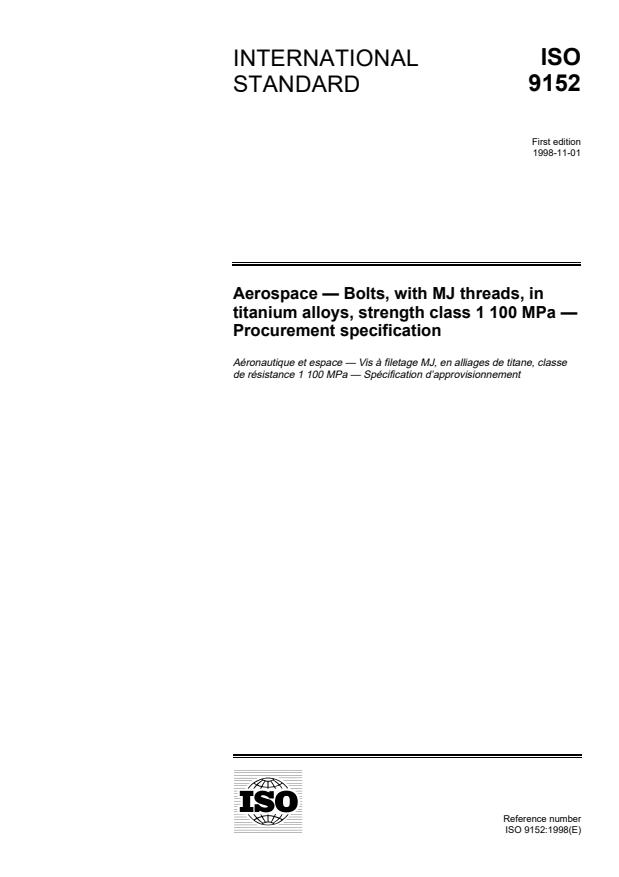

ISO 9152:1998 - Aerospace — Bolts, with MJ threads, in titanium alloys, strength class 1 100 MPa — Procurement specification Released:10/29/1998
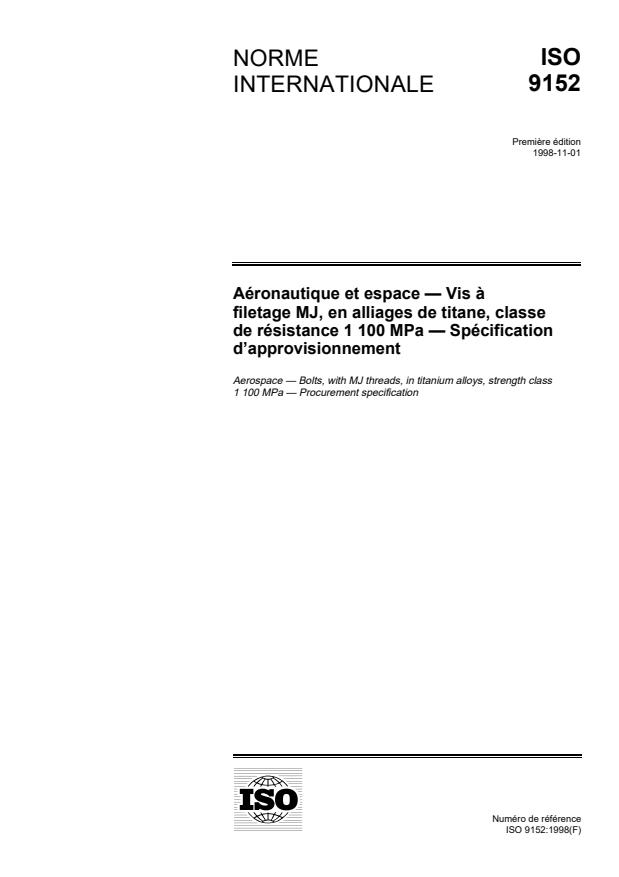

ISO 9152:1998 - Aéronautique et espace — Vis a filetage MJ, en alliages de titane, classe de résistance 1 100 MPa — Spécification d'approvisionnement Released:10/29/1998
Overview
ISO 9152:1998 - Aerospace - Bolts, with MJ threads, in titanium alloys, strength class 1 100 MPa - Procurement specification - is an ISO procurement and quality assurance standard that defines the characteristics, inspection, testing and supplier qualification requirements for MJ‑thread bolts made from titanium alloys for aerospace use. The standard is intended to be invoked by a definition document (drawing or specification) and complements related material and test standards referenced within.
Key topics and technical requirements
- Material & strength class: Bolts must be manufactured from the titanium alloy and strength class identified in the definition document; material compliance is verified by reference to the material standard.
- Manufacture and processing:
- Hot forging of bolt heads prior to heat treatment.
- Controlled heat treatment (blanks not heat‑treated more than twice).
- Threads formed by rolling after full heat treatment.
- Fillet between head and shank to be cold‑rolled after heat treatment and machining to remove machining marks; visual inspection at ×10–×20 magnification.
- Surface and coatings: Surface finish and coatings are to comply with the definition document and ISO 4288 surface‑texture rules; penetrant inspection per ISO 3452 where required.
- Mechanical tests:
- Tensile strength and double‑shear strength tests (see Tables referenced in the standard).
- Tension‑fatigue requirements: mean life ≥ 65 000 cycles; individual life ≥ 45 000 cycles and ≤ 130 000 cycles; test frequency ≤ 140 Hz; loads defined in the standard.
- Recess/driving feature torque test: driving feature must resist specified removal torque without cam‑out; test includes application of a defined end load (specified in the standard).
- Quality assurance and inspection:
- Manufacturer approval per ISO 9002 and retention of quality documentation for minimum 10 years.
- Qualification inspections (e.g., 25 bolts sampled by simple random sampling for each type/diameter).
- Production acceptance sampling plans referenced to ISO 2859‑1 and use of SPC methods (ISO/TR 13425, ISO 7966, ISO 7870, ISO 8258) where validated.
- Definitions and defect classification: Clear terms for production batch, inspection lot, critical/major/minor defects, and sampling plans.
Applications and users
- Who uses it: aerospace procurement engineers, fastener manufacturers and suppliers, quality assurance and certification authorities, design and structural engineers specifying fasteners for airframe assemblies.
- Practical use cases:
- Contractual procurement specification for titanium MJ‑thread bolts in aircraft and spacecraft structures.
- Supplier qualification and acceptance testing programs.
- Establishing inspection plans, control charts and SPC integration for production reliability.
Related standards
- ISO 5855‑2 (MJ thread limits)
- ISO 4288 (surface texture)
- ISO 3452 (penetrant testing)
- ISO 6892 (tensile testing)
- ISO 7961 (fastener test methods)
- ISO 2859‑1 (sampling plans)
- ISO 9002 (quality system model)
- ISO/TR 13425 (statistical methods in standardization)
Keywords: ISO 9152:1998, aerospace bolts, MJ threads, titanium alloys, procurement specification, bolt qualification, tension fatigue, fastener quality control.
Relations
- Effective Date
- 25-Aug-2026
- Effective Date
- 25-Aug-2026
- Effective Date
- 25-Aug-2026
- Effective Date
- 25-Aug-2026
- Effective Date
- 25-Aug-2026
- Effective Date
- 25-Aug-2026
- Effective Date
- 25-Aug-2026
- Effective Date
- 25-Aug-2026
- Effective Date
- 25-Aug-2026
- Effective Date
- 25-Aug-2026
- Effective Date
- 25-Aug-2026
- Effective Date
- 25-Aug-2026
- Effective Date
- 25-Aug-2026
- Effective Date
- 25-Aug-2026
- Effective Date
- 25-Aug-2026
Buy Documents
ISO 9152:1998 - Aerospace — Bolts, with MJ threads, in titanium alloys, strength class 1 100 MPa — Procurement specification Released:10/29/1998
ISO 9152:1998 - Aéronautique et espace — Vis a filetage MJ, en alliages de titane, classe de résistance 1 100 MPa — Spécification d'approvisionnement Released:10/29/1998
Get Certified
Connect with accredited certification bodies for this standard

BUREAU VERITAS Certification Germany
Bureau Veritas certification in Germany.

Element Materials Technology
Materials testing and product certification.

AQMS Ltd.
AQMS provides ISO certification to SMEs across the UK.
Sponsored listings
Frequently Asked Questions
ISO 9152:1998 is a standard published by the International Organization for Standardization (ISO). Its full title is "Aerospace — Bolts, with MJ threads, in titanium alloys, strength class 1 100 MPa — Procurement specification". This standard covers: Aerospace — Bolts, with MJ threads, in titanium alloys, strength class 1 100 MPa — Procurement specification
Aerospace — Bolts, with MJ threads, in titanium alloys, strength class 1 100 MPa — Procurement specification
ISO 9152:1998 is classified under the following ICS (International Classification for Standards) categories: 49.030.20 - Bolts, screws, studs. The ICS classification helps identify the subject area and facilitates finding related standards.
ISO 9152:1998 has the following relationships with other standards: It is inter standard links to EN 4137:2009, EN 4135:2009, EN 4072:2009, EN 2884:2024, EN 4848:2022, EN 4495:2006, EN 3740:2019, EN 4071:2009, EN 4499:2009, EN 4849:2022, EN 3381:2025, EN 4178:2017, EN 4501:2006, EN 2549:2006, EN 3820:2017. Understanding these relationships helps ensure you are using the most current and applicable version of the standard.
ISO 9152:1998 is available in PDF format for immediate download after purchase. The document can be added to your cart and obtained through the secure checkout process. Digital delivery ensures instant access to the complete standard document.
Standards Content (Sample)
INTERNATIONAL ISO
STANDARD 9152
First edition
1998-11-01
Aerospace — Bolts, with MJ threads, in
titanium alloys, strength class 1 100 MPa —
Procurement specification
Aéronautique et espace — Vis à filetage MJ, en alliages de titane, classe
de résistance 1 100 MPa — Spécification d’approvisionnement
A
Reference number
Contents
1 Scope .1
2 Normative references .1
3 Terms and definitions .2
4 Quality assurance.4
4.1 General.4
4.1.1 Approval of manufacturers.4
4.1.2 Qualification of bolts .4
4.1.3 Acceptance of bolts.4
4.2 Qualification inspection conditions.4
4.3 Acceptance inspection conditions .4
4.4 Use of "Statistical process control (SPC)".5
5 Requirements.5
Annex A (informative) Cross sectional areas and formulae for tensile and tension fatigue loads.21
Annex B (informative) Cross sectional areas and formulae for double shear loads.23
© ISO 1998
All rights reserved. Unless otherwise specified, no part of this publication may be reproduced or utilized in any form or by any means, electronic
or mechanical, including photocopying and microfilm, without permission in writing from the publisher.
International Organization for Standardization
Case postale 56 • CH-1211 Genève 20 • Switzerland
Internet iso@iso.ch
Printed in Switzerland
ii
© ISO
Foreword
ISO (the International Organization for Standardization) is a worldwide federation of national standards bodies (ISO
member bodies). The work of preparing International Standards is normally carried out through ISO technical
committees. Each member body interested in a subject for which a technical committee has been established has
the right to be represented on that committee. International organizations, governmental and non-governmental, in
liaison with ISO, also take part in the work. ISO collaborates closely with the International Electrotechnical
Commission (IEC) on all matters of electrotechnical standardization.
International Standards are drafted in accordance with the rules given in the ISO/IEC Directives, Part 3.
Draft International Standards adopted by the technical committees are circulated to the member bodies for voting.
Publication as an International Standard requires approval by at least 75 % of the member bodies casting a vote.
International Standard ISO 9152 was prepared by Technical Committee ISO/TC 20, Aircraft and space vehicles,
Subcommittee SC 4, Aerospace fastener systems.
Annexes A and B of this International Standard are for information only.
iii
INTERNATIONAL STANDARD © ISO ISO 9152:1998(E)
Aerospace — Bolts, with MJ threads, in titanium alloys,
strength class 1 100 MPa — Procurement specification
1 Scope
This International Standard specifies the characteristics and quality assurance requirements for MJ threads bolts
made in titanium alloy, of strength class 1 100 MPa, for aerospace construction.
It is applicable whenever it is referenced in a definition document.
2 Normative references
The following normative documents contain provisions which, through reference in this text, constitute provisions of
this International Standard. For dated references, subsequent amendments to, or revisions of, any of these
publications do not apply. However, parties to agreements based on this International Standard are encouraged to
investigate the possibility of applying the most recent editions of the normative documents indicated below. For
undated references, the latest edition of the normative document referred to applies. Members of ISO and IEC
maintain registers of currently valid International Standards.
ISO 2859-1:1989, Sampling procedures for inspection by attributes — Part 1: Sampling plans indexed by
acceptable quality level (AQL) for lot-by-lot inspection.
ISO 3452:1984, Non-destructive testing — Penetrant inspection — General principles.
ISO 4288:1996, Geometrical Product Specifications (GPS) — Surface texture: Profile method — Rules and
procedures for the assessment of surface texture.
ISO 5855-2:1988, Aerospace — MJ threads — Part 2: Limit dimensions for bolts and nuts.
ISO 6892:1998, Metallic materials — Tensile testing at ambient temperature.
ISO 7870:1993, Control charts — General guide and introduction.
ISO 7961:1994, Aerospace — Bolts — Test methods.
ISO 7966:1993, Acceptance control charts.
ISO 8258:1991, Shewhart control charts.
ISO 9002:1994, Quality systems — Model for quality assurance in production, installation and servicing.
ISO/TR 13425:1995, Guide for the selection of statistical methods in standardization and specification.
© ISO
3 Terms and definitions
For the purposes of this International Standard, the following terms and definitions apply.
3.1
production batch
quantity of finished bolts, manufactured using the same process, from a single material cast (single heat of alloy),
having the same number of definition document, same thread and diameter code, heat treated together to the same
specified conditions and produced as one continuous run
3.2
inspection lot
quantity of bolts from a single production batch having the same number of definition document
3.3
definition document
document specifying directly or indirectly all the requirements for bolts
NOTE The definition document may be an International Standard, an in-house standard or a drawing.
3.4
crack
rupture in the material which may extend in any direction and which may be intercrystalline or transcrystalline in
character
3.5
seam
open surface defect
3.6
lap
surface defect caused by folding over metal fins or sharp corners and then rolling or forging them into the surface
3.7
crevice
hollow area at thread crest
3.8
inclusions
non-metallic particles originating from the material manufacturing process
NOTE These particles may be isolated or arranged in strings.
3.9
microstructural shearing
shear banding
V- or U-shaped rippled grain structure immediately below the thread root, or chevron-shaped rippled grain structure
within the thread crest
3.10
sampling plan
plan according to which one or more samples are taken in order to obtain information and to reach a decision, if
possible
© ISO
NOTE In this International Standard, each sampling plan defines the number of bolts to be inspected as a function of the
1)
size of the batch and the acceptance number [number of defective items acceptable (Ac)] .
3.11
simple random sampling
sampling of n items from a population of N items in such a way that all possible combinations of n items have the
same probability of being chosen
3.12
critical defect
defect that, according to judgement and experience, is likely to result in hazardous or unsafe conditions for
individuals using, maintaining, or depending upon the considered product (bolt), or that is likely to prevent
performance of the function of a major end item
3.13
major defect
defect, other than critical, that is likely to result in a failure or to reduce materially the usability of the considered
product (bolt) for its intended purpose
3.14
minor defect
defect that is not likely to reduce materially the usability of the considered product (bolt) for its intended purpose, or
that represents a departure from established specification having little bearing on the effective use or operation of
this product
3.15
limiting quality
LQ
Æsampling planæ quality level which corresponds to a specified and relatively low probability of acceptance
NOTE 1 It is the limiting lot quality characteristic that the consumer is willing to accept with a low probability that a lot of this
quality would occur.
NOTE 2 For the purposes of this International Standard, the limiting quality quoted in Table 8 corresponds to a probability of
acceptance of 10 %.
3.16
acceptable quality level
AQL
maximum percent defective (or the maximum number of defects per hundred units) that, for purposes of sampling
inspection, can be considered satisfactory as a process average
NOTE Variant: quality level which in a sampling plan corresponds to a specified but relatively high probability of
acceptance.
1) Supplementary information taken from ISO 2859-1.
© ISO
4 Quality assurance
4.1 General
4.1.1 Approval of manufacturers
The manufacturer shall conform to the quality assurance and approval procedures defined by ISO 9002. The
purpose of these procedures is to ensure that a manufacturer has a quality system and the capability for continuous
production of bolts complying with the specified quality requirements.
Quality documentation, as specified in ISO 9002, for parts produced in accordance with this International Standard,
shall be maintained for a minimum period of 10 years.
The approval of the manufacturer shall be granted by the Certification Authorities, or their appointed representative,
who may be the prime contractor.
4.1.2 Qualification of bolts
2)
The purpose of inspections is to verify that the design and manufacturing conditions of a bolt enable it to satisfy
the requirements of this International Standard.
The qualification shall be granted by the Certification Authorities in the purchaser's country, or their appointed
representative, who may be the prime contractor.
4.1.3 Acceptance of bolts
The purpose of inspections is to verify, as simply as possible, using a method which is inexpensive, with the
uncertainty inherent in statistical sampling, that the bolts satisfy the requirements of this International Standard.
They shall be carried out by the manufacturer, or under his responsibility.
The manufacturer is responsible for the quality of the bolts manufactured.
4.2 Qualification inspection conditions
Unless otherwise specified, the inspection shall be carried out on:
each type and diameter of bolt;
25 bolts selected from a single inspection lot by simple random sampling.
The test programme may possibly be reduced, or the qualification granted, without inspection: any such decision
shall be based on the results obtained on similar types and diameters of bolts provided that the design and
manufacturing conditions are identical.
The inspections shall be repeated on any bolt if the manufacturing conditions have modified.
Table 2 indicates the allocation of bolt sample for the inspections.
4.3 Acceptance inspection conditions
Inspections shall be carried out on each production batch or inspection lot. Bolts from the batch or lot to be
inspected shall be selected by simple random sampling.
2) In order to simplify the text the term "inspections" used in this International Standard also refers to "inspections and tests".
© ISO
Each bolt may be submitted to several inspections, provided that none of its characteristics has been altered during
any of these inspections.
The bolts to be subjected to destructive inspections may be those on which non-destructive inspections have been
carried out.
If a more stringent inspection is deemed necessary, all or part of the qualification inspections may be performed
during the acceptance inspections. In this case, the number of bolts submitted is the same as that submitted for
qualification inspection.
Production batches or inspection lots declared unacceptable after the production acceptance inspections shall be
submitted for re-inspection only after all the defective units have been removed and/or defects have been corrected.
In this case, the attribute(s) which caused the rejection shall be verified using a sample of twice the normal size with
the same number of defective items acceptable.
4.4 Use of "Statistical process control (SPC)"
When a characteristic is obtained by a controlled statistical process, the manufacturer has the possibility, in order to
declare conformity of the characteristic, of refraining from the final systematic sampling provided for in this
International Standard, if he is capable of formally justifying this choice by using ISO/TR 13425 and the standards
quoted in it as a basis.
This justification will include the following phases:
analysis of the product's key characteristics;
analysis of the risks for each implemented process;
determination of the parameters and/or characteristics to be respected under SPC;
determination of the capabilities of each process;
drawing up an inspection plan and integration in the manufacturing process;
drawing up of routes and control charts (ISO 7966, ISO 7870, ISO 8258);
use of control charts for data consolidation;
determination of the audits to be run and the control to be carried out to ensure reliability of the device.
To be usable in production, this process should have been validated beforehand by the qualifying body, either
during the qualification phase, or a posteriori according to the case, by analysing the justificatory file and the results
of the qualification inspections such as provided for in clause 5. Such an SPC process is not applicable to
destructive tests apart from the measurement of the hydrogen content.
5 Requirements
The requirements of this International Standard are given in Table 1 and, unless otherwise specified, they apply to
bolts ready for use. The test temperature, unless otherwise specified, shall be the ambient temperature. These
requirements complement the requirements of all other standards or specifications referenced in the definition
document.
© ISO
Table 1 — Requirements and test methods
Clause Characteristic Requirement Inspection and test Desig- Sample
method a size
nation
5.1 Material In accordance with the definition See material standard As required
document by semi-
finished
product
Q20
5.2 Dimensions In accordance with the Standard gauging
definition document
A Tables
3 and 4
5.3 Manufacturing
Q
5.3.1 Forging The heads of the bolts shall be According to the
formed by a hot forging process route of manufacture
before heat treatment.
The equipment shall ensure an The equipment used
adequate and uniform temperature shall be approved.
throughout the production batch.
Q
5.3.2 Heat treatment The forged blanks shall be heat- According to the
treated to produce the properties process route
required by the definition
The equipment used
document. Blanks shall not be
shall be approved.
heat-treated more than twice.
5.3.3 Removal of If machining is required, it is
surface necessary to respect the
contamination requirements of 5.5.1.
(bearing face and
shank)
Q5
5.3.4 Fillet between The fillet radius shall be cold Visual examination at
a suitable
head and shank rolled after heat treatment and
A Tables
magnification of · 10
machining so as to remove all
3 and 4
to · 20 and
visual signs of machining and to
dimensional check
create superficial cold working. The
deformation shall not exceed the
values in Figure 1.
The requirements apply to bolts
except for the following:
a) threaded to head bolts;
b) bolts with a nominal diameter
< 5 mm.
Q
5.3.5 Threads Formed by a single rolling According to the
process after full heat treatment manufacturing route
Q5
5.3.6 Surface In accordance with the ISO 4288
roughness definition document Visual examination
A Tables
3 and 4
Q5
5.3.7 Surface coating In accordance with the See surface coating
definition document standard.
A Tables
3 and 4
© ISO
Table 1 (continued)
Clause Characteristic Requirement Inspection and test Desig- Sample
a
method size
nation
5.4 Mechanical
properties
Q5
5.4.1 Tensile strength See Table 5. On bolts: ISO 7961
A Table 6 or
The requirements apply on bolts On test specimen:
Table 7
except on the following: ISO 6892
a) protruding head bolts of grip
The test specimens to
length < twice the nominal
be produced from the
shank diameter;
same material batch
b) countersunk head bolts of grip as the bolts and
length < two and a half times the treated wi
...
NORME ISO
INTERNATIONALE 9152
Première édition
1998-11-01
Aéronautique et espace — Vis à
filetage MJ, en alliages de titane, classe
de résistance 1 100 MPa — Spécification
d’approvisionnement
Aerospace — Bolts, with MJ threads, in titanium alloys, strength class
1 100 MPa — Procurement specification
A
Numéro de référence
Sommaire Page
1 Domaine d’application .1
2 Références normatives .1
3 Termes et définitions.2
4 Assurance de la qualité.4
4.1 Généralités .4
4.1.1 Agrément des fabricants.4
4.1.2 Qualification des vis.4
4.1.3 Réception des vis .4
4.2 Condition d'exécution des contrôles de qualification .4
4.3 Conditions d'exécution des contrôles de réception .4
4.4 Utilisation de la «Maîtrise statistique de procédé (MSP)» .5
5 Exigences .5
Annexe A (informative) Sections et formules de calcul des charges en traction et de tenue en fatigue.21
Annexe B (informative) Sections et formules de calcul des charges de double cisaillement.23
© ISO 1998
Droits de reproduction réservés. Sauf prescription différente, aucune partie de cette publication ne peut être reproduite ni utilisée sous quelque
forme que ce soit et par aucun procédé, électronique ou mécanique, y compris la photocopie et les microfilms, sans l'accord écrit de l'éditeur.
Organisation internationale de normalisation
Case postale 56 • CH-1211 Genève 20 • Suisse
Internet iso@iso.ch
Imprimé en Suisse
ii
© ISO
Avant-propos
L'ISO (Organisation internationale de normalisation) est une fédération mondiale d'organismes nationaux de
normalisation (comités membres de l'ISO). L'élaboration des Normes internationales est en général confiée aux
comités techniques de l'ISO. Chaque comité membre intéressé par une étude a le droit de faire partie du comité
technique créé à cet effet. Les organisations internationales, gouvernementales et non gouvernementales, en
liaison avec l'ISO, participent également aux travaux. L'ISO collabore étroitement avec la Commission
électrotechnique internationale (CEI) en ce qui concerne la normalisation électrotechnique.
Les Normes internationales sont rédigées conformément aux règles données dans les Directives ISO/CEI, Partie 3.
Les projets de Normes internationales adoptés par les comités techniques sont soumis aux comités membres pour
vote. Leur publication comme Normes internationales requiert l'approbation de 75 % au moins des comités
membres votants.
La Norme internationale ISO 9152 a été élaborée par le comité technique ISO/TC 20, Aéronautique et espace,
sous-comité SC 4, Éléments de fixation pour constructions aérospatiales.
Les annexes A et B de la présente Norme internationale sont données uniquement à titre d’information.
iii
NORME INTERNATIONALE © ISO ISO 9152:1998(F)
Aéronautique et espace — Vis à filetage MJ, en alliages de titane,
classe de résistance 1 100 Mpa —
Spécification d’approvisionnement
1 Domaine d’application
La présente Norme internationale spécifie les caractéristiques et les exigences d'assurance de la qualité des vis à
filetage MJ, fabriquées en alliage de titane, de classe de résistance 1 100 MPa, pour les constructions
aérospatiales.
Elle est applicable chaque fois qu'elle est référencée dans un document de définition.
2 Références normatives
Les documents normatifs suivants contiennent des dispositions qui, par suite de la référence qui y est faite,
constituent des dispositions valables pour la présente Norme internationale. Pour les références datées, les
amendements ultérieurs ou les révisions de ces publications ne s'appliquent pas. Toutefois, les parties prenantes
aux accords fondés sur la présente Norme internationale sont invitées à rechercher la possibilité d'appliquer les
éditions les plus récentes des documents normatifs indiqués ci-après. Pour les références non datées, la dernière
édition du document normatif en référence s'applique. Les membres de l'ISO et de la CEI possèdent le registre des
Normes internationales en vigueur.
ISO 2859-1:1989, Règles d'échantillonnage pour les contrôles par attributs — Partie 1: Plans d'échantillonnage
pour les contrôles lot par lot, indexés d'après le niveau de qualité acceptable (NQA).
ISO 3452:1984, Essais non destructifs — Contrôle par ressuage — Principes généraux.
ISO 4288:1996, Spécification géométrique des produits (GPS) — État de surface: Méthode du profil — Règles et
procédures pour l'évaluation de l'état de surface.
ISO 5855-2:1988, Aéronautique et espace — Filetage MJ — Partie 2: Dimensions limites pour vis et écrous.
ISO 6892:1998, Matériaux métalliques — Essai de traction à température ambiante.
ISO 7870:1993, Cartes de contrôle — Principes généraux et introduction à l’emploi.
ISO 7961:1994, Aéronautique et espace — Vis — Méthodes d'essai.
ISO 7966:1993, Cartes de contrôle pour acceptation.
ISO 8258:1991, Cartes de contrôle de Shewhart.
ISO 9002:1994, Systèmes qualité — Modèle pour l'assurance de la qualité en production, installation et prestations
associées.
ISO/TR 13425:1995, Guide pour la sélection des méthodes statistiques en normalisation et en spécifications.
© ISO
3 Termes et définitions
Pour les besoins de la présente Norme internationale, les termes et définitions suivants s'appliquent.
3.1
lot de production
quantité de vis prêtes à l'emploi, réalisées suivant la même gamme de fabrication, à partir d'un matériau issu d'une
même coulée (même traitement thermique de l'alliage), de même numéro de document de définition, de même
code diamètre et de même code filetage, ayant subi ensemble les traitements thermiques dans les mêmes
conditions spécifiées et produites de façon continue
3.2
lot de contrôle
quantité de vis appartenant à un même lot de production, de même numéro de document de définition
3.3
document de définition
document spécifiant directement ou indirectement toutes les exigences pour les vis
NOTE Le document de définition peut être une Norme internationale, une norme nationale, une norme d'entreprise ou un
dessin.
3.4
crique
rupture dans le matériau, qui peut s'étendre en toutes directions et qui peut être à caractère intercristallin ou
transcristallin
3.5
strie
rayure
défaut de surface ouvert
3.6
repli
défaut de surface provoqué par le rabattement sur elles-mêmes de particules de métal ou d'arêtes vives qui sont
ensuite roulées ou forgées en surface
3.7
cratère
forme en creux au sommet des filets
3.8
inclusions
particules non métalliques ayant pour origine le procédé d'élaboration du matériau
NOTE Ces particules peuvent être isolées ou réparties en cordons.
3.9
cisaillement microstructural
zone de cisaillement
structure granulaire déchirée de forme en V ou en U immédiatement sous le rayon à fond de filet, ou de forme en
chevron en sommet de filet
3.10
plan d'échantillonnage
plan selon lequel un ou plusieurs échantillons sont prélevés pour obtenir une information et si possible conduire à
une décision
© ISO
NOTE Dans la présente Norme internationale, chaque plan d'échantillonnage définit le nombre de vis à contrôler en
1)
fonction de la taille du lot et du critère d'acceptation @nombre de défectueux acceptables (NA)# .
3.11
échantillonnage simple au hasard
mode de prélèvement de n individus dans une population de N individus tel que toutes les combinaisons possibles
de n individus aient la même probabilité d'être prélevées
3.12
défaut critique
défaut qui, d'après le jugement et l'expérience, est susceptible de conduire à un manque de sécurité ou à des
risques d'accident pour les utilisateurs, le personnel d'entretien, ou ceux qui dépendent du produit considéré (vis),
ou bien qui pourra empêcher l'accomplissement de la fonction d'un produit final plus important
3.13
défaut majeur
défaut qui, sans être critique, risque de provoquer une défaillance, ou bien de réduire de façon importante la
possibilité d'utilisation du produit considéré (vis) pour le but qui lui est assigné
3.14
défaut mineur
défaut qui ne réduit vraisemblablement pas beaucoup la possibilité d'utilisation du produit considéré (vis) pour le but
qui lui est assigné, ou qui traduit, par rapport aux spécifications fixées, une divergence n'entraînant que peu de
conséquences appréciables sur l'utilisation ou le fonctionnement efficace de ce produit
3.15
qualité limite
QL
^plan d'échantillonnage& niveau de qualité qui correspond à une probabilité d'acceptation spécifiée et relativement
faible.
NOTE 1 C’est la caractéristique limite de qualité d'un lot que le client ne veut accepter qu'avec une faible probabilité.
NOTE 2 Pour les besoins de la présente Norme internationale, la qualité limite citée dans le Tableau 8 correspond à une
probabilité d'acceptation de 10 %.
3.16
niveau de qualité acceptable
NQA
pourcentage maximal de défectueux (ou le nombre maximal de défauts par cent unités) qui, pour le contrôle par
échantillonnage, peut être considéré comme satisfaisant en tant que caractéristique moyenne de la qualité de la
production
NOTE En variante, niveau de qualité qui, dans un plan d'échantillonnage, correspond à une probabilité d'acceptation
spécifiée, mais relativement forte.
1) Information complémentaire extraite de l’ISO 2859-1.
© ISO
4 Assurance de la qualité
4.1 Généralités
4.1.1 Agrément des fabricants
Le fabricant doit satisfaire aux procédures d'assurance qualité et d'agrément définies dans l’ISO 9002. Ces
procédures ont pour but d'assurer qu'un fabricant dispose d'un système qualité et qu'il est apte à réaliser de
manière régulière des vis répondant aux exigences de qualité spécifiées.
Comme spécifié dans l’ISO 9002, les documents relatifs à la qualité des pièces produites conformément à la
présente Norme internationale doivent être archivés pendant au moins 10 ans.
L'agrément du fabricant doit être délivré par les Autorités de certification, ou leur représentant délégué, qui peut être
le premier maître d'œuvre.
4.1.2 Qualification des vis
2)
Les contrôles ont pour but de vérifier que la conception et les conditions de réalisation d'une vis lui permettent de
satisfaire aux exigences de la présente Norme internationale.
La qualification doit être délivrée par des Autorités de certification du pays de l'acheteur, ou leur représentant
délégué, qui peut être le premier maître d'oeuvre.
4.1.3 Réception des vis
Les contrôles ont pour but de vérifier, de la façon la plus simple, la moins coûteuse et avec l'incertitude inhérente au
contrôle statistique, que les vis sont en mesure de satisfaire aux exigences de la présente Norme internationale.
Ils doivent être effectués par le fabricant ou sous sa responsabilité.
Le fabricant est responsable de la qualité des vis réalisées.
4.2 Condition d'exécution des contrôles de qualification
Sauf spécification contraire, ces contrôles doivent être effectués sur:
tout type et tout diamètre de vis;
25 vis prélevées dans un seul lot de contrôle par échantillonnage simple au hasard.
Éventuellement, le programme d'essai peut être réduit, ou la qualification peut être prononcée sans contrôle: cette
décision doit être prise en fonction des résultats obtenus sur d'autres types ou d'autres diamètres de vis, à condition
que ces vis aient une conception identique et qu'elles aient été fabriquées dans les mêmes conditions.
Les contrôles doivent être effectués de nouveau sur toute vis dont les conditions de réalisation ont été modifiées.
Le tableau 2 indique les affectations des vis échantillons aux différents contrôles.
4.3 Conditions d'exécution des contrôles de réception
Ces contrôles doivent être effectués sur chaque lot de production ou de contrôle. Les vis doivent être prélevées
dans le lot à contrôler par échantillonnage simple au hasard.
2) Dans un but de simplification du texte, le terme «contrôle» utilisé dans la présente Norme internationale désigne à la fois les
«contrôles» et les «essais».
© ISO
Chaque vis peut être affectée à plusieurs contrôles à condition qu'aucune de ses caractéristiques n'ait été altérée
pendant l'un quelconque de ces contrôles.
Les vis devant subir les contrôles destructifs peuvent être prélevées parmi celles ayant subi les contrôles non
destructifs.
Lorsqu'un contrôle renforcé apparaît nécessaire, tout ou partie des contrôles de qualification peuvent être effectués
en réception. Dans ce cas, le nombre de vis à soumettre à ces contrôles est le même que celui affecté aux
contrôles de qualification.
Un lot de production ou de contrôle n'ayant pas satisfait aux exigences de réception ne doit être de nouveau
présenté à la réception que lorsque toutes les unités défectueuses ont été enlevées et/ou tous les défauts corrigés.
Dans ce cas, le ou les paramètres ayant entraîné le refus doivent être vérifiés sur un échantillonnage double avec
le même nombre de défectueux acceptables.
4.4 Utilisation de la «Maîtrise statistique de procédé (MSP)»
Lorsqu’une caractéristique est obtenue par un procédé statistiquement maîtrisé, le fabricant a la possibilité, pour
prononcer la conformité de la caractéristique, de s’abstenir du prélèvement systématique final prévu dans la
présente Norme internationale, s’il est en mesure de justifier formellement ce choix, en s’appuyant sur
l’ISO/TR 13425 et les normes qui y sont citées.
Cette justification comprendra les phases nécessaires suivantes:
analyse des caractéristiques clés du produit;
analyse des risques pour chaque procédé mis en œuvre;
détermination des paramètres et/ou des caractéristiques à suivre sous MSP;
détermination des capabilités de chaque procédé;
établissement du plan de contrôle et intégration dans le processus de fabrication;
établissement des gammes et cartes de contrôle (ISO 7966, ISO 7870, ISO 8258);
exploitation des cartes de contrôle pour consolidation des données;
détermination des audits à mener et des contrôles à effectuer pour assurer la fiabilité du dispositif.
Pour être utilisable en production, ce dispositif aurait dû être validé au préalable par l'organisme qualificateur soit en
phase de qualification, soit a posteriori selon le cas, par l'analyse du dossier justificatif et des résultats des contrôles
de qualification tels qu'ils sont prévus à l’article 5. Un tel procédé MSP n'est pas applicable aux essais
destructifs, sauf la mesure de teneur en hydrogène.
5 Exigences
Les exigences requises par la présente Norme internationale sont indiquées dans le Tableau 1 et, sauf indication
contraire, s'entendent sur vis prêtes à l'emploi. La température d'essai doit être, sauf indication contraire, la
température ambiante. Ces exigences viennent en complément des exigences figurant dans toutes les autres
normes ou spécifications citées dans le document de définition.
© ISO
Tableau 1 — Exigences techniques et méthodes d'essai
Para- Méthode de contrôle Affec- Effectif de
Caractéristique Exigence
graphe et d'essai a l'échantillon
tation
5.1 Matériaux En accord avec le document de Voir la norme de Contrôle
définition matériau. effectué sur
demi-produit
5.2 Dimensions En accord avec le document de Instruments usuels Q 20
définition
A Tableaux
3 et 4
5.3 Fabrication
5.3.1 Matriçage Les têtes des vis doivent être Suivant gamme de Q
matricées à chaud avant traitement fabrication
thermique.
L'équipement doit garantir une L'équipement utilisé
température adéquate et uniforme doit être approuvé.
pour tout le lot de production.
Q
5.3.2 Traitement Le lot d'ébauches doit être soumis à Suivant gamme de
thermique un traitement thermique assurant les procédé
propriétés requises par le document
L'équipement utilisé
de définition. Les ébauches ne
doit être approuvé.
doivent pas être traitées
thermiquement plus de deux fois.
5.3.3 Élimination de la Si nécessaire, un usinage peut être
couche effectué en respectant les exigences
contaminée (face de 5.5.1.
d'appui et fût)
5.3.4 Raccordement Le rayon de raccordement sous tête Examen visuel avec Q 5
entre tête et fût doit être galeté, après traitement un grossissement de
A Tableaux
thermique et usinage, pour · 10 à · 20 et
3 et 4
supprimer toute trace visible vérification
d'usinage et créer un écrouissage dimensionnelle
superficiel. La déformation ne doit appropriée
pas excéder les valeurs indiquées à
la Figure 1.
Cette exigence s'applique sur vis
sauf dans les cas suivants:
a) vis filetées jusqu'à proximité de
la tête;
b) vis de diamètre nominal
< 5 mm.
5.3.5 Filetage Obtenu par un seul roulage, après Suivant gamme de Q
traitement thermique complet fabrication
Q 5
5.3.6 Rugosité de En accord avec le document de ISO 4288
surface définition Examen visuel
A Tableaux
3 et 4
Q 5
5.3.7 Revêtement de En accord avec le document de Voir norme de
surface définition revêtement de
A Tableaux
surface.
3 et 4
© ISO
Tableau 1 (suite)
Para- Méthode de contrôle Affec- Effectif de
Caractéristique Exigence
graphe et d'essai a l'échantillon
tation
5.4 Propriétés
mécaniques
5.4.1 Résistance en Voir Tableau 5. Sur vis: ISO 7961
Q 5
traction
Cette exigence s'applique sur vis Sur éprouvettes :
A Tableau 6 ou
sauf dans les cas suivants: ISO 6892
Tableau 7
a) vis à tête saillante de longueur Les éprouvettes
de serrage , deux fois le doivent être issues du
diamètre nominal du fût; même lot de matière
que les vis et traitées
b) vis à tête fraisée de longueur
avec elles.
de serrage , deux fois et demi
le diamètre nominal du fût;
c) vis filetées jusqu'à proximi
...