


ISO 12234-1:2007
(Main)Electronic still-picture imaging — Removable memory — Part 1: Basic removable-memory model
Electronic still-picture imaging — Removable memory — Part 1: Basic removable-memory model
ISO 12234-2:2007 specifies a basic removable-memory reference model for digital electronic still-picture cameras. The reference model includes image file formats for storing image data and metadata, filing system requirements for storing and retrieving the image files on the removable memory, and media profiles which are specific to a given storage technology. The reference model allows the image data and metadata to be interchanged among the various components of an electronic imaging system by using the removable storage media.
Imagerie de prises de vue électroniques — Mémoire mobile — Partie 1: Modèle de mémoire mobile de base
General Information
- Status
- Withdrawn
- Publication Date
- 23-Oct-2007
- Withdrawal Date
- 23-Oct-2007
- Technical Committee
- ISO/TC 42 - Photography
- Drafting Committee
- ISO/TC 42 - Photography
- Current Stage
- 9599 - Withdrawal of International Standard
- Start Date
- 26-Jun-2012
- Completion Date
- 14-Feb-2026
Relations
- Effective Date
- 28-Feb-2009
- Effective Date
- 15-Apr-2008
Frequently Asked Questions
ISO 12234-1:2007 is a standard published by the International Organization for Standardization (ISO). Its full title is "Electronic still-picture imaging — Removable memory — Part 1: Basic removable-memory model". This standard covers: ISO 12234-2:2007 specifies a basic removable-memory reference model for digital electronic still-picture cameras. The reference model includes image file formats for storing image data and metadata, filing system requirements for storing and retrieving the image files on the removable memory, and media profiles which are specific to a given storage technology. The reference model allows the image data and metadata to be interchanged among the various components of an electronic imaging system by using the removable storage media.
ISO 12234-2:2007 specifies a basic removable-memory reference model for digital electronic still-picture cameras. The reference model includes image file formats for storing image data and metadata, filing system requirements for storing and retrieving the image files on the removable memory, and media profiles which are specific to a given storage technology. The reference model allows the image data and metadata to be interchanged among the various components of an electronic imaging system by using the removable storage media.
ISO 12234-1:2007 is classified under the following ICS (International Classification for Standards) categories: 37.040.99 - Other standards related to photography. The ICS classification helps identify the subject area and facilitates finding related standards.
ISO 12234-1:2007 has the following relationships with other standards: It is inter standard links to ISO 12234-1:2012, ISO 12234-1:2001. Understanding these relationships helps ensure you are using the most current and applicable version of the standard.
ISO 12234-1:2007 is available in PDF format for immediate download after purchase. The document can be added to your cart and obtained through the secure checkout process. Digital delivery ensures instant access to the complete standard document.
Standards Content (Sample)
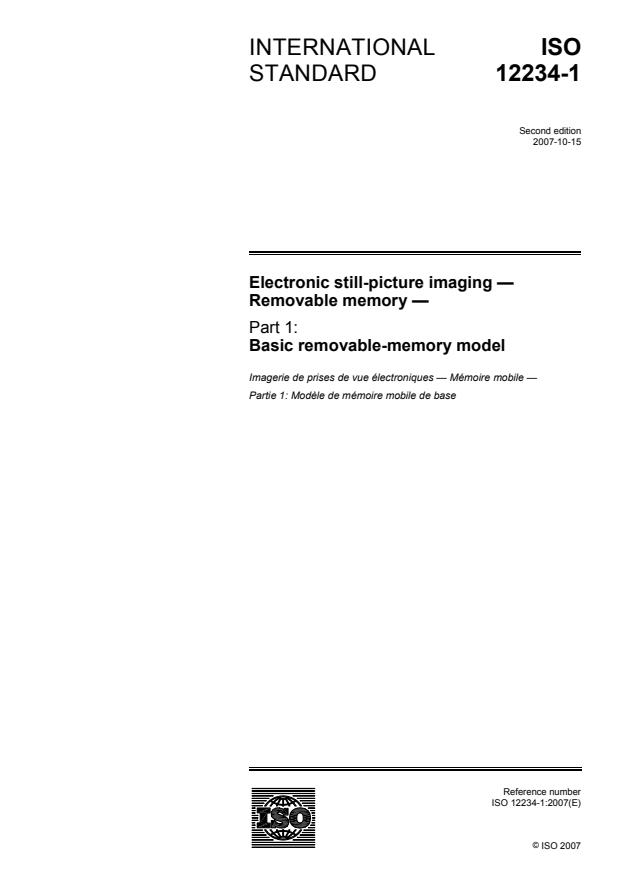
INTERNATIONAL ISO
STANDARD 12234-1
Second edition
2007-10-15
Electronic still-picture imaging —
Removable memory —
Part 1:
Basic removable-memory model
Imagerie de prises de vue électroniques — Mémoire mobile —
Partie 1: Modèle de mémoire mobile de base
Reference number
©
ISO 2007
PDF disclaimer
This PDF file may contain embedded typefaces. In accordance with Adobe's licensing policy, this file may be printed or viewed but
shall not be edited unless the typefaces which are embedded are licensed to and installed on the computer performing the editing. In
downloading this file, parties accept therein the responsibility of not infringing Adobe's licensing policy. The ISO Central Secretariat
accepts no liability in this area.
Adobe is a trademark of Adobe Systems Incorporated.
Details of the software products used to create this PDF file can be found in the General Info relative to the file; the PDF-creation
parameters were optimized for printing. Every care has been taken to ensure that the file is suitable for use by ISO member bodies. In
the unlikely event that a problem relating to it is found, please inform the Central Secretariat at the address given below.
© ISO 2007
All rights reserved. Unless otherwise specified, no part of this publication may be reproduced or utilized in any form or by any means,
electronic or mechanical, including photocopying and microfilm, without permission in writing from either ISO at the address below or
ISO's member body in the country of the requester.
ISO copyright office
Case postale 56 • CH-1211 Geneva 20
Tel. + 41 22 749 01 11
Fax + 41 22 749 09 47
E-mail copyright@iso.org
Web www.iso.org
Published in Switzerland
ii © ISO 2007 – All rights reserved
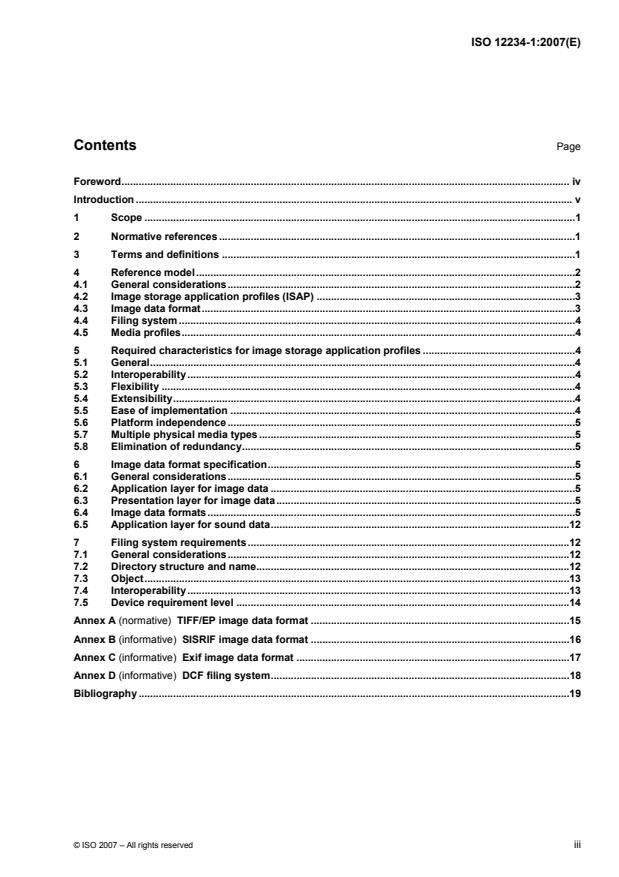
Contents Page
Foreword. iv
Introduction . v
1 Scope .1
2 Normative references .1
3 Terms and definitions .1
4 Reference model.2
4.1 General considerations.2
4.2 Image storage application profiles (ISAP) .3
4.3 Image data format.3
4.4 Filing system.4
4.5 Media profiles.4
5 Required characteristics for image storage application profiles .4
5.1 General.4
5.2 Interoperability.4
5.3 Flexibility .4
5.4 Extensibility.4
5.5 Ease of implementation .4
5.6 Platform independence .5
5.7 Multiple physical media types .5
5.8 Elimination of redundancy.5
6 Image data format specification.5
6.1 General considerations.5
6.2 Application layer for image data .5
6.3 Presentation layer for image data.5
6.4 Image data formats.5
6.5 Application layer for sound data.12
7 Filing system requirements.12
7.1 General considerations.12
7.2 Directory structure and name.12
7.3 Object.13
7.4 Interoperability.13
7.5 Device requirement level .14
Annex A (normative) TIFF/EP image data format .15
Annex B (informative) SISRIF image data format .16
Annex C (informative) Exif image data format .17
Annex D (informative) DCF filing system.18
Bibliography .19
Foreword
ISO (the International Organization for Standardization) is a worldwide federation of national standards bodies
(ISO member bodies). The work of preparing International Standards is normally carried out through ISO
technical committees. Each member body interested in a subject for which a technical committee has been
established has the right to be represented on that committee. International organizations, governmental and
non-governmental, in liaison with ISO, also take part in the work. ISO collaborates closely with the
International Electrotechnical Commission (IEC) on all matters of electrotechnical standardization.
International Standards are drafted in accordance with the rules given in the ISO/IEC Directives, Part 2.
The main task of technical committees is to prepare International Standards. Draft International Standards
adopted by the technical committees are circulated to the member bodies for voting. Publication as an
International Standard requires approval by at least 75 % of the member bodies casting a vote.
Attention is drawn to the possibility that some of the elements of this document may be the subject of patent
rights. ISO shall not be held responsible for identifying any or all such patent rights.
ISO 12234-1 was prepared by Technical Committee ISO/TC 42, Photography.
This second edition cancels and replaces the first edition (ISO 12234-1:2001), which has been technically
revised.
ISO 12234 consists of the following parts, under the general title Electronic still-picture imaging — Removable
memory:
⎯ Part 1: Basic removable-memory model
⎯ Part 2: TIFF/EP image data format
iv © ISO 2007 – All rights reserved
Introduction
The ISO 12234 series addresses removable memory requirements for electronic still cameras. Unlike a
traditional photographic system, an electronic photography system divides the imaging chain into discrete
components separately devoted to image acquisition, storage, transmission, processing and display. Since
the components may be made by different manufacturers, there is a need to specify a standard format for
data interchange among the various components of an electronic imaging system.
This part of ISO 12234 describes data interchange using a removable storage media. The purpose of the
removable storage media is to store images digitally in a media that is compact, low in power, and
mechanically rugged. These removable storage media will be used to transport the data to other components
in the imaging chain. This part of ISO 12234 further specifies the required information content for a removable
memory data format. The information content includes both the image data and data items describing the
image. Normative Annex A and informative Annexes B and C describe various conforming formats. The data
features supported by each of these formats are also described in Clause 6. The information content further
includes the filing system which organizes the image data. Informative Annex D describes a conforming filing
system. The filing system features are described in Clause 7.
An implementation is said to be in compliance if, at a minimum, all mandatory elements are present.
Recommended features are not required, but will substantially enhance interoperability, performance and/or
robustness.
In developing this part of ISO 12234, a structured methodology was followed. A reference model describes the
environment as well as the overall architecture in which this part of ISO 12234 is applicable. The architecture
separates the software-only layers, termed the image data format and the filing system, from the hardware
technology-dependent layers, termed the media profile. An image data format is media independent and
contains the image data, image related data and a means for structuring these data elements. A filing system
defines the data organization on the storage media used but which is independent of the media.
The International Organization for Standardization (ISO) draws attention to the fact that it is claimed that
compliance with this document may involve the use of patents.
ISO takes no position concerning the evidence, validity and scope of these patent rights.
The holders of these patent rights have assured ISO that they are willing to negotiate licences under
reasonable and non-discriminatory terms and conditions with applicants throughout the world. In this respect,
the statements of the holders of these patent rights are registered with ISO. Information may be obtained
from:
⎯ Eastman Kodak Company
Attention: Director, Corporate Commercial Affairs
343 State Street
Rochester, New York, USA 14650-0211
⎯ Konica Minolta Technology Center, Inc.
Attention: General Manager, Intellectual Property Center
No.1 Sakura-machi, Hino-shi
Tokyo 191-8511, Japan
⎯ FUJIFILM Corporation
Attention: Industrial Standards Office
7-3, Akasaka 9-chome, Minato-Ku
Tokyo 107-0052 Japan
Attention is drawn to the possibility that some of the elements of this document may be the subject of patent
rights other than those identified above. ISO shall not be held responsible for identifying any or all such patent
rights.
With the permission of Adobe Systems Incorporated, numerous tag names and values used in this part of
ISO 12234 have been copied verbatim from the TIFF 6.0 specification dated June 3, 1992, specification
copyright 1986-1988, 1992 Adobe Systems Incorporated.
vi © ISO 2007 – All rights reserved
INTERNATIONAL STANDARD ISO 12234-1:2007(E)
Electronic still-picture imaging — Removable memory —
Part 1:
Basic removable-memory model
1 Scope
This part of ISO 12234 specifies a basic removable-memory reference model for digital electronic still-picture
cameras. The reference model includes image file formats for storing image data and metadata, filing system
requirements for storing and retrieving the image files on the removable memory, and media profiles which
are specific to a given storage technology. The reference model allows the image data and metadata to be
interchanged among the various components of an electronic imaging system by using the removable storage
media.
2 Normative references
The following referenced documents are indispensable for the application of this document. For dated
references, only the edition cited applies. For undated references, the latest edition of the referenced
document (including any amendments) applies.
ISO 12232, Photography — Digital still cameras — Determination of exposure index, ISO speed ratings,
standard output sensitivity, and recommended exposure index
ISO 12233, Photography — Electronic still-picture cameras — Resolution measurements
ISO 12234-2, Electronic still-picture imaging — Removable memory — Part 2: TIFF/EP image data format
ISO 14524, Photography — Electronic still-picture cameras — Methods for measuring opto-electronic
conversion functions (OECFs)
3 Terms and definitions
For the purposes of this document, the following terms and definitions apply.
3.1
filing system
software structure which specifies how the data is logically organized on a given storage media
3.2
image data format
structure and content which specify image data and the organization of the image related data in a device
independent manner
3.3
image storage application profile
ISAP
media profile, the filing system and the image data format
NOTE The ISAP specifies all the information necessary to completely implement the removable memory.
3.4
media profile
portion of the memory module specification which is specific to a given memory technology; including the form
factor, interconnection and access protocol
3.5
memory card
specific type of memory module with a physical form factor no larger than that of a credit card in outline and
approximately 85 mm × 55 mm in size
3.6
memory module
physical implementation of the removable memory, containing the image data format combined with a
specified physical form factor, interconnect definition and access protocol
3.7
removable memory
storage in a user removable form factor, which is transportable, and intended for the digital storage of image
data in electronic still cameras
NOTE The memory media can be read/write, write once, etc., but has to be non-volatile when removed from the
camera so as to retain the data.
3.8
sound compression
process of altering the sound data coding in order to reduce the size of a sound file in the electronic still
picture camera
cf. sound recording (3.9).
3.9
sound recording
recording of the sound data relative to an image acquired by the electronic still camera
NOTE 1 The sound recording can be made before, during, or after the time of the image acquisition.
NOTE 2 A sound recording attached to an electronic still picture is considered an annotation of the image, as
distinguished from a sound recording which is attached to and synchronized with motion pictures or video pictures.
4 Reference model
4.1 General considerations
Table 1 summarizes the reference model for this part of ISO 12234. The reference model is a layered model.
The implementation of any one layer can be changed without affecting the implementation of any other layer.
The reference model describes the types of elements included in each layer.
2 © ISO 2007 – All rights reserved
Table 1 — Reference model for removable storage
Layer Intent Examples Implementation
Application Content-image data Image data Image data format
and parameters
Presentation Define structure of image data Tags or tuples
and encoding mechanism
Session Define data organization Filing system for image Filing system
on media storage/retrieval
Transport Communication of data across Data transmission protocol Media profile
a channel
Network Conformance layer Compatibility and interoperability
with other systems
Data link a) Assures reliable data a) Card information structure
read/write
b) Error correction methods
b) Storage media specific
c) Control for insert/removal
recording information
Physical Assure basic compatibility a) Form factor, pin alignment,
in physical form factor size
and electrical signals
b) Electrical interface
specification
c) Protocol/command sets
4.2 Image storage application profiles (ISAP)
The ISAP completely specifies all the information necessary to implement a particular type of removable
storage. The image storage application profile consists of three parts:
⎯ the image data format, which describes the structure and content of the image data;
⎯ the filing system, which describes how the image files are stored and retrieved;
⎯ the media profile, which describes the media used to store the image files.
4.3 Image data format
The image data format consists of the application and presentation layers. The application layer defines the
content of the image data. The presentation layer defines the encoding of the image data. This part of
ISO 12234 specifies image data formats that are consistent across implementations and independent of the
media used for storage.
The content defined in the application layer includes the image and image related information, called
metadata, such as the date the image was captured. The encoding defined in the presentation layer includes
the structures which define the image and the image related information as digital values. For example, the
encoding describes whether the image is stored as strips or tiles, and whether the metadata is stored as
numbers or characters. The detailed elements in three allowed image data formats are described in Clause 6.
The image data formats described in this part of ISO 12234 provide an explicit binding between the content in
the application layer and the encoding method given in the presentation layer.
4.4 Filing system
The filing system definition includes the information required for the session layer. It defines the data
organization on the storage media used.
4.5 Media profiles
Many different removable memory types are used in digital electronic still-picture cameras. The storage
technologies include various solid state memory cards, magnetic hard drives and optical discs. Each of these
removable memory types can be described by an appropriate media profile.
The media profile definition includes the information required for the transport, network, data link and physical
layers. The transport layer defines the protocol for how this data is transported between the digital electronic
still-picture camera and the removable memory. The network layer describes the conformance requirements
needed to maintain compatibility and interoperability with other systems. The data link layer describes the
mechanisms for assuring reliable communications, and the specifications for reading, writing, erasing,
removing and inserting specific types of media. The physical layer assures the basic compatibility of the
physical and electrical interface. It defines the physical form factor, connector specifications and electrical
interface specifications.
5 Required characteristics for image storage application profiles
5.1 General
The characteristics required for suitable image data formats and media profiles are specified in 5.2 to 5.8.
These criteria were used in the development of this part of ISO 12234 and will be used in developing its future
versions.
5.2 Interoperability
This part of ISO 12234 fosters interoperability between systems manufactured by different vendors. Here
interoperability permits
a) storage of image data on a removable medium,
b) removal of that media from a digital electronic still-picture camera,
c) insertion of that media into a second system, and
d) transfer of the image data to the second device.
5.3 Flexibility
This reference model permits flexibility across applications requiring different levels of feature sets. Some
image formats allow default values for specific data elements in order to simplify the implementation.
5.4 Extensibility
This reference model allows for various extensions to provide the possibility of incorporating new features.
Some image data formats include the capability for private extensions to meet special needs. In future
revisions of this part of ISO 12234, new features may be added to the present image data formats. In addition,
new media profiles or image data formats may be included.
5.5 Ease of implementation
This reference model allows easy and unambiguous implementation. In particular, many electronic still-picture
cameras have limited processing power and even many of the hosts reading the data may have limited
processing power. Hence, the standard format requires minimal encoding and decoding of the image data.
4 © ISO 2007 – All rights reserved
5.6 Platform independence
Because it will be necessary to exchange data between different hardware platforms running under different
operating systems, this reference model is platform independent. In particular, the data and data structures
presented to the application are platform independent.
5.7 Multiple physical media types
This reference model supports multiple physical media types. Media based on various different storage
technologies, e.g. solid state EEPROM and rotating magnetic disc storage, are supported for use as
removable storage media in electronic still-picture cameras.
5.8 Elimination of redundancy
Information should appear once and only once within the image data format. This prevents conflicts if the data
is entered in two different places and happens to be inconsistent. If a type of information appears in multiple
places, the data written needs to be consistent, e.g. by assigning equivalent values. This applies both to
explicitly entered data and to data implicitly derived from other fields.
6 Image data format specification
6.1 General considerations
The image data format corresponds to the application and presentation layers of the reference model, and is
independent of the storage media used. The image data formats described in Annexes A, B, C, and D are
intended for use as image interchange formats for photographic images within the scope of the reference
model. It is recognized that images from sources other than electronic still-picture cameras may use different
image data formats.
6.2 Application
...
Questions, Comments and Discussion
Ask us and Technical Secretary will try to provide an answer. You can facilitate discussion about the standard in here.
Loading comments...