


ISO/FDIS 19011
(Main)Guidelines for auditing management systems
Guidelines for auditing management systems
This document provides guidance on auditing management systems, including the principles of auditing, managing an audit programme and conducting management system audits, as well as guidance on the evaluation of competence of individuals involved in the audit process. These activities include the individual(s) managing the audit programme, auditors and audit teams. It is applicable to all organizations that need to plan and conduct internal or external audits of management systems or manage an audit programme. The application of this document to other types of audits is possible, provided that special consideration is given to the specific competence needed.
Lignes directrices pour l’audit des systèmes de management
Le présent document fournit des lignes directrices sur l'audit de systèmes de management, comprenant les principes de l'audit, le management d'un programme d'audit et la réalisation d'audits de systèmes de management. Elle donne également des lignes directrices sur l'évaluation de la compétence des personnes impliquées dans le processus d'audit. Ces activités concernent le(s) responsable(s) du management du programme d'audit, les auditeurs et les équipes d'audit. Il est applicable à tous les organismes qui doivent planifier et réaliser des audits internes ou externes de systèmes de management ou manager un programme d'audit. Le présent document peut, en principe, s'appliquer à d'autres types d'audits, à condition toutefois d'accorder une attention toute particulière aux compétences spécifiques requises.
General Information
- Status
- Not Published
- Technical Committee
- ISO/PC 302 - Guidelines for auditing management systems
- Current Stage
- 5020 - FDIS ballot initiated: 2 months. Proof sent to secretariat
- Start Date
- 16-Feb-2026
- Completion Date
- 16-Feb-2026
Relations
- Effective Date
- 12-Feb-2026
- Effective Date
- 17-Feb-2024
- Effective Date
- 03-Feb-2024
Overview
ISO/FDIS 19011:2026, Guidelines for Auditing Management Systems, is the international standard developed by ISO for organizations looking to establish effective and reliable audit programs across any management system. This document details the best practices for conducting audits, including principles of auditing, managing audit programs, and evaluating auditor competence. ISO 19011 is applicable to all organizations-regardless of sector, size, or type-that need to plan and execute internal or external audits, or oversee an audit program.
The guidance in ISO 19011 supports auditing against a wide range of management system criteria, from quality, environmental, and information security management, to statutory and regulatory requirements. Its content is adaptable and evolves with advancements in management systems and auditing techniques, ensuring organizations remain compliant and competitive in today's global marketplace.
Key Topics
ISO/FDIS 19011:2026 identifies the following fundamental areas:
Principles of Auditing: The standard establishes key principles that underpin every management system audit, including:
- Integrity and professional conduct
- Fair presentation and accurate reporting
- Due professional care and diligence
- Confidentiality of sensitive audit information
- Independence and objectivity in auditing
- Evidence-based and risk-based approaches
Managing an Audit Programme: Guidance is provided on establishing, implementing, monitoring, and continually improving an audit programme. This includes defining objectives, determining scope, scheduling audits, and allocating competent resources.
Conducting Management System Audits: Steps outlined for carrying out audits from planning and preparation to reporting and follow-up. Special attention is given to the use of both onsite and remote auditing methods, including audits of virtual locations.
Competence of Auditors: The standard details how to determine, evaluate, and maintain the competence of individuals involved in the audit process, from audit programme managers to auditors and technical experts.
Applications
ISO 19011 is a comprehensive guideline used across many business scenarios:
- Internal Audits: Companies use ISO 19011 to plan and perform internal audits (first party) of their management systems for quality, environmental, information security, and other disciplines.
- Supplier and External Audits: It supports organizations conducting second-party audits of suppliers or external partners, ensuring risk management and continuous improvement within the supply chain.
- Preparation for Certification: While not designed for certification itself, ISO 19011 provides valuable guidance for organizations seeking compliance with standards like ISO 9001, ISO 14001, or ISO/IEC 27001.
- Combined and Integrated Audits: The standard covers auditing more than one management system simultaneously (combined audits), streamlining resources and promoting integrated management system approaches.
- Remote and Virtual Audits: ISO 19011 incorporates best practices for remote auditing, reflecting changes in technology and increasing reliance on virtual work environments.
Related Standards
Organizations that implement ISO 19011 often reference these related standards:
- ISO 9001: Quality management systems - Requirements
- ISO 14001: Environmental management systems - Requirements
- ISO/IEC 27001: Information security management systems
- ISO/IEC 17021-1: Requirements for bodies providing audit and certification of management systems
- ISO/IEC TS 17012: Guidance on remote auditing methods
ISO 19011 can be applied alongside sector-specific management system standards, enhancing the effectiveness, consistency, and credibility of an organization's internal and external audits worldwide.
For organizations aiming to improve their management system performance, ensure legal and regulatory compliance, and drive continuous improvement, ISO/FDIS 19011:2026 is the benchmark standard for auditing excellence.
Buy Documents

ISO/FDIS 19011 - Guidelines for auditing management systems Released:2. 02. 2026
REDLINE ISO/FDIS 19011 - Guidelines for auditing management systems Released:2. 02. 2026

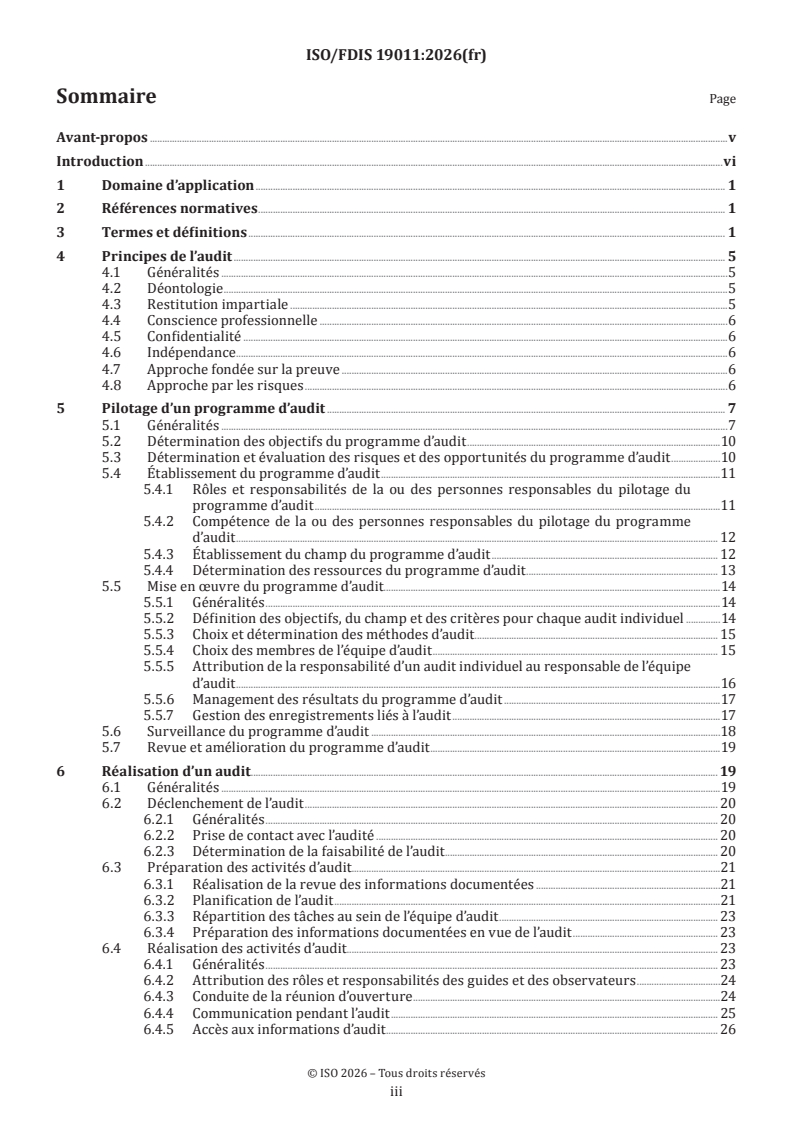
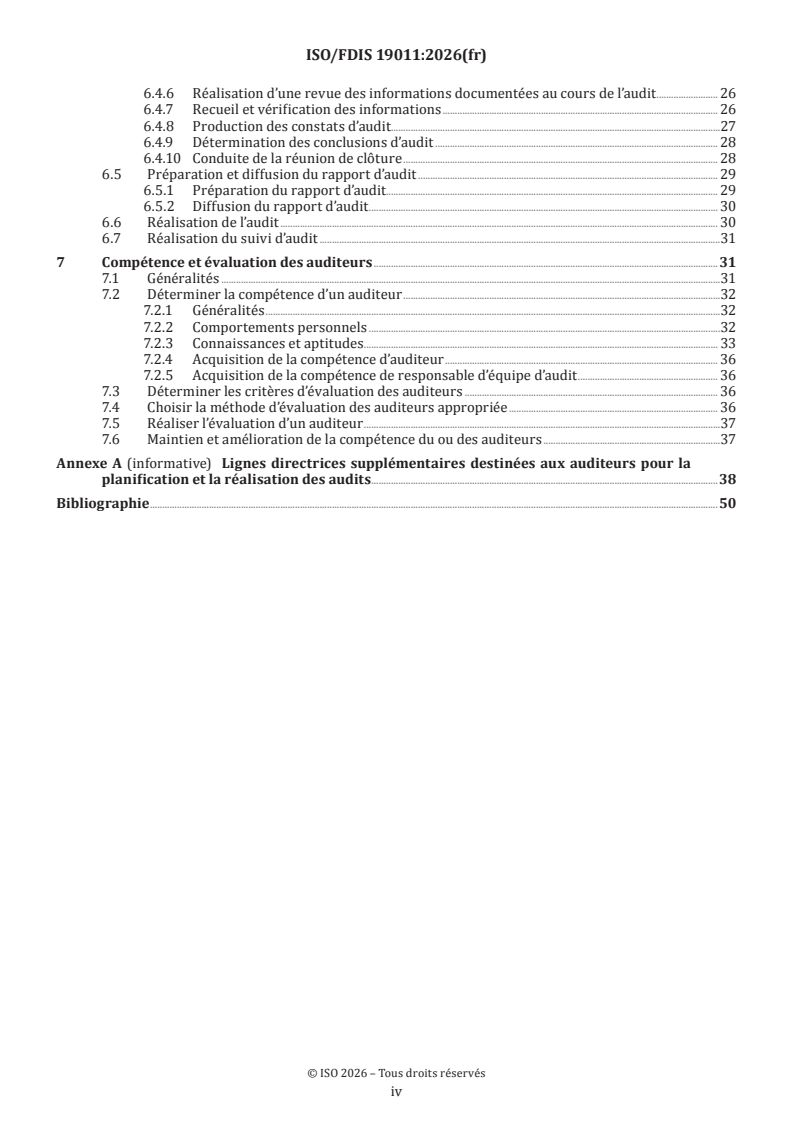
ISO/FDIS 19011 - Lignes directrices pour l’audit des systèmes de management
Get Certified
Connect with accredited certification bodies for this standard

BSI Group
BSI (British Standards Institution) is the business standards company that helps organizations make excellence a habit.

Bureau Veritas
Bureau Veritas is a world leader in laboratory testing, inspection and certification services.

DNV
DNV is an independent assurance and risk management provider.
Sponsored listings
Frequently Asked Questions
ISO/FDIS 19011 is a draft published by the International Organization for Standardization (ISO). Its full title is "Guidelines for auditing management systems". This standard covers: This document provides guidance on auditing management systems, including the principles of auditing, managing an audit programme and conducting management system audits, as well as guidance on the evaluation of competence of individuals involved in the audit process. These activities include the individual(s) managing the audit programme, auditors and audit teams. It is applicable to all organizations that need to plan and conduct internal or external audits of management systems or manage an audit programme. The application of this document to other types of audits is possible, provided that special consideration is given to the specific competence needed.
This document provides guidance on auditing management systems, including the principles of auditing, managing an audit programme and conducting management system audits, as well as guidance on the evaluation of competence of individuals involved in the audit process. These activities include the individual(s) managing the audit programme, auditors and audit teams. It is applicable to all organizations that need to plan and conduct internal or external audits of management systems or manage an audit programme. The application of this document to other types of audits is possible, provided that special consideration is given to the specific competence needed.
ISO/FDIS 19011 is classified under the following ICS (International Classification for Standards) categories: 03.120.20 - Product and company certification. Conformity assessment. The ICS classification helps identify the subject area and facilitates finding related standards.
ISO/FDIS 19011 has the following relationships with other standards: It is inter standard links to FprEN ISO 19011, ISO 9803-2:2020, ISO 19011:2018. Understanding these relationships helps ensure you are using the most current and applicable version of the standard.
ISO/FDIS 19011 is available in PDF format for immediate download after purchase. The document can be added to your cart and obtained through the secure checkout process. Digital delivery ensures instant access to the complete standard document.
Standards Content (Sample)
FINAL DRAFT
International
Standard
ISO/PC 302
Guidelines for auditing
Secretariat: ANSI
management systems
Voting begins on:
Lignes directrices pour l’audit des systèmes de management 2026-02-16
Voting terminates on:
2026-04-13
RECIPIENTS OF THIS DRAFT ARE INVITED TO SUBMIT,
WITH THEIR COMMENTS, NOTIFICATION OF ANY
RELEVANT PATENT RIGHTS OF WHICH THEY ARE AWARE
AND TO PROVIDE SUPPOR TING DOCUMENTATION.
IN ADDITION TO THEIR EVALUATION AS
BEING ACCEPTABLE FOR INDUSTRIAL, TECHNO
ISO/CEN PARALLEL PROCESSING LOGICAL, COMMERCIAL AND USER PURPOSES, DRAFT
INTERNATIONAL STANDARDS MAY ON OCCASION HAVE
TO BE CONSIDERED IN THE LIGHT OF THEIR POTENTIAL
TO BECOME STAN DARDS TO WHICH REFERENCE MAY BE
MADE IN NATIONAL REGULATIONS.
Reference number
FINAL DRAFT
International
Standard
ISO/PC 302
Guidelines for auditing
Secretariat: ANSI
management systems
Voting begins on:
Lignes directrices pour l’audit des systèmes de management
Voting terminates on:
RECIPIENTS OF THIS DRAFT ARE INVITED TO SUBMIT,
WITH THEIR COMMENTS, NOTIFICATION OF ANY
RELEVANT PATENT RIGHTS OF WHICH THEY ARE AWARE
AND TO PROVIDE SUPPOR TING DOCUMENTATION.
© ISO 2026
IN ADDITION TO THEIR EVALUATION AS
All rights reserved. Unless otherwise specified, or required in the context of its implementation, no part of this publication may
BEING ACCEPTABLE FOR INDUSTRIAL, TECHNO
ISO/CEN PARALLEL PROCESSING
LOGICAL, COMMERCIAL AND USER PURPOSES, DRAFT
be reproduced or utilized otherwise in any form or by any means, electronic or mechanical, including photocopying, or posting on
INTERNATIONAL STANDARDS MAY ON OCCASION HAVE
the internet or an intranet, without prior written permission. Permission can be requested from either ISO at the address below
TO BE CONSIDERED IN THE LIGHT OF THEIR POTENTIAL
or ISO’s member body in the country of the requester.
TO BECOME STAN DARDS TO WHICH REFERENCE MAY BE
MADE IN NATIONAL REGULATIONS.
ISO copyright office
CP 401 • Ch. de Blandonnet 8
CH-1214 Vernier, Geneva
Phone: +41 22 749 01 11
Email: copyright@iso.org
Website: www.iso.org
Published in Switzerland Reference number
ii
Contents Page
Foreword .v
Introduction .vi
1 Scope . 1
2 Normative references . 1
3 Terms and definitions . 1
4 Principles of auditing . 5
4.1 General .5
4.2 Integrity .5
4.3 Fair presentation .5
4.4 Due professional care .5
4.5 Confidentiality .6
4.6 Independence .6
4.7 Evidence-based approach .6
4.8 Risk-based approach .6
5 Managing an audit programme . 6
5.1 General .6
5.2 Establishing audit programme objectives .9
5.3 Determining and evaluating audit programme risks and opportunities .9
5.4 Establishing the audit programme .10
5.4.1 Roles and responsibilities of individual(s) managing the audit programme .10
5.4.2 Competence of individual(s) managing the audit programme .11
5.4.3 Establishing the scope of the audit programme .11
5.4.4 Determining audit programme resources . 12
5.5 Implementing the audit programme . 12
5.5.1 General . 12
5.5.2 Defining the objectives, scope and criteria for an individual audit . 13
5.5.3 Selecting and determining auditing methods .14
5.5.4 Selecting audit team members .14
5.5.5 Assigning responsibility for an individual audit to the audit team leader . 15
5.5.6 Managing audit programme results .16
5.5.7 Managing audit related records .16
5.6 Monitoring the audit programme .17
5.7 Reviewing and improving the audit programme.17
6 Conducting an audit .18
6.1 General .18
6.2 Initiating the audit .18
6.2.1 General .18
6.2.2 Establishing contact with the auditee .18
6.2.3 Determining the feasibility of the audit.19
6.3 Preparing auditing activities .19
6.3.1 Performing the review of documented information .19
6.3.2 Audit planning .19
6.3.3 Assigning work to the audit team .21
6.3.4 Preparing documented information for the audit .21
6.4 Conducting auditing activities .21
6.4.1 General .21
6.4.2 Assigning the roles and responsibilities of guides and observers .21
6.4.3 Conducting the opening meeting . 22
6.4.4 Communicating during the audit . 23
6.4.5 Providing access to audit information . 23
6.4.6 Reviewing documented information while conducting the audit . 23
6.4.7 Collecting and verifying information.24
6.4.8 Generating the audit findings . 25
iii
6.4.9 Determining the audit conclusions . 25
6.4.10 Conducting the closing meeting. 26
6.5 Preparing and distributing the audit report . .27
6.5.1 Preparing the audit report .27
6.5.2 Distributing the audit report .27
6.6 Completing the audit . 28
6.7 Conducting the audit follow-up . 28
7 Competence and evaluation of auditors .28
7.1 General . 28
7.2 Determining auditor competence . 29
7.2.1 General . 29
7.2.2 Personal behaviour . 29
7.2.3 Knowledge and skills . 30
7.2.4 Achieving auditor competence .32
7.2.5 Achieving audit team leader competence . 33
7.3 Establishing the auditor evaluation criteria . 33
7.4 Selecting the appropriate auditor evaluation method . 33
7.5 Conducting the auditor evaluation . 33
7.6 Maintaining and improving auditor competence . 34
Annex A (informative) Additional guidance for auditors for planning and conducting audits .35
Bibliography .46
iv
Foreword
ISO (the International Organization for Standardization) is a worldwide federation of national standards
bodies (ISO member bodies). The work of preparing International Standards is normally carried out through
ISO technical committees. Each member body interested in a subject for which a technical committee
has been established has the right to be represented on that committee. International organizations,
governmental and non-governmental, in liaison with ISO, also take part in the work. ISO collaborates closely
with the International Electrotechnical Commission (IEC) on all matters of electrotechnical standardization.
The procedures used to develop this document and those intended for its further maintenance are described
in the ISO/IEC Directives, Part 1. In particular, the different approval criteria needed for the different types
of ISO document should be noted. This document was drafted in accordance with the editorial rules of the
ISO/IEC Directives, Part 2 (see www.iso.org/directives).
ISO draws attention to the possibility that the implementation of this document may involve the use of (a)
patent(s). ISO takes no position concerning the evidence, validity or applicability of any claimed patent
rights in respect thereof. As of the date of publication of this document, ISO had not received notice of (a)
patent(s) which may be required to implement this document. However, implementers are cautioned that
this may not represent the latest information, which may be obtained from the patent database available at
www.iso.org/patents. ISO shall not be held responsible for identifying any or all such patent rights.
Any trade name used in this document is information given for the convenience of users and does not
constitute an endorsement.
For an explanation of the voluntary nature of standards, the meaning of ISO specific terms and expressions
related to conformity assessment, as well as information about ISO's adherence to the World Trade
Organization (WTO) principles in the Technical Barriers to Trade (TBT), see www.iso.org/iso/foreword.html.
This document was prepared by Project Committee ISO/PC 302, Guidelines for auditing management systems,
in collaboration with the European Committee for Standardization (CEN) Technical Committee CEN/CLC/
JTC 1, Criteria for conformity assessment bodies, in accordance with the Agreement on technical cooperation
between ISO and CEN (Vienna Agreement).
This fourth edition cancels and replaces the third edition (ISO 19011:2018), which has been technically
revised.
The main changes are as follows:
— expansion of guidance on remote auditing methods through the introduction of guidance contained in
ISO/IEC TS 17012;
— expansion of Annex A to provide guidance on remote auditing methods and virtual locations.
Any feedback or questions on this document should be directed to the user’s national standards body. A
complete listing of these bodies can be found at www.iso.org/members.html.
v
Introduction
Since the third edition of this document was published in 2018, several management system standards
have been published in new fields. Most of them have a common structure, identical core requirements,
and common terms and core definitions. As a result, there is a need to consider a broader approach to
management system auditing, as well as to provide guidance that is more generic.
This document provides guidance which can be applied to audit against a range of audit criteria (separately
or in combination) including, but not limited to:
— requirements specified in one or more management system standards;
— policies, processes and requirements specified by the organization or other relevant interested parties;
— statutory and regulatory requirements;
— one or more management system processes defined by the organization and/or other parties;
— management system plan(s) relating to the provision of specific results of a management system (e.g.
quality plan, project plan).
This document provides guidance for all organizations regardless of their size and type, and audits of varying
scopes. This includes those conducted by large audit teams, typically of larger organizations, and those by
single auditors, whether in large or small organizations. This guidance should be adapted as appropriate to
the scope, complexity of the audit programme.
This document concentrates on internal audits (first party) and audits conducted by organizations on
their external providers and other external interested parties (second party). This document can also be
useful for external audits conducted for purposes other than third-party management system certification.
ISO/IEC 17021-1 provides requirements for auditing management systems for third-party certification;
however, this document can provide useful additional guidance (see Table 1).
Table 1 — Different types of audits
First party Second party Third party
Internal audit External provider audit Certification audit or accreditation
assessment
Audit by the external interested party Statutory, regulatory and similar
of an organization audit
ISO/IEC TS 17012 addresses the growing need for remote auditing methods. Its aim is to provide guidance
on implementing remote auditing methods effectively while supporting the general principles of auditing as
outlined in this document.
To simplify the readability of this document, the singular form of “management system” is preferred, but the
reader can adapt the implementation of the guidance to their own situation. This also applies to the use of
“individual” and “individuals”, “auditor” and “auditors”.
This document is intended to apply to a broad range of potential users, including auditors, organizations
implementing management systems and organizations needing to conduct management system audits for
contractual or regulatory reasons. The guidance in this document can be applied to users in developing their
own audit-related requirements.
The guidance in this document can also be used for the purpose of self-declaration and can be useful to
organizations involved in the training, qualification and certification of persons participating in the audit
programme.
The guidance in this document is intended to be flexible. As indicated at various points in the text, the use
of this guidance can differ depending on the size and level of maturity of an organization’s management
system. The nature and complexity of the organization to be audited, as well as the objectives and scope of
the audits to be conducted, should also be considered.
vi
This document adopts the combined audit approach when two or more management systems of different
disciplines are audited together. Where these systems are integrated into a single management system,
the principles and processes of auditing are the same as for a combined audit (sometimes known as an
“integrated audit”).
vii
FINAL DRAFT International Standard ISO/FDIS 19011:2026(en)
Guidelines for auditing management systems
1 Scope
This document gives guidance on auditing management systems, including the principles of auditing,
managing an audit programme and conducting management system audits, as well as guidance on the
evaluation of competence of individuals involved in the audit process. These individuals include those
managing the audit programme, auditors and audit teams.
It is applicable to all organizations that need to plan and conduct audits of management systems or manage
an audit programme.
The application of this document to other types of audits is possible, provided that special consideration is
given to the specific competence needed and the objectives to be achieved.
2 Normative references
There are no normative references in this document.
3 Terms and definitions
For the purposes of this document, the following terms and definitions apply.
ISO and IEC maintain terminology databases for use in standardization at the following addresses:
— ISO Online browsing platform: available at https:// www .iso .org/ obp
— IEC Electropedia: available at https:// www .electropedia .org/
3.1
audit
systematic, independent and documented process (3.25) for obtaining objective evidence (3.9) and evaluating
it objectively to determine the extent to which the audit criteria (3.8) are fulfilled
Note 1 to entry: Internal audits, sometimes called first-party audits, are conducted by, or on behalf of, the organization
itself.
Note 2 to entry: External audits include those generally called second and third-party audits. Second-party audits are
conducted by parties having an interest in the organization, such as customers, or by other individuals on their behalf.
Third-party audits are conducted by independent auditing organizations, such as those providing certification/
registration of conformity (3.21) or governmental agencies and regulatory authorities.
1)
[SOURCE: ISO 9000:—, 3.12.1, modified — Notes to entry replaced.]
3.2
combined audit
audit (3.1) carried out together at a single auditee (3.14) on two or more management systems (3.19)
[SOURCE: ISO 9000:—, 3.12.2, modified — Note 1 to entry deleted.]
1) Under preparation. Stage at the time of publication: ISO/FDIS 9000:2026.
3.3
joint audit
audit (3.1) carried out at a single auditee (3.14) by two or more auditing organizations
[SOURCE: ISO 9000:—, 3.12.3]
3.4
remote auditing method
method used for conducting audit activities from any place other than the location of the auditee (3.14)
Note 1 to entry: Remote auditing methods can be used in combination with on-site methods to achieve a full and
effective audit (3.1).
Note 2 to entry: Remote auditing methods can be used for virtual locations, i.e. where an organization performs work
or provides a service using an online environment, enabling individuals to execute processes (3.25) irrespective of
physical locations.
Note 3 to entry: Remote auditing methods can be used by the auditor (3.16) at one site of the auditee to audit another
site.
[SOURCE: ISO/IEC TS 17012:2024, 3.1]
3.5
audit programme
arrangements for a set of one or more audits (3.1) planned for a specific time frame and directed towards a
specific purpose
3.6
audit scope
extent and boundaries of an audit (3.1)
Note 1 to entry: The audit scope generally includes a description of the physical and virtual locations (see 3.4, Note 2 to
entry), functions, organizational units, activities and processes (3.25), as well as the time period covered.
3.7
audit plan
description of the activities and arrangements for an audit (3.1)
3.8
audit criteria
set of requirements (3.24) used as a reference against which objective evidence (3.9) is compared
Note 1 to entry: If the audit criteria are legal (including statutory or regulatory) requirements, the words “compliance”
or “non-compliance” are often used in an audit finding (3.11).
Note 2 to entry: Requirements may include policies, procedures, work instructions, legal requirements, contractual
obligations, industry standards, etc.
3.9
objective evidence
data supporting the existence or verity of something
Note 1 to entry: Objective evidence can be obtained through observation, measurement, test or by other means.
[SOURCE: ISO 9000:—, 3.8.6, modified — Note 2 to entry deleted.]
3.10
audit evidence
records, statements of fact or other information, which are relevant to the audit criteria (3.8) and verifiable
3.11
audit finding
results of the evaluation of the collected audit evidence (3.10) against audit criteria (3.8)
Note 1 to entry: Audit findings indicate conformity (3.21) or nonconformity (3.22).
Note 2 to entry: Audit findings can lead to the identification of risks (3.20), opportunities for improvement or recording
good practices.
Note 3 to entry: If the audit criteria are selected from statutory requirements or regulatory requirements, the audit
finding is termed “compliance” or “non-compliance”.
3.12
audit conclusion
result of an audit (3.1), after consideration of the audit objectives and all audit findings (3.11)
3.13
audit client
organization or person requesting an audit (3.1)
Note 1 to entry: In the case of internal audit, the audit client can also be the auditee (3.14) or the individual(s) managing
the audit programme (3.5). Requests for external audit can come from sources such as regulatory authorities,
contracting parties, or potential or existing customers.
[SOURCE: ISO 9000:—, 3.12.4, modified — Note 1 to entry added.]
3.14
auditee
organization as a whole or parts thereof being audited
3.15
audit team
one or more persons conducting an audit (3.1), supported if needed by technical experts (3.17)
Note 1 to entry: One auditor (3.16) of the audit team is appointed as the audit team leader.
Note 2 to entry: The audit team can include auditors-in-training.
3.16
auditor
person who conducts an audit (3.1)
3.17
technical expert
person who provides specific knowledge or expertise to the audit team (3.15)
Note 1 to entry: Specific knowledge or expertise relates to the organization, the activity, process (3.25), product,
service, discipline to be audited, language or culture.
Note 2 to entry: A technical expert to the audit team does not act as an auditor (3.16).
3.18
observer
individual who accompanies the audit team (3.15) but does not act as an auditor (3.16) nor a technical expert
(3.17)
3.19
management system
set of interrelated or interacting elements of an organization to establish policies and objectives, and
processes (3.25) to achieve those objectives
Note 1 to entry: A management system can address a single discipline or several disciplines, e.g. quality management,
financial management or environmental management.
Note 2 to entry: The management system elements establish the organization’s structure, roles and responsibilities,
planning, operation, policies, practices, rules, beliefs, objectives and processes to achieve those objectives.
Note 3 to entry: The scope of a management system can include the whole of the organization, specific and identified
functions of the organization, specific and identified sections of the organization, or one or more functions across a
group of organizations.
[SOURCE: ISO 9000:—, 3.4.2, modified — Note 4 to entry has been deleted.]
3.20
risk
effect of uncertainty
Note 1 to entry: An effect is a deviation from the expected — positive or negative.
Note 2 to entry: Uncertainty is the state, even partial, of deficiency of information related to, understanding or
knowledge of, an event, its consequence, or likelihood.
Note 3 to entry: Risk is often characterized by reference to potential events and consequences, or a combination of
these.
Note 4 to entry: Risk is often expressed in terms of a combination of the consequences of an event (including changes
in circumstances) and the associated likelihood of occurrence.
[SOURCE: ISO 9000:—, 3.7.2, modified — Note 5 to entry deleted.]
3.21
conformity
fulfilment of a requirement (3.24)
[SOURCE: ISO 9000:—, 3.5.9]
3.22
nonconformity
non-fulfilment of a requirement (3.24)
[SOURCE: ISO 9000:—, 3.5.13]
3.23
competence
ability to apply knowledge and skills to achieve intended results
[SOURCE: ISO 9000:—, 3.10.6]
3.24
requirement
need or expectation that is stated, generally implied or obligatory
Note 1 to entry: “Generally implied” means that it is custom or common practice for the organization and interested
parties that the need or expectation under consideration is implied.
Note 2 to entry: A specified requirement is one that is stated, e.g. in documented information.
[SOURCE: ISO 9000:—, 3.5.1, modified — Notes 3, 4 and 5 to entry deleted.]
3.25
process
set of interrelated or interacting activities that use inputs to deliver an intended result
[SOURCE: ISO 9000:—, 3.3.1, modified — Notes to entry deleted.]
3.26
performance
measurable result
Note 1 to entry: Performance can relate either to quantitative or qualitative findings.
Note 2 to entry: Performance can relate to managing activities, processes (3.25), products, services, systems or
organizations.
[SOURCE: ISO 9000:—, 3.7.3]
3.27
effectiveness
extent to which planned activities are realized and planned results are achieved
[SOURCE: ISO 9000:—, 3.7.17]
4 Principles of auditing
4.1 General
Auditing is characterized by reliance on a number of principles. These principles should help to make the
audit an effective and reliable tool in support of management policies and controls, by providing information
on which an organization can act in order to improve its performance. Adherence to these principles is
fundamental to provide audit conclusions that are relevant and sufficient, and for enabling auditors, working
independently from one another, to reach similar conclusions in similar circumstances.
The guidance given in Clauses 5 to 7 is based on the seven principles outlined in 4.2 to 4.8.
4.2 Integrity
Integrity is the foundation of professionalism.
Auditors and the individual(s) managing an audit programme should:
a) perform their work ethically, with honesty and responsibility;
b) only undertake auditing activities if they are competent to do so;
c) perform their work in an impartial manner, i.e. remain fair and unbiased in all their dealings;
d) be sensitive to any influences that can be exerted on their judgement while carrying out an audit.
4.3 Fair presentation
Fair presentation is the obligation to report truthfully and accurately.
Audit findings, audit conclusions and audit reports should reflect truthfully and accurately the auditing
activities. Significant obstacles encountered during the audit and unresolved diverging opinions between the
audit team and the auditee should be reported. The communication should be truthful, accurate, objective,
timely, clear and complete.
4.4 Due professional care
Due professional care is the application of diligence and judgement in auditing.
Auditors should exercise due care irrespective of the importance of the task they perform, and the confidence
placed in them by the audit client and other interested parties. An important factor in carrying out their
work with due professional care is having the ability to make reasoned judgements in all audit situations.
4.5 Confidentiality
Confidentiality is security and privacy of information.
Auditors should exercise discretion in the use and protection of information acquired in the course of their
auditing activities. Audit information should not be used inappropriately for personal gain by the auditor or
the audit client, or in a manner detrimental to the legitimate interests of the auditee. This principle includes
the proper handling of sensitive or confidential information.
4.6 Independence
Independence is the basis for the impartiality of the audit and objectivity of the audit conclusions.
Auditors should be independent of the activity being audited wherever practicable and should in all cases act
in a manner that is free from bias and conflict of interest. Auditors should maintain objectivity throughout
the audit process to ensure that the audit findings and conclusions are based only on the audit evidence.
When it is not possible for internal auditors to be independent of the activity being audited, every effort
should be made to remove bias and encourage objectivity.
4.7 Evidence-based approach
Evidence-based approach is the rational method for reaching reliable and reproducible audit conclusions in
a systematic audit process.
Audit evidence should be verifiable. It should be based on samples of the information available, since an
audit is conducted during a specified duration and with finite resources. An appropriate use of sampling
should be applied, since this is closely related to the confidence that can be placed in the audit conclusions.
4.8 Risk-based approach
Risk-based approach is an audit approach that considers risks and opportunities.
The risk-based approach should substantively influence the planning and implementation of the audit
programme, and the planning, conducting and reporting of audits in order to ensure that audits are focused
on matters that are significant for the audit client, and for achieving the audit programme objectives.
5 Managing an audit programme
5.1 General
An audit programme should be established. It can include audits addressing one or more management
system standards or other requirements, conducted either separately or in combination (combined audit).
The extent of an audit programme should be based on the size and nature of the auditee, as well as on the
functionality, complexity, the type of risks and opportunities, the scope, and the level of maturity of the
management system(s) to be audited.
The functionality of the management system can be even more complex in the case of multiple locations or
when important functions are sourced externally.
Particular attention should be paid to where important decisions are made and to the design, planning and
review of the audit programme.
The audit programme should be scaled in accordance with the size and complexity of the organization.
In order to understand the context of the auditee, the audit programme should take into account the
organization’s:
— organizational objectives;
— relevant external and internal issues;
— needs and expectations of relevant interested parties;
— application of technology such as digital tools;
— information security and confidentiality requirements.
When allocating resources and methods to the audit programme, priority should be given to matters in the
management system with higher inherent risk and lower levels of performance.
Competent individuals should be assigned to manage the audit programme (see 5.4.2).
The audit programme should include information and identify resources to enable the audits to be conducted
effectively within the specified time frames. The information should include:
a) objectives for the audit programme (see 5.2);
b) risks and opportunities associated with the audit programme (see 5.3) and the actions to address them;
c) scope (extent, boundaries, locations) of each audit within the audit programme;
d) schedule (number/duration/frequency) of the audits;
e) audit types, such as internal or external;
f) audit criteria;
g) auditing methods to be employed, including remote auditing methods (see Clause A.16);
h) criteria for selecting the audit team (audit team leader, auditors and, if needed, technical experts);
i) criteria for participation of observers, where relevant;
j) the organization’s context based on external and internal issues;
k) relevant documented information.
Some of this information is not always available until more detailed audit planning is completed.
The implementation of the audit programme should be monitored and assessed on an ongoing basis (see 5.6)
to ensure its audit programme objectives have been achieved. The audit programme should be reviewed in
order to determine needs for changes and possible opportunities for improvements (see 5.7).
Figure 1 illustrates the process flow for the management of an audit programme.
NOTE 1 This figure illustrates the application of the Plan-Do-Check-Act cycle in this document.
NOTE 2 Clause/subclause numbering refers to the relevant clauses/subclauses of this document.
NOTE 3 Conducting the audit follow-up (see 6.7) is not always applicable, as illustrated by the dashed lines.
Figure 1 — Process flows for managing an audit programme and conducting an audit
5.2 Establishing audit programme objectives
The audit client should ensure that the audit programme objectives are established to direct the planning and
conducting of audits and should ensure the audit programme is implemented effectively. Audit programme
objectives should be consistent with the audit client’s strategic direction, its context, and support its
management system policies and objectives.
These objectives can be based on consideration of the following:
a) needs and expectations of relevant interested parties, both external and internal;
b) characteristics of and requirements for processes, products, services and projects, and any changes to
them;
c) management system requirements, including differing specific requirements covered during a combined
audit;
d) need for evaluation of organizations that are part of the supply chain;
e) auditee’s level of performance and level of maturity of the management system(s), as reflected in
relevant performance indicators, the occurrence of nonconformities or incidents or complaints from
interested parties;
f) identified risks and opportunities to the auditee;
g) results of previous audits.
Examples of audit programme objectives can include the following:
— identifying opportunities for the improvement of a management system and its performance;
— evaluating the capability of the auditee to determine its context;
— evaluating the capability of the auditee to determine risks and opportunities and to identify and
implement effective actions to address them;
— determining the conformance to all relevant requirements (e.g. statutory and regulatory requirements,
compliance commitments, requirements for certification to a management system standard);
— establishing the level of confidence in the capability of an organization in the supply chain;
— determining the continuing suitability, adequacy and effectiveness of the auditee’s management system;
— evaluating the compatibility and alignment of the management system objectives with the strategic
direction of the organization.
5.3 Determining and evaluating audit programme risks and opportunities
There are risks and opportunities related to the context of the auditee that can be associated with an
audit programme and can affect the achievement of its objectives. The individual(s) managing the audit
programme should identify risks and opportunities and present them to the audit client when developing
the audit programme and resource requirements, so that they can be addressed appropriately.
Risks can be associated with the following:
a) planning (e.g. failure to set relevant and appropriate audit objectives and determine the extent, number,
duration, locations and schedule of the audits);
b) resources (e.g. allowing insufficient time, equipment and/or training for developing the audit programme
or conducting an audit; lack of competent auditors; loss of auditors or availability of auditors);
c) selection of the audit team (e.g. insufficient overall competence to conduct audits effectively, lack of
independence and impartiality of the auditors);
d) selection of the audit method (e.g. on-site, remote, taking into account the capability of the selected
method to achieve the defined audit objective) (see Clause A.1, A.15 and A.16);
e) communication (e.g. ineffective communication processes/channels);
f) implementation (e.g. ineffective coordination of the audits within the audit programme, not conducting
the audits in accordance with the audit programme or not considering information security and
confidentiality);
g) control of documented information (e.g. ineffective determination of the necessary documented
information required by auditors and relevant intere
...
ISO/PC 302
Secretariat: ANSI
Date: 2025-12-112026-01-30
Guidelines for auditing management systems
Lignes directrices pour l’audit des systèmes de management
FDIS stage
TThhiis drs draafftt i is s susubbmmiitttteed d ttoo aa ppaarraallellel l vvoottee i inn IISSOO,, CCEEN.N.
All rights reserved. Unless otherwise specified, or required in the context of its implementation, no part of this publication
may be reproduced or utilized otherwise in any form or by any means, electronic or mechanical, including photocopying,
or posting on the internet or an intranet, without prior written permission. Permission can be requested from either ISO
at the address below or ISO’s member body in the country of the requester.
ISO copyright office
CP 401 • Ch. de Blandonnet 8
CH-1214 Vernier, Geneva
Phone: + 41 22 749 01 11
E-mail: copyright@iso.org
Website: www.iso.org
Published in Switzerland
ii
Contents
Foreword . iv
Introduction . v
1 Scope . 1
2 Normative references . 1
3 Terms and definitions . 1
4 Principles of auditing . 5
4.1 General . 5
4.2 Integrity . 5
4.3 Fair presentation . 6
4.4 Due professional care . 6
4.5 Confidentiality . 6
4.6 Independence . 6
4.7 Evidence-based approach . 6
4.8 Risk-based approach . 6
5 Managing an audit programme . 7
5.1 General . 7
5.2 Establishing audit programme objectives . 11
5.3 Determining and evaluating audit programme risks and opportunities . 11
5.4 Establishing the audit programme . 12
5.5 Implementing the audit programme . 15
5.6 Monitoring the audit programme . 20
5.7 Reviewing and improving the audit programme . 20
6 Conducting an audit . 21
6.1 General . 21
6.2 Initiating the audit . 21
6.3 Preparing auditing activities . 22
6.4 Conducting auditing activities . 25
6.5 Preparing and distributing the audit report . 31
6.6 Completing the audit . 32
6.7 Conducting the audit follow-up . 32
7 Competence and evaluation of auditors . 33
7.1 General . 33
7.2 Determining auditor competence . 33
7.3 Establishing the auditor evaluation criteria . 38
7.4 Selecting the appropriate auditor evaluation method . 38
7.5 Conducting the auditor evaluation . 39
7.6 Maintaining and improving auditor competence . 39
Annex A (informative) Additional guidance for auditors for planning and conducting audits . 40
Bibliography . 52
iii
Foreword
ISO (the International Organization for Standardization) is a worldwide federation of national standards
bodies (ISO member bodies). The work of preparing International Standards is normally carried out through
ISO technical committees. Each member body interested in a subject for which a technical committee has been
established has the right to be represented on that committee. International organizations, governmental and
non-governmental, in liaison with ISO, also take part in the work. ISO collaborates closely with the
International Electrotechnical Commission (IEC) on all matters of electrotechnical standardization.
The procedures used to develop this document and those intended for its further maintenance are described
in the ISO/IEC Directives, Part 1. In particular, the different approval criteria needed for the different types of
ISO document should be noted. This document was drafted in accordance with the editorial rules of the
ISO/IEC Directives, Part 2 (see www.iso.org/directives).
ISO draws attention to the possibility that the implementation of this document may involve the use of (a)
patent(s). ISO takes no position concerning the evidence, validity or applicability of any claimed patent rights
in respect thereof. As of the date of publication of this document, ISO had not received notice of (a) patent(s)
which may be required to implement this document. However, implementers are cautioned that this may not
represent the latest information, which may be obtained from the patent database available at
www.iso.org/patents. ISO shall not be held responsible for identifying any or all such patent rights.
Any trade name used in this document is information given for the convenience of users and does not
constitute an endorsement.
For an explanation of the voluntary nature of standards, the meaning of ISO specific terms and expressions
related to conformity assessment, as well as information about ISO's adherence to the World Trade
Organization (WTO) principles in the Technical Barriers to Trade (TBT), see www.iso.org/iso/foreword.html.
This document was prepared by Project Committee ISO/PC 302, Guidelines for auditing management systems,
in collaboration with the European Committee for Standardization (CEN) Technical Committee
CEN/CLC/JTC 1, Criteria for conformity assessment bodies, in accordance with the Agreement on technical
cooperation between ISO and CEN (Vienna Agreement).
This fourth edition cancels and replaces the third edition (ISO 19011:2018), which has been technically
revised.
The main changes are as follows:
— expansion of guidance on remote auditing methods through the introduction of guidance contained in
ISO/IEC TS 17012;
— expansion of Annex A to provide guidance on remote auditing methods and virtual locations.
Any feedback or questions on this document should be directed to the user’s national standards body. A
complete listing of these bodies can be found at www.iso.org/members.html.
iv
Introduction
Since the third edition of this document was published in 2018, several management system standards have
been published in new fields. Most of them have a common structure, identical core requirements, and
common terms and core definitions. As a result, there is a need to consider a broader approach to management
system auditing, as well as to provide guidance that is more generic.
This document provides guidance which can be applied to audit against a range of audit criteria (separately
or in combination) including, but not limited to:
— requirements specified in one or more management system standards;
— policies, processes and requirements specified by the organization or other relevant interested parties;
— statutory and regulatory requirements;
— Oneone or more management system processes defined by the organization and/or other parties;
— management system plan(s) relating to the provision of specific results of a management system (e.g.
quality plan, project plan).
This document provides guidance for all organizations regardless of their size and type, and audits of varying
scopes. This includes those conducted by large audit teams, typically of larger organizations, and those by
single auditors, whether in large or small organizations. This guidance should be adapted as appropriate to
the scope, complexity of the audit programme.
This document concentrates on internal audits (first party) and audits conducted by organizations on their
external providers and other external interested parties (second party). This document can also be useful for
external audits conducted for purposes other than third-party management system certification. ISO/IEC
17021-1 provides requirements for auditing management systems for third-party certification; however, this
document can provide useful additional guidance (see Table 1).
Table 1 — Different types of audits
First party Second party Third party
Internal audit External provider audit Certification audit or accreditation
assessment
Audit by the external interested Statutory, regulatory and similar
party of an organization audit
ISO/IEC TS 17012 addresses the growing need for remote auditing methods. Its aim is to provide guidance on
implementing remote auditing methods effectively while supporting the general principles of auditing as
outlined in this document.
To simplify the readability of this document, the singular form of “management system” is preferred, but the
reader can adapt the implementation of the guidance to their own situation. This also applies to the use of
“individual” and “individuals”, “auditor” and “auditors”.
This document is intended to apply to a broad range of potential users, including auditors, organizations
implementing management systems and organizations needing to conduct management system audits for
contractual or regulatory reasons. The guidance in this document can be applied to users in developing their
own audit-related requirements.
v
The guidance in this document can also be used for the purpose of self-declaration and can be useful to
organizations involved in the training, qualification and certification of persons participating in the audit
programme.
The guidance in this document is intended to be flexible. As indicated at various points in the text, the use of
this guidance can differ depending on the size and level of maturity of an organization’s management system.
The nature and complexity of the organization to be audited, as well as the objectives and scope of the audits
to be conducted, should also be considered.
This document adopts the combined audit approach when two or more management systems of different
disciplines are audited together. Where these systems are integrated into a single management system, the
principles and processes of auditing are the same as for a combined audit (sometimes known as an “integrated
audit”).
vi
Guidelines for auditing management systems
1 Scope
This document gives guidance on auditing management systems, including the principles of auditing,
managing an audit programme and conducting management system audits, as well as guidance on the
evaluation of competence of individuals involved in the audit process. These individuals include those
managing the audit programme, auditors and audit teams.
It is applicable to all organizations that need to plan and conduct audits of management systems or manage
an audit programme.
The application of this document to other types of audits is possible, provided that special consideration is
given to the specific competence needed and the objectives to be achieved.
2 Normative references
There are no normative references in this document.
3 Terms and definitions
For the purposes of this document, the following terms and definitions apply.
ISO and IEC maintain terminology databases for use in standardization at the following addresses:
— ISO Online browsing platform: available at https://www.iso.org/obp
— IEC Electropedia: available at https://www.electropedia.org/
3.1
audit
systematic, independent and documented process (3.25) for obtaining objective evidence (3.9) and evaluating
it objectively to determine the extent to which the audit criteria (3.8) are fulfilled
Note 1 to entry: Internal audits, sometimes called first-party audits, are conducted by, or on behalf of, the organization
itself.
Note 2 to entry: External audits include those generally called second and third-party audits. Second-party audits are
conducted by parties having an interest in the organization, such as customers, or by other individuals on their behalf.
Third-party audits are conducted by independent auditing organizations, such as those providing
certification/registration of conformity (3.21) or governmental agencies and regulatory authorities.
1 1)
[SOURCE: ISO 9000:2026, :—, 3.12.1.18, modified — Notes to entry replaced.]
3.2
combined audit
audit (3.1) carried out together at a single auditee (3.14) on two or more management systems (3.19)
[SOURCE: ISO 9000:2026,:—, 3.1312.2, modified — Note 1 to entry deleted.]
Under preparation.
1)
Under preparation. Stage at the time of publication: ISO/FDIS 9000:2026.
3.3
joint audit
audit (3.1) carried out at a single auditee (3.14) by two or more auditing organizations
[SOURCE: ISO 9000:2026,:—, 3.1312.3]
3.4
remote auditing method
method used for conducting audit activities from any place other than the location of the auditee (3.14)
Note 1 to entry: Remote auditing methods can be used in combination with on-site methods to achieve a full and effective
audit (3.1).
Note 2 to entry: Remote auditing methods can be used for virtual locations, i.e. where an organization performs work or
provides a service using an online environment, enabling individuals to execute processes (3.25) irrespective of physical
locations.
Note 3 to entry: Remote auditing methods can be used by the auditor (3.16) at one site of the auditee to audit another
site.
[SOURCE: ISO/IEC TS 17012:2024, 3.1]
3.5
audit programme
arrangements for a set of one or more audits (3.1) planned for a specific time frame and directed towards a
specific purpose
3.6
audit scope
extent and boundaries of an audit (3.1)
Note 1 to entry: The audit scope generally includes a description of the physical and virtual locations (see 3.4, Note 2 to
entry), functions, organizational units, activities and processes (3.25), as well as the time period covered.
3.7
audit plan
description of the activities and arrangements for an audit (3.1)
3.8
audit criteria
set of requirements (3.24) used as a reference against which objective evidence (3.9) is compared
Note 1 to entry: If the audit criteria are legal (including statutory or regulatory) requirements, the words “compliance”
or “non-compliance” are often used in an audit finding (3.11).
Note 2 to entry: Requirements may include policies, procedures, work instructions, legal requirements, contractual
obligations, industry standards, etc.
3.9
objective evidence
data supporting the existence or verity of something
Note 1 to entry: Objective evidence can be obtained through observation, measurement, test or by other means.
[SOURCE: ISO 9000:2026,:—, 3.98.6, modified — Note 2 to entry deleted.]
3.10
audit evidence
records, statements of fact or other information, which are relevant to the audit criteria (3.8) and verifiable
3.11
audit finding
results of the evaluation of the collected audit evidence (3.10) against audit criteria (3.8)
Note 1 to entry: Audit findings indicate conformity (3.21) or nonconformity (3.22).
Note 2 to entry: Audit findings can lead to the identification of risks (3.20), opportunities for improvement or recording
good practices.
Note 3 to entry: If the audit criteria are selected from statutory requirements or regulatory requirements, the audit
finding is termed “compliance” or “non-compliance.”.
3.12
audit conclusion
result of an audit (3.1), after consideration of the audit objectives and all audit findings (3.11)
3.13
audit client
organization or person requesting an audit (3.1)
Note 1 to entry: In the case of internal audit, the audit client can also be the auditee (3.14) or the individual(s) managing
the audit programme (3.5). Requests for external audit can come from sources such as regulatory authorities, contracting
parties, or potential or existing customers.
[SOURCE: ISO 9000:2026,:—, 3.1312.4, modified — Note 1 to entry added.]
3.14
auditee
organization as a whole or parts thereof being audited
3.15
audit team
one or more persons conducting an audit (3.1), supported if needed by technical experts (3.17)
Note 1 to entry: One auditor (3.16) of the audit team is appointed as the audit team leader.
Note 2 to entry: The audit team can include auditors-in-training.
3.16
auditor
person who conducts an audit (3.1)
3.17
technical expert
person who provides specific knowledge or expertise to the audit team (3.15)
Note 1 to entry: Specific knowledge or expertise relates to the organization, the activity, process (3.25), product, service,
discipline to be audited, language or culture.
Note 2 to entry: A technical expert to the audit team does not act as an auditor (3.16).
3.18
observer
individual who accompanies the audit team (3.15) but does not act as an auditor (3.16) nor a technical expert
(3.17)
3.19
management system
set of interrelated or interacting elements of an organization to establish policies and objectives, and processes
(3.25) to achieve those objectives
Note 1 to entry: A management system can address a single discipline or several disciplines, e.g. quality management,
financial management or environmental management.
Note 2 to entry: The management system elements establish the organization’s structure, roles and responsibilities,
planning, operation, policies, practices, rules, beliefs, objectives and processes (3.25) to achieve those objectives.
Note 3 to entry: The scope of a management system can include the whole of the organization, specific and identified
functions of the organization, specific and identified sections of the organization, or one or more functions across a group
of organizations.
[SOURCE: ISO 9000:2026,:—, 3.1.4.2, modified — Note 4 to entry has been deleted.]
3.20
risk
effect of uncertainty
Note 1 to entry: An effect is a deviation from the expected –— positive or negative.
Note 2 to entry: Uncertainty is the state, even partial, of deficiency of information related to, understanding or knowledge
of, an event, its consequence and, or likelihood.
Note 3 to entry: Risk is often characterized by reference to potential events and consequences, or a combination of these.
Note 4 to entry: Risk is often expressed in terms of a combination of the consequences of an event (including changes in
circumstances) and the associated likelihood of occurrence.
[SOURCE: ISO 9000:2026,:—, 3.1.7.2, modified — Note 5 to entry 5 deleted.]
3.21
conformity
fulfilment of a requirement (3.24)
[SOURCE: ISO 9000:2026, 3.1.15, modified — Note 1 to entry deleted.]:—, 3.5.9]
3.22
nonconformity
non-fulfilment of a requirement (3.24)
[SOURCE: ISO 9000:2026,:—, 3.1.165.13]
3.23
competence
ability to apply knowledge and skills to achieve intended results
[SOURCE: ISO 9000:2026,:—, 3.1.9, modified — Note 1 to entry deleted.]10.6]
3.24
requirement
need or expectation that is stated, generally implied or obligatory
Note 1 to entry: “Generally implied” means that it is custom or common practice for the organization and interested
parties that the need or expectation under consideration is implied.
Note 2 to entry: A specified requirement is one that is stated, e.g. in documented information.
[SOURCE: ISO 9000:2026,:—, 3.5.1.14, modified — Notes 3, 4 and 5 to entry deleted.]
3.25
process
set of interrelated or interacting activities that use inputs to deliver an intended result
[SOURCE: ISO 9000:2026,:—, 3.3.1.8, modified — Notes to entry deleted.]
3.26
performance
measurable result
Note 1 to entry: Performance can relate either to quantitative or qualitative findings.
Note 2 to entry: Performance can relate to the management ofmanaging activities, processes (3.25), products, services,
systems or organizations.
[SOURCE: ISO 9000:2026,:—, 3.1.11]7.3.27]
3.27
effectiveness
extent to which planned activities are realized and planned results are achieved
[SOURCE: ISO 9000:2026,:—, 3.1.137.17]
4 Principles of auditing
4.1 General
Auditing is characterized by reliance on a number of principles. These principles should help to make the audit
an effective and reliable tool in support of management policies and controls, by providing information on
which an organization can act in order to improve its performance. Adherence to these principles is
fundamental to provide audit conclusions that are relevant and sufficient, and for enabling auditors, working
independently from one another, to reach similar conclusions in similar circumstances.
The guidance given in Clauses 5 to 7 is based on the seven principles outlined in 4.2 to 4.8below.
4.2 Integrity
Integrity is the foundation of professionalism.
Auditors and the individual(s) managing an audit programme should:
a) 1) perform their work ethically, with honesty and responsibility;
b) 2) only undertake auditing activities if they are competent to do so;
c) 3) perform their work in an impartial manner, i.e. remain fair and unbiased in all their dealings;
d) 4) be sensitive to any influences that can be exerted on their judgement while carrying out an
audit.
4.3 Fair presentation
Fair presentation is the obligation to report truthfully and accurately.
Audit findings, audit conclusions and audit reports should reflect truthfully and accurately the auditing
activities. Significant obstacles encountered during the audit and unresolved diverging opinions between the
audit team and the auditee should be reported. The communication should be truthful, accurate, objective,
timely, clear and complete.
4.4 Due professional care
Due professional care is the application of diligence and judgement in auditing.
Auditors should exercise due care irrespective of the importance of the task they perform, and the confidence
placed in them by the audit client and other interested parties. An important factor in carrying out their work
with due professional care is having the ability to make reasoned judgements in all audit situations.
4.5 Confidentiality
Confidentiality is security and privacy of information.
Auditors should exercise discretion in the use and protection of information acquired in the course of their
auditing activities. Audit information should not be used inappropriately for personal gain by the auditor or
the audit client, or in a manner detrimental to the legitimate interests of the auditee. This principle includes
the proper handling of sensitive or confidential information.
4.6 Independence
Independence is the basis for the impartiality of the audit and objectivity of the audit conclusions.
Auditors should be independent of the activity being audited wherever practicable and should in all cases act
in a manner that is free from bias and conflict of interest. Auditors should maintain objectivity throughout the
audit process to ensure that the audit findings and conclusions are based only on the audit evidence.
When it is not possible for internal auditors to be independent of the activity being audited, every effort should
be made to remove bias and encourage objectivity.
4.7 Evidence-based approach
Evidence-based approach is the rational method for reaching reliable and reproducible audit conclusions in a
systematic audit process.
Audit evidence should be verifiable. It should be based on samples of the information available, since an audit
is conducted during a specified duration and with finite resources. An appropriate use of sampling should be
applied, since this is closely related to the confidence that can be placed in the audit conclusions.
4.8 Risk-based approach
Risk-based approach is an audit approach that considers risks and opportunities.
The risk-based approach should substantively influence the planning and implementation of the audit
programme, and the planning, conducting, and reporting of audits in order to ensure that audits are focused
on matters that are significant for the audit client, and for achieving the audit programme objectives.
5 Managing an audit programme
5.1 General
An audit programme should be established. It can include audits addressing one or more management system
standards or other requirements, conducted either separately or in combination (combined audit).
The extent of an audit programme should be based on the size and nature of the auditee, as well as on the
functionality, complexity, the type of risks and opportunities, the scope, and the level of maturity of the
management system(s) to be audited.
The functionality of the management system can be even more complex in the case of multiple locations or
when important functions are sourced externally.
Particular attention should be paid to where important decisions are made and to the design, planning and
review of the audit programme.
The audit programme should be scaled in accordance with the size and complexity of the organization.
In order to understand the context of the auditee, the audit programme should take into account the
organization’s:
— organizational objectives;
— relevant external and internal issues;
— needs and expectations of relevant interested parties;
— application of technology such as digital tools;
— information security and confidentiality requirements.
When allocating resources and methods to the audit programme, priority should be given to matters in the
management system with higher inherent risk and lower levels of performance.
Competent individuals should be assigned to manage the audit programme (see 5.4.2).
The audit programme should include information and identify resources to enable the audits to be conducted
effectively within the specified time frames. The information should include:
a) objectives for the audit programme (see 5.2);
b) risks and opportunities associated with the audit programme (see 5.3) and the actions to address them;
c) scope (extent, boundaries, locations) of each audit within the audit programme;
d) schedule (number/duration/frequency) of the audits;
e) audit types, such as internal or external;
f) audit criteria;
g) auditing methods to be employed, including remote auditing methods (see Clause A.16);
h) criteria for selecting the audit team (audit team leader, auditors and, if needed, technical experts);
i) criteria for participation of observers, where relevant;
j) the organization’s context based on external and internal issues;
k) relevant documented information.
Some of this information is not always available until more detailed audit planning is completed.
The implementation of the audit programme should be monitored and assessed on an ongoing basis (see 5.6)
to ensure its audit programme objectives have been achieved. The audit programme should be reviewed in
order to determine needs for changes and possible opportunities for improvements (see 5.7).
Figure 1 illustrates the process flow for the management of an audit programme.
NOTE 1 This figure illustrates the application of the Plan-Do-Check-Act cycle in this document.
NOTE 2 Clause/subclause numbering refers to the relevant clauses/subclauses of this document.
NOTE 3 Conducting the audit follow-up (see 6.7) is not always applicable, as illustrated by the dashed lines.
Figure 1 — Process flows for managing an audit programme and conducting an audit
5.2 Establishing audit programme objectives
The audit client should ensure that the audit programme objectives are established to direct the planning and
conducting of audits and should ensure the audit programme is implemented effectively. Audit programme
objectives should be consistent with the audit client’s strategic direction, its context, and support its
management system policies and objectives.
These objectives can be based on consideration of the following:
a) needs and expectations of relevant interested parties, both external and internal;
b) characteristics of and requirements for processes, products, services and projects, and any changes to
them;
c) management system requirements, including differing specific requirements covered during a combined
audit;
d) need for evaluation of organizations that are part of the supply chain;
e) auditee’s level of performance and level of maturity of the management system(s), as reflected in relevant
performance indicators, the occurrence of nonconformities or incidents or complaints from interested
parties;
f) identified risks and opportunities to the auditee;
g) results of previous audits.
Examples of audit programme objectives can include the following:
— identifying opportunities for the improvement of a management system and its performance;
— evaluating the capability of the auditee to determine its context;
— evaluating the capability of the auditee to determine risks and opportunities and to identify and implement
effective actions to address them;
— determining the conformance to all relevant requirements (e.g. statutory and regulatory requirements,
compliance commitments, requirements for certification to a management system standard);
— establishing the level of confidence in the capability of an organization in the supply chain;
— determining the continuing suitability, adequacy and effectiveness of the auditee’s management system;
— evaluating the compatibility and alignment of the management system objectives with the strategic
direction of the organization.
5.3 Determining and evaluating audit programme risks and opportunities
There are risks and opportunities related to the context of the auditee that can be associated with an audit
programme and can affect the achievement of its objectives. The individual(s) managing the audit programme
should identify risks and opportunities and present them to the audit client when developing the audit
programme and resource requirements, so that they can be addressed appropriately.
Risks can be associated with the following:
a) planning (e.g. failure to set relevant and appropriate audit objectives and determine the extent, number,
duration, locations and schedule of the audits);
b) resources (e.g. allowing insufficient time, equipment and/or training for developing the audit programme
or conducting an audit; lack of competent auditors; loss of auditors or availability of auditors);
c) selection of the audit team (e.g. insufficient overall competence to conduct audits effectively, lack of
independence and impartiality of the auditors);
d) selection of the audit method (e.g. on-site, remote, taking into account the capability of the selected
method to achieve the defined audit objective) (see Clause A.1, A.15 and A.16);
e) communication (e.g. ineffective communication processes/channels);
f) implementation (e.g. ineffective coordination of the audits within the audit programme, not conducting
the audits in accordance with the audit programme or not considering information security and
confidentiality);
g) control of documented information (e.g. ineffective determination of the necessary documented
information required by auditors and relevant interested parties, failure to adequately protect audit
records);
h) monitoring, reviewing and improving the audit programme (e.g. ineffective monitoring of audit
programme outcomes);
i) sponsorship (e.g. failure to engage leadership to enable an effective audit programme implementation);
j) availability and cooperation of the auditee and availability of evidence to be sampled;
k) security of information communication technology methods (e.g. ineffective or unsecured platform
selection).
Opportunities for improving the audit programme can include:
— allowing multiple audits to be conducted in a single visit;
— minimizing time and distances for the travel to locations;
— matching the audit team’s competence to the level required to achieve the audit objectives;
— selecting the audit method to be used to align with the capability and availability of information and
communication technologies.
5.4 Establishing the audit programme
5.4.1 Roles and responsibilities of individual(s) managing the audit programme
The individual(s) managing the audit programme should:
a) ensure that the integrity of the audit programme is maintained and that there is no undue influence
exerted over the audit programme;
b) establish the extent of the audit programme according to the relevant objectives (see 5.2) and any known
constraints;
c) determine the external and internal issues, and risks and opportunities that can affect the audit
programme, and implement actions to address them, integrating these actions in all relevant auditing
activities, as appropriate;
d) ensure the selection of audit teams and the overall competence for the auditing activities by assigning
roles, responsibilities and authorities, and supporting leadership, as appropriate;
e) establish all relevant processes including for:
1) the audit objectives, scope(s) and criteria of the audits, determination of auditing methods and
selection of the audit team;
2) the coordination and scheduling of all audits within the audit programme;
3) the evaluation of auditor(s) competence (see 7.2);
4) the external and internal communications, as appropriate;
5) the resolution of disputes and handling of complaints;
6) the audit follow-up, if applicable;
7) reporting to the audit client and relevant interested parties, as appropriate.;
f) determine and ensure provision of all necessary resources;
g) ensure that appropriate documented information is prepared and maintained, including audit
programme records;
h) monitor, review and improve the audit programme;
i) communicate the audit programme to the audit client and, as appropriate, relevant interested parties.
The individual(s) managing the audit programme should request its approval by the audit client.
5.4.2 Competence of individual(s) managing the audit programme
The individual(s) managing the audit programme should have the necessary competence to manage the
programme, effectively and efficiently, including knowledge of:
a) audit principles (see Clause 4), methods and processes (see Clauses A.1 and A.2);
b) management system standards, other relevant standards and reference/guidance documents;
c) information regarding the auditee and its context (e.g. external/internal issues, relevant interested
parties and their needs and expectations, business activities, products, services and processes of the
auditee);
d) applicable statutory and regulatory requirements and other requirements relevant to the business
activities of the auditee.
As appropriate, knowledge of risk management, project and process management, and information and
communications technology can be considered.
The individual(s) managing the audit programme should be engaged in appropriate continual professional
development activities to maintain the necessary competence to manage the audit programme.
5.4.3 Establishing the scope of the audit programme
The individual(s) managing the audit programme should determine the scope of the audit programme. This
can vary depending on the information provided by the audit client or the auditee regarding its context (see
5.3).
NOTE In certain cases, depending on the auditee’s structure or its activities, the audit programme only consists of a
single audit.
Other factors impacting the scope of an audit programme can include the following:
a) the objective, scope and duration of each audit and the number of audits to be conducted, reporting
method and, if applicable, audit follow up;
b) the management system standards;
c) the number, importance, complexity, similarity and locations of the activities to be audited;
d) factors influencing the effectiveness of the management system;
e) applicable audit criteria, such as planned arrangements for the relevant management system standards,
statutory and regulatory requirements and other requirements to which the organization is committed;
f) results of previous internal or external audits and management reviews, if appropriate;
g) results of a previous audit programme review;
h) language, cultural and social issues;
i) the concerns of interested parties, such as customer complaints, non-compliance with statutory and
regulatory requirements and other requirements to which the organization is committed, or supply chain
issues;
j) significant changes to the auditee’s context or its operations and related risks and opportunities;
k) availability of information and communication technologies (e.g. adequate network bandwidth, computer
and network hardware and software) to support auditing activities, in particular the use of remote
auditing methods (see Clause A.16);
l) the occurrence of external and internal events (e.g. nonconformities of products or services, or incidents
impacting information security, health and safety or the environment);
m) business risks and opportunities, including actions to address them.
5.4.4 Determining audit programme resources
When determining resources for the audit programme, the individual(s) managing the audit programme
should consider:
a) the financial and time resources necessary to develop, implement, manage and improve auditing
activities;
b) auditing methods (see Clause A.1);
c) the individual and overall availability of auditors and technical experts having competence appropriate
to the particular audit programme objectives (e.g.,. including interpreters);
d) the extent of the audit programme (see 5.4.3) and audit programme risks and opportunities (see 5.3);
e) travel time, travel cost, accommodation and other auditing needs;
f) the impact of different time zones and languages;
g) the availability of information and communication technologies (e.g. technical resources required to set
up an audit using technologies that support remote collaboration);
h) the availability of any tools, technology and equipment required;
i) the availability of necessary documented information, as determined during the establishment of the
audit programme (see Clause A.5);
j) requirements related to the facility, including any security clearances and equipment (e.g. background
checks, personal protective equipment, ability to wear industry appropriate attire).
5.5 Implementing the audit programme
5.5.1 General
Once the audit programme has been established (see 5.4.3) and related resources have been determined (see
5.4.4), the operational planning and the coordination of all the activities within the programme should be
implemented.
The individual(s) managing the audit programme should:
a) communicate the relevant parts of the audit programme, including the risks and opportunities involved,
to relevant interested parties and inform them periodically of its progress, using established external and
internal communication channels;
b) define objectives, scope and criteria for each individual audit;
...
PROJET FINAL
Norme
internationale
ISO/PC 302
Lignes directrices pour l’audit des
Secrétariat: ANSI
systèmes de management
Début de vote:
Guidelines for auditing management systems 2026-02-16
Vote clos le:
2026-04-13
LES DESTINATAIRES DU PRÉSENT PROJET SONT
INVITÉS À PRÉSENTER, AVEC LEURS OBSERVATIONS,
NOTIFICATION DES DROITS DE PROPRIÉTÉ DONT ILS
AURAIENT ÉVENTUELLEMENT CONNAISSANCE ET À
FOURNIR UNE DOCUMENTATION EXPLICATIVE.
OUTRE LE FAIT D’ÊTRE EXAMINÉS POUR
ÉTABLIR S’ILS SONT ACCEPTABLES À DES FINS
INDUSTRIELLES, TECHNOLOGIQUES ET COM-MERCIALES,
AINSI QUE DU POINT DE VUE DES UTILISATEURS, LES
PROJETS DE NORMES
TRAITEMENT PARALLÈLE ISO/CEN
INTERNATIONALES DOIVENT PARFOIS ÊTRE CONSIDÉRÉS
DU POINT DE VUE DE LEUR POSSI BILITÉ DE DEVENIR DES
NORMES POUVANT
SERVIR DE RÉFÉRENCE DANS LA RÉGLEMENTATION
NATIONALE.
Numéro de référence
PROJET FINAL
Norme
internationale
ISO/PC 302
Lignes directrices pour l’audit des
Secrétariat: ANSI
systèmes de management
Début de vote:
Guidelines for auditing management systems
2026-02-16
Vote clos le:
2026-04-13
LES DESTINATAIRES DU PRÉSENT PROJET SONT
INVITÉS À PRÉSENTER, AVEC LEURS OBSERVATIONS,
NOTIFICATION DES DROITS DE PROPRIÉTÉ DONT ILS
AURAIENT ÉVENTUELLEMENT CONNAISSANCE ET À
FOURNIR UNE DOCUMENTATION EXPLICATIVE.
DOCUMENT PROTÉGÉ PAR COPYRIGHT
OUTRE LE FAIT D’ÊTRE EXAMINÉS POUR
ÉTABLIR S’ILS SONT ACCEPTABLES À DES FINS
© ISO 2026 INDUSTRIELLES, TECHNOLOGIQUES ET COM-MERCIALES,
AINSI QUE DU POINT DE VUE DES UTILISATEURS, LES
Tous droits réservés. Sauf prescription différente ou nécessité dans le contexte de sa mise en œuvre, aucune partie de cette
PROJETS DE NORMES
TRAITEMENT PARALLÈLE ISO/CEN
INTERNATIONALES DOIVENT PARFOIS ÊTRE CONSIDÉRÉS
publication ne peut être reproduite ni utilisée sous quelque forme que ce soit et par aucun procédé, électronique ou mécanique,
DU POINT DE VUE DE LEUR POSSI BILITÉ DE DEVENIR DES
y compris la photocopie, ou la diffusion sur l’internet ou sur un intranet, sans autorisation écrite préalable. Une autorisation peut
NORMES POUVANT
être demandée à l’ISO à l’adresse ci-après ou au comité membre de l’ISO dans le pays du demandeur.
SERVIR DE RÉFÉRENCE DANS LA RÉGLEMENTATION
NATIONALE.
ISO copyright office
Case postale 401 • Ch. de Blandonnet 8
CH-1214 Vernier, Genève
Tél.: +41 22 749 01 11
E-mail: copyright@iso.org
Web: www.iso.org
Publié en Suisse Numéro de référence
ii
Sommaire Page
Avant-propos .v
Introduction .vi
1 Domaine d’application . 1
2 Références normatives . 1
3 Termes et définitions . 1
4 Principes de l’audit . 5
4.1 Généralités .5
4.2 Déontologie .5
4.3 Restitution impartiale .5
4.4 Conscience professionnelle .6
4.5 Confidentialité .6
4.6 Indépendance .6
4.7 Approche fondée sur la preuve .6
4.8 Approche par les risques .6
5 Pilotage d’un programme d’audit . 7
5.1 Généralités .7
5.2 Détermination des objectifs du programme d’audit .10
5.3 Détermination et évaluation des risques et des opportunités du programme d’audit .10
5.4 Établissement du programme d’audit .11
5.4.1 Rôles et responsabilités de la ou des personnes responsables du pilotage du
programme d’audit .11
5.4.2 Compétence de la ou des personnes responsables du pilotage du programme
d’audit . 12
5.4.3 Établissement du champ du programme d’audit . 12
5.4.4 Détermination des ressources du programme d’audit . 13
5.5 Mise en œuvre du programme d’audit.14
5.5.1 Généralités .14
5.5.2 Définition des objectifs, du champ et des critères pour chaque audit individuel .14
5.5.3 Choix et détermination des méthodes d’audit . 15
5.5.4 Choix des membres de l’équipe d’audit . 15
5.5.5 Attribution de la responsabilité d’un audit individuel au responsable de l’équipe
d’audit .16
5.5.6 Management des résultats du programme d’audit .17
5.5.7 Gestion des enregistrements liés à l’audit .17
5.6 Surveillance du programme d’audit .18
5.7 Revue et amélioration du programme d’audit .19
6 Réalisation d’un audit . 19
6.1 Généralités .19
6.2 Déclenchement de l’audit . 20
6.2.1 Généralités . 20
6.2.2 Prise de contact avec l’audité . 20
6.2.3 Détermination de la faisabilité de l’audit . 20
6.3 Préparation des activités d’audit.21
6.3.1 Réalisation de la revue des informations documentées .21
6.3.2 Planification de l’audit .21
6.3.3 Répartition des tâches au sein de l’équipe d’audit . 23
6.3.4 Préparation des informations documentées en vue de l’audit . 23
6.4 Réalisation des activités d’audit . . . 23
6.4.1 Généralités . 23
6.4.2 Attribution des rôles et responsabilités des guides et des observateurs .24
6.4.3 Conduite de la réunion d’ouverture .24
6.4.4 Communication pendant l’audit . 25
6.4.5 Accès aux informations d’audit . 26
iii
6.4.6 Réalisation d’une revue des informations documentées au cours de l’audit . 26
6.4.7 Recueil et vérification des informations . 26
6.4.8 Production des constats d’audit . .27
6.4.9 Détermination des conclusions d’audit . 28
6.4.10 Conduite de la réunion de clôture . 28
6.5 Préparation et diffusion du rapport d’audit . 29
6.5.1 Préparation du rapport d’audit. 29
6.5.2 Diffusion du rapport d’audit . 30
6.6 Réalisation de l’audit . 30
6.7 Réalisation du suivi d’audit .31
7 Compétence et évaluation des auditeurs .31
7.1 Généralités .31
7.2 Déterminer la compétence d’un auditeur .32
7.2.1 Généralités .32
7.2.2 Comportements personnels .32
7.2.3 Connaissances et aptitudes . . 33
7.2.4 Acquisition de la compétence d’auditeur . 36
7.2.5 Acquisition de la compétence de responsable d’équipe d’audit . 36
7.3 Déterminer les critères d’évaluation des auditeurs . 36
7.4 Choisir la méthode d’évaluation des auditeurs appropriée . 36
7.5 Réaliser l’évaluation d’un auditeur .37
7.6 Maintien et amélioration de la compétence du ou des auditeurs .37
Annexe A (informative) Lignes directrices supplémentaires destinées aux auditeurs pour la
planification et la réalisation des audits .38
Bibliographie .50
iv
Avant-propos
L’ISO (Organisation internationale de normalisation) est une fédération mondiale d’organismes nationaux
de normalisation (comités membres de l’ISO). L’élaboration des Normes internationales est en général
confiée aux comités techniques de l’ISO. Chaque comité membre intéressé par une étude a le droit de faire
partie du comité technique créé à cet effet. Les organisations internationales, gouvernementales et non
gouvernementales, en liaison avec l’ISO participent également aux travaux. L’ISO collabore étroitement avec
la Commission électrotechnique internationale (IEC) en ce qui concerne la normalisation électrotechnique.
Les procédures utilisées pour élaborer le présent document et celles destinées à sa mise à jour sont
décrites dans les Directives ISO/IEC, Partie 1. Il convient, en particulier, de prendre note des différents
critères d’approbation requis pour les différents types de documents ISO. Le présent document
a été rédigé conformément aux règles de rédaction données dans les Directives ISO/IEC, Partie 2
(voir www.iso.org/directives).
L’ISO attire l’attention sur le fait que la mise en application du présent document peut entraîner l’utilisation
d’un ou de plusieurs brevets. L’ISO ne prend pas position quant à la preuve, à la validité et à l’applicabilité
de tout droit de brevet revendiqué à cet égard. À la date de publication du présent document, l’ISO n’avait
pas reçu notification qu’un ou plusieurs brevets pouvaient être nécessaires à sa mise en application.
Toutefois, il y a lieu d’avertir les responsables de la mise en application du présent document que des
informations plus récentes sont susceptibles de figurer dans la base de données de brevets, disponible à
l’adresse www.iso.org/brevets. L’ISO ne saurait être tenue pour responsable de ne pas avoir identifié de tels
droits de propriété et averti de leur existence.
Les appellations commerciales éventuellement mentionnées dans le présent document sont données pour
information, par souci de commodité, à l’intention des utilisateurs et ne sauraient constituer un engagement.
Pour une explication de la nature volontaire des normes, la signification des termes et expressions
spécifiques de l’ISO liés à l’évaluation de la conformité, ou pour toute information au sujet de l’adhésion de
l’ISO aux principes de l’Organisation mondiale du commerce (OMC) concernant les obstacles techniques au
commerce (OTC), voir www.iso.org/iso/fr/avant-propos.html.
Le présent document a été élaboré par le comité de projet ISO/PC 302, Lignes directrices pour l’audit des
systèmes de management, en collaboration avec le comité technique CEN/CLC/JTC 1, Critères applicables
aux organismes d’évaluation de la conformité, du Comité européen de normalisation (CEN), conformément à
l’Accord de coopération technique entre l’ISO et le CEN (Accord de Vienne).
Cette quatrième édition annule et remplace la troisième édition (ISO 19011:2018), qui a fait l’objet d’une
révision technique.
Les principales modifications sont les suivantes:
— développement de lignes directrices relatives aux méthodes d’audit à distance par l’introduction des
lignes directrices de l’ISO/IEC TS 17012;
— développement de l’Annexe A afin de fournir des lignes directrices relatives aux méthodes d’audit à
distance et aux sites virtuels.
Il convient que l’utilisateur adresse tout retour d’information ou toute question concernant le présent
document à l’organisme national de normalisation de son pays. Une liste exhaustive desdits organismes se
trouve à l’adresse www.iso.org/fr/members.html.
v
Introduction
Depuis que la troisième édition du présent document a été publiée en 2018, plusieurs normes de systèmes
de management ont été publiées dans de nouveaux domaines. La plupart d’entre elles ont une structure
commune, des exigences fondamentales identiques et des termes et définitions communs. De ce fait, il est
nécessaire d’envisager une approche plus globale de l’audit des systèmes de management et de fournir des
lignes directrices plus génériques.
Le présent document fournit des lignes directrices qui peuvent être appliquées à l’audit par rapport à une
série de critères d’audit (séparément ou en combinaison) comprenant, sans toutefois s’y limiter:
— les exigences spécifiées dans une ou plusieurs normes de systèmes de management;
— les politiques, les processus et les exigences spécifiés par l’organisme ou toute autre partie intéressée
pertinente;
— les exigences légales et réglementaires;
— un ou plusieurs processus du système de management définis par l’organisme et/ou d’autres parties;
— Un ou plusieurs plans de système de management se rapportant à la fourniture d’éléments de sortie
spécifiques d’un système de management (par exemple plan qualité, plan de projet).
Le présent document fournit des lignes directrices à l’attention de tous les organismes, quels que soient leur
taille et leur type, et pour des audits de champs variables. Cela inclut ceux réalisés par de grandes équipes
d’audit, généralement dans de grands organismes, et ceux réalisés par des auditeurs uniques, dans de grands
ou petits organismes. Il convient, selon le cas, d’adapter ces lignes directrices au champ et à la complexité du
programme d’audit.
Le présent document se concentre sur les audits internes (première partie) et les audits réalisés par des
organismes auprès de leurs prestataires externes et d’autres parties intéressées externes (seconde
partie). Le présent document peut également être utile pour des audits externes réalisés à d’autres fins
que la certification par tierce partie d’un système de management. L’ISO/IEC 17021-1 fournit des exigences
relatives à l’audit des systèmes de management en vue d’une certification par tierce partie; toutefois, le
présent document peut fournir des lignes directrices supplémentaires utiles (voir Tableau 1).
Tableau 1 — Différents types d’audits
Première partie Seconde partie Tierce partie
Audit interne Audit des prestataires externes Audit de certification ou évaluation
d’accréditation
Audit par la partie intéressée externe Audit à des fins légales, réglemen-
d’un organisme taires et similaires
L’ISO/IEC TS 17012 répond au besoin croissant de méthodes d’audit à distance. Son objectif est de fournir
des lignes directrices sur la mise en œuvre efficace de méthodes d’audit à distance tout en soutenant les
principes généraux d’audit décrits dans le présent document.
Pour simplifier la lisibilité du présent document, la forme singulière de “système de management” est
préférable. Le lecteur peut toutefois adapter la mise en œuvre des lignes directrices à sa propre situation
particulière. Cela s’applique également à l’utilisation de “personne” et “personnes”, “auditeur” et “auditeurs”.
Le présent document est destiné à une large gamme d’utilisateurs potentiels parmi lesquels des auditeurs,
des organismes mettant en œuvre des systèmes de management et des organismes devant réaliser des
audits de systèmes de management dans un cadre contractuel ou réglementaire. Les lignes directrices du
présent document peuvent être appliquées aux utilisateurs lors de l’élaboration de leurs propres exigences
en matière d’audit.
vi
Les lignes directrices fournies dans le présent document peuvent également être utilisées à des fins
d’autodéclaration et peuvent par ailleurs se révéler utiles aux organismes impliqués dans la formation, la
qualification et la certification de personnes participant au programme d’audit.
Les lignes directrices fournies dans le présent document se veulent flexibles. Comme indiqué à différentes
reprises dans le texte, l’utilisation de ces lignes directrices peut varier selon la taille et le niveau de maturité
du système de management de l’organisme. Il convient également de prendre en considération la nature et la
complexité de l’organisme à auditer, ainsi que les objectifs et le champ des audits à réaliser.
Le présent document adopte le principe d’audit combiné lorsque deux ou plusieurs systèmes de management
de disciplines différentes sont audités ensemble. Les principes et les processus d’audit sont identiques à ceux
applicables à un audit combiné (parfois appelé “audit intégré”) lorsque les systèmes définis sont intégrés
dans un système de management unique.
vii
PROJET FINAL Norme internationale ISO/FDIS 19011:2026(fr)
Lignes directrices pour l’audit des systèmes de management
1 Domaine d’application
Le présent document donne des lignes directrices sur l’audit de systèmes de management, comprenant les
principes de l’audit, le pilotage d’un programme d’audit et la réalisation d’audits de systèmes de management.
Il donne également des lignes directrices sur l’évaluation de la compétence des personnes impliquées dans le
processus d’audit. Ces personnes incluent les responsables du pilotage du programme d’audit, les auditeurs
et les équipes d’audit.
Il est applicable à tous les organismes qui doivent planifier et réaliser des audits de systèmes de management
ou piloter un programme d’audit.
Le présent document peut, en principe, s’appliquer à d’autres types d’audits, à condition toutefois d’accorder
une attention toute particulière aux compétences spécifiques requises et aux objectifs à atteindre.
2 Références normatives
Le présent document ne contient aucune référence normative.
3 Termes et définitions
Pour les besoins du présent document, les termes et définitions suivants s’appliquent.
L’ISO et l’IEC tiennent à jour des bases de données terminologiques destinées à être utilisées en normalisation,
consultables aux adresses suivantes:
— ISO Online browsing platform: disponible à l’adresse https:// www .iso .org/ obp
— IEC Electropedia: disponible à l’adresse https:// www .electropedia .org/
3.1
audit
processus (3.25) méthodique, indépendant et documenté, permettant d’obtenir des preuves objectives (3.9)
et de les évaluer de manière objective pour déterminer dans quelle mesure les critères d’audit (3.8) sont
satisfaits
Note 1 à l'article: Les audits internes, parfois appelés audits première partie, sont réalisés par ou pour le compte de
l’organisme lui-même.
Note 2 à l'article: Les audits externes comprennent les audits appelés généralement audits seconde et tierce partie.
Les audits seconde partie sont réalisés par des parties ayant un intérêt à l’égard de l’organisme, comme les clients ou
d’autres personnes agissant en leur nom. Les audits tierce partie sont réalisés par des organismes d’audit externes et
indépendants, tels que ceux qui délivrent l’enregistrement ou la certification de conformité (3.21) ou des organismes
publics et des autorités de réglementation.
1)
[SOURCE: ISO 9000 :—, 3.12.1, modifié — Les notes à l’article ont été remplacées.]
1) En cours d'élaboration. Stade au moment de la publication: ISO/FDIS 9000:2026.
3.2
audit combiné
audit (3.1) réalisé simultanément auprès d’un seul audité (3.14) sur deux systèmes de management (3.19) ou
plus
[SOURCE: ISO 9000:—, 3.12.2, modifié — La Note 1 à l’article a été supprimée.]
3.3
audit conjoint
audit (3.1) réalisé auprès d’un seul audité (3.14) par deux organismes d’audit ou plus
[SOURCE: ISO 9000:—, 3.12.3]
3.4
méthode d’audit à distance
méthode utilisée pour mener des activités d’audit à partir de n’importe quel endroit autre que le site de
l’audité (3.14)
Note 1 à l'article: Les méthodes d’audit à distance peuvent être utilisées conjointement avec des méthodes sur site
pour réaliser un audit (3.1) complet et efficace.
Note 2 à l'article: Les méthodes d’audit à distance peuvent être utilisées pour des lieux virtuels, c’est-à-dire là où un
organisme réalise un travail ou fournit un service en utilisant un environnement en ligne, permettant à des personnes
d’exécuter les processus (3.25), quel que soit le lieu physique.
Note 3 à l'article: Les méthodes d’audit à distance peuvent être utilisées par l’auditeur (3.16) sur un site de l’audité pour
auditer un autre site.
[SOURCE: ISO/IEC TS 17012:2024, 3.1]
3.5
programme d’audit
dispositions relatives à un ensemble d’un ou plusieurs audits (3.1) planifié pour une durée spécifique et
dirigé dans un but spécifique
3.6
champ de l’audit
étendue et limites d’un audit (3.1)
Note 1 à l'article: Le champ de l’audit décrit généralement les sites physiques et virtuels (voir 3.4, Note 2 à l’article), les
fonctions, les unités organisationnelles, les activités et les processus (3.25) ainsi que la période couverte.
3.7
plan d’audit
description des activités et des dispositions nécessaires pour réaliser un audit (3.1)
3.8
critères d’audit
ensemble d’exigences (3.24) utilisées comme référence vis-à-vis de laquelle les preuves objectives (3.9) sont
comparées
Note 1 à l'article: Si les critères d’audit sont des exigences légales (y compris statutaires ou réglementaires), les termes
“obligation de conformité” et “obligation de non-conformité” sont souvent utilisés dans un constat d’audit (3.11).
Note 2 à l'article: Les exigences peuvent comprendre des politiques, des procédures, des instructions de travail, des
exigences légales, des obligations contractuelles, des normes sectorielles, etc.
3.9
preuves objectives
données démontrant l’existence ou la véracité de quelque chose
Note 1 à l'article: Les preuves objectives peuvent être obtenues par observation, mesure, essai ou par un autre moyen.
[SOURCE: ISO 9000:—, 3.8.6, modifié — La Note 2 à l’article a été supprimée.]
3.10
preuves d’audit
enregistrements, énoncés de faits ou autres informations pertinents pour les critères d’audit (3.8)
et vérifiables
3.11
constat d’audit
résultats de l’évaluation des preuves d’audit (3.10) recueillies, par rapport aux critères d’audit (3.8)
Note 1 à l'article: Les constats d’audit indiquent la conformité (3.21) ou la non-conformité (3.22).
Note 2 à l'article: Les constats d’audit peuvent conduire à l’identification des risques (3.20), des opportunités
d’amélioration ou à la consignation des bonnes pratiques.
Note 3 à l'article: Si les critères d’audit sont choisis parmi les exigences légales ou les exigences réglementaires, le
constat d’audit est appelé “obligation de conformité” ou “obligation de non-conformité”.
3.12
conclusion d’audit
résultat d’un audit (3.1), après avoir pris en considération les objectifs de l’audit et tous les constats d’audit
(3.11)
3.13
client de l’audit
organisme ou personne demandant un audit (3.1)
Note 1 à l'article: Dans le cas d’un audit interne, le client de l’audit peut également être l’audité (3.14) ou la ou les
personnes responsables du pilotage du programme d’audit (3.5). Les demandes d’audit externe peuvent provenir de
sources telles que des autorités de réglementation, des parties contractantes ou des clients potentiels ou existants.
[SOURCE: ISO 9000:—, 3.12.4, modifié — La Note 1 à l’article a été ajoutée.]
3.14
audité
organisme dans son ensemble ou parties de celui-ci qui sont audités
3.15
équipe d’audit
une ou plusieurs personnes réalisant un audit (3.1), assistées, si nécessaire, par des experts techniques (3.17)
Note 1 à l'article: Un auditeur (3.16) de l’équipe d’audit est nommé responsable de l’équipe d’audit.
Note 2 à l'article: L’équipe d’audit peut comprendre des auditeurs en formation.
3.16
auditeur
personne qui réalise un audit (3.1)
3.17
expert technique
personne apportant à l’équipe d’audit (3.15) des connaissances ou une expertise spécifiques
Note 1 à l'article: Ces connaissances ou cette expertise spécifiques se rapportent à l’organisme, à l’activité, au processus
(3.25) au produit, au service, au domaine à auditer, à la langue ou à la culture.
Note 2 à l'article: Au sein de l’équipe d’audit, un expert technique n’agit pas en tant qu’auditeur (3.16).
3.18
observateur
personne qui accompagne l’équipe d’audit (3.15), mais qui n’agit pas en tant qu’auditeur (3.16) ni expert
technique (3.17)
3.19
système de management
ensemble d’éléments corrélés ou en interaction d’un organisme, utilisés pour établir des politiques, des
objectifs et des processus (3.25) de façon à atteindre lesdits objectifs
Note 1 à l'article: Un système de management peut traiter d’un seul ou de plusieurs domaines, par exemple management
de la qualité, gestion financière ou management environnemental.
Note 2 à l'article: Les éléments du système de management comprennent la structure, les rôles et responsabilités, la
planification, le fonctionnement de l’organisme, les politiques, les pratiques, les règles, les convictions, les objectifs et
les processus permettant d’atteindre ces objectifs.
Note 3 à l'article: Le périmètre d’un système de management peut comprendre l’ensemble de l’organisme, des fonctions
ou des sections spécifiques et identifiées de l’organisme, ou une ou plusieurs fonctions dans un groupe d’organismes.
[SOURCE: ISO 9000:—, 3.4.2, modifié — La Note 4 à l’article a été supprimée.]
3.20
risque
effet de l’incertitude
Note 1 à l'article: Un effet est un écart, positif ou négatif, par rapport à une attente.
Note 2 à l'article: L’incertitude est l’état, même partiel, de manque d’information qui entrave la compréhension ou la
connaissance d’un événement, de ses conséquences ou de sa vraisemblance.
Note 3 à l'article: Un risque est souvent caractérisé par référence à des événements potentiels et à des conséquences
également potentielles, ou par référence à une combinaison des deux.
Note 4 à l'article: Un risque est souvent exprimé en termes de combinaison des conséquences d’un événement (y
compris des changements de circonstances) et de la vraisemblance de son occurrence.
[SOURCE: ISO 9000:—, 3.7.2, modifié — La Note 5 à l’article a été supprimée.]
3.21
conformité
satisfaction d’une exigence (3.24)
[SOURCE: ISO 9000:—, 3.5.9]
3.22
non-conformité
non-satisfaction d’une exigence (3.24)
[SOURCE: ISO 9000:—, 3.5.13]
3.23
compétence
aptitude à mettre en pratique des connaissances et des savoir-faire pour obtenir les résultats attendus
[SOURCE: ISO 9000:—, 3.10.6]
3.24
exigence
besoin ou attente formulé, généralement implicite ou obligatoire
Note 1 à l'article: “Généralement implicite” signifie qu’il est habituel ou courant, pour l’organisme et les parties
intéressées, que le besoin ou l’attente en question soit implicite.
Note 2 à l'article: Une exigence spécifiée est une exigence formulée, par exemple une information documentée.
[SOURCE: ISO 9000:—, 3.5.1, modifié — Les Notes 3, 4 et 5 à l’article ont été supprimées.]
3.25
processus
ensemble d’activités corrélées ou en interaction qui utilise des éléments d’entrée pour produire un résultat
attendu
[SOURCE: ISO 9000:—, 3.3.1, modifié — Les notes à l’article ont été supprimées.]
3.26
performance
résultat mesurable
Note 1 à l'article: Les performances peuvent être liées à des résultats quantitatifs ou qualitatifs.
Note 2 à l'article: Les performances peuvent concerner la gestion d’activités, de processus (3.25), de produits, de
services, de systèmes ou d’organismes.
[SOURCE: ISO 9000:—, 3.7.3]
3.27
efficacité
niveau de réalisation des activités planifiées et d’obtention des résultats attendus
[SOURCE: ISO 9000:—, 3.7.17]
4 Principes de l’audit
4.1 Généralités
L’audit est caractérisé par le respect d’un certain nombre de principes. Il convient que ces principes fassent
de l’audit un outil efficace et fiable sur lequel la direction peut s’appuyer pour gérer ses politiques et mesures
de maîtrise en fournissant des informations à partir desquelles l’organisme peut agir pour améliorer ses
performances. Le respect de ces principes est fondamental pour fournir des conclusions d’audit qui soient
pertinentes et suffisantes, et pour que des auditeurs travaillant indépendamment les uns des autres
parviennent à des conclusions similaires dans des circonstances similaires.
Les lignes directrices données dans l’Article 5 à l’Article 7 sont fondées sur les sept principes décrits
dans l’Article 4.2 à l’Article 4.8.
4.2 Déontologie
La déontologie est le fondement du professionnalisme.
Il convient que les auditeurs et la ou les personnes responsables du pilotage du programme d’audit:
a) réalisent leurs tâches de manière éthique, avec honnêteté et responsabilité;
b) réalisent des activités d’audit uniquement s’ils ont les compétences requises;
c) réalisent leurs tâches en toute impartialité, c’est-à-dire qu’ils restent justes et sans parti pris dans toutes
leurs actions;
d) soient sensibilisés à toutes les influences que peuvent exercer d’autres parties intéressées sur leur
jugement pendant la réalisation d’un audit.
4.3 Restitution impartiale
La restitution impartiale est l’obligation de rendre compte de manière sincère et précise.
Il convient que les constats d’audit, conclusions d’audit et rapports d’audit reflètent de manière sincère et
précise les activités d’audit. Il convient de consigner les obstacles importants rencontrés pendant l’audit et
les divergences d’opinions non résolues entre l’équipe d’audit et l’audité. Il convient que la communication
soit sincère, précise, objective, opportune, claire et complète.
4.4 Conscience professionnelle
La conscience professionnelle est l’attitude diligente et avisée au cours de l’audit.
Il convient que les auditeurs agissent indépendamment de l’importance des tâches qu’ils réalisent et la
confiance que leur ont accordée le client de l’audit et les autres parties intéressées. La qualité essentielle
pour réaliser leurs tâches avec conscience professionnelle réside dans la capacité de prendre des décisions
avisées dans toutes les situations d’audit.
4.5 Confidentialité
La confidentialité est la sécurité et la confidentialité des informations.
Il convient que les auditeurs utilisent avec précaution les informations acquises au cours de leurs missions.
Il convient que les informations d’audit ne soient pas utilisées de manière inappropriée au seul bénéfice
de l’auditeur ou du client de l’audit ou de manière qui pourrait porter préjudice aux intérêts légitimes de
l’audité. Ce concept comprend le traitement correct des informations sensibles ou confidentielles.
4.6 Indépendance
L’indépendance est le fondement de l’impartialité de l’audit et de l’objectivité des conclusions d’audit.
Il convient que les auditeurs soient indépendants de l’activité auditée dans la mesure du possible et agissent
dans tous les cas d’une manière dénuée de parti pris et de conflits d’intérêts. Il convient que les auditeurs
conservent un état d’esprit objectif tout au long du processus d’audit pour s’assurer que les constats d’audit
et conclusions d’audit sont uniquement fondés sur les preuves d’audit.
Lorsqu’il est impossible pour les auditeurs internes d’être indépendants de l’activité auditée, il convient de
s’efforcer d’établir des relations sans parti pris et de créer un climat d’objectivité.
4.7 Approche fondée sur la preuve
L’approche fondée sur la preuve est la méthode rationnelle pour parvenir à des conclusions d’audit fiables et
reproductibles dans un processus d’audit systématique.
Il convient que les preuves d’audit soient vérifiables. Il convient qu’elles s’appuient sur des échantillons des
informations disponibles, dans la mesure où un audit est réalisé pendant une durée spécifiée et avec des
ressources délimitées. Il convient d’utiliser l’échantillonnage de manière appropriée, dans la mesure où
cette utilisation est étroitement liée à la confiance qui peut être accordée aux conclusions d’audit.
4.8 Approche par les risques
L’approche par les risques est l’approche d’audit prenant en considération les risques et les opportunités.
Il convient que l’approche par les risques ait une influence substantielle sur la planification et la mise en
œuvre du programme d’audit, et la planification, la réalisation et le compte rendu des audits afin de s’assurer
que les audits soient axés sur les questions importantes pour le client de l’audit et de réaliser les objectifs du
programme d’audit.
5 Pilotage d’un programme d’audit
5.1 Généralités
Il convient d’établir un programme d’audit. Il peut inclure des audits prenant en compte une ou plusieurs
normes de systèmes de management ou d’autres exigences, réalisés de manière individuelle ou combinée
(audit combiné).
Il convient que l’étendue d’un programme d’audit tienne compte de la taille et de la nature de l’audité, ainsi
que de la fonctionnalité, de la complexité, du type de risques et opportunités, du périmètre et du niveau de
maturité du ou des systèmes de management à auditer.
La fonctionnalité du système de management peut être encore plus complexe dans le cas de sites multiples
ou lorsque des fonctions importantes sont externalisées.
Il convient de porter une attention particulière lorsque des décisions importantes sont prises ainsi qu’à la
conception, à la planification et à la revue du programme d’audit.
Il convient que le programme d’audit soit adapté à la taille et la complexité de l’organisme.
Pour comprendre le contexte de l’organisme audité, il convient que le programme d’audit tienne compte:
— de ses objectifs;
— de ses enjeux externes et internes pertinents;
— des besoins et attentes des parties intéressées pertinentes;
— de l’application de technologies telles que des outils numériques;
— des exigences en matière de sécurité et de confidentialité des informations.
Lors de l’affectation des ressources et des méthodes au programme d’audit, il convient d’accorder la priorité
aux problématiques qui, au sein d’un système de management, présentent un risque intrinsèque élevé et un
faible niveau de performance.
Il convient d’attribuer la responsabilité du pilotage du programme d’audit à des personnes compétentes
(voir 5.4.2).
Il convient que le programme d’audit comporte les informations et identifie les ressources permettant
de réaliser les audits de façon efficace dans les délais spécifiés. Il est recommandé que ces informations
comprennent:
a) les objectifs du programme d’audit (voir 5.2);
b) les risques et opportunités associés au programme d’audit (voir 5.3) et les actions à mettre en œuvre
pour y faire face;
c) le champ (étendue, limites, lieux) de chaque audit au sein du programme d’audit;
d) le calendrier (nombre/durée/fréquence) des audits;
e) les types d’audit, tels qu’internes ou externes;
f) les critères d’audit;
g) les méthodes d’audit à employer, y compris les méthodes d’audit à distance (voir A.16);
h) les critères de sélection de l’équipe d’audit (responsable de l’équipe d’audit, auditeurs et, si nécessaire,
experts techniques);
i) les critères de participation des observateurs, le cas échéant;
j) le contexte de l’organisme fondé sur les enjeux externes et internes;
k) les informations documentées pertinentes.
Certaines de ces informations ne sont pas toujours disponibles tant qu’une planification plus détaillée de
l’audit n’est pas achevée.
Il convient de surveiller et d’évaluer de manière continue la mise en œuvre du programme d’audit (voir 5.6)
afin de s’assurer de la réalisation des objectifs du programme d’audit. Il convient que le prog
...
Questions, Comments and Discussion
Ask us and Technical Secretary will try to provide an answer. You can facilitate discussion about the standard in here.
Loading comments...