


ISO/TS 17575-1:2010
(Main)Electronic fee collection — Application interface definition for autonomous systems — Part 1: Charging
Electronic fee collection — Application interface definition for autonomous systems — Part 1: Charging
ISO/TS 17575‑1:2010 defines the format and semantic of the data exchange between a Front End (OBE plus optional proxy) and corresponding Back Ends in autonomous toll regimes. ISO/TS 17575‑1:2010 deals with the definition of the data elements used to report charging details from the Front End to the CE and to receive data which can be used to re-configure the ongoing process of gathering charge relevant information in the Front End. The data defined in ISO/TS 17575‑1:2010 is used to generate charge reports that contain information about the road usage of a vehicle for certain time intervals. The contents of these charge reports might vary between toll regimes. A toll regime comprises a set of rules for charging, including the charged network, the charging principles, the liable vehicles and a definition of the required contents of the charge report. The data defined in ISO/TS 17575‑1:2010 are exchanged using an open definition of a communication stack as defined in ISO/TS 17575‑2. The definitions in ISO/TS 17575‑1:2010 comprise: reporting data, i.e. data for transferring road usage data from Front End to Back End, including a response from the Back End towards the Front End; contract data, i.e. data for identifying contractually essential entities; road usage data, i.e. data for reporting the amount of road usage; account data for managing a payment account; versioning data; compliance checking data, i.e. data imported from ISO/TS 12813, which are required in Compliance Checking Communications.
Perception du télépéage — Définition de l'interface d'application pour les systèmes autonomes — Partie 1: Imputation
General Information
- Status
- Withdrawn
- Publication Date
- 09-Jun-2010
- Withdrawal Date
- 09-Jun-2010
- Technical Committee
- ISO/TC 204 - Intelligent transport systems
- Drafting Committee
- ISO/TC 204/WG 5 - Fee and toll collection
- Current Stage
- 9599 - Withdrawal of International Standard
- Start Date
- 18-Jan-2016
- Completion Date
- 12-Feb-2026
Relations
- Effective Date
- 09-Feb-2026
- Effective Date
- 09-Feb-2026
- Effective Date
- 09-Feb-2026
- Effective Date
- 09-Feb-2026
- Effective Date
- 09-Feb-2026
- Effective Date
- 09-Feb-2026
- Effective Date
- 09-Feb-2026
- Effective Date
- 09-Feb-2026
- Effective Date
- 09-Feb-2026
- Effective Date
- 09-Feb-2026
- Effective Date
- 09-Feb-2026
- Effective Date
- 12-Feb-2026
- Effective Date
- 06-Jun-2022
- Effective Date
- 29-Jun-2013
Get Certified
Connect with accredited certification bodies for this standard

BSI Group
BSI (British Standards Institution) is the business standards company that helps organizations make excellence a habit.

Great Wall Tianjin Quality Assurance Center
Established 1993, first batch to receive national accreditation with IAF recognition.
Hong Kong Quality Assurance Agency (HKQAA)
Hong Kong's leading certification body.
Sponsored listings
Frequently Asked Questions
ISO/TS 17575-1:2010 is a technical specification published by the International Organization for Standardization (ISO). Its full title is "Electronic fee collection — Application interface definition for autonomous systems — Part 1: Charging". This standard covers: ISO/TS 17575‑1:2010 defines the format and semantic of the data exchange between a Front End (OBE plus optional proxy) and corresponding Back Ends in autonomous toll regimes. ISO/TS 17575‑1:2010 deals with the definition of the data elements used to report charging details from the Front End to the CE and to receive data which can be used to re-configure the ongoing process of gathering charge relevant information in the Front End. The data defined in ISO/TS 17575‑1:2010 is used to generate charge reports that contain information about the road usage of a vehicle for certain time intervals. The contents of these charge reports might vary between toll regimes. A toll regime comprises a set of rules for charging, including the charged network, the charging principles, the liable vehicles and a definition of the required contents of the charge report. The data defined in ISO/TS 17575‑1:2010 are exchanged using an open definition of a communication stack as defined in ISO/TS 17575‑2. The definitions in ISO/TS 17575‑1:2010 comprise: reporting data, i.e. data for transferring road usage data from Front End to Back End, including a response from the Back End towards the Front End; contract data, i.e. data for identifying contractually essential entities; road usage data, i.e. data for reporting the amount of road usage; account data for managing a payment account; versioning data; compliance checking data, i.e. data imported from ISO/TS 12813, which are required in Compliance Checking Communications.
ISO/TS 17575‑1:2010 defines the format and semantic of the data exchange between a Front End (OBE plus optional proxy) and corresponding Back Ends in autonomous toll regimes. ISO/TS 17575‑1:2010 deals with the definition of the data elements used to report charging details from the Front End to the CE and to receive data which can be used to re-configure the ongoing process of gathering charge relevant information in the Front End. The data defined in ISO/TS 17575‑1:2010 is used to generate charge reports that contain information about the road usage of a vehicle for certain time intervals. The contents of these charge reports might vary between toll regimes. A toll regime comprises a set of rules for charging, including the charged network, the charging principles, the liable vehicles and a definition of the required contents of the charge report. The data defined in ISO/TS 17575‑1:2010 are exchanged using an open definition of a communication stack as defined in ISO/TS 17575‑2. The definitions in ISO/TS 17575‑1:2010 comprise: reporting data, i.e. data for transferring road usage data from Front End to Back End, including a response from the Back End towards the Front End; contract data, i.e. data for identifying contractually essential entities; road usage data, i.e. data for reporting the amount of road usage; account data for managing a payment account; versioning data; compliance checking data, i.e. data imported from ISO/TS 12813, which are required in Compliance Checking Communications.
ISO/TS 17575-1:2010 is classified under the following ICS (International Classification for Standards) categories: 03.220.20 - Road transport; 35.240.60 - IT applications in transport. The ICS classification helps identify the subject area and facilitates finding related standards.
ISO/TS 17575-1:2010 has the following relationships with other standards: It is inter standard links to EN ISO 12855:2012, CEN ISO/TS 17575-3:2011, CEN ISO/TS 16410-2:2012, CEN ISO/TS 17444-1:2012, CEN ISO/TS 17444-2:2013, CEN ISO/TS 16403-2:2012, CEN ISO/TS 16403-1:2012, CEN ISO/TS 16407-2:2012, CEN ISO/TS 16401-2:2012, CEN ISO/TS 16410-1:2011, CEN ISO/TS 16401-1:2012, CEN ISO/TS 17575-1:2010, ISO/TS 18950:2021, ISO 17575-1:2016. Understanding these relationships helps ensure you are using the most current and applicable version of the standard.
ISO/TS 17575-1:2010 is available in PDF format for immediate download after purchase. The document can be added to your cart and obtained through the secure checkout process. Digital delivery ensures instant access to the complete standard document.
Standards Content (Sample)
TECHNICAL ISO/TS
SPECIFICATION 17575-1
First edition
2010-06-15
Electronic fee collection — Application
interface definition for autonomous
systems —
Part 1:
Charging
Perception du télépéage — Définition de l'interface d'application pour
les systèmes autonomes —
Partie 1: Imputation
Reference number
©
ISO 2010
PDF disclaimer
This PDF file may contain embedded typefaces. In accordance with Adobe's licensing policy, this file may be printed or viewed but
shall not be edited unless the typefaces which are embedded are licensed to and installed on the computer performing the editing. In
downloading this file, parties accept therein the responsibility of not infringing Adobe's licensing policy. The ISO Central Secretariat
accepts no liability in this area.
Adobe is a trademark of Adobe Systems Incorporated.
Details of the software products used to create this PDF file can be found in the General Info relative to the file; the PDF-creation
parameters were optimized for printing. Every care has been taken to ensure that the file is suitable for use by ISO member bodies. In
the unlikely event that a problem relating to it is found, please inform the Central Secretariat at the address given below.
© ISO 2010
All rights reserved. Unless otherwise specified, no part of this publication may be reproduced or utilized in any form or by any means,
electronic or mechanical, including photocopying and microfilm, without permission in writing from either ISO at the address below or
ISO's member body in the country of the requester.
ISO copyright office
Case postale 56 • CH-1211 Geneva 20
Tel. + 41 22 749 01 11
Fax + 41 22 749 09 47
E-mail copyright@iso.org
Web www.iso.org
Published in Switzerland
ii © ISO 2010 – All rights reserved
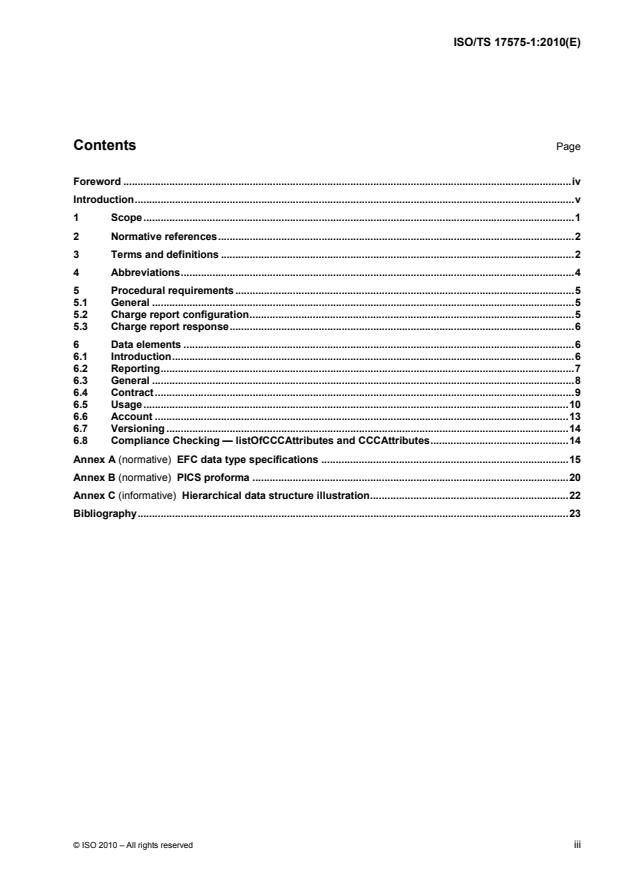
Contents Page
Foreword .iv
Introduction.v
1 Scope.1
2 Normative references.2
3 Terms and definitions .2
4 Abbreviations.4
5 Procedural requirements.5
5.1 General .5
5.2 Charge report configuration.5
5.3 Charge report response.6
6 Data elements .6
6.1 Introduction.6
6.2 Reporting.7
6.3 General .8
6.4 Contract.9
6.5 Usage.10
6.6 Account .13
6.7 Versioning .14
6.8 Compliance Checking — listOfCCCAttributes and CCCAttributes.14
Annex A (normative) EFC data type specifications .15
Annex B (normative) PICS proforma .20
Annex C (informative) Hierarchical data structure illustration.22
Bibliography.23
Foreword
ISO (the International Organization for Standardization) is a worldwide federation of national standards bodies
(ISO member bodies). The work of preparing International Standards is normally carried out through ISO
technical committees. Each member body interested in a subject for which a technical committee has been
established has the right to be represented on that committee. International organizations, governmental and
non-governmental, in liaison with ISO, also take part in the work. ISO collaborates closely with the
International Electrotechnical Commission (IEC) on all matters of electrotechnical standardization.
International Standards are drafted in accordance with the rules given in the ISO/IEC Directives, Part 2.
The main task of technical committees is to prepare International Standards. Draft International Standards
adopted by the technical committees are circulated to the member bodies for voting. Publication as an
International Standard requires approval by at least 75 % of the member bodies casting a vote.
In other circumstances, particularly when there is an urgent market requirement for such documents, a
technical committee may decide to publish other types of document:
⎯ an ISO Publicly Available Specification (ISO/PAS) represents an agreement between technical experts in
an ISO working group and is accepted for publication if it is approved by more than 50 % of the members
of the parent committee casting a vote;
⎯ an ISO Technical Specification (ISO/TS) represents an agreement between the members of a technical
committee and is accepted for publication if it is approved by 2/3 of the members of the committee casting
a vote.
An ISO/PAS or ISO/TS is reviewed after three years in order to decide whether it will be confirmed for a
further three years, revised to become an International Standard, or withdrawn. If the ISO/PAS or ISO/TS is
confirmed, it is reviewed again after a further three years, at which time it must either be transformed into an
International Standard or be withdrawn.
Attention is drawn to the possibility that some of the elements of this document may be the subject of patent
rights. ISO shall not be held responsible for identifying any or all such patent rights.
ISO/TS 17575-1 was prepared by the European Committee for Standardization (CEN) Technical Committee
CEN/TC 278, Road transport and traffic telematics, in collaboration with Technical Committee ISO/TC 204,
Intelligent transport systems, in accordance with the Agreement on technical cooperation between ISO and
CEN (Vienna Agreement).
ISO/TS 17575 consists of the following parts, under the general title Electronic fee collection — Application
interface definition for autonomous systems:
⎯ Part 1: Charging
⎯ Part 2: Communication and connection to the lower layers
⎯ Part 3: Context data
⎯ Part 4: Roaming
iv © ISO 2010 – All rights reserved
Introduction
Autonomous systems
This part of ISO/TS 17575 is part of a series of specifications defining the information exchange between the
Front End and the Back End in Electronic Fee Collection (EFC) based on autonomous on-board equipment
(OBE). EFC systems automatically collect charging data for the use of road infrastructure including motorway
tolls, zone-based fees in urban areas, tolls for special infrastructure like bridges and tunnels, distance-based
charging and parking fees.
Autonomous OBE operates without relying on dedicated road-side infrastructure by employing wide-area
technologies such as Global Navigation Satellite Systems (GNSS) and Cellular Communications Networks
(CN). These EFC systems are referred to by a variety of names. Besides the terms autonomous systems and
GNSS/CN systems, also the terms GPS/GSM systems, and wide-area charging systems are in use.
Autonomous systems use satellite positioning, often combined with additional sensor technologies such as
gyroscopes, odometers and accelerometers, to localize the vehicle and to find its position on a map containing
the charged geographic objects, such as charged roads or charged areas. From the charged objects, the
vehicle characteristics, the time of day and other data that are relevant for describing road use, the tariff and
ultimately the road usage fee are determined.
Some of the strengths of the autonomous approach to electronic fee collection are its flexibility, allowing the
implementation of almost all conceivable charging principles, and its independence from local infrastructure,
thereby predisposing this technology towards interoperability across charging systems and countries.
Interoperability can only be achieved with clearly defined interfaces, which is the aim and justification of
ISO/TS 17575.
Business architecture
This part of ISO/TS 17575 complies with the business architecture defined in the draft of the future
International Standard ISO 17573. According to this architecture, the Toll Charger is the provider of the road
infrastructure and, hence, the recipient of the road usage charges. The Toll Charger is the actor associated
with the Toll Charging role. See Figure 1.
Interoperability
Management
Service
Provision
Toll
Charging
Service Usage
Figure 1 — The rolebased model underlying this Technical Specification
Service Providers issue OBE to the users of the road infrastructure. Service Providers are responsible for
operating the OBE that will record the amount of road usage in all toll charging systems the vehicle passes
through and for delivering the charging data to the individual Toll Chargers. In general, each Service Provider
delivers charging data to several Toll Chargers, as well as each Toll Charger in general receives charging
data from more than one Service Provider. Interoperability Management in Figure 1 comprises all
specifications and activities that in common define and maintain a set of rules that govern the overall toll
charging environment.
Technical architecture
The technical architecture of Figure 2 is independent of any particular practical realization. It reflects the fact
that some processing functionalities can either be allocated to the OBE or to an associated off-board
component (Proxy). An example of processing functionality that can be realized either on- or off-board is map-
matching, where the vehicle locations in terms of measured coordinates from GNSS are associated to
geographic objects on a map that either resides on- or off-board. Also tariffication can be done with OBE tariff
tables and processing, or with an off-board component.
Scope of
ISO 17575
Proxy
Processing Equipment
OBE
Front End Back End
Road Usage Data
Context Data
Figure 2 — Assumed technical architecture and interfaces
The combined functionality of OBE and Proxy is denoted as Front End. A Front End implementation where
processing is predominately on OBE-side is known as a smart client (or intelligent client, fat client) or edge-
heavy. A Front End where processing is mostly done off-board is denoted as thin-client or edge-light
architecture. Many implementations between the “thin” and “thick” extremes are possible, as depicted by the
gradual transition in the wedges in Figure 2. Both extremes of architectural choices have their merits and are
one means where manufacturers compete with individual allocations of functionality between on-board and
central resources.
Especially for thin client OBE, manufacturers might devise a wide variety of optimizations of the transfer of
localization data between OBE and off-board components, where proprietary algorithms are used for data
reduction and data compression. Standardization of this transfer is neither fully possible nor beneficial.
Location of the specification interface
In order to abstract from, and become independent of, these architectural implementation choices, the primary
scope of ISO/TS 17575 is the data exchange between Front End and Back End (see the corresponding dotted
line in Figure 2). For every toll regime, the Back End will send context data, i.e. a description of the toll regime
in terms of charged objects, charging rules and, if required, the tariff scheme to the Front End, and will receive
usage data from the Front End.
vi © ISO 2010 – All rights reserved
It has to be noted also that the distribution of tasks and responsibilities between Service Provider and Toll
Charger will vary individually. Depending on the local legal situation, Toll Chargers will require “thinner” or
“thicker” data, and might or might not leave certain data processing tasks to Service Providers. Hence, the
data definitions in ISO/TS 17575 may be useful on several interfaces.
ISO/TS 17575 also provides for basic media-independent communication services that may be used for
communication between Front End and Back End, which might be line-based or an air-link, and can also be
used for the air-link between OBE and central communication server.
The parts of ISO/TS 17575
Part 1: Charging, defines the attributes for the transfer of usage data from the Front End to the Back End. The
required attributes will differ from one Toll Charger to another, hence, attributes for all requirements are
offered, ranging from attributes for raw localization data, for map-matched geographic objects and for
completely priced toll transactions.
Part 2: Communication and connection to lower layers, defines basic communication services for data transfer
over the OBE air-link or between Front End and Back End.
Part 3: Context Data, defines the data to be used for a description of individual charging systems in terms of
charged geographical objects and charging and reporting rules. For every Toll Charger's system, attributes as
defined in part 3 are used to transfer data to the Front End in order to instruct it which data to collect and
report.
Part 4: Roaming, defines the functional details and data elements required to operate more than one EFC
regime in parallel. The domains of these EFC regimes may or may not overlap. The charge rules of different
overlapping EFC regimes can be linked, i.e. they may include rules that an area pricing scheme will not be
charged if an overlapping toll road is used and already paid for.
Figure 3 — Scope of ISO/TS 17575
Applicatory needs covered by ISO/TS 17575
⎯ The parts of ISO/TS 17575 are compliant with the architecture defined in the future International Standard
ISO 17573.
⎯ The parts of ISO/TS 17575 support charges for use of road sections (including bridges, tunnels, passes,
etc.), passage of cordons (entry/exit) and use of infrastructure within an area (distance, time).
⎯ The parts of ISO/TS 17575 support fee collection based on units of distance or duration, and based on
occurrence of events.
⎯ The parts of ISO/TS 17575 support modulation of fees by vehicle category, road category, time of usage
and contract type (e.g. exempt vehicles, special tariff vehicles, etc.).
⎯ The parts of ISO/TS 17575 support limiting of fees by a defined maximum per period of usage.
⎯ The parts of ISO/TS 17575 support fees with different legal status (e.g. public tax, private toll).
⎯ The parts of ISO/TS 17575 support differing requirements of different Toll Chargers, especially in terms of
⎯ geographic domain and context descriptions,
⎯ contents and frequency of charge reports,
⎯ feedback to the driver (e.g. green or red light),
⎯ provision of additional detailed data on request, e.g. for settling of disputes.
⎯ The parts of ISO/TS 17575 support overlapping geographic toll domains.
⎯ The parts of ISO/TS 17575 support adaptations to changes in
⎯ tolled infrastructure,
⎯ tariffs, and
⎯ participating regimes.
⎯ The parts of ISO/TS 17575 support the provision of trust guarantees by the Service Provider to the Toll
Charger for the data originated from the Front End.
viii © ISO 2010 – All rights reserved
TECHNICAL SPECIFICATION ISO/TS 17575-1:2010(E)
Electronic fee collection — Application interface definition for
autonomous systems —
Part 1:
Charging
1 Scope
This part of ISO/TS 17575 defines the format and semantic of the data exchange between a Front End (OBE
plus optional proxy) and corresponding Back Ends in autonomous toll regimes. This part of ISO/TS 17575
deals with the definition of the data elements used to report charging details from the Front End to the Back
End and to receive data which can be used to re-configure the ongoing process of gathering charge relevant
information in the Front End.
The constitution of the charge report is dependent on configuration data that are assumed to be present in the
Front End. The assembly of charge reports can be configured for each individual toll regime according to local
needs. Charge reports generated in accordance with this part of ISO/TS 17575 are consistent with the
requirements derived from the current architectural concept favoured in the relevant standardization bodies.
NOTE An EFC architecture standard is currently under development and is to be published in ISO 17573.
The data defined in this part of ISO/TS 17575 are used to generate charge reports that contain information
about the road usage of a vehicle for certain time intervals. The contents of these charge reports might vary
between toll regimes. A toll regime comprises a set of rules for charging, including the charged network, the
charging principles, the liable vehicles and a definition of the required contents of the charge report.
The data defined in this part of ISO/TS 17575 are exchanged using an open definition of a communication
stack as defined in ISO/TS 17575-2.
The definitions in this part of ISO/TS 17575 comprise:
⎯ reporting data, i.e. data for transferring road usage data from Front End to Back End, including a
response from the Back End towards the Front End;
⎯ contract data, i.e. data for identifying contractually essential entities;
⎯ road usage data, i.e. data for reporting the amount of road usage;
⎯ account data for managing a payment account;
⎯ versioning data;
⎯ compliance checking data, i.e. data imported from ISO/TS 12813, which are required in Compliance
Checking Communications.
2 Normative references
The following referenced documents are indispensable for the application of this document. For dated
references, only the edition cited applies. For undated references, the latest edition of the referenced
document (including any amendments) applies.
ISO 6709, Standard representation of geographic point location by coordinates
ISO/IEC 8824-1, Information technology — Abstract Syntax Notation One (ASN.1): Specification of basic
notation — Part 1
ISO/IEC 8825-2, Information technology — ASN.1 encoding rules: Specification of Packed Encoding Rules
(PER) — Part 2
ISO/TS 12813, Electronic fee collection — Compliance check communication for autonomous systems
ISO 14906, Road transport and traffic telematics — Electronic fee collection — Application interface definition
for dedicated short-range communication
3 Terms and definitions
For the purposes of this document, the following terms and definitions apply.
NOTE Some terms used in this document might also be defined in the future International Standard ISO 17573. The
intention is to define them consistently. However, as ISO 17573 is still under development these definitions might be
aligned in future.
3.1
area pricing
charging process based on road usage occurring within a given area
3.2
attribute
application information formed by one or by a sequence of data elements, used for implementation of a
transaction
3.3
authenticator
data appended to, or a cryptographic transformation of, a data unit that allows a recipient of the data unit to
prove the source and/or the integrity of the data unit and protect against forgery
[ISO 14906:2004, definition 3.4]
3.4
Back End
generic name for the computing and communication facilities of the Service Provider and/or the Toll Charger
3.5
charge report
data structure transmitted from the Front End to the Back End to report road usage data and supplementary
related information
3.6
charge object
any object that is part of the toll context description that may be charged for its use under certain conditions
3.7
contract
agreement governing part of the collective behaviour of a set of objects
NOTE A contract specifies obligations, permissions and prohibitions for the objects involved.
2 © ISO 2010 – All rights reserved
3.8
cordon
border line of an area
3.9
cordon pricing
charging process based on registering passages of a cordon
3.10
data element
datum, which might itself consist of lower level data elements
3.11
data group
group of data elements selected by semantic relation
3.12
data integrity
property that data have not been altered or destroyed in an unauthorised manner
[ISO 14906:2004, definition 3.10]
3.13
Front End
part(s) of the toll system where road usage data for an individual road user are collected, processed and
delivered to the Back End
NOTE The Front End comprises the on-board equipment and an optional proxy.
3.14
proxy
optional component of the Front End that communicates with on-board equipment and processes road usage
data into a format compliant with this Technical Specification and delivers the data to the Back End
3.15
road
any stretch of land that can be navigated by a vehicle
3.16
road usage
travelling on a road with a vehicle
3.17
road usage data
data necessary to calculate the fees accumulated by a road user
3.18
road section tolling
processes for EFC based on charges for individual road sections
3.19
tarrification
calculation of the tariff
3.20
toll
charge, tax, fee or duty in connection with using a vehicle within a toll domain
NOTE The definition is the generalization of the classic definition of a toll as a charge, a tax, or a duty for permission
to pass a barrier or to proceed along a road, over a bridge, etc. The definition above also includes fees regarded as an
(administrative) obligation, e.g. a tax or a duty.
3.21
toll cluster
group of toll schemes operating under a common agreement providing interoperability for vehicles equipped
with an appropriate OBE and being contracted under a service provider being part of the cluster
3.22
toll context
logical view of a toll scheme as defined by attributes and functions
3.23
toll context data
set of data necessary to define a toll context
3.24
toll domain
area or part of a road network where a toll regime is applied
3.25
toll regime
set of rules, including enforcement rules, governing the collection of toll in a toll
3.26
toll service
service enabling users having only one contract and one set of OBE to use a vehicle in one or more toll
domains
3.27
toll system
overall view of a toll scheme or toll cluster
NOTE A component of a toll system can itself be a system, in which case it may be called a toll subsystem.
3.28
transaction
whole of the exchange of information between Front End and Back End necessary for the completion of a toll
operation
3.29
transaction model
functional model describing the general structure of Electronic Payment Fee Collection transactions
[ISO 14906:2004, definition 3.20]
4 Abbreviations
For the purposes of this document, the following abbreviations apply unless otherwise specified.
⎯ ADU Application data unit
⎯ ASN.1 Abstract Syntax Notation One (See ISO/IEC 8824-1.)
⎯ CCC Compliance Check Communication, as defined by ISO/TS 12813
⎯ CN Cellular network
⎯ DSRC Dedicated short range communication
⎯ EFC Electronic Fee Collection as defined in ISO 14906; here used as an equivalent to the term toll
⎯ GNSS Global Navigation Satellite Systems
4 © ISO 2010 – All rights reserved
⎯ GPS Global positioning system
⎯ GSM Global System for Mobile Communications
⎯ HMI Human-machine interface
⎯ OBE On-board equipment
⎯ PICS Protocol Implementation Conformance Statements
⎯ RSE Road side equipment
⎯ VAT Value added tax
5 Procedural requirements
5.1 General
This part of ISO/TS 17575 is intended to be used in autonomous toll systems set up according to an overall
architecture currently favoured in the relevant standardization bodies.
NOTE An EFC architecture standard is currently under development and will be published as ISO 17573.
It defines the format and semantics of charge reports and charge report responses, which are part of the end-
to-end information flow.
On-board equipment collects data on the road usage of an individual vehicle. These data are aggregated and
processed regarding their relevance for charging either in the on-board equipment or in a proxy. The
combination of on-board equipment and proxy is referred to as a Front End.
This part of ISO/TS 17575 defines the data required for communicating charge-relevant road usage data for
an individual vehicle from the Front End to the Back End. The Front End shall accumulate road usage data
into charge reports and send the charge reports to the Back End. The Back End shall confirm reception of a
charge report (ChargeReport) with a charge report response (ChargeReportResponse).
5.2 Charge report configuration
All data elements comprising the attribute charge report are coded as optional (except for the
usageStatementList, which ultimately also contains only optional elements).
For every toll regime, the Back End sends context data to the Front End. Context data is a description in terms
of charge objects, charging rules and, if required, the tariff scheme.
Toll context data defines which data elements shall be present and which shall not. The Back End shall
communicate the toll context data defining the requested charge report contents to the Front End before the
on-board equipment is expected to collect road usage data. Upon reception of toll context data the Front End
shall start to collect, process and accumulate road usage data into charge reports as requested. Toll context
data also define upon which events charge reports shall be communicated.
NOTE 1 The charge report content requirements defined by the toll context data allow setting the report contents as
required by the properties of the toll regime. These properties include the basic toll system types like:
⎯ road section tolling (the charge relevant parameter is the sum of the road section lengths or tariff used by the
vehicle);
⎯ area pricing (the charge relevant parameter is either the distance driven inside the area or the time stayed inside the
area);
⎯ cordon pricing (the charge relevant parameter is the event of crossing the cordon around an area).
NOTE 2 Depending on local needs, Toll Chargers may require more or less processed data to varying levels of detail.
Privacy considerations, enforcement approach and legal nature of the charge will also influence the choices agreed
between toll charger and toll service provider regarding the requested contents of charge reports.
Charge reports support:
⎯ reporting a list of charge objects that are declared as being used by the vehicle including associated tariff modifiers;
this report may or may not include the calculated fee or tax;
⎯ reports of road usage sessions within a single set of tariff modifiers; this report may or may not include the calculated
fee or tax;
⎯ report of contiguous sessions on a toll road or area where just the aggregated fee and the associated reference time
is reported;
⎯ reports where only the total fee within a predefined report period is forwarded (in this case it is anticipated that other
means, outside the scope of this part of ISO/TS 17575, are used to allow a certain degree of validation of the
charging process);
⎯ any combination of the reports listed above.
5.3 Charge report response
The Back End shall respond to every received charge report with a charge report response. Which of the
optional elements of the attribute ChargeReportResponse are present is not defined in this part of
ISO/TS 17575.
NOTE The contents of the charge report response depend on the make and type of the Front End and on application
software of the Front End and Back End as defined by the business requirements of the individual Service Provider. This
part of ISO/TS 17575 only offers data elements for the response but does not impose restrictions upon the implementation
and business choices by requiring mandatory content.
6 Data elements
6.1 Introduction
Data elements are grouped in logical groups for readability only.
The data group Reporting contains the main data elements of the charge report communication. These
elements are the top level, overarching data structures containing all data elements described in this part of
ISO/TS 17575.
The data group General contains data elements and types which are not explicitly part of other groups.
The data group Contract contains data elements and types related to road user contract information.
The data group Usage contains the information necessary to describe the usage of infrastructure causing
eligibility for fees. These data are necessary for calculating the charges and for setting up correct bills and for
settling disputes. The main data elements of this group present in the charge report and charge report
response are respectively usageStatementList and dataReceived.
The data group Account contains the elements necessary to ensure that the correct account (and road user)
is charged with the toll fees. The elements in the group Account are used for managing road user accounts in
the Front End. These Front End accounts can contain the following types of data.
⎯ Credit: the account holds a value corresponding to a monetary amount.
⎯ Distance: the account holds a value representing a distance.
⎯ Time: the account holds a value representing a point in time.
6 © ISO 2010 – All rights reserved
⎯ Duration: the account holds a value representing a time duration.
⎯ Event: the account holds a value representing a number of events.
The main data elements of this group present in the charge report and charge report response are
respectively accountStatus and accountUpdate.
NOTE The kind of event counted in the respective option of the account data type is left to the implementation.
The data group Versioning contains data elements for version control of elements on the OBE.
The data group Compliance Checking provides information exchanged in compliance checking
communication (CCC), as defined in ISO/TS 12813. Some of the data exchanged by CCC are already
covered by other data elements, but for complete information about the content of CCC the data in this group
are necessary.
6.2 Reporting
The two data types ChargeReport and ChargeReportResponse described in this subclause cover the
complete charge report communication.
The data type ChargeReport comprises the following data elements:
⎯ obeId,
⎯ vehicleLPNr,
⎯ paymentMeans,
⎯ serviceProviderContract,
⎯ tollCharger,
⎯ timeOfReport,
⎯ reportPeriod,
⎯ versionInfo,
⎯ usageStatementList,
⎯ vatForThisSession,
⎯ accountStatus,
⎯ transactionCounter,
⎯ mileage,
⎯ cccAttributes,
⎯ authenticator.
Those are the basic data elements for charge communication. A data element of the type ChargeReport is
sent by the Front End whenever it is necessary to transmit charge data to the Back End.
The report contains the necessary data for identifying the (already registered) OBE and contract. It relays the
information on usage of chargeable infrastructure by the vehicle and provides additional information for
plausibility checks and accounting procedures (e.g. VAT calculations).
The data elements contained in this structure pertain to logical data groups and are detailed in the rest of
Clause 6.
In response to a charge report, the Back End answers with a data element of the type
ChargeReportResponse. This data type consists of the following components:
⎯ reportRecipientId,
⎯ dataReceived,
⎯ versionsResponse,
⎯ obeStatusForDriver,
⎯ accountUpdate,
⎯ responseAuthenticator.
These data provide a confirmation of the data reception at the application level. In addition feedback to the
Front End (e.g. request for updates, change in OBE status) is provided.
The data types and elements contained in this structure and the ones constituting those pertain to logical data
groups and are detailed below.
6.3 General
6.3.1 vehicleDescription
The data element vehicleDescription contains a list of characteristics (vehicleLPNr, axles, class,
dimensions, specificCharacteristics, ladenWeight, weightLimits) of the vehicle. The data types of
these elements are defined in and imported from ISO 14906.
6.3.2 timeOfReport
The data element timeOfReport gives the date and time when the charge report was compiled for
transmission. The corresponding data type DateAndTime is defined in and imported from ISO 14906.
NOTE All data elements giving time information use the local time at the location of the vehicle.
6.3.3 reportPeriod
The data element reportPeriod gives the time period covered by the respective ChargeReport.
6.3.4 vatForThisSession
The data element vatForThisSession contains the aggregated VAT for the fees communicated in the
respective charge report. Its associated data type is PaymentFee, which is defined in and imported from
ISO 14906.
6.3.5 transactionCounter
The data element transactionCounter gives the number of the current charge report. This counter shall be
incremented by the Front End after compilation of a charge report, facilitating distinction between charge
reports. In the case of overflow the counter starts again at 0.
6.3.6 mileage
The data element mileage contains the reading of an internal mileage counter of type Distance. Counter
reset and starting point shall be left to implementation; for one OBE and one contract the counter shall
continuously count all vehicle mileage; counter shall start from zero in case of overflow (i.e. when reaching the
maximum value).
6.3.7 Distance
The data type Distance contains distance values. The first element (dist) is an integer containing the
distance value itself, the second (disUnit) is used for defining the unit of distance used. It can have the
values kilometres, miles and metres.
6.3.8 Position
The data type position defines a geographical position, with the elements longitude and latitude as
defined in ISO 6709.
8 © ISO 2010 – All rights reserved
6.3.9 Period
The data type Period defines a period of time, defined by the date and time of its beginning (beginOfPeriod)
and of its end (endOfPeriod).
The data types of these elements are defined in and imported from ISO 14906.
6.3.10 Duration
The data type Duration defines a time span, defined by the actual value (dur) of the ASN.1 type REAL, and
the respective unit (durUnit), which can have one of the values seconds, minutes, hours, days or months.
6.3.11 authenticator and responseAuthenticator
The data elements authenticator and responseAuthenticator are both of data type
MessageAuthenticator and contain a security code intended for implementation of security measures. They
can be used, for example, for ensuring integrity and authenticity of the respective data structure they are part
of (through a message authentication code or signature on all the other data elements).
6.3.12 MessageAuthenticator
The data type MessageAuthenticator contains a security code of the ASN.1 type OCTET STRING, intended
for implementation of security measures. It can be used, for example, for ensuring integrity and authenticity of
the respective data structure of which they are part. The MessageAuthenticator always covers all data
elements contained in the respective data structure.
NOTE The UsageAuthenticator in the data element UsageStatement is the only exception from the above
rule. In this case only it can be used for authentication of data not contained in the respective ChargeReport and
ChargeReportResponse.
The choice of specific algorithms for applying security measures is outside the scope of ISO/TS 17575.
6.4 Contract
6.4.1 obeId
The data element obeId is a unique identifier of the OBE. It contains two parts, one part (manufacturerId) a
unique identification of the OBE manufacturer, and the other part (EquipmentOBUId) a manufacturer-specific
identification of the individual OBE. The respective data types are defined in and imported from ISO 14906.
6.4.2 vehicleLPNr
The data element vehicleLPNr can be used either in the chargeReport data element or as part of the
vehicleDescription in lower levels of the data structure. It shall only be present in the chargeReport if it is
not used on the lower levels. The respective data type is defined in and imported from ISO 14906.
6.4.3 paymentMeans
The data element paymentMeans is a unique identification of an individual account, the respective data type is
defined in and imported from ISO 14906.
6.4.4 serviceProviderContract
The data element serviceProviderContract identifies the service provider and the contract type to which
the charge report data pertain. The respective data type is defined in and imported from ISO 14906.
NOTE 1 This is compatible with the concept favoured in the future architecture standard ISO 17573.
NOTE 2 It is the responsibility of the Service Provider to keep a consistent relationship between obeId,
paymentMeans and serviceProviderContract in their database.
6.4.5 tollCharger
The data element tollCharger comprises two parts, identifying two of the sub roles of the toll charger:
⎯ the toll operator of the respective toll scheme (data element efcOperator);
⎯ the Transport Service Provider, recipient of fees collected in this scheme (data element recipient).
The data type Provider of both parts is imported from ISO 14906.
6.4.6 reportRecipientID
The data element reportRecipientID identifies the entity which received the respective usage statement.
6.4.7 obeStatusForDriver
The data element obeStatusForDriver contains information for controlling the HMI elements which
communicate the status of the OBE and the contract to the driver. It is of the type ObeStatus.
6.4.8 ObeStatus
The data element ObeStatus contains information about the HMI elements that communicate the status of
the OBE and the contract to the driver. The following values are foreseen:
⎯ ok,
⎯ nok,
⎯ contactOperator,
⎯ nokInLocalContext,
⎯ noSignalling.
The value ok indicates that the OBE and contract are valid for toll collection in the current context; nok means
that there is a problem and the road user has to undertake some action; contactOperator indicates that
contacting the operator is expected from the road user; nokInLocalContext provides for the case that a local
toll charger is not accepting the OBE or contract any longer, while it might still be valid in other contexts;
noSignalling provides for the case that no indication whatsoever is given to the road user.
6.5 Usage
6.5.1 usageStatementList and UsageStatement
The data element usageStatementList contains a list of all the usage statements (data type
UsageStatement) of the respective charge report.
The data type UsageStatement contains the information about actual road infrastructure use, which is
required by the Back End to calculate the charges.
This data type consists of the following components:
⎯ usageStatementID
⎯ regimeID
⎯ aggregatedFee
⎯ aggregatedSingleTariffClassSession
⎯ listOfChargeObjects
⎯ listOfRawUsageData
⎯ noUsage
⎯ additionalUsageInformation
⎯ usageAuthenticator
10 © ISO 2010 – All rights reserved
There are four options for describing road infrastructure use, which are represented by the following data
elements:
⎯ aggregatedFee,
⎯ aggregatedSingleTariffClassSession,
⎯ listOfChargeObjects,
⎯ listOfRawUsageData.
Any combination of these options is possible. For special purposes (e.g. sign in) it is also possible to use
empty usage statements. Those can be marked with the flag noUsage.
Security measures can be applied to the data type UsageStatement using the element UsageAuthenticator.
NOTE The data element UsageAuthenticator can also be used to implement the trusted recorder concept as
described, for example, in the report of the European expert group 12. In this case the UsageAuthenticator does not
contain a signature on the respective UsageStatement, but rather on data not contained in the respective
UsageStatement.
6.5.2 usageStatementID
The data element usageStatementID is an identifier of the respective usage statement. The Front End shall
assign this identifier and ensure its uniqueness within the charge report.
6.5.3 regimeID
The data element regimeID is an identifier of one of the regimes operated by a Toll Charger. This Toll
Charger shall assign unique values within its realm.
6.5.4 aggregatedFee
The data element aggregatedFee contains the time period covered by the statement (timePeriodCovered)
and the total amount of fee without VAT (feeExclVat) and the corresponding VAT (vat) aggregated within
the time period given in timePeriodCovered.
6.5.5 aggregatedSingleTariffClassSession
The data element aggregatedSingleTariffClassSession contains the following data elements:
⎯ timePeriodCovered,
⎯ vehicleDescription,
⎯ tariffClass,
⎯ totalDistanceCovered,
⎯ numberOfDetectedEvents,
⎯ ObeStatus,
⎯ feeExclVat,
⎯ vat
It describes a single tariff class session, which is a part of a trip without any changes of charge-relevant
parameters. Session changes may be due to changes in vehicle category, road category, time of day, etc. The
information contained is: the time period covered by the statement (timePeriodCovered), the respective
vehicle description (vehicleDescri
...
Questions, Comments and Discussion
Ask us and Technical Secretary will try to provide an answer. You can facilitate discussion about the standard in here.
Loading comments...