


ISO/FDIS 5858
(Main)Aerospace — Nuts, self-locking, with maximum operating temperature less than or equal to 425 °C — Procurement specification
Aerospace — Nuts, self-locking, with maximum operating temperature less than or equal to 425 °C — Procurement specification
This International Standard specifies the required characteristics for metric self-locking nuts, with MJ threads, for use in aerospace construction at a maximum temperature less than or equal to 425 °C. It is applicable to nuts as defined above, provided that reference is made to this International Standard in the relevant definition document.
Aéronautique et espace — Écrous à freinage interne dont la température maximale d'utilisation est inférieure ou égale à 425 °C — Spécification d'approvisionnement
La présente Norme internationale spécifie les caractéristiques requises pour les écrous à freinage interne, métriques, à filetage MJ conformément à l'ISO 5855-2, utilisés dans les constructions aérospatiales à des températures maximales inférieures ou égales à 425 °C. Elle est applicable aux écrous à freinage interne répondant à la définition ci-dessus, à condition qu'elle soit référencée dans le document de définition les concernant.
General Information
- Status
- Not Published
- Technical Committee
- ISO/TC 20/SC 4 - Aerospace fastener systems
- Drafting Committee
- ISO/TC 20/SC 4/WG 3 - Supporting documents
- Current Stage
- 5020 - FDIS ballot initiated: 2 months. Proof sent to secretariat
- Start Date
- 20-Feb-2026
- Completion Date
- 20-Feb-2026
Relations
- Effective Date
- 15-Feb-2025
Overview
ISO/FDIS 5858:2025 is an international procurement specification developed by the International Organization for Standardization (ISO), specifically aimed at the aerospace sector. This standard details the characteristics, testing, and quality assurance requirements for metric self-locking nuts with MJ threads, designed for aerospace applications where the operating temperature does not exceed 425 °C. Its adoption provides manufacturers, suppliers, and end users a consistent benchmark for the procurement, inspection, and use of these critical fasteners.
Key Topics
- Scope of Application: Defines requirements for self-locking nuts with metric MJ threads, used in aerospace construction under high-temperature conditions.
- Technical Requirements: Outlines detailed specifications for material properties, surface condition, dimensional tolerances, performance metrics, and acceptable surface discontinuities.
- Testing & Inspection: Specifies qualification and production acceptance inspections, including hardness, corrosion resistance, surface coatings, and functionality tests such as wrench engagement and vibration resistance.
- Quality Assurance: Establishes protocols for manufacturer approval, batch qualification, statistical process control (SPC), and traceability through packaging and labelling.
- Terminology: Provides precise definitions for technical terms such as self-locking torque, seating torque, production batch, and various types of defects.
- Referenced Standards: Incorporates a wide range of related ISO standards to address testing methods, measurement accuracy, and quality management systems.
Applications
ISO/FDIS 5858 offers significant practical value in both civil and military aerospace manufacturing. Key applications include:
- Aircraft Assembly: Ensures that self-locking nuts meet stringent performance and safety criteria when used in aircraft structures exposed to elevated temperatures.
- Aerospace Maintenance and Repair: Standardized requirements allow for confident sourcing and replacement of fasteners, simplifying maintenance workflows and documentation.
- Supplier Qualification: Provides an international benchmark for evaluating and auditing suppliers of aerospace fasteners, promoting global consistency and reliability.
- Quality Management Systems: Integrates with ISO-based quality assurance programs, enabling effective sampling, batch traceability, and statistical quality control in production environments.
- Design Engineering: Assists engineers in selecting appropriate fastening solutions by referencing a globally accepted specification for high-temperature, self-locking metric nuts.
Related Standards
The requirements and test methods in ISO/FDIS 5858 are closely linked to several other international standards, including:
- ISO 5855-2: Aerospace - MJ threads - Limit dimensions for bolts and nuts.
- ISO 7481: Aerospace - Nuts, self-locking, with maximum operating temperature less than or equal to 425 °C - Test methods.
- ISO 691: Assembly tools for screws and nuts - Wrench and socket openings.
- ISO 1463: Metallic and oxide coatings - Measurement of coating thickness.
- ISO 9227: Corrosion tests in artificial atmospheres - Salt spray tests.
- ISO 2859-1: Sampling procedures for inspection by attributes.
- ISO 7870 series: Control charts for statistical process control.
Conclusion
Adopting ISO/FDIS 5858:2025 assures that aerospace self-locking nuts are manufactured, tested, and procured according to internationally recognized standards for performance, safety, and reliability. Its integration into the aerospace supply chain helps minimize risk, enhance product quality, and streamline global procurement processes for aerospace fasteners.
Buy Documents
ISO/FDIS 5858 - Aerospace — Nuts, self-locking, with maximum operating temperature less than or equal to 425 °C — Procurement specification Released:6. 02. 2026
REDLINE ISO/FDIS 5858 - Aerospace — Nuts, self-locking, with maximum operating temperature less than or equal to 425 °C — Procurement specification Released:6. 02. 2026
Get Certified
Connect with accredited certification bodies for this standard

DEKRA North America
DEKRA certification services in North America.

Eagle Registrations Inc.
American certification body for aerospace and defense.

Element Materials Technology
Materials testing and product certification.
Sponsored listings
Frequently Asked Questions
ISO/FDIS 5858 is a draft published by the International Organization for Standardization (ISO). Its full title is "Aerospace — Nuts, self-locking, with maximum operating temperature less than or equal to 425 °C — Procurement specification". This standard covers: This International Standard specifies the required characteristics for metric self-locking nuts, with MJ threads, for use in aerospace construction at a maximum temperature less than or equal to 425 °C. It is applicable to nuts as defined above, provided that reference is made to this International Standard in the relevant definition document.
This International Standard specifies the required characteristics for metric self-locking nuts, with MJ threads, for use in aerospace construction at a maximum temperature less than or equal to 425 °C. It is applicable to nuts as defined above, provided that reference is made to this International Standard in the relevant definition document.
ISO/FDIS 5858 is classified under the following ICS (International Classification for Standards) categories: 49.030.30 - Nuts. The ICS classification helps identify the subject area and facilitates finding related standards.
ISO/FDIS 5858 has the following relationships with other standards: It is inter standard links to ISO 5858:1999. Understanding these relationships helps ensure you are using the most current and applicable version of the standard.
ISO/FDIS 5858 is available in PDF format for immediate download after purchase. The document can be added to your cart and obtained through the secure checkout process. Digital delivery ensures instant access to the complete standard document.
Standards Content (Sample)
FINAL DRAFT
International
Standard
ISO/TC 20/SC 4
Aerospace — Nuts, self-locking, with
Secretariat: DIN
maximum operating temperature
Voting begins on:
less than or equal to 425 °C —
2026-02-20
Procurement specification
Voting terminates on:
2026-04-17
Aéronautique et espace — Écrous à freinage interne dont la
température maximale d'utilisation est inférieure ou égale à 425
°C — Spécification d'approvisionnement
RECIPIENTS OF THIS DRAFT ARE INVITED TO SUBMIT,
WITH THEIR COMMENTS, NOTIFICATION OF ANY
RELEVANT PATENT RIGHTS OF WHICH THEY ARE AWARE
AND TO PROVIDE SUPPOR TING DOCUMENTATION.
IN ADDITION TO THEIR EVALUATION AS
BEING ACCEPTABLE FOR INDUSTRIAL, TECHNO
LOGICAL, COMMERCIAL AND USER PURPOSES, DRAFT
INTERNATIONAL STANDARDS MAY ON OCCASION HAVE
TO BE CONSIDERED IN THE LIGHT OF THEIR POTENTIAL
TO BECOME STAN DARDS TO WHICH REFERENCE MAY BE
MADE IN NATIONAL REGULATIONS.
Reference number
FINAL DRAFT
International
Standard
ISO/TC 20/SC 4
Aerospace — Nuts, self-locking, with
Secretariat: DIN
maximum operating temperature
Voting begins on:
less than or equal to 425 °C —
Procurement specification
Voting terminates on:
Aéronautique et espace — Écrous à freinage interne dont la
température maximale d'utilisation est inférieure ou égale à 425
°C — Spécification d'approvisionnement
RECIPIENTS OF THIS DRAFT ARE INVITED TO SUBMIT,
WITH THEIR COMMENTS, NOTIFICATION OF ANY
RELEVANT PATENT RIGHTS OF WHICH THEY ARE AWARE
AND TO PROVIDE SUPPOR TING DOCUMENTATION.
© ISO 2026
IN ADDITION TO THEIR EVALUATION AS
All rights reserved. Unless otherwise specified, or required in the context of its implementation, no part of this publication may
BEING ACCEPTABLE FOR INDUSTRIAL, TECHNO
LOGICAL, COMMERCIAL AND USER PURPOSES, DRAFT
be reproduced or utilized otherwise in any form or by any means, electronic or mechanical, including photocopying, or posting on
INTERNATIONAL STANDARDS MAY ON OCCASION HAVE
the internet or an intranet, without prior written permission. Permission can be requested from either ISO at the address below
TO BE CONSIDERED IN THE LIGHT OF THEIR POTENTIAL
or ISO’s member body in the country of the requester.
TO BECOME STAN DARDS TO WHICH REFERENCE MAY BE
MADE IN NATIONAL REGULATIONS.
ISO copyright office
CP 401 • Ch. de Blandonnet 8
CH-1214 Vernier, Geneva
Phone: +41 22 749 01 11
Email: copyright@iso.org
Website: www.iso.org
Published in Switzerland Reference number
ii
Contents Page
Foreword .iv
1 Scope . 1
2 Normative references . 1
3 Terms and definitions . 1
4 Quality assurance . 3
4.1 General .3
4.1.1 Manufacturer's approval .3
4.1.2 Qualification of nuts .3
4.1.3 Production acceptance of nuts .3
4.2 Qualification inspection and test conditions .3
4.3 Production acceptance inspection and test conditions .4
4.4 Use of statistical process control (SPC) .4
5 Technical requirements . 5
Annex A (normative) Types of permissible surface discontinuity .28
Annex B (informative) Cross-sectional area formula.29
Bibliography .30
iii
Foreword
ISO (the International Organization for Standardization) is a worldwide federation of national standards
bodies (ISO member bodies). The work of preparing International Standards is normally carried out through
ISO technical committees. Each member body interested in a subject for which a technical committee
has been established has the right to be represented on that committee. International organizations,
governmental and non-governmental, in liaison with ISO, also take part in the work. ISO collaborates closely
with the International Electrotechnical Commission (IEC) on all matters of electrotechnical standardization.
The procedures used to develop this document and those intended for its further maintenance are described
in the ISO/IEC Directives, Part 1. In particular, the different approval criteria needed for the different types
of ISO document should be noted. This document was drafted in accordance with the editorial rules of the
ISO/IEC Directives, Part 2 (see www.iso.org/directives).
ISO draws attention to the possibility that the implementation of this document may involve the use of (a)
patent(s). ISO takes no position concerning the evidence, validity or applicability of any claimed patent
rights in respect thereof. As of the date of publication of this document, ISO had not received notice of (a)
patent(s) which may be required to implement this document. However, implementers are cautioned that
this may not represent the latest information, which may be obtained from the patent database available at
www.iso.org/patents. ISO shall not be held responsible for identifying any or all such patent rights.
Any trade name used in this document is information given for the convenience of users and does not
constitute an endorsement.
For an explanation of the voluntary nature of standards, the meaning of ISO specific terms and expressions
related to conformity assessment, as well as information about ISO's adherence to the World Trade
Organization (WTO) principles in the Technical Barriers to Trade (TBT), see www.iso.org/iso/foreword.html.
This document was prepared by Technical Committee ISO/TC 20, Aircraft and space vehicles, Subcommittee
SC 4, Aerospace fastener systems.
This third edition cancels and replaces the second edition (ISO 5858:1999), which has been technically
revised.
The main changes are as follows:
— normative references have been updated;
— the structure of Table 1 has been changed;
— new tables for sampling have been added.
Any feedback or questions on this document should be directed to the user’s national standards body. A
complete listing of these bodies can be found at www.iso.org/members.html.
iv
FINAL DRAFT International Standard ISO/FDIS 5858:2026(en)
Aerospace — Nuts, self-locking, with maximum operating
temperature less than or equal to 425 °C — Procurement
specification
1 Scope
This document specifies the required characteristics for metric self-locking nuts, with MJ threads, for use in
aerospace construction at a maximum temperature less than or equal to 425 °C.
It is applicable to nuts as defined above, provided that reference is made to this document in the relevant
definition document.
2 Normative references
The following documents are referred to in the text in such a way that some or all of their content constitutes
requirements of this document. For dated references, only the edition cited applies. For undated references,
the latest edition of the referenced document (including any amendments) applies.
ISO 691, Assembly tools for screws and nuts — Wrench and socket openings — Tolerances for general use
ISO 1463, Metallic and oxide coatings — Measurement of coating thickness — Microscopical method
ISO 3452-1, Non-destructive testing — Penetrant testing — Part 1: General principles
ISO 3887, Steels — Determination of the depth of decarburization
ISO 5855-2, Aerospace — MJ threads — Part 2: Limit dimensions for bolts and nuts
ISO 7403, Aerospace — Spline drives — Wrenching configuration — Metric series
ISO 7481, Aerospace — Nuts, self-locking, with maximum operating temperature less than or equal to 425 °C —
Test methods
ISO 8788, Aerospace — Nuts, metric — Tolerances of form and position
ISO 9227, Corrosion tests in artificial atmospheres — Salt spray tests
ISO 9934 , Non-destructive testing — Magnetic particle testing
ISO 21920-3, Geometrical product specifications (GPS) — Surface texture: Profile — Part 3: Specification
operators
ASTM E1417, Standard Practice for Liquid Penetrant Testing
ASTM E1444, Standard Practice for Magnetic Particle Testing
3 Terms and definitions
For the purposes of this document, the following terms and definitions apply.
ISO and IEC maintain terminology databases for use in standardization at the following addresses:
— ISO Online browsing platform: available at https://www.iso.org/obp
— IEC Electropedia: available at https://www.electropedia.org/
3.1
definition document
document specifying all the requirements for nuts, i.e.:
— metallurgical requirements;
— geometrical and dimensional requirements;
— functional requirements (strength and temperature classes)
Note 1 to entry: The definition document may be an International Standard, a national standard, or an in-house
standard or drawing.
3.2
finished nut
nut ready for use, inclusive of any possible treatments or surface coatings, as specified in the definition
document (3.1)
3.3
production batch
quantity of finished nuts (3.2), manufactured using the same process, from a single material cast (single
heat of alloy), having the same number of definitiondocument (3.1), same thread and diameter code, heat
treated together to the same specified condition and produced as one continuous run in the course of the
same production cycle, following the same manufacturing route and having undergone all the relevant heat
treatments and surface treatments
3.4
crack
rupture in the material which can extend in any direction and which can be intercrystalline or
transcrystalline in character
3.5
seam
open surface defect resulting from extension of the metal
3.6
lap
folding over of unwelded metal that can arise when the material is formed (drawing) or in the finished
product (pressing or forging)
3.7
inclusion
non-metallic particle originating from the material manufacturing process
Note 1 to entry: These particles can be isolated or arranged in strings.
3.11
sampling plan
plan according to which one or more samples are taken in order to obtain information and possibly reach a
decision
Note 1 to entry: In this document, each sampling plan specifies the number of nuts to be inspected as a function of the
size of the batch (3.3) and the acceptance number [number of defective items acceptable (Ac)]. See ISO 2859-1.
3.12
simple random sampling
sampling of n items from a population of N items in such a way that all possible combinations of n items have
the same probability of being chosen
3.15
self-locking torque
torque to be applied to the nut or bolt to maintain its movement of rotation in relation to the associated part,
the assembly being under no axial load and the nut-locking system being completely engaged with the bolt
(two pitches minimum protrusion, including the end chamfer)
3.16
seating torque
tightening torque to be applied to the nut or bolt to introduce or to increase the axial load in the assembly
3.18
breakaway torque
torque required to start unscrewing the nut or bolt with respect to the associated part, with the nut-
locking device still fully engaged on the bolt, but after the axial load in the assembly has been removed by
unscrewing half a turn followed by a halt in rotational movement
3.19
wrench torque
tightening and untightening torques which the driving feature of the nut has to withstand repeatedly
without any permanent deformation which would prevent the appropriate wrench from being used or
preclude re-use of the nut
3.20
IRR
initial reliability requirement
inspection reliability requirement
minimum acceptable outgoing yield or probability of conformance
4 Quality assurance
4.1 General
4.1.1 Manufacturer's approval
The manufacturer shall be capable of continuous production of nuts meeting the quality requirements
specified in this document.
4.1.2 Qualification of nuts
The purpose of qualification inspections and tests of nuts is to check that the design and manufacturing
conditions for a nut allow it to satisfy the requirements of this document.
4.1.3 Production acceptance of nuts
The purpose of production acceptance inspection and tests of a nut is to check, as simply as possible, using
a method which is inexpensive but most representative of the actual conditions of use, with the uncertainty
inherent in statistical sampling, that the nuts satisfy the requirements of this document.
Production acceptance inspections and tests shall be carried out by, or under the responsibility of, the
manufacturer.
The manufacturer is responsible for the quality of the nuts manufactured.
4.2 Qualification inspection and test conditions
Qualification inspections and tests (requirements, methods, numbers of nuts) are specified in Table 1. They
shall be carried out on:
— each type and diameter of nut;
— 100 nuts selected from a single batch by simple random sampling.
The test programme can be reduced, or qualification of a nut granted, without inspection or testing; any
such decision shall be based on the results obtained on similar types and diameters of nuts provided that
the design and manufacturing conditions are identical.
The inspections and tests shall be repeated on any nut if the supplier or the manufacturing conditions have
changed.
Qualification inspections and tests are summarized in Table 2.
4.3 Production acceptance inspection and test conditions
Production acceptance inspections and tests (requirements, methods, numbers of nuts) are specified in
Table 1. They shall be carried out on each batch. Nuts from the batch to be tested shall be selected by simple
random sampling.
Each nut may be subjected to several inspections or tests.
The nuts to be subjected to destructive inspections or tests may be those on which non-destructive
inspections or tests have been carried out.
If a more stringent inspection is deemed necessary, all or part of the qualification inspections and tests may
be performed during the production acceptance inspections and testing. In this case, the number of nuts
submitted is the same as that submitted for qualification inspections and tests.
Batches declared unacceptable after the production acceptance inspections and tests shall be submitted
for re-inspection or testing only after either all the defective units have been removed or defects have been
corrected, or both. In this case, the attribute(s) which caused the rejection shall be verified using a sample
of twice the normal size but the maximum number of allowed defective items shall be the same as in the
original inspection.
Production acceptance inspections and tests are summarized in Table 2.
4.4 Use of statistical process control (SPC)
Where a characteristic is obtained by a controlled statistical process, in order to declare conformity of
the characteristic, the manufacturer may refrain from the final systematic sampling provided for in this
document, if he/she is can formally justify this choice by using the standards quoted in it as a basis.
This justification will include the following phases:
— analysis of the product's key characteristics;
— analysis of the risks for each implemented process;
— determination of either the parameters or characteristics, or both, to be respected under SPC;
— determination of the capabilities of each process;
— drawing up an inspection plan and integration in the manufacturing process;
— drawing up of routes and control charts (e.g. ISO 7870-1, ISO 7870-2, ISO 7870-3);
— use of control charts for data consolidation;
— determination of the audits to be run and the control to be carried out to ensure reliability of the device.
To be usable in production, this process shall be validated beforehand by the qualifying body, either during
the qualification phase or a posteriori, according to the case, by analysing the justificatory file and the
results of the qualification inspections such as provided for in Clause 5.
5 Technical requirements
The technical requirements are given in Table 1.
They complement the requirements of all other standards or specifications referenced in the definition
document for the nut.
If there is no International Standard specifying the method to be used, a prior agreement shall be reached
between the user and the manufacturer with respect to the following inspections and tests:
— spectrographic analysis or spectroscopic analysis of the material (Table 1, item-no 111);
— micrographic inspection of the structure of the material (Table 1, item-no 1-2);
— inspection for carburization or decarburization (Table 1, item-no 1-3);
— magnetoscopic or fluorescent inspection for surface discontinuities (Table 1, item-no 1-4);
— magnetic permeability inspection (Table 1, item-no 1-6);
— inspection by chemical reagent to determine type of surface coating (Table 1, item-no 2-2);
— tactile inspection or inspection using a profilometer to determine surface roughness (Table 1, item-
no 3-2).
Table 1 — Technical requirements
Inspection and test Sample
Item-no Characteristic Technical requirement Test category
method size
1 Material
a
1-1 Type The material shall be as Spectrographic analysis Qualification 3
specified in the definition or spectroscopic analysis
document. (method to be agreed upon
between the user and man-
ufacturer).
a
See Clause 4 for applicability conditions.
b
Inspections applicable only to nuts made of steel or steel alloy.
c
Inspection to be carried out before coating of the surface or after removal of the surface coating.
d
Inspection applicable only to nuts made of stainless steel.
e
Inspection applicable only to electrolytic coatings (cadmium, silver, etc.).
f
This inspection may be performed on nuts that have been subjected to the inspection of microstructure (see item no 1-2).
g
Test applicable only to all-metal self-locking wrench nuts.
h
For the qualification testing of all-metal self-locking nuts, the nuts shall be exposed for 6 h to the maximum operating
temperature specified in the definition document before the load is applied.
i
Test applicable only to wrench nuts.
j
Test applicable only to nuts heat-treated to a hardness equal to or greater than 44 HRC.
k
Test applicable only to floating-anchor nuts, gang channel nuts and fixed-anchor nuts, produced in several parts and
assembled by brazing or clinching.
l
Test applicable only to gang channel and anchor nuts, with the exception of corner nuts (see ISO 7481) and of reduced-
series single-lug nuts.
m
For all-metal self-locking nuts made of stainless steel with MoS -type dry-film lubrication, this test shall be carried out
over five cycles in order to avoid any risk of seizing.
n
Test applicable only to nuts of diameter 5 mm, 6 mm, 7 mm, 8 mm, 10 mm and 12 mm (see ISO 7481).
o
Test applicable only to sealing nuts.
p
Test applicable only to clinch nuts.
TTabablele 1 1 ((ccoonnttiinnueuedd))
Inspection and test Sample
Item-no Characteristic Technical requirement Test category
method size
a
1-2 Microstructure Nuts shall be free from Micrographic inspection Qualification 5
cracks. The inclusions of a transverse section
shall not exceed the values (method to be agreed upon
specified in the material between the user and man-
standard, when specified ufacturer).
therein.
a
1-3 Carburization or No area of carburization and Microscopic examina- Qualification 5
b
decarburization no area of total decarburiza- tion in accordance with
tion is permissible. An area the method agreed upon
of partial decarburization between the user and man-
is permissible provided ufacturer or Vickers micro-
that the thickness over the hardness measurement
area is less than or equal to (using a 300 g load) in
0,1 mm. accordance with ISO 3887,
or an equivalent method,
shall be carried out.
b a
1-4 Surface disconti- The types of permissible Magnetoscopic (method Qualification 5
c
nuities surface discontinuity shall to be agreed upon between
be in accordance with the user and manufacturer,
Production Ac- Tables 11
Annex A. The maximum shall in accordance with.
ceptance and 12
depth allowed for these ISO 9934 or ASTM E1444)
discontinuities is given in or penetrant inspection in
Table 17. accordance with ISO 3452-
1 or ASTM E1417.
Nuts shall be free from In the event of any doubt
cracks. arising as to the nature
of the defects detected,
inspect defective nuts at a
magnification of × 10 after
sectioning.
a
See Clause 4 for applicability conditions.
b
Inspections applicable only to nuts made of steel or steel alloy.
c
Inspection to be carried out before coating of the surface or after removal of the surface coating.
d
Inspection applicable only to nuts made of stainless steel.
e
Inspection applicable only to electrolytic coatings (cadmium, silver, etc.).
f
This inspection may be performed on nuts that have been subjected to the inspection of microstructure (see item no 1-2).
g
Test applicable only to all-metal self-locking wrench nuts.
h
For the qualification testing of all-metal self-locking nuts, the nuts shall be exposed for 6 h to the maximum operating
temperature specified in the definition document before the load is applied.
i
Test applicable only to wrench nuts.
j
Test applicable only to nuts heat-treated to a hardness equal to or greater than 44 HRC.
k
Test applicable only to floating-anchor nuts, gang channel nuts and fixed-anchor nuts, produced in several parts and
assembled by brazing or clinching.
l
Test applicable only to gang channel and anchor nuts, with the exception of corner nuts (see ISO 7481) and of reduced-
series single-lug nuts.
m
For all-metal self-locking nuts made of stainless steel with MoS -type dry-film lubrication, this test shall be carried out
over five cycles in order to avoid any risk of seizing.
n
Test applicable only to nuts of diameter 5 mm, 6 mm, 7 mm, 8 mm, 10 mm and 12 mm (see ISO 7481).
o
Test applicable only to sealing nuts.
p
Test applicable only to clinch nuts.
TTabablele 1 1 ((ccoonnttiinnueuedd))
Inspection and test Sample
Item-no Characteristic Technical requirement Test category
method size
a
1-5 Hardness The hardness of the finished In accordance with Qualification 5
nuts shall be within the lim- ISO 7481.
Production accept- Table 16,
its specified in the definition
ance
column B
document for the nut or in
the material standard.
d a
1-6 Non-magnetism The magnetic permeability Method to be agreed upon Qualification 5
of the finished nuts shall be between the user and man-
less than 2 (air = 1) in a mag- ufacturer.
netic field of 15 916 A/m.
2 Surface coating
a
2-1 Presence Surface coating shall be Visual examination. Qualification 100
specified in the definition
Production accept- Tables 11
document applied at the
ance and 13
locations.
e a
2-2 Type Surface coating shall be as Visual examination or Qualification 3
specified in the definition inspection by chemical
Production accept- Table 16,
document. reagent in case of doubt
ance column A
(method to be agreed upon
between the user and man-
ufacturer).
e a
2-3 Thickness The thickness of the surface Device for measuring the Qualification 5
coating shall be within the thickness of surface coat-
Production accept- Table 16,
limits specified in the defini- ings, e.g.
ance column B
tion document.
ISO 1463 for micro graphic
for ISO
If no limits are specified in method or ISO 3497 for
the definition document, the X-Ray method
measurement position is
In case of doubt, micro-
Table 16,
specified as the functional
graphic inspection shall be
Column
surfaces: bearing surface
carried out in accordance
A for ISO
f
and thread surface
with ISO 1463
a
2-4 Adhesion Qualification
a
See Clause 4 for applicability conditions.
b
Inspections applicable only to nuts made of steel or steel alloy.
c
Inspection to be carried out before coating of the surface or after removal of the surface coating.
d
Inspection applicable only to nuts made of stainless steel.
e
Inspection applicable only to electrolytic coatings (cadmium, silver, etc.).
f
This inspection may be performed on nuts that have been subjected to the inspection of microstructure (see item no 1-2).
g
Test applicable only to all-metal self-locking wrench nuts.
h
For the qualification testing of all-metal self-locking nuts, the nuts shall be exposed for 6 h to the maximum operating
temperature specified in the definition document before the load is applied.
i
Test applicable only to wrench nuts.
j
Test applicable only to nuts heat-treated to a hardness equal to or greater than 44 HRC.
k
Test applicable only to floating-anchor nuts, gang channel nuts and fixed-anchor nuts, produced in several parts and
assembled by brazing or clinching.
l
Test applicable only to gang channel and anchor nuts, with the exception of corner nuts (see ISO 7481) and of reduced-
series single-lug nuts.
m
For all-metal self-locking nuts made of stainless steel with MoS -type dry-film lubrication, this test shall be carried out
over five cycles in order to avoid any risk of seizing.
n
Test applicable only to nuts of diameter 5 mm, 6 mm, 7 mm, 8 mm, 10 mm and 12 mm (see ISO 7481).
o
Test applicable only to sealing nuts.
p
Test applicable only to clinch nuts.
TTabablele 1 1 ((ccoonnttiinnueuedd))
Inspection and test Sample
Item-no Characteristic Technical requirement Test category
method size
a) of molybde- There shall be no sign of Heat the nuts to the max- 5
num disulfide flaking, cracking or soften- imum operating tempera-
(MoS2) ing after test. ture specified in the defi-
nition document for 3 h,
then cool the nuts slowly to
ambient temperature.
b) of silver There shall be no sign of Heat the nuts to the
blisters or exfoliation after maximum operating tem-
test. perature specified in the
definition document for
4 h, then rapidly cool the
nuts with compressed air
(at a pressure of 0,3 MPa
to 0,4 MPa) by means of a
nozzle with a diameter of
1,5 mm held close to the
surface of the nuts.
a
2-5 Corrosion resist- The surface coating speci- Neutral salt spray (NSS) Qualification 8
b
ance fied in the definition docu- test shall be carried out in
ment (protective treatment accordance with ISO 9227.
and, possibly, lubrication)
Exposure for 336 h with-
shall ensure effective pro-
out signs of corrosion.
tection against corrosion.
3 Surface condition
a
3-1 Appearance Finished nuts shall be free Visual examination. In Qualification 100
from burrs and bumps. the event of any doubt
Production accept- Tables 11
arising as to the nature
ance and 13
of the defects detected,
inspect defective nuts at a
magnification of × 10 after
sectioning.
a
3-2 Surface Rough- The surface roughness of the In accordance with ISO Qualification 5
c
ness nuts shall be as specified in 21920-3.
the definition document.
Visual examination.
a
See Clause 4 for applicability conditions.
b
Inspections applicable only to nuts made of steel or steel alloy.
c
Inspection to be carried out before coating of the surface or after removal of the surface coating.
d
Inspection applicable only to nuts made of stainless steel.
e
Inspection applicable only to electrolytic coatings (cadmium, silver, etc.).
f
This inspection may be performed on nuts that have been subjected to the inspection of microstructure (see item no 1-2).
g
Test applicable only to all-metal self-locking wrench nuts.
h
For the qualification testing of all-metal self-locking nuts, the nuts shall be exposed for 6 h to the maximum operating
temperature specified in the definition document before the load is applied.
i
Test applicable only to wrench nuts.
j
Test applicable only to nuts heat-treated to a hardness equal to or greater than 44 HRC.
k
Test applicable only to floating-anchor nuts, gang channel nuts and fixed-anchor nuts, produced in several parts and
assembled by brazing or clinching.
l
Test applicable only to gang channel and anchor nuts, with the exception of corner nuts (see ISO 7481) and of reduced-
series single-lug nuts.
m
For all-metal self-locking nuts made of stainless steel with MoS -type dry-film lubrication, this test shall be carried out
over five cycles in order to avoid any risk of seizing.
n
Test applicable only to nuts of diameter 5 mm, 6 mm, 7 mm, 8 mm, 10 mm and 12 mm (see ISO 7481).
o
Test applicable only to sealing nuts.
p
Test applicable only to clinch nuts.
TTabablele 1 1 ((ccoonnttiinnueuedd))
Inspection and test Sample
Item-no Characteristic Technical requirement Test category
method size
a
4 Marking The nuts shall be marked as Visual examination. Qualification 100
specified in the definition
Production accept- Tables 11
document.
ance and 14
5 Dimensions
a
5-1 General dimen- The dimensions and any Suitable limit gauges or Qualification 20
sions deviations in form and po- measuring instruments.
Production accept- Tables 11,14
sition, measured at ambient
ance and 15
temperature, shall be within
the limits specified in the
definition document.
a
5-2 Thread The thread shall be in con- Qualification 20
formity with the definition
Production accept- Tables 11
document.
ance and 13
— Nuts with locking by
plastic insert
The threaded GO gauge shall Threaded GO/NO GO
be capable of being freely gauges.
screwed up to the locking
device
— All-metal selflocking
nuts
The threaded GO gauge shall Threaded GO/NO GO
be capable of being freely gauges.
screwed for at least one
turn.
For nuts with molybdenum Bolt with standard threads
disulfide dry lubrication, a in accordance with
bolt with standard threads ISO 5855-2 shall be used.
shall be capable of being
freely screwed for at least
one turn.
a
See Clause 4 for applicability conditions.
b
Inspections applicable only to nuts made of steel or steel alloy.
c
Inspection to be carried out before coating of the surface or after removal of the surface coating.
d
Inspection applicable only to nuts made of stainless steel.
e
Inspection applicable only to electrolytic coatings (cadmium, silver, etc.).
f
This inspection may be performed on nuts that have been subjected to the inspection of microstructure (see item no 1-2).
g
Test applicable only to all-metal self-locking wrench nuts.
h
For the qualification testing of all-metal self-locking nuts, the nuts shall be exposed for 6 h to the maximum operating
temperature specified in the definition document before the load is applied.
i
Test applicable only to wrench nuts.
j
Test applicable only to nuts heat-treated to a hardness equal to or greater than 44 HRC.
k
Test applicable only to floating-anchor nuts, gang channel nuts and fixed-anchor nuts, produced in several parts and
assembled by brazing or clinching.
l
Test applicable only to gang channel and anchor nuts, with the exception of corner nuts (see ISO 7481) and of reduced-
series single-lug nuts.
m
For all-metal self-locking nuts made of stainless steel with MoS -type dry-film lubrication, this test shall be carried out
over five cycles in order to avoid any risk of seizing.
n
Test applicable only to nuts of diameter 5 mm, 6 mm, 7 mm, 8 mm, 10 mm and 12 mm (see ISO 7481).
o
Test applicable only to sealing nuts.
p
Test applicable only to clinch nuts.
TTabablele 1 1 ((ccoonnttiinnueuedd))
Inspection and test Sample
Item-no Characteristic Technical requirement Test category
method size
a
5-3 Wrench engage- The deformation necessary Female gauge satisfying Qualification 20
g
ment to achieve internal locking the following dimensional
Production accept- Tables 11
shall not prevent a wrench requirements:
ance and 14
from being used.
A female gauge, of identical a) Hexagonal and bihex-
form to the driving feature agonal drive
of the nut being inspected,
Minimum tolerances spec-
shall be capable of being
ified shall be in accordance
freely installed over a length
with ISO 691.
equal to the wrenching
b) Spline drive
height specified in the defi-
nition document.
Maximum material condi-
tion of female wrenching
device shall be in accord-
ance with ISO 7403.
a
5-4 Squareness of Any out-of-squareness of In accordance with Qualification 20
bearing surface the bearing surface, relative ISO 7481.
Production accept- Tables 11
to the thread, shall be
ance to 14
within the limits specified in
ISO 8788.
6 Performance
a
6-1 Axial load The finished nuts shall In accordance with Qualification 8 for 80 %
withstand the axial load ISO 7481. load and 8
specified for their tensile for 100 %
strength class, as laid down load
in the definition document.
Production accept- Table 16,
ance column B
a) 80 % test The nuts shall not display: The load to be applied is
specified in Table 3.
a
See Clause 4 for applicability conditions.
b
Inspections applicable only to nuts made of steel or steel alloy.
c
Inspection to be carried out before coating of the surface or after removal of the surface coating.
d
Inspection applicable only to nuts made of stainless steel.
e
Inspection applicable only to electrolytic coatings (cadmium, silver, etc.).
f
This inspection may be performed on nuts that have been subjected to the inspection of microstructure (see item no 1-2).
g
Test applicable only to all-metal self-locking wrench nuts.
h
For the qualification testing of all-metal self-locking nuts, the nuts shall be exposed for 6 h to the maximum operating
temperature specified in the definition document before the load is applied.
i
Test applicable only to wrench nuts.
j
Test applicable only to nuts heat-treated to a hardness equal to or greater than 44 HRC.
k
Test applicable only to floating-anchor nuts, gang channel nuts and fixed-anchor nuts, produced in several parts and
assembled by brazing or clinching.
l
Test applicable only to gang channel and anchor nuts, with the exception of corner nuts (see ISO 7481) and of reduced-
series single-lug nuts.
m
For all-metal self-locking nuts made of stainless steel with MoS -type dry-film lubrication, this test shall be carried out
over five cycles in order to avoid any risk of seizing.
n
Test applicable only to nuts of diameter 5 mm, 6 mm, 7 mm, 8 mm, 10 mm and 12 mm (see ISO 7481).
o
Test applicable only to sealing nuts.
p
Test applicable only to clinch nuts.
TTabablele 1 1 ((ccoonnttiinnueuedd))
Inspection and test Sample
Item-no Characteristic Technical requirement Test category
method size
— any cracks;
— any permanent set;
— any significant
reduction in their
locking torque.
b) 100 % test The nuts shall not display: The load to be applied is
h
specified in Table 4 .
— any cracks;
— any fractures.
Permanent set and resultant
effects (reduction or disap-
pearance of locking torque)
are permissible.
a
6-2 Wrenching fea- Finished nuts shall with- In accordance with Qualification 3
i
ture (wrench stand the torque specified ISO 7481.
torque) for the tensile strength
The torque shall be as
Production accept- Not appli-
class, as laid down in the
specified in Table 5 and
ance cable
definition document, and
shall be applied 15 times
shall not display any crack
by alternately tightening
or deformation preventing a
and untightening the nut.
standard socket or spanner
from being used.
a
See Clause 4 for applicability conditions.
b
Inspections applicable only to nuts made of steel or steel alloy.
c
Inspection to be carried out before coating of the surface or after removal of the surface coating.
d
Inspection applicable only to nuts made of stainless steel.
e
Inspection applicable only to electrolytic coatings (cadmium, silver, etc.).
f
This inspection may be performed on nuts that have been subjected to the inspection of microstructure (see item no 1-2).
g
Test applicable only to all-metal self-locking wrench nuts.
h
For the qualification testing of all-metal self-locking nuts, the nuts shall be exposed for 6 h to the maximum operating
temperature specified in the definition document before the load is applied.
i
Test applicable only to wrench nuts.
j
Test applicable only to nuts heat-treated to a hardness equal to or greater than 44 HRC.
k
Test applicable only to floating-anchor nuts, gang channel nuts and fixed-anchor nuts, produced in several parts and
assembled by brazing or clinching.
l
Test applicable only to gang channel and anchor nuts, with the exception of corner nuts (see ISO 7481) and of reduced-
series single-lug nuts.
m
For all-metal self-locking nuts made of stainless steel with MoS -type dry-film lubrication, this test shall be carried out
over five cycles in order to avoid any risk of seizing.
n
Test applicable only to nuts of diameter 5 mm, 6 mm, 7 mm, 8 mm, 10 mm and 12 mm (see ISO 7481).
o
Test applicable only to sealing nuts.
p
Test applicable only to clinch nuts.
TTabablele 1 1 ((ccoonnttiinnueuedd))
Inspection and test Sample
Item-no Characteristic Technical requirement Test category
method size
a
6-3 Stress embrittle- Heat treatment and surface In accordance with Qualification 3
j
ment treatment shall not cause ISO 7481.
any embrittlement that
The tightening torque ap-
can prevent the nuts from
plied shall be as specified
withstanding continuously,
in Table 6.
without cracking or ruptur-
The axial load shall be
ing, the axial load specified
applied for 168 h.
for their tensile strength
class, as laid down in the
definition document.
k a
6-4 Torque-out The retention device in the See ISO 7481. Qualification 3
body of the nut shall be
The torque specified in
capable of withstanding the
Table 7 shall be applied in
torque arising during screw-
both directions.
ing, tightening, unscrewing
and untightening, and the
body of the nut shall not
become detached from the
plate, cage or gang channel.
No crack or deformation
shall be present which is
likely to prevent the nut
from being re-used.
a
6-5 Non-rotation of During application of the See ISO 7481. Qualification 5
captive washer captive washer seating
The squeeze torque
torque, the washer shall not
applied shall be equal to
rotate on the bearing plate.
0,5 × the value specified in
The test is not applicable Table 6.
to nuts with a diameter
The seating torque applied
< 4 mm.
shall be the torque speci-
The test shall be carried out fied in Table 6.
on one cycle only.
a
See Clause 4 for applicability conditions.
b
Inspections applicable only to nuts made of steel or steel alloy.
c
Inspection to be carried out before coating of the surface or after removal of the surface coating.
d
Inspection applicable only to nuts made of stainless steel.
e
Inspection applicable only to electrolytic coatings (cadmium, silver, etc.).
f
This inspection may be performed on nuts that have been subjected to the inspection of microstructure (see item no 1-2).
g
Test applicable only to all-metal self-locking wrench nuts.
h
For the qualification testing of all-metal self-locking nuts, the nuts shall be exposed for 6 h to the maximum operating
temperature specified in the definition document before the load is applied.
i
Test applicable only to wrench nuts.
j
Test applicable only to nuts heat-treated to a hardness equal to or greater than 44 HRC.
k
Test applicable only to floating-anchor nuts, gang channel nuts and fixed-anchor nuts, produced in several parts and
assembled by brazing or clinching.
l
Test applicable only to gang channel and anchor nuts, with the exception of corner nuts (see ISO 7481) and of reduced-
series single-lug nuts.
m
For all-metal self-locking nuts made of stainless steel with MoS -type dry-film lubrication, this test shall be carried out
over five cycles in order to avoid any risk of seizing.
n
Test applicable only to nuts of diameter 5 mm, 6 mm, 7 mm, 8 mm, 10 mm and 12 mm (see ISO 7481).
o
Test applicable only to sealing nuts.
p
Test applicable only to clinch nuts.
TTabablele 1 1 ((ccoonnttiinnueuedd))
Inspection and test Sample
Item-no Characteristic Technical requirement Test category
method size
l a
6-6 Push-out Finished nuts shall be capa- See ISO 7481. Qualification 3
ble of withstanding the axial
The load specified in
load which can arise during
Table 8 shall be applied.
screwing without any cracks
appearing.
Any deformation at the
thread axis shall be less
than 0,8 mm and shall not
prevent a standard bolt
being installed over at least
one turn.
6-7 Locking The locking device shall
enable:
— the nuts to be re-used
after several removal
operations;
— correct tensioning of
the bolts when a normal
tightening torque is
applied, and there shall
be no risk of causing
the bolts to fail under
tension.
a
See Clause 4 for applicability conditions.
b
Inspections applicable only to nuts made of steel or steel alloy.
c
Inspection to be carried out before coating of the surface or after removal of the surface coating.
d
Inspection applicable only to nuts m
...
Date: 2025-11-21
ISO/FDIS 5858:2025(en)
ISO/TC 20/SC 4/WG 3
Secretariat: DIN
Date: 2026-02-06
Aerospace — Nuts, self-locking, with maximum operating
temperature less than or equal to 425 °C — Procurement
specification
Aéronautique et espace — Écrous à freinage interne dont la température maximale d'utilisation est
inférieure ou égale à 425 °C — Spécification d'approvisionnement
FDIS stage
All rights reserved. Unless otherwise specified, or required in the context of its implementation, no part of this publication
may be reproduced or utilized otherwise in any form or by any means, electronic or mechanical, including photocopying,
or posting on the internet or an intranet, without prior written permission. Permission can be requested from either ISO
at the address below or ISO’s member body in the country of the requester.
ISO copyright office
CP 401 • Ch. de Blandonnet 8
CH-1214 Vernier, Geneva
Phone: + 41 22 749 01 11
E-mail: copyright@iso.org
Website: www.iso.org
Published in Switzerland
iii
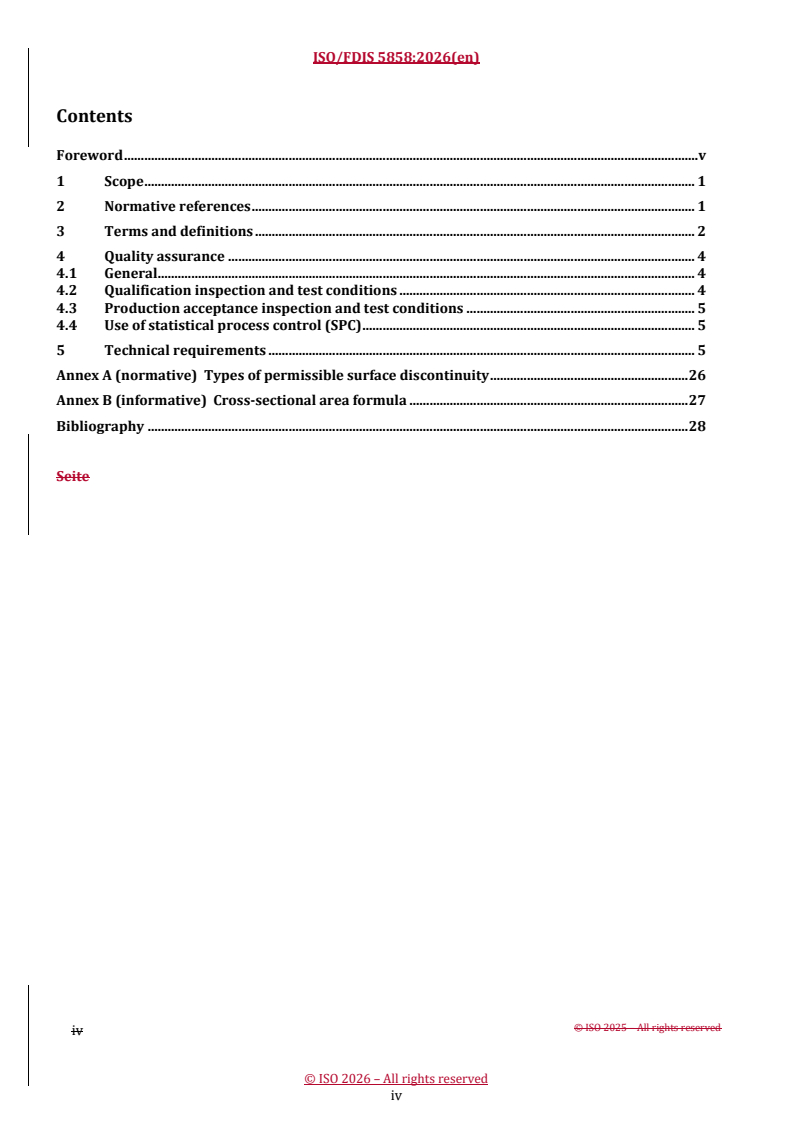
Contents
Foreword . v
1 Scope . 1
2 Normative references . 1
3 Terms and definitions . 2
4 Quality assurance . 4
4.1 General . 4
4.2 Qualification inspection and test conditions . 4
4.3 Production acceptance inspection and test conditions . 5
4.4 Use of statistical process control (SPC) . 5
5 Technical requirements . 5
Annex A (normative) Types of permissible surface discontinuity . 26
Annex B (informative) Cross-sectional area formula . 27
Bibliography . 28
Seite
iv
iv
Foreword
ISO (the International Organization for Standardization) is a worldwide federation of national standards
bodies (ISO member bodies). The work of preparing International Standards is normally carried out through
ISO technical committees. Each member body interested in a subject for which a technical committee has been
established has the right to be represented on that committee. International organizations, governmental and
non-governmental, in liaison with ISO, also take part in the work. ISO collaborates closely with the
International Electrotechnical Commission (IEC) on all matters of electrotechnical standardization.
The procedures used to develop this document and those intended for its further maintenance are described
in the ISO/IEC Directives, Part 1. In particular, the different approval criteria needed for the different types of
ISO document should be noted. This document was drafted in accordance with the editorial rules of the
ISO/IEC Directives, Part 2 (see www.iso.org/directives).
ISO draws attention to the possibility that the implementation of this document may involve the use of (a)
patent(s). ISO takes no position concerning the evidence, validity or applicability of any claimed patent rights
in respect thereof. As of the date of publication of this document, ISO had not received notice of (a) patent(s)
which may be required to implement this document. However, implementers are cautioned that this may not
represent the latest information, which may be obtained from the patent database available at
www.iso.org/patents. ISO shall not be held responsible for identifying any or all such patent rights.
Any trade name used in this document is information given for the convenience of users and does not
constitute an endorsement.
For an explanation of the voluntary nature of standards, the meaning of ISO specific terms and expressions
related to conformity assessment, as well as information about ISO's adherence to the World Trade
Organization (WTO) principles in the Technical Barriers to Trade (TBT), see www.iso.org/iso/foreword.html.
This document was prepared by Technical Committee ISO/TC 20, Aircraft and space vehicles, Subcommittee
SC 4, Aerospace fastener systems.
This third edition cancels and replaces the second edition (ISO 5858:1999), which has been technically
revised.
The main changes are as follows:
— — normative references have been updated;
— — the structure of Table 1Table 1 has been changed;
— — new tables for sampling have been added.
Any feedback or questions on this document should be directed to the user’s national standards body. A
complete listing of these bodies can be found at www.iso.org/members.html.
v
DRAFT International Standard ISO/DIS 5858:2025(en)
Aerospace — Nuts, self-locking, with maximum operating
temperature less than or equal to 425 °C — Procurement
specification
1 Scope
This document specifies the required characteristics for metric self-locking nuts, with MJ threads, for use in
aerospace construction at a maximum temperature less than or equal to 425 °C.
It is applicable to nuts as defined above, provided that reference is made to this document in the relevant
definition document.
2 Normative references
The following documents are referred to in the text in such a way that some or all of their content constitutes
requirements of this document. For dated references, only the edition cited applies. For undated references,
the latest edition of the referenced document (including any amendments) applies.
ISO 691, Assembly tools for screws and nuts — Wrench and socket openings — Tolerances for general use
ISO 1463, Metallic and oxide coatings — Measurement of coating thickness — Microscopical method
ISO 2859-1, Sampling procedures for inspection by attributes — Part 1: Sampling schemes indexed by
acceptance quality limit (AQL) for lot-by-lot inspection
ISO 3452--1, Non-destructive testing — Penetrant testing — Part 1: General principles
ISO 3887, Steels — Determination of the depth of decarburization
ISO 5855-2, Aerospace — MJ threads — Part 2: Limit dimensions for bolts and nuts
ISO 7403, Aerospace — Spline drives — Wrenching configuration — Metric series
ISO 7481, Aerospace — Nuts, self-locking, with maximum operating temperature less than or equal to 425 °C —
Test methods
ISO 7870-1, Control charts — Part 1: General guidelines
ISO 7870-2, Control charts — Part 2: Shewhart control charts
ISO 7870-3, Control charts — Part 3: Acceptance control charts
ISO 8788, Aerospace — Nuts, metric — Tolerances of form and position
ISO 9227, Corrosion tests in artificial atmospheres — Salt spray tests
ISO 9934, Non-destructive testing — Magnetic particle testing
ISO 21920--3, Geometrical product specifications (GPS) — Surface texture: Profile — Part 3: Specification
operators
ASTM E1417, Standard Practice for Liquid Penetrant Testing
ASTM E1444, Standard Practice for Magnetic Particle Testing
AS/EN 9138, Aerospace Series - Quality Management Systems Statistical Product Acceptance Requirements
3 Terms and definitions
For the purposes of this document, the following terms and definitions apply.
ISO and IEC maintain terminology databases for use in standardization at the following addresses:
— — ISO Online browsing platform: available at https://www.iso.org/obp
— — IEC Electropedia: available at https://www.electropedia.org/
3.1 3.1
definition document
document specifying all the requirements for nuts, i.e.:
— — metallurgical requirements;
— — geometrical and dimensional requirements;
— — functional requirements (strength and temperature classes)
Note 1 to entry: The definition document may be an International Standard, a national standard, or an in-house
standard or drawing.
3.2 3.2
finished nut
nut ready for use, inclusive of any possible treatments or surface coatings, as specified in the definition
document (3.1(3.1))
3.3
3.3 Production
production batch
quantity of finished nuts (3.2,), manufactured using the same process, from a single material cast (single heat
of alloy), having the same number of definition document (3.1definition document (3.1),), same thread and
diameter code, heat treated together to the same specified condition and produced as one continuous run
in the course of the same production cycle, following the same manufacturing route and having undergone all
the relevant heat treatments and surface treatments.
3.33.4 3.4
crack
rupture in the material which canextendcan extend in any direction and which can be intercrystalline or
transcrystalline in character
3.43.5 3.5
seam
open surface defect resulting from extension of the metal
3.53.6 3.6
lap
folding over of unwelded metal that can arise when the material is formed (drawing) or in the finished product
(pressing or forging)
3.63.7 3.7
inclusion
non-metallic particle originating from the material manufacturing process
Note 1 to entry: These particles can be isolated or arranged in strings.
3.73.8 3.11
sampling plan
plan according to which one or more samples are taken in order to obtain information and possibly reach a
decision
Note 1 to entry: In this document, each sampling plan specifies the number of nuts to be inspected as a
function of the size of the batch (3.3(3.3)) and the acceptance number [number of defective items acceptable (Ac)]. See
ISO 2859-1.
3.83.9 3.12
simple random sampling
sampling of n items from a population of N items in such a way that all possible combinations of n items have
the same probability of being chosen
3.93.10 3.15
self-locking torque
torque to be applied to the nut or bolt to maintain its movement of rotation in relation to the associated part,
the assembly being under no axial load and the nut-locking system being completely engaged with the bolt
(two pitches minimum protrusion, including the end chamfer)
3.103.11 3.16
seating torque
tightening torque to be applied to the nut or bolt to introduce or to increase the axial load in the assembly
3.113.12 3.18
breakaway torque
torque required to start unscrewing the nut or bolt with respect to the associated part, with the nut-locking
device still fully engaged on the bolt, but after the axial load in the assembly has been removed by unscrewing
half a turn followed by a halt in rotational movement
3.123.13 3.19
wrench torque
tightening and untightening torques which the driving feature of the nut has to withstand repeatedly without
any permanent deformation which would prevent the appropriate wrench from being used or preclude re-
use of the nut
3.133.14 3.20
IRR
Initial (or Inspection) Reliability Requirement
initial reliability requirement
inspection reliability requirement
minimum acceptable outgoing yield or probability of conformance
4 Quality assurance
4.1 General
4.1.1 Manufacturer's approval
The manufacturer shall be capable of continuous production of nuts meeting the quality requirements
specified in this document.
4.1.2 Qualification of nuts
The purpose of qualification inspections and tests of nuts is to check that the design and manufacturing
conditions for a nut allow it to satisfy the requirements of this document.
4.1.3 Production acceptance of nuts
The purpose of production acceptance inspection and tests of a nut is to check, as simply as possible, using a
method which is inexpensive but most representative of the actual conditions of use, with the uncertainty
inherent in statistical sampling, that the nuts satisfy the requirements of this document.
Production acceptance inspections and tests shall be carried out by, or under the responsibility of, the
manufacturer.
The manufacturer is responsible for the quality of the nuts manufactured.
4.2 Qualification inspection and test conditions
Qualification inspections and tests (requirements, methods, numbers of nuts) are specified in Table 1Table 1.
They shall be carried out on:
— — each type and diameter of nut;
— — 100 nuts selected from a single batch by simple random sampling.
The test programme can be reduced, or qualification of a nut granted, without inspection or testing; any such
decision shall be based on the results obtained on similar types and diameters of nuts provided that the design
and manufacturing conditions are identical.
The inspections and tests shall be repeated on any nut if the supplier or the manufacturing conditions have
changed.
Qualification inspections and tests are summarized in Table 2Table 2.
4.3 Production acceptance inspection and test conditions
Production acceptance inspections and tests (requirements, methods, numbers of nuts) are specified in
Table 1Table 1. They shall be carried out on each batch. Nuts from the batch to be tested shall be selected by
simple random sampling.
Each nut may be subjected to several inspections or tests.
The nuts to be subjected to destructive inspections or tests may be those on which non-destructive inspections
or tests have been carried out.
If a more stringent inspection is deemed necessary, all or part of the qualification inspections and tests may
be performed during the production acceptance inspections and testing. In this case, the number of nuts
submitted is the same as that submitted for qualification inspections and tests.
Batches declared unacceptable after the production acceptance inspections and tests shall be submitted for
re-inspection or testing only after either all the defective units have been removed or defects have been
corrected, or both. In this case, the attribute(s) which caused the rejection shall be verified using a sample of
twice the normal size but the maximum number of allowed defective items shall be the same as in the original
inspection.
Production acceptance inspections and tests are summarized in Table 2Table 2.
4.4 Use of statistical process control (SPC)
Where a characteristic is obtained by a controlled statistical process, in order to declare conformity of the
characteristic, the manufacturer canmay refrain from the final systematic sampling provided for in this
document, if he/she is can formally justify this choice by using the standards quoted in it as a basis.
This justification will include the following phases:
— — analysis of the product's key characteristics;
— — analysis of the risks for each implemented process;
— — determination of either the parameters or characteristics, or both, to be respected under SPC;
— — determination of the capabilities of each process;
— — drawing up an inspection plan and integration in the manufacturing process;
— — drawing up of routes and control charts (e.g. ISO 7870-1, ISO 7870-2, ISO 7870-3);
— — use of control charts for data consolidation;
— — determination of the audits to be run and the control to be carried out to ensure reliability of the
device.
To be usable in production, this process shall be validated beforehand by the qualifying body, either during
the qualification phase or a posteriori, according to the case, by analysing the justificatory file and the results
of the qualification inspections such as provided for in Clause 5Clause 5.
5 Technical requirements
The technical requirements are given in Table 1Table 1.
They complement the requirements of all other standards or specifications referenced in the definition
document for the nut.
NOTE If there is no International Standard specifying the method to be used, a prior agreement shall
be reached between the user and the manufacturer with respect to the following inspections and tests:
— spectrographic analysis or spectroscopic analysis of the material (Table 1(Table 1,, item-no
111);
— micrographic inspection of the structure of the material (Table 1(Table 1,, item-no 1-2);
— inspection for carburization or decarburization (Table 1(Table 1,, item-no 1-3);
— magnetoscopic or fluorescent inspection for surface discontinuities (Table 1(Table 1,, item-no
1-4);
— magnetic permeability inspection (Table 1(Table 1,, item-no 1-6);
— inspection by chemical reagent to determine type of surface coating (Table 1(Table 1,, item-no
2-2);
— tactile inspection or inspection using a profilometer to determine surface roughness
(Table 1(Table 1,, item-no 3-2).
Table 1 — Technical requirements
Inspection and test Sample
Item-no Characteristic Technical requirement Test category
method size
1 Material
a
1-1 Type The material shall be as Spectrographic analysis Qualification 3
specified in the definition or spectroscopic
document. analysis (method to be
agreed upon between
the user and
manufacturer).
a
1-2 Microstructure Nuts shall be free from Micrographic Qualification 5
cracks. The inclusions inspection of a
shall not exceed the transverse section
values specified in the (method to be agreed
material standard, when upon between the user
specified therein. and manufacturer).
a
1-3 Carburization No area of carburization Microscopic Qualification 5
or and no area of total examination in
decarburizatio decarburization is accordance with the
b
n permissible. An area of method agreed upon
partial decarburization is between the user and
permissible provided manufacturer or
that the thickness over Vickers microhardness
the area is less than or measurement (using a
equal to 0,1 mm. 300 g load) in
accordance with
ISO 3887, or an
Inspection and test Sample
Item-no Characteristic Technical requirement Test category
method size
equivalent method,
shall be carried out.
b a
1-4 Surface The types of permissible Magnetoscopic Qualification 5
discontinuities surface discontinuity (method to be agreed
c
shall be in accordance upon between the user
with Annex Aannex A. and manufacturer, shall
The maximum depth in accordance with. ISO
Production Tables 1
allowed for these 9934 or ASTM E1444)
Acceptance 1Tables
discontinuities is given in or penetrant inspection
11 and
Table 17Table 17. in accordance with ISO
3452-1 or ASTM E1417.
Nuts shall be free from In the event of any
cracks. doubt arising as to the
nature of the defects
detected, inspect
defective nuts at a
magnification of × 10
after sectioning.
a
1-5 Hardness The hardness of the In accordance with Qualification 5
finished nuts shall be ISO 7481.
Production Table 16
within the limits
acceptance Table 16,
specified in the definition
,
document for the nut or
column
in the material standard.
B
a
1-6 Non- The magnetic Method to be agreed Qualification 5
d
magnetism permeability of the upon between the user
finished nuts shall be less and manufacturer.
than 2 (air = 1) in a
magnetic field of
15 916 A/m.
2 Surface coating
a
2-1 Presence Surface coating shall be Visual examination. Qualification 100
specified in the definition
Production Tables 1
document applied at the
acceptance 1Tables
locations.
11 and
e a
2-2 Type Surface coating shall be Visual examination or Qualification 3
as specified in the inspection by chemical
Production Table 16
definition document. reagent in case of doubt
acceptance Table 16,
(method to be agreed
,
upon between the user
column
and manufacturer).
A
e a
2-3 Thickness The thickness of the Device for measuring Qualification 5
surface coating shall be the thickness of surface
Production Table 16
within the limits coatings, e.g.
acceptance Table 16,
specified in the definition
ISO 1463 for micro
,
document.
graphic method or ISO
column
If no limits are specified 3497 for X-Ray method
in the definition
Inspection and test Sample
Item-no Characteristic Technical requirement Test category
method size
document, the In case of doubt, B for ISO
measurement position is micrographic 1463
specified as the inspection shall be
functional surfaces: carried out in
Table
bearing surface and accordance with
16Tab
f
thread surface ISO 1463
le 16,
,
Column
A for ISO
a
2-4 Adhesion Qualification
a) of There shall be no sign of Heat the nuts to the 5
molybdenum flaking, cracking or maximum operating
disulfide softening after test. temperature specified
(MoS2) in the definition
document for 3 h, then
cool the nuts slowly to
ambient temperature.
b) of silver There shall be no sign of Heat the nuts to the
blisters or exfoliation maximum operating
after test. temperature specified
in the definition
document for 4 h, then
rapidly cool the nuts
with compressed air (at
a pressure of 0,3 MPa to
0,4 MPa) by means of a
nozzle with a diameter
of 1,5 mm held close to
the surface of the nuts.
a
2-5 Corrosion The surface coating Neutral salt spray (NSS) Qualification 8
b
resistance specified in the definition test shall be carried out
document (protective in accordance with
treatment and, possibly, ISO 9227.
lubrication) shall ensure
Exposure for 336 h
effective protection
without signs of
against corrosion.
corrosion.
3 Surface condition
a
3-1 Appearance Finished nuts shall be Visual examination. In Qualification 100
free from burrs and the event of any doubt
Production Tables 1
bumps. arising as to the nature
acceptance 1Tables
of the defects detected,
11 and
inspect defective nuts
at a magnification
of × 10 after sectioning.
a
3-2 Surface The surface roughness of In accordance with ISO Qualification 5
c
Roughness the nuts shall be as 21920-3.
Inspection and test Sample
Item-no Characteristic Technical requirement Test category
method size
specified in the definition Visual examination.
document.
a
4 Marking The nuts shall be marked Visual examination. Qualification 100
as specified in the
Production Tables 1
definition document.
acceptance 1Tables
11 and
5 Dimensions
a
5-1 General The dimensions and any Suitable limit gauges or Qualification 20
dimensions deviations in form and measuring instruments.
Production Tables 1
position, measured at
acceptance 1Tables
ambient temperature,
11,14,14
shall be within the limits
and
specified in the definition
document.
a
5-2 Thread The thread shall be in Qualification 20
conformity with the
Production Tables 1
definition document.
acceptance 1Tables
11 and
— — Nuts with
locking by plastic
insert
The threaded GO gauge Threaded GO/NO GO
shall be capable of being gauges.
freely screwed up to the
locking device
— — All-metal
selflocking nuts
The threaded GO gauge Threaded GO/NO GO
shall be capable of being gauges.
freely screwed for at
least one turn.
For nuts with molybde- Bolt with standard
nummolybdenum threads in accordance
disulfide dry lubrication, with ISO 5855-2 shall
a bolt with standard be used.
threads shall be capable
of being freely screwed
for at least one turn.
a
5-3 Wrench The deformation neces- Female gauge satisfying Qualification 20
g
engagement sarynecessary to achieve the following
Production Tables 1
internal locking shall not dimensional
acceptance 1Tables
prevent a wrench from requirements:
11 and
being used.
A female gauge, of a)
identical form to the Hexa
Inspection and test Sample
Item-no Characteristic Technical requirement Test category
method size
driving feature of the nut gonal and
being inspected, shall be bihexagonal drive
capable of being freely
Minimum tolerances
installed over a length
specified shall be in
equal to the wrenching
accordance
height specified in the
withISOwith ISO 691.
definition document.
b)
Splin
e drive
Maximum material
condition of female
wrenching device shall
be in accordance with
ISO 7403.
a
5-4 Squareness of Any out-of-squareness of In accordance with Qualification 20
bearing surface the bearing surface, ISO 7481.
Production Tables 1
relative to the thread,
acceptance 1Tables
shall be within the limits
11 to
specified in ISO 8788.
6 Performance
a
6-1 Axial load The finished nuts shall In accordance with Qualification 8 for
withstand the axial load ISO 7481. 80 %
specified for their tensile load and
strength class, as laid 8 for
100 %
down in the definition
document. load
Production Table 16
acceptance Table 16,
,
column
B
a) 80 % test The nuts shall not The load to be applied
display: is specified in
Table 3Table 3.
— — any cracks;
— — any permanent
set;
— — any significant
reduction in their
locking torque.
b) 100 % test The nuts shall not The load to be applied
display: is specified in
h h
Table 4Table 4 .
© I
...
Questions, Comments and Discussion
Ask us and Technical Secretary will try to provide an answer. You can facilitate discussion about the standard in here.
Loading comments...