

ISO 13957:1997
(Main)Plastics pipes and fittings — Polyethylene (PE) tapping tees — Test method for impact resistance
General Information
- Abstract
- Status
- Published
- Publication Date
- 24-Dec-1997
- Current Stage
- 9092 - International Standard to be revised
- Start Date
- 08-Jun-2026
- Completion Date
- 29-Aug-2026
Buy Documents
ISO 13957:1997 - Plastics pipes and fittings — Polyethylene (PE) tapping tees — Test method for impact resistance Released:12/25/1997
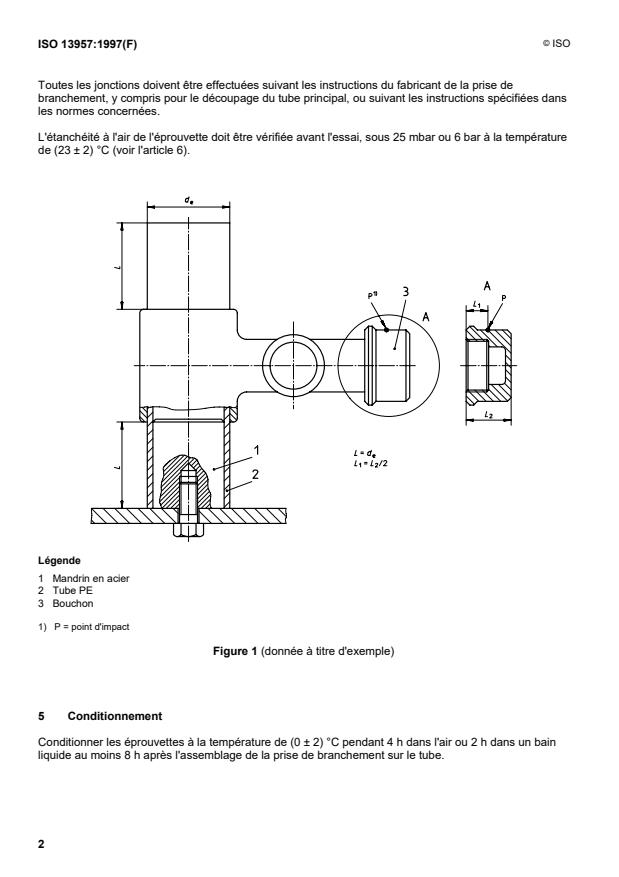
ISO 13957:1997 - Tubes et raccords en matieres plastiques — Prises de branchement en polyéthylene (PE) — Méthode d'essai de la résistance au choc Released:12/25/1997
Overview
ISO 13957:1997 specifies a standardized test method for impact resistance of polyethylene (PE) tapping tees used in plastic pipes and fittings for fluid conveyance. The standard describes the apparatus, conditioning, test procedure and acceptance checks to determine whether a PE tapping tee withstands impact without visible damage or loss of airtightness.
Key Topics and Requirements
- Scope: Impact-resistance testing of PE tapping tees intended for fluid conveyance.
- Test principle: A striker weight is dropped vertically onto the cap or branch top of a tapping tee fused to a pipe; two impacts are applied from opposite directions, then the joint is inspected for cracks and airtightness loss.
- Apparatus
- Falling-weight machine with guide ensuring striker velocity ≥ 95% of theoretical.
- Striker mass: 2 500 g ± 20 g or 5 000 g ± 20 g with a 50 mm hemispherical striking surface.
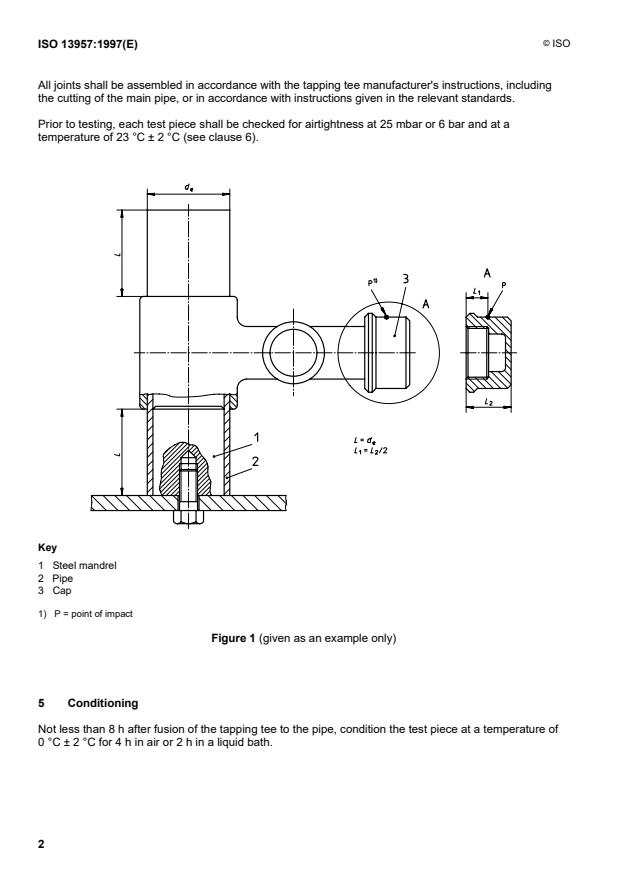
- Rigid test holder with steel mandrel to prevent rotation.
- Test pieces and assembly
- Minimum three test pieces per tapping tee size.
- Complete pipe/tapping tee assemblies fused according to manufacturer instructions or relevant standards.
- Pre-test airtightness check at 25 mbar or 6 bar at 23 °C ± 2 °C.
- Conditioning
- Wait at least 8 hours after fusion, then condition at 0 °C ± 2 °C for 4 h (air) or 2 h (liquid bath).
- Procedure
- Drop height: 2 000 mm ± 10 mm along axis parallel to pipe.
- Point of impact: within 30 mm of the branch top, preferably on a cylindrical cap section.
- After two opposite impacts, visually inspect (no magnification) for cracks/ruptures and verify airtightness at 23 °C ± 2 °C using internal pressure 25 mbar or 6 bar.
- Test report must include reference to ISO 13957, sample identification, test temperature, striker mass, drop height, number of pieces, failure types, observations, test date and laboratory.
Applications and Who Uses It
- Manufacturers of PE tapping tees and pipe fittings use ISO 13957 to validate product durability and quality control.
- Independent testing laboratories adopt the method to certify impact resistance and support compliance claims.
- Utilities, engineers and specifiers rely on the standard to select components for water, gas and other fluid distribution systems where resistance to accidental impact is critical.
- Regulators and procurement teams reference the test when setting acceptance criteria for installed pipeline accessories.
Related Standards
- Prepared by ISO/TC 138 (Plastics pipes, fittings and valves), Subcommittee SC 5 on general properties and test methods.
- ISO 13957 complements other standards covering fusion assembly, material specifications and general test methods for plastic pipes and fittings (refer to manufacturer or national bodies for specific fusion/assembly standards).
Keywords: ISO 13957, polyethylene tapping tees, PE tapping tees, impact resistance test, plastic pipes and fittings, tapping tee impact test, pipe fitting testing.
Relations
- Effective Date
- 09-Feb-2026
- Effective Date
- 09-Feb-2026
- Effective Date
- 09-Feb-2026
- Effective Date
- 09-Feb-2026
Buy Documents
ISO 13957:1997 - Plastics pipes and fittings — Polyethylene (PE) tapping tees — Test method for impact resistance Released:12/25/1997
ISO 13957:1997 - Tubes et raccords en matieres plastiques — Prises de branchement en polyéthylene (PE) — Méthode d'essai de la résistance au choc Released:12/25/1997
Get Certified
Connect with accredited certification bodies for this standard

Institut za varilstvo d.o.o. (Welding Institute)
Slovenia's leading welding institute since 1952. ISO 3834, EN 1090, pressure equipment certification, NDT personnel, welder qualification. Only IIW Au
Sponsored listings
Frequently Asked Questions
ISO 13957:1997 is a standard published by the International Organization for Standardization (ISO). Its full title is "Plastics pipes and fittings — Polyethylene (PE) tapping tees — Test method for impact resistance". This standard covers: Plastics pipes and fittings — Polyethylene (PE) tapping tees — Test method for impact resistance
Plastics pipes and fittings — Polyethylene (PE) tapping tees — Test method for impact resistance
ISO 13957:1997 is classified under the following ICS (International Classification for Standards) categories: 23.040.45 - Plastics fittings. The ICS classification helps identify the subject area and facilitates finding related standards.
ISO 13957:1997 has the following relationships with other standards: It is inter standard links to EN 1555-3:2025, EN 12201-3:2024, EN ISO 16486-3:2020, EN ISO 16486-3:2025. Understanding these relationships helps ensure you are using the most current and applicable version of the standard.
ISO 13957:1997 is available in PDF format for immediate download after purchase. The document can be added to your cart and obtained through the secure checkout process. Digital delivery ensures instant access to the complete standard document.
Standards Content (Sample)
INTERNATIONAL ISO
STANDARD 13957
First edition
1997-12-15
Plastics pipes and fittings — Polyethylene
(PE) tapping tees — Test method for impact
resistance
Tubes et raccords en matières plastiques — Prises de branchement
en polyéthylène (PE) — Méthode d'essai de la résistance au choc
A
Reference number
Foreword
ISO (the International Organization for Standardization) is a worldwide
federation of national standards bodies (ISO member bodies). The work of
preparing International Standards is normally carried out through ISO
technical committees. Each member body interested in a subject for which
a technical committee has been established has the right to be represented
on that committee. International organizations, governmental and non-
governmental, in liaison with ISO, also take part in the work. ISO
collaborates closely with the International Electrotechnical Commission
(IEC) on all matters of electrotechnical standardization.
Draft International Standards adopted by the technical committees are
circulated to the member bodies for voting. Publication as an International
Standard requires approval by at least 75 % of the member bodies casting
a vote.
International Standard ISO 13957 was prepared by Technical Committee
ISO/TC 138, Plastics pipes, fittings and valves for the transport of fluids,
Subcommittee SC 5, General properties of pipes, fittings and valves
of plastic materials and their accessories — Test methods and basic
specifications.
© ISO 1997
All rights reserved. Unless otherwise specified, no part of this publication may be reproduced
or utilized in any form or by any means, electronic or mechanical, including photocopying and
microfilm, without permission in writing from the publisher.
International Organization for Standardization
Case postale 56 • CH-1211 Genève 20 • Switzerland
Internet central@iso.ch
X.400 c=ch; a=400net; p=iso; o=isocs; s=central
Printed in Switzerland
ii
©
INTERNATIONAL STANDARD ISO ISO 13957:1997(E)
Plastics pipes and fittings — Polyethylene (PE) tapping tees —
Test method for impact resistance
1 Scope
This International Standard specifies a test method for the impact resistance of polyethylene (PE)
tapping tees.
This International Standard is applicable to PE tapping tees intended for the conveyance of fluids.
2 Principle
The cap (or the top of the branch) of a tapping tee is subjected to impact by means of a weight, falling
from a constant height, parallel to the axis of the pipe to which the tapping tee is fused.
After two impacts from opposite directions parallel to the axis of the pipe, the tee is inspected for visible
damage and for loss of airtightness.
The test is carried out at 0 °C ± 2 °C or another specified temperature.
3 Apparatus
3.1 Falling-weight test machine, incorporating a main frame with guide bars or a guide tube fixed in
the vertical position to guide a striker so that, when the striker is released, it falls vertically and freely and
the velocity of the striker at the moment of impact with the tapping tee is not less than 95 % of the
theoretical velocity.
3.2 Striker, with a mass of 2 500 g ± 20 g or 5 000 g ± 20 g and with a hemispherical striking surface
of diameter 50 mm.
3.3 Rigid test piece holder with a steel mandrel,
...
NORME ISO
INTERNATIONALE 13957
Première édition
1997-12-15
Tubes et raccords en matières
plastiques — Prises de branchement
en polyéthylène (PE) — Méthode d'essai
de la résistance au choc
Plastics pipes and fittings — Polyethylene (PE) tapping tees — Test
method for impact resistance
A
Numéro de référence
Avant-propos
L'ISO (Organisation internationale de normalisation) est une fédération
mondiale d'organismes nationaux de normalisation (comités membres de
l'ISO). L'élaboration des Normes internationales est en général confiée aux
comités techniques de l'ISO. Chaque comité membre intéressé par une
étude a le droit de faire partie du comité technique créé à cet effet. Les
organisations internationales, gouvernementales et non gouvernementales,
en liaison avec l'ISO, participent également aux travaux. L'ISO collabore
étroitement avec la Commission électrotechnique internationale (CEI) en
ce qui concerne la normalisation électrotechnique.
Les projets de Normes internationales adoptés par les comités techniques
sont soumis aux comités membres pour vote. Leur publication comme
Normes internationales requiert l'approbation de 75 % au moins des
comités membres votants.
La Norme internationale ISO 13957 a été élaborée par le comité technique
ISO/TC 138, Tubes, raccords et robinetterie en matières plastiques pour le
transport des fluides, sous-comité SC 5, Propriétés générales des tubes,
raccords et robinetteries en matières plastiques et leurs accessoires —
Méthodes d'essais et spécifications de base.
© ISO 1997
Droits de reproduction réservés. Sauf prescription différente, aucune partie de cette publi-
cation ne peut être reproduite ni utilisée sous quelque forme que ce soit et par aucun pro-
cédé, électronique ou mécanique, y compris la photocopie et les microfilms, sans l'accord
écrit de l'éditeur.
Organisation internationale de normalisation
Case postale 56 • CH-1211 Genève 20 • Suisse
Internet central@iso.ch
X.400 c=ch; a=400net; p=iso; o=isocs; s=central
Imprimé en Suisse
ii
©
NORME INTERNATIONALE ISO ISO 13957:1997(F)
Tubes et raccords en matières plastiques — Prises de branchement
en polyéthylène (PE) — Méthode d'essai de la résistance au choc
1 Domaine d'application
La présente Norme internationale prescrit une méthode d'essai pour déterminer la résistance aux chocs
des prises de branchement en polyéthylène (PE).
Elle est applicable aux prises de branchement en polyéthylène (PE) destinées au transport des fluides.
2 Principe
Le bouchon ou l'extrémité du fut de la prise de branchement est soumis(e) à un choc à l'aide d'une
masse qui tombe d'une hauteur constante, parallèlement à l'axe du tube auquel cette prise de
branchement est soudée.
Après deux chocs suivant des sens opposés, mais parallèles à l'axe principal du té, les dommages
visibles et la perte d'étanchéité à l'air sont contrôlés.
L'essai est effectué à (0 ± 2) °C ou à une température spécifiée.
3 Appareillage
3.1 Machine d'essai de chute de masse, comportant un bâti, avec des rails ou un tube de guidage
fixé(s) en position verticale pour recevoir un percuteur et lui permettre de tomber verticalement et
librement, de telle sorte qu'au moment du choc sur la prise de branchement, la vitesse du percuteur ne
soit pas inférieure à 95 % de la vitesse théorique.
3.2 Percuteur, d'une masse de 2 500 g ± 20 g ou de 5 000 g ± 20 g, avec une surface de frappe
hémisphérique de diamètre 50 mm.
3.3 Support rigide avec mandrin en acier, capable
...