Aerospace series - Constant displacement hydraulic motors - General specifications

ISO 9206:2016 establishes the general requirements for constant displacement hydraulic motors, suitable for use in aircraft hydraulic systems at pressures up to 35 000 kPa (5 000 psi). Primary and secondary function motors are covered in ISO 9206:2016; however, actuators with internal rotation angle limits and low-speed motors are not covered. ISO 9206:2016 is to be used in conjunction with the detail specification that is particular to each application.

Série aérospatiale — Moteurs hydrauliques à cylindrée fixe — Spécifications générales

General Information

Status
Withdrawn
Publication Date
02-Mar-2016
Withdrawal Date
02-Mar-2016
Current Stage
9599 - Withdrawal of International Standard
Start Date
07-Dec-2018
Completion Date
13-Dec-2025
Ref Project

Relations

Standard
ISO 9206:2016 - Aerospace series -- Constant displacement hydraulic motors -- General specifications
English language
34 pages
sale 15% off
Preview
sale 15% off
Preview
Standard
ISO 9206:2016 - Aerospace series -- Constant displacement hydraulic motors -- General specifications
English language
34 pages
sale 15% off
Preview
sale 15% off
Preview

Frequently Asked Questions

ISO 9206:2016 is a standard published by the International Organization for Standardization (ISO). Its full title is "Aerospace series - Constant displacement hydraulic motors - General specifications". This standard covers: ISO 9206:2016 establishes the general requirements for constant displacement hydraulic motors, suitable for use in aircraft hydraulic systems at pressures up to 35 000 kPa (5 000 psi). Primary and secondary function motors are covered in ISO 9206:2016; however, actuators with internal rotation angle limits and low-speed motors are not covered. ISO 9206:2016 is to be used in conjunction with the detail specification that is particular to each application.

ISO 9206:2016 establishes the general requirements for constant displacement hydraulic motors, suitable for use in aircraft hydraulic systems at pressures up to 35 000 kPa (5 000 psi). Primary and secondary function motors are covered in ISO 9206:2016; however, actuators with internal rotation angle limits and low-speed motors are not covered. ISO 9206:2016 is to be used in conjunction with the detail specification that is particular to each application.

ISO 9206:2016 is classified under the following ICS (International Classification for Standards) categories: 49.080 - Aerospace fluid systems and components. The ICS classification helps identify the subject area and facilitates finding related standards.

ISO 9206:2016 has the following relationships with other standards: It is inter standard links to ISO 4126-7:2013/Amd 1:2016, ISO 9206:2018, ISO 12333:2000, ISO 9206:1990. Understanding these relationships helps ensure you are using the most current and applicable version of the standard.

You can purchase ISO 9206:2016 directly from iTeh Standards. The document is available in PDF format and is delivered instantly after payment. Add the standard to your cart and complete the secure checkout process. iTeh Standards is an authorized distributor of ISO standards.

Standards Content (Sample)


INTERNATIONAL ISO
STANDARD 9206
Second edition
2016-03-01
Aerospace series — Constant
displacement hydraulic motors —
General specifications
Série aérospatiale — Moteurs hydrauliques à cylindrée fixe —
Spécifications générales
Reference number
©
ISO 2016
© ISO 2016, Published in Switzerland
All rights reserved. Unless otherwise specified, no part of this publication may be reproduced or utilized otherwise in any form
or by any means, electronic or mechanical, including photocopying, or posting on the internet or an intranet, without prior
written permission. Permission can be requested from either ISO at the address below or ISO’s member body in the country of
the requester.
ISO copyright office
Ch. de Blandonnet 8 • CP 401
CH-1214 Vernier, Geneva, Switzerland
Tel. +41 22 749 01 11
Fax +41 22 749 09 47
copyright@iso.org
www.iso.org
ii © ISO 2016 – All rights reserved

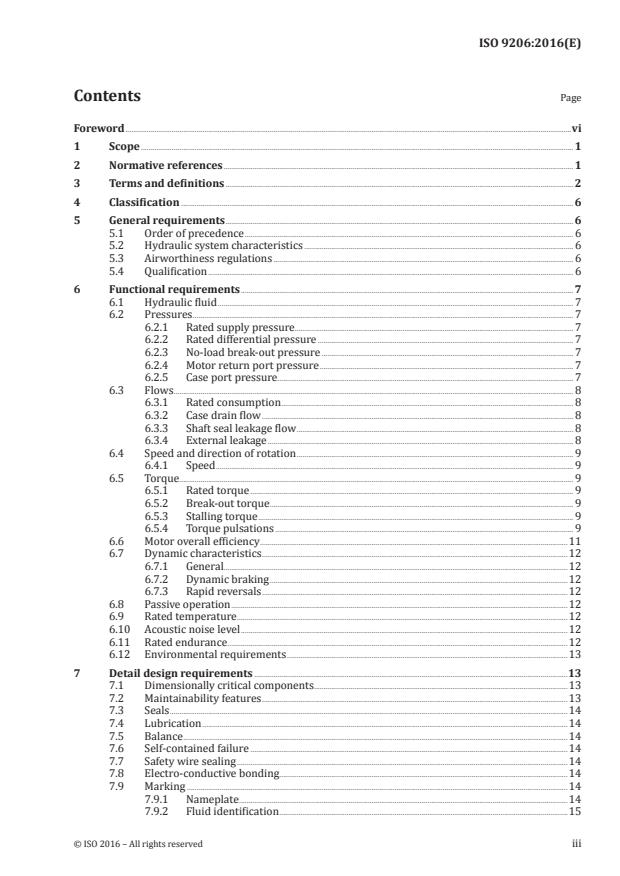
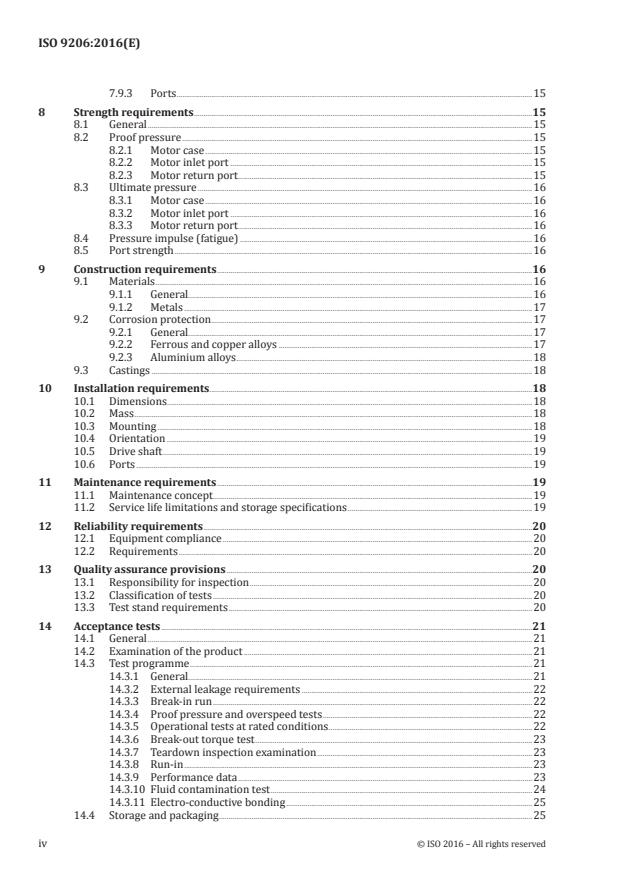
Contents Page
Foreword .vi
1 Scope . 1
2 Normative references . 1
3 Terms and definitions . 2
4 Classification . 6
5 General requirements . 6
5.1 Order of precedence . 6
5.2 Hydraulic system characteristics . 6
5.3 Airworthiness regulations . 6
5.4 Qualification . 6
6 Functional requirements . 7
6.1 Hydraulic fluid . 7
6.2 Pressures . 7
6.2.1 Rated supply pressure. 7
6.2.2 Rated differential pressure . 7
6.2.3 No-load break-out pressure . 7
6.2.4 Motor return port pressure . 7
6.2.5 Case port pressure . . 7
6.3 Flows . 8
6.3.1 Rated consumption . 8
6.3.2 Case drain flow . 8
6.3.3 Shaft seal leakage flow . 8
6.3.4 External leakage . 8
6.4 Speed and direction of rotation . 9
6.4.1 Speed . 9
6.5 Torque . 9
6.5.1 Rated torque . 9
6.5.2 Break-out torque . 9
6.5.3 Stalling torque . 9
6.5.4 Torque pulsations . 9
6.6 Motor overall efficiency .11
6.7 Dynamic characteristics .12
6.7.1 General.12
6.7.2 Dynamic braking .12
6.7.3 Rapid reversals .12
6.8 Passive operation .12
6.9 Rated temperature .12
6.10 Acoustic noise level .12
6.11 Rated endurance .12
6.12 Environmental requirements .13
7 Detail design requirements .13
7.1 Dimensionally critical components .13
7.2 Maintainability features .13
7.3 Seals .14
7.4 Lubrication .14
7.5 Balance .14
7.6 Self-contained failure .14
7.7 Safety wire sealing .14
7.8 Electro-conductive bonding .14
7.9 Marking .14
7.9.1 Nameplate .14
7.9.2 Fluid identification .15
7.9.3 Ports .15
8 Strength requirements .15
8.1 General .15
8.2 Proof pressure .15
8.2.1 Motor case .15
8.2.2 Motor inlet port .15
8.2.3 Motor return port .15
8.3 Ultimate pressure .16
8.3.1 Motor case .16
8.3.2 Motor inlet port .16
8.3.3 Motor return port .16
8.4 Pressure impulse (fatigue) .16
8.5 Port strength .16
9 Construction requirements .16
9.1 Materials .16
9.1.1 General.16
9.1.2 Metals .17
9.2 Corrosion protection .17
9.2.1 General.17
9.2.2 Ferrous and copper alloys .17
9.2.3 Aluminium alloys .18
9.3 Castings .18
10 Installation requirements.18
10.1 Dimensions .18
10.2 Mass .18
10.3 Mounting .18
10.4 Orientation .19
10.5 Drive shaft .19
10.6 Ports .19
11 Maintenance requirements .19
11.1 Maintenance concept .19
11.2 Service life limitations and storage specifications .19
12 Reliability requirements .20
12.1 Equipment compliance .20
12.2 Requirements .20
13 Quality assurance provisions .20
13.1 Responsibility for inspection .20
13.2 Classification of tests .20
13.3 Test stand requirements .20
14 Acceptance tests .21
14.1 General .21
14.2 Examination of the product .21
14.3 Test programme .21
14.3.1 General.21
14.3.2 External leakage requirements .22
14.3.3 Break-in run .22
14.3.4 Proof pressure and overspeed tests .22
14.3.5 Operational tests at rated conditions .22
14.3.6 Break-out torque test .23
14.3.7 Teardown inspection examination .23
14.3.8 Run-in .23
14.3.9 Performance data .23
14.3.10 Fluid contamination test .24
14.3.11 Electro-conductive bonding .25
14.4 Storage and packaging .25
iv © ISO 2016 – All rights reserved

15 Qualification procedures .25
15.1 General .25
15.2 Qualification procedure .25
15.2.1 Qualification by analogy .25
15.2.2 Motor qualification test report .25
15.2.3 Samples and program of qualification tests .25
15.3 Qualification testing .26
15.3.1 Dimensional check .26
15.3.2 Expanded envelope acceptance tests .26
15.3.3 Overspeed test .27
15.3.4 Operational test at overpressure .27
15.3.5 Calibration .27
15.3.6 Endurance testing .28
15.3.7 Environmental tests .31
15.3.8 Structural tests .32
15.3.9 Supplementary tests .33
Bibliography .34
Foreword
ISO (the International Organization for Standardization) is a worldwide federation of national standards
bodies (ISO member bodies). The work of preparing International Standards is normally carried out
through ISO technical committees. Each member body interested in a subject for which a technical
committee has been established has the right to be represented on that committee. International
organizations, governmental and non-governmental, in liaison with ISO, also take part in the work.
ISO collaborates closely with the International Electrotechnical Commission (IEC) on all matters of
electrotechnical standardization.
The procedures used to develop this document and those intended for its further maintenance are
described in the ISO/IEC Directives, Part 1. In particular the different approval criteria needed for the
different types of ISO documents should be noted. This document was drafted in accordance with the
editorial rules of the ISO/IEC Directives, Part 2 (see www.iso.org/directives).
Attention is drawn to the possibility that some of the elements of this document may be the subject of
patent rights. ISO shall not be held responsible for identifying any or all such patent rights. Details of
any patent rights identified during the development of the document will be in the Introduction and/or
on the ISO list of patent declarations received (see www.iso.org/patents).
Any trade name used in this document is information given for the convenience of users and does not
constitute an endorsement.
For an explanation on the meaning of ISO specific terms and expressions related to conformity
assessment, as well as information about ISO’s adherence to the WTO principles in the Technical
Barriers to Trade (TBT) see the following URL: Foreword - Supplementary information
The committee responsible for this document is ISO/TC 20, Aircraft and space vehicles, Subcommittee
SC 10, Aerospace fluid systems and components.
This second edition cancels and replaces the first edition (ISO 9206:1990) and ISO 12333:2000. The
entire document has been rewritten and it incorporates requirements from ISO 12333:2000.
vi © ISO 2016 – All rights reserved

INTERNATIONAL STANDARD ISO 9206:2016(E)
Aerospace series — Constant displacement hydraulic
motors — General specifications
1 Scope
This International Standard establishes the general requirements for constant displacement hydraulic
motors, suitable for use in aircraft hydraulic systems at pressures up to 35 000 kPa (5 000 psi).
Primary and secondary function motors (see Clause 4) are covered in this International Standard;
however, actuators with internal rotation angle limits and low-speed motors are not covered.
This International Standard is to be used in conjunction with the detail specification that is particular
to each application.
2 Normative references
The following documents, in whole or in part, are normatively referenced in this document and are
indispensable for its application. For dated references, only the edition cited applies. For undated
references, the latest edition of the referenced document (including any amendments) applies.
ISO 2093, Electroplated coatings of tin — Specification and test methods
ISO 2669, Environmental tests for aircraft equipment — Steady-state acceleration
ISO 2671, Environmental tests for aircraft equipment — Part 3.4 : Acoustic vibration
ISO 2685, Aircraft — Environmental test procedure for airborne equipment — Resistance to fire in
designated fire zones
ISO 3323, Aircraft — Hydraulic components — Marking to indicate fluid for which component is approved
ISO 3601-1:2012, Fluid power systems — O-rings — Part 1: Inside diameters, cross-sections, tolerances and
designation codes
ISO 7137, Aircraft — Environmental conditions and test procedures for airborne equipment
ISO 7320, Aerospace — Couplings, threaded and sealed, for fluid systems — Dimensions
ISO 8078, Aerospace process — Anodic treatment of aluminium alloys — Sulfuric acid process, undyed coating
ISO 8079, Aerospace process — Anodic treatment of aluminium alloys — Sulfuric acid process, dyed coating
ISO 8081, Aerospace process — Chemical conversion coating for aluminium alloys — General purpose
ISO 8399-1, Aerospace — Accessory drives and mounting flanges (Metric series) — Part 1: Design criteria
ISO 8399-2, Aerospace — Accessory drives and mounting flanges (Metric series) — Part 2: Dimensions
ISO 8625-1, Aerospace — Fluid systems — Vocabulary — Part 1: General terms and definitions related to
pressure
ISO 8625-2, Aerospace — Fluid systems — Vocabulary — Part 2: General terms and definitions relating to
flow
ISO 8625-3, Aerospace — Fluid systems — Vocabulary — Part 3: General terms and definitions relating to
temperature
1)
ISO 11218:— , Aerospace — Cleanliness classification for hydraulic fluids
3 Terms and definitions
For the purposes of this document, the terms and definitions given in ISO 8625-1, ISO 8625-2, ISO 8625-3,
and the following apply.
3.1
fixed displacement hydraulic motor
mechanical actuator that converts hydraulic pressure and flow into torque and angular displacement
(rotation)
3.2
purchaser
organization that has the engineering responsibility for the hydraulic system that includes the motor
Note 1 to entry: Typically, the purchaser is an aircraft manufacturer, an equipment manufacturer that has the
actuation system responsibility or a modification centre.
Note 2 to entry: The purchaser is responsible for the compilation of the detail specification.
3.3
detail specification
document compiled by the purchaser (3.2) that specifies the following:
a) technical requirements;
b) acceptance and qualification test requirements;
c) reliability requirements;
d) quality requirements;
e) packaging requirements;
f) other requirements
3.4
supplier
organization that provides the motor
Note 1 to entry: Typically, the supplier is the manufacturer of the motor who will be responsible for the design,
production, and qualification of the motor
3.5
ports of the hydraulic motor
3.5.1
motor inlet port
port that receives flow from the hydraulic system to supply the motor
3.5.2
motor return port
port that returns flow back to the system
3.5.3
motor case drain port
port that drains internal leakage flow to the reservoir
1) To be published. (Revision of ISO 11218:1993)
2 © ISO 2016 – All rights reserved

3.5.4
shaft seal port
port that routes any shaft seal leakage from the motor to an overboard drain, collector tank, etc.
3.6
temperature terms
3.6.1
rated temperature
maximum continuous temperature of the fluid to be supplied at the inlet port of the motor
Note 1 to entry: It is expressed in degrees centigrade.
3.6.2
minimum continuous temperature
minimum temperature of the fluid to be continuously supplied at the supply port of the motor
Note 1 to entry: It is expressed in degrees centigrade.
Note 2 to entry: This temperature is generally higher than the survival temperature.
3.7
pressure terms
3.7.1
design operating pressure
normal maximum steady pressure
Note 1 to entry: Excluded are reasonable tolerances, transient pressure effects such as may arise from the
following:
— pressure ripple;
— reactions to system functioning;
— demands that may affect fatigue.
3.7.2
rated supply pressure
system rated pressure, which is normally the hydraulic power generation system design operating
pressure (3.7.1)
3.7.3
rated differential pressure
differential pressure measured between the motor inlet and outlet ports required to produce rated
torque (3.11.1)
3.7.4
no-load break-out pressure
differential pressure required for starting the output shaft, without interruption, with the case drain
port at the rated return pressure
3.7.5
motor return pressure
3.7.5.1
nominal motor return pressure
pressure generated at the return port as the motor returns flow back to the system
3.7.5.2
rated motor return pressure
maximum pressure at the return port
Note 1 to entry: This is applicable to uni-directional motors only.
Note 2 to entry: This is a stressing term only as the nominal motor pressure is generally considerably less than
the rated motor return pressure.
3.7.6
case drain pressure
3.7.6.1
rated case drain pressure
nominal pressure at which the motor case is required to operate continuously in the system
3.7.6.2
maximum case pressure
maximum of either
— the maximum pressure peak that may be imposed by the hydraulic system on the motor case drain
port (3.5.3), or
— the pressure resulting from integral bypassing of the rated flow towards the outlet and drain ports
in order to take into account the accidental transitory separation of the components
3.8
rated consumption
flow rate measured at the motor inlet port (3.5.1) under conditions of the following:
— rated fluid temperature;
— rated differential pressure (3.7.3);
— rated speed (3.10.1);
— using the hydraulic fluid specified in the detail specification (3.3)
3.9
rated displacement
maximum theoretical volume of fluid generated by one revolution of its output shaft
Note 1 to entry: It shall be expressed in cubic centimetres per revolution (cubic inches per revolution).
Note 2 to entry: The rated displacement shall be calculated from the geometrical configuration of the motor,
without allowing for the effects of the following:
— permissible manufacturing tolerances;
— distortions of the motor structure;
— the compressibility of the hydraulic fluid;
— internal leakage;
— temperature.
Note 3 to entry: The rated displacement is used to indicate the size of the motor rather than its performance.

4 © ISO 2016 – All rights reserved

3.10
speed terms
3.10.1
rated speed
maximum speed at which the motor is required to operate continuously at rated temperature (3.6.1)
and at rated differential pressure (3.7.3)
Note 1 to entry: The rated speed shall be expressed as the number of revolutions of the motor output shaft
per minute.
3.10.2
maximum no-load speed
speed reached at rated conditions with no opposing torque
3.11
torque terms
3.11.1
rated torque
minimum torque value at rated operating conditions
3.11.2
break-out torque
minimum torque against which the motor will start at operating conditions specified in the detail
specification (3.3)
Note 1 to entry: The specification shall be met at any angular position of the output shaft.
3.11.3
stalling torque
minimum opposing torque which stops the rotation of the outlet shaft at the rated supply pressure (3.7.2)
and for the outlet port and case drain port pressures specified in the detail specification (3.3)
3.12
motor overall efficiency
obtained from the formula:
motor overall efficiency (%) = (output shaft power/input fluid power) × 100
where
output shaft power= shaft torque × RPM;
input fluid power= (inlet pressure – return pressure) × rated flow
Note 1 to entry: This formula ignores compressibility effects. If this formula is to be used, the flow rate
measurement should be made on the compressed flow stream.
3.13
rated endurance
total number of hours and cycles of operation to be included in the endurance phase of its
qualification testing
3.14
first article inspection
process that conducts the following:
— verifies that the parts of a component comply with the drawings;
— verifies that the manufacturing processes have been compiled and are adhered to;
— verifies that the assembly processes have been compiled and are adhered to;
— verifies that the acceptance test of the component is in accordance with the test procedure, and that
the results of the test are in agreement with the test requirements
4 Classification
The hydraulic motors covered by this International Standard are classified in two categories.
— Category A: Primary function motors, for example, flight controls, slats, flaps, adjustable planes,
transfer units, constant speed drives, etc.
— Category B: Secondary function motors, for example, hoists, guns, radars, doors, etc.
The motor category shall be specified in the detail specification.
5 General requirements
5.1 Order of precedence
The detail specification shall take precedence in the case of a conflict between the requirements of this
International Standard and the detail specification.
5.2 Hydraulic system characteristics
The hydraulic motor shall be designed to be operated by the hydraulic system as defined in the detail
specification.
The detail specification shall include the characteristics of the hydraulic system in which the motor
is to be used. This shall include the flow versus pressure curves for the supply, return, and case drain
lines for the following hydraulic fluid temperatures:
— normal operating temperature (for example, +20 °C);
— rated temperature;
— minimum continuous temperature.
5.3 Airworthiness regulations
The hydraulic motor shall comply with the applicable airworthiness regulations.
5.4 Qualification
Hydraulic motors furnished under this International Standard shall be products that have passed the
qualification tests that are specified in the detail specification.
6 © ISO 2016 – All rights reserved

6 Functional requirements
6.1 Hydraulic fluid
The detail specification shall state the applicable hydraulic fluid.
6.2 Pressures
6.2.1 Rated supply pressure
The value of the rated supply pressure shall be stated in the detail specification and shall be one of the
following values of rated supply pressures listed in Table 1 (derived from ISO 6771).
Table 1 — Rated supply pressure
Pressure Metric system Imperial system
Class kPa basic psi basic
A 4 000 600
B 10 500 1 500
C 16 000 2 500
D 21 000 3 000
E 28 000 4 000
J 35 000 5 000
6.2.2 Rated differential pressure
The rated differential pressure shall be specified in the detail specification.
6.2.3 No-load break-out pressure
The no-load break-out pressure shall be specified in the detail specification.
6.2.4 Motor return port pressure
6.2.4.1 Nominal return pressure
The nominal return pressure shall be specified in the detail specification.
6.2.4.2 Rated motor return pressure
The rated motor return pressure (where applicable) shall also be specified in the detail specification.
Unless otherwise specified in the detail specification, the rated motor return pressure shall be
7 000 kPa (1 000 psi).
6.2.5 Case port pressure
6.2.5.1 Rated case port pressure
The rated case port pressure shall be specified in the detail specification.
Caution should be taken defining the rated case pressure. Too high a pressure may cause abnormal
shaft seal and shaft bearing loading, affecting their operation and reducing the motor life.
6.2.5.2 Maximum case port pressure
The maximum case drain port pressure shall be specified in the detail specification.
6.3 Flows
6.3.1 Rated consumption
The detail specification shall state the value of the rated consumption, which shall be in l/min (or gpm).
6.3.2 Case drain flow
The detail specification shall state that the motor shall be capable of producing at least a minimum case
drain flow.
The motor case flow rate [which shall be in l/min (or gpm)] shall be specified under the following
conditions:
1) the motor turning at rated torque and speed;
2) the motor turning at zero torque;
3) the motor stalled, shaft locked at any position.
The minimum and maximum case drain flow shall be stated at conditions specified in the detail
specification.
6.3.3 Shaft seal leakage flow
The detail specification shall state the value of the maximum dynamic shaft seal leakage (which shall
be in drops/min) at the following conditions:
a) New build:
— the motor filled with fluid, but un-pressurized;
— when subject to proof pressure at ambient temperature;
— when the motor is operating at rated consumption flow.
b) Qualification testing:
— over the expanded test envelope;
— at the completion of the endurance test;
— when subject to proof pressure at rated temperature;
— when subject to ultimate pressure at rated temperature.
6.3.4 External leakage
No leakage sufficient to form a drop from the motor case or from any case static seal shall be permitted.
Dynamic shaft seal leakage shall not be considered as external leakage.
8 © ISO 2016 – All rights reserved

6.4 Speed and direction of rotation
6.4.1 Speed
6.4.1.1 Rated speed
The rated speed of the motor shall be specified in the detail specification.
NOTE As an indication, the maximum recommended values are given in the Nomograph in Figures 1 and
2. If speeds are kept well below those indicated by the curves, the operating life may be improved. However,
several system factors such as fluid, temperature, duty cycle, contamination, expected life, etc. will also
influence the values.
6.4.1.2 Overspeed
Unless otherwise specified in the detail specification, the motor shall be capable of operating without
any failures at 125 % of rated motor discharge flow for the durations and at the conditions of Table 6
and/or Table 7 for 30 minutes.
6.4.1.3 Maximum no-load speed
The maximum no-load speed shall be specified in the detail specification.
6.4.1.4 Direction of rotation
Unless otherwise specified in the detail specification, the hydraulic motor shall operate satisfactorily in
either direction of rotation. It shall not be necessary to alter the motor to effect a change in the direction
of rotation; it should only be necessary to reverse the direction of flow.
NOTE For single direction of rotation applications, an improvement of weight and efficiency may be obtained
by optimizing the timing design parameters for the intended direction of rotation.
6.5 Torque
6.5.1 Rated torque
The rated torque shall be specified in the detail specification.
6.5.2 Break-out torque
The break-out torque shall be specified in the detail specification.
6.5.3 Stalling torque
The stalling torque shall be specified in the detail specification.
At low speeds (500 to 800 rpm), the mechanical efficiency of hydraulic motors can be up to 99 %.
This high efficiency should be considered when stressing the mechanisms that are powered by the
hydraulic motor.
6.5.4 Torque pulsations
The motor shall be designed to deliver continuous torque without excessive amplitude ripple
(considered as being over ±10 % of rated torque) when the motor is operated within the rated speed
range at any of the conditions specified in Clause 15.
Y 175 225 275 325 375
150 200 250 300 350400
l/min.
a
35 000 kPa
a
28 000 kPa
a
21 000 kPa
X
Key
Y rated motor displacement in millilitres per revolution
X motor speed in rpm × 1 000
a
Recommended maximum rated speeds.
Figure 1 — Nomograph of maximum recommended values for rated speeds against motor
displacement (Metric units)
10 © ISO 2016 – All rights reserved
...


DRAFT INTERNATIONAL STANDARD ISO/DIS 9206
ISO/TC 20/SC 10 Secretariat: DIN
Voting begins on Voting terminates on

2013-04-03 2013-07-03
INTERNATIONAL ORGANIZATION FOR STANDARDIZATION  •  МЕЖДУНАРОДНАЯ ОРГАНИЗАЦИЯ ПО СТАНДАРТИЗАЦИИ  •  ORGANISATION INTERNATIONALE DE NORMALISATION

Aerospace — Constant displacement hydraulic motors —
General specifications
Aéronautique et espace — Moteurs hydrauliques à cylindrée fixe — Spécifications générales
[Revision of first edition (ISO 9206:1990)]
ICS 49.080
To expedite distribution, this document is circulated as received from the committee
secretariat. ISO Central Secretariat work of editing and text composition will be undertaken at
publication stage.
Pour accélérer la distribution, le présent document est distribué tel qu'il est parvenu du
secrétariat du comité. Le travail de rédaction et de composition de texte sera effectué au
Secrétariat central de l'ISO au stade de publication.

THIS DOCUMENT IS A DRAFT CIRCULATED FOR COMMENT AND APPROVAL. IT IS THEREFORE SUBJECT TO CHANGE AND MAY NOT BE
REFERRED TO AS AN INTERNATIONAL STANDARD UNTIL PUBLISHED AS SUCH.
IN ADDITION TO THEIR EVALUATION AS BEING ACCEPTABLE FOR INDUSTRIAL, TECHNOLOGICAL, COMMERCIAL AND USER PURPOSES, DRAFT
INTERNATIONAL STANDARDS MAY ON OCCASION HAVE TO BE CONSIDERED IN THE LIGHT OF THEIR POTENTIAL TO BECOME STANDARDS TO
WHICH REFERENCE MAY BE MADE IN NATIONAL REGULATIONS.
RECIPIENTS OF THIS DRAFT ARE INVITED TO SUBMIT, WITH THEIR COMMENTS, NOTIFICATION OF ANY RELEVANT PATENT RIGHTS OF WHICH
THEY ARE AWARE AND TO PROVIDE SUPPORTING DOCUMENTATION.
©  International Organization for Standardization, 2013

ISO/DIS 9206
©  ISO 2013
All rights reserved. Unless otherwise specified, no part of this publication may be reproduced or utilized otherwise in any form or by any
means, electronic or mechanical, including photocopying, or posting on the internet or an intranet, without prior written permission.
Permission can be requested from either ISO at the address below or ISO’s member body in the country of the requester.
ISO copyright office
Case postale 56 • CH-1211 Geneva 20
Tel. + 41 22 749 01 11
Fax + 41 22 749 09 47
E-mail copyright@iso.org
Web www.iso.org
Published in Switzerland
ii © ISO 2013 – All rights reserved

ISO/DIS 9206
Contents Page
Foreword . iv
1 Scope . 1
2 Normative references . 1
3 Terms and definitions . 2
4 Classification . 6
5 General requirements . 6
6 Functional requirements . 6
7 Detail design requirements . 14
8 Strength requirements . 15
9 Construction requirements . 17
10 Installation requirements . 19
11 Maintenance requirements . 20
12 Reliability requirements . 20
13 Quality assurance provisions . 21
14 Acceptance tests . 22
15 Qualification procedures . 25

ISO/DIS 9206
Foreword
Users should note that all International Standards undergo revision from time to time and that any reference
made herein to any other International Standard implies its latest edition, unless otherwise stated.
ISO (the International Organization for Standardization) is a worldwide federation of national standards bodies
(ISO member bodies). The work of preparing International Standards is normally carried out through ISO
technical committees. Each member body interested in a subject for which a technical committee has been
established has the right to be represented on that committee. International organizations, governmental and
non-governmental, in liaison with ISO, also take part in the work. ISO collaborates closely with the
International Electrotechnical Commission (IEC) on all matters of electrotechnical standardization.
International Standards are drafted in accordance with the rules given in the ISO/IEC Directives, Part 2.
The main task of technical committees is to prepare International Standards. Draft International Standards
adopted by the technical committees are circulated to the member bodies for voting. Publication as an
International Standard requires approval by at least 75 % of the member bodies casting a vote.
Attention is drawn to the possibility that some of the elements of this document may be the subject of patent
rights. ISO shall not be held responsible for identifying any or all such patent rights.
ISO 9206 was prepared by Technical Committee ISO/TC 20, Aircraft and space vehicles, Subcommittee
SC 10, Aerospace fluid systems and components.
This edition cancels and replaces the edition ISO 9206:1990.

iv © ISO 2013 – All rights reserved

ISO/DIS 9206
1 Scope
This International Standard establishes the general requirements for constant displacement hydraulic motors,
suitable for use in aircraft hydraulic systems at pressures up to 35 000 kPa (5 000 psi).
Primary and secondary function motors (see Clause 4) are covered in this International Standard; however,
actuators with internal rotation angle limits and low-speed motors are not covered.
This International Standard shall be used in conjunction with the detail specification that is particular to each
application.
2 Normative references
The following referenced documents are indispensable for the application of this document. For dated
references, only the edition cited applies. For undated references, the latest edition of the referenced
document (including any amendments) applies.
ISO 2093, Electroplated coatings of tin — Specification and test methods
ISO 2669, Environmental tests for aircraft equipment — Steady-state acceleration
ISO 2671, Environmental tests for aircraft equipment — Part 3.4: Acoustic vibration
ISO 2685, Aircraft — Environmental test procedure for airborne equipment — Resistance to fire in designated
fire zones
ISO 3323, Aircraft — Hydraulic components — Marking to indicate fluid for which component is approved
ISO 3601-1, Fluid systems — O-rings — Part 1: Inside diameters, cross-sections, tolerances and designation
codes
ISO 6771, Aerospace — Fluid systems and components — Pressure and temperature classifications
ISO 7137, Aircraft — Environmental conditions and test procedures for airborne equipment
ISO 7320, Aerospace — Couplings, threaded and sealed, for fluid systems — Dimensions
ISO 8078, Aerospace process — Anodic treatment of aluminium alloys — Sulfuric acid process, undyed
coating
ISO 8079, Aerospace process — Anodic treatment of aluminium alloys — Sulfuric acid process, dyed coating
ISO 8081, Aerospace process — Chemical conversion coating for aluminium alloys — General purpose
ISO 8399-1, Aerospace — Accessory drives and mounting flanges (Metric series) — Part 1: Design criteria
ISO 8399-2, Aerospace — Accessory drives and mounting flanges (Metric series) — Part 2: Dimensions
ISO 8625-1, Aerospace — Fluid systems — Vocabulary — Part 1: General terms and definitions related to
pressure
ISO 8625-2, Aerospace — Fluid systems — Vocabulary — Part 2: General terms and definitions relating to
flow
ISO 8625-3, Aerospace — Fluid systems — Vocabulary — Part 3: General terms and definitions relating to
temperature
ISO 11218, Aerospace — Cleanliness classification for hydraulic fluids

ISO/DIS 9206
3 Terms and definitions
For the purposes of this document the terms and definitions given in ISO 8625-1, ISO 8625-2 and ISO 8625-3
and the following apply.
3.1
fixed displacement hydraulic motor
mechanical actuator that converts hydraulic pressure and flow into torque and angular displacement (rotation)
3.2
purchaser
organization that has the engineering responsibility for the hydraulic system that includes the motor
NOTE 1 Typically, the purchaser is an aircraft manufacturer, an equipment manufacturer that has the actuation system
responsibility or a modification centre. The purchaser is responsible for the compilation of the detail specification.
3.3
detail specification
document compiled by the purchaser that specifies the following:
 technical requirements;
 acceptance and qualification test requirements;
 reliability requirements;
 quality requirements;
 packaging requirements;
 other requirements
3.4
supplier
manufacturer of the motor who will be responsible for the design, production and qualification of the motor
3.5
ports of the hydraulic motor
3.5.1
motor inlet port
port that receives flow from the hydraulic system to supply the motor
3.5.2
motor return port
port that returns flow back to the system
3.5.3
motor case drain port
port that drains internal leakage flow to the reservoir
3.5.4
shaft seal port
port that routes any shaft seal leakage from the motor to an overboard drain, collector tank, etc.
ISO/DIS 9206
3.6
temperature terms
3.6.1
rated temperature
maximum continuous temperature of the fluid to be supplied at the inlet port of the motor; it is expressed in
degrees centigrade
3.6.2
minimum continuous temperature
minimum continuous temperature of the fluid to be supplied at the supply port of the motor; it is expressed in
degrees centigrade
3.7
pressure terms
3.7.1
design operating pressure
normal maximum steady pressure
NOTE 1 Excluded are reasonable tolerances, transient pressure effects such as may arise from:
 pressure ripple;
 reactions to system functioning;
 demands that may affect fatigue.
3.7.2
rated supply pressure
system rated pressure, which is normally the hydraulic power generation system design operating pressure
3.7.3
rated differential pressure
rated differential pressure shall be defined as the differential pressure measured between the motor inlet and
outlet ports required to produce rated torque
3.7.4
no-load break-out pressure
differential pressure required for starting the output shaft, without interruption, with the drain port at the rated
return pressure
3.7.5
motor return pressure
3.7.5.1
nominal motor return pressure
pressure generated at the return port as the motor returns flow back to the system
3.7.5.2
rated motor return pressure
maximum pressure at the return port
NOTE 1 is applicable to uni-directional motors only;
NOTE 2 is a stressing term only as the nominal motor pressure is generally considerably less than the rated motor
return pressure
ISO/DIS 9206
3.7.6
case drain pressure
3.7.6.1
rated case drain pressure
nominal pressure at which the motor case is required to operate continuously in the system
3.7.6.2
maximum case pressure
the maximum of either:
 the maximum pressure peak that may be imposed by the hydraulic system on the motor case drain port,
or;
 the pressure resulting from integral bypassing of the rated flow towards the outlet and drain ports in order
to take into account the accidental transitory separation of the components
3.8
rated consumption
the flow rate measured at the motor inlet port under conditions of:
 rated fluid temperature;
 rated differential pressure;
 rated speed;
 using the hydraulic fluid specified in the detail specification
3.9
rated displacement
theoretical volume of fluid generated by one revolution of its output shaft
NOTE 1 It shall be expressed in cubic centimetres per revolution (cubic inches per revolution).
NOTE 2 The rated displacement shall be calculated from the geometrical configuration of the motor, without allowing
for the effects of:
 permissible manufacturing tolerances;
 distortions of the motor structure;
 the compressibility of the hydraulic fluid;
 internal leakage;
 temperature.
NOTE 3 The rated displacement is used to indicate the size of the motor rather than its performance.
3.10
speed terms
3.10.1
rated speed
maximum speed at which the motor is required to operate continuously at rated temperature and at rated
differential pressure
NOTE 1 The rated speed shall be expressed as the number of revolutions of the motor output shaft per minute.
3.10.2
maximum no-load speed
speed reached at rated conditions with no opposing torque
ISO/DIS 9206
3.11
torque terms
3.11.1
rated torque
minimum torque value at rated operating conditions
3.11.2
break-out torque
minimum torque against which the motor will start at operating conditions specified in the detail specification
NOTE 1 The specification shall be met at any angular position of the output shaft.
3.11.3
stalling torque
minimum opposing torque which stops the rotation of the outlet shaft at the rated supply pressure and for the
outlet port and case drain port pressures specified in the detail specification
3.12
motor overall efficiency
motor overall efficiency (including volumetric efficiency) is obtained from the equation:
motor overall efficiency (%) = (output shaft power/input fluid power) x 100
where:
 output shaft power = shaft torque x RPM
 input fluid power = (full-flow pressure – inlet pressure) x rated flow
NOTE 1 This equation ignores compressibility effects. If this equation is to be used, the flow rate measurement should
be made on the compressed flow stream.
3.13
rated endurance
the total number of hours and cycles of operation to be included in the endurance phase of its qualification
testing
3.14
first article inspection
process that conducts the following:
 verifies that the parts of a component complies with the drawings;
 verifies that the manufacturing processes have been compiled and are adhered to;
 verifies that the assembly processes have been compiled and are adhered to;
 verifies that the acceptance test of the component is in accordance with the test procedure, and that the
results of the test are in agreement with the test requirements
ISO/DIS 9206
4 Classification
The hydraulic motors covered by this International Standard are classified in two categories:
 Category A: primary function motors, for example flight controls, slats, flaps, adjustable planes, transfer
units, constant speed drives, etc.;
 Category B: secondary function motors, for example hoists, guns, radars, doors, etc.
The motor category shall be specified in the detail specification.
5 General requirements
5.1 Order of precedence
The detail specification shall take precedence in the case of a conflict between the requirements of this
standard and the detail specification.
5.2 Hydraulic system characteristics
The hydraulic motor shall be designed to be operated by the hydraulic system as defined in the detail
specification.
The detail specification shall include the characteristics of the hydraulic system in which the motor is to be
used. This shall include the flow versus pressure curves for the supply, return and case drain lines for the
following hydraulic fluid temperatures:
 normal operating temperature (for example + 20 °C);
 rated temperature;
 minimum continuous temperature.
5.3 Airworthiness regulations
The hydraulic motor shall comply with the applicable airworthiness regulations.
5.4 Qualification
Hydraulic motors furnished under this standard shall be products that have passed the qualification tests that
are specified in the detail specification.
6 Functional requirements
6.1 Hydraulic fluid
The detail specification shall state the applicable hydraulic fluid.
6.2 Pressures
6.2.1 Rated supply pressure
The value of the rated supply pressure shall be stated in the detail specification and shall be one of the
following values of rated supply pressures listed in Table 1 (derived from ISO 6771):
ISO/DIS 9206
Table 1 — Rated Supply Pressure
Pressure Metric system Imperial system
Class kPa basic psi basic
A 4 000 600
B 10 500 1 500
C 16 000 2 500
D 21 000 3 000
E 28 000 4 000
J 35 000 5 000
6.2.2 Rated differential pressure
The rated differential pressure shall be specified in the detail specification.
6.2.3 No-load break-out pressure
The no-load break-out pressure shall be specified in the detail specification.
6.2.4 Motor return port pressure
6.2.4.1 Nominal return pressure
The nominal return pressure shall be specified in the detail specification.
6.2.4.2 Rated motor return pressure
The rated motor return pressure (where applicable) shall also be specified in the detail specification. Unless
otherwise specified in the detail specification, the rated motor return pressure shall be 7 000 kPa (1 000 psi).
6.2.5 Case port pressure
6.2.5.1 Rated case port pressure
The rated case port pressure shall be specified in the detail specification.
6.2.5.2 Maximum case port pressure
The maximum case drain port pressure shall be specified in the detail specification.
6.3 Flows
6.3.1 Rated consumption
The detail specification shall state the value of the rated consumption, which shall be in l/min (or gpm).
6.3.2 Case drain flow
The detail specification shall state that the motor shall be capable of producing at least a minimum case drain
flow:
The motor case flow rate (which shall be in l/min (or gpm)) shall be specified under the following conditions:
1) the motor turning at rated torque and speed;
ISO/DIS 9206
2) the motor turning at zero torque;
3) the motor stalled, shaft locked at any position.
The minimum and maximum case drain flow shall be stated at conditions specified in the detail specification.
6.3.3 Shaft seal leakage flow
The detail specification shall state the value of the maximum dynamic shaft seal leakage (which shall be in
drops/min) at the following conditions:
a) New build:
 the motor filled with fluid, but un-pressurized;
 when subject to proof pressure at ambient temperature;
 when the motor is operating at rated consumption flow.
b) Qualification testing:
 over the expanded test envelope;
 at the completion of the endurance test;
 when subject to proof pressure at rated temperature;
 when subject to ultimate pressure at rated temperature.
6.3.4 External leakage
No leakage sufficient to form a drop from the motor case or from any case static seal shall be permitted.
Dynamic shaft seal leakage shall not be considered as external leakage.
6.4 Speed and direction of rotation
6.4.1 Speed
6.4.1.1 Rated speed
The rated speed of the motor shall be specified in the detail specification.
NOTE As an indication, the maximum recommended values are given in the Nomograph in Figures 1a and 1b. If
speeds are kept well below those indicated by the curves, the operating life may be improved. However, several system
factors such as fluid, temperature, duty cycle, contamination, expected life, etc. will also influence the values.
6.4.1.2 Overspeed
Unless otherwise specified in the detail specification, the motor shall be capable of operating without any
failures at 125 % of rated motor discharge flow for the durations and at the conditions of Tables 6 and/or 7 for
30 minutes.
6.4.1.3 Maximum no-load speed
The maximum no-load speed shall be specified in the detail specification.
ISO/DIS 9206
6.4.1.4 Direction of rotation
Unless otherwise specified in the detail specification, the hydraulic motor shall operate satisfactorily in either
direction of rotation. It shall not be necessary to alter the motor to effect a change in the direction of rotation; it
should only be necessary to reverse the direction of flow.
6.5 Torque
6.5.1 Rated torque
The rated torque shall be specified in the detail specification.
6.5.2 Break-out torque
The break-out torque shall be specified in the detail specification.
6.5.3 Stalling torque
The stalling torque shall be specified in the detail specification.
6.5.4 Torque pulsations
The motor shall be designed to deliver continuous torque without excessive amplitude ripple (considered as
being over ± 10 % of rated torque) when the motor is operated within the rated speed range at any of the
conditions specified in Clause 15.

ISO/DIS 9206
Key
Y rated motor displacement in millilitres per revolution
X motor speed in rpm x 1 000
a recommended maximum rated speeds
Figure 1a — Nomograph of maximum recommended values for rated speeds against motor
displacement (Metric units)
ISO/DIS 9206
Key
Y rated motor displacement in cubic inches per revolution
X motor speed in rpm x 1 000
a recommended maximum rated speeds
Figure 1b — Nomograph of maximum recommended values for rated speeds against motor
displacement (American units)
ISO/DIS 9206
6.6 Motor overall efficiency
The following efficiency values shall be stated in the detail specification:
 the overall efficiency of the motor when new;
 the overall efficiency of the motor after the endurance test, this value being considered as an objective.
When determining output power by calculation from flow rate and pressure change, only the net pressure
difference between inlet and outlet ports of the motor shall be used. The flow rate may be as measured in the
low pressure side of the discharge line, provided that adequate compensation is made for compressibility
when calculating efficiency.
6.7 Dynamic characteristics
6.7.1 General
If requested by the purchaser, the motor polar moment of inertia and motor impedance shall be supplied to
assist in developing system dynamic performance.
6.7.2 Dynamic braking
The motor shall be designed to withstand, at rated conditions, a braking torque which stops it in 0,02 s with no
operating damage and with no reduction in performance.
6.7.3 Rapid reversals
If required by the application, the motor shall withstand, at conditions specified in the detail specification, rapid
reversals of direction of rotation without damage.
6.8 Passive operation
Passive operation of the motor (for example in redundant systems), without fluid supply, shall be specified in
the detail specification.
6.9 Rated temperature
ISO 8625-3 provides the requirements for temperature classification (Type I, Type II or Type III) if the motor is
to be used in a military aircraft or helicopter.
If the application is for a commercial aircraft, the detail specification shall state the rated temperature.
6.10 Acoustic noise level
If required, the motor shall have a maximum acoustic noise level at rated operating conditions. The detail
specification shall state its value together with the measuring procedure, when applicable.
When conducting the acoustic noise test, the hydraulic test rig shall have the circuit impedance as specified in
15.3.5.2. To the extent possible, acoustic noise contributions from other hydraulic or structural members
attached to or in the vicinity of the motor must be accounted for separately.
6.11 Rated endurance
The detail specification should specify the duration and the conditions of the endurance test. However, if they
are not specified in the detail specification, then the endurance test shall be in accordance with Table 2 and
15.3.6.
ISO/DIS 9206
The endurance test shall be conducted with the fluid cleanliness of the hydraulic fluid at the maximum class
specified for the application.
Table 2 — Duration and conditions of the endurance test
Category of Continuous Operation with
Hydraulic
motor operation alternating load
system
(see Clause 4) h cycles
Commercial applications 1 500
4 × 10
A
Types I and II military applications 750 2 × 10
Type III military applications 250 1 × 10
Commercial applications 500
2 × 10
B Types I and II military applications 250
1 × 10
Type III military applications 125
0,5 × 10
6.12 Environmental requirements
The detail specification shall state the environmental and operating conditions to which the motor is exposed,
based on the following criteria:
a) temperature and altitude (in accordance with ISO 7137);
b) humidity (in accordance with ISO 7137);
c) fluids susceptibility (in accordance with ISO 7137);
d) vibrations (in accordance with ISO 7137);
e) acoustic vibrations (in accordance with ISO 2671);
f) steady-state acceleration (in accordance with ISO 2669);
g) resistance to fungus and mould (in accordance with ISO 7137);
h) salt spray (in accordance with ISO 7137);
i) water resistance (in accordance with ISO 7137);
j) sand and dust (in accordance with ISO 7137);
k) shock (in accordance with ISO 7137);
l) ice formation (in accordance with ISO 7137);
m) fire resistance (in accordance with ISO 2685) – motors in fire zones only.
ISO/DIS 9206
7 Detail design requirements
7.1 Dimensionally critical components
Parts shall include mechanical means to prevent them from being installed incorrectly if:
a) they are likely to cause incorrect operation;
b) they can cause damage if the installation direction is reversed;
c) they can be incorrectly located on assembly.
7.2 Maintainability features
In addition to the requirements of 7.1, components that are not functionally interchangeable shall not be
physically interchangeable.
All wear surfaces shall be replaceable or repairable.
Connections, mounting and wiring provisions shall be designed to prevent incorrect coupling.
The design shall permit the line replacement of the unit or a module of the unit using standard tools only.
The design shall be such that special or unique equipment is kept to a strict minimum for shop repair, overhaul
and maintenance checks.
7.3 Seals
Static and dynamic seals shall be in accordance with ISO 3601-1, series A. Non-standard seals, necessary to
demonstrate compliance with the requirements of this International Standard, may be used subject to the
approval of the purchaser.
For motors used in commercial aircraft and military type III systems, back-up rings used shall be subject to the
approval of the purchaser.
7.4 Lubrication
The motor shall be self-lubricated, with no provision for lubrication apart from the circulating hydraulic fluid.
7.5 Balance
The individual rotating parts of the motor shall be inherently balanced about their own primary operating axis.
The motor shall not vibrate due to self-generated accelerations in such a way that any part of it yields or is
otherwise structurally compromised throughout the speed range up to the maximum specified overspeed
condition.
7.6 Self-contained failure
The motor shall be designed to completely contain all internal parts in the event of a failure due to an
overspeed condition. The maximum overspeed conditions shall be specified in the detail specification.
No loss of fluid from the motor shall occur as a result of the failure, other than the external and shaft seal
leakages specified in the detail specification.
ISO/DIS 9206
7.7 Safety wire sealing
A manufacturer’s non-metallic seal of guarantee may be used to indicate if the motor has been tampered with
internally.
Lead-type safety wire sealing shall not be used.
7.8 Electro-conductive bonding
The motor shall have a facility to enable it to be effectively bonded to the airframe. The detail specification
shall state the bonding requirements.
7.9 Marking
7.9.1 Nameplate
A nameplate shall be securely attached to the motor. The information marked in the spaces provided shall be
as required in the format given in Table 3.
Table 3 — Format for nameplate
Constant-displacement hydraulic motor
Name of manufacturer:.
Manufacturer's code:.
Manufacturer's part number:.
Serial number:.
Fluid:.
Rating:
Displacement: .
Differential pressure: .
Speed: .
Torque: .

7.9.2 Fluid identification
The fluid for which the motor is approved to use shall be identified in accordance with ISO 3323.
7.9.3 Ports
The inlet port corresponding to each direction of rotation, the case drain port, and the shaft seal port shall be
identified on each motor by clear and permanent markings.
8 Strength requirements
8.1 General
The strength requirements shall be maintained over the entire ambient and fluid temperature range.
8.2 Proof pressure
8.2.1 Motor case
Unless the detail specification states a different value, the motor case shall statically withstand a pressure of
at least equal to or greater than 5 000 kPa (750 psi), the maximum case pressure or 1,5 times the rated
ISO/DIS 9206
pressure for the case (whichever is the greater) without permanent damage being done or performance being
impaired.
8.2.2 Motor inlet port
Unless the detail specification states a different value, the motor inlet port shall statically withstand a pressure
equal to 1,5 times the rated supply pressure for the motor inlet without any permanent damage being done or
performance being impaired.
8.2.3 Motor return port
Unless the detail specification states a different value, the motor return port shall statically withstand a
pressure equal to 1,5 times the rated pressure without permanent damage being done or performance being
impaired.
8.3 Ultimate pressure
8.3.1 Motor case
Unless the detail specification states a different value, the motor case shall be designed to withstand a
pressure of at least 6 000 kPa (850 psi) at the case-drain port or 2,5 times the rated pressure for the case
(whichever is the greater) with no structural failure.
8.3.2 Motor inlet port
Unless the detail specification states a different value, the motor inlet port shall statically withstand a pressure
equal to 2,5 times the rated supply pressure for the motor inlet with no structural failure.
8.3.3 Motor return port
Unless the detail specification states a different value, the motor return port shall statically withstand a
pressure equal to 2,5 times rated pressure for the motor return with no structural failure.
8.4 Pressure impulse (fatigue)
The motor shall withstand the fatigue effects of all cyclic pressures, including transients and external loads.
The detail specification shall state:
a) The overall predicted duty cycle for the different parts of the motor throughout the lifetime of its
application;
b) The scatter factor that is to be applied for analysis or fatigue (pressure impulse) testing;
c) The external loads.
8.5 Port strength
The structure of the ports and the relevant areas of the motor case shall be such that it withstands a torque
2,5 times the maximum torque that is specified for attaching or removing the unions and lines on installation or
removing motors during maintenance operations. No permanent distortion or alteration in the correct operation
shall occur.
ISO/DIS 9206
9 Construction requirements
9.1 Materials
9.1.1 General
All materials shall be compatible with the hydraulic fluid that is specified in the detail specification.
Materials and processes used in the manufacture of the motor shall:
 be of aerospace quality;
 be suitable for the purpose;
 comply with the applicable official standards.
Materials that comply with the supplier’s material specifications are acceptable provided that these
specifications are acceptable to the purchaser and include provisions for adequate testing. The use of the
supplier’s specifications does not constitute a waiver of other applicable standards.
9.1.2 Metals
9.1.2.1 General
All metals shall be compatible with any fluids with which it will be in contact, with the service and storage
temperatures, and functional requirements to which the components will be subjected. Those metals not in
direct contact with the hydraulic fluid shall have the appropriate corrosion-resistant properties or they shall be
suitably protected as specified in 9.2.
If the properties or operating safety of the motor are likely to be jeopardised by the use of the materials and
processes specified above, other materials and procedures may be used subject to the purchaser’s approval.
In this case, materials or processes shall be chosen to provide the maximum corrosion resistance compatible
with the operating requirements.
9.1.2.2 Motors for type I systems
Except for the internal surfaces in constant contact with the hydraulic fluid, ferrous alloys shall have a
chromium mass fraction of at least 12 % or shall be suitably protected against corrosion as specified in 9.2.
Tin, cadmium and zinc platings shall not be used for internal parts or for internal surfaces in contact with the
hydraulic fluid or exposed to its vapours. The grooves for external O-rings seals shall not be considered as
internal surfaces in constant contact with hydraulic fluid.
Magnesium alloys shall not be used.
9.1.2.3 Motors for type II and III systems and for commercial aircraft applications
Ferrous alloys used shall be suitably protected against corrosion as specified in 9.2.
Tin, cadmium and zinc platings shall not be used for internal parts that are in contact with the hydraulic fluid or
exposed to its vapour.
Magnesium alloys shall not be used.
ISO/DIS 9206
9.2 Corrosion protection
9.2.1 General
Metals that do not inherently possess sufficient corrosion-resisting characteristics shall be suitably protected,
in accordance with the following sub-clauses, to resist corrosion that may result from conditions such as:
 dissimilar metal combinations;
 moisture;
 salt spray;
 high temperature deterioration.
9.2.2 Ferrous and copper alloys
Ferrous alloys requiring corrosion-preventive treatment and all copper alloys, except for parts with bearing
surfaces, shall receive surface plating selected from the following:
 electrolytic nickel plating;
 electrolytic silver plating;
 electrolytic tin plating, in accordance with ISO 2093;
 electrodeless nickel plating.
Electrolytic tin shall not be used for internal parts or internal surfaces in contact with the hydraulic fluid or
exposed in its vapours, or on surfaces subjected to abrasion. Where not indicated, the class and type of
plating are at the supplier's discretion.
Other metal plating, the use of which has been proved to be satisfactory to the purchaser, such as 85 %
electrolytic tin plating, shall be protected by anodizing. However, in the absence of abrasive conditions, they
may be coated with a chemical film.
Exceptions shall be submitted to the purchaser for approval.
9.2.3 Aluminium alloys
All aluminium alloys shall be anodised in accordance with ISO 8078 and ISO 8079 (except that in the absence
of abrasive conditions they may coated with chemical film in accordance with ISO 8081), unless otherwise
authorised.
Exceptions shall be submitted to the purchaser for approval.
9.3 Castings
Castings shall be of high quality, clean, sound and free from cracks, blow holes, excessive porosity and other
defects.
Defects not materially affecting the suitability of the castings may be repaired at the foundry or during
machining by peening, impregnation, welding or other methods acceptable to the purchaser. The inspection
and repair of castings shall be checked by quality control techniques and standards that are satisfactory to the
purchaser.
ISO/DIS 9206
10 Installation requirements
10.1 Dimensions
Dimensions pertinent to the installation of the motor in aircraft shall be specified on the supplier's installation
drawing and in the detail specification.
10.2 Mass
The dry mass of the completely assembled motor shall be stated on the supplier's installation drawing.
The supplier and the purchaser shall agree on the mass of fluid contained in the motor.
10.3 Mounting
Unless otherwise specified in the detail specification, all motors shall incorporate a standard mounting flange,
which shall be in accordance with ISO 8399-1 and ISO 8399-2.
When the mounting flange is in conformity with ISO 8399-1 and ISO 8399-2, the relation between the
maximum displacement of the motor and the type of mounting flange shall be in accordance with Table 4.
Table 4 — Relation between displacement and flange type
Maximum displacement Maximum displacement
Flange type —
3 3
Spigot reference
cm /r in /r
2,5 0,15 150
5 0,31 200
10 0,61 300
15 0,92
20 1,22
30 1,83 350
40 2,44
50 3,05
10.4 Orientation
The mounting conditions of the motor shall be defined by agreement between the manufacturer and the
purchaser.
10.5 Drive shaft
Unless otherwise specified in the detail specification, an easily removable shaft shall be fitted at the interface
between the motor between the motor rotating group and actuation means that it is driving (for example a
gearbox).
The drive shaft shall be held in place by means of a positive locking system.
The drive shaft shall include a shear section.
The end of the drive shaft shall comply with ISO 8399-1 and ISO 8399-2 unless otherwise specified in the
detail specification.
ISO/DIS 9206
The following shall be specified in the detail specification:
 shear torque;
 the loads other than those self-induced by the motor torque;
 the coupling lubrication mode.
10.6 Ports
Unless otherwise specified in the detail specification, the port configuration shall be in accordance with
ISO 7320.
11 Maintenance requirements
11.1 Maintenance concept
The detail specification shall state the specified maintenance concept; for example “On Condition”.
11.2 Service life limitations and storage specifications
The detail specification shall state the specifications and appropriate definitions and shall include:
a) the time between overhauls (if applicable);
b) the storage life;
c) the service life limit.
12 Reliability requirements
12.1 Equipment compliance
All of the reliability specifications shall be met throughout the service life of the equipment, assuming that all
approved maintenance cycles have been carried out.
12.2 Requirements
The detail specification shall state the specifications and the appropriate definitions, which shall include:
a) the defect rate;
b) the failure rate;
c) the safety rate (if applicable);
d) the failure mode and effect analysis (FMEA).
ISO/DIS 9206
13 Quality assurance provisions
13.1 Responsibility for inspection
Unless otherwise specified in the contract or order, the supplier:
 is responsible for carrying out all the inspection operations specified in this International Standard;
 may use his own inspection and testing facilities or the services of any industrial laboratory approved by
the national authorities.
The national authorities reserve the right to carry out any of the inspection operations specified in this
International Standard where it is deemed necessary to ensure supplies and services that comply with
stipulated specifications.
13.2 Classification of tests
The following test program shall be performed for the purposes of checking whether the motors comply with
this International Standard:
a) acceptance tests (see Clause 14);
b) qualification tests (see Clause 15).
13.3 Test stand requirements
The following tolerance limits are set for the required steady state operating conditions for the test stands that
are employed for the acceptance tests and the qualification tests, unless otherwise agreed between the
supplier and the purchaser:
a) inlet pressure: ± 2 % of rated inlet pressure, but not more than ± 35 kPa; (± 5 psi);
b) case pressure: ± 2 % of rated case pressure, but not more than ± 100 kPa; (± 15 psi);
c) discharge pressure: ± 2 % of rated discharge pressure, but not more than ± 200 kPa; (± 30 psi);
d) inlet/temperature:
 − 57 °C to + 43 °C, within ± 3 °C;
 + 43 °C to + 107 °C, within ± 6 °C.
e) flow: within ± 2 % of rated flow;
f) shaft speed: ± 100 r/m;
g) torque: ± 2 % of maximum motor input torque.
The accuracy of the instrumentation shall be consistent with the measurement tolerances required.
The test stands shall use sufficient filtration so as to maintain the cleanliness of the fluid to ISO 11218 Class 5,
or better, except for the qualification endurance testing (see 15.3.6).
The hydraulic fluid in the test circuit shall be the same as that specified for the application (see 6.1).
ISO/DIS 9206
14 Acceptance tests
14.1 General
Each motor submitted for delivery under a procurement contract shall be subjected to the examinations and
acc
...

Questions, Comments and Discussion

Ask us and Technical Secretary will try to provide an answer. You can facilitate discussion about the standard in here.

Loading comments...