


ISO/TS 15638-16:2013
(Main)Intelligent transport systems — Framework for collaborative Telematics Applications for Regulated commercial freight Vehicles (TARV) — Part 16: Vehicle speed monitoring (VSM)
Intelligent transport systems — Framework for collaborative Telematics Applications for Regulated commercial freight Vehicles (TARV) — Part 16: Vehicle speed monitoring (VSM)
ISO/TS 15638-16:2013 addresses the provision of ?Vehicle speed monitoring' and specifies the form and content of such data required to support such systems, and access methods (4.2) to that data. ISO/TS 15638-16:2013 provides specifications (4.44) for common communications and data exchange aspects of the application service (4.4) Vehicle speed monitoring that a regulator (4.40) may elect to require or support as an option, including: a) high level definition of the service that a service provider (4.42) has to provide, (The service definition describes common service elements; but does not define the detail of how such an application service (4.4) is instantiated, nor the acceptable value ranges of the data concepts defined) b) means to realise the service c) application data, naming content and quality that an IVS (4.25) has to deliver. The definition of what comprises a 'regulated' service is regarded as an issue for National decision, and may vary from jurisdiction (4.29) to jurisdiction. This document does not impose any requirements on nations in respect of which services for regulated vehicles jurisdictions will require, or support as an option, but provides standardised sets of requirements descriptions for identified services to enable consistent and cost efficient implementations where instantiated. ISO 15638 has been developed for use in the context of regulated commercial freight vehicles (hereinafter referred to as ?regulated vehicles' (4.39). There is nothing, however, to prevent a jurisdiction extending or adapting the scope to include other types of regulated vehicles, as it deems appropriate.
Systèmes intelligents de transport — Cadre pour applications télématiques collaboratives pour véhicules de fret commercial réglementé (TARV) — Partie 16: Monitorage de la vitesse des véhicules
General Information
- Status
- Withdrawn
- Publication Date
- 04-Aug-2013
- Withdrawal Date
- 04-Aug-2013
- Technical Committee
- ISO/TC 204 - Intelligent transport systems
- Drafting Committee
- ISO/TC 204/WG 7 - General fleet management and commercial/freight
- Current Stage
- 9599 - Withdrawal of International Standard
- Start Date
- 08-Jul-2014
- Completion Date
- 12-Feb-2026
Relations
- Effective Date
- 28-Sep-2013
Get Certified
Connect with accredited certification bodies for this standard

BSI Group
BSI (British Standards Institution) is the business standards company that helps organizations make excellence a habit.

Great Wall Tianjin Quality Assurance Center
Established 1993, first batch to receive national accreditation with IAF recognition.
Hong Kong Quality Assurance Agency (HKQAA)
Hong Kong's leading certification body.
Sponsored listings
Frequently Asked Questions
ISO/TS 15638-16:2013 is a technical specification published by the International Organization for Standardization (ISO). Its full title is "Intelligent transport systems — Framework for collaborative Telematics Applications for Regulated commercial freight Vehicles (TARV) — Part 16: Vehicle speed monitoring (VSM)". This standard covers: ISO/TS 15638-16:2013 addresses the provision of ?Vehicle speed monitoring' and specifies the form and content of such data required to support such systems, and access methods (4.2) to that data. ISO/TS 15638-16:2013 provides specifications (4.44) for common communications and data exchange aspects of the application service (4.4) Vehicle speed monitoring that a regulator (4.40) may elect to require or support as an option, including: a) high level definition of the service that a service provider (4.42) has to provide, (The service definition describes common service elements; but does not define the detail of how such an application service (4.4) is instantiated, nor the acceptable value ranges of the data concepts defined) b) means to realise the service c) application data, naming content and quality that an IVS (4.25) has to deliver. The definition of what comprises a 'regulated' service is regarded as an issue for National decision, and may vary from jurisdiction (4.29) to jurisdiction. This document does not impose any requirements on nations in respect of which services for regulated vehicles jurisdictions will require, or support as an option, but provides standardised sets of requirements descriptions for identified services to enable consistent and cost efficient implementations where instantiated. ISO 15638 has been developed for use in the context of regulated commercial freight vehicles (hereinafter referred to as ?regulated vehicles' (4.39). There is nothing, however, to prevent a jurisdiction extending or adapting the scope to include other types of regulated vehicles, as it deems appropriate.
ISO/TS 15638-16:2013 addresses the provision of ?Vehicle speed monitoring' and specifies the form and content of such data required to support such systems, and access methods (4.2) to that data. ISO/TS 15638-16:2013 provides specifications (4.44) for common communications and data exchange aspects of the application service (4.4) Vehicle speed monitoring that a regulator (4.40) may elect to require or support as an option, including: a) high level definition of the service that a service provider (4.42) has to provide, (The service definition describes common service elements; but does not define the detail of how such an application service (4.4) is instantiated, nor the acceptable value ranges of the data concepts defined) b) means to realise the service c) application data, naming content and quality that an IVS (4.25) has to deliver. The definition of what comprises a 'regulated' service is regarded as an issue for National decision, and may vary from jurisdiction (4.29) to jurisdiction. This document does not impose any requirements on nations in respect of which services for regulated vehicles jurisdictions will require, or support as an option, but provides standardised sets of requirements descriptions for identified services to enable consistent and cost efficient implementations where instantiated. ISO 15638 has been developed for use in the context of regulated commercial freight vehicles (hereinafter referred to as ?regulated vehicles' (4.39). There is nothing, however, to prevent a jurisdiction extending or adapting the scope to include other types of regulated vehicles, as it deems appropriate.
ISO/TS 15638-16:2013 is classified under the following ICS (International Classification for Standards) categories: 03.220.20 - Road transport; 35.240.60 - IT applications in transport. The ICS classification helps identify the subject area and facilitates finding related standards.
ISO/TS 15638-16:2013 has the following relationships with other standards: It is inter standard links to ISO 15638-16:2014. Understanding these relationships helps ensure you are using the most current and applicable version of the standard.
ISO/TS 15638-16:2013 is available in PDF format for immediate download after purchase. The document can be added to your cart and obtained through the secure checkout process. Digital delivery ensures instant access to the complete standard document.
Standards Content (Sample)
TECHNICAL ISO/TS
SPECIFICATION 15638-16
First edition
2013-08-15
Intelligent transport systems —
Framework for collaborative Telematics
Applications for Regulated commercial
freight Vehicles (TARV) —
Part 16:
Vehicle speed monitoring (VSM)
Systèmes intelligents de transport — Cadre pour applications
télématiques collaboratives pour véhicules de fret commercial
réglementé (TARV) —
Partie 16
Reference number
©
ISO 2013
© ISO 2013
All rights reserved. Unless otherwise specified, no part of this publication may be reproduced or utilized otherwise in any form or by any
means, electronic or mechanical, including photocopying, or posting on the internet or an intranet, without prior written permission.
Permission can be requested from either ISO at the address below or ISO’s member body in the country of the requester.
ISO copyright office
Case postale 56 CH-1211 Geneva 20
Tel. + 41 22 749 01 11
Fax + 41 22 749 09 47
E-mail copyright@iso.org
Web www.iso.org
Published in Switzerland
ii © ISO 2013 – All rights reserved
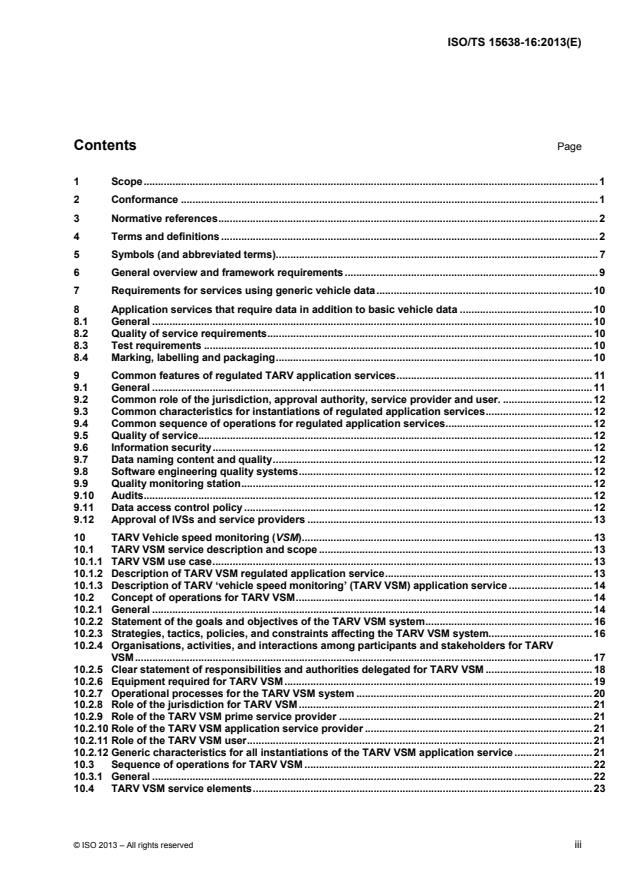
Contents Page
1 Scope . 1
2 Conformance . 1
3 Normative references . 2
4 Terms and definitions . 2
5 Symbols (and abbreviated terms) . 7
6 General overview and framework requirements . 9
7 Requirements for services using generic vehicle data . 10
8 Application services that require data in addition to basic vehicle data . 10
8.1 General . 10
8.2 Quality of service requirements . 10
8.3 Test requirements . 10
8.4 Marking, labelling and packaging . 10
9 Common features of regulated TARV application services . 11
9.1 General . 11
9.2 Common role of the jurisdiction, approval authority, service provider and user. . 12
9.3 Common characteristics for instantiations of regulated application services . 12
9.4 Common sequence of operations for regulated application services . 12
9.5 Quality of service . 12
9.6 Information security . 12
9.7 Data naming content and quality . 12
9.8 Software engineering quality systems . 12
9.9 Quality monitoring station . 12
9.10 Audits. 12
9.11 Data access control policy . 12
9.12 Approval of IVSs and service providers . 13
10 TARV Vehicle speed monitoring (VSM) . 13
10.1 TARV VSM service description and scope . 13
10.1.1 TARV VSM use case . 13
10.1.2 Description of TARV VSM regulated application service . 13
10.1.3 Description of TARV ‘vehicle speed monitoring’ (TARV VSM) application service . 14
10.2 Concept of operations for TARV VSM . 14
10.2.1 General . 14
10.2.2 Statement of the goals and objectives of the TARV VSM system . 16
10.2.3 Strategies, tactics, policies, and constraints affecting the TARV VSM system. 16
10.2.4 Organisations, activities, and interactions among participants and stakeholders for TARV
VSM . 17
10.2.5 Clear statement of responsibilities and authorities delegated for TARV VSM . 18
10.2.6 Equipment required for TARV VSM . 19
10.2.7 Operational processes for the TARV VSM system . 20
10.2.8 Role of the jurisdiction for TARV VSM . 21
10.2.9 Role of the TARV VSM prime service provider . 21
10.2.10 Role of the TARV VSM application service provider . 21
10.2.11 Role of the TARV VSM user . 21
10.2.12 Generic characteristics for all instantiations of the TARV VSM application service . 21
10.3 Sequence of operations for TARV VSM . 22
10.3.1 General . 22
10.4 TARV VSM service elements . 23
10.4.1 TARV VSM service element (SE) 1: Establish ‘Vehicle speed monitoring’ regulations,
requirements, and approval arrangements . 23
10.4.2 TARV VSM SE2: Request system approval . 24
10.4.3 TARV VSM SE3: User (operator) contracts with prime service provider . 24
10.4.4 TARV VSM SE4: User (operator) equips vehicle with a device to read the driver licence
(DLR) . 24
10.4.5 TARV VSM SE5: User contracts with application service provider . 24
10.4.6 TARV VSM SE6: application service provider uploads software into the TARV equipped
vehicles of the operator . 24
10.4.7 TARV VSM SE7: The driver obtains an electronic drivers licence device (eDL) . 24
10.4.8 TARV VSM SE8: Driver use of vehicle routines . 24
10.4.9 TARV VSM SE9: Time series recording of vehicle speed . 25
10.4.10 TARV VSM SE10: Map matched recording of vehicle speed infringement (VSMI) . 26
10.4.11 TARV VSM SE11: ‘Interrogated’ request for vehicle speed monitoring data . 27
10.4.12 TARV VSM SE12: End of session . 27
10.5 Generic TARV VDSM data naming, content and quality . 27
10.6 TARV VSM application service specific provisions for quality of service . 31
10.7 TARV VSM application service specific provisions for test requirements . 31
10.8 TARV VSM application specific rules for the approval of IVSs and ‘Service Providers’ . 31
11 Declaration of patents and intellectual property . 31
Annex A (informative) Independent testing of the protocols defined in this Part of ISO 15638 . 32
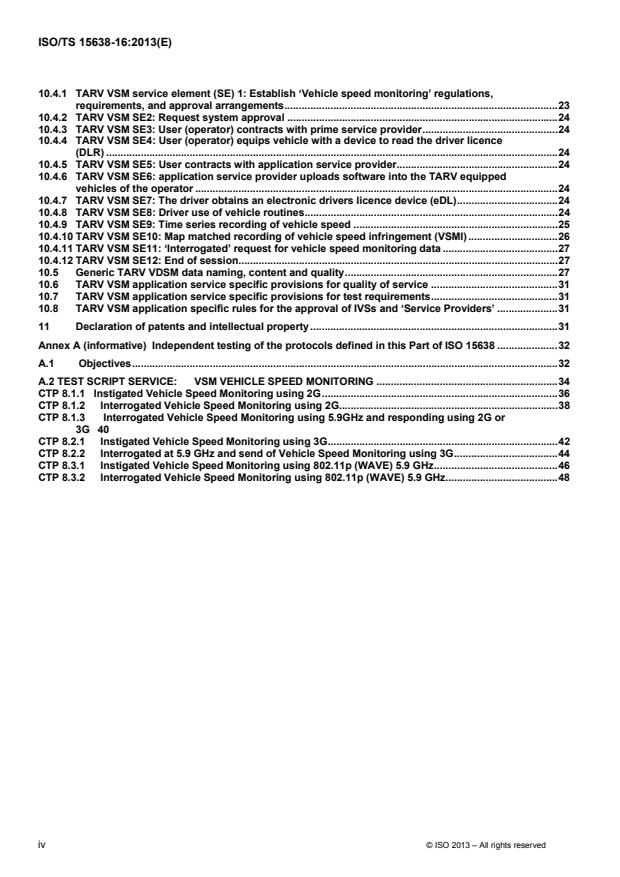
A.1 Objectives . 32
A.2 TEST SCRIPT SERVICE: VSM VEHICLE SPEED MONITORING . 34
CTP 8.1.1 Instigated Vehicle Speed Monitoring using 2G . 36
CTP 8.1.2 Interrogated Vehicle Speed Monitoring using 2G . 38
CTP 8.1.3 Interrogated Vehicle Speed Monitoring using 5.9GHz and responding using 2G or
3G 40
CTP 8.2.1 Instigated Vehicle Speed Monitoring using 3G . 42
CTP 8.2.2 Interrogated at 5.9 GHz and send of Vehicle Speed Monitoring using 3G . 44
CTP 8.3.1 Instigated Vehicle Speed Monitoring using 802.11p (WAVE) 5.9 GHz . 46
CTP 8.3.2 Interrogated Vehicle Speed Monitoring using 802.11p (WAVE) 5.9 GHz. 48
iv © ISO 2013 – All rights reserved
Foreword
ISO (the International Organization for Standardization) is a worldwide federation of national standards bodies
(ISO member bodies). The work of preparing International Standards is normally carried out through ISO
technical committees. Each member body interested in a subject for which a technical committee has been
established has the right to be represented on that committee. International organizations, governmental and
non-governmental, in liaison with ISO, also take part in the work. ISO collaborates closely with the
International Electrotechnical Commission (IEC) on all matters of electrotechnical standardization.
The procedures used to develop this document and those intended for its further maintenance are described
in the ISO/IEC Directives, Part 1. In particular the different approval criteria needed for the different types of
ISO documents should be noted. This document was drafted in accordance with the editorial rules of the
ISO/IEC Directives, Part 2. www.iso.org/directives.
Attention is drawn to the possibility that some of the elements of this document may be the subject of patent
rights. ISO shall not be held responsible for identifying any or all such patent rights. Details of any patent
rights identified during the development of the document will be in the Introduction and/or on the ISO list of
patent declarations received. www.iso.org/patents.
Any trade name used in this document is information given for the convenience of users and does not
constitute an endorsement.
The committee responsible for this document is ISO/TC 204, Intelligent transport systems
ISO 15638 consists of the following parts, under the general title Intelligent transport systems — Framework
for collaborative Telematics Applications for Regulated commercial freight Vehicles (TARV):
— Part 1 Framework and architecture
— Part 2: Common platform parameters using CALM
— Part 3: Operating requirements, 'Approval Authority' procedures, and enforcement provisions for the
providers of regulated services
— Part 5: Generic vehicle information
— Part 6: Regulated applications [Technical Specification]
— Part 7: Other applications
— Part 8: Vehicle access monitoring (VAM) [Technical Specification]
— Part 9: Remote electronic tachograph monitoring (RTM) [Technical Specification]
— Part 10: Emergency messaging system/eCall (EMS) [Technical Specification]
— Part 11: Driver work records (work and rest hours compliance) (DWR) [Technical Specification]
— Part 12: Vehicle mass monitoring (VMM) [Technical Specification]
— Part 14: Vehicle access control (VAC) [Technical Specification]
— Part 15: Vehicle location monitoring (VLM) [Technical Specification]
— Part 16: Vehicle speed monitoring (VSM) [Technical Specification]
— Part 17: Consignment and location monitoring (CLM) [Technical Specification]
— Part 18: ADR (Dangerous Goods) transport monitoring (ADR) [Technical Specification]
— Part 19: Vehicle parking facilities (VPF) [Technical Specification]
The following parts are under preparation:
— Part 4: System security requirements [Technical Specification]
— Part 13: ‘Mass’ information for jurisdictional control and enforcement
vi © ISO 2013 – All rights reserved
Introduction
Many ITS technologies have been embraced by commercial transport operators (4.35) and freight owners, in
the areas of fleet management, safety and security. Telematics (4.46) applications have also been developed
for governmental use. Such regulatory services in use or being considered vary from jurisdiction (4.29) to
jurisdiction, but include electronic on-board recorders, digital tachograph (4.45), on-board mass (4.33)
monitoring, ‘mass’ data for regulatory control and management (4.34), vehicle access (4.1) methods, hazardous
goods tracking and e-call. Additional applications with a regulatory impact being developed include, fatigue
management, speed monitoring and heavy vehicle penalties imposed based on location, distance and time.
In such an emerging environment of regulatory and commercial applications (4.14), it is timely to consider an
overall architecture (4.10) (business and functional) that could support these functions from a single platform
within a commercial freight vehicle that operate within such regulations. International Standards will allow for a
speedy development and specification (4.44) of new applications that build upon the functionality of a generic
specification platform. A suite of standards documents is required to describe and define the framework (4.22)
and requirements so that the on board equipment and back office systems can be commercially designed in
an open market to meet common requirements of jurisdictions (4.29).
This suite of standards addresses and defines the framework (4.22) for a range of cooperative telematics (4.46)
applications for regulated vehicles (4.39) (such as access methods (4.2), driver fatigue management, speed
monitoring, on-board mass (4.33) monitoring, mass’ data for regulatory control and management (4.34). The
overall scope includes the concept of operation, legal and regulatory issues, and the generic cooperative
provision of services to regulated vehicles (4.39), using an on-board ITS platform. The framework is based on a
(multiple) service provider (4.42) oriented approach with provisions for the approval (4.7) and auditing (4.11) of
service providers.
This suite of standards documents will:
provide the basis for future development of cooperative ITS telematics (4.46) applications for regulated
vehicles (4.39). Many elements to accomplish this are already available. Existing relevant standards
will be referenced, and the specifications (4.44) will use existing standards (such as CALM) wherever
practicable.
allow for a powerful platform for highly cost-effective delivery of a range of telematics applications for
(4.39) .
regulated vehicles
a business architecture (4.10) based on a (multiple) service provider (4.42) oriented approach
address legal and regulatory aspects for the approval (4.7) and auditing (4.11) of service providers.
This suite of standards deliverables is timely as many governments (Europe, North America, Asia and
Australia/New Zealand) are considering the use of telematics (4.46) for a range of regulatory purposes.
Ensuring that a single in-vehicle platform can deliver a range of services to both government and industry
through open standards and competitive markets is a strategic objective.
This part of the ISO 15638 family of standards documents provides specifications (4.44) for Vehicle speed
monitoring.
NOTE: The definition of what comprises a ‘regulated’ vehicle is regarded as an issue for national decision, and may vary
from jurisdiction (4.29) to jurisdiction. This suite of standards documents does not impose any requirements on nations in
respect of how they define a regulated vehicle (4.39).
NOTE: The definition of what comprises a ‘regulated’ service is regarded as an issue for national decision, and may vary
from jurisdiction (4.29) to jurisdiction. This suite of standards documents does not impose any requirements on nations in
respect of which services for regulated vehicles (4.39) jurisdictions will require, or support as an option, but will provide
standardised sets of requirements descriptions for identified services to enable consistent and cost efficient
implementations where implemented.
viii © ISO 2013 – All rights reserved
TECHNICAL SPECIFICATION ISO/TS 15638-16:2013(E)
Intelligent transport systems — Framework for collaborative
Telematics Applications for Regulated commercial freight
Vehicles (TARV) —
Part 16:
Vehicle speed monitoring (VSM)
1 Scope
This part of ISO 15638 addresses the provision of ‘Vehicle speed monitoring’ and specifies the form and
content of such data required to support such systems, and access methods (4.2) to that data.
This part of ISO 15638 provides specifications (4.44) for common communications and data exchange aspects
of the application service (4.4) Vehicle speed monitoring that a regulator (4.40) may elect to require or support
as an option, including:
a) high level definition of the service that a service provider (4.42) has to provide, (The service definition
describes common service elements; but does not define the detail of how such an application service
(4.4) is instantiated, nor the acceptable value ranges of the data concepts defined)
b) means to realise the service
c) application data, naming content and quality that an IVS (4.25) has to deliver.
The definition of what comprises a ‘regulated’ service is regarded as an issue for National decision, and may
vary from jurisdiction (4.29) to jurisdiction. This document does not impose any requirements on nations in
respect of which services for regulated vehicles jurisdictions will require, or support as an option, but provides
standardised sets of requirements descriptions for identified services to enable consistent and cost efficient
implementations where instantiated.
ISO 15638 has been developed for use in the context of regulated commercial freight vehicles (hereinafter
referred to as ‘regulated vehicles’ (4.39). There is nothing, however, to prevent a jurisdiction extending or
adapting the scope to include other types of regulated vehicles, as it deems appropriate.
2 Conformance
Requirements to demonstrate conformance to any of the general provisions or specific application services
(4.4) described in this part of ISO 15638 shall be within the regulations imposed by the jurisdiction (4.29) where
they are instantiated. Conformance requirements to meet the provisions of this International Standard are
therefore deemed to be under the control of, and to the specification of, the jurisdiction where the application
service(s)is/are instantiated.
The protocols defined in this Part of ISO 15638 have been independently tested. Annex A (Informative)
provides results of these tests. In any conformance assurance process undertaken by candidate systems,
where appropriate the results may be used as part of its process of conformance compliance.
3 Normative references
The following referenced documents, in whole or in part, are normatively referenced in this document and are
indispensable for its application. For dated references, only the edition cited applies. For undated references,
the latest edition of the referenced document (including any amendments) applies.
ISO 15638-1 Intelligent transport systems — Framework for collaborative Telematics Applications for
Regulated commercial freight Vehicles (TARV) — Part 1: Framework and architecture
ISO 15638 -2 Intelligent transport systems — Framework for collaborative Telematics Applications for
Regulated commercial freight Vehicles (TARV) — Part 2: Common platform parameters
using CALM
ISO 15638 -3 Intelligent transport systems — Framework for collaborative telematics applications for
regulated commercial freight vehicles (TARV) — Part 3: Operating requirements,
'Approval Authority' procedures, and enforcement provisions for the providers of
regulated services
ISO 15638 -4 Intelligent transport systems — Framework for collaborative Telematics Applications for
Regulated commercial freight Vehicles (TARV) — Part 4: System security
requirements
ISO 15638 -5 Intelligent transport systems — Framework for collaborative Telematics Applications for
Regulated commercial freight Vehicles (TARV) — Part 5: Generic vehicle information
ISO 15638 -6 Intelligent transport systems — Framework for collaborative Telematics Applications for
Regulated commercial freight Vehicles (TARV) — Part 6: Regulated applications
ISO 15638 -8 Intelligent transport systems — Framework for cooperative Telematics Applications for
Regulated commercial freight vehicles (TARV) — Part 8: Vehicle access monitoring
(VAM)
ISO 15638 -11 Intelligent transport systems — Framework for cooperative Telematics Applications for
Regulated Vehicles (TARV) — Part 11: Driver work records (work and rest hours
compliance) (DWR)
4 Terms and definitions
For the purposes of this document, the terms and definitions given in ISO 15638-1 and the following apply.
4.1
access
admittance, entry, permit to use the road network and/or associated infrastructure (bridges, tunnels etc.)
4.2
access methods
procedures and protocols to provision and retrieve data
4.3
app
small (usually) Java™ (4.28) applets, organised as software bundles, that support application services (4.4) by
keeping the data pantry (4.18) provisioned with up to date data
4.4
Under preparation.
2 © ISO 2013 – All rights reserved
application service
service provided by a service provider (4.42) enabled by accessing data from the IVS (4.25) of a regulated
vehicle (4.39) via a wireless communications network
4.5
application service provider
ASP
party that provides an application service (4.4)
4.6
app library
separately secure area of memory in IVS (4.25) where apps are stored [with different access controls to data
pantry (4.18)]
4.7
approval
formal affirmation that an applicant has satisfied all the requirements for appointment as an application service
provider (4.5) or that an application service delivers the required service levels.
4.8
approval agreement
written agreement made between an approval authority (regulatory) (4.9) and a service provider (4.42)
NOTE An approval authority (regulatory) (4.9) approval agreement recognises the fact that a service provider (4.42),
having satisfied the approval authority’s requirements for appointment as a service provider, is appointed in that capacity,
and sets out the legal obligations of the parties with respect to the on-going role of the service provider.
4.9
approval authority (regulatory)
organisation (usually independent) which conducts approval (4.7) and ongoing audit (4.11) for service providers
(4.42) on behalf of a jurisdiction (4.29)
4.10
architecture
formalised description of the design of the structure of TARV and its framework (4.22)
4.11
audit/auditing
review of a party’s capacity to meet, or continue to meet, the initial and ongoing approval agreements (4.8) as
a service provider (4.42)
4.12
basic vehicle data
data that shall be maintained/provided by all IVS (4.25) [regardless of jurisdiction (4.29)]
4.13
CALM communications access for land mobiles
layered solution that enables continuous or quasi continuous communications between vehicles and the
infrastructure, or between vehicles, using such (multiple) wireless telecommunications media that are
available in any particular location, and which have the ability to migrate to a different available media where
required and where media selection is at the discretion of user (4.47) determined parameters by using a suite
of standards based on ISO 21217 (CALM architecture) and ISO21210 (CALM networking) that provide a
common platform for a number of standardised media using ITS-stations (4.27) to provide wireless support for
applications, such that the application is independent of any particular wireless medium
4.14
commercial application(s)
ITS applications in regulated vehicles (4.39) for commercial (non-regulated) purposes
EXAMPLE Asset tracking, vehicle and engine monitoring, cargo security, driver management etc.
4.15
consignment
shipment of goods/cargo to a destination
4.16
cooperative ITS
C-ITS
ITS applications for both regulatory and commercial purposes that require the exchange of data between
uncontracted parties using multiple ITS-stations (4.27) communicating with each other and sharing data with
other parties with whom they have no direct contractual relationship to provide one or more ITS services (4.26)
4.17
core data
basic vehicle data (4.12) plus any additional data required to provide an implemented regulated application
service (4.38)
4.18
data pantry
secure area of memory in IVS (4.25) where data values are stored [with different access controls to app library
(4.6)]
4.19
driver
person driving the regulated vehicle at any specific point in time
4.20
driver work records
DWR
collection, collation, and transfer of driver (4.19) work and rest hours data from an in-vehicle system (4.25) to an
application service provider (4.5)
4.21
facilities
layer that sits on top of the communication stack and helps to provide data interoperability and reuse, and to
manage applications and enable dynamic real time loading of new applications
4.22
framework
particular set of beliefs, ideas referred to in order to describe a scenario or solve a problem
4.23
global navigation satellite system
GNSS
comprises several networks of satellites that transmit radio signals containing time and distance data that can
be picked up by a receiver, allowing the user to identify the location of its receiver anywhere around the globe
4.24
global positioning system
GPS
instantiation of GNSS (4.23) controlled by the US Department of Defence
4.25
in-vehicle system
IVS
ITS-station (4.27) and connected equipment on board a vehicle
4 © ISO 2013 – All rights reserved
4.26
ITS service
communication functionality offered by an ITS-station (4.27) to an ITS-station application
4.27
ITS-station
ITS-s
entity in a communication network, comprised of application, facilities (4.21), networking and access layer
components specified in ISO 21217 that operate within a bounded secure management domain
4.28
Java™
object oriented open source operating language developed by SUN systems
4.29
jurisdiction
government, road or traffic authority which owns the regulatory applications (4.37)
EXAMPLE Country, state, city council, road authority, government department (customs, treasury, transport), etc.
4.30
Kalman filter
set of mathematical equations that implement a predictor-corrector type estimator that is optimal in the sense
that it minimizes the estimated error covariance
4.31
local data tree
LDT
frequently updated data concept stored in the on on-board data pantry (4.18) containing a collection of data
values deemed essential for either a) TARV regulated application service (4.38), or b) cooperative intelligent
transport systems (4.16)
4.32
map
spatial dataset that defines the road system
4.33
mass
mass of a given heavy vehicle as measured by equipment affixed to the regulated vehicle (4.39)
4.34
‘mass’ data for regulatory control and management
MRC
collection, collation, and transfer of vehicle mass (4.33) data from an in-vehicle system (4.25) to an application
service provider (4.5) to enable data provision to jurisdictions (4.29) for the control and management of
equipped vehicles based on the mass of the regulated vehicle (4.39), or use of such data to enable compliance
with the provisions of regulations.
4.35
operator
fleet manager of a regulated vehicle
4.36
prime service provider
service provider (4.42) who is the first contractor to provide regulated application services (4.38) to the regulated
vehicle (4.39), or a nominated successor on termination of that initial contract
NOTE The prime service provider (4.36) is also responsible to maintain the installed IVS (4.25); if the IVS was not
installed during the manufacture of the vehicle the prime service provider (4.36) is also responsible to install and
commission the IVS (4.25).
4.37
regulated/regulatory application
application arrangement using TARV utilised by jurisdictions (4.29) for granting certain categories of
commercial vehicles rights to operate in regulated circumstances subject to certain conditions, or indeed to
permit a vehicle to operate within the jurisdiction
NOTE This can be mandatory or voluntary at the discretion of the jurisdiction.
4.38
regulated application service
TARV application service to meet the requirements of a regulated application that is mandated by a regulation
imposed by a jurisdiction (4.29), or is an option supported by a jurisdiction
4.39
regulated commercial freight vehicle/regulated vehicle
vehicle that is subject to regulations determined by the jurisdiction (4.29) as to its use on the road system of the
jurisdiction in regulated circumstances, subject to certain conditions, and in compliance with specific
regulations for that class of regulated vehicle
NOTE At the option of jurisdictions; this may require the provision of information via TARV or provide the option to do
so.
4.40
regulator
agent of the jurisdiction (4.29) appointed to regulate and manage TARV within the domain of the jurisdiction;
may or may not be the approval authority (regulatory) (4.9)
4.41
remote tachograph monitoring
RTM
collection, collation, and transfer of data from an on-board electronic tachograph (4.45) system to an
application service provider (4.5)
4.42
service provider
party which is approved by a approval authority (regulatory) (4.9) as suitable to provide regulated or
commercial ITS application services (4.4)
4.43
session
wireless communication exchange between the ITS-station (4.27) of an IVS (4.25) and the ITS-station of its
application service provider (4.5) to achieve data update, data provision, upload apps, or otherwise manage
the provision of the application service (4.4), or a wireless communication provision of data to the ITS-station of
an IVS (4.25) from any other ITS-station
4.44
specification
explicit and detailed description of the nature and functional requirements and minimum performance of
equipment, service or a combination of both
4.45
tachograph
sender unit mounted to a vehicle gearbox, a tachograph head and a digital driver card, which records the
regulated vehicle (4.39) speed and the times at which it was driven and aspects of the driver’s (4.19) activity
selected from a choice of modes
4.46
telematics
use of wireless media to obtain and transmit (data) from a distant source
6 © ISO 2013 – All rights reserved
4.47
user
individual or party that enrols in and operates within a regulated or commercial application (4.14) service (4.4)
EXAMPLE Driver (4.19), transport operator (4.35), freight owner, etc.
4.48
vehicle access control
VAC
control of regulated vehicles ingress to and egress from controlled areas and associated penalties and levies
4.49
vehicle access management
VAM
monitoring and management of regulated vehicles approaching or within sensitive and controlled areas
4.50
vehicle location monitoring
VLM
collection, collation, and transfer of vehicle location data from an in-vehicle system (4.25) to an application
service provider (4.5)
4.51
vehicle mass monitoring
VMM
collection, collation, and transfer of vehicle mass (4.33) data from an in-vehicle system (4.25) to an application
service provider (4.5)
4.52
vehicle parking facility
VPF
system for booking and access (4.1) to and egress from a vehicle parking facility (VPF) (4.52)
4.53
vehicle speed monitoring
VSM
collection, collation, and transfer of vehicle speed data from an in-vehicle system (4.25) to an application
service provider (4.5)
5 Symbols (and abbreviated terms)
ANPR
automatic number plate recognition
app
TM
applet (JAVA application or similar) (4.3)
ASP
application service provider (4.5)
CALM
communications access for land mobiles (4.13)
C-ITS
cooperative intelligent transport systems (4.16)
DLR
driving licence reader
DRD
driver records device
DWR
driver work records (4.20)
eDL
electronic driver (4.19) licence
EMS
emergency message system
GNSS
global navigation satellite system (4.23)
H&S
health and safety
ID
identity
IP
internet protocol
ITS-S
ITS station (4.27)
IVS
In-vehicle system (4.25)
LDT
local data tree (4.31)
MRC
‘mass’ data for regulatory control and management (4.34)
PPS
precise positioning service (NAVSTAR)
RFID
radio frequency identification device
RTM
remote tachograph monitoring (4.41)
SE
service element
SPF
secure parking facility (4.68)
SPS
standard positioning service (NAVSTAR)
TARV
telematics (4.46) applications for regulated vehicles (4.39)
8 © ISO 2013 – All rights reserved
UTC
coordinated universal time
VAC
vehicle access control (4.48)
VAM
vehicle access management (4.49)
VLM
vehicle location monitoring (4.50)
VMM
vehicle mass monitoring (4.51)
VSM
vehicle speed monitoring (4.53)
VSP
vehicle secure parking (4.52)
VDSM
vehicle/driver speed monitoring
VDSMI
vehicle/driver speed monitoring infringement
VSMI
vehicle speed monitoring (4.53) infringement
6 General overview and framework requirements
ISO TS 15638-1 provided a framework (4.22) and architecture (4.10) for TARV. It provided a general
description of the roles of the actors in TARV and their relationships.
To understand clearly the TARV framework, architecture (4.10) and detail and specification (4.44) of the roles of
the actors involved, the reader is referred to ISO TS 15638-1.
ISO TS 15638-6 provides the core requirements for all regulated applications. To understand clearly the
general context in to which the provision of this application service, the reader is referred to ISO TS 15638-6.
In order to be compliant with this part of ISO 15638, the overall architecture employed shall comply to ISO
15638-1.
In order to be compliant with this part of ISO 15638, the communications employed shall comply to ISO
15638-2.
In order to be compliant with this part of ISO 15638, the operating requirements employed shall comply to ISO
15638-3.
In order to be compliant with this part of ISO 15638, the security employed shall comply to ISO 15638-4.
In order to be compliant with this part of ISO 15638, the basic vehicle data shall comply to ISO 15638-5.
In order to be compliant with this part of ISO 15638, the generic conditions for this application service shall
comply to ISO 15638-6.
ISO 15638 has been developed for use in the context of regulated commercial freight vehicles. There is
nothing however to prevent a jurisdiction extending or adapting the scope to include other types of regulated
vehicles, as it deems appropriate.
7 Requirements for services using generic vehicle data
The means by which the access commands for generic vehicle information specified in ISO 15638-5 can be
used to provide all or part of the data required in order to support a regulated application service (4.38) shall be
as defined in ISO 15638-6.
8 Application services that require data in addition to basic vehicle data
8.1 General
Shall be conducted as defined in ISO 15638-6.
8.2 Quality of service requirements
This part of ISO 15638 contains no general requirements concerning quality of service. Such aspects shall be
determined by a jurisdiction (4.29) as part of its specification (4.44) for any particular regulated application
service (4.38). However, where a specified regulated application service (4.38) has specific Q of S requirements
essential to maintain interoperability, these aspects shall be as specified in Clause 10.
8.3 Test requirements
This part of ISO 15638 contains no general requirements concerning test requirements. Such aspects shall be
determined by a jurisdiction (4.29) as part of its specification (4.44) for any particular regulated application
service (4.38), and issued as a formal test requirements specification (4.44) document. However, where a
specified regulated application service (4.38) has specific test requirements essential to maintain
interoperability, these aspects shall be as specified in Clause 10 relating to this regulated application service,
or in a separate standards document referenced within that Clause. And where multiple jurisdictions recognise
a benefit to common test procedures for a specific regulated application service, this shall be the subject of a
separate standards document.
8.4 Marking, labelling and packaging
This part of ISO 15638 has no specific requirements for marking labelling or packaging.
However, where the privacy of an individual may be potentially or actually compromised by any instantiation
based on the ISO 15638 family of Standards, the contracting parties shall make such risk explicitly known to
the implementing jurisdiction (4.29) and shall abide by the privacy laws and regulations of the implementing
jurisdiction and shall mark up or label any contracts specifically and explicitly drawing attention to any loss of
privacy and precautions taken to protect privacy. Attention is drawn to ISO TR 12859 in this respect.
10 © ISO 2013 – All rights reserved
9 Common features of regulated TARV application services
9.1 General
The details of the instantiation of regulated application service (4.38) are as designed by the application service
system to meet the requirements of a particular jurisdiction (4.29) and are not defined herein. ISO 15638-6
specifies the generic roles and responsibilities of actors in the systems, and instantiations that claim
compliance with this part of ISO 15638 shall also be compliant with the requirements of ISO 15638-6.
The means by which data is provisioned into the data pantry (4.18), and the means to obtain the TARV LDT
(4.31) and core data (4.17) are described in Clause 8 of ISO 15638-6.
In order to minimise demand on the IVS (4.25) (which it is assumed will be performing multiple application
services (4.4) simultaneously, as well as supporting general safety related cooperative vehicle systems), and
because national requirements and system offerings will differ, a ‘cloud’ approach has been taken in defining
TARV regulated application services (4.38).
The TARV approach is for the on-board app (4.3) supporting the application service to collect and collate the
relevant data, and at intervals determined by the app, or on demand from the application service provider
(4.5)(ASP), pass that data to the ASP. All of the actual application service processing shall occur in the
mainframe system of the ASP (in the ‘cloud’).
For further information see Clause 9 of ISO 15638-6.
At a conceptual level, The TARV system is therefore essentially simple, as shown in Figure 1. The process is
similar to that for CoreData, but data is supplied to a different on-board file in the data pantry (4.18).
Run on-board 'app'
Collect and file data in
on-board data pantry
Transfer the data to
ASP System
Application service
Provider
wireless link
Delete file content and
return to repopulate
data into file
Figure 1 — TARV Regulated application service on-board procedure
At a common generic functional level for this application service, the process may be seen as shown in Figure
2 below, however the connected eq
...
Questions, Comments and Discussion
Ask us and Technical Secretary will try to provide an answer. You can facilitate discussion about the standard in here.
Loading comments...