


ISO/FDIS 24495-3
(Main)Plain language — Part 3: Science writing
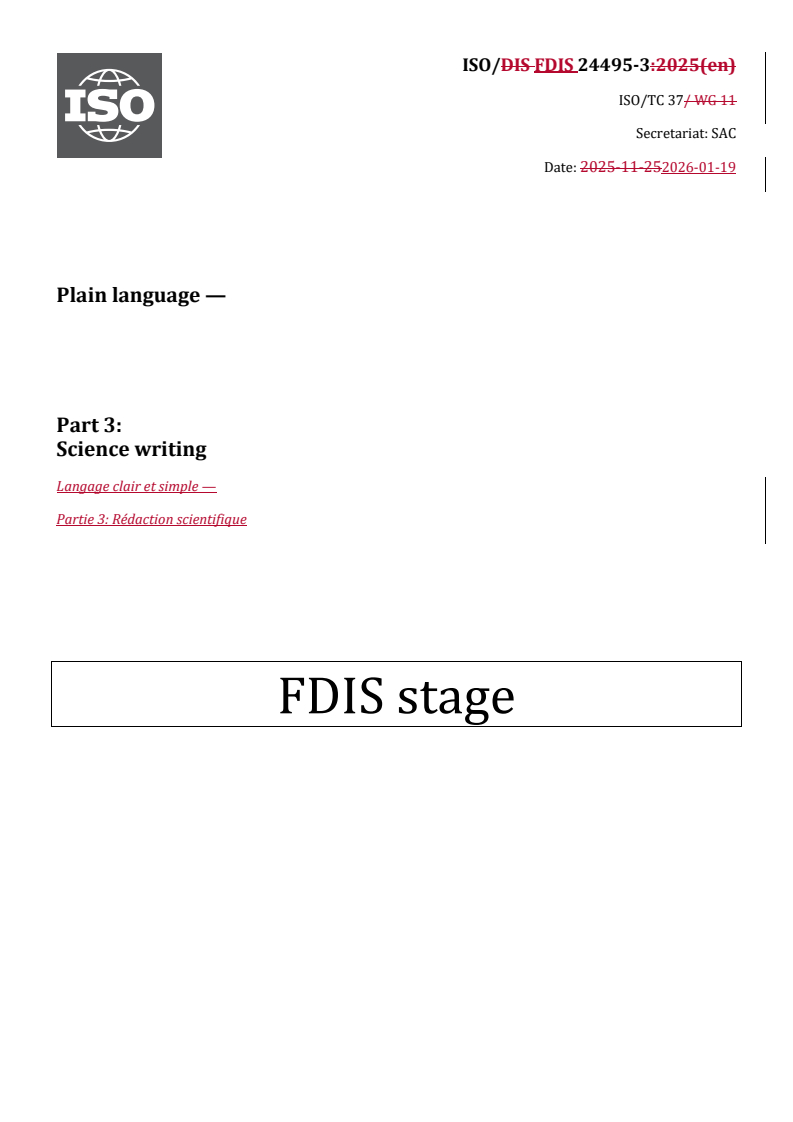
Plain language — Part 3: Science writing
This [proposed] standard is for anybody who creates or helps create scientific documents intended for diverse audiences. It builds, and relies, on the foundation for plain language in ISO/DIS 24495-1, Plain Language — Part 1: Governing Principles and Guidelines. It does not repeat the guidance in Part 1. Rather, it adds guidance and techniques to help authors make sure that readers or users of scientific information can understand and make use of what they read. It applies only to printed or digital information that is primarily in the form of text. It does not include existing technical guidance about accessibility and digital documents, although its guidance can apply to both.
Langage clair et simple — Partie 3: Rédaction scientifique
General Information
- Status
- Not Published
- Technical Committee
- ISO/TC 37 - Language and terminology
- Drafting Committee
- ISO/TC 37 - Language and terminology
- Current Stage
- 5020 - FDIS ballot initiated: 2 months. Proof sent to secretariat
- Start Date
- 03-Feb-2026
- Completion Date
- 03-Feb-2026
Overview
ISO/FDIS 24495-3: Plain Language - Part 3: Science Writing is a proposed international standard developed by ISO to guide the creation of scientific documents in plain language. It supports anyone involved in preparing scientific content for audiences with diverse backgrounds and needs-ranging from students and the general public to decision-makers and policy influencers. This standard builds upon the foundation established in ISO 24495-1 (Governing Principles and Guidelines) by introducing additional, targeted guidance for making scientific information both understandable and actionable.
ISO/FDIS 24495-3 addresses only textual scientific content, in print or digital format, and does not repeat accessibility or technical digital guidelines, though its principles can be applied in those contexts. By following this standard, science writers can improve the clarity, relevance, and reliability of scientific information, fostering trust and scientific literacy among broad audiences.
Key Topics
ISO/FDIS 24495-3 is organized according to four governing principles derived from ISO 24495-1:
- Relevance: Ensure readers get what they need by identifying their backgrounds, purposes, and informational context.
- Findability: Structure documents using plain language and clear headings to help readers easily locate information.
- Understandability: Use techniques such as concise language, logical organization, and supporting visuals to make content accessible to non-expert audiences.
- Usability: Present information in ways that help readers apply or act upon the science presented.
Additional topics include:
- Characterizing intended audiences and adapting scientific language accordingly.
- Ethical considerations, such as presenting unbiased data, stating limitations and uncertainties, declaring conflicts of interest, and protecting sensitive information.
- Understanding the genre and purpose of science documents to ensure content and format suit diverse reader needs.
- Techniques for planning, drafting, and reviewing content to maximize clarity, accuracy, and reader engagement.
Applications
ISO/FDIS 24495-3 delivers practical value across a range of science communication scenarios:
- Public-facing science content: Fact sheets, websites, news articles, and educational materials that explain scientific concepts to non-specialists.
- Patient and consumer information: Clear, actionable summaries that help lay audiences understand research findings, healthcare interventions, or technology applications.
- Policy and decision-support documents: Reports or summaries provided to stakeholders or leaders who require easily digestible, reliable science information to guide choices.
- Media and outreach: Science communication for journalists, advocacy groups, and community events, making research and discoveries more accessible.
- Training and guidance for writers: Helping technical writers, editors, and science communicators apply structured approaches to plain language in scientific contexts.
By implementing this standard, organizations and individuals can improve comprehension, increase scientific engagement, and maintain the accuracy and integrity of scientific information distributed to non-expert audiences.
Related Standards
To achieve best practices in plain language and science communication, the following standards are closely related:
- ISO 24495-1: Plain Language - Governing Principles and Guidelines
The foundational document specifying general requirements for plain language communication across all subject fields. - ISO 24495-2 (forthcoming): Plain Language - Part 2: [Specific Applications]
Expands the plain language framework to other domains and document types. - Other references:
Additional guidance on scientific writing ethics, data visualization standards, and accessibility (though not included in ISO/FDIS 24495-3) can complement the adoption of this standard.
For writers, editors, and organizations aiming to make scientific information clear, relevant, and reliable for diverse audiences, ISO/FDIS 24495-3 establishes essential guidelines for effective plain language in science writing.
Buy Documents
ISO/FDIS 24495-3 - Plain language — Part 3: Science writing Released:20. 01. 2026
REDLINE ISO/FDIS 24495-3 - Plain language — Part 3: Science writing Released:20. 01. 2026
ISO/FDIS 24495-3 - Langage clair et simple — Partie 3: Rédaction scientifique
Frequently Asked Questions
ISO/FDIS 24495-3 is a draft published by the International Organization for Standardization (ISO). Its full title is "Plain language — Part 3: Science writing". This standard covers: This [proposed] standard is for anybody who creates or helps create scientific documents intended for diverse audiences. It builds, and relies, on the foundation for plain language in ISO/DIS 24495-1, Plain Language — Part 1: Governing Principles and Guidelines. It does not repeat the guidance in Part 1. Rather, it adds guidance and techniques to help authors make sure that readers or users of scientific information can understand and make use of what they read. It applies only to printed or digital information that is primarily in the form of text. It does not include existing technical guidance about accessibility and digital documents, although its guidance can apply to both.
This [proposed] standard is for anybody who creates or helps create scientific documents intended for diverse audiences. It builds, and relies, on the foundation for plain language in ISO/DIS 24495-1, Plain Language — Part 1: Governing Principles and Guidelines. It does not repeat the guidance in Part 1. Rather, it adds guidance and techniques to help authors make sure that readers or users of scientific information can understand and make use of what they read. It applies only to printed or digital information that is primarily in the form of text. It does not include existing technical guidance about accessibility and digital documents, although its guidance can apply to both.
ISO/FDIS 24495-3 is classified under the following ICS (International Classification for Standards) categories: 01.140.10 - Writing and transliteration. The ICS classification helps identify the subject area and facilitates finding related standards.
ISO/FDIS 24495-3 is available in PDF format for immediate download after purchase. The document can be added to your cart and obtained through the secure checkout process. Digital delivery ensures instant access to the complete standard document.
Standards Content (Sample)
FINAL DRAFT
International
Standard
ISO/TC 37
Plain language —
Secretariat: SAC
Part 3:
Voting begins on:
2026-02-03
Science writing
Voting terminates on:
Langage clair et simple —
2026-03-31
Partie 3: Rédaction scientifique
RECIPIENTS OF THIS DRAFT ARE INVITED TO SUBMIT,
WITH THEIR COMMENTS, NOTIFICATION OF ANY
RELEVANT PATENT RIGHTS OF WHICH THEY ARE AWARE
AND TO PROVIDE SUPPOR TING DOCUMENTATION.
IN ADDITION TO THEIR EVALUATION AS
BEING ACCEPTABLE FOR INDUSTRIAL, TECHNO-
LOGICAL, COMMERCIAL AND USER PURPOSES, DRAFT
INTERNATIONAL STANDARDS MAY ON OCCASION HAVE
TO BE CONSIDERED IN THE LIGHT OF THEIR POTENTIAL
TO BECOME STAN DARDS TO WHICH REFERENCE MAY BE
MADE IN NATIONAL REGULATIONS.
Reference number
FINAL DRAFT
International
Standard
ISO/TC 37
Plain language —
Secretariat: SAC
Part 3:
Voting begins on:
Science writing
Voting terminates on:
Langage clair et simple —
Partie 3: Rédaction scientifique
RECIPIENTS OF THIS DRAFT ARE INVITED TO SUBMIT,
WITH THEIR COMMENTS, NOTIFICATION OF ANY
RELEVANT PATENT RIGHTS OF WHICH THEY ARE AWARE
AND TO PROVIDE SUPPOR TING DOCUMENTATION.
© ISO 2026
IN ADDITION TO THEIR EVALUATION AS
All rights reserved. Unless otherwise specified, or required in the context of its implementation, no part of this publication may
BEING ACCEPTABLE FOR INDUSTRIAL, TECHNO-
LOGICAL, COMMERCIAL AND USER PURPOSES, DRAFT
be reproduced or utilized otherwise in any form or by any means, electronic or mechanical, including photocopying, or posting on
INTERNATIONAL STANDARDS MAY ON OCCASION HAVE
the internet or an intranet, without prior written permission. Permission can be requested from either ISO at the address below
TO BE CONSIDERED IN THE LIGHT OF THEIR POTENTIAL
or ISO’s member body in the country of the requester.
TO BECOME STAN DARDS TO WHICH REFERENCE MAY BE
MADE IN NATIONAL REGULATIONS.
ISO copyright office
CP 401 • Ch. de Blandonnet 8
CH-1214 Vernier, Geneva
Phone: +41 22 749 01 11
Email: copyright@iso.org
Website: www.iso.org
Published in Switzerland Reference number
ii
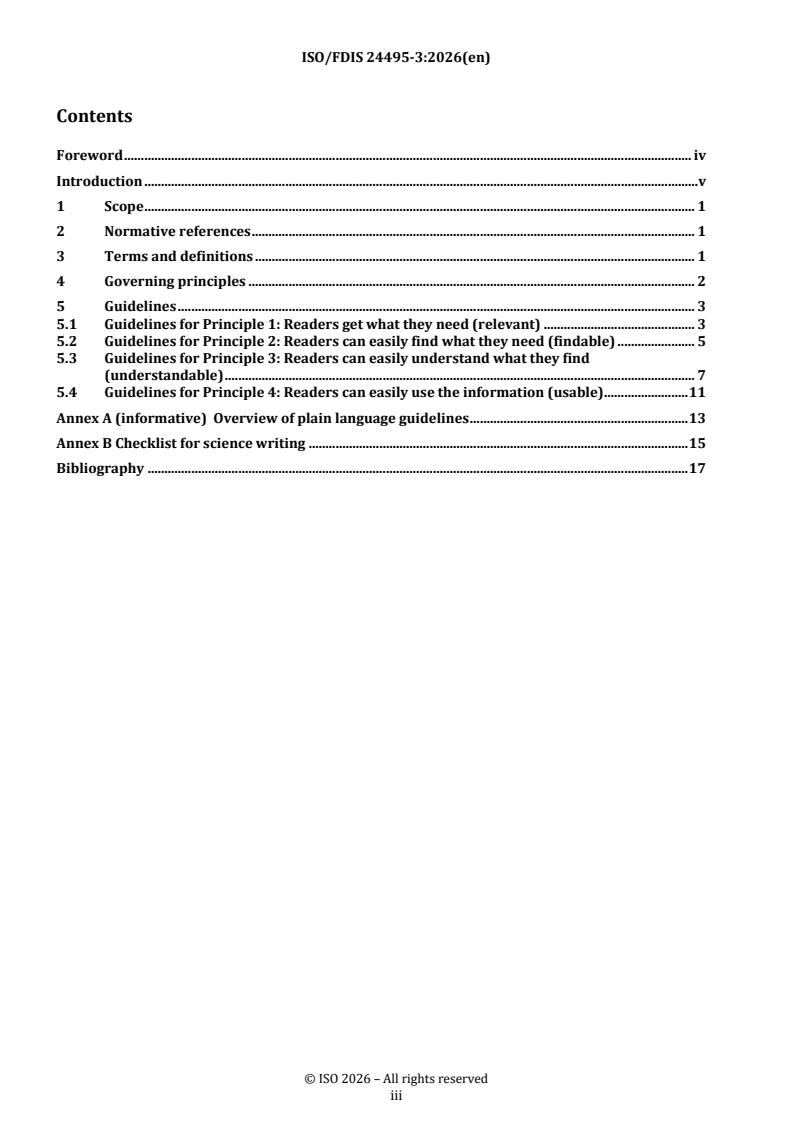
Contents Page
Foreword .iv
Introduction .v
1 Scope . 1
2 Normative references . 1
3 Terms and definitions . 1
4 Governing principles . 2
5 Guidelines . 2
5.1 Guidelines for Principle 1: Readers get what they need (relevant) .2
5.1.1 Initial steps .2
5.1.2 Characterize the readers.3
5.1.3 Identify the genre .3
5.1.4 Identify the purpose .3
5.1.5 Plan the document .4
5.1.6 Present content ethically .4
5.2 Guidelines for Principle 2: Readers can easily find what they need (findable) .5
5.2.1 Initial steps .5
5.2.2 Provide an overview .5
5.2.3 Structure the document for the intended readers .5
5.2.4 Provide navigational support .6
5.3 Guidelines for Principle 3: Readers can easily understand what they find
(understandable) .6
5.3.1 Initial steps .6
5.3.2 Indicate the status of information .7
5.3.3 Use precise language .7
5.3.4 Design effective images . . .8
5.3.5 Identify important or critical data displays . .9
5.3.6 Characterize data to aid understanding .9
5.3.7 Design effective tables .10
5.4 Guidelines for Principle 4: Readers can easily use the information (usable).10
5.4.1 Initial steps .10
5.4.2 Steps to increase usability .10
5.4.3 Check usability .11
Annex A (informative) Overview of plain language guidelines .12
Annex B Checklist for science writing .13
Bibliography .15
iii
Foreword
ISO (the International Organization for Standardization) is a worldwide federation of national standards
bodies (ISO member bodies). The work of preparing International Standards is normally carried out through
ISO technical committees. Each member body interested in a subject for which a technical committee
has been established has the right to be represented on that committee. International organizations,
governmental and non-governmental, in liaison with ISO, also take part in the work. ISO collaborates closely
with the International Electrotechnical Commission (IEC) on all matters of electrotechnical standardization.
The procedures used to develop this document and those intended for its further maintenance are described
in the ISO/IEC Directives, Part 1. In particular, the different approval criteria needed for the different types
of ISO document should be noted. This document was drafted in accordance with the editorial rules of the
ISO/IEC Directives, Part 2 (see www.iso.org/directives).
ISO draws attention to the possibility that the implementation of this document may involve the use of (a)
patent(s). ISO takes no position concerning the evidence, validity or applicability of any claimed patent
rights in respect thereof. As of the date of publication of this document, ISO had not received notice of (a)
patent(s) which may be required to implement this document. However, implementers are cautioned that
this may not represent the latest information, which may be obtained from the patent database available at
www.iso.org/patents. ISO shall not be held responsible for identifying any or all such patent rights.
Any trade name used in this document is information given for the convenience of users and does not
constitute an endorsement.
For an explanation of the voluntary nature of standards, the meaning of ISO specific terms and expressions
related to conformity assessment, as well as information about ISO’s adherence to the World Trade
Organization (WTO) principles in the Technical Barriers to Trade (TBT), see www.iso.org/iso/foreword.html.
This document was prepared by Technical Committee ISO/TC 37, Language and terminology.
A list of all parts in the ISO 24495 series can be found on the ISO website.
Any feedback or questions on this document should be directed to the user’s national standards body. A
complete listing of these bodies can be found at www.iso.org/members.html.
iv
Introduction
Science needs to be open to all, and one of the roadblocks to that goal is dense and highly specialized writing.
If the public has access to scientific information that they can read, understand and use, they will gain more
trust in science and be better informed citizens.
This document provides guidelines to help authors make scientific information accessible and useful to
wide and varied groups of readers. These guidelines are based on evidence from research about how people
understand written language. These guidelines are intended to help authors meet the following goals:
— empower those who contribute to science, communicate science and read about science;
— improve comprehension and accessibility for readers of scientific information while maintaining
accuracy and precision;
— enable readers to increase their scientific literacy so they are better able to read, understand and use
scientific information;
— encourage engagement with science among broad public readership;
— create documents that foster dialogue with readers on current scientific issues;
— promote communicating science responsibly and ethically.
v
FINAL DRAFT International Standard ISO/FDIS 24495-3:2026(en)
Plain language —
Part 3:
Science writing
1 Scope
This document establishes governing principles and guidelines for plain science writing. It builds upon the
foundation for plain language established in ISO 24495-1. It is organized according to the four principles
presented in ISO 24495-1.
This guidance focuses on science writing: writing about scientific subjects that is intended for readers
with varying education levels, backgrounds and interests. These readers can range from young students to
decision-makers in industry and government.
The guidance does not explicitly address scientific writing. Such writing is found in scientific journal
articles or academic documents, where experts write for others in their fields of specialization. However,
it is possible that other experts do not work in precisely the same field as the author and prefer reading
documents that follow plain language guidance. The principles found in this guidance and in ISO 24495-1
can help any author who seeks to create a plain language document.
This document applies to printed or digital information that is primarily in the form of text and images. The
guidance in this document applies to most written languages.
2 Normative references
There are no normative references in this document.
3 Terms and definitions
For the purposes of this document, the following terms and definitions apply.
ISO and IEC maintain terminology databases for use in standardization at the following addresses:
— ISO Online browsing platform: available at https:// www .iso .org/ obp
— IEC Electropedia: available at https:// www .electropedia .org/
3.1
author
individual or organization who develops or helps develop documents
Note 1 to entry: The definition of author herein differs from that of author in scientific writing of journal articles or
books, where ethical rules determine who gets credit and legal principles determine who holds copyright.
EXAMPLE Writers, content developers or managers, editors, information architects or designers, information
developers or managers, legislative drafters, public relations officers, technical writers, translators, UX (user
experience) writers, writing project managers.
[SOURCE: ISO 24495-1:2023, 3.4, modified — Note to entry added and “professional writers” replaced with
“writers” in the example.]
3.2
image
visual representation of information
EXAMPLE Chart, diagram, drawing, flowchart, graph, icon, infographic, map, picture, photograph, table.
[SOURCE: ISO 24495-1:2023, 3.6]
3.3
noun string
noun stack
sequence of two or more nouns combined to present a single concept
Note 1 to entry: Noun strings make comprehension difficult.
EXAMPLE Sea turtle nesting beach, hospital employee safety protocol violation report form.
3.4
science writing
writing about scientific subjects that is intended for readers with varying education levels, backgrounds and
interests
EXAMPLE A briefing on sea-level rise to help homeowners decide whether or not to buy flood insurance, a plain
language summary of a clinical trial report intended to help patients understand the evidence behind the risks and
benefits of semaglutide therapy for weight loss.
3.5
scientific writing
writing by scientists for readers who share their specialist knowledge
EXAMPLE A meta-analysis of 10 years of data on sea-level rise along the mid-Atlantic coast of the United States, a
study of cardiac amyloid deposits based on autopsies of 10 patients who died as a result of amyloidosis.
4 Governing principles
The guidelines in this document are based on the four governing principles in ISO 24495-1:
— Principle 1: Readers get what they need (relevant).
— Principle 2: Readers can easily find what they need (findable).
— Principle 3: Readers can easily understand what they find (understandable).
— Principle 4: Readers can easily use the information (usable).
The principles and guidelines in ISO 24495-1 apply to creating all documents, including science writing, in
plain language.
Annex A provides a visual overview of the principles and all guidelines. Annex B provides a checklist to help
authors apply this document.
5 Guidelines
5.1 Guidelines for Principle 1: Readers get what they need (relevant)
5.1.1 Initial steps
Principle 1 focuses on what authors should do before they start drafting. Authors should consider the
following general guidelines outlined in ISO 24495-1:2023, 5.1:
— Identify the readers.
— Identify the readers’ purposes for reading.
— Identify the context in which readers will read the document.
— Select the document type or types.
— Select content that readers need.
Useful guidance can also be found in Reference [5].
In addition to these general guidelines, authors should consider the specific guidelines for science writing
that are in this document.
5.1.2 Characterize the readers
For science writing it is important to plan and adapt plain language based on the particular readers an
author hopes to reach. Understanding the readers helps the author in many ways; for example, to determine
what terminology to use, how to organize the content, how to identify critical information, what evidence to
provide, and where to publish.
Characterizing the readers is particularly important in science writing, since the writing is intended to reach
readers who have widely varied backgrounds in science. The writing should be as accessible as possible
while still providing accurate and precise scientific information.
Science authors should characterize their readers by asking questions such as these:
a) Are there distinct groups of readers with different backgrounds and purposes for seeking information?
What range of educational backgrounds can be expected?
b) Do readers seek general information on a current topic, perhaps through websites or media outlets?
What level of knowledge are readers likely to have about the topic? How familiar are they with domain-
specific terminology?
c) Do readers need scientific evidence to solve problems, make decisions or endorse a policy; for example,
conservation groups, government workers, funding agencies, review boards or project managers? What
explanations do they need to understand the content in context?
d) What level of data literacy can be expected among the intended readers? What help are readers likely to
need to interpret data?
e) Do readers need to make decisions concerning health and safety? Are some readers likely to be in
critical situations? Do some readers need help understanding complex disease mechanisms?
f) Do readers represent varying specializations who are regular readers of popular scientific magazines
and journals? Can the content be made accessible without over-simplification?
5.1.3 Identify the genre
Authors should become familiar with and follow the conventions of established genres, recognizing that
these conventions change over time. Science writing takes many forms, including fact sheets, patient
information, science books for the public, product information and instructions, public relations releases,
research summaries, science blogs and websites. Some genres of science writing explicitly call for plain
language; for instance, plain language summaries of research reports and Cochrane Reviews, which are
[3]
systematic reviews of healthcare interventions written for both professionals and the general public.
5.1.4 Identify the purpose
Authors should identify the purpose of the document and express that purpose in a way suited to the readers
and the genre. For example, the document’s purpose can be to answer the readers’ questions, advise them
on actions to take or help them solve a problem. One common purpose of science writing is to help broad
groups of readers understand scientific research by providing an overview or summary.
The purpose should be clear in the title or headline and should typically be stated at or near the beginning
of the document. Defining readers and their purposes for reading will encourage authors to check for and
remove information that is unnecessary, irrelevant, misleading or confusing.
5.1.5 Plan the document
Before drafting a document, authors should plan in these ways:
a) Establish the primary purpose and the key messages of the document.
b) Identify background information the readers need to understand the context.
c) Outline the key sections or chapters needed to logically develop the content.
d) Determine how the content should be organized to ensure a logical flow of information.
e) Plan for a balanced level of information complexity that neither overwhelms the readers nor
oversimplifies content.
f) Determine whether and how evidence (data, observations, studies) and examples will be integrated to
support each point or argument.
g) Determine what images (charts, graphs, tables, diagrams, photographs) will enhance understanding
and where they should be placed.
h) Determine how much attention should be given to methods used to gather evidence. Some general
readers would benefit from a brief discussion of methods so they understand how evidence was
gathered. More specialized readers would want to know the details of methods so they can evaluate the
reliability of results. For certain readers, details of method can be overwhelming or confusing.
i) Identify any counter arguments and how they can be addressed.
j) Determine the unknowns, uncertainties or limitations of the scientific information to be presented.
How much confidence can be placed in these understandings? What is not yet known with certainty?
k) Identify conclusions or statements of significance that will leave readers with a sense of the importance
of the information presented.
l) If appropriate, identify action steps that can be followed. Describe how the information presented can
be used by the readers.
m) Identify any additional materials (appendices, glossaries, references, etc.) that are needed to support
the main content.
5.1.6 Present content ethically
In addition to following the guidance in ISO 24495-1:2023, 5.1.6 f), authors should respect scientific ethics,
as follows:
a) Present data fairly, in an unbiased and impartial manner, without skewing, selecting or distorting them
to favour a particular perspective or interpretation.
b) Indicate the limits and uncertainties of current knowledge; for example, whether results of drug tests
apply to all populations or whether biology studies apply in other geographic areas or under other
conditions.
c) Be careful not to mislead readers through headlines, illustrations or statements that do not faithfully
represent the factual information.
d) Consider offering an evaluation of the reliability of source publications and their publishers, in the
present era of preprints, misinformation, withdrawn studies and predatory journals.
e) State potential conflicts of interest or sources of bias; for example, whether the author works for an
organization involved in a study or has received payment, contracts or gifts from funders of a study
mentioned in the document.
f) Consider privacy, confidentiality and social consequences when communicating sensitive data, such as
personal data about participants (especially children), data about ethnic or social groups or information
pertaining to people with health conditions or disabilities. Refer to ethical protocols or guidelines if
appropriate to the context and genre.
g) Do not plagiarize, falsify or fabricate information.
h) Be transparent about any technological aids in writing or producing images; for example, images
manipulated by graphics programs, content generated by artificial intelligence, or text written with the
assistance of artificial intelligence.
5.2 Guidelines for Principle 2: Readers can easily find what they need (findable)
5.2.1 Initial steps
Principle 2 ensures that readers can easily find what they need. Authors should consider the following
general guidelines about document structure outlined in ISO 24495-1:2023, 5.2:
— Stru
...
ISO/DIS FDIS 24495-3:2025(en)
ISO/TC 37/ WG 11
Secretariat: SAC
Date: 2025-11-252026-01-19
Plain language —
Part 3:
Science writing
Langage clair et simple —
Partie 3: Rédaction scientifique
FDIS stage
All rights reserved. Unless otherwise specified, or required in the context of its implementation, no part of this publication
may be reproduced or utilized otherwise in any form or by any means, electronic or mechanical, including photocopying,
or posting on the internet or an intranet, without prior written permission. Permission can be requested from either ISO
at the address below or ISO’s member body in the country of the requester.
ISO copyright office
CP 401 • Ch. de Blandonnet 8
CH-1214 Vernier, Geneva
Phone: + 41 22 749 01 11
E-mail: copyright@iso.org
Website: www.iso.org
Published in Switzerland
ii
Contents
Foreword . iv
Introduction . v
1 Scope . 1
2 Normative references . 1
3 Terms and definitions . 1
4 Governing principles . 2
5 Guidelines . 3
5.1 Guidelines for Principle 1: Readers get what they need (relevant) . 3
5.2 Guidelines for Principle 2: Readers can easily find what they need (findable) . 5
5.3 Guidelines for Principle 3: Readers can easily understand what they find
(understandable) . 7
5.4 Guidelines for Principle 4: Readers can easily use the information (usable) . 11
Annex A (informative) Overview of plain language guidelines . 13
Annex B Checklist for science writing . 15
Bibliography . 17
iii
Foreword
ISO (the International Organization for Standardization) is a worldwide federation of national standards
bodies (ISO member bodies). The work of preparing International Standards is normally carried out through
ISO technical committees. Each member body interested in a subject for which a technical committee has been
established has the right to be represented on that committee. International organizations, governmental and
non-governmental, in liaison with ISO, also take part in the work. ISO collaborates closely with the
International Electrotechnical Commission (IEC) on all matters of electrotechnical standardization.
The procedures used to develop this document and those intended for its further maintenance are described
in the ISO/IEC Directives, Part 1. In particular, the different approval criteria needed for the different types of
ISO document should be noted. This document was drafted in accordance with the editorial rules of the
ISO/IEC Directives, Part 2 (see www.iso.org/directives).
ISO draws attention to the possibility that the implementation of this document may involve the use of (a)
patent(s). ISO takes no position concerning the evidence, validity or applicability of any claimed patent rights
in respect thereof. As of the date of publication of this document, ISO had not received notice of (a) patent(s)
which may be required to implement this document. However, implementers are cautioned that this may not
represent the latest information, which may be obtained from the patent database available at
www.iso.org/patents. ISO shall not be held responsible for identifying any or all such patent rights.
Any trade name used in this document is information given for the convenience of users and does not
constitute an endorsement.
For an explanation of the voluntary nature of standards, the meaning of ISO specific terms and expressions
related to conformity assessment, as well as information about ISO’s adherence to the World Trade
Organization (WTO) principles in the Technical Barriers to Trade (TBT), see www.iso.org/iso/foreword.html.
This document was prepared by Technical Committee ISO/TC 37, Language and terminology.
A list of all parts in the ISO 24495 series can be found on the ISO website.
Any feedback or questions on this document should be directed to the user’s national standards body. A
complete listing of these bodies can be found at www.iso.org/members.html.
iv
Introduction
Science needs to be open to all, and one of the roadblocks to that goal is dense and highly specialized writing.
If the public has access to scientific information that they can read, understand and use, they will gain more
trust in science and be better informed citizens.
This document provides guidelines to help authors make scientific information accessible and useful to wide
and varied groups of readers. These guidelines are based on evidence from research about how people
understand written language. These guidelines are intended to help authors meet the following goals:
— empower those who contribute to science, communicate science and read about science;
— improve comprehension and accessibility for readers of scientific information while maintaining accuracy
and precision;
— enable readers to increase their scientific literacy so they are better able to read, understand and use
scientific information;
— encourage engagement with science among broad public readership;
— create documents that foster dialogue with readers on current scientific issues;
— promote communicating science responsibly and ethically.
v
Plain language —
Part 3:
Science writing
1 Scope
This document establishes governing principles and guidelines for plain science writing. It builds upon the
foundation for plain language established in ISO 24495-1. It is organized according to the four principles
presented in ISO 24495-1.
This guidance focuses on science writing: writing about scientific subjects that is intended for readers with
varying education levels, backgrounds and interests. These readers can range from young students to
decision-makers in industry and government.
The guidance does not explicitly address scientific writing. Such writing is found in scientific journal articles
or academic documents, where experts write for others in their fields of specialization. However, it is possible
that other experts do not work in precisely the same field as the author and may well prefer reading
documents that follow plain language guidance. The principles found in this guidance and in ISO 24495-1 can
help any author who seeks to create a plain language document.
This document applies to printed or digital information that is primarily in the form of text and images. The
guidance in this document applies to most written languages.
2 Normative references
There are no normative references in this document.
3 Terms and definitions
For the purposes of this document, the following terms and definitions apply.
ISO and IEC maintain terminology databases for use in standardization at the following addresses:
— ISO Online browsing platform: available at https://www.iso.org/obp
— IEC Electropedia: available at https://www.electropedia.org/
3.1
author
individual or organization who develops or helps develop documents
Note 1 to entry: The definition of author herein differs from that of author in scientific writing of journal articles or books,
where ethical rules determine who gets credit and legal principles determine who holds copyright.
EXAMPLE Writers, content developers or managers, editors, information architects or designers, information
developers or managers, legislative drafters, public relations officers, technical writers, translators, UX (user experience)
writers, writing project managers.
[SOURCE: ISO 24495-1:2023, 3.4, modified - note— Note to entry added and “professional writers” replaced
with “writers” in the example.]
3.2
image
visual representation of information
EXAMPLE Chart, diagram, drawing, flowchart, graph, icon, infographic, map, picture, photograph, table.
[SOURCE: ISO 24495-1:2023, 3.6]
3.3
noun string
noun stack
sequence of two or more nouns combined to present a single concept
Note 1 to entry: Noun strings make comprehension difficult.
EXAMPLE Sea turtle nesting beach, hospital employee safety protocol violation report form.
3.4
science writing
writing about scientific subjects that is intended for readers with varying education levels, backgrounds and
interests
EXAMPLE A briefing on sea-level rise to help homeowners decide whether or not to buy flood insurance, a plain
language summary of a clinical trial report intended to help patients understand the evidence behind the risks and
benefits of semaglutide therapy for weight loss.
3.5
scientific writing
writing by scientists for readers who share their specialist knowledge
EXAMPLE A meta-analysis of 10 years of data on sea-level rise along the mid-Atlantic coast of the United States, a
study of cardiac amyloid deposits based on autopsies of 10 patients who died as a result of amyloidosis.
4 Governing principles
The guidelines in this document are based on the four governing principles in ISO 24495-1:
— Principle 1: Readers get what they need (relevant).
— Principle 2: Readers can easily find what they need (findable).
— Principle 3: Readers can easily understand what they find (understandable).
— Principle 4: Readers can easily use the information (usable).
The principles and guidelines in ISO 24495-1 apply to creating all documents, including science writing, in
plain language.
Annex A provides a visual overview of the principles and all guidelines. Annex B provides a checklist to help
authors apply this document.
5 Guidelines
5.1 Guidelines for Principle 1: Readers get what they need (relevant)
5.1.1 Initial steps
Principle 1 focuses on what authors should do before they start drafting. Authors should consider the
following general guidelines outlined in ISO 24495-1:2023, 5.1:
— Identify the readers.
— Identify the readers’ purposes for reading.
— Identify the context in which readers will read the document.
— Select the document type or types.
— Select content that readers need.
Useful guidance can also be found in Reference [5under reference [5].].
In addition to these general guidelines, authors should consider the specific guidelines for science writing that
are in this document.
5.1.2 Characterize the readers
For science writing it is important to plan and adapt plain language based on the particular readers an author
hopes to reach. Understanding the readers helps the author in many ways; for example, to determine what
terminology to use, how to organize the content, how to identify critical information, what evidence to provide,
and where to publish.
Characterizing the readers is particularly important in science writing, since the writing is intended to reach
readers who have widely varied backgrounds in science. The writing should be as accessible as possible while
still providing accurate and precise scientific information.
Science authors should characterize their readers by asking questions such as these:
a) Are there distinct groups of readers with different backgrounds and purposes for seeking information?
What range of educational backgrounds can be expected?
b) Do readers seek general information on a current topic, perhaps through websites or media outlets? What
level of knowledge are readers likely to have about the topic? How familiar are they with domain-specific
terminology?
c) Do readers need scientific evidence to solve problems, make decisions or endorse a policy; for example,
conservation groups, government workers, funding agencies, review boards or project managers? What
explanations do they need to understand the content in context?
d) What level of data literacy can be expected among the intended readers? What help are readers likely to
need to interpret data?
e) Do readers need to make decisions concerning health and safety? Are some readers likely to be in critical
situations? Do some readers need help understanding complex disease mechanisms?
f) Do readers represent varying specializations who are regular readers of popular scientific magazines and
journals? Can the content be made accessible without over-simplification?
5.1.3 Identify the genre
Authors should become familiar with and follow the conventions of established genres, recognizing that these
conventions change over time. Science writing takes many forms, including fact sheets, patient information,
science books for the public, product information and instructions, public relations releases, research
summaries, science blogs and websites. Some genres of science writing explicitly call for plain language; for
instance, plain language summaries of research reports and Cochrane Reviews, which are systematic reviews
[3]
of healthcare interventions written for both professionals and the general public.
5.1.4 Identify the purpose
Authors should identify the purpose of the document and express that purpose in a way suited to the readers
and the genre. For example, the document’s purpose can be to answer the readers’ questions, advise them on
actions to take or help them solve a problem. One common purpose of science writing is to help broad groups
of readers understand scientific research by providing an overview or summary.
The purpose should be clear in the title or headline and should typically be stated at or near the beginning of
the document. Defining readers and their purposes for reading will encourage authors to check for and remove
information that is unnecessary, irrelevant, misleading or confusing.
5.1.5 Plan the document
Before drafting a document, authors should plan in these ways:
a) Establish the primary purpose and the key messages of the document.
b) Identify background information the readers need to understand the context.
c) Outline the key sections or chapters needed to logically develop the content.
d) Determine how the content should be organized to ensure a logical flow of information.
e) Plan for a balanced level of information complexity that neither overwhelms the readers nor
oversimplifies content.
f) Determine whether and how evidence (data, observations, studies) and examples will be integrated to
support each point or argument.
g) Determine what images (charts, graphs, tables, diagrams, photographs) will enhance understanding and
where they should be placed.
h) Determine how much attention should be given to methods used to gather evidence. Some general readers
would benefit from a brief discussion of methods so they understand how evidence was gathered. More
specialized readers would want to know the details of methods so they can evaluate the reliability of
results. For certain readers, details of method can be overwhelming or confusing.
i) Identify any counter arguments and how they can be addressed.
j) Determine the unknowns, uncertainties or limitations of the scientific information to be presented. How
much confidence can be placed in these understandings? What is not yet known with certainty?
k) Identify conclusions or statements of significance that will leave readers with a sense of the importance
of the information presented.
l) If appropriate, identify action steps that can be followed. Describe how the information presented can be
used by the readers.
m) Identify any additional materials (appendices, glossaries, references, etc.) that are needed to support the
main content.
5.1.6 Present content ethically
In addition to following the guidance in ISO 24495-1:2023, 5.1.6 f), authors should respect scientific ethics, as
follows:
a) Present data fairly, in an unbiased and impartial manner, without skewing, selecting or distorting them to
favour a particular perspective or interpretation.
b) Indicate the limits and uncertainties of current knowledge; for example, whether results of drug tests
apply to all populations or whether biology studies apply in other geographic areas or under other
conditions.
c) Be careful not to mislead readers through headlines, illustrations or statements that do not faithfully
represent the factual information.
d) Consider offering an evaluation of the reliability of source publications and their publishers, in the present
era of preprints, misinformation, withdrawn studies, and predatory journals.
e) State potential conflicts of interest or sources of bias; for example, whether the author works for an
organization involved in a study or has received payment, contracts or gifts from funders of a study
mentioned in the document.
f) Consider privacy, confidentiality and social consequences when communicating sensitive data, such as
personal data about participants (especially children), data about ethnic or social groups or information
pertaining to people with health conditions or disabilities. Refer to ethical protocols or guidelines if
appropriate to the context and genre.
g) Do not plagiarize, falsify or fabricate information.
h) Be transparent about any technological aids in writing or producing images; for example, images
manipulated by graphics programs, content generated by artificial intelligence, or text written with the
assistance of artificial intelligence.
5.2 Guidelines for Principle 2: Readers can easily find what they need (findable)
5.2.1 Initial steps
Principle 2 ensures that readers can easily find what they need. Authors should consider the following general
guidelines about document structure outlined in ISO 24495-1:2023, 5.2:
— Structure the document for readers.
— Use information design techniques that enable readers to find information.
— Use headings to help readers predict what comes next.
— Keep supplementary information separate.
Readers should be able to quickly determine the scope of the document and whether it serves their purposes.
The following techniques in 5.2.2, 5.2.3 and 5.2.4 help readers find and use what they need.
5.2.2 Provide an overview
Authors should orient readers at the beginning of a document by considering the following techniques.:
— Provide an informative summary or list of key points at the beginning of long or complex documents.
— If useful, describe the scope of the document, indicating what it does or does not cover.
EXAMPLE This fact sheet covers the major causes of human deaths on Earth according to World Health Organization
statistics. Note that data are missing for some countries.
5.2.3 Structure the document for the intended readers
Authors should establish a cohesive structure for science writing that meets the needs of the readers, aiding
them in finding what they need and engaging with scientific content effectively. Authors should consider the
following:
a) Prioritize key information by arranging information hierarchically, placing essential details in prominent
positions and leading the narrative with the most essential details, such as the main conclusions, the real-
world implications or the practical applications of the information.
b) Clearly demarcate different sections or different types of content with visual cues such as borders, lines,
space breaks, boxing, shading or indentation.
c) Provide clear transitions; for example, signalling shifts in topic with transitional phrases and sentences to
guide readers and foster a cohesive narrative. Transitions can signal various types of connections.
EXAMPLE logicLogic (therefore, however, in conclusion), time (then, after five minutes), addition (also, moreover)
and attitude (obviously, not surprisingly).
d) For documents with many figures or tables, provide links to allow readers to go directly to the data.
e) Direct readers to additional information to learn more. Pointers to additional information can take the
form of links to web pages, lists of recommended readings or viewings, or mention of agencies or
organizations that are good sources of information.
5.2.4 Provide navigational support
Especially in longer documents, authors should give readers signposts to the document organization to
support the differing routes that readers take through documents:
a) For long or complex documents, provide a table of contents.
b) Provide bookmarks, links, page numbers or other support for navigation.
c) Include informative headers and footers.
d) Use headings. In addition to following the guidance in ISO 24495-1:2023, 5.2.3 and 5.2.4, make sure
headings in long documents are hierarchical and that the hierarchy is clear. Clarity can be achieved, for
instance, through consistent and coherent use of
...
PROJET FINAL
Norme
internationale
ISO/TC 37
Langage clair et simple —
Secrétariat: SAC
Partie 3:
Début de vote:
2026-02-03
Rédaction scientifique
Vote clos le:
Plain language —
2026-03-31
Part 3: Science writing
LES DESTINATAIRES DU PRÉSENT PROJET SONT
INVITÉS À PRÉSENTER, AVEC LEURS OBSERVATIONS,
NOTIFICATION DES DROITS DE PROPRIÉTÉ DONT ILS
AURAIENT ÉVENTUELLEMENT CONNAISSANCE ET À
FOURNIR UNE DOCUMENTATION EXPLICATIVE.
OUTRE LE FAIT D’ÊTRE EXAMINÉS POUR
ÉTABLIR S’ILS SONT ACCEPTABLES À DES FINS
INDUSTRIELLES, TECHNOLOGIQUES ET COM-MERCIALES,
AINSI QUE DU POINT DE VUE DES UTILISATEURS, LES
PROJETS DE NORMES
INTERNATIONALES DOIVENT PARFOIS ÊTRE CONSIDÉRÉS
DU POINT DE VUE DE LEUR POSSI BILITÉ DE DEVENIR DES
NORMES POUVANT
SERVIR DE RÉFÉRENCE DANS LA RÉGLEMENTATION
NATIONALE.
Numéro de référence
PROJET FINAL
Norme
internationale
ISO/TC 37
Langage clair et simple —
Secrétariat: SAC
Partie 3:
Début de vote:
Rédaction scientifique 2026-02-03
Vote clos le:
Plain language —
2026-03-31
Part 3: Science writing
LES DESTINATAIRES DU PRÉSENT PROJET SONT
INVITÉS À PRÉSENTER, AVEC LEURS OBSERVATIONS,
NOTIFICATION DES DROITS DE PROPRIÉTÉ DONT ILS
AURAIENT ÉVENTUELLEMENT CONNAISSANCE ET À
FOURNIR UNE DOCUMENTATION EXPLICATIVE.
DOCUMENT PROTÉGÉ PAR COPYRIGHT
OUTRE LE FAIT D’ÊTRE EXAMINÉS POUR
ÉTABLIR S’ILS SONT ACCEPTABLES À DES FINS
© ISO 2026 INDUSTRIELLES, TECHNOLOGIQUES ET COM-MERCIALES,
AINSI QUE DU POINT DE VUE DES UTILISATEURS, LES
Tous droits réservés. Sauf prescription différente ou nécessité dans le contexte de sa mise en œuvre, aucune partie de cette
PROJETS DE NORMES
INTERNATIONALES DOIVENT PARFOIS ÊTRE CONSIDÉRÉS
publication ne peut être reproduite ni utilisée sous quelque forme que ce soit et par aucun procédé, électronique ou mécanique,
DU POINT DE VUE DE LEUR POSSI BILITÉ DE DEVENIR DES
y compris la photocopie, ou la diffusion sur l’internet ou sur un intranet, sans autorisation écrite préalable. Une autorisation peut
NORMES POUVANT
être demandée à l’ISO à l’adresse ci-après ou au comité membre de l’ISO dans le pays du demandeur.
SERVIR DE RÉFÉRENCE DANS LA RÉGLEMENTATION
NATIONALE.
ISO copyright office
Case postale 401 • Ch. de Blandonnet 8
CH-1214 Vernier, Genève
Tél.: +41 22 749 01 11
E-mail: copyright@iso.org
Web: www.iso.org
Publié en Suisse Numéro de référence
ii
Sommaire Page
Avant-propos .iv
Introduction .v
1 Domaine d’application . 1
2 Références normatives . 1
3 Termes et définitions . 1
4 Principes directeurs . 2
5 Lignes directrices . 3
5.1 Lignes directrices associées au principe 1: les lecteurs obtiennent ce dont ils ont besoin
(pertinent) .3
5.1.1 Étapes initiales .3
5.1.2 Caractériser les lecteurs .3
5.1.3 Identifier le genre .4
5.1.4 Identifier l’objectif .4
5.1.5 Planifier le document .4
5.1.6 Présenter le contenu de manière éthique .5
5.2 Lignes directrices associées au principe 2: les lecteurs peuvent facilement trouver ce
dont ils ont besoin (facile à trouver) .5
5.2.1 Étapes initiales .5
5.2.2 Fournir une vue d’ensemble .6
5.2.3 Structurer le document pour les lecteurs visés .6
5.2.4 Apporter une aide à la navigation .6
5.3 Lignes directrices associées au principe 3: les lecteurs peuvent facilement comprendre
ce qu’ils trouvent (compréhensible) .7
5.3.1 Étapes initiales .7
5.3.2 Indiquer le statut des informations .7
5.3.3 Utiliser un langage précis .8
5.3.4 Concevoir des images efficaces .9
5.3.5 Identifier les affichages de données importantes ou critiques .10
5.3.6 Caractériser les données pour faciliter la compréhension .10
5.3.7 Concevoir des tableaux efficaces .11
5.4 Lignes directrices associées au principe 4: les lecteurs peuvent facilement utiliser
l’information (utilisable) .11
5.4.1 Étapes initiales .11
5.4.2 Étapes pour augmenter l’utilisabilité.11
5.4.3 Vérifier l’utilisabilité . 12
Annexe A (informative) Aperçu des lignes directrices du langage clair .13
Annexe B Liste de critères à contrôler pour la rédaction scientifique .15
Bibliographie . 17
iii
Avant-propos
L’ISO (Organisation internationale de normalisation) est une fédération mondiale d’organismes nationaux
de normalisation (comités membres de l’ISO). L’élaboration des Normes internationales est en général
confiée aux comités techniques de l’ISO. Chaque comité membre intéressé par une étude a le droit de faire
partie du comité technique créé à cet effet. Les organisations internationales, gouvernementales et non
gouvernementales, en liaison avec l’ISO participent également aux travaux. L’ISO collabore étroitement avec
la Commission électrotechnique internationale (IEC) en ce qui concerne la normalisation électrotechnique.
Les procédures utilisées pour élaborer le présent document et celles destinées à sa mise à jour sont
décrites dans les Directives ISO/IEC, Partie 1. Il convient, en particulier, de prendre note des différents
critères d’approbation requis pour les différents types de documents ISO. Le présent document
a été rédigé conformément aux règles de rédaction données dans les Directives ISO/IEC, Partie 2
(voir www.iso.org/directives).
L’ISO attire l’attention sur le fait que la mise en application du présent document peut entraîner l’utilisation
d’un ou de plusieurs brevets. L’ISO ne prend pas position quant à la preuve, à la validité et à l’applicabilité de
tout droit de brevet revendiqué à cet égard. À la date de publication du présent document, l’ISO n’avait pas
reçu notification qu’un ou plusieurs brevets pouvaient être nécessaires à sa mise en application. Toutefois,
il y a lieu d’avertir les responsables de la mise en application du présent document que des informations
plus récentes sont susceptibles de figurer dans la base de données de brevets, disponible à l’adresse
www.iso.org/brevets. L’ISO ne saurait être tenue pour responsable de ne pas avoir identifié de tels droits de
propriété et averti de leur existence.
Les appellations commerciales éventuellement mentionnées dans le présent document sont données pour
information, par souci de commodité, à l’intention des utilisateurs et ne sauraient constituer un engagement.
Pour une explication de la nature volontaire des normes, la signification des termes et expressions
spécifiques de l’ISO liés à l’évaluation de la conformité, ou pour toute information au sujet de l’adhésion de
l’ISO aux principes de l’Organisation mondiale du commerce (OMC) concernant les obstacles techniques au
commerce (OTC), voir le lien suivant: www.iso.org/iso/fr/avant-propos.
Le présent document a été élaboré par le comité technique ISO/TC 37, Langage et terminologie.
Une liste de toutes les parties de la série ISO 24495 se trouve sur le site web de l’ISO.
Il convient que l’utilisateur adresse tout retour d’information ou toute question concernant le présent
document à l’organisme national de normalisation de son pays. Une liste exhaustive desdits organismes se
trouve à l’adresse www.iso.org/fr/members.html.
iv
Introduction
La science doit être accessible à tous, et l’un des obstacles à cet objectif est une rédaction dense et hautement
spécialisée. Si le public a accès à des informations scientifiques qu’il peut lire, comprendre et utiliser, il aura
davantage confiance dans la science et les citoyens seront mieux informés.
Le présent document fournit des lignes directrices pour aider les auteurs à rendre l’information scientifique
accessible et utile à un large éventail de lecteurs. Ces lignes directrices s’appuient sur des données issues de
recherches sur la manière dont les gens comprennent le langage écrit. Ces lignes directrices sont destinées à
aider les auteurs à atteindre les objectifs suivants:
— responsabiliser ceux qui contribuent à la science, communiquent sur elle et lisent des articles scientifiques;
— améliorer la compréhension et l’accessibilité des informations scientifiques, tout en maintenant
l’exactitude et la précision;
— permettre aux lecteurs d’accroître leurs connaissances scientifiques afin qu’ils soient mieux à même de
lire, comprendre et utiliser les informations scientifiques;
— encourager l’intérêt pour la science auprès d’un large public de lecteurs;
— créer des documents favorisant le dialogue avec les lecteurs sur les questions scientifiques actuelles;
— promouvoir une communication scientifique responsable et éthique.
v
PROJET FINAL Norme internationale ISO/FDIS 24495-3:2026(fr)
Langage clair et simple —
Partie 3:
Rédaction scientifique
1 Domaine d’application
Le présent document établit des principes directeurs et des lignes directrices pour une rédaction scientifique
claire. Il s’appuie sur les bases du langage clair établies dans l’ISO 24495-1. Il s’articule autour des quatre
principes présentés dans l’ISO 24495-1.
Ce guide se concentre sur la rédaction scientifique: rédaction de documents sur des sujets scientifiques qui
sont destinés à des lecteurs de niveaux de formation, de parcours et d’intérêts variés, des étudiants aux
décideurs du monde industriel et politique.
Les recommandations ne traitent pas de la rédaction scientifique spécialisée. On trouve ce type de rédaction
dans les articles de revues scientifiques ou les documents universitaires, dans lesquels des spécialistes
écrivent pour d’autres spécialistes de leur domaine. Cependant, il est possible que d’autres spécialistes ne
travaillent pas exactement dans le même domaine que l’auteur et préfèrent lire des documents qui suivent
les recommandations pour un langage clair. Les principes énoncés dans les présentes recommandations et
dans l’ISO 24495-1 peuvent aider tout auteur qui cherche à créer un document en langage clair.
Le présent document s’applique aux informations imprimées ou numériques qui se présentent principalement
sous forme de texte et d’images. Les recommandations du présent document s’appliquent à la plupart des
langues écrites.
2 Références normatives
Le présent document ne contient aucune référence normative.
3 Termes et définitions
Pour les besoins du présent document, les termes et définitions suivants s’appliquent.
L’ISO et l’IEC tiennent à jour des bases de données terminologiques destinées à être utilisées en normalisation,
consultables aux adresses suivantes:
— ISO Online browsing platform: disponible à l’adresse https:// www .iso .org/ obp
— IEC Electropedia: disponible à l’adresse https:// www .electropedia .org/
3.1
auteur
individu ou organisme qui élabore ou aide à élaborer des documents
Note 1 à l'article: La définition d’auteur ici diffère de celle employée dans la rédaction scientifique d’articles de revues
ou de livres, où des règles déontologiques déterminent qui obtient le crédit et des principes juridiques déterminent qui
détient les droits d’auteur.
EXEMPLE Rédacteurs, développeurs ou gestionnaires de contenu, éditeurs, architectes ou concepteurs
d’information, développeurs ou gestionnaires d’information, rédacteurs de textes législatifs, chargés des relations
publiques, rédacteurs techniques, traducteurs, rédacteurs UX (expérience utilisateur), chefs de projets de rédaction.
[SOURCE: ISO 24495‑1:2023, 3.4, modifié — La note à l’article a été ajoutée et “rédacteurs professionnels” a
été remplacés par “rédacteurs” dans l’exemple.]
3.2
image
représentation visuelle de l’information
EXEMPLE Diagramme, schéma, dessin, organigramme, graphique, icône, infographie, carte, illustration,
photographie, tableau.
[SOURCE: ISO 24495‑1:2023, 3.6]
3.3
terme complexe
nom composé
séquence de deux noms ou plus combinés pour présenter un concept unique
Note 1 à l'article: Les termes complexes rendent la compréhension difficile.
EXEMPLE Plage de nidification de tortues marines, formulaire de signalement de violation du protocole de
sécurité des employés de l’hôpital.
3.4
rédaction scientifique
rédaction de documents sur des sujets scientifiques destinés à des lecteurs de niveaux de formation,
de parcours et d’intérêts variés
EXEMPLE Une présentation sur l’élévation du niveau de la mer pour aider les propriétaires à décider de souscrire
ou non une assurance contre les inondations, un résumé en langage clair d’un rapport d’essai clinique destiné à aider
les patients à comprendre les preuves qui sous-tendent les risques et les avantages du traitement par sémaglutide
pour la perte de poids.
3.5
rédaction scientifique spécialisée
rédaction par des scientifiques à l’attention de lecteurs qui partagent des connaissances spécialisées
EXEMPLE Une méta-analyse de 10 ans de données sur l’élévation du niveau de la mer le long de la côte médio-
atlantique des États-Unis, une étude des dépôts amyloïdes cardiaques basée sur les autopsies de 10 patients décédés
des suites d’une amylose.
4 Principes directeurs
Les lignes directrices du présent document sont fondées sur les quatre principes directeurs de l’ISO 24495-1:
— principe 1: les lecteurs obtiennent ce dont ils ont besoin (pertinent);
— principe 2: les lecteurs peuvent facilement trouver ce dont ils ont besoin (facile à trouver);
— principe 3: les lecteurs peuvent facilement comprendre ce qu’ils trouvent (compréhensible);
— principe 4: les lecteurs peuvent facilement utiliser l’information (utilisable).
Les principes et lignes directrices de l’ISO 24495-1 s’appliquent à la création de tous les documents, y
compris la rédaction scientifique, en langage clair.
L’Annexe A donne un aperçu visuel des principes et de toutes les lignes directrices. L’Annexe B fournit une
liste de critères pour aider les auteurs à appliquer le présent document.
5 Lignes directrices
5.1 Lignes directrices associées au principe 1: les lecteurs obtiennent ce dont ils ont besoin
(pertinent)
5.1.1 Étapes initiales
Le principe 1 se centre sur ce qu’il convient aux auteurs de faire avant de commencer la rédaction. Il convient
que les auteurs tiennent compte des lignes directrices générales suivantes décrites dans l’ISO 24495-1:2023,
5.1:
— identifier les lecteurs;
— identifier les objectifs de lecture des lecteurs;
— identifier le contexte dans lequel les lecteurs liront le document;
— choisir le ou les types de documents;
— sélectionner le contenu dont les lecteurs ont besoin.
Des recommandations utiles sont également disponibles dans la Référence [5].
En plus de ces lignes directrices générales, il convient que les auteurs tiennent compte des lignes directrices
spécifiques à la rédaction scientifique qui sont énoncées dans le présent document.
5.1.2 Caractériser les lecteurs
En matière de rédaction scientifique, il est important de planifier et d’adapter un langage clair en fonction
des lecteurs particuliers qu’un auteur souhaite atteindre. Comprendre qui sont ses lecteurs aide l’auteur à
bien des égards; par exemple, pour déterminer quelle terminologie utiliser, comment organiser le contenu,
comment identifier les informations critiques, quelles preuves apporter et où publier.
La caractérisation des lecteurs est particulièrement importante pour la rédaction scientifique dans la
mesure où elle est destinée à atteindre des lecteurs dont les connaissances scientifiques sont très variées. Il
convient que la rédaction soit aussi accessible que possible tout en fournissant des informations scientifiques
exactes et précises.
Il convient que les auteurs caractérisent leurs lecteurs en se posant des questions telles que celles-ci:
a) Existe‑t‑il des groupes distincts de lecteurs dont les parcours et les objectifs diffèrent dans leur
recherche d’informations? À quel éventail de niveaux d’études peut-on s’attendre?
b) Les lecteurs recherchent‑ils des informations générales sur un sujet d’actualité, sur des sites web ou
dans les médias? Quel niveau de connaissance les lecteurs sont‑ils susceptibles d’avoir sur le sujet? À
quel point connaissent‑ils la terminologie spécifique du domaine?
c) Les lecteurs ont‑ils besoin de preuves scientifiques pour résoudre des problèmes, prendre des décisions
ou approuver une politique; par exemple des groupes de défense de l’environnement, des fonctionnaires,
des organismes de financement, des comités d’examen ou des chefs de projet? De quelles explications
ont-ils besoin pour comprendre le contenu en contexte?
d) Quel niveau de maîtrise de la lecture des données peut-on attendre des lecteurs visés? De quelle aide les
lecteurs sont-ils susceptibles d’avoir besoin pour interpréter les données?
e) Les lecteurs doivent-ils prendre des décisions concernant la santé et la sécurité? Certains lecteurs sont-
ils susceptibles de se trouver dans des situations critiques? Certains lecteurs ont-ils besoin d’aide pour
comprendre les mécanismes complexes des maladies?
f) Les lecteurs représentent-ils différentes spécialisations et sont-ils des lecteurs réguliers de magazines
et de revues de vulgarisation scientifique? Le contenu peut‑il être rendu accessible sans être trop
simplifié?
5.1.3 Identifier le genre
Il est recommandé aux auteurs de se familiariser avec les conventions des genres de texte et de les
respecter, tout en sachant que ces conventions évoluent au fil du temps. La rédaction scientifique revêt de
nombreuses formes: fiches d’information, brochures destinées aux patients, ouvrages scientifiques destinés
au grand public, informations et instructions relatives à différents produits, communiqués de relations
publiques, résumés de recherche, blogs scientifiques, ou encore sites Web. Certains genres scientifiques
requièrent explicitement un langage clair; par exemple, les résumés des rapports de recherche et des revues
[3]
systématiques des données de santé rédigées à la fois à l’intention des professionnels et du grand public .
5.1.4 Identifier l’objectif
Il convient que les auteurs identifient l’objectif du document et le présentent d’une manière adaptée aux
lecteurs et au genre de texte. Par exemple, l’objectif du document peut être de répondre aux questions
des lecteurs, de les conseiller sur des actions à mener ou de les aider à résoudre un problème. Un objectif
fréquent de la rédaction scientifique est d’aider un large public à comprendre la recherche scientifique en en
fournissant un aperçu ou un résumé.
Il convient que l’objectif soit clairement énoncé dans le titre ou dans l’en‑tête et qu’il soit généralement
mentionné au début ou vers le début du document. Définir les lecteurs et les raisons pour lesquelles ils
vont lire le texte encourage les auteurs à repérer et à supprimer les informations inutiles, non pertinentes,
trompeuses ou prêtant à confusion.
5.1.5 Planifier le document
Avant de commencer la rédaction, il convient que les auteurs organisent la rédaction de leur document de la
manière suivante:
a) établir l’objectif principal et les messages clés du document;
b) identifier les informations de base dont les lecteurs ont besoin pour comprendre le contexte;
c) définir les sections ou chapitres clés nécessaires pour développer le contenu de manière logique;
d) déterminer comment il convient d’organiser le contenu pour assurer un flux logique d’informations;
e) prévoir un niveau équilibré de complexité de l’information qui ne submerge pas les lecteurs sans
simplifier le contenu à l’excès;
f) déterminer si et comment les preuves (données, observations, études) et les exemples seront intégrés
pour étayer chaque point ou argument;
g) déterminer quelles images (graphiques, tableaux, diagrammes, photographies) permettent d’améliorer
la compréhension et où il convient de les placer;
h) déterminer l’attention qu’il convient d’accorder aux méthodes utilisées pour recueillir les preuves
scientifiques. Certains lecteurs généralistes apprécieront une brève présentation des méthodes afin
de comprendre comment les preuves ont été recueillies. Des lecteurs plus spécialisés souhaiteront
connaître les détails des méthodes afin de pouvoir évaluer la fiabilité des résultats. Pour certains
lecteurs, les détails des méthodes peuvent être trop fastidieux ou prêter à confusion;
i) identifier les contre‑arguments et la manière dont ils peuvent être traités;
j) déterminer les inconnues, incertitudes ou limites des informations scientifiques à présenter. Quelle
confiance peut‑on accorder à ces interprétations? Qu’est‑ce qui n’est pas encore connu avec certitude?
k) identifier les conclusions ou les affirmations importantes qui permettront aux lecteurs de comprendre
la valeur des informations présentées;
l) le cas échéant, identifier les mesures qui peuvent être prises. Décrire comment les informations
présentées peuvent être utilisées par les lecteurs;
m) identifier tout contenu supplémentaire (annexes, glossaires, références, etc.) nécessaire pour étayer le
contenu principal.
5.1.6 Présenter le contenu de manière éthique
En plus de suivre les recommandations de l’ISO 24495-1:2023, 5.1.6 f), il convient que les auteurs respectent
la déontologie scientifique, comme suit:
a) présenter les données de manière équitable, impartiale et objective, sans les déformer, les tronquer ou
les dénaturer afin de ne pas favoriser une perspective ou une interprétation particulière;
b) indiquer les limites et les incertitudes des connaissances actuelles; par exemple, si les résultats des tests
de dépistage de drogues s’appliquent à toutes les populations ou si les études biologiques s’appliquent
dans d’autres zones géographiques ou dans d’autres conditions;
c) veiller à ne pas induire les lecteurs en erreur par des titres, des illustrations ou des énoncés qui ne
reflètent pas fidèlement les informations mentionnées;
d) à l’ère des prépublications, de la désinformation, des études retirées et des revues prédatrices, envisager
d’offrir une évaluation de la fiabilité des publications sources et de leurs éditeurs;
e) indiquer les conflits d’intérêts potentiels ou les sources de partialité; par exemple, si l’auteur travaille
pour un organisme impliqué dans une étude ou s’il a reçu des paiements, des contrats ou des cadeaux de
la part des bailleurs de fonds d’une étude mentionnée dans le document;
f) tenir compte de la vie privée, de la confidentialité et des conséquences sociales lors de la communication
de données sensibles, telles que les données personnelles sur les participants (en particulier les enfants),
les données sur des groupes ethniques ou sociaux ou les informations concernant des personnes
souffrant de problèmes de santé ou de handicaps. Se reporter aux protocoles ou lignes directrices en
matière de déontologie si cela est approprié au contexte et au genre de texte;
g) ne pas plagier, falsifier ou fabriquer des informations;
h) faire preuve de transparence concernant toute aide technologique utilisée pour la rédaction ou la
production d’images; par exemple, les images manipulées par des logiciels graphiques, les contenus
générés par une intelligence artificielle ou les textes rédigés à l’aide d’une intelligence artificielle.
5.2 Lignes directrices associées au principe 2: les lecteurs peuvent facilement trouver ce
dont ils ont besoin (facile à trouver)
5.2.1 Étapes initiales
Le principe 2 veille à ce que les lecteurs puissent facilement trouver ce dont ils ont besoin. Il convient que les
auteurs tiennent compte des lignes directrices générales suivantes concernant la structure des documents,
décrites dans l’ISO 24495-1:2023, 5.2:
— structurer le document pour les lecteurs;
— utiliser des techniques d’organisation visuelle de l’information qui permettent aux lecteurs de trouver
l’information;
— utiliser des titres pour aider les lecteurs à anticiper ce qui va suivre;
— isoler les informations supplémentaires.
Il convient que les lecteurs soient en mesure de déterminer rapidement le domaine d’application du document
et s’il répond à leurs objectifs. Les techniques mentionnées en 5.2.2, 5.2.3 et 5.2.4 aident les lecteurs à trouver
et à utiliser ce dont ils ont besoin.
5.2.2 Fournir une vue d’ensemble
Il convient que les auteurs orientent les lecteurs au début d’un document en utilisant les techniques suivantes:
— fournir un résumé informatif ou une liste des points clés au début de documents longs ou complexes;
— si c’est utile, décrire le domaine d’application
...
Questions, Comments and Discussion
Ask us and Technical Secretary will try to provide an answer. You can facilitate discussion about the standard in here.
Loading comments...