

ISO 18805:2026
(Main)Tyre classification — Agricultural, forestry and construction machines
- Abstract
This document specifies the classification codes of tyres for agricultural and forestry tractors and machines.
- Status
- Published
- Publication Date
- 01-Jun-2026
- Technical Committee
- ISO/TC 31/SC 5 - Agricultural tyres and rims
- Drafting Committee
- ISO/TC 31/SC 5 - Agricultural tyres and rims
- Current Stage
- 6060 - International Standard published
- Start Date
- 02-Jun-2026
- Due Date
- 20-Jun-2027
- Completion Date
- 02-Jun-2026
ISO 18805:2026 is an International Standard from ISO that sets classification codes for tyres used on agricultural and forestry tractors and machines. It gives a common tyre nomenclature so tyre makers, machinery builders, distributors, and buyers can identify the tyre purpose and tread type in the same way.
What does ISO 18805:2026 specify?
ISO 18805:2026 specifies the classification codes of tyres for agricultural and forestry tractors and machines. Clause 4 is the core of the document: Table 1 defines tyre purposes, and Table 2 assigns the corresponding classification codes and tread names.
| Clause / table | What it covers |
|---|---|
| 1 Scope | The application of the document |
| 2 Normative references | ISO 4223-1 |
| 3 Terms and definitions | Terms from ISO 4223-1 |
| 4 / Table 1 | Tyre-purpose definitions |
| 4 / Table 2 | Tyre classification code and tyre nomenclature |
The document is practical rather than prescriptive in a test sense. It is used to name tyres correctly, not to set performance limits.
What are the key requirements of ISO 18805:2026?
ISO 18805:2026 requires users to treat the classification code as a tyre identification code, not as part of the size marking. When the code is used, it shall be clearly separated from the size marking on the tyre. In practice, this avoids confusion between tyre size and tyre service description.
The tyre-purpose definitions matter
ISO 18805:2026 uses Table 1 to define what each tyre is intended to do. The main purpose groups are:
- Tractor drive-wheel tyre - for driven axles on agricultural and forestry tractors, where sustained high torque is expected.
- Tractor steering-wheel tyre - for non-driven axles on agricultural and forestry tractors.
- Implement tyre - for agricultural machines, implements, or trailers that are not intended for sustained high torque service.
- Implement traction tyre - for driven axles on implements or agricultural machinery, identified with I-2 and I-3.
- Implement trailer tyre - for non-driven axles of implements, agricultural machinery, or trailers, identified with I-1, I-4, and I-6.
- Logging and forestry service tyre - a special-design agricultural tyre for forestry use.
- High flotation tyres - larger-volume tyres intended to reduce surface contact pressure.
In practice, these definitions help a buyer or engineer choose the right service category before comparing tread patterns.
The classification codes group tyres by service
ISO 18805:2026 uses Table 2 to group tyres by service type and tread name. The main groups are:
- R - agricultural tractor drive-wheel service
- F - agricultural tractor steering-wheel service, non-traction pattern
- I - agricultural implement service
- G - lawn and garden service
- LS - logging and forestry service
- HF - high flotation service
Each group then has named subtypes such as R-1 regular tread, R-1W wet soil traction tread, R-2 cane and rice deep tread, and R-4 industrial, construction application tread. This gives a shorthand for specifying the tread style needed for soil conditions or machine use.
The code names tell you the intended use
ISO 18805:2026 links each code to a clear tread or service description, such as F-1 agricultural single rib tread, I-3 traction tread, LS-3 deep tread, or HF-4 extra deep tread. In practice, this is what people use when writing tyre specifications, comparing products, or checking that a tyre matches the intended machine task.
What terms does ISO 18805:2026 define?
ISO 18805:2026 relies on the terms in ISO 4223-1, and clause 4 gives the key purpose terms used in the classification.
- Tractor drive-wheel tyre - a tyre for driven tractor axles where high torque is sustained.
- Tractor steering-wheel tyre - a tyre for non-driven tractor axles.
- Implement tyre - a tyre for agricultural machines, implements, or trailers that are not in sustained high torque service.
- Logging and forestry service tyre - a special agricultural tyre designed for forestry application.
- High flotation tyres - tyres with larger volume to lower surface contact pressure.
- Classification code - the service code such as R, F, I, G, LS, or HF used to identify the tyre category.
- Size marking - the tyre size identification, from which the classification code is kept separate.
Who uses ISO 18805:2026?
ISO 18805:2026 is used by tyre manufacturers, agricultural and forestry machinery manufacturers, dealers, and buyers who need a shared naming system for tyre types. It also helps procurement teams and service staff specify replacement tyres correctly and compare products by service category rather than by appearance alone.
What changed in ISO 18805:2026 from the previous edition?
ISO 18805:2026 is the second edition and cancels and replaces ISO 18805:2017. The stated technical change is a modification of the classification codes in Table 2.
Which standards are used with ISO 18805:2026?
ISO 18805:2026 cites ISO 4223-1, Definitions of some terms used in the tyre industry - Part 1: Pneumatic tyres. That reference supplies the general tyre terminology used in the document, so users should read it when they need the accepted industry meanings of the terms.
What does the ISO 18805:2026 document contain?
ISO 18805:2026 is a short, table-driven standard built around classification and nomenclature. It contains one table of tyre-purpose definitions and one table of classification codes and tread names, which together support tyre specification and identification.
The document also states how the code is to be shown relative to the size marking, which matters when marking tyres and writing product descriptions. Its structure is limited to scope, normative references, terms and definitions, and the classification section, so readers can find the naming rules quickly.
Relations
- Effective Date
- 22-Jun-2024
Get Certified
Connect with accredited certification bodies for this standard

DIN CERTCO
DIN Group product certification.

Smithers Quality Assessments
US management systems and product certification.
Sponsored listings
Frequently Asked Questions
ISO 18805:2026 is a standard published by the International Organization for Standardization (ISO). Its full title is "Tyre classification — Agricultural, forestry and construction machines". This standard covers: This document specifies the classification codes of tyres for agricultural and forestry tractors and machines.
This document specifies the classification codes of tyres for agricultural and forestry tractors and machines.
ISO 18805:2026 is classified under the following ICS (International Classification for Standards) categories: 83.160.30 - Tyres for agricultural machinery. The ICS classification helps identify the subject area and facilitates finding related standards.
ISO 18805:2026 has the following relationships with other standards: It is inter standard links to ISO 18805:2017. Understanding these relationships helps ensure you are using the most current and applicable version of the standard.
ISO 18805:2026 is available in PDF format for immediate download after purchase. The document can be added to your cart and obtained through the secure checkout process. Digital delivery ensures instant access to the complete standard document.
Standards Content (Sample)
International
Standard
ISO 18805
Second edition
Tyre classification — Agricultural,
2026-06
forestry and construction machines
Classification des pneumatiques — Machines agricoles, engins
forestiers et engins de construction
Reference number
© ISO 2026
All rights reserved. Unless otherwise specified, or required in the context of its implementation, no part of this publication may
be reproduced or utilized otherwise in any form or by any means, electronic or mechanical, including photocopying, or posting on
the internet or an intranet, without prior written permission. Permission can be requested from either ISO at the address below
or ISO’s member body in the country of the requester.
ISO copyright office
CP 401 • Ch. de Blandonnet 8
CH-1214 Vernier, Geneva
Phone: +41 22 749 01 11
Email: copyright@iso.org
Website: www.iso.org
Published in Switzerland
ii
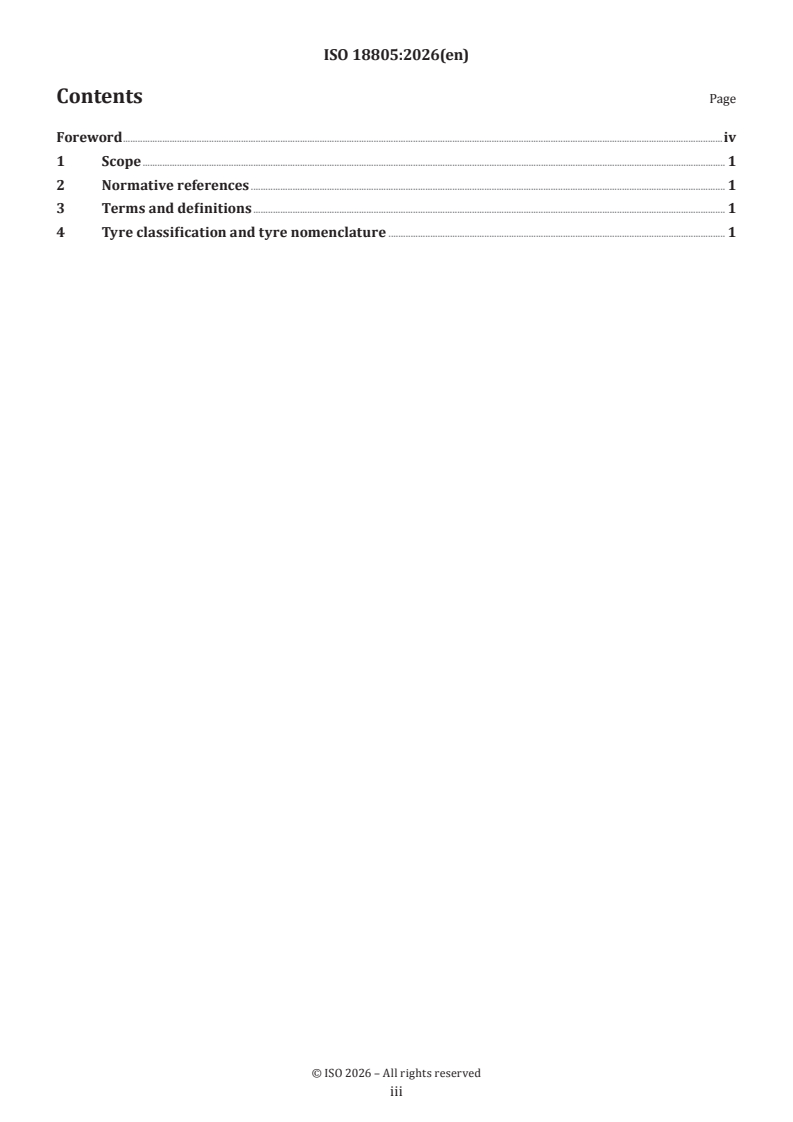
Contents Page
Foreword .iv
1 Scope . 1
2 Normative references . 1
3 Terms and definitions . 1
4 Tyre classification and tyre nomenclature . 1
iii
Foreword
ISO (the International Organization for Standardization) is a worldwide federation of national standards
bodies (ISO member bodies). The work of preparing International Standards is normally carried out through
ISO technical committees. Each member body interested in a subject for which a technical committee
has been established has the right to be represented on that committee. International organizations,
governmental and non-governmental, in liaison with ISO, also take part in the work. ISO collaborates closely
with the International Electrotechnical Commission (IEC) on all matters of electrotechnical standardization.
The procedures used to develop this document and those intended for its further maintenance are described
in the ISO/IEC Directives, Part 1. In particular, the different approval criteria needed for the different types
of ISO document should be noted. This document was drafted in accordance with the editorial rules of the
ISO/IEC Directives, Part 2 (see www.iso.org/directives).
ISO draws attention to the possibility that the implementation of this document may involve the use of (a)
patent(s). ISO takes no position concerning the evidence, validity or applicability of any claimed patent
rights in respect thereof. As of the date of publication of this document, ISO had not received notice of (a)
patent(s) which may be required to implement this document. However, implementers are cautioned that
this may not represent the latest information, which may be obtained from the patent database available at
www.iso.org/patents. ISO shall not be held responsible for identifying any or all such patent rights.
Any trade name used in this document is information given for the convenience of users and does not
constitute an endorsement.
For an explanation of the voluntary nature of standards, the meaning of ISO specific terms and expressions
related to conformity assessment, as well as information about ISO's adherence to the World Trade
Organization (WTO) principles in the Technical Barriers to Trade (TBT), see www.iso.org/iso/foreword.html.
This document was prepared by Technical Committee ISO/TC 31, Tyres, rims and valves, Su
...