


ISO 8943:2025
(Main)Refrigerated light hydrocarbon fluids — Sampling of liquefied natural gas — Continuous and intermittent methods
Refrigerated light hydrocarbon fluids — Sampling of liquefied natural gas — Continuous and intermittent methods
This document specifies methods for the continuous and intermittent sampling of liquefied natural gas (LNG) while it is being transferred through an LNG transfer line.
Hydrocarbures liquides légers réfrigérés — Échantillonnage de gaz naturel liquéfié — Méthodes en continu et par intermittence
L'ISO 8943:2007 prescrit une méthode d'échantillonnage en continu et une méthode d'échantillonnage par intermittence du GNL lors de son transfert par une conduite de transfert de GNL.
General Information
- Status
- Published
- Publication Date
- 09-Apr-2025
- Current Stage
- 6060 - International Standard published
- Start Date
- 10-Apr-2025
- Due Date
- 06-Jan-2025
- Completion Date
- 10-Apr-2025
Relations
- Effective Date
- 06-Jun-2022
Overview
ISO 8943:2025 - Refrigerated light hydrocarbon fluids - Sampling of liquefied natural gas - Continuous and intermittent methods - specifies standardized methods for collecting representative samples of liquefied natural gas (LNG) while it is being transferred through an LNG transfer line. The standard covers both continuous sampling (constant flow into a gas sample holder) and intermittent sampling (grab samples at predetermined time or flow intervals) and is intended to ensure accurate composition data needed for density and calorific-value calculations in custody transfer and quality control.
Notable updates in the 2025 (third) edition include:
- an overview of gasified LNG sampling,
- introduction of CP/FP (constant pressure / floating piston) sample holders and cylinders,
- provisions for multiple shore-transfer pipelines,
- specification of a stable flow rate for continuous sampling,
- guidance to detect outliers in online analysis,
- an example sampling report.
Key technical topics and requirements
- Scope and definitions: Clear terminology for LNG sampling components (e.g., sampling probe, LNG sample vaporizer, gas sample holder, gas sample cylinder, CP/FP cylinder).
- Sampling system outline: Direct vs. indirect sampling methods; spot and incremental composite approaches for indirect sampling; handling multiple transfer lines.
- Precautions: Safe handling of LNG, risks of partial fractionation of samples, and requirements for supervision during sampling operations.
- Apparatus specifications: Materials, sampling probes, vaporizers to gasify LNG samples, compressors for transfer, pressure regulators, sample filters, and technical details for CP/FP cylinders and holders.
- Procedures: Step-by-step sampling workflows for continuous and intermittent methods, filling and purging of sample cylinders, suspension of sampling, and interface options for online gas chromatograph systems.
- Reporting and quality control: Requirements for a sampling report and examples, plus annexes such as sub-cooling calculations and CP/FP technical specs.
Practical applications and who uses this standard
ISO 8943:2025 is used where accurate LNG composition is essential:
- Terminal and berth operators performing custody transfer and invoicing based on calorific content.
- Pipeline and transfer-line engineers designing sampling tap points and vaporizers.
- Laboratories and analysts conducting offline or online gas chromatography and compositional analysis.
- Quality assurance / metrology teams ensuring representative sampling and traceability.
- Safety and operations personnel implementing safe handling and sampling procedures during LNG transfer.
Typical applications include custody transfer verification, product quality control, regulatory compliance, and calibration/validation of online analytical systems.
Related standards
- ISO 10715 (sampling concepts: direct and indirect sampling references)
- Earlier ISO documents referenced for definitions (e.g., ISO 1998 series)
- National and industry LNG guidance used alongside ISO 8943 for implementation details
Keywords: ISO 8943, LNG sampling, liquefied natural gas, continuous sampling, intermittent sampling, CP/FP sample cylinder, LNG vaporizer, online gas chromatograph, transfer line.

Get Certified
Connect with accredited certification bodies for this standard

ABS Quality Evaluations Inc.
American Bureau of Shipping quality certification.

Element Materials Technology
Materials testing and product certification.

ABS Group Brazil
ABS Group certification services in Brazil.
Sponsored listings
Frequently Asked Questions
ISO 8943:2025 is a standard published by the International Organization for Standardization (ISO). Its full title is "Refrigerated light hydrocarbon fluids — Sampling of liquefied natural gas — Continuous and intermittent methods". This standard covers: This document specifies methods for the continuous and intermittent sampling of liquefied natural gas (LNG) while it is being transferred through an LNG transfer line.
This document specifies methods for the continuous and intermittent sampling of liquefied natural gas (LNG) while it is being transferred through an LNG transfer line.
ISO 8943:2025 is classified under the following ICS (International Classification for Standards) categories: 75.060 - Natural gas. The ICS classification helps identify the subject area and facilitates finding related standards.
ISO 8943:2025 has the following relationships with other standards: It is inter standard links to ISO 8943:2007. Understanding these relationships helps ensure you are using the most current and applicable version of the standard.
ISO 8943:2025 is available in PDF format for immediate download after purchase. The document can be added to your cart and obtained through the secure checkout process. Digital delivery ensures instant access to the complete standard document.
Standards Content (Sample)
International
Standard
ISO 8943
Third edition
Refrigerated light hydrocarbon
2025-04
fluids — Sampling of liquefied
natural gas — Continuous and
intermittent methods
Hydrocarbures liquides légers réfrigérés — Échantillonnage de
gaz naturel liquéfié — Méthodes en continu et par intermittence
Reference number
ISO 8943:2025(en)
COPYRIGHT PROTECTED DOCUMENT
© ISO 2025
All rights reserved. Unless otherwise specified, or required in the context of its implementation, no part of this publication may
be reproduced or utilized otherwise in any form or by any means, electronic or mechanical, including photocopying, or posting on
the internet or an intranet, without prior written permission. Permission can be requested from either ISO at the address below
or ISO’s member body in the country of the requester.
ISO copyright office
CP 401 • Ch. de Blandonnet 8
CH-1214 Vernier, Geneva
Phone: +41 22 749 01 11
Email: copyright@iso.org
Website: www.iso.org
Published in Switzerland
ii
ISO 8943:2025(en)
Contents Page
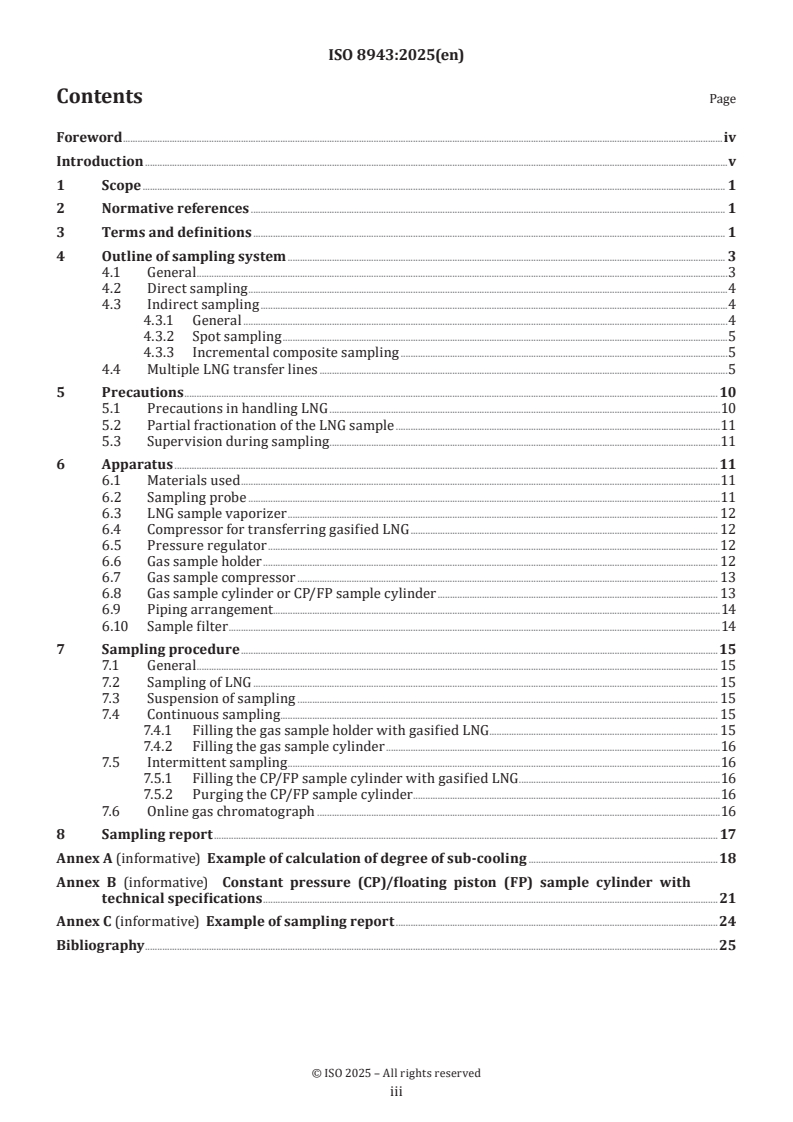
Foreword .iv
Introduction .v
1 Scope . 1
2 Normative references . 1
3 Terms and definitions . 1
4 Outline of sampling system .3
4.1 General .3
4.2 Direct sampling .4
4.3 Indirect sampling .4
4.3.1 General .4
4.3.2 Spot sampling .5
4.3.3 Incremental composite sampling .5
4.4 Multiple LNG transfer lines .5
5 Precautions .10
5.1 Precautions in handling LNG .10
5.2 Partial fractionation of the LNG sample .11
5.3 Supervision during sampling . .11
6 Apparatus .11
6.1 Materials used .11
6.2 Sampling probe .11
6.3 LNG sample vaporizer . 12
6.4 Compressor for transferring gasified LNG . 12
6.5 Pressure regulator . 12
6.6 Gas sample holder . 12
6.7 Gas sample compressor . 13
6.8 Gas sample cylinder or CP/FP sample cylinder . 13
6.9 Piping arrangement.14
6.10 Sample filter .14
7 Sampling procedure .15
7.1 General . 15
7.2 Sampling of LNG . 15
7.3 Suspension of sampling . 15
7.4 Continuous sampling . 15
7.4.1 Filling the gas sample holder with gasified LNG . 15
7.4.2 Filling the gas sample cylinder .16
7.5 Intermittent sampling .16
7.5.1 Filling the CP/FP sample cylinder with gasified LNG .16
7.5.2 Purging the CP/FP sample cylinder .16
7.6 Online gas chromatograph .16
8 Sampling report . 17
Annex A (informative) Example of calculation of degree of sub-cooling .18
Annex B (informative) Constant pressure (CP)/floating piston (FP) sample cylinder with
technical specifications .21
Annex C (informative) Example of sampling report .24
Bibliography .25
iii
ISO 8943:2025(en)
Foreword
ISO (the International Organization for Standardization) is a worldwide federation of national standards
bodies (ISO member bodies). The work of preparing International Standards is normally carried out through
ISO technical committees. Each member body interested in a subject for which a technical committee
has been established has the right to be represented on that committee. International organizations,
governmental and non-governmental, in liaison with ISO, also take part in the work. ISO collaborates closely
with the International Electrotechnical Commission (IEC) on all matters of electrotechnical standardization.
The procedures used to develop this document and those intended for its further maintenance are described
in the ISO/IEC Directives, Part 1. In particular, the different approval criteria needed for the different types
of ISO documents should be noted. This document was drafted in accordance with the editorial rules of the
ISO/IEC Directives, Part 2 (see www.iso.org/directives).
ISO draws attention to the possibility that the implementation of this document may involve the use of (a)
patent(s). ISO takes no position concerning the evidence, validity or applicability of any claimed patent
rights in respect thereof. As of the date of publication of this document, ISO had not received notice of (a)
patent(s) which may be required to implement this document. However, implementers are cautioned that
this may not represent the latest information, which may be obtained from the patent database available at
www.iso.org/patents. ISO shall not be held responsible for identifying any or all such patent rights.
Any trade name used in this document is information given for the convenience of users and does not
constitute an endorsement.
For an explanation of the voluntary nature of standards, the meaning of ISO specific terms and expressions
related to conformity assessment, as well as information about ISO’s adherence to the World Trade
Organization (WTO) principles in the Technical Barriers to Trade (TBT), see www.iso.org/iso/foreword.html.
This document was prepared by Technical Committee ISO/TC 28, Petroleum and related products, fuels and
lubricants from natural or synthetic sources, Subcommittee SC 5, Measurement of refrigerated hydrocarbon
and non-petroleum based liquefied gaseous fuels.
This third edition cancels and replaces the second edition (ISO 8943:2007), which has been technically
revised.
The main changes are as follows:
— an overview of gasified LNG sampling has been added;
— a CP/FP sample holder has been introduced;
— a multiple shore transfer pipeline has been considered;
— a stable flow rate has been specified;
— an approach to find an outlier of online analysis results has been introduced;
— an example of a sampling report has been added.
Any feedback or questions on this document should be directed to the user’s national standards body. A
complete listing of these bodies can be found at www.iso.org/members.html.
iv
ISO 8943:2025(en)
Introduction
In the custody transfer of liquefied natural gas, hereinafter referred to as LNG, it is common practice to
determine the quantity transferred on a calorific-content basis. The total calorific content of the quantities
of LNG quoted in the custody transfer is determined by the liquid volume, liquid density and gross calorific
value of the LNG delivered.
Knowledge of the composition of LNG is required to calculate its density and calorific content. Therefore,
precise sampling is a prerequisite for precise analysis.
LNG is a complex mixture of low-molecular-weight hydrocarbons with nitrogen as a principal inert impurity.
Typically, methane is the major component. Minor-component concentrations vary with the source of the
raw gas, the liquefaction pre-treatment, the liquefaction process and the storage conditions.
v
International Standard ISO 8943:2025(en)
Refrigerated light hydrocarbon fluids — Sampling of liquefied
natural gas — Continuous and intermittent methods
1 Scope
This document specifies methods for the continuous and intermittent sampling of liquefied natural gas
(LNG) while it is being transferred through an LNG transfer line.
2 Normative references
There are no normative references in this document.
3 Terms and definitions
For the purposes of this document, the following terms and definitions apply.
ISO and IEC maintain terminology databases for use in standardization at the following addresses:
— ISO Online browsing platform: available at https:// www .iso .org/ obp
— IEC Electropedia: available at https:// www .electropedia .org/
3.1
accumulator
storage provided to absorb pressure pulsations of gasified liquefied natural gas (LNG) (3.10) and to
homogenize it
[SOURCE: ISO 1998-5:1998, 5.20.275]
3.2
bubbling
procedure, in the case of water-seal-type gas sample holder (3.22), to saturate the seal water (3.19) in a gas
sample holder with gasified liquefied natural gas (LNG) (3.10) for suppressing the effect of the seal water on
the gas sample
[SOURCE: ISO 1998-5:1998, 5.20.287, modified — “in the case of water-seal-type gas sample holder” added
to the definition.]
3.3
compressor for transferring gasified LNG
compressor used for boosting the pressure of gasified liquefied natural gas (LNG) (3.10) when gasified LNG
in the LNG sample vaporizer (3.11) cannot be transferred to the gas sample holder by its inherent pressure
3.4
constant pressure/floating piston sample cylinder
CP/FP sample cylinder
portable cylinder which has a floating piston dividing sample gas and pre-charge gas, capable of maintaining
constant pressure during the sampling period
3.5
constant pressure/floating piston sample holder
CP/FP sample holder
unportable holder or cylinder which has a floating piston dividing sample gas and pre-charge gas, capable of
maintaining constant pressure during the sampling period
ISO 8943:2025(en)
3.6
continuous sampling
process to collect samples from gasified liquefied natural gas (LNG) (3.10) stream into a gas sample holder
continuously with constant flow rate
Note 1 to entry: The gasified LNG from the vaporizer is thereafter continuously fed into the gas sample holder.
3.7
gas sample cylinder
sample cylinder, usually used for continuous sampling (3.6), the retention of the gas sample and its transfer
to an analysing instrument
3.8
gas sample compressor
compressor used for charging the gas sample collected in a gas sample holder into a gas sample cylinder (3.7)
3.9
intermittent sampling
process to collect samples from a gasified liquefied natural gas (LNG) (3.10) stream and place them into a gas
sample holder or cylinder intermittently, grab by grab, with predetermined time or flow amount intervals
3.10
liquefied natural gas
LNG
liquids composed predominantly of methane
3.11
liquefied natural gas sample vaporizer
LNG sample vaporizer
apparatus to completely gasify the liquefied natural gas (LNG) (3.10) sample collected from the LNG transfer
line (3.12)
3.12
liquefied natural gas transfer line
LNG transfer line
pipeline used for transferring liquefied natural gas (LNG) (3.10)
3.13
offline analysis
procedure of analysis implemented on the representative sample gas that is once charged into a gas sample
cylinder (3.7) or a CP/FP sample cylinder (3.4)
3.14
online analysis
procedure of analysis implemented using an analytical equipment that is directly connected through
pipelines or other means to the sampling device
3.15
online gas chromatograph
gas chromatograph that is connected to the gasified liquefied natural gas (LNG) (3.10) stream, downstream
of an offtake probe and vaporiser, to facilitate online analysis (3.14)
3.16
pressure regulator
pressure-regulating valve and pressure sensor provided to keep the gas pressure constant at the gas sample
holder inlet
3.17
sample filter
filter used to protect the sampling valve for the online gas chromatograph (3.15) from scoring due to the
presence of foreign contaminants, such as metal shavings and dirt
ISO 8943:2025(en)
3.18
sampling probe
device inserted into gas or liquid to be sampled from the transfer line or fitted to the transfer line for
collecting a sample
[SOURCE: ISO 1998-6:2000, 6.40.104]
3.19
seal water
water used in the water-seal-type gas sample holder (3.22) to preclude contact of the gas sample with the
atmosphere
3.20
sub-cooling
lowering the temperature of liquefied natural gas (3.10) to below its boiling point at a given pressure, i.e. to a
sub-cooled state
3.21
waterless-type gas sample holder
holder without seal water (3.19) used for collecting gasified liquefied natural gas (LNG) (3.10)
3.22
water-seal-type gas sample holder
holder with seal water (3.19) used for collecting gasified liquefied natural gas (LNG) (3.10)
3.23
direct sampling
sampling in situations where there is a direct connection between the natural gas to be sampled and the
analytical unit
[SOURCE: ISO 10715:2022, 3.5]
3.24
indirect sampling
sampling in situations where there is no direct connection between the natural gas to be sampled and the
analytical unit
[SOURCE: ISO 10715:2022, 3.11]
3.25
spot sampling
sampling of a specified volume taken at a specified place at a specified time from a stream of gas
3.26
incremental composite sampling
accumulate sampling from the process line into sample cylinder(s) during a certain period, in order to have
a representative sample
4 Outline of sampling system
4.1 General
The purpose of sampling is to take a representative sample. The sample is analysed to determine the
composition of the LNG transferred. Regardless of the sampling method or system design, the LNG sample
collected through the sampling probe provided on the LNG transfer line is gasified in the LNG sample
vaporizer system. Samples shall be taken after the accumulator if an accumulator is installed in the gasified
LNG stream. The samples shall be representative of the transferred LNG.
The primary isolation valve between the sample probe and the vaporizer should be an emergency shutdown
(ESD) which fails safe to isolate the liquified LNG from the sampling system or gas chromatograph (GC). The
ISO 8943:2025(en)
valve is closed if the temperature at the outlet of the vaporizer is below the working temperatures of the
elements downstream to prevent damage and potential external loss of LNG by leakage.
Typically, the sampling system is designed to take three physical samples: one for analysis, one for the seller
and one for the buyer.
Refer to Figure 1 for an outline of the sampling.
NOTE The order of the descriptions in 4.2 and 4.3 does not reflect a preference for any specific design or type
of system.
Key
A LNG transfer line
B vaporizer
C gasified LNG process line
D1 direct sampling
D2 indirect sampling
E1 spot sampling
E2 incremental composite sampling
F1 continuous sampling
F2 intermittent sampling
Figure 1 — Outline of gasified LNG sampling
4.2 Direct sampling
There is a direct connection between the gasified LNG stream and an analytical unit such as a gas
chromatograph. A gasified LNG stream sample is taken and sent directly to the analytical unit for online
analysis. The pipeline temperature of the gasified LNG stream shall be maintained appropriately to avoid
partial condensation of the gasified components.
4.3 Indirect sampling
4.3.1 General
Gasified LNG samples in cylinders are taken for offline analysis. The samples are fed into the analytical unit
from the cylinders, which are filled from the gasified LNG stream.
ISO 8943:2025(en)
4.3.2 Spot sampling
A sample is taken into a sample cylinder from the gasified LNG stream in a short period during LNG transfer,
on demand or at predetermined intervals.
4.3.3 Incremental composite sampling
4.3.3.1 General
A sample is taken incrementally into a sample holder or a CP/FP sample cylinder during the proper sampling
period which is described in 7.2.
4.3.3.2 Continuous sampling
Gasified LNG from the LNG sample vaporizer outlet is continuously fed into the gas sample holder by its
inherent pressure when the pressure is sufficiently high or after its pressure has been boosted by the
compressor for transferring gasified LNG when the pressure is insufficient. In this process, the gas
pressure in the sampling line is controlled by a pressure regulator and the flow into the gas sample holder
is maintained by the gas sample holder inlet valve. The gas sample collected in the gas sample holder is fed
into the gas sample cylinder. An outline flow process diagram of the sampling system is shown in Figure 2
for a water-seal-type gas sample holder and in Figure 3 and Figure 4 for a waterless-type gas sample holder.
4.3.3.3 Intermittent sampling
Gasified LNG from the LNG sample vaporizer outlet is continuously fed into the sampling loop by its inherent
pressure when the pressure is sufficiently high, or after its pressure has been boosted by the compressor for
transferring gasified LNG when the pressure is insufficient. In this process, the gas pressure in the sampling
line is controlled by a pressure regulator. The gas sample is charged into the CP/FP sample cylinder by the
sampler. The gas sample collected in the cylinder is for offline analysis. An outline process flow diagram of
the sampling system using a CP/FP sample cylinder is shown in Figure 5.
4.4 Multiple LNG transfer lines
If multiple LNG transfer lines exist, a gas sample mixer should be installed at the confluence point of the
individual gasified LNG streams. The sample from the individual LNG stream should be mixed appropriately,
for instance in proportion to individual LNG transfer rates. Refer to Figure 6 for two LNG transfer lines.
ISO 8943:2025(en)
Key
1 LNG transfer line 10 water-seal-type gas sample holder
2 LNG sample vaporizer 11 compressor for charging gas sample
3 pressure gauge 12 gas sample cylinder
4 thermometer 13 sampling line
5 accumulator 14 water pipeline
6 pressure regulator 15 drain pit
7 pressure indicating controller 16 needle valve
8 flow meter 17 valve
9 gas line 18 line for online gas chromatograph (GC)
Figure 2 — Example of continuous sampling for a water-seal-type gas sample holder
with a compressor
ISO 8943:2025(en)
Key
1 LNG transfer line 10 vacuum balloon gas sample holder
2 LNG sample vaporizer 11 vacuum pump
3 pressure gauge 12 gas sample cylinder
4 thermometer 13 sampling line
5 accumulator 14 inert gas line (for compressing gas of inner layer of sampling holder)
6 pressure regulator 15 flow indicating controller
7 pressure indicating controller 16 needle valve
8 flow meter 17 valve
9 gas line 18 line for online gas chromatograph (GC)
Figure 3 — Example of continuous sampling for a waterless-type vacuum balloon gas sample holder
ISO 8943:2025(en)
Key
1 LNG transfer line 10 CP/FP sample holder
2 LNG sample vaporizer 11 buffer gas cylinder
3 pressure gauge 12 gas sample cylinder
4 thermometer 13 sampling line
5 accumulator 14 motive gas chamber
6 pressure regulator 15 sample gas chamber
7 pressure indicating controller 16 needle valve
8 flow controller 17 valve
9 gas line 18 line for online gas chromatograph (GC)
19 check valve
Figure 4 — Example of continuous sampling for a waterless-type CP/FP sample holder
ISO 8943:2025(en)
Key
1 LNG transfer line 9 gas line
2 LNG sample vaporizer 10 gas sampler
3 pressure gauge 11 CP/FP sample cylinder
4 thermometer 12 valve
5 accumulator 13 sample chamber
6 pressure regulator 14 pre-charge chamber
7 pressure indicating controller 15 auto pre-charge system
8 line for online gas chromatograph (GC)
Figure 5 — Example of intermittent sampling for CP/FP sample cylinder
ISO 8943:2025(en)
Key
1 LNG transfer line A 10 LNG transfer line B
2 LNG sample vaporizer 11 sample gas mixer
3 pressure gauge 12 pipeline to sample holder
4 thermometer 13 sampling line
5 accumulator 14 valve
6 pressure regulator 15 line for online gas chromatograph (GC)
7 pressure indicating controller
8 flow meter
9 gas line
Figure 6 — Example of sampling for multiple LNG transfer lines
5 Precautions
5.1 Precautions in handling LNG
As LNG is cryogenic, skin contact of the skin with LNG can cause frostbite. If the gas diffuses into the air, it
lowers the oxygen content, which can result in suffocation or, if ignited, fire. Suitable precautions shall be
taken against these risks.
ISO 8943:2025(en)
5.2 Par
...
Questions, Comments and Discussion
Ask us and Technical Secretary will try to provide an answer. You can facilitate discussion about the standard in here.
Loading comments...